


Real-Time Egress Model for Multiplex Buildings under Fire Based on Artificial Neural Network


Abstract
1. Introduction
2. Fire Simulation for Multiplex Building
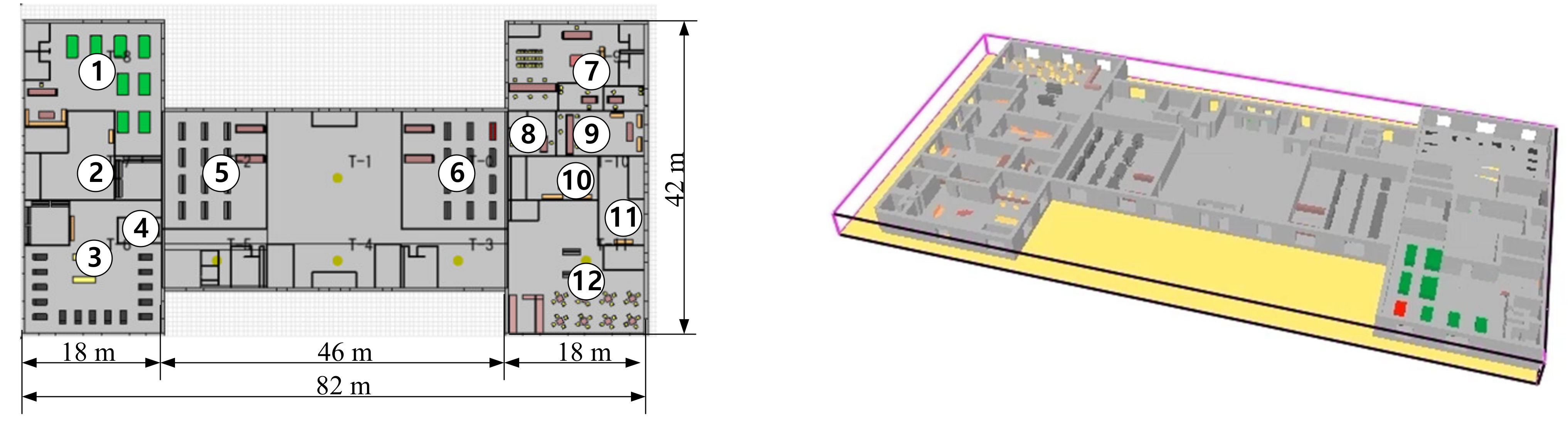
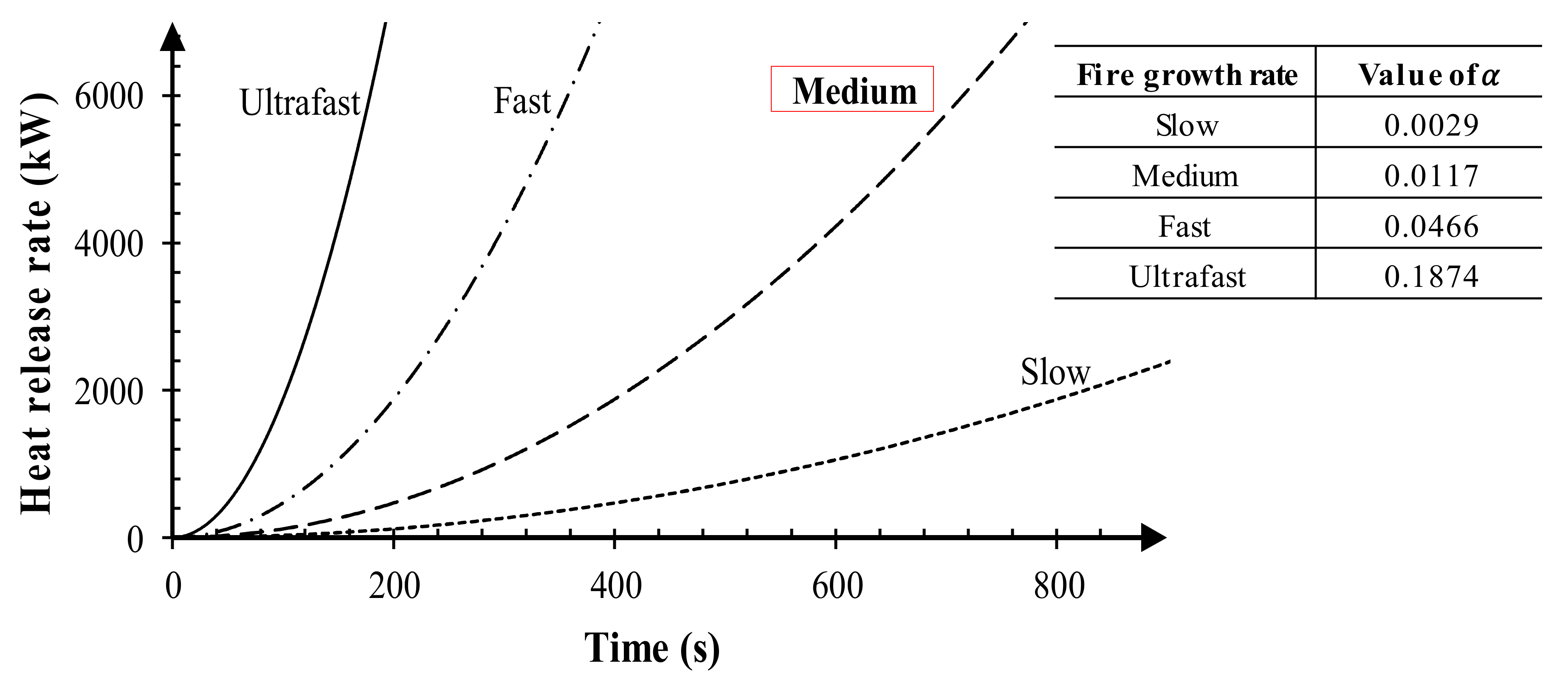
2.1. Description of Fire Simulation
2.2. Fire Simulation Results
3. Artificial Neural Network (ANN) Model for Estimating Available Safe Egress Time (ASET)
3.1. ANN Training Algorithm
3.2. Training Results
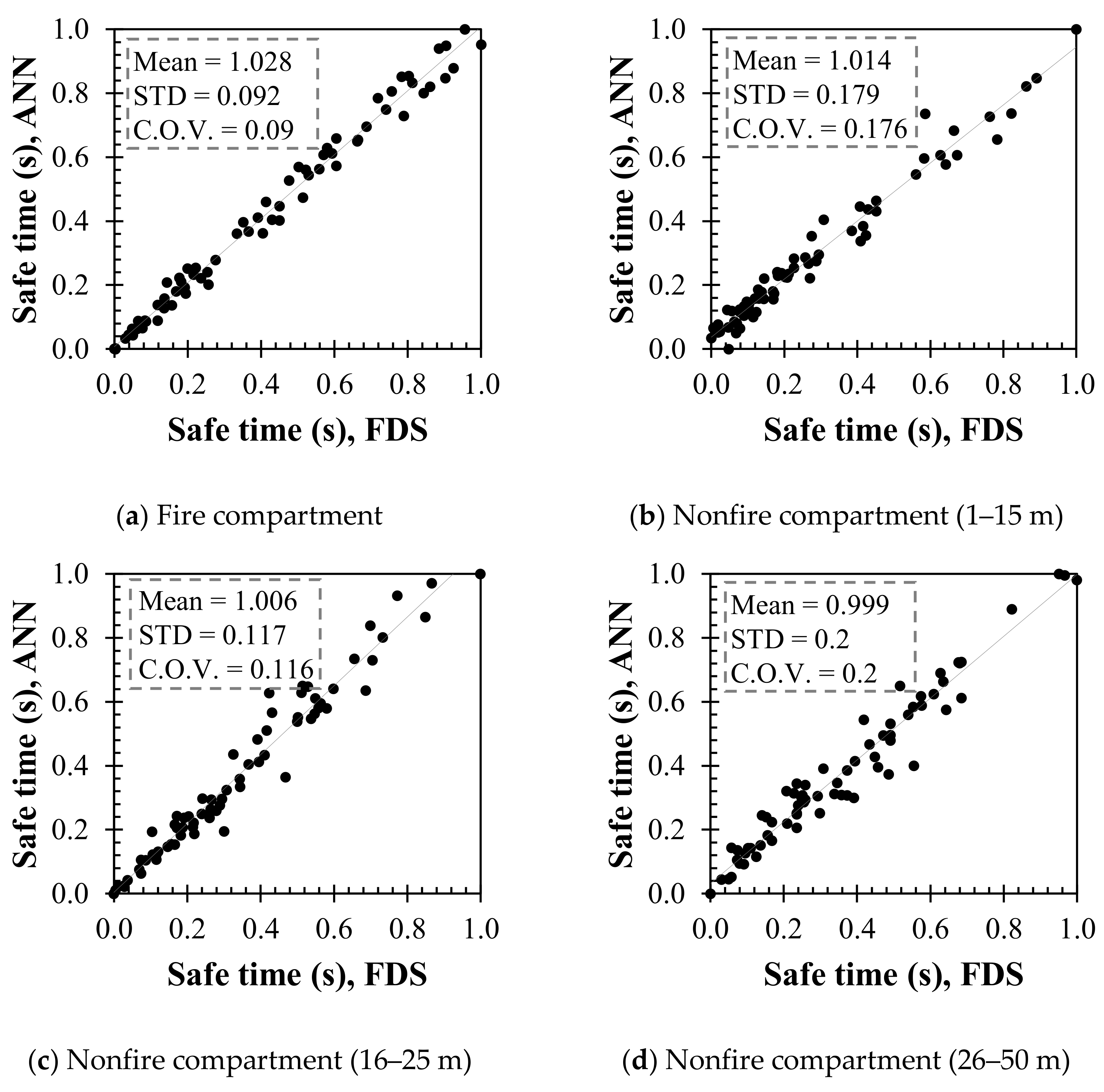
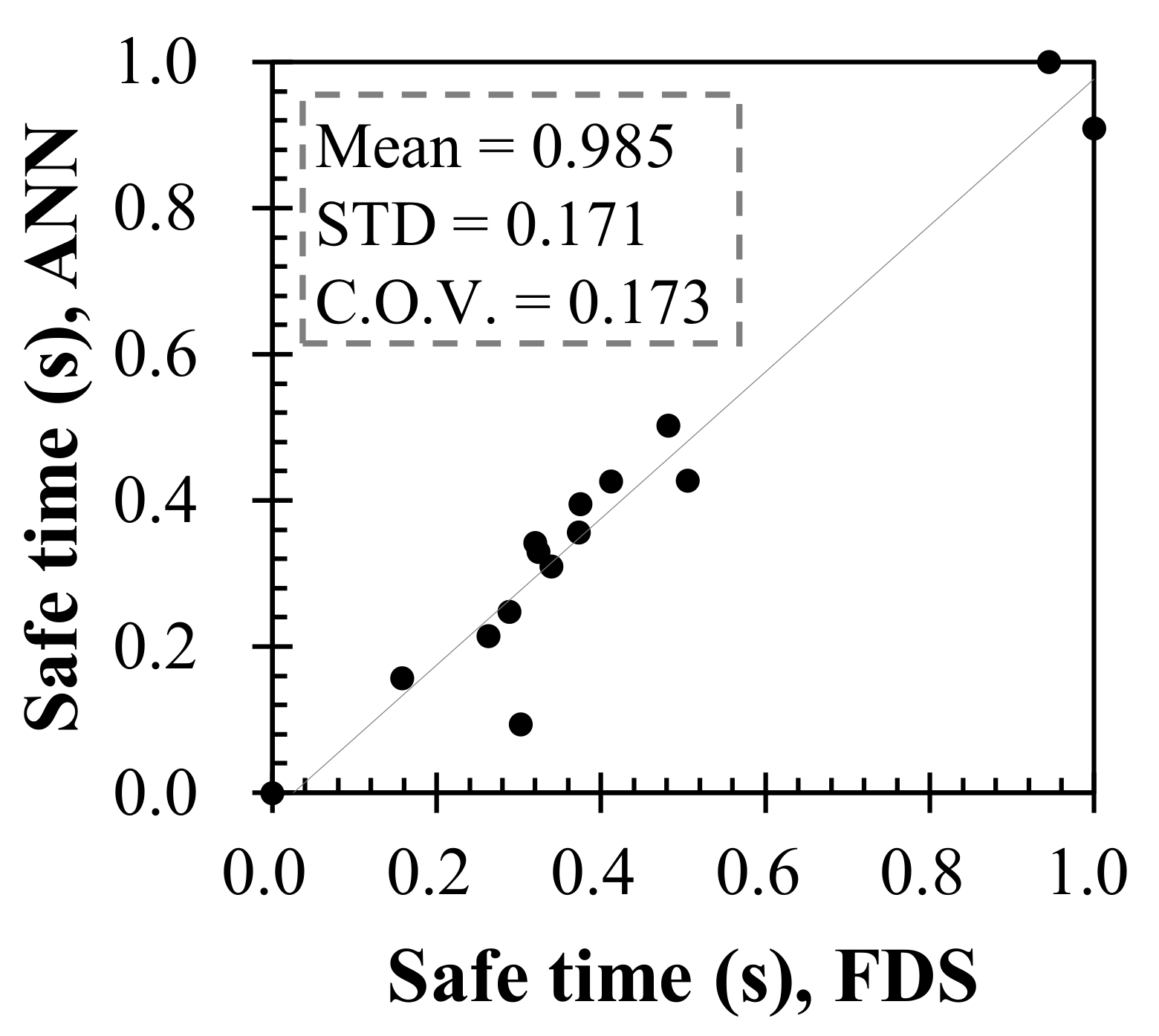
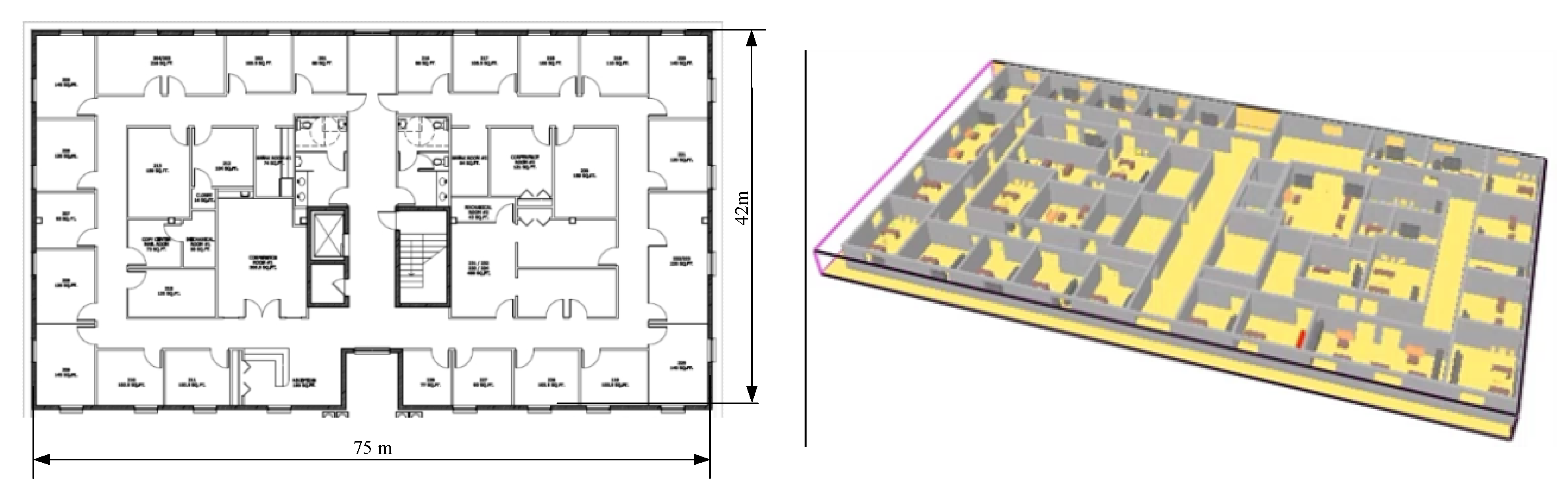
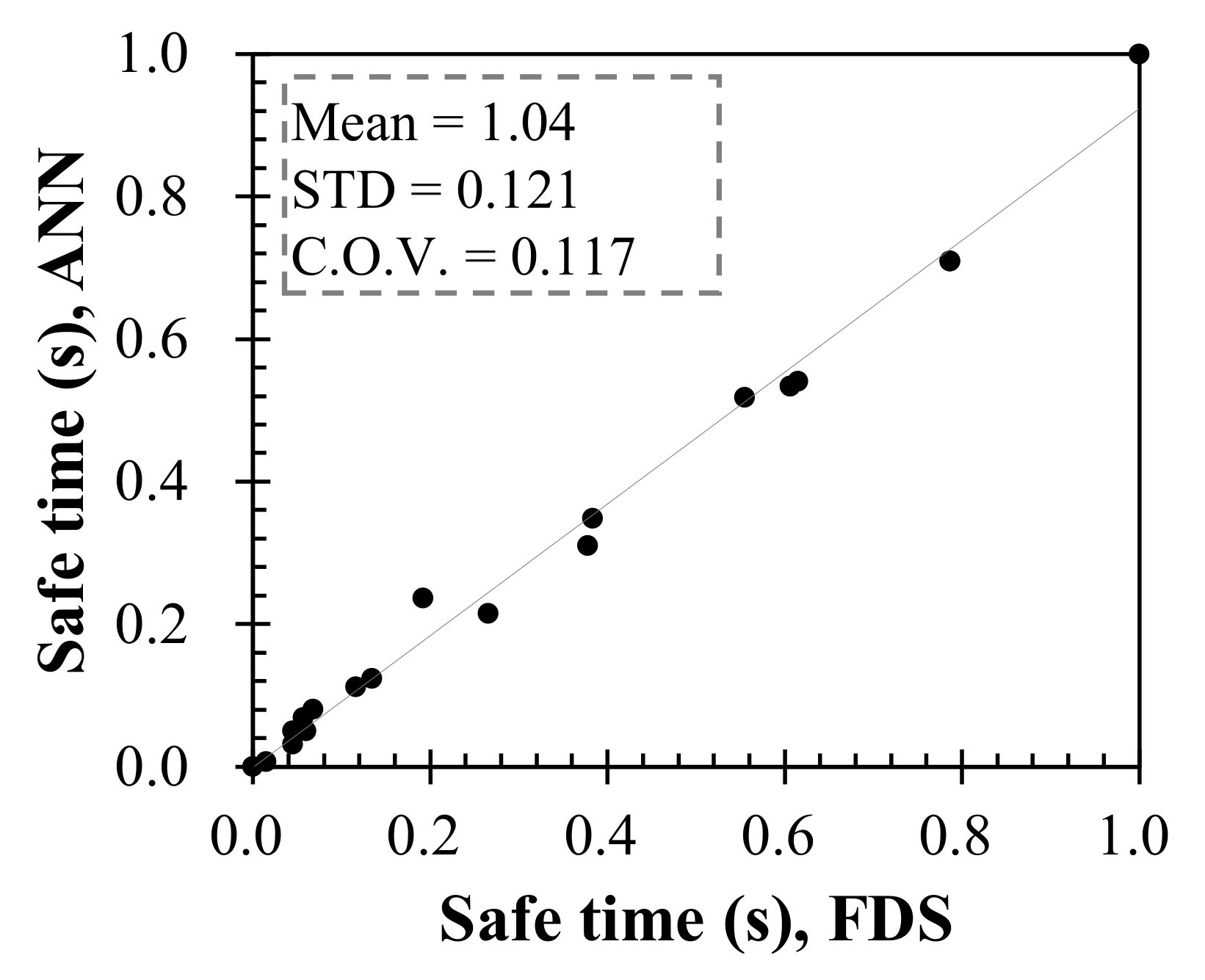
3.3. Verification of ANN Model
4. Egress Model for Multiplex Buildings in Fire
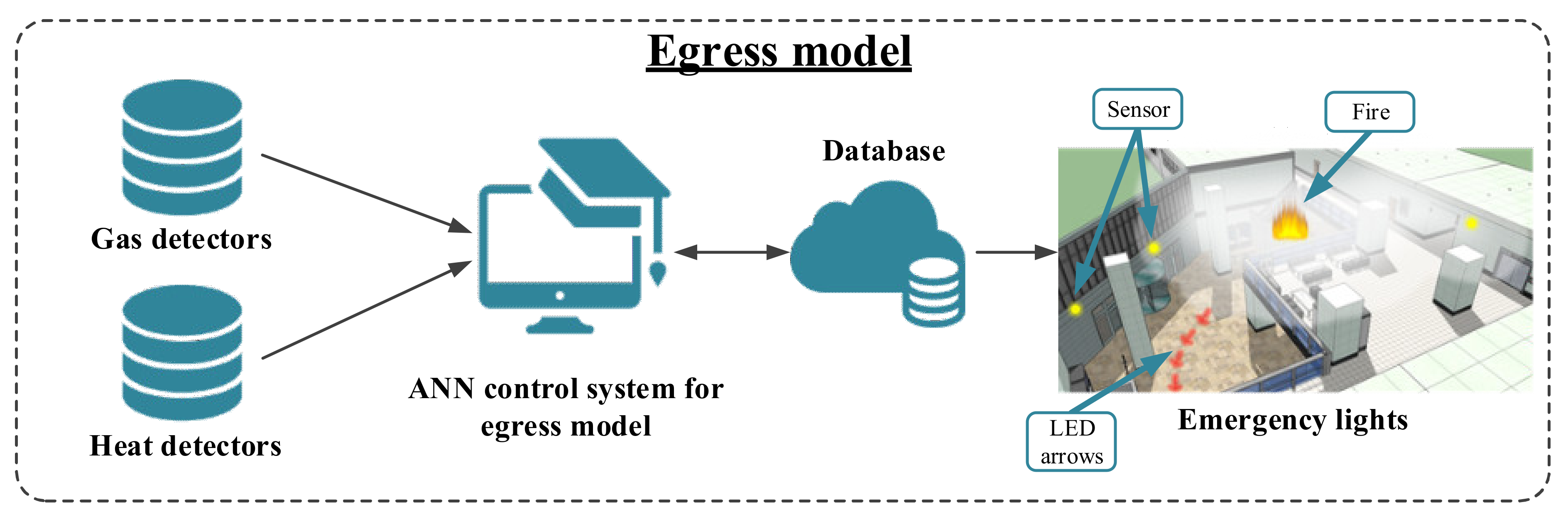
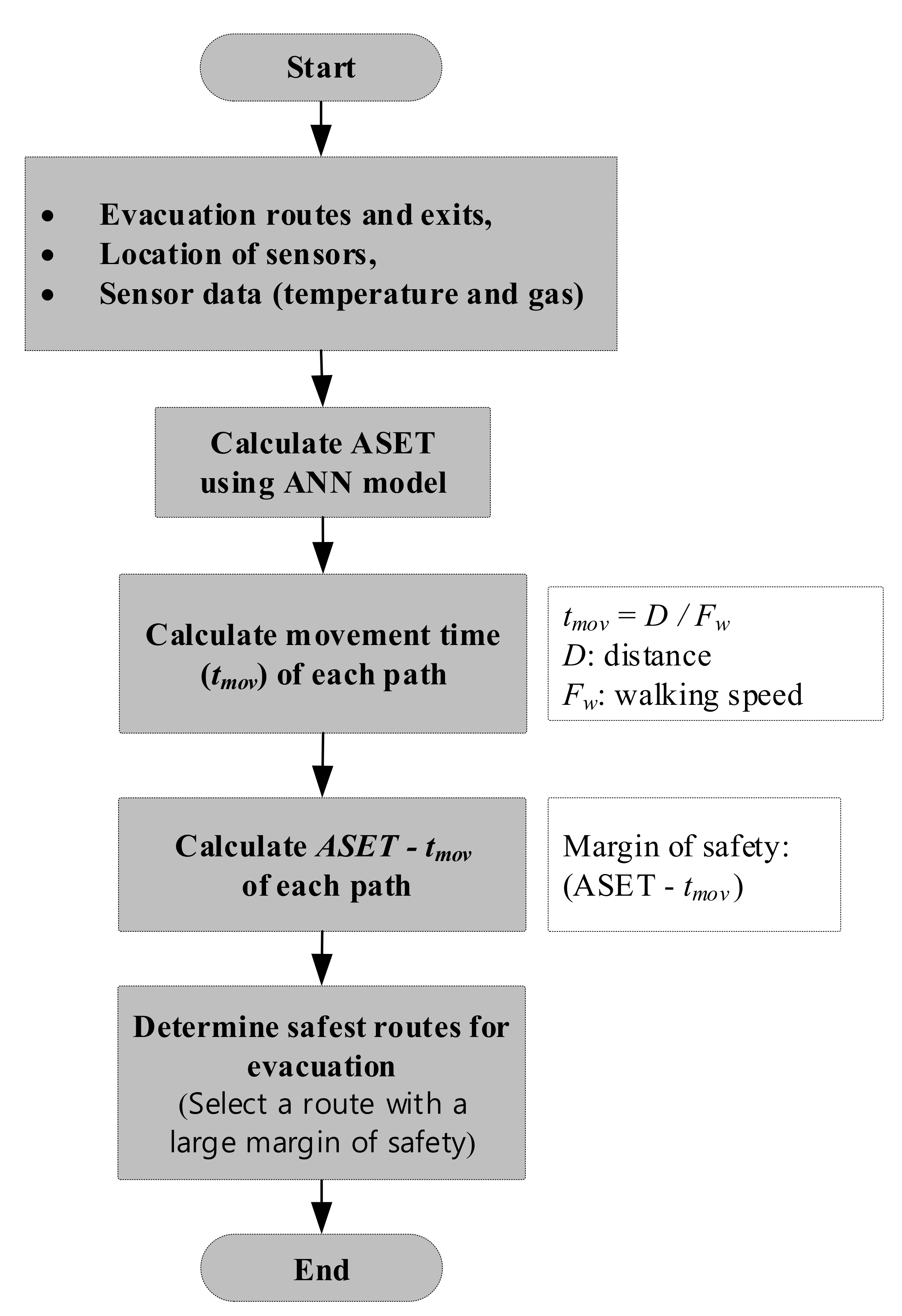
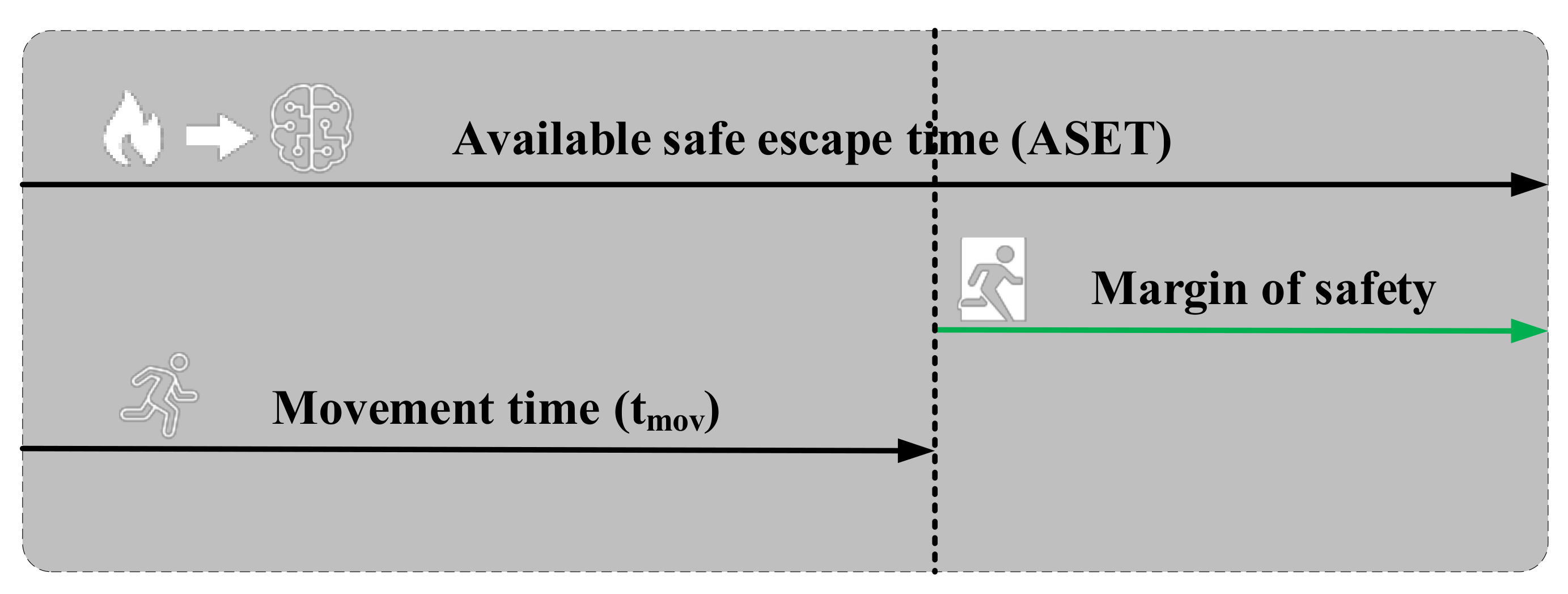
4.1. Egress Model Algorithm
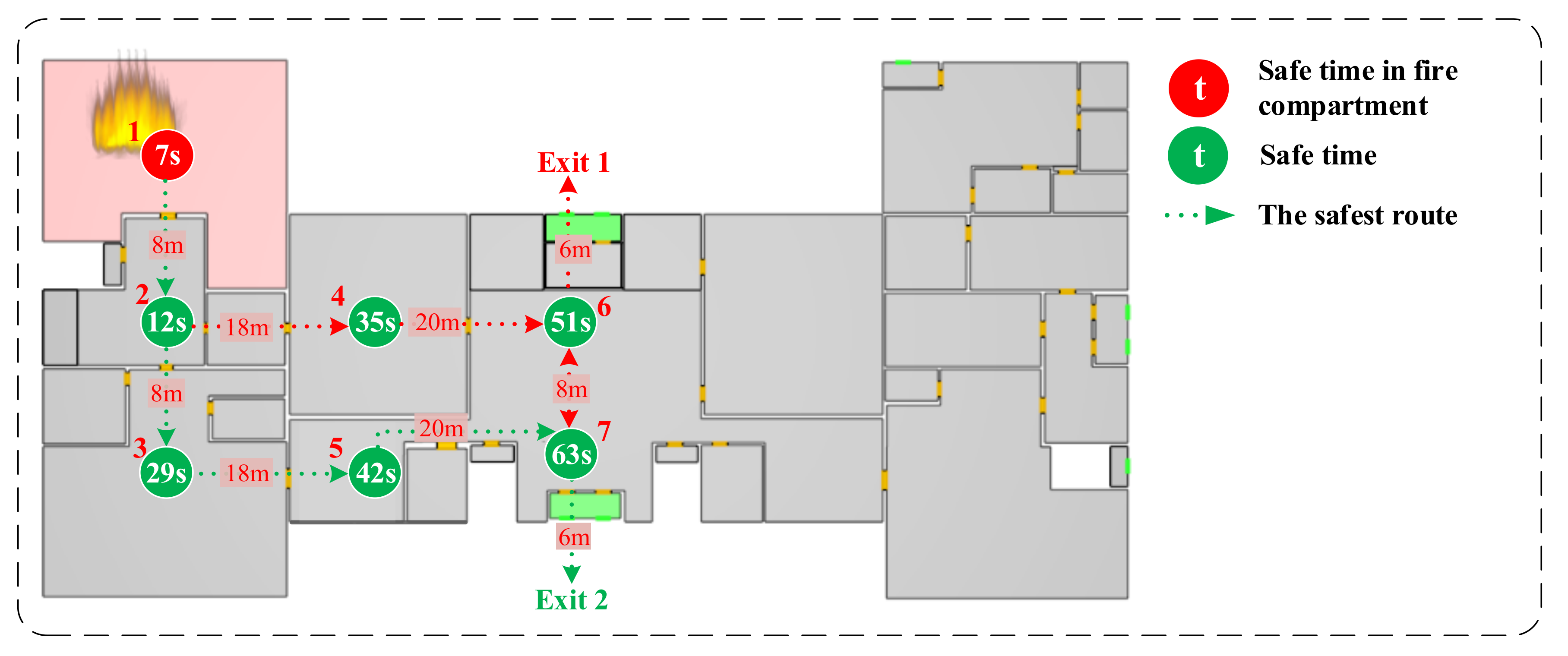
4.2. Application of Proposed Egress Model
5. Conclusions
- 1.
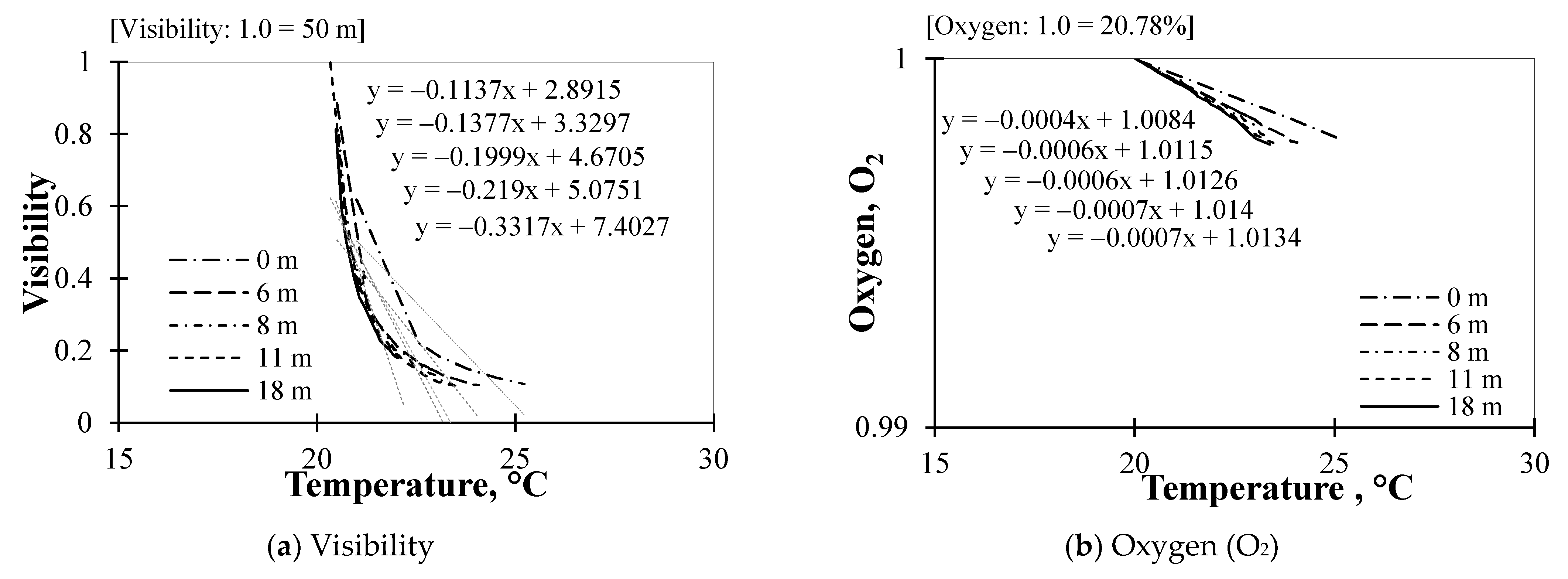
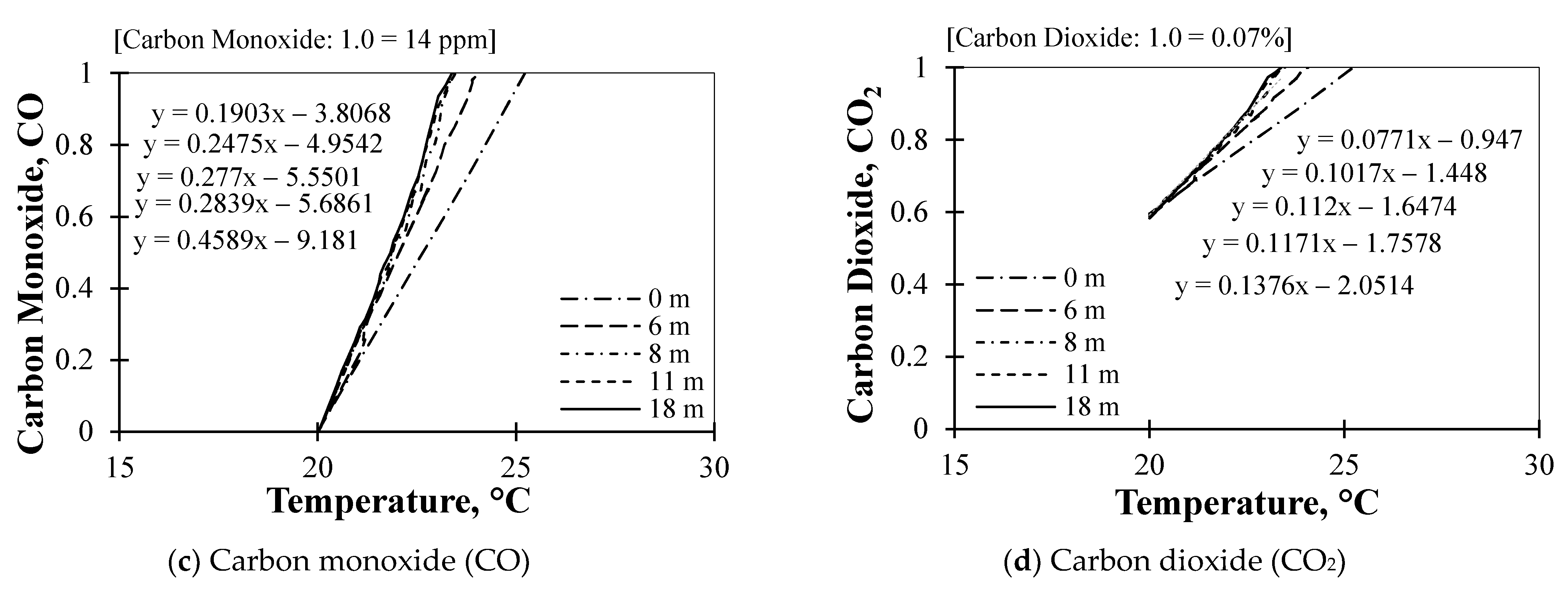
- The fire simulation results showed that temperature and visibility are the most influential factors on the safety of occupants under fire and the concentrations of oxygen (O2) and carbon dioxide (CO2) are relatively less influential.
- 2.
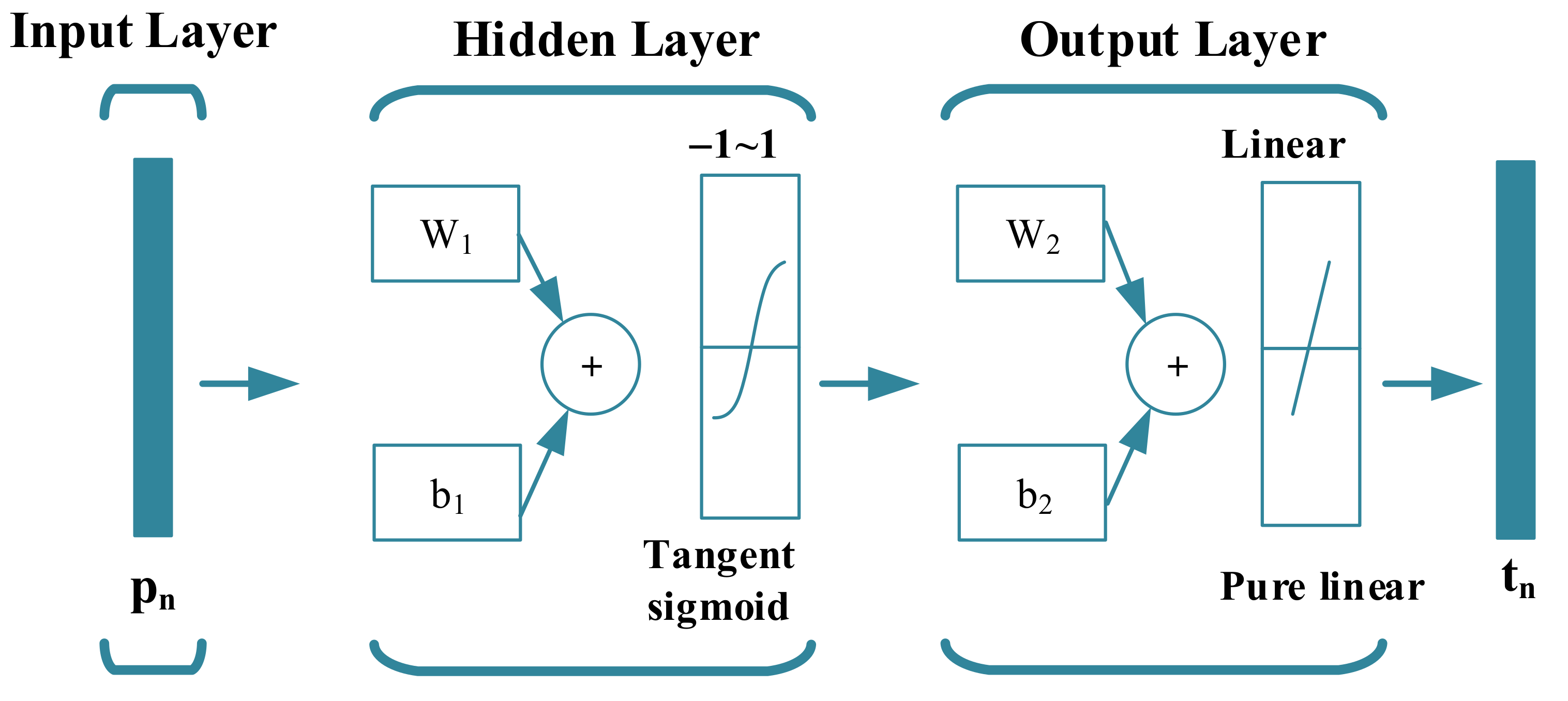
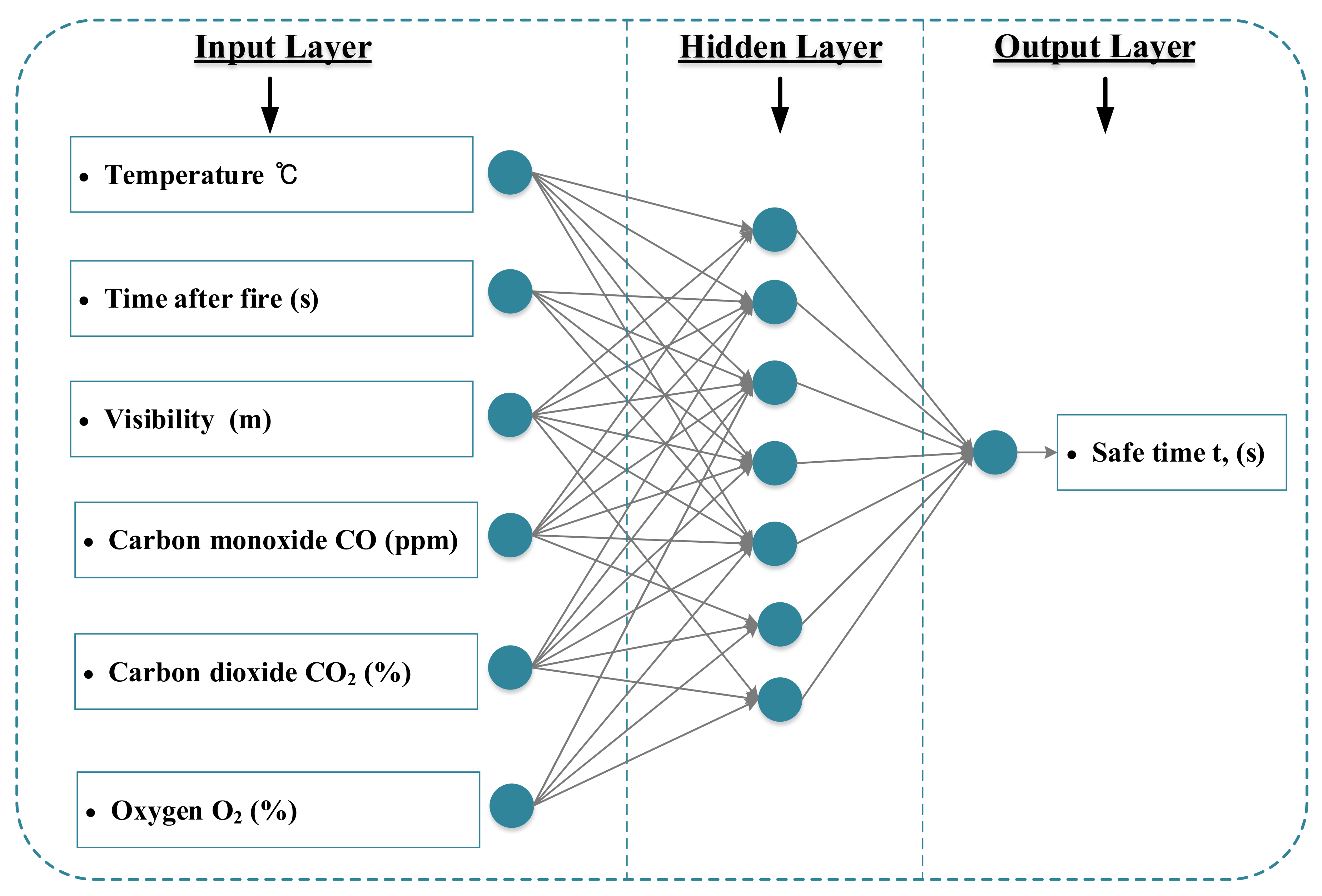
- The ANN model was developed based on the normalized correlations between fire simulation variables, and it estimated the ASET derived from the simulation results very accurately. In addition, this study examined whether the proposed ANN model can be used to obtain the ASET of another multiplex building that was not used in the development of the model, and it was confirmed that the proposed ANN model also provided a good estimation of the ASET for the building.
- 3.
- Based on the ANN model, an egress model was proposed to ensure the safety of occupants under fire, and it provided optimal evacuation routes with the highest margin of safety in consideration of both ASET and the movement time of occupants..
- 4.
- In this study, however, the application of the proposed ANN algorithm and egress model was limited to multiplex buildings. Therefore, there is a need to secure fire simulation data of various types of buildings, such as apartment houses and underground structures, to further expand the application ranges of the proposed model in the future.
Author Contributions
Funding
Institutional Review Board Statement
Informed Consent Statement
Data Availability Statement
Conflicts of Interest
References
- Choi, J.A.; Lee, M.G.; Lee, D.D. Fire Modeling and Smoking Control Characteristic Analysis of Electric Room by Using FDS. J. Korea Acad. Ind. Coop. Soc. 2018, 19, 662–668. [Google Scholar] [CrossRef]
- Han, H.S.; Hwang, C.H. Study on the Available Safe Egress Time (ASET) Considering the Input Parameters and Model Uncertainties in Fire Simulation. Fire Sci. Eng. 2019, 33, 112–120. [Google Scholar] [CrossRef]
- Jang, J.S.; Kong, I.C.; Rie, D.H. A Study of Optimal Evacuation Simulation by Artificial Intelligence Evacuation Guidance Application. J. Korean Soc. Saf. 2019, 28, 118–122. [Google Scholar] [CrossRef]
- Park, Y.J.; Sung, W.K.; Kim, H.G. Developing Fire Scenario of High-Rise Buildings. In Proceedings of the Korea Institute of Fire Science and Engineering Conference; Korean Institute of Fire Science and Engineering: Seoul, Korea, 2011; pp. 262–265. [Google Scholar]
- Sujatmiko, W.; Dipojono, H.K.; Soelami, F.N. Study on fire dynamic development in a multistory building compartment. Procedia Eng. 2017, 170, 162–168. [Google Scholar] [CrossRef]
- Kim, J.H.; Joo, S.Y.; Lee, J.J. An Evaluation on Evacuation Safety in Multiplex Cinema Based on Fire & Evacuation Simulation. Korean Inst. Archit. Sustain. Environ. Build. Syst. 2007, 1, 7–13. [Google Scholar]
- Oh, H.J.; Baek, S.T.; Kim, W.S.; Lee, S.K. A study on the Evacuation Performance Review for the Office Buildings. T. Korean Inst. Fire Sci. Eng. 2003, 17, 1–6. [Google Scholar]
- Nardo, M.D.; Gallo, M.; Murino, T.; Santillo, L.C. System Dynamics Simulation for Fire and Explosion Risk Analysis in Home Environment. IREMOS 2017, 10, 1. [Google Scholar] [CrossRef]
- Nimlyat, P.S.; Audu, A.U.; Ola-Adisa, E.O.; Gwatau, D. An evaluation of the fire safety measures in high-rise buildings in Nigeria. Sustain. Cities Soc. 2017, 35, 774–785. [Google Scholar] [CrossRef]
- Baek, E.S.; Baek, G.J.; Shin, H.; Song, M.J.; Kook, C.; Kim, S.W. A Study on the Awareness of Fire Safety and Evacuation Guide System. J. Korean Inst. Fire Sci. Eng 2010, 24, 45–53. [Google Scholar]
- Stanković, G.; Petelin, S.; Vidmar, P.; Perkovič, M. Impact of LNG Vapor Dispersion on Evacuation Routes inside LNG Terminals. Stroj. Vestn.-J. Mech. Eng. 2018, 64, 176–184. [Google Scholar] [CrossRef]
- Popescu, Ileana.; Nikitopoulos, D.; Constantinou, P.; Nafornita, I. Comparison of ANN Based Models for Path Loss Prediction in Indoor Environment. IEEE Veh. Technol. 2006. [Google Scholar] [CrossRef]
- Saadatseresht, M.; Varshosaz, M. Visibility prediction based on artificial neural networks used in automatic network design. Photogramm. Rec. 2007, 22, 336–355. [Google Scholar] [CrossRef]
- Shin, D.C. Development of an Artificial Neural Networks Model for the Required Safety Egress Time of an Office Room. J. Korean Soc. Hazard Mitig. 2014, 14, 27–33. [Google Scholar] [CrossRef][Green Version]
- McGrattan, K. Fire Dynamics Simulator—User’s Guide; Simo, H., Randall, M., Jason, F., Craig, W., Kristopher, O., Eds.; National Institute of Standards and Technology Special Publication 1019: Gaithersburg, MD, USA, 2013. [Google Scholar]
- McGrattan, K. Fire Dynamics Simulator, Technical Reference Guide; Hostikka, S., McDermott, R., Floyd, J., Weinschenk, C., Overholt, K., Eds.; National Institute of Standards and Technology Special Publication 1018-1: Gaithersburg, MD, USA, 2016. [Google Scholar]
- DiNenno, P.J. SFPE Handbook of Fire Protection Engineering; National Fire Protection Association: Quincy, MA, USA, 2002. [Google Scholar]
- Kim, H.J.; David, G.L. Heat Release Rates of Burning Items in Fires. In Proceedings of the 38th Aerospace Sciences Meeting and Exhibit, Reno, NV, USA, 10–13 January 2000. [Google Scholar] [CrossRef]
- NFPA 92B. Standard for Smoke Management Systems in Malls, Atria and Large Spaces; National Fire Protection Association: Quincy, MA, USA, 2005. [Google Scholar]
- Buchanan, A.H.; Abu, A.K. Structural Design for Fire Safety; John Wiley & Sons LTD: Hoboken, NJ, USA, 2001. [Google Scholar]
- Russell, S.; Norvig, P. Artificial Intelligence A Modern Approach; Pearson: London, UK, 2010. [Google Scholar]
- Cho, H.C.; Lee, D.H.; Ju, H.J.; Kim, K.S.; Kim, K.H.; Monteiro, P.J. Remaining Service Life Estimation of Reinforced Concrete Buildings based on Fuzzy Approach. Comput. Concr. 2015, 15, 879–902. [Google Scholar] [CrossRef]
- Cho, H.C.; Lee, D.H.; Ju, H.J.; Park, H.C.; Kim, H.Y.; Kim, K.S. Fire Damage Assessment of Reinforced Concrete Structures Using Fuzzy Theory. Appl. Sci. 2017, 7, 518. [Google Scholar] [CrossRef]
- Kang, H.; Cho, H.C.; Choi, S.H.; Heo, I.W.; Kim, H.Y.; Kim, K.S. Estimation of Heating Temperature for Fire-Damaged Concrete Structures Using Adaptive Neuro-Fuzzy Inference. Syst. Mater. 2019, 12, 964. [Google Scholar] [CrossRef] [PubMed]
- Hagan, M.T.; Menhaj, M. Training feedforward networks with the Marquardt algorithm. IEEE Trans. Neural Netw. 1994, 5. [Google Scholar] [CrossRef] [PubMed]
- Lee, J.S.; Suh, K.D. Calculation of Stability Number of Tetrapods Using Weight and Biases of ANN Model. J Korean Soc. Coast Ocean Eng. 2016, 28, 277–283. [Google Scholar] [CrossRef]
- Nielsen, R.H. Theory of the Backpropagation Neural Network. IEEE IJCNN N. Y. 1989, 1593–1605. [Google Scholar] [CrossRef]
- Bohannon, R.W. Comfortable and maximum walking speed of adults aged 20–79 years: Reference values and determinants. Age Ageing 1997, 26, 15–19. [Google Scholar] [CrossRef] [PubMed]

| Materials (Fuel Type) | Chemical Formula | CO Yield, yco (g/g) | Soot Yield, ysoot (g/g) |
|---|---|---|---|
| Ethanol | C2H5OH | 0.008 | - |
| Kerosene | C14H30 | 0.012 | 0.042 |
| Polystyrene, GM47 | CH1.1 | 0.06 | 0.18 |
| Polyurethane foams, GM27 | CH1.7 | 0.042 | 0.198 |
| Wood (red oak) | C1.7H0.72O0.001 | 0.004 | 0.015 |
| Physical Property | Performance Criteria | |
|---|---|---|
| Breath height limit | 1.8 m from the bottom | |
| Temperature limit | Less than 60 °C | |
| Allowable visibility | More than 5 m | |
| Allowable toxicity limit | CO | Less than 1400 ppm |
| O2 | More than 15% | |
| CO2 | Less than 5% | |
| Case No. * | Fuel Type | Total HRR, kW | Ramp-Up Time, s |
|---|---|---|---|
| Q | t | ||
| 1, 13, 25, 37, 49 | Ethanol Kerosene Polystyrene, GM47 Polyurethane foams, GM27 Wood (red oak) | 16,139.1 | 1173.5 |
| 2, 14, 26, 38, 50 | 1148 | 313.0 | |
| 3, 15, 27, 39, 51 | 6963.6 | 770.8 | |
| 4, 16, 28, 40, 52 | 22,885 | 1397.4 | |
| 5, 17, 29, 41, 53 | 22,885 | 1397.4 | |
| 6, 18, 30, 42, 54 | 13,243.9 | 1063.0 | |
| 7, 19, 31, 43, 55 | 9113.2 | 881.8 | |
| 8, 20, 32, 44, 56 | 1570.5 | 366.1 | |
| 9, 21, 33, 45, 57 | 22,940 | 1399.0 | |
| 10, 22, 34, 46, 58 | 2144.5 | 427.8 | |
| 11, 23, 35, 47, 59 | 3141 | 517.7 | |
| 12, 24, 36, 48, 60 | 3436.2 | 541.5 |
| Parameters | Slope at the Fire Compartment | |
|---|---|---|
| O2 | Ethanol | −0.0006 |
| Kerosene | −0.0006 | |
| Polystyrene | −0.0006 | |
| Polyurethane | −0.0006 | |
| Wood | −0.0004 | |
| AVG | −0.0006 | |
| CO2 | Ethanol | 0.0210 |
| Kerosene | 0.0219 | |
| Polystyrene | 0.0922 | |
| Polyurethane | 0.0217 | |
| Wood | 0.0273 | |
| AVG | 0.0368 | |
| Visibility | Ethanol | 0.0729 |
| Kerosene | 0.0076 | |
| Polystyrene | 0.1441 | |
| Polyurethane | 0.0101 | |
| Wood | 0.0243 | |
| AVG | 0.0518 | |
| CO | Ethanol | 0.0171 |
| Kerosene | 0.0249 | |
| Polystyrene | 0.1627 | |
| Polyurethane | 0.0245 | |
| Wood | 0.0323 | |
| AVG | 0.0523 | |
| Locations | Slope at the Distance from Fire Compartment | ||||||
|---|---|---|---|---|---|---|---|
| Parameters | 1 m | 15 m | 16 m | 25 m | 26 m | 50 m | |
| O2 | Polyurethane | −0.0013 | −0.0009 | −0.0021 | −0.003 | −0.0024 | −0.0036 |
| Polystyrene | −0.0013 | −0.0009 | −0.0022 | −0.0010 | −0.0014 | −0.0026 | |
| Ethanol | −0.0012 | −0.0008 | −0.0023 | 0.0011 | −0.0005 | −0.0011 | |
| Kerosene | −0.0011 | −0.0009 | −0.0017 | −0.0009 | −0.0013 | −0.0033 | |
| Wood | −0.0009 | −0.0006 | −0.0014 | −0.0008 | −0.0009 | −0.0012 | |
| AVG | −0.0012 | −0.0008 | −0.0019 | −0.0009 | −0.0013 | −0.0024 | |
| CO2 | Polyurethane | 0.0099 | 0.0303 | 0.0898 | 0.0932 | 0.2054 | 0.2995 |
| Polystyrene | 0.0120 | 0.0295 | 0.0530 | 0.0284 | 0.0985 | 0.1935 | |
| Ethanol | 0.0140 | 0.0287 | 0.0351 | 0.0518 | 0.0759 | 0.0993 | |
| Kerosene | 0.0086 | 0.0280 | 0.0427 | 0.0313 | 0.0789 | 0.0896 | |
| Wood | 0.0084 | 0.0271 | 0.0419 | 0.0940 | 0.0818 | 0.0948 | |
| AVG | 0.0106 | 0.0287 | 0.0525 | 0.0598 | 0.1081 | 0.1942 | |
| Visibility | Polyurethane | −0.0223 | −0.1811 | −0.2979 | −0.4640 | −0.4251 | −0.5966 |
| Polystyrene | −0.1509 | −0.2027 | −0.2428 | −0.1969 | −0.3507 | −0.4523 | |
| Ethanol | −0.1467 | −0.2560 | −0.3668 | −0.3668 | −0.9863 | −0.6662 | |
| Kerosene | −0.0658 | −0.1050 | −0.2857 | −0.1663 | −0.3998 | −0.5133 | |
| Wood | −0.0450 | −0.8123 | −0.2292 | −0.1306 | −0.1054 | −0.2966 | |
| AVG | −0.0861 | −0.3114 | −0.2845 | −0.2649 | −0.4535 | −0.505 | |
| CO | Polyurethane | 0.0102 | 0.0340 | 0.1191 | 0.1353 | 0.3443 | 0.1287 |
| Polystyrene | 0.0123 | 0.0327 | 0.0581 | 0.0309 | 0.1221 | 0.1942 | |
| Ethanol | 0.0976 | 0.0251 | 0.0474 | 0.0541 | 0.2433 | 0.2093 | |
| Kerosene | 0.0488 | 0.0311 | 0.0472 | 0.0352 | 0.0980 | 0.1081 | |
| Wood | 0.0386 | 0.0303 | 0.0462 | 0.1503 | 0.1058 | 0.1488 | |
| AVG | 0.0415 | 0.0306 | 0.0636 | 0.0812 | 0.1827 | 0.1578 | |
| Temperature, ℃ | CO, ppm | CO2, % | Time after Fire | O2, % | Visibility, m | Safe Time | |
|---|---|---|---|---|---|---|---|
| Min | 20.57 | 1.30 | 0.04 | 15 | 20.73 | 5.41 | 3 |
| Max | 27.19 | 11.81 | 0.07 | 65 | 20.78 | 48.39 | 93 |
| Distance from Fire Compartment: 1 m to 15 m | ||||||||
|---|---|---|---|---|---|---|---|---|
| Distance, m | Temperature, ℃ | CO, ppm | CO2, % | Time after Fire | O2, % | Visibility, m | Safe Time | |
| Min | 1 | 20.33 | 1.30 | 0.04 | 65 | 20.7 | 6.81 | 10 |
| Max | 15 | 23.47 | 9.34 | 0.06 | 318 | 20.7 | 48.27 | 217 |
| Distance from Fire Compartment: 16 m to 25 m | ||||||||
| Distance, m | Temperature, ℃ | CO, ppm | CO2, % | Time after fire | O2, % | Visibility, m | Safe time | |
| Min | 16 | 20.33 | 1.24 | 0.04 | 128 | 20.7 | 5.30 | 7 |
| Max | 25 | 22.71 | 11.95 | 0.07 | 434 | 20.7 | 46.23 | 229 |
| Distance from Fire Compartment: 26 m to 50 m | ||||||||
| Distance, m | Temperature, ℃ | CO, ppm | CO2, % | Time after fire | O2, % | Visibility, m | Safe time | |
| Min | 26 | 20.18 | 1.35 | 0.04 | 158 | 20.7 | 6.36 | 9 |
| Max | 50 | 21.70 | 9.94 | 0.06 | 493 | 20.7 | 46.53 | 283 |
| Hidden Neurons` | Bias 1 (b1) | Weight1 (W1) | Weight2 (W2) | |||||
|---|---|---|---|---|---|---|---|---|
| Temperature, ℃ | CO, ppm | CO2, % | Time after Fire | O2, % | Visibility, m | ASET, s | ||
| 1 | 2.827 | −0.210 | 2.907 | 0.855 | −3.355 | −0.889 | −0.169 | −2.264 |
| 2 | 0.991 | −1.009 | 2.153 | 0.676 | −0.616 | 0.346 | 0.564 | −0.859 |
| 3 | −1.025 | 1.805 | 0.720 | −2.775 | 1.821 | 2.318 | 0.014 | −3.989 |
| 4 | −0.045 | 1.413 | −0.428 | −0.124 | 0.842 | 0.643 | 1.850 | 1.098 |
| 5 | −1.740 | −0.940 | −1.285 | 0.426 | 1.668 | 0.293 | −0.763 | −0.476 |
| 6 | −1.628 | −2.821 | −0.480 | −1.333 | 2.461 | −0.537 | −0.734 | 2.599 |
| 7 | −2.787 | 0.243 | 1.280 | 1.316 | −0.818 | −0.657 | 0.640 | −0.361 |
| Bias 2 (b2) = 1.093 | ||||||||
| Case No. * | Fuel Type | Total HRR, kW | Ramp-Up Time, s |
|---|---|---|---|
| Q | t | ||
| 1, 11 | Polyurethane foams, Polystyrene foams | 11404.90 | 986.47 |
| 2, 12 | 20099.10 | 1309.56 | |
| 3, 13 | 7968.70 | 824.57 | |
| 4, 14 | 10137.40 | 930.04 | |
| 5, 15 | 8233.90 | 838.18 | |
| 6, 16 | 5068.70 | 657.63 | |
| 7, 17 | 2168.70 | 430.17 | |
| 8, 18 | 34214.70 | 1708.61 | |
| 9, 19 | 14299.10 | 1104.56 | |
| 10, 20 | 8504.90 | 851.87 |
| No. | Distance, m | Time after Fire, s | Temperature, ℃ | CO, ppm | CO2, % | O2, % | Visibility, m | Safe Time, s (FDS) |
|---|---|---|---|---|---|---|---|---|
| 1 | 0 | 22.7 | 22.5 | 5.6 | 0.05 | 20.8 | 11.2 | 13.8 |
| 2 | 26 | 305.3 | 21.59 | 5.57 | 0.06 | 20.8 | 11.3 | 60.2 |
| 3 | 0 | 29.5 | 24.3 | 9.8 | 0.06 | 20.7 | 6.5 | 7.1 |
| 4 | 0 | 32.3 | 24.9 | 11.1 | 0.06 | 20.7 | 5.8 | 4.3 |
| 5 | 16 | 128.8 | 20.84 | 2.51 | 0.04 | 20.8 | 25.1 | 77.2 |
| 6 | 14 | 114.1 | 21.4 | 5.1 | 0.05 | 20.8 | 12.5 | 38.6 |
| 7 | 14 | 124.7 | 21.9 | 6.9 | 0.05 | 20.8 | 9.1 | 27.9 |
| 8 | 26 | 305.3 | 21.59 | 5.57 | 0.06 | 20.8 | 11.3 | 60.2 |
| 9 | 25 | 196.7 | 21.9 | 8.7 | 0.06 | 20.7 | 7.3 | 15.5 |
| 10 | 15 | 119.2 | 20.7 | 2.8 | 0.04 | 20.8 | 22.9 | 39.1 |
| 11 | 15 | 199.6 | 20.51 | 1.76 | 0.04 | 20.8 | 35.8 | 97.4 |
| 12 | 15 | 137.3 | 21.8 | 6.7 | 0.05 | 20.8 | 9.4 | 21.0 |
| 13 | 0 | 21.3 | 22.9 | 6.6 | 0.05 | 20.8 | 9.7 | 8.2 |
| 14 | 15 | 236.0 | 21.22 | 4.91 | 0.05 | 20.8 | 12.8 | 61.0 |
| 15 | 5 | 79.9 | 20.7 | 2.2 | 0.04 | 20.8 | 28.5 | 55.3 |
| 16 | 0 | 22.7 | 23.4 | 7.7 | 0.06 | 20.8 | 8.2 | 8.5 |
| 17 | 0 | 24.8 | 24.9 | 10.9 | 0.06 | 20.7 | 5.9 | 2.8 |
| 18 | 0 | 18.5 | 22.6 | 5.7 | 0.05 | 20.8 | 11.1 | 9.2 |
| 19 | 16 | 128.8 | 20.84 | 2.51 | 0.04 | 20.8 | 25.1 | 77.2 |
| 20 | 0 | 20.6 | 23.5 | 7.7 | 0.06 | 20.8 | 8.3 | 7.1 |
| Case No. | Safe Time, s (FDS) | Safe Time, s (ANN) | Error, s | Error, % |
|---|---|---|---|---|
| 1 | 13.8 | 14.7 | 0.9 | 6.0 |
| 2 | 60.2 | 57.8 | 2.4 | 4.1 |
| 3 | 7.1 | 6.4 | 0.7 | 10.5 |
| 4 | 4.3 | 4.0 | 0.3 | 6.3 |
| 5 | 77.2 | 75.7 | 1.5 | 1.9 |
| 6 | 38.6 | 35.0 | 3.6 | 10.3 |
| 7 | 27.9 | 25.2 | 2.7 | 10.9 |
| 8 | 60.2 | 57.8 | 2.4 | 4.1 |
| 9 | 15.5 | 15.9 | 0.4 | 2.3 |
| 10 | 39.1 | 38.8 | 0.3 | 0.7 |
| 11 | 97.4 | 105.4 | 8 | 7.6 |
| 12 | 21.0 | 27.4 | 6.4 | 23.5 |
| 13 | 8.2 | 10.3 | 2.1 | 20.9 |
| 14 | 61.0 | 58.5 | 2.5 | 4.3 |
| 15 | 55.3 | 56.2 | 0.9 | 1.6 |
| 16 | 8.5 | 8.4 | 0.1 | 1.6 |
| 17 | 2.8 | 3.2 | 0.4 | 11.8 |
| 18 | 9.2 | 11.5 | 2.3 | 19.8 |
| 19 | 77.2 | 75.7 | 1.5 | 1.9 |
| 20 | 7.1 | 8.4 | 1.3 | 15.7 |
| AVG | 34.5 | 34.8 | 2.03 | 8.3 |
| Path | Distance (m) | Available Safe Egress Time (sec.) | Movement Time (sec.) | Margin of Safety (sec.) | Result * Safe = 1 Unsafe = 0 |
|---|---|---|---|---|---|
| D | ASET | tmov | ASET- tmov | ||
| 1 → 2 | 8 | 12 | 6.29 | 5.71 | 1 |
| 2 → 4 | 18 | 35 | 14.15 | 20.85 | 0 |
| 2 → 3 | 8 | 29 | 6.29 | 22.71 | 1 |
| 3 → 5 | 18 | 42 | 14.15 | 27.85 | 1 |
| 4 → 6 | 20 | 51 | 15.72 | 35.28 | 0 |
| 5 → 7 | 20 | 63 | 15.72 | 47.28 | 1 |
| 6 → 7 | 8 | 63 | 6.29 | 56.71 | 0 |
| 6 → Exit 1 | 6 | 51 | 4.72 | 46.28 | 0 |
| 7 → Exit 2 | 6 | 63 | 4.72 | 58.28 | 1 |
Publisher’s Note: MDPI stays neutral with regard to jurisdictional claims in published maps and institutional affiliations. |
© 2021 by the authors. Licensee MDPI, Basel, Switzerland. This article is an open access article distributed under the terms and conditions of the Creative Commons Attribution (CC BY) license (https://creativecommons.org/licenses/by/4.0/).
Share and Cite
Darkhanbat, K.; Heo, I.; Han, S.-J.; Cho, H.-C.; Kim, K.S. Real-Time Egress Model for Multiplex Buildings under Fire Based on Artificial Neural Network. Appl. Sci. 2021, 11, 6337. https://doi.org/10.3390/app11146337
Darkhanbat K, Heo I, Han S-J, Cho H-C, Kim KS. Real-Time Egress Model for Multiplex Buildings under Fire Based on Artificial Neural Network. Applied Sciences. 2021; 11(14):6337. https://doi.org/10.3390/app11146337
Chicago/Turabian StyleDarkhanbat, Khaliunaa, Inwook Heo, Sun-Jin Han, Hae-Chang Cho, and Kang Su Kim. 2021. "Real-Time Egress Model for Multiplex Buildings under Fire Based on Artificial Neural Network" Applied Sciences 11, no. 14: 6337. https://doi.org/10.3390/app11146337
APA StyleDarkhanbat, K., Heo, I., Han, S.-J., Cho, H.-C., & Kim, K. S. (2021). Real-Time Egress Model for Multiplex Buildings under Fire Based on Artificial Neural Network. Applied Sciences, 11(14), 6337. https://doi.org/10.3390/app11146337

