


Path Following and Obstacle Avoidance for Unmanned Aerial Vehicles Using a Virtual-Force-Based Guidance Law

Abstract
1. Introduction
2. Problem Formulation
2.1. Vehicle Model
2.2. Problem Definition
3. The Virtual-Force-Based Guidance Law
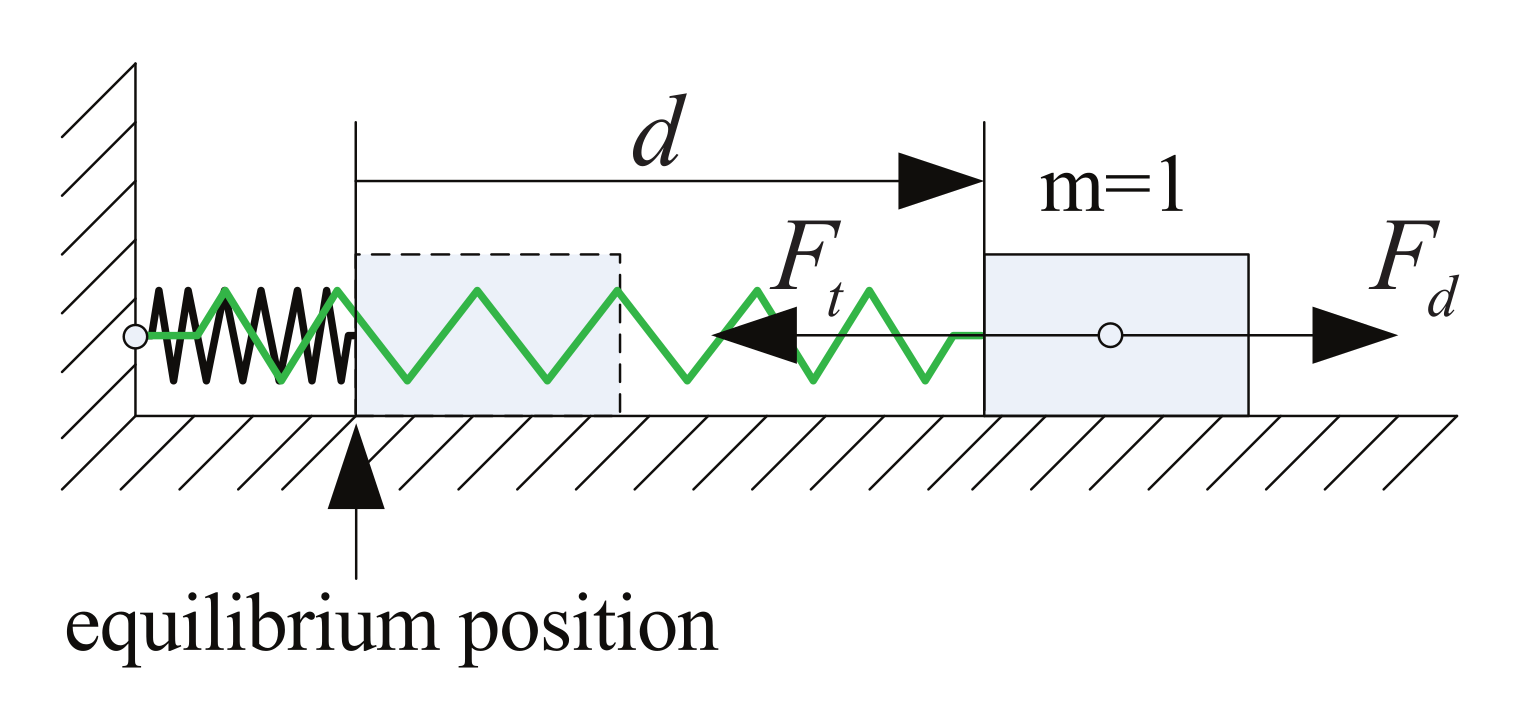
3.1. Spring Mass System: The Source of the Idea
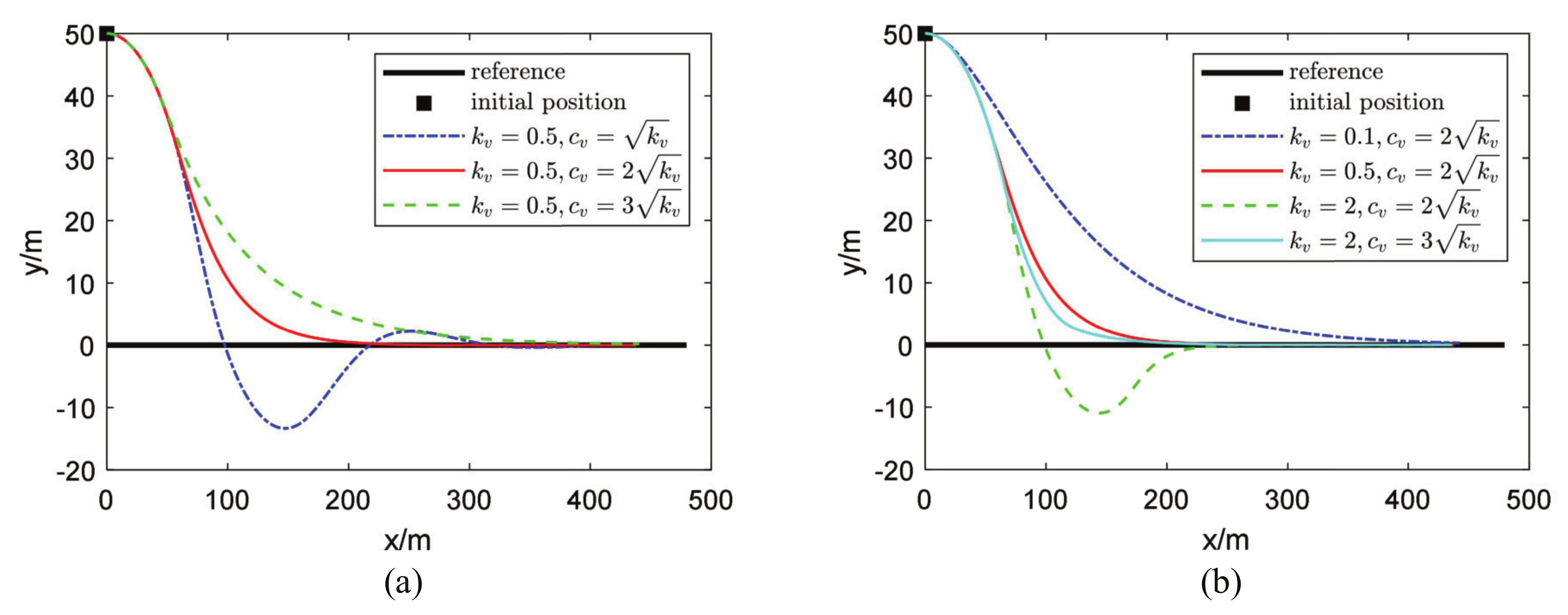
- When , the spring mass system is a second-order weakly damped control system. Then, there will be oscillation before convergence.
- When , the system is a second-order critical damped control system. In this case, d converges to 0 without overshoot.
- When , the system is a second-order over damped system. d converges to 0 without overshoot, and the convergence rate is slower with a larger c.
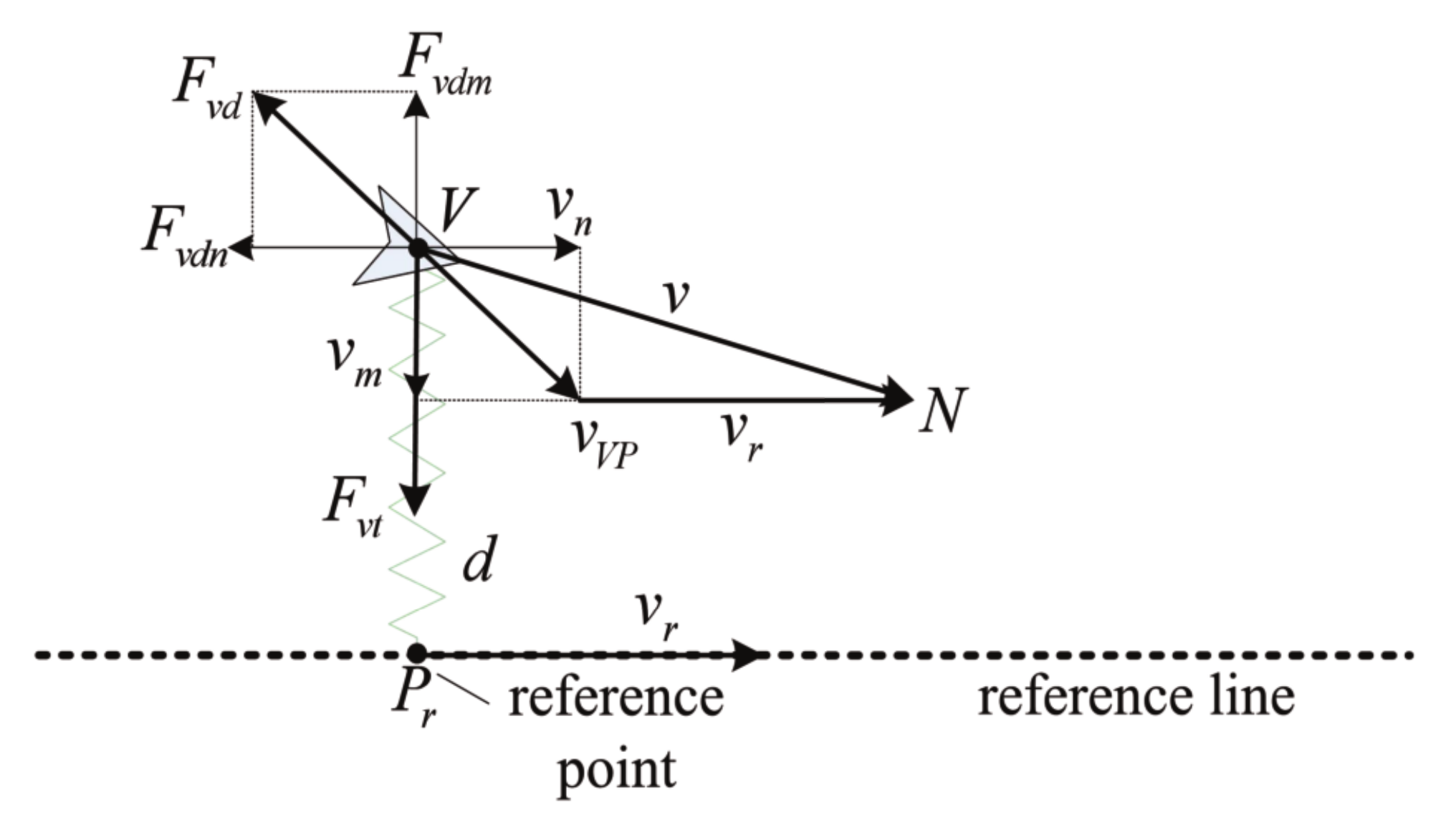
3.2. The Virtual Forces for Straight-Line Following
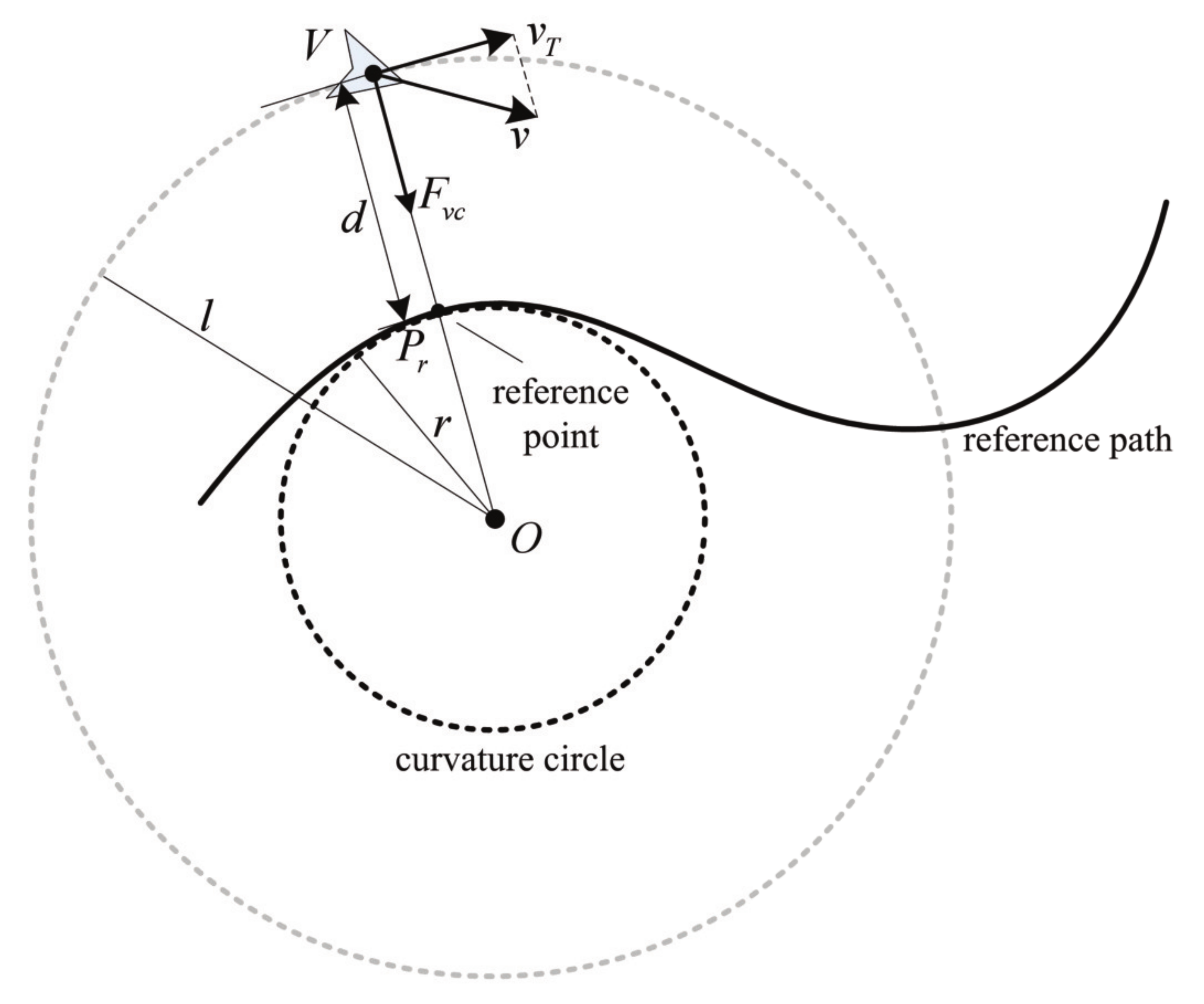
3.3. Virtual Centripetal Force for Curve Following
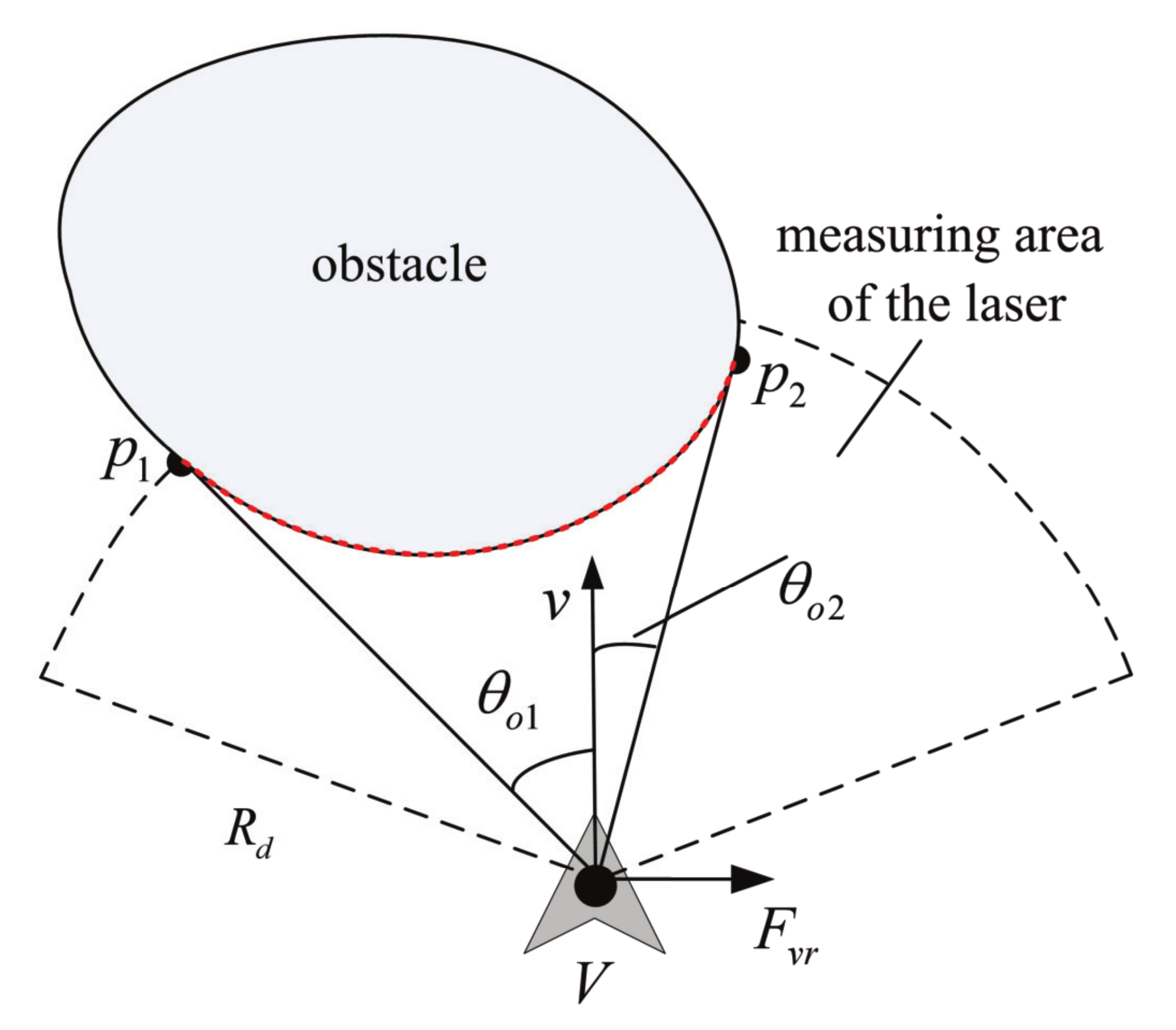
3.4. Virtual Repulsive Force for Obstacle Avoidance
3.5. Driven of the Virtual-Force-Based Guidance Law
- Step 1: Obtain the state of the UAV.
- Step 2: Determine the reference point and calculate the reference center O. The reference center is determined by the reference point and the reference radius at point .where
- Step 4: Obtain the resultant virtual force in the forward and lateral direction by decomposing the virtual forces in the two directionswhere the subscripts f and l are used to denote the components of forces in the UAV’s forward and lateral direction.
- Step 5: Obtain the input command of the VFGL bywhere is the control interval in practical application. and are the minimum and the maximum velocity of the UAV. is the maximum course rate. The expression of is
4. Evaluation
4.1. Numerical Simulation
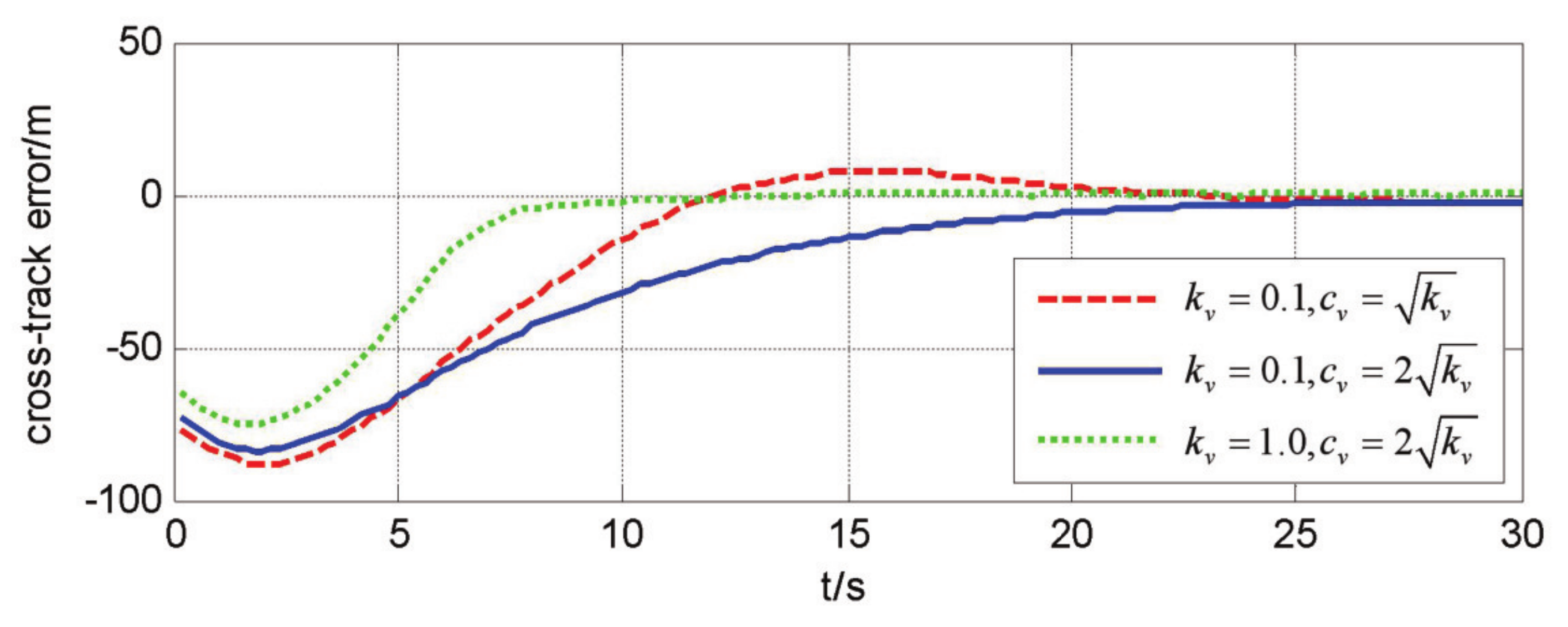
4.1.1. Path Following with Different Parameters
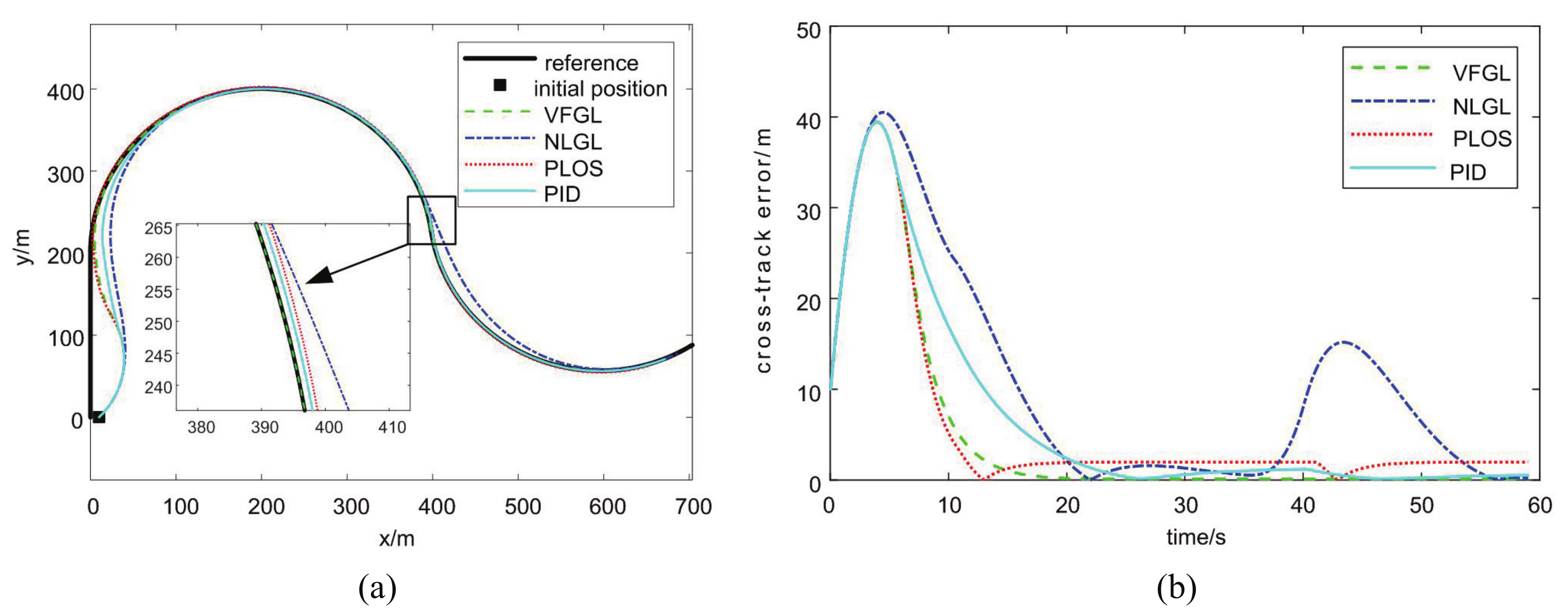
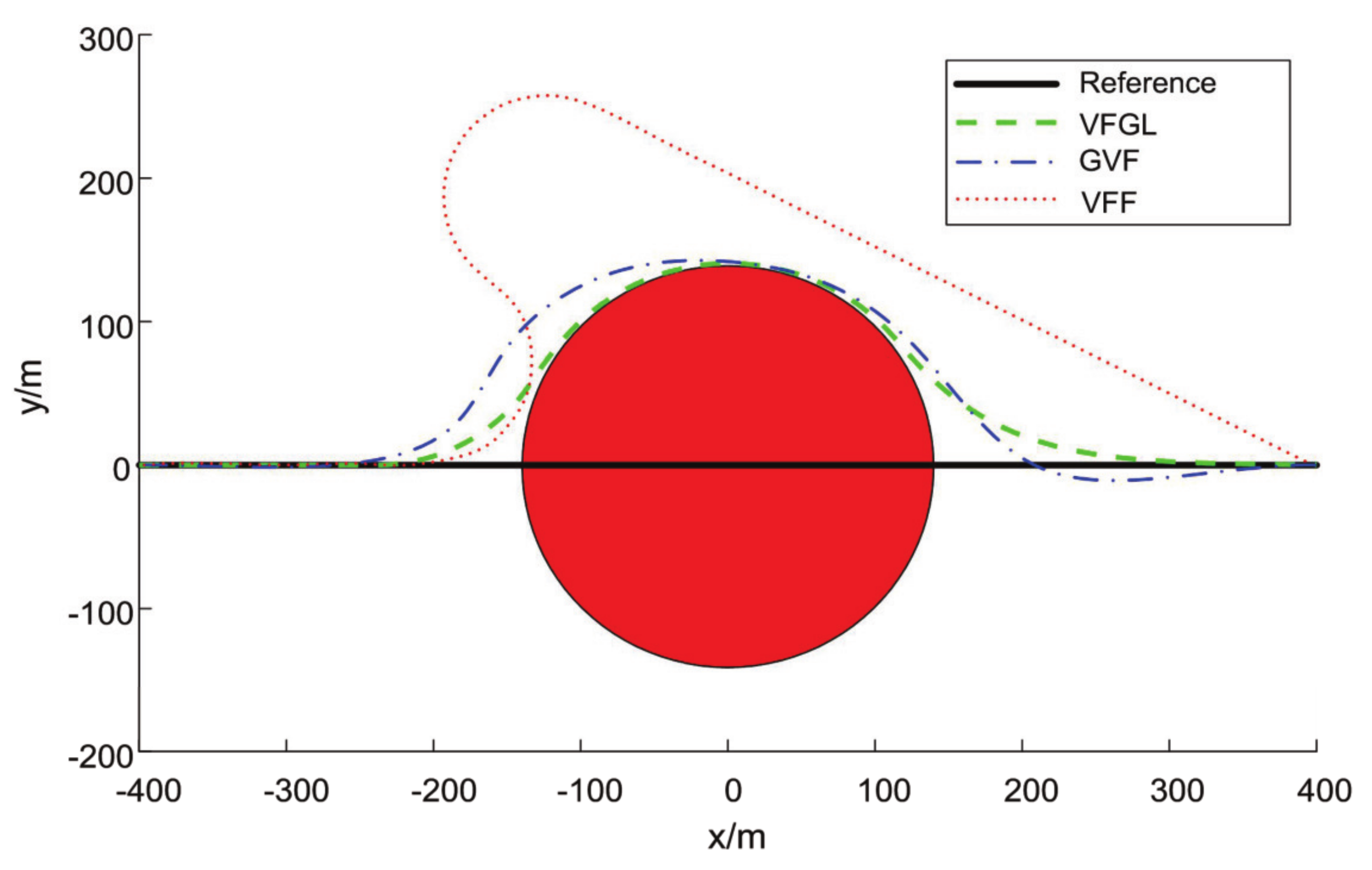
4.1.2. Comparison of the VFGL with Other Methods
4.2. Hardware-in-the-Loop Simulation
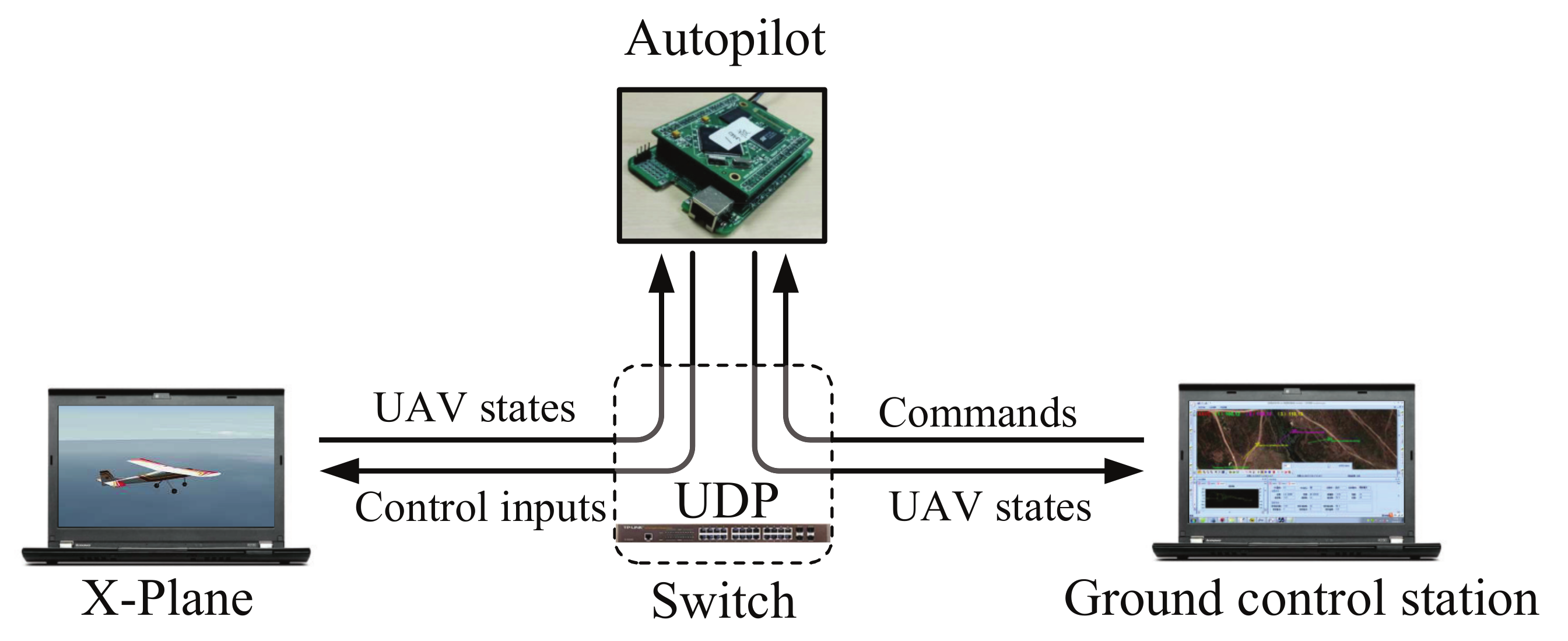
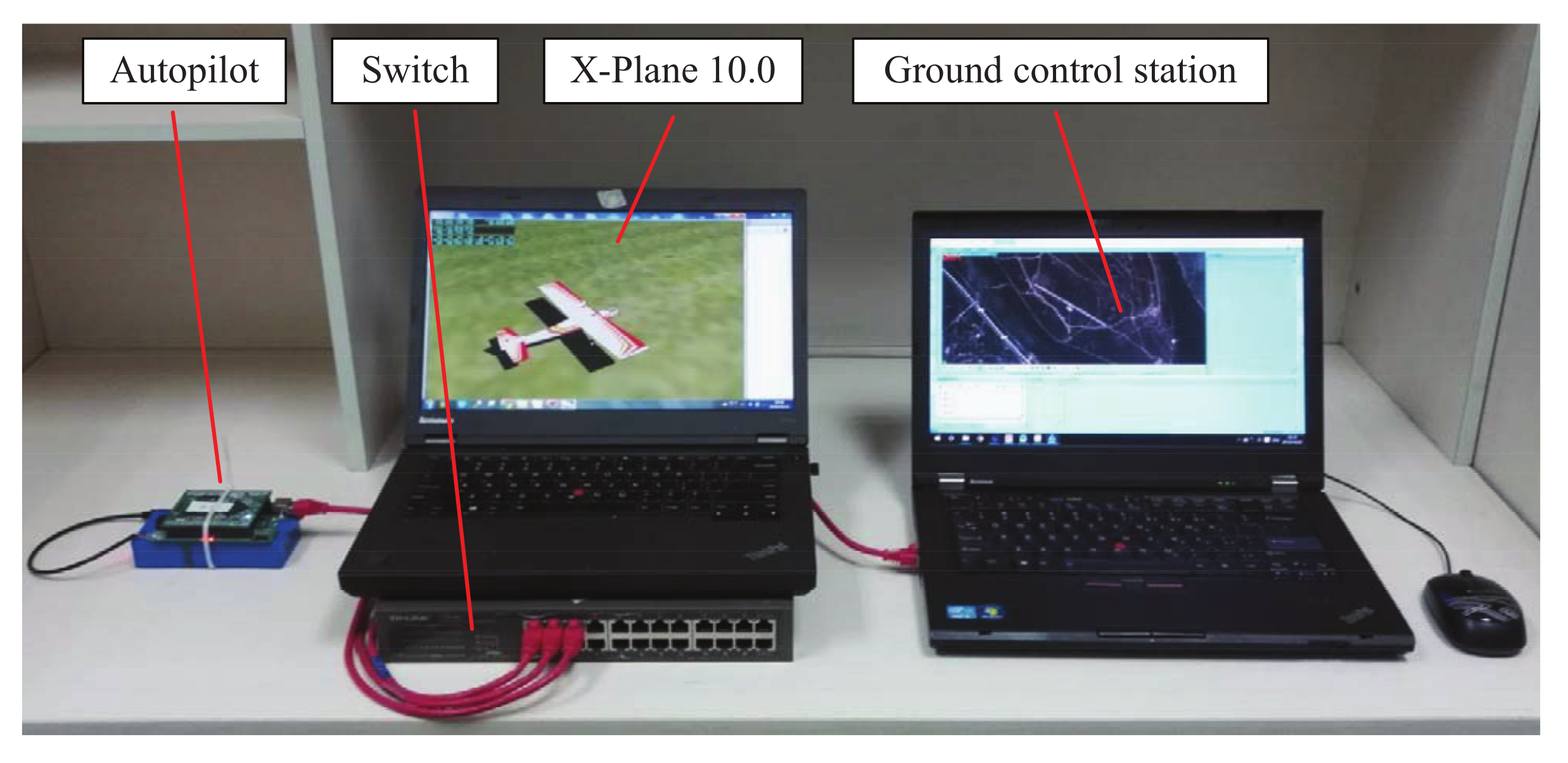
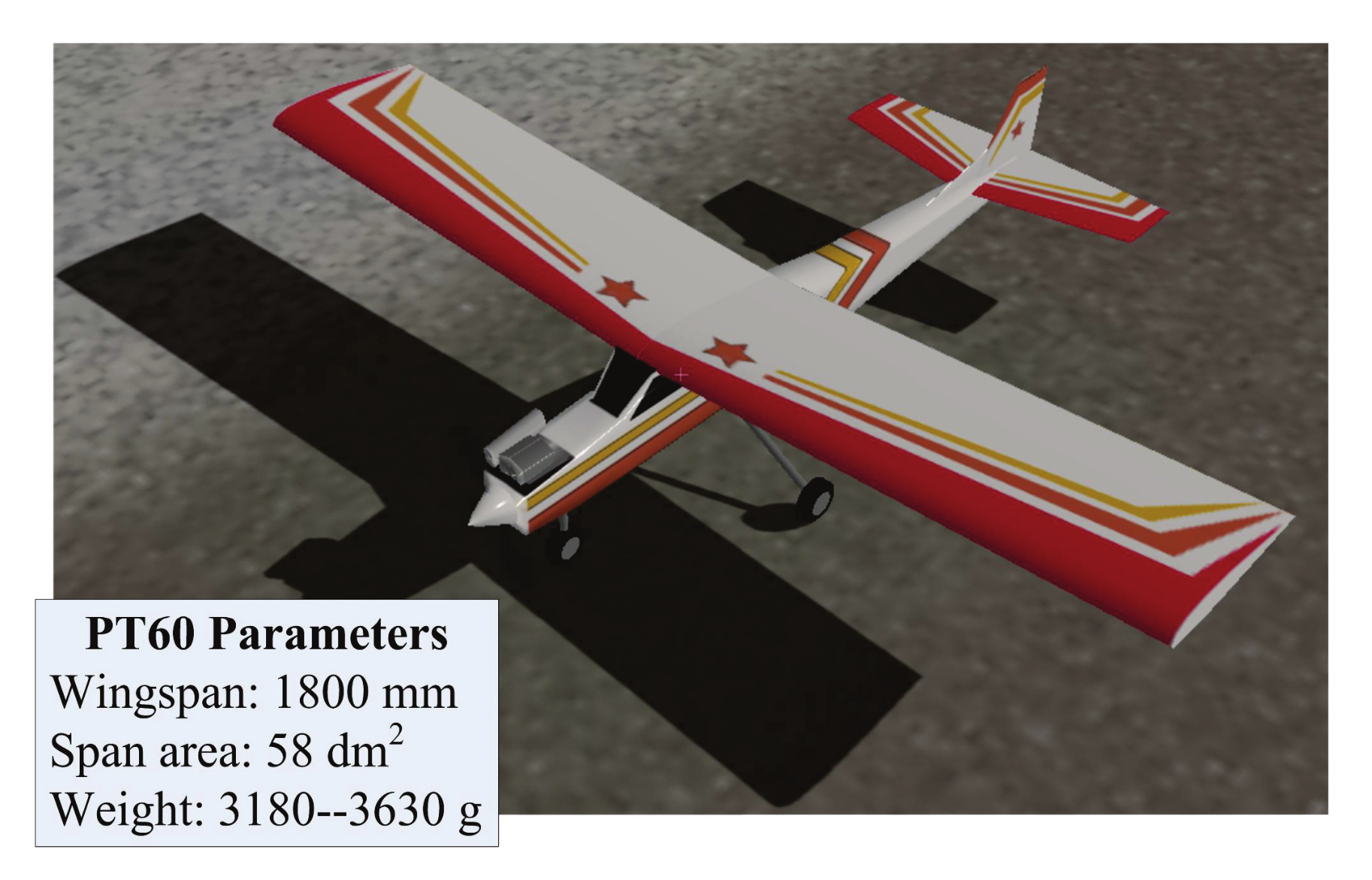
4.2.1. System Setup
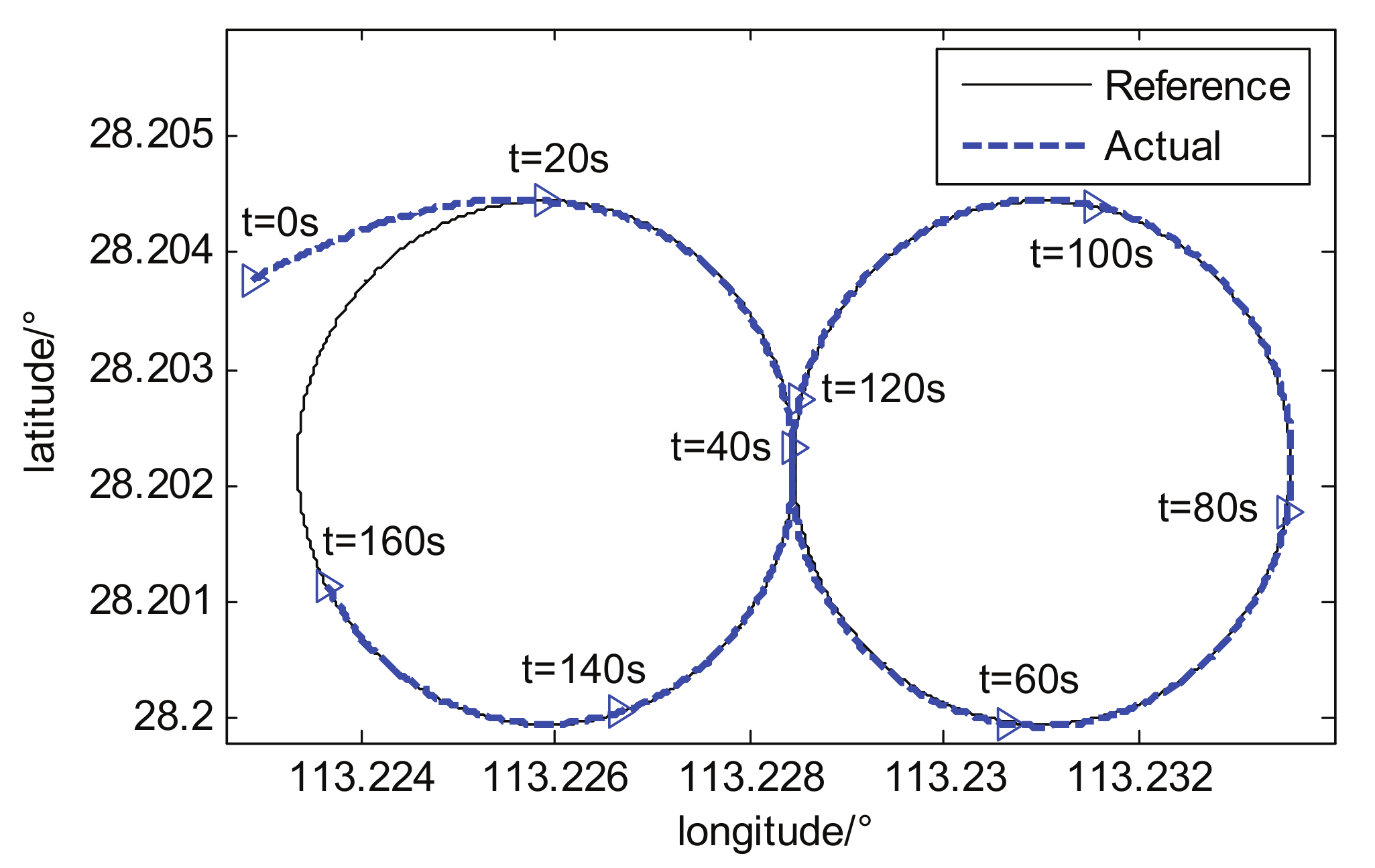
4.2.2. Results of the HIL Simulation
5. Conclusions
Author Contributions
Funding
Institutional Review Board Statement
Informed Consent Statement
Data Availability Statement
Conflicts of Interest
References
- Wang, X.; Yao, X.; Zhang, L. Path planning under constraints and path following control of autonomous underwater vehicle with dynamical uncertainties and wave disturbances. J. Intell. Robot. Syst. 2020, 99, 891–908. [Google Scholar] [CrossRef]
- Massimiliano, I.; Antonio, S. Path following and obstacle avoidance for an autonomous UAV using a depth camera. Robot. Auton. Syst. 2018, 106, 38–46. [Google Scholar]
- Radmanesh, M.; Kumar, M.; Guentert, P.H.; Sarim, M. Overview of path planning and obstacle avoidance algorithms for UAVs: A comparative study. Unmanned Syst. 2018, 6, 2301–3850. [Google Scholar] [CrossRef]
- Carrio, A.; Lin, Y.; Saripalli, S.; Campoy, P. Obstacle detection system for small UAVs using ADS-B and thermal imaging. J. Intell. Robot. Syst. 2017, 88, 583–595. [Google Scholar] [CrossRef]
- Rodríguez-Seda, E.J.; Tang, C.; Spong, M.W.; Stipanović, D.M. Trajectory tracking with collision avoidance for nonholonomic vehicles with acceleration constraints and limited sensing. Int. J. Robot. Res. 2014, 33, 1569–1592. [Google Scholar] [CrossRef]
- Kumon, M.; Nagata, M.; Kohzawa, R.; Mizumoto, I.; Iwai, Z. Flight Path Control of Small Unmanned Air Vehicle. J. Field Robot. 2006, 23, 223–244. [Google Scholar] [CrossRef]
- Alessandretti, A.; Aguiar, A.P.; Jones, C. Trajectory-tracking and path-following controllers for constrained underactuated vehicles using Model Predictive Control. In Proceedings of the 2013 European Control Conference, Zurich, Switzerland, 17–19 July 2013; pp. 1371–1376. [Google Scholar]
- Castillo, C.; Moreno, W.; Valavanis, K. Unmanned helicopter waypoint trajectory tracking using model predictive control. In Proceedings of the Mediterranean Conference on Control & Automation, Athens, Greece, 27–29 June 2007; pp. 1–8. [Google Scholar]
- Künhe, F.; Gomes, J.; Fetter, W. Mobile robot trajectory tracking using model predictive control. In II IEEE Latin-American Robotics Symposium; IEEE: Washington, DC, USA, 2005. [Google Scholar]
- Brezoescu, A.; Espinoza, T.; Castillo, P.; Lozano, R. Adaptive trajectory following for a fixed-wing UAV in presence of crosswind. J. Intell. Robot. Syst. 2013, 69, 257–271. [Google Scholar] [CrossRef][Green Version]
- Fossen, T.I.; Pettersen, K.Y.; Galeazzi, R. Line-of-sight path following for dubins paths with adaptive sideslip compensation of drift forces. IEEE Trans. Control. Syst. Technol. 2015, 23, 820–827. [Google Scholar] [CrossRef]
- Poznyak, A.S.; Yu, W.; Sanchez, E.N.; Perez, J.P. Nonlinear adaptive trajectory tracking using dynamic neural networks. IEEE Trans. Neural Netw. 1999, 10, 1402–1411. [Google Scholar] [CrossRef]
- Chwa, D. Sliding-mode tracking control of nonholonomic wheeled mobile robots in polar coordinates. IEEE Trans. Control. Syst. Technol. 2004, 12, 637–644. [Google Scholar] [CrossRef]
- Yang, J.M.; Kim, J.H. Sliding mode control for trajectory tracking of nonholonomic wheeled mobile robots. IEEE Trans. Robot. Autom. 1999, 15, 578–587. [Google Scholar] [CrossRef]
- Divelbiss, A.W.; Wen, J.T. Trajectory tracking control of a car-trailer system. IEEE Trans. Control. Syst. Technol. 1997, 5, 269–278. [Google Scholar] [CrossRef]
- Ratnoo, A.; Sujit, P.; Kothari, M. Adaptive optimal path following for high wind flights. In Proceedings of the 18th IFAC World Congress, Milano, Italy, 28 August–2 September 2011. Volume 2. [Google Scholar]
- Schoellig, A.P.; Mueller, F.L.; D’Andrea, R. Optimization-based iterative learning for precise quadrocopter trajectory tracking. Auton. Robot. 2012, 33, 103–127. [Google Scholar] [CrossRef]
- Fossen, T.I.; Breivik, M.; Skjetne, R. Line-of-sight path following of underactuated marine craft. In Proceedings of the 6th IFAC MCMC, Girona, Spain, 17–19 September 2003; pp. 244–249. [Google Scholar]
- Conte, G.; Duranti, S.; Merz, T. Dynamic 3D path following for an autonomous helicopter. IFAC Proc. Vol. 2004, 37, 472–477. [Google Scholar] [CrossRef]
- Park, S.; Deyst, J.; How, J.P. A new nonlinear guidance logic for trajectory tracking. In Proceedings of the AIAA Guidance, Navigation and Control Conference, Providence, RI, USA, 16–19 August 2004; pp. 1–16. [Google Scholar]
- Jung, W.; Lim, S.; Lee, D.; Bang, H. Unmanned Aircraft Vector Field Path Following with Arrival Angle Control. J. Intell. Robot. Syst. 2016, 1–15. [Google Scholar] [CrossRef]
- Nelson, D.R.; Barber, D.B.; McLain, T.W.; Beard, R.W. Vector field path following for miniature air vehicles. IEEE Trans. Robot. 2007, 23, 519–529. [Google Scholar] [CrossRef]
- Kothari, M.; Postlethwaite, I.; Gu, D.W. UAV path following in windy urban environments. J. Intell. Robot. Syst. 2014, 74, 1013–1028. [Google Scholar] [CrossRef]
- Sujit, P.B.; Saripalli, S.; Sousa, J.B. Unmanned aerial vehicle path following: A survey and analysis of algorithms for fixed-wing unmanned aerial vehicles. IEEE Control Syst. 2014, 34, 42–59. [Google Scholar]
- Park, S.; Deyst, J.; How, J.P. Performance and Lyapunov stability of a nonlinear path following guidance method. J. Guid. Control Dyn. 2007, 30, 1718–1728. [Google Scholar] [CrossRef]
- Howard, T.M.; Green, C.J.; Kelly, A. Receding horizon model-predictive control for mobile robot navigation of intricate paths. In Field and Service Robotics; Springer: Berlin/Heidelberg, Germany, 2010; pp. 69–78. [Google Scholar]
- Hwang, C.L.; Chang, L.J. Trajectory tracking and obstacle avoidance of car-like mobile robots in an intelligent space using mixed H2/H∞ decentralized control. IEEE/ASME Trans. Mechatron. 2007, 12, 345–352. [Google Scholar] [CrossRef]
- Khatib, O. Real-Time Obstacle Avoidance for Manipulators and Mobile Robots. Int. J. Robot. Res. 1986, 5, 396–404. [Google Scholar] [CrossRef]
- Borenstein, J.; Koren, Y. Real-Time Obstacle Avoidance for Fast Mobile Robots in Cluttered Environments. In Proceedings of the IEEE International Conference on Robotics and Automation, Cincinnati, OH, USA, 13–18 May 1990; pp. 572–577. [Google Scholar]
- Borenstein, J.; Koren, Y. The Vector Field Histogram-Fast Obstacle Avoidance for Mobile Robots. IEEE Trans. Robot. Autom. 1991, 7, 278–288. [Google Scholar] [CrossRef]
- Nakai, K.; Uchiyama, K. Vector Fields for UAV Guidance Using Potential Function Method for Formation Flight. In Proceedings of the AIAA Guidance, Navigation, and Control Conference and Exhibit, Boston, MA, USA, 19–22 August 2013; pp. 278–288. [Google Scholar]
- Goncalves, V.; Pimenta, L.C.; Maia, C.A.; Dutra, B.C.; Pereira, G.A. Vector Fields for Robot Navigation Along Time-Varying Curves in n-Dimensions. IEEE Trans. Robot. 2010, 26, 647–659. [Google Scholar] [CrossRef]
- Wilhelm, J.; Clem, G. Vector field uav guidance for path following and obstacle avoidance with minimal deviation. J. Guid. Dyn. 2019, 42, 1848–1856. [Google Scholar] [CrossRef]
- Stefan, S.; Tobias, N.; Javier, A.M.; Otmar, H. Sample Efficient Learning of Path Following and Obstacle Avoidance Behavior for Quadrotors. IEEE Robot. Autom. Lett. 2018, 3, 3852–3859. [Google Scholar]
- Nguyen, P.D.H.; Recchiuto, C.T.; Sgorbissa, A. Real-Time Path Generation and Obstacle Avoidance for Multirotors: A Novel Approach. J. Intell. Robot. Syst. 2018, 89, 27–49. [Google Scholar] [CrossRef]
- Sgorbissa, A. Integrated robot planning, path following, and obstacle avoidance in two and three dimensions: Wheeled robots, underwater vehicles, and multicopters. Int. J. Robot. Res. 2019, 38, 853–876. [Google Scholar] [CrossRef]
- Carlos, R.S.; Dominguez, D.; Gonzalo, J.; Escapa, A. Path planner for autonomous exploration of underground mines by aerial vehicles. Sensors 2020, 20, 4259. [Google Scholar]
- Steiner, J.A.; He, X.; Bourne, J.R.; Leang, K.K. Open sector rapid reactive collision avoidance: Application in aerial robot navigation through outdoor unstructured environments. Robot. Auton. Syst. 2019, 112, 211–220. [Google Scholar] [CrossRef]
- Cheein, F.A.; Scaglia, G. Trajectory tracking controller design for unmanned vehicles: A new methodology. J. Field Robot. 2014, 31, 861–887. [Google Scholar] [CrossRef]
- Beard, R.; Ferrin, J.; Humpherys, J. Fixed wing UAV path following in wind with input constraints. IEEE Trans. Control. Syst. Technol. 2014, 22, 2103–2117. [Google Scholar] [CrossRef]
- Zhao, S.; Wang, X.; Lin, Z.; Zhang, D.; Shen, L. Integrating Vector Field Approach and Input-to-State Stability Curved Path Following for Unmanned Aerial Vehicles. IEEE Trans. Syst. Man Cybern. 2020, 50, 2897–2904. [Google Scholar] [CrossRef]
- Wang, X.; Zhang, J.; Zhang, D.; Shen, L. UAV formation: From numerical simulation to actual flight. In Proceedings of the 2015 IEEE International Conference on Information and Automation, Lijiang, China, 8–10 August 2015; pp. 475–480. [Google Scholar]
- Wang, X.; Zhang, J.; Zhang, D.; Shen, L. Development of an Experiment System for UAV Formation Flight. Robot 2017, 39, 160–166. [Google Scholar]
- Zhang, D.; Wang, X. Autonomous Landing Control of Fixed-wing UAVs: From Theory to Field Experiment. J. Intell. Robot. Syst. 2017, 88, 619–634. [Google Scholar] [CrossRef]
- Zhao, S.; Wang, X.; Zhang, D.; Shen, L. Curved path following control for fixed-wing unmanned aerial vehicles with control constraint. J. Intell. Robot. Syst. 2017, 89, 107–119. [Google Scholar] [CrossRef]
- Wang, X.; Kong, W.; Zhang, D.; Shen, L. Active disturbance rejection controller for small fixed-wing UAVs with model uncertainty. In Proceedings of the 2015 IEEE International Conference on Information and Automation, Lijiang, China, 8–10 August 2015; pp. 2299–2304. [Google Scholar]

| Label | Parameters |
|---|---|
| 1 | , |
| 2 | , |
| 3 | , |
Publisher’s Note: MDPI stays neutral with regard to jurisdictional claims in published maps and institutional affiliations. |
© 2021 by the authors. Licensee MDPI, Basel, Switzerland. This article is an open access article distributed under the terms and conditions of the Creative Commons Attribution (CC BY) license (https://creativecommons.org/licenses/by/4.0/).
Share and Cite
Wang, X.; Cai, L.; Kong, L.; Wang, B.; Huang, S.; Lin, C. Path Following and Obstacle Avoidance for Unmanned Aerial Vehicles Using a Virtual-Force-Based Guidance Law. Appl. Sci. 2021, 11, 4618. https://doi.org/10.3390/app11104618
Wang X, Cai L, Kong L, Wang B, Huang S, Lin C. Path Following and Obstacle Avoidance for Unmanned Aerial Vehicles Using a Virtual-Force-Based Guidance Law. Applied Sciences. 2021; 11(10):4618. https://doi.org/10.3390/app11104618
Chicago/Turabian StyleWang, Xun, Libing Cai, Longxing Kong, Binfeng Wang, Shaohua Huang, and Chengdi Lin. 2021. "Path Following and Obstacle Avoidance for Unmanned Aerial Vehicles Using a Virtual-Force-Based Guidance Law" Applied Sciences 11, no. 10: 4618. https://doi.org/10.3390/app11104618
APA StyleWang, X., Cai, L., Kong, L., Wang, B., Huang, S., & Lin, C. (2021). Path Following and Obstacle Avoidance for Unmanned Aerial Vehicles Using a Virtual-Force-Based Guidance Law. Applied Sciences, 11(10), 4618. https://doi.org/10.3390/app11104618

