


Abstract
The thickness of the oil film in ceramic ball bearings varies greatly at starved lubrication conditions, thus leading to non-uniform contact between the balls and raceways in the circumference. The lubrication parameters have a direct impact on the thickness of the oil film and then affect the dynamic characteristics of the ceramic ball bearings. A nonlinear dynamic model of ceramic ball bearing with limited lubrication is presented in this paper, and parametric studies on the effect of lubrication parameters are conducted. In starved conditions, the uneven contact between the ball and ring leads to changes in vibration, and the inner ring vibration is applied to evaluate the degree of starved lubrication. The results show that as the oil quantity increases, the bearing stiffness increases and results in increased peak frequency. As the oil quantity decreases, the thickness of the oil film reduces, resulting in the bearing vibration increase. The research findings provide a theoretical reference for ceramic ball bearing design and have guided significance for improving the service performance of ceramic ball bearings.
1. Introduction
Ceramic ball bearings have excellent performance and perform well in high temperature and high-speed environments, which can ensure the normal operation of high-speed devices [1,2]. Bearings are important to support components for equipment. The vibration characteristics of ceramic ball bearings directly affect the accuracy and vibration characteristics of the equipment.
The mechanism of bearing vibration is very complex, involving many factors, such as process errors, structural parameters, and operating parameters [3,4,5,6,7,8,9]. Zhang et al. [10] established a dynamic model to analyze the influence of structural parameters on bearing vibration. Cui et al. [11] used the theory of rolling bearing dynamics to establish a dynamic analysis model of angular contact ball bearings. It is found that adjusting the structural parameters and the axial preload can reduce the vibration of the bearing. Bai et al. [12] developed a nonlinear dynamic model of full ceramic bearings, considering different diameters of the ball, oil film forces, and load. The dynamic response of each element of the full ceramic bearing is obtained by solving the model.
Bearing vibration is not just related to structural parameters, but is also affected by the working parameters, including lubrication [13,14,15]. The lubricating oil cannot enter the bearing smoothly under high-speed, heavy-duty conditions. The amount of oil inside the bearing gradually decreases and the starvation state occurs [16,17,18,19,20,21,22]. This phenomenon has attracted a lot of research interest in the field of starvation lubrication. Tanaka [23] studied the hydrodynamic performance of journal bearings in the absence of lubrication from theoretical and experimental conditions. The reduction in film thickness along the bearing circumference can affect the static and dynamic performance of journal bearings. Maruyama and Saitoh [24] studied the relationship between oil supply flow and oil film thickness under stable starvation lubrication conditions. The flow rate of the supplied oil was precisely controlled in the experiment and the oil film thickness was measured. The relationship between the oil supply flow rate and the oil film thickness is determined. Ebner et al. [25] studied the effects of insufficient lubrication on the working behavior of elastohydrodynamic lubrication (EHL) contactors in gears. The results show that a small amount of initial oil can lubricate normally and have different operating performance on different surfaces. Results show that a very small amount of initial oil is sufficient for lubrication and different operating behaviors for different surfaces. Hamrock and Dowson [26,27] simulated the starvation phenomenon by moving the entrance to the contact center and calculated the actual distance of the entrance by the correction factor of the oil film thickness. Wedeven et al. [28] studied the effect of lubricant distribution on oil film thickness in the inlet area of EHL. The minimum meniscus length of the EHL inlet area is theoretically determined to prevent insufficient lubrication. Liu et al. [29] studied the sliding contact situation under various lubricant quantities. Theoretical results show that the starved film has a certain carrying capacity and the film thickness is a sensitive function of the amount of lubricant supplied. Venner et al. [30] proposed a model for predicting the change in the grease layer in a rolling bearing because of the centrifugal force of the ball and the EHL contact pressure. This model estimates the longest local replenishment interval to ensure the normal bearing operation and helps to improve bearing life predictions related to lubricants.
However, the currently developed models are based primarily on the theory of EHL to analyze the effect of the amount of lubricant on the operation of the mechanism. There are few studies on the impact of the amount of lubricant on the dynamic performance of bearings in dynamic models. Recently, Bai et al. [31] showed that uneven contact between the ball and ring would affect the vibration conditions of the entire ceramic bearing. In the starving lubrication, uneven contact becomes more apparent. Under starvation lubrication conditions, the thickness of the lubricant film that transfers the load between the ball and the raceway is very thin and unstable. Different oil film thickness will lead to different bearing load conditions and then affect the dynamic characteristics of the bearing. In this paper, a nonlinear dynamic model of ceramic ball bearings with starved lubrication is established. Considering detailed lubrication conditions with lubrication parameters, through numerical calculations, the influence of the oil amount on the vibration of the bearing inner ring was studied.
2. Dynamic Model
2.1. Contact Model between the Balls and Inner Ring
Model of the Inner Ring
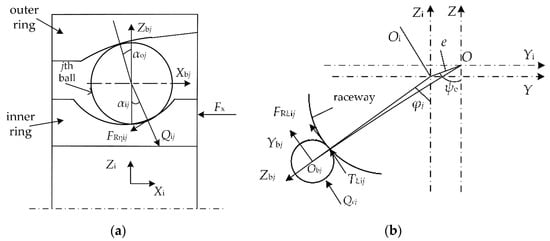
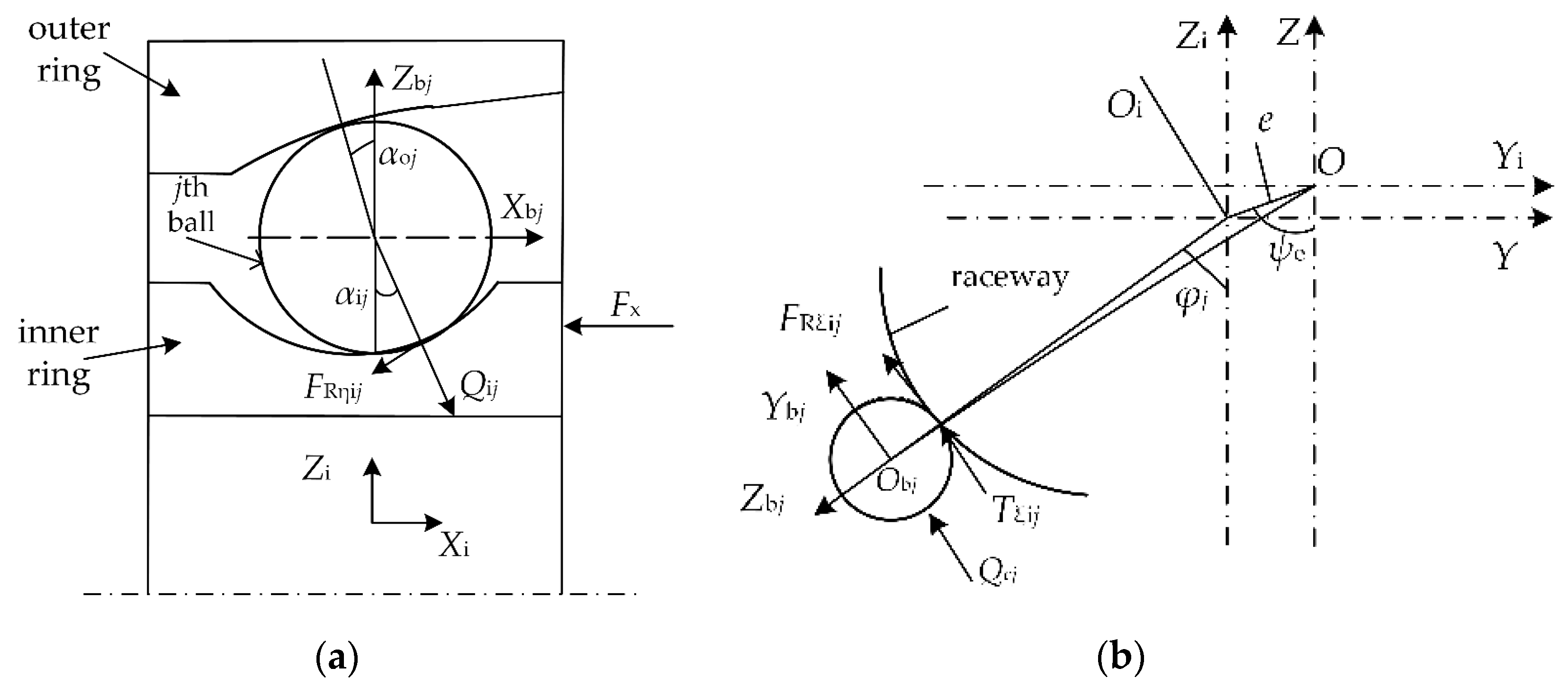
In order to facilitate the analysis of the dynamic performance of ceramic ball bearings, the following assumptions were made: The working surface of the bearing parts has an ideal geometry and the center of mass coincides with the centroid; the outer ring of the bearing does not rotate and the inner ring rotates around the X-axis; each ball has the same diameter; the inertial coordinate system of the bearing is {O; X, Y, Z}; the inner ring coordinate system of the bearing is {O; Xi, Yi, Zi}; and the coordinate system of the jth ball is {Obj; Xbj, Ybj, Zbj}. When an angular contact ball bearing rotated at high speed, the inner ring was subjected to the normal contact force of the ball, the traction force, the friction of the lubricating oil, and the applied load. The force model of the inner ring is shown in Figure 1.
Figure 1.
The force model of the inner ring in the plane XOZ (a) and in the plane YOZ (b).
The inner ring dynamic nonlinear differential equations can be expressed as:
where the contact surface between the ball and the raceway is approximately an ellipse, η and ξ are the short axis and the long axis of the contact ellipse between the ball and the raceway, subscript i represents the inner ring, Fx, Fy, Fz, My, and Mz are externally applied forces and torques, αij is the contact angle between the ball and inner raceway, is the azimuth of the jth ball, Qij is normal contact force between the ball and inner raceway, Tηij is the traction force of the contact surfaces, FRηij is a hydrodynamic frictional force at the inlet zone, mi is the mass of the inner ring, are the acceleration of the inner ring in the inertial coordinate system, Iix, Iiy, and Iiz are the principal moments of inertia of the inner ring in the inertial coordinate system, represent the angular velocity of the inner ring in the inertial coordinate system, are the angular accelerations of the inner ring in the inertial coordinate system, D is the normal ball diameter, and rij is the rolling radius:
where d is the pitch diameter of the bearing and Ri is groove curvature radius of the inner race raceway.
2.2. Model of the Ball at Normal Lubricated Conditions
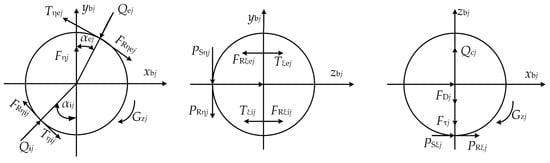
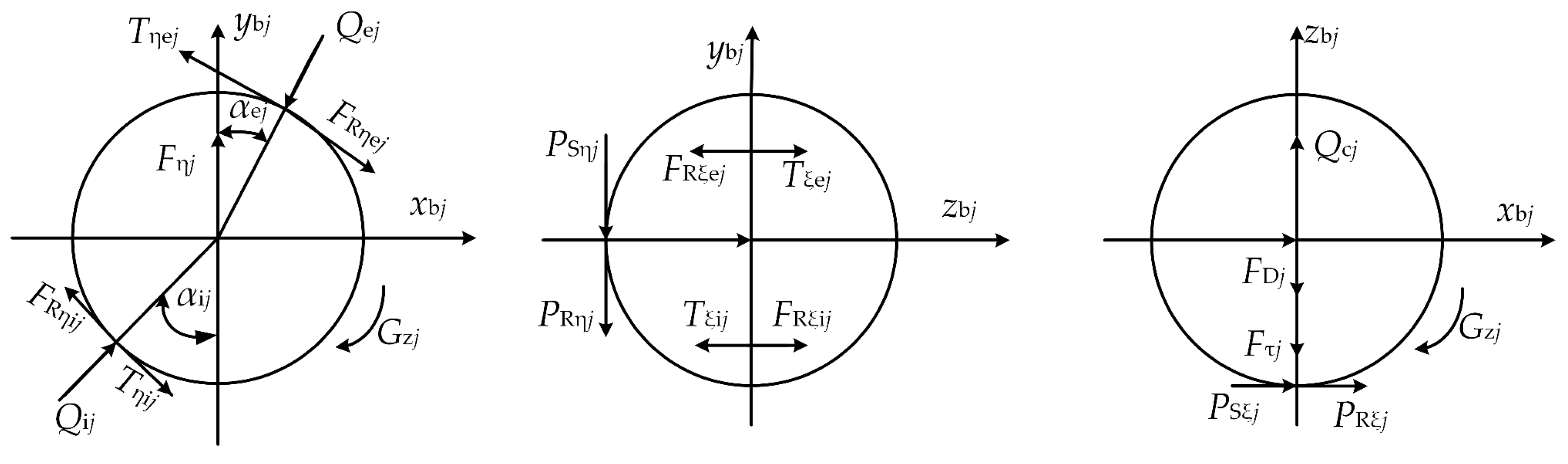
When fully lubricated, the oil filled the gap between the ball and the inner ring to allow the ball to be loaded. The force acting on the loaded ball is shown in Figure 2.
Figure 2.
The forces acting on the loaded balls.
The dynamic differential equations of the fully lubricated ball are shown as:
where subscript e represents the outer ring, αij, and αej are the contact angles between the ball and raceway, Qij, and Qej are the normal contact forces between the ball and raceway, Tηij, Tηej, Tξij, and Tξej are traction forces of the contact surfaces, Qcj is the collision force between the jth ball and the cage, Fηj and Fτj are components of the ball’s center, PRηj and PRξj are the rolling frictional forces acting on the ball’s surfacem PSηj and PSξj are the sliding frictional forces acting on the ball’s surface, FRηij, FRηej, FRξij and FRξej are the hydrodynamic frictional forces at the inlet zone, Jx, Jy and Jz are components of the ball’s moment of inertia of xbj, ybj, and zbj directions, Gyj and Gzj are components of the ball’s inertia moment of ybj and zbj directions, FDj is the aerodynamic resistance acting on the ball by the gas–oil mixture, ωxj, ωyj and ωzj are the angular velocity of the jth ball in {Obj; Xbj, Ybj, Zbj}, and are the angular accelerations of the jth ball in {Obj; Xbj, Ybj, Zbj}. mb is the mass of the ball are the displacement accelerations of the jth ball in the inertial coordinate system, Ibj is moments of inertia of the jth ball, ωbjx, ωbjy, and ωbjz are the angular velocities of the jth ball in the inertial coordinate system, are the angular accelerations of the jth ball in the inertial coordinate system, and is orbit speed of the jth ball in the inertial coordinate system.
2.3. Model of the Ball at Starved Lubricated Conditions
The lubrication regime in bearings was governed by EHL. In this application, when the amount of lubricant was enough to fill the inlet of the contact, the lubrication method was called full filling. However, in the process of bearing a high-speed operation, the oil could not be replenished quickly enough after the ball rolling. At this point, the lubricant supply at the inlet was insufficient and entered the stage of oil starvation.
When there was enough oil, the central oil film thickness hc was generally a function of viscosity, load, contact material, and shape, regardless of temperature, and can be expressed as:
where α0 is the pressure index of viscosity, η0 is the dynamic viscosity at normal pressure, R is the equivalent radius of curvature, Q is the normal contact force between the ball and raceway, and u is the average surface velocity and can be expressed as:
where ω is the angular velocity of the inner ring and E is the equivalent elastic modulus and satisfies the following equation:
where E1 and E2 are elastic moduli of the two contact materials and v1 and v2 are Poisson’s ratios of the two contact materials.
In order to facilitate analysis, these parameters were dimensionless, as follows:
where Hc is a dimensionless central film thickness:
where Rx is the equivalent radius of curvature in the long axis direction.
The velocity parameter U is expressed as
the load parameter W is expressed as
and the material parameter G is expressed as
Using these dimensionless parameters, Hamrock and Dowson [26] proposed a formula for calculating the numerical solution of point contact dimensionless elastohydrodynamic lubricating film thickness and dimensionless minimum film thickness:
where k is the ellipticity and can be expressed as:
where a is the long half axis of the ellipse, b is the short half axis of the ellipse, and Ry is the equivalent radius of curvature in the short axis direction.
Therefore, the corresponding central oil film thickness and minimum film thickness are shown as:
where e is the constant of nature.
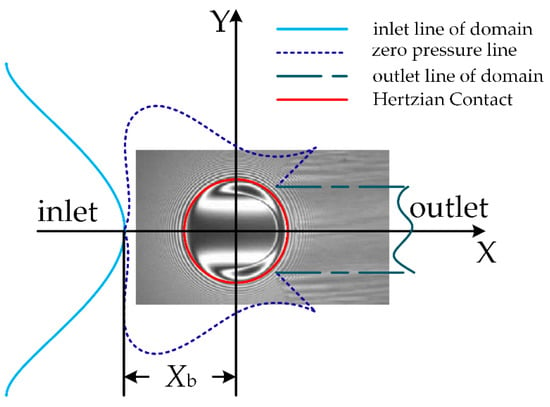
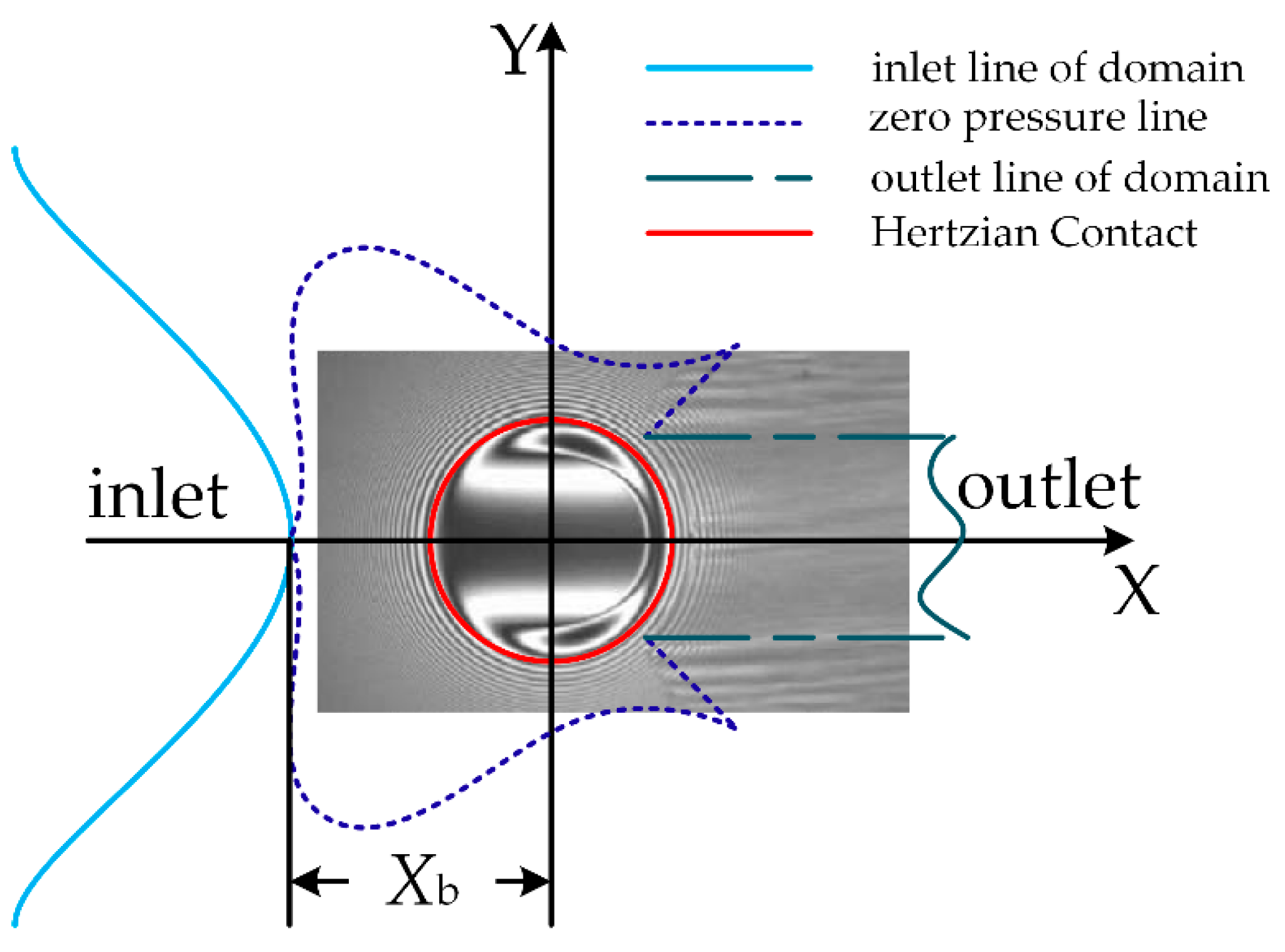
Hamrock and Dowson [26] simulated starvation by moving the inlet to the contact center and proposed a correction coefficient to show the change of oil film thickness with the inlet distance. They calculated the minimum length of the film inlet area to ensure adequate lubrication. Mohammadpour [32] obtained a photo–micrograph of the interferogram of the lubricant film under the same conditions as the isobaric curve, as shown in Figure 3. The actual distance Xb between the inlet and the Hertz contact center is marked in Figure 3.
Figure 3.
The actual distance between the inlet and the Hertz contact center.
Xb can be expressed as:
where hb is the oil film thickness at the lubrication inlet:
where Qv is the supplied oil flow rate, τ is the kinematic viscosity of the lubricating oil and ω is the angular velocity of the inner ring, and r is the inner ring radius.
Let L be a dimensionless parameter of Xb, so the dimensionless distance L is determined by
The boundary between fully flooded and starved (L*) can be expressed as:
where Hc is dimensionless hc (Hc = hc/Rx). Thus, the starvation condition can be determined by the boundary condition on L. When L > L*, the lubricating oil completely flooded the inlet zone, and when L < L*, the oil film thickness decreased and the bearing entered a starvation state. The actual central oil film thickness, hc1, can be obtained as:
when fully lubricated, the thickness of the lubricant was sufficient to carry the load. When the oil decreased gradually, it was not enough to fill the gap, so the ball could not contact the inner race. At this time, the differential equations of the ball in the starvation lubrication state are shown as:
3. Numerical Simulation
The main parameters of the bearing used in the calculation are shown in Table 1.
Table 1.
The major parameters of the bearing.
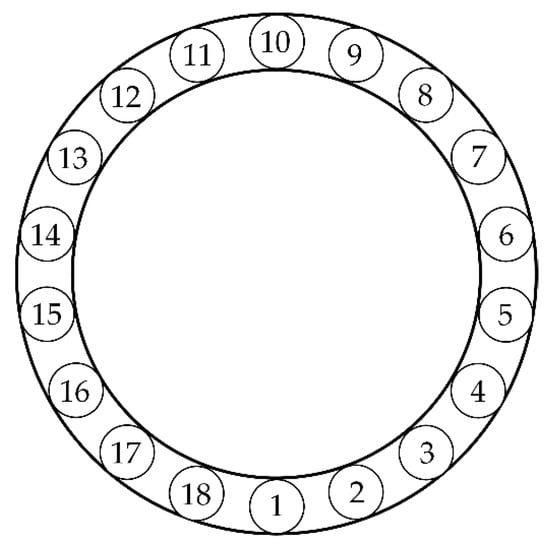
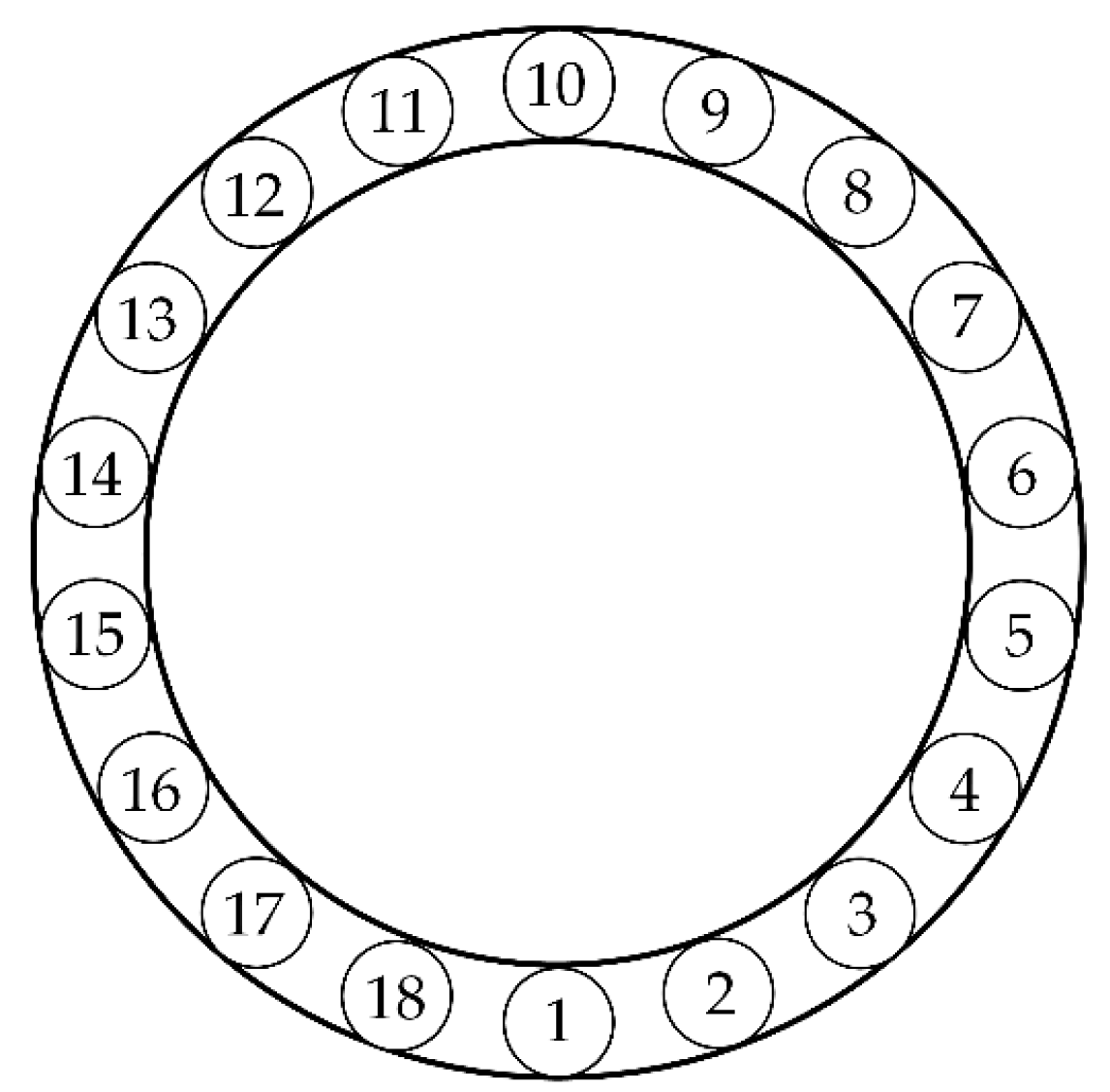
The balls are marked 1–18 sequentially, as shown in Figure 4.
Figure 4.
The marked balls.
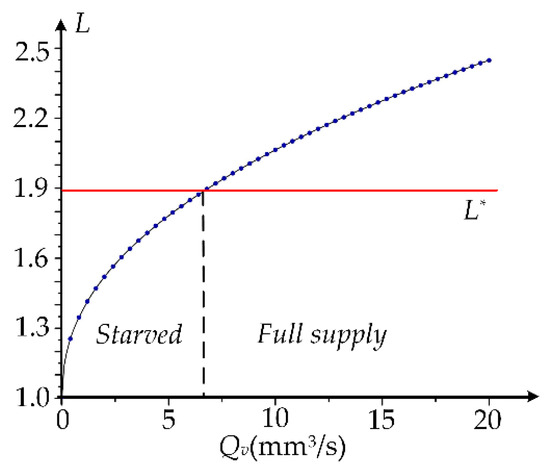
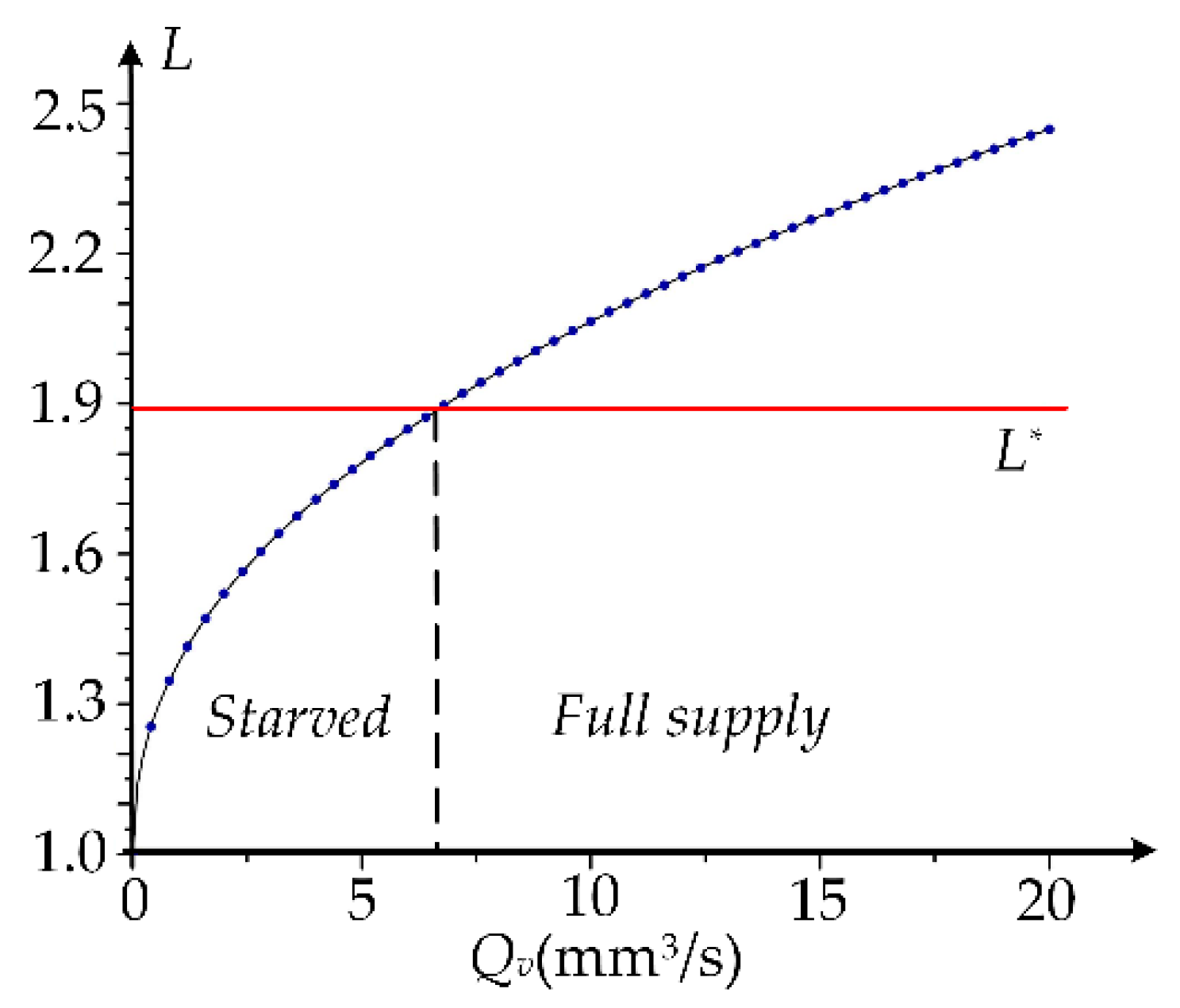
The values of L, L* can be obtained by calculating Equations (1)–(28), and the relationship between Qv and L is obtained, as shown in Figure 5.
Figure 5.
The trend of the dimensionless inlet distance at different oil flow rates.
The red line shown in Figure 5 is the calculated dimensionless inlet distance at the boundary between fully flooded and starved (L*), and L decreased with the decrease of Qv. When L < L*, it was the starved state.
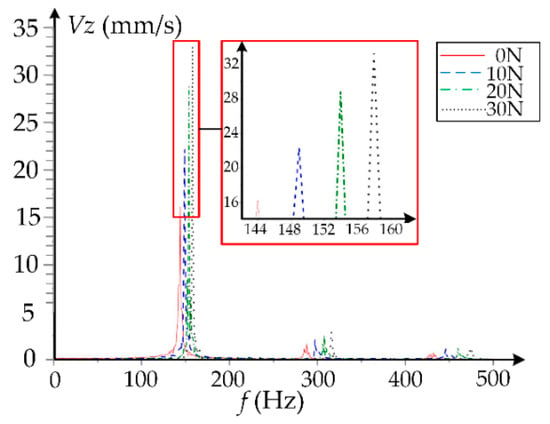
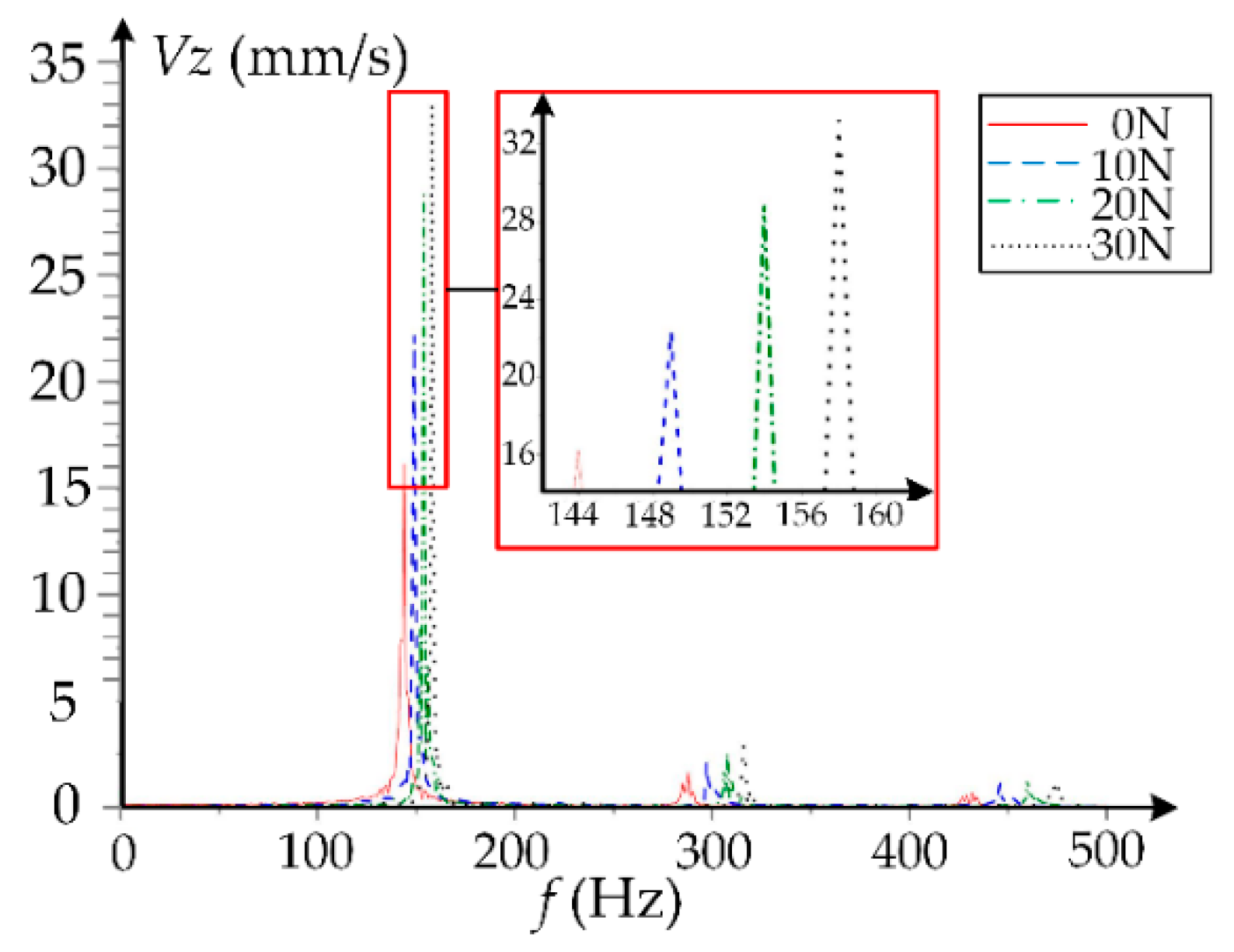
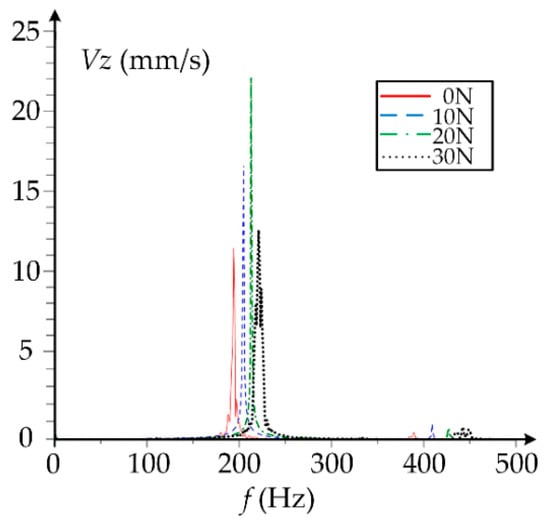
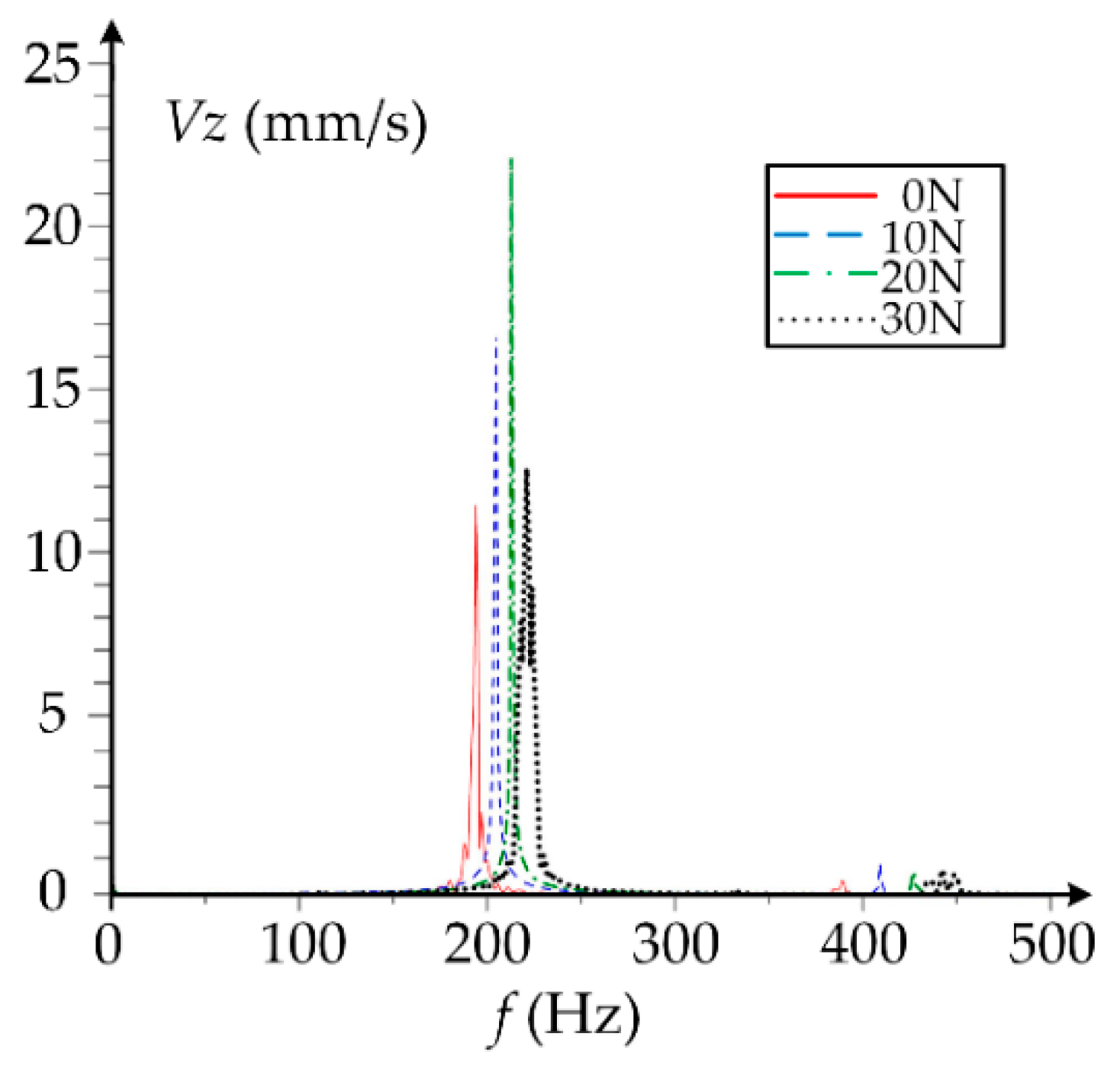
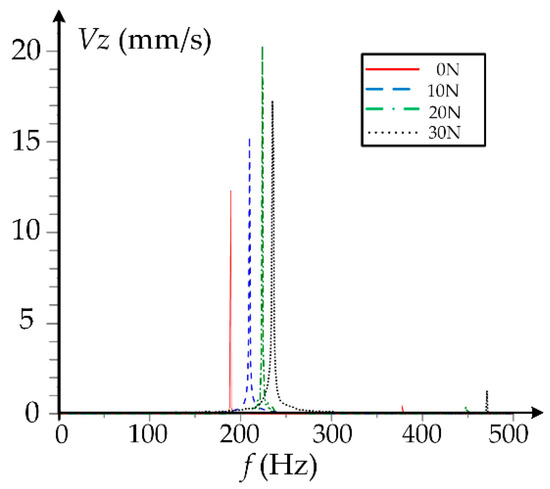
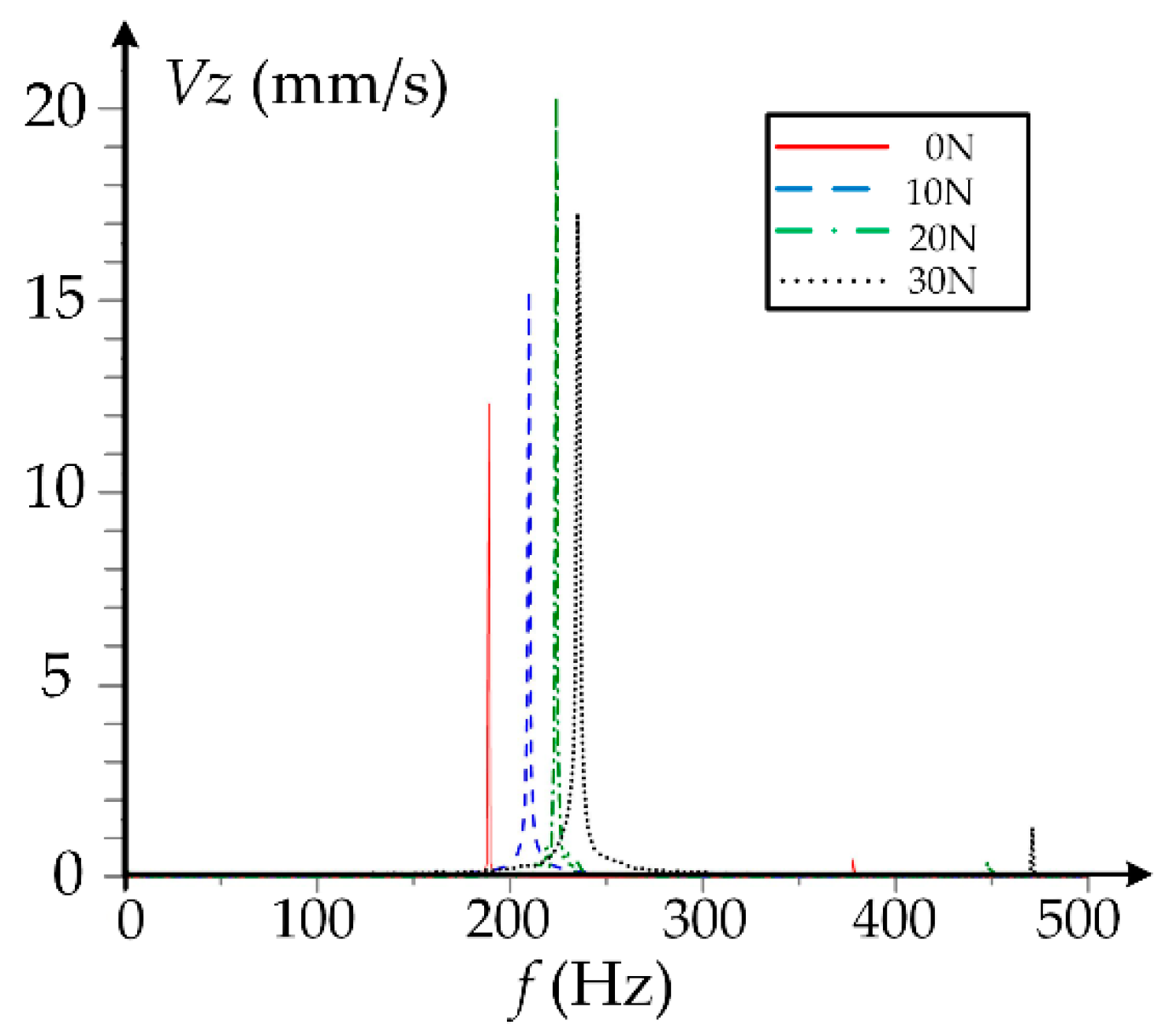
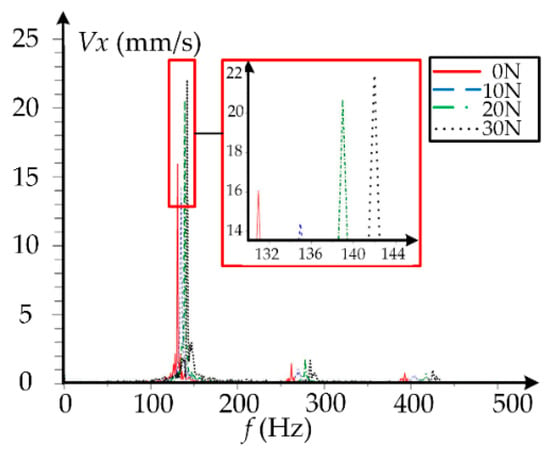
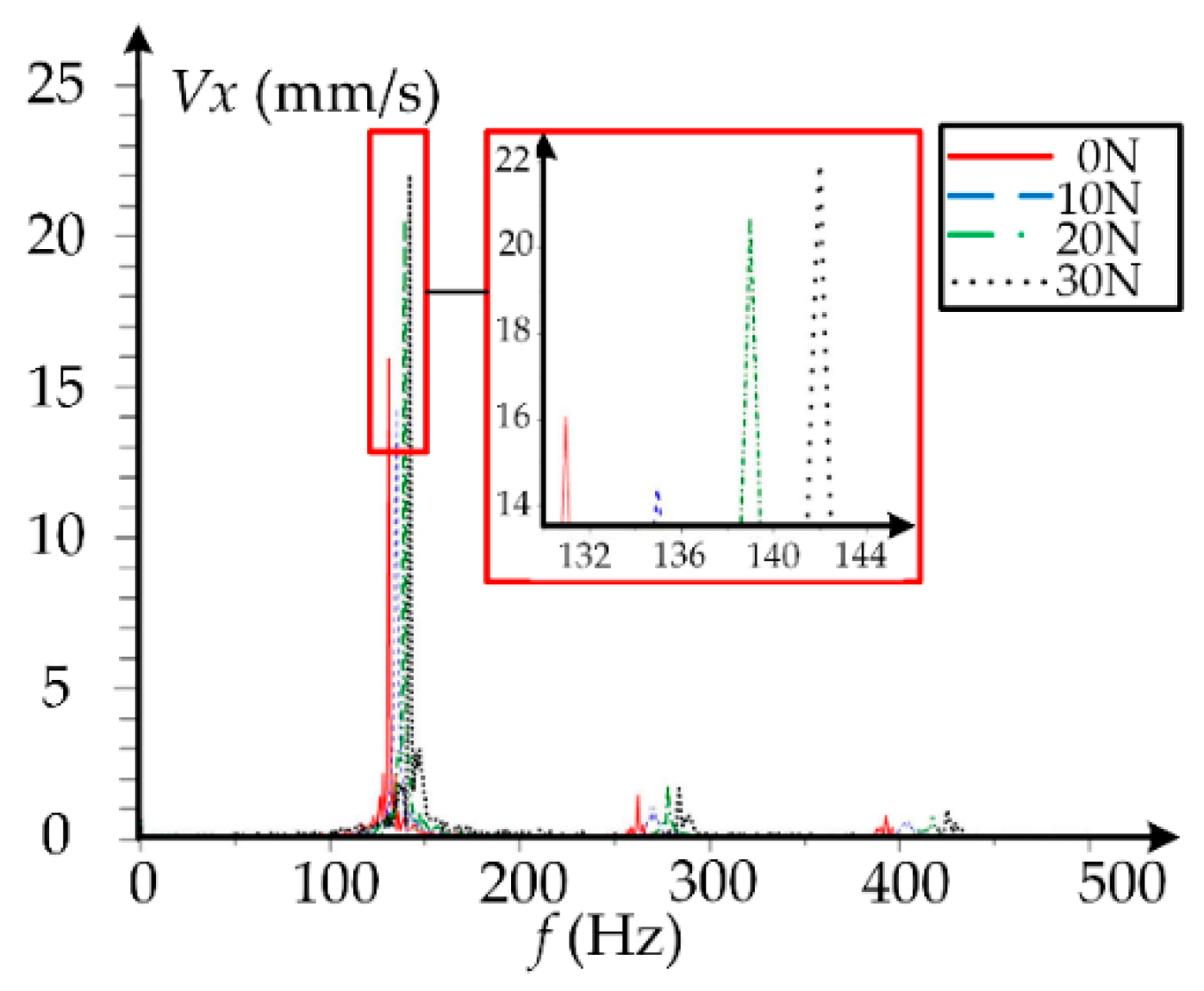
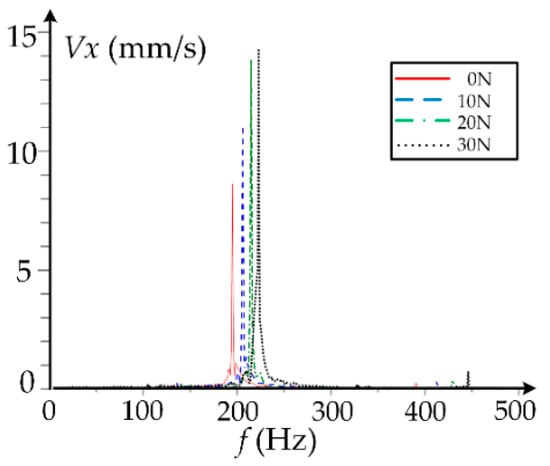
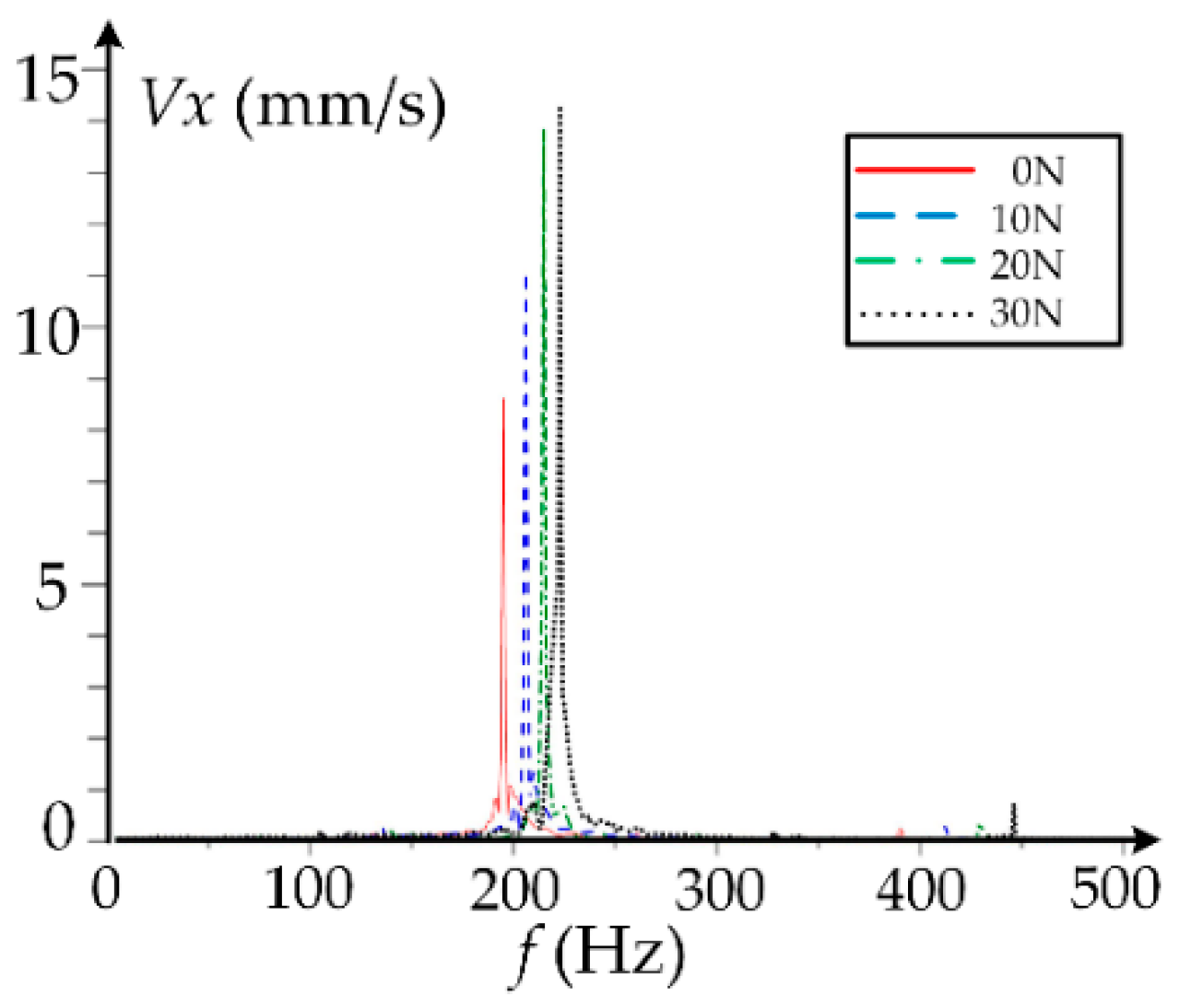
In order to obtain the detailed variation of vibration, L = 1.1, 1.3, 1.5, 1.7, and 1.9 were selected to represent the amount of lubricant for analysis, and the bearing vibration conditions, in which different dimensionless inlet distances L are different, were studied. When the lubricating oil was sufficient with L = 1.9, the bearing vibration could be obtained from Equations (1)–(30). When the bearing ran in the starved conditions with L = 1.1 to 1.7, the vibration of the bearing could be obtained from Equations (1)–(6) and (13)–(36). The difference in the dynamic response under certain radial loads under different lubrication conditions is shown in Figure 6, Figure 7, Figure 8, Figure 9 and Figure 10. Assuming the rotation speed of the inner ring is 15,000 r/min, the radial force (Fz) was 10 N, 20 N, and 30 N, respectively.
Figure 6.
The bearing vibration under different radial loads when L = 1.1.
Figure 7.
The bearing vibration under different radial loads when L = 1.3.
Figure 8.
The bearing vibration under different radial loads when L = 1.5.
Figure 9.
The bearing vibration under different radial loads when L = 1.7.
Figure 10.
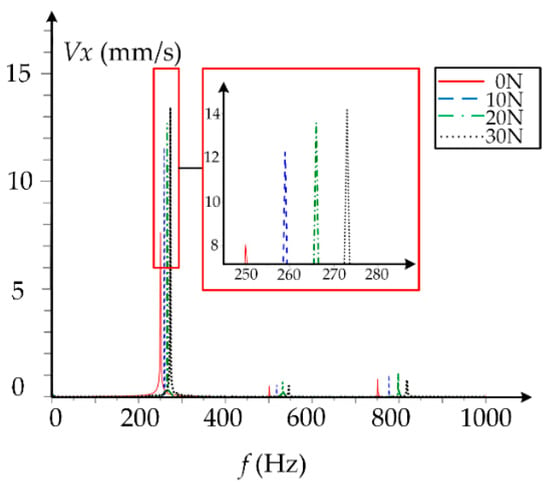
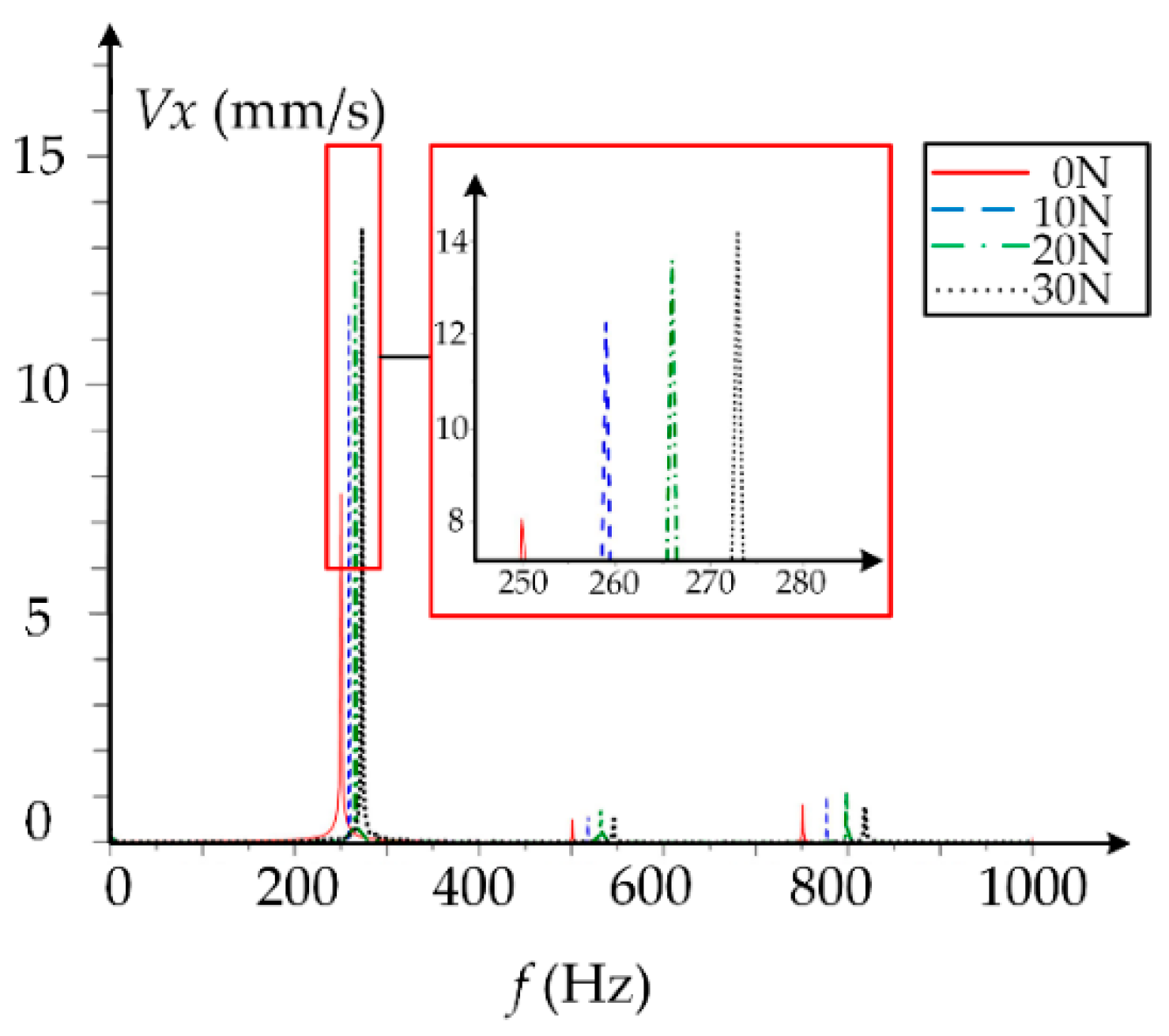
The bearing vibration under different radial loads when L = 1.9.
With the increase in oil content, the friction coefficient between the ball and inner ring decreased gradually, and the contact load distribution became uniform. These changes caused the vibration of the bearing inner ring to decrease slightly. In Figure 6, when the dimensionless inlet distance was small (L = 1.1), the bearing vibration amplitude could reach 32 mm/s. In Figure 7, the dimensionless inlet distance was set to 1.3 and the bearing vibration amplitude was 24 mm/s, which was lower than Figure 6. In Figure 8, Figure 9 and Figure 10, the maximum amplitudes were 19, 20, and 16. This shows that the amplitude of bearing vibration decreased slightly with the increase of oil amount. By comparison, the vibration amplitude of the bearing in Figure 6 was significantly smaller than that in Figure 10, which verifies the analysis results. As the oil amount increased, the trend of vibration amplitude decreased. This shows that the applied load had a greater influence on the bearing of starved lubrication conditions. Furthermore, it can be seen in Figure 6 and Figure 10 that the natural frequency of the bearing was considerably increased. This is explained by the fact that the natural frequency of the bearing is related to the stiffness. The oil film stiffness Koil between the ball and the raceway is expressed as:
The contact stiffness Kc between the ball and the raceway is expressed as:
where K is the contact coefficient between the ball and the raceway. Krij refers to the radial component of the comprehensive stiffness between the ball and the inner ring, and Kaij refers to the axial component of the comprehensive stiffness between the ball and the inner ring.
where (Koil)ij is the oil film stiffness of the jth ball and the inner ring and (Kc)ij is the contact stiffness between the jth ball and the inner ring. Bearing axial stiffness Ka and radial stiffness Kr can be expressed as:
The natural frequency of the bearing vibration can be expressed as:
where M is the mass of the bearing system.
When the thickness of the oil film was small, for example, L = 1.1, some balls could nor contact the raceway, and the contact stiffness Kc was 0. According to Equations (39)–(42), this shows that Krij, Kaij, Krej, and Kaej were also 0. Therefore, by calculating Equations (43) and (44), we can get the total stiffness. When the thickness of the oil film was large, for example, L = 1.9, all the balls could contact the raceway. By calculating (41) and (42), this shows that the stiffness at this time was greater than the stiffness at L = 1.1. According to Equations (45) and (46) that the greater the stiffness, the greater the natural frequency of the bearing. This phenomenon can be seen in Figure 6, Figure 7, Figure 8, Figure 9 and Figure 10. It can also be seen from Figure 6, Figure 7, Figure 8, Figure 9 and Figure 10 that the bearing vibration natural frequency increased with radial load. As a result, the increase in load increased the contact force between the ball and the raceway. As a result, the minimum oil film thickness was reduced, and the oil film stiffness increased.
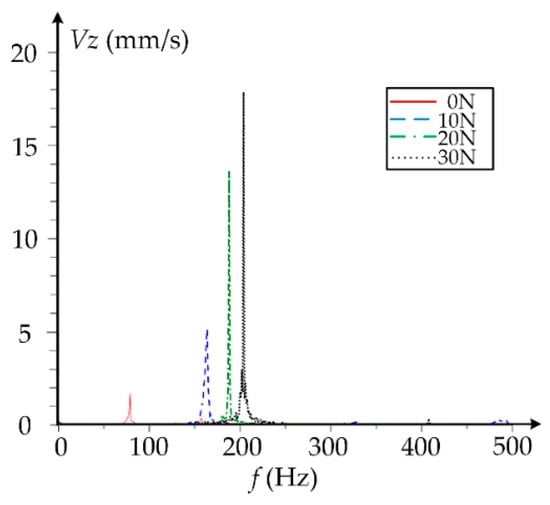
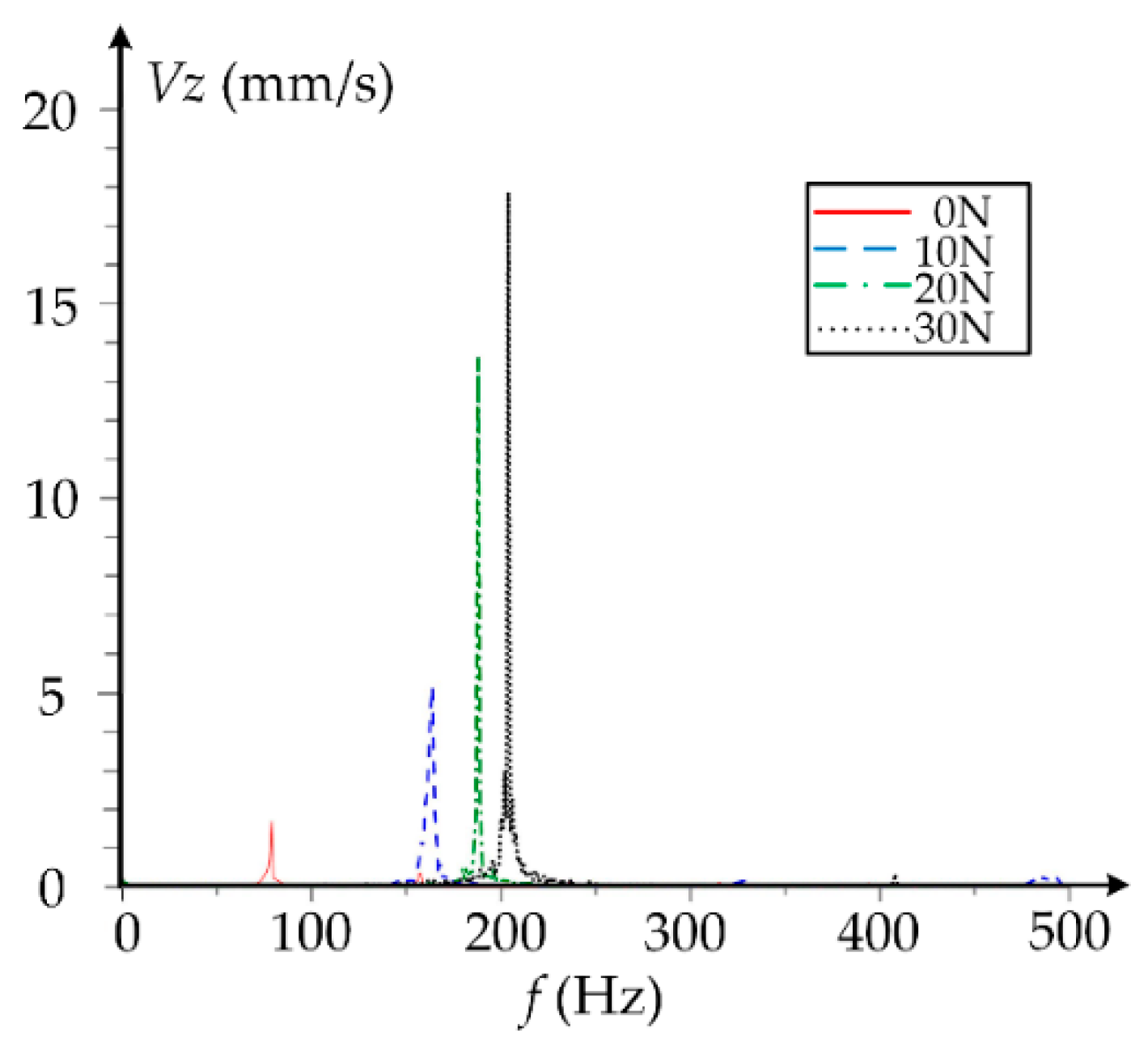
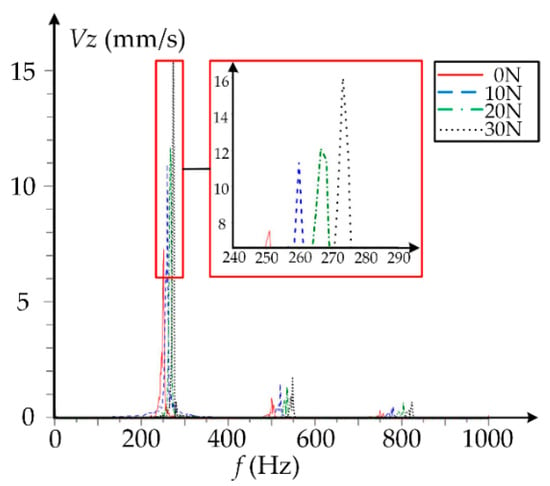
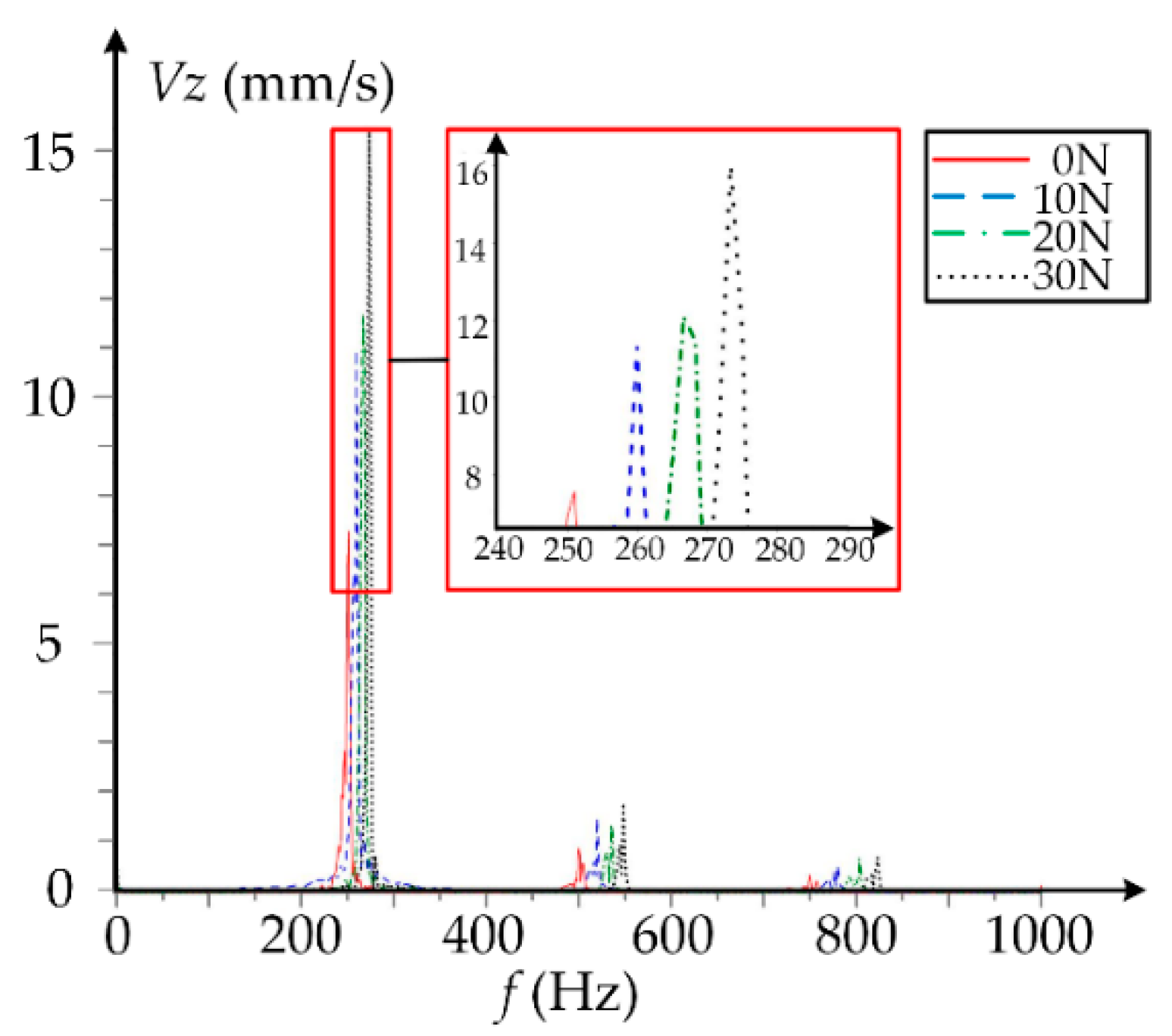
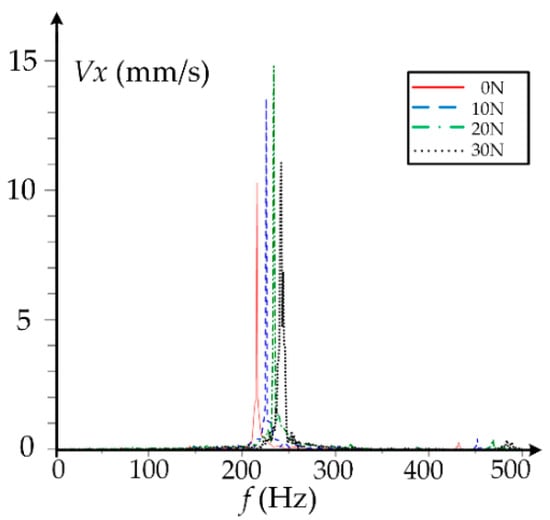
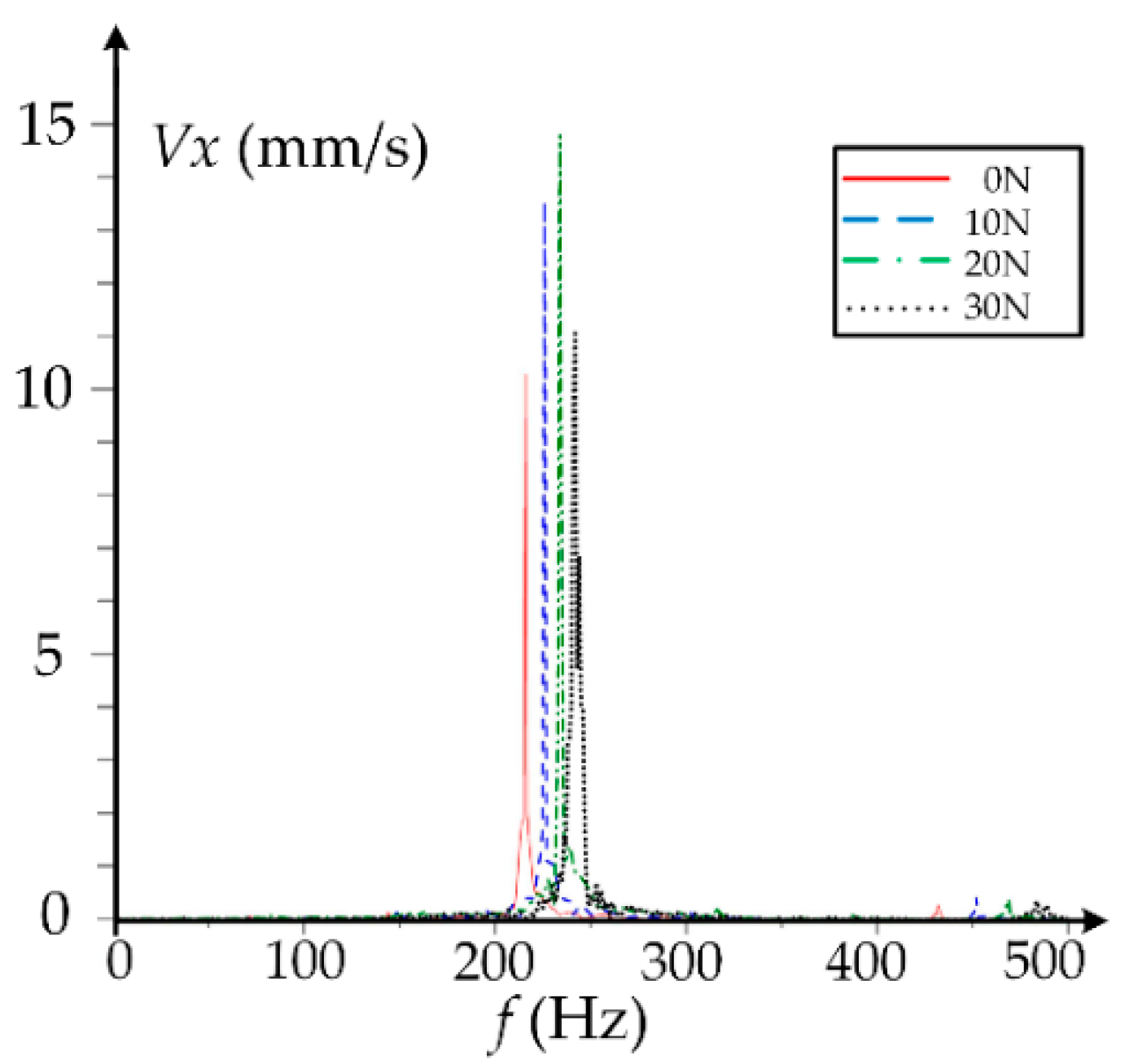
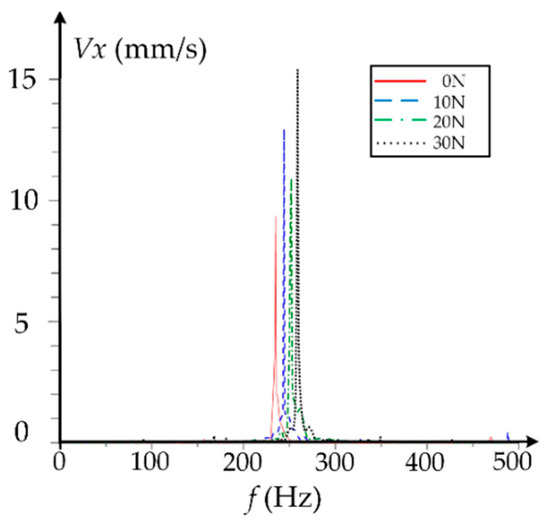
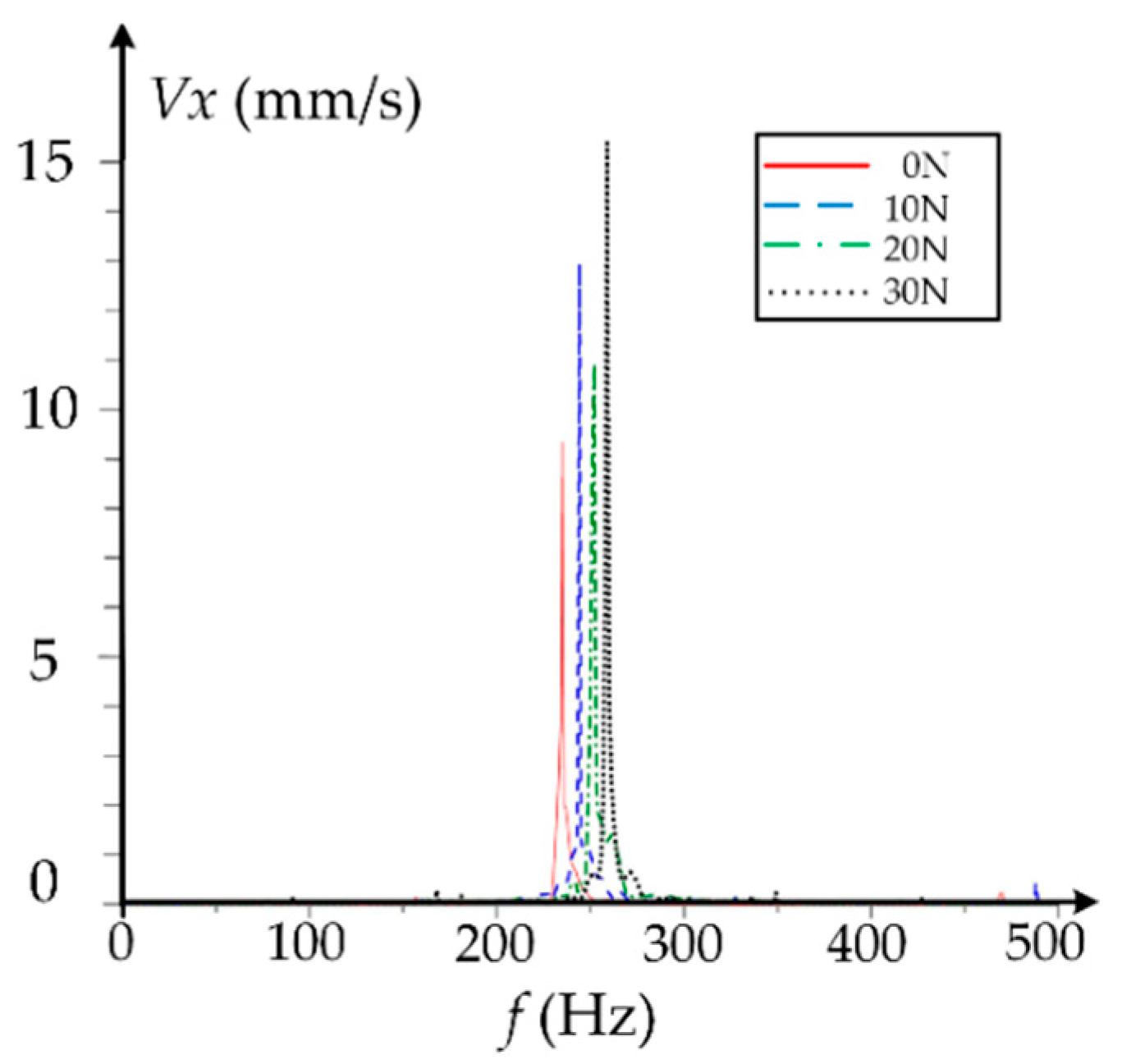
Assuming the rotation speed of the inner ring was 15,000 r/min, the axial force (Fx) was 10 N, 20 N, and 30 N, respectively, and the radial force (Fz) was 0 N. Figure 11, Figure 12, Figure 13, Figure 14 and Figure 15 show the relationship between the axial load of the bearing and the vibration of the bearing when the dimensionless inlet distance L was different.
Figure 11.
The bearing vibration under different axial loads when L = 1.1.
Figure 12.
The bearing vibration under different axial loads when L = 1.3.
Figure 13.
The bearing vibration under different axial loads when L = 1.5.
Figure 14.
The bearing vibration under different axial loads when L = 1.7.
Figure 15.
The bearing vibration under different axial loads when L = 1.9.
It can be observed from Figure 11, Figure 12, Figure 13, Figure 14 and Figure 15 that as the amount of oil increased, the amplitude of bearing vibration significantly reduced. The dominant frequency of the bearing increased as the oil quantity increased. These characteristics were the same as the changes in Figure 6, Figure 7, Figure 8, Figure 9 and Figure 10. As shown, during the increase, the bearing vibration decreased with a certain amount of force. According to Equation (1), the force generated in the bearing could be balanced when by applying a certain axial load, and the vibration of the bearing reduced. When the load continued to increase, it increased the bearing vibration. Therefore, for bearings with a given structure, there was a reasonable range of axial loads that made the bearings vibrate less during operation.
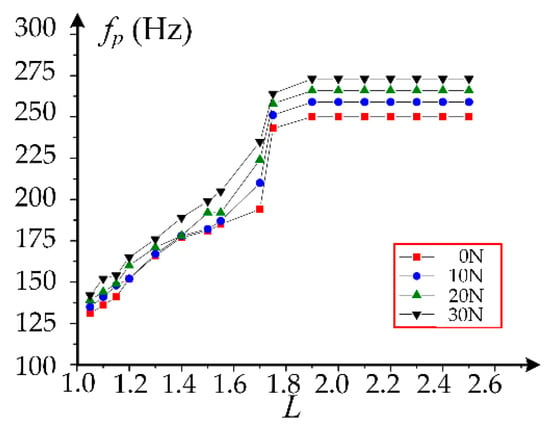
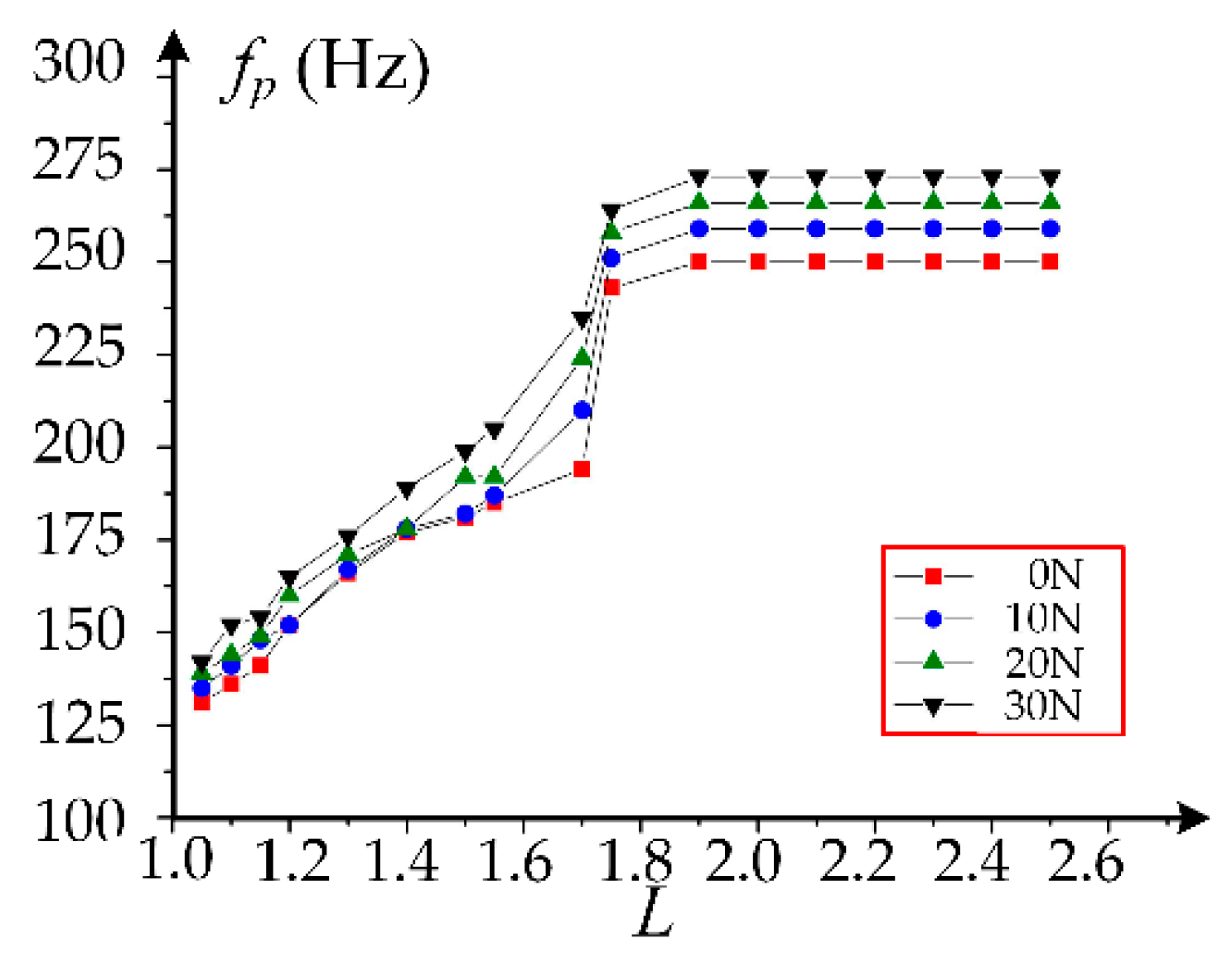
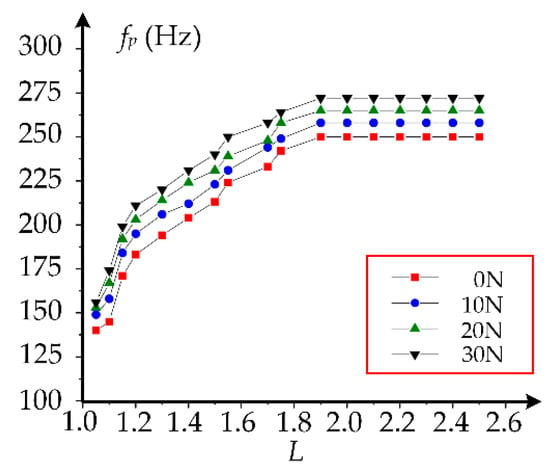
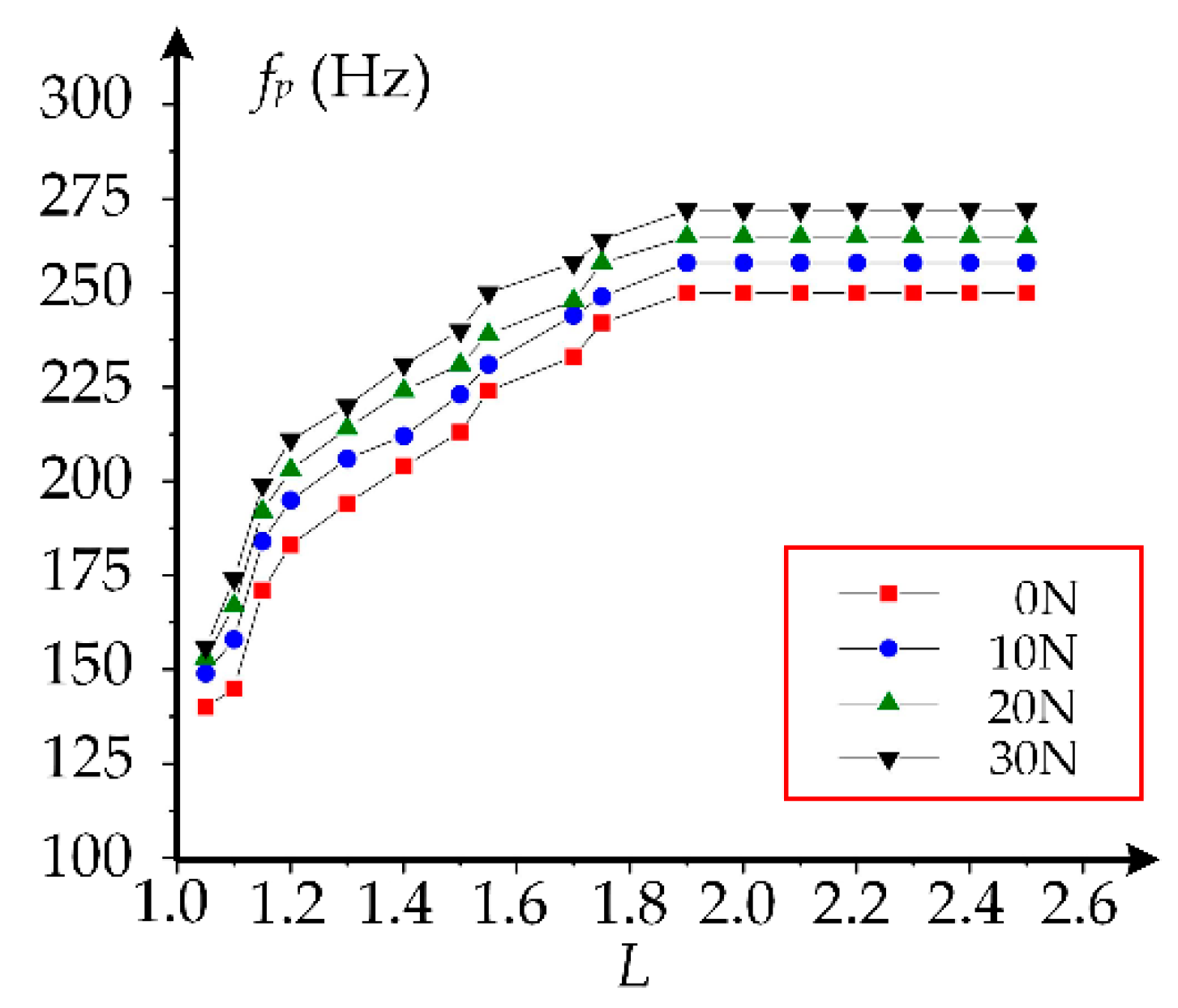
Figure 16 and Figure 17 show the relationship between the inlet distance and the peak vibration frequency fp of the bearing under different working conditions.
Figure 16.
Peak vibration frequency with different radial loads.
Figure 17.
Peak vibration frequency with different axial loads.
As the oil increased, the contact stiffness of the ball with the inner ring increased, resulting in an increase in the natural frequency of the bearing. When the amount of oil increased and L > L*, the oil film thickness did not change substantially, and the influence of the increase of the oil quantity on the rigidity became small. Therefore, the natural frequency of the bearing did not change any more, as shown in Figure 16 and Figure 17.
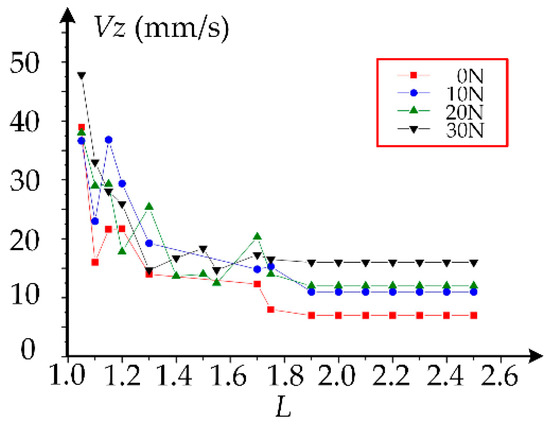
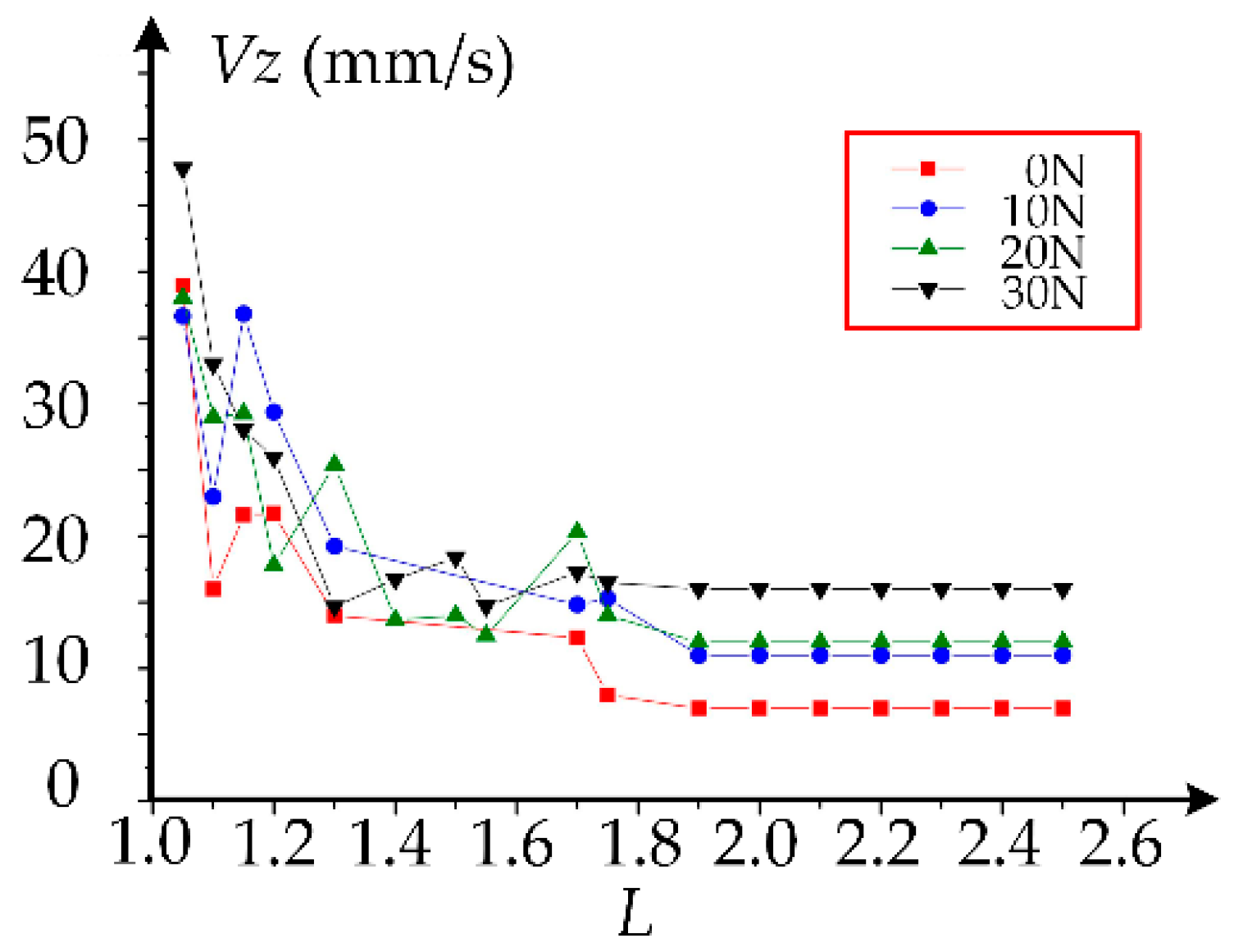
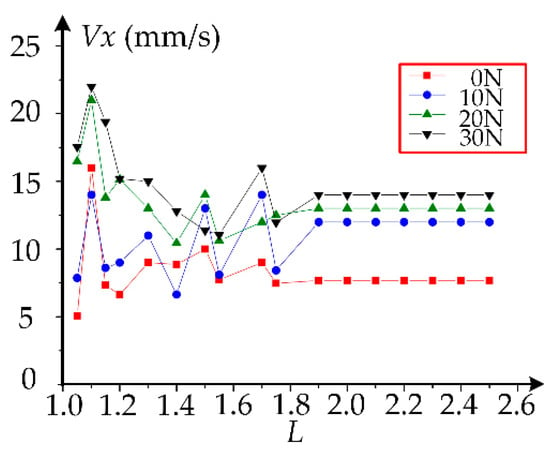
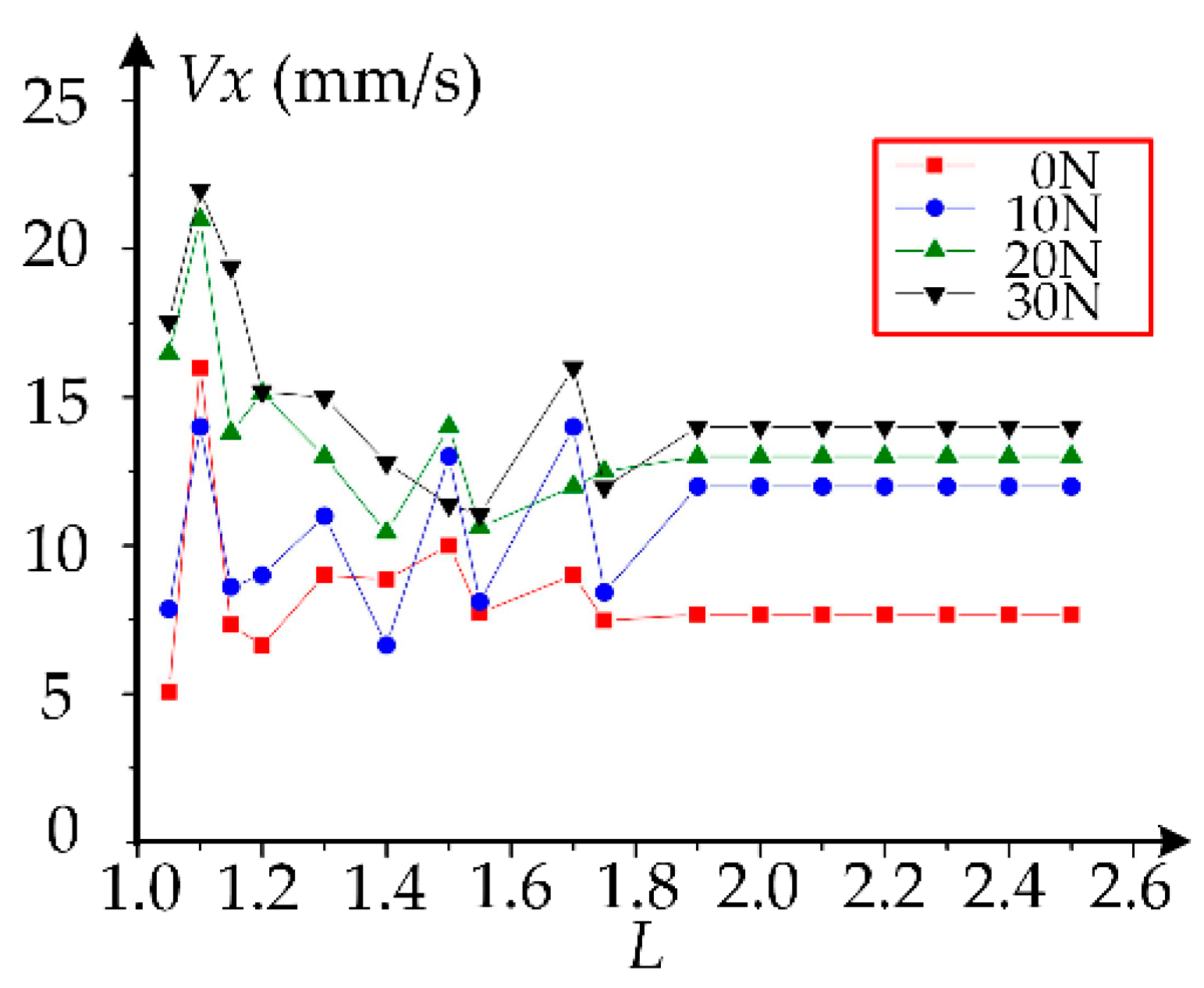
Figure 18 and Figure 19 show the relationship between the inlet distance and the amplitude of axial and radial vibration velocity of bearing vibration under different working conditions.
Figure 18.
The vibration amplitude with different radial loads.
Figure 19.
The vibration amplitudes with different axial loads.
When the oil film thickness was very small, the ball and the inner ring could be regarded to be in direct contact. The contact surface friction was enhanced, causing the bearing to generate a large amplitude of vibration. As the amount of lubricating oil increased, the oil film separated the ball from the raceway. The contact surface friction was reduced, the contact load distribution was uniform, and the amplitude of the bearing vibration gradually decreased. In Figure 18 and Figure 19, it can be obviously observed that as L increased, the vibration amplitude of the bearing greatly reduced. When the oil quantity increased to L > L*, there was no substantial change in oil film thickness. At this time, the influence of the increase of oil amount on the friction of the contact surface became small. Therefore, the vibration amplitude of the bearing no longer changed.
4. Discussion
By considering the lubrication in the differential equation of bearing dynamics, the influence of the amount of lubricant on the dynamic characteristics of the bearing can be obtained, as well as the degree of influence of the amount of lubricant on the vibration of the bearing inner ring under different external loads. This paper is based on the critical inlet distance L* defined by Hamrock [26] to determine whether the bearing is starved. According to Figure 16, Figure 17, Figure 18 and Figure 19 the lines trend changed at the boundary between fully flooded and starved conditions. This indicates that the bearing vibration changed under starvation and full flooding. In the absence of oil, factors such as uneven contact between the ball and the inner ring can have a greater impact on bearing vibration. The degree of changing in bearing vibration with load was also more pronounced. The contact force and friction between the inner ring and the ball increased because of starved lubrication. The contact force between the ball and the inner ring was stronger, and the vibration of the inner ring increased. Lubrication increased the contact stiffness of the contact pairs in the bearing, and the natural frequency of the bearing vibration also increased. In the case of a sufficient amount of oil, the thickness of the oil film substantially unchanged. The contact load between the ball and the inner ring was evenly distributed, and the frictional force decreased to gradually reduce the bearing vibration and reach a steady state. The contact stiffness of the contact pair in the bearing tended to be stable, so the inherent frequency of the bearing vibration did not change.
5. Conclusions
This paper proposes a bearing dynamic model that considers the change of the lubrication parameters and conducts investigations on the bearing vibration based on the models. The results show that the vibration conditions of the bearing under the starved lubricated conditions are different from those with enough oil. In the case of oil starvation, factors such as non-uniform contact between the ball and inner ring have a greater impact on bearing vibration. The bearing vibration decreases as the oil flow increases, and the bearing vibration can be minimized when the amount of lubricant is just enough to prevent a substantial reduction in the minimum film thickness. Furthermore, the peak frequencies also increase with the oil flow, and the growth flattens as the oil continues to increase towards fully flooded. This study obtained the impact of lubricant supply on bearing vibration and provided theoretical foundations to the application of full ceramic bearings.
Author Contributions
Conceptualization, K.Z. and X.B.; formal analysis, K.Z. and X.W.; funding acquisition, K.Z. and X.B.; investigation, X.W.; methodology, Z.W. and X.B.; resources, K.Z. and D.Z.; supervision, K.Z. and X.B.; validation, J.S. and D.Z.; visualization, X.W.; writing—original draft, X.W.; writing—review and editing, K.Z. and X.B. All authors have read and agreed to the published version of the manuscript.
Funding
This research was funded by the National Key R&D Program of China [grant number 2017YFC0703903], National Natural Science Foundations of China [grant number 51675353, 51905357] and Scientific Research Project of Liaoning Provincial Department of Education [grant number lnqn201909].
Acknowledgments
This work got support from the researchers in the laboratory of ceramic motorized spindle of Shenyang Jianzhu University and the funders. The authors are thankful for their help during the research.
Conflicts of Interest
The authors declare no conflict of interest.
Nomenclature
| a | The long half axis of the ellipse |
| b | The short half axis of the ellipse |
| D | The normal ball diameter |
| d | The pitch diameter of the bearing |
| e | The constant of nature |
| E | Equivalent elastic modulus |
| E1, E2 | Elastic moduli of the two contact materials |
| Fx, Fy, Fz | Components externally applied forces of X, Y, and Z directions |
| FRηij, FRηej, FRξij, FRξej | Hydrodynamic frictional forces at the inlet zone |
| Fηj, Fτj | Inertial force component of the ball |
| FDj | Aerodynamic resistance acting on the ball by the gas–oil mixture; |
| fx, fy | The natural frequency of bearing vibration in axial and radial directions |
| G | Material parameter |
| Gyj, Gzj | Components of the ball’s inertia moment of ybj and zbj directions |
| hb | The oil film thickness at the lubrication inlet |
| Hc | A dimensionless central oil film thickness |
| hc | The central oil film thickness |
| hmin | The minimum oil film thickness |
| hc1 | The actual central oil film thickness |
| Ibj | Moments of inertia of the jth ball |
| Iix, Iiy, Iiz | The principal moments of inertia of the inner ring in the inertial coordinate system |
| Jx, Jy, Jz | Components of the ball’s moment of inertia of xbj, ybj, and zbj directions |
| j | The jth ball |
| Koil | The oil film stiffness between the ball and the raceway |
| Kc | The contact stiffness |
| K | The contact coefficient between the ball and the raceway |
| Krij | The radial component of the comprehensive stiffness between the jth ball and the inner ring |
| Kaij | The axial component of the comprehensive stiffness between the jth ball and the inner ring |
| Kaej | The axial component of the comprehensive stiffness between the jth ball and the outer ring |
| Krej | The radial component of the comprehensive stiffness between the jth ball and the outer ring |
| (Koil)ij | The oil film stiffness of the jth ball and the inner ring |
| (Koil)ej | The oil film stiffness of the jth ball and the outer ring |
| (Kc)ij | The contact stiffness between the jth ball and the inner ring |
| (Kc)ej | The contact stiffness between the jth ball and the outer ring |
| Ka | Axial stiffness |
| Kr | Radial stiffness |
| k | Ellipticity |
| L | The dimensionless distance between the inlet and the Hertz contact center |
| L* | The boundary between fully flooded and starved |
| My, Mz | Externally applied torques |
| mi | Mass of the inner ring |
| mb | Mass of the ball |
| M | Mass of the bearing system |
| {O; X, Y, Z} | The inertial coordinate system of the bearing |
| {O; Xi, Yi, Zi} | The inner ring coordinate system of the bearing |
| {Obj; Xbj, Ybj, Zbj} | The coordinate system of the jth ball |
| PRηj, PRξj | Rolling frictional forces acting on the ball’s surface |
| PSηj, PSξj | Sliding frictional forces acting on the ball’s surface |
| Qij, Qej | Normal contact forces between the ball and raceway |
| Qcj | Collision force between the jth ball and the cage |
| Qv | The supplied oil flow rate |
| Q | Normal contact force between the ball and raceway |
| rij | The rolling radius |
| Ri | Groove curvature radius of inner race raceway |
| R | The equivalent radius of curvature |
| Rx | The equivalent radius of curvature in the long axis direction |
| Ry | The equivalent radius of curvature in the short axis direction |
| r | The inner ring radius |
| Tηij, Tηej, Tξij, Tξej | Traction forces of the contact surfaces |
| u | The average surface velocity |
| U | Velocity parameter |
| v1 and v2 | Poisson’s ratios of the two contact materials |
| W | Load parameter |
| The acceleration of the inner ring in the inertial coordinate system | |
| Displacement accelerations of the jth ball in the inertial coordinate system | |
| Xb | The actual distance between the inlet and the Hertz contact center |
| αij, αej | Contact angles between the ball and raceway |
| α0 | The pressure index of viscosity |
| δ | The contact deformation between the ball and the inner ring |
| η | The short axis of the ellipse |
| η0 | The dynamic viscosity at normal pressure |
| τ | The kinematic viscosity of the lubricating oil |
| The azimuth of the jth ball | |
| ξ | The long axis of the ellipse |
| Orbit speed of the jth ball in the inertial coordinate system | |
| ω | The angular velocity of the inner ring |
| Represent the angular velocity of the inner ring in the inertial coordinate system | |
| The angular accelerations of the inner ring in the inertial coordinate system | |
| ωxj, ωyj, ωzj | The angular velocity of the jth ball in {Obj; Xbj, Ybj, Zbj} |
| The angular accelerations of the jth ball in {Obj; Xbj, Ybj, Zbj} | |
| ωbjx, ωbjy, ωbjz | The angular velocities of the jth ball in the inertial coordinate system |
| The angular accelerations of the jth ball in the inertial coordinate system | |
| Subscript i | Represents the inner ring |
| Subscript e | Represents the outer ring |
References
- Wu, Y.H.; Zhang, L.X.; Zhang, K.; Li, S.H. Design on High-Speed Precision Grinder. Key Eng. Mater. 2006, 304, 492–496. [Google Scholar] [CrossRef] [Scilit]
- Li, S.H.; Wu, Y.H.; Zhang, K. Parameter Optimization for Oil/Air Lubrication of High Speed Ceramic Motorized Spindle without Bearing Inner Rings. Appl. Mech. Mater. 2010, 37, 839–843. [Google Scholar] [CrossRef] [Scilit]
- Tiwari, M.; Gupta, K.; Prakash, O. Dynamic response of an unbalanced rotor supported on ball bearings. J. Sound Vib. 2000, 238, 757–779. [Google Scholar] [CrossRef] [Scilit]
- Harsha, S.P. Nonlinear dynamic response of a balanced rotor supported by rolling element bearings due to radial internal clearance effect. Mech. Mach. Theory 2006, 41, 688–706. [Google Scholar] [CrossRef] [Scilit]
- Tripathi, J.S.; Agrawal, J.F. Development of Analytical Model of Ball Bearings for EHL Contact. IJRMEE 2018, 5, 5–12. [Google Scholar]
- Shi, H.T.; Bai, X.T. Model-based uneven loading condition monitoring of full ceramic ball bearings in starved lubrication. Mech. Syst. Signal Pr. 2020, 139, 106583. [Google Scholar] [CrossRef] [Scilit]
- Nonato, F.; Cavalca, K.L. An approach for including the stiffness and damping of elastohydrodynamic point contacts in deep groove ball bearing equilibrium models. J. Sound Vib. 2014, 333, 6960–6978. [Google Scholar] [CrossRef] [Scilit]
- Shi, H.T.; Bai, X.T.; Zhang, K.; Wang, Z.N.; Liu, Z.M. Spalling localization on the outer ring of hybrid ceramic ball bearings based on the sound signals. IEEE Access 2019, 7, 134621–134634. [Google Scholar] [CrossRef] [Scilit]
- Bai, X.T.; Wu, Y.H.; Zhang, K.; Chen, C.Z.; Yan, H.P. Radiation noise of the bearing applied to the ceramic motorized spindle based on the sub-source decomposition method. J. Sound Vib. 2017, 410, 35–48. [Google Scholar] [CrossRef] [Scilit]
- Zhang, W.H.; Deng, S.E.; Chen, G.D.; Cui, Y.C. Study on the impact of roller convexity excursion of high-speed cylindrical roller bearing on roller’s dynamic characteristics. Mech. Mach. Theory 2016, 103, 21–39. [Google Scholar] [CrossRef] [Scilit]
- Cui, Y.C.; Zhang, W.H.; Deng, S.E.; Chen, G.D. The impact of roller dynamic unbalance of high-speed cylindrical roller bearing on the cage nonlinear dynamic characteristics. Mech. Mach. Theory 2017, 118, 65–83. [Google Scholar]
- Bai, X.T.; Wu, Y.H.; Rosca, I.C.; Zhang, K.; Shi, H.T. Investigation on the effects of the ball diameter difference in the sound radiation of full ceramic bearings. J. Sound Vib. 2019, 450, 231–250. [Google Scholar] [CrossRef] [Scilit]
- Shah, D.S.; Patel, V.N. A Dynamic Model for Vibration Studies of Dry and Lubricated Deep Groove Ball Bearings Considering Local Defects on Races. Measurement 2019, 137, 535–555. [Google Scholar] [CrossRef] [Scilit]
- Adiyanto, O.; Pratama, P.S.; Choi, W. Tribological characteristics of SCM 440 bearing steel under gas and oil lubricant in the cylinder block tractor engine. Ind. Lubr. Tribol. 2018, 70, 1361–1366. [Google Scholar] [CrossRef] [Scilit]
- Fischer, D.; Jacobs, G.; Stratmann, A.; Burghardt, G. Effect of base oil type in grease composition on the lubricating film formation in EHD contacts. Lubricants 2018, 6, 32. [Google Scholar] [CrossRef] [Scilit]
- Jablonka, K.; Glovnea, R.; Bongaerts, J. Quantitative measurements of film thickness in a radially loaded deep-groove ball bearing. Tribol. Int. 2018, 119, 239–249. [Google Scholar] [CrossRef] [Scilit]
- Kostal, D.; Sperka, P.; Krupka, I.; Hartl, M. Experimental Comparison of the Behavior between Base Oil and Grease Starvation Based on Inlet Film Thickness. Tribol. Ind. 2017, 39, 110–119. [Google Scholar] [CrossRef] [Scilit]
- Liu, Z.; Meng, X.; Wen, C.; Yu, S.; Zhou, Z. On the oil-gas-solid mixed bearing between compression ring and cylinder liner under starved lubrication and high boundary pressures. Tribol. Int. 2019, 105869. [Google Scholar] [CrossRef] [Scilit]
- Nogi, T. An analysis of starved EHL point contacts with reflow. Tribol. Online 2015, 10, 64–75. [Google Scholar] [CrossRef] [Scilit]
- Vengudusamy, B.; Kuhn, M.; Rankl, M.; Spallek, R. Film forming behavior of greases under starved and fully flooded EHL conditions. Tribol. Trans. 2016, 59, 62–71. [Google Scholar] [CrossRef] [Scilit]
- Fischer, D.; Mues, H.; Jacobs, G.; Stratmann, A. Effect of Over Rolling Frequency on the Film Formation in Grease Lubricated EHD Contacts under Starved Conditions. Lubricants 2019, 7, 19. [Google Scholar] [CrossRef] [Scilit]
- Bijani, D.; Deladi, E.; de Rooij, M.; Schipper, D. The influence of surface texturing on the film thickness in starved lubricated parallel sliding contacts. Lubricants 2018, 6, 61. [Google Scholar] [CrossRef] [Scilit]
- Tanaka, M. Journal bearing performance under starved lubrication. Tribol. Int. 2000, 33, 259–264. [Google Scholar] [CrossRef] [Scilit]
- Maruyama, T.; Saitoh, T. Relationship between supplied oil flow rates and oil film thicknesses under starved elastohydrodynamic lubrication. Lubricants 2015, 3, 365–380. [Google Scholar] [CrossRef] [Scilit]
- Ebner, M.; Yilmaz, M.; Lohner, T.; Michaelis, K.; Höhn, B.-R.; Stahl, K. On the effect of starved lubrication on elastohydrodynamic (EHL) line contacts. Tribol. Int. 2018, 118, 515–523. [Google Scholar] [CrossRef] [Scilit]
- Hamrock, B.J.; Dowson, D. Isothermal elastohydrodynamic lubrication of point contacts. 3. Fully flooded results. J. Lubr. Technol. 1977, 99, 64–76. [Google Scholar] [CrossRef] [Scilit]
- Hamrock, B.J.; Dowson, D. Isothermal elastohydrodynamic lubrication of point contacts, Part IV–Starvation results. J. Lubr. Technol. 1977, 99, 15–23. [Google Scholar] [CrossRef] [Scilit]
- Wedeven, L.D.; Evans, D.; Cameron, A. Optical analysis of ball bearing starvation. Mech. Eng. 1971, 93, 44–50. [Google Scholar] [CrossRef] [Scilit]
- Liu, C.L.; Guo, F.; Wong, P.L. Characterisation of starved hydrodynamic lubricating films. Tribol. Int. 2019, 31, 694–701. [Google Scholar] [CrossRef] [Scilit]
- Venner, C.H.; Zoelen, M.T.; Lugt, P.M. Thin layer flow and film decay modeling for grease lubricated rolling bearings. Tribol. Int. 2012, 47, 175–187. [Google Scholar] [CrossRef] [Scilit]
- Shi, H.T.; Bai, X.T.; Zhang, K.; Wu, Y.H.; Yue, G.D. Influence of uneven loading condition on the sound radiation of starved lubricated full ceramic ball bearings. J. Sound Vib. 2019, 461, 114910. [Google Scholar] [CrossRef] [Scilit]
- Mohammadpour, M.; Johns-Rahnejat, P.M.; Rahnejat, H.; Gohar, R. Boundary conditions for elastohydrodynamics of circular point contacts. Tribol. Lett. 2014, 53, 107–118. [Google Scholar] [CrossRef] [Scilit]

© 2020 by the authors. Licensee MDPI, Basel, Switzerland. This article is an open access article distributed under the terms and conditions of the Creative Commons Attribution (CC BY) license (http://creativecommons.org/licenses/by/4.0/).