Article

Building Reliable Massive Capacity SSDs through a Flash Aware RAID-Like Protection †

1
Department of Aerospace and Software Engineering & Engineering Research Institute, Gyeongsang National University, Jinju 52828, Korea
2
Department of Computer Software Engineering, Changshin University, Changwon 51352, Korea
*
Author to whom correspondence should be addressed.
This Paper Is an Extended Version of Paper Published in the IEEE International Conference on Consumer Electronics (ICCE) 2020, Las Vegas, NV, USA, 4–6 January 2020.
Appl. Sci. 2020, 10(24), 9149; https://doi.org/10.3390/app10249149
Submission received: 14 November 2020 / Revised: 16 December 2020 / Accepted: 16 December 2020 / Published: 21 December 2020
(This article belongs to the Section Computing and Artificial Intelligence)

Abstract

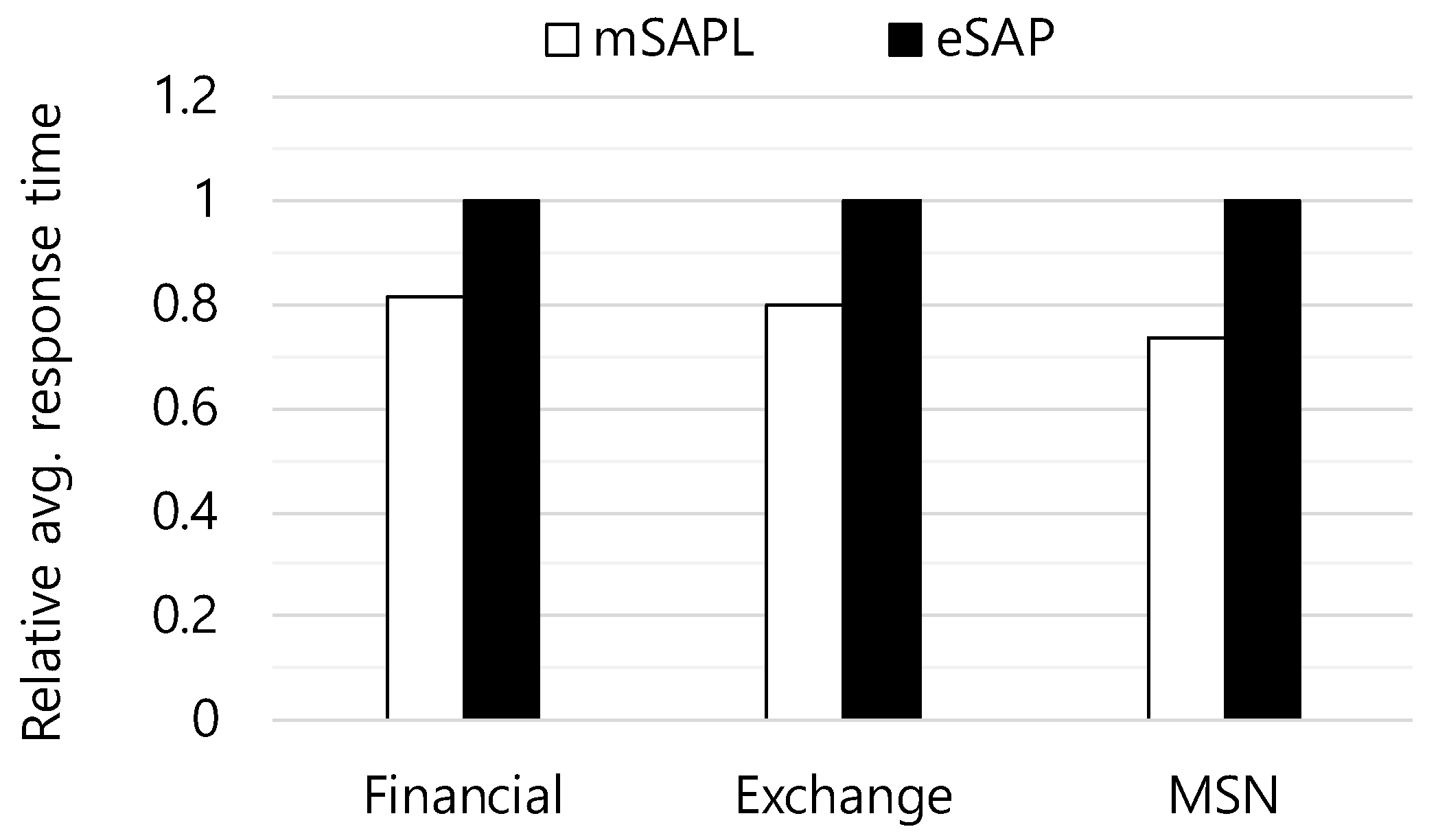
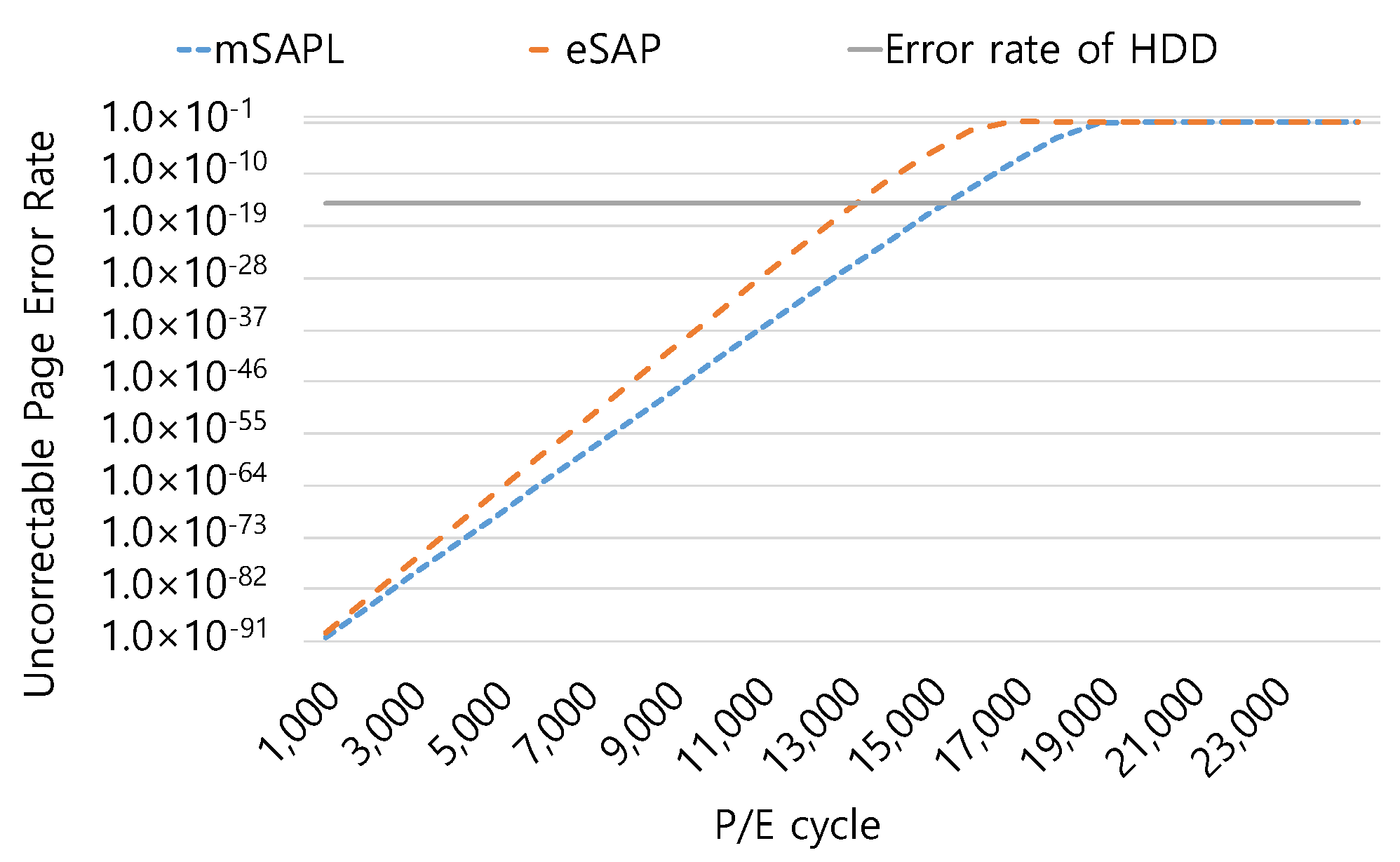
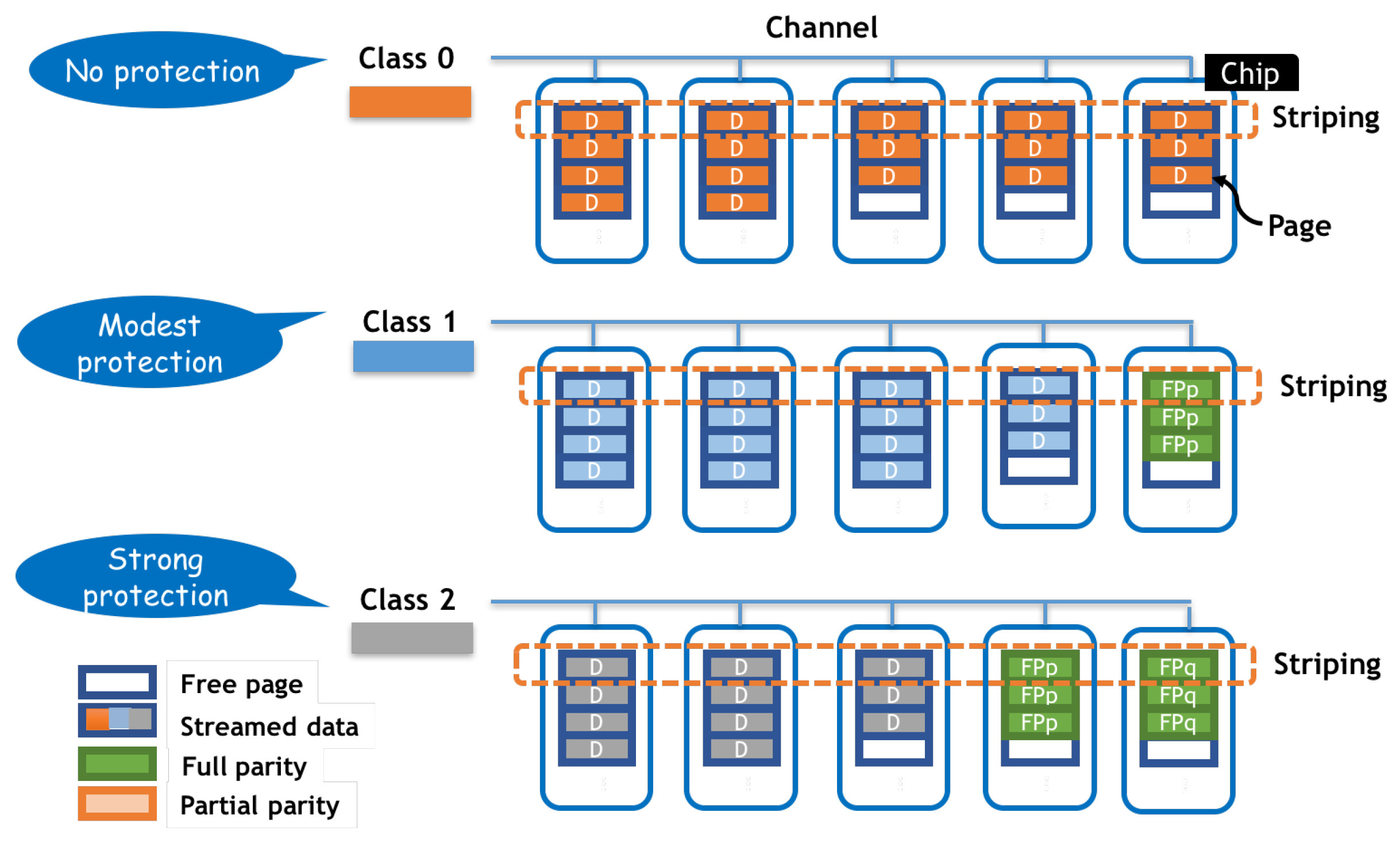
The demand for mass storage devices has become an inevitable consequence of the explosive increase in data volume. The three-dimensional (3D) vertical NAND (V-NAND) and quad-level cell (QLC) technologies rapidly accelerate the capacity increase of flash memory based storage system, such as SSDs (Solid State Drives). Massive capacity SSDs adopt dozens or hundreds of flash memory chips in order to implement large capacity storage. However, employing such a large number of flash chips increases the error rate in SSDs. A RAID-like technique inside an SSD has been used in a variety of commercial products, along with various studies, in order to protect user data. With the advent of new types of massive storage devices, studies on the design of RAID-like protection techniques for such huge capacity SSDs are important and essential. In this paper, we propose a massive SSD-Aware Parity Logging (mSAPL) scheme that protects against n-failures at the same time in a stripe, where n is protection strength that is specified by the user. The proposed technique allows for us to choose the strength of protection for user data. We implemented mSAPL on a trace-based simulator and evaluated it with real-world I/O workload traces. In addition, we quantitatively analyze the error rates of a flash based SSD for different RAID-like configurations with analytic models. We show that mSAPL outperforms the state-of-the-art RAID-like technique in the performance and reliability.
Keywords: NAND flash memory; SSDs (Solid State Drives); reliability; raw bit error rate NAND flash memory; SSDs (Solid State Drives); reliability; raw bit error rate