Article

A Relay Selection Protocol for UAV-Assisted VANETs


1
The Research & Development Institute of Northwestern Polytechnical University in Shenzhen, Shenzhen 518057, China
2
Department of Communication Engineering, Northwestern Polytechnical University, Xi’an 710072, China
3
State Key Laboratory of Integrated Services Networks, Xidian University, Xi’an 710072, China
4
Department of Computer Science, University of Victoria, Victoria, BC V8P 5C2, Canada
*
Author to whom correspondence should be addressed.
Appl. Sci. 2020, 10(23), 8762; https://doi.org/10.3390/app10238762
Submission received: 3 November 2020 / Revised: 2 December 2020 / Accepted: 4 December 2020 / Published: 7 December 2020

Abstract

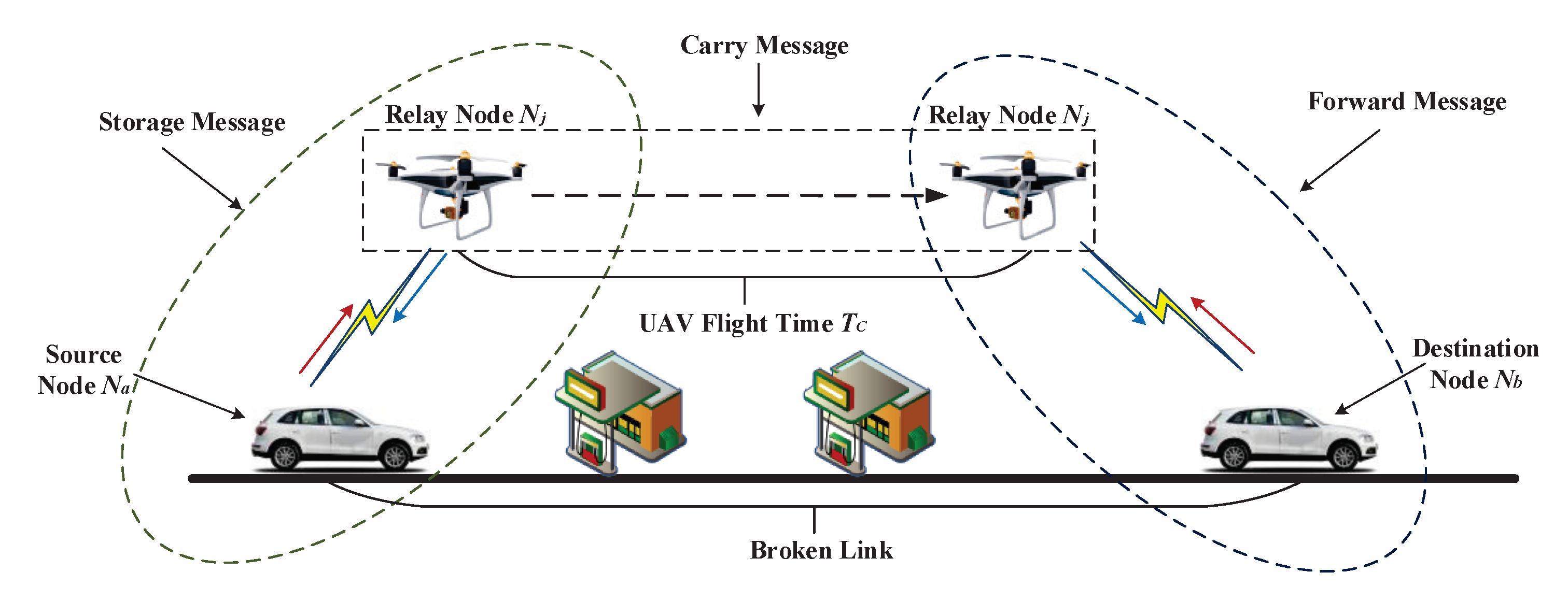
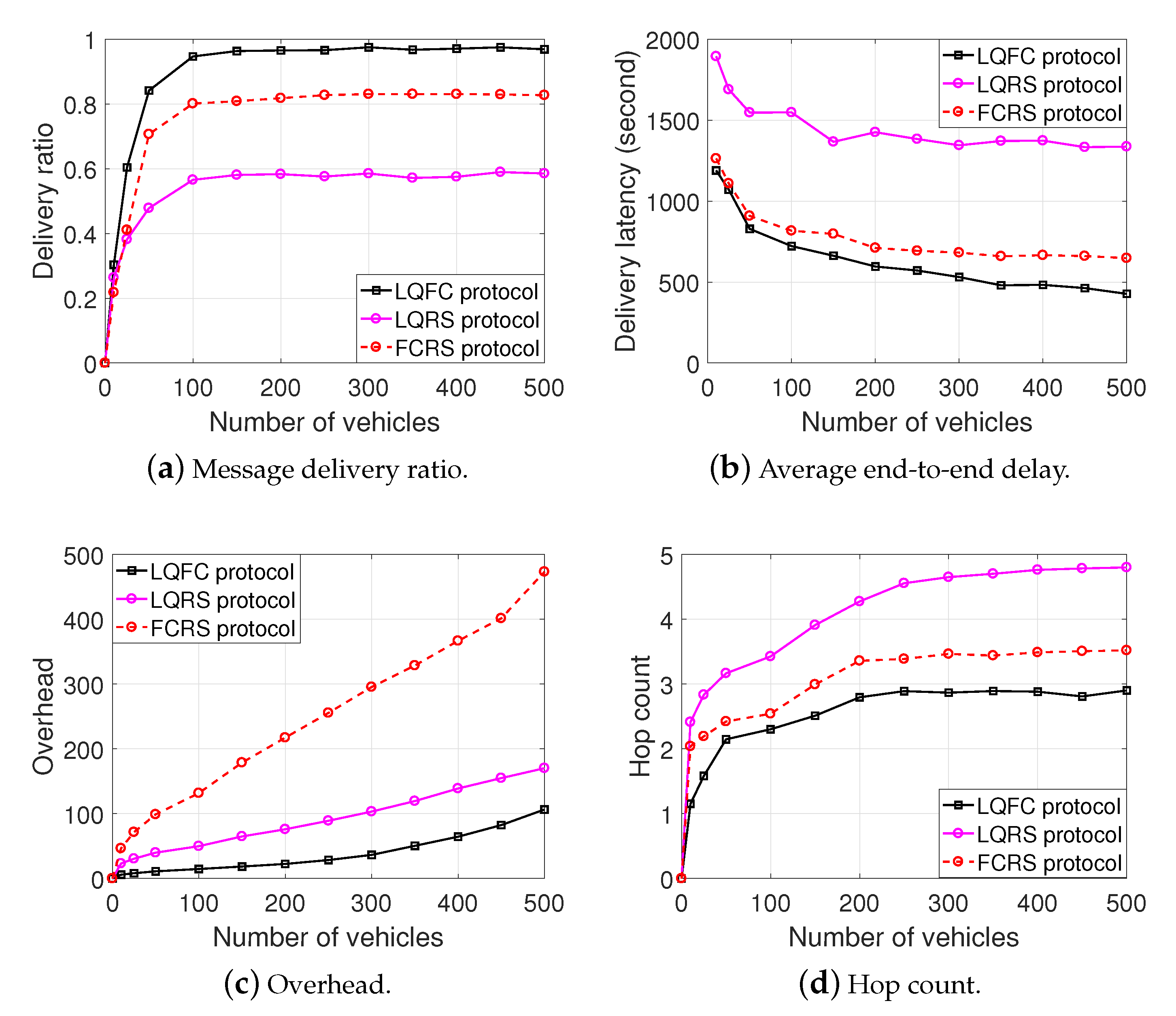
In this paper, we investigate the relay selection problem for the unmanned aerial vehicle (UAV)-assisted vehicular ad-hoc networks (VANETs). For the considered network, we first model and analyze the link quality of service (LQoS) from the source node (SN) to the neighbor node and the node forward capacity (NFC) from the neighbor node to the destination node (DN). Then, the relay selection problem is formulated as a multi-objective optimization problem by jointly considering the LQoS and the NFC. Afterward, we decompose the problem into two subproblems and propose a relay selection protocol with the storage-carry-forward (SCF) method. Moreover, we define a utility function with the node encounter frequency (NEF) and the message time-to-live (TTL) taken into account, based on which a redundant copy-deleting approach is devised. Furthermore, we analyze the security of the designed protocol. Finally, the simulation results demonstrate that the proposed relay selection protocol can improve the message delivery ratio, reduce the average end-to-end delay, and limit the overhead.
Keywords: relay selection; storage-carry-forward (SCF); unmanned aerial vehicle (UAV); vehicular ad-hoc networks (VANETs) relay selection; storage-carry-forward (SCF); unmanned aerial vehicle (UAV); vehicular ad-hoc networks (VANETs)