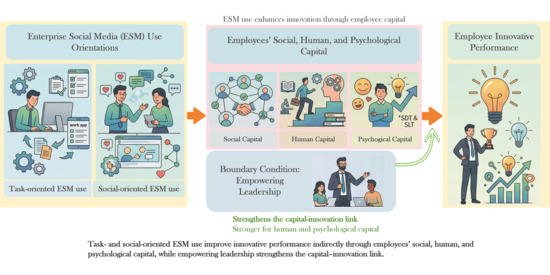
Enterprise Social Media Use and Employee Innovation: The Role of Employee Capital and Empowering Leadership

Abstract
1. Introduction
2. Theoretical Framework
2.1. Core Constructs
2.1.1. Enterprise Social Media
2.1.2. Employees’ Three Capitals
2.1.3. Innovative Performance (INNO)
2.1.4. Empowering Leadership (EL)
2.2. Theories
2.2.1. Self-Determination Theory
2.2.2. Social Learning Theory
2.2.3. Integrating Theories
2.3. Hypotheses Development
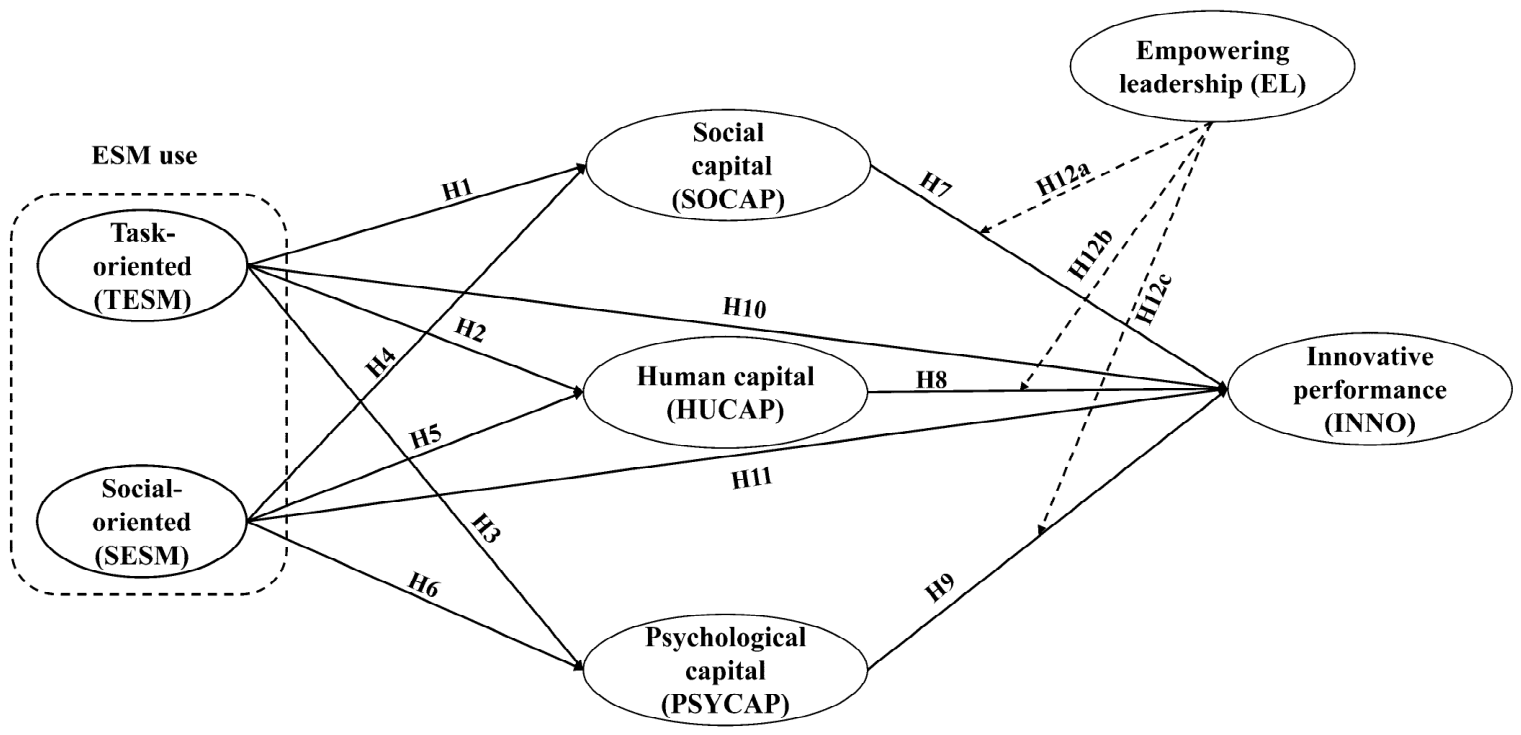
2.3.1. ESM Use and Employee Capitals (H1–H6)
2.3.2. Employee Capital and Employees’ Innovative Performance (H7–H9)
2.3.3. ESM Use and INNO (H10–H11)
2.3.4. Moderating Effects of Empowering Leadership (H12a–H12c)
2.3.5. Mediating Effects of Employee Capitals (H13)
3. Materials and Methods
3.1. Research Design
3.2. Sampling and Data Collection
3.3. Measures
3.4. Common Method Bias and Reliability Precautions
3.5. Data Analysis Strategy
3.6. Ethical Consideration
4. Results
4.1. Respondent Profile and Sample Overview
4.2. Measurement Model Assessment
4.3. Structural Model Assessment
4.3.1. Explanatory Power
4.3.2. Predictive Performance
4.4. Hypothesis Testing
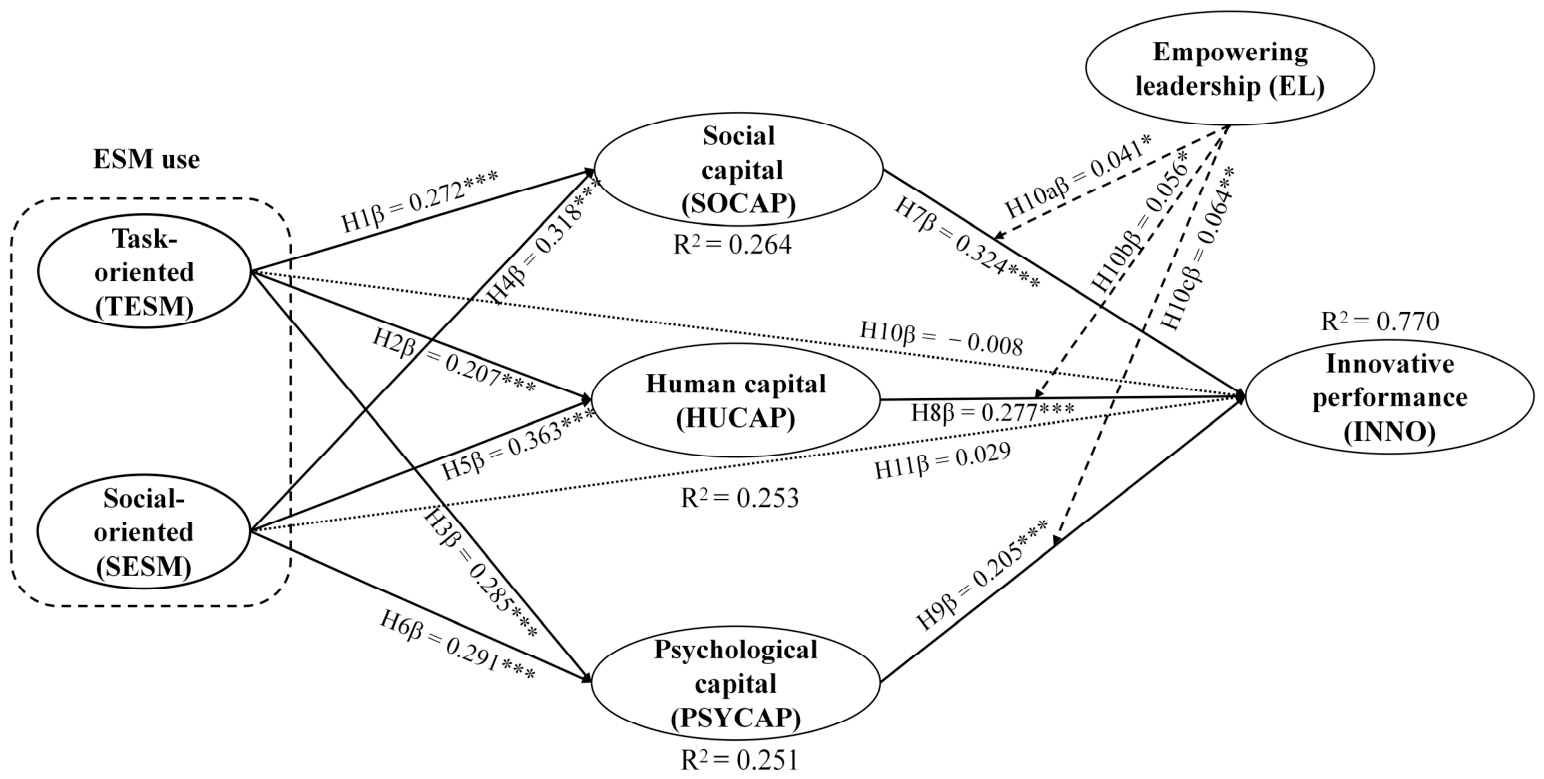
4.4.1. Direct Effects (H1–H11)
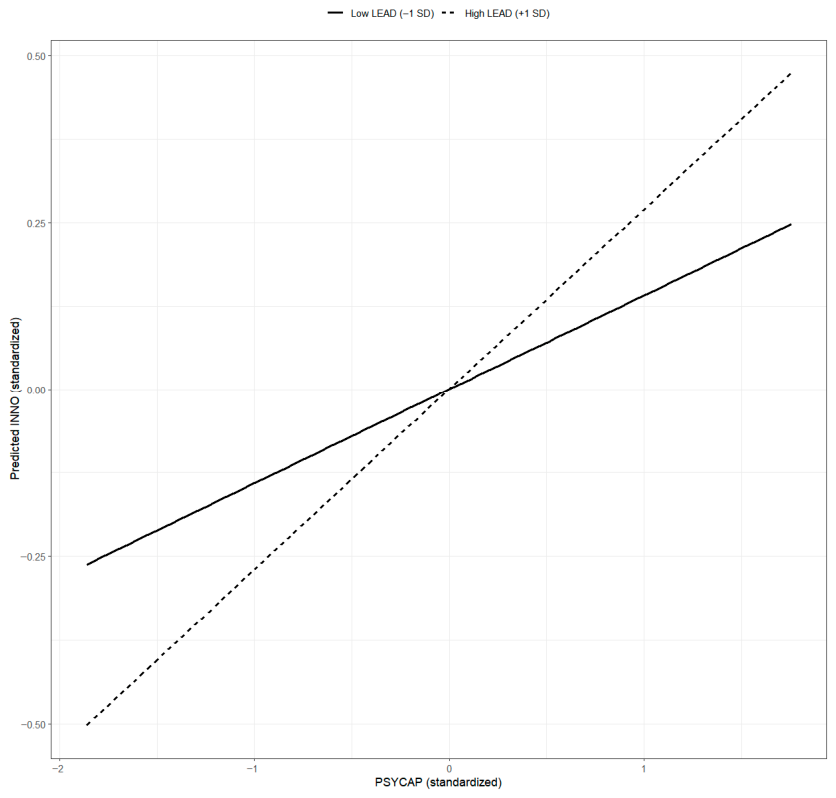
4.4.2. Moderation Effects (H12a–H12c)
4.4.3. Mediation Effects (H13)
4.5. Sensitivity Analyses and Robustness Checks
5. Discussion
5.1. Summary of Key Findings
5.2. General Discussion
5.2.1. Interpretation of TESM and SESM
5.2.2. The Role of SOCAP
5.2.3. The Role of HUCAP
5.2.4. The Role of PSYCAP
5.2.5. The Boundary Role of EL
5.2.6. Theoretical Implications
5.3. Practical Implications
5.3.1. Implications for Organizations Using ESM
5.3.2. Implications for Managers and Team Leaders
5.3.3. Implications for Employees and Work Teams
6. Conclusions
6.1. Contributions
6.1.1. Theoretical Contributions
- It distinguishes between task-oriented and social-oriented ESM use and shows their differentiated relationships with employees’ social, human, and psychological capital. This distinction addresses a gap in prior studies that have often focused on overall ESM use while paying less attention to the heterogeneous effects of different use orientations.
- It develops and tests a multi-capital indirect mediation framework, thereby clarifying the “black box” between ESM use and employee innovation. By examining SOCAP, HUCAP, and PSYCAP simultaneously, this study provides a more integrated explanation for the mixed findings in prior ESM–innovation research.
- It identifies the differentiated boundary role of EL in the resource-to-innovation process. The results suggest that EL is especially important for helping employees convert HUCAP and PSYCAP into innovative performance, while its moderating role in the SOCAP–INNO relationship is weaker. This extends the contingent view of EL in the context of digital collaborative innovation.
6.1.2. Practical Contributions
- For organizations, the findings suggest that ESM should be positioned as a resource-building infrastructure for innovation rather than merely as a communication tool. ESM evaluation should therefore focus not only on surface activity indicators, but also on whether the platform supports the accumulation of SOCAP, HUCAP, and PSYCAP.
- For managers, the findings clarify the practical focus of EL. Managers should reduce the perceived risk of experimentation and support employees in applying their knowledge and psychological resources to innovation rather than over-intervening in everyday social interaction and collaboration on ESM.
- For employees, the findings suggest a strategic path for ESM use. Employees can support their innovative performance by combining high-quality task-oriented participation with appropriate social-oriented interaction, thereby accumulating the social, human, and psychological resources required for innovation.
6.2. Limitations and Future Research
Supplementary Materials
Author Contributions
Funding
Institutional Review Board Statement
Informed Consent Statement
Data Availability Statement
Acknowledgments
Conflicts of Interest
Abbreviations
| ESM | Enterprise social media |
| TESM | Task-oriented enterprise social media use |
| SESM | Social-oriented enterprise social media use |
| SOCAP | Social capital |
| HUCAP | Human capital |
| PSYCAP | Psychological capital |
| EL | Empowering leadership |
| INNO | Innovative performance |
| SDT | Self-determination theory |
| SLT | Social learning theory |
Appendix A. Measurement Items/Questionnaire

| Constructs and Source | Dimensions | Coding | Question in English | Question Translated to Chinese |
|---|---|---|---|---|
| Task-oriented ESM use (Zhang et al., 2019) | TESM1 | I use ESM to organize my working files. | 我使用企业社交媒体来管理我的工作文件。 | |
| TESM2 | I use ESM to share information about organizational policies, procedures and organizational objectives with colleagues. | 我使用企业社交媒体来和同事们分享公司政策,流程和企业目标等信息。 | ||
| TESM3 | I use ESM to share my expertise in a particular area. | 我使用企业社交媒体来分享我在特定领域的专业知识。 | ||
| Social-oriented ESM use (Zhang et al., 2019) | SESM1 | I use ESM to organize social events with co-workers after working hours. | 我使用企业社交媒体来组织工作之外与同事们的社交活动。 | |
| SESM2 | I use ESM to make friends with my colleagues. | 我使用企业社交媒体来和同事们交朋友。 | ||
| SESM3 | I use ESM to take a break from work. | 我使用企业社交媒体来从工作中休息一会儿。 | ||
| SESM4 | I use ESM to find colleagues with similar interests. | 我使用企业社交媒体来找到志同道合的同事。 | ||
| Empowering Leadership (Ahearne et al., 2005) | Emphasize a sense of meaning in your work | EL1 | My leader helps me understand how my goals relate to the goals of my team. | 我的领导帮助我理解自己的目标与团队目标之间的关系。 |
| EL2 | My leader helps me understand the importance of my work to my team’s overall performance. | 我的领导帮助我明白了自己工作对于团队整体表现的重要性。 | ||
| EL3 | My leader helps me understand how my work fits into the big picture. | 我的领导帮助我理解了自己的工作如何融入整体大局之中。 | ||
| Encourage participation in team and organizational decisions | EL4 | My leader often involves me in making decisions. | 我的领导经常让我参与决策过程。 | |
| EL5 | My leader often consults with me when making important decisions. | 我的领导在做出重要决策时也会征求我的意见。 | ||
| EL6 | If a decision is likely to affect me, my leader will ask for my opinion. | 如果一项决策可能会影响到我,我的领导会征求我的意见。 | ||
| Expresses confidence in high performance | EL7 | My leader trusts me to handle difficult tasks. | 我的领导信任我能够处理困难的任务。 | |
| EL8 | Even when I made mistakes, my leader believed that my ability could improve. | 即使我犯了错误,我的领导也相信我的能力能够提升。 | ||
| EL9 | My leader has full confidence that I can perform the task well. | 我的领导完全相信我能出色地完成任务。 | ||
| Reduce administrative level constraints | EL10 | My leader allows me to work in my own way. | 我的领导允许我按照自己的方式工作。 | |
| EL11 | My leader tried to simplify the rules and regulations to improve my work efficiency. | 我的领导试图简化规章制度以提高工作效率。 | ||
| EL12 | My leader allows me to make big decisions quickly to deal with problems. | 我的领导允许我迅速做出重大决策来处理问题。 | ||
| Social Capital (Chiu et al., 2006; Nahapiet & Ghoshal, 1998) | Structural capital | SOCAP1 | I maintain a close social relationship with my colleagues in the department. | 我与部门内的同事们保持着密切的社交关系。 |
| SOCAP2 | I spend time interacting with my colleagues in the department. | 我花时间与部门内的同事们交流互动。 | ||
| SOCAP3 | I have a friendship with my colleagues in the department. | 我和部门内的同事们建立了友谊。 | ||
| SOCAP4 | I maintain close interaction with my colleagues in the department. | 我与部门内的同事们保持着密切的联系。 | ||
| Relational capital | SOCAP5 | My colleagues don’t take advantage of others, even when given the opportunity. | 我的同事们即使有机会也不会利用他人。 | |
| SOCAP6 | My colleagues always keep their promises to each other. | 我的同事们总是彼此信守承诺。 | ||
| SOCAP7 | My colleagues can exchange information and opinions freely among themselves. | 我的同事们之间可以自由地交流信息和意见。 | ||
| SOCAP8 | My colleagues are honest with each other. | 我的同事们彼此之间都很诚实。 | ||
| SOCAP9 | The opinions and suggestions I put forward in my work will be adopted for reference. | 我在工作中提出的意见和建议会被采纳作为参考。 | ||
| SOCAP10 | When work content changes, I am informed in advance and I communicate with colleagues in my department. | 当工作内容发生变化时,我会提前得到通知,并与部门内的同事们沟通。 | ||
| Cognitive capital | SOCAP11 | My colleagues in the department are passionate about the achievement of collective goals and corporate missions. | 部门内的同事们热衷于实现集体目标和企业使命。 | |
| SOCAP12 | My colleagues always agree on priorities in the department. | 部门内的同事们总是就工作重点达成一致。 | ||
| SOCAP13 | My colleagues think that helping others is enjoyable. | 同事们认为帮助他人是一件愉快的事情。 | ||
| SOCAP14 | My colleagues share the same goal. | 同事们有着相同的目标。 | ||
| Human Capital (Dahiya & Raghuvanshi, 2022) | Employee Capability | HUCAP1 | I am competent in performing my job effectively. | 我能够高效地完成工作。 |
| HUCAP2 | I receive adequate training and development opportunities from the organization. | 我从公司获得了足够的培训和发展机会。 | ||
| HUCAP3 | I generally receive support and help from the organization to upgrade my qualifications and skills. | 我通常会得到公司的支持和帮助,以提升我的资质和技能。 | ||
| HUCAP4 | My work experience is valuable to the organization. | 我的工作经验对公司很有价值。 | ||
| HUCAP5 | My qualifications help me access growth opportunities within the organization. | 我的资质使我能够在公司内部获得成长机会。 | ||
| Leadership and Motivation | HUCAP6 | I have certain leadership skills that enable me to perform well. | 我具备一定的领导能力,这使我能够出色地完成工作。 | |
| HUCAP7 | I consistently strive to perform my best at work. | 我始终努力在工作中做到最好。 | ||
| HUCAP8 | I approach tasks with enthusiasm and energy. | 我满怀热情和活力地对待任务。 | ||
| HUCAP9 | I encourage others to achieve more in their work. | 我鼓励他人在工作中取得更大的成就。 | ||
| Employee satisfaction and creativity | HUCAP10 | I feel satisfied in finding innovative ways to complete complex tasks. | 我乐于寻找创新的方法来完成复杂的任务。 | |
| HUCAP11 | I prefer to explore the process of turning the ideas into a reality. | 我喜欢探索将想法变为现实的过程。 | ||
| HUCAP12 | I consistently come up with new ideas. | 我总是能提出新的想法。 | ||
| HUCAP13 | I feel satisfied with the available resources to accomplish my work goals creatively. | 我对自己创造性地实现工作目标所拥有的可用资源感到满意。 | ||
| HUCAP14 | I feel satisfied with the praise and recognition that I receive from the management for doing extraordinary efforts. | 我对自己因付出非凡努力而获得管理层的赞扬和认可感到满意。 | ||
| Psychological Capital (Luthans et al., 2007) | Self-efficacy | PSYCAP1 | I feel confident presenting information or opinions to a group of colleagues. | 我有信心在一群同事面前清晰地表达信息或观点。 |
| PSYCAP2 | I feel confident contributing useful ideas to discussions about my team’s or organization’s strategy. | 我有信心在团队或组织战略相关讨论中提出有价值的想法。 | ||
| PSYCAP3 | I am confident in setting clear goals for my work responsibilities. | 我有信心为自己负责的工作设定清晰的目标。 | ||
| PSYCAP4 | I feel confident reaching out to people outside the organization (e.g., suppliers or customers) to discuss work issues. | 我有信心主动联系组织外部人员(如供应商或客户)讨论工作问题。 | ||
| Hope | PSYCAP5 | I can come up with several workable ways to achieve my work goals. | 为了实现工作目标,我能想出多种可行的方法。 | |
| PSYCAP6 | When I face a setback at work, I can quickly find alternative routes to keep moving toward my goals. | 遇到工作挫折时,我能迅速找到替代路径,继续朝目标推进。 | ||
| PSYCAP7 | I pursue my work goals with determination, even when progress is difficult. | 即使推进困难,我也会坚定地推动工作目标的达成。 | ||
| Optimism | PSYCAP8 | In my work, I generally expect things to turn out well. | 在工作中,我通常预期事情会向好的方向发展。 | |
| PSYCAP9 | When the future at work feels uncertain, I still tend to look for positive possibilities. | 即使工作前景不确定,我也倾向于看到积极的可能性。 | ||
| PSYCAP10 | Overall, I believe I will succeed in my job. | 总体而言,我相信自己能把工作做好并取得成功。 | ||
| Resilience | PSYCAP11 | After difficulties at work, I can bounce back quickly and refocus. | 工作遇到困难后,我能很快恢复状态并重新投入。 | |
| PSYCAP12 | I can get through tough times at work because I have handled challenges before. | 即使经历艰难时期,我也能凭借以往经验挺过去。 | ||
| PSYCAP13 | When work does not go as planned, I recover and keep moving forward. | 当工作不如预期时,我能重新振作并继续前进。 | ||
| PSYCAP14 | When I have problems at work, I can stay calm and continue to make progress. | 面对工作问题时,我能保持冷静并继续把事情推进下去。 | ||
| Innovative Performance (Janssen, 2000) | Idea generation | INNO1 | I create new ideas for difficult issues at work. | 我会针对工作中的棘手问题提出新的想法。 |
| INNO2 | I generate original solutions for work-related problems. | 我会为工作相关问题提出原创性的解决方案。 | ||
| Idea promotion | INNO3 | I mobilize support for my innovative ideas. | 我会争取他人对我创新想法的支持。 | |
| INNO4 | I seek approval for my innovative ideas. | 我会为我的创新想法争取获得认可/批准。 | ||
| Idea realization | INNO5 | I transform innovative ideas into useful applications at work. | 我会把创新想法转化为工作中的有用应用。 | |
| INNO6 | I introduce innovative ideas into the work environment in a systematic way. | 我会以系统化的方式将创新想法引入到工作环境中。 |
| CODING | Question in English | Question in Chinese | Answer Scale |
|---|---|---|---|
| ESMTP | Which enterprise social media platform do you use? | 您使用的是哪种企业级社交媒体平台? | 1 = Enterprise WeChat, 2 = DingTalk, 3 = Feishu, 4 = Huawei WeLink, 5 = Others |
| GEN | What is your gender? | 请问您的性别是? | 1 = Male, 2 = Female |
| AGE | What is your age? | 请问您多大了? | 1 = 18~25, 2 = 26~30, 3 = 31~40, 4 = 41~50, 5 = 51~60 |
| EDU | What is your education level? | 您的教育程度是怎样的? | 1 = High school/Technical secondary, 2 = College, 3 = Bachelor, 4 = Master, 5 = Doctor |
| TENURE | How many years have you worked? | 您工作了多少年? | 1 = 1~5, 2 = 6~10, 3 = 11~20, 4 = 21~30, 5 = 31~40 |
| JOBLV | What is your job level? | 您的职位级别是怎样的? | 1= General staff, 2 = Junior management, 3 = Supervisor, 4 = Senior Executive |
| INDUSTRY | What type of industry are you in? | 您所在的行业类型是? | 1 = Information Technology and software Services, 2 = Financial and insurance services, 3 = Manufacturing Industry (High Technology/Intelligent Manufacturing), 4 = Others (please indicate): _________________ |
| ROLE | Which of the following types does the nature of your position mainly fall into? | 您的职位性质主要属于以下哪种类型? | 1 = Research and development/Product design, 2 = Project Management/Operation support, 3 = Marketing/Brand/Customer Management, 4 = Human resource, 5 = Others _________________ |
Appendix B. SmartPLS Moderation Specification and Sensitivity Analyses
Appendix B.1. Purpose
| Metric | Model Fit |
|---|---|
| (R2) for INNO | 0.770 |
| Q2_predict for INNO (PLSpredict) | 0.488 |
| SRMR | 0.034 |
| PLSpredict summary: RMSE wins/total | 46/48 |
| PLSpredict summary: MAE wins/total | 47/48 |
Appendix B.2. Model Specification
| Path | β | t | p | 95% CI | Decision |
|---|---|---|---|---|---|
| EL → INNO | 0.698 | 27.564 | <0.001 | [0.648, 0.747] | Significant |
Appendix B.3. Estimation Settings
Appendix B.4. Moderation Specification Check
| Effect | β (p-Value) |
|---|---|
| SOCAP → INNO | 0.324 *** (0.000) |
| HUCAP → INNO | 0.277 *** (0.000) |
| PSYCAP → INNO | 0.205 *** (0.000) |
| EL × SOCAP → INNO | 0.041 † (0.060) |
| EL × HUCAP → INNO | 0.056 * (0.031) |
| EL × PSYCAP → INNO | 0.064 ** (0.009) |
Appendix B.5. Control-Variable Sensitivity Analysis
| Path | β/p with CV | β/p Without CV | Decision | Interpretation |
|---|---|---|---|---|
| TESM → SOCAP | 0.272/<0.001 | 0.272/<0.001 | Consistent | Supported in both specifications |
| TESM → HUCAP | 0.207/<0.001 | 0.207/<0.001 | Consistent | Supported in both specifications |
| TESM → PSYCAP | 0.285/<0.001 | 0.285/<0.001 | Consistent | Supported in both specifications |
| SESM → SOCAP | 0.318/<0.001 | 0.318/<0.001 | Consistent | Supported in both specifications |
| SESM → HUCAP | 0.363/<0.001 | 0.363/<0.001 | Consistent | Supported in both specifications |
| SESM → PSYCAP | 0.291/<0.001 | 0.291/<0.001 | Consistent | Supported in both specifications |
| SOCAP → INNO | 0.324/<0.001 | 0.322/<0.001 | Consistent | Supported in both specifications |
| HUCAP → INNO | 0.277/<0.001 | 0.274/<0.001 | Consistent | Supported in both specifications |
| PSYCAP → INNO | 0.205/<0.001 | 0.202/<0.001 | Consistent | Supported in both specifications |
| EL → INNO | 0.698/<0.001 | 0.695/<0.001 | Consistent | Significant in both specifications |
| EL × SOCAP → INNO | 0.041/0.06 | 0.045/0.037 | Direction stable; significance stronger without controls | Positive in both; marginal with controls and significant without controls |
| EL × HUCAP → INNO | 0.056/0.031 | 0.057/0.034 | Consistent | Significant in both specifications |
| EL × PSYCAP → INNO | 0.064/0.009 | 0.071/0.005 | Consistent | Significant in both specifications |
Appendix B.6. Bootstrap Resampling Sensitivity Analysis
| Path | β | p, 5000 Resamples | p, 10,000 Resamples | Decision |
|---|---|---|---|---|
| TESM → SOCAP | 0.272 | <0.001 | <0.001 | Consistent |
| TESM → HUCAP | 0.207 | <0.001 | <0.001 | Consistent |
| TESM → PSYCAP | 0.285 | <0.001 | <0.001 | Consistent |
| SESM → SOCAP | 0.318 | <0.001 | <0.001 | Consistent |
| SESM → HUCAP | 0.363 | <0.001 | <0.001 | Consistent |
| SESM → PSYCAP | 0.291 | <0.001 | <0.001 | Consistent |
| SOCAP → INNO | 0.324 | <0.001 | <0.001 | Consistent |
| HUCAP → INNO | 0.277 | <0.001 | <0.001 | Consistent |
| PSYCAP → INNO | 0.205 | <0.001 | <0.001 | Consistent |
| TESM → INNO | −0.008 | 0.744 | 0.741 | Consistent; non-significant in both |
| SESM → INNO | 0.029 | 0.2 | 0.196 | Consistent; non-significant in both |
| EL × SOCAP → INNO | 0.041 | 0.06 | 0.058 | Consistent; positive and marginal in both |
| EL × HUCAP → INNO | 0.056 | 0.031 | 0.029 | Consistent; significant in both |
| EL × PSYCAP → INNO | 0.064 | 0.009 | 0.009 | Consistent; significant in both |
Appendix B.7. Summary
Appendix C. Data Screening and Response-Quality Checks
Appendix C.1. Missing Data
Appendix C.2. Attention Checks and Response-Consistency Screening
Appendix C.3. Minimum Completion-Time Threshold
Appendix C.4. Straightlining/Invariant Responding
| Rule (Screening Criterion) | n Removed (Incremental) | Excluded If Triggered? |
|---|---|---|
| Attention-check failure (≥2/5 incorrect) | 22 | Yes |
| Borderline attention-check (1/5 incorrect) + ≥1 additional flag | 15 | Yes |
| Completion time < 240 s | 26 | Yes |
| Invariant responding (SD = 0) | 4 | Yes |
| Straightlining (longest identical-response run > 41 of 82) | 9 | Yes |
| Total excluded (union of rules above) | 76 | — |
| Final analytic sample | 613 | — |
References
- Abbas, M., & Raja, U. (2015). Impact of psychological capital on innovative performance and job stress. Canadian Journal of Administrative Sciences/Revue Canadienne des Sciences de l’Administration, 32(2), 128–138. [Google Scholar] [CrossRef]
- Adler, P. S., & Seok-Woo, K. (2002). Social capital: Prospects for a new concept. The Academy of Management Review, 27(1), 17–40. [Google Scholar] [CrossRef]
- Ahearne, M., Mathieu, J., & Rapp, A. (2005). To empower or not to empower your sales force? An empirical examination of the influence of leadership empowerment behavior on customer satisfaction and performance. Journal of Applied Psychology, 90(5), 945–955. [Google Scholar] [CrossRef]
- Al-Omoush, K. S., Ribeiro-Navarrete, S., Lassala, C., & Skare, M. (2022). Networking and knowledge creation: Social capital and collaborative innovation in responding to the COVID-19 crisis. Journal of Innovation & Knowledge, 7(2), 100181. [Google Scholar] [CrossRef]
- Alshebami, A. S. (2021). The influence of psychological capital on employees’ innovative behavior: Mediating role of employees’ innovative intention and employees’ job satisfaction. SAGE Open, 11(3), 21582440211040809. [Google Scholar] [CrossRef]
- Amundsen, S., & Martinsen, Ø. L. (2014). Self–other agreement in empowering leadership: Relationships with leader effectiveness and subordinates’ job satisfaction and turnover intention. The Leadership Quarterly, 25(4), 784–800. [Google Scholar] [CrossRef]
- Amundsen, S., & Martinsen, Ø. L. (2015). Linking empowering leadership to job satisfaction, work effort, and creativity: The role of self-leadership and psychological empowerment. Journal of Leadership & Organizational Studies, 22(3), 304–323. [Google Scholar] [CrossRef]
- Avey, J. B., Reichard, R. J., Luthans, F., & Mhatre, K. H. (2011). Meta-analysis of the impact of positive psychological capital on employee attitudes, behaviors, and performance. Human Resource Development Quarterly, 22(2), 127–152. [Google Scholar] [CrossRef]
- Baard, P. P., Deci, E. L., & Ryan, R. M. (2004). Intrinsic need satisfaction: A motivational basis of performance and weil-being in two work settings. Journal of Applied Social Psychology, 34(10), 2045–2068. [Google Scholar] [CrossRef]
- Baig, S. A., Iqbal, S., Abrar, M., Baig, I. A., Amjad, F., Zia-ur-Rehman, M., & Awan, M. U. (2021). Impact of leadership styles on employees’ performance with moderating role of positive psychological capital. Total Quality Management & Business Excellence, 32(9–10), 1085–1105. [Google Scholar] [CrossRef]
- Bandura, A. (1977). Social learning theory. Prentice-Hall. [Google Scholar]
- Bandura, A. (1986). Social foundations of thought and action: A social cognitive theory. Prentice-Hall. [Google Scholar]
- Barney, J. (1991). Firm resources and sustained competitive advantage. Journal of Management, 17(1), 99–120. [Google Scholar] [CrossRef]
- Becker, G. S. (1964). Human capital: A theoretical and empirical analysis, with special reference to education. Columbia University Press. [Google Scholar]
- Berraies, S., Lajili, R., & Chtioui, R. (2020). Social capital, employees’ well-being and knowledge sharing: Does enterprise social networks use matter? Case of Tunisian knowledge-intensive firms. Journal of Intellectual Capital, 21(6), 1153–1183. [Google Scholar] [CrossRef]
- Bhatti, S. H., Vorobyev, D., Zakariya, R., & Christofi, M. (2021). Social capital, knowledge sharing, work meaningfulness and creativity: Evidence from the Pakistani pharmaceutical industry. Journal of Intellectual Capital, 22(2), 243–259. [Google Scholar] [CrossRef]
- Bodhi, R., Luqman, A., Hina, M., & Papa, A. (2023). Work-related social media use and employee-related outcomes: A moderated mediation model. International Journal of Emerging Markets, 18(11), 4948–4967. [Google Scholar] [CrossRef]
- Bourdieu, P. (1986). The forms of capital. Teoksessa: Richardson, JG. Toim. Greenwood Press. [Google Scholar]
- Burhan, Q.-u.-A., & Khan, M. A. (2024). From identification to innovation: How empowering leadership drives organizational innovativeness. Leadership & Organization Development Journal, 45(3), 478–498. [Google Scholar] [CrossRef]
- Caya, O., & Mosconi, E. (2023). Citizen behaviors, enterprise social media and firm performance. Information Technology & People, 36(3), 1298–1325. [Google Scholar] [CrossRef]
- Chen, X., & Wei, S. (2020). The impact of social media use for communication and social exchange relationship on employee performance. Journal of Knowledge Management, 24(6), 1289–1314. [Google Scholar] [CrossRef]
- Chiang, C.-F., & Chen, J.-A. (2021). How empowering leadership and a cooperative climate influence employees’ voice behavior and knowledge sharing in the hotel industry. Journal of Quality Assurance in Hospitality & Tourism, 22(4), 476–495. [Google Scholar] [CrossRef]
- Chiu, C.-M., Hsu, M.-H., & Wang, E. T. G. (2006). Understanding knowledge sharing in virtual communities: An integration of social capital and social cognitive theories. Decision Support Systems, 42(3), 1872–1888. [Google Scholar] [CrossRef]
- Coleman, J. S. (1988). Social capital in the creation of human capital. American Journal of Sociology, 94, S95–S120. Available online: http://www.jstor.org/stable/2780243 (accessed on 10 January 2026). [CrossRef]
- Dahiya, R., & Raghuvanshi, J. (2022). Measure human capital because people really matter: Development and validation of human capital scale (HuCapS). International Journal of Productivity and Performance Management, 71(6), 2235–2261. [Google Scholar] [CrossRef]
- Dai, J., Xu, D., Shao, J., Lim, J. J., & Shangguan, W. (2024). Enterprise social media and knowledge creation capability: A comparison between pre- and post-COVID-19 pandemic. Industrial Management & Data Systems, 124(4), 1413–1436. [Google Scholar] [CrossRef]
- Dai, Y., Li, H., Xie, W., & Deng, T. (2022). Power distance belief and workplace communication: The mediating role of fear of authority. International Journal of Environmental Research and Public Health, 19(5), 2932. [Google Scholar] [CrossRef]
- Deci, E. L., Olafsen, A. H., & Ryan, R. M. (2017). Self-determination theory in work organizations: The state of a science. Annual Review of Organizational Psychology and Organizational Behavior, 4, 19–43. [Google Scholar] [CrossRef]
- Deci, E. L., & Ryan, R. M. (1985). The general causality orientations scale: Self-determination in personality. Journal of Research in Personality, 19(2), 109–134. [Google Scholar] [CrossRef]
- Ellison, N. B., Gibbs, J. L., & Weber, M. S. (2014). The use of enterprise social network sites for knowledge sharing in distributed organizations: The role of organizational affordances. American Behavioral Scientist, 59(1), 103–123. [Google Scholar] [CrossRef]
- Feng, J., Zhan, L., & Wang, C. (2024). Building career adaptability through enterprise social media use. Management Decision, 63(5), 1722–1744. [Google Scholar] [CrossRef]
- Fu, J., Sawang, S., & Sun, Y. (2019). Enterprise social media adoption: Its impact on social capital in work and job satisfaction. Sustainability, 11(16), 4453. [Google Scholar] [CrossRef]
- Ganguly, A., Talukdar, A., & Chatterjee, D. (2019). Evaluating the role of social capital, tacit knowledge sharing, knowledge quality and reciprocity in determining innovation capability of an organization. Journal of Knowledge Management, 23(6), 1105–1135. [Google Scholar] [CrossRef]
- García-Sánchez, P., Díaz-Díaz, N. L., & De Saá-Pérez, P. (2017). Social capital and knowledge sharing in academic research teams. International Review of Administrative Sciences, 85(1), 191–207. [Google Scholar] [CrossRef]
- Grover, S. L., Teo, S. T. T., Pick, D., Roche, M., & Newton, C. J. (2018). Psychological capital as a personal resource in the JD-R model. Personnel Review, 47(4), 968–984. [Google Scholar] [CrossRef]
- Guo, Y., Zhu, Y., & Zhang, L. (2022). Inclusive leadership, leader identification and employee voice behavior: The moderating role of power distance. Current Psychology, 41(3), 1301–1310. [Google Scholar] [CrossRef]
- Hair, J., & Alamer, A. (2022). Partial Least Squares Structural Equation Modeling (PLS-SEM) in second language and education research: Guidelines using an applied example. Research Methods in Applied Linguistics, 1(3), 100027. [Google Scholar] [CrossRef]
- Hair, J. F., Risher, J. J., Sarstedt, M., & Ringle, C. M. (2019). When to use and how to report the results of PLS-SEM. European Business Review, 31(1), 2–24. [Google Scholar] [CrossRef]
- Hair, J. F., Jr., Hult, G. T. M., Ringle, C. M., Sarstedt, M., Danks, N. P., & Ray, S. (2021). Partial least squares structural equation modeling (PLS-SEM) using R: A workbook. Springer Nature. [Google Scholar]
- Hanifah, H., Abd Halim, N., Vafaei-Zadeh, A., & Nawaser, K. (2022). Effect of intellectual capital and entrepreneurial orientation on innovation performance of manufacturing SMEs: Mediating role of knowledge sharing. Journal of Intellectual Capital, 23(6), 1175–1198. [Google Scholar] [CrossRef]
- Hoang, G., Wilson-Evered, E., Lockstone-Binney, L., & Luu, T. T. (2021). Empowering leadership in hospitality and tourism management: A systematic literature review. International Journal of Contemporary Hospitality Management, 33(12), 4182–4214. [Google Scholar] [CrossRef]
- Hofstede, G. (2011). Dimensionalizing cultures: The Hofstede model in context. Online Readings in Psychology and Culture, 2(1), 8. [Google Scholar] [CrossRef]
- Hu, R., Li, Y., Huang, J., Zhang, Y., Jiang, R., & Dunlop, E. (2023). Psychological capital and breakthrough innovation: The role of tacit knowledge sharing and task interdependence. Frontiers in Psychology, 14, 1097936. Available online: https://www.frontiersin.org/journals/psychology/articles/10.3389/fpsyg.2023.1097936 (accessed on 24 January 2026). [CrossRef]
- Huang, Y., Singh, P. V., & Ghose, A. (2015). A structural model of employee behavioral dynamics in enterprise social media. Management Science, 61(12), 2825–2844. Available online: http://www.jstor.org/stable/24551560 (accessed on 12 February 2026). [CrossRef]
- Janssen, O. (2000). Job demands, perceptions of effort-reward fairness and innovative work behaviour. Journal of Occupational and Organizational Psychology, 73(3), 287–302. [Google Scholar] [CrossRef]
- Jia, Q., Lei, Y., Guo, Y., & Li, X. (2022). Leveraging enterprise social network technology: Understanding the roles of compatibility and intrinsic motivation. Journal of Enterprise Information Management, 35(6), 1764–1788. [Google Scholar] [CrossRef]
- Jing, F. F., Wilkinson, A., Mowbray, P. K., Khan, M., & Zhang, H. (2022). How difficulties in upward voice lead to lateral voice: A case study of a Chinese hospital. Personnel Review, 52(3), 760–776. [Google Scholar] [CrossRef]
- Kalra, A., & Baral, R. (2019). Enterprise social network (ESN) systems and knowledge sharing: What makes it work for users? VINE Journal of Information and Knowledge Management Systems, 50(2), 305–327. [Google Scholar] [CrossRef]
- Kamboj, S., Kumar, V., & Rahman, Z. (2017). Social media usage and firm performance: The mediating role of social capital. Social Network Analysis and Mining, 7(1), 51. [Google Scholar] [CrossRef]
- Khan, A. N. (2023). A Diary study of social media and performance in service sector: Transformational leadership as cross-level moderator. Current Psychology, 42(12), 10077–10091. [Google Scholar] [CrossRef]
- Khatoon, A., Rehman, S. U., Islam, T., & Ashraf, Y. (2024). Knowledge sharing through empowering leadership: The roles of psychological empowerment and learning goal orientation. Global Knowledge, Memory and Communication, 73(4/5), 682–697. [Google Scholar] [CrossRef]
- Kim, M., & Beehr, T. A. (2021). The power of empowering leadership: Allowing and encouraging followers to take charge of their own jobs. The International Journal of Human Resource Management, 32(9), 1865–1898. [Google Scholar] [CrossRef]
- Kim, M., & Beehr, T. A. (2023). Empowering leadership improves employees’ positive psychological states to result in more favorable behaviors. The International Journal of Human Resource Management, 34(10), 2002–2038. [Google Scholar] [CrossRef]
- Kim, M., Beehr, T. A., & Prewett, M. S. (2018). Employee responses to empowering leadership: A meta-analysis. Journal of Leadership & Organizational Studies, 25(3), 257–276. [Google Scholar] [CrossRef]
- Ko, S.-H., & Choi, Y. (2019). Compassion and job performance: Dual-paths through positive work-related identity, collective self esteem, and positive psychological capital. Sustainability, 11(23), 6766. [Google Scholar] [CrossRef]
- Kuegler, M., Smolnik, S., & Kane, G. (2015). What’s in IT for employees? Understanding the relationship between use and performance in enterprise social software. The Journal of Strategic Information Systems, 24(2), 90–112. [Google Scholar] [CrossRef]
- Kumar, S., & Rani, P. (2024). Social media usage and job performance: A sequential mediation analysis with social capital, self-efficacy, job satisfaction and knowledge sharing. Benchmarking: An International Journal, 32(10), 3937–3961. [Google Scholar] [CrossRef]
- Kwahk, K.-Y., & Park, D.-H. (2016). The effects of network sharing on knowledge-sharing activities and job performance in enterprise social media environments. Computers in Human Behavior, 55, 826–839. [Google Scholar] [CrossRef]
- Kwan, H. K., Chen, Y., Tang, G., Zhang, X., & Le, J. (2025). Power distance orientation alleviates the beneficial effects of empowering leadership on actors’ work engagement via negative affect and sleep quality. Asia Pacific Journal of Management, 42(2), 689–714. [Google Scholar] [CrossRef]
- Leonardi, P. M. (2015). Ambient awareness and knowledge acquisition: Using social media to learn “Who knows what” and “Who knows whom”. MIS Quarterly, 39(4), 747–762. [Google Scholar] [CrossRef]
- Leonardi, P. M., Huysman, M., & Steinfield, C. (2013). Enterprise social media: Definition, history, and prospects for the study of social technologies in organizations. Journal of Computer-Mediated Communication, 19(1), 1–19. [Google Scholar] [CrossRef]
- Leonardi, P. M., & Treem, J. W. (2012). Knowledge management technology as a stage for strategic self-presentation: Implications for knowledge sharing in organizations. Information and Organization, 22(1), 37–59. [Google Scholar] [CrossRef]
- Leyer, M., Richter, A., & Steinhüser, M. (2019). Power to the workers. International Journal of Operations & Production Management, 39(1), 24–42. [Google Scholar] [CrossRef]
- Liang, M., Qi, Z., Ge, Z., Xin, Z., & Hao, F. (2024). How employee resilience contributes to digital performance: Moderating role of enterprise social media usage. Behaviour & Information Technology, 44, 713–730. [Google Scholar] [CrossRef]
- Liang, M., Xin, Z., Yan, D. X., & Fei, J. (2021). How to improve employee satisfaction and efficiency through different enterprise social media use. Journal of Enterprise Information Management, 34(3), 922–947. [Google Scholar] [CrossRef]
- Lin, C.-Y., & Huang, C.-K. (2021). Employee turnover intentions and job performance from a planned change: The effects of an organizational learning culture and job satisfaction. International Journal of Manpower, 42(3), 409–423. [Google Scholar] [CrossRef]
- Lin, M., Zhang, X., Ng, B. C. S., & Zhong, L. (2020). To empower or not to empower? Multilevel effects of empowering leadership on knowledge hiding. International Journal of Hospitality Management, 89, 102540. [Google Scholar] [CrossRef]
- Liu, J., & Yan, J. (2021). Filling structural holes? Guanxi-based facilitation of knowledge sharing within a destination network. Journal of Organizational Change Management, 35(2), 264–279. [Google Scholar] [CrossRef]
- Liu, Y., Chen, J., & Han, X. (2023). Research on the influence of employee psychological capital and knowledge sharing on breakthrough innovation performance. Frontiers in Psychology, 13, 1084090. Available online: https://www.frontiersin.org/journals/psychology/articles/10.3389/fpsyg.2022.1084090 (accessed on 12 February 2026). [CrossRef] [PubMed]
- Lu, Y., & Pan, T. (2019). The Effect of Employee Participation in Enterprise Social Media on Their Job Performance. IEEE Access, 7, 137528–137542. [Google Scholar] [CrossRef]
- Luqman, A., Talwar, S., Masood, A., & Dhir, A. (2021). Does enterprise social media use promote employee creativity and well-being? Journal of Business Research, 131, 40–54. [Google Scholar] [CrossRef]
- Luthans, F., Avey, J. B., Avolio, B. J., & Peterson, S. J. (2010). The development and resulting performance impact of positive psychological capital. Human Resource Development Quarterly, 21(1), 41–67. [Google Scholar] [CrossRef]
- Luthans, F., Youssef, C. M., & Avolio, B. J. (2007). Psychological capital: Developing the human competitive edge. Oxford University Press. [Google Scholar]
- Lyu, C., Peng, C., Yang, H., Li, H., & Gu, X. (2022). Social capital and innovation performance of digital firms: Serial mediation effect of cross-border knowledge search and absorptive capacity. Journal of Innovation & Knowledge, 7(2), 100187. [Google Scholar] [CrossRef]
- Ma, L., Zhang, X., Wang, G., & Zhang, G. (2021). How to build employees’ relationship capital through different enterprise social media platform use: The moderating role of innovation culture. Internet Research, 31(5), 1823–1848. [Google Scholar] [CrossRef]
- Majchrzak, A., Wagner, C., & Yates, D. (2013). The impact of shaping on knowledge reuse for organizational improvement with Wikis. MIS Quarterly, 37(2), 455–469. [Google Scholar] [CrossRef]
- Masood, A., Zhang, Q., Ali, M., Cappiello, G., & Dhir, A. (2023). Linking enterprise social media use, trust and knowledge sharing: Paradoxical roles of communication transparency and personal blogging. Journal of Knowledge Management, 27(4), 1056–1085. [Google Scholar] [CrossRef]
- Mäntymäki, M., & Riemer, K. (2016). Enterprise social networking: A knowledge management perspective. International Journal of Information Management, 36(6), 1042–1052. [Google Scholar] [CrossRef]
- Men, L. R., O’Neil, J., & Ewing, M. (2020). Examining the effects of internal social media usage on employee engagement. Public Relations Review, 46(2), 101880. [Google Scholar] [CrossRef]
- Monje-Amor, A., Xanthopoulou, D., Calvo, N., & Abeal Vázquez, J. P. (2021). Structural empowerment, psychological empowerment, and work engagement: A cross-country study. European Management Journal, 39(6), 779–789. [Google Scholar] [CrossRef]
- Moqbel, M., Bartelt, V. L., Topuz, K., & Gehrt, K. L. (2020). Enterprise social media: Combating turnover in businesses. Internet Research, 30(2), 591–610. [Google Scholar] [CrossRef]
- Morrison, E. W. (2023). Employee voice and silence: Taking stock a decade later. Annual Review of Organizational Psychology and Organizational Behavior, 10, 79–107. [Google Scholar] [CrossRef]
- Muñoz-Pascual, L., & Galende, J. (2020). Ambidextrous knowledge and learning capability: The magic potion for employee creativity and sustainable innovation performance. Sustainability, 12(10), 3966. [Google Scholar] [CrossRef]
- Nahapiet, J., & Ghoshal, S. (1998). Social capital, intellectual capital, and the organizational advantage. Academy of Management Review, 23(2), 242–266. [Google Scholar] [CrossRef] [PubMed]
- Nambisan, S., & Baron, R. A. (2021). On the costs of digital entrepreneurship: Role conflict, stress, and venture performance in digital platform-based ecosystems. Journal of Business Research, 125, 520–532. [Google Scholar] [CrossRef]
- Naqshbandi, M. M., Tabche, I., & Choudhary, N. (2019). Managing open innovation. Management Decision, 57(3), 703–723. [Google Scholar] [CrossRef]
- Nonaka, I., & Peltokorpi, V. (2006). Objectivity and subjectivity in knowledge management: A review of 20 top articles. Knowledge and Process Management, 13(2), 73–82. [Google Scholar] [CrossRef]
- Nonaka, I., & Takeuchi, H. (1996). The knowledge-creating company: How Japanese companies create the dynamics of innovation. Long Range Planning, 29(4), 592. [Google Scholar] [CrossRef]
- Nusrat, A., He, Y., Luqman, A., Mehrotra, A., & Shankar, A. (2023). Unraveling the psychological and behavioral consequences of using enterprise social media (ESM) in mitigating the cyberslacking. Technological Forecasting and Social Change, 196, 122868. [Google Scholar] [CrossRef]
- Nusrat, A., He, Y., Luqman, A., Nijjer, S., & Gugnani, R. (2024). From slack to strength: Examining ESNs impact on mental toughness and cyberslacking in the workplace. Technological Forecasting and Social Change, 198, 122950. [Google Scholar] [CrossRef]
- Nusrat, A., He, Y., Luqman, A., Waheed, A., & Dhir, A. (2021). Enterprise social media and cyber-slacking: A Kahn’s model perspective. Information & Management, 58(1), 103405. [Google Scholar] [CrossRef]
- Pekkala, K., Auvinen, T., Sajasalo, P., & Valentini, C. (2022). What’s in it for me and you? Exploring managerial perceptions of employees’ work-related social media use. Employee Relations: The International Journal, 44(7), 46–62. [Google Scholar] [CrossRef]
- Pekkala, K., & van Zoonen, W. (2022). Work-related social media use: The mediating role of social media communication self-efficacy. European Management Journal, 40(1), 67–76. [Google Scholar] [CrossRef]
- Peng, Z., Sun, Y., & Guo, X. (2018). Antecedents of employees’ extended use of enterprise systems: An integrative view of person, environment, and technology. International Journal of Information Management, 39, 104–120. [Google Scholar] [CrossRef]
- Phelps, C., Heidl, R., & Wadhwa, A. (2012). Knowledge, networks, and knowledge networks: A review and research agenda. Journal of Management, 38(4), 1115–1166. [Google Scholar] [CrossRef]
- Pitafi, A. H. (2024). Enterprise social media as enablers of employees’ agility: The impact of work stress and enterprise social media visibility. Information Technology & People, 38(3), 1230–1253. [Google Scholar] [CrossRef]
- Pitafi, A. H., Rasheed, M. I., Islam, N., & Dhir, A. (2023). Investigating visibility affordance, knowledge transfer and employee agility performance. A study of enterprise social media. Technovation, 128, 102874. [Google Scholar] [CrossRef]
- Ployhart, R. E., & Moliterno, T. P. (2011). Emergence of the human capital resource: A multilevel model. Academy of Management Review, 36(1), 127–150. [Google Scholar] [CrossRef]
- Podsakoff, P. M., MacKenzie, S. B., Lee, J.-Y., & Podsakoff, N. P. (2003). Common method biases in behavioral research: A critical review of the literature and recommended remedies. Journal of Applied Psychology, 88(5), 879–903. [Google Scholar] [CrossRef] [PubMed]
- Qi, C., & Chau, P. Y. K. (2018). Will enterprise social networking systems promote knowledge management and organizational learning? An empirical study. Journal of Organizational Computing and Electronic Commerce, 28(1), 31–57. [Google Scholar] [CrossRef]
- Rao Jada, U., Mukhopadhyay, S., & Titiyal, R. (2019). Empowering leadership and innovative work behavior: A moderated mediation examination. Journal of Knowledge Management, 23(5), 915–930. [Google Scholar] [CrossRef]
- Rasheed, M. I., Pitafi, A. H., Mishra, S., & Chotia, V. (2023). When and how ESM affects creativity: The role of communication visibility and employee agility in a cross-cultural setting. Technological Forecasting and Social Change, 194, 122717. [Google Scholar] [CrossRef]
- Ren, F., & Song, Z. (2024). Employee radical and incremental creativity: A systematic review. The Journal of Creative Behavior, 58(2), 297–308. [Google Scholar] [CrossRef]
- Riemer, K., Richter, A., & Seltsikas, P. (2010). Enterprise microblogging: Procrastination or productive use? Available online: https://aisel.aisnet.org/amcis2010/506 (accessed on 13 January 2026).
- Ringle, C. M., Sarstedt, M., Sinkovics, N., & Sinkovics, R. R. (2023). A perspective on using partial least squares structural equation modelling in data articles. Data in Brief, 48, 109074. [Google Scholar] [CrossRef]
- Ringle, C. M., Wende, S., & Becker, J.-M. (2024). SmartPLS 4. Bönningstedt: SmartPLS. Available online: https://www.smartpls.com (accessed on 13 March 2026).
- Rivaldo, Y., & Nabella, S. D. (2023). Employee performance: Education, training, experience and work discipline. Quality—Access to Success, 24(193), 182–188. [Google Scholar] [CrossRef]
- Ryan, R. M., & Deci, E. L. (2000). Self-determination theory and the facilitation of intrinsic motivation, social development, and well-being. American Psychologist, 55(1), 68–78. [Google Scholar] [CrossRef]
- Saraf, N., Bharati, P., & Ravichandran, T. (2023). Does social capital arise from enterprise or public social media use? A model of social media antecedents and consequences. Information Systems Frontiers, 25(6), 2353–2375. [Google Scholar] [CrossRef]
- Sæbø, Ø., Federici, T., & Braccini, A. M. (2020). Combining social media affordances for organising collective action. Information Systems Journal, 30(4), 699–732. [Google Scholar] [CrossRef]
- Schötteler, S., Laumer, S., & Schuhbauer, H. (2023). Consequences of enterprise social media network positions for employees. Business & Information Systems Engineering, 65(4), 425–440. [Google Scholar] [CrossRef]
- Scott, S. G., & Bruce, R. A. (1994). Determinants of innovative behavior: A path model of individual innovation in the workplace. The Academy of Management Journal, 37(3), 580–607. [Google Scholar] [CrossRef]
- Shang, R.-A., & Sun, Y. (2021). So little time for so many ties: Fit between the social capital embedded in enterprise social media and individual learning requirements. Computers in Human Behavior, 120, 106615. [Google Scholar] [CrossRef]
- Shang, Y., Pan, Y., & Richards, M. (2023). Facilitating or inhibiting? The role of enterprise social media use in job performance. Information Technology & People, 36(6), 2338–2360. [Google Scholar] [CrossRef]
- Sharma, A., Bhatnagar, J., Jaiswal, M., & Thite, M. (2023). Enterprise social media and organizational learning capability: Mediated moderation effect of social capital and informal learning. Journal of Enterprise Information Management, 36(2), 528–552. [Google Scholar] [CrossRef]
- Si, W., Khan, N. A., Ali, M., Amin, M. W., & Pan, Q. (2023). Excessive enterprise social media usage and employee creativity: An application of the transactional theory of stress and coping. Acta Psychologica, 232, 103811. [Google Scholar] [CrossRef]
- Singh, S. K., Mazzucchelli, A., Vessal, S. R., & Solidoro, A. (2021). Knowledge-based HRM practices and innovation performance: Role of social capital and knowledge sharing. Journal of International Management, 27(1), 100830. [Google Scholar] [CrossRef]
- Soomro, S. A., & Soomro, S. A. (2024). Green intellectual capital and employee environmental citizenship behavior: The mediating role of organizational agility and green creativity. Journal of Intellectual Capital, 25(4), 822–840. [Google Scholar] [CrossRef]
- Suh, A., & Bock, G. W. (2015, January 5–8). The impact of enterprise social media on task performance in dispersed teams. 2015 48th Hawaii International Conference on System Sciences, Kauai, HI, USA. [Google Scholar]
- Sun, M., Yahiaoui, D., & Murtaza, G. (2025). Employee voice in the Chinese context: A systematic review and future perspectives. Multinational Business Review, 34(1), 91–115. [Google Scholar] [CrossRef]
- Sun, Y., Liu, Y., Zhang, J. Z., Fu, J., Hu, F., Xiang, Y., & Sun, Q. (2021). Dark side of enterprise social media usage: A literature review from the conflict-based perspective. International Journal of Information Management, 61, 102393. [Google Scholar] [CrossRef]
- Sun, Y., Mengyi, Z., & Jeyaraj, A. (2023). How enterprise social media affordances affect employee agility: A self-determination theory perspective. Information Technology & People, 38(1), 87–115. [Google Scholar] [CrossRef]
- Treem, J. W., & Leonardi, P. M. (2013). Social media use in organizations: Exploring the affordances of visibility, editability, persistence, and association. Annals of the International Communication Association, 36(1), 143–189. [Google Scholar] [CrossRef]
- Ullah, Y., Ullah, H., & Jan, S. (2021). The mediating role of employee creativity between knowledge sharing and innovative performance: Empirical evidence from manufacturing firms in emerging markets. Management Research Review, 45(1), 86–100. [Google Scholar] [CrossRef]
- Vuori, V., & Okkonen, J. (2012). Knowledge sharing motivational factors of using an intra-organizational social media platform. Journal of Knowledge Management, 16(4), 592–603. [Google Scholar] [CrossRef]
- Wang, C., & Cardon, P. W. (2019). The networked enterprise and legitimacy judgments: Why digital platforms need leadership. Journal of Business Strategy, 40(6), 33–39. [Google Scholar] [CrossRef]
- Wang, C., Yuan, T., & Feng, J. (2022). Instrumental ties or expressive ties? Impact mechanism of supervisor–subordinate ties based on enterprise social media on employee performance. Journal of Enterprise Information Management, 35(3), 866–884. [Google Scholar] [CrossRef]
- Wang, Y., Liu, L., Wang, J., & Wang, L. (2012). Work-family conflict and burnout among Chinese doctors: The mediating role of psychological capital. Journal of Occupational Health, 54(3), 232–240. [Google Scholar] [CrossRef]
- Wang, Z., Bu, X., & Cai, S. (2021). Core self-evaluation, individual intellectual capital and employee creativity. Current Psychology, 40(3), 1203–1217. [Google Scholar] [CrossRef]
- Wei, S., Chen, X., & Liu, C. (2022). What motivates employees to use social media at work? A perspective of self-determination theory. Industrial Management & Data Systems, 122(1), 55–77. [Google Scholar] [CrossRef]
- Wu, S., Pitafi, A. H., Pitafi, S., & Ren, M. (2021). Investigating the consequences of the socio-instrumental use of enterprise social media on employee work efficiency: A work-stress environment. Frontiers in Psychology, 12, 738118. [Google Scholar] [CrossRef]
- Xiong, J., & Sun, D. (2022). What role does enterprise social network play? A study on enterprise social network use, knowledge acquisition and innovation performance. Journal of Enterprise Information Management, 36(1), 151–171. [Google Scholar] [CrossRef]
- Yu, M. (2014). Examining the effect of individualism and collectivism on knowledge sharing intention: An examination of tacit knowledge as moderator. Chinese Management Studies, 8(1), 149–166. [Google Scholar] [CrossRef]
- Zhang, X., Ma, L., Xu, B., & Xu, F. (2019). How social media usage affects employees’ job satisfaction and turnover intention: An empirical study in China. Information & Management, 56(6), 103136. [Google Scholar] [CrossRef]
- Zhao, S., Jiang, Y., Peng, X., & Hong, J. (2020). Knowledge sharing direction and innovation performance in organizations: Do absorptive capacity and individual creativity matter? European Journal of Innovation Management, 24(2), 371–394. [Google Scholar] [CrossRef]
- Zhao, X., Lynch, J. G., Jr., & Chen, Q. (2010). Reconsidering Baron and Kenny: Myths and truths about mediation analysis. Journal of Consumer Research, 37(2), 197–206. [Google Scholar] [CrossRef]
- Zhao, X., Yi, C., & Chen, C. (2022). How to stimulate employees’ innovative behavior: Internal social capital, workplace friendship and innovative identity. Frontiers in Psychology, 13, 1000332. [Google Scholar] [CrossRef] [PubMed]
- Zhou, S., & Yin, J. (2025). Enterprise social media in contemporary workplaces: A computational literature review. Frontiers in Communication, 10, 1616365. Available online: https://www.frontiersin.org/journals/communication/articles/10.3389/fcomm.2025.1616365 (accessed on 22 March 2026). [CrossRef]
- Zhu, M., Sun, Y., Zhang, J. Z., Fu, J., & Yang, B. (2024). Effects of enterprise social media use on employee improvisation ability through psychological conditions: The moderating role of enterprise social media policy. Decision Support Systems, 181, 114212. [Google Scholar] [CrossRef]


| Variables | Categories | Respondents | |
|---|---|---|---|
| Frequency | Percentage | ||
| Gender | Male | 318 | 51.88% |
| Female | 295 | 48.12% | |
| Age | 18–25 | 110 | 17.9% |
| 26–30 | 197 | 32.1% | |
| 31–40 | 126 | 20.6% | |
| 41–50 | 112 | 18.3% | |
| 51–60 | 68 | 11.1% | |
| Education | High school/Technical secondary | 16 | 2.6% |
| College | 165 | 26.9% | |
| Bachelor degree | 262 | 42.7% | |
| Master’s degree | 155 | 25.3% | |
| Doctor degree | 15 | 2.4% | |
| Work Tenure | 1–5 years | 185 | 30.2% |
| 6–10 years | 244 | 39.8% | |
| 11–20 years | 144 | 23.5% | |
| 21–30 years | 31 | 5.1% | |
| 31–40 years | 9 | 1.5% | |
| Job Level | General staff | 285 | 46.5% |
| Junior management | 208 | 33.9% | |
| Supervisor | 75 | 12.2% | |
| Senior Executive | 45 | 7.3% | |
| Cronbach’s Alpha | Composite Reliability (Rho_a) | Composite Reliability (Rho_c) | Average Variance Extracted (AVE) | |
|---|---|---|---|---|
| HUCAP | 0.943 | 0.944 | 0.950 | 0.576 |
| INNO | 0.858 | 0.859 | 0.894 | 0.584 |
| EL | 0.937 | 0.943 | 0.946 | 0.599 |
| PSYCAP | 0.933 | 0.934 | 0.942 | 0.536 |
| SESM | 0.877 | 0.878 | 0.916 | 0.731 |
| SOCAP | 0.945 | 0.946 | 0.951 | 0.582 |
| TESM | 0.882 | 0.882 | 0.927 | 0.808 |
| TESM | SESM | SOCAP | HUCAP | PSYCAP | EL | INNO | |
|---|---|---|---|---|---|---|---|
| TESM | 0.899 | ||||||
| SESM | 0.518 | 0.855 | |||||
| SOCAP | 0.436 | 0.459 | 0.763 | ||||
| HUCAP | 0.395 | 0.470 | 0.451 | 0.759 | |||
| PSYCAP | 0.435 | 0.438 | 0.479 | 0.532 | 0.732 | ||
| EL | −0.033 | −0.046 | −0.134 | −0.118 | −0.097 | 0.774 | |
| INNO | 0.314 | 0.363 | 0.459 | 0.458 | 0.445 | 0.567 | 0.765 |
| Path | Heterotrait–Monotrait Ratio (HTMT) |
|---|---|
| INNO ↔ HUCAP | 0.507 |
| EL ↔ HUCAP | 0.127 |
| EL ↔ INNO | 0.630 |
| PSYCAP ↔ HUCAP | 0.565 |
| PSYCAP ↔ INNO | 0.496 |
| PSYCAP ↔ EL | 0.108 |
| SESM ↔ HUCAP | 0.515 |
| SESM ↔ INNO | 0.417 |
| SESM ↔ EL | 0.058 |
| SESM ↔ PSYCAP | 0.481 |
| SOCAP ↔ HUCAP | 0.477 |
| SOCAP ↔ INNO | 0.507 |
| SOCAP ↔ EL | 0.147 |
| SOCAP ↔ PSYCAP | 0.508 |
| SOCAP ↔ SESM | 0.503 |
| TESM ↔ HUCAP | 0.432 |
| TESM ↔ INNO | 0.360 |
| TESM ↔ EL | 0.040 |
| TESM ↔ PSYCAP | 0.478 |
| TESM ↔ SESM | 0.588 |
| TESM ↔ SOCAP | 0.476 |
| Variables | SOCAP | HUCAP | PSYCAP | INNO |
|---|---|---|---|---|
| R-squared | 0.264 | 0.252 | 0.251 | 0.770 |
| Adj. R-squared | 0.262 | 0.250 | 0.249 | 0.765 |
| Path | f-Square |
|---|---|
| TESM → HUCAP | 0.042 |
| TESM → PSYCAP | 0.079 |
| TESM → SOCAP | 0.073 |
| SESM → HUCAP | 0.129 |
| SESM → PSYCAP | 0.083 |
| SESM → SOCAP | 0.101 |
| SOCAP → INNO | 0.322 |
| HUCAP → INNO | 0.224 |
| PSYCAP → INNO | 0.120 |
| EL × SOCAP → INNO | 0.006 |
| EL × HUCAP → INNO | 0.009 |
| EL × PSYCAP → INNO | 0.013 |
| Construct | Q2 Predict | RMSE | MAE |
|---|---|---|---|
| HUCAP | 0.246 | 0.871 | 0.708 |
| INNO | 0.488 | 0.717 | 0.564 |
| PSYCAP | 0.245 | 0.871 | 0.715 |
| SOCAP | 0.258 | 0.863 | 0.713 |
| Hypothesis | Path | β | 95% CI | p | Result |
|---|---|---|---|---|---|
| H1 | TESM → SOCAP | 0.272 | [0.187, 0.361] | <0.001 | Supported |
| H2 | TESM → HUCAP | 0.207 | [0.130, 0.291] | <0.001 | Supported |
| H3 | TESM → PSYCAP | 0.285 | [0.210, 0.365] | <0.001 | Supported |
| H4 | SESM → SOCAP | 0.318 | [0.229, 0.405] | <0.001 | Supported |
| H5 | SESM → HUCAP | 0.363 | [0.277, 0.443] | <0.001 | Supported |
| H6 | SESM → PSYCAP | 0.291 | [0.210, 0.367] | <0.001 | Supported |
| H7 | SOCAP → INNO | 0.324 | [0.271, 0.378] | <0.001 | Supported |
| H8 | HUCAP → INNO | 0.277 | [0.224, 0.333] | <0.001 | Supported |
| H9 | PSYCAP → INNO | 0.205 | [0.150, 0.263] | <0.001 | Supported |
| H10 | TESM → INNO | −0.008 | [−0.055, 0.040] | 0.744 | Not supported |
| H11 | SESM → INNO | 0.029 | [−0.017, 0.073] | 0.200 | Not supported |
| H12a | EL × SOCAP → INNO | 0.041 | [0.000, 0.084] | 0.060 | Marginally supported |
| H12b | EL × HUCAP → INNO | 0.056 | [0.005, 0.108] | 0.031 | Supported |
| H12c | EL × PSYCAP → INNO | 0.064 | [0.016, 0.112] | 0.009 | Supported |
| Path | β (Indirect) | 95% CI | β (Direct) | Total (Σab) | Mediation Type |
|---|---|---|---|---|---|
| TESM → SOCAP → INNO | 0.088 *** | [0.059, 0.123] | −0.008 (n.s.) | 0.204 | Indirect-only mediation |
| TESM → HUCAP → INNO | 0.057 *** | [0.035, 0.083] | −0.008 (n.s.) | 0.204 | Indirect-only mediation |
| TESM → PSYCAP → INNO | 0.058 *** | [0.038, 0.084] | −0.008 (n.s.) | 0.204 | Indirect-only mediation |
| SESM → SOCAP → INNO | 0.103 *** | [0.070, 0.138] | 0.029 (n.s.) | 0.264 | Indirect-only mediation |
| SESM → HUCAP → INNO | 0.101 *** | [0.071, 0.133] | 0.029 (n.s.) | 0.264 | Indirect-only mediation |
| SESM → PSYCAP → INNO | 0.060 *** | [0.038, 0.084] | 0.029 (n.s.) | 0.264 | Indirect-only mediation |
| Sensitivity Check | Purpose | Main Conclusion |
|---|---|---|
| SmartPLS moderation specification | To clarify whether the moderator’s main effect was included in the moderation estimation | EL → INNO was automatically included in SmartPLS moderation estimation; focal moderation results remained stable |
| Control-variable specification | To examine whether results depend on the treatment of demographic/work-related controls | Main path directions and significance decisions remained substantively unchanged |
| Bootstrap resampling setting | To examine whether inference depends on resampling settings | Results based on 10,000 bootstrap resamples were consistent with the original 5000-resample results |
Disclaimer/Publisher’s Note: The statements, opinions and data contained in all publications are solely those of the individual author(s) and contributor(s) and not of MDPI and/or the editor(s). MDPI and/or the editor(s) disclaim responsibility for any injury to people or property resulting from any ideas, methods, instructions or products referred to in the content. |
© 2026 by the authors. Licensee MDPI, Basel, Switzerland. This article is an open access article distributed under the terms and conditions of the Creative Commons Attribution (CC BY) license.
Share and Cite
Zhang, L.; Aumeboonsuke, V. Enterprise Social Media Use and Employee Innovation: The Role of Employee Capital and Empowering Leadership. Adm. Sci. 2026, 16, 238. https://doi.org/10.3390/admsci16050238
Zhang L, Aumeboonsuke V. Enterprise Social Media Use and Employee Innovation: The Role of Employee Capital and Empowering Leadership. Administrative Sciences. 2026; 16(5):238. https://doi.org/10.3390/admsci16050238
Chicago/Turabian StyleZhang, Lu, and Vesarach Aumeboonsuke. 2026. "Enterprise Social Media Use and Employee Innovation: The Role of Employee Capital and Empowering Leadership" Administrative Sciences 16, no. 5: 238. https://doi.org/10.3390/admsci16050238
APA StyleZhang, L., & Aumeboonsuke, V. (2026). Enterprise Social Media Use and Employee Innovation: The Role of Employee Capital and Empowering Leadership. Administrative Sciences, 16(5), 238. https://doi.org/10.3390/admsci16050238