Article

A Dual-Drive Recommendation Model for Smart Healthcare Platforms: Synergizing Proactive Search and AI-Driven Decision-Making

1
Logistics School, Beijing Wuzi University, Beijing 101149, China
2
School of Economics and Management, Tongji University, Shanghai 200092, China
*
Author to whom correspondence should be addressed.
Adm. Sci. 2026, 16(4), 175; https://doi.org/10.3390/admsci16040175

Submission received: 28 January 2026 / Revised: 24 March 2026 / Accepted: 27 March 2026 / Published: 1 April 2026

Abstract

The emergence of smart healthcare platforms has significantly enhanced the accessibility of medical services, yet it has also introduced critical challenges such as information overload and patient decision-making dilemmas. This study investigates the interaction and synergistic optimization of a dual-drive mechanism—comprising ‘patient proactive search’ and ‘artificial intelligence (AI)-driven recommendations’—within healthcare platform recommendation systems. By developing a game-theoretic model that incorporates heterogeneous users (including random single-search users and rational multi-stage decision-makers) and competitive medical institutions, we systematically analyze how different recommendation strategies influence market equilibrium, patient utility, and platform profit. The findings reveal that in the absence of AI-driven recommendations, a higher proportion of random users intensifies price competition among providers. In contrast, the integration of AI-driven recommendations with proactive search behavior effectively mitigates price wars and enhances matching efficiency. Furthermore, our analysis identifies an optimal recommendation strategy weight that enables the platform to simultaneously improve both equilibrium price and user demand. This research offers a theoretical foundation for the design of efficient and sustainable recommendation systems in smart healthcare platforms and provides practical managerial insights for improving medical service efficiency and optimizing resource allocation.

1. Introduction

The convergence of artificial intelligence (AI), big data, and the Internet of Things (IoT) is instigating a paradigm shift within the global healthcare landscape, fostering the emergence of data-driven, intelligent ecosystems (K. Qian & Jain, 2024; Yan et al., 2025). This evolution from traditional, experience-heavy models to ‘data-and-intelligence’-powered operations is fundamentally altering service delivery mechanisms. Smart healthcare platforms, encompassing online consultations, telemedicine, and intelligent triage systems, are at the forefront of this change, enhancing accessibility and convenience for patients. Supportive governmental policies, such as China’s ‘Healthy China 2030’ strategy and accompanying ‘Hospital Smart Service Grading Evaluation Standards,’ further accelerate this transition. By 2024, China had witnessed the establishment of over 1600 internet hospitals, facilitating hundreds of millions of online consultations annually, underscoring the model’s significant potential and market demand (Yang et al., 2022).
However, this rapid expansion unveils critical operational challenges rooted in information management and decision-making efficiency. Platforms create environments characterized by information abundance, where patients must navigate vast information sets—including doctor profiles, department specializations, and treatment options—without the necessary medical expertise to evaluate them effectively. This leads to information overload and subsequent decision paralysis (Yan et al., 2025). Evidence from Youanmen Hospital suggests that over 65% of users abandon platforms due to an inability to select appropriate doctors or comprehend recommendation logic. A core operational problem thus emerges: the suboptimal interplay and lack of dynamic synergy between the patient’s active search capability and the platform’s AI-driven decision support. This misalignment often forces a false choice between passive acceptance of system recommendations and inefficient manual exploration, degrading user satisfaction and overall platform performance.
Based on the above attributes, we can observe that formally modeling and optimizing the integration of active search and AI decision-making carries substantial theoretical and practical weight. Theoretically, it moves beyond the limitations of purely passive recommendation systems, introducing a more nuanced, interactive framework that captures the user’s role in the information-seeking process. This enriches the body of knowledge in healthcare information systems and service operations. Practically, achieving this synergy presents a compelling optimization problem. Preliminary studies, such as the tri-agent ‘Generator–Evaluator–Reflector’ framework, show promise, reportedly boosting performance metrics by 9.91% (Z. Zhou et al., 2024). Real-world implementations, like JD Health’s AI Hospital which created an integrated service loop, claim efficiency gains exceeding 40% (J. Li et al., 2025). For platform operators, effectively managing this interaction is key to superior resource allocation, reduced operational friction, and enhanced sustainable value creation for all stakeholders—patients, providers, and the platform itself. While this study uses China as a motivating example, the theoretical framework developed herein is intended to be universal, applicable to any smart healthcare platform where patients face information overload and possess autonomous search capabilities.
This study focuses on the recommendation systems within smart healthcare platforms, and the research is centered on the following three questions:
  • How do different recommendation strategies (e.g., service-oriented vs. profit-oriented) reshape the competitive and cooperative dynamics among medical hospitals and ultimately affect platform profitability?
  • When users possess autonomous search capabilities, should the platform deploy a recommendation system?
  • What recommendation strategy should the platform adopt to maximize total social welfare and its own profit?
To address the aforementioned questions, this paper develops a theoretical model for recommendation strategies in smart healthcare platforms, aiming to systematically analyze the impact mechanisms of different recommendation strategies on market equilibrium and to explore the platform’s optimal decision between service-oriented and profit-oriented strategies. Due to a lack of professional medical knowledge, users need to search for information on the price and utility of medical hospitals to support their decision-making. This study incorporates user heterogeneity by categorizing users into two types: random and rational. The key distinction between the two user types lies in their search behavior: random users make decisions based solely on the expected utility of the current option after a proactive search or AI recommendation, without further exploration, whereas rational users continue searching for other options if their expected utility is not met, until they either find a satisfactory service or determine that additional searching is not beneficial (van Den Broek & Moeslund, 2024). This paper introduces the optimal stopping theory to characterize users’ sequential decision-making process, which posits that a user’s expected utility is the difference between the anticipated benefit and search cost and that users make purchasing decisions by weighing future search costs. Relative to classical models, our key theoretical contribution is the synergistic equilibrium analysis of: (1) the endogenous interaction between AI recommendations and proactive search; (2) user heterogeneity (random vs. rational) as a moderator of competitive dynamics; and (3) a dual-objective scoring rule that identifies an optimal weight range for simultaneously increasing both price and demand—breaking the classical trade-off.
The remainder of this paper is organized as follows: Section 2 reviews the relevant literature and identifies research gaps. Section 3 formulates the research problem and develops the theoretical framework. Section 4 analyzes market equilibrium under two decision-making scenarios. Section 5 derives optimal strategies through comparative static analysis. Building upon this foundation, Section 6 examines the platform’s optimal recommendation strategy. Section 7 discusses the theoretical synthesis and cross-context applicability. Section 8 synthesizes the theoretical contributions and managerial implications.

2. Literature Review

As a core carrier of the ‘Internet + Healthcare’ model, smart healthcare platforms are profoundly reshaping healthcare interactions. The rapid development of internet hospitals worldwide is accelerating the transition from traditional service channels to intelligent digital gateways, promoting the democratization of medical knowledge and granting patients unprecedented information autonomy (Hews-Girard et al., 2024). However, the inherent contradiction between platform information overload and medical professional barriers creates a decision-making dilemma for patients—they desire to acquire information through proactive searches while simultaneously requiring precise decision support from the system (G. Li & Liu, 2024).

2.1. Healthcare Platforms

The emergence of smart healthcare platforms is driving a structural transformation in the operational architectures of traditional medical service delivery. With the global proliferation of internet hospitals, the interaction between patients and healthcare systems has undergone transformative changes, shifting medical knowledge from a professional monopoly to public accessibility and granting patients unprecedented information autonomy (Joachim et al., 2022). However, the exponential growth of platform information and the professional barriers of medical services have created a structural contradiction, resulting in a dual dilemma for patients in decision-making: they both desire to acquire sufficient information through proactive searches and require precise decision support from systems (Knotnerus et al., 2024).
Information overload has emerged as a central challenge for healthcare recommendation platforms. According to recent research of frontiers in public health, information overload in mobile health applications significantly affects components of the health belief model, including perceived severity, susceptibility, and self-efficacy, ultimately leading to overutilization of medical services (Petrakaki & Kornelakis, 2025). Ruocco et al. (2024), through bibliometric analysis, confirmed that patients on online consultation platforms face difficulties in selecting doctors, while traditional recommendation algorithms struggle with data sparsity and cold-start problems. A comparative study by Willemsen et al. (2024) further revealed that digital health platforms in developing countries have not fully leveraged data to optimize patient decisions, resulting in approximately 65% of users discontinuing services due to selection difficulties. The key scientific problems and challenges in healthcare recommendation platforms are shown in Table 1.
To address these challenges, scholars have proposed various innovative solutions. For instance, researchers have developed a full-process precision diagnosis and treatment platform that employs dynamic decision-making models, significantly reducing decision time through patient profiling and bipartite graph recommendation algorithms. Moreover, scholars collectively point toward solutions for the ‘convenience paradox’—ensuring that convenient services genuinely reduce rather than exacerbate users’ cognitive burdens through technological optimization (Smith et al., 2025).
Although healthcare recommendation systems have garnered widespread attention as an interdisciplinary research field, existing studies share a critical limitation: most models assume users make decisions solely within recommended item sets, overlooking the impact of proactive search behaviors on recommendation effectiveness (Moqurrab et al., 2022). This limitation leads to systematic overestimation of the actual influence of recommendation strategies. This study aims to systematically review the research landscape of healthcare service recommendation platforms, analyze key scientific problems and technical challenges, and provide a theoretical framework and practical guidance for constructing a dual-drive collaborative model that balances proactive search and AI recommendations, ultimately optimizing the efficiency of medical resource allocation.

2.2. Patient Proactive Search Behavior

Proactive search behavior refers to information-seeking activities initiated autonomously by patients to fulfill health needs. From a behavioral economics perspective, patient search behavior follows the optimal stopping theory, where expected utility is the difference between the anticipated benefit and search cost. Patients cease searching when the marginal benefit equals the marginal cost (Graham et al., 2023). This explains why patients do not indefinitely seek the optimal solution but rather stop upon finding a satisfactory one. Scholars have advanced search behavior research from various angles: In search behavior, Abdalla et al. (2024) optimized search engines by incorporating user click history and personalized ranking; De Clercq (2025) achieved similar improvements by linking user content preferences to product click-through rates; and Kim et al. (2022) distinguished between goal-directed and exploratory search behaviors through eye-tracking experiments, providing insights for user segmentation. In theoretical modeling, Graham et al. (2023) examined the impact of loyal users’ search behavior on price competition; Zheng et al. (2025) analyzed advertisers’ budget allocation strategies across multiple platforms; and Huisman et al. (2022) treated the recommendation system as an exogenous variable, exploring user decision-making when facing differentiated products.
However, proactive search has significant limitations: Firstly, its effectiveness depends on the patient’s digital literacy and medical knowledge base, potentially exacerbating the digital divide for disadvantaged groups. The digital divide in healthcare refers to the unequal access to and utilization of digital health services among different population groups, often exacerbating existing health disparities (Amir et al., 2025). Research has shown that patients with lower digital literacy, limited internet access, or socioeconomic disadvantages are less likely to benefit from online health platforms, potentially widening the gap in healthcare outcomes (Hollimon et al., 2025). Secondly, information overload can lead to decision fatigue and diminished confidence, a phenomenon known as the ‘information paradox’. The ‘information paradox’ captures the counterintuitive effect that increased information access may induce decision paralysis and erode confidence, particularly for individuals without medical expertise (Zhong et al., 2024). This paradox is especially pronounced for disadvantaged groups, potentially widening the digital divide. In the context of smart healthcare platforms, the combination of information overload and AI-driven recommendations may inadvertently disadvantage these groups if they lack the skills to navigate the system or trust algorithmic outputs (Shukla et al., 2025).

2.3. Recommendation Systems and Strategies

AI-driven decision mechanisms analyze patient information through algorithms to provide precise medical service recommendations, primarily including doctor recommendations, appointment scheduling, and resource allocation (Xia et al., 2024). Their theoretical foundations encompass multi-attribute decision-making such as synthesizing multiple attributes like doctor qualifications and patient reviews, collaborative filtering based on patterns of similar patient choices, and reinforcement learning to achieve continuous strategy optimization through environmental interaction. Unlike proactive search, where users actively seek information, AI-driven recommendations provide passive decision support by analyzing user data and predicting preferences. The synergy between these two mechanisms lies in their complementarity: search allows users to explore options, while recommendations guide them toward suitable choices, reducing cognitive load.
Existing research diverges into two main directions: The first focuses on technical optimization. For instance, Liao et al. (2022) refined recommendation mechanisms from a trust perspective. G. Li and Liu (2024) designed algorithms based on inventory management needs; Mashayekhi et al. (2024) utilized multi-armed bandit algorithms to optimize personalized recommendations, concentrating on performance metrics like prediction accuracy and system self-adjustment capability. The second direction involves economic impact analysis. Studies demonstrate that recommendation systems significantly enhance user purchase intention (Ming & Xia, 2024). For example, Park et al. (2024) verified the impact on willingness to pay; F. Qian et al. (2023) found that high-level personalized recommendations promote information adoption in short video contexts. On the supply side, Tran and Huh (2023) indicated that recommendation strategies alter market competition dynamics and provider profitability. Research on profit-oriented strategies shows divergent findings: Yin et al. (2025) found that they can maximize platform profit, whereas C. Zhou et al. (2023) demonstrated the opposite outcome when considering sellers’ strategic responses.
A key limitation pervades existing studies: the assumption that consumers make decisions only within the recommended set of products, ignoring the possibility of users discovering new options through autonomous search, thus systematically overestimating the influence of recommendation strategies.

2.4. Research Gap and Our Contribution

Despite significant progress in user search behavior research, few studies integrate platform recommendation strategies and user search behavior into a unified framework to systematically analyze how they jointly shape competitive markets. This research gap is particularly pronounced in the context of health platforms—where numerous providers offer homogeneous services, user utility varies by preference, and users can seek better options through proactive search (Sangaiah et al., 2024; Yu, 2024).
Therefore, this paper develops an equilibrium model that uniquely integrates heterogeneous user search behavior—distinguishing between random and rational searchers—with an endogenous platform recommendation strategy, enabling analysis of their strategic interaction and its implications for market equilibrium. It deeply analyzes how different recommendation strategies, through interaction with search behavior, ultimately affect user choices, provider competition, and platform profit, providing theoretical foundations and practical guidance for the operational optimization of smart healthcare platforms.

3. Modeling Framework: Basic Assumptions

This section develops a theoretical model of a smart health platform to analyze the impact of different recommendation strategies on patient choice behavior and market equilibrium, as well as to explore the platform’s optimal trade-off between ‘user autonomy’ and ‘AI-driven decision guidance’. The model features a two-sided market connected by platform P: one side consists of two heterogeneous healthcare providers—Hospitals A and B; the other side comprises patient users with different decision-making patterns.
The notations used in this paper are summarized in Table 2.

3.1. Analytical Modeling Approach

The hospitals set their service prices at p A and p B , providing users with health benefits v A and v B , respectively. We assume identical health benefits from both hospitals ( v A = v B ), justified by our focus on common illnesses where clinical outcomes are generally comparable due to standardized protocols. Patient choice complexity arises not from actual outcome differences but from perceived differences driven by limited medical knowledge and cognitive biases—captured by the preference heterogeneity parameter μ . The platform’s profit stems from successful transaction commissions, charging a commission α ( 0 < α < 1 ) on the service price for each facilitated transaction.

3.1.1. User Behavior Modeling and Classification

Acknowledging patients’ limited professional knowledge, their decisions rely on service prices and evaluation information obtained through search. Based on differences in information processing patterns, users are categorized into two types to capture behavioral heterogeneity (Yang et al., 2022).
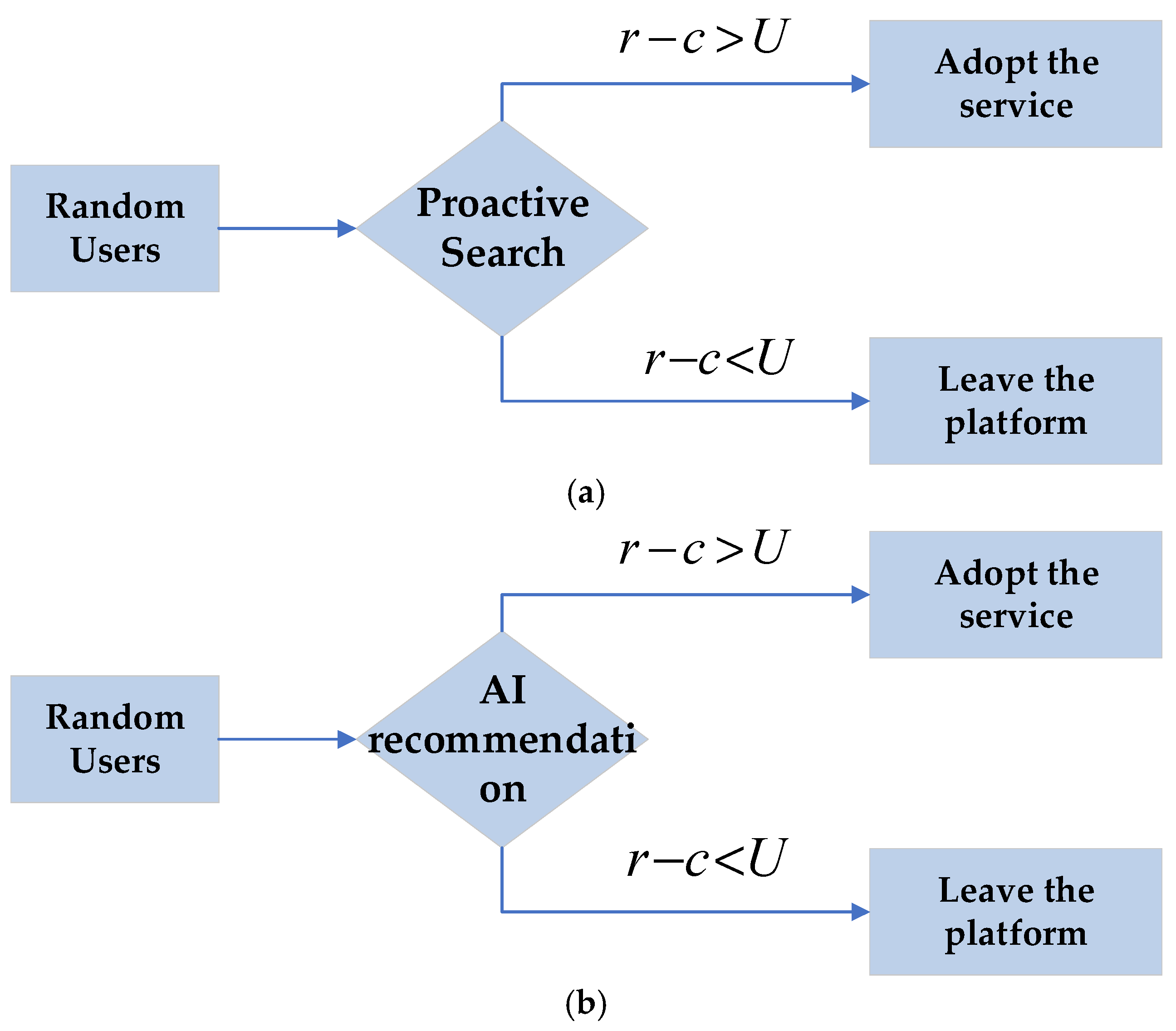
Random users: This type of user exhibits relatively simple behavior. After an initial search or upon receiving a single recommendation from the platform, they make a decision based on the expected utility of the current option and do not engage in further searches. Specifically, a random user adopts the service if its utility meets or exceeds their expected utility threshold r c (where r represents the utility threshold at which the user deems the service sufficiently suitable for themselves; c represents the consultation cost). Otherwise, they leave the platform without further search, as illustrated in Figure 1.
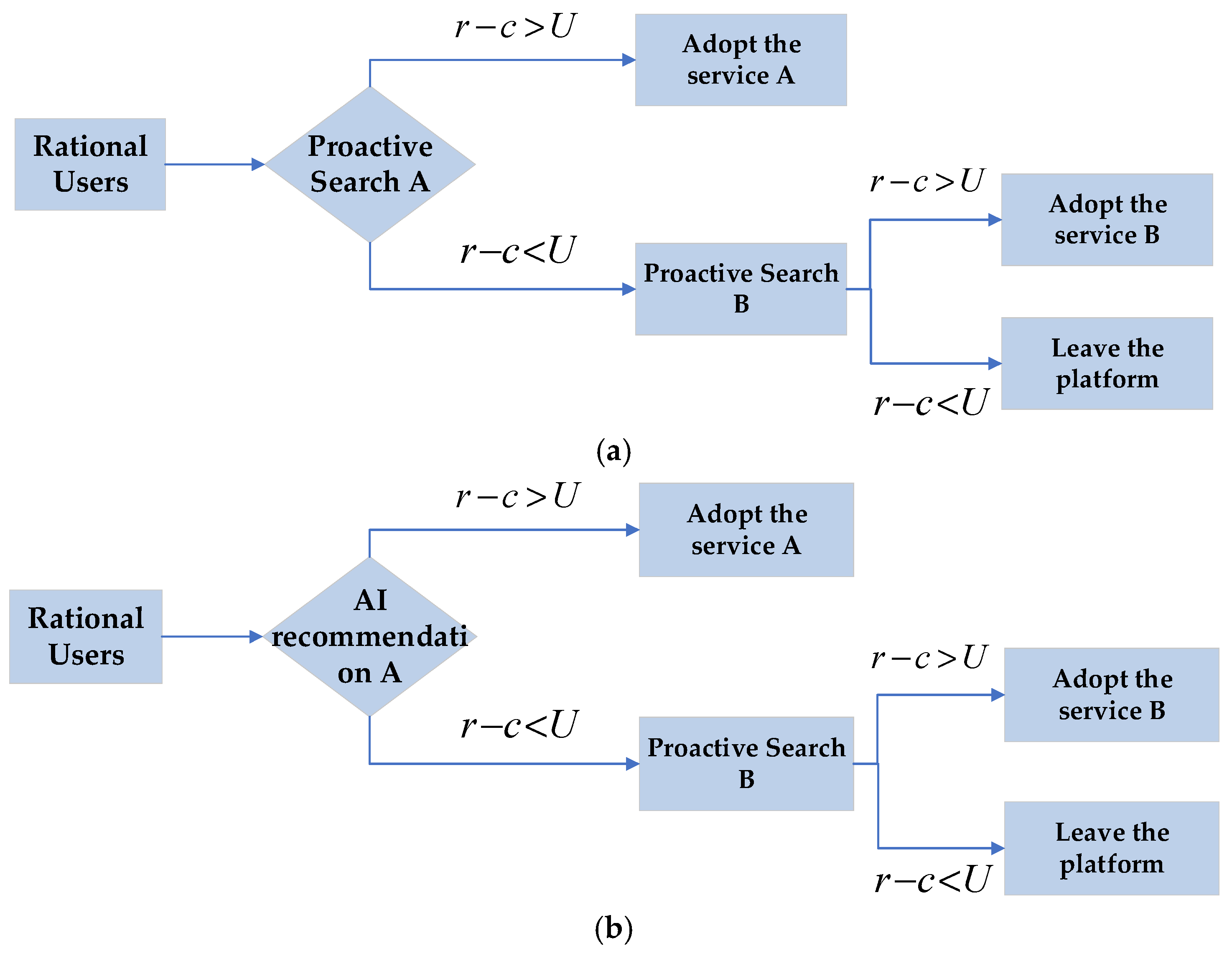
Rational users: The decision-making process of this type of user follows the optimal stopping theory, balancing expected benefits against search costs. Rational users not only evaluate the utility of the current option but also consider the potential utility gain from future searches weighed against the associated search cost. Consequently, if the current option fails to meet their dynamically adjusted expected utility threshold, they continue searching until they find a satisfactory service or determine that further search is not economically justified (Bi et al., 2025), as illustrated in Figure 2.
The total user population is normalized to 1. Let the proportion of random users be θ ; then, the proportion of rational users is 1 θ . The parameter θ directly reflects the proportion of users with proactive search capability in the market. This setup establishes the behavioral foundation for subsequent analysis of the equilibrium effects and optimal decision-making regarding the platform’s recommendation strategies.

3.1.2. Service Preference and Utility Function

We employ the linear model to capture users’ differentiated preferences for medical services. Providers are located at the endpoints of a linear space of length 1: Hospital A at point 0 and Hospital B at point 1. Users are uniformly distributed along the interval [0, 1], and their location 1 / 2 μ , 1 / 2 + μ (where 0 < 1 / 2 μ < 1 / 2 + μ < 1 ) represents their preference for provider type. μ reflects the differences in users’ hospital preferences. The parameter τ denotes the unit disutility incurred from the mismatch between the service and user preference.
Based on this, the net utility for a user j located at l is l j . Clearly, users located closer to 0 prefer Hospital A, while those located closer to 1 prefer Hospital B.

3.2. Patient Decision Process Modeling

The user search and decision processes draw on the optimal stopping principle.

3.2.1. Scenario Without AI Recommendation System

In this baseline case, users proactively search for information on platform providers. Random users: After randomly searching one hospital (A or B), they decide to purchase based on whether its utility meets the threshold. If not, they exit. Rational users: After searching one hospital, they compare its utility with the expected net benefit of searching the other hospital. They only stop searching and make a purchase decision if the current option’s utility is high enough that further search is not beneficial. Specific decision conditions are defined by a set of inequalities.
For a user j , the net utility of choosing Hospital A is U A = v l j τ p A , while the net utility of choosing Hospital B is U B = v ( 1 l j ) τ p B . Clearly, users located on the right side of the space ( 1 / 2 < l j < 1 / 2 + μ ) can obtain a better healthcare experience from Hospital B, whereas users on the left side ( 1 / 2 μ < l j < 1 / 2 ) are likely to receive a better experience from Hospital A.
The conditions under which a random user l j searches for Hospital A and chooses Hospital A are U A > r c ; that is
v l j τ p A > r c
The random user will select Hospital A under the condition that Equation (1) is satisfied and stop the search without searching for Hospital B either, while rational users will continue to search for Hospital B. After evaluating both hospitals, they will choose the better one. At this point, the conditions for the user to select Hospital A are U A > U B > r c ; that is
v l j τ p A > v ( 1 l j ) τ p B > r c
Equations (1) and (2) constitute the purchase conditions for users to choose Hospital A. Similarly, the purchase conditions for users to choose Hospital B can be obtained. The conditions under which a random user l j searches for Hospital B and chooses Hospital B are U B > r c ; that is
v ( 1 l j ) τ p B > r c
The conditions for a rational user l j to choose the searched Hospital A over searching for Hospital B are U B > U A > r c ; that is
v ( 1 l j ) τ p B > v l j τ p A > r c
By aggregating all possible decision paths, the user demand functions for each provider under the baseline model can be derived.

3.2.2. Scenario with AI Recommendation System

The platform deploys an AI recommendation system aiming to balance dual objectives: enhancing user utility to protect health interests and generating sufficient profit for sustainable operation. The designed recommendation strategy integrates both platform profit and user utility, drawing on the work of J. Li et al. (2025).
The platform’s profit from a transaction facilitated for the hospital Z i = α p i , i A , B . The platform employs a recommendation system based on a composite score, which is a linear weighted sum of the expected user utility and expected platform profit:
S i = E U i + ω E Z i
Here, the weight parameter ω measures the relative importance the platform assigns to its own profit compared to user utility. The system recommends the provider with the higher score by comparing the score difference between A and B.
S A S B = v A l j τ p A + ω α p A v B 1 l j τ p B + ω α p B
The critical preference location l 0 where a user is indifferent between the two providers S A S B = 0 can be solved:
l 0 = 1 2 + v A v B + ω α 1 p A p B 2 τ
The recommendation system will recommend A to the user if l j < l 0 ; otherwise, it will recommend B. And Equation (7) also reveals that when ω < 1 / α , the system tends to recommend the lower-priced hospital, as a service-oriented recommendation strategy, whereas when ω > 1 / α , it might recommend the higher-priced hospital as a profit-oriented recommendation strategy.
Furthermore, the model incorporates the recommendation accuracy parameter λ , representing the probability that the system correctly recommends the hospital yielding higher utility to a given user. For instance, for a user better suited to Hospital A, the probability of being recommended A is λ , and the probability of being recommended B is 1 λ , where λ > 1 / 2 , reflecting the effectiveness of intelligent recommendation over random recommendation.

3.3. Basic Model Assumptions

To ensure the rigor and tractability of the model, the following four basic assumptions are proposed:
Assumption 1
(information asymmetry regarding targeted search). Prior to receiving platform recommendations or conducting autonomous searches, users have not engaged in any targeted information collection specifically for this medical consultation.
Assumption 2
(basic search motivation and market coverage). All users have the fundamental motivation to search for the first medical hospital, and for any user, at least one hospital exists that can provide positive utility. This assumption posits that the reservation utility r  is sufficiently low.
Assumption 3
(concavity of profit functions). The profit functions of both medical hospitals and the platform are concave, ensuring the existence of a unique pure-strategy Nash equilibrium (Vaidya & Bansal, 2024).
Assumption 4
(recommendation acceptance). If the recommendation system accurately suggests a hospital that provides higher utility, the user, upon comparing it with alternatives found through their own search, will adopt the recommendation and choose that hospital.
We acknowledge that this assumption idealizes user behavior. Future research could relax this assumption by incorporating trust heterogeneity or a probabilistic acceptance function, as discussed in Section 8.3.

4. Comparative Analysis of Decision-Making Scenarios: Proactive Search and AI-Driven Recommendation

Based on the aforementioned model, this section analyzes the game equilibrium under two distinct scenarios: users operating without the platform’s recommendation system (Scenario 1: Proactive Decision-Making) and users utilizing the platform’s recommendation system (Scenario 2: AI-Driven Decision-Making). All model parameters were quantitatively calibrated based on the China Health Statistical Yearbook (National Health Commission of the People’s Republic of China, 2024) and industry empirical studies. The specific mapping logic is described in Table 3.
For realistic ranges, industry reports indicate that commission rates α on major Chinese internet health platforms typically range from 5% to 15%, which is why we center our analysis on α = 0.1. The recommendation accuracy λ is proprietary information, but the prior literature (G. Li & Liu, 2024) suggests that λ > 0.7 is generally considered high accuracy. Our analysis covers λ from 0.5 (random) to 0.9 (highly accurate), encompassing the realistic range. Furthermore, this study did not involve any human participants.
It is important to emphasize that these numerical values are theoretical constructs calibrated to align with plausible empirical magnitudes. They are intended as an illustrative example to demonstrate the underlying theoretical mechanisms via comparative statics, rather than to provide precise empirical predictions or serve as robust empirical evidence.

4.1. Scenario 1: Equilibrium Under User Proactive Decision-Making (No Recommendation System)

In this scenario, patients rely solely on their own search results, independent of platform recommendations. Users initiate their search process randomly. Given the total user population normalized to 1, it is assumed that half of the users start by searching for Hospital A and the other half start by searching for Hospital B. The demand composition for Hospital A is derived first.
Users choosing Hospital A can originate from three possible decision paths:
(1)
Choosing Hospital A immediately after the first search.
(2)
Searching for Hospital A first, then searching for Hospital B, and finally choosing Hospital A after comparison.
(3)
Searching for Hospital B first, then searching for Hospital A, and finally choosing Hospital A after comparison.
Among these, only Path (1) involves random users, as they make decisions after a single search without further exploration.
Demand from Path (1): Random users decide to choose Hospital A if condition (1) ( l j < v p A N r + c τ ) is met. The demand function for this segment is
D A 1 N = θ 4 μ v p A N r + c τ ( 1 2 μ )
Demand from Path (2): Rational users following this path would choose Hospital A if condition (2) ( v p B N r + c τ < l j < p B N p A N 2 τ + 1 2 ) is satisfied. However, according to Assumption 2, at least one hospital exists that can provide positive utility. This assumption posits that the reservation utility r is sufficiently low, which means l 0 < min v p A N r + c τ , v p B N r + c τ . Under this condition, this demand is infeasible.
Demand from Path (3): Rational users following this path choose Hospital A if they do not meet the conditions of both Equations (3) and (4), i.e., l j < min 1 v p B N r + c τ , p B N p A N 2 τ + 1 2 . The demand function for this segment is
D A 2 N = 1 θ 4 μ 1 v p B N r + c τ + μ 1 2
Aggregating these paths, the total demand function for Hospital A is
D A N = D A 1 N + D A 2 N = θ 4 μ v p A N r + c τ + μ 1 2 + 1 θ 4 μ 1 2 v p B N r + c τ + μ
Similarly, the total demand function for Hospital B can be derived as
D B N = θ 4 μ v p B N r + c τ + μ 1 2 + 1 θ 4 μ 1 2 v p A N r + c τ + μ
The profit function for a hospital is
π i = 1 α p i D i
The profit function for a platform is
π i = α p i D i
The equilibrium prices and demands for both hospitals under profit maximization are derived by simultaneously solving the first-order conditions π i p i = 0 and the demand functions (10)–(12).
Theorem 1.
Under the scenario of user autonomous decision-making without a recommendation system, the equilibrium price and equilibrium demand are given by
p i N = τ 1 2 + μ θ + 2 θ 1 v r + c 3 θ 1
D i N = 1 4 μ v r + c τ 1 2 + μ θ 3 θ 1 2 θ 1 v r + c τ 3 θ 1 + μ + 1 2 + θ 2
Proof. 
 
According to π i = 1 α p i D i , the profits of providers A and B can be calculated.
The profit of Hospital A is
π A N = 1 α p A N D A N = 1 α p A N θ 4 μ v p A N r + c τ + μ 1 2 + 1 θ 4 μ 1 2 v p B N r + c τ + μ
The profit of Hospital B is
π B N = 1 α p B N D B N = 1 α p B N θ 4 μ v p B N r + c τ + μ 1 2 + 1 θ 4 μ 1 2 v p A N r + c τ + μ
Substituting Equations (16) and (17) into π A N p A N = 0 and π B N p B N = 0 , respectively, it can be obtained that
1 α θ 4 μ v p A N r + c τ + μ 1 2 + 1 θ 4 μ 1 2 v p B N r + c τ + μ θ p A N 4 μ τ = 0
1 α θ 4 μ v p B N r + c τ + μ 1 2 + 1 θ 4 μ 1 2 v p A N r + c τ + μ θ p B N 4 μ τ = 0
Solving Equations (17) and (18) simultaneously yields the equilibrium price in Theorem 1:
p A N = p B N = p i N = τ 1 2 + μ θ + 2 θ 1 v r + c 3 θ 1
Substituting Equation (5) into (10) and (11) yields the equilibrium demand in Theorem 1.
D A N = D B N = D i N = 1 4 μ v r + c τ 1 2 + μ θ 3 θ 1 2 θ 1 v r + c τ 3 θ 1 + μ + 1 2 + θ 2
Substituting Equations (20) and (21) into (12) and (13) yields the equilibrium profits for the hospital and the platform. The analytical expression is rather complex and will not be elaborated on here.
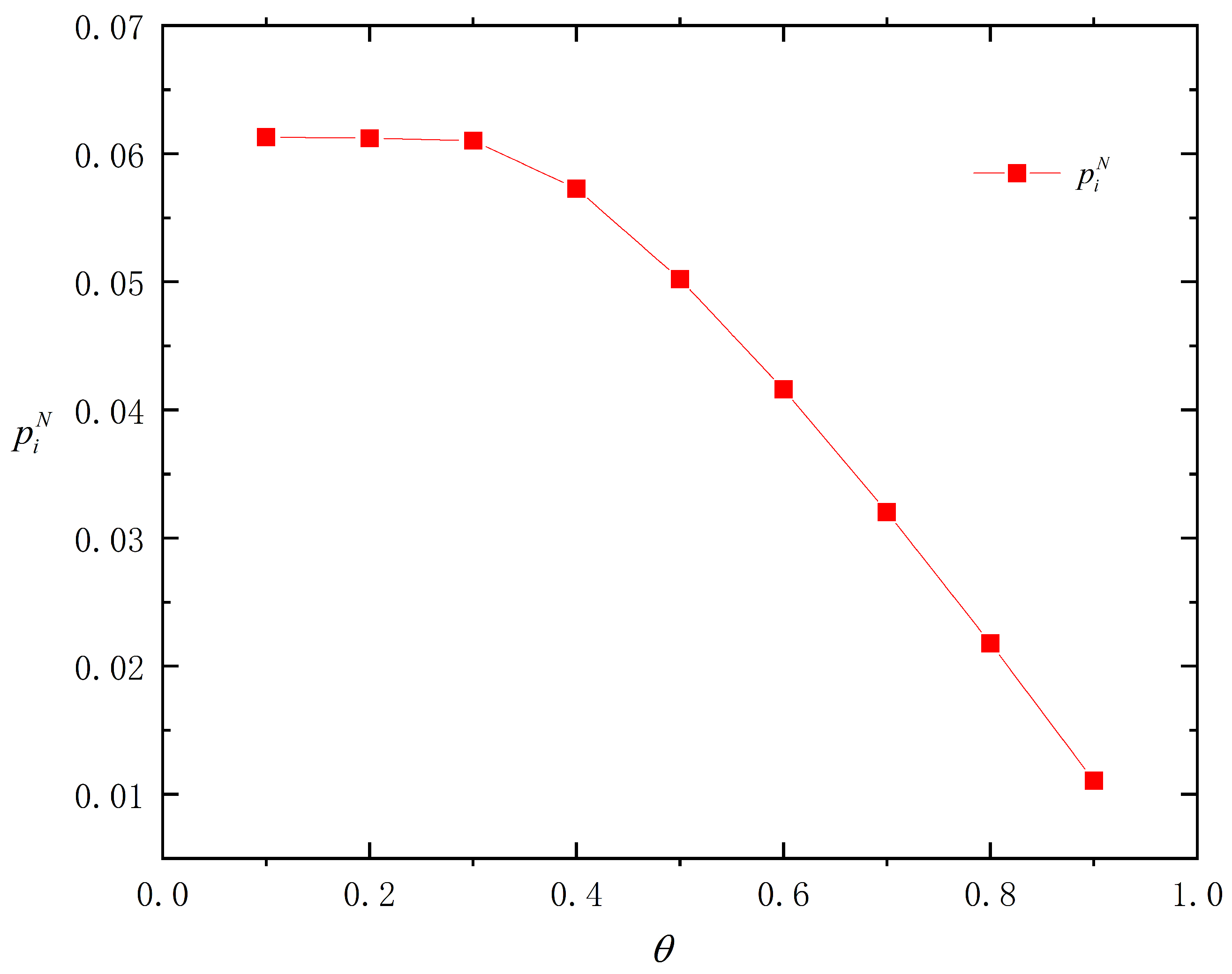
The results of Theorem 1 underscore the importance of price as the primary decision-making signal for users who lack in-depth search capabilities and medical expertise. To investigate the impact of user heterogeneity on pricing, we differentiate the equilibrium price expression in (14) with respect to the proportion of random users ( θ ), yielding
p i N θ = τ + v r + c 3 τ ( 1 2 + μ ) 3 θ 1 2
When μ > τ + v r + c 3 τ 1 2 , yields p i N θ < 0 . □
  • Managerial Insight 1: User Heterogeneity and Price Competition.
Figure 3 reveals a key economic mechanism: when user heterogeneity is high, an increase in the proportion of random users ( θ ) drives down equilibrium prices and intensifies competition. The intuition is as follows: High heterogeneity means patients have diverse preferences, making it difficult for hospitals to differentiate themselves on non-price attributes that appeal uniformly to all users. For random users—who conduct only a single search and make immediate decisions—price becomes the most salient and easily comparable signal. Unlike service quality, which requires expertise to evaluate and varies across individuals, price offers a clear standard that hospitals can use to attract these ‘one-shot’ decision-makers. Consequently, hospitals engage in price undercutting to capture this segment, eroding profits and intensifying price competition. This mechanism illustrates how the interaction between user search behavior and preference heterogeneity shapes market outcomes—a dynamic that would be missed in a model without user heterogeneity or with only rational searchers.

4.2. Scenario 2: Equilibrium Under AI-Driven Decision-Making (With a Recommendation System)

In this scenario, the smart platform employs an AI recommendation system that suggests the medical hospital with the higher comprehensive score S i to the user. All users are first exposed to the recommended hospital. If the utility of this hospital meets or exceeds their reservation utility r , the user will choose it directly; if the recommended hospital’s utility falls below the reservation utility, random users exit the platform, while rational users autonomously search for the other hospital and make a decision after comparison.
The user demand for Hospital A is also composed of three paths:
(1)
Choosing immediately after being recommended Hospital A.
(2)
Being recommended Hospital A first, then searching for Hospital B, and finally choosing Hospital A after comparison.
(3)
Being recommended Hospital B first, then searching for Hospital A, and finally choosing Hospital A after comparison.
Among these, Path (1) involves random users who accept the recommendation without further search, while Paths (2) and (3) involve the comparative decisions of rational users. Note that the recommendation system has an accuracy rate λ , meaning it does not always perfectly match user preferences.
Demand from Path (1): Users choosing immediately after being recommended Hospital A must satisfy condition (1) ( l j < v p A M r + c τ ). Considering the recommendation accuracy λ , the system correctly recommends A to users better suited for A with probability l j < l 0 = 1 2 + v A v B + ω α 1 p A M p B M 2 τ , contributing demand:
D A 1 M = θ λ 2 μ ω α 1 p A M p B M 2 τ + μ
Concurrently, the system incorrectly recommends A to users better suited for B with probability 1 λ , contributing demand:
D A 2 M = 1 θ 1 λ 2 μ v p A M r + c τ 1 2 ω α 1 p A M p B M 2 τ
Demand from Path (2): Rational users ultimately choosing A via this path must satisfy condition (2) but not condition (1), i.e., v p B M r + c τ < l j < p B M p A M 2 τ + 1 2 . According to Assumption 4, users will choose A after being correctly recommended.
Demand from Path (3): These are rational users who were incorrectly recommended B but corrected the choice through autonomous search. Their preference must satisfy l j < p A p B 2 τ + 1 2 . Considering recommendation accuracy, this demand is
D A 3 M = 1 θ 1 λ 2 μ p A M p B M 2 τ + μ
Therefore, with the recommendation system present, the total demand function for Hospital A is obtained by combining the three demand paths given by (23)–(25).
D A M = D A 1 M + D A 2 M + D A 3 M = θ λ 2 μ ω α 1 p A M p B M 2 τ + μ + 1 θ 1 λ 2 μ v p A M r + c τ 1 2 ω α 1 p A M p B M 2 τ + 1 θ 1 λ 2 μ p A M p B M 2 τ + μ = θ λ 2 μ ω α 1 p A M p B M 2 τ + μ + 1 θ 1 λ 2 μ v p A M r + c τ 1 2 ω α 2 p A M p B M 2 τ + μ
Similarly, the total demand function for Hospital B is
D B M = θ λ 2 μ ω α 1 p B M p A M 2 τ + μ + 1 θ 1 λ 2 μ v p A M r + c τ 1 2 ω α 2 p B M p A M 2 τ + μ
Medical hospitals choose optimal prices to maximize profits:
π i M = 1 α p i M D i M
π p M = α p p M D p M
Theorem 2.
Under the scenario of an AI recommendation system, the equilibrium price and equilibrium demand are given by (30)–(31), respectively.
p i M = θ λ + 1 θ 1 λ μ v r + c τ + μ 1 2 1 θ 1 λ μ 2 + ω α 2 τ θ λ μ ω α 1 τ
D i M = θ λ 2 + 1 θ 1 λ 2 μ v r + c τ 1 2 + μ θ λ + 1 θ 1 λ μ v r + c τ + μ 1 2 τ 1 θ 1 λ μ 2 + ω α 2 τ θ λ ω α 1 μ
Proof. 
 
According to π i = 1 α p i D i , the profits of providers A and B can be calculated.
The profit of Hospital A is
π A M = 1 α p A M D A M = 1 α p A M θ λ 2 μ ω α 1 p A M p B M 2 τ + μ + 1 θ 1 λ 2 μ v p A M r + c τ 1 2 ω α 2 p A M p B M 2 τ + μ
The profit of Hospital B is
π B M = 1 α p B M D B M = 1 α p B M θ λ 2 μ ω α 1 p B M p A M 2 τ + μ + 1 θ 1 λ 2 μ v p A M r + c τ 1 2 ω α 2 p B M p A M 2 τ + μ
Substituting Equations (32) and (33) into π A M p A M = 0 and π B M p B M = 0 , respectively, it can be obtained that
1 α θ λ 2 μ ω α 1 p A M p B M 2 τ + μ + p A M ω α 1 2 τ 1 θ 1 λ 2 μ 1 τ + ω α 2 2 τ
1 α θ λ 2 μ ω α 1 p B M p A M 2 τ + μ + p B M ω α 1 2 τ 1 θ 1 λ 2 μ 1 τ + ω α 2 2 τ
Solving Equations (34) and (35) simultaneously yields the equilibrium price in Theorem 1:
p A M = p B M = p i M = θ λ + 1 θ 1 λ μ v r + c τ + μ 1 2 1 θ 1 λ μ 2 + ω α 2 τ θ λ μ ω α 1 τ
Substituting Equation (5) into (26) and (27) yields the equilibrium demand in Theorem 1.
D A M = D B M = D i M = θ λ 2 + 1 θ 1 λ 2 μ v r + c τ 1 2 + μ θ λ + 1 θ 1 λ μ v r + c τ + μ 1 2 τ 1 θ 1 λ μ 2 + ω α 2 τ θ λ ω α 1 μ
Substituting Equations (36) and (37) into (28) and (29) yields the equilibrium profits for the hospital and the platform. □
Due to the complexity of the profit functions in Theorem 2, we focus on examining how key parameters—such as the proportion of random users θ , heterogeneity in user institutional preferences μ , and recommendation accuracy λ —affect the equilibrium outcomes. Building on the equilibrium results in Theorem 2, we further investigate the systematic impact of user composition and platform strategy on market equilibrium. If users were restricted to recommendations only (i.e., no rational users conduct autonomous searches), then the demand from Paths (2) and (3) would disappear. In that case, the model would reduce to one where all users behave like random users, and the equilibrium price would be lower than that in Theorem 2 because users lose their ability to counterbalance platform influence through search. This highlights the importance of incorporating proactive search behavior in the model.

4.2.1. Impact of User Composition on Price Competition

By computing the partial derivative of the equilibrium price in (30) with respect to the proportion of random users, we obtain
p i M θ = λ + λ θ μ v r + c τ + μ 1 2 ( 1 λ ) μ ( 2 + ω α 2 τ ) λ μ ω α 1 τ 1 θ 1 λ μ 2 + ω α 2 τ θ λ μ ω α 1 τ 2
When θ < λ λ 1 ( 2 + ω α 2 τ ) + λ ω α 1 τ λ μ v r + c τ + μ 1 2 , this yields p i M θ > 0 .
This result indicates that a higher proportion of random users intensifies price competition among medical institutions, leading to a decrease in the equilibrium price. To understand the intuition behind this finding, consider the decision process of random users. Unlike rational users who compare multiple options, random users make decisions based on a single search and lack the opportunity to compare alternative options. Consequently, price becomes the most salient and easily comparable attribute, prompting hospitals to compete aggressively on price to capture this segment.

4.2.2. Moderating Effect of Platform Recommendation Strategy

The platform adjusts its recommendation strategy, profit-oriented or user-service-oriented, through the weighting factor ω . The interaction between this factor and the recommendation accuracy λ significantly influences both market price and demand.
(1). Impact on equilibrium price: The weighting factor ω is a key variable moderating the effectiveness of the strategy. The equilibrium price in (30) can be differentiated with respect to the weighting factor ω :
p i M ω = α μ τ 1 θ 1 λ 2 θ λ μ
When λ < 1 θ 1 + θ , 1 2 v r + c τ < μ < 1 2 , this yields p i M ω > 0 .
When λ < 1 θ 1 + θ , the platform tends to adopt a profit-oriented strategy (i.e., assigning a higher weight to profit). Under such conditions, low recommendation accuracy weakens users’ trust in the recommendation results. To maintain profitability, the platform increases the commission weight, ultimately leading to higher service prices to compensate for potential transaction losses caused by inaccurate recommendations.
When λ > 1 θ 1 + θ , the platform can effectively implement a service-oriented strategy. High-accuracy recommendations reliably match user preferences with medical services, shifting user focus from price alone to the comprehensive value of the service. At this stage, the platform can lower ω and prioritize recommendations that offer higher user utility, even if they come at a potentially lower price. This strategy helps mitigate price competition.
This demonstrates the importance of improving recommendation accuracy. Once accuracy exceeds the critical threshold, the platform can center its strategy on user benefits, recommending services that enhance user utility even at lower prices. A further discussion of the impact of accuracy on platform strategy is provided below.
2 p i M ω λ = α θ μ τ < 0
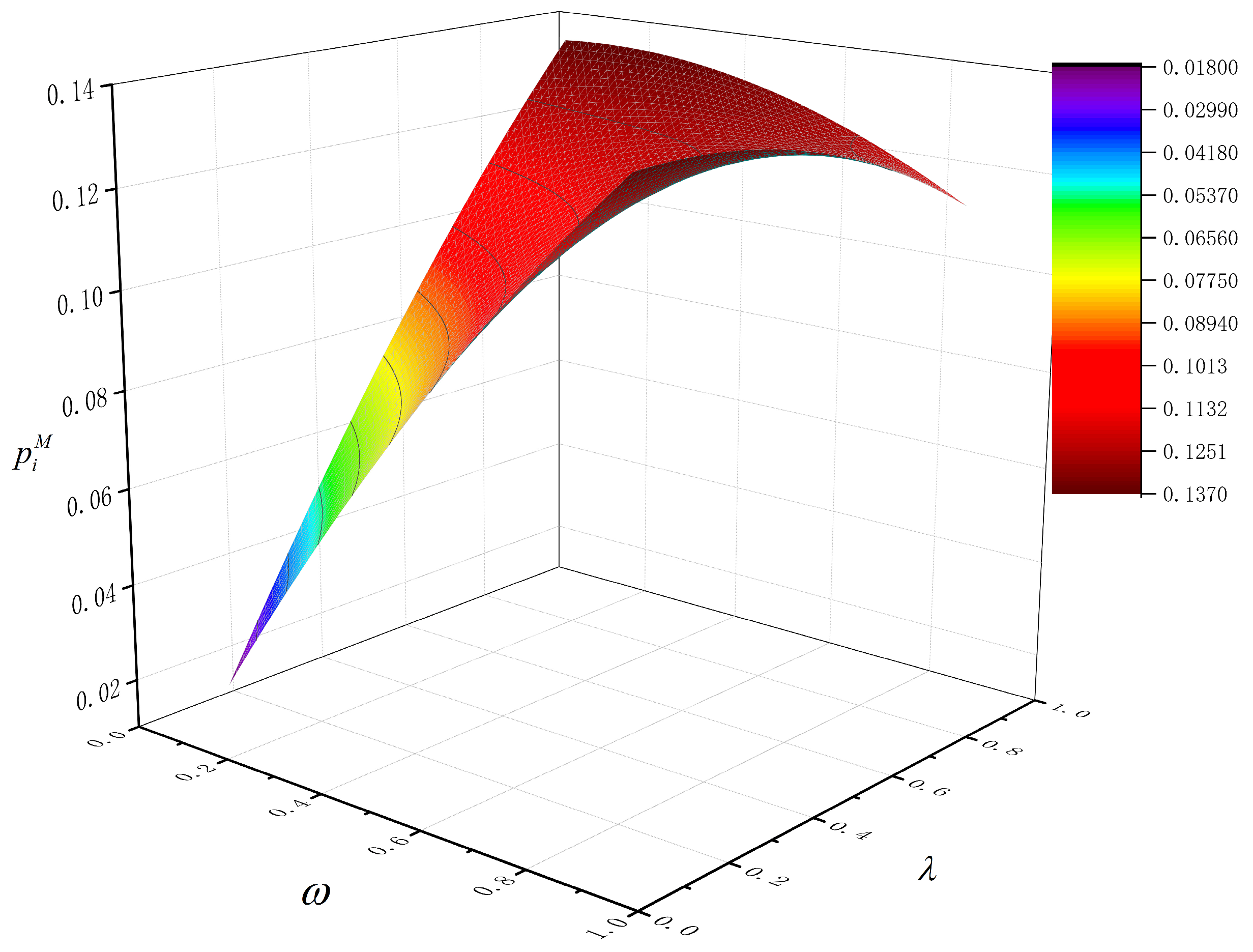
Figure 4 reveals that the improvement in system performance exhibits a nonlinear relationship with recommendation accuracy. The system demonstrates rapid initial improvement followed by a noticeable deceleration in growth rate after crossing a critical threshold, ultimately approaching a saturation plateau where further gains in accuracy yield stabilizing returns.
After reaching a peak, improving benefits for both the platform and users requires focusing on user-specific factors. Taking the second derivative of p i M with respect to ω and μ yields
2 p i M ω μ = α θ λ μ 2 τ > 0
This means that the variation in user preferences is correlated with their impact on platform strategy and service pricing. The broader the user distribution, the more imperative it becomes to implement differentiated pricing strategies to cater to diverse user preferences, rather than driving providers toward price competition.
As shown in Figure 5, the equilibrium price stabilizes in the high-accuracy region and may even rebound due to the enhanced perceived value, as in the red part of Figure 5. Furthermore, an increase in user preference heterogeneity raises the equilibrium price. Differentiated user preferences create scope for differential pricing, enabling medical institutions to compete based on the unique value of their services rather than on price alone.
(2). Impact on equilibrium demand: Platform strategy significantly affects demand. The equilibrium demand in (31) can be differentiated with respect to the weighting factor ω :
D i M ω = α 1 θ 1 λ 2 μ 1 2 τ θ λ μ τ
Contrary to the price effect, when λ > μ 2 θ , D i M ω < 0 , which means both accuracy and profit sharing are high, and demand tends to decline. A decrease in user volume may further intensify competition among service providers. Therefore, a profit-oriented strategy that sacrifices customer volume to maintain profit is unsustainable for normal market operation. Instead, adopting a benefit-oriented recommendation strategy can increase user volume.
To further discuss the platform strategy through recommendation accuracy, the second derivative of D i M with respect to ω and λ is taken.
2 D i M ω λ = θ α 1 θ 2 μ 2 τ > 0
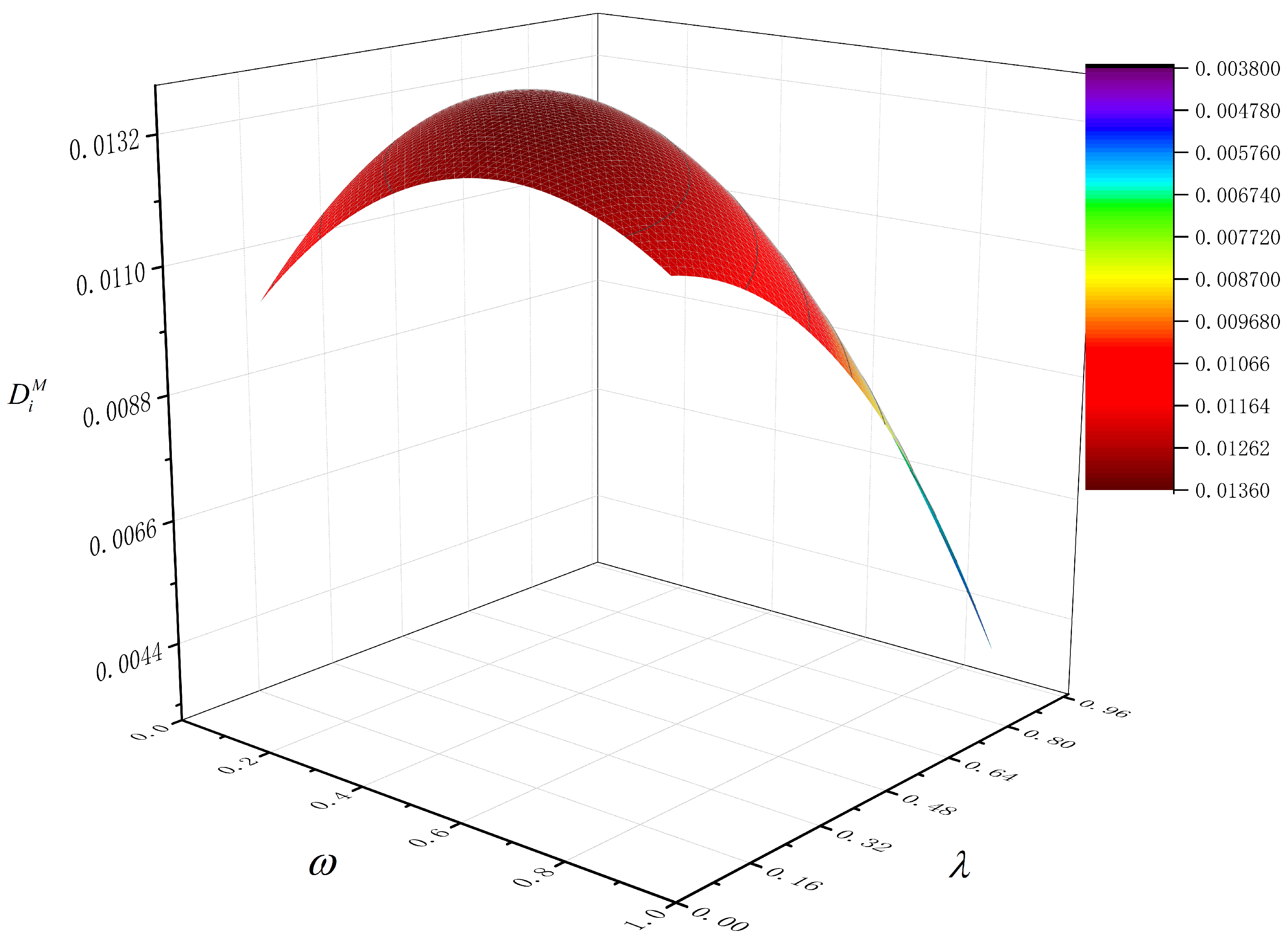
Under a service-oriented strategy, improving accuracy has a clear positive effect on demand. Adopting a user-service-oriented strategy combined with high-accuracy recommendations effectively stimulates demand. Accurate recommendations enhance user trust and satisfaction, thereby boosting the platform’s transaction volume. More users receive suitable service options, increasing the platform business volume. This reflects users’ preference for accurate recommendations and the urgent need for precise medical service positioning, as illustrated in Figure 6.
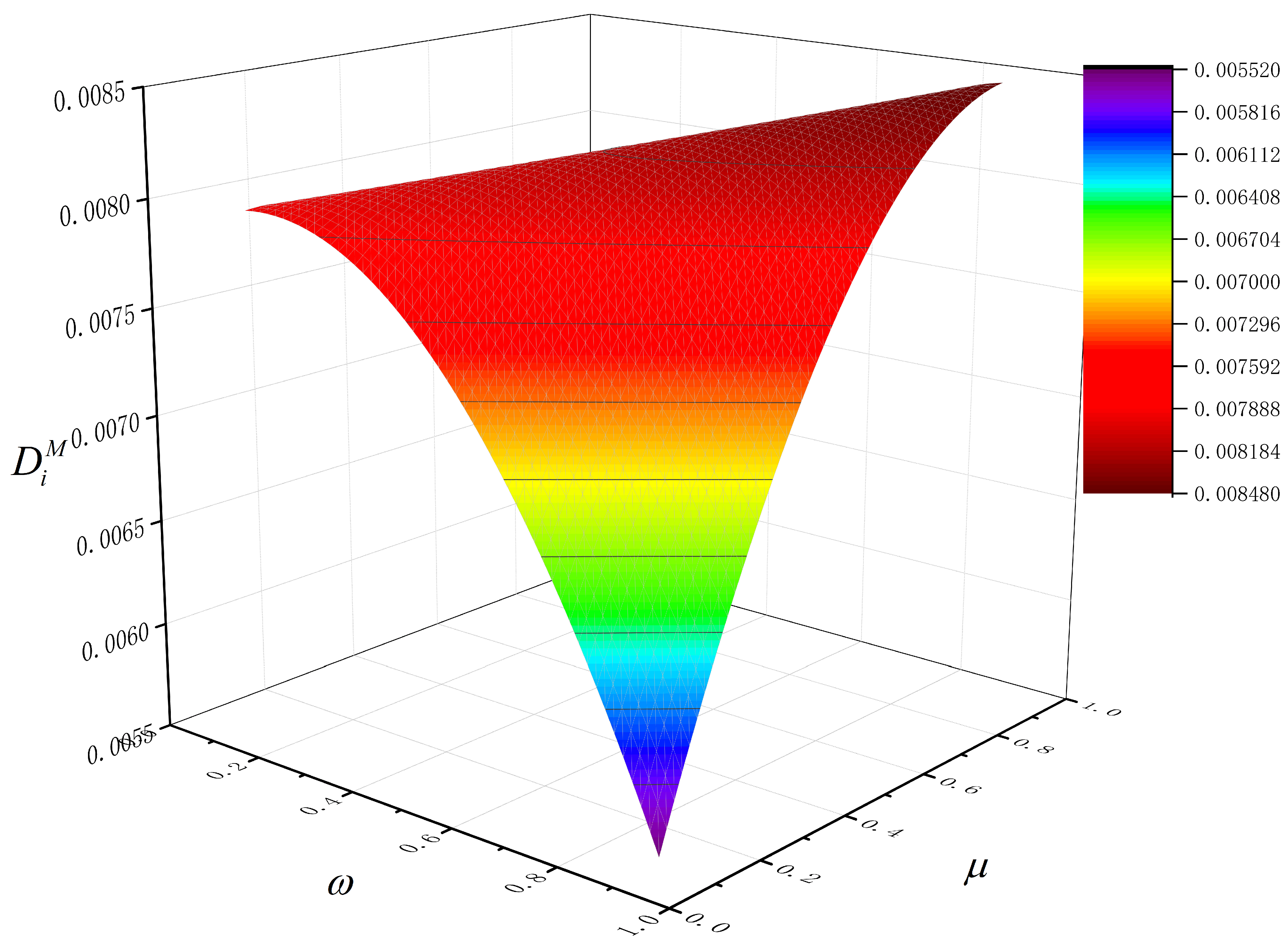
The second derivative of p i M with respect to ω and μ is taken to see how the user difference affects the demands.
2 D i M ω μ = α 1 θ 1 λ 4 μ 2 τ > 0
As shown in Figure 7, an increase in user preference heterogeneity is also associated with higher demand, as it allows the platform to better meet the needs of a diversified market through precise recommendations, thereby expanding its user base. These equilibrium results thus provide a formal response to Research Question 1 in Section 1.
  • Managerial Insight 2: Platform Strategy Selection.
Our model uncovers a fundamental economic trade-off governing the platform’s choice between profit-oriented and service-oriented recommendation strategies. The intuition behind this trade-off is explained below.
When the recommendation accuracy (λ) is low, the platform’s recommendations are noisy and often misaligned with user preferences. In this regime, adopting a profit-oriented strategy (i.e., increasing ω) exacerbates two problems. First, inaccurate recommendations already reduce user trust and satisfaction. Second, when the platform tilts recommendations toward higher-priced hospitals to boost its commission revenue, users—especially rational ones who can search—perceive these recommendations as self-serving and may reject them or exit the platform. The net effect is a classic adverse selection dynamic: higher profit weighting drives away price-sensitive and rational users, leaving a shrinking pool of random users who are less discerning but also less profitable. This leads to the dual outcome of higher equilibrium prices (as hospitals cater to the remaining less-price-sensitive segment) and demand contraction (as overall user participation falls). Thus, when accuracy is low, prioritizing profit is self-defeating: it erodes the platform’s user base while failing to generate sustainable revenue.
When the recommendation accuracy (λ) is high, the platform’s recommendations reliably match users with suitable hospitals. Under these conditions, a service-oriented strategy (lower ω) becomes optimal. The economic logic is one of a virtuous cycle. Accurate recommendations enhance user trust and satisfaction, encouraging more users to follow recommendations rather than conducting costly searches. This increased reliance on recommendations reduces the emphasis on price as the primary competition dimension. Hospitals, recognizing that they are now being evaluated on match quality rather than price alone, shift their competition toward service differentiation. This softens price competition, allowing equilibrium prices to stabilize or even rise modestly. Meanwhile, the improved user experience attracts more users to the platform, expanding transaction volume. The platform thus achieves a Pareto improvement: users receive better-matched services, hospitals compete on quality rather than price, and the platform benefits from increased volume and sustainable long-term growth.
In essence, the model reveals that recommendation accuracy serves as a strategic enabler. Low accuracy traps the platform in a low-trust equilibrium where profit-seeking backfires. High accuracy unlocks a high-trust equilibrium where user-centric design aligns the interests of all stakeholders. The managerial implication is clear: investments in improving recommendation accuracy are not merely technical upgrades—they are foundational to business model transformation and long-term competitive advantage.

5. Strategy Analysis of Platform Recommendation System

Research indicates that the intensity of price competition among medical service providers primarily depends on the proportion of random users, the accuracy of the recommendation system, and the platform’s adopted recommendation strategy. This section delves into the impact mechanisms of different recommendation strategies by systematically comparing market equilibria with and without the recommendation system.
Proposition 1.
The impact of the recommendation system on the equilibrium price and demand satisfies the following conditions:
(1)
The recommendation system increases the equilibrium price only if the platform’s strategy weight  ω < ω 1 .
(2)
The recommendation system increases user demand only if the platform’s strategy weight  ω > ω 2 .
Proof. 
(1) By comparing the equilibrium prices in Theorems 1 and 2 and computing Δ p = p i N p i M , then setting Δ p < 0 , the following is obtained:
Δ p = p i N p i M = τ 1 2 + μ θ + 2 θ 1 v r + c 3 θ 1 θ λ + 1 θ 1 λ μ v r + c τ + μ 1 2 1 θ 1 λ μ 2 + ω α 2 τ θ λ μ ω α 1 τ < 0
and simplifying yields
ω < 3 θ 1 K L 1 θ 1 λ + θ λ μ τ α 1 θ 1 λ 2 θ λ α 2 μ τ
where K = θ λ + 1 θ 1 λ μ v r + c τ + μ 1 2 , L = τ 1 2 + μ θ + 2 θ 1 v r + c .
Let ω 1 = 3 θ 1 K L 1 θ 1 λ + θ λ μ τ α 1 θ 1 λ 2 θ λ α 2 μ τ , thus completing the proof.
(2) The proof for the demand part follows a similar logic and is omitted here.
ω > ω 2 = 1 4 μ v r + c τ 1 2 + μ θ 3 θ 1 2 θ 1 v r + c τ 3 θ 1 + μ + 1 2 θ 2 K θ λ 2 2 μ 1 θ 1 λ v r + c τ + 1 2 μ α 1 θ 1 λ 2 θ λ α 2 μ τ
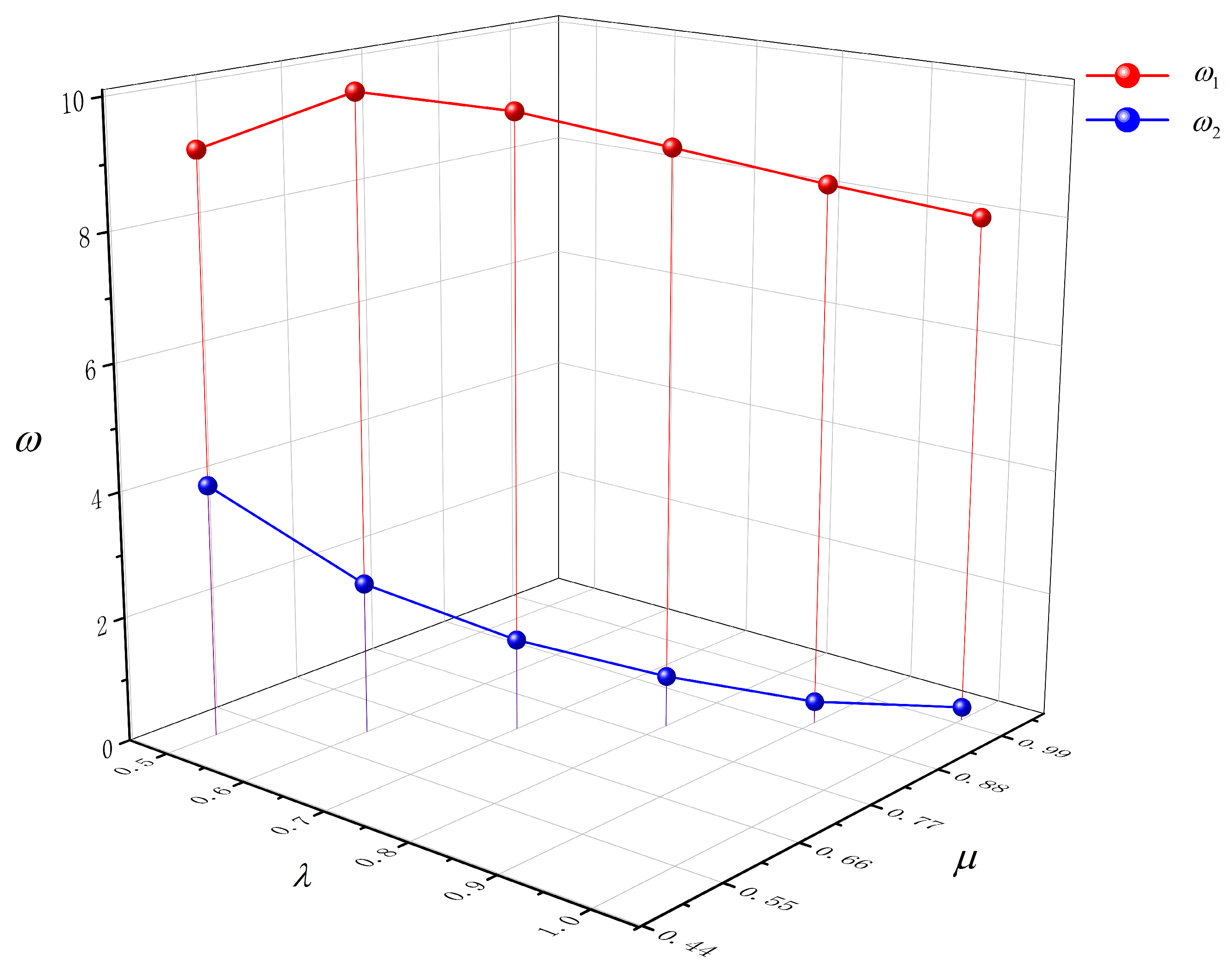
Proposition 1 reveals that the critical thresholds ω 1 , ω 2 , which determine how the recommendation strategy influences equilibrium outcomes, are significantly affected by the recommendation system’s accuracy λ and user preference heterogeneity μ . As shown in Figure 8, both the equilibrium price and user demand exhibit systematic variation with the strategy weight.
Specifically, in market environments characterized by high recommendation accuracy and substantial user preference heterogeneity, adopting a service-oriented strategy (lower ω ) helps reduce the equilibrium price, as shown by the red line in Figure 8. This suggests that in an intelligent recommendation environment with high matching capability, increasing the weight assigned to medical service quality evaluation effectively enhances total user welfare. Simultaneously, highly differentiated user preferences combined with precise recommendation mechanisms lead to better service matching, significantly improving the user experience. Under these conditions, the focus of competition among medical institutions shifts from price wars to service quality competition.
From the demand perspective, a highly accurate and differentiated recommendation strategy can significantly increase user adoption, as shown by the blue line in Figure 8. Precise matching algorithms and personalized recommendations substantially improve user acceptance rates. At this stage, the platform could moderately consider introducing a profit-oriented strategy (appropriately increasing ω ). Given the increased operational costs associated with high-accuracy recommendations and personalized services, appropriately raising the platform’s profit share is conducive to maintaining its healthy development. However, according to fundamental economic principles, price increases typically lead to demand reduction, while excessively low prices hinder healthy market development. Therefore, finding a moderate strategy weight is crucial.
Based on the conclusions of Proposition 1 and the definition of the recommendation strategy, we further derive the following lemma:
Lemma 1.
When the platform’s recommendation strategy weight satisfies ω 2 < ω < ω 1 , the recommendation system can simultaneously increase both the equilibrium price and user demand.
Lemma 1 indicates that the optimal platform recommendation strategy is not an extreme focus solely on either price or service quality but rather seeks a delicate balance between the two, as shown in Figure 8 by the region between the red and blue lines. This moderate recommendation strategy can simultaneously address user demand and medical institution profits, promoting the sustainable development of smart healthcare platforms. Particularly for user segments with personalized needs, this strategy not only improves user experience by offering more suitable medical institution choices but also enhances conversion rates by increasing user stickiness. This directly addresses Research Question 2 posed in Section 1. When the platform’s recommendation strategy weight satisfies ω 2 < ω < ω 1 , we can introduce the recommendation system to improve platform utility.
Furthermore, a moderate recommendation strategy also helps meet the profit requirements of medical institutions partnering with the platform, thereby strengthening the collaborative relationship between the platform and these institutions. When medical institutions receive more user choices on the platform, their motivation to participate actively increases, creating a virtuous cycle. This naturally leads to a key question: how can the optimal platform recommendation strategy weight be determined? We will explore this in depth in the next section.

6. Platform’s Optimal Recommendation Strategy

Building upon the preceding theoretical analysis of the relationships among recommendation strategies, user preferences, and market equilibrium, this section delves into the optimal recommendation strategy decision for platform profit maximization based on the equilibrium results from Theorem 2.
Proposition 2.
Under different market environments, the optimal recommendation strategy weight  ω  for the mobile health platform is jointly determined by the platform commission rate  α  and the proportion of random users  θ .
Proof. 
In the context of the recommendation system, the platform selects the optimal strategy weight ω to achieve the profit maximization objective. The platform’s profit function π p M in Equation (29) can be expressed as a function of the strategy weight ω , and the optimization problem is formulated as π p M ω = 0 .
The optimal solution ω can be obtained by solving the first-order condition.
ω = 2 θ λ + 1 τ K 1 θ 1 λ 1 θ 1 λ + α θ λ
Research indicates that the impact of the recommendation strategy on the profits of both medical service providers and the platform significantly depends on market conditions such as the proportion of random users, user preference heterogeneity, and recommendation system accuracy. As platform managers, they can dynamically adjust the recommendation strategy according to the specific market environment to achieve profit optimization. Its numerical solutions are shown in Table 4.
Combining Proposition 2 with the visual analysis in Table 4, we derive the following managerial insights:
(1)
Strategy selection in high-commission-rate environments: When the platform charges medical institutions a relatively high commission rate, the optimal strategy tends to be a user-service-oriented recommendation system. This is because high commission rates may lead to the loss of high-quality medical institutions. In this scenario, the platform needs to maintain market competitiveness by enhancing the user experience and meeting user demands. This indicates that the platform cannot focus solely on short-term profits but should pay more attention to cultivating long-term user value.
(2)
Strategy adjustment influenced by user structure: When rational users constitute a relatively high proportion, the platform should lean more towards a service-oriented recommendation strategy. Rational users typically conduct autonomous searches based on platform recommendations, and their decision-making process comprehensively considers multiple factors such as price and service quality. Especially in the healthcare industry, service effectiveness is often a key consideration in the final decision. Therefore, the platform needs to respond to the needs of such users by increasing the weight assigned to service benefits, thereby improving the recommendation acceptance rate.
(3)
Gradual adjustment of strategy weight: In environments with different commission rates, the platform can achieve optimal performance by adopting a mildly user-oriented recommendation strategy. This suggests that a moderate focus on user value is the foundation for the platform’s sustainable development. The preceding analysis provides the solution to Question 3, as outlined in Section 1.
  • Managerial Insight 3: Synergistic Recommendation.
The economic value of a recommendation system in healthcare platforms can be understood through three interconnected mechanisms: search cost reduction, quality signal provision, and preference matching.
The first mechanism is search cost reduction. In the absence of recommendations, users must engage in costly sequential searches to gather information about hospital prices and service attributes. For random users, each search incurs a cost c; for rational users, search continues until the marginal benefit equals the marginal cost. Recommendation systems act as an information shortcut, providing users with a pre-screened option that reflects both their inferred preferences and platform objectives. This reduces the expected number of searches per user, lowering overall search costs and increasing the likelihood of transaction completion. The welfare gain from this reduction is captured by users through higher net utility and by the platform through increased transaction volume.
The second mechanism is quality signal provision. Healthcare is a classic credence good—users cannot easily assess service quality even after consumption, let alone before. This creates a market failure: hospitals with genuine quality advantages cannot credibly signal this to users, while low-quality providers can mimic high-quality ones through superficial attributes. A high-accuracy recommendation system serves as a third-party certification mechanism, aggregating historical data and user feedback to infer hospital quality. When the platform recommends a hospital, it implicitly signals that this provider offers good match quality for the user. This signal is credible because the platform’s reputation and long-term profitability depend on recommendation accuracy. The result is a reduction in information asymmetry between hospitals and users, enabling high-quality providers to differentiate themselves and compete on dimensions other than price.
The third mechanism is preference matching. User preferences in healthcare are highly heterogeneous (captured by parameter μ )—some patients value proximity, others prioritize hospital reputation, and still others are sensitive to price. A uniform recommendation strategy cannot serve all users efficiently. The platform’s scoring function allows it to tailor recommendations to individual preferences while balancing its own profit motives. When ω is low, recommendations prioritize user utility, effectively matching users with hospitals that best satisfy their heterogeneous preferences. This matching efficiency generates surplus for users and reduces the likelihood of mismatched consultations, which in turn lowers the probability of repeat visits or negative feedback.
These three mechanisms interact in important ways. For instance, high-quality signals enable better preference matching, which in turn reduces users’ reliance on costly search. Conversely, when recommendations are inaccurate (low λ), the signal is noisy and matching is poor, forcing users back into search mode and undermining the platform’s value proposition. The model’s comparative statics reveal that improving recommendation accuracy amplifies all three mechanisms, creating a positive feedback loop: better matching → higher user satisfaction → increased platform usage → more data for further accuracy improvements.
The managerial implication is clear: Recommendation systems should not be viewed merely as algorithmic tools for user convenience. Rather, they are strategic assets that reshape market structure by reducing information frictions, enabling quality competition, and aligning heterogeneous user preferences with provider offerings. Investments in recommendation accuracy are therefore investments in the platform’s fundamental economic efficiency and long-term competitive positioning.
To assess robustness, we conducted sensitivity analyses by varying key parameters ( v ,   r ,   c ,   τ ,   μ ,   λ ) subjected to ±20% around their baseline values, shown in Table 5. The result suggests that our conclusions are robust to reasonable changes in parameter values.
The sensitivity analysis presented above confirms that the quantitative patterns in our results remain stable across reasonable parameter variations. However, readers should interpret these numerical results as illustrative demonstrations of the model’s comparative statics, not as empirically validated estimates.

7. Discussion: Theoretical Synthesis and Cross-Context Applicability

This section integrates our findings with classical two-sided market theory and the broader literature on platform governance and recommendation systems. It also examines the applicability of the dual-drive model across diverse healthcare environments, from resource-constrained developing countries to mature, data-saturated markets.

7.1. Theoretical Contributions Relative to Classical Two-Sided Markets

Classical two-sided market models incorporating search and recommendation typically treat these mechanisms as exogenous, substitutable, or unidirectional—for instance, viewing recommendation accuracy solely as a search cost reducer or modeling search behavior as a static cost–benefit trade-off independent of platform strategies (Branzei et al., 2021). These models often assume homogeneous passive users and overlook the sector-specific information asymmetry inherent in healthcare. Our equilibrium analysis of the dual-drive mechanism (proactive search + AI-driven recommendation) addresses these limitations by introducing four novel insights tailored to the smart healthcare context.

7.1.1. Endogenous Synergistic Interaction

Classical models isolate search and recommendation, with equilibrium outcomes determined by a single mechanism (e.g., recommendation accuracy or search cost alone). In contrast, our model endogenizes their complementary synergy as a core driver of market equilibrium (Guiñazú et al., 2025). AI recommendations function as a precision guidance mechanism for proactive search, reducing inefficient search costs for rational users and improving the targeting of information acquisition. Conversely, proactive search serves as a correction mechanism for imperfect AI recommendations ( λ < 1 ), enabling rational users to offset recommendation errors through multi-stage search and comparison. The equilibrium analysis (Theorems 1 and 2, Proposition 1) quantifies the joint marginal effects of recommendation accuracy ( λ ) and user search heterogeneity (θ) on equilibrium price and demand—a result unattainable in models that study search or recommendation in isolation. For instance, our finding that high λ mitigates price competition only when combined with rational user search (Managerial Insight 2) represents a unique equilibrium prediction of the dual-drive framework, revealing that the value of AI recommendations in healthcare cannot be realized without active user decision-making.

7.1.2. User Heterogeneity as a Core Moderator of Competitive Dynamics

Classical two-sided market models either assume homogeneous user search behavior or treat heterogeneity as a fixed exogenous parameter (e.g., a predetermined search cost distribution) (Guiñazú et al., 2025). Our model categorizes users into random (single search) and rational (multi-stage search) types based on optimal stopping theory and endogenizes the proportion of random users ( θ ) as a key modulator of equilibrium outcomes. The equilibrium analysis uncovers nonlinear conditional relationships that classical models cannot capture: in the no-recommendation scenario, a higher θ intensifies price competition only under conditions of high user preference heterogeneity ( μ ); in the AI recommendation scenario, the positive moderating effect of λ on equilibrium price activates only when θ falls below a critical threshold. These results demonstrate that heterogeneity in user search decisions fundamentally reshapes both the competitive logic of medical institutions and the effectiveness of platform recommendation strategies—a critical characteristic unique to healthcare platforms, where users lack professional medical knowledge and exhibit extreme variation in decision-making autonomy.

7.1.3. Dual-Objective Scoring Rule and Optimal Strategy Weight Range

Classical recommendation models typically adopt single-objective scoring rules (pure user utility or pure platform profit), and their equilibrium analyses yield the standard trade-off between price and demand: higher prices inevitably reduce demand, and vice versa. Our model introduces a dual-objective composite scoring rule that integrates both user utility and platform profit. The equilibrium analysis identifies for the first time a moderate strategy weight range ( ω 2   <   ω   <   ω 1 , Lemma 1) within which the platform can simultaneously increase both the equilibrium price and user demand—thereby breaking the classical price–demand trade-off. This finding is particularly relevant to the healthcare sector, where platforms must balance the interests of three stakeholders (patients, medical institutions, and themselves) and where both user welfare and industrial sustainability are non-negotiable. The equilibrium derivation of the critical thresholds ω1 and ω2 enriches the theoretical understanding of recommendation strategy optimization in two-sided markets for experience goods.

7.1.4. Healthcare-Specific Equilibrium Dynamics

Classical two-sided market models abstract away from sector-specific characteristics, assuming that users can effectively evaluate product or service value. Our equilibrium analysis fully accounts for the extreme professional information asymmetry inherent in healthcare: patients cannot independently judge the quality of medical services, and service value functions as an experience good. This yields healthcare-specific equilibrium implications that classical models cannot explain. First, in the no-recommendation scenario, price becomes the only intuitive decision criterion for random users due to information scarcity, precipitating a race to the bottom in medical institution pricing. Second, in the dual-drive scenario, high-accuracy AI recommendations shift the competitive focus of medical institutions from price competition to service matching competition by reducing information asymmetry; proactive search further solidifies this shift by enabling users to verify service matching quality. These sector-specific equilibrium dynamics fill a significant gap in classical two-sided market research concerning experience goods with high information asymmetry.

7.2. Applicability Across Diverse Healthcare Environments

The manuscript cites Willemsen et al. (2024)’s research on digital health platforms in developing countries. We now explicitly examine how the dual-drive model would function across different developmental and technological contexts, from resource-constrained settings to mature, data-saturated healthcare environments.

7.2.1. Developing Countries and Emerging Economies

In less developed countries, the dual-drive model faces multiple interrelated implementation barriers. Infrastructure constraints, including limited internet penetration and unreliable connectivity, prevent widespread platform access, particularly in rural areas. Compounding this, human capital constraints mean that proactive search requires baseline digital and health literacy—skills that cannot be assumed in populations with limited formal education. Cultural and trust barriers further impede adoption, as patients in contexts where traditional medicine remains dominant may distrust algorithm-driven recommendations. Finally, economic constraints are salient: users facing basic subsistence needs may prioritize food and shelter over healthcare consultation fees. Collectively, these barriers create a challenging environment for the deployment of smart healthcare platforms.
However, the potential benefits of smart healthcare platforms—reduced search costs, improved matching efficiency, and more equitable resource allocation—are arguably greatest in precisely these contexts. Our model suggests that realizing these benefits requires complementary investments: (1) Infrastructure development: This includes expanding broadband connectivity and subsidizing device access. (2) Literacy programs: These involve integrating digital skills training into education and community health initiatives. (3) Trust-building measures: These include engaging community leaders and ensuring algorithmic transparency. (4) Affordable access models: These involve tiered pricing, public–private partnerships, and integration with public health insurance (Easwaran et al., 2025).
In such environments, a phased implementation approach is advisable: the initial focus is on basic information services and trust-building, with sophisticated AI recommendations introduced as digital literacy and connectivity improve.

7.2.2. Mature, Data-Saturated Healthcare Environments

In contrast, in more mature, data-saturated healthcare environments—such as those found in developed countries with comprehensive electronic health records, high digital adoption, and sophisticated AI capabilities—our model’s assumptions are more readily satisfied (Main et al., 2025), and several distinctive dynamics emerge:
(1)
Enhanced recommendation accuracy: Rich historical data from electronic health records, longitudinal patient histories, and large-scale outcome studies enables more precise user profiling and higher recommendation accuracy ( λ ). This activates the virtuous cycle identified in our model: with high λ, platforms can adopt service-oriented strategies (lower ω ), which further enhances user trust and satisfaction. The availability of granular data also allows for continuous learning and improvement in recommendation algorithms, creating positive feedback loops that amplify the benefits of the dual-drive model.
(2)
Sophisticated user behavior: Higher digital literacy and greater familiarity with online platforms mean that a larger proportion of users exhibit rational search behavior (lower θ ). These users actively compare options, seek second opinions when appropriate, and use platform recommendations as one input among many in their decision-making process. This strengthens the corrective mechanism identified in our model, where rational users offset imperfect recommendations through autonomous search. The presence of sophisticated users also disciplines platform behavior, as platforms cannot rely on passive acceptance of potentially self-serving recommendations.
(3)
Quality-based competition: With high recommendation accuracy ( λ ) and a low proportion of random users ( θ ), the focus of competition shifts from price to service quality. Hospitals and providers differentiate themselves based on clinical outcomes, patient experience, and specialized expertise—dimensions that are more effectively communicated through accurate recommendations than through price signals alone. This aligns with the differentiated service models observed in mature healthcare markets, where reputation and quality metrics play increasingly important roles in patient choice.
(4)
Data network effects: As user bases grow and data accumulates, recommendation accuracy improves endogenously—a dynamic our current model treats as exogenous but which represents an important feature of mature platforms. These data network effects create increasing returns to scale and can lead to winner-take-all dynamics, with implications for market structure and competition policy. Future research could extend our model to incorporate this endogenous improvement in λ as a function of user base size and engagement.
(5)
Integration with existing healthcare systems: In mature environments, smart healthcare platforms are often integrated with broader healthcare delivery systems, including electronic health records, telemedicine infrastructure, and national health information exchanges. This integration enhances the relevance and accuracy of recommendations by incorporating clinical data, treatment histories, and real-time provider availability. It also enables seamless transitions between digital and in-person care, creating a hybrid service model that combines the convenience of online platforms with the depth of traditional healthcare.
(6)
Regulatory and ethical considerations: Mature healthcare environments typically have established regulatory frameworks governing data privacy, algorithmic transparency, and medical AI. These frameworks can enhance trust in recommendation systems while also imposing constraints on platform behavior. Our model’s dual-objective scoring rule provides a framework for operationalizing regulatory requirements—for instance, mandating minimum user welfare weights through constraints on the strategy parameter ω.

7.3. Contingency Framework for Dual-Drive Model Implementation

Synthesizing the above analysis, we propose a contingency framework that maps dual-drive model implementation to environmental maturity, as presented in Table 6.
This framework provides guidance for platform managers and policymakers in tailoring the dual-drive model to their specific contexts, and it highlights how the theoretical insights from our model manifest differently across developmental stages. The framework also underscores that successful implementation requires not only technological sophistication but also alignment with local institutional, cultural, and economic conditions—a consideration often overlooked in one-size-fits-all approaches to healthcare platform design.

7.4. Implications for Theory and Practice

The foregoing analysis yields several implications for both theory and practice. Theoretically, our work extends classical two-sided market models by demonstrating that the interaction between user search heterogeneity and platform recommendation design fundamentally shapes equilibrium outcomes in ways that isolated analyses cannot capture. Practically, the contingency framework provides a roadmap for platform managers and policymakers to calibrate their strategies to local conditions, recognizing that the optimal design of dual-drive platforms varies systematically with environmental maturity. These insights contribute to a more nuanced understanding of how AI-driven healthcare platforms can be effectively deployed across the global spectrum of developmental contexts.

8. Conclusions and Managerial Implications

8.1. Conclusions

This study develops a theoretical model for recommendation strategies in smart healthcare platforms, systematically analyzing the impact mechanisms of recommendation systems on market equilibrium, user utility, and platform profit in contexts where users possess autonomous search capabilities. By comparing scenarios with and without a recommendation system, it elucidates the effects of both user-service-oriented and profit-oriented recommendation strategies under different market conditions and establishes decision-making principles for platforms to select optimal strategies.
First, in the absence of a recommendation system, the intensity of price competition is significantly influenced by user composition. When the proportion of random users is high, medical institutions tend to adopt price reduction strategies to attract these single-decision users. However, when user preference heterogeneity is high, a uniform low-price strategy becomes less effective in guiding user choice. In such cases, offering differentiated and customized medical services emerges as a more effective competitive approach.
Second, in scenarios deploying a recommendation system, the accuracy of recommendations plays a crucial moderating role in the market structure. High-accuracy recommendations effectively match user preferences with medical services, thereby alleviating price competition among medical institutions. Comparative analysis reveals that user-oriented recommendation strategies significantly enhance consumer surplus and increase user adoption willingness. In contrast, while profit-oriented strategies may boost platform revenue in the short term, they can potentially suppress market demand. Overall, a balanced strategy with a mild inclination towards either users or profit can improve the equilibrium price while expanding user demand, resulting in market performance superior to that of a scenario without a recommendation system.
Third, the selection of the platform’s optimal recommendation strategy highly depends on market parameters such as recommendation system accuracy, commission rate level, proportion of random users, and user preference heterogeneity. Specifically, (1) high-accuracy recommendation systems create conditions for implementing profit-oriented strategies by improving matching efficiency. (2) In environments with high commission rates, platforms need to prioritize user-oriented strategies to maintain service quality and avoid the loss of medical institutions. (3) Faced with highly heterogeneous user demands, user-oriented strategies become essential for platforms to expand their user base.

8.2. Contributions and Implications

This study offers several contributions to the literature on healthcare platforms, recommendation systems, and platform governance while also providing practical insights for stakeholders.

8.2.1. Contributions

Theoretical contribution: This research advances the understanding of how proactive search and AI-driven recommendations jointly shape market outcomes in healthcare platforms. While prior studies have examined search behavior and recommendation systems in isolation, we develop a unified framework that captures their strategic interaction. Our model reveals that the platform’s optimal recommendation strategy depends critically on the interplay between recommendation accuracy (λ) and user heterogeneity (μ)—a finding that would be obscured in models that consider only one mechanism. Furthermore, by distinguishing between random and rational users, we show that user composition (θ) fundamentally affects price competition: a higher proportion of random users intensifies price wars, but high-accuracy recommendations can mitigate this effect by shifting competition toward quality. This contributes to the platform governance literature by demonstrating how recommendation systems can serve as coordination mechanisms that align the interests of users, providers, and the platform.
Integration with the existing literature: Our findings connect to and extend several streams of research. First, consistent with Willemsen et al. (2024), we find that recommendation systems are particularly valuable in contexts where users lack expertise—such as healthcare. However, our model goes further by showing that the magnitude of this value depends on recommendation accuracy. In developing countries where digital literacy is lower and information frictions are more severe, the dual-drive model could potentially bridge the gap by reducing search costs and providing credible signals. Yet, as we discuss in Section 7.3, implementation barriers such as limited internet access may constrain its effectiveness. In contrast, in more mature, data-saturated healthcare environments (e.g., developed countries with comprehensive electronic health records and high digital adoption), the model’s assumptions are more readily satisfied. In such contexts, high-accuracy recommendations can leverage rich user data to achieve superior matching, potentially transforming platform competition from price-based to quality-based. This aligns with prior work on data-driven platforms that emphasizes the role of information assets in shaping competitive dynamics.
Methodological innovation: From a methodological standpoint, this study introduces a novel application of optimal stopping theory to model users’ sequential search decisions in healthcare contexts. By integrating this micro-behavioral foundation with a platform’s strategic recommendation design, we provide a tractable framework for analyzing equilibrium outcomes in two-sided healthcare markets. The model also demonstrates how multi-attribute decision theory can be operationalized through a linear scoring rule that balances user utility and platform profit—an approach that can be adapted to other platform settings beyond healthcare.

8.2.2. Managerial Implications

Our findings offer actionable insights for multiple stakeholders.
For platform managers, the key takeaway is that recommendation accuracy is not merely a technical metric but a strategic asset that determines the feasibility of different business models. When accuracy is low, profit-oriented strategies backfire, leading to demand contraction and intensified price competition. Investments in improving recommendation accuracy are therefore foundational to transitioning toward a user-centric model that creates value for all parties. Moreover, the optimal strategy weight ω should be dynamically adjusted based on market conditions: in environments with high user heterogeneity, service-oriented strategies yield greater long-term benefits.
For patients, the dual-drive model implies reduced search costs and improved matching quality. When platforms adopt service-oriented strategies with high accuracy, patients are more likely to receive recommendations that align with their preferences, reducing the cognitive burden of navigating complex medical information and increasing consultation efficiency.
For hospitals and healthcare providers, the model highlights a shift in competitive dynamics. In regimes with accurate recommendations, competition moves away from price and toward service quality and differentiation. Providers that invest in quality improvement and patient experience can leverage the platform’s recommendation system to attract users who value these attributes, creating a virtuous cycle of quality competition.
For policymakers, this research provides a theoretical foundation for understanding how platform governance affects healthcare outcomes. In contexts like China, where the ‘Healthy China 2030’ strategy aims to optimize resource allocation and promote service equalization, our model suggests that well-designed recommendation systems can help achieve these goals by directing patients to appropriate providers and reducing congestion at tertiary hospitals. However, policymakers must also attend to potential equity concerns: if recommendation algorithms are biased or if digital access is uneven, the platform may exacerbate rather than reduce disparities.

8.3. Limitations and Future Work

While this study provides important implications for the operational management of smart healthcare platforms, several limitations should be acknowledged, which also open avenues for future research: (1) Model structure and assumptions: Our model assumes a single-period game with exogenous recommendation accuracy ( λ ). Future research could extend this to a multi-period dynamic framework where λ evolves endogenously through platform learning and user engagement, capturing the trade-off between short-term profit and long-term algorithm quality. (2) Market structure: The model assumes a duopoly market structure with two competing hospitals, which simplifies real-world complexity. Future work should consider multi-provider settings to examine how market concentration, provider differentiation, and network effects shape equilibrium outcomes. (3) Provider heterogeneity: The assumption of homogeneous medical services ( v A = v B ) abstracts from quality differences. Introducing heterogeneous provider values would enable analysis of quality competition and provider incentives for quality improvement under different recommendation strategies. (4) User behavior and trust: Assumption 4 (recommendation acceptance) posits that users will choose a correctly recommended hospital after comparing it with alternatives identified through their own search. This implies that users do not place absolute trust in the recommendation system; rather, they treat it as one source of information alongside their own search efforts. An interesting question arises: under what conditions will users directly follow a recommendation without further search, and how does their degree of trust in the system influence subsequent decision-making behavior? Future research could incorporate trust-based variables—such as algorithmic transparency, past experience, and cultural attitudes—to model how trust moderates recommendation acceptance, particularly in healthcare where mistrust can have significant consequences. (5) Empirical validation: The current study is theoretical, with numerical analysis illustrating mechanisms rather than providing empirical calibration. Future research should empirically validate the model’s predictions using field data from operational healthcare platforms.
Addressing these limitations through the proposed extensions would not only enhance the realism and applicability of the dual-drive model but also contribute to a richer theoretical understanding of how AI-powered platforms shape healthcare markets.

Author Contributions

Conceptualization, L.G.; methodology, L.G.; software, L.G.; validation, L.G.; formal analysis, L.G.; investigation, L.G.; resources, L.G.; writing—original draft preparation, L.G.; visualization, L.G.; supervision, X.W.; project administration, L.G. and X.W.; funding acquisition, L.G. All authors have read and agreed to the published version of the manuscript.

Funding

This research was funded by the Beijing Social Science Foundation Project, grant number 25BJ03196.

Institutional Review Board Statement

Not applicable.

Informed Consent Statement

Not applicable.

Data Availability Statement

Data are contained within the article.

Acknowledgments

The authors thank the editors and reviewers for their hard work.

Conflicts of Interest

The authors declare no conflicts of interest.

References

  1. Abdalla, A. A., Saeed, I., & Khan, J. (2024). Cross culture examination of perceived overqualification, psychological well-being and job search: The moderating role of proactive behavior. Psychology Research and Behavior Management, 17, 553–566. [Google Scholar] [CrossRef]
  2. Amir, A. S., Mulyana, D., Dida, S., & Suminar, J. R. (2025). Bridging the digital divide: Enhancing doctor-patient communication through digital media platforms. Journal of Education and Health Promotion, 14(1), 423. [Google Scholar] [CrossRef]
  3. Bi, R., Wu, F., & Yuan, S. (2025). Leadership-driven pricing and customization in collaborative manufacturing: A platform dynamics perspective. Journal of Theoretical and Applied Electronic Commerce Research, 20(3), 222. [Google Scholar] [CrossRef]
  4. Branzei, R., Gutiérrez, E., Llorca, N., & Sánchez-Soriano, J. (2021). Does it make sense to analyse a two-sided market as a multi-choice game? Annals of Operations Research, 301(1–2), 17–40. [Google Scholar] [CrossRef]
  5. De Clercq, D. (2025). Psychological contract breaches, plans to quit, and destructive voice behavior: Catalytic effects of proactive personality. European Management Journal, 43(3), 481–491. [Google Scholar] [CrossRef]
  6. Dodeja, L., Tambwekar, P., Hedlund-Botti, E., & Gombolay, M. (2024). Towards the design of user-centric strategy recommendation systems for collaborative human–AI tasks. International Journal of Human Computer Studies, 184, 103216. [Google Scholar] [CrossRef] [PubMed]
  7. Easwaran, V., Anthoor, S. P., Orayj, K., Mantargi, M. J. S., Dinakaran, M., Nagarajan, A., & Goruntla, N. (2025). Knowledge, attitude, and self-medication practices among healthcare students from the metropolitan city of South India. Scientific Reports, 16, 3580. [Google Scholar] [CrossRef]
  8. Graham, S. A., Pickus, S. K., Lockwood, K. G., Buch, L. S., Dunn, P., & Paruthi, J. (2023). Business vs after-hours use of an artificial intelligence-powered digital health platform among insured patients. JAMA Network Open, 6(9), E2333511. [Google Scholar] [CrossRef]
  9. Guiñazú, N., Neme, P., & Oviedo, J. (2025). Dynamic matching games: Stationary equilibria under varying commitments. Journal of Dynamics and Games, 16, 57–75. [Google Scholar] [CrossRef]
  10. Hews-Girard, J., Bright, K., Barker, M., Bassi, E. M., Iorfino, F., LaMonica, H. M., Moskovic, K., Fersovitch, M., Stamp, L., Gondziola, J., Hickie, I., & Dimitropoulos, G. (2024). Mental health provider and youth service users’ perspectives regarding implementation of a digital mental health platform for youth: A survey study. Digital Health, 10, 241289179. [Google Scholar] [CrossRef]
  11. Hollimon, L. A., Taylor, K. V., Fiegenbaum, R., Carrasco, M., Garchitorena Gomez, L., Chung, D., & Seixas, A. A. (2025). Redefining and solving the digital divide and exclusion to improve healthcare: Going beyond access to include availability, adequacy, acceptability, and affordability. Frontiers in Digital Health, 7, 1508686. [Google Scholar] [CrossRef]
  12. Huisman, L., van Duijn, S. M. C., Silva, N., van Doeveren, R., Michuki, J., Kuria, M., & Rogo, K. (2022). A digital mobile health platform increasing efficiency and transparency towards universal health coverage in low- and middle-income countries. Digital Health, 8, 221092213. [Google Scholar] [CrossRef]
  13. Joachim, S., Forkan, A. R. M., Jayaraman, P. P., Morshed, A., & Wickramasinghe, N. (2022). A nudge-inspired ai-driven health platform for self-management of diabetes. Sensors, 22(12), 4620. [Google Scholar] [CrossRef]
  14. Kim, M., Kim, Y., & Choi, M. (2022). Mobile health platform based on user-centered design to promote exercise for patients with peripheral artery disease. BMC Medical Informatics and Decision Making, 22(1), 01945. [Google Scholar] [CrossRef]
  15. Knotnerus, H. R., Ngo, H. T. N., Maarsingh, O. R., & van Vugt, V. A. (2024). Understanding older adults’ experiences with a digital health platform in general practice: Qualitative interview study. JMIR Aging, 7, 59168. [Google Scholar] [CrossRef]
  16. Li, G., & Liu, Y. (2024, August 28–30). Recommendation systems with non-stationary transformer. ICAC 2024—29th International Conference on Automation and Computing, Sunderland, UK. [Google Scholar]
  17. Li, J., Sun, J., & Zhang, J. (2025). Dynamic pricing for internet service platforms with initial demand constraints: Unified or differentiated pricing? Journal of Theoretical and Applied Electronic Commerce Research, 20(3), 224. [Google Scholar] [CrossRef]
  18. Liao, M., Sundar, S. S., & Walther, J. B. (2022, April 30–May 5). User trust in recommendation systems: A comparison of content-based, collaborative and demographic filtering. Conference on Human Factors in Computing Systems-Proceedings, New Orleans, LA, USA. [Google Scholar]
  19. Main, C., Schäfer, C., & Kanavos, P. (2025). From vision to reality: The EU’s pharmaceutical reforms and the path to improved access. PharmacoEconomics-Open, 9(3), 331–339. [Google Scholar] [CrossRef] [PubMed]
  20. Mandyam, N. K., Lau, J., Keck, C., Chen, E., & Yip, A. W. (2025). Scoping review of digital health technologies and interventions that target lifestyle behavior change in Singapore. Digital Health, 11, 251337032. [Google Scholar] [CrossRef] [PubMed]
  21. Mashayekhi, Y., Li, N., Kang, B., Lijffijt, J., & De Bie, T. (2024). A challenge-based survey of e-recruitment recommendation systems. Computing Surveys, 56, 3659942. [Google Scholar] [CrossRef]
  22. Ming, Y., & Xia, C. (2024). How internet healthcare information overflow affects farmers’ healthcare consumption: Insights from China. Frontiers in Public Health, 12, 1380254. [Google Scholar] [CrossRef]
  23. Moqurrab, S. A., Tariq, N., Anjum, A., Asheralieva, A., Malik, S. U. R., Malik, H., & Gill, S. S. (2022). A deep learning-based privacy-preserving model for smart healthcare in internet of medical things using fog computing. Wireless Personal Communications, 126(3), 2379–2401. [Google Scholar] [CrossRef]
  24. National Health Commission of the People’s Republic of China. (2024). China health statistical yearbook 2024. Peking Union 912 Medical 688. College Press. [Google Scholar]
  25. Park, M., Bui, L. K., Kim, J., Kim, J., Jung, J., Shin, O., & Kim, D. S. (2024). Developing an online health community platform for facilitating empowerment in chronic disease prevention and health promotion. CIN—Computers Informatics Nursing, 42(6), 421–429. [Google Scholar] [CrossRef]
  26. Petrakaki, D., & Kornelakis, A. (2025). What do content moderators do? Emotion work and control on a digital health platform. Journal of Management Studies, 132, 13219. [Google Scholar] [CrossRef]
  27. Qian, F., Yuan, B., Chen, H., Chen, J., Lian, D., & Zhao, S. (2023). Enhancing the transferability of adversarial examples based on nesterov momentum for recommendation systems. IEEE Transactions on Big Data, 9(5), 1276–1287. [Google Scholar] [CrossRef]
  28. Qian, K., & Jain, S. (2024). Digital content creation: An analysis of the impact of recommendation systems. Management Science, 70(12), 8668–8684. [Google Scholar] [CrossRef]
  29. Ruocco, L., Zhuang, Y., Ng, R., Munthali, R. J., Hudec, K. L., Wang, A. Y., Vereschagin, M., Vigo, D. V., & Psych, L. (2024). A platform for connecting social media data to domain-specific topics using large language models: An application to student mental health. JAMIA Open, 7, ooae001. [Google Scholar] [CrossRef] [PubMed]
  30. Sangaiah, A. K., Javadpour, A., Ja’fari, F., Pinto, P., & Chuang, H. M. (2024). Privacy-aware and AI techniques for healthcare based on K-anonymity model in internet of things. IEEE Transactions on Engineering Management, 71, 12448–12462. [Google Scholar] [CrossRef]
  31. Shukla, A. D., Goh, J. M., & Agarwal, L. (2025). The illusion of trust and the paradox of disclosure: How fake physician reviews exploit privacy concerns. Internet Research, 01, 0042. [Google Scholar] [CrossRef]
  32. Smith, A. J., Mangelsdorf, S. N., Baker, S. T. E., Jafari, J., Alvarez-Jimenez, M., Hitchcock, C., & Cross, S. (2025). User character strengths and engagement prediction on a digital mental health platform for young people: Longitudinal observational study. Journal of Medical Internet Research, 27, 73793. [Google Scholar] [CrossRef]
  33. Tran, D. T., & Huh, J. H. (2023). New machine learning model based on the time factor for e-commerce recommendation systems. Journal of Supercomputing, 79(6), 6756–6801. [Google Scholar] [CrossRef]
  34. Vaidya, Y., & Bansal, A. (2024, December 11–13). A/B testing-based decision-making for recommendation systems. 2024 International Conference on AI x Data and Knowledge Engineering (AlxDKE 2024), Tokyo, Japan. [Google Scholar]
  35. van Den Broek, M. K., & Moeslund, T. B. (2024). What is proactive human-robot interaction?—A review of a progressive field and its definitions. ACM Transactions on Human-Robot Interaction, 13(4), 3650117. [Google Scholar] [CrossRef]
  36. Willemsen, R. F., Chavannes, N. H., & Aardoom, J. J. (2024). Feasibility and acceptability of a health app platform providing individuals with a budget to purchase preselected apps to work on their health and well-being: Quantitative evaluation study. JMIR Formative Research, 8, 51408. [Google Scholar] [CrossRef]
  37. Xia, Z., Sun, A., Xu, J., Peng, Y., Ma, R., & Cheng, M. (2024). Contemporary recommendation systems on big data and their applications: A survey. IEEE Access, 12, 196914–196928. [Google Scholar] [CrossRef]
  38. Yan, X., Hu, Y., Zhu, J., & Yang, X. (2025). User psychological perception and pricing mechanism of AI large language model. Journal of Theoretical and Applied Electronic Commerce Research, 20(3), 241. [Google Scholar] [CrossRef]
  39. Yang, H., Guo, X., Peng, Z., & Lai, K. H. (2022). Patient empowerment in an online health platform: Exploring the quadratic effects of patients’ conscious-competence on perceived health status. Computers in Human Behavior, 136, 107346. [Google Scholar] [CrossRef]
  40. Yin, J., Qiu, X., & Wang, Y. (2025). The impact of AI-personalized recommendations on clicking intentions: Evidence from chinese e-commerce. Journal of Theoretical and Applied Electronic Commerce Research, 20(1), 21. [Google Scholar] [CrossRef]
  41. Yu, J. (2024, March 4–8). Lessons learnt from building friend recommendation systems. WSDM 2024—Proceedings of the 17th ACM International Conference on Web Search and Data Mining, Merida, Mexico. [Google Scholar]
  42. Zheng, J., Wang, Y., Chen, Y., & Wen, Y. (2025). Cooperation or non-cooperation: Examining impact of spillover effect on community group buying operational strategy. Journal of Theoretical and Applied Electronic Commerce Research, 20(2), 140. [Google Scholar] [CrossRef]
  43. Zhong, L., Cao, J., & Xue, F. (2024). The paradox of convenience: How information overload in mHealth apps leads to medical service overuse. Frontiers in Public Health, 12, 1408998. [Google Scholar] [CrossRef]
  44. Zhou, C., Li, H., Zhang, L., & Ren, Y. (2023). Optimal recommendation strategies for AI-powered e-commerce platforms: A study of duopoly manufacturers and market competition. Journal of Theoretical and Applied Electronic Commerce Research, 18(2), 1086–1106. [Google Scholar] [CrossRef]
  45. Zhou, Z., Jin, D., He, J., Zhou, S., Wu, J., Wang, S., & Feng, T. (2024). Digital health platform for improving the effect of the active health management of chronic diseases in the community: Mixed methods exploratory study. Journal of Medical Internet Research, 26, 50959. [Google Scholar] [CrossRef] [PubMed]
Figure 1. (a) Random users’ proactive search choices (take A for example). (b) Random users’ AI recommendation choices (take A for example).
Admsci 16 00175 g001
Figure 2. (a) Rational users’ proactive search choices (take A for example). (b) Rational users’ AI recommendation choices (take A for example).
Admsci 16 00175 g002
Figure 3. The influence of user heterogeneity on the equilibrium price.
Admsci 16 00175 g003
Figure 4. The influence of the recommendation strategy and recommendation accuracy on the equilibrium price.
Admsci 16 00175 g004
Figure 5. The influence of the recommendation strategy and user-specific factors on the equilibrium price.
Admsci 16 00175 g005
Figure 6. The influence of the recommendation strategy and recommendation accuracy on the equilibrium demand.
Admsci 16 00175 g006
Figure 7. The influence of the recommendation strategy and user-specific factors on the equilibrium demand.
Admsci 16 00175 g007
Figure 8. The influence of the recommendation system’s accuracy λ and user preference heterogeneity μ on the recommendation strategy.
Admsci 16 00175 g008
Table 1. Key scientific problems and challenges in healthcare recommendation platforms.
Key ProblemCore ChallengeScope of ImpactExisting Solutions
Information Overload and Decision DilemmaCognitive overload leads to decreased decision qualityPatient experience, resource allocation efficiencyPersonalized filtering (De Clercq, 2025), decision aids (Dodeja et al., 2024)
Complexity of Doctor–Patient MatchingOptimal decision-making under multidimensional attributesRecommendation accuracy, patient satisfactionMultidimensional sequence alignment (Abdalla et al., 2024), cross-domain knowledge fusion (Mandyam et al., 2025)
Algorithm Fairness Recommendation quality differences among different groupsMedical fairness, user trustFairness-aware algorithms (Kim et al., 2022), explainable AI techniques (C. Zhou et al., 2023)
Table 2. List of notations.
SymbolDescription
i A , B Identifiers of Hospital A or B
o N , M Decision processing channel ( N —proactive search; M —AI recommendation system)
j The platform user
p i o Service price for hospital i in channel o
v i Health benefits in hospital i
α Platform charges commission
r Utility threshold
c Consultation cost
θ Proportion of random users
μ Users’ hospital preferences
l i Net utility for a user j located at l
τ Mismatch between the hospital and the user
U i Net utility of choosing hospital i
ω Importance platform assigns to its own profit compared to user utility
λ Recommendation accuracy parameter
Note All numerical simulations were conducted in Microsoft Excel by substituting specific parameter values into the derived equilibrium expressions. All figures presented in the manuscript were generated using Origin 2021.
Table 3. Explanation of parameter mapping from actual statistics.
Final ValueRationale & Mapping Logic
v = 0.6Derived from the average efficacy score (full score = 1) of outpatient services in national Grade A tertiary hospitals, combined with the 82% patient treatment effective rate recorded in the Yearbook and 80% satisfaction.
r = 0.3References the minimum satisfaction threshold of outpatients (60% critical satisfaction rate reported in the Yearbook), adjusted by patients’ medical psychological expectations, 50%.
c = 0.2Calculated by standardizing the average outpatient fee of national online hospitals (100 RMB) as a proportion of per capita disposable income.
τ = 0.3Computed using the entropy weight method based on the hospital department matching accuracy (70% matching rate stated in the Yearbook) to quantify mismatch loss coefficients.
μ = 0.3Statistically derived from the variance of medical preferences across age groups (18–65 years old), corrected by regional differences in medical resource distribution.
Table 4. Optimal recommendation strategy weight ω under different commission rates α and random user proportions θ .
α 0.10.20.30.40.50.60.70.80.9
ω
θ
0.10.1120.1070.1030.0990.0960.0920.0890.0860.083
0.22.3782.1802.0121.8691.7441.6351.5391.4531.377
0.33.8413.3502.9712.6692.4232.2182.0451.8971.769
0.45.2314.3213.6813.2062.8392.5482.3112.1141.949
0.56.7295.2334.2823.6233.1402.7712.4792.2432.048
0.68.4386.1374.8223.9713.3752.9352.5962.3282.110
0.710.4607.0545.3224.2723.5693.0642.6842.3892.151
0.812.9217.9995.7924.5403.7333.1692.7542.4342.181
0.916.0058.9786.2394.7813.8753.2582.8102.4702.204
Table 5. Sensitivity analyses.
ParameterBaseline ValueFluctuation Amplitude of PriceFluctuation Amplitude of DemandFluctuation Amplitude of Platform ProfitRobustness Conclusion
−20%+20%−20%+20%−20%+20%
v 0.6−4.20%+4.08%−3.56%+3.96%−5.25%+4.68%Robust
r 0.3−3.70%+5.36%−3.28%+4.22%−3.280%+6.14%Robust
c 0.2−5.10%+3.21%+6.59%−3.78%+3.59%−3.22%Robust
τ 0.3−4.80%+4.36%+4.34%−3.63%+5.62%−6.18%Robust
μ 0.3−2.90%+3.65%−4.29+4.16%−5.29%+5.27%Robust
λ 0.8+6.30%−4.82%−4.13%+6.82%−4.73%+6.76%Robust
Table 6. Model implementation with respect to environmental maturity.
Environmental DimensionDeveloping ContextsEmerging ContextsMature Contexts
Digital infrastructureLimited, unreliableImproving, urban-focusedRobust, ubiquitous
User digital literacyLowModerateHigh
Trust in AILow (traditional medicine dominant)GrowingEstablished (with regulatory oversight)
Data availabilityScarceGrowingRich, longitudinal
Optimal strategy focusTrust-building, basic servicesHybrid (service + profit)Quality-based competition
Key policy prioritiesInfrastructure, literacy, affordabilityInteroperability, standardsPrivacy, algorithmic fairness, competition
Disclaimer/Publisher’s Note: The statements, opinions and data contained in all publications are solely those of the individual author(s) and contributor(s) and not of MDPI and/or the editor(s). MDPI and/or the editor(s) disclaim responsibility for any injury to people or property resulting from any ideas, methods, instructions or products referred to in the content.