1. Introduction
The complexities of defining what appears to be the relatively simple concept of resilience are widely recognised (
Windle, 2011). The concept of resilience comprises physical, biological, psychological, social, and cultural systems (
Aguirre, 2006). Some authors argue that resilience describes a process whereby people bounce back from adversity and go on with their lives. It is a dynamic process highly influenced by protective factors. Protective factors are specific competencies that are necessary for the process of resilience to occur (
Dyer & Mcguinness, 1996). There is relevance to the development of resilience as a concept, focusing on the disaster and risk governance perspective and the conceptual evolution of resilience (
Alexander, 2013). Other researchers have analysed how resilience becomes a central concept in governance and public policy (
Chandler, 2014), as well as the public administration perspective, which links resilience to public administration, early preoccupations of institutional adaptation and governance capacity (
Duit, 2016). The recent literature states that resilience, an interdisciplinary construct that has been defined in multiple ways, broadly refers to positive adaptation to a significant stressor (
King et al., 2022) and that resilience is a complex concept that has become not just a ‘buzzword’ but also a meta-concept used in fields as far apart as biology, psychology, environmental studies, system-of-systems engineering and more (
Bucovetchi et al., 2024). In contrast, authors also argue that this desire to create a unified theory of resilience misapplies the concept, ignores the dynamics of its emergence and the polysemic nature of its use in theory, policy, and practice (
Rogers, 2020).
State Resilience
However, there is an important aspect to address that continues to emerge in recent years, which is state resilience. Its emergence may be the result of a lack of resilience against hostile actions by state or non-state actors who, to achieve their objectives, undertake, among other things, hybrid activities. However, the terms ‘state resilience’ and ‘hybrid activities’ are insufficiently precisely formulated in the literature and are described in a conceptual rather than a definitional manner. Both national and NATO (North Atlantic Treaty Organization) documents lack universally accepted definitions of these terms (
Keplin, 2023). Studies based on analysing countries with a high State Resilience Index (SRI), questioning whether they can handle crises better, showed, based on statistical analysis, that:
SRI alone does not dictate crisis response capability;
Countries with low SRI demonstrated unexpected resilience;
Nations with high SRI experienced more severe impacts;
An inverse relationship between SRI and GDP (Gross Domestic Product) during crises was observed (
Reuveni, 2024).
Authors state that research should focus more on compound resilience—how regional economies cope with cascading or simultaneous shocks (
Rimidis & Butkus, 2025). In terms of governance, urban resilience governance design can help encourage urban resilience and sustainability by increasing the agility of urban ecosystems, preventing future disturbances and threats, reversing crises, and creating sustainability based on prosperity, justice, and sustainability (
Abdillah et al., 2025).
When resilience is addressed and analysed, societies also struggle with cognitive warfare. The rise in cognitive warfare has reshaped modern conflict by positioning the human mind as a key battleground (
Marjanović & Smiljanic, 2025). In the European Union, for example, its approach to command and control in cognitive warfare integrates multi-level efforts to protect information integrity, increase public resilience, and promote digital governance while respecting democratic values (
Karami, 2024). Such strategies denote an active involvement of society in establishing societal norms that protect the population and institutional structures. The contributions reside in enhancing or reinforcing the literature already existent for a clearer and stronger understanding of state resilience, namely exploring relevant dimensions, such as ecology, information, digital and institutional capacity, in European countries. The main aim is to develop and apply cross-sectional composite frameworks for mapping the resilience of European countries against cognitive warfare by integrating the indicators. Key elements contain developing resilience measures, integrating pillars (ecology of information, institutional and digital capacity and the socioeconomic context), as well as typologies of resilience, resulting from comparisons of EU countries. The paper contains relevant frameworks on resilience and highlights the literature on resilience and cognitive warfare as a starting point, organising and showcasing hypotheses to be tested, applying a comparative quantitative approach with secondary analysis, interpreting the results and offering conclusions based on the findings.
3. Materials and Methods
The aim of this study is to investigate, comparatively, at the level of the analysed European countries, the relationships between institutional capacity, media ecology, digital infrastructure and social vulnerabilities and how they are associated with cognitive resilience in the context of risks specific to cognitive warfare, based on the available international indicators.
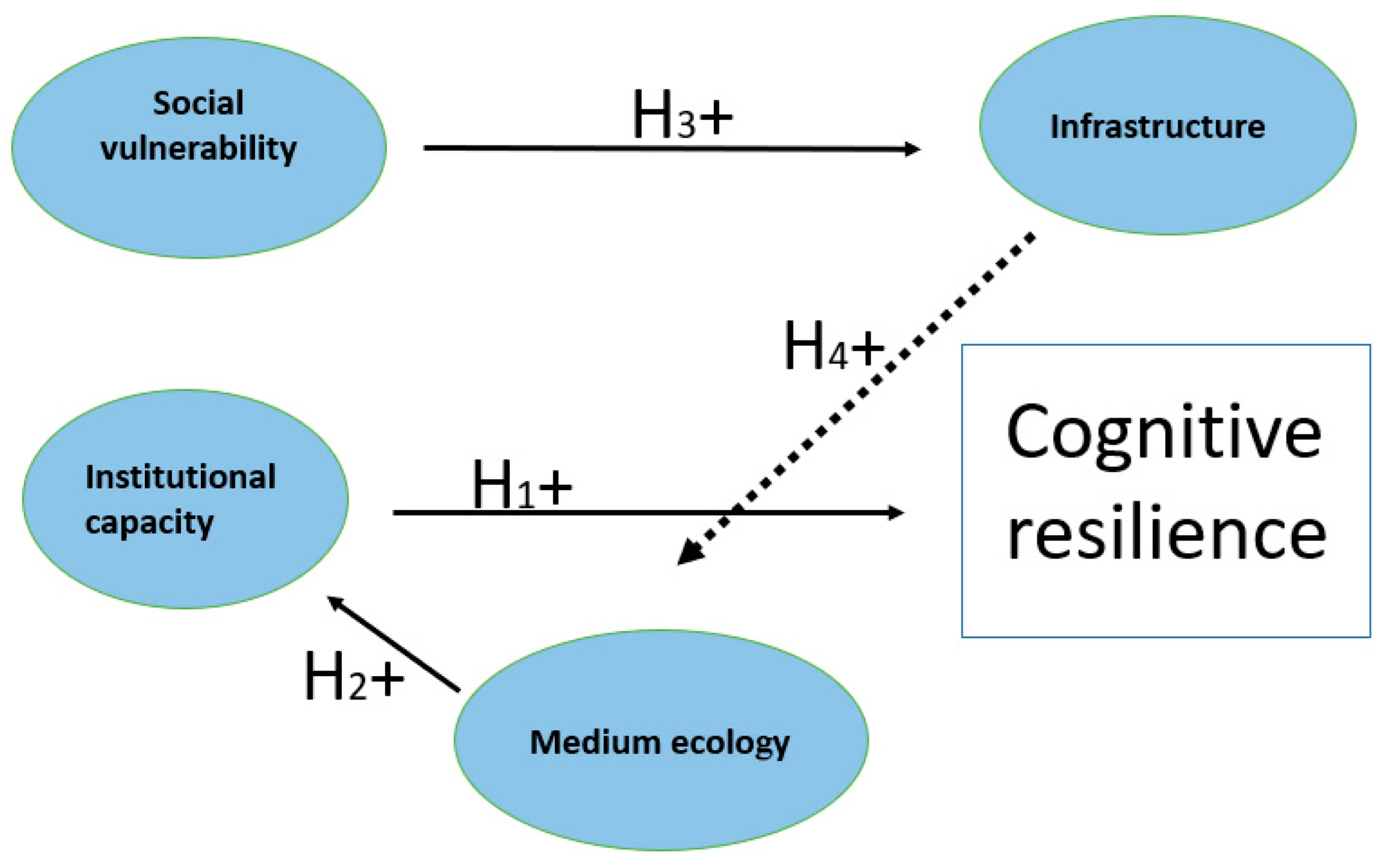
The present research adopts a comparative quantitative approach, based on secondary data analysis. The data used came from international open-access databases, which aggregate standardised and cross-country comparable indicators on socio-economic development, governance, digital infrastructure and the information environment. The choice of this methodological strategy is justified by the objective of the study: to test a conceptual model (
Figure 1) that explains the differences between states in terms of resilience to cognitive warfare through structural and institutional dimensions measurable at the national level.
The unit of analysis is the state, and the sample is made up of 39 European countries, selected based on the criterion of data availability for the variables included in the analysis. The set of countries covers both the EU space and its institutional and geopolitical neighbourhood: 27 Member States of the European Union, 8 EU candidate countries (Albania, Bosnia and Herzegovina, Moldova, Montenegro, North Macedonia, Serbia, Turkiye, Ukraine), as well as non-EU European states included in the economic or regional cooperation area (Iceland, Norway, Switzerland, the United Kingdom). This configuration allows the comparison of national contexts with different levels of institutional integration, administrative capacity, digital development and characteristics of the information space.
The analysis is based on a set of 23 variables (
Table 1), organised into five constructs (composite variables) that correspond to the theoretical dimensions of the model: cognitive resilience, media ecology, social vulnerabilities, digital infrastructure and institutional capacity.
In the operationalization stage, the indicators were grouped into composites according to the conceptual logic of the model (
Table 2). Thus, cognitive resilience is captured through a combination of socio-economic and human capital indicators (GDP_PPP, Gini, youth unemployment, academic freedom and basic skills). Media ecology reflects the quality and safety of the information space, as measured by the RSF (Reporters Without Borders—
Reporters Sans Frontières) index, the share of internet users and online security. Social vulnerabilities are operationalized through the context dimensions that capture political, economic, legal and social pressures, as well as the safety component (political, economic, legal, social contexts and safety). Digital infrastructure is measured by a set of indicators on connectivity and conditions of use (mobile connectivity index, infrastructure, affordability, consumer readiness, content and services, network coverage). Finally, institutional capacity is approximated through governance effectiveness, e-government development, AI preparedness, and perceptions of corruption (Gov. Effectiveness, EGDI, AI readiness, and CPI). Each composite variable was calculated as the average of the standardised indicators that compose it, a common solution in comparative studies to avoid over-weighting a single indicator and to maintain the interpretability of the scores.
In this study, cognitive resilience is conceptualised as a structural dimension reflecting a society’s capacity to critically process information, sustain epistemic autonomy, and limit the destabilising effects of information manipulation. For this reason, the composite includes indicators capturing material resources and socio-economic cohesion (GDP_PPP, Gini, youth unemployment), the autonomy of knowledge institutions (academic freedom index), and the minimum skills required for critical participation in the digital environment (basic skills mobile). Media ecology was operationalized through the RSF index, internet users, and online security, as these variables jointly capture the quality of the information environment, effective access to information, and the conditions of digital safety. Social vulnerabilities include political context, economic context, legal context, social context, and safety, as these indicators describe contextual pressures that may amplify societal fragility. Digital infrastructure was constructed from the mobile connectivity index and its relevant subdimensions—infrastructure, affordability, consumer readiness, content and services, and network coverage—since these indicators describe the fundamental conditions of digital connectivity and use. Finally, institutional capacity was defined through government effectiveness, the e-government development index (EGDI), AI readiness, and the corruption perceptions index, indicators that together reflect the quality of governance, administrative capacity, the state’s digital maturity, and institutional integrity (
Norris et al., 2008;
Spannagel & Kinzelbach, 2023;
United Nations, 2024;
World Bank, 2025b;
Oxford Insights, 2024;
Reporters Without Borders, 2025;
Transparency International, 2025).
The selection of these indicators follows a logic of structural operationalization of resilience at the state level, where cognitive warfare is understood not merely as a communication problem but as the outcome of interactions between governance quality, the information ecosystem, digital infrastructure, and broader social conditions. In this context, aggregating indicators into composite variables allows the analysis to capture broader latent dimensions than any single variable alone, while simultaneously reducing the risk of over-weighting individual indicators (
World Bank, 2025a,
2025c,
2025d). Following the observation of the second reviewer, we have also introduced an explicit justification regarding social capital as a relevant determinant of social and organisational resilience. The literature consistently shows that trust, social networks, and cooperative capacity enhance community resilience, including in contexts of crisis and information disruption (
World Health Organization, 2025). However, a distinct social capital composite was not included in the present model due to the absence of comparable and consistently available indicators for all 39 countries included in the analysis. This limitation is now explicitly acknowledged in the manuscript and identified as a direction for future research (
Aldrich & Meyer, 2015;
Norris et al., 2008). Finally, for conceptual clarity, the terminology was standardised throughout the manuscript, and the term media ecology is now used consistently instead of the less precise formulation “average ecology.”
Research Hypotheses
H1. Countries with higher institutional capacity will have higher cognitive resilience.
H2. A healthier (more robust/functional) media ecology is associated with a higher institutional capacity.
H3. Countries with a higher level of digital infrastructure and access will be more socially vulnerable, as exposure and intensity of interaction with the online environment increase opportunities for manipulation and amplification of narratives.
H4. Infrastructure moderates the relationship between institutional capacity and cognitive resilience, so the positive effect of institutional capacity on cognitive resilience is stronger in countries with higher infrastructure.
Regarding the ethical dimension, the use of aggregated country-based, public and non-identifiable data does not pose privacy risks. The main limitations of this approach derive, first, from the selective nature of operationalisation. Although the indicators used capture relevant dimensions (institutional capacity, media ecology, social vulnerabilities and digital infrastructure), it is likely that other indicators—potentially equally important for the dynamics of cognitive warfare—can also be integrated into a more comprehensive model. Secondly, the concept of cognitive warfare and, implicitly, that of cognitive resilience represents an area that is still in a process of theoretical and methodological consolidation. The literature does not yet provide a stable consensus on the most appropriate indicators or on the best measurement methods, which implies that the relationships proposed in the model can also be interpreted through other conceptual grids, and some dimensions may require refinement in future research. Thirdly, the use of a secondary, cross-sectional data analysis, based on aggregated indicators at country level, imposes structural limits on inference. Even if statistical models can highlight significant associations between composite variables and support the idea of influences compatible with the hypotheses formulated, the available data do not allow the demonstration of strict causality in the experimental sense. The identified relationships must be understood, first of all, as correlations and as indications of possible mechanisms, depending on the structure of the data and the mode of operationalisation.
4. Results
The theoretical model in the methodology was analysed and estimated by the PLS-SEM method in SmartPLS 4, using composite variables previously constructed in IBM SPSS 2.2 Statistics (through the MEAN function), so that each latent construct is represented by a single aggregate score (
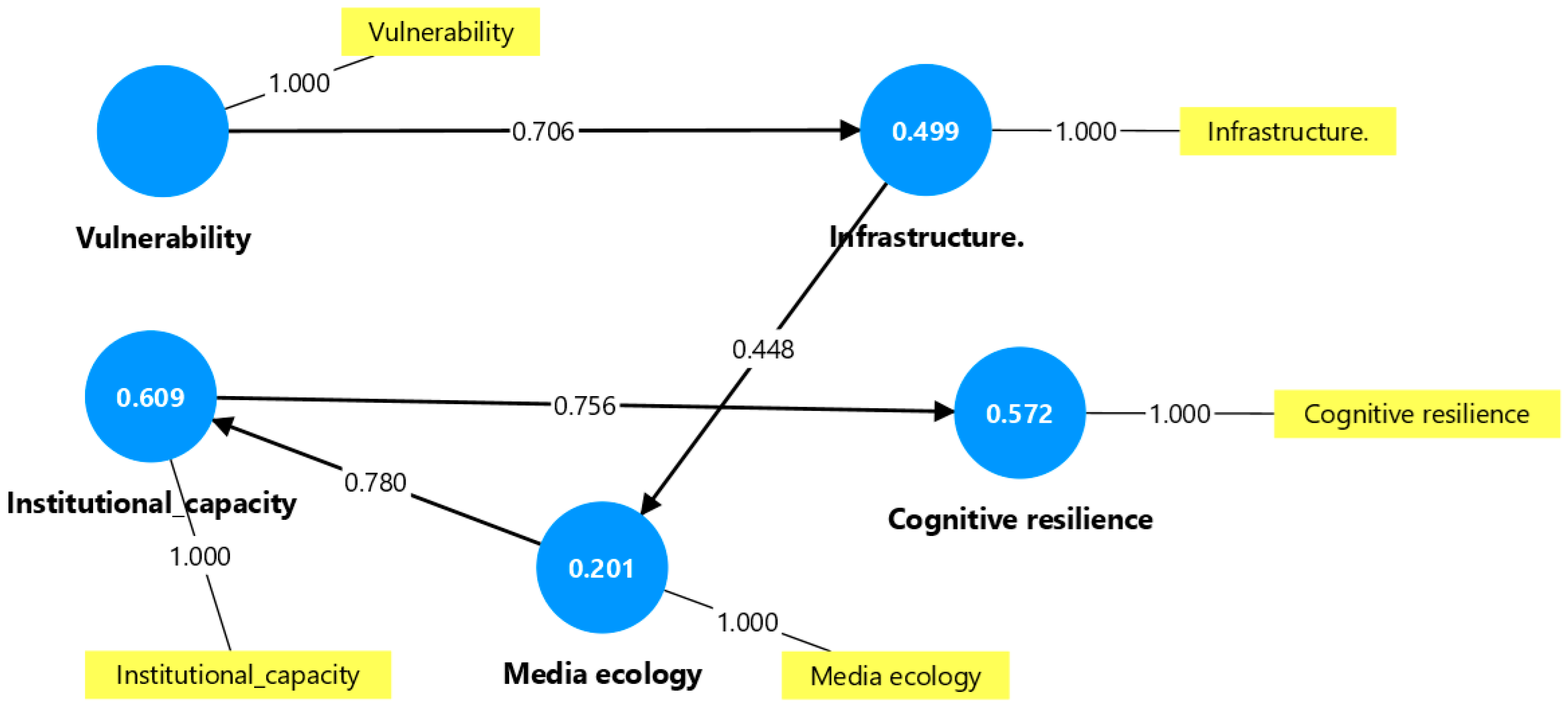
Hair et al., 2019). The structure of the model follows the logic of the hypotheses formulated and captures a chain mechanism: vulnerabilities are associated with the level of infrastructure (β = 0.706), infrastructure contributes to media ecology (β = 0.448), media ecology supports institutional capacity (β = 0.780), and institutional capacity directly influences cognitive resilience (β = 0.756). The explanatory power of the model is reflected by the R
2 values displayed in the constructs (e.g., R
2 = 0.572 for cognitive resilience), indicating a good ability to capture the variation in the target phenomenon in the sample of countries analysed. Next, each causal relationship will be analysed separately, by interpreting path coefficients, statistical significance (bootstrapping) and theoretical implications for understanding resilience to cognitive warfare (
Figure 2).
4.1. Effect of Institutional Capacity on Cognitive Resilience
The analysis of the relationship between institutional capacity and cognitive resilience highlights a strong and consistent association in the sample of the 39 European countries analysed. The main result of the Pearson correlation indicates r = 0.756, with
p < 0.001 (Sig. 2-tailed = 0.000), which suggests a robust positive relationship: as institutional capacity increases, the general trend is for cognitive resilience to also register higher values (
Table 3).
Beyond the statistical significance, an important aspect is the substantial (practical) significance of this relationship. Pearson’s coefficient can be converted into an intuitive measure of common variance by calculating r2:
This result shows that approximately 57.2% of the variation in cognitive resilience is associated with variation in institutional capacity (at a bivariate level, without including other predictors). In a cross-country comparative analysis, where the social phenomenon was influenced by multiple historical, political, and cultural conditions, a proportion of the variance associated with this magnitude was considered substantial. In other words, institutional capacity emerges as a major structural dimension, capable of explaining relevant differences between states in terms of their potential to resist informational pressures and mechanisms of influence specific to cognitive warfare (
Claverie & du Cluzel, 2022).
The theoretical interpretation of this connection is consistent with the logic of the conceptual model of the study. Institutional capacity (operationalized through indicators such as governance effectiveness, e-government development, AI preparedness, and perceptions of corruption) essentially reflects how well state mechanisms work in terms of coordination, policy implementation, administrative quality, and integrity (
Atkinson, 2018). At the same time, cognitive resilience (defined here by a combination of socio-economic resources and capacities of the population, including academic freedom and basic skills) can be understood as a product of institutional stability and the socio-political environment that allows the formation and maintenance of a functioning public space. In the context of cognitive warfare, effective institutions can reduce society’s vulnerability through several channels: more coherent public communication in crisis situations, more consistent educational and digital policies, reducing arbitrariness and corruption (which fuels mistrust), and increasing the state’s capacity to respond in a coordinated manner to disinformation campaigns (
Hung & Hung, 2022).
An important point in reading this result is that the observed association should not be interpreted as a strict causal relationship. Pearson’s correlation describes the direction and intensity of the linear relationship between two variables, but it cannot establish the mechanisms by which one determines the other. Especially in a transversal design and based on aggregated indicators, there is the possibility of bidirectional relationships (e.g., states with high cognitive resilience can, in turn, support the development of institutions through social stability and democratic pressure) or third-party factors (such as the general level of development, administrative traditions, political culture, geopolitical positioning) that simultaneously influence both dimensions. However, even through this logic, the strong correlation observed confirms that the two constructs are closely connected and that any analytical approach on the resilience of states to cognitive warfare should give a central role to institutional capacity.
Also, the significance of this result must be understood in relation to the structure of the sample. The 39 countries include both European Union Member States and candidate countries and non-EU European states, which introduces considerable variability in administrative capacity, the level of digitalization and the quality of governance. Typically, it is this structural variation that makes strong relationships possible in cross-country analyses: where differences between units are pronounced, correlations can more clearly reflect the contrast between distinct institutional profiles. Thus, the association r = 0.756 can also be interpreted as an expression of a European “gradient”: states with more efficient institutions and less affected by corruption tend to offer more favourable social and educational conditions for cognitive resilience, while states with lower institutional capacity find it difficult to consolidate these resources.
4.2. The Association Between Media Ecology and Institutional Capacity
Pearson’s correlation analysis between the variables Institutional capacity and Media ecology indicates a strong positive linear relationship within the sample of 39 countries (
Table 4). According to the correlation table, the Pearson coefficient is r = 0.780, and the associated significance level is
p < 0.001 (Sig. 2-tailed = 0.000). This result shows that the observed association is statistically significant, and the probability that this relationship occurs randomly in the sample is very low, under the null hypothesis of lack of relationship (r = 0).
From the point of view of magnitude, the r-value = 0.780 suggests a substantial association: as institutional capacity scores increase, average ecology scores tend to increase in turn. To provide a quantitative interpretation of the strength of the relationship, the coefficient can be expressed by the common variance of the two variables (r2). The calculation leads to:
Therefore, the two variables share approximately 60.8% common variance in the bivariate analysis, which indicates considerable overlap between the variation in institutional capacity and the variation in media ecology in the dataset used. In terms of cross-country benchmarking practices, this represents a large relationship, especially given the typical heterogeneity of the European countries included (differences in development, governance, digitalization, media space, etc.). At the same time, it is important to note that this result describes a linear association between two composite scores at the country level. The Pearson coefficient captures the direction and intensity of the relationship, without automatically implying a deterministic relationship: within the same model, there may be countries that deviate from the general trend but, overall, the dominant trend in the sample is a clearly positive one. For example, in the Netherlands, although the institutional capacity is very high (score 39.45), the average observed ecology (83.63) is lower than that estimated by the general trend (92.29). In the Republic of Moldova, although the institutional capacity is lower (24.91), the average observed ecology (84.09) is higher than the one estimated by the general trend (78.87).
4.3. Shapping: The Relationship Between Digital Infrastructure (Access) and Social Vulnerabilities
The Pearson correlation analysis performed between the variables infrastructure and vulnerabilities highlights a clear positive linear association at the sample level of N = 39 states. The correlation table (
Table 5) shows a coefficient r = 0.706, with
p < 0.001 (Sig. 2-tailed = 0.000), which indicates that the observed relationship is statistically significant under the conditions of the bilateral test. In descriptive terms, this result suggests that countries that score higher on infrastructure tend to score higher on vulnerabilities at the same time, depending on how these variables were operationalized in the dataset.
From the perspective of effect size, the coefficient r = 0.706 indicates a strong association (although lower than in the case of the previous relationships discussed). To quantify the proportion of common variation between the two variables, r2 can be calculated:
Therefore, infrastructure and vulnerabilities share about 49.8% common variance in bivariate analysis. This result is analytically relevant because it suggests a consistent link between the two dimensions: almost half of the observed variation in one of the variables is associated with the variation in the other (in the sense of covariance, not causality). It is also important to specify exactly what this result ‘says’ and ‘does not say’.
4.4. Shapping: Triad Media Ecology—Infrastructure—Cognitive Resilience
The correlation table provides an overview of how the three dimensions—media ecology, cognitive resilience and digital infrastructure—relate to each other across the 39 countries in the sample (
Table 6). Unlike previous analyses focused on a single relationship, here the results allow a ‘networked’ reading, i.e., examining whether there is a coherent pattern in which one of the variables plays the role of a connection point between the other two.
The first relationship, Media Ecology—Cognitive Resilience, has a coefficient of r = 0.587, with p < 0.001. From an analytical point of view, this indicates a positive association of moderate intensity, but consistent enough to be statistically significant in the sample. Thus, a substantial part of the variation in cognitive resilience is associated with the variation in media ecology, but this relationship is not ‘almost perfect’ (as was the case with some coefficients >0.75 in previous analyses).
The second relationship, media ecology—infrastructure, indicates r = 0.448, with p = 0.004, so it is also a positive association of moderate intensity and is statistically significant. Analytically, this suggests that digital infrastructure is associated to a relevant extent with media ecology but does not explain it almost completely. There is a lot of room for additional factors that differentiate media ecology between countries. The third result is the one that changes the “configuration”: cognitive resilience—infrastructure has r = 0.160, with p = 0.332, i.e., a very weak and statistically insignificant correlation. In terms of reporting practices, this result means that there is no empirical support for a direct linear relationship between digital infrastructure and cognitive resilience, at least in the form of operationalisation used in this sample as well. Taken together, the three correlations outline a clear pattern: media ecology is the only variable that significantly correlates with both, while infrastructure does not significantly correlate with cognitive resilience. This setup is useful analytically because it suggests that if there is a link between infrastructure and cognitive resilience in your dataset, it is more likely to be observed indirectly, via media ecology (i.e., infrastructure associates with media ecology, and media ecology associates with resilience).
4.5. Profile of Associations Between Cognitive Resilience and Different Structural Indicators
The Pearson set of correlations indicates that cognitive resilience is part of a relatively coherent pattern of association with several structural dimensions of the states analysed (
Table 7). Instead of suggesting a single dominant link, the table outlines a “profile” in which some variables align very closely with cognitive resilience, others have a moderate relationship, and one of them has an inverse relationship. This differentiated distribution of coefficients is useful analytically because it allows the identification of areas where cognitive resilience seems to be most strongly correlated in the sample of 39 countries.
The most pronounced association occurs in relation to Government Effectiveness (r = 0.800;
p < 0.001), which places this indicator at the centre of the network of correlations with cognitive resilience. At the descriptive level, this relationship suggests that the variation in cognitive resilience between countries closely follows the variation in governance effectiveness, at least in the sense of a bivariate linear relationship (
Setyobudi & Setyaningrum, 2019). Very close in intensity is internet users (r = 0.770;
p < 0.001), which indicates that cognitive resilience has a comparably strong association with an indicator of digital penetration/use.
A second level of association, still robust but noticeably lower in magnitude, is represented by AI readiness (r = 0.639; p < 0.001). This result indicates that preparing a country for the integration of artificial intelligence technologies aligns significantly with cognitive resilience, but not as closely as the effectiveness of governance and the use of the internet. In strictly bivariate terms of analysis, the difference between r ≈ 0.64 and r ≈ 0.77–0.80 suggests that the link to “advanced technological maturity” is important but does not have the same statistical intensity as the two main correlates.
Following this profile, there are two indicators with moderate correlations, both significant: RSF (r = 0.544;
p < 0.001) and EGDI (r = 0.481;
p = 0.002). Analytically, their positioning in the table is relevant because it shows that the dimensions associated with the information environment and the digitalization of governance are correlated with cognitive resilience, but at a lower level compared to general governance and internet use. In other words, in this sample, the variation in cognitive resilience appears to be more ‘closely related’ to variables of general capacity (GovEffectiveness) and extent of digital use (InternetUsers) than to more specific indicators (EGDI) or a complex indicator of press freedom/conditions (RSF). Based on the distribution of the coefficients, two indicators with weaker but significant relationships appear at the 5% threshold: academic freedom index (r = 0.375;
p = 0.019) and youth unemployment (r = −0.329;
p = 0.041). Analytically, these two results are important for different reasons. In the case of academic freedom, the positive relationship is relatively modest in intensity, indicating an existing association, but less pronounced than the rest of the correlates. In the case of youth unemployment, the sign of the coefficient is negative, and the relationship, although smaller in size, introduces a distinct dimension: where youth unemployment is higher, cognitive resilience tends to be lower (in terms of a bivariate linear relationship) (
Demeke, 2022).
An important aspect, from a strictly analytical point of view, is that these coefficients should not be read in isolation but as part of a common structure: institutional and digital indicators are generally interrelated with each other (e.g., GovEffectiveness, EGDI and AI readiness may partially overlap). Therefore, what the table provides is a bivariate picture of how each predictor is associated with cognitive resilience “taken separately”, not an estimate of partial (mutually controlled) effects.
4.6. Mapping European Countries’ Resilience to Cognitive Warfare
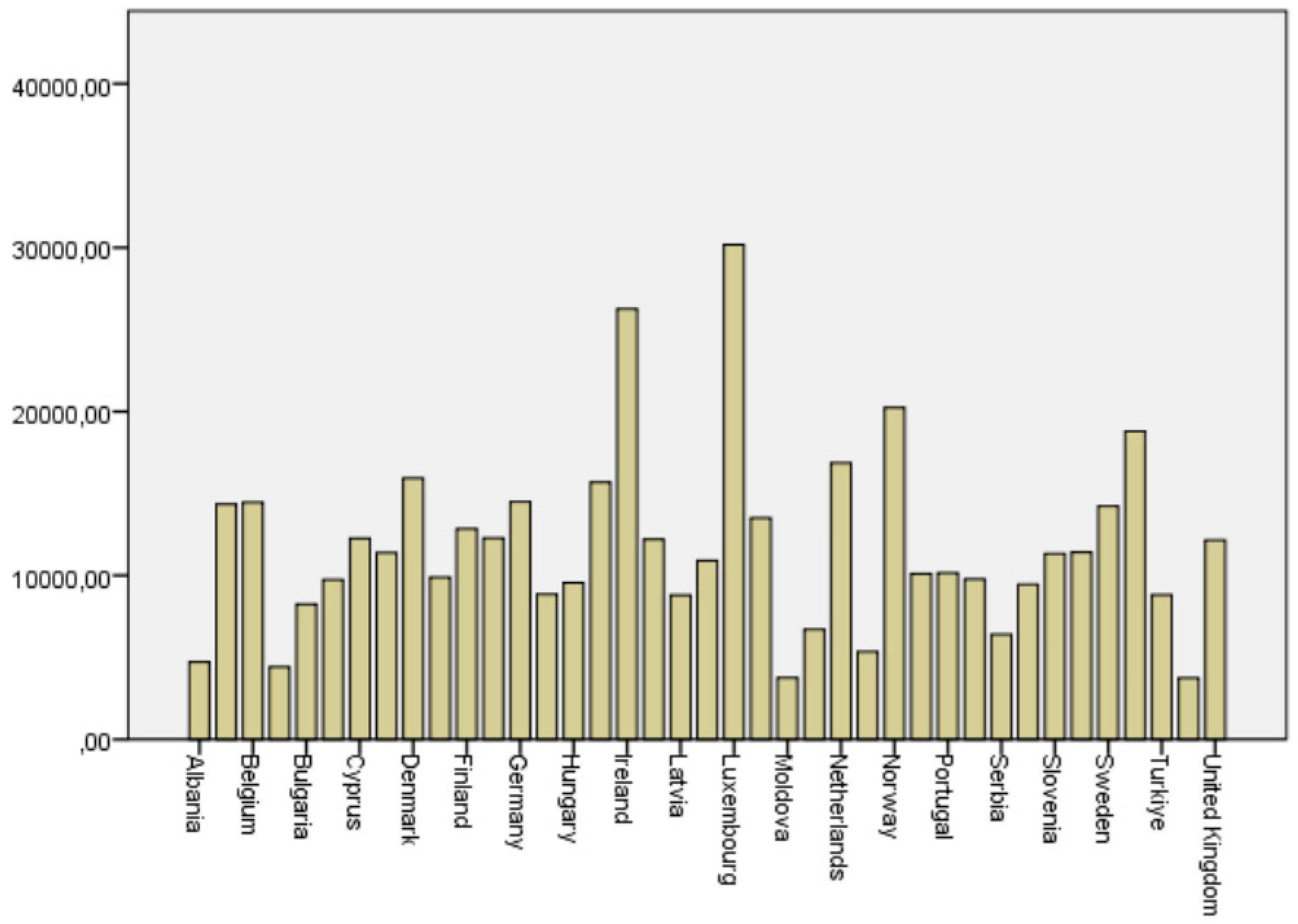
The graph shown (
Figure 3) shows the top 10 states according to the composite cognitive resilience score. The recorded order confirms that Luxembourg, Ireland, Norway, Switzerland, and the Netherlands stand out significantly, with raw scores between ~15,000 and ~30,000 (arbitrary units). Denmark, Germany, Iceland, Belgium and Austria follow, all with values between ~14,000 and ~16,000. This hierarchy shows a concentration of performance in the northwest of the continent: the wealthy states of the Benelux area and Scandinavia combine efficient institutions, economic prosperity and advanced digital infrastructure, which allows populations to better manage information flows and be less vulnerable to cognitive manipulation.
The graph’s results largely align with the Open Society Institute’s Media Literacy Index 2026 (
Media literacy index 2026, 2026). This index, focused on vulnerability to disinformation, places Denmark, Finland, Ireland and the Netherlands in the first category, highlighting that the countries of northwestern Europe stand out for media literacy, education, trust in institutions and advanced economy. Although in our chart Luxembourg and Switzerland become leaders, while Finland does not appear in the top 10, this discrepancy is explained by the weight of socio-economic variables in our composite. Countries with high incomes (Luxembourg, Switzerland) and low inequality are favoured, while Finland—recognised for its media literacy—does not excel in all economic criteria, although it remains in the top third of the ranking anyway.
Independent analyses reach similar conclusions. A Media@LSE study, which compares 18 Western democracies, identifies a “high resilience group” made up of Finland, Denmark, the Netherlands, Sweden and Ireland, with southern European states such as Spain, Italy and Greece at the opposite pole (
Goodman, 2020). In the present graph, Ireland and Denmark are at the top, while Spain and Greece are absent from the top 10, confirming the geographical polarisation observed by the LSE; Italy does not appear in the database, but the southern states (Greece, Spain) have much lower scores in the composite calculus.
The most obvious difference from the OSIS index is the positioning of Luxembourg and Switzerland. These states do not appear among the leaders in the Media Literacy Index, but their cognitive resilience scores are very high in our analysis due to their extremely high GDP per capita, high-performance education systems and high degree of trust in institutions.
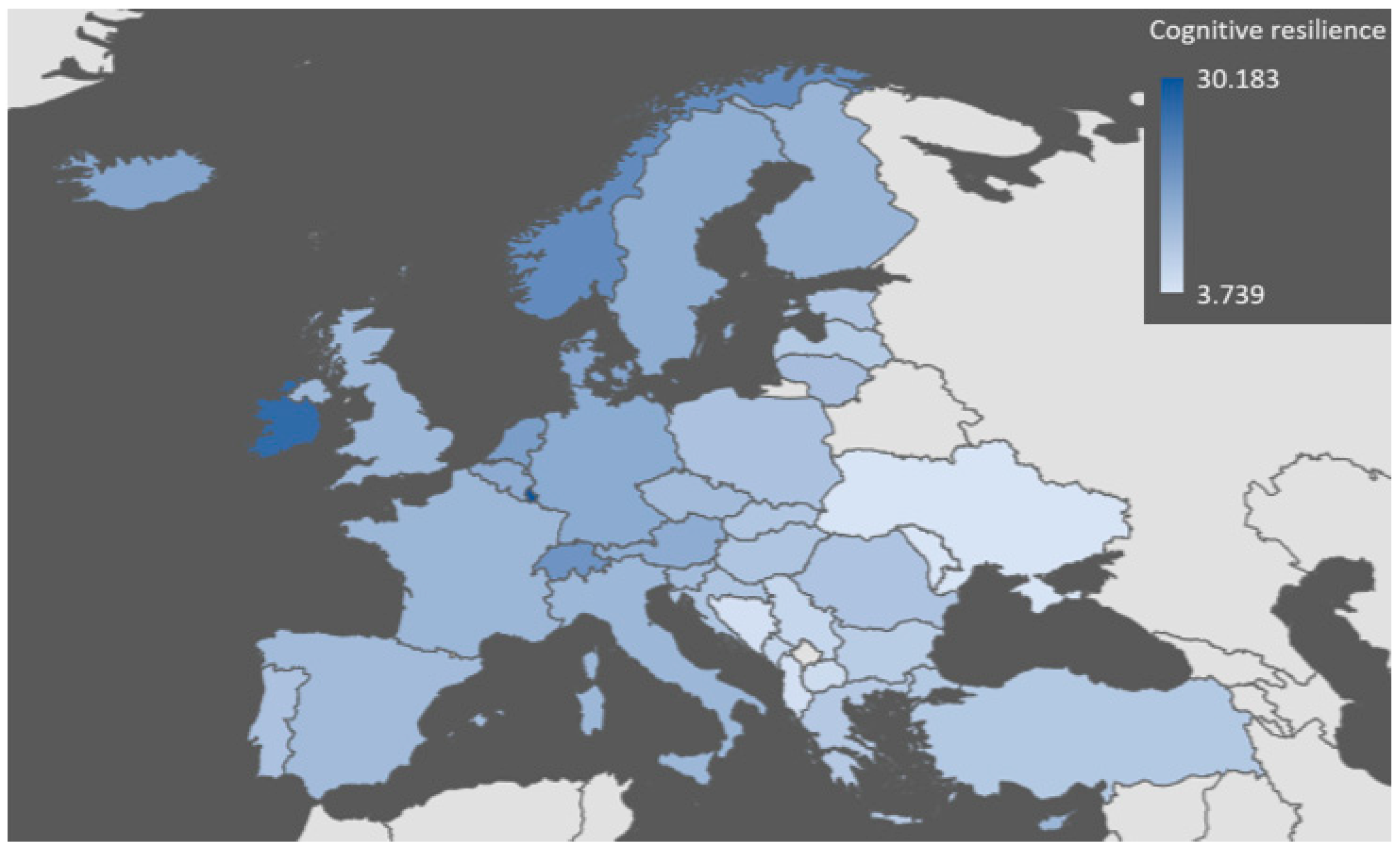
On the other hand, countries such as North Macedonia, Bosnia and Herzegovina or Albania—ranked last in the Media Literacy Index—are also at the bottom of our ranking, confirming their high vulnerability to cognitive warfare. In addition, the graph captures aspects that OSIS does not highlight: Germany and Austria, although not consistently at the top of media literacy indices, score well due to a stable economy and intellectual capital, suggesting that cognitive resilience does not only depend on media literacy, but also on the socio-economic and institutional context (
Figure 4).
5. Discussion
The results outline a chain mechanism: vulnerabilities → infrastructure (β ≈ 0.706), infrastructure → media ecology (β ≈ 0.448), media ecology → institutional capacity (β ≈ 0.780) and institutional capacity → cognitive resilience (β ≈ 0.756), with a substantial R
2 for cognitive resilience (≈0.572). The interpretation becomes more solid if it is anchored in the international literature (NATO,
Cognitive Warfare, n.d.).
In the case of H1 (institutional capacity → cognitive resilience), the strongly positive relationship is congruent with the literature on resilience to disinformation and hybrid threats: the comparative frameworks show that vulnerability to disinformation differs between countries depending on institutional architecture, quality of governance, level of trust and public response capabilities (
Humprecht et al., 2020). In political and disinformation psychology, empirical evidence (on other populations and designs) suggests that trust in institutions/experts and cognitive competences (e.g., numeracy) are associated with lower susceptibility to misinformation, and distrust may become part of a self-reinforcing cycle (
Roozenbeek et al., 2020).
For H2 (media ecology → institutional capacity), the consistent association (r ≈ 0.780) is also consistent with the classic literature on the media as a “watchdog” and on the relationship between press freedom and the quality of governance (
Allcott & Gentzkow, 2017). Cross-country studies show that press freedom is associated with lower levels of corruption and better accountability mechanisms, and “media capture” weakens democratic accountability (
Kocak & Kıbrıs, 2023).
H3 (digital infrastructure → social vulnerabilities, positive) is the most interpretively “delicate” hypothesis, and the result (r ≈ 0.706) can be put in agreement with two strands in the literature. The first is that of risk amplification: high connectivity increases the “attack surface” for influence operations, and the online environment favours the rapid and widespread dissemination of manipulative content, including through virality dynamics (
Lazer et al., 2018). The second thread is that of hybridization: European institutions and the security community are increasingly treating FIMI/disinformation together with cyber components, showing that information manipulation events can include compromising infrastructure or accounts, and collaboration between the cyber and counter-FIMI communities is critical for detection and attribution (
Foreign information manipulation interference (FIMI) and cybersecurity—Threat landscape|ENISA, 2025). However, here also appears an area of criticism that deserves to be explicitly formulated: the positive correlation can also reflect the fact that “vulnerabilities” (as they are operationalized through political/economic/legal/social/safety contexts) can partially capture the “density of exposure” and the complexity of digitised societies, not just fragility in the strict sense. The literature shows that the internet and infrastructure can facilitate both mobilisation (including protest) and resilience, depending on education, institutions and the quality of the information ecosystem (
Amorim et al., 2022). For this reason, H3 is, in academic terms, supported by the data obtained but it would benefit from a discussion about the metric meaning of vulnerabilities and possible third-party variables (general level of development, polarisation, media fragmentation) that could produce a positive correlation between infrastructure and “context”. This aspect is a line of further development of our study.
Finally, H4 (infrastructure moderates the effect of institutional capacity on cognitive resilience) is not confirmed by the set of results presented. A series of arguments converge: the direct relationship infrastructure → cognitive resilience is very weak and insignificant in the correlational triad (r ≈ 0.160), suggesting that infrastructure, in itself, is not an automatic “accelerator” of resilience. Theoretically, however, there is a basis for H4: in areas such as e-government, transparency and anti-corruption, the effects of digitalization may depend on institutional maturity (“partial” vs. “transformative” implementations), and some studies show that e-government is associated with a decrease in perceptions of corruption, but with differences between developed and developing countries (exactly the logic that the hypothesis suggests) (
Setyobudi & Setyaningrum, 2019). The rigorous conclusion is therefore that H4 remains unconfirmed in the current form of the analysis but is plausible and testable at a later stage through an interaction term and/or a “moderated mediation” model.
The apparent tension between H3 and H4 can be resolved by distinguishing between two roles of digital infrastructure: as a factor of exposure, it may increase opportunities for manipulation and thus amplify vulnerabilities; as an enabling resource, it may theoretically strengthen the positive effects of institutional capacity, although this latter mechanism was not confirmed in the present study.
6. Conclusions
The analysis highlights a coherent structural mechanism linking digital infrastructure, media ecology, institutional capacity and cognitive resilience, but clearly indicates that the foundation of resilience is not technological but institutional. The strongest relationship identified is between institutional capacity and cognitive resilience, suggesting that governance efficiency, administrative integrity, and public policy coherence are the central pillars of societal resistance to influence and information manipulation. Media ecology is in close association with institutional capacity, which indicates an interdependence between the quality of governance and the health of the information space. In contrast, digital infrastructure does not have a significant direct effect on cognitive resilience, which shows that mere connectivity is not enough to generate cognitive protection. Its impact appears to be indirect, through other structural dimensions. The hierarchy of states confirms a concentration of high levels of resilience in North-West Europe, where efficient institutions, economic stability and strengthened media ecosystems converge. Overall, the results support the idea that cognitive resilience is a product of institutional architecture and the quality of the information environment, and digitisation, in the absence of strengthening governance, is not a guarantor of resistance to cognitive warfare.
For public policies, the main conclusion is that cognitive resilience (as a macro proxy) seems to be anchored primarily in the institutional capacity and health of the information ecosystem, not in the digital infrastructure itself. It supports integrated interventions: administrative and integrity reforms, protecting media pluralism, strengthening online security, and measures that reduce socio-economic vulnerabilities (e.g., youth unemployment) associated with decreasing resilience. From the defence perspective, this conclusion is compatible with NATO’s analysis (
Media literacy index 2026, 2026) of cognitive warfare, which emphasises the role of societal resilience and civil-military coordination; at the same time, defence planning must treat connectivity as an ‘asset’ and as an ‘attack surface’, which requires aligned security policies and digital governance (
Cognitive Warfare, n.d.).
7. Criticisms, Limits and What Would Strengthen the Study
Three boundaries are worth discussing as part of a comprehensive academic approach. The first is the limit of causal inference: the data are cross-sectional and aggregated at the country level; even if the PLS-SEM model is formulated causally, the results remain associations compatible with hypotheses, not causal “evidence”. Interestingly, even the defence literature recommending technical countermeasures (including AI) recognises the difficulty of establishing causality and attribution in information ecosystems, which reinforces interpretative caution (
Lahmann et al., 2025).
The second is operationalisation: the use of simple composite measures is transparent but it can over-represent indicators with high variance or mask internal tensions (e.g., a country with high economic performance but with academic freedom or weaker basic skills). The literature on composites explicitly recommends sensitivity analyses (change in weights, exclusion of indicators, geometric vs. arithmetic aggregation) precisely to demonstrate the robustness of rankings (
Nardo et al., 2008).
The third concerns micro-macro mechanisms: “cognitive resilience” as a macro index can strongly correlate with governance, but the psychological mechanisms by which individuals reject misinformation are mediated by skills, motivations, and confidence (
Anstead et al., 2025). Recent meta-analyses and syntheses show that media literacy interventions can improve resilience, but the effects vary and depend on the context, platforms, and vulnerable groups included in the samples (
Anstead et al., 2025). Therefore, the direction of natural expansion would be triangulation: the study retains the macro model but completes it with variables closer to “cognitive” variables (polarisation, social trust, media consumption, media education), where there are comparable data.
At the same time, the present study opens several directions for future research. First, research on cognitive resilience in the context of cognitive warfare remains a relatively incipient field, both internationally and, even more clearly, in the Romanian academic space. For this reason, the current model should be understood as an initial analytical framework rather than a closed explanatory formula. Future studies may refine and expand this approach by testing additional variables that could shape cognitive resilience at both the societal and institutional levels, including social capital, social trust, political polarisation, civic participation, media consumption patterns, media literacy, educational quality, and exposure to digital platforms. Second, further research should examine more closely how cognitive resilience is composed internally, which dimensions weigh more heavily in different national contexts and through what mechanisms these factors interact. Third, future studies may also benefit from combining macro-level comparative models with micro-level data in order to better understand how structural conditions are translated into individual and collective resilience capacities. Such developments would help clarify not only which factors influence cognitive resilience, but also how they interact, accumulate, and vary across societies.



 ,
,