1. Introduction
Digital transformation has become a defining structural phenomenon of the Industrial Revolution 4.0, characterized by the increasing integration of technologies such as the Internet of Things (IoT), big data analytics, artificial intelligence, and cloud computing into organizational activities. The adoption of digital technologies has reshaped how organizations create value, allocate resources, and sustain competitive advantage, positioning information and communication technology (ICT) not merely as an operational tool but as a strategic determinant of organizational performance and long-term viability (
Yang et al., 2021). Empirical studies consistently indicate that organizations capable of leveraging ICT effectively tend to outperform their competitors, while those that fail to adapt often experience declining competitiveness and, in some cases, organizational exit (
Chasanah et al., 2021).
The expansion of digital platforms, particularly social media and e-commerce, has further intensified expectations regarding technology adoption, especially for small and medium-sized enterprises (SMEs). Digital platforms are widely portrayed as mechanisms that enable SMEs to expand market reach, enhance brand visibility, and strengthen interactions with customers and business partners. In the Indonesian context, platforms such as Facebook, Instagram, TikTok, Shopee, Tokopedia, and Gojek have been shown to increase customer engagement and market exposure for SMEs (
Mwaanga & Hapompwe, 2024). Beyond marketing, social media also functions as a channel for information exchange and knowledge sharing that may stimulate innovation and improve business performance (
Ghazwani & Alzahrani, 2024). However, existing evidence suggests that technology adoption does not automatically translate into superior outcomes. SMEs are still required to develop adaptive strategies, strengthen innovation capacity, and manage operational costs effectively for digital technologies to contribute meaningfully to competitiveness (
Amirrudin et al., 2024).
Despite their strategic role as the backbone of the Indonesian economy—contributing more than 60% of national GDP and absorbing approximately 97% of the workforce—SMEs continue to face substantial challenges in digital transformation. With more than 65 million SMEs operating by 2024, the sector represents significant economic potential. Nevertheless, only around 20% of SMEs actively utilize digital platforms, despite extensive government initiatives such as the National MSME Go Digital Movement aimed at accelerating digitalization. This persistent gap between economic potential and actual technology adoption indicates that digital transformation among SMEs is shaped by factors that extend beyond policy support and infrastructure availability.
Existing studies increasingly recognize that uneven technology adoption among SMEs reflects constraints related to limited knowledge, human capital, financial access, and resistance to organizational change (
Fadlan et al., 2023;
Kusumawati et al., 2023). These findings suggest that digital transformation is not merely a technical or economic process but is closely intertwined with managerial perceptions, organizational readiness, and broader socio-cultural contexts (
Ramdani et al., 2021). In practice, technology adoption within SMEs rarely follows a linear trajectory. Instead, it is influenced by resource limitations, market uncertainty, and how business actors perceive the benefits and risks associated with innovation (
Bin et al., 2021). Understanding innovation as an organizational and social process therefore becomes essential to explaining why some SMEs adopt digital technologies incrementally, while others remain reluctant or selectively engaged (
Hassan et al., 2024).
This complexity is further intensified in the context of culture-based and creative industry SMEs, particularly within the handicraft sector. Empirical studies indicate that despite persistent internal and external barriers, craft-based creative SMEs represent one of the most dynamic and fast-growing segments, making them a particularly relevant setting for examining the non-linear and socially embedded nature of technology adoption (
Kofler & Walder, 2024;
Raya et al., 2021). As one of the leading subsectors of Indonesia’s creative economy, the handicraft industry contributes significantly to exports and global competitiveness, drawing on rich cultural heritage and artisanal skills. At the same time, handicraft SMEs face increasing pressure to respond to changing markets and technological developments, especially in marketing practices, product innovation, and value chain coordination (
Fernández Bellver et al., 2023;
Li et al., 2025). These pressures raise fundamental organizational dilemmas regarding how innovation can be pursued without undermining cultural identity, traditional knowledge, and environmental sustainability.
The case of ata weaving SMEs in Karangasem Regency, Bali, illustrates this tension. Ata crafts, derived from
Lygodium spp., represent products deeply embedded in cultural, esthetic, and sustainability values. Originating as household and ritual items, ata crafts have evolved into commercially valuable products such as bags, baskets, and home décor—driven by tourism growth in Tenganan Pegringsingan Village since the 1980s (
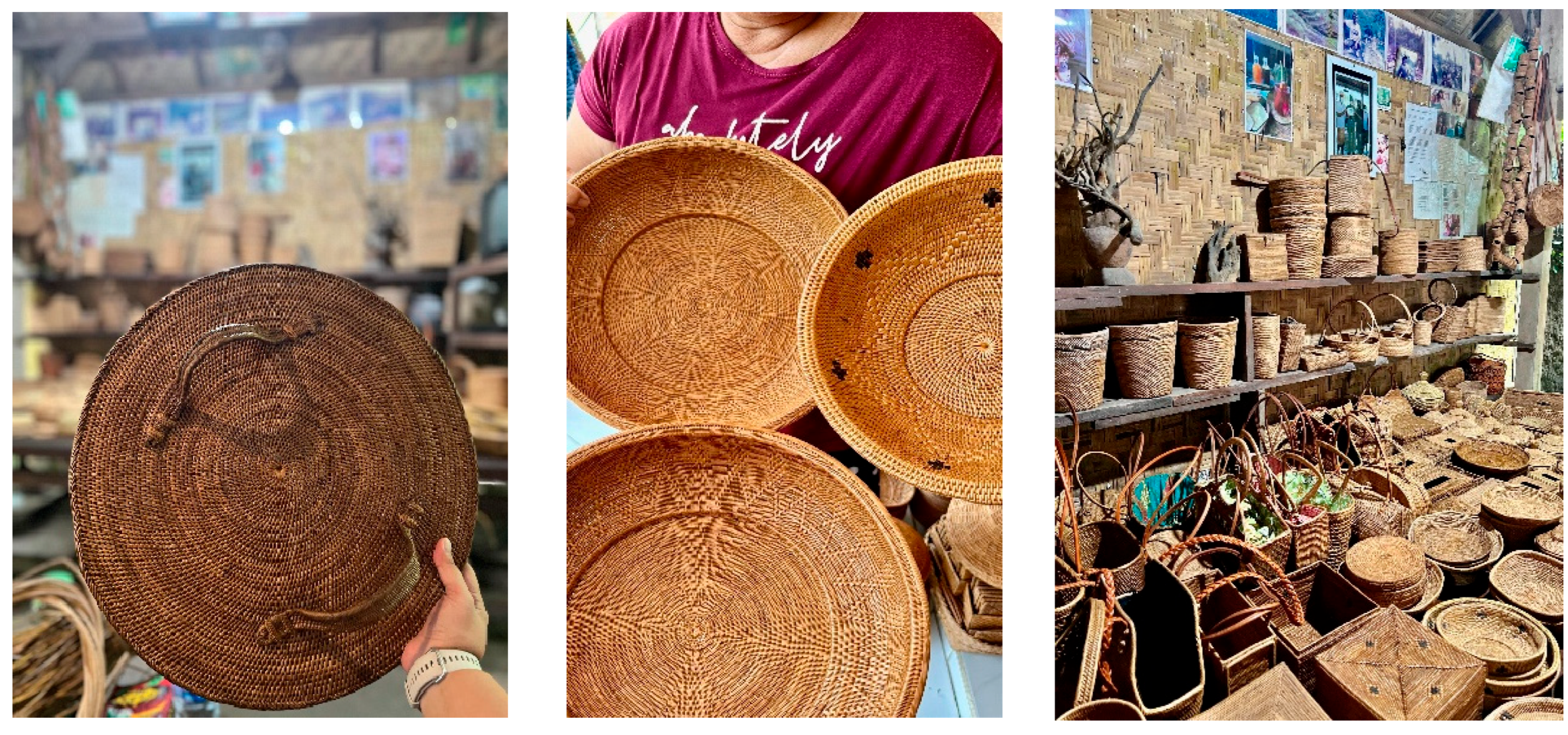
Ministry of Education and Culture Reference Data, 2021). This transformation from traditional use to market oriented products is illustrated in
Figure 1.
Although design innovation and product diversification demonstrate responsiveness to market demand, production processes largely retain traditional techniques supported by minimal technological intervention. This pattern reflects a selective and contextual approach to innovation, in which technological change is carefully negotiated rather than fully embraced (
Überbacher et al., 2020). Despite growing economic potential and an increasing number of SMEs in the region—particularly during the COVID-19 pandemic—craft-based enterprises continue to encounter barriers in leveraging digital technologies to expand market reach and strengthen competitiveness (
Trindade & De Giovanni, 2025).
Although research on technology adoption in SMEs has expanded substantially, much of the literature remains concentrated on manufacturing, service, and technology-driven retail sectors, often emphasizing efficiency gains and performance outcomes. The socio-cultural dimensions inherent in handicraft and heritage-based SMEs receive comparatively limited attention. Moreover, studies applying Innovation of Diffusion Theory (IDT) to SMEs frequently adopt a generic and normative perspective, treating business actors as relatively homogeneous and overlooking the role of cultural values in shaping adoption decisions (
Purnomo et al., 2021). In culture-based SMEs, however, innovation attributes such as compatibility and relative advantage are interpreted through the lens of traditional values, product authenticity, and social legitimacy, rather than solely through economic considerations.
Empirical research that examines digital technology adoption in Indonesian handicraft SMEs through the framework of Innovation of Diffusion Theory remains limited. Existing studies tend to measure digitalization primarily through observable indicators such as social media or e-commerce usage, without adequately exploring how SMEs position themselves along different adopter stages or how perceptions of innovation characteristics influence long-term adoption strategies. This gap is particularly salient for craft-based SMEs, which must navigate the tension between enhancing competitiveness through innovation and preserving cultural integrity and sustainability (
Dryden-Palmer et al., 2020;
Ghobakhloo, 2020;
Yurdagul, 2023).
To address this gap, this study is guided by the following research question: How do craft-based SMEs negotiate the tension between digital innovation, cultural identity, and sustainability in their adoption strategies? This article analyzes technology adoption in craft-based SMEs using Diffusion of Innovation Theory as the primary analytical framework. Rather than treating innovation as a uniform or technology-driven process, the study examines how SMEs interpret and negotiate innovation within culturally embedded organizational contexts. By situating Diffusion of Innovation Theory within the realities of culture-based enterprises, this research offers a more nuanced understanding of SME innovation pathways and highlights the importance of cultural compatibility in shaping adaptive, non-disruptive innovation strategies.
2. Theoretical Framework
Innovation of Diffusion Theory (IDT), originally developed by Everett M. Rogers, provides one of the most influential frameworks for understanding how new ideas, practices, or technologies are introduced, communicated, and adopted within a social system. Rogers conceptualizes diffusion as a process through which an innovation is communicated over time among members of a social system through specific channels (
Rogers & Everett, 1983). Within organizational and management studies, IDT has been widely applied to explain patterns of technological adoption at both individual and organizational levels, particularly in contexts characterized by uncertainty, limited resources, and varying degrees of readiness, such as small and medium-sized enterprises (SMEs) (
Dearing & Cox, 2018).
From an organizational perspective, IDT moves beyond purely technical explanations of innovation adoption by emphasizing the social and cognitive dimensions of decision-making. Adoption is not understood as a single event but as a process shaped by communication, social influence, and interpretation within a specific organizational and cultural environment. In SMEs, where decision-making structures are often informal and closely tied to owner-managers, the diffusion process is especially sensitive to perceptions, trust, and experiential learning. As a result, innovation adoption tends to unfold incrementally rather than through radical or disruptive change, particularly when organizational practices are deeply embedded in tradition and community norms (
Aizstrauta et al., 2015;
Maria et al., 2025).
A central element of IDT is the classification of adopters into five categories—innovators, early adopters, the early majority, the late majority, and laggards—reflecting differences in risk tolerance, openness to change, and social roles within the diffusion process (
Rogers & Everett, 1983). In organizational contexts, these categories do not merely represent individual characteristics but also indicate how organizations position themselves within broader networks of influence and legitimacy. For SMEs, innovators and early adopters often function as boundary spanners who experiment with new technologies and provide observable reference points for others. Conversely, late adopters tend to rely on established routines and adopt innovations only when uncertainty is reduced or external pressures intensify. Understanding these adopter categories is therefore critical for explaining variation in innovation pathways among SMEs operating within the same sector.
Beyond adopter categories, Rogers emphasizes that adoption decisions are strongly influenced by how potential adopters perceive five key attributes of innovation: relative advantage, compatibility, complexity, trialability, and observability. These attributes shape how innovations are evaluated and interpreted prior to adoption. Relative advantage refers to the degree to which an innovation is perceived as superior to existing practices. In SMEs, this advantage is not solely measured in economic terms but may also include improvements in flexibility, market access, and organizational resilience. However, perceived benefits alone are insufficient to ensure adoption, particularly when innovations challenge established ways of working (
Abosede, 2020).
Among the five attributes, compatibility occupies a particularly critical role in culture-based and craft-oriented SMEs. Compatibility refers to the extent to which an innovation aligns with existing values, experiences, and operational practices. In organizational settings where business activities are intertwined with cultural identity and social obligations, innovations that conflict with traditional norms may be resisted despite offering economic gains. Prior studies suggest that innovations aligned with local values and social expectations are more likely to be adopted and sustained over time (
Raya et al., 2021;
Van Houtven et al., 2023). In this sense, compatibility acts as a mediating mechanism that determines whether innovation is perceived as an opportunity for adaptation or as a threat to organizational legitimacy.
Complexity refers to the degree to which an innovation is perceived as difficult to understand or implement. For SMEs with limited digital literacy and managerial capacity, high perceived complexity increases uncertainty and discourages experimentation. Technologies that are seen as overly complex may amplify perceived risks, particularly when organizational learning opportunities are limited. In contrast, innovations that are perceived as simple and user-friendly enable gradual experimentation and foster confidence among business actors, facilitating incremental adoption.
Trialability reflects the extent to which an innovation can be tested on a limited basis before full-scale implementation. This attribute is especially relevant for SMEs operating under resource constraints, as it allows organizations to assess potential benefits while minimizing financial and operational risks. In craft-based SMEs, trialability supports learning-by-doing and enables the selective integration of digital tools without disrupting core production processes or compromising business continuity.
Observability refers to the visibility of innovation outcomes to others within a social system. High observability facilitates social learning, as the successful adoption of innovation by one organization, can influence others through demonstration effects. Within tightly knit SME communities, observable outcomes such as improved market access or enhanced product visibility can accelerate diffusion by reducing uncertainty and reinforcing the perceived legitimacy of innovation.
While IDT has been extensively applied in studies of SME digitalization, much of the existing literature implicitly assumes that innovation is culturally neutral and universally desirable. Such assumptions risk overlooking the ways in which organizational values, cultural identity, and social structures shape how innovation is interpreted and enacted. In response to this limitation, this study adopts IDT as a flexible analytical framework rather than a deterministic model. By situating innovation diffusion within the socio-cultural and organizational context of craft-based SMEs, the framework allows for an examination of adaptive, non-disruptive innovation pathways that challenge linear and technology-centric narratives of organizational change (
Dryden-Palmer et al., 2020;
Rogers & Everett, 1983).
Alternative frameworks, including the Technology Acceptance Model (TAM) and the Technology–Organization–Environment (TOE) framework, were considered during the research design. However, the TAM primarily focuses on individual-level perceptions of usefulness and ease of use, which proves insufficient to explain adoption decisions that are collectively shaped and culturally embedded (
Ibrahim et al., 2024). Similarly, while TOE offers valuable insights into organizational readiness and environmental pressures, it tends to treat culture as a contextual factor rather than as a central organizing logic (
Baker, 2012;
Faiz et al., 2024). Given the emphasis of this study on community-based governance and cultural negotiation, IDT was deemed more appropriate for capturing the observed patterns of digital innovation diffusion
3. Materials and Methods
This study adopts a qualitative descriptive research design to examine technology readiness and patterns of digital adoption among handicraft small and medium-sized enterprises (SMEs). A qualitative approach is particularly appropriate for capturing the complexity of digital adoption as an organizational and social process, as it enables an in-depth exploration of experiences, perceptions, and contextual factors that shape SMEs’ engagement with digital technologies dimensions that are difficult to adequately capture through quantitative methods (
Creswell, 2009;
Lim, 2025). Rather than seeking statistical generalization, the study aims to develop a contextualized understanding of how technology adoption unfolds within specific cultural and economic settings, where innovation is closely intertwined with local values and established business practices (
Leavy, 2017).
The research is grounded in an interpretive paradigm, which conceptualizes social reality as subjective and socially constructed through interaction and lived experience. From this perspective, SMEs’ attitudes toward digital technology, as well as their adoption decisions and everyday practices, are understood as outcomes of meaning-making processes rather than purely rational or technical calculations. Positioning informants’ perspectives at the center of analysis allows for an examination of how digital innovation is interpreted, negotiated, and selectively enacted within the organizational realities of handicraft enterprises (
Creswell & Plano Clark, 2018). Accordingly, technology adoption is treated not as a linear or technology-driven process, but as one that is embedded in local traditions, cultural values, and historically rooted business practices. This epistemological stance aligns with the study’s broader objective of examining innovation without detaching it from the cultural identity that sustains handicraft-based organizations.
The empirical setting of the study is Karangasem Regency, Bali, a region widely recognized as a center of handicrafts made from
Lygodium spp. (ata). The development of ata handicrafts accelerated in the 1980s alongside the growth of tourism in Tenganan Pegringsingan Village, transforming these products from household and ritual items into commodities with significant domestic and international market value (
Ministry of Education and Culture Reference Data, 2021). Despite this strong economic and cultural potential, many handicraft SMEs in the region continue to face persistent challenges in adopting digital technologies to enhance competitiveness and expand market reach. This context offers a particularly relevant empirical setting for examining how digital innovation is negotiated in parallel with efforts to preserve traditional values and production practices.
Data collection combined a literature review, semi-structured in-depth interviews (see
supplementary materials), and digital documentation in order to enhance analytical depth and strengthen credibility through triangulation. The literature review provided the conceptual grounding of the study, particularly in relation to SME technology adoption and Innovation of Diffusion Theory, and informed the development of the interview guidelines.
According to
Creswell (
2009), the selection of participants in qualitative research is guided by four key aspects identified by
Miles and Huberman (
1994): the research setting (where the study takes place), the actors (who are observed or interviewed), the events (what the actors observe or experience), and the processes (the evolving nature of activities and interactions within the setting). Unlike quantitative research, participant selection in qualitative studies is not determined by sample size but by the researcher’s ability to obtain rich and sufficient data to address the research questions. Data collection may be concluded once theoretical saturation is reached, meaning that no new insights or information emerge from additional participants (
Creswell, 2009;
Creswell & Plano Clark, 2018).
In this study, primary empirical data were obtained through face-to-face, semi-structured interviews with ten handicraft SME owners in Tenganan Village, Bali. Participants were purposively selected to represent ata handicraft SMEs with direct involvement in culturally embedded production and marketing activities in Tenganan Village, Karangasem Regency, Bali. The selection criteria included SMEs that remained in operation at the time of the study and had prior experience using social media and/or e-commerce platforms in their business activities. The study involved ten participants who were owners or managers of ata handicraft SMEs, with businesses established over a relatively long period, ranging from the mid-1980s to 2010.
Most of these enterprises had been operating for more than two decades, indicating a high level of business continuity and strong embeddedness in local traditions and economic networks. This interview format allowed informants to articulate their experiences, considerations, and rationales regarding digital technology adoption in their own terms, while still enabling the researcher to probe themes relevant to innovation and organizational decision-making. All interviews were conducted with informed consent, audio-recorded, and transcribed verbatim.
This sampling strategy enabled the capture of diverse patterns of digital adoption, reflecting varying degrees of openness, caution, and selectivity toward digitalization. To ensure confidentiality and ethical integrity, all informants were anonymized using identification codes (I1–I10). To ensure the reliability and validity of this qualitative study, several methodological strategies were employed throughout the research process. Credibility and dependability were strengthened through prolonged engagement in the field and in-depth, semi-structured interviews with SME owners, which enabled a nuanced understanding of culturally embedded business practices while ensuring consistency across participants. Interviews followed a consistent protocol to ensure comparability across cases while allowing participants to elaborate on their lived experiences. Data were analyzed using a rigorous thematic analysis process, involving iterative coding, theme development, and constant comparison across transcripts to ensure analytical coherence and consistency.
A clear audit trail was maintained to document participant selection, interview procedures, coding decisions, and analytical steps, allowing the research process to remain transparent, traceable, and logically consistent. The variation among informants provides a rich empirical basis for analyzing how digital technologies are adopted, adapted, or resisted within the organizational and cultural contexts of handicraft SMEs.
4. Results
4.1. Development of Ata Handicraft Business in Tenganan Village
The development of the ata handicraft business in Tenganan Village does not follow a uniform entrepreneurial trajectory. Instead, it reflects multiple pathways shaped by ritual obligations, intergenerational transmission, adaptive learning, and design experimentation. Across interviews, four dominant patterns emerged: ritual-based origins, hereditary continuation, self-directed entry, and innovation-driven differentiation.
4.1.1. Ritual Origins and Gradual Commercialization
Ata weaving initially functioned as a ritual practice embedded in Hindu ceremonies, particularly the Pandan War tradition. At this stage, production was culturally mandated rather than market-oriented.
As Informant 6 explained:
“In the past, the weaving was not sold and was only made for ceremonial purposes related to the Pandan War. Later, foreign visitors showed interest and requested similar items.”
(I6)
Similarly, Informant 7 stated:
“I learned weaving from my mother. At that time, it was produced only for ritual use. Commercial production began around the 1990s.”
(I7)
The transition toward commercialization occurred gradually through sustained interaction with visitors and foreign buyers. Informant 1 described this shift:
“My father initially wove ata for the Pandan War ceremony. Over time, the designs developed into different forms, and visitors began to place orders, specifying patterns and sizes.”
(I1)
These accounts indicate that economic expansion did not replace ritual function but extended it. Commercialization emerged as an adaptive response to external demand rather than as a deliberate entrepreneurial transformation.
4.1.2. Intergenerational Transmission and Strategic Differentiation
Weaving skills are commonly inherited within families, yet managerial capabilities are not always transmitted simultaneously. While earlier generations were primarily engaged in production, subsequent generations increasingly assumed responsibility for business development.
Informant 2 reflected on generational continuity:
“I inherited it from my parents. In the past, almost everyone here was involved in weaving, but now it has become less common.”
(I2)
Meanwhile, Informant 6 emphasized the shift toward more intentional business management:
“If there was any real effort to develop it as a business, it only started when I took over.”
(I6)
These statements suggest that sustainability depends not only on technical skill inheritance but also on evolving entrepreneurial interpretation. Inheritance preserves craftsmanship, whereas strategic adaptation shapes long-term viability.
4.1.3. Adaptive Entry and Network-Based Positioning
Not all artisans entered the sector through family lineage. Some developed competencies through informal learning and gradual immersion in local production networks.
Informant 4 explained:
“At first, I helped my neighbors. I continued to learn slowly until I was able to do it myself.”
(I4)
Similarly, Informant 5 noted:
“This is not a hereditary business. I learned from the environment around me.”
(I5)
A different strategic positioning was described by Informant 10:
“I chose to focus on being a supplier to one large factory in Denpasar. They handle the design and overseas sales.”
(I10)
These trajectories demonstrate that entry pathways are adaptive rather than linear. Participation in the ata industry is shaped by individual agency within established value-chain structures, enabling flexible positioning within broader market networks.
4.1.4. Design Innovation and Market Expansion, Export Integration, and Limited Digital Adoption
Design innovation has contributed to product differentiation since the late 1990s. Informant 3 stated:
“Between 1996 and 1998, I started developing new designs. Previously, the designs were quite ordinary.”
(I3)
Diversification facilitated export integration, particularly with Japanese buyers. Informant 1 noted:
“Ninety-nine percent of our orders come from Japan. They provide the images and sizes, and we follow their specifications.”
(I1)
Despite export engagement, digital adoption remains limited and cautious. Informant 2 stated:
“No, I don’t use technology at all.”
(I2)
Informant 4 reported basic communication use:
“There are now overseas buyers who contact me directly via WhatsApp.”
(I4)
Negative experiences also shaped perceptions:
“A foreign buyer once placed an order, and I was confused about how to send the goods. That experience caused problems for me.”
(I10)
In some cases, promotion occurs through customers:
“Nowadays, it is the customers themselves who promote our products.”
(I1)
These findings indicate that while product innovation and export integration are well established, digital platforms function as complementary tools rather than transformative mechanisms. Technological engagement remains selectively adopted within existing production and marketing logics.
Figure 2 illustrates how product diversification has emerged as a strategic response to market demand while preserving traditional production practices. Overall, the sustainability of the ata handicraft sector in Tenganan Village is shaped by the interaction between cultural continuity, incremental innovation, and externally stimulated market expansion. Digital technology, although recognized, has not fundamentally restructured production or marketing systems. Competitiveness among SMEs is therefore determined not solely by technological adoption, but by artisans’ capacity to adapt to evolving market conditions while preserving cultural embeddedness (
Fitriasari, 2020).
4.2. Structural and Contextual Constraints Shaping Innovation Readiness
Digital innovation adoption among ata handicraft SMEs occurs within structurally bounded conditions rather than as isolated managerial choices. The findings indicate that innovation readiness is shaped by interrelated constraints in human capital, ecological production systems, market structures, and demographic capacity. These dimensions collectively define the parameters within which digital technologies are evaluated.
4.2.1. Human Capital and Digital Capability Constraints
Limited digital literacy constitutes a primary constraint. Artisans reported difficulties operating social media platforms, creating online sales accounts, and managing digital transactions. Informant 1 noted:
“No… I don’t have any time… I’m not tech-savvy”.
(I1)
Similarly, Informant 4 explained:
“I’m not good with technology. I can’t create a selling account by myself, and I don’t have time to manage it”.
(I4)
These accounts indicate that digital activities are perceived as external to core production routines. Time scarcity and limited technological competence reinforce the perception of digital engagement as an additional operational burden.
Infrastructure limitations further compound this condition. Informant 5 reported:
“I don’t have proper equipment, my phone isn’t advanced, and I don’t know how to edit photos, set prices, or write descriptions”.
(I5)
Digital exclusion thus reflects the combined effect of skill deficits and resource constraints. Within Innovation Diffusion Theory (IDT), these factors increase perceived complexity and reduce perceived feasibility, shaping the initial evaluation of digital innovation.
4.2.2. Ecological and Production-Based Vulnerabilities
Production processes are fully manual and environmentally dependent. Seasonal variations affect raw material quality and drying time, directly influencing output consistency. Informant 4 explained:
“It’s hard to get mature ata. If it’s too young, it will break easily. During the rainy season, drying takes much longer”.
(I4)
Informant 6 similarly noted:
“When it rains, drying takes too long and the color becomes uneven”.
(I6)
Ecological instability introduces operational uncertainty and financial risk, particularly in export markets. Informant 9 described product rejection due to seasonal effects:
“During the rainy season, the ata turns dark and smells musty. Once, 20 bags were rejected by a Japanese buyer because the color was uneven. I suffered losses, but it became a lesson”.
(I9)
Under such conditions, digital expansion may be perceived as increasing exposure to demand volatility. From an IDT perspective, ecological dependency heightens perceived risk and moderates’ assessments of relative advantage.
4.2.3. Market Competition and Dependence Structures
The market environment is characterized by price competition and intermediary dependence. Informant 1 described intense price pressures:
“While it already 15 businesses exist at first, competition is extreme. Some businesses sell products made with 100,000-rupiah only for 20,000-rupiah profit.”
(I1)
Simultaneously, reliance on factory intermediaries provides income stability but limits marketing diversification. Informant 10 stated:
“I can’t promote online, so when the factory has no orders, I also have no work”.
(I10)
Stable buyer networks reduce incentives to pursue digital channels. Consequently, the perceived relative advantage of digital marketing is re-evaluated within existing dependency structures, contributing to selective or incremental adoption patterns.
4.2.4. Demographic and Personal Capacity Factors
Age and health conditions further shape adaptive capacity. Informant 8 stated:
“I can’t work too hard anymore. I once had severe back pain, so now I have to be careful. I’m already old”.
(I8)
Informant 9 similarly noted technological difficulty associated with physical limitations:
“I’m not good with technology. The phone screen is small, and my vision isn’t clear anymore”.
(I9)
These factors encourage conservative business strategies oriented toward workload stability. In addition, concerns regarding skill transmission constrain long-term scalability. Informant 2 observed:
“If someone orders 100 pieces, it could take six months. Today, even sixth grades can’t weave an ata, whereas me before fifth graders were already learn how to create ata products”.
(I2)
Limited labor regeneration affects perceived compatibility between digital expansion and existing production capacity. Within IDT, demographic conditions influence assessments of innovation–practice alignment.
Overall, structural, ecological, market, and demographic constraints collectively delimit the space within which digital innovation is considered viable. Adoption decisions are shaped not only by awareness of technology but by its perceived alignment with production stability, labor availability, and risk exposure. These contextual conditions actively reshape the interpretation of innovation attributes: capability constraints intensify perceived complexity; ecological uncertainty heightens perceived risk; dependency structures moderate relative advantage; and demographic limitations affect compatibility judgments. Selective digital adoption therefore reflects an interpretive process embedded within structural realities rather than a simple lag in technological awareness. The following section examines how these filtered perceptions of innovation attributes unfold across stages of the diffusion process.
4.3. Processual Diffusion and Cultural Filtering of Innovation Attributes
Building on the structural constraints identified in
Section 4.2, digital innovation among ata handicraft SMEs unfolds through the stages of the diffusion process. However, progression is neither linear nor uniform. Each stage—knowledge, persuasion, decision, implementation, and confirmation—is mediated by culturally embedded interpretations of innovation attributes.
Rather than treating diffusion stages and innovation attributes as separate constructs, this study integrates them analytically. Diffusion stages provide the temporal structure, while innovation attributes (relative advantage, compatibility, complexity, trialability, and observability) function as interpretive filters shaping movement across stages. Selective adoption thus reflects culturally grounded economic reasoning rather than technological resistance.
4.3.1. Knowledge Stage: Perceived Complexity and Constrained Activation
Artisans demonstrate general awareness of digital platforms but limited operational confidence. As Informant 1 stated:
“No… I don’t have any time… I’m not tech-savvy”.
(I1)
Informant 4 similarly noted:
“I’m not good with technology. I can’t create a selling account by myself, and I don’t have time to manage it”.
(I4)
Awareness remains cognitive rather than actionable. Perceived complexity, particularly regarding account management and customer interaction, prevents knowledge from translating into experimentation. Diffusion slows at the transition from recognition to activation, as complexity is assessed against existing workload constraints.
4.3.2. Persuasion Stage: Compatibility and Reframed Relative Advantage
During persuasion, digital marketing is evaluated against established production and market arrangements. Dependence on intermediary buyers illustrates this alignment:
“I can’t promote online, so when the factory has no orders, I also have no work”.
(I10)
Stable buyer networks are interpreted as sufficient rather than problematic. Simultaneously, production limits reshape perceived benefits:
“If someone orders 100 pieces, it could take six months”.
(I2)
In this context, relative advantage is redefined. Increased demand typically framed as beneficial in digital entrepreneurship may signify production strain. When digital expansion is perceived as incompatible with existing capacity, positive persuasion weakens prior to commitment.
4.3.3. Decision Stage: Risk Sensitivity and Strategic Non-Adoption
In the decision stage, technological and ecological risks converge. Informant 5 emphasized equipment and skill limitations:
“I don’t have proper equipment, my phone isn’t advanced, and I don’t know how to edit photos, set prices, or write descriptions”.
(I5)
Production vulnerability further heightens caution:
“… 20 bags were rejected by a Japanese buyer because the color was uneven”.
(I9)
Ecological instability amplifies perceived uncertainty. Introducing online demand variability into an already fragile production system is viewed as risk escalation. Under such conditions, non-adoption represents strategic risk management rather than passive resistance. The decision reflects preservation of operational stability within constrained material conditions.
4.3.4. Implementation Stage: Relational Trialability and Limited Internalization
Where digital engagement occurs, implementation remains partial and relational. Age-related and physical constraints limit internalization:
“I can’t work too hard anymore… I’m already old”.
(I8)
Digital participation often relies on family members or intermediaries, reducing perceived complexity but limiting capability development. Trialability thus emerges in mediated form; experimentation occurs indirectly rather than becoming embedded practice. Implementation remains situational rather than institutionalized.
4.3.5. Confirmation Stage: Observability as Stability
In the confirmation stage, outcomes are evaluated through locally defined indicators of success. As Informant 1 observed:
“While it already 15 businesses exist…”.
(I1)
Rather than prioritizing digital metrics, artisans assess success through income continuity and manageable production flow. When existing buyer channels remain stable, incentives for structural transformation are limited. Observability is therefore interpreted in terms of economic sufficiency and relational continuity rather than growth-oriented performance indicators.
Across diffusion stages, innovation attributes are not interpreted as neutral technical characteristics but are filtered through culturally embedded production logics and locally grounded notions of economic sufficiency. Complexity, compatibility, relative advantage, trialability, and observability are each recalibrated in relation to production stability, relational continuity, and risk moderation.
This pattern reflects a process of cultural–philosophical filtering in which innovation is selectively integrated rather than uniformly adopted. Non-adoption therefore represents contextually rational positioning within structurally bounded conditions, rather than technological backwardness.
5. Discussion
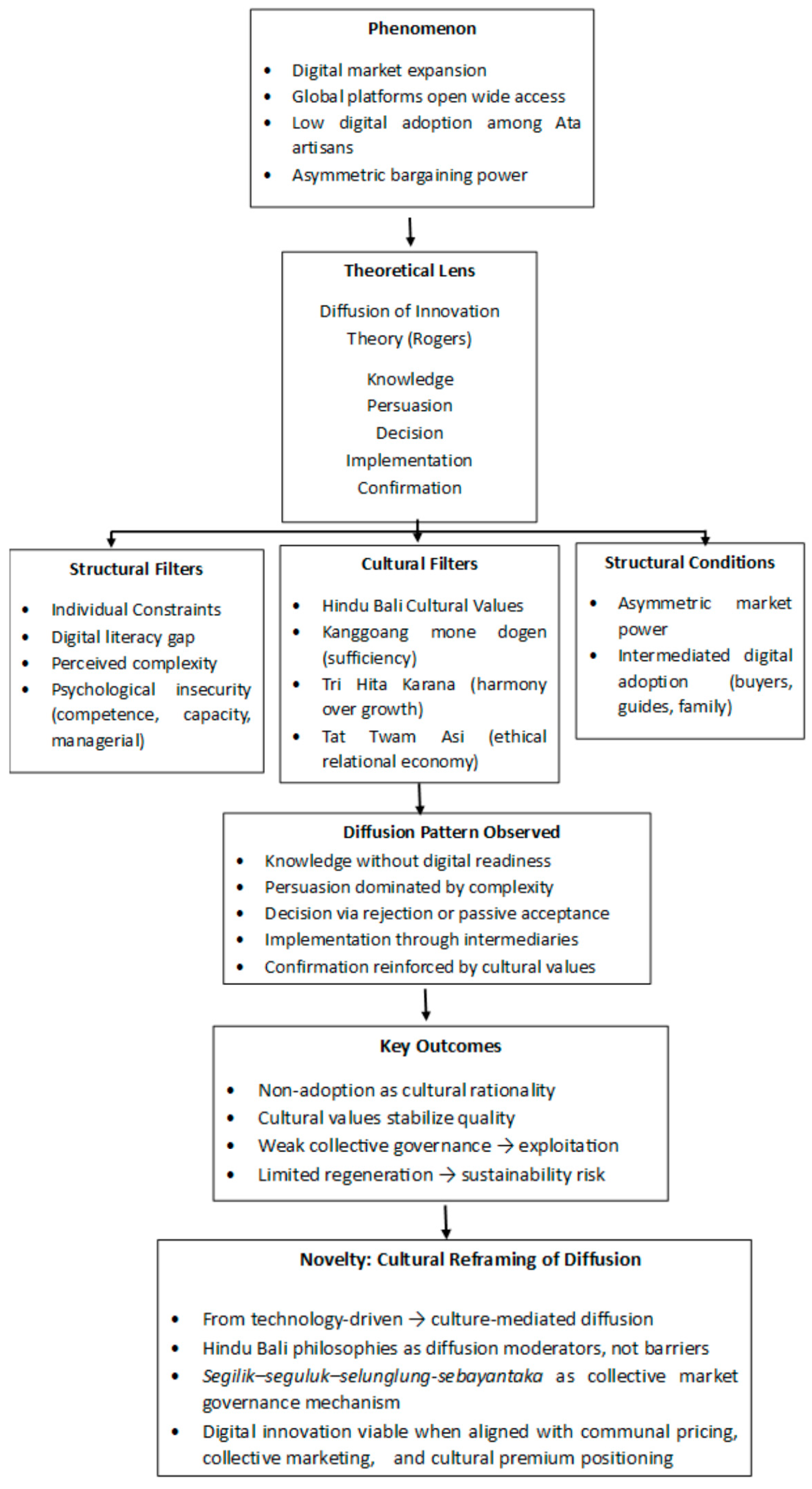
The analytical framework developed in this study positions digital innovation among ata handicraft SMEs as a culturally mediated diffusion process rather than a linear technological transition. Digital market expansion, global platform openness, and asymmetric bargaining power interact with the stages of Innovation Diffusion Theory (IDT) through structural and cultural filters. These filters shape how artisans interpret and selectively engage with digital technologies, resulting in indirect adoption and value-based confirmation rather than full technological integration (
Dryden-Palmer et al., 2020;
Rogers & Everett, 1983). Diffusion thus culminates not in transformation, but in culturally coherent organizational outcomes shaped by sustainability concerns and market vulnerability.
The findings challenge dominant innovation narratives that equate progress with rapid digitalization and expansion (
Wang, 2025). In Tenganan, innovation unfolds as gradual adaptation embedded in inherited practices, social relations, and collective norms. Market chains function as interdependent systems that optimize local resources through collaboration rather than competitive scaling. Innovation therefore operates through functional reinterpretation, reinforcing its socially embedded character (
Arsa et al., 2023;
Rogers & Everett, 1983).
Intergenerational inheritance further explains the non-linear trajectory of change. While weaving skills are transmitted effectively, managerial and strategic orientations are reinterpreted rather than replicated, resulting in incremental rather than structural transformation (
Baltazar et al., 2023). Design innovation emerges as the most culturally legitimate form of change, allowing experimentation within traditional production boundaries (
Israel, 2022;
Sundstr et al., 2026). International expansion, including into Japan, Europe, and the United States, is primarily buyer-mediated rather than digitally driven (
Yu & Schweisfurth, 2020).
Although digital technologies are widely portrayed as universally enabling and transformative for SMEs (
Hassan et al., 2024;
Nambisan et al., 2019;
Zammuto et al., 2007), this study reveals a context-contingent reality. Digital tools are selectively engaged, collectively mediated, or strategically delayed when perceived to disrupt cultural balance or established moral–economic arrangements (
Li et al., 2025;
Panduwinata et al., 2025;
Sitiari et al., 2024;
Ulas, 2019). Limited digital literacy, infrastructure constraints, environmental vulnerability, price competition, and demographic factors create the baseline conditions within which adoption decisions are made (
Galdino & Lamont, 2019;
Kindström et al., 2024;
Leonelli et al., 2019;
Reim et al., 2022;
Telukdarie et al., 2023). Non-adoption therefore reflects rational positioning rather than technological resistance.
As illustrated in
Figure 3, digital adoption is shaped by the interaction between structural constraints, cultural values, and mediated market relations. This interaction is further reflected in the diffusion process across different adoption stages.
Table 1 summarizes how each stage of innovation diffusion manifests in the context of Ata SMEs.
From an IDT perspective, diffusion among ata SMEs often stabilizes between the knowledge and decision stages. While awareness exists, perceived complexity, low self-efficacy, and concerns about production disruption outweigh perceived benefits. Importantly, non-adoption frequently operates as confirmation reaffirming stable practices perceived as sufficient and reliable. Diffusion thus follows a selective and non-linear pathway shaped primarily by compatibility and complexity rather than efficiency maximization.
The deeper explanation for this pattern lies in Balinese philosophical principles. Artisans repeatedly articulated a sufficiency-oriented logic encapsulated in
kanggoang mone dogen (“earning just enough”). This orientation aligns with
Tri Hita Karana, which emphasizes harmony among spiritual, social, and environmental domains (
Arsa et al., 2023;
Kumar et al., 2016;
Sitiari et al., 2024). Business is therefore understood not as profit maximization, but as a relational practice embedded in moral obligation.
Tat Twam Asi reinforces this ethical orientation by framing economic exchange through empathy and mutual responsibility (
Joewono, 2023).
Within this worldview, aggressive expansion or excessive visibility may be perceived as ethically misaligned. Limited digital adoption thus represents cultural rationality rather than cultural lag (
Jurlin, 2022;
Khando et al., 2023;
Koutsobinas et al., 2022;
Li et al., 2025;
Ritzer & Esposti, 2020). However, this sufficiency-oriented philosophy operates within asymmetrical global markets, where restraint can expose artisans to unequal bargaining power (
Judijanto, 2025). Cultural coherence may therefore coexist with structural vulnerability.
Importantly, cultural values do not function solely as constraints. When reframed as cultural capital, principles such as
kanggoang mone dogen and
Tri Hita Karana can underpin a cultural premium, where authenticity and ethical production become sources of competitive advantage (
Hafeez et al., 2025;
Li et al., 2025;
Warner & Wäger, 2019). This reframing shifts the analytical lens from adapting culture to market logic toward reshaping market mechanisms to recognize culturally embedded value.
Collective governance further mediates diffusion dynamics. The philosophy of
Segilik–Seguluk–Selunglung-Sebayantaka provides a normative foundation for shared decision-making and risk distribution. Community-based digital coordination, such as collective marketing units, pricing agreements incorporating symbolic value, documentation systems, and village-supervised escrow arrangements, reduces individual complexity while preserving cultural legitimacy (
Bühler et al., 2023;
Dibella et al., 2022). Such mechanisms demonstrate that collective evaluation, rather than individual technological choice, governs diffusion trajectories.
These findings extend Innovation of Diffusion Theory by introducing cultural–philosophical filtering as a structuring mechanism in adoption processes. Innovation attributes are not evaluated solely through functional or economic criteria; they are recalibrated through ethical compatibility, communal balance, and sustainability logic. Relative advantage is defined by predictability and fairness rather than growth; compatibility is assessed against moral economy; complexity incorporates social and ethical risk; trialability becomes collective and iterative; and observability is grounded in stability rather than digital metrics (
Enshassi et al., 2025).
Accordingly, diffusion in culturally embedded craft-based SMEs follows a non-linear and collectively mediated pathway. Slow or selective adoption reflects deliberate cultural alignment within structurally constrained conditions, suggesting the need for DOI to more explicitly account for ethical compatibility and collective governance as core diffusion mechanisms.
Theoretical Contributions
This study reconceptualizes digital adoption in SMEs as a culturally mediated strategic process rather than a linear technological transition. Contrary to dominant digital strategy narratives that equate sustainability with accelerated digital integration, the findings demonstrate that craft-based SMEs evaluate digitalization through ethical, relational, and sufficiency-oriented logics. Selective or delayed adoption therefore reflects strategic calibration within culturally embedded constraints, challenging universal growth-centric assumptions in digital transformation discourse.
Second, the study advances Innovation of Diffusion Theory by introducing cultural–philosophical filtering as an active evaluative mechanism shaping adoption trajectories. Innovation attributes are recalibrated through ethical compatibility and collective governance: relative advantage is defined by predictability and fairness rather than expansion; compatibility is assessed against moral economy principles; complexity incorporates social and ethical disruption; and trialability is collectively mediated. Diffusion thus unfolds as a non-linear process in which non-adoption may function as value-based confirmation rather than technological inertia.
Finally, the findings establish boundary conditions for digital strategy in culturally embedded and craft-based SMEs, suggesting that diffusion models require greater sensitivity to ethical rationality and collective governance structures. Future research may comparatively examine how different local philosophical systems shape interpretations of innovation attributes across diverse cultural and industrial settings. Longitudinal studies are also needed to explore how cultural–philosophical filtering interacts with organizational scaling and digital transformation trajectories, particularly as enterprises transition toward hybrid strategic models. Together, these directions point toward a culturally contingent theory of SME digital strategy.
6. Conclusions
This study demonstrates that digital engagement in craft-based SMEs is not adequately explained by efficiency-driven or technology-centric frameworks. Empirical evidence from the ata handicraft community in Tenganan shows that innovation adoption is filtered through culturally embedded values and collective governance structures that recalibrate how digital tools are interpreted and deployed. Selective digitalization emerges not as resistance or capability deficit, but as strategic calibration within a moral–economic system that prioritizes stability, relational trust, and long-term resilience over rapid expansion.
By theorizing cultural principles as organizational logics that actively structure coordination, pricing, and market participation, the study advances a culturally contingent understanding of diffusion and SME digital strategy. The mechanisms identified—collective intermediation, ethically bounded adoption, and community-anchored governance—suggest that digital transformation in heritage-based enterprises follows negotiated rather than linear trajectories, with sustainability rooted in equilibrium preservation rather than growth intensity.
Several limitations warrant consideration. The single-case qualitative design limits statistical generalization, and the findings are situated within a distinct socio-cultural context. The analysis also focuses primarily on marketing-related digital adoption and does not quantitatively assess performance outcomes. Overall, the study repositions digital technology not as a universal accelerator of SME growth, but as a strategically embedded instrument whose value depends on its alignment with collective norms and ethical rationality. This perspective contributes to ongoing debates on sustainable digital strategy, inclusive innovation, and equitable value-chain participation in culturally embedded economies.
Implication for Stakeholders
This study contributes to government, SME, and tourism–cultural stakeholders by framing digitalization in traditional sectors as a culturally embedded process rather than a purely technical intervention. It underscores the need for culturally sensitive digital strategies that respect local values and social relations, and for training programs designed around gradual adoption, long-term mentoring, and the preservation of meaningful traditional market practices. The findings support community-driven digital facilitation models—such as family-based marketing and intergenerational collaboration—that avoid disrupting traditional production systems.
Author Contributions
Conceptualization, N.P.A.K., L.P.M.; Writing—original draft & review and editing, N.P.A.K.; Supervision, G.S.D.; Data Curation, Formal Analysis, L.P.M.; Methodology, Visualization, I.A.O.M. All authors have read and agreed to the published version of the manuscript.
Funding
This research received no external funding.
Institutional Review Board Statement
This study was conducted in accordance with the Declaration of Helsinki. Based on the Ethics Committee of Universitas Pendidikan Nasional, the methodological design, data collection procedures, and ethical safeguards of this research were found to meet the ethical standards required for studies involving human participants. The study, which involved the collection of original data from individuals within SMEs in Tenganan Village, Karangasem Regency, Bali Province, demonstrated adequate consideration for participant rights and welfare. As confirmed by the Committee, the measures outlined by the researchers, including obtaining informed consent, ensuring confidentiality and anonymity, emphasizing voluntary participation without coercion, and implementing secure procedures for data storage and handling, are appropriate and consistent with both institutional and international ethical guidelines.
Informed Consent Statement
Informed consent was obtained from all subjects involved in the study.
Data Availability Statement
The original contributions presented in this study are included in the article/
supplementary material. Further inquiries can be directed to the corresponding author(s).
Conflicts of Interest
The authors declare no conflict of interest.
References
- Abosede, O. E. (2020). Diffusion of innovation theory: An effective approach to accelerate adoption of information and communication technology in twenty-first century knowledge society. International Journal of Innovative Research & Development, 9(4), 147–155. [Google Scholar]
- Aizstrauta, D., Ginters, E., & Eroles, M. P. (2015). Applying theory of diffusion of innovations to evaluate technology acceptance and sustainability. Procedia—Procedia Computer Science, 43, 69–77. [Google Scholar] [CrossRef]
- Amirrudin, A. H., Jamaluddin, R., Kamaruddin, N. S., & Salehuddin, N. (2024). Examining the impacts of social media to non-financial performance of smes in Malaysia. International Journal of Business and Technopreneurship (IJBT), 14(2), 193–210. [Google Scholar] [CrossRef]
- Arsa, I. K. S., Mertanadi, I. M., Made, N., Widiastini, A., & Prayudi, M. A. (2023). Pang pada payu: Implementing tri hita karana principles on pawongan aspect as a balinese business concept. International Review of Management and Marketing, 13(6), 43–48. [Google Scholar] [CrossRef]
- Baker, J. (2012). The technology–organization–environment framework (pp. 231–245). Springer. [Google Scholar] [CrossRef]
- Baltazar, J. R., Fernandes, C. I., Ramadani, V., & Hughes, M. (2023). Family business succession and innovation: A systematic literature review. Review of Managerial Science, 17, 2897–2920. [Google Scholar] [CrossRef]
- Bin, M., Hui, G., Qifeng, W., & Ke, Y. (2021). A systematic review of factors influencing digital transformation of SMEs. Turkish Journal of Computer and Mathematics Education, 12(11), 1673–1686. [Google Scholar] [CrossRef]
- Bühler, M. M., Calzada, I., Cane, I., Jelinek, T., & Kapoor, A. (2023). Unlocking the power of digital commons: Data cooperatives as a pathway for data sovereign, innovative and equitable digital communities. Digital, 3(3), 146–171. [Google Scholar] [CrossRef]
- Chasanah, A., Jahroh, S., & Dewi, F. (2021). Digital marketing changes of micro-small enterprises before and during COVID-19 pandemic in bogor, Indonesia. Business Review and Case Studies, 2(1), 1–9. [Google Scholar] [CrossRef]
- Creswell, J. W. (2009). Qualitative, quantitative, and mixed-methods research. Microbe Magazine, 4(11), 485. [Google Scholar] [CrossRef]
- Creswell, J. W., & Plano Clark, V. L. (2018). Core mixed methods design. In Designing and conducting mixed methods research (pp. 77–84). Sage Publications, Inc. [Google Scholar]
- Dearing, J. W., & Cox, J. G. (2018). Diffusion of innovations theory, principles, and practice. Health Affairs, 37(2), 183–190. [Google Scholar] [CrossRef]
- Dibella, J., Forrest, N., Burch, S., Morton, S., Verena, N., & Rao-williams, J. (2022). Exploring the potential of SMEs to build individual, organizational, and community resilience through sustainability-oriented business practices. Business Strategy and the Environment, 32(1), 721–735. [Google Scholar] [CrossRef]
- Dryden-Palmer, K. D., Parshuram, C. S., & Berta, W. B. (2020). Context, complexity and process in the implementation of evidence-based innovation: A realist informed review. BMC Health Services Research, 20(1), 81. [Google Scholar] [CrossRef]
- Enshassi, M., Nathan, R. J., Soekmawati, & Ismail, H. (2025). Unveiling barriers and drivers of AI adoption for digital marketing in Malaysian SMEs. Journal of Open Innovation: Technology, Market, and Complexity, 11(2), 100519. [Google Scholar] [CrossRef]
- Fadlan, A., Lubis, R. P., & Sinulingga, K. A. (2023). Digitalization of MSMEs in pelawi utara district, langkat regency: Opportunities and challenges. Best Journal of Administration and Management, 2(2), 64–70. [Google Scholar] [CrossRef]
- Faiz, F., Le, V., & Masli, E. K. (2024). Determinants of digital technology adoption in innovative SMEs. Journal of Innovation & Knowledge, 9(4), 100610. [Google Scholar] [CrossRef]
- Fernández Bellver, D., Prados-Peña, M. B., García-López, A. M., & Molina-Moreno, V. (2023). Crafts as a key factor in local development: Bibliometric analysis. Heliyon, 9(1), e13039. [Google Scholar] [CrossRef]
- Fitriasari, F. (2020). How do small and medium enterprises (SMEs) survive the COVID-19 outbreak? Jurnal Inovasi Ekonomi, 5(2), 53–62. [Google Scholar] [CrossRef]
- Galdino, K. M., & Lamont, B. T. (2019). Market and internationalization knowledge in entrepreneurial internationalization processes. International Journal of Entrepreneurial Behavior & Research, 25(7), 1580–1600. [Google Scholar] [CrossRef]
- Ghazwani, S. S., & Alzahrani, S. (2024). The use of social media platforms for competitive information and knowledge sharing and its effect on SMEs’ profitability and growth through innovation. Sustainability, 16(1), 106. [Google Scholar] [CrossRef]
- Ghobakhloo, M. (2020). Determinants of information and digital technology implementation for smart manufacturing. International Journal of Production Research, 58(8), 2384–2405. [Google Scholar] [CrossRef]
- Hafeez, S., Shahzad, K., & De Silva, M. (2025). Enhancing digital transformation in SMEs: The dynamic capabilities of innovation intermediaries within ecosystems. Long Range Planning, 58(3), 102525. [Google Scholar] [CrossRef]
- Hassan, S. S., Meisner, K., Krause, K., Bzhalava, L., & Moog, P. (2024). Is digitalization a source of innovation? Exploring the role of digital diffusion in SME innovation performance. Small Business Economics, 62(4), 1469–1491. [Google Scholar] [CrossRef]
- Ibrahim, F., Münscher, J. C., Daseking, M., & Telle, N. T. (2024). The technology acceptance model and adopter type analysis in the context of artificial intelligence. Frontiers in Artificial Intelligence, 7, 1496518. [Google Scholar] [CrossRef] [PubMed]
- Israel, B. (2022). Enhancing customer retention in manufacturing SMEs through supply chain innovative practices. Management Dynamics in the Knowledge Economy, 10, 272–286. [Google Scholar] [CrossRef]
- Joewono, H. H. (2023). Local wisdom based social responsibility of balinese sme to improve competitiveness. Jurnal Aplikasi Bisnis dan Manajemen, 9(1), 141–151. [Google Scholar] [CrossRef]
- Judijanto, L. (2025). Competitiveness of Indonesian CPO, its successful penetration in the European Union vegetable Oils market, and protectionism trade policies in the EU market to stop it grow further. Cogent Social Sciences, 11(1), 2501758. [Google Scholar] [CrossRef]
- Jurlin, K. (2022). Were culture and heritage important for the resilience of tourism in the COVID-19 pandemic? Journal of Risk and Financial Management, 15(5), 205. [Google Scholar] [CrossRef]
- Khando, K., Islam, M. S., & Gao, S. (2023). The emerging technologies of digital payments and associated challenges: A systematic literature review. Future Internet, 15(1), 21. [Google Scholar] [CrossRef]
- Kindström, D., Carlborg, P., & Nord, T. (2024). Challenges for growing SMEs: A managerial perspective challenges for growing SMEs: A managerial perspective. Journal of Small Business Management, 62(2), 700–723. [Google Scholar] [CrossRef]
- Kofler, I., & Walder, M. (2024). Crafts and their social imaginary: How technological development shapes the future of the crafts sector. Social Sciences, 13(3), 137. [Google Scholar] [CrossRef]
- Koutsobinas, T., Michalopoulou, P., & Koutsobinas, T. (2022). Networks of culture creatives in Patras: The relevance of cultural lag. European Planning Studies, 31(8), 1651–1672. [Google Scholar] [CrossRef]
- Kumar, A. B. C., Radhakrishnan, V., Suba, M., & Chetty, V. (2016). A study of correlation of symptomatic nephrolithiasis and need for urological intervention. International Journal of Multidisciplinary Educational Research, 5(12), 1–256. [Google Scholar]
- Kusumawati, A., Asfari, U., Putri, A., Ramadhanti, A., Dea, E., Jaya, A., Hadyanto, F. D., Adoption, D., & Benefit, N. (2023). Factor analysis of intention to use open-source ERP: A case study from east java area. INTENSIF: Jurnal Ilmiah Penelitian dan Penerapan Teknologi Sistem Informasi, 7(2), 202–220. [Google Scholar] [CrossRef]
- Leavy, P. (2017). Research design: Quantitative, qualittative, mixed methods, arts-based and community based participatory research approsches. The Guilford Press. [Google Scholar]
- Leonelli, S., Masciarelli, F., & Fontana, F. (2019). The impact of personality traits and abilities on entrepreneurial orientation in SMEs. Journal of Small Business & Entrepreneurship, 34(3), 269–294. [Google Scholar] [CrossRef]
- Li, H., Xue, T., Zheng, Z., Luo, X., & Huang, G. (2025). The innovation of traditional handicrafts and cultural identity: A multidimensional value analysis using the DEMATEL-ISM method. PLoS ONE, 20(5), e0322893. [Google Scholar] [CrossRef]
- Lim, W. M. (2025). What is qualitative research? An overview and guidelines. Australasian Marketing Journal (AMJ), 33(2), 199–229. [Google Scholar] [CrossRef]
- Maria, S., Alka, N., Abdul, H., & Saad, H. (2025). A review of diffusion of innovations theory (DOI) and technology, organization, and environment framework (TOE) in the adoption of artificial intelligence. International Journal of Academic Research in Business and Social Sciences, 15(3), 2118–2129. [Google Scholar] [CrossRef]
- Miles, M. B., & Huberman, A. M. (1994). Qualitative data analysis: An expanded sourcebook (2nd ed.). Sage Publications, Inc. [Google Scholar]
- Ministry of Education and Culture Reference Data [Kementerian Pendidikan, Kebudayaan, Riset, dan Teknologi]. (2021). Kerajinan ata Kabupaten Karangasem. Referensi Data Kebudayaan. Available online: https://referensi.data.kemendikdasmen.go.id/budayakita/wbtb/objek/AA001187 (accessed on 23 February 2026).
- Mwaanga, L. C., & Hapompwe, C. C. (2024). An investigation into social media utilisation in small and medium-sized enterprises and its effect on business performance: A case study of kabwata township, Lusaka. Journal of Economics, Finance And Management Studies, 7(8), 4821–4828. [Google Scholar] [CrossRef]
- Nambisan, S., Wright, M., Feldman, M., & Western, C. (2019). The digital transformation of innovation and entrepreneurship: Progress, challenges and key themes. Research Policy, 48(8), 103773. [Google Scholar] [CrossRef]
- Panduwinata, L. F., Subroto, W. T., & Sakti, N. C. (2025). Digitalization on micro, small, and medium enterprises (MSMEs): A systematic literature review. International Journal of Economics Commerce and Management, 2(1), 397–409. [Google Scholar] [CrossRef]
- Purnomo, R. A., Sebelas, U., Sarungu, J. J., Sebelas, U., Samudro, B. R., Sebelas, U., Mulyaningsih, T., & Sebelas, U. (2021). The dynamics of technology adoption readiness of micro, small, and medium enterprises and affecting characteristics: The experience from Indonesia. Review of International Geographical Education, 11(3), 834–854. [Google Scholar]
- Ramdani, B., Raja, S., & Kayumova, M. (2021). Digital innovation in SMEs: A systematic review, synthesis and research agenda. Information Technology for Development, 28, 56–80. [Google Scholar] [CrossRef]
- Raya, A. B., Andiani, R., Siregar, A. P., Prasada, I. Y., Indana, F., Gracia, T., Simbolon, Y., Kinasih, A. T., & Nugroho, A. D. (2021). Challenges, open innovation, and engagement theory at craft SMEs: Evidence from Indonesian batik. Journal of Open Innovation: Technology, Market, and Complexity, 7(2), 121. [Google Scholar] [CrossRef]
- Reim, W., Yli-viitala, P., Arrasvuori, J., & Parida, V. (2022). Tackling business model challenges in SME internationalization through digitalization. Journal of Innovation & Knowledge, 7(3), 100199. [Google Scholar] [CrossRef]
- Ritzer, G., & Esposti, P. D. (2020). Creative destruction and cultural lag in the digital age by george ritzer and piergiorgio degli esposti. Sociology Between the Gaps: Forgotten and Neglected Topics, 5, 1–10. [Google Scholar]
- Rogers, E. M., & Everett, M. (1983). Diffusion of third edition. Free Press. [Google Scholar]
- Sitiari, N. W., Datrini, L. K., Sarmawa, W. G., & Setini, M. (2024). Sustainability at its core: Embracing the essence of tri hita karana philosophy to empower eco-tourism-focused MSMEs in bali. Journal of Finance and Business Digital, 3(9), 171–184. [Google Scholar] [CrossRef]
- Sundstr, A., Hyder, A. S., & Chowdhury, E. H. (2026). Market-oriented business model for SMEs’ disruptive innovations internationalization. Marketing Intelligence & Planning, 39(5), 670–686. [Google Scholar] [CrossRef]
- Telukdarie, A., Dube, T., Matjuta, P., & Philbin, S. (2023). The opportunities and challenges of digitalization for SME’s. Procedia Computer Science, 217(2022), 689–698. [Google Scholar] [CrossRef]
- Trindade, M. A. M., & De Giovanni, P. (2025). Craftsmen and digital transformation: Business strategies and contracts in a post-Covid world. Journal of Engineering and Technology Management—JET-M, 78, 101917. [Google Scholar] [CrossRef]
- Ulas, D. (2019). Digital transformation process and SMEs. Procedia Computer Science, 158, 662–671. [Google Scholar] [CrossRef]
- Überbacher, R., Brozzi, R., & Matt, D. T. (2020). Innovation in craftsmanship family Smes in times of digitalization. Piccola Impresa Small Business, (1), 67–85. [Google Scholar] [CrossRef]
- Van Houtven, C. H., Drake, C., Malo, T. L., Decosimo, K., Tucker, M., Sullivan, C., D’Adolf, J., Hughes, J. M., Christensen, L., Grubber, J. M., Coffman, C. J., Sperber, N. R., Wang, V., Allen, K. D., Hastings, S. N., Shea, C. M., & Zullig, L. L. (2023). Ready, set, go! The role of organizational readiness to predict adoption of a family caregiver training program using the Rogers’ diffusion of innovation theory. Implementation Science Communications, 4(1), 69. [Google Scholar] [CrossRef]
- Wang, S. (2025). Digital transformation and innovation performance in small- and medium-sized enterprises: A systems perspective on the interplay of digital adoption, digital drive, and digital culture. Systems, 13(1), 43. [Google Scholar] [CrossRef]
- Warner, K. S. R., & Wäger, M. (2019). Building dynamic capabilities for digital transformation: An ongoing process of strategic renewal. Long Range Planning, 52(3), 326–349. [Google Scholar] [CrossRef]
- Yang, M., Fu, M., & Zhang, Z. (2021). The adoption of digital technologies in supply chains: Drivers, process and impact. Technological Forecasting and Social Change, 169, 120795. [Google Scholar] [CrossRef]
- Yu, F., & Schweisfurth, T. (2020). Industry 4.0 technology implementation in SMEs—A survey in the Danish-German border region. International Journal of Innovation Studies, 4(3), 76–84. [Google Scholar] [CrossRef]
- Yurdagul, E. (2023). Mathematical approach to the role of inward and outward foreign direct investors-led diffusion of innovation in sino economic convergence-divergence in light of rogers’ diffusion of innovation theory and economic convergence divergence theory. International Journal of East Asian Studies, 12(1), 36–75. [Google Scholar] [CrossRef]
- Zammuto, R. F., Griffith, T. L., Majchrzak, A., Dougherty, D. J., Faraj, S., & Griffith, T. L. (2007). Information technology and the changing fabric of organization. Organization Science, 18(5), 749–762. [Google Scholar] [CrossRef]
| Disclaimer/Publisher’s Note: The statements, opinions and data contained in all publications are solely those of the individual author(s) and contributor(s) and not of MDPI and/or the editor(s). MDPI and/or the editor(s) disclaim responsibility for any injury to people or property resulting from any ideas, methods, instructions or products referred to in the content. |