Transformational, Transactional, and Ethical Leadership in Sustainable Family Entrepreneurship: A Global Systematic Review

 , , , and
Abstract
1. Introduction
- What evidence of leadership in sustainable family enterprises has been documented in indexed scientific journals?
- What methodology was applied in each of the identified studies?
- How is leadership perceived within sustainable family entrepreneurship and what were the key findings reported across the examined records?
- To identify the available evidence on leadership in sustainable family enterprises published in indexed scientific journals.
- To describe the methodology applied in each of the identified studies.
- To examine how leadership is perceived within sustainable family entrepreneurship and to summarize the key findings reported across the reviewed records.
2. Methodology
2.1. Eligibility Criteria
- (a)
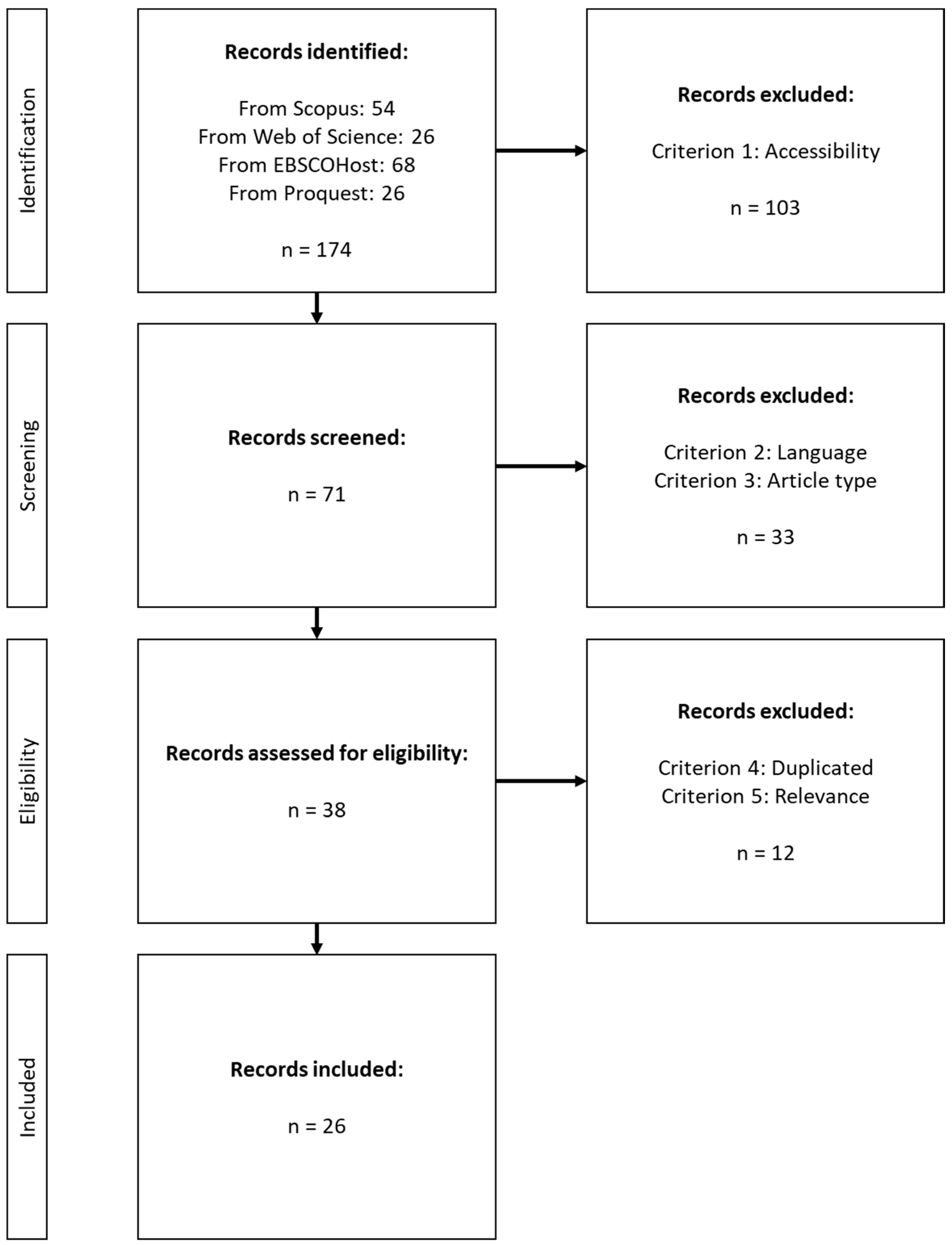
- Criterion 1: Accessibility. Eligible records were those that could be directly downloaded from the selected databases using the credentials of Universidad César Vallejo.
- (b)
- Criterion 2: Language. Records published in English were included. Consequently, studies published in other languages were excluded.
- (c)
- Criterion 3: Article type. The review sought to include only empirical research articles. Therefore, other document types (such as literature reviews, editorials, theses, and similar) were excluded.
- (d)
- Criterion 4: Duplicates. Because searches were conducted across four databases, duplicate records were identified and discarded.
- (e)
- Criterion 5: Relevance. Each article reaching this stage was read thoroughly; only those reporting on leadership experiences within sustainable family enterprises were retained.
2.2. Information Sources and Search Strategy
2.3. Selection Process of Studies and Data Extraction
- (a)
- Criterion 1: Accessibility. A total of one hundred and three articles were removed under this filter. The exclusion of articles based on accessibility was primarily due to subscription and paywall restrictions. Although these studies met the thematic and methodological criteria, full-text access was not available through the institutional subscriptions of the authors’ university.
- (b)
- Criterion 2: Language. Although the search was conducted in English, two articles written in Turkish and one in Portuguese were identified and excluded.
- (c)
- Criterion 3: Type of article. Thirty records were removed because they corresponded to other literature reviews, opinion pieces, or similar formats.
- (d)
- Criterion 4: Duplicity. Since searches were performed across four databases, nine duplicated articles indexed in more than one source were removed.
- (e)
- Criterion 5: Relevance. A detailed content analysis of the remaining records allowed the identification and removal of three manuscripts that, despite meeting the previous criteria, were not considered relevant because they did not contribute to the research objectives.
2.4. List of Data
2.5. Assessment of Bias Risk in Individual Studies
2.6. Synthesis Methods
3. Results
3.1. Identification of the Available Evidence on Leadership in Sustainable Family Enterprises Published in Indexed Scientific Journals
3.2. Description the Methodology Applied in Each of the Identified Studies
3.3. To Examine Identify the Evidence of Leadership in Sustainable Family Entrepreneurship, and Key Findings Across the Reviewed Records
4. Discussion
4.1. Transformational Leadership
4.2. Transactional Leadership
4.3. Ethical Leadership
4.4. Gender, Leadership, and Sustainability in Family Enterprises
4.5. Cultural Context as a Moderator of Leadership Effectiveness
4.6. Leadership, Succession, and Intergenerational Sustainability
4.7. Methodological Reflections on the Evidence Base
4.8. Emerging and Exploratory Research Directions
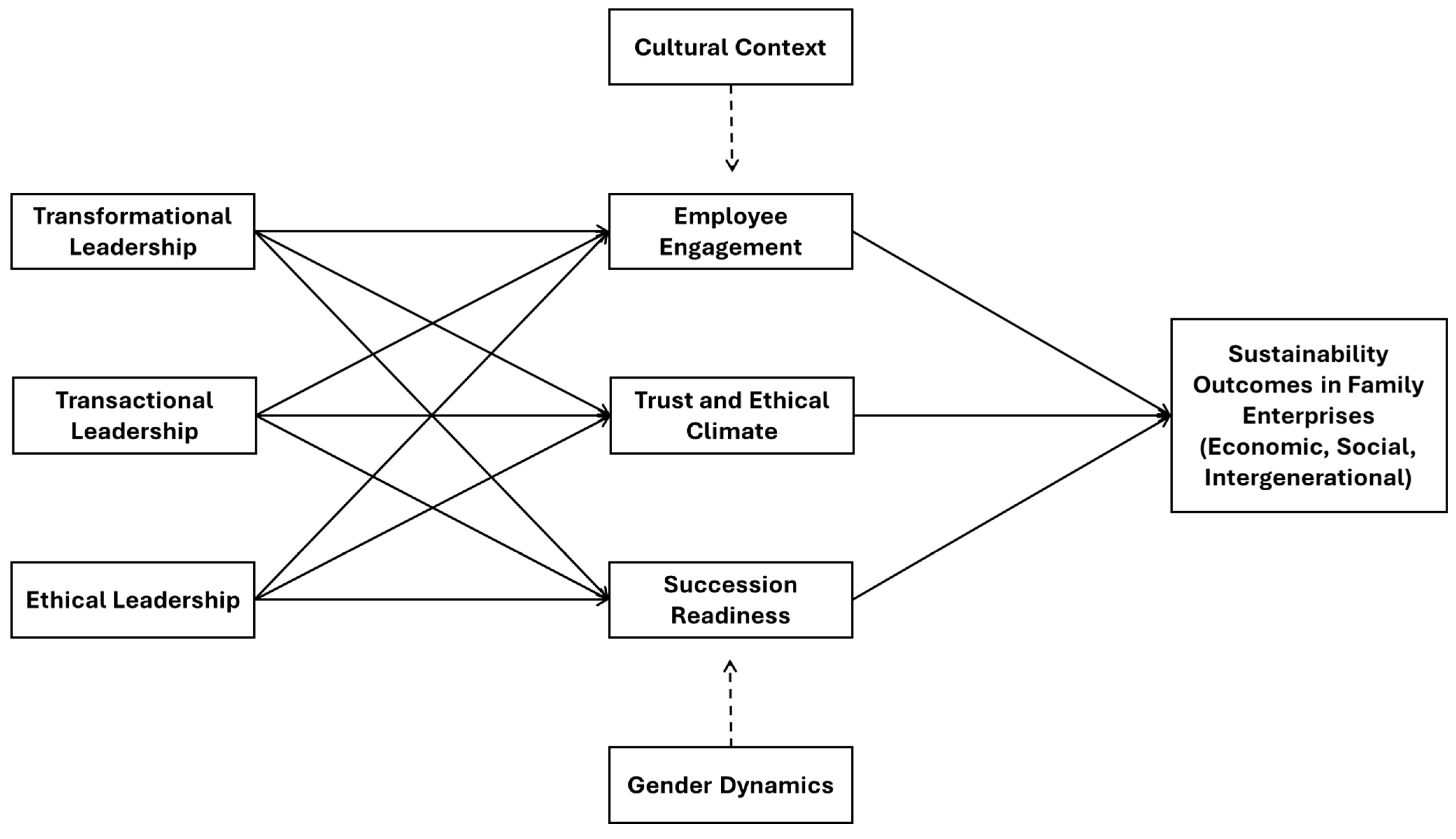
4.9. Conceptual Framework for Leadership and Sustainability in Family Enterprises
5. Conclusions
5.1. General Findings and Observed Trends
5.2. Identified Limitations
5.3. Academic and Practical Implications
5.4. Recommendations for Future Research
Supplementary Materials
Author Contributions
Funding
Institutional Review Board Statement
Informed Consent Statement
Data Availability Statement
Conflicts of Interest
References
- Abdullah, H. O., Atshan, N., Al-Abrrow, H., Alnoor, A., Valeri, M., & Erkol Bayram, G. (2023). Leadership styles and sustainable organizational energy in family business: Modeling non-compensatory and nonlinear relationships. Journal of Family Business Management, 13(4), 1104–1131. [Google Scholar] [CrossRef]
- Adams, A. M., Ahmed, R., Shuvo, T. A., Yusuf, S. S., Akhter, S., & Anwar, I. (2019). Exploratory qualitative study to understand the underlying motivations and strategies of the private for-profit healthcare sector in urban Bangladesh. BMJ Open, 9(7), e026586. [Google Scholar] [CrossRef]
- Al Obaidy, A. L. A., Alshehadeh, A. R., Al-Khawaja, H. A., Basheti, I. A., & Al-Zaqeba, M. A. A. (2024). Development of a new concept and definition of inheritance risk management in family businesses toward sustainability. International Journal of Advanced and Applied Sciences, 11(6), 1–13. [Google Scholar] [CrossRef]
- Arista Zavala, R., & De la Garza Ramos, M. I. (2022). Influencia de la familiness en la relación de la heterogeneidad familiar y la postura innovadora de la empresa familiar. CIENCIA Ergo-Sum, 29(3), 1–18. [Google Scholar] [CrossRef]
- Baron, R. A. (2006). Opportunity recognition as pattern recognition: How entrepreneurs “connect the dots” to identify new business opportunities. Academy of Management Perspectives, 20(1), 104–119. [Google Scholar] [CrossRef]
- Bednarz, J., Bieliński, T., Nikodemska-Wołowik, A., & Otukoya, A. (2017). Sources of the competitive advantage of family enterprises: An international approach focusing on China, Nigeria and Poland. Entrepreneurial Business and Economics Review, 5(2), 123–142. [Google Scholar] [CrossRef][Green Version]
- Berrone, P., Cruz, C., & Gomez-Mejia, L. R. (2012). Socioemotional wealth in family firms. Family Business Review, 25(3), 258–279. [Google Scholar] [CrossRef]
- Birdthistle, N. (2024). Roots of success: The impact of family businesses on economies and society. In Attaining the 2030 sustainable development goal of life on land (pp. 13–26). Emerald Publishing Limited. [Google Scholar] [CrossRef]
- Birdthistle, N., & Hales, R. (2022). Family businesses and their importance to worldwide economies. In Attaining the 2030 sustainable development goal of industry, innovation and infrastructure (pp. 9–13). Emerald Publishing Limited. [Google Scholar] [CrossRef]
- Bonfanti, A., De Crescenzo, V., Simeoni, F., & Loza Adaui, C. R. (2024). Convergences and divergences in sustainable entrepreneurship and social entrepreneurship research: A systematic review and research agenda. Journal of Business Research, 170, 114336. [Google Scholar] [CrossRef]
- Boscán Carroz, M. C., Meleán Romero, R. A., Chávez Vera, K. J., & Calanchez Urribarri, Á. (2023). Emprendimiento peruano en el marco del desarrollo sostenible. Retos, 13(26), 223–236. [Google Scholar] [CrossRef]
- Bozer, G., Levin, L., & Santora, J. C. (2017). Succession in family business: Multi-source perspectives. Journal of Small Business and Enterprise Development, 24(4), 753–774. [Google Scholar] [CrossRef]
- Cater, J. J., III, & Beal, B. D. (2015). Servant leadership in multigenerational family firms. The Journal of Applied Management and Entrepreneurship, 20(4), 25–48. [Google Scholar] [CrossRef]
- Chirapanda, S. (2019). Identification of success factors for sustainability in family businesses. Journal of Family Business Management. ahead-of-print. [Google Scholar] [CrossRef]
- Chirinos Araque, Y. d. V., Pérez Peralta, C. M., Martínez de Meriño, C. Y., & Meriño Córdoba, V. H. (2017). Sustainable entrepreneurship: An integrated knowledge management perspective. Revista de Geografía Agrícola, 58, 47–54. [Google Scholar] [CrossRef]
- Chrisman, J. J., Chua, J. H., & Sharma, P. (2005). Trends and directions in the development of a strategic management theory of the family firm. Entrepreneurship Theory and Practice, 29(5), 555–575. [Google Scholar] [CrossRef]
- Cleary, P., Quinn, M., & Moreno, A. (2019). Socioemotional wealth in family firms: A longitudinal content analysis of corporate disclosures. Journal of Family Business Strategy, 10(2), 119–132. [Google Scholar] [CrossRef]
- Cohen, B., & Winn, M. I. (2007). Market imperfections, opportunity and sustainable entrepreneurship. Journal of Business Venturing, 22(1), 29–49. [Google Scholar] [CrossRef]
- Çetin, M. (2021). The relation between religiosity, family cohesion and ethical leadership: A study of family firms in Turkey. Journal of Family Business Management, 11(4), 333–354. [Google Scholar] [CrossRef]
- Daw, D. (2013). Exploring the factors affecting family-owned enterprises (FOEs) sustainability in Lebanon. Business Journal for Entrepreneurs, 2013(4), 39. Available online: https://openurl.ebsco.com/EPDB%3Agcd%3A8%3A16203464/detailv2?sid=ebsco%3Aplink%3Ascholar&id=ebsco%3Agcd%3A93300944&crl=c&link_origin=scholar.google.com (accessed on 7 November 2025).
- Dean, T. J., & McMullen, J. S. (2007). Toward a theory of sustainable entrepreneurship: Reducing environmental degradation through entrepreneurial action. Journal of Business Venturing, 22(1), 50–76. [Google Scholar] [CrossRef]
- de la Rosa Alburquerque, A., Carrillo, O. L., & Ramírez Segura, J. C. (2009). Organization, business and family: From the family business to the family organization. Gestión y Estrategia, 36, 17–36. [Google Scholar] [CrossRef]
- Delfín-Ruiz, C., Cano-Guzmán, R., & Peña-Valencia, E. J. (2020). Funcionabilidad familiar como estrategia para la generación del emprendimiento social en México. Revista Venezolana de Gerencia, 25(89), 79–91. [Google Scholar] [CrossRef][Green Version]
- Della Peruta, M. R. (2011). Family business: Leadership and succession (pp. 73–107). Springer. [Google Scholar] [CrossRef]
- Díaz Bedoya, K., Jarrín Salcán, M. E., Enderica Armijos, H. O., & Cervantes Díaz, C. (2024). Liderazgo y cultura organizacional en empresas familiares. Desde una perspectiva teórica. Cuestiones Políticas, 42(80), 247–259. [Google Scholar] [CrossRef]
- Dolar, B., Biloslavo, R., & Aydin, E. (2024). The intergenerational succession of leadership in the family business: The change succession brings. International Journal of Organizational Leadership, 13(4), 802–823. [Google Scholar] [CrossRef]
- Domańska, A., Hernández-Linares, R., Zajkowski, R., & Żukowska, B. (2024). Family firm entrepreneurship and sustainability initiatives: Women as corporate change agents. Business Ethics, the Environment & Responsibility, 33(2), 217–240. [Google Scholar] [CrossRef]
- Efferin, S., & Hartono, M. S. (2015). Management control and leadership styles in family business. Journal of Accounting & Organizational Change, 11(1), 130–159. [Google Scholar] [CrossRef]
- Eller, F. J., Gielnik, M. M., Wimmer, H., Thölke, C., Holzapfel, S., Tegtmeier, S., & Halberstadt, J. (2020). Identifying business opportunities for sustainable development: Longitudinal and experimental evidence contributing to the field of sustainable entrepreneurship. Business Strategy and the Environment, 29(3), 1387–1403. [Google Scholar] [CrossRef]
- Ertuna, B., Karatas-Ozkan, M., & Yamak, S. (2019). Diffusion of sustainability and CSR discourse in hospitality industry. International Journal of Contemporary Hospitality Management, 31(6), 2564–2581. [Google Scholar] [CrossRef]
- Fernández, C., & Quintero, N. (2017). Liderazgo transformacional y transaccional en emprendedores venezolanos. Revista Venezolana de Gerencia, 22(77), 56. [Google Scholar] [CrossRef]
- Fernández-Bedoya, V. H., Meneses-La-Riva, M. E., Suyo-Vega, J. A., & Gago-Chávez, J. d. J. S. (2023a). Entrepreneurship research in times of COVID-19: Experiences from South America. Sustainability, 15(7), 6028. [Google Scholar] [CrossRef]
- Fernández-Bedoya, V. H., Meneses-La-Riva, M. E., Suyo-Vega, J. A., Grijalva-Salazar, R. V., Gago-Chávez, J. d. J. S., Ocupa-Cabrera, H. G., Alvarado-Suyo, S. A., & Ocupa-Meneses, G. D. D. (2023b). Innovation in entrepreneurship during the time of COVID-19: A scoping review of the scientific evidence from Peru. F1000Research, 12, 665. [Google Scholar] [CrossRef] [PubMed]
- Galindo-Martín, M.-Á., Castaño-Martínez, M.-S., & Méndez-Picazo, M.-T. (2023). Digitalization, entrepreneurship and competitiveness: An analysis from 19 European countries. Review of Managerial Science, 17(5), 1809–1826. [Google Scholar] [CrossRef]
- Gallo, M. A. (1995). The role of family business and its distinctive characteristic behavior in industrial activity. Family Business Review, 8(2), 83–97. [Google Scholar] [CrossRef]
- Garcés-Galdeano, L., & Larraza-Kintana, M. (2024). Emprendimiento y empresa familiar: ¿dos disciplinas hermanas o distintas? Boletín de Estudios Económicos, 78(234), 41–56. [Google Scholar] [CrossRef]
- Garófalo Valdiviezo, V. A., & Arguello Pazmiño, A. M. (2024). Análisis de los factores que influyen en el emprendimiento sostenible: Un estudio bibliográfico. Reincisol, 3(6), 3853–3879. [Google Scholar] [CrossRef]
- Gashi, R., & Smajlaj, V. (2024). The power of women in the success of business family: A case study of Kosovo, Albania and North Macedonia. Humanities and Social Sciences Letters, 13(1), 25–44. [Google Scholar] [CrossRef]
- Gërguri-Rashiti, S., Zejnullahu-Pllana, D., Podvorica, G., & Berisha, G. (2024). Unveiling the path to sustainable family business: A case study of environmentalism in the food and non-alcoholic beverages industry. Journal of Family and Economic Issues, 46(4), 1226–1243. [Google Scholar] [CrossRef]
- Gómez-Mejía, L. R., Haynes, K. T., Núñez-Nickel, M., Jacobson, K. J. L., & Moyano-Fuentes, J. (2007). Socioemotional wealth and business risks in family-controlled firms: Evidence from Spanish olive oil mills. Administrative Science Quarterly, 52(1), 106–137. [Google Scholar] [CrossRef]
- Guo, H., Zhang, Y., Sun, Y., & Yang, W. (2024). The effects of trans-generational conflict on trans-generational entrepreneurship performance from the perspective of first-generation entrepreneurs’ networks: Evidence from China. Sage Open, 14(2), 1–19. [Google Scholar] [CrossRef]
- Halasz, M., Sedliacikova, M., Dobrovic, J., Janáková-Sujová, A., & Schmidtová, J. (2024). Internal barriers of family business: A survey in wood-working and furniture family enterprises in Slovakia before and during the COVID-19 pandemic. Journal of Ecohumanism, 3(6), 2075–2086. [Google Scholar] [CrossRef]
- Häußler, S., & Ulrich, P. (2024). Exploring strategic corporate sustainability management in family businesses: A systematic literature review. Review of Managerial Science, 1–16. [Google Scholar] [CrossRef]
- Heredia, J., Rubiños, C., Vega, W., Heredia, W., & Flores, A. (2022). New strategies to explain organizational resilience on the firms: A cross-countries configurations approach. Sustainability, 14(3), 1612. [Google Scholar] [CrossRef]
- Jamil, M., Md Fadzil, A. F., Waqar, A., & Yaacob, M. R. (2023). Exploring entrepreneurial qualities for the sustainability of family businesses in Pakistan. Journal of Family Business Management, 13(4), 856–872. [Google Scholar] [CrossRef]
- Jamil, M., Stephens, S., & Md Fadzil, A. F. (2025). Sustainability in family business settings: A strategic entrepreneurship perspective. Journal of Family Business Management, 15(1), 29–47. [Google Scholar] [CrossRef]
- Jing, S., Hou, K., Niu, Z., & Yan, J. (2022). A selection model for innovation strategies in family SMEs. Computers & Industrial Engineering, 172, 108628. [Google Scholar] [CrossRef]
- Kaban, L. M. (2024). Inclusive leaders for innovation in the founder stage and sibling partnership of family enterprises. The Southern African Journal of Entrepreneurship and Small Business Management, 16(1), a917. [Google Scholar] [CrossRef]
- Kaptein, M. (2019). The moral entrepreneur: A new component of ethical leadership. Journal of Business Ethics, 156(4), 1135–1150. [Google Scholar] [CrossRef]
- Kariyapperuma, N., & Collins, E. (2021). Family logics and environmental sustainability: A study of the New Zealand wine industry. Business Strategy and the Environment, 30(8), 3626–3650. [Google Scholar] [CrossRef]
- Kirmanen, A., & Kansikas, J. (2013). Small family business contributions to the economy: An enterprise population level study. In Handbook of research on family business (2nd ed., pp. 609–627). Edward Elgar Publishing. [Google Scholar] [CrossRef]
- Kitchenham, B. (2004). Procedures for performing systematic reviews. In Procedures for performing systematic reviews. Keele University. [Google Scholar]
- Leiva Ojeda, M. A., Portillo Gutiérrez, A. M., & Patiño Villalba, D. M. (2025). Características de las empresas familiares de la ciudad de San Lorenzo del año 2022. Revista Científica UPAP, 5(1), 56–71. [Google Scholar] [CrossRef]
- Lenguaza Alborno, M. Á., Sosa Aoyama, J. K., & Riquelme Benítez, C. R. (2024). Factores de éxito para la sostenibilidad y vigencia de empresas familiares. Revista Científica en Ciencias Sociales, 6, e601501. [Google Scholar] [CrossRef]
- Lukito, D., Susanti, M., Susanto, Y., Judijanto, L., Ali, M., Hartono, & Mahardhani, A. J. (2025). Determinants of sustainable employee performance: A study of family businesses in Indonesia. Asia Pacific Management Review, 30, 100340. [Google Scholar] [CrossRef]
- Ma, Z., Fan, M., Su, J., Ouyang, C., & Wu, M. (2022). Impact of differential leadership on employee Zhengchong behavior: A complex network’s perspective. Sustainability, 14(20), 13238. [Google Scholar] [CrossRef]
- Marques, F. C., Ferreira, F. A. F., Zopounidis, C., & Banaitis, A. (2022). A system dynamics-based approach to determinants of family business growth. Annals of Operations Research, 311(2), 799–819. [Google Scholar] [CrossRef]
- Marques, P., Bikfalvi, A., & Busquet, F. (2022). A family imprinting approach to nurturing willing successors: Evidence from centennial family firms. Family Business Review, 35(3), 246–274. [Google Scholar] [CrossRef]
- Mathuva, D., Njiraini, N., & Ndunge, A. (2025). Sustainable entrepreneurship competencies in social enterprises run by the catholic nuns: Evidence from Kenya, Uganda, and Zambia. Journal of African Business, 26, 1–32. [Google Scholar] [CrossRef]
- Meurer, T., Weissmantel, C. W., & Hein, N. (2024). Turnover intention in family businesses: The moderating effect of the stewardship mechanism and transformational leadership. RAM Revista de Administração Mackenzie, 25(3), eRAMG240169. [Google Scholar] [CrossRef]
- Miller, D., Minichilli, A., & Corbetta, G. (2013). Is family leadership always beneficial? Strategic Management Journal, 34(5), 553–571. [Google Scholar] [CrossRef]
- Miroshnychenko, I., De Massis, A., Miller, D., & Barontini, R. (2021). Family business growth around the world. Entrepreneurship Theory and Practice, 45(4), 682–708. [Google Scholar] [CrossRef]
- Moravanská, M., Lušňáková, Z., Rumanko, B., & Novotná, K. (2023). Young leaders as implementers of neuroscience innovations in family food businesses. Potravinarstvo Slovak Journal of Food Sciences, 17, 620–634. [Google Scholar] [CrossRef]
- Nwuke, O., & Adeola, O. (2023). Leadership transition and survival strategies for family-owned SMEs in an emerging economy. Journal of Family Business Management, 13(4), 1343–1365. [Google Scholar] [CrossRef]
- Ocaña Patarón, E. R., Vargas Guambo, V. M., Orozco Valencia, E. G., & Guanga Casco, E. R. (2023). La generación de valor a partir de ecoemprendimiento sostenibles. Tesla Revista Científica, 3(2), e217. [Google Scholar] [CrossRef]
- Oudah, M., Jabeen, F., & Dixon, C. (2018). Determinants linked to family business sustainability in the UAE: An AHP approach. Sustainability, 10(1), 246. [Google Scholar] [CrossRef]
- Page, M. J., McKenzie, J. E., Bossuyt, P. M., Boutron, I., Hoffmann, T. C., Mulrow, C. D., Shamseer, L., Tetzlaff, J. M., Akl, E. A., Brennan, S. E., Chou, R., Glanville, J., Grimshaw, J. M., Hróbjartsson, A., Lalu, M. M., Li, T., Loder, E. W., Mayo-Wilson, E., McDonald, S., … Moher, D. (2021). The PRISMA 2020 statement: An updated guideline for reporting systematic reviews. Revista Espanola de Cardiologia, 74(9), 790–799. [Google Scholar] [CrossRef]
- Palalić, R., & Smajić, H. (2022). Socioemotional wealth (SEW) as the driver of business performance in family businesses in Bosnia and Herzegovina: The mediating role of transformational leadership. Journal of Family Business Management, 12(4), 1043–1064. [Google Scholar] [CrossRef]
- Petticrew, M., & Roberts, H. (2006). Systematic reviews in the social sciences. In M. Petticrew, & H. Roberts (Eds.), Systematic reviews in the social sciences: A practical guide. Blackwell Publishing Ltd. [Google Scholar] [CrossRef]
- Pinos Ramón, L., Sigüenza Orellana, S., & Álava Atiencie, G. (2024). Análisis comparativo del perfil emprendedor social de líderes y jóvenes universitarios: El caso de la universidad de Cuenca, Ecuador. REVESCO Revista de Estudios Cooperativos, 148(1), e98574. [Google Scholar] [CrossRef]
- Porfírio, J. A., Felício, J. A., & Carrilho, T. (2020). Family business succession: Analysis of the drivers of success based on entrepreneurship theory. Journal of Business Research, 115, 250–257. [Google Scholar] [CrossRef]
- Powers, A., & Zhao, J. (2019). Staying alive: Entrepreneurship in family-owned media across generations. Baltic Journal of Management, 14(4), 641–657. [Google Scholar] [CrossRef]
- Ramadani, V., & Hoy, F. (2015). Context and uniqueness of family businesses. In Family businesses in transition economies (pp. 9–37). Springer International Publishing. [Google Scholar] [CrossRef]
- Ramirez-Lozano, J., Peñaflor-Guerra, R., & Sanagustín-Fons, V. (2023). Leadership, communication, and job satisfaction for employee engagement and sustainability of family businesses in Latin America. Administrative Sciences, 13(6), 137. [Google Scholar] [CrossRef]
- Rosen, V., Luddin, M. R., & Supriyati, Y. (2019). Succession management success at PT bakrie brothers Tbk. Global Business and Organizational Excellence, 38(5), 18–26. [Google Scholar] [CrossRef]
- Rumanko, B., Lušňáková, Z., Moravanská, M., & Šajbidorová, M. (2021). Succession as a risk process in the survival of a family business—Case of Slovakia. Journal of Risk and Financial Management, 14(10), 458. [Google Scholar] [CrossRef]
- Sanagustín-Fons, M., Ramírez-Lozano, J., & Peñaflor-Guerra, R. (2020). Feminine and religious leadership. A long term company model. Cauriensia, 15, 771–803. [Google Scholar] [CrossRef]
- Sanchez-Famoso, V., Maseda, A., Iturralde, T., & Alayo, M. (2023). A generational perspective of family firms’ social capital: Interplay between ethical leadership and firm performance. Business Ethics, the Environment & Responsibility, 32(2), 773–789. [Google Scholar] [CrossRef]
- Schaltegger, S., & Wagner, M. (2011). Sustainable entrepreneurship and sustainability innovation: Categories and interactions. Business Strategy and the Environment, 20(4), 222–237. [Google Scholar] [CrossRef]
- Shane, S., & Venkataraman, S. (2000). The promise of enterpreneurship as a field of research. The Academy of Management Review, 25(1), 217–226. [Google Scholar] [CrossRef]
- Shepherd, D. A., & Patzelt, H. (2011). The new field of sustainable entrepreneurship: Studying entrepreneurial action linking “what is to be sustained” with “what is to be developed”. Entrepreneurship Theory and Practice, 35(1), 137–163. [Google Scholar] [CrossRef]
- Siakas, K., Vassiliadis, S., & Siakas, E. (2014). Family businesses: A diagnosis and self therapy model. International Journal of Entrepreneurial Knowledge, 2(1), 28. [Google Scholar] [CrossRef]
- Slavec Gomezel, A., & Stritar, R. (2023). Does it pay to be an ethical leader in entrepreneurship? An investigation of the relationships between entrepreneurs’ regulatory focus, ethical leadership, and small firm growth. Review of Managerial Science, 17(1), 155–173. [Google Scholar] [CrossRef]
- Soares, G. G., Lélio da Silva Braga, V., Susana da Encarnação Marques, C., & Ratten, V. (2021). Corporate entrepreneurship education’s impact on family business sustainability: A case study in Brazil. The International Journal of Management Education, 19(1), 100424. [Google Scholar] [CrossRef]
- Sunthonpagasit, J., & Hanson, B. (2019). Developing sustainable leadership practices to improve employee engagement through ODI: A case study of Thai family-owned business. ABAC ODI Journal Vision. Action. Outcome, 6(1), 40–61. [Google Scholar]
- Vig, S. (2023). Sustainable development through sustainable entrepreneurship and innovation: A single-case approach. Social Responsibility Journal, 19(7), 1196–1217. [Google Scholar] [CrossRef]
- Wang, B., Liang, Q., Song, L., & Xu, E. (2022). Institutional complexity and family business development: A case study of the Charoen Pokphand group. Nankai Business Review International, 13(1), 34–57. [Google Scholar] [CrossRef]
- Yasir, N., Xie, R., & Zhang, J. (2022). The impact of personal values and attitude toward sustainable entrepreneurship on entrepreneurial intention to enhance sustainable development: Empirical evidence from Pakistan. Sustainability, 14(11), 6792. [Google Scholar] [CrossRef]
- Yu, X., Liu, T., He, L., & Li, Y. (2023). Micro-foundations of strategic decision-making in family business organisations: A cognitive neuroscience perspective. Long Range Planning, 56(5), 102198. [Google Scholar] [CrossRef]
- Zheng, V., & Wong, S.-L. (2016). Competing for leadership and ownership: The Li & Fung Group’s legendary and strategy. Journal of Entrepreneurship in Emerging Economies, 8(3), 304–320. [Google Scholar] [CrossRef]



| Search Code | Database | Access Date |
|---|---|---|
| S | Scopus | 28 January 2025 |
| W | Web of Science | 28 January 2025 |
| E | EBSCOHost | 28 January 2025 |
| P | Proquest | 28 January 2025 |
| Process | Search Results | ||||
|---|---|---|---|---|---|
| SCOPUS | WoS | EBSCOHost | Proquest | Total | |
| Initial search results | 54 | 26 | 68 | 26 | 174 |
| Criterion 1: Accessibility | 41 | 19 | 40 | 3 | 103 |
| Partial search results | 13 | 7 | 28 | 23 | 71 |
| Criterion 2: Language | 0 | 0 | 3 | 0 | 3 |
| Partial search results | 13 | 7 | 25 | 23 | 68 |
| Criterion 3: Article type | 2 | 0 | 18 | 10 | 30 |
| Partial search results | 11 | 7 | 7 | 13 | 38 |
| Criterion 4: Duplicates | 0 | 3 | 3 | 3 | 9 |
| Partial search results | 11 | 4 | 4 | 10 | 29 |
| Criterion 5: Relevance | 1 | 0 | 1 | 1 | 3 |
| Final search results | 10 | 4 | 3 | 9 | 26 |
| Code | Citation | Title | Journal | Year of Publication | Country |
|---|---|---|---|---|---|
| S01 | (Lukito et al., 2025) | Determinants of sustainable employee performance: A study of family businesses in Indonesia | Asia Pacific Management Review | 2025 | Indonesia |
| S02 | (Ramirez-Lozano et al., 2023) | Leadership, Communication, and Job Satisfaction for Employee Engagement and Sustainability of Family Businesses in Latin America | Administrative Sciences | 2023 | Peru |
| S03 | (Kaban, 2024) | Inclusive leaders for innovation in the founder stage and sibling partnership of family enterprises | Southern African Journal of Entrepreneurship and Small Business Management | 2024 | Indonesia |
| S04 | (Gashi & Smajlaj, 2024) | The power of women in the success of business family: A case study of Kosovo, Albania and North Macedonia | Humanities and Social Sciences Letters | 2025 | Kosovo, Albania and North Macedonia |
| S05 | (Al Obaidy et al., 2024) | Development of a new concept and definition of inheritance risk management in family businesses toward sustainability | International Journal of Advanced and Applied Sciences | 2024 | United Arab Emirates |
| S06 | (Moravanská et al., 2023) | Young leaders as implementers of neuroscience innovations in family food businesses | Potravinarstvo Slovak Journal of Food Sciences | 2023 | Slovakia |
| S07 | (Domańska et al., 2024) | Family firm entrepreneurship and sustainability initiatives: Women as corporate change agents | Business Ethics, the Environment and Responsibility | 2024 | Poland |
| S08 | (Sanagustín-Fons et al., 2020) | Feminine and religious leadership. A long term company model | Cauriensia | 2020 | Peru |
| S09 | (Ma et al., 2022) | Impact of Differential Leadership on Employee Zhengchong Behavior: A Complex Network’s Perspective | Sustainability | 2022 | China |
| S10 | (Adams et al., 2019) | Exploratory qualitative study to understand the underlying motivations and strategies of the private for-profit healthcare sector in urban Bangladesh | BMJ Open | 2019 | Bangladesh |
| W01 | (Oudah et al., 2018) | Determinants Linked to Family Business Sustainability in the UAE: An AHP Approach | Sustainability | 2018 | United Arab Emirates |
| W02 | (Jamil et al., 2025) | Sustainability in family business settings: a strategic entrepreneurship perspective | Journal of Family Business Management | 2024 | Pakistan |
| W03 | (Dolar et al., 2024) | The Intergenerational Succession of Leadership in the Family Business: The Change Succession Brings | International Journal of Organizational Leadership | 2024 | Slovenia |
| W04 | (Rumanko et al., 2021) | Succession as a Risk Process in the Survival of a Family Business—Case of Slovakia | Risk and Financial Management | 2021 | Slovakia |
| E01 | (Daw, 2013) | Exploring The Factors Affecting Family-Owned Enterprises (FOEs) Sustainability In Lebanon | Business Journal for Entrepreneurs | 2013 | Lebanon |
| E02 | (Siakas et al., 2014) | Family Business: A Diagnosis and Self Therapy Model | International Journal of Entrepreneurial Knowledge | 2014 | Finland and Greece |
| E03 | (Rosen et al., 2019) | Succession management success at PT Bakrie Brothers Tbk | Global Business and Organizational Excellence | 2019 | Indonesia |
| P01 | (Zheng & Wong, 2016) | Competing for leadership and ownership: the Li & Fung Group’s legendary and strategy | Journal of Entrepreneurship in Emerging Economies | 2016 | China |
| P02 | (Sunthonpagasit & Hanson, 2019) | Developing Sustainable Leadership Practices to Improve Employee Engagement through ODI: A Case Study of Thai Family-Owned Business | ABAC ODI Journal Vision. Action. Outcome | 2019 | Thailand |
| P03 | (Ertuna et al., 2019) | Diffusion of sustainability and CSR discourse in hospitality industry. Dynamics of local context | International Journal of Contemporary Hospitality Management | 2019 | Turkey |
| P04 | (Cater & Beal, 2015) | Servant Leadership in Multigenerational Family Firms | The Journal of Applied Management and Entrepreneurship | 2015 | United States of America |
| P05 | (Bozer et al., 2017) | Succession in family business: multi-source perspectives | Journal of Small Business and Enterprise Development | 2017 | Australia |
| P06 | (Jamil et al., 2023) | Exploring entrepreneurial qualities for the sustainability of family businesses in Pakistan | Journal of Family Business Management | 2023 | Pakistan |
| P07 | (Chirapanda, 2019) | Identification of success factors for sustainability in family businesses. Case study method and exploratory research in Japan | Journal of Family Business Management | 2020 | Japan |
| P08 | (Abdullah et al., 2023) | Leadership styles and sustainable organizational energy in family business: modeling non-compensatory and nonlinear relationships | Journal of Family Business Management | 2023 | Malaysia |
| P09 | (Nwuke & Adeola, 2023) | Leadership transition and survival strategies for family-owned SMEs in an emerging economy | Journal of Family Business Management | 2023 | Nigeria |
| Code | Citation | Methodology |
|---|---|---|
| S01 | (Lukito et al., 2025) | This research utilized a quantitative, cross-sectional survey approach. Data collecting commenced via Google Forms, and 250 full-time employees of Indonesian family firms provided the necessary data source. Structural equation modeling was conducted with SmartPLS 4 to facilitate analysis of the structural model. The sample encompassed small, medium, and large businesses in the growth stage and working, for the most part, in the manufacturing, trading, and service sectors. |
| S02 | (Ramirez-Lozano et al., 2023) | The methodological design integrated qualitative, quantitative, and documentary methods. Information was collected directly from founders–owners and from other family members. This study also utilized directors and employees from two equivalent Peruvian firms, Arti S.L. and Tai Loy, for the comparative study. For the quantitative component, two non-probabilistic samples were created from surveys, with 368 employees from Tai Loy and 75 from Arti S.L. |
| S03 | (Kaban, 2024) | A quantitative correlational design using PLS-SEM was implemented. Between April and December 2023, employees from four family-owned firms in North Sumatra completed online questionnaires. The firms that participated were in the founder stage and sibling-partnership stages and operated in the manufacturing and services industry. |
| S04 | (Gashi & Smajlaj, 2024) | The research commenced with a thorough review of the literature in order to refine the original research problem and formulate hypotheses. Primary data were collected through an online survey and analyzed entirely in a quantitative manner. Statistical techniques included descriptive statistics, OLS regression, Pearson correlation and one-way t-tests. The sample included 490 women from Kosovo, Albania, and North Macedonia, who were randomly selected and interacted with online survey questions. |
| S05 | (Al Obaidy et al., 2024) | A quantitative design was used to examine the impact of risks associated with the owner’s death on long-term continuity. Findings show that inheritance risk management is central to successful transitions and business sustainability. This approach enabled the development of a detailed framework for safeguarding family legacy and maintaining operational stability. |
| S06 | (Moravanská et al., 2023) | Qualitative data were collected using structured, controlled interviews with young managers from small and medium-sized family food firms in Slovakia. The responses were analyzed statistically using text-mining techniques. |
| S07 | (Domańska et al., 2024) | Data were collected from an online survey distributed between April and June 2021 to 7142 Polish family-business owners and managers. Because no official registry existed, the mailing list was developed from media sources, national registers, and family business foundations. The study obtained a 2.8% response rate, and half of the responding firms were still run by their founding generation. |
| S08 | (Sanagustín-Fons et al., 2020) | This case study followed the organizational-development framework of Cummings and Worley. The first phase involved documentary analysis to establish the theoretical base and describe the 70-year history and current situation of Arti S.A., a Peruvian family SME founded by a German immigrant. The second phase consisted of a survey conducted in summer 2018 assessing employees’ perceptions and job satisfaction using Hofstede’s organizational culture model. |
| S09 | (Ma et al., 2022) | Drawing on social comparison theory, this study constructed a network evolutionary game model to examine how differential leadership shapes Zhengchong behavior in family firms. Numerical simulations were run to identify factors influencing employee strategy choices. Results indicate that the extent of leader favoritism affects employees’ likelihood of engaging in Zhengchong behaviors. |
| S10 | (Adams et al., 2019) | This qualitative exploratory study was undertaken across three major cities in Bangladesh so that heterogeneous experiences of access and utilization of health care services would be captured. Data collection took place from September 2013 to March 2014 and included interviews with 80 participants, including government actors, private-sector practitioners and service users. Key informant interviews were also conducted with professional associations and representatives from the pharmaceutical-negotiating groups (Pharmaceutical Industry of Bangladesh) and the Private Clinic Owners’ Association across the district of Kushtia. |
| W01 | (Oudah et al., 2018) | The study utilized the Analytical Hierarchy Process (AHP), which is a decision-making analysis that was used to classify and rank sustainability success factors in UAE family firms. This study collected data through interviews with participants of twelve medium and large family businesses. |
| W02 | (Jamil et al., 2025) | A qualitative research design using twelve semi-structured interviews was developed in order to study family business owners’ definitions of sustainability, along with their sustainability-related practices, motivation, attitudes, and behaviors. |
| W04 | (Dolar et al., 2024) | This qualitative research examined intergenerational succession in medium-sized manufacturing family firms in Slovenia. A total of six cases were analyzed using semi-structured interviews with three individuals in each company: the incumbent, the successor, and the family representative. The analysis of the transcriptions allowed for the identification of repeating themes. |
| W05 | (Rumanko et al., 2021) | Between March and September 2020, semi-structured interviews were carried out with 74 Slovak family-business owners. The interviews focused on the four succession stages: initiation of succession, choosing a successor, transferring knowledge, and transferring ownership. Text-mining analysis was used, and visualizations were created using conceptual scatter diagrams. |
| E01 | (Daw, 2013) | This study was based on a survey-based, mixed-methods approach, which was supplemented by semi-structured interviews with 50 owners, managers, and consultants from ten family businesses in greater Beirut, as well as included focus groups to supplement the responses given the social nature of decision-making in Lebanon. |
| E02 | (Siakas et al., 2014) | A mixed-methods approach was used, a quantitative survey of 200 family firms from Finland and Greece was utilized and was supplemented by qualitative site visits and 20 interviews. Both of these approaches helped develop a diagnostic and self-therapy model for family enterprises. |
| E03 | (Rosen et al., 2019) | A single case-study method was utilized, starting with direct observation of activities related to succession, followed by interviews of 11 senior executives. A variety of secondary sources (e.g., annual reports, company documents, photographs, and industry research) were also reviewed, in addition to readings about succession in family firms. |
| P01 | (Zheng & Wong, 2016) | A case study of Sitti Yont Group Co., Ltd., a family business in Thailand, studied sustainable leadership and its relationship to employee engagement. An organizational-development intervention based on appreciative coaching was designed and executed. Participants were interviewed pre- and post-intervention, and engagement was measured pre- and post-intervention. |
| P02 | (Sunthonpagasit & Hanson, 2019) | Evidence was gathered through case studies of Hilton Worldwide, its Turkish subsidiary, and a local hotel chain. Executive interviews served as the main data source, complemented by extensive secondary documentation. |
| P03 | (Ertuna et al., 2019) | Empirical evidence is generated through case studies covering Hilton Worldwide Holdings Inc. (Hilton), its Turkish subsidiary and a local hotel chain to ensure data triangulation. Primary data were collected through interviews with the executives of the selected case hotels, which was supported by extensive secondary data. |
| P04 | (Cater & Beal, 2015) | The Organizational Leadership Assessment (OLA) was used to determine the presence of servant leadership. A qualitative case study with semi-structured interviews compared firms exhibiting servant leadership with those that did not. |
| P05 | (Bozer et al., 2017) | The study used an explanatory qualitative design with two stages: 16 interviews in the first phase and 41 prospective case study interviews in the second. All participants came from Australian family firms undergoing or approaching generational succession. |
| P06 | (Jamil et al., 2023) | A qualitative case-study approach was used to examine which entrepreneurial traits support the long-term sustainability of Pakistani family firms. In-depth analysis allowed exploration of the characteristics enabling business longevity. |
| P07 | (Chirapanda, 2019) | This qualitative study examined 15 Japanese family businesses across industries such as food, manufacturing, services, handicrafts, pharmaceuticals, and confectionery. Snowball sampling was used to recruit participants. Person-to-person interviews were conducted to understand business structures and succession processes. |
| P08 | (Abdullah et al., 2023) | A dual-stage analytic approach combined Structural Equation Modeling (SEM) with Artificial Neural Networks (ANN). Data were collected through a questionnaire completed by 528 employees in Malaysian family firms. |
| P09 | (Nwuke & Adeola, 2023) | A qualitative multiple-case study was undertaken, involving founders from three medium-sized Nigerian family firms. Semi-structured interviews and company documents were used to examine leadership-transition practices. |
| Code | Citation | Evidence of Leadership in Sustainable Family Entrepreneurship | Key Findings |
|---|---|---|---|
| S01 | (Lukito et al., 2025) | The research indicates that a transformational leadership style has a substantial positive impact on employee performance. Effective leaders who involve employees in decision-making and foster open communication can enhance employee loyalty and performance. The study emphasizes the importance of leadership in creating a work environment that values employee input and promotes ethical conduct. It is suggested that family firms should adopt a transformational leadership approach to improve employee engagement and organizational trust. | 1. Job satisfaction is identified as the most significant factor affecting employee performance. Factors such as fair compensation, motivation, and a supportive work environment are crucial in enhancing job satisfaction and, consequently, employee performance. Family firms are encouraged to prioritize employee well-being and implement policies that promote a positive work environment to foster job satisfaction and improve employee retention. 2. The work environment plays a critical role in moderating the relationship between employee performance, job satisfaction, and leadership style. A conducive work environment can amplify the positive effects of effective leadership and job satisfaction on employee performance. This highlights the importance of family firms investing in creating a supportive and comfortable work environment to enhance employee productivity and overall organizational success. 3. Motivation and compensation are key determinants of employee performance in family businesses. Fair and competitive compensation practices, along with creating a motivating work environment, can significantly influence employee motivation and performance. The study suggests that family firms should focus on implementing effective reward systems and motivational strategies to enhance employee engagement and improve overall performance outcomes. |
| S02 | (Ramirez-Lozano et al., 2023) | The research demonstrates that leadership is a paramount component of organizational success, and the same is true for Peruvian family businesses. Authentic leadership increases employee engagement through the establishment of an ethical climate based on employee trust in management. When employees feel their leaders are credible and trustworthy, they are more willing to invest in the firm and its long-term success. Communication is also a critical component of engagement. It serves as the conduit through which leaders and employees share their efforts and coordinate efforts toward achieving organizational goals. Open and transparent communication can foster increased engagement, job satisfaction, and commitment to the organization. In addition, open and transparent communication reduces the anxiety that comes with familial dynamics that may arise in family-run businesses. Satisfied employees have higher productivity, engagement, and loyalty, which reduces or greater rewards (lower turnover, less costs from recruitment and training). | 1. The study found that participatory and authentic leadership styles, effective communication, and high job satisfaction were central to talent retention in two family-owned small and medium-sized enterprises in Peru. These factors contribute to substantive employee engagement, which is critical for the sustainability of family business. 2. The results imply that Peruvian family businesses can leverage quality leadership, open communication, job satisfaction; opportunities for professional advancement; competitive remuneration; and a supportive working environment to enhance their long-term sustainability and contribute to national development. 3. Different leadership styles—transformational or transactional, and even laissez-faire in specific contexts—can lead to enhanced communication, job satisfaction, and engagement as important pillars for the long-term sustainability of family businesses. |
| S03 | (Kaban, 2024) | In addition to trust and engagement, inclusive leadership will enhance innovative behavior, particularly at the sibling partner stage of the business and in service businesses. Inclusive leaders embrace diversity, equity, and fairness in the workplace leading to a sense of belonging and intentionally prompting employees to share their perspectives. Inclusive leaders foster a healthy work environment that encourages employees to want to provide value to the firm and take risks. A leader’s effectiveness is critical for innovation and helping family businesses engage change in order to become competitive and build long-term success. | 1. Inclusive leadership has a positive effect on innovative behavior. 2. Affective commitment mediates the relationship between inclusive leadership and innovative behavior. 3. Learning culture does not predict innovative behavior and is not a mediating variable. |
| S04 | (Gashi & Smajlaj, 2024) | The study indicates that family support is a crucial factor for women in advancing to leadership roles in family firms. Cultural aspects also reinforce women’s capacity to lead. Education is another critical factor for women’s preparedness, as most women enrolled in formal education before entering leadership roles and continued to advance their skills with ongoing education. Their leadership choices contribute to sustaining and reinterpreting local traditions in the family firm’s context. Women also help develop the business by identifying adaptive opportunities. Family support is also an important emotional and practical source of support, reducing anxiety and helping women negotiate barriers more effectively. | 1. The support from one’s family plays an important role in women’s success in leadership positions in family businesses, being the most important resource to overcome challenges and sustain success in long-term leadership. 2. Education is also seen as central to building women’s leadership capability in family firms by allowing women to develop analytical frameworks and scientific knowledge essential for decision-making. 3. Dimensions of culture (to include customs and traditions) continues to play a role in women’s direct family business participation, with shifting norms recognizing women are motivated and capable leaders, which was not always the case in that sphere of family business previously. |
| S05 | (Al Obaidy et al., 2024) | Effective Inheritance Risk Management requires a holistic approach that reflects the goals, values, and capabilities of each family member, ensuring alignment with the long-term vision of both the business and the family constitution. This type of approach is important for mitigating the risks inherent in family transition of ownership, wealth, and leadership. It relies on proactive planning, robust governance systems, and sound succession processes. | 1. Managing risk relating to inheritance and ensuring smooth passage of business across generations is essential to sustainability of family businesses over time. 2. IRM acts as a moderating mechanism to understand the impacts of legacy and risk management on sustainability. 3. Our work encourages the production of policy and formal documents, awareness workshops, specialized training, and enhanced governance methods to improve performance and social responsibilities of organizations. |
| S06 | (Moravanská et al., 2023) | Neuroscience-informed practices that are new are beginning to be integrated into family-owned food operations. It is noteworthy that, among the younger managers, women are more frequently using neuroscience principles to promote positive workplace conditions and cultivating people-focused leadership. Young male managers are oriented more toward the development of staff, focusing on learning processes. | 1. There is a slow rise of neuroscience-inspired management styles emerging. 2. Emerging leaders in Slovakia’s small and medium food enterprises are attempting with new HR practices inspired by neuroscience approaches. 3. Women managers are applying neuroscience approaches to improve working conditions, and building interpersonal leadership, while men managers use neuroscience to inform staff and their development and the learning processes. |
| S07 | (Domańska et al., 2024) | Social role theory and upper echelons theory suggest that women CEOs may be change agents in shaping the way entrepreneurial orientation (EO) is realized into sustainability efforts. Women’s increased moral sensitivity, empathy, and concern for others may lead women to demonstrate more altruistic behavior in organizational leadership roles. | 1. The results indicate that only one EO dimension (innovativeness) has a significant direct association with sustainability efforts, and that the CEO’s gender affects the relationship between proactiveness and autonomy and sustainability outcomes. 2. The findings also support a positive relationship between innovativeness and sustainability practices. Generally, firms with an innovation-oriented strategy have greater ease in developing sustainability practices. 3. This research highlights practical implications for family business owners in regard to developing the innovative aspects of entrepreneurship to address social and environmental issues via meaningful sustainability practices. |
| S08 | (Sanagustín-Fons et al., 2020) | This study aims to analyze an effective family business with an ethical and religious management style and philosophy as it relates to its female designer and female successor. The founder’s and successor’s civil, physical presence, coupled with their form of leader followership, have contributed to the sustainable growth of the family business in light of ethical and religious management. Here, the founder exhibited closer proximity and a more personal style; however, the successor introduced their own distinctive religious and innovative creativity. The founder exemplified a style of servant leadership emphasizing humility, austerity of self, and caring for the employees, while also emphasizing the company motto of “Ora et labora,” which represented an ethos of quality, service, and commitment to society. | 1. Ethical management and a specific style of powerful leadership tied to an organizational culture represent two key variables that guarantee a successful family business. 2. Women leaders can bring unique and distinctive understandings and priorities that serve to advance positive social outcomes and inherent ethical accountability. 3. Family businesses possess a collective sense of a strong and deep organizational culture. |
| S09 | (Ma et al., 2022) | Differentiated leadership signifies a particular leadership style characteristic of many Chinese organizations, where the leader separates employees into two categories, “insiders” and “outsiders,” with the “insiders” being employees who are considered to be closer to the leader, while those considered “outsiders” have less proximity to the leader. For those who may be recognized as “insiders” they will receive more attention, especially when an “insider” does well. “Outsiders” typically get much less attention from the leader than “insiders.” The typical response by “insiders” is not only to respond positively to the leader when they exhibit outstanding performance, but usually the “insider” makes significant individual contributions and demonstrates higher levels of organizational citizenship behavior. If applied in moderation this style of selective norm, or preferential treatment by a leader can create supportive behavioral norms for Zhengchong implying that this leader will increasingly increase behaviors to make themselves visible for recognition of prior outstanding performance. This may propel the “insiders” to increase productivity, engage in proactive creative-thinking ideas or behaviors within the organization that positively affects organizational behavior development. | 1. Simulation outcomes indicate that the extent of preferential treatment significantly affects Zhengchong behavior. For contemporary family firms, a balanced level of partiality appears most effective in fostering this behavior. 2. Employees’ awareness of a differential environment also strengthens the tendency toward favoritism. Leaders play a crucial role in motivating employees to demonstrate their skills and improve their performance. 3. By applying complex network theory, the study offers novel insights into how differential leadership shapes Zhengchong behavior, confirming that moderate favoritism combined with employee perceptions of differential treatment can stimulate positive behavioral responses. |
| S10 | (Adams et al., 2019) | While financial gain is a major incentive for entering and operating private healthcare services, the study also highlights several non-monetary motivations—such as a desire to assist underserved populations, personal ambition, social status aspirations, obligations to uphold family business traditions, and reactions to difficult family circumstances. The analysis is framed using the Business Policy Model, which includes: the design of products and services, along with efforts to make them appealing through discounted packages and stronger doctor–patient relationships; strategies to navigate the market environment, including the use of medical brokers, referral fees, and pharmaceutical incentives; and organizational capabilities, such as compensating for workforce shortages by depending on public-sector doctors, specialists, on-call staff, trainees, unlicensed nurses, and referrals to public hospitals for complex cases. | 1. With public healthcare capacity limited and demand rising rapidly in urban Bangladesh, participation from private for-profit providers is essential for moving toward universal health coverage. Given the informal nature of the sector and weak regulatory and financing structures, expansion must occur slowly and carefully. 2. This qualitative, exploratory research is one of the first attempts to uncover the motivations and operational strategies of urban private-sector healthcare providers in Bangladesh. One notable challenge was respondents’ reluctance to reveal their business practices. 3. Achieving SDG 3—universal health coverage by 2030—remains difficult in Bangladesh’s diverse healthcare landscape, especially amid rapid urbanization, including a 3% annual growth rate in cities and an even higher 7% growth rate in low-income settlements. |
| W01 | (Oudah et al., 2018) | The research indicated that for large and medium sized family firms in the UAE to remain sustainable to sustain, it is necessary to focus on several important factors. Large firms typically understand the risks associated with poor transitions and tend to think long-term, although they should put more emphasis to build family values and capital. Conversely, medium firms appear to have lesser awareness of transition vulnerabilities, think in shorter planning horizons, and often focus on short-term financial gain. This indicates a need for better succession systems, more direct strategic oversight, and better governance. | 1. While big family firms in the UAE typically prepare for the future, they are encouraged to reinforce the role of shared family values and family capital in their long-term strategies. 2. Medium family firms must give greater importance to succession planning, strategic design, and effective governance structures to secure their long-term survival. 3. The study identifies key sustainability factors and their importance for family businesses in the UAE, which can help business leaders and policymakers. |
| W02 | (Jamil et al., 2025) | The research indicated that family business leadership is evidenced through other parameters including: the leader taking charging and ownership of sustaining the business; leadership styles and values affect the culture of the business; the importance of effectively leading and making decisions as central to serving the family; as well as incurring the importance of maintaining consistent culture through consistency in leader behaviors or practices. | 1. Sustainability in family businesses is important, but awareness of sustainability processes and procedures is low, and implementation is not systematic. 2. Strategic entrepreneurship can be a mechanism for improving sustainability in family businesses. 3. The study proposes a revised model of family business sustainability, highlighting key dimensions like resources, strategy, leadership, capabilities, organizational structure, and environment. |
| W03 | (Dolar et al., 2024) | The paper explores leadership succession in Slovenian family businesses, highlighting the importance of understanding the succession process and its impact on both the business and family relationships. It emphasizes the complex dynamics between the incumbent (IC) and the successor (SR) and the necessity of balancing the outgoing leader’s willingness to step aside with the successor’s readiness to take over. The study also acknowledges the influence of family members, particularly spouses, in the succession process. | 1. The study reveals varying attitudes toward succession among participants, with incumbents often hesitant to relinquish control and successors approaching the process with a mix of optimism and caution. 2. Succession in family businesses is a multifaceted process involving personal, familial, and business considerations, with key factors including planning, fairness, trust, and the willingness of incumbents and successors. 3. The research identifies different types of successor commitment (affective, normative, calculative, and imperative), with affective commitment being the most prevalent among the cases studied. |
| W04 | (Rumanko et al., 2021) | The document focuses on the risk factors in the succession process rather than explicitly detailing “evidence of leadership. “Therefore, this section will discuss factors that influence the leadership transition and potential challenges: The study emphasizes the importance of the owner’s approach to succession planning, including their willingness to address the topic, develop a plan, and prepare the successor. Effective leadership transfer is linked to open communication, emotional readiness of the owner to relinquish control, and the successor’s preparedness. Risks to leadership transition include delaying succession, lack of a clear plan, inadequate successor preparation, and family conflicts. | 1. Only 48.64% of family business owners in Slovakia have initiated the succession process. Many owners postpone succession planning, lack a written plan, and primarily address succession in later stages of ownership. Key factors influencing succession include the agreement between owners and successors, the owner’s age, and the company’s time on the market. 2. Successor selection in Slovak family businesses often favors direct descendants, especially sons, with successors frequently being groomed from childhood. Owners emphasize the importance of education and practical experience for successors, along with developing an emotional connection to the company. The successor’s education and active involvement in the business are crucial for a smooth transition. 3. The research identifies several risk factors in family business succession, including inadequate planning, unclear processes, family conflicts, and insufficient successor preparation. Effective succession requires addressing these risks through proactive planning, clear communication, and professionalizing the succession process. The study highlights the need for family businesses to view succession as a critical risk management process to ensure long-term survival. |
| E01 | (Daw, 2013) | Michel Pharaon, a parliamentarian and owner of Pharaon Homelines, highlights the complexities of transferring family businesses across generations. He emphasizes the need for planning ownership continuity and management succession to overcome challenges and ensure successful expansion. Marwan Assaf, chairman of the advisory board of the Institute of Family and Entrepreneurial Business, notes that family-owned enterprises are more profitable and have higher market values compared to non-family-owned enterprises. According to economist Marwan Iskandar, this is due to the fact that people tend to work harder and be more careful when they are acting for themselves. | 1. The study confirms that innovation, leadership, and proper succession planning are critical for the sustainability of family businesses. 2. Family-owned businesses in Lebanon have shown significant growth and resilience, contributing substantially to the economy by creating job opportunities and adapting to environmental changes. 3. Effective succession planning is identified as a major challenge for Lebanese family-owned businesses, with the transfer of ownership and management across generations posing significant complications. |
| E02 | (Siakas et al., 2014) | The Family Business in the New Economy: How to Survive and Develop (FAMBUS) initiative aims to develop a diagnostic and self-therapy process that addresses critical family business issues—including resolving family conflicts, facilitating organizational modernization and helping family business leaders navigate environmental and global changes. Its predecessor led to the development of trusting relationships and high-performance teams, and now serves as an external, objective process that assists family business leaders in clarifying hidden tensions or unresolved issues. A by-product is that it leads family members to develop their own pathways to improvement—not just economically but also in terms of longevity and stability. | 1. Family firms operate as intricate systems that depend on sound strategic planning, effective leadership, and dedicated personnel to achieve success. 2. Unlike non-family organizations, these firms must constantly balance two interacting and sometimes competing domains: the emotional sphere of the family and the professional demands of the business. 3. Among the core challenges they face, succession emerges as one of the most critical, alongside strategic decision-making, intra-family disputes, and the complexities of daily operations. |
| E03 | (Rosen et al., 2019) | Aburizal Bakrie (the current chairman of the company and successful entrepreneur) is cited as having an intuitive understanding of business context along with the ability to adjust to changes in government strategy and domestic economic growth. The company contends that all family members who are employed by the family company along with any senior non-family executives must possess strong entrepreneurial characteristics. It is by using the critical entrepreneurial traits of family members and any other senior leaders that sound decisions about investments, growth in new lines of business, and resource allocation can be made—while also directing employees toward the company’s vision. | 1. The review of BNBR’s trajectory indicates four central elements that have supported its long-term continuity: a clear commitment to sustainability, a strong entrepreneurial orientation, consistent alignment with the firm’s cultural principles, and a carefully organized approach to managing leadership succession. 2. The organization’s cultural identity—captured in the Trimatra Bakrie framework—is built around three core ideas: being Indonesian in essence, generating positive impact, and fostering unity. 3. BNBR’s succession management process follows a pattern of planning, organizing, actuating, and controlling (POAC), ensuring a smooth transfer of leadership across various managerial levels. |
| P01 | (Zheng & Wong, 2016) | The Li & Fung Group, a family-controlled multinational group of companies, has developed by maintaining strong family control and passing leadership within the family. Victor Fung, the third-generation leader, notes that many family enterprises reach a stage where the patriarch needs to transfer control to the next generation. The paper examines the many facets of family ownership, control, and continuity mechanisms, through understanding the Li & Fung Group’s experiences across four generations. | 1. The study identifies key ways for resolving family conflict and ensuring business continuity in family businesses. 2. Li & Fung effectively adopted the “pruning the family tree” and “listing and de-listing” mechanisms during critical stages of succession and development, contributing to its century-long success. 3. The research highlights that family businesses are dynamic, create jobs, provide services and products, and stimulate economic development by fostering entrepreneurship. |
| P02 | (Sunthonpagasit & Hanson, 2019) | The case highlights the Sitti Yont Group Co., Ltd., a family-owned Thailand company, where decision-making is heavily influenced by the father (CEO/Owner) and family members, often contributing to non-family workers feeling marginalized and disengaged. Further, the organization is coping with a outdated working culture and human resource management. The new generations decided the family business would continue with the family. | 1. Sustainable leadership practices can be applied in less developed countries like Thailand to improve employee engagement. 2. Employee engagement and sustainable leadership practices are mutually reinforcing, fostering a collaborative working environment that encourages innovation. 3. Family-owned businesses often face challenges in human resource management due to the complex dynamics of family involvement. |
| P03 | (Ertuna et al., 2019) | The paper discusses how multinational companies (MNCs) and local hotels collaborate on sustainability and corporate social responsibility (CSR) practices in developing countries like Turkey. It emphasizes the importance of aligning global CSR strategies with local institutional logics, such as community values and norms. Hotel managers are encouraged to adapt their CSR practices to local needs by engaging with various stakeholders, including NGOs and government bodies, to ensure that their sustainability initiatives are relevant and effective. | 1. Some CSR and sustainability logics from the headquarters of multinational companies are adopted by local affiliate hotels, but not all. 2. Local affiliate hotels aim to gain local legitimacy in their host environments, which sometimes conflicts with the standardized formats imposed by their headquarters. 3. The values of the family and the family business headquarters influence the CSR and sustainability strategy and the logics that reflect the local context in local family-owned hotel chains. |
| P04 | (Cater & Beal, 2015) | The research focuses on servant leadership, which occurs within multi-generational family enterprises, examining these facets of complexity in terms of multi-goals, managing conflict, and succession. Servant leaders value the benefits of serving others, utilizing trust, and developing cooperation. Your research demonstrates how servant leadership may facilitate the success of family enterprises, creating a balanced engaged employee and long-term sustainability. | 1. Servant leadership may benefit multi-generational family firms by addressing complex goals, resolving conflicts, and aiding in succession. 2. Servant leaders prioritize serving others, which can increase trust, citizenship behavior, collaboration, and job satisfaction. 3. The study found that servant leaders are actively engaged with employees and family, earning their respect through commitment. |
| P05 | (Bozer et al., 2017) | The research studies the personal/professional elements that create successful leadership transition in family enterprises, analyzing from the perspectives of four stakeholders: the current leader, the successor, family members, and non-family employees. The interviews I conducted with incumbents and successors emphasize the importance of maintaining family bonds, a flexible family culture, and unique resources created from “familiness,” enabling successful transitions. | 1. Insights from both incumbents and successors emphasize that a unified family environment, an adaptable cultural foundation, and the distinctive advantages of families contribute positively to succession outcomes. 2. Several individual factors (such as early exposure to the family business and experience gained outside the firm) shape the successor’s level of commitment, which may evolve once they step into a leadership role. 3. Among the professional elements, business size emerged as the factor most consistently identified by incumbents, successors, and non-family participants as significantly influencing how the succession process unfolds. |
| P06 | (Jamil et al., 2023) | The research highlights the role of entrepreneurs in family businesses, emphasizing how their attributes are vital to business growth and success. Entrepreneurs are important to family business sustainability. The study investigates how entrepreneur attributes, such as motivation and personality, contribute to family business sustainability. This research focuses on the context of Pakistan, where family business sustainability is a concern. | 1. Four main themes were identified as key elements for family business sustainability: cognitive characteristics, leadership role, motivation, and personality traits. 2. The study highlights that the sustainability rate of family businesses is low, especially with generational change. 3. Previous studies have focused on entrepreneurs’ success factors and demographic characteristics in relation to business performance, but there is a need for more research on entrepreneurial qualities for family business sustainability. |
| P07 | (Chirapanda, 2019) | Japanese family businesses have taken a leading effort to enhance human capital through workforce development, hiring younger employees and local people, and embedding employee welfare. Current senior employees are essential for preparing the next generation by mentoring prospects and enabling their understanding of the firm’s values and operating norms. When a male heir was not an option, certain families would employ sons-in-law in leadership segments of the firm. Sometimes these sons-in-law would add new questions and approaches to firm leadership through their previous experiences, which can foster improved management and help maintain family ownership as compared to managing ‘family capital’. | 1. The study highlights several essential elements for long-term sustainability, including ongoing innovation, the development of competitive advantages, effective leadership with strong team coordination, and cultivating solid ties with the surrounding community. Together, these components are crucial for ensuring successful generational transfer in family firms. 2. Family enterprises focus on strengthening their core capabilities as a way to position themselves competitively in both domestic and international markets. 3. To enhance their competitive standing, the study identifies two primary strategic approaches: pursuing cost efficiency and differentiating themselves through the constant creation of new products. |
| P08 | (Abdullah et al., 2023) | The study examines the effects of leadership styles on the sustainability of organizational energy in Malaysian family companies with organizational ambidexterity as a mediation factor. Leadership styles help explain a leader’s attendance in influencing their employ yes and adjusting for internal and external pressures. The research recognizes that organizational ambidexterity is important as it pairs together exploratory innovation and exploitative efficient usage of existing resources, all of which assist firms in responding to changes. | 1. Leadership styles have a positive and significant relationship with long-term organizational energy. 2. Organizational ambidexterity mediates the relationship between leadership styles and sustainable organizational energy. 3. Transformational, transactional, and bureaucratic leadership styles all affect sustainable organizational energy. |
| P09 | (Nwuke & Adeola, 2023) | The research identifies the founder’s continued role as an important finding for creating a constructive ownership and leadership succession. Activities that occupy the founder, such as selecting and developing the successor’s leadership, are important to the continued existence of the business as a family business in the succession phase. Transformational leaders, like the founders in this study, influence and shape the behaviors of their followers (successors) towards achieving the desired business goals. The study also highlights the significance of the incumbent leader’s motivation and the choice of leadership source in determining the outcome of the transitioning process. | 1. The continuity and long-term viability of family firms largely hinge on the founder’s willingness to hand over control, the degree of preparation given to the successor, the cultivation of trust and legitimacy in the next leader, and the transmission of a coherent strategic vision for the company’s future. 2. The results of the research offer practical guidance for leaders of family-owned SMEs, particularly in designing and implementing effective plans for managing leadership transitions. 3. The quality of leadership preparedness of successors, which includes coaching, academic education, character-building, and unofficial business administration instructions, enhances their capability to tackle organizational problems. |
Disclaimer/Publisher’s Note: The statements, opinions and data contained in all publications are solely those of the individual author(s) and contributor(s) and not of MDPI and/or the editor(s). MDPI and/or the editor(s) disclaim responsibility for any injury to people or property resulting from any ideas, methods, instructions or products referred to in the content. |
© 2026 by the authors. Licensee MDPI, Basel, Switzerland. This article is an open access article distributed under the terms and conditions of the Creative Commons Attribution (CC BY) license.
Share and Cite
Meneses-La-Riva, M.E.; Suyo-Vega, J.A.; Ocupa-Cabrera, H.G.; Alvarado-Suyo, S.A.; Fernández-Bedoya, V.H. Transformational, Transactional, and Ethical Leadership in Sustainable Family Entrepreneurship: A Global Systematic Review. Adm. Sci. 2026, 16, 120. https://doi.org/10.3390/admsci16030120
Meneses-La-Riva ME, Suyo-Vega JA, Ocupa-Cabrera HG, Alvarado-Suyo SA, Fernández-Bedoya VH. Transformational, Transactional, and Ethical Leadership in Sustainable Family Entrepreneurship: A Global Systematic Review. Administrative Sciences. 2026; 16(3):120. https://doi.org/10.3390/admsci16030120
Chicago/Turabian StyleMeneses-La-Riva, Monica Elisa, Josefina Amanda Suyo-Vega, Hitler Giovanni Ocupa-Cabrera, Sofía Almendra Alvarado-Suyo, and Víctor Hugo Fernández-Bedoya. 2026. "Transformational, Transactional, and Ethical Leadership in Sustainable Family Entrepreneurship: A Global Systematic Review" Administrative Sciences 16, no. 3: 120. https://doi.org/10.3390/admsci16030120
APA StyleMeneses-La-Riva, M. E., Suyo-Vega, J. A., Ocupa-Cabrera, H. G., Alvarado-Suyo, S. A., & Fernández-Bedoya, V. H. (2026). Transformational, Transactional, and Ethical Leadership in Sustainable Family Entrepreneurship: A Global Systematic Review. Administrative Sciences, 16(3), 120. https://doi.org/10.3390/admsci16030120