Generative Artificial Intelligence in HRM Practice: Patterns, Profiles, and Theoretical Insights



Abstract
1. Introduction
2. Theoretical Background
2.1. Current Evidence and Research Gaps
2.1.1. Practice-Led Insights
2.1.2. Academic Research
2.2. Theoretical Lenses for Understanding GenAI Use in HRM
3. Methodology
3.1. Research Design
3.2. Data Collection
3.3. Data Analysis
4. Results
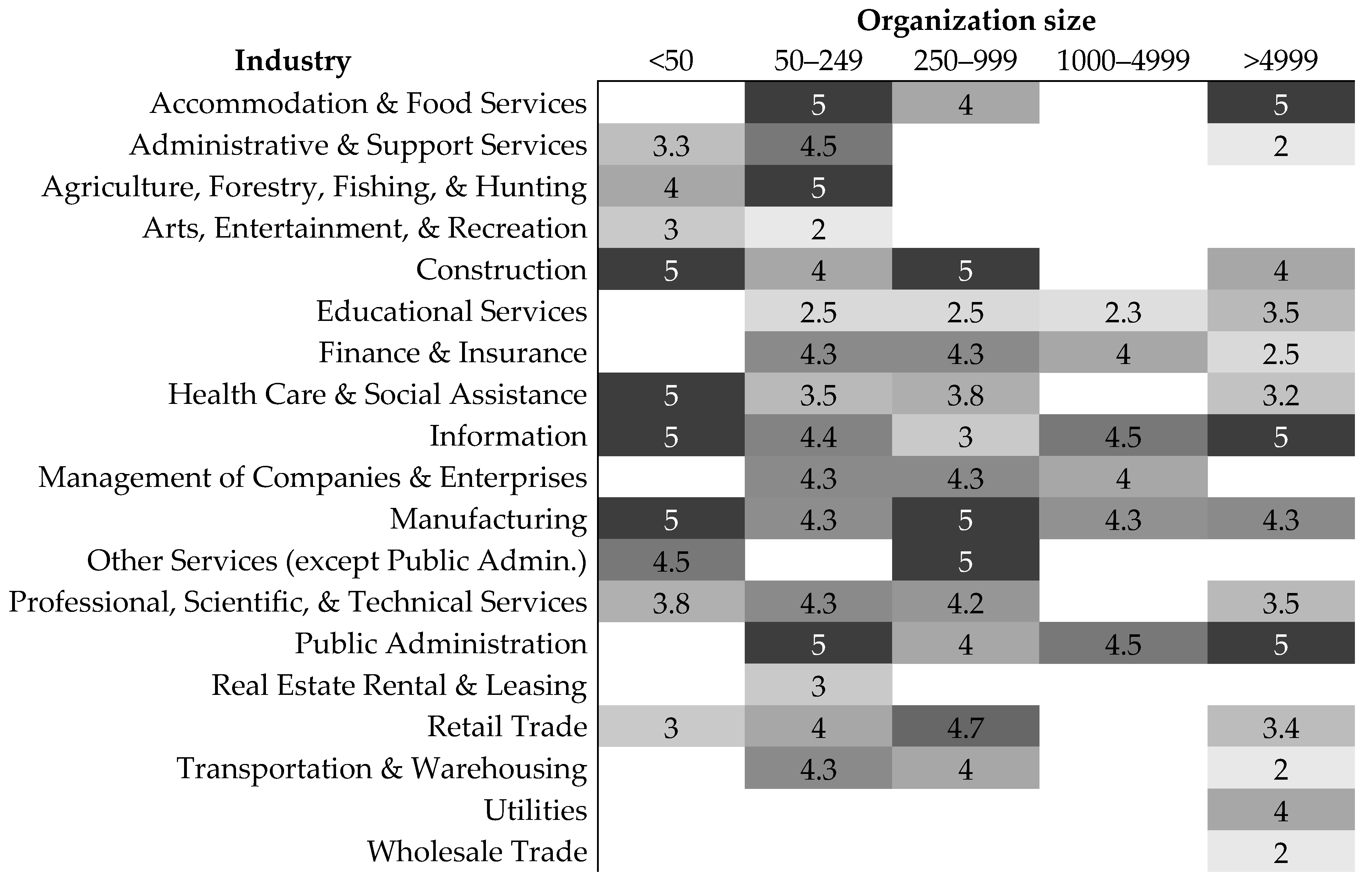
4.1. Frequency of Use and Contextual Factors
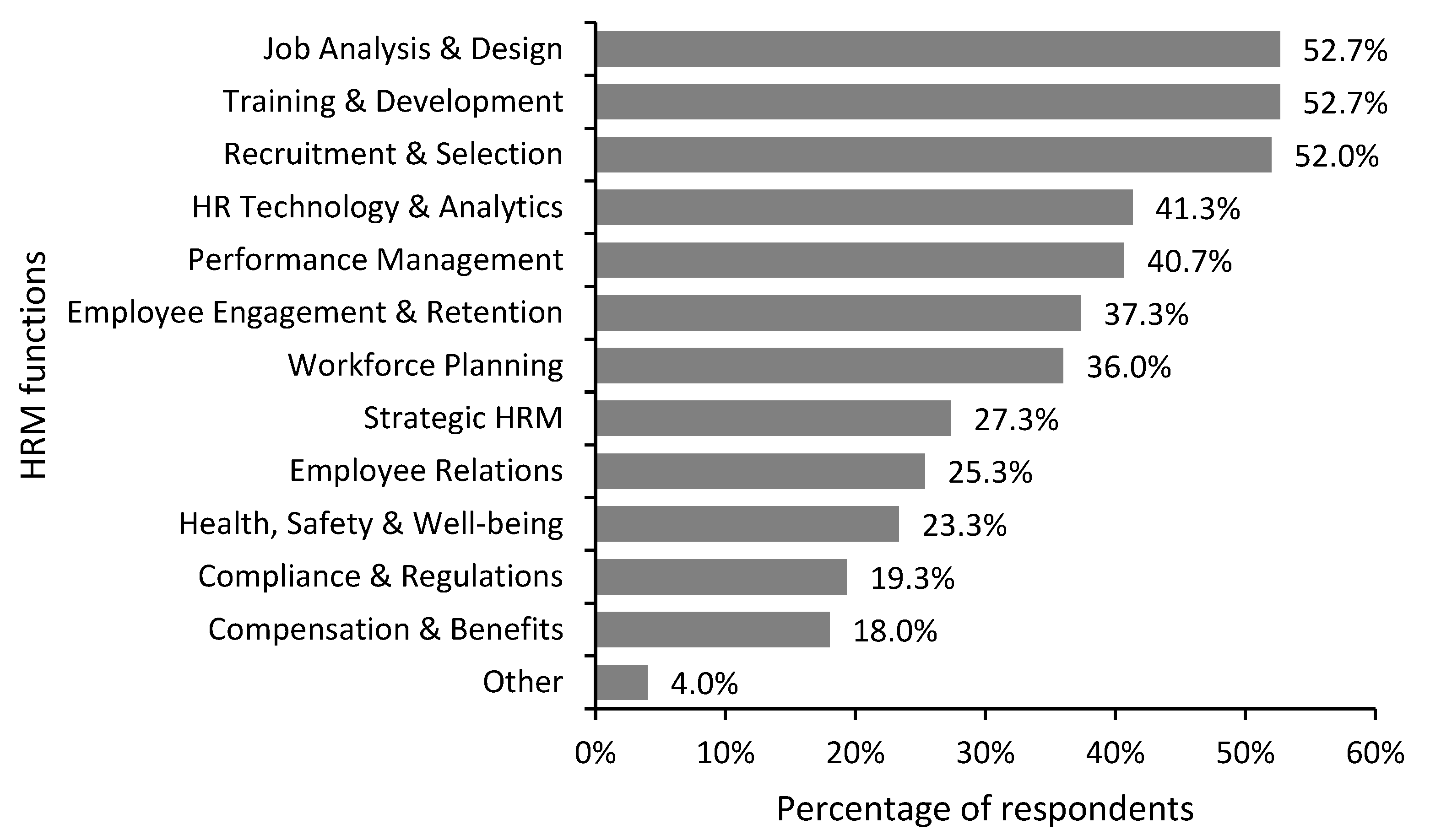
4.2. Use Within HRM Functions
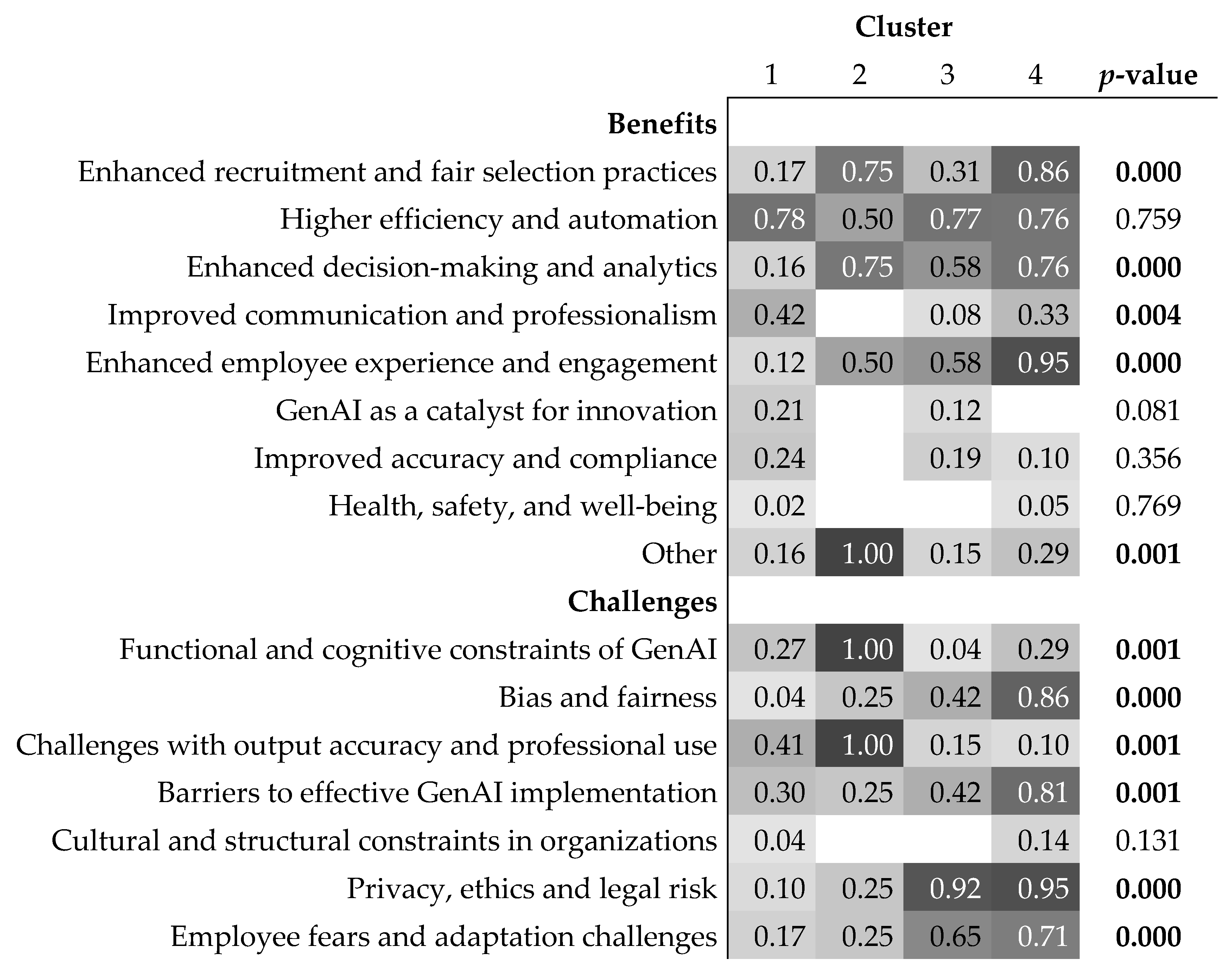
4.3. Perceived Benefits and Challenges
4.4. User Profiles
4.4.1. Cluster 1: Cautious Optimists
“GenAI saved a ton of time by automating repetitive tasks… made hiring easier and faster by helping screen candidates and create personalized interview questions… kept communication clear, professional and consistent.”
“It sometimes needs a lot of revisions… can be limited in what it knows… sometimes does not understand the correct context.”
4.4.2. Cluster 2: Enthusiastic Users with Technical Concerns (Illustrative Archetype)
“It helps expedite hiring… create custom training plans… it gives us useful insights for performance reviews and promotions.”
4.4.3. Cluster 3: Pragmatic Frequent Users
“Ensure the content aligns with company culture and values… address privacy and security when using employee information… balance automation with human connection… train the model for unique or complex scenarios… address skepticism or resistance from employees.”
4.4.4. Cluster 4: Critical Lead Users
“It streamlines… performance evaluation… helps process large applicant pools… reduces all info to suitability scores, and generates data as to what justifies the ratings.”
“Potential biases in outputs… issues with data privacy and compliance with GDPR… mistrust among employees… over-reliance on generative AI that can overlook the human aspect in HR activities.”
5. Discussion
5.1. Theoretical Implications
5.2. Practical Implications
5.3. Limitations
6. Conclusions
Author Contributions
Funding
Institutional Review Board Statement
Informed Consent Statement
Data Availability Statement
Acknowledgments
Conflicts of Interest
Abbreviations
| GenAI | Generative Artificial Intelligence |
| HRM | Human Resource Management |
| HR | Human Resource |
| UK | United Kingdom |
| US | United States |
| DOI | Diffusion of Innovation |
| TOE | Technology-Organization-Environment |
| TTF | Task-Technology Fit |
| GDPR | General Data Protection Regulation |
| FDR | False-Discovery-Rate |
Appendix A
- (1)
- Gender:
- (a)
- Male
- (b)
- Female
- (c)
- Other
- (2)
- Age:
- (a)
- 18–25 years
- (b)
- 26–35 years
- (c)
- 36–45 years
- (d)
- 46–55 years
- (e)
- Over 55 years
- (3)
- Highest level of education:
- (a)
- No formal education
- (b)
- Primary or elementary education
- (c)
- Secondary or high school education
- (d)
- Vocational or technical training
- (e)
- Bachelor’s degree
- (f)
- Master’s degree or higher
- (4)
- Country of residence:
- (a)
- UK
- (b)
- USA
- (5)
- Years of experience in HRM:
- (a)
- Less than 3 years
- (b)
- 3–5 years
- (c)
- 6–10 years
- (d)
- 11–20 years
- (e)
- Over 20 years
- (6)
- Current job position level:
- (a)
- Entry-level (e.g., HR Assistant)
- (b)
- Mid-level (e.g., HR Specialist)
- (c)
- Senior level or manager (e.g., Senior HR Manager)
- (d)
- Director or Executive (e.g., HR Director, CEO)
- (e)
- Other (please specify):
- (7)
- Industry sector:
- (a)
- Agriculture, Forestry, Fishing, and Hunting
- (b)
- Mining
- (c)
- Utilities
- (d)
- Construction
- (e)
- Manufacturing
- (f)
- Wholesale Trade
- (g)
- Retail Trade
- (h)
- Transportation and Warehousing
- (i)
- Information
- (j)
- Finance and Insurance
- (k)
- Real Estate Rental and Leasing
- (l)
- Professional, Scientific, and Technical Services
- (m)
- Management of Companies and Enterprises
- (n)
- Administrative and Support Services
- (o)
- Educational Services
- (p)
- Health Care and Social Assistance
- (q)
- Arts, Entertainment, and Recreation
- (r)
- Accommodation and Food Services
- (s)
- Other Services (except Public Administration)
- (t)
- Public Administration
- (8)
- Number of employees:
- (a)
- Less than 50 employees
- (b)
- 50–249 employees
- (c)
- 250–999 employees
- (d)
- 1000–4999 employees
- (e)
- Over 4999 employees
- (9)
- What kind of policy does your organization have about the use of GenAI?
- (a)
- Formal policy allowing use of GenAI
- (b)
- Formal policy prohibiting use of GenAI
- (c)
- Informal policy against use of GenAI
- (d)
- Informal policy allowing use of GenAI
- (e)
- No formal or informal policy
- (10)
- Which GenAI tools do you use in your HRM activities?
- (a)
- ChatGPT
- (b)
- Gemini
- (c)
- Copilot
- (d)
- NotebookLM
- (e)
- GenAI embedded in HRM software
- (f)
- Other (please specify):
- (11)
- How frequently do you use GenAI tools in your HRM activities?
- (a)
- At least once a day
- (b)
- At least every two days
- (c)
- At least once a week
- (d)
- At least every two weeks
- (e)
- At least once a month
- (12)
- Which HRM activities do you use GenAI for?
- (a)
- Job Analysis and Design
- (b)
- Strategic Human Resource Management
- (c)
- Workforce Planning
- (d)
- HR Technology and Analytics
- (e)
- Compliance with Laws and Regulations
- (f)
- Recruitment and Selection
- (g)
- Training and Development
- (h)
- Performance Management
- (i)
- Compensation and Benefits
- (j)
- Employee Relations
- (k)
- Employee Engagement and Retention
- (l)
- Health, Safety, and Well-being
- (m)
- Other (Please specify):
- (13)
- Please describe your current use of GenAI in your HRM activities.
- (14)
- What benefits have you experienced from using GenAI in your HRM activities?
- (15)
- What challenges have you encountered while using GenAI in your HRM activities?
- (16)
- Please provide any additional comments or insights regarding the use of GenAI in HRM at your organization.
Appendix B

| Item | Item Format | Response Options | Coding Used | Why Is Appropriate | What It Cannot Capture |
|---|---|---|---|---|---|
| Frequency of GenAI use | Single item | At least once a day; at least every two days; at least once a week; at least every two weeks; at least once a month | Ordinal | Captures usage intensity parsimoniously in an exploratory design | Does not capture session duration, or within-person variability over time |
| GenAI policy environment | Single item | Formal policy allowing use of GenAI; formal policy prohibiting use of GenAI; informal policy against use of GenAI; informal policy allowing use of GenAI; no formal or informal policy | Categorical | Single classification is appropriate for mapping governance setting as reported by respondents | Does not measure enforcement, awareness, or policy maturity; relies on respondent knowledge |
| Organization size | Single item | Less than 50 employees; 50–249 employees; 250–999 employees; 1000–4999 employees; over 4999 employees | Ordinal-coded category index | Standard proxy for structural/resource differences | Cannot capture resource slack or HRM function size |
| Industry | Single item | Agriculture, forestry, fishing, and hunting; mining; utilities; construction; manufacturing; wholesale trade; retail trade; transportation and warehousing; information; finance and insurance; real estate rental and leasing; professional, scientific, and technical services; management of companies and enterprises; administrative and support services; educational services; health care and social assistance; arts, entertainment, and recreation; accommodation and food services; other services (except public administration); public administration. | Categorical | Industry is a contextual classifier; single item is standard in surveys | Cannot represent within-industry heterogeneity |
| Country | Single item | UK; US | Categorical | Used for sampling frame description rather than causal inference | Not used to claim national effects in this paper |
| Tool types used | Multiple-response checklist | ChatGPT; Gemini; Copilot; NotebookLM; GenAI embedded in HRM software; other | Binary | Checklists are appropriate for enumerating tool ecology in early-stage practice | Does not capture depth of use per tool, governance restrictions per tool, or tool proficiency |
| HRM functions where GenAI is applied | Multiple-response checklist | Job analysis and design; strategic human resource management; workforce planning; HR technology and analytics; compliance with laws and regulations; recruitment and selection; training and development; performance management; compensation and benefits; employee relations; employee engagement and retention; health, safety, and well-being; other | Binary | Captures breadth of application across HRM activities without assuming a single latent dimension | Does not capture process integration level, criticality of the activity, or activity frequency |
| Perceived benefits | Open-ended response | Open text | 9 themes; binary indicator per theme based on code presence | Open-ended elicitation avoids imposing categories; binary theme presence supports profiling without treating themes as reflective scales | Does not measure strength/importance of each benefit; theme presence depends on what respondents choose to mention |
| Perceived challenges | Open-ended response | Open text | 7 themes; binary indicator per theme based on code presence | Same rationale as benefits; supports pattern detection (co-occurrence) | Does not capture severity, probability, or organizational consequences of each challenge |
| How GenAI is incorporated into HRM activities | Open-ended response | Open text | Coded to HRM functions (per codebook) | Provides contextual detail that complements closed items (triangulation) | Not a behavioral trace; cannot verify actual use; depends on recall and self-presentation |
Appendix C
Appendix C.1. Internal Validation and Linkage Sensitivity
| k | Silhouette | ARI (Average vs. Complete) | ARI (Average vs. Single) |
|---|---|---|---|
| 3 | 0.256 | 0.536 | 0.028 |
| 4 | 0.190 | 0.558 | 0.026 |
| 5 | 0.168 | 0.513 | 0.021 |
Appendix C.2. Subsampling Stability
| Metric | Value |
|---|---|
| Subsample fraction | 0.80 |
| Iterations | 500 |
| ARI mean | 0.745 |
| ARI median | 0.752 |
| ARI (25th percentile) | 0.683 |
| ARI (75th percentile) | 0.810 |
| Median minimum cluster size across runs | 2 |
| % runs with any cluster ≤ 4 cases | 91.6% |
Appendix C.3. Sensitivity Analysis Excluding the Smallest Cluster
| Variable | Test Statistic (H) | df | p | Group Sizes |
|---|---|---|---|---|
| Frequency of GenAI use | 1.172 | 2 | 0.557 | {1: 99, 3: 26, 4: 21} |
| Organizational size | 12.514 | 2 | 0.0019 | {1: 99, 3: 26, 4: 21} |
| Post hoc (organizational size): pairwise Mann–Whitney U with BH/FDR correction | ||||
| Contrast | U | p | p (FDR) | |
| Cluster 1 vs. 3 | 1749.5 | 0.0029 | 0.0087 | |
| Cluster 1 vs. 4 | 1366.5 | 0.0173 | 0.0260 | |
| Cluster 3 vs. 4 | 256.5 | 0.6890 | 0.6890 | |
| Variable | Test | p | p (FDR) |
|---|---|---|---|
| Industry | Fisher–Freeman–Halton test with Monte Carlo Simulation | 0.120 | 0.169 |
| Policy environment | Fisher–Freeman–Halton test with Monte Carlo Simulation | 0.169 | 0.169 |
Appendix D
| Cluster (k = 4) | UK (n = 70) | USA (n = 80) | Total |
|---|---|---|---|
| 1 | 45 (64.3%) | 54 (67.5%) | 99 |
| 2 | 2 (2.9%) | 2 (2.5%) | 4 |
| 3 | 13 (18.6%) | 13 (16.2%) | 26 |
| 4 | 10 (14.3%) | 11 (13.8%) | 21 |
| Association test | - | - | χ2(3) = 0.20, p = 0.978 |
| Top reported benefits | ||||
| Benefit theme (top 5 overall) | UK % | USA % | p | p (FDR) |
| Higher efficiency and automation | 81.4 | 72.5 | 0.247 | 0.658 |
| Improved communication and professionalism | 28.6 | 38.8 | 0.228 | 0.658 |
| Enhanced decision-making and analytics | 42.9 | 25.0 | 0.025 | 0.393 |
| Enhanced employee experience and engagement | 27.1 | 37.5 | 0.222 | 0.658 |
| Enhanced recruitment and fair selection practices | 24.3 | 36.2 | 0.155 | 0.658 |
| Top reported challenges | ||||
| Challenge theme (top 5 overall) | UK % | USA % | p | p (FDR) |
| Barriers to effective implementation | 42.9 | 36.2 | 0.503 | 0.944 |
| Privacy, ethics and legal risk | 37.1 | 36.2 | 1.000 | 1.000 |
| Output accuracy and professional use | 37.1 | 31.2 | 0.492 | 0.944 |
| Employee fears and adaptation challenges | 35.7 | 31.2 | 0.605 | 0.944 |
| Functional and cognitive constraints of GenAI | 27.1 | 23.8 | 0.708 | 0.944 |
References
- Abdelhay, S., Haider, S., Hazaimeh, H. M., El-Bannany, M., & Marie, A. (2025). The impact of generative AI (ChatGPT) on recruitment efficiency and candidate quality: The mediating role of process automation level and the moderating role of organizational size. Frontiers in Human Dynamics, 4, 1487671. [Google Scholar] [CrossRef]
- Aguinis, H., Beltran, J. R., & Cope, A. (2024). How to use generative AI as a human resource management assistant. Organizational Dynamics, 53(1), 101029. [Google Scholar] [CrossRef]
- Andrieux, P., Johnson, R. D., Sarabadani, J., & Van Slyke, C. (2024). Ethical considerations of generative AI-enabled human resource management. Organizational Dynamics, 53(1), 101032. [Google Scholar] [CrossRef]
- Anshima, Bhardwaj, B., & Sharma, D. (2026). Paradoxes of implementing AI-augmented HRM in the workplace: A systematic literature review and future research agenda. Management Review Quarterly, 1–40. [Google Scholar] [CrossRef]
- Banh, L., & Strobel, G. (2023). Generative artificial intelligence. Electronic Markets, 33(1), 63. [Google Scholar] [CrossRef]
- Berg, J. M., Raj, M., & Seamans, R. (2023). Capturing value from artificial intelligence. Academy of Management Discoveries, 9(4), 424–428. [Google Scholar] [CrossRef]
- Bousquette, I. (2025, May 12). Why moderna merged its tech and HR departments. The Wall Street Journal. Available online: https://www.wsj.com/articles/why-moderna-merged-its-tech-and-hr-departments-95318c2a (accessed on 12 May 2025).
- Braun, V., & Clarke, V. (2006). Using thematic analysis in psychology. Qualitative Research in Psychology, 3(2), 77–101. [Google Scholar] [CrossRef]
- Braun, V., & Clarke, V. (2021). One size fits all? What counts as quality practice in (reflexive) thematic analysis? Qualitative Research in Psychology, 18(3), 328–352. [Google Scholar] [CrossRef]
- Brown, O., Davison, R. M., Decker, S., Ellis, D. A., Faulconbridge, J., Gore, J., Greenwood, M., Islam, G., Lubinski, C., MacKenzie, N. G., Meyer, R., Muzio, D., Quattrone, P., Ravishankar, M. N., Zilber, T., Ren, S., Sarala, R. M., & Hibbert, P. (2024). Theory-driven perspectives on generative artificial intelligence in business and management. British Journal of Management, 35(1), 3–23. [Google Scholar] [CrossRef]
- Bryman, A. (2006). Integrating quantitative and qualitative research: How is it done? Qualitative Research, 6(1), 97–113. [Google Scholar] [CrossRef]
- Budhwar, P., Chowdhury, S., Wood, G., Aguinis, H., Bamber, G. J., Beltran, J. R., Boselie, P., Lee Cooke, F., Decker, S., DeNisi, A., Dey, P. K., Guest, D., Knoblich, A. J., Malik, A., Paauwe, J., Papagiannidis, S., Patel, C., Pereira, V., Ren, S., … Varma, A. (2023). Human resource management in the age of generative artificial intelligence: Perspectives and research directions on ChatGPT. Human Resource Management Journal, 33(3), 606–659. [Google Scholar] [CrossRef]
- Chowdhury, S., Budhwar, P., & Wood, G. (2024). Generative artificial intelligence in business: Towards a strategic human resource management framework. British Journal of Management, 35(4), 1680–1691. [Google Scholar] [CrossRef]
- Dessler, G. (2024). Human resource management (17th ed.). Pearson. [Google Scholar]
- Dutta, D., & Naveen, P. M. (2025). Transforming recruitment and selection practices in organizations through discriminative and generative AI adoption: A structuration lens. Human Resource Management, 65(1), 77–115. [Google Scholar] [CrossRef]
- Dwivedi, Y. K., Kshetri, N., Hughes, L., Slade, E. L., Jeyaraj, A., Kar, A. K., Baabdullah, A. M., Koohang, A., Raghavan, V., Ahuja, M., Albanna, H., Albashrawi, M. A., Al-Busaidi, A. S., Balakrishnan, J., Barlette, Y., Basu, S., Bose, I., Brooks, L., Buhalis, D., … Wright, R. (2023). “So what if ChatGPT wrote it?” Multidisciplinary perspectives on opportunities, challenges and implications of generative conversational AI for research, practice and policy. International Journal of Information Management, 71, 102642. [Google Scholar] [CrossRef]
- Edmondson, A. C., & McManus, S. E. (2007). Methodological fit in management field research. Academy of Management Review, 32(4), 1155–1179. [Google Scholar] [CrossRef]
- Flynn, J., Commisso, C., Mallon, D., Van Durme, Y., Harrington, S., & Lahiri, G. (2025). 2025 global human capital trends: Turning tensions into triumphs—Helping leaders transform uncertainty into opportunity. Deloitte Insights. Available online: https://www2.deloitte.com/us/en/insights/focus/human-capital-trends.html (accessed on 12 May 2025).
- Gandhi, N., Lim, R., Durth, S., Bérubé, V., Seiler, C., & Kedia, K. (2025). The critical role of strategic workforce planning in the age of AI. McKinsey’s & Company. Available online: https://www.mckinsey.com/capabilities/people-and-organizational-performance/our-insights/the-critical-role-of-strategic-workforce-planning-in-the-age-of-ai?utm_source=chatgpt.com#/ (accessed on 12 May 2025).
- Garcia, R. F., & Kwok, L. (2025). Generative artificial intelligence in human resource management: A critical reflection on impacts, resilience and roles. International Journal of Contemporary Hospitality Management, 37(9), 3136–3158. [Google Scholar] [CrossRef]
- Goodhue, D., & Thompson, R. (1995). Task-technology fit and individual performance. MIS Quarterly, 19(2), 213–236. [Google Scholar] [CrossRef]
- Jiang, Y., Cai, Z., & Wang, X. (2025). Leverage Generative AI for human resource management: Integrated risk analysis approach. The International Journal of Human Resource Management, 36(11), 1929–1959. [Google Scholar] [CrossRef]
- Kanbach, D. K., Heiduk, L., Blueher, G., Schreiter, M., & Lahmann, A. (2024). The GenAI is out of the bottle: Generative artificial intelligence from a business model innovation perspective. Review of Managerial Science, 18(4), 1189–1220. [Google Scholar] [CrossRef]
- Khalili, N., & Jahanbakht, M. (2025). Unveiling the Unspoken: A Conceptual Framework for AI-Enabled Tacit Knowledge Co-Evolution. Knowledge, 6(1), 1. [Google Scholar] [CrossRef]
- Korzynski, P., Mazurek, G., Altmann, A., Ejdys, J., Kazlauskaite, R., Paliszkiewicz, J., Wach, K., & Ziemba, E. (2023). Generative artificial intelligence as a new context for management theories: Analysis of ChatGPT. Central European Management Journal, 31(1), 3–13. [Google Scholar] [CrossRef]
- Koteczki, R., Csikor, D., & Balassa, B. E. (2025). The role of generative AI in improving the sustainability and efficiency of HR recruitment process. Discover Sustainability, 6(1), 1–28. [Google Scholar] [CrossRef]
- Kshetri, N., Dwivedi, Y. K., Davenport, T. H., & Panteli, N. (2024). Generative artificial intelligence in marketing: Applications, opportunities, challenges, and research agenda. International Journal of Information Management, 75, 102716. [Google Scholar] [CrossRef]
- Li, B., & Cheng, Y. (2025). ChatGPT in human resource management: A systematic review of influential factors, processes, and outcomes. Heliyon, 11(15), e44048. [Google Scholar] [CrossRef]
- Metzger, M., O’Reilly, S., & Mac an Bhaird, C. (2025). Generative artificial intelligence augmenting SME financial management. Technovation, 147, 103313. [Google Scholar] [CrossRef]
- Mori, M., Sassetti, S., Cavaliere, V., & Bonti, M. (2025). A systematic literature review on artificial intelligence in recruiting and selection: A matter of ethics. Personnel Review, 54(3), 854–878. [Google Scholar] [CrossRef]
- Naghshineh, B., & Carvalho, H. (2025). Exploring the effects of additive manufacturing technology adoption on the state of the supply chain: A resilience perspective. Operations Management Research, 18, 495–517. [Google Scholar] [CrossRef]
- Nyberg, A. J., Schleicher, D. J., Bell, B. S., Boon, C., Cappelli, P., Collings, D. G., Molle, J. E. D., Feuerriegel, S., Gerhart, B., Jeong, Y., Korsgaard, M. A., Minbaeva, D., & Ployhart, R. E. (2025). A brave new world of human resources research: Navigating perils and identifying grand challenges of the GenAI revolution. Journal of Management, 51(6), 2677–2718. [Google Scholar] [CrossRef]
- Palan, S., & Schitter, C. (2018). Prolific. ac—A subject pool for online experiments. Journal of Behavioral and Experimental Finance, 17, 22–27. [Google Scholar] [CrossRef]
- Peer, E., Brandimarte, L., Samat, S., & Acquisti, A. (2017). Beyond the Turk: Alternative platforms for crowdsourcing behavioral research. Journal of Experimental Social Psychology, 70, 153–163. [Google Scholar] [CrossRef]
- Pereira, V., Hadjielias, E., Christofi, M., & Vrontis, D. (2023). A systematic literature review on the impact of artificial intelligence on workplace outcomes: A multi-process perspective. Human Resource Management Review, 33(1), 100857. [Google Scholar] [CrossRef]
- Phillips, J., & Robie, C. (2024). Hacking the perfect score on high-stakes personality assessments with generative AI. Personality and Individual Differences, 231, 112840. [Google Scholar] [CrossRef]
- Ployhart, R. E. (2006). Staffing in the 21st century: New challenges and strategic opportunities. Journal of Management, 32(6), 868–897. [Google Scholar] [CrossRef]
- Poitevin, H., & Rizaoglu, E. (2023). How to evaluate use cases for generative AI in HR. Gartner. Available online: https://reportds.s3.us-east-2.amazonaws.com/How+to+Evaluate+Use+Cases+for+Generative+AI+in+HR+-+Gartner.pdf (accessed on 12 May 2025).
- Popera, A. (2024). Survey reveals HR’s role in AI adoption. Available online: https://www.shrm.org/enterprise-solutions/insights/survey-reveals-hr-s-role-in-ai-adoption- (accessed on 12 May 2025).
- Prasad, D. K., & De, S. (2024). Generative AI as a catalyst for HRM practices: Mediating effects of trust. Humanities and Social Sciences Communications, 11, 1362. [Google Scholar] [CrossRef]
- Rogers, E. M. (2003). Diffusion of innovations (5th ed.). Free Press. [Google Scholar]
- Spector, P. E. (2019). Do not cross me: Optimizing the use of cross-sectional designs. Journal of Business and Psychology, 34, 125–137. [Google Scholar] [CrossRef]
- Statista. (2025). Generative AI—Worldwide. Statista Market Forecast. [Google Scholar]
- Stergiou, D. (2025). Using ChatGPT to support human resource management in the hotel industry. Worldwide Hospitality and Tourism Themes, 17(5), 602–615. [Google Scholar] [CrossRef]
- Szandała, T. (2025). ChatGPT vs. human expertise in the context of IT recruitment. Expert Systems with Applications, 264, 125868. [Google Scholar] [CrossRef]
- Timmermans, S., & Tavory, I. (2024). Data analysis in qualitative research: Theorizing with abductive analysis. University of Chicago Press. [Google Scholar]
- Tornatzky, L., & Fleischer, M. (1990). The processes of technological innovation. Lexington Books. [Google Scholar]
- UPWS. (2025). 2025 generative AI report: Learning fuels human + AI collaboration (white paper). University of Phoenix Workforce Solutions. Available online: https://www.phoenix.edu/content/dam/edu/media-center/doc/whitepapers/genai-report-final-remediated.pdf (accessed on 12 May 2025).
- Vojnovski, T. (2024, May 31). Generative AI + immersive training: SweetRush’s power duo for effective, engaging guest service training at Hilton. SweetRush. Available online: https://www.sweetrush.com/generative-ai-immersive-training-sweetrush-and-hilton/ (accessed on 12 May 2025).
- Wamba, S. F., Guthrie, C., Queiroz, M. M., & Minner, S. (2024). ChatGPT and generative artificial intelligence: An exploratory study of key benefits and challenges in operations and supply chain management. International Journal of Production Research, 62(16), 5676–5696. [Google Scholar] [CrossRef]
- Wamba, S. F., Queiroz, M. M., Jabbour, C. J. C., & Shi, C. V. (2023). Are both generative AI and ChatGPT game changers for 21st-Century operations and supply chain excellence? International Journal of Production Economics, 265, 109015. [Google Scholar] [CrossRef]
- Wilkinson, L. (2023, October 18). How P&G rolled out its internal generative AI model. CIO Dive. Available online: https://www.ciodive.com/news/procter-gamble-PG-chatgp-AI-openAI/697067/ (accessed on 12 May 2025).
- Zielinski, D. (2024, July 8). Personalization, GenAI transform engagement at Johnson & Johnson. SHRM. Available online: https://www.shrm.org/topics-tools/news/technology/personalization--genai-transform-engagement-at-johnson---johnson (accessed on 12 May 2025).


| Company | HRM Function | Description | Source |
|---|---|---|---|
| Moderna | Performance management, compensation, and benefits | It implemented a human resources GPT (tailored version of ChatGPT) to handle employee questions, routing them as necessary to GPTs focused on performance management, equity, or benefits. | Bousquette (2025) |
| Procter & Gamble | Onboarding | It deployed an internal LLM called “chatPG” based on OpenAI’s APIs for onboarding. | Wilkinson (2023) |
| Hilton | Training and development | It implemented a VR guest-service simulator with an LLM backend that gives contextualized feedback to hotel staff. | Vojnovski (2024) |
| Johnson & Johnson | Employee engagement | It uses ChatGPT to summarize thousands of employee comments in annual engagement surveys, and create personalized engagement reports. | Zielinski (2024) |
| Hewlett-Packard Enterprise | Recruitment | It uses a GenAI-enabled chatbot on its careers website page to assist candidates in finding a job or answer questions about the hiring process, level of work experience required, and the type of jobs available. | Andrieux et al. (2024) |
| n | % | ||
|---|---|---|---|
| Gender | |||
| Male | 53 | 35.3 | |
| Female | 97 | 64.7 | |
| Age | |||
| 18–25 years | 25 | 16.7 | |
| 26–35 years | 58 | 38.7 | |
| 36–45 years | 38 | 25.3 | |
| 46–55 years | 18 | 12.0 | |
| Over 55 years | 11 | 7.3 | |
| Education | |||
| Secondary or high school education | 10 | 6.7 | |
| Vocational or technical training | 13 | 8.7 | |
| Bachelor’s degree | 77 | 51.3 | |
| Master’s degree or higher | 50 | 33.3 | |
| Country of residence | |||
| US | 80 | 53.3 | |
| UK | 70 | 46.7 | |
| Years of experience in HRM | |||
| Less than 3 years | 34 | 22.7 | |
| 3–5 years | 49 | 32.7 | |
| 6–10 years | 36 | 24.0 | |
| 11–20 years | 20 | 13.3 | |
| Over 20 years | 11 | 7.3 | |
| Current job position level | |||
| Entry-level | 17 | 11.3 | |
| Mid-level | 75 | 50.0 | |
| Senior-level or manager | 46 | 30.7 | |
| Director or Executive | 12 | 8.0 | |
| Industry sector | |||
| Accommodation and Food Services | 4 | 2.7 | |
| Administrative and Support Services | 8 | 5.3 | |
| Agriculture, Forestry, Fishing, and Hunting | 3 | 2.0 | |
| Arts, Entertainment, and Recreation | 3 | 2.0 | |
| Construction | 6 | 4.0 | |
| Educational Services | 9 | 6.0 | |
| Finance and Insurance | 14 | 9.3 | |
| Health Care and Social Assistance | 18 | 12.0 | |
| Information | 10 | 6.7 | |
| Management of Companies and Enterprises | 7 | 4.7 | |
| Manufacturing | 21 | 14.0 | |
| Other Services (except Public Administration) | 3 | 2.0 | |
| Professional, Scientific, and Technical Services | 18 | 12.0 | |
| Public Administration | 6 | 4.0 | |
| Real Estate Rental and Leasing | 1 | 0.7 | |
| Retail Trade | 12 | 8.0 | |
| Transportation and Warehousing | 5 | 3.3 | |
| Utilities | 1 | 0.7 | |
| Wholesale Trade | 1 | 0.7 | |
| Number of employees | |||
| Less than 50 employees | 19 | 12.7 | |
| 50–249 employees | 50 | 33.3 | |
| 250–999 employees | 30 | 20.0 | |
| 1000–4999 employees | 15 | 10.0 | |
| Over 4999 employees | 36 | 24.0 | |
| HRM Function | Use Cases |
|---|---|
| Job Analysis and Design | Create inclusive job descriptions; summarize and standardize job descriptions; identify key skills and competencies. |
| Training and Development | Create custom, engaging learning materials and assessments; refine content; personalize onboarding, training and development plans; analyze training needs; build interactive learning experiences. |
| Recruitment and Selection | Draft inclusive job postings, advertisements, and emails; create applicant response templates; use chatbots for queries, guidance, and interview scheduling; screen résumés; generate interview questions; generate candidate summary profiles; collect candidate data; conduct virtual interviews; rank candidates; guide recruitment strategies. |
| Performance Management | Set SMART goals; track goal progress; write reviews; assess employee performance metrics; assess employee strengths and areas for improvement; write reviews; support performance decisions; flag unrecognized employees. |
| Employee Engagement and Retention | Design engagement surveys; generate strategies to improve engagement and retention strategies; personalize employee communications. |
| Workforce Planning | Predict hiring needs; brainstorm ideas to support strategic and scenario planning. |
| HR Analytics | Identify trends; predict employee performance/turnover; analyze feedback; generate employee and headcount reports; analyze employee feedback from surveys, emails, and chats. |
| Compliance | Draft/update policies and procedures for legal compliance; verify adherence to labor laws; summarize legal updates and recommend actions; condense policies; draft employment contracts. |
| Employee Relations | Draft internal and external communications (e.g., to unions); respond to complaints; generate document templates; ensure DEI alignment in communications; use chatbots for inquiries. |
| Health, Safety, and Well-being | Create wellness plans and incentives; support employees with mental health/personal issues; suggest well-being improvements and healthy habits. |
| Strategic HRM | Enable predictive workforce planning; align talent management with strategic goals; inform retention/performance decisions using employee data; automate policy updates; link engagement initiatives outcomes. |
| Compensation and Benefits | Automate payroll, leave, and bonus calculations; analyze hourly wage data. |
| Benefits | n | % |
|---|---|---|
| Higher efficiency and automation | 115 | 76.7% |
| Improved communication and professionalism | 51 | 34.0% |
| Enhanced decision-making and analytics | 50 | 33.3% |
| Enhanced employee experience and engagement | 49 | 32.7% |
| Enhanced recruitment and fair selection practices | 46 | 30.7% |
| Improved accuracy and compliance | 31 | 20.7% |
| Catalyst for innovation | 24 | 16.0% |
| Health, safety, and well-being | 3 | 2.0% |
| Other | 30 | 20.0% |
| Challenges | n | % |
|---|---|---|
| Barriers to effective implementation | 59 | 39.3% |
| Privacy, ethics and legal risk | 55 | 36.7% |
| Challenges with output accuracy and professional use | 51 | 34.0% |
| Employee fears and adaptation challenges | 50 | 33.3% |
| Functional and cognitive constraints | 38 | 25.3% |
| Bias and fairness | 34 | 22.7% |
| Cultural and structural constraints in organizations | 7 | 4.7% |
| Risk Level | Mode | Reported Uses in This Study (Table 3) | Implications for Governance |
|---|---|---|---|
| Low | Content assistance | Draft job descriptions; draft training and onboarding materials; draft HRM communications; draft policy text | Basic human review; basic accuracy checks; avoid sensitive data by default |
| Medium | Decision support | Summarize résumés; summarize engagement-survey comments; generate interview questions; suggest learning paths; draft performance-feedback text for human revision | Structured verification; documentation of inputs/outputs; privacy-aware data handling |
| High | Decision automation (or consequential decision support) | Candidate ranking or suitability scores; outputs used to support performance decisions (e.g., ratings/justifications) | Tight constraints or prohibition; second-person review; auditable trail; bias/privacy/compliance checks; exception-handling process |
Disclaimer/Publisher’s Note: The statements, opinions and data contained in all publications are solely those of the individual author(s) and contributor(s) and not of MDPI and/or the editor(s). MDPI and/or the editor(s) disclaim responsibility for any injury to people or property resulting from any ideas, methods, instructions or products referred to in the content. |
© 2026 by the authors. Licensee MDPI, Basel, Switzerland. This article is an open access article distributed under the terms and conditions of the Creative Commons Attribution (CC BY) license.
Share and Cite
Melão, N.; Reis, J. Generative Artificial Intelligence in HRM Practice: Patterns, Profiles, and Theoretical Insights. Adm. Sci. 2026, 16, 113. https://doi.org/10.3390/admsci16030113
Melão N, Reis J. Generative Artificial Intelligence in HRM Practice: Patterns, Profiles, and Theoretical Insights. Administrative Sciences. 2026; 16(3):113. https://doi.org/10.3390/admsci16030113
Chicago/Turabian StyleMelão, Nuno, and João Reis. 2026. "Generative Artificial Intelligence in HRM Practice: Patterns, Profiles, and Theoretical Insights" Administrative Sciences 16, no. 3: 113. https://doi.org/10.3390/admsci16030113
APA StyleMelão, N., & Reis, J. (2026). Generative Artificial Intelligence in HRM Practice: Patterns, Profiles, and Theoretical Insights. Administrative Sciences, 16(3), 113. https://doi.org/10.3390/admsci16030113