Entrepreneurship and Conway’s Game of Life: A Theoretical Approach from a Systemic Perspective


Abstract
1. Introduction
2. Literature Review
2.1. Entrepreneurship
2.1.1. Entrepreneurship as a Dynamic System
2.1.2. Entrepreneurship as a Game and Complexity Simulation
- Competition: In entrepreneurship, as in a game, competition is a central factor. Entrepreneurs compete for resources, customers, and the market, and must develop strategies to differentiate themselves from their competitors. According to Porter (1980), competitive advantage is achieved through innovation, efficiency, and the ability to respond to market needs.
- Strategy: Entrepreneurship requires careful strategic planning, similar to that used in video games. Entrepreneurs must decide how to allocate resources, when to enter or exit a market, and how to position their products or services. These strategic decisions are crucial to long-term success.
- Uncertainty: In both games and entrepreneurship, uncertainty is an inherent characteristic. Entrepreneurs operate in an environment where market conditions can change rapidly, and decisions must be made with incomplete information. According to Knight (1921), uncertainty is distinguished from risk because it cannot be quantified, which adds an element of unpredictability to the entrepreneurial process.
- Binary outcomes: In many games, the outcomes are binary: win or lose. The same is true in entrepreneurship: while outcomes can be more nuanced, there is also a dichotomy between success and failure. A study by Shane (2008) shows that most startups fail within the first few years, highlighting the «all or nothing» nature of entrepreneurship.
2.2. Entrepreneurship and Uncertainty
2.3. Entrepreneurship and Adaptability
2.4. Entrepreneurship and Growth
2.5. Entrepreneurship and Sustainability
2.6. Four Interrelated Dimensions
2.7. Conway’s Game of Life
2.7.1. Origin and Conceptualization
- Survival: A living cell with two or three living neighbours remains alive in the next generation.
- Death by loneliness: A living cell with fewer than two living neighbours dies in the next generation.
- Death by overpopulation: A living cell with more than three living neighbours dies in the next generation.
- Birth: A dead cell with exactly three living neighbours becomes a living cell in the next generation.
2.7.2. The Four Main Features of Conway’s Game of Life
- Uncertainty in the Game of Life: Uncertainty emerges as a systemic property despite the determinism of the basic rules, a phenomenon documented by Wolfram (2002) who demonstrated the extreme sensitivity to initial conditions in cellular automata. Although the rules of the game are deterministic—the state of a cell in the next generation depends only on the state of its neighbours in the current generation—the long-term evolution of the system is unpredictable. According to Gardner (1970), even simple initial configurations can give rise to complex and chaotic patterns that are difficult to anticipate. This unpredictability is analogous to the uncertainty faced by entrepreneurs in a dynamic business environment.
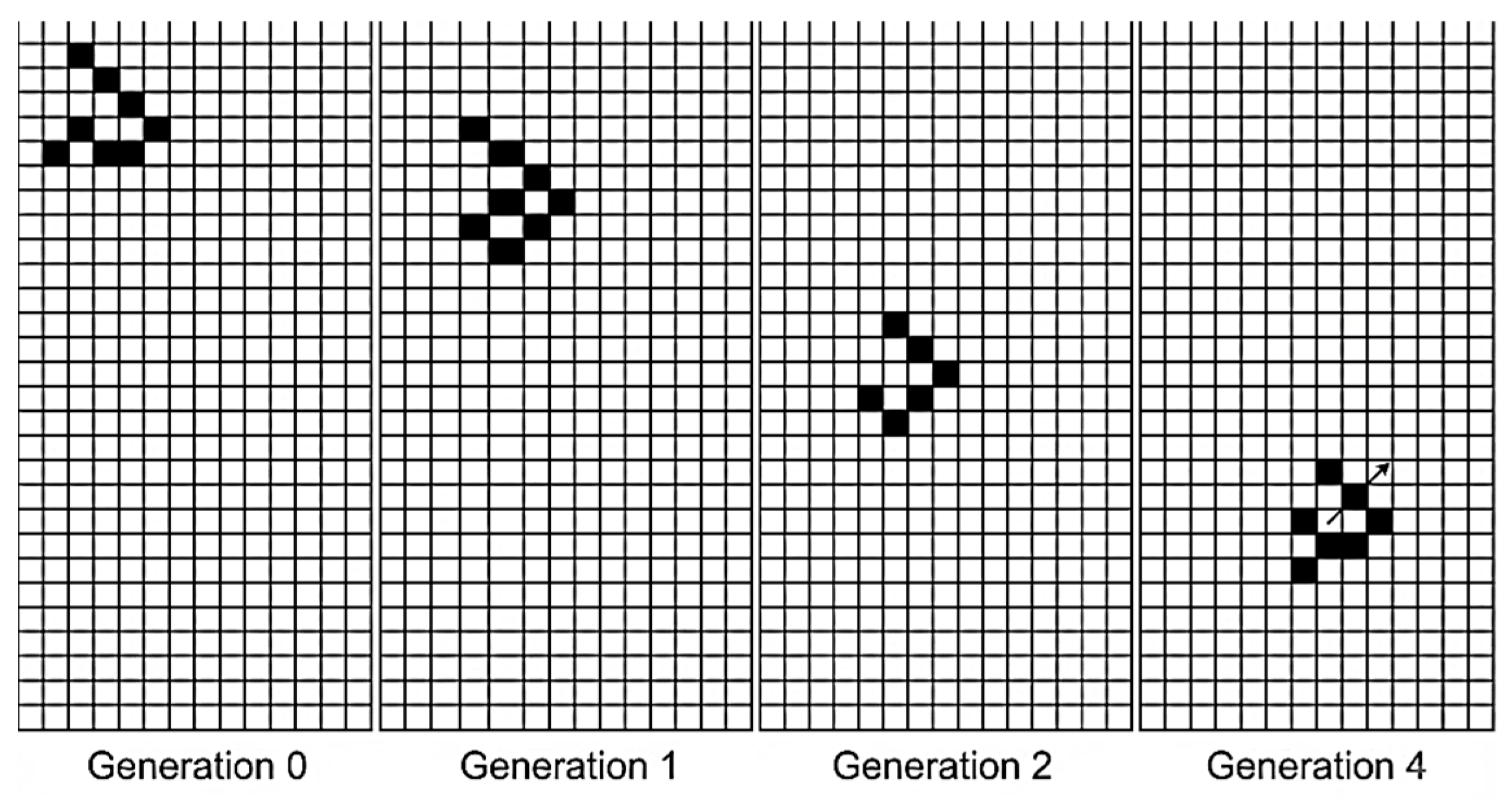
- Adaptability in the Game of Life: Adaptability is manifested in the ability of structures such as gliders to maintain their integrity through spatial displacement, a behaviour that Holland (1998) categorises as emergence in complex adaptive systems. Cells cannot «decide» their state, but the system as a whole exhibits adaptive behaviour. For example, certain configurations, such as «gliders», move around the network and can interact with other structures in ways that allow their survival and propagation. This phenomenon illustrates how adaptability arises from simple, localised rules.
- Growth in the Game of Life: Growth as a distinctive feature is verified by studying unbounded configurations such as the «Gosper Glider Gun», whose capacity for indefinite pattern generation shows self-organising properties. Some initial configurations may result in exponential growth, while others may quickly stagnate or disappear. For example, «devourer» structures are structures that can «consume» others, allowing for controlled and sustained growth. The game demonstrates that growth is neither linear nor predictable but rather depends on complex interactions between multiple factors.
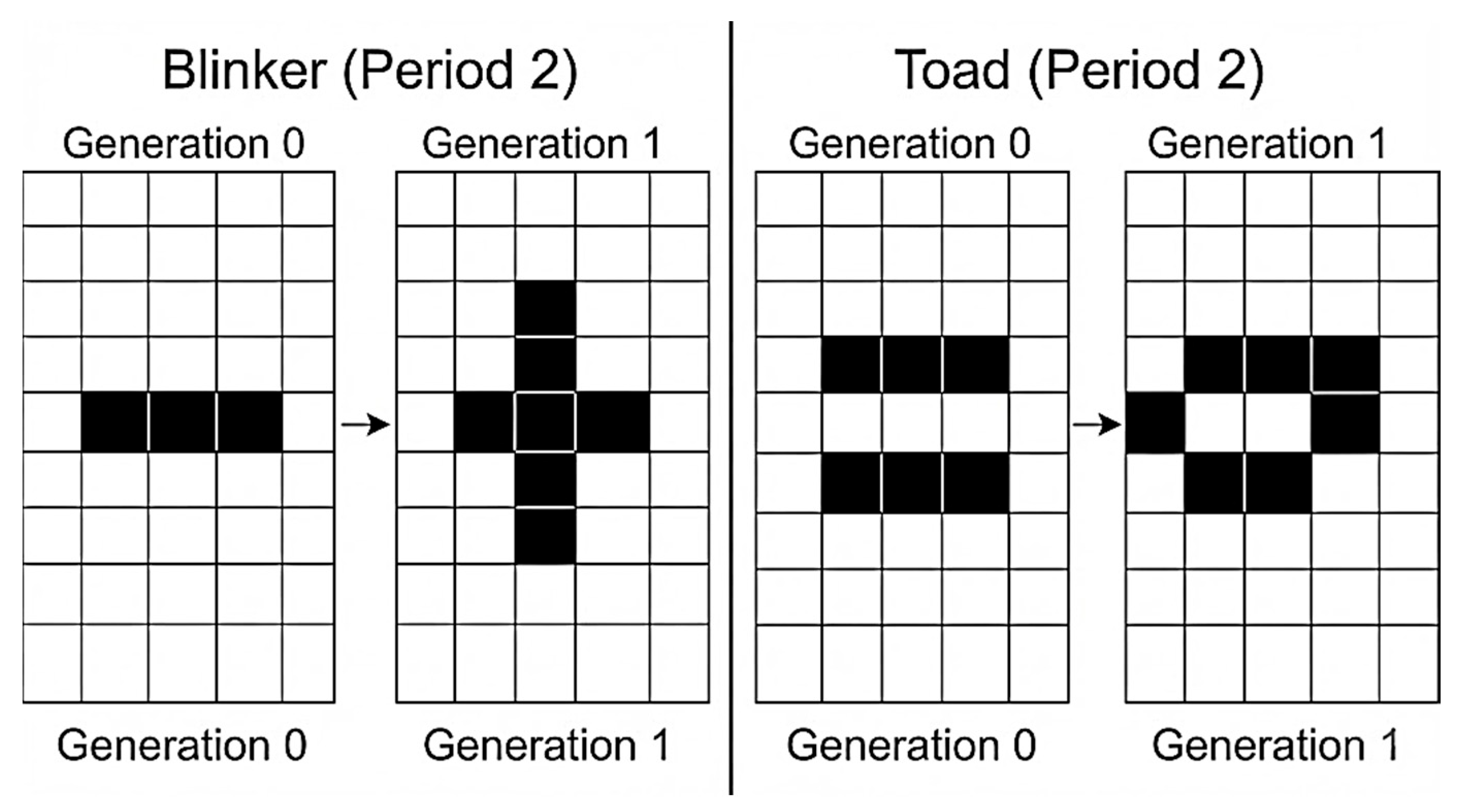
- Sustainability in the Game of Life: Sustainability is demonstrated through the analysis of periodic and static structures that maintain their essential configuration over time, a phenomenon that Weick and Sutcliffe (2007) relate to principles of resilience in organisational systems. Some configurations, such as «still life» and «oscillators», can be maintained indefinitely without change, representing a sustainable equilibrium. However, other configurations can lead to extinction or uncontrolled growth that depletes available resources. According to Meadows et al. (1992), sustainability requires a dynamic balance between resource use and the regenerative capacity of the system, a principle reflected in the Game of Life.
2.7.3. Mathematical Model of the Game of Life
3. Rationale of the Study
4. Methodology
4.1. Aims
4.2. Study Design and Configuration
- A search in academic databases (Web of Science, Scopus, JSTOR) was performed using a Boolean string combining keywords relevant to both fields: (“Conway’s Game of Life” OR “Cellular Automata”) AND (“Entrepreneurship” OR “Complex Adaptive Systems” OR “Business Dynamics”). The search covered the period from 1970 to 2024 to encompass both the foundational algorithmic literature and contemporary management applications.
- The selection of sources was governed by specific inclusion criteria: peer-reviewed articles, books, and conference proceedings in English and Spanish that explicitly linked computational modelling to social sciences, economics, or organisational ecology. Purely technical papers focusing solely on code optimisation without systemic or sociological implications were excluded. The final selection comprised the references cited in this document.
- A comparative analysis of findings (Kitchenham & Charters, 2007) was conducted to triangulate the biological rules with economic theories.
4.3. Limitations
5. Discussion of the Results
5.1. Entrepreneurship and Its Relationship with Conway’s Game of Life
5.1.1. Entrepreneurship, Conway’s Game of Life, and Uncertainty
5.1.2. Entrepreneurship, Conway’s Game of Life and Adaptability
5.1.3. Entrepreneurship, Conway’s Game of Life and Growth
5.1.4. Entrepreneurship, Conway’s Game of Life and Sustainability
5.2. Additional Parallels
5.2.1. Systemic Properties and Entrepreneurship and Their Relationship with Conway’s Game of Life
- Adaptability: Gompers and Lerner (2004) highlight that successful entrepreneurs are those who adapt quickly to change, similar to how patterns in the Game of Life evolve to survive in a dynamic environment.
5.2.2. Local Decisions and Global Success
5.2.3. Emerging Innovation
5.2.4. Resilience and Adaptation
5.2.5. Exponential Growth
5.3. Mathematical Representation of the Correlation Between Entrepreneurship and Conway’s Game of Life (Proposed Model)
5.3.1. The Entrepreneurial State Function
E(x, y, t) = 0 If the venture is Inactive (insolvent or market exit)
5.3.2. The Viability Potential Function (Ψ)
- A(t) is the Adaptability Factor (Internal capabilities).
- ∑E(i, j, t) is the Ecosystem Density (Sum of active neighbours).
- ξ(t) is Stochastic Uncertainty (Random external shocks).
- α and β are weighting coefficients.
5.3.3. The Dynamic Transition Rules
- Death by Isolation (Ψ < θmin): Corresponds to Conway’s rule of «Underpopulation» (fewer than 2 neighbours). If the venture lacks sufficient resources or network support (low Viability Potential), it dies.
- Death by Saturation (Ψ > θmax): Corresponds to Conway’s rule of «Overpopulation» (more than 3 neighbours). If the market is too crowded or the venture over-expands beyond its capacity, it collapses.
- Survival and Birth (Within the Window): Corresponds to Conway’s «Survival» (2–3 neighbours) and «Reproduction» (3 neighbours) rules. A venture survives or is born only when the tension between internal adaptability and external pressure falls within this optimal «Goldilocks zone».
5.3.4. Practical Application: A Strategic Simulation Under Uncertainty
- Current State: The venture is currently inactive, so E(x, y, t) = 0.
- Ecosystem Density (∑E): The market analysis reveals only one major player in the immediate vicinity. Thus, ∑E = 1.
- Survival Threshold (θmin): Based on industry standards (capital requirements, customer base), the minimum potential required to sustain operations is estimated at 3 units (θmin = 3).
- If we apply the strict, deterministic rules of the original Game of Life, a cell with only one neighbour dies (or is not born) due to underpopulation (isolation). Without intervention, the venture is destined to fail because the external support is insufficient.
- Using Equation (5), the entrepreneur calculates the Viability Potential (Ψ):
5.3.5. Implications of the Model
5.4. Other Dimensions for Conway’s Game of Life
- Emergence of complex patterns from simple rules: The game demonstrates how complex structures emerge from interactions based on minimal rules (Gardner, 1970). In entrepreneurship, this is reflected in the ability to generate innovative business models from simple ideas, highlighting the importance of iteration and adaptation (Ries, 2011).
- Survival, growth, and extinction dynamics: Cells in the game «survive», «die«, or «born» depending on their environment, similar to how startups compete in changing markets (Blank, 2013a). The analogy highlights the need to adapt to external conditions in order to thrive.
- Importance of environment and interconnections: The state of a cell depends on its neighbours, similar to the dependence of entrepreneurs on networks of contacts, collaborators, and market trends (Stam, 2015). Success is not isolated, but systemic.
- Experimentation and iterative learning: The game allows for testing configurations to observe outcomes, paralleling the «build-measure-learn» method used by startups (Ries, 2011). Entrepreneurs must quickly test hypotheses and adjust accordingly.
- Resilience and Sustainability: Some patterns in the game (such as «oscillators») persist over time, while others disappear. This reflects the need to build resilient business models (Weick & Sutcliffe, 2007).
6. Main Contributions of the Parallels Between Conway’s Game of Life and Entrepreneurship
- A different theoretical perspective for entrepreneurship: This study advances the field of entrepreneurship by introducing a new theoretical framework based on complex systems theory, using Conway’s Game of Life as both a metaphor and a simulation model. This perspective conceptualises entrepreneurship as a dynamic and adaptive system, where local decisions can result in emergent, non-linear, and sometimes unpredictable global outcomes. Such understanding is key to analysing disruptive innovation, business model evolution, and entrepreneurial survival.
- Balance between innovation and operational stability: The analogy between Entrepreneurship and Conway’s Game of Life emphasises that sustainable scaling depends not only on innovation but also on operational stability and systemic fit. Startups that balance novelty with resilience can grow organically, achieving both internal coherence and external alignment.
- Dynamic configurations as adaptation models: Dynamic configurations such as «gliders» exemplify how businesses can achieve sustainable progress through continuous adaptation. This insight aligns with the principle of strategic iteration, where decisions are evaluated and modified based on environmental feedback, akin to the movement of gliders within the game grid (Berlekamp et al., 1982).
- Entrepreneurship as a complex adaptive system: From the authors’ perspective, entrepreneurship is understood as an emerging phenomenon driven by iteration, continuous learning, and responsiveness to environmental conditions, concepts rooted in the theory of complex adaptive systems (Holland, 1995; Blank, 2013b; Ries, 2011). By leveraging the Game of Life’s rules, the document offers a mathematical representation of entrepreneurial behaviour under uncertainty, modelling variables such as adaptability, sustainability, and growth. This analogical approach makes it possible to simulate how choices like resource allocation, market targeting, or organisational structure can shape entrepreneurial outcomes (Mitchell, 2009; Gardner, 1970).
- Expanding the traditional approach to entrepreneurship: These insights expand traditional, often economic, views of entrepreneurship by incorporating systemic properties such as emergence, feedback loops, and sensitivity to initial conditions (Wolfram, 2002; Shane & Venkataraman, 2000). It also enhances conceptual and pedagogical tools for both researchers and educators, allowing entrepreneurship to be approached as a system where micro-decisions can trigger macro-patterns.
- Iteration, learning, and sustainability: This theoretical approach also supports the implementation of iterative, feedback-driven practices such as the Lean Startup (Blank, 2013b), enabling entrepreneurs to navigate uncertainty through validated learning. In this way, they can develop minimum viable products, simulate their evolution, and refine strategies based on market reactions.
- Local actions, global behaviours: The parallel between Conway’s Game of Life and entrepreneurship offers a useful heuristic for explaining how simple, localised actions generate complex adaptive behaviours in uncertain environments. As in the Game of Life, entrepreneurial configurations can stabilise, expand, or vanish depending on their initial design and external pressures (Berlekamp et al., 1982). These patterns reflect critical principles in entrepreneurship such as resilience, adaptability, and strategic flexibility.
- Mental laboratories for decision-making: These simulations act as «mental laboratories», enabling entrepreneurs to anticipate failure points, sustainability thresholds, or opportunities for growth. Configurations such as «oscillators» or «gliders» serve as visual models for testing hypotheses about product design, team structure, or market timing.
- Pedagogical and research applications: Educators and researchers can use this model to teach and study entrepreneurial ecosystems as adaptive systems. Professors may employ Conway’s Game of Life to simulate market scenarios, promote critical thinking, and train students in identifying key leverage points in business development (Holland, 1995; Wolfram, 2002). Researchers can apply the framework to build novel analytical methods based on the behaviour of complex systems.
- Predictive power and sustainable scaling: The Conway’s Game of Life framework also offers predictive power by illustrating how certain initial conditions lead to specific patterns. This can help entrepreneurs and investors identify early indicators of potential growth, decline, or transformation. In particular, the model supports the design of ventures that are structurally capable of adapting to external shocks, improving decision-making under uncertainty.
- Scalability as iterative evolution: For emerging businesses aiming to scale and become consolidated companies, the model illustrates how sustainable growth arises from the consistent application of simple rules and local responsiveness. Just as resilient patterns in the Game of Life emerge through iterative interactions, successful startups evolve by continuously adjusting their strategies in response to market feedback (Blank, 2013a; Weick & Sutcliffe, 2007).
- Simulation as a methodological tool: From a methodological standpoint, this approach offers a simulation framework to visualise and test how early-stage decisions impact long-term outcomes. Using systematic rules similar to those in the Game of Life, entrepreneurs can explore the likely evolution of their ventures in various hypothetical environments, helping them understand the significance of initial conditions and the multiplicative effects of small changes (Johnson, 2001; Wolfram, 2002).
- Strategic planning based on simulations: Conway’s Game of Life not only serves as a metaphor but also functions as an analytical tool for strategic planning. Entrepreneurs can model the progression of their business across different scenarios, observing how micro-decisions generate trajectories of success, stagnation, or failure (Gardner, 1970; Mitchell, 2009). This enables more informed choices and encourages experimentation through a safe, visual medium.
- Strategies informed by systemic logic: Practically, this perspective enables entrepreneurs to develop strategies that account for systemic complexity. Understanding how initial configurations influence future patterns helps in assessing foundational decisions such as target market selection, business model design, and leadership structure (Gardner, 1970; Holland, 1995). Entrepreneurs are encouraged to see their ventures as evolving entities, shaped by interactions with external and internal variables.
- Sustainable models and dynamic structures: For instance, stable game structures like «still life» represent sustainable entrepreneurial models that maintain equilibrium with their environment, while dynamic structures like «gliders» illustrate ventures that evolve continuously to remain viable. This systems-based view aligns with the concept of dynamic capabilities (Teece et al., 1997), highlighting the importance of strategic responsiveness.
- Systemic evaluation of strategic decisions: Entrepreneurs can therefore adopt a systemic logic when evaluating strategic options, considering not only individual variables but also their interactions and potential ripple effects. This approach fosters the development of robust, interconnected strategies that support long-term viability even in volatile markets.
- Utility for consultants and analysis: Consultants and analysts may also benefit from the mathematical representations proposed, using them to model organisational configurations, assess risk, and predict emerging behaviours. This integrative and interdisciplinary model provides a robust foundation for both theoretical advancement and practical decision-making across the entrepreneurial ecosystem.
- Visualise economic, social, and environmental impact: Furthermore, the framework facilitates the adoption of triple-bottom-line strategies (Elkington, 1999) by helping entrepreneurs visualise the long-term impacts of their decisions on economic, social, and environmental dimensions. Structures that persist in the Conway’s Game of Life mirror the resilience required for sustainable businesses.
7. Conclusions
8. Social Implications
9. Managerial Implications
10. Educational Implications
Author Contributions
Funding
Institutional Review Board Statement
Informed Consent Statement
Data Availability Statement
Conflicts of Interest
References
- Acs, Z. J., & Audretsch, D. B. (2003). Innovation and the knowledge economy. MIT Press. [Google Scholar]
- Adamatzky, A. (2010). Game of life cellular automata. Springer. [Google Scholar] [CrossRef]
- Aldrich, H. E., & Cliff, J. E. (2003). The pervasive effects of family on entrepreneurship: Toward a family embeddedness perspective. Journal of Business Venturing, 18(5), 573–596. [Google Scholar] [CrossRef]
- Aldrich, H. E., & Ruef, M. (2006). Organizations evolving (2nd ed.). Sage Publications. Available online: https://amirone2006.wordpress.com/wp-content/uploads/2014/02/aldrich-and-ruef-2006.pdf (accessed on 7 January 2025).
- Audretsch, D. B., Belitski, M., Caiazza, R., Drapeau, M. D., Menter, M., & Wales, W. J. (2024). Resilience and digitally-advanced entrepreneurship. Entrepreneurship & Regional Development, 36(1–2), 1–9. [Google Scholar] [CrossRef]
- Berlekamp, E. R., Conway, J. H., & Guy, R. K. (1982). Winning ways for your mathematical plays. Academic Press. [Google Scholar]
- Bharadwaj, A., El Sawy, O. A., Pavlou, P. A., & Venkatraman, N. (2013). Digital business strategy: Toward a new generation of insights. MIS Quarterly, 37(2), 471–482. Available online: https://www.jstor.org/stable/43825919 (accessed on 7 January 2025). [CrossRef]
- Blank, S. (2013a). The four steps to the epiphany: Successful strategies for products that win. K&S Ranch Press. [Google Scholar]
- Blank, S. (2013b). The startup owner’s manual: The step-by-step guide for building a great company. K&S Ranch. [Google Scholar]
- Bocken, N. M., Short, S. W., Rana, P., & Evans, S. (2014). A literature and practice review to develop sustainable business model archetypes. Journal of Cleaner Production, 65, 42–56. [Google Scholar] [CrossRef]
- Braun, V., & Clarke, V. (2006). Using thematic analysis in psychology. Qualitative Research in Psychology, 3(2), 77–101. [Google Scholar] [CrossRef]
- Cantner, U., Cunningham, J. A., Lehmann, E. E., & Menter, M. (2021). Entrepreneurial ecosystems: A dynamic lifecycle model. Small Business Economics, 57(1), 407–423. [Google Scholar] [CrossRef]
- Cao, Z., & Shi, X. (2021). A systematic literature review of entrepreneurial ecosystems in advanced and emerging economies. Small Business Economics, 57(1), 75–110. [Google Scholar] [CrossRef]
- Christensen, C. M., Raynor, M. E., & McDonald, R. (2015). What is disruptive innovation? (pp. 44–53). Harvard Business Review. Available online: https://hbr.org/2015/12/what-is-disruptive-innovation (accessed on 7 January 2025).
- Debnath, T. K. (2022). The effect of chaos theory in the field of business: A review. International Journal of Progressive Research in Science and Engineering, 3(5), 88–92. Available online: https://journal.ijprse.com/index.php/ijprse/article/view/570 (accessed on 7 January 2025).
- Eisenhardt, K. M., & Martin, J. A. (2000). Dynamic capabilities: What are they? Journal of Strategic Management Society, 21(10–11), 1105–1121. [Google Scholar] [CrossRef]
- Elkington, J. (1999). Cannibals with Forks: The triple bottom line of 21st-Century Business. Wiley. [Google Scholar]
- Evans, S., Vladimirova, D., Holgado, M., van Fossen, K., Yang, M., Silva, E. A., & Barlow, C. Y. (2017). Business model innovation for sustainability: Towards a unified perspective for creation of sustainable business models. Business Strategy and the Environment, 26(5), 597–608. [Google Scholar] [CrossRef]
- Fairlie, R. (2020). The impact of COVID-19 on small business owners: Evidence from the first three months following widespread social distancing restrictions. Journal of Economics & Management Strategy, 29(4), 727–740. [Google Scholar] [CrossRef]
- Faux, D. A., & Bassom, P. (2023). The game of life as a species model. American Journal of Physics, 91(7), 561–568. [Google Scholar] [CrossRef]
- Gardner, M. (1970). Mathematical games: The fantastic combinations of john Conway’s new solitaire, “life”. Scientific American, 223(4), 120–123. [Google Scholar] [CrossRef]
- Glaser, B. G., & Strauss, A. L. (1967). The discovery of grounded theory. Aldine. [Google Scholar]
- Gompers, P., & Lerner, J. (2004). The venture capital cycle. MIT Press. [Google Scholar]
- Gorman, G., Hanlon, D., & King, W. (1997). Research perspectives on entrepreneurship education, business education, and small business management training: A ten-year review. International Small Business Journal, 15(3), 56–77. [Google Scholar] [CrossRef]
- Haanaes, K. (2016). Why every company should embrace sustainability. Harvard Business Review. [Google Scholar]
- Holland, J. H. (1995). Hidden order: How adaptation generates complexity. Basic Books. [Google Scholar]
- Holland, J. H. (1998). Emergence: From chaos to order. Basic Books. [Google Scholar]
- Isabelle, D. A. (2020). Gamification of entrepreneurship education. Decision Sciences Journal of Innovative Education, 18(2), 203–223. [Google Scholar] [CrossRef]
- Isenberg, D. J. (2010). How to start a business revolution. Harvard Business Review, 88(6), 40–50. [Google Scholar]
- Johnson, S. (2001). Emergence: The connected lives of ants, brains, cities, and software. Scribner. [Google Scholar]
- Kitchenham, B., & Charters, S. (2007). Guidelines for performing systematic literature reviews in software engineering. EBSE Technical Report, 2(3), 1–57. [Google Scholar]
- Knight, F. H. (1921). Risk, uncertainty and profit. Hart, Schaffner & Marx. [Google Scholar]
- Kraus, S., Breier, M., & Dasí-Rodríguez, S. (2020). The art of crafting a systematic literature review in entrepreneurship research. International Entrepreneurship and Management Journal, 16, 1023–1042. [Google Scholar] [CrossRef]
- Kuckertz, A., Brändle, L., Gaudig, A., Hinderer, S., Reyes, C. A. M., Prochotta, A., Steinbrink, K. M., & Berger, E. S. C. (2020). Startups in times of crisis—A rapid response to the COVID-19 pandemic. Journal of Business Venturing Insights, 13, e00169. [Google Scholar] [CrossRef]
- Langton, C. G. (1990). Computation at the edge of chaos: Phase transitions and emergent computation. Physica D: Nonlinear Phenomena, 42(1–3), 12–37. [Google Scholar] [CrossRef]
- Lerner, J., & Gompers, P. (2001). Invention money: How venture capital creates new wealth. Harvard Business School Press. Available online: https://www.hbs.edu/faculty/Pages/item.aspx?num=10434 (accessed on 7 January 2025).
- Levin, S. A., Anderies, J. M., Adger, N., Barrett, S., Bennett, E. M., Cardenas, J. C., Carpenter, S. R., Crépin, A.-S., Ehrlich, P., Fischer, J., Folke, C., Kautsky, N., Kling, C., Nyborg, K., Polasky, S., Scheffer, M., Segerson, K., Shogren, J., van den Bergh, J., … Wilen, J. (2022). Governance in the face of extreme events: Lessons from evolutionary processes for structuring interventions, and the need to go beyond. Ecosystems, 25, 697–711. [Google Scholar] [CrossRef] [PubMed]
- Liguori, E. W., & Pittz, T. G. (2020). Strategies for small business: Surviving and thriving in the era of COVID-19. Journal of the International Council for Small Business, 1(2), 106–110. [Google Scholar] [CrossRef]
- McClelland, D. C. (1965). N achievement and entrepreneurship: A longitudinal study. Journal of Personality and Social Psychology, 1(4), 389–392. [Google Scholar] [CrossRef]
- McKelvey, B. (2004). Toward a complexity science of entrepreneurship. Journal of Business Venturing, 19(3), 313–341. [Google Scholar] [CrossRef]
- McMullen, J. S., & Shepherd, D. A. (2006). Entrepreneurial action and the role of uncertainty in the theory of the entrepreneur. Academy of Management Review, 31(1), 132–152. [Google Scholar] [CrossRef]
- Meadows, D. H., Meadows, D. L., & Randers, J. (1992). Beyond limits: Facing global collapse, imagining a sustainable future. Chelsea Green Publishing. [Google Scholar]
- Mitchell, M. (2009). Complexity: A guided tour. Oxford University Press. [Google Scholar]
- Mordvintsev, A., Randazzo, E., Niklasson, E., & Levin, M. (2020). Growing neural cellular automata. Distill, 5(2), e23. [Google Scholar] [CrossRef]
- Penrose, E. (1959). The theory of the growth of the firm. Oxford University Press. [Google Scholar]
- Porter, M. E. (1980). Competitive strategy: Techniques for analyzing industries and competitors. Free Press. [Google Scholar]
- Porter, M. E., & Kramer, M. R. (2011). Creating shared value. Harvard Business Review, 89(1/2), 62–77. [Google Scholar]
- Ratten, V., & Jones, P. (2021). Entrepreneurship and management education: Exploring trends and gaps. The International Journal of Management Education, 19(1), 100433. [Google Scholar] [CrossRef]
- Rehman, N. U., & Elrehail, H. (2023). Game theory in entrepreneurship: A review of the literature. Journal of Business and Socio-Economic Development, 3(1), 5–23. [Google Scholar] [CrossRef]
- Ries, E. (2011). The lean startup: How today’s entrepreneurs use continuous innovation to create radically successful businesses. Crown Publishing Group. [Google Scholar]
- Roundy, P. T., Bradshaw, M., & Brockman, B. K. (2018). The emergence of entrepreneurial ecosystems: A complex adaptive systems approach. Journal of Business Research, 86, 1–10. [Google Scholar] [CrossRef]
- Sarasvathy, S. D. (2001). Causality and effectuation: Toward a theoretical shift from economic inevitability to managerial contingency. Academy of Management Review, 26(2), 243–263. [Google Scholar] [CrossRef]
- Sayama, H. (2015). Introduction to the modeling and analysis of complex systems. Open SUNY Textbooks. [Google Scholar]
- Schumpeter, J. A. (1934). The theory of economic development: An inquiry into profit, capital, credit, interest, and the business cycle. Harvard University Press. [Google Scholar]
- Shane, S. (2003). A general theory of entrepreneurship: The individual-opportunity nexus. Edward Elgar Publishing. [Google Scholar]
- Shane, S. (2008). The illusions of entrepreneurship: The costly myths that rule the lives of entrepreneurs, investors, and policymakers. Yale University Press. [Google Scholar]
- Shane, S., & Venkataraman, S. (2000). The promise of entrepreneurship as a field of research. Academy of Management Review, 25(1), 217–226. [Google Scholar] [CrossRef]
- Shepherd, D. A., & Gruber, M. (2021). The lean startup framework: Closing the academic–practitioner divide. Entrepreneurship Theory and Practice, 45(5), 967–998. [Google Scholar] [CrossRef]
- Snyder, H. (2019). Literature review as a research methodology: An overview and guidelines. Journal of Business Research, 104, 333–339. [Google Scholar] [CrossRef]
- Stam, E. (2015). Entrepreneurial ecosystems and regional policy: A sympathetic critique. European Planning Studies, 23(9), 1759–1769. [Google Scholar] [CrossRef]
- Stam, E., & van de Ven, A. (2021). Entrepreneurial ecosystem elements. Small Business Economics, 56, 809–832. [Google Scholar] [CrossRef]
- Stone, B. (2013). The everything store: Jeff Bezos and the age of Amazon. Little, Brown. [Google Scholar]
- Taleb, N. N. (2007). Black Swan: The impact of the highly improbable. Random House. [Google Scholar]
- Teece, D. J., Pisano, G., & Shuen, A. (1997). Dynamic capabilities and strategic management. Journal of Strategic Management, 18(7), 509–533. [Google Scholar] [CrossRef]
- Theodoraki, C., Dana, L. P., & Caputo, A. (2022). Building sustainable entrepreneurial ecosystems: A holistic approach. Journal of Business Research, 140, 346–360. [Google Scholar] [CrossRef]
- Torraco, R. J. (2016). Writing integrative literature reviews: Using the past and present to explore the future. Human Resource Development Review, 15(4), 404–428. [Google Scholar] [CrossRef]
- von Neumann, J., & Morgenstern, O. (1944). Game theory and economic behaviour. Princeton University Press. [Google Scholar]
- Weick, K. E., & Sutcliffe, K. M. (2007). Managing the unexpected: Resilient performance in an age of uncertainty (2nd ed.). Jossey-Bass. [Google Scholar]
- Wenzel, M., Stanske, S., & Lieberman, M. B. (2020). Strategic responses to crisis. Strategic Management Journal, 41(7/18), V7–V18. [Google Scholar] [CrossRef]
- Wolfram, S. (2002). A new kind of science. Wolfram Media. [Google Scholar]
- Wuensche, A., & Lesser, M. (1992). The global dynamics of cellular automata: An atlas of basin of attraction fields of one-dimensional cellular Automata. Addison-Wesley. [Google Scholar]
- Wurth, B., Stam, E., & Spigel, B. (2022). Toward an entrepreneurial ecosystem research program. Entrepreneurship Theory and Practice, 46(3), 729–778. [Google Scholar] [CrossRef]
- York, J. G., & Venkataraman, S. (2010). The entrepreneur–environment nexus: Uncertainty, innovation, and allocation. Journal of Business Venturing, 25(5), 449–463. [Google Scholar] [CrossRef]
- Zahra, S. A. (2021). The resource-based view, resourcefulness, and resource management in startup firms: A proposed research agenda. Journal of Management, 47(7), 1841–1860. [Google Scholar] [CrossRef]
- Zhou, J., & Cen, W. (2024). Digital entrepreneurial ecosystem embeddedness, knowledge dynamic capabilities, and user entrepreneurial opportunity development in China: The moderating role of entrepreneurial learning. Sustainability, 16(11), 4343. [Google Scholar] [CrossRef]
- Zhou, Z. (2024). Analysis on tesla’s marketing strategy. Journal of Education, Humanities and Social Sciences, 31. Available online: https://drpress.org/ojs/index.php/EHSS/article/download/20344/19910/40012 (accessed on 7 January 2025).



| Dimension | Entrepreneurship | Conway’s Game of Life | Parallels |
|---|---|---|---|
| Uncertainty | Entrepreneurs face a changing environment with no guarantee of success. Decisions must be made with incomplete information and constant risks. | Each new generation of cells can have unpredictable behaviour, depending on simple initial conditions | Both contexts are based on known rules or conditions, but the results can be unexpected and highly sensitive to small changes. |
| Adaptability | A successful startup must adjust its business model, strategies, or products to suit the environment and market needs. | Cells «survive» only if they adapt to their immediate environment; their survival depends on local dynamics. | The survival of both the enterprise and the cells in the game depends on their ability to adapt to their changing environment. |
| Growth | It involves expansion, whether by increasing customers, revenue, or territory; growth can be rapid or gradual, depending on strategic decisions. | Cells can multiply rapidly, forming complex structures, but this growth depends on their initial configuration. | In both cases, growth arises as a result of favourable conditions and good strategic decisions (or initial patterns). |
| Sustainability | A business must be sustained over time, managing resources and avoiding errors that make it unviable. | Some configurations manage to remain stable or repetitive over time, avoiding extinction. | Sustainability depends on internal balance: in entrepreneurship, on resources and decisions; in games, on stable or cyclical patterns. |
Disclaimer/Publisher’s Note: The statements, opinions and data contained in all publications are solely those of the individual author(s) and contributor(s) and not of MDPI and/or the editor(s). MDPI and/or the editor(s) disclaim responsibility for any injury to people or property resulting from any ideas, methods, instructions or products referred to in the content. |
© 2026 by the authors. Licensee MDPI, Basel, Switzerland. This article is an open access article distributed under the terms and conditions of the Creative Commons Attribution (CC BY) license.
Share and Cite
Socorro Márquez, F.O.; Reyes Ortiz, G.E.; Torrez Meruvia, H. Entrepreneurship and Conway’s Game of Life: A Theoretical Approach from a Systemic Perspective. Adm. Sci. 2026, 16, 45. https://doi.org/10.3390/admsci16010045
Socorro Márquez FO, Reyes Ortiz GE, Torrez Meruvia H. Entrepreneurship and Conway’s Game of Life: A Theoretical Approach from a Systemic Perspective. Administrative Sciences. 2026; 16(1):45. https://doi.org/10.3390/admsci16010045
Chicago/Turabian StyleSocorro Márquez, Félix Oscar, Giovanni Efrain Reyes Ortiz, and Harold Torrez Meruvia. 2026. "Entrepreneurship and Conway’s Game of Life: A Theoretical Approach from a Systemic Perspective" Administrative Sciences 16, no. 1: 45. https://doi.org/10.3390/admsci16010045
APA StyleSocorro Márquez, F. O., Reyes Ortiz, G. E., & Torrez Meruvia, H. (2026). Entrepreneurship and Conway’s Game of Life: A Theoretical Approach from a Systemic Perspective. Administrative Sciences, 16(1), 45. https://doi.org/10.3390/admsci16010045