1. Introduction
Pre-pandemic, only seven percent of workers whose jobs could be done remotely worked from home full-time, compared to 55 percent during the pandemic. That number has naturally decreased over time, and by late 2025, it stabilized at about 25 percent (
Francis, 2025). Large companies like Microsoft, The New York Times, Paramount, and NBCUniversal are telling employees to return to the office, but many struggle to enforce these orders. Those required to be in the office just one day a week see nearly full compliance, but companies demanding three or more days see compliance drop below 75 percent (
Francis, 2025). The average office attendance is 3.5 days per week (
Sand et al., 2025). This creates a critical challenge for leaders: How can they build a consistent culture across traditional and hybrid/remote workplaces without creating two separate cultures—one for office workers and another for hybrid/remote workers?
Many organizations are working to find the right balance among on-site, hybrid, and remote work options. They want employees to spend enough time in the office to naturally interact with coworkers, brainstorm as a team, and gain exposure to senior leaders. At the same time, they aim to offer enough flexibility to attract individuals who prefer not to commute five days a week (
Gratton, 2024). Unsurprisingly, 70 percent of employers consider flexible work options “very important” or “extremely important,” according to the Society for Human Resource Management’s 2024 Employee Benefits Survey (
SHRM, 2024). A large Pew Research Center survey (
Parker, 2025) found that nearly half of respondents who work from home at least some of the time said they would probably leave their jobs if they had to return to the office full-time (assuming other remote or hybrid work options are available). This presents another key challenge for leaders: fostering connectedness, collaboration, and effective communication.
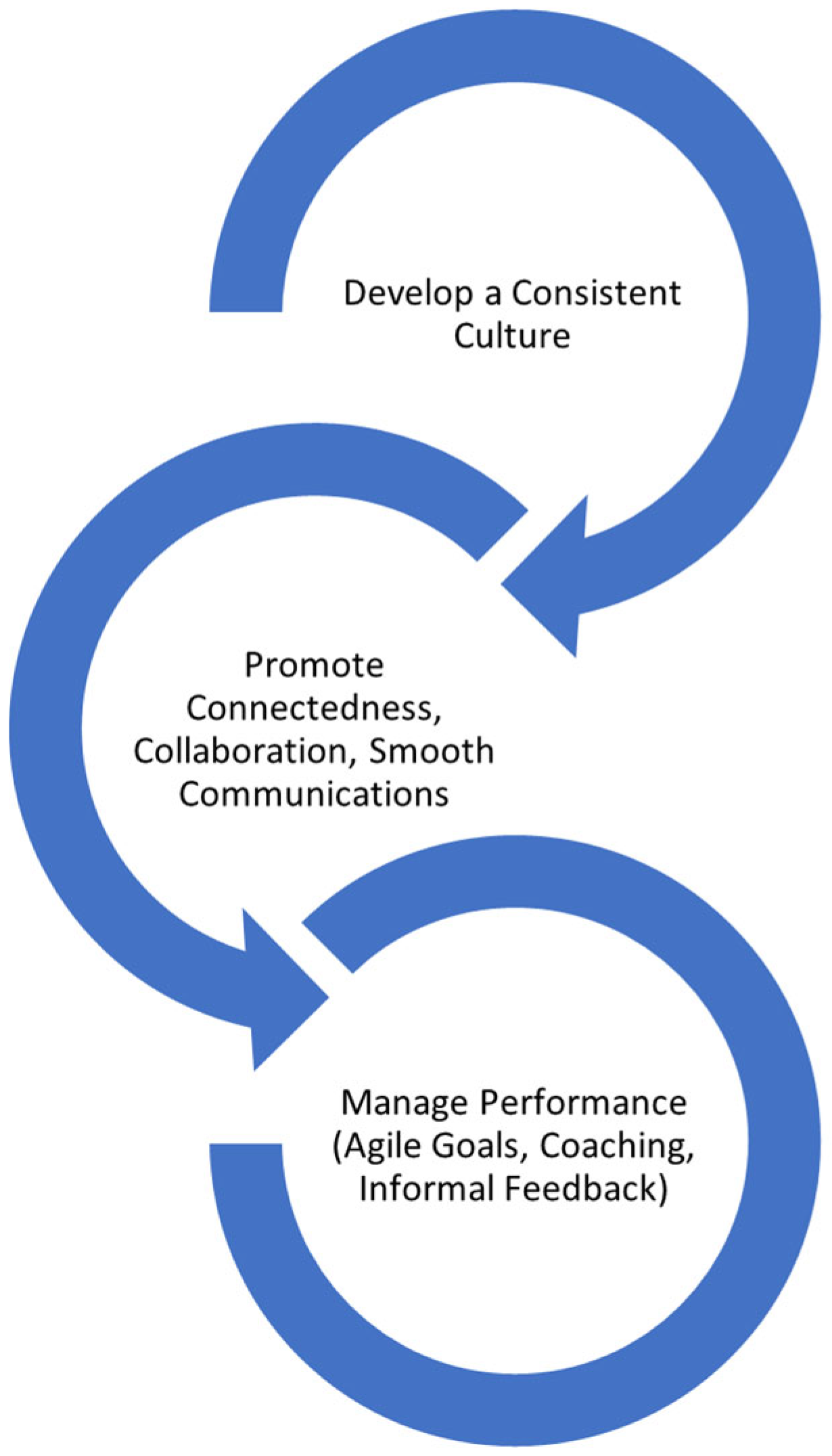
These challenges are now key management priorities: establishing a consistent company culture, fostering strong connections among employees both in and out of the office, and implementing effective performance management for all staff. This paper explores how organizations can sustain culture, connection, and performance in hybrid and remote settings. The next section discusses the long-term outlook for hybrid and remote work, followed by sections addressing organizational culture, onboarding new hires (both in person and virtually), and strategies to promote connectedness, collaboration, and seamless communication. The final sections explore performance management, including proximity bias, employee monitoring, and the role of artificial intelligence.
Figure 1 shows the conceptual framework.
The Future of Hybrid/Remote Work Arrangements
Working remotely during the pandemic marked a major shift from pre-pandemic norms. For many, it was not just a response to a specific event but an experience that reshaped workplace culture (
Gavett, 2025). Survey data show that about three-quarters of companies plan to support hybrid work, while only 19% say they will require employees to work in the office full-time. Workers want that flexibility because, when given the choice, nearly 90% prefer to work remotely at least part-time. Nearly 75% say the main reason they go into the office is to interact with colleagues (
Agovino, 2023b). They want to connect with them in comfortable environments that include spaces to relax, options for healthy food, and outdoor areas (
Gurchiek, 2024).
To provide perspective on hybrid and remote work, consider that many jobs cannot be done remotely. These include roles that require hands-on work with specialized equipment, direct contact with customers or clients, physical labor, or on-site work. Examples include service and hospitality roles such as restaurant, retail, and hotel housekeeping; manufacturing and skilled trades like assembly-line work and plumbing; healthcare and direct-care roles, including medical professionals and caregivers; public safety and emergency services such as police and firefighters; and delivery services for packages and food.
For jobs that can be done through hybrid or remote work setups, including technology, marketing, finance, creative fields, and administrative roles, these arrangements are likely to continue, though not at levels seen during the pandemic. According to McKinsey’s research across eight countries, 800 jobs, and 2000 tasks, 20 to 25 percent of workforces in advanced economies could work from home three to five days a week. That’s four to five times more remote work than before the pandemic (
McKinsey & Co., 2023). At Microsoft, 52% of employees want to work in a hybrid or remote role for the rest of their careers (
Agovino, 2023b).
If employees are not in the office, they might also not be working from home. “Hybrid/remote” could mean working from home, from an office hub, or on the go. Companies like IWG offer various workspace solutions that provide greater flexibility and meet the needs of individuals, teams, and even entire organizations, including workspaces, co-working spaces, and meeting rooms (
IWG, 2025).
It is not just high-wage, white-collar workers who seek hybrid flexibility. Almost 50 percent of midlevel and senior executives prefer hybrid work arrangements (
Chaker, 2023;
Francis, 2025). Lower-wage roles in customer service, data entry, tech support, and call centers have also shifted to remote work as employers have realized that customer support agents and freight dispatchers, for example, can be just as effective and productive working from home, if not more. These productivity gains, along with better recruitment and retention, lower absenteeism, and reduced real estate costs, have encouraged companies to keep offering remote options.
Frontline workers, such as those in manufacturing and healthcare, are also seeking flexibility in what they work on, who they work with, and their work hours. They want control and stability in their schedules, along with paid leave (
McRae et al., 2023). To find out which flexibility options employers offer their on-site employees, and which would motivate them to change jobs, Gallup surveyed 5700 U.S. workers across industries like manufacturing, transportation, healthcare, education, and services. They found that the most common options—such as relaxed dress codes, flexible start and end times, and choosing which days to work—were not the ones employees valued most. Instead, they prioritized more paid time off, a four-day workweek, and remote or work-from-home options (
Harter, 2023).
2. Organizational Culture and Hybrid/Remote Work
After reviewing what organizational culture is and how it is communicated, this section examines ways to foster culture in hybrid/remote environments and mechanisms to promote cultural alignment with AI. Organizational culture defines the work environment employees experience daily and influences how leaders make employment decisions (
Laker et al., 2025).
Tetenbaum (
1999) described it as the DNA of an organization—unseen but crucial in shaping the character of the workplace. Employees can describe organizational culture. They know it is rooted in their organization’s history and traditions and that it serves as a source of collective identity and commitment to the organization (
Schneider et al., 2017). In essence, culture represents how managers’ and employees’ values and actions create a distinctive business environment (
Warrick, 2017). It is embedded in and communicated through mechanisms such as the following (
Schneider et al., 2013):
Formal statements of organizational philosophy and materials used for recruitment, selection, and socialization of new employees.
Promotion criteria.
Stories, legends, and myths about key people and events.
What leaders pay attention to, measure, and control.
Implicit and possibly unconscious criteria that leaders use to determine who fits key slots in the organization.
Strong organizational cultures help employees understand the ‘unwritten rules’ and expected behaviors. They feel they belong and know what is required to perform well and advance. That is what we mean when we say culture is a source of collective identity. In an office-based environment, leaders and employees live their cultures daily. However, when some employees work remotely or on flexible schedules, team members do not interact regularly, which can lead to communication breakdowns. The results include missed deadlines and unclear expectations about responsibilities and tasks. Performance and productivity decline.
Interestingly, scholars note that none of the methods for developing and maintaining organizational culture address physical space. Accordingly, prior research suggests little reason to believe that in-person interactions are necessary for building and sustaining organizational culture (
Gibson et al., 2023). Rather than viewing hybrid work as a disruption to the cultural experience, leaders should see it as an opportunity to foster culture in new ways.
For example, among hybrid or remote workers, technology—such as email, social media, meeting platforms, instant messaging, and file storage—is vital for maintaining a cohesive organizational culture. In-person interactions are also important but should be used intentionally and selectively—such as during team formation, project kick-offs, quarterly meetings, events, or organizational changes like mergers or acquisitions. Making sure employees spend time together, discuss expectations, plan, and get to know each other is essential for building trust and reinforcing the organizational culture. To prevent the development of separate cultures based on work location, focus on clearly defining what the culture is or should be. Then, use the many available tools to support that culture and its dynamics (
Gibson et al., 2023).
Many organizations are adopting artificial intelligence to automate routine tasks, improve decision-making, and foster innovation. Yet, AI is not a plug-and-play technology; it brings significant changes to organizational culture and work practices. Organizations with cultures of innovation and openness are more likely to adopt AI successfully, while those with rigid hierarchical structures may struggle (
Fountaine et al., 2021).
To promote cultural alignment, research suggests the following (
Murire, 2024): integrate AI-adoption initiatives into broader cultural programs that focus on innovation, collaboration, and continuous learning. Encourage a mindset shift that views AI as an opportunity for growth and progress rather than a threat to job security. As “culture carriers”, leaders play a vital role in communicating this vision and reinforcing it through their actions and communication strategies. AI-based coaching of leaders can improve those capabilities (
Lange & Parra-Moyano, 2025). Leaders are also responsible for creating the right environment for failure by empowering people to experiment to uncover how AI can fit into their workflows (
Spataro, 2023).
To overcome obstacles to cultural change, help employees understand why AI is being implemented and what its potential benefits are. To achieve this, involve stakeholders at all levels, gather feedback, and address concerns early on. Invest in continuous learning and upskilling programs and integrate learning into the daily flow of business. The goal is to create a culture that values curiosity, accepts failure, and encourages ongoing learning (
Spataro, 2023). Lastly, monitor and evaluate AI’s impact on organizational culture (
Fountaine et al., 2021;
Murire, 2024). What about new hires? How do they learn about their organization’s culture? The next section addresses this question.
New-Hire Onboarding
Leading organizations ensure new hires experience a positive first impression as they transition from outsiders to insiders (
Lewis, 2021). After examining the traditional onboarding process, this section will explore pre-boarding and virtual onboarding.
There are three main goals for every new hire’s onboarding process: (1) to excite them about their first day, whether they’re in the office or working remotely; (2) to prepare them for success and reduce the time it takes for them to become productive in their new roles; and (3) to emphasize early experiences with the organization and prioritize it over logistics and paperwork. Successful onboarding programs can pay off significantly, with up to 50 percent higher retention among new hires and 62 percent higher productivity (
Sibisi & Kappers, 2022). To start, here are six key questions to answer (
Maurer, 2022):
How long will the program last (considering that it typically takes 12 months for new employees to reach their full performance potential)?
At the end of the first day, what impression do you want new hires to walk away with?
What do new employees need to know about the culture and work environment?
What roles will HR, direct managers, and co-workers play in the process?
What kinds of goals do you want to set for new employees (e.g., regarding their compliance with company policies, or performance expectations linked to concrete, time-bound measures)?
How will you gather feedback and measure the program’s success?
Answers to these questions will assist HR and senior management in developing a plan to help new employees quickly understand company policies and workflows while becoming fully aware of the organization’s culture.
Before new hires start, however, some organizations practice pre-boarding. New hires access an onboarding portal to watch a welcome video, complete initial documentation online, and preview the onboarding program and their first-day schedule. All relevant stakeholders are notified about the new hire’s impending arrival. For example, commercial real estate platform Buildout, Inc., uses Greenhouse Welcome software to create a resource hub filled with information about the company, its brand, and its mission (
Lewis, 2021). Buildout sends links to the Welcome tool to all new hires well before their first day. According to the company’s CEO, this helps keep them engaged with the company, excited about the job, and makes them continue to feel confident in their decision to join. Here are some additional features of the Welcome tool that Buildout uses.
New employees receive information about and photos of the leaders for the teams they are joining. The information includes who each leader is, what they do, and what their interests are. This helps them learn some interesting, fun facts about the leadership team and their manager. Buildout also creats a buddy program. During pre-boarding, new employees get to meet their buddy, who will help guide them through their first weeks and months on the job. Greenhouse Welcome software includes automated tasks and reminders to help new hires understand their roles and responsibilities, such as sending a reminder to every new employee several weeks into their job to give feedback about their first few weeks. Other vendors, such as Stoke Talent, also offer tools to manage workflows for non-payroll workers, including freelancers, contractors, consultants, and agencies.
Virtual onboarding for a remote workforce requires special considerations. Here are four key issues to consider (
Maurer, 2022):
Preparation is paramount—In addition to pre-boarding, ensure that new hires have the tools and technology they need immediately. Laptops, software, and access to the right platforms and databases are critical to employees’ effectiveness and to their belief that their new employers are prepared for them and committed to their success.
Manager engagement with remote new hires is critical because their supervisors are their lifelines to the company. The best managers are present, accessible, and highly responsive. They create personalized onboarding journeys, have one-on-ones more often, and prioritize replying swiftly to their remote team members.
Culture is critical—connecting to peers and tapping into their natural storytelling by sharing examples is a great way to identify unwritten rules, the essence of company culture.
Build social capital—networks of people who can support a new hire’s learning and growth. Pair a buddy with each new hire, an experienced employee who wants to help them get excited about working there. Schedule weekly meetings, but allow each pair to develop its own timetable.
The final step is to create a dashboard to monitor onboarding goal achievement and identify areas for improvement over time. Because alternative forms of hybrid and remote work will continue, virtual onboarding will become more common, making careful attention to the four issues above even more critical.
As we noted earlier, the second top challenge facing organizations with a mix of in-office and remote workers is enhancing connectedness. The following section addresses that topic.
3. Enabling Connectedness, Collaboration, and Smooth Communications
This section reviews research on the lack of social connections, strategies to foster connectedness, and how technology can help build relationships and strengthen team dynamics. Social connections—the structure, function, and quality of our relationships with others—are a vital yet often underestimated factor influencing individual and community health, safety, resilience, and prosperity. A lack of social connections can have far-reaching effects on mental health, as loneliness has been linked to increased risks of dementia (50%), stroke (32%), cardiovascular disease (29%), and premature death (26%) (
U.S. Surgeon General, 2023). Social isolation is not only a problem for older adults who have lost spouses, family, or friends; people of any age can experience loneliness even when surrounded by others. Although the highest levels of social isolation occur among older adults, young adults are nearly twice as likely to report feeling lonely as those aged 65 and older. In fact, the rate of loneliness among young adults has been rising every year from 1976 to 2019 (
U.S. Surgeon General, 2023).
In recent years, the bonds holding a workforce together have weakened. Fully 38% of all workers surveyed report feeling lonely at work at least monthly, although survey data show no significant differences in loneliness between on-site and remote workers. Meanwhile, remote and hybrid employees are much more likely than their on-site counterparts to report enjoying video meetings (
Gurchiek, 2023). A study by Airspeed, a social platform company, of 800 C-suite executives and 800 remote or hybrid workers found that two out of three executives believe employees leave their jobs because of a lack of social connections. That is also the leading reason employees at remote or hybrid organizations cite for quitting their jobs (
Miller, 2022). In the same survey, 90% of executives say their remote teams lack culture and connection, and more than 70% of remote workers feel they do not socialize enough.
Connectedness opposes loneliness. When people feel socially connected, they experience psychological safety, authenticity, and trusted allies they can confide in or seek help from. Those conditions create opportunities for growth. Among those with close friends at work, 76% say they are more likely to stay with their employer, 80% have a stronger sense of belonging, and 86% say they are more satisfied with their jobs than those without close friends (
Maurer, 2025).
Technology has clearly changed how people connect, with employees often not interacting physically before virtual meetings and disappearing afterward. However, technology can also help build relationships, especially for remote and hybrid workers. Thus, SHRM research (
Gurchiek, 2023) found the following:
75% of workers have used technology, such as video conferencing and instant messaging, to collaborate and connect with co-workers.
82% reported that their experience was positive.
50% of workers say they use tools such as Slack or Teams channels more often than they did pre-pandemic.
How should leaders build bridges across geographic and generational barriers to address the lack of social connections? Based on their research,
McRae et al. (
2023) advise employers to do three things: offer employees choice and autonomy, provide a clear structure and purpose, and create a sense of levity and fun. For example, to promote choice and autonomy, employees might complete a connection-preference questionnaire that informs managers about how they prefer to engage with their coworkers—informally through happy hours or scheduled lunch-and-learn events. To enable employees to participate more freely, set clear norms for interactions—such as which meetings require participants to be on video and which do not. To speed up team problem-solving, some companies schedule regular “standing” meetings, where team members post issues in advance on collaboration platforms like Slack or Microsoft Teams and are encouraged to resolve what they can before meetings (
Cross et al., 2021).
Alternatively, teams can co-develop their own norms for interaction and communication, creating a safer environment for genuine connections. This addresses Microsoft’s finding that, although remote work can increase job satisfaction, it can also make employees feel “socially isolated, guilty, and trying to overcompensate” (
Hirsch, 2023). One survey of nearly 3500 employees reveals that staff members are five times more likely to be on high-performing teams and 12 times more likely to feel connected with their colleagues if their organizations actively help employees build connections (
McRae et al., 2023).
With hybrid and remote work arrangements here to stay and continually evolving, fostering connectedness, collaboration, and effective communication remains an ongoing challenge. To strengthen team dynamics, for example, in-person interactions should include happy hours, team lunches, and team-building events that promote bonding and social connection (
Maurer, 2025). Strong workplace cultures and active social and work connections among employees yield significant benefits. They increase employee engagement, enhance well-being, improve retention, and support high performance levels. However, in workplaces where managers and employees rarely meet face-to-face, a common question from managers is, “How can I manage them if I can’t see them?” The following section addresses that challenging issue.
4. Managing Performance in a Hybrid/Remote Work Environment
After a brief overview of the current state of performance management, this section explores proximity bias, its potential impact on careers, and strategies to reduce its effects. It also discusses the effects of employee monitoring, how to use it effectively, and safeguards for employee privacy.
The current state of performance management is discouraging, and remote or hybrid work arrangements make it worse (
Cascio, 2025a). Consider the results of a survey of 837 North American employers by consulting firm WTW (
Agovino, 2023a). Although 93% of employers considered “driving organizational performance” a key goal for performance management, only 44% said their programs were achieving that goal. While 72% cited “supporting the career development of employees” as a primary objective, just 31% reported that their programs met this target. Fewer than half believe their managers effectively review the performance of direct reports. Just one in three thinks their employees feel performance is evaluated fairly, and only one in six said they have modified their approach to performance management to fit remote and hybrid work arrangements.
Unfortunately, many managers view the concept of performance management as too narrow and highly specific. They often equate it with performance appraisal, the rating process they typically conduct once or twice a year, sometimes quarterly, to identify and discuss the strengths and weaknesses of individuals or work teams related to their jobs. In reality, performance management is a continuous process that requires a willingness and commitment to improve performance at the individual or team level every day. Think of it as a kind of compass that shows both an employee’s current direction and their desired direction. Like a compass, a manager’s role is to show where that person is now and help focus efforts on reaching the desired goal (
Cascio, 2025b).
4.1. Proximity Bias
In remote/hybrid working environments, however, managers do not see their employees in person each day, as they do with those who work in the office. This poses a unique problem known as proximity bias—a tendency to favor in-office employees. Conversely, remote/hybrid workers often miss out on feedback.
Hirsch (
2022) offers some common examples:
Assessing the work of on-site employees more highly than remote employees, regardless of objective or subjective performance metrics;
Offering on-site employees the most attractive projects, assignments, or developmental opportunities;
Failing to include remote employees in essential meetings or not actively encouraging them to contribute.
Proximity bias might harm careers in subtle ways. Despite the appeal of remote or hybrid work, evidence suggests that the career penalty may be greatest for women, young people, and people of color, who often lack the professional networks that in-office work can help develop. Yet, many surveys show that these same groups of workers also value flexible work arrangements the most and are least likely to return to the office voluntarily (
Goldberg & Casselman, 2023). Unsurprisingly, the top concern of more than four in ten executives in a survey of 10,000 white-collar workers by Future Forum was potential inequities between remote and in-office employees (
Gurchiek, 2022).
What are the best ways to avoid proximity bias? Rather than ignore it or bring everyone back to the office, build guidelines and operating models that address it systematically. Help leaders develop the skills to manage remote and hybrid workers well. These include scheduling frequent, informal check-ins instead of formal once-yearly reviews and engaging in more open, two-way conversations with their direct reports. The purpose is to deepen their understanding of the challenges employees face and the resources they need to accomplish work (
Cascio, 2025a;
Hirsch, 2022).
Manager training should promote regular check-ins with all employees, not just those seen face-to-face. The most crucial thing managers can do is to be very clear about their expectations for employees and the teams they manage. Clarify priorities, key deliverables, quality standards, and deadlines. Then, ensure employees have all the resources they need to produce high-quality work (
Bergeron, 2022). This may seem obvious, but it is not, especially given a Gallup study showing that only about half of workers know what is expected of them at work. That percentage is likely even higher in remote or hybrid environments (
Zielinski, 2023).
As noted earlier, managers should check in informally with all of their direct reports—at least once or twice a week. The purpose is to keep them updated on the latest developments that may affect them, understand team workflows, and address any issues they face in a timely manner. Check-ins are about building connections with employees and gaining their trust. The manager’s role is to address interpersonal and work barriers, provide the support employees need, and coach them to be most engaged and productive. This may require some managers to shift from managing time, activity, or physical presence to managing results and outcomes (
Krishnamoorthy, 2022). Finally, recognize and reward employees who meet expectations, as recognition costs little yet offers powerful benefits (
Zheliabovskii, 2025). Clear expectations, regular check-ins with all employees, removing obstacles, managing based on results, and recognizing those who meet expectations are timeless principles.
4.2. Monitoring Employees
More than half of workers in management, operational, and financial roles now spend at least some time working from home (
Cambon & Mollica, 2023). Some employers are turning to technology to supervise remote employees, using software called “tattleware”, marketed as productivity-measurement tools (
Murty & Karanth, 2022). Sneek, for example, takes webcam photos of employees as frequently as every minute and uploads them for senior leaders to review. Companies increasingly seek evidence—including screenshots, login times, and keystroke data—to ensure their workforces are productive (
Laker et al., 2020). Monitoring systems can also detect when an employee is performing tasks unrelated to their job, such as browsing the web for restaurant recommendations or weekend plans.
Employers cite benefits, such as increased accountability, process improvements (based on robust analytics), workload management (identifying when an employee is overworked and may be on the verge of burnout), and the protection of sensitive business information. If the goal is to protect confidential data and trade secrets, however, there are alternatives, such as implementing security controls that limit employees’ ability to save, copy, or print sensitive data (
Nagele-Piazza, 2023).
Monitoring also imposes costs on employees, which should be acknowledged (
Kantor & Sundaram, 2022;
Ovide, 2022;
Ziegler, 2022). It can lead to job dissatisfaction and counterproductive work behaviors, including decreased commitment, trust, engagement, and fewer innovative work suggestions. Additionally, it may lead to perceptions of unfairness and invasion of privacy, as well as increased demands and stress—key factors that can contribute to burnout (
Bakker et al., 2014;
Blumenfeld et al., 2020;
Jensen & Raver, 2012;
Kensbock & Stöckmann, 2021). A comprehensive meta-analysis of the effects of electronic monitoring across 94 independent samples with 23,461 workers supports these findings and shows no evidence that monitoring improves job performance. Instead, it correlates with increased worker stress, regardless of monitoring characteristics. However, organizations that conduct monitoring more transparently and less invasively can expect more positive attitudes from employees (
Ravid et al., 2023). As younger generations prefer results-oriented management and their ranks grow in workplaces worldwide, the use of “tattleware” is likely to decline significantly in the future.
One alternative is to use anonymized and aggregated team data to protect individual privacy and to provide answers to questions such as the following:
Is inefficient process design causing the team to do the same work in multiple ways?
Where does the team need training/mentoring to serve customers better?
Is a bad user interface or user experience frustrating and slowing the team’s response to customers?
How are technology problems slowing down my team? Is the team equipped with adequate tools for collaboration or problem-solving (
Murty & Karanth, 2022)?
Data collected in this way can help build a work graph, or a digital map of how teams experience work, to identify where processes are broken and improve them.
4.3. More on Performance Management and Performance Assessment in Remote/Hybrid Workplaces
Currently, organizations are focusing less on evaluation and more on agile goal setting, coaching, and feedback to help employees enhance their performance. Performance management is challenging because it requires daily, not just annual, attention. It starts when a manager clearly communicates the organization’s mission and priorities and then demonstrates to employees how their work contributes to the overall mission. Providing a clear “line of sight” connects employees’ work to organizational success, giving work more meaning and purpose.
The overall process involves three key elements: (1) define performance, (2) facilitate performance, and (3) encourage performance (
Cascio, 2025b). Here is a brief explanation of each one.
Define Performance—If you are very clear about your expectations with each of your direct reports, they will know exactly what is expected of them and stay focused on meeting those expectations. Pay close attention to three key elements: goals, measures, and assessment. Set specific, challenging goals for each of your team members, as this clarifies exactly what you expect and encourages high performance. Focus on tangible measures, like the average response time to a customer’s inquiry, and track progress toward each goal. The result is a “scorecard” that will capture your direct reports’ attention. The next step is to facilitate performance.
Facilitate Performance—A key duty of every manager is to remove barriers that hinder successful performance, such as outdated or poorly maintained equipment, delays in receiving supplies, and inefficient work practices. Employees are aware of these issues and are willing to identify them—if you ask for their input. It is then your responsibility to remove these obstacles. Afterward, the next step is to provide adequate resources—money, equipment, or staff—because if employees lack the tools needed to achieve the challenging goals they have set, they will become frustrated and disillusioned. Conversely, employees truly value it if you supply everything they need to perform well, and they will respond positively.
Encourage Performance—All of this leads to the final element of a solid performance management system, namely, encourage performance by doing three more things well: (1) Provide rewards that employees really care about, like pay, benefits, free time, merchandise, or special privileges. (2) Provide rewards in a timely fashion, soon after your people achieve their goals. (3) Distribute rewards fairly, explaining clearly why and how you rewarded your people.
In summary, managing for maximum performance requires doing three things well: defining performance, facilitating performance, and encouraging performance. Remember: like a compass, the manager’s role is to provide orientation, direction, and feedback. With respect to feedback, research consistently shows that sitting down once or twice a year for a perfunctory feedback review is not effective (
Aguinis, 2023). Rather, informal, continuous feedback is the most valuable driver of effective performance management and positive job attitudes. When provided immediately after good or poor performance, it helps employees make real-time changes to their behavior and to perform better. The key for managers is to seize “teachable moments” to coach employees. After all, as
Tristram (
1996) noted in Fast Company, “coaching isn’t therapy. It’s product development with you as the product”.
4.4. Performance Reviews in Remote and Hybrid Environments
This section explains how organizations adapt traditional performance management practices for these settings and the potential role of AI. Eventually, organizations must make decisions about pay, promotions, incentives, and sometimes terminations (whether for cause or not, such as layoffs). These decisions should be based on performance. Remote and hybrid workplaces require innovative methods for assessing performance, as it is vital that all employees are judged fairly on merit. Traditional management practices such as goal setting, feedback, and regular progress reports remain essential. What changes is how organizations implement these principles (
Behson, 2023). Those who manage remote and hybrid employee evaluations successfully do three things: first, they define what good performance looks like in terms of company values, customer satisfaction, core tasks, and project completion; second, they incorporate regular goal-setting and feedback sessions; and third, they promote collaboration and team building by sharing performance assessment duties across the workforce.
Is there a role for AI in the performance management process? Evidence suggests a cautious ‘yes’ for certain aspects of performance management and for large organizations with access to significant amounts of data (
Varma et al., 2024). For example, AI can be very effective in helping establish specific goals based on past performance and company requirements. However, whether the goals set are achievable or relevant is something that needs to be thoroughly discussed between the supervisor and the employee.
What about performance feedback? AI can provide real-time feedback to employees, rather than making them wait until the end of the quarter or performance period. It can analyze past performance and suggest areas for improvement for both parties to consider before the feedback session. An additional potential benefit is that data-driven, AI-generated feedback can help reduce subjectivity and bias. However, AI tools cannot replace the necessary face-to-face dialogue between managers and their direct reports.
AI-powered virtual coaching platforms can assist in simulating feedback scenarios and providing managers with interactive coaching sessions. Additionally, PIPS (performance improvement plans) can be easily generated by AI, including relevant data such as past performance, projected performance during the review period, and specific steps to enhance future performance.
To use AI effectively in performance management, safeguards to ensure accuracy and prevent bias are essential. Start by training all stakeholders, especially supervisors and their direct reports, since their support is crucial. Provide human oversight and conduct regular audits to assess accuracy. As
Varma et al. (
2024) wisely warned, incorporating technology into HR processes does not automatically guarantee objectivity.
5. Summary and Conclusions
Working remotely during the pandemic reshaped workplace culture. As a result, the demand for greater flexibility and remote or hybrid work arrangements among workers and managers is here to stay. The main challenge leaders face in adapting to these new setups is maintaining a consistent organizational culture, underscoring how the values and actions of managers and employees shape the business environment. Strong organizational cultures help employees understand “unwritten rules” and expected behaviors.
Based on their review of prior research,
Gibson et al. (
2023) concluded that in-person interactions are not necessary to build and sustain organizational culture. Yet, we know little about how organizations create consistent cultures when some employees are in the office while others are not. This is a pressing research question.
Gibson et al. (
2023) advise senior leaders to focus on what the culture is or should be, then use the many available tools to support that culture and its dynamics.
For example, based on
Sibisi and Kappers (
2022), take proactive steps to create a strong first impression on new hires as they move from outsiders to insiders. Create excitement about their first day, whether it is in or out of the office. Help them become fully productive in their new roles as soon as possible. Especially with a remote or hybrid workforce, managers must engage with new hires because they are new hires’ lifelines to the company. They must be present, accessible, and highly responsive. The best ones create personalized onboarding experiences and hold regular one-on-one meetings.
Maintaining connections with colleagues and managers remains a major challenge. Social connection—the structure, function, and quality of our relationships with others—is a vital but often overlooked aspect of individual well-being. The lack of such connections is a primary reason why employees in remote or hybrid workplaces leave their jobs (
Maurer, 2025). Since these work arrangements are likely to continue, fostering connectedness, collaboration, and effective communication will remain ongoing challenges. Looking ahead, one of the most valuable skills managers can develop is mastering effective virtual meetings, as they will continue to be essential channels for enhancing collaboration and connection (
Frisch & Greene, 2021). Much current advice is experience-based (
Rathore, 2022), rather than the result of experimental research showing what works best. Another crucial skill is learning how to manage employees when you cannot see them.
Proximity bias presents a specific challenge with remote and hybrid workers, yet there is minimal empirical (field or laboratory) research on this issue. It occurs when these workers miss out on feedback because they are not physically present in the office. To address this, available evidence suggests developing guidelines and operating models that systematically tackle the problem. Managers should schedule regular, informal check-ins with all employees, not just those they see in person, to promote more open, two-way communication. Additionally, managers need to be very clear about their expectations for their staff and teams. Avoid relying on technology to monitor employees, as evidence indicates it can lead to decreased commitment, trust, and engagement, as well as perceptions of unfairness and privacy invasions, along with increased demands and stress.
Effective approaches to performance management focus less on evaluation and more on agile goal setting, coaching, and feedback. To do this well, define, facilitate, and promote performance, because like a compass, the manager’s role is to provide orientation, direction, and feedback. Finally, recognize individual and team accomplishments because everyone wants to know that their work is appreciated and that they are part of something bigger than themselves.
As AI becomes more integrated into performance management, key research questions include whether AI truly streamlines reviews, reduces bias, improves feedback quality, and how outcomes differ across cultures. Ultimately, sustaining organizational success in a hybrid era requires leaders to integrate culture, connection, and performance management into a cohesive system of trust and accountability.