1. Introduction
The development of employee skills and capabilities has become a strategic priority for organizations competing in increasingly dynamic and knowledge-driven environments. Across industries, employee training is essential for improving productivity, strengthening competitiveness, and ensuring organizational sustainability (
Iddrisu & Adam, 2024). In manufacturing settings, where technological change, operational complexity, and quality standards are rapidly evolving, effective training systems are especially critical. Employee training refers to programs that provide workers with information, new skills, or professional development opportunities (
Daniel, 2018;
Narasimhan & Ramanarayanan, 2014). Among various training approaches, on-the-job training (OJT) stands out for its practical relevance, immediate applicability, and cost-effectiveness.
Empirical studies have repeatedly shown that OJT enhances various aspects of employee performance, such as task proficiency, problem-solving ability, and adaptability, by fostering both cognitive and behavioral learning outcomes (
Ellinger & Ellinger, 2014;
Garavan et al., 2020;
Salas et al., 2012). However, its success is not automatic; it depends on the interaction between training characteristics (design, delivery style, needs assessment, evaluation) and individual characteristics (prior knowledge, self-efficacy, motivation to learn, motivation to transfer) (
Blume et al., 2010;
Colquitt et al., 2000;
Grossman & Salas, 2011). When training programs are well designed, practically oriented, and supported by opportunities for feedback and reflection, employees are more likely to integrate learned skills into their daily tasks, thereby achieving better performance outcomes (
Kirkpatrick & Kirkpatrick, 2006;
Noe, 2016). Unlike formal classroom training, OJT enables experiential learning, allowing trainees to immediately apply acquired knowledge to their tasks, thus enhancing both learning transfer and performance improvement (
Aguinis & Kraiger, 2009;
Jacobs, 2014;
Salas et al., 2012).
In developing economies such as Myanmar, the importance of OJT is amplified. The manufacturing sector, which is experiencing rapid industrial expansion, often lacks formal training infrastructure and relies heavily on OJT as the main vehicle for employee skill development (
Iddrisu & Adam, 2024). Despite this reliance, empirical research on how OJT translates into measurable performance outcomes for employees remains limited. Existing studies have primarily focused on general training practices rather than examining the mechanisms through which OJT enhances individual performance. Moreover, there has been little consideration of psychological and instructional perspectives that explain how and why OJT works in such contexts (
Akdere & Egan, 2020;
Garavan et al., 2020).
From a theoretical perspective, several frameworks explain why OJT contributes to employee performance. Human capital theory (
Becker, 1964) views training as an investment that enhances employees’ productive capacity, improving their efficiency and adaptability. Similarly, social exchange theory (
Blau, 1986) suggests that employees reciprocate an organization’s investment in their development by increasing their commitment and performance. Furthermore, transfer of training theory (
Baldwin & Ford, 1988) emphasizes that the effectiveness of training depends on alignment between training design, trainee characteristics, and the work environment, while self-determination theory (
Ryan & Deci, 2000) and social cognitive theory (
Bandura, 1997) highlight intrinsic motivation and self-efficacy as essential psychological drivers of performance improvement.
In developing economies, these dynamics are particularly complex. Myanmar’s manufacturing sector, characterized by rapid industrialization and growing foreign investment, faces persistent challenges in workforce development, including limited access to formal training systems, skill shortages, and uneven HR infrastructure. Existing studies in this field do not consider the manufacturing sector in Myanmar. Despite evidence of OJT’s importance, empirical studies seldom examine how OJT influences performance through psychological and instructional factors in manufacturing in developing countries such as Myanmar. However, the reinforcement of technology-driven learning, such as simulated workplace environments, by manufacturing industries could improve employee skill development in contexts where formal training institutions are limited. To address this gap, this study investigates the effects of OJT on employee performance (EP) in Myanmar’s manufacturing sector, emphasizing the mediating role of individual characteristics and the moderating role of training characteristics.
2. Theoretical Background and Conceptual Framework
2.1. On-the-Job Training and Performance
On-the-job training (OJT) is one of the most widely implemented forms of employee development, particularly valued for its direct connection to job performance. OJT involves structured learning activities conducted within the workplace, allowing employees to acquire and apply new knowledge, skills, and behaviors in real-time work settings (
Aguinis & Kraiger, 2009;
Jacobs, 2014). This experiential approach strengthens the connection between learning and task execution, enabling employees to enhance their proficiency, efficiency, and problem-solving capabilities (
Noe et al., 2010;
Salas et al., 2012).
According to human capital theory (
Becker, 1964), training is an investment that improves the productive capacity of employees by developing their skills and competencies. Employees who receive effective OJT not only perform their tasks more effectively but also demonstrate higher levels of engagement and adaptability (
Garavan et al., 2020). Studies have shown that well-designed OJT programs significantly enhance job performance and reduce skill gaps, especially in industries that require practical and technical expertise (
Burke & Hutchins, 2007;
Ellinger & Ellinger, 2014).
OJT also supports learning retention and motivation through immediate application and feedback. Unlike classroom training, which often separates learning from the work environment, OJT situates learning in the context in which employee performance occurs, leading to stronger behavioral transfer (
Blume et al., 2010;
Fegade & Sharma, 2023). Consequently, OJT serves as a critical mechanism for translating theoretical learning into tangible improvements in employee performance across the manufacturing, service, and industrial sectors (
Daniel, 2018;
Garavan et al., 2020).
Despite its proven effectiveness, OJT outcomes depend on several key factors. These include the structure and quality of the training design, the delivery method, the identification of actual learning needs, and the evaluation of training outcomes (
Kirkpatrick & Kirkpatrick, 2006;
Noe, 2016). Furthermore, the individual learner’s psychological attributes, such as self-efficacy, motivation to learn, and prior experience, play an equally essential role in determining how effectively OJT contributes to employee performance (
Colquitt et al., 2000;
Grossman & Salas, 2011). Therefore, understanding both the training process and individual learning factors is critical for maximizing the effectiveness of OJT in workplace contexts.
Table 1 presents examples from the existing literature on training and development, which lack research on on-the-job training (OJT) and performance outcomes in developing countries such as Myanmar.
2.2. Conceptual Framework
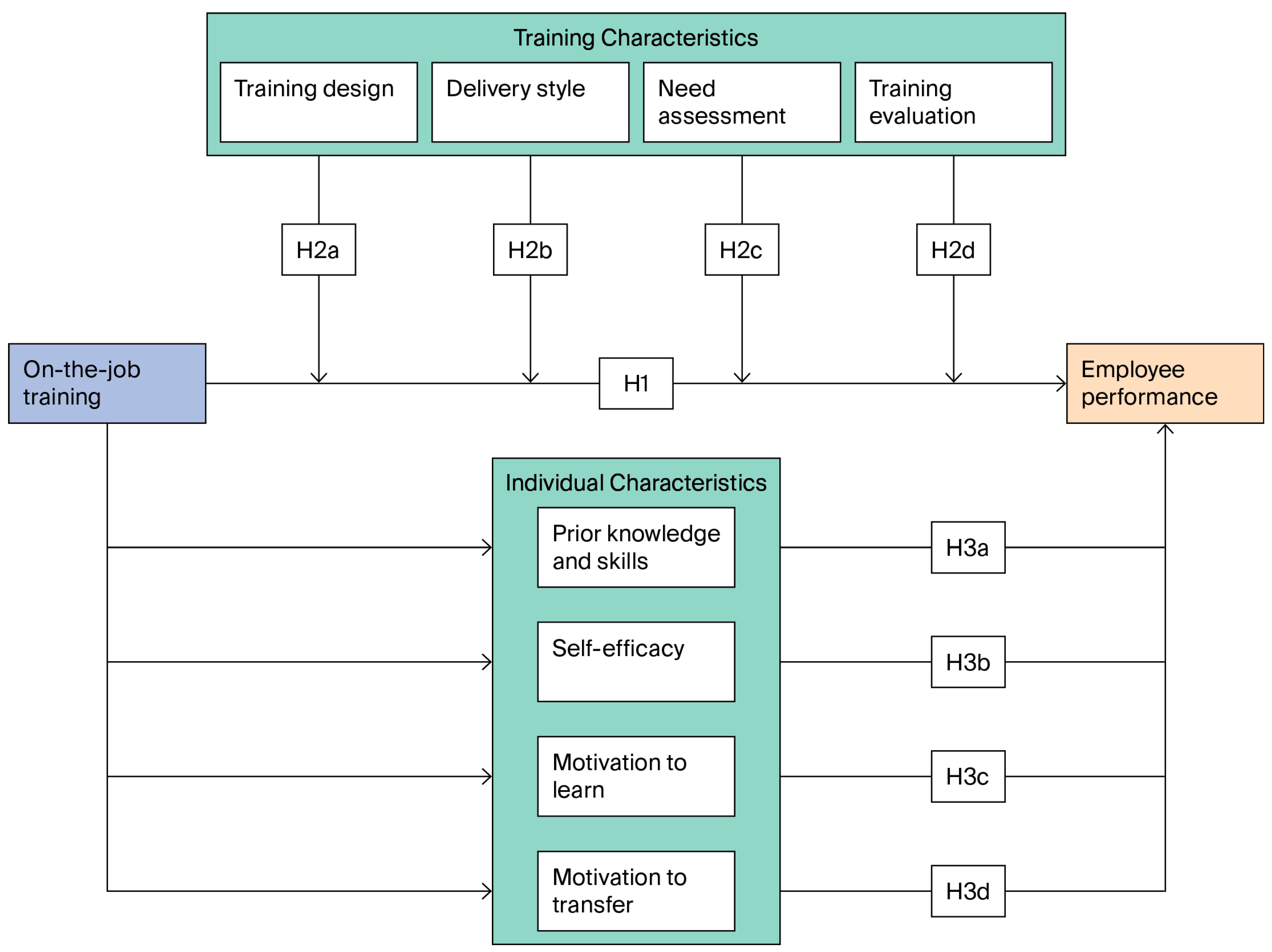
The conceptual framework of this study is based on the premise that OJT enhances EP via a combination of instructional and psychological mechanisms. As indicated in
Figure 1, the model postulates that OJT directly contributes to performance by enhancing job-related knowledge, operational skills, and task efficiency. However, OJT’s influence is further modified both by internal employee characteristics and the quality of the training environment. Four key individual characteristics, namely prior knowledge and skills, self-efficacy, motivation to learn, and motivation to transfer, function as mediators in explaining how employees internalize the content of training and then transform their experience into improved performance outcomes.
At the same time, four training characteristics, namely training design, delivery style, needs assessment, and training evaluation, serve as moderators influencing the strength of the OJT–performance relationship as a function of how well training is tailored to meet job requirements and learning needs. This integrative conceptualization reflects the realities of Myanmar’s manufacturing sector, where OJT is often the primary mode of capability development and where training outcomes vary depending on both organizational practices and employees’ preparedness to learn.
The proposed conceptual model is derived from various complementary theoretical traditions. Human capital theory (
Becker, 1964) supports the idea of a direct relationship between OJT and EP on the principle that education and training are forms of capital investment that increase employees’ productivity and long-term employability. Employees who obtain OJT acquire certain specific job-related competencies that increase their productive value to employers and enhance their performance efficiency. This perspective emphasizes that one factor driving individual productivity and career development is the acquisition of skills through OJT. This perspective is supported by findings in resource-constrained environments, where OJT is one of the more inexpensive methods of skill accumulation (
Garavan et al., 2020).
Social exchange theory (
Blau, 1986) explains the motivational aspect of training effectiveness. If employees feel their organization invests in their growth through meaningful OJT opportunities, they are likely to repay the organization with greater commitment, job involvement, and performance. OJT thus serves as both a capability-building mechanism and a relational exchange process, reinforcing mutual trust and engagement between employees and supervisors (
Akdere & Egan, 2020). This theoretical lens is particularly relevant in Myanmar, where supportive supervisory relationships and skill-based training are generally seen as signs of mutual trust and value within the workplace. Taken together, these theories justify the role of motivational mediators (motivation to learn and motivation to transfer) in translating supportive training experiences into performance outcomes.
The framework is further bolstered by the transfer of training theory (
Baldwin & Ford, 1988), which identifies three determinants of training transfer: training design, trainee characteristics, and the work environment. For this study, focus is placed on the first two determinants—training and individual characteristics—as they most directly impact employee-level performance outcomes. Proper training design ensures that content, delivery methods, and feedback mechanisms all align with actual job requirements (
Kirkpatrick & Kirkpatrick, 2006). Moreover, this theory serves as the foundation for including individual mediators and training characteristics as mechanisms to shape learning transfer. Studies continue to indicate that transfer is more effective when training is job-relevant, interactive, and systematically evaluated (
Blume et al., 2010;
Grossman & Salas, 2011). Similarly, trainees with higher motivation and self-efficacy exhibit greater persistence and engagement in applying new skills on the job (
Colquitt et al., 2000).
Moreover, the mediating pathways find psychological grounding in self-determination theory (
Ryan & Deci, 2000) and social cognitive theory (
Bandura, 1997). Self-determination theory explains how OJT enables employees to develop intrinsic motivation by fulfilling the needs for competence, autonomy, and relatedness. When OJT activities satisfy employees’ psychological needs, they become more interested and persistent in applying their newly learned skills. OJT environments that offer autonomy and supportive feedback can, thus, foster deeper learning and sustained performance improvement. Employees with high self-efficacy will face challenges confidently, thereby putting in more effort and persisting through difficulties to successfully apply their newly acquired skills. For OJT, self-efficacy may mediate the link between training and improved job performance, as indicated by
Abun et al. (
2021). According to social cognitive theory, self-efficacy is a major determinant of whether employees approach newly learned skills with confidence. These combined theoretical perspectives, therefore, provide a coherent and comprehensive explanation of why OJT improves performance, how individual psychological processes mediate this effect, and under what training conditions the benefits of OJT are most likely to be realized.
3. Hypothesis Development
3.1. Direct Effects of OJT
OJT provides employees with hands-on learning experiences that help them acquire knowledge and skills relevant to their specific job tasks. Through structured guidance, observation, and practice, employees develop greater task proficiency, adaptability, and confidence (
Burke & Hutchins, 2007;
Salas et al., 2012). Prior studies have consistently demonstrated a significant positive association between OJT and various dimensions of employee performance, including productivity, job satisfaction, and innovative behavior (
Ellinger & Ellinger, 2014;
Garavan et al., 2020).
The direct effect of OJT on EP can be explained by human capital theory, which posits that training increases the knowledge and capabilities of workers, thereby improving their performance and employability. Moreover, social exchange theory suggests that when employees perceive employers to have invested in their professional development, they reciprocate with higher motivation, effort, and performance. Therefore, we hypothesize the following:
H1. OJT has a significant positive effect on employee performance (EP).
3.2. Moderating Effects of Training Characteristics
The effectiveness of OJT depends substantially on the quality of training, design, and implementation. The transfer of training model (
Baldwin & Ford, 1988) highlights that well-designed training, characterized by clear objectives, relevant content, and structured evaluation, enhances learning transfer and performance. Similarly, the four-level evaluation model proposed by Kirkpatrick (
Kirkpatrick & Kirkpatrick, 2006) emphasizes that effective training should address learning needs, employ appropriate delivery methods, and include continuous feedback.
Training characteristics such as design, delivery style, needs assessment, and evaluation can strengthen or weaken the link between OJT and EP (
Aguinis & Kraiger, 2009;
Noe, 2016). For example, interactive and learner-centered delivery methods promote engagement, while a comprehensive needs assessment ensures alignment between training content and job requirements (
Grossman & Salas, 2011). Continuous evaluation provides feedback loops that reinforce learning and encourage skill application (
Fegade & Sharma, 2023).
Accordingly, the following hypotheses are proposed:
H2a. Training design (TD) moderates the relationship between OJT and employee performance (EP).
H2b. Delivery style (DS) moderates the relationship between OJT and employee performance (EP).
H2c. Training needs assessment (NA) moderates the relationship between OJT and employee performance (EP).
H2d. Training evaluation (TE) moderates the relationship between OJT and employee performance (EP).
3.3. Mediating Effects of Individual Characteristics
Employees’ individual characteristics play a crucial role in determining how OJT translates into improved job performance. Research on training transfer emphasizes that personal attributes such as prior knowledge, motivation, and self-efficacy influence the extent to which employees apply acquired skills in the workplace (
Baldwin et al., 2017;
Colquitt et al., 2000). Employees with higher prior knowledge can better integrate new learning into existing schemes, while those with stronger self-efficacy show greater persistence and adaptability when applying new techniques (
Abun et al., 2021;
Bandura, 1997).
Moreover, the motivation and desire to learn, acquire, and master new competencies drive active engagement during training (
Ryan & Deci, 2000). Motivation to transfer, on the other hand, reflects an individual’s intention to apply the learned material in their work, which directly influences post-training performance (
Grossman & Salas, 2011). The integration of self-determination theory and social cognitive theory suggests that these psychological mechanisms jointly mediate the effect of OJT on employee performance (
Noe et al., 2010). Hence, the following hypotheses are proposed:
H3a. Prior knowledge (PS) mediates the relationship between OJT and employee performance (EP).
H3b. Self-efficacy (SE) mediates the relationship between OJT and employee performance (EP).
H3c. Motivation to learn (ML) mediates the relationship between OJT and employee performance (EP).
H3d. Motivation to transfer (MT) mediates the relationship between OJT and employee performance (EP).
The conceptual model, thus, integrates the direct, mediating, and moderating pathways through which OJT influences employee performance. It posits that while OJT has an inherently positive effect on performance, the strength and significance of this effect depend on the interplay between training characteristics (as moderators) and individual psychological mechanisms (as mediators). This multi-layered approach provides a comprehensive framework for understanding how OJT can be optimized to improve employee outcomes, particularly within developing industrial contexts such as the manufacturing sector in Myanmar.
4. Methodology
4.1. Research Design
This study employed a quantitative, cross-sectional research design to examine the impact of on-the-job training (OJT) on employee performance (EP) in the manufacturing sector in Myanmar. The research design was suitable for testing a theoretically grounded model involving direct, mediating, and moderating relationships among multiple variables. A cross-sectional approach was selected due to practical limitations in conducting longitudinal studies within Myanmar’s industrial context and the need to capture varied manufacturing firms at a single point in time.
A cross-sectional approach was employed due to the practical constraints of conducting longitudinal studies in Myanmar’s industrial environment and the need to capture a diverse range of manufacturing enterprises at a single point in time. The research followed a deductive approach, testing hypotheses derived from human capital theory, social exchange theory, transfer of training theory, and self-determination theory.
4.2. Measures
A structured questionnaire was used as the primary data collection instrument. It was developed based on validated scales from prior studies, adapted for contextual relevance to the manufacturing environment in Myanmar, and reviewed by human resource development (HRD) experts to ensure clarity and cultural fit. The survey was provided in both English and Burmese to ensure comprehension.
The questionnaire consisted of four main sections:
Demographic and job-related information: Gender, education, experience, and position;
OJT and its characteristics: Measured via frequency, duration, scope of training exposure, and training characteristics (TD, DS, NA, and TE);
Performance Outcomes: Assessed via employee performance indicators;
Employee individual characteristics: Employee individual characteristics included prior knowledge and skills (PS), self-efficacy (SE), motivation to learn (ML), and motivation to transfer (MT).
All perceptual measures used a five-point Likert scale ranging from 1 = strongly disagree to 5 = strongly agree. OJT was treated as an independent variable and measured by the frequency and duration of employees’ participation in various OJT activities within their organizations. Employee performance (EP), the dependent variable, was assessed using established measurement items adapted from
Koopmans et al. (
2011) that capture employees’ work behaviors and performance outcomes. Individual characteristics functioned as the mediating variable and were measured using validated items developed by
Abun et al. (
2021), focusing on factors such as prior knowledge and skills, self-efficacy, motivation to learn, and motivation to transfer. Training characteristics, including training design, delivery style, needs assessment, and training evaluation, served as the moderating variable and were measured using items adapted from
Al-Mughairi (
2018). The brief survey measurement items are described in
Appendix A. Together, these constructs form a comprehensive framework for examining the impact of OJT on employee performance within the manufacturing sector in Myanmar.
4.3. Data Collection
This study targeted employees of manufacturing firms in Myanmar’s three main industrial regions: Yangon, Mandalay, and Naypyidaw. These areas account for most of the country’s manufacturing output, including food processing, garment and textile production, chemical, pharmaceutical, and wood-based industries. Reliability testing from the pilot study (n = 50) confirmed internal consistency with Cronbach’s α values between 0.78 and 0.91 across constructs. The finalized instrument demonstrated strong content validity and cultural appropriateness.
A stratified random sampling technique was employed to ensure representation across different sub-industries and enterprise scales. The sampling frame was first divided into strata based on manufacturing categories (e.g., food, garments, pharmaceuticals). Within each stratum, manufacturing firms were randomly selected in proportion to their numbers in Yangon, Mandalay, and Naypyidaw. From each selected organization, five employees were randomly chosen using the employee name list provided by their HR department or owner. This two-stage stratified approach ensured that the final dataset reflected the diversity of manufacturing employees in Myanmar across sectors, firm sizes, and regions. However, only 309 employees reported having received OJT before; therefore, only their data were analyzed in this study. This approach ensured that only employees with OJT experience were included in the analysis, thereby enhancing the validity of responses concerning training effectiveness.
The sample size met the minimum requirements for Hayes’ PROCESS model (n = 200+) for regression-based mediation and moderation analyses (
Hayes, 2022), ensuring adequate statistical power. This careful consideration of sample size was crucial for reliably detecting mediated effects, a common challenge in mediation studies (
Fritz & MacKinnon, 2007). Specifically, a minimum of 78 participants is required for mediation analyses, with 158 participants needed to detect a small moderation effect at α = 0.05 using G*Power software (3.1.9.7), while larger sample sizes of 462 enhance the detection of medium-small indirect effects with 80% power (
Kalika et al., 2022;
Lassri & Gewirtz-Meydan, 2022). Participants represented a broad range of ages, positions, and educational backgrounds, reflecting the diversity of the manufacturing workforce in Myanmar. Data were collected between 3 July and 28 August 2024 using both self-administered paper questionnaires and supervised survey sessions within participating organizations. Three trained field research teams, each led by a supervisor, coordinated data collection under the guidance of the principal investigator. Prior to data collection, respondents were informed about this study’s purpose, assured of their anonymity, and asked to provide written informed consent. Participation was voluntary, and respondents were permitted to withdraw at any stage without consequences.
4.4. Data Analysis
All quantitative data were coded, and hierarchical regression was used as the main analytical model in SPSS (27). The PROCESS macro (Models 1 and 4) was used to estimate mediation and moderation effects via regression equations. The analytical procedure involved several steps, such as preliminary data screening, reliability and validity testing, descriptive statistics, exploratory factor analysis, regression analysis, mediation analysis, and moderation analysis. This analytic strategy ensured we performed a robust, comprehensive assessment of both direct and interaction effects within the conceptual model.
4.5. Ethical Considerations
This study was conducted with the ethical approval of the Institutional Review Board of Beihang University. Participants were fully informed about the research objectives and procedures before providing written consent. Confidentiality and anonymity were maintained throughout, and data were stored securely in password-protected systems accessible only to the research team. No incentives were provided to participants, and no identifying information was collected to ensure impartiality and data integrity.
5. Discussion
5.1. Descriptive Statistics and Reliability
Descriptive analysis was conducted to summarize respondent characteristics, and variable distributions are shown in
Table 2. Out of 309 valid responses, 61.5% were male and 38.5% were female. Most respondents held production-related positions such as workers (66.3%) and senior workers (16.2%), while supervisors and managers represented smaller portions (13.9% and 3.6%, respectively). Educational backgrounds ranged from primary school (17.5%) to university graduates (27.5%), reflecting a diverse industrial workforce.
5.2. Exploratory Factor Analysis
The descriptive results revealed that respondents generally regarded OJT as a positive and valuable mechanism for skill enhancement. Mean scores for OJT-related variables ranged from 2.7395 to 3.4466 on a five-point Likert scale, suggesting moderate-to-high engagement with training activities. EP exhibited a mean of 3.36, with
Table 3 indicating a favorable perception of post-training work outcomes. Reliability and validity analyses demonstrated strong internal consistency across all constructs. Cronbach’s alpha values ranged from 0.79 to 0.97, exceeding the recommended 0.70 threshold (
Hair et al., 2021). These findings indicate that all measurement scales were psychometrically sound and appropriate for subsequent hypothesis testing.
To assess construct validity, exploratory factor analysis (EFA) was conducted using principal component analysis with Varimax rotation. The Kaiser–Meyer–Olkin (KMO) values exceeded 0.741, and Bartlett’s Test of Sphericity was significant (p < 0.001), confirming sampling adequacy. Items with factor loadings below 0.50 or substantial cross-loadings were removed. The analysis produced a clear factor structure consistent with the theoretical model, yielding distinct components corresponding to training characteristics (training design, delivery style, needs assessment, training evaluation), individual characteristics (prior knowledge, self-efficacy, motivation to learn, motivation to transfer), and employee performance.
5.3. Direct Effects of OJT on EP
The model summary of the analysis results for OJT on EP (
Table 4) indicates a correlation coefficient (R) of 0.499, suggesting a positive relationship between OJT and EP. The R
2 value of 0.249 means that 24.9% of the variance in EP can be explained by OJT alone. After adjusting for model complexity, the adjusted R
2 remains at 0.247, confirming the robustness of the model and indicating minimal bias due to sample size or variable inclusion.
The standard error of estimate (0.37204) reflects the average deviation of observed EP from the model’s predicted values. This low error value supports the reliability and predictive accuracy of the regression model. These results further validate the ANOVA findings (
Table 5) (F = 101.881,
p < 0.001), confirming that OJT is a statistically significant predictor of EP and that, therefore, H1 is supported according to the analysis results. Together, the R
2 and F-statistics provide compelling evidence that employees who receive effective OJT achieve better performance outcomes.
The findings are consistent with the study of
Aguinis and Kraiger (
2009) and
Noe (
2016), who reported that structured OJT learning contributes significantly to employee skill development and efficiency. Moreover, they reaffirm the principles of human capital theory, suggesting that investment in human resources through practical learning yields measurable performance gains. Similarly,
Ellinger and Ellinger (
2014) emphasizes that OJT fosters experiential learning, improving task mastery and behavioral competence.
In the context of the manufacturing industry in Myanmar, where formal training infrastructure remains limited, this finding underscores the strategic value of OJT as a cost-effective mechanism for improving employee performance. The significant variance explained (R2 = 0.249) highlights OJT as a crucial determinant of employee productivity and competitiveness in resource-constrained settings.
5.4. Moderating Effects of Training Characteristics
To examine how training characteristics influenced the OJT–EP relationship, four moderators were tested: training design (TD), delivery style (DS), needs assessment (NA), and training evaluation (TE). The model summary of the moderation analysis is shown in
Table 6. The results reveal that training characteristics, namely TD, DS, NA, and TE, significantly moderate the relationship between OJT and employee performance.
The model summaries indicate that all four moderators improve the predictive power of the OJT-to-EP model (p < 0.001). Among them, TE (R2 = 0.9586) and DS (R2 = 0.8214) exhibit the strongest explanatory capacities, suggesting that interactive delivery methods and training evaluation processes critically reinforce the OJT–EP relationship. TD (R2 = 0.2597) and NA (R2 = 0.3697) also contribute significantly, highlighting the importance of aligning training structure and content with job requirements.
The interaction terms in
Table 7 show that all moderators significantly strengthen the OJT–EP relationship (
p < 0.05). The highest moderating effect was found for TD (β = 0.1043), followed by Na (β = 0.0948), DS (β = 0.0822), and TE (β = 0.0343). These results suggest that well-structured, learner-centered, and feedback-rich training environments produce the most effective OJT outcomes. These findings align with transfer of training theory, which posits that the success of training depends on instructional design, delivery, and feedback mechanisms.
Noe (
2016) and
Kirkpatrick and Kirkpatrick (
2006) similarly emphasize that structured design and continuous evaluation are essential for effective learning transfer. Additionally,
Salas et al. (
2012) found that when training is well-designed and closely linked to job tasks, employees are more likely to apply new skills effectively.
The conditional effects in
Table 8 and incremental variance in
Table 9 show that the impact of OJT on EP increases at higher levels of training quality across all four training characteristics. For TD, the OJT-to-EP slope increases from 0.30 (low TD) to 0.43 (high TD), confirming that structured programs facilitate better performance transfer. DS similarly amplifies performance outcomes when training is more interactive (β increases from 0.048 to 0.1165). For NA, when training aligns closely with skill gaps, OJT becomes more effective (β = 0.1459 at high NA). TE yields a progressive increase from 0.0398 to 0.081, highlighting the reinforcing role of ongoing feedback and performance tracking. These results confirm that the OJT–EP relationship is most potent under conditions of high training quality, consistent with transfer of training theory (
Baldwin & Ford, 1988).
5.5. Mediating Effects of Individual Characteristics
The mediation analysis presented in
Table 10,
Table 11,
Table 12,
Table 13 and
Table 14 examines how employees’ individual-level factors of prior knowledge and skills (PS), self-efficacy (SE), motivation to learn (ML), and motivation to transfer (MT) mediate the relationship between OJT and EP. The model summary (
Table 10) reveals that OJT explains between 3.4 percent and 53 percent of the variance in these mediators, all of which are statistically significant (
p < 0.001). MT (R
2 = 0.5303) and SE (R
2 = 0.25) show particularly strong explanatory power, suggesting that OJT not only transmits technical knowledge but also cultivates psychological factors that support learning transfer. These results demonstrate that effective OJT experiences can enhance employees’ intrinsic drive and confidence to perform new tasks, aligning with transfer of training theory (
Baldwin & Ford, 1988), which emphasizes the influence of individual readiness and motivation on post-training application.
The direct effect estimates in
Table 11 further confirm that OJT exerts a significant positive influence on all four mediators. The coefficients for PS (β = 0.3653), SE (β = 0.2874), ML (β = 0.1559), and MT (β = 0.5833) indicate that participation in OJT improves both cognitive and affective readiness for performance. The relatively strong coefficient for MT suggests that employees who view training as relevant and practical are more inclined to apply new skills in their daily work. Likewise, the positive association between OJT and SE reflects how structured workplace learning strengthens employees’ belief in their ability to execute job tasks successfully. This finding resonates with social cognitive theory (
Bandura, 1997), which identifies self-efficacy as a critical psychological driver that sustains learning behavior and guides the translation of knowledge into effective performance.
The indirect effect results in
Table 12 provide further support for mediation, showing that all four mediators transmit the positive influence of OJT on EP, supporting H3a, H3b, H3c, and H3d. The bootstrapped coefficients for PS (β = 0.1987), SE (β = 0.2196), ML (β = 0.0961), and MT (β = 0.4059) are statistically significant, with confidence intervals excluding zero. Among these, MT and SE yield the strongest indirect effects, demonstrating that psychological mechanisms play a more central role than cognitive ones in converting training participation into measurable performance gains. This pattern reinforces self-determination theory (
Ryan & Deci, 2000), which posits that intrinsic motivation and autonomy are decisive factors in sustained learning engagement.
The total effect analysis in
Table 13 confirms that the combined direct and indirect influences of OJT on EP are positive and significant across all models (
p < 0.001), while the bootstrapped confidence intervals in
Table 14 further validate the robustness of these mediations. Thus, H3a, H3b, H3c, and H3d are supported. These results are consistent with those of
Colquitt et al. (
2000) and
Abun et al. (
2021), who identified self-efficacy and motivation as key psychological mechanisms linking training quality to job performance. This study extends this understanding by empirically demonstrating these relationships in the context of a developing country, where OJT frequently serves as a substitute for formal training systems.
The mediation patterns reveal that OJT contributes not only to technical skill acquisition but also to employees’ psychological readiness for learning and performance improvement. Employees with higher levels of pre-training competence, self-belief, and intrinsic motivation are more likely to internalize new skills and apply them effectively in their work environments. These findings emphasize that the success of OJT depends on integrating cognitive (knowledge and skills) and affective (motivation and confidence) dimensions. Consequently, training practitioners working at manufacturing organizations should design OJT programs that simultaneously strengthen employees’ technical abilities and foster a positive motivational climate to enhance learning transfer and performance sustainability.
5.6. Summary of Discussion
The overall findings of this study establish that OJT is crucial for improving employee performance in the manufacturing sector in Myanmar. The significant direct effect of OJT on performance supports the predictions of human capital theory, which holds that skill acquisition through workplace learning enhances employees’ task proficiency, adaptability, and the quality of their work. It is noteworthy that only 309 of 1240 participants (approximately 25%) reported participating in OJT; this indicates that OJT remains underutilized in the manufacturing sector in Myanmar despite its proven effectiveness. Small and medium organizations, in particular, lack formal human resource department systems, structured training programs, and skill development procedures. As a result, OJT is often implemented inconsistently or limited only to critical operations.
This also supports recent empirical evidence from developing and emerging economies, where OJT continues to be one of the most effective ways to develop a workforce. For instance,
Iddrisu and Adam (
2024) noted that OJT enhances performance in Ghanaian manufacturing firms, while
Nabi et al. (
2025) and
Ma et al. (
2024) reached similar conclusions, finding that structured workplace learning enhances productivity and engagement in resource-constrained industrial contexts. Consequently, this study reinforces global findings and extends them to Myanmar, an under-researched setting where formal training infrastructure remains limited.
This study also shows that both training characteristics—training design, delivery style, needs assessment, and evaluation—and individual psychological characteristics—self-efficacy, prior knowledge, motivation to learn, and motivation to transfer—significantly influence the effectiveness of OJT. Their strong moderating influences align with the literature on training transfer, which indicates that well-designed, feedback-rich training improves transfer. This point is supported by
Blume et al. (
2010) (
Fegade & Sharma, 2023;
Grossman & Salas, 2011).
More recent scoping reviews, including the Workplace Training Transfer Review of 2025, have also found that the quality of training has become increasingly critical as manufacturing systems adopt new technologies that require rapid upskilling. Similarly, the mediating roles of motivation and self-efficacy align with findings from previous studies by
Abun et al. (
2021) and
Colquitt et al. (
2000), as well as recent workplace learning studies, which demonstrate that psychological readiness is one of the most powerful predictors of post-training performance. In developing countries, psychological factors such as these become even more influential due to generally weak HR systems that force employees to rely heavily on intrinsic motivation to bridge structural skill gaps.
These findings highlight how the effectiveness of OJT in Myanmar depends on the interplay between the quality of training and learner psychology. Even in situations of limited or partial formalization of training structures, employees with high self-efficacy and motivation exhibit impressive performance improvements. Compared to global studies, this study offers unique contributions by showing that in low-infrastructure manufacturing environments, employee factors often compensate for weak training systems, and effective OJT results neither from good program design nor from employee engagement and confidence. Such contextual insight helps to extend understanding of OJT dynamics in emerging economies. It highlights the need for organizations to enhance instructional design and provide motivational support to maximize performance outcomes.
6. Theoretical Contributions
This study extends the existing literature on training, learning, and performance by incorporating human capital, transfer of training, and self-determination, along with psychological or learning perspectives, in the context of a developing economy. First, the finding that on-the-job training (OJT) has a significant direct impact on employee performance (EP) supports human capital theory (
Becker, 1964), which holds that investment in human resources enhances productivity. Recent large-scale empirical research affirms this relationship (
Ma et al., 2024), providing evidence that the firm-provided training often takes the form of OJT and contributes significantly to human capital accumulation. It also helps to explain wage and productivity differences across economies. Also,
Zalukhu et al. (
2025) state that well-structured training, particularly need-based and contextually relevant training, remains a strong predictor of performance and organizational outcomes. Thus, the results provide further support for using human capital theory in a resource-constrained developing country context where access to formal education and training infrastructure may be limited.
Individual psychological attributes such as prior knowledge and skills, self-efficacy, motivation to learn, and motivation to transfer mediate the effect of OJT on performance, extending what might be considered the core psychological and motivational mechanisms underpinning training effectiveness. This supports recent empirical findings, such as those of
Brodny and Tutak (
2024), which emphasize that the qualitative aspects of human capital, such as skills, motivation, and adaptability, matter as much as its quantitative accumulation in determining performance and productivity outcomes. Similarly, research such as that by
Nabi et al. (
2025) demonstrates that training satisfaction impacts work engagement and job performance through mediators such as job satisfaction and motivation, thereby reinforcing the importance of psychological mediators. This reaffirms the notion that individual internal states are not just passive by-products of training but active drivers that determine how effectively training material is converted into real job performance.
The moderating effects of training design, delivery style, needs assessment, and evaluation provide empirical evidence for the transfer of training theory (
Blume et al., 2010) in the context of developing economies. Successful training transfer is heavily dependent on instructional design, training context, and supportive organizational conditions.
Maheswari and Nalini (
2025) confirm that training transfer significantly influences job performance, particularly when training is job-related and supported by organizational learning practices. These findings, when applied to the manufacturing sector in Myanmar, show that, in resource-limited settings, the design and context of OJT are critical, highlighting the importance of training quality.
The contextualization of Western-rooted theories in a developing economy environment conceptually contributes to the understanding that individual psychological resources and informal, firm-level training can, to some extent, substitute for weak or inadequate formal education/training infrastructures. Such thinking resonates with broader, macro-level findings on the need for human capital development to spur economic growth and employment quality in developing countries, as documented in (
Judijanto et al., 2025), which shows growing interest in and empirical evidence of human capital investments in emerging economies.
By drawing, in particular, on recent empirical and review-based evidence, this study not only re-establishes classic theories of training, human capital, and motivation but also updates and extends these theories to demonstrate their relevance, conditional processes, and boundary conditions in developing country settings, illustrating how informal on-the-job training can lead to actual gains in performance when appropriately designed and implemented.
7. Practical Contributions
The findings of this study yield several actionable implications for managers, trainers, and HRD practitioners seeking to maximize the effectiveness of OJT. Organizations should design structured and learner-centered OJT programs that incorporate clearly defined objectives, hands-on practice, and job-relevant content. Programs that integrate demonstration, practice, and feedback are more likely to achieve strong learning transfer and performance improvement (
Kirkpatrick & Kirkpatrick, 2006;
Noe, 2016). The results highlight the need to implement effective delivery and evaluation systems. Interactive delivery styles such as mentoring, coaching, and peer-assisted learning encourage engagement and knowledge retention. Continuous evaluation through supervisor feedback and post-training assessments helps to ensure that training outcomes are sustained.
Managers should enhance employees’ psychological readiness by fostering motivation and self-efficacy. Encouraging participation, providing autonomy, and recognizing the application of new skills build confidence and long-term commitment to learning (
Bandura, 1997;
Colquitt et al., 2000). Aligning OJT with job requirements through a comprehensive needs assessment ensures that training content addresses actual skill gaps rather than generic competencies. Tailoring OJT content to job-specific contexts increases relevance and transferability (
Aguinis & Kraiger, 2009;
Grossman & Salas, 2011). It is necessary to encourage employees to undertake learning through either formal or informal approaches, and organizations should support employee learning motivation, particularly in developing economies where formal training infrastructure is limited. Managers can promote informal learning through peer mentoring, feedback mechanisms, and collaborative problem-solving. At a strategic level, this approach enhances workforce adaptability and supports organizational competitiveness and sustainability in dynamic industrial environments.
8. Conclusions
This empirical study has revealed that, in the manufacturing industry in Myanmar, OJT has a positive impact on EP, thereby supporting H1. Additionally, the training characteristics significantly influence OJT effectiveness, lending support to H2a, H2b, H2c, and H2d. Moreover, employees’ individual characteristics play a mediating role between OJT and EP, providing evidence in favor of H3a, H3b, H3c, and H3d.
This study makes three key contributions: First, it extends empirical understanding of the effectiveness of OJT to a developing country context where structured training systems are still emerging. Second, it proposes an integrated framework that connects employee-level psychological mechanisms with training characteristic factors to explain performance outcomes. Third, it provides practical insights for human resource development (HRD) practitioners seeking to enhance training effectiveness and employee capability in manufacturing industries.
This study resolved two key issues: first, it demonstrated that individual employee characteristics mediate the OJT–EP relationship, and second, it confirmed that training characteristics moderate this effect. Together, these findings establish OJT as a dual-level process shaped by both personal and instructional factors.
9. Limitations and Future Research
While this study provides robust empirical evidence in support of its arguments, certain limitations should be acknowledged. First, the cross-sectional design restricts causal inference. Future research should adopt longitudinal or experimental designs to examine the long-term effects of OJT on employee performance. Second, data were collected exclusively from the manufacturing sector; subsequent research should explore other sectors, such as services or technology, to enhance the generalizability of the results. Third, performance outcomes were self-reported, which may lead to perceptual bias; future studies could incorporate multi-source data (e.g., supervisor ratings or objective metrics). Finally, qualitative approaches such as interviews or focus groups could provide deeper insights into the contextual and cultural factors shaping the effectiveness of OJT in developing economies.
Author Contributions
Conceptualization, T.S.N. and W.F.; methodology; software; validation; formal analysis; investigation; resources; data curation; writing—original draft preparation; visualization, T.S.N.; writing—review and editing; supervision; project administration; funding acquisition, W.F. All authors have read and agreed to the published version of the manuscript.
Funding
This research received no specific grant from any funding agency in the public, commercial, or not-for-profit sectors. The study was self-funded by authors.
Institutional Review Board Statement
The study was conducted in accordance with the Declaration of Helsinki, and approved by the Institutional Review Board (or Ethics Committee) of School of Economics and Management, Beihang University (protocol code IRB-BUAA-SEM-2025-0301 and date of approval 16 October 2025).
Informed Consent Statement
Informed consent was obtained from all participants involved in this study.
Data Availability Statement
The data that support the findings of this study are available from the corresponding author upon reasonable request.
Conflicts of Interest
The authors declare no conflicts of interest.
Abbreviations
| OJT | On-the-job training |
| EP | Employee performance |
| TD | Training design |
| DS | Delivery style |
| NA | Training needs assessment |
| TE | Training evaluation |
| PS | Prior knowledge and skills |
| SE | Self-efficacy |
| ML | Motivation to learn |
| MT | Motivation to transfer |
Appendix A
Survey on the Impact of On-the-Job Training (Brief Description)
(This survey will be used only for academic research purposes.)
Section I. Personal and Organizational Information
Section II. Training Information
Participation in OJT
Training-related information (duration, frequency, location, types, trainer types)
Training characteristics
Section III. Employee Performance
Section IV. Individual Characteristics
Prior knowledge and skills—6 items
Motivation to learn—5 items
Self-efficacy—5 items
Motivation to transfer—5 items
References
- Abun, D., Nicolas, M. T., Apollo, E., Magallanes, T., & Encarnacion, M. J. (2021). Employees’ self-efficacy and work performance of employees as mediated by work environment. International Journal of Research in Business and Social Science, 10(7), 1–15. [Google Scholar] [CrossRef]
- Aguinis, H., & Kraiger, K. (2009). Benefits of training and development for individuals and teams, organizations, and society. Annual Review of Psychology, 60(1), 451–474. [Google Scholar] [CrossRef]
- Akdere, M., & Egan, T. (2020). Transformational leadership and human resource development: Linking employee learning, job satisfaction, and organizational performance. Human Resource Development Quarterly, 31(4), 393–421. [Google Scholar] [CrossRef]
- Al-Mughairi, A. M. (2018). The evaluation of training and development of employees- the case of a national oil and gas industry [Ph.D. thesis, Burnel University]. [Google Scholar]
- Baldwin, T. T., & Ford, J. K. (1988). Transfer of training: A review and directions for future research. Personnel Psychology, 41(1), 63–105. [Google Scholar] [CrossRef]
- Baldwin, T. T., Ford, J., & Blume, B. (2017). The state of transfer of training research: Moving toward more consumer-centric inquiry. Human Resource Development Quarterly, 28(1), 17–28. [Google Scholar] [CrossRef]
- Bandura, A. (1997). Self-efficacy: The exercise of control. W. H. Freeman & Co. [Google Scholar]
- Becker, G. S. (1964). Human capital: A theoretical and empirical analysis, with special reference to education. Columbia University Press. [Google Scholar]
- Blau, P. M. (1986). Exchange and power in social life (2nd ed.). Routledge. [Google Scholar] [CrossRef]
- Blume, B. D., Ford, J. K., Baldwin, T. T., & Huang, J. L. (2010). Transfer of training: A meta-analytic review. Journal of Management, 36(4), 1065–1105. [Google Scholar] [CrossRef]
- Brodny, J., & Tutak, M. (2024). A multi-criteria measurement and assessment of human capital development in EU-27 countries: A 10-year perspective. Journal of Open Innovation: Technology, Market, and Complexity, 10(4), 100394. [Google Scholar] [CrossRef]
- Burke, L. A., & Hutchins, H. M. (2007). Training transfer: An integrative literature review. Human Resource Development Review, 6(3), 263–296. [Google Scholar] [CrossRef]
- Cernatescu, E. C., Ploscaru, A.-N., & Cazacu, M. (2020). Research on the impact of training and personal development on individual and organizational performance. Ovidius University Annals, Economics Sciences Series, 20(2), 619–623. [Google Scholar]
- Colquitt, J. A., LePine, J. A., & Noe, R. A. (2000). Toward an integrate theory of training motivation: A meta-analytic path analysis of 20 years of research. Journal of Applied Psychology, 85(5), 678–707. [Google Scholar] [CrossRef]
- Daniel, C. O. (2018). Effects of training on organizational performance. Asian Journal of Business and Management, 6(5), 2321–2802. [Google Scholar] [CrossRef]
- Ellinger, A. E., & Ellinger, A. D. (2014). Leveraging human resource development expertise to improve supply chain managers’ skills and competencies. European Journal of Training and Development, 38(1), 118–135. [Google Scholar] [CrossRef]
- Fegade, D. T., & Sharma, P. (2023). Exploring the impact of employee training and development on organizational efficiency and effectiveness—A systematic literature review. IOSR Journal of Business and Management, 25(4), 56–63. [Google Scholar]
- Fritz, M. S., & MacKinnon, D. P. (2007). Required sample size to detect the mediated effect. Psychological Science, 18(3), 233–239. [Google Scholar] [CrossRef]
- Garavan, T., McCarthy, A., Lai, Y., Murphy, K., Sheehan, M., & Carbery, R. (2020). Training and organisational performance: Ameta-analysisof temporal, institutional and organisational context moderators. Human Resource Management Journal, 31(1), 93–119. [Google Scholar] [CrossRef]
- Grossman, R., & Salas, E. (2011). The transfer of training: What really matters. International Journal of Training and Development, 15(2), 103–120. [Google Scholar] [CrossRef]
- Hair, J. F., Hult, G. T. M., Ringle, C. M., Sarstedt, M., Danks, N. P., & Ray, S. (2021). An introduction to structural equation modeling. In Partial least squares structural equation modeling (PLS-SEM) using R (pp. 1–29). Springer. [Google Scholar] [CrossRef]
- Hayes, A. F. (2022). Introduction to mediation, moderation, and conditional process analysis—A regression-based approach (3rd ed.). The Guilford Press. [Google Scholar]
- Htun, W. T., & Bhaumik, A. (2022). The impact of training and development on employee job performance—A case study of manufacturing companies in Mandalay, Myanmar. International Journal of Creative Research Thoughts, 10(9), 645–648. [Google Scholar]
- Iddrisu, I., & Adam, A. (2024). Nexuses between induction training and on the-job-training on employee job performance: The mediating role of organizational culture. International Journal of Organizational Analysis, 33, 879–895. [Google Scholar] [CrossRef]
- Jacobs, R. (2014). Structured on-the-job training. In The routledge companion to human resource development (pp. 272–284). Taylor and Francis. [Google Scholar]
- Judijanto, L., Wahdah, G. F., Ibrahim, E., & Syamsinah, S. (2025). Human capital development in developing countries: A comparative bibliometric analysis. West Science Social and Humanities Studies, 3(06), 862–872. [Google Scholar] [CrossRef]
- Kalika, E., Egan, H., & Mantzios, M. (2022). Exploring the role of mindful eating and self-compassion on eating behaviours and orthorexia in people following a vegan diet. Eating and Weight Disorders, 27(7), 2641–2651. [Google Scholar] [CrossRef] [PubMed]
- Kashif, A. R., & Shafiq, D. M. (2020). Impact of on Job training, training design and training delivery style on organizations performance. FUJBE, 5(2), 31–41. [Google Scholar] [CrossRef]
- Kirkpatrick, D. L., & Kirkpatrick, J. D. (2006). Evaluating training program: The four levels (3rd ed.). Berrett-Koehler Publishers. [Google Scholar]
- Koopmans, L., Bernaards, C. M., Hildebrandt, V. H., Schaufeli, W. B., de Vet Henrica, C. W., & van der Beek, A. J. (2011). Conceptual frameworks of individual work performance: A systematic review. Journal of Occupational and Environmental Medicine, 53(8), 856–866. [Google Scholar] [CrossRef]
- Korpi, T., & Tåhlin, M. (2021). On-the-job training: A skill match approach to the determinants of lifelong learning. Industrial Relations Journal, 52(1), 64–81. [Google Scholar] [CrossRef]
- Lassri, D., & Gewirtz-Meydan, A. (2022). Self-compassion moderates the mediating effect of self-criticism in the link between childhood maltreatment and psychopathology. Journal of Interpersonal Violence, 37(23–24), NP21699–NP21722. [Google Scholar] [CrossRef]
- Ma, X., Nakab, A., & Vidart, D. (2024). Human capital investment and development: The role of on-the-job training. Journal of Political Economy Macroeconomics, 2(1), 107–148. [Google Scholar] [CrossRef]
- Maheswari, D. P., & Nalini, D. V. (2025). Bridging the gap between training and practice: An empirical study on training transfer and employee performance. Journal of Marketing & Social Research, 2(6), 212–216. [Google Scholar]
- Nabi, M. N., Miah, M. S., Hossain, M. S., Islam, M. F., Sultana, S., Yesmin, M., & Hasan, E. (2025). Navigating the training satisfaction effects on organizational performance: Examining multiple mediating paths with PLS-SEM and IPMA. Social Sciences & Humanities Open, 12, 101858. [Google Scholar] [CrossRef]
- Narasimhan, G. V., & Ramanarayanan, C. S. (2014). Analysis of training needs assessment and implementation—A comparative study of public and private sector banks. Indian Journal of Commerce and Management Studies, 5(3), 71–79. [Google Scholar]
- Nderitu, M. W., Gakobo, T., & Ochieng’, P. I. (2019). Effect of human capital management on employee performance at co-operative bank of Kenya. Human Resource and Leadership Journal, 4(2), 21–40. [Google Scholar] [CrossRef]
- Nielsen, K., & Shepherd, R. (2022). Understanding the outcomes of training to improve employee mental health: A novel framework for training transfer and effectiveness evaluation. Work & Stress, 36(4), 377–391. [Google Scholar] [CrossRef]
- Noe, R. A. (2016). Employee training and development (7th ed.). Mc Graw Hill Education. [Google Scholar]
- Noe, R. A., Tews, M. J., & Alison, D. (2010). Learner engagement: A new perspective for enhancing our understanding of learner motivation and workplace learning. The Academy of Management Annals, 4(1), 279–315. [Google Scholar] [CrossRef]
- Ozkeser, B. (2019, June 21–23). Impact of training on employee motivation in human resources management. 3rd World Conference on Technology, Innovation and Entrepreneurship, Istanbul, Turkey. [Google Scholar]
- Ryan, R. M., & Deci, E. L. (2000). Self-determination theory and the facilitation of intrinsic motivation, social development, and well-being. American Psychologist, 55(1), 68–78. [Google Scholar] [CrossRef]
- Salas, E., Tannenbaum, S. I., Kraiger, K., & Smith-Jentsch, K. A. (2012). The science of training and development in organizations: What matters in practice. Psychological Science in the Public Interest, 13(2), 74–101. [Google Scholar] [CrossRef] [PubMed]
- Sumayya, U., Tariq, S., & Butt, A. (2022). The impact of compensation and training on organizational performance—The mediating role of employee performance during covid. Reviews of Management Sciences, 4(1), 155–167. [Google Scholar] [CrossRef]
- Yaqub, Y., & Singh, A. K. (2021). Impact of training design on trainees’ motivation: An empirical study. Industrial and Commercial Training, 54(2), 220–230. [Google Scholar] [CrossRef]
- Zalukhu, R. R., Lase, D., & Telaumbanua, A. (2025). The effectiveness of employee training and development: A systematic literature review from a human resource management perspective. Jurnal Manajemen Kepemimpinan dan Supervisi Pendidikan, 10(2), 1027–1043. [Google Scholar] [CrossRef]
- Zar Thwin, N. P., Naing Soe, Y., Bhaumik, A., & Midhunchakkarayarthy, M. (2022). Impact of training and development on employee performance: A study of myanmar internet service provider industry. Proceedings on Engineering Sciences, 4(3), 291–300. [Google Scholar] [CrossRef]
| Disclaimer/Publisher’s Note: The statements, opinions and data contained in all publications are solely those of the individual author(s) and contributor(s) and not of MDPI and/or the editor(s). MDPI and/or the editor(s) disclaim responsibility for any injury to people or property resulting from any ideas, methods, instructions or products referred to in the content. |