From Design to Theory: Understanding the Evolution of Blockchain Research in Project Management


Abstract
1. Introduction
2. Literature Review
2.1. Blockchain and Project Management
2.2. The Need for Theoretical and Methodological Mapping
2.3. Gregor’s (2006) Typology as a Framework for Theoretical Assessment
- (1)
- Theory for analyzing,
- (2)
- Theory for explaining,
- (3)
- Theory for predicting,
- (4)
- Theory for explaining and predicting, and
- (5)
- Theory for design and action.
3. Materials and Methods
3.1. Review Design
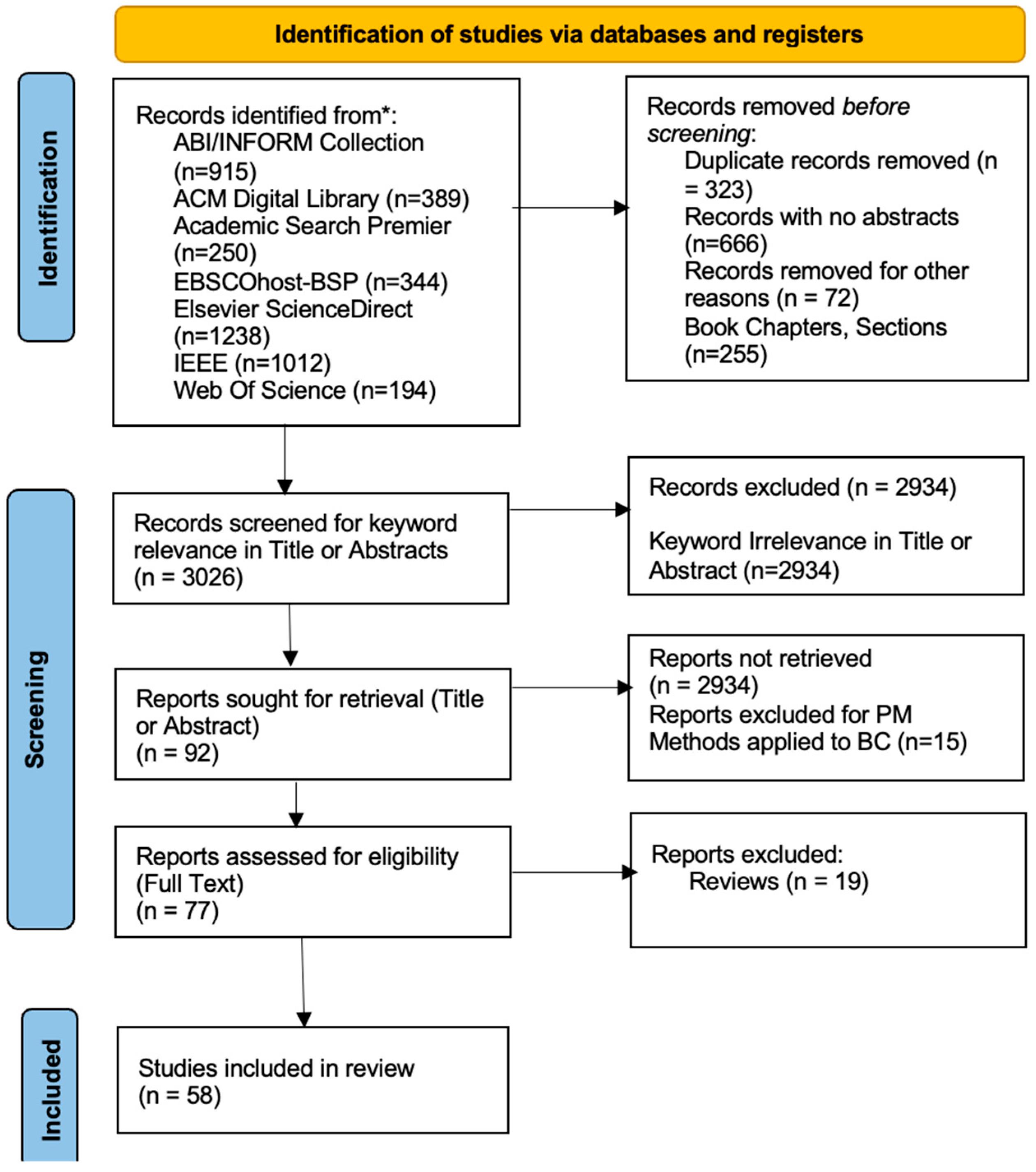
3.2. Search Strategy
3.3. Data Extraction
3.4. Theoretical Framework for Classification
3.5. Coding and Reliability
4. Results
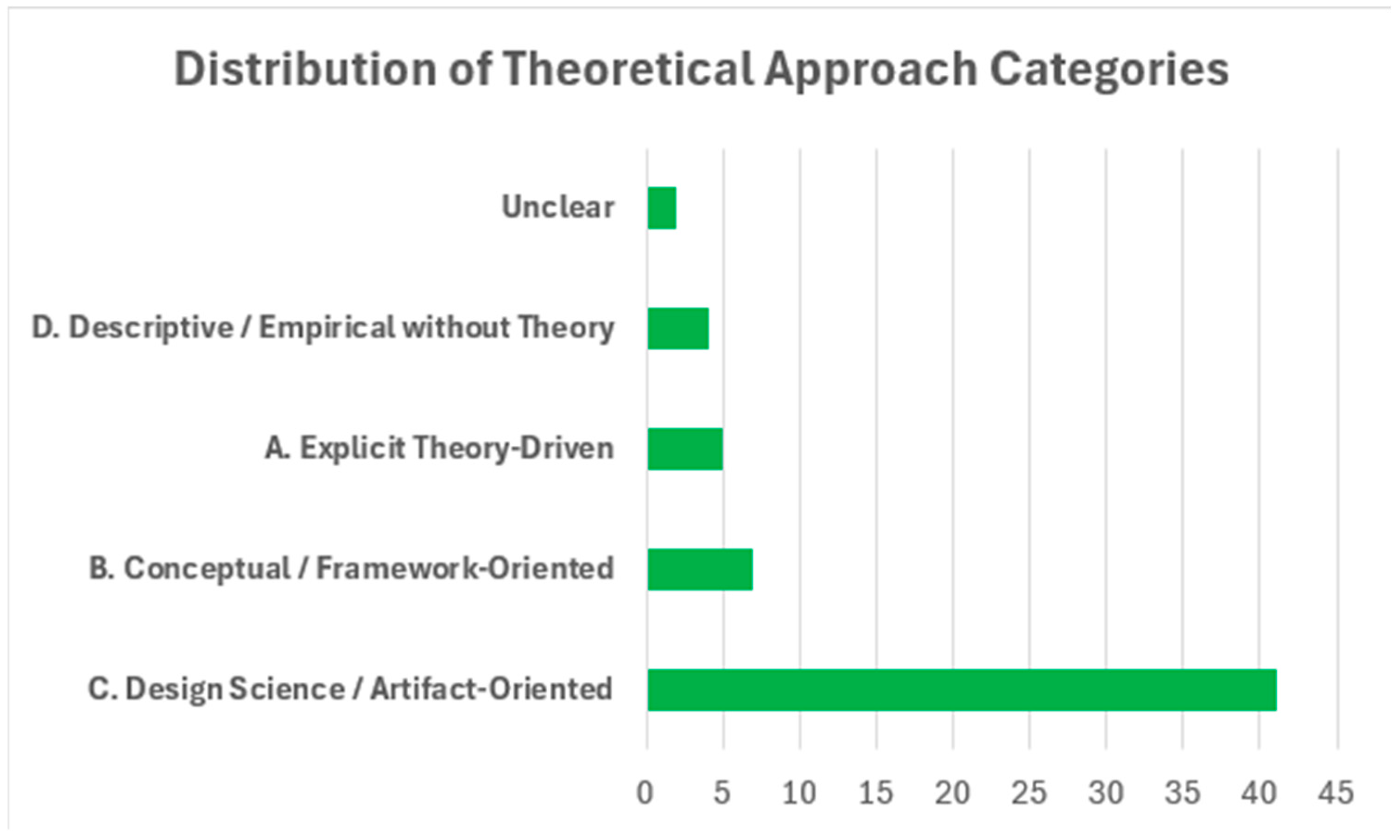
4.1. Distribution of Theoretical Approaches
- A. Explicit Theory-Driven: Studies applying established theories (e.g., TAM, DOI, Institutional Theory) to explain or predict blockchain adoption and performance in project management contexts.
- B. Conceptual/Framework-Oriented: Papers proposing integrative or conceptual models (e.g., smart contract frameworks) without empirical testing or explicit theoretical foundation.
- C. Design Science/Artifact-Oriented: Studies that design, develop, or evaluate blockchain-based systems, prototypes, or architectures aimed at improving PM functions.
- D. Descriptive/Empirical without Theory: Qualitative or case-based works that describe blockchain use or assess adoption barriers without grounding in formal theory.
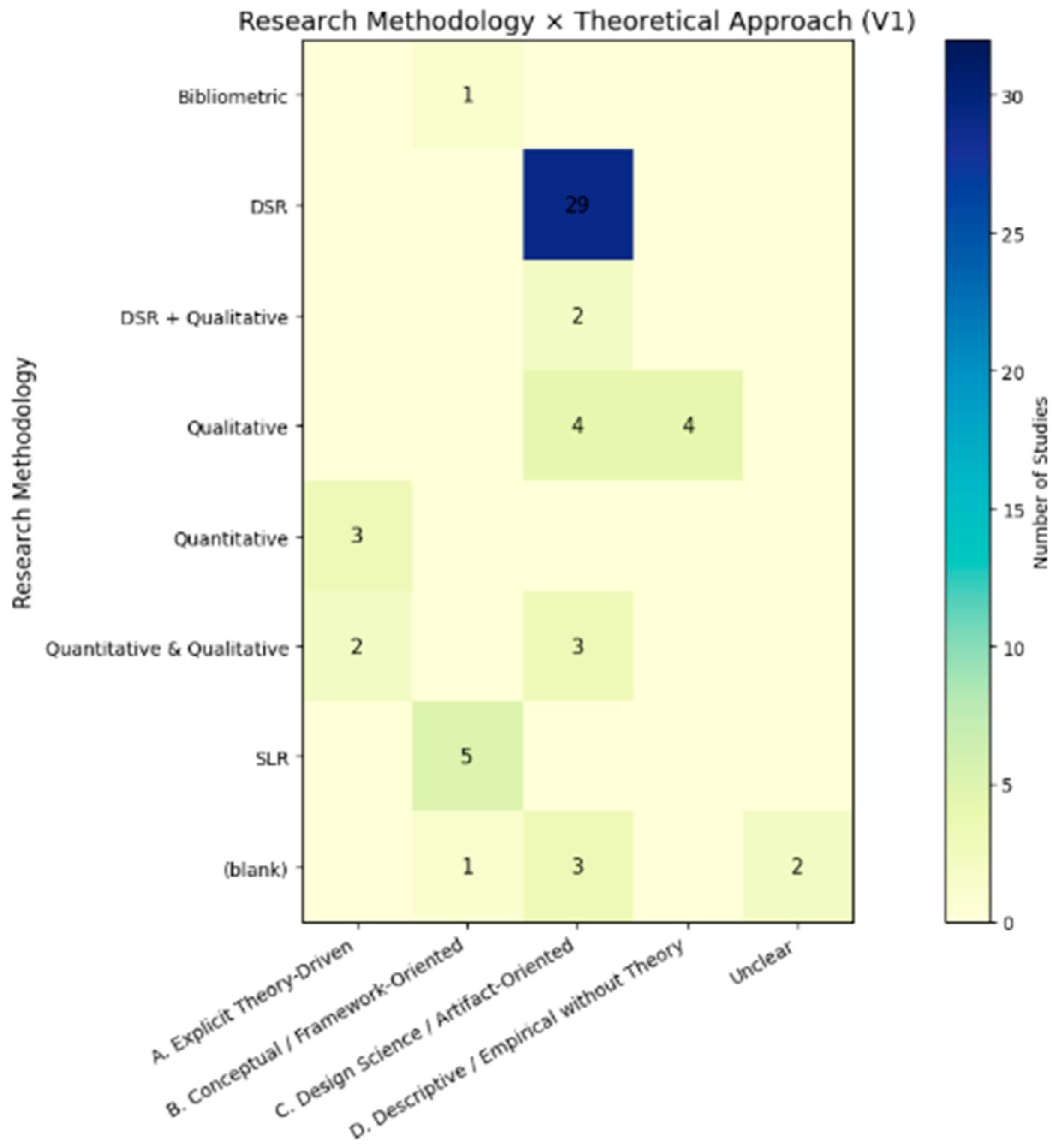
4.2. Research Methods and Their Link to Theoretical Orientation
4.2.1. Design Science and Technical Development

| Methodological Pattern | Corresponding Theoretical Category | Citations |
|---|---|---|
| Design Science and Technical Development | Design Science/Artifact-Oriented | (Zhao et al., 2023; Wang et al., 2018; Udvaros et al., 2023; Yoon et al., 2024; Çakmak et al., 2022; AL Ghadmi et al., 2023; Rahman et al., 2025; Machado et al., 2020; Khalfan et al., 2022; Ni et al., 2021; H. Bai et al., 2024; Shen, 2024; Liu et al., 2019; Hu et al., 2024; Lafhaj et al., 2025; Arunkumar et al., 2024; El Khatib et al., 2022; Liao et al., 2024; Li et al., 2022; Elazhary & Hosny, 2023; Rocky et al., 2021; El Khatib et al., 2023; J. Zhou, 2023; Wu et al., 2022; Bahnas et al., 2024; Spychiger et al., 2023; Lee & Yoon, 2019; Guo et al., 2022; Han et al., 2022; Y. Bai et al., 2018; S K & N, 2022; Ebekozien et al., 2024; Choudhari et al., 2021; Alkhaldi & Al-Omary, 2024; da Silva & Rosamilha, 2024; Li et al., 2023; Bharadwaj et al., 2023; Meng & Sun, 2021; L. Zhou, 2024; Serrano, 2022; Xu et al., 2024) |
4.2.2. Quantitative/Theory-Testing Studies
| Methodological Pattern | Corresponding Theoretical Category | Citations |
|---|---|---|
| Quantitative/Theory-testing Studies | Explicit Theory Driven | (Kim et al., 2020; Gao et al., 2023; Deep et al., 2022; Demirkesen et al., 2024; Duan et al., 2023) |
4.2.3. Qualitative/Case-Based Research
| Methodological Pattern | Corresponding Theoretical Category | Citations |
|---|---|---|
| Qualitative/Case-based research | Descriptive/Empirical without Theory | (Renwick & Tierney, 2020; Lotfi et al., 2022; Sharma et al., 2023) |
4.2.4. Conceptual Frameworks
| Methodological Pattern | Corresponding Theoretical Category | Citations |
|---|---|---|
| Conceptual Frameworks | Conceptual/Framework-Oriented | (Jain et al., 2024; Lu et al., 2022; Brüggemann & Timinger, 2023; Hong et al., 2020; Hargaden et al., 2019; Alkhudary & Gardiner, 2024; Serrano & Barnett, 2023) |
- Design Science → Design Science/Artifact-Oriented
- Quantitative → Explicit Theory-Driven
- Qualitative → Descriptive
4.3. Coding Reliability and Agreement
- Version 1 (V1) used a comprehensive rule-based classifier that captured both explicit and implicit theoretical cues across focus, methodology, and adoption context.
- Version 2 (V2) employed a stricter, conservative rule set that required explicit evidence of theory or methodology labeling.
- V1 captures the full conceptual and methodological landscape of blockchain-based project-management research by recognizing both explicit and implicit theoretical indicators.
- The V2 dataset served solely as a validation layer to test coding consistency.
4.4. Thematic Insights
5. Discussion
5.1. Theoretical Implications
- Dominance of Design Science and Research
- Underdeveloped Theoretical Foundations
- Conceptual and Framework-Oriented Studies as a Bridge
- Implications for Theoretical Development
5.2. Methodological Implications
5.3. Emerging Trends
- Integrate blockchain prototypes within existing project governance structures rather than treating them as isolated tools.
- Establish interoperability standards connecting blockchain systems with BIM, ERP, and supply chain management platforms.
- Prioritize change management and user readiness, ensuring that technological adoption aligns with project workflows.
- Foster multi-stakeholder collaboration, involving clients, contractors, and regulators in blockchain design and governance.
- Synthesis: From Findings to Theoretical Significance
- Theory-Building Implications (Why findings matter for theory)
6. Implications for Research and Practice
6.1. Implications for Research
- Translate Design Insights into Theoretical Constructs
- Develop Hybrid Theoretical Frameworks
- Adopt Multi-Level and Mixed-Method Designs
6.2. Implications for Practice
- Align Blockchain Use with Project Governance Structures
- Plan for Interoperability and Systems Integration
- Invest in Change Management and Skills Development
6.3. Integrative Perspective
7. Conclusions
Author Contributions
Funding
Institutional Review Board Statement
Informed Consent Statement
Data Availability Statement
Conflicts of Interest
References
- Ahmadisheykhsarmast, S., & Sonmez, R. (2020). A smart contract system for security of payment of construction contracts. Automation in Construction, 120, 103401. [Google Scholar] [CrossRef]
- AL Ghadmi, B. A. A., Abdulkader, O. A., & Alwarhi, A. A. (2023). Blockchain based software engineering requirements analysis and management. In X.-S. Yang, S. Sherratt, N. Dey, & A. Joshi (Eds.), Proceedings of seventh international congress on information and communication technology (pp. 75–83). Springer Nature. [Google Scholar] [CrossRef]
- Alkhaldi, B., & Al-Omary, A. (2024). Supply-blockchain functional prototype for optimizing port operations using hyperledger fabric. Blockchains, 2(3), 217. [Google Scholar] [CrossRef]
- Alkhudary, R., & Gardiner, P. (2024). Utilizing blockchain to enhance project management information systems: Insights into project portfolio success, knowledge management and learning capabilities. International Journal of Managing Projects in Business, 17(4/5), 731–754. [Google Scholar] [CrossRef]
- Arunkumar, O. N., Divya, D., & Kurian, J. S. (2024). Dark side of blockchain technology adoption in SMEs: An Indian perspective. Journal of Information Communication & Ethics in Society, 22(1), 6–37. [Google Scholar] [CrossRef]
- Bahnas, N., Adel, K., Khallaf, R., & Elhakeem, A. (2024). Monitoring and controlling engineering projects with blockchain-based critical chain project management. Automation in Construction, 165, 105484. [Google Scholar] [CrossRef]
- Bai, H., Li, Z., Chen, K., & Li, X. (2024). Blockchain-based responsibility management framework for smart city building information modeling projects using non-fungible tokens. Buildings, 14(11), 3647. [Google Scholar] [CrossRef]
- Bai, Y., Li, Z., Wu, K., Yang, J., Liang, S., Ouyang, B., Chen, Z., & Wang, J. (2018, November 30–December 2). Researchain: Union blockchain based scientific research project management system. 2018 Chinese Automation Congress (CAC) (pp. 4206–4209), Xi’an, China. [Google Scholar]
- Bharadwaj, P. K., Lakhanpal, S., Uniyal, V., Kumar, R. R., Al-Chilibi, H., & Alazzam, M. B. (2023, May 12–13). The role of smart contracts in cryptocurrency-based project management. 2023 3rd International Conference on Advance Computing and Innovative Technologies in Engineering (ICACITE) (pp. 950–954), Greater Noida, India. [Google Scholar] [CrossRef]
- Boell, S. K., & Cecez-Kecmanovic, D. (2015). On being ‘Systematic’ in literature reviews in IS. Journal of Information Technology, 30(2), 161–173. [Google Scholar] [CrossRef]
- Brüggemann, R., & Timinger, H. (2023, April 20–22). Blockchain-based task planning and management system for project management. 2023 IEEE European Technology and Engineering Management Summit (E-TEMS) (pp. 183–188), Kaunas, Lithuania. [Google Scholar] [CrossRef]
- Campbell, J., Quincy, C., Osserman, J., & Pedersen, O. K. (2013). Coding in-depth semistructured interviews. Sociological Methods & Research, 42(3), 294–320. [Google Scholar] [CrossRef]
- Choudhari, S., Das, S., Parasher, S., & Gangwar, D. (2021, April 2–4). Sub contractor life cycle management in enterprise system using blockchain technology. 6th International Conference for Convergence in Technology (I2CT), Maharashtra, India. [Google Scholar] [CrossRef]
- Çakmak, A., Özcan, B., Özdem, M., Bekin, F., Kırtekin, K., Aydın, Ş., & Ayaz, E. (2022, December 15–16). Blockchain based project management. 2022 3rd International Informatics and Software Engineering Conference (IISEC) (pp. 1–6), Ankara, Turkey. [Google Scholar] [CrossRef]
- da Silva, L. F., & Rosamilha, N. J. (2024). Sustainability, circular economy, and projects: Research opportunities. Revista de Gestao e Projetos, 15(3), 463–475. [Google Scholar] [CrossRef]
- Deep, S., Bhoola, V., Verma, S., & Ranasinghe, U. (2022). Identifying the risk factors in real estate construction projects: An analytical study to propose a control structure for decision-making. Journal of Financial Management of Property and Construction, 27(2), 220–238. [Google Scholar] [CrossRef]
- Demirkesen, S., Tezel, A., Uysal, F., & Ozturk, Z. (2024). Investigating the impact of blockchain on project risk management success: A structural equation model. IEEE Transactions on Engineering Management, 71, 8356–8368. [Google Scholar] [CrossRef]
- Duan, K., Caballero, J. M., & Jing, X. (2023, May 18–19). Scrum-based development model: Improve the engineering quality and testing method of blockchain projects. 2023 8th International Conference on Business and Industrial Research (ICBIR) (pp. 807–811), Bangkok, Thailand. [Google Scholar] [CrossRef]
- Ebekozien, A., Aigbavboa, C., Adekunle, S. A., Samsurijan, M. S., Aliu, J., Arthur-Aidoo, B. M., & Amadi, G. C. (2024). Smart contract applications in the built environment: How prepared are Nigerian construction stakeholders? Frontiers of Engineering Management, 11(1), 50–61. [Google Scholar] [CrossRef]
- Elazhary, M., & Hosny, O. (2023). Framework for the application of blockchain technology to delay analysis. Journal of Legal Affairs and Dispute Resolution in Engineering and Construction, 15(2), 04522063. [Google Scholar] [CrossRef]
- El Khatib, M., Alnaqbi, A., Alnaqbi, A., Alsuwaidi, H., & El Khatib, A. (2023, March 7–8). How blockchain and IoT affect project risk management. 2023 International Conference on Business Analytics for Technology and Security (ICBATS) (pp. 1–7), Dubai, United Arab Emirates. [Google Scholar] [CrossRef]
- El Khatib, M., Bin Khadim, S., Al Ketbi, W., Al Kuwaiti, N. H., & El Khatib, A. (2022, October 6–7). Digital transformation and disruptive technologies: Effect of blockchain on managing construction projects. 2022 International Conference on Cyber Resilience (ICCR) (pp. 1–9), Dubai, United Arab Emirates. [Google Scholar] [CrossRef]
- Gao, Y., Casasayas, O., Wang, J., & Xu, X. (2023). Factors affecting the blockchain application in construction management in China: An ANP-SWOT hybrid approach. Architectural Engineering and Design Management, 19(6), 665–680. [Google Scholar] [CrossRef]
- Gregor, S. (2006). The nature of theory in information systems. Management information systems quarterly. Available online: https://www.academia.edu/4857259/The_Nature_of_Theory_in_Information_Systems (accessed on 18 October 2025).
- Gregor, S., & Hevner, A. (2013). Positioning and presenting design science research for maximum impact. MIS Quarterly, 37, 337–356. [Google Scholar] [CrossRef]
- Guo, Q., Chen, S., Wang, J., & Pan, X. (2022, July 15–17). Research and design of electric power engineering project management system bsed on blockchain technology. 2022 International Conference on Blockchain Technology and Information Security (ICBCTIS) (pp. 80–84), Huaihua City, China. [Google Scholar] [CrossRef]
- Han, Z., Li, L., & Ding, Y. (2022, October 28–30). Research on the application of blockchain technology in defense engineering. 2022 2nd International Conference on Computer Science and Blockchain (CCSB) (pp. 1–6), Wuhan, China. [Google Scholar] [CrossRef]
- Hargaden, V., Papakostas, N., Newell, A., Khavia, A., & Scanlon, A. (2019, June 17–19). The role of blockchain technologies in construction engineering project management. 2019 IEEE International Conference on Engineering, Technology and Innovation (ICE/ITMC), Valbonne Sophia-Antipolis, France. [Google Scholar]
- Hevner, A. R., March, S. T., Park, J., & Ram, S. (2004). Design science in information systems research. Management Information Systems Quarterly, 28, 75. [Google Scholar] [CrossRef]
- Hong, J., Li, J., Zhang, L., Huang, X., Tu, X., & Liu, Y. (2020, November 23–25). The application of blockchain for the management of engineering projects in power system. 2020 IEEE Sustainable Power and Energy Conference (iSPEC) (pp. 1648–1654), Chengdu, China. [Google Scholar] [CrossRef]
- Hu, Y., McFarlane, A., & Hussain, F. (2024). CarbonApp: Blockchain enabled carbon offset project management. In L. Barolli (Ed.), Advanced information networking and applications (Vol. 202, pp. 13–25). Springer Nature. [Google Scholar] [CrossRef]
- Jain, D., Harinder, D., Peera, K. M., Balamaheswari, M., Pandey, A. K., & Abraham, D. S. (2024). Applications of blockchain technology in civil engineering. Journal of Computational Analysis and Applications (JoCAAA), 33(06), 186–196. [Google Scholar]
- Khalfan, M., Azizi, N., Haass, O., Maqsood, T., & Ahmed, I. (2022). Blockchain technology: Potential applications for public sector e-procurement and project management. Sustainability, 14(10), 5791. [Google Scholar] [CrossRef]
- Kim, K., Lee, G., & Kim, S. (2020). A study on the application of blockchain technology in the construction industry. KSCE Journal of Civil Engineering, 24(9), 2561–2571. [Google Scholar] [CrossRef]
- Kitchenham, B., & Charters, S. (2007). Guidelines for performing systematic literature reviews in software engineering. Keele University. [Google Scholar]
- Lafhaj, Z., Rebai, S., Hamdi, O., Jabbar, R., Ayech, H., & Yim, P. (2025). Copula: A decentralized solution for construction project monitoring using blockchain. Smart and Sustainable Built Environment, 14(5), 1483–1512. [Google Scholar] [CrossRef]
- Landis, J. R., & Koch, G. G. (1977). The measurement of observer agreement for categorical data. Biometrics, 33(1), 159. [Google Scholar] [CrossRef] [PubMed]
- Lee, E., & Yoon, Y. I. (2019, May 29–31). Project management model based on consistency strategy for blockchain platform. 2019 IEEE 17th International Conference on Software Engineering Research, Management and Applications (SERA) (pp. 38–44), Honolulu, HI, USA. [Google Scholar] [CrossRef]
- Li, D., Han, D., Xia, B., Weng, T.-H., Castiglione, A., & Li, K.-C. (2022). Fabric-GC: A blockchain-based gantt chart system for cross-organizational project management. Computer Science and Information Systems, 19(3), 1213–1240. [Google Scholar] [CrossRef]
- Li, D., Shen, J., Dai, J., & Xia, Y. (2023). The analysis of a power information management system based on machine learning algorithm. International Journal of Information Technologies and Systems Approach, 16(3), 1–14. [Google Scholar] [CrossRef]
- Liao, L., Ye, Y., Wei, N., Li, H., & Fan, C. (2024). Exploring blockchain technology acceptance among non-managerial construction practitioners in Shenzhen, China. Engineering Construction and Architectural Management, 31(5), 2053–2076. [Google Scholar] [CrossRef]
- Liu, Z., Jiang, L., Osmani, M., & Demian, P. (2019). Building information management (BIM) and blockchain (BC) for sustainable building design information management framework. Electronics, 8(7), 724. [Google Scholar] [CrossRef]
- Lotfi, R., Kargar, B., Gharehbaghi, A., Hazrati, H., Nazari, S., & Amra, M. (2022). Resource-constrained time-cost-quality-energy-environment tradeoff problem by considering blockchain technology, risk and robustness: A case study of healthcare project. Environmental Science and Pollution Research, 29(42), 63560–63576. [Google Scholar] [CrossRef] [PubMed]
- Lu, W., Wu, L., & Xue, F. (2022). Blockchain technology for projects: A multicriteria decision matrix. Project Management Journal, 53(1), 84–99. [Google Scholar] [CrossRef]
- Machado, T. B., Ricciardi, L., & Oliveira, M. B. P. P. (2020). Blockchain technology for the management of food sciences researches. Trends in Food Science & Technology, 102, 261–270. [Google Scholar] [CrossRef]
- Mendling, J., Weber, I., Aalst, W. V. D., Brocke, J. V., Cabanillas, C., Daniel, F., Debois, S., Ciccio, C. D., Dumas, M., Dustdar, S., Gal, A., García-Bañuelos, L., Governatori, G., Hull, R., Rosa, M. L., Leopold, H., Leymann, F., Recker, J., Reichert, M., … Zhu, L. (2018). Blockchains for business process management—Challenges and opportunities. ACM Transactions on Management Information Systems (TMIS), 9(1), 1–6. [Google Scholar] [CrossRef]
- Meng, Q., & Sun, R. (2021). Towards secure and efficient scientific research project management using consortium blockchain. Journal of Signal Processing Systems for Signal Image and Video Technology, 93(2–3), 323–332. [Google Scholar] [CrossRef]
- Mukkamala, R. R., Vatrapu, R., Ray, P. K., Sengupta, G., & Halder, S. (2018). Blockchain for social business: Principles and applications. IEEE Engineering Management Review, 46(4), 94–99. [Google Scholar] [CrossRef]
- Ni, Y., Sun, B., & Wang, Y. (2021). Blockchain-based BIM digital project management mechanism research. IEEE Access, 9, 161342–161351. [Google Scholar] [CrossRef]
- Nowell, L., Norris, J., White, D., & Moules, N. (2017). Thematic analysis: Striving to meet the trustworthiness criteria. International Journal of Qualitative, 16, 1–13. [Google Scholar] [CrossRef]
- Oliveira, M., Mccormack, K., & Trkman, P. (2012). Business analytics in supply chains—The contingent effect of business process maturity. Expert Systems with Applications, 39, 5488–5498. [Google Scholar] [CrossRef]
- Page, M. J., McKenzie, J. E., Bossuyt, P. M., Boutron, I., Hoffmann, T. C., Mulrow, C. D., Shamseer, L., Tetzlaff, J. M., Akl, E. A., Brennan, S. E., Chou, R., Glanville, J., Grimshaw, J. M., Hróbjartsson, A., Lalu, M. M., Li, T., Loder, E. W., Mayo-Wilson, E., McDonald, S., … Moher, D. (2021). The PRISMA 2020 statement: An updated guideline for reporting systematic reviews. Systematic Reviews, 10(1), 89. [Google Scholar] [CrossRef]
- Peffers, K., Tuunanen, T., Rothenberger, M. A., & Chatterjee, S. (2007). A design science research methodology for information systems research. Journal of Management Information Systems, 24, 45. [Google Scholar] [CrossRef]
- Perera, R., Wickramarachchi, R., & Rajapakse, C. (2023, March 3–5). Applications of blockchain technology in project management—A systematic literature review. 2023 2nd International Conference for Innovation in Technology (INOCON) (pp. 1–7), Bangalore, India. [Google Scholar] [CrossRef]
- Rahman, T. N., Abedin Khan, M. F., Bin Shahed, L., & Kafi, A. H. (2025, January 19–22). Blockchain in project management for information security, transparency and accountability. 2025 International Conference on Electronics, Information, and Communication (ICEIC) (pp. 1–4), Osaka, Japan. [Google Scholar] [CrossRef]
- Renwick, R., & Tierney, B. (2020). Are blockchain-based systems the future of project management? A preliminary exploration. The Journal of The British Blockchain Association. [Google Scholar] [CrossRef]
- Rocky, S. K., Rahim, L. A., Ahmad, R., & Sarlan, A. (2021, December 1–2). Hierarchical permissioned blockchain and traceability of requirement changes. 2021 International Conference on Intelligent Cybernetics Technology & Applications (ICICyTA) (pp. 144–148), Bandung, Indonesia. [Google Scholar] [CrossRef]
- Saberi, S., Kouhizadeh, M., Sarkis, J., & Shen, L. (2019). Blockchain technology and its relationships to sustainable supply chain management. International Journal of Production Research, 57(7), 2117–2135. [Google Scholar] [CrossRef]
- Saldana, J. (2021). The coding manual for qualitative researchers. Available online: https://collegepublishing.sagepub.com/products/the-coding-manual-for-qualitative-researchers-4-273583 (accessed on 18 October 2025).
- Sekar, A., Noteboom, C., & Tech, D. (2025). Strategic factors for blockchain implementation in supply chains. Administrative Sciences, 15(11), 410. [Google Scholar] [CrossRef]
- Serrano, W. (2022). Verification and validation for data marketplaces via a blockchain and smart contracts. Blockchain: Research and Applications, 3(4), 100100. [Google Scholar] [CrossRef]
- Serrano, W., & Barnett, J. (2023). Verification and validation for a project information model based on a blockchain. In X.-S. Yang, S. Sherratt, N. Dey, & A. Joshi (Eds.), Proceedings of seventh international congress on information and communication technology (pp. 219–233). Springer Nature. [Google Scholar] [CrossRef]
- Sharma, V., Oyebode, O. J., Uniyal, V., Rajyalaxmi, M., Al-Taee, M., & Alazzam, M. B. (2023, May 12–13). Technical use of smart contracts in blockchain-based project management. 2023 3rd International Conference on Advance Computing and Innovative Technologies in Engineering (ICACITE) (pp. 272–276), Greater Noida, India. [Google Scholar] [CrossRef]
- Shen, Y. (2024, November 20–22). Blockchain-driven project management system for digital transformation: Enhancing transparency and security. 2024 4th International Conference on Digital Society and Intelligent Systems (DSInS) (pp. 272–275), Sydney, Australia. [Google Scholar] [CrossRef]
- S K, P. N., & N, D. L. (2022, March 16–18). Secure metadata curating the agile software development process and its need for blockchain storage. 2022 International Conference on Electronics and Renewable Systems (ICEARS) (pp. 958–963), Tuticorin, India. [Google Scholar] [CrossRef]
- Spychiger, F., Lustenberger, M., Martignoni, J., Schädler, L., & Lehner, P. (2023). Organizing projects with blockchain through a decentralized autonomous organization. Project Leadership and Society, 4, 100102. [Google Scholar] [CrossRef]
- Taroun, A., & Yang, J. (2011). Dempster-shafer theory of evidence: Potential usage for decision making and risk analysis in construction project management. Available online: https://personalpages.manchester.ac.uk/staff/jian-bo.yang/JB%20Yang%20Journal_Papers/TarounYang_JBHER_ER-ProjectRisk.pdf (accessed on 18 October 2025).
- Treiblmaier, H. (2018). The impact of the blockchain on the supply chain: A theory-based research framework and a call for action. Supply Chain Management: An International Journal, 23(6), 545–559. [Google Scholar] [CrossRef]
- Turk, Ž., & Klinc, R. (2017). Potentials of blockchain technology for construction management. Procedia Engineering, 196, 638–645. [Google Scholar] [CrossRef]
- Udvaros, J., Forman, N., & Avornicului, S. M. (2023). Agile storyboard and software development leveraging smart contract technology in order to increase stakeholder confidence. Electronics, 12(2), 426. [Google Scholar] [CrossRef]
- Wang, S., Ni, X., Yuan, Y., Wang, X., Ouyang, L., & Wang, F.-Y. (2018, July 30–August 3). A preliminary research of prediction markets based on blockchain powered smart contracts. IEEE 2018 International Congress on Cybermatics/2018 IEEE Conferences on Internet of Things, Green Computing and Communications, Cyber, Physical and Social Computing, Smart Data, Blockchain, Computer and Information Technology (pp. 1287–1293), Halifax, NS, Canada. [Google Scholar] [CrossRef]
- Weber, R. (2012). Evaluating and developing theories in the information systems discipline. Journal of the Association for Information Systems, 13(1), 2. [Google Scholar] [CrossRef]
- Wu, L., Lu, W., Xue, F., Li, X., Zhao, R., & Tang, M. (2022). Linking permissioned blockchain to Internet of Things (IoT)-BIM platform for off-site production management in modular construction. Computers in Industry, 135, 103573. [Google Scholar] [CrossRef]
- Xu, Y., Chi, M., Chong, H.-Y., Lee, C.-Y., & Chen, K. (2024). When BIM meets blockchain: A mixed-methods literature review. Journal of Civil Engineering and Management, 30(7), 646–669. [Google Scholar] [CrossRef]
- Yoon, J. H., Aurangzeb, I., & McNamara, S. (2024). Bim- and blockchain-enabled automatic procurement system (Bbaps) removing relationship bias: Proof-of-concept. Elsevier BV. [Google Scholar] [CrossRef]
- Zhao, R., Chen, Z., & Xue, F. (2023). A blockchain 3.0 paradigm for digital twins in construction project management. Automation in Construction, 145, 104645. [Google Scholar] [CrossRef]
- Zhou, J. (2023). Information construction of construction project management based on internet of things blockchain. Security and Privacy, 6(2), e221. [Google Scholar] [CrossRef]
- Zhou, L. (2024). Trustworthy digital twinning data platform for power infrastructure construction projects using blockchain and semantic web. Frontiers in Built Environment, 10, 1440513. [Google Scholar] [CrossRef]

| Prior SLRs (SCM, Construction, Procurement) | This SLR (Blockchain in PM) |
|---|---|
| Focus on applications, architectures, and benefits | Focuses on theoretical and methodological structures |
| Do not classify studies by theory type | Uses Gregor’s (2006) typology to classify theoretical orientation |
| Limited assessment of methodological rigor | Maps research methods × theory, revealing field maturity |
| Treat blockchain mainly as a technical innovation | Treats blockchain as a socio-technical phenomenon requiring theory |
| Do not evaluate field evolution | Conducts temporal analysis of theory–method trends |
| Derived Category from Gregor’s Types | Description |
|---|---|
| Explicit Theory-Driven (Types II–IV) | Studies applying established theories to explain or predict blockchain adoption and outcomes |
| Conceptual/Framework-Oriented | Studies proposing conceptual or integrative models without explicit theoretical grounding |
| Design Science/Artifact-Oriented (Type V) | Studies developing, implementing, or evaluating blockchain-based systems or artifacts. |
| Descriptive/Empirical without Theory (Type I) | Exploratory or case-based studies analyzing blockchain applications without an explicit theoretical foundation. |
| Inclusion | Exclusion |
|---|---|
| Peer-reviewed journal or conference papers. | Non-peer-reviewed sources (e.g., editorials, white papers, books, book chapters, dissertations). |
| Studies discussing blockchain applications, adoption, or frameworks in project management or closely related domains (e.g., construction, engineering, IT project governance). | Articles focusing solely on blockchain technology without a project management context. |
| English-language publications. | Non-English papers |
| Full-text available and accessible for data extraction. | Duplicate entries or incomplete data. |
| SLR Category | Derived from Gregor’s Type(s) | Description |
|---|---|---|
| A. Explicit Theory-Driven | Type II, III, IV | Studies explicitly apply formal theories (e.g., Technology Acceptance Model, Diffusion of Innovation, Institutional Theory) to explain or predict blockchain adoption or behavior in PM contexts. |
| B. Conceptual/Framework-Oriented | (Newly added category) | Studies proposing integrative or conceptual frameworks without empirical validation or explicit theoretical grounding. |
| C. Design Science/Artifact-Oriented | Type V | Studies developing, implementing, or evaluating blockchain-enabled systems, models, or prototypes for project management. |
| D. Descriptive/Empirical without Theory | Type I | Exploratory, qualitative, or case-based studies that describe blockchain applications without referencing or developing theory. |
| Category | Frequency (n) | Relative Share (%) | Nature of Contribution |
|---|---|---|---|
| C. Design Science/Artifact-Oriented | 41 | 70.7 | System prototypes, blockchain frameworks, and smart-contract architectures. |
| B. Conceptual/Framework-Oriented | 7 | 12.1 | Conceptual models or integrative frameworks linking blockchain with project management processes, without empirical validation. |
| A. Explicit Theory-Driven | 5 | 8.6 | Adoption-focused studies using behavioral or organizational theories. |
| D. Descriptive/Empirical without Theory | 3 | 5.2 | Qualitative case studies or exploratory analyses describing blockchain implementation without explicit theoretical grounding. |
| Unclear/Mixed | 2 | 3.4 | Papers with hybrid or ambiguous methodological articulation. |
Disclaimer/Publisher’s Note: The statements, opinions and data contained in all publications are solely those of the individual author(s) and contributor(s) and not of MDPI and/or the editor(s). MDPI and/or the editor(s) disclaim responsibility for any injury to people or property resulting from any ideas, methods, instructions or products referred to in the content. |
© 2025 by the authors. Licensee MDPI, Basel, Switzerland. This article is an open access article distributed under the terms and conditions of the Creative Commons Attribution (CC BY) license (https://creativecommons.org/licenses/by/4.0/).
Share and Cite
Noteboom, C.; Sekar, A.; Seru, S.N. From Design to Theory: Understanding the Evolution of Blockchain Research in Project Management. Adm. Sci. 2025, 15, 495. https://doi.org/10.3390/admsci15120495
Noteboom C, Sekar A, Seru SN. From Design to Theory: Understanding the Evolution of Blockchain Research in Project Management. Administrative Sciences. 2025; 15(12):495. https://doi.org/10.3390/admsci15120495
Chicago/Turabian StyleNoteboom, Cherie, Aravindh Sekar, and Sai Neelima Seru. 2025. "From Design to Theory: Understanding the Evolution of Blockchain Research in Project Management" Administrative Sciences 15, no. 12: 495. https://doi.org/10.3390/admsci15120495
APA StyleNoteboom, C., Sekar, A., & Seru, S. N. (2025). From Design to Theory: Understanding the Evolution of Blockchain Research in Project Management. Administrative Sciences, 15(12), 495. https://doi.org/10.3390/admsci15120495