Employee Behavior in Sustainable Digital Marketing: The Role of AI Technologies in the UAE



Abstract
1. Introduction
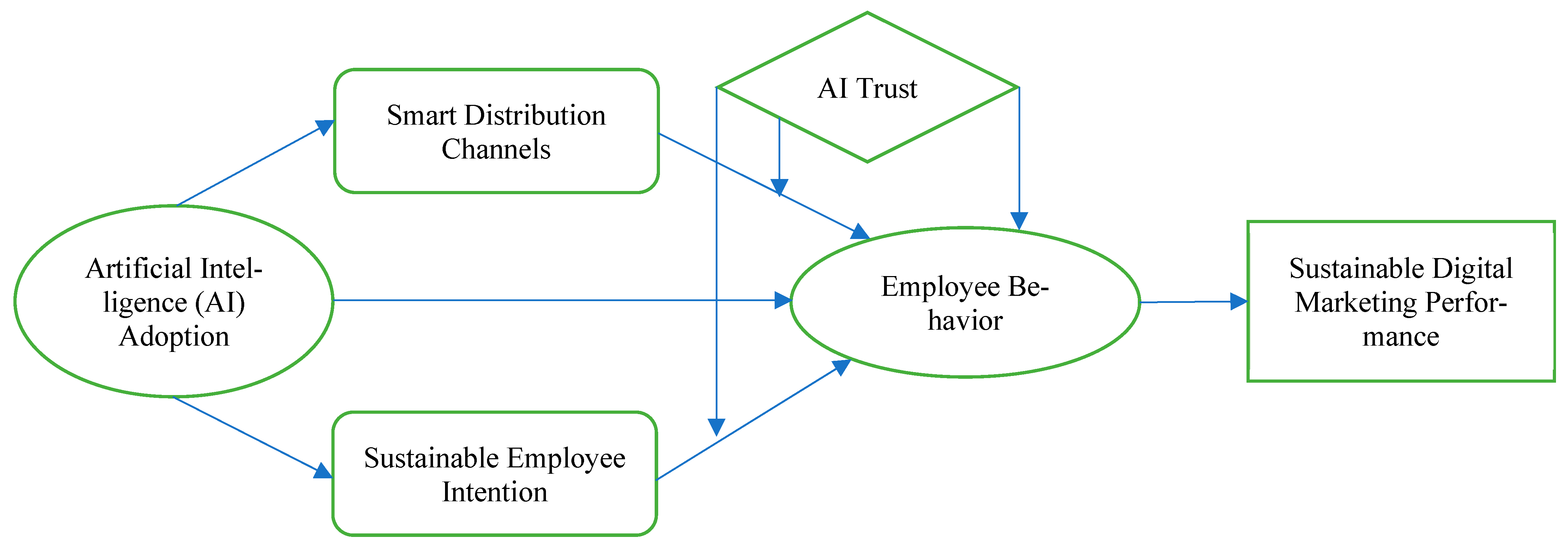
- The primary objective of this study is to examine how AI adoption influences sustainable digital marketing outcomes through the mediating roles of SDCs and sustainable employee intention, while considering the moderating effect of AI trust on these relationships. The study focuses on how employees’ behavioral responses shape the effectiveness of AI-driven sustainability strategies within UAE organizations.
- To address this objective, the research develops and empirically tests a comprehensive mediation–moderation model grounded in the Technology Acceptance Model (TAM) and Sociotechnical Systems Theory (STS). Data was collected through a structured questionnaire administered to the employees of leading UAE telecommunication organizations, and the proposed relationships were analyzed using Partial Least Squares Structural Equation Modeling (PLS-SEM).
- This study contributes to theory by integrating behavioral (TAM) and systemic (STS) perspectives to explain the dual influence of technology and human factors in sustainable marketing. Practically, it provides insights for managers and policymakers in the UAE on how to enhance sustainability through employee engagement, AI trust-building, and ethical technology implementation. By combining technological and human-centered lenses, the study bridges a crucial gap between technological innovation and organizational sustainability behavior.
2. Literature Review
2.1. Theoretical Framework of the Study
2.2. Hypotheses Development
2.2.1. Artificial Intelligence (AI) Adoption and Employee Behavior
2.2.2. Artificial Intelligence (AI) Adoption, Smart Distribution Channels, and Sustainable Employee Intention
2.2.3. Smart Distribution Channels, Sustainable Employee Intention, and Employee Behavior
2.3. Employee Behavior and Sustainable Digital Marketing
2.4. Moderation Effect of Artificial Intelligence (AI) Trust
3. Methodology
3.1. Research Design
3.2. Population and Sampling
3.3. Questionnaire Development
3.4. Data Collection and Statistical Tool
4. Data Analysis
4.1. Demographic Profile of Respondents
4.2. Results of Structural Equation Modeling (SEM)
5. Discussion
6. Conclusions
6.1. Implication of the Study
6.2. Limitations and Future Directions
Author Contributions
Funding
Institutional Review Board Statement
Informed Consent Statement
Data Availability Statement
Conflicts of Interest
References
- Abrardi, L., Cambini, C., & Rondi, L. (2022). Artificial intelligence, firms and consumer behavior: A survey. Journal of Economic Surveys, 36(4), 969–991. [Google Scholar] [CrossRef]
- Al Koliby, I. S., Mehat, N. A. B., Al-Swidi, A. K., & Al-Hakimi, M. A. (2024). Unveiling the linkages between entrepreneurial culture, innovation capability, digital marketing capability and sustainable competitive performance of manufacturing SMEs: Evidence from emerging countries. The Bottom Line, 37(4), 473–500. [Google Scholar] [CrossRef]
- Al Maskari, A. (2018). Theory of Planned Behavior (TPB) Ajzen (1988). In Technology adoption and social issues: Concepts, methodologies, tools, and applications (pp. 46–67). IGI Global Scientific Publishing. [Google Scholar]
- Ansari, H. U. H., & Khan, S. N. (2024). Linking green transformational leadership and employee pro-environmental behavior: The role of intention and work environment. Sustainable Futures, 8, 100336. [Google Scholar] [CrossRef]
- Arroyabe, M. F., Arranz, C. F., De Arroyabe, I. F., & de Arroyabe, J. C. F. (2024). Analyzing AI adoption in European SMEs: A study of digital capabilities, innovation, and external environment. Technology in Society, 79, 102733. [Google Scholar] [CrossRef]
- Barja-Martinez, S., Aragüés-Peñalba, M., Munné-Collado, Í., Lloret-Gallego, P., Bullich-Massagué, E., & Villafafila-Robles, R. (2021). Artificial intelligence techniques for enabling Big Data services in distribution networks: A review. Renewable and Sustainable Energy Reviews, 150, 111459. [Google Scholar] [CrossRef]
- Bido, D., da Silva, D., & Ringle, C. (2014). Structural equation modeling with the Smartpls. Brazilian Journal of Marketing, 13(2), 56–73. [Google Scholar]
- Braganza, A., Chen, W., Canhoto, A., & Sap, S. (2021). Productive employment and decent work: The impact of AI adoption on psychological contracts, job engagement and employee trust. Journal of Business Research, 131, 485–494. [Google Scholar] [CrossRef]
- Cao, P., & Liu, S. (2023). The impact of artificial intelligence technology stimuli on sustainable consumption behavior: Evidence from ant forest users in China. Behavioral Sciences, 13(7), 604. [Google Scholar] [CrossRef]
- Chai, C. S., Lin, P.-Y., Jong, M. S.-Y., Dai, Y., Chiu, T. K., & Qin, J. (2021). Perceptions of and behavioral intentions towards learning artificial intelligence in primary school students. Educational Technology & Society, 24(3), 89–101. [Google Scholar]
- Chan, E. S., Hon, A. H., Chan, W., & Okumus, F. (2014). What drives employees’ intentions to implement green practices in hotels? The role of knowledge, awareness, concern and ecological behaviour. International Journal of Hospitality Management, 40, 20–28. [Google Scholar] [CrossRef]
- Cheah, J.-H., Sarstedt, M., Ringle, C. M., Ramayah, T., & Ting, H. (2018). Convergent validity assessment of formatively measured constructs in PLS-SEM: On using single-item versus multi-item measures in redundancy analyses. International Journal of Contemporary Hospitality Management, 30, 3192–3210. [Google Scholar] [CrossRef]
- Comrey, A., & Lee, H. (1992). A first course in factor analysis (2nd ed.). Lawrence Earlbaum Associates. [Google Scholar]
- Davis, F. D., Bagozzi, R. P., & Warshaw, P. R. (1989). User acceptance of computer technology: A comparison of two theoretical models. Management Science, 35(8), 982–1003. [Google Scholar] [CrossRef]
- Dimoff, J. K., & Kelloway, E. K. (2019). With a little help from my boss: The impact of workplace mental health training on leader behaviors and employee resource utilization. Journal of Occupational Health Psychology, 24(1), 4–19. [Google Scholar] [CrossRef] [PubMed]
- Dulloo, R., Appolloni, A., & Mathiyazhagan, K. (2025). AI-powered communication: Strategic framework for technological innovation, brand perception, and sustainable marketing. In Strategic blueprints for AI-driven marketing in the digital era (pp. 1–40). IGI Global Scientific Publishing. [Google Scholar]
- Eng, P. H., & Liu, R. L. (2024). Will intelligent technologies replace humans in the future? An exploratory study for likelihood of intelligent technologies to replace humans in the future. In Current and future trends on intelligent technology adoption: Volume 2 (pp. 171–202). Springer. [Google Scholar]
- Frazier, G. L., & Sheth, J. N. (1985). An attitude-behavior framework for distribution channel management. Journal of Marketing, 49(3), 38–48. [Google Scholar] [CrossRef]
- Greenland, S. J. (2019). Future sustainability, innovation and marketing: A framework for understanding impediments to sustainable innovation adoption and corporate social responsibility. In The components of sustainable development: Engagement and partnership (pp. 63–80). Springer. [Google Scholar]
- Gündüzyeli, B. (2024). Artificial intelligence in digital marketing within the framework of sustainable management. Sustainability, 16(23), 10511. [Google Scholar] [CrossRef]
- Hafkesbrink, J. (2021). Questions. Heterotrait-Monotrait Ratio of Correlations (HTMT) in assessing the discriminant validity in PLS-SEM model? ResearchGate. Available online: https://www.researchgate.net/post/Heterotrait-Monotrait-Ratio-of-Correlations-HTMT-in-assessing-the-discriminant-validity-in-PLS-SEM-model (accessed on 10 September 2025).
- Hair, J. F., Jr., Hult, G. T. M., Ringle, C., & Sarstedt, M. (2016). A primer on partial least squares structural equation modeling (PLS-SEM). Sage Publications. [Google Scholar]
- Henseler, J., Dijkstra, T. K., Sarstedt, M., Ringle, C. M., Diamantopoulos, A., Straub, D. W., Ketchen, D. J., Hair, J. F., Hult, G. T. M., & Calantone, R. J. (2014). Common beliefs and reality about PLS: Comments on Rönkkö and Evermann (2013). Organizational Research Methods, 17(2), 182–209. [Google Scholar] [CrossRef]
- Henseler, J., Ringle, C. M., & Sinkovics, R. R. (2009). The use of partial least squares path modeling in international marketing. In New challenges to international marketing (pp. 277–319). Emerald Group Publishing Limited. [Google Scholar]
- Jaillant, L., & Rees, A. (2023). Applying AI to digital archives: Trust, collaboration and shared professional ethics. Digital Scholarship in the Humanities, 38(2), 571–585. [Google Scholar] [CrossRef]
- Jain, V., Wadhwani, K., & Eastman, J. K. (2024). Artificial intelligence consumer behavior: A hybrid review and research agenda. Journal of Consumer Behaviour, 23(2), 676–697. [Google Scholar] [CrossRef]
- Januszkiewicz, K. (2022). Understanding flexibility–dimensions of employee behavior flexibility. International Journal of Contemporary Management, 58(3), 27–40. [Google Scholar] [CrossRef]
- Jimmieson, N. L., Peach, M., & White, K. M. (2008). Utilizing the theory of planned behavior to inform change management: An investigation of employee intentions to support organizational change. The Journal of Applied Behavioral Science, 44(2), 237–262. [Google Scholar] [CrossRef]
- Kazmi, S. A. A., Shahzad, M. K., Khan, A. Z., & Shin, D. R. (2017). Smart distribution networks: A review of modern distribution concepts from a planning perspective. Energies, 10(4), 501. [Google Scholar] [CrossRef]
- Khan, A. A., Laghari, A. A., Rashid, M., Li, H., Javed, A. R., & Gadekallu, T. R. (2023). Artificial intelligence and blockchain technology for secure smart grid and power distribution automation: A state-of-the-art review. Sustainable Energy Technologies and Assessments, 57, 103282. [Google Scholar] [CrossRef]
- Kim, B.-J., & Kim, M.-J. (2025). The AI-environment paradox: Unraveling the impact of artificial intelligence (AI) adoption on pro-environmental behavior through work overload and self-efficacy in AI learning. Journal of Environmental Management, 380, 125102. [Google Scholar] [CrossRef] [PubMed]
- Kim, J., Giroux, M., & Lee, J. C. (2021). When do you trust AI? The effect of number presentation detail on consumer trust and acceptance of AI recommendations. Psychology & Marketing, 38(7), 1140–1155. [Google Scholar] [CrossRef]
- Ladelsky, L. K., & Lee, T. W. (2023). Effect of risky decision-making and job satisfaction on turnover intention and turnover behavior among information technology employees. International Journal of Organizational Analysis, 31(7), 3553–3581. [Google Scholar] [CrossRef]
- Li, J. J., Bonn, M. A., & Ye, B. H. (2019). Hotel employee’s artificial intelligence and robotics awareness and its impact on turnover intention: The moderating roles of perceived organizational support and competitive psychological climate. Tourism Management, 73, 172–181. [Google Scholar] [CrossRef]
- Li, Y.-H., Li, Y.-L., Wei, M.-Y., & Li, G.-Y. (2024). Innovation and challenges of artificial intelligence technology in personalized healthcare. Scientific Reports, 14(1), 18994. [Google Scholar] [CrossRef]
- Lin, R.-R., & Lee, J.-C. (2024). The supports provided by artificial intelligence to continuous usage intention of mobile banking: Evidence from China. Aslib Journal of Information Management, 76(2), 293–310. [Google Scholar] [CrossRef]
- Liu, Y., Li, Y., Song, K., & Chu, F. (2024). The two faces of Artificial Intelligence (AI): Analyzing how AI usage shapes employee behaviors in the hospitality industry. International Journal of Hospitality Management, 122, 103875. [Google Scholar] [CrossRef]
- Malhotra, A. (2024). Application of digital marketing and its impact on marketing behavior in the industrial sectors. In Emerging trends in smart societies (pp. 158–162). Routledge. [Google Scholar]
- McElheran, K., Li, J. F., Brynjolfsson, E., Kroff, Z., Dinlersoz, E., Foster, L., & Zolas, N. (2024). AI adoption in America: Who, what, and where. Journal of Economics & Management Strategy, 33(2), 375–415. [Google Scholar] [CrossRef]
- Mennella, C., Maniscalco, U., De Pietro, G., & Esposito, M. (2024). Ethical and regulatory challenges of AI technologies in healthcare: A narrative review. Heliyon, 10(4), e26297. [Google Scholar] [CrossRef]
- Mheidat, M., Jahmani, A., & Alhashash, K. M. (2025). Metaverse tourism model: A revolution in tourism management and marketing. Journal of Metaverse Business Designs, 6(1), 56–68. [Google Scholar] [CrossRef]
- Minh, T. C., & Quynh, N. N. T. (2024). Factors affecting sustainable consumption behavior: Roles of pandemics and perceived consumer effectiveness. Cleaner and Responsible Consumption, 12, 100158. [Google Scholar] [CrossRef]
- Mohassel, R. R., Fung, A., Mohammadi, F., & Raahemifar, K. (2014). A survey on advanced metering infrastructure. International Journal of Electrical Power & Energy Systems, 63, 473–484. [Google Scholar] [CrossRef]
- Moorthy, T., & Sahid, S. (2022). The influence of digital marketing literacy on entrepreneurship behavior among public university students in Malaysia. International Journal of Academic Research in Business and Social Sciences, 12(1), 548–568. [Google Scholar] [CrossRef]
- Presbitero, A., & Teng-Calleja, M. (2023). Job attitudes and career behaviors relating to employees’ perceived incorporation of artificial intelligence in the workplace: A career self-management perspective. Personnel Review, 52(4), 1169–1187. [Google Scholar] [CrossRef]
- Rabby, F., Chimhundu, R., & Hassan, R. (2021). Artificial intelligence in digital marketing influences consumer behaviour: A review and theoretical foundation for future research. Academy of Marketing Studies Journal, 25(5), 1–7. [Google Scholar] [CrossRef]
- Ramachandran, K., Mary, A. A. S., Hawladar, S., Asokk, D., Bhaskar, B., & Pitroda, J. (2022). Machine learning and role of artificial intelligence in optimizing work performance and employee behavior. Materials Today: Proceedings, 51, 2327–2331. [Google Scholar] [CrossRef]
- Ringle, C. M., Sarstedt, M., & Straub, D. (2012). A critical look at the use of PLS-SEM in MIS Quarterly. MIS Quarterly, 36, iii–xiv. [Google Scholar] [CrossRef]
- Rubel, M. R. B., Kee, D. M. H., & Rimi, N. N. (2023). Promoting technology innovation performance through high involvement HRM, technology adaptation and innovativeness. Business Process Management Journal, 29(5), 1277–1302. [Google Scholar] [CrossRef]
- Salhab, H., Zoubi, M., Khrais, L. T., Estaitia, H., Harb, L., Al Huniti, A., & Morshed, A. (2025). AI-driven sustainable marketing in gulf cooperation council retail: Advancing SDGs through smart channels. Administrative Sciences, 15(1), 20. [Google Scholar] [CrossRef]
- Sawang, S., Ng, P. Y., Kivits, R. A., Dsilva, J., & Locke, J. (2024). Examining the influence of customers, suppliers, and regulators on environmental practices of SMEs: Evidence from the United Arab Emirates. Business Strategy and the Environment, 33(7), 6533–6546. [Google Scholar] [CrossRef]
- Shaikh, F., Afshan, G., Anwar, R. S., Abbas, Z., & Chana, K. A. (2023). Analyzing the impact of artificial intelligence on employee productivity: The mediating effect of knowledge sharing and well-being. Asia Pacific Journal of Human Resources, 61(4), 794–820. [Google Scholar] [CrossRef]
- Shi, J. (2022). Research on optimization of cross-border e-commerce logistics distribution network in the context of artificial intelligence. Mobile Information Systems, 2022(1), 3022280. [Google Scholar] [CrossRef]
- Steven, P. H. (2025). Reinforcing financial growth in metaverse organizations: A governance-driven approach to leveraging technological advancements in the United States of America (USA). Journal of Metaverse Business Designs, 6(1), 1–11. [Google Scholar] [CrossRef]
- Sumartono, E., Harliyanto, R., Situmeang, S. M. T., Siagian, D. S., & Septaria, E. (2024). The legal implications of data privacy laws, cybersecurity regulations, and ai ethics in a digital society. The Journal of Academic Science, 1(2), 103–110. [Google Scholar] [CrossRef]
- Sweis, R. J. (2010). The relationship between information technology adoption and job satisfaction in contracting companies in Jordan. Journal of Information Technology in Construction, 15, 44–63. [Google Scholar]
- Thangaraju, K., & Palani, P. (2024). Integrating sustainability into AI-driven HRM practices: Examining employee engagement and organizational performance in the IT industry. Pakistan Journal of Life & Social Sciences, 22(2), 14014–14028. [Google Scholar]
- Tomaira, R. (2022). DUBAI from marginal gulf town to regional hub. In Emerging global cities (pp. 34–65). Columbia University Press. [Google Scholar]
- Toraman, Y. (2022). User acceptance of metaverse: Insights from technology acceptance model (TAM) and planned behavior theory (PBT). EMAJ: Emerging Markets Journal, 12(1), 67–75. [Google Scholar] [CrossRef]
- Trist, E., & Emery, F. (2015). Sociotechnical systems theory. In Organizational behavior 2 (pp. 169–194). Routledge. [Google Scholar]
- Trivedi, A., Kaur, E. K., Choudhary, C., & Barnwal, P. (2023, March 3–5). Should AI technologies replace the human jobs? 2023 2nd International Conference for Innovation in Technology (INOCON), Bangalore, India. [Google Scholar]
- Udin, U. (2022). Knowledge sharing and innovative work behavior: Testing the role of entrepreneurial passion in distribution channel. Journal of Distribution Science, 20(2), 79–89. [Google Scholar]
- Venkatesh, V., & Davis, F. D. (2000). A theoretical extension of the technology acceptance model: Four longitudinal field studies. Management Science, 46(2), 186–204. [Google Scholar] [CrossRef]
- Verma, S., & Singh, V. (2022). The employees intention to work in artificial intelligence-based hybrid environments. IEEE Transactions on Engineering Management, 71, 3266–3277. [Google Scholar] [CrossRef]
- Walker, G. H., Stanton, N. A., Salmon, P. M., & Jenkins, D. P. (2008). A review of sociotechnical systems theory: A classic concept for new command and control paradigms. Theoretical Issues in Ergonomics Science, 9(6), 479–499. [Google Scholar] [CrossRef]
- White, K., Cakanlar, A., Sethi, S., & Trudel, R. (2025). The past, present, and future of sustainability marketing: How did we get here and where might we go? Journal of Business Research, 187, 115056. [Google Scholar] [CrossRef]
- Williams, S., & Shiaw, W. T. (1999). Mood and organizational citizenship behavior: The effects of positive affect on employee organizational citizenship behavior intentions. The Journal of Psychology, 133(6), 656–668. [Google Scholar] [CrossRef]
- Yi, Y., Nataraajan, R., & Gong, T. (2011). Customer participation and citizenship behavioral influences on employee performance, satisfaction, commitment, and turnover intention. Journal of Business Research, 64(1), 87–95. [Google Scholar] [CrossRef]
- Yoon, S. W., & Park, J. G. (2023). Employee’s intention to share knowledge: The impacts of learning organization culture and learning goal orientation. International Journal of Manpower, 44(2), 231–246. [Google Scholar] [CrossRef]
- Yragui, N. L., Demsky, C. A., Hammer, L. B., Van Dyck, S., & Neradilek, M. B. (2017). Linking workplace aggression to employee well-being and work: The moderating role of family-supportive supervisor behaviors (FSSB). Journal of Business and Psychology, 32(2), 179–196. [Google Scholar] [CrossRef] [PubMed]
- Zawra, L. M., Mansour, H. A., Eldin, A. T., & Messiha, N. W. (2017, September 9–11). Utilizing the internet of things (IoT) technologies in the implementation of industry 4.0. International Conference on Advanced Intelligent Systems and Informatics, Cairo, Egypt. [Google Scholar]
- Zhang, Y., & Wang, S. (2023). The influence of anthropomorphic appearance of artificial intelligence products on consumer behavior and brand evaluation under different product types. Journal of Retailing and Consumer Services, 74, 103432. [Google Scholar] [CrossRef]
- Zhou, J., Sheng, S., & Zhang, C. (2022). Deterring unethical behaviors in marketing channels: The role of distributor whistleblowing. Journal of Business Ethics, 181(1), 97–115. [Google Scholar] [CrossRef]
- Ziakis, C., & Vlachopoulou, M. (2023). Artificial intelligence in digital marketing: Insights from a comprehensive review. Information, 14(12), 664. [Google Scholar] [CrossRef]


| Variables | Items | Source |
|---|---|---|
| Artificial Intelligence (AI) Adoption |
| Salhab et al. (2025) |
| Smart Distribution Channels (SDCs) |
| Salhab et al. (2025) |
| Sustainable Employee Intention |
| Minh and Quynh (2024) |
| AI Trust |
| Salhab et al. (2025) |
| Employee Behavior |
| Januszkiewicz (2022) |
| Sustainable Digital Marketing |
| Al Koliby et al. (2024) |
| Demographic Variable | Category | Frequency (n) | Percentage (%) |
|---|---|---|---|
| Gender | Male | 225 | 75.0 |
| Female | 75 | 25.0 | |
| Age Group | 20–29 years | 60 | 20.0 |
| 30–39 years | 120 | 40.0 | |
| 40–49 years | 90 | 30.0 | |
| 50 years and above | 30 | 10.0 | |
| Education Level | Bachelor’s degree | 135 | 45.0 |
| Master’s degree | 120 | 40.0 | |
| Doctorate | 30 | 10.0 | |
| Diploma/Other | 15 | 5.0 | |
| Job Position | Marketing/Customer Engagement | 90 | 30.0 |
| IT/Technical | 75 | 25.0 | |
| Management/Leadership | 75 | 25.0 | |
| Sustainability/CSR Roles | 60 | 20.0 | |
| Work Experience | Less than 5 years | 75 | 25.0 |
| 5–10 years | 105 | 35.0 | |
| 11–15 years | 75 | 25.0 | |
| More than 15 years | 45 | 15.0 |
| Items | Missing | Mean | Median | Min | Max | SD | Kurtosis | Skewness |
|---|---|---|---|---|---|---|---|---|
| AIA1 | 0 | 3.165 | 3 | 1 | 5 | 1.33 | −1.127 | −0.108 |
| AIA2 | 0 | 2.675 | 3 | 1 | 5 | 1.129 | −0.566 | 0.185 |
| AIA3 | 0 | 2.643 | 3 | 1 | 5 | 1.105 | −0.545 | 0.278 |
| AIA4 | 0 | 2.563 | 3 | 1 | 5 | 1.173 | −0.774 | 0.296 |
| SDC1 | 0 | 2.555 | 3 | 1 | 5 | 1.201 | −0.68 | 0.363 |
| SDC2 | 0 | 3.323 | 3 | 1 | 5 | 1.321 | −1.157 | −0.191 |
| SDC3 | 0 | 3.285 | 3 | 1 | 5 | 1.319 | −1.174 | −0.166 |
| SDC4 | 0 | 3.16 | 3 | 1 | 5 | 1.309 | −1.088 | −0.069 |
| SEI1 | 0 | 3.28 | 3 | 1 | 5 | 1.308 | −1.031 | −0.235 |
| SEI2 | 0 | 3.272 | 3 | 1 | 5 | 1.261 | −1.027 | −0.131 |
| SEI3 | 0 | 3.173 | 3 | 1 | 5 | 1.222 | −0.927 | −0.176 |
| SEI4 | 0 | 2.736 | 3 | 1 | 5 | 1.089 | −0.442 | 0.34 |
| SEI5 | 0 | 2.763 | 3 | 1 | 5 | 1.112 | −0.769 | 0.176 |
| AIT1 | 0 | 3.123 | 3 | 1 | 5 | 1.28 | −0.977 | −0.2 |
| AIT2 | 0 | 3.128 | 3 | 1 | 5 | 1.296 | −1.003 | −0.203 |
| EB1 | 0 | 3.011 | 3 | 1 | 5 | 1.275 | −0.942 | −0.012 |
| EB2 | 0 | 3.035 | 3 | 1 | 5 | 1.22 | −0.836 | −0.058 |
| EB3 | 0 | 2.992 | 3 | 1 | 5 | 1.232 | −0.88 | −0.096 |
| EB4 | 0 | 3.357 | 3 | 1 | 5 | 1.252 | −0.955 | −0.275 |
| EB5 | 0 | 3.339 | 3 | 1 | 5 | 1.29 | −1.029 | −0.231 |
| SDM1 | 0 | 3.309 | 3 | 1 | 5 | 1.331 | −1.146 | −0.213 |
| SDM2 | 0 | 3.355 | 3 | 1 | 5 | 1.269 | −1.012 | −0.234 |
| SDM3 | 0 | 3.283 | 3 | 1 | 5 | 1.248 | −0.927 | −0.135 |
| SDM4 | 0 | 3.085 | 3 | 1 | 5 | 1.149 | −0.752 | −0.094 |
| Variables | Items | Loading | Alpha | CR | AVE |
|---|---|---|---|---|---|
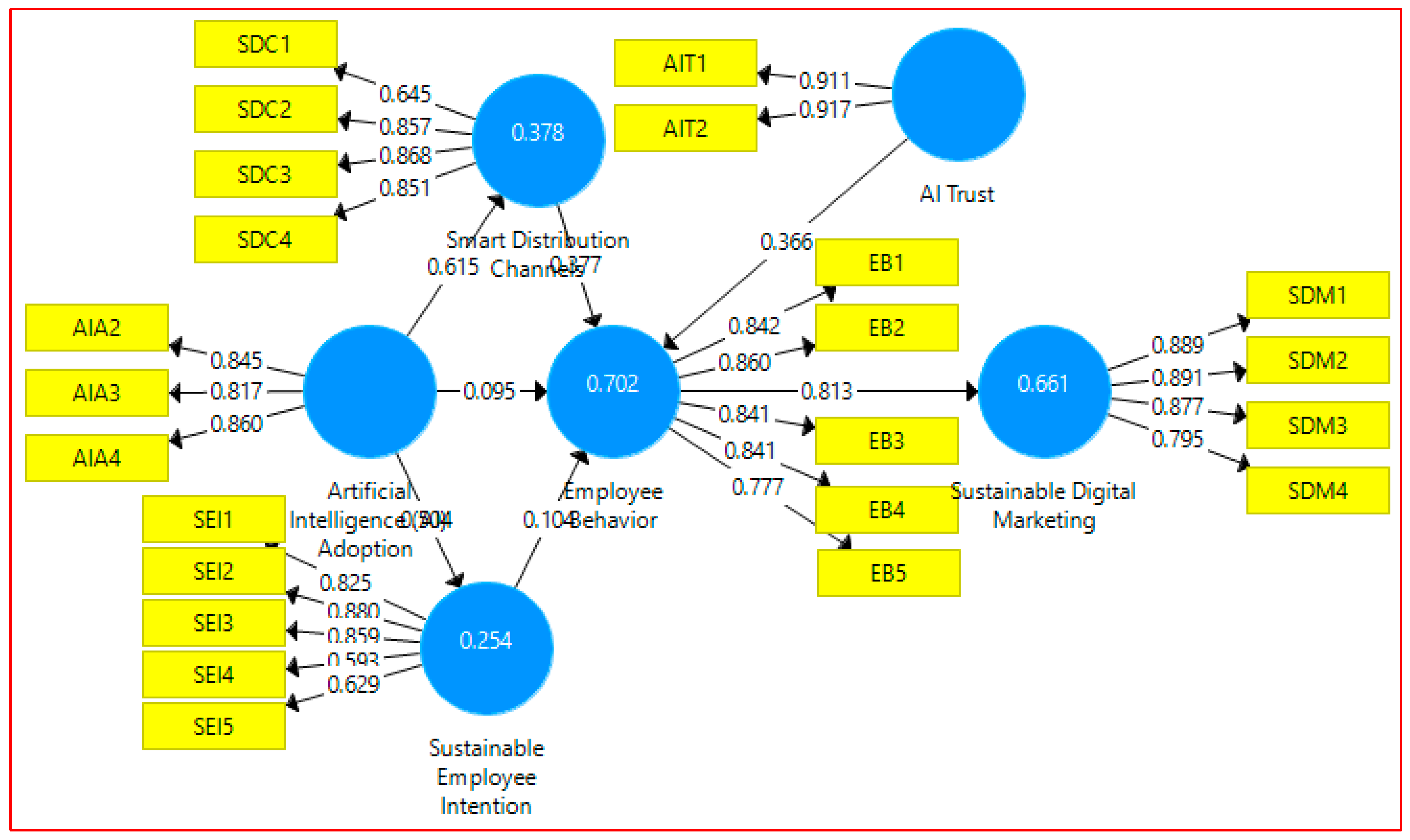
| Artificial Intelligence (AI) Adoption | AIA2 | 0.845 | 0.793 | 0.879 | 0.707 |
| AIA3 | 0.817 | ||||
| AIA4 | 0.86 | ||||
| AI Trust | AIT1 | 0.911 | 0.803 | 0.91 | 0.835 |
| AIT2 | 0.917 | ||||
| Employee Behavior | EB1 | 0.842 | 0.89 | 0.919 | 0.694 |
| EB2 | 0.86 | ||||
| EB3 | 0.841 | ||||
| EB4 | 0.841 | ||||
| EB5 | 0.777 | ||||
| Smart Distribution Channels | SDC1 | 0.645 | 0.819 | 0.883 | 0.657 |
| SDC2 | 0.857 | ||||
| SDC3 | 0.868 | ||||
| SDC4 | 0.851 | ||||
| Sustainable Digital Marketing | SDM1 | 0.889 | 0.886 | 0.921 | 0.746 |
| SDM2 | 0.891 | ||||
| SDM3 | 0.877 | ||||
| SDM4 | 0.795 | ||||
| Sustainable Employee Intention | SEI1 | 0.825 | 0.818 | 0.875 | 0.588 |
| SEI2 | 0.88 | ||||
| SEI3 | 0.859 | ||||
| SEI4 | 0.593 | ||||
| SEI5 | 0.629 |
| AIT | AIA | EB | SDC | SDM | SEI | |
|---|---|---|---|---|---|---|
| AI Trust | ||||||
| Artificial Intelligence (AI) Adoption | 0.578 | |||||
| Employee Behavior | 0.804 | 0.649 | ||||
| Smart Distribution Channels | 0.793 | 0.757 | 0.617 | |||
| Sustainable Digital Marketing | 0.609 | 0.64 | 0.708 | 0.714 | ||
| Sustainable Employee Intention | 0.715 | 0.621 | 0.803 | 0.602 | 0.689 |
| β | Mean | SD | T Statistics | p Values | |
|---|---|---|---|---|---|
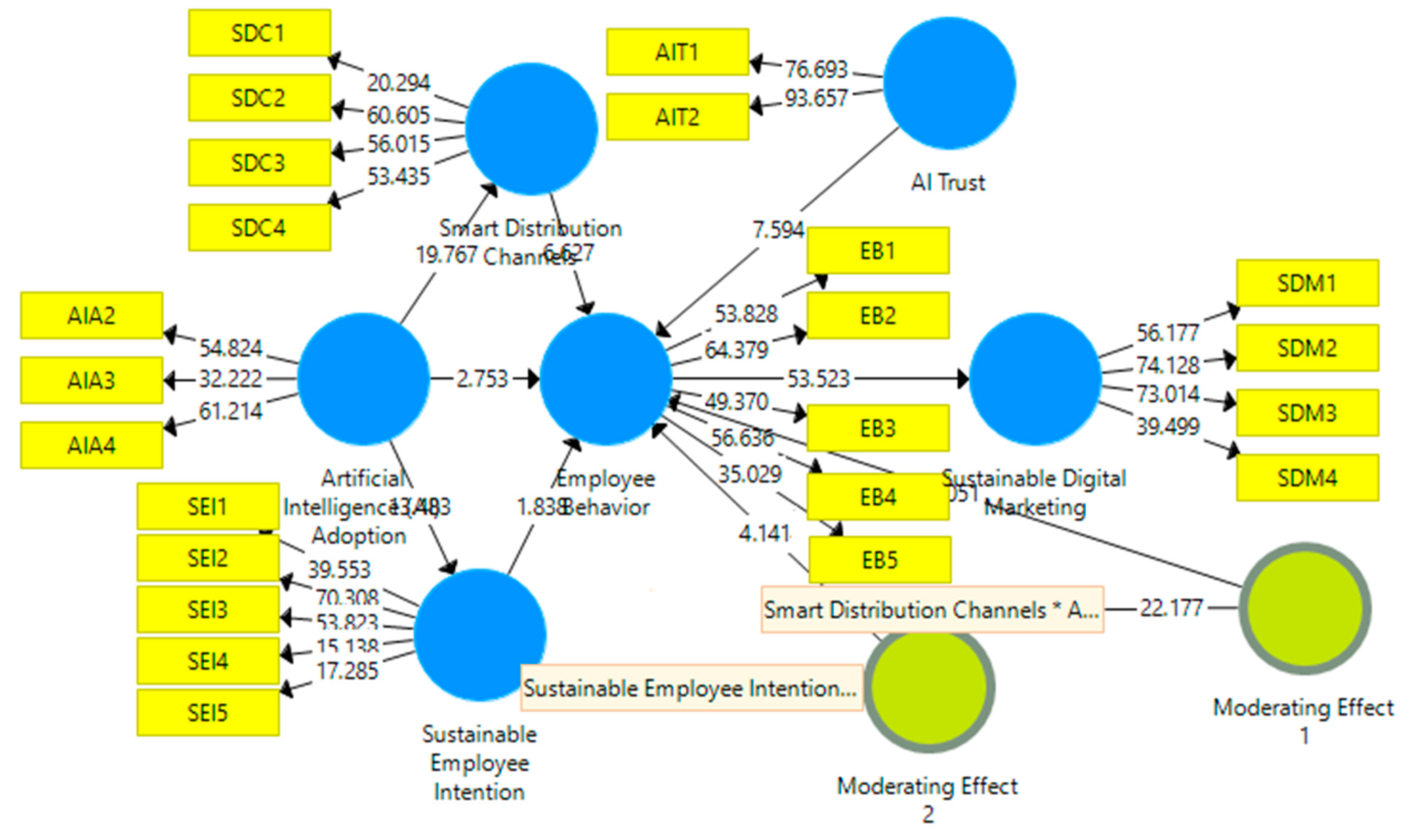
| AI Trust → Employee Behavior | 0.352 | 0.352 | 0.046 | 7.594 | 0 |
| Artificial Intelligence (AI) Adoption → Employee Behavior | 0.096 | 0.096 | 0.035 | 2.753 | 0.006 |
| Artificial Intelligence (AI) Adoption → Smart Distribution Channels | 0.615 | 0.614 | 0.031 | 19.767 | 0 |
| Artificial Intelligence (AI) Adoption → Sustainable Employee Intention | 0.504 | 0.502 | 0.037 | 13.483 | 0 |
| Employee Behavior → Sustainable Digital Marketing | 0.813 | 0.813 | 0.015 | 53.523 | 0 |
| Moderating Effect 1 → Employee Behavior | −0.068 | −0.064 | 0.064 | 1.051 | 0.294 |
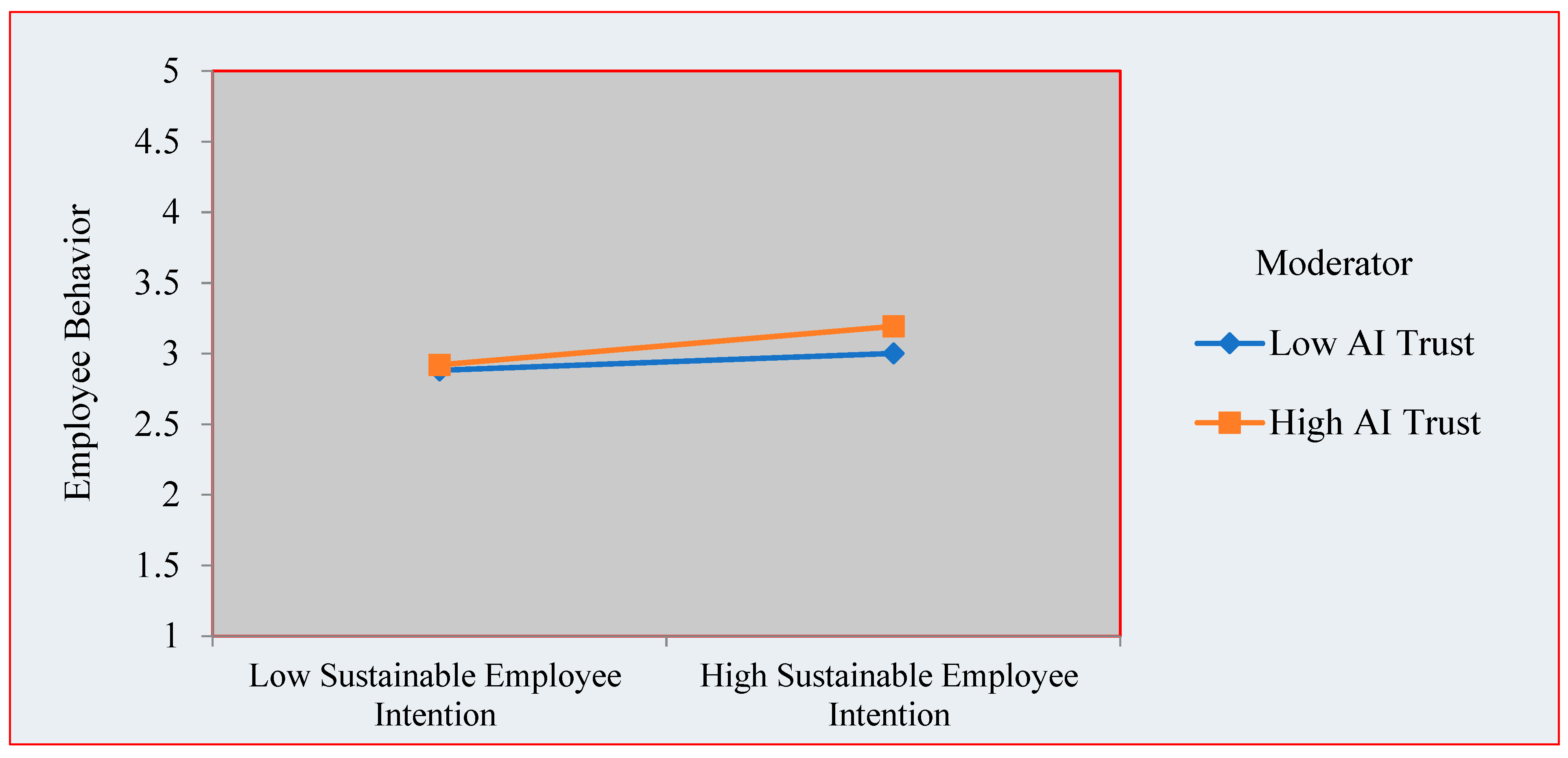
| Moderating Effect 2 → Employee Behavior | 0.058 | 0.06 | 0.014 | 4.141 | 0 |
| Smart Distribution Channels → Employee Behavior | 0.372 | 0.369 | 0.056 | 6.627 | 0 |
| Sustainable Employee Intention → Employee Behavior | 0.098 | 0.101 | 0.054 | 1.838 | 0.067 |
| β | Mean | SD | T Statistics | p Values | |
|---|---|---|---|---|---|
| Artificial Intelligence (AI) Adoption → Sustainable Employee Intention → Employee Behavior | 0.05 | 0.051 | 0.027 | 1.806 | 0.071 |
| Artificial Intelligence (AI) Adoption → Smart Distribution Channels → Employee Behavior | 0.229 | 0.226 | 0.036 | 6.281 | 0 |
Disclaimer/Publisher’s Note: The statements, opinions and data contained in all publications are solely those of the individual author(s) and contributor(s) and not of MDPI and/or the editor(s). MDPI and/or the editor(s) disclaim responsibility for any injury to people or property resulting from any ideas, methods, instructions or products referred to in the content. |
© 2025 by the authors. Licensee MDPI, Basel, Switzerland. This article is an open access article distributed under the terms and conditions of the Creative Commons Attribution (CC BY) license (https://creativecommons.org/licenses/by/4.0/).
Share and Cite
Aljumah, A.I.; Nuseir, M.; El Refae, G. Employee Behavior in Sustainable Digital Marketing: The Role of AI Technologies in the UAE. Adm. Sci. 2025, 15, 491. https://doi.org/10.3390/admsci15120491
Aljumah AI, Nuseir M, El Refae G. Employee Behavior in Sustainable Digital Marketing: The Role of AI Technologies in the UAE. Administrative Sciences. 2025; 15(12):491. https://doi.org/10.3390/admsci15120491
Chicago/Turabian StyleAljumah, Ahmad Ibrahim, Mohammed Nuseir, and Ghaleb El Refae. 2025. "Employee Behavior in Sustainable Digital Marketing: The Role of AI Technologies in the UAE" Administrative Sciences 15, no. 12: 491. https://doi.org/10.3390/admsci15120491
APA StyleAljumah, A. I., Nuseir, M., & El Refae, G. (2025). Employee Behavior in Sustainable Digital Marketing: The Role of AI Technologies in the UAE. Administrative Sciences, 15(12), 491. https://doi.org/10.3390/admsci15120491