Article

Remote Work and Job Satisfaction: A Decade of Insights Through a Bibliometric Lens

1
ESTA Belfort, School of Business and Engineering, 3 Rue du Dr Frery, 90000 Belfort, France
2
Higher Institute of Management of Sousse, RJ7G+M7, Sousse 4000, Tunisia
*
Author to whom correspondence should be addressed.
Adm. Sci. 2025, 15(11), 439; https://doi.org/10.3390/admsci15110439
Submission received: 23 August 2025 / Revised: 1 November 2025 / Accepted: 4 November 2025 / Published: 12 November 2025

Abstract

This study analyzes the relationship between remote work and job satisfaction from a bibliometric perspective. Remote work has grown in popularity, especially due to global trends accelerated by the pandemic, which impacts employee safety, wellbeing, and satisfaction. Based on 199 articles indexed in Scopus from 2014 to 2024, we identified a steady growth of this topic, with significant increases between 2021 and 2023. Global collaboration analysis indicates that the United States, India, and the United Kingdom are at the forefront of research and should work towards bridging knowledge across the Global North and South. We identify factors related to the satisfaction of remote workers (balance between on-site and off-site work, autonomy, flexibility, social isolation, gender differences). A keyword co-occurrence analysis was conducted to identify topical coverage and was complemented by clustering highly cited studies. We examine differences between the public and private sectors and suggest research paths to better understand the implications of remote work for job satisfaction in different organizational contexts.

1. Introduction

Remote work, once considered an out-of-the-mainstream practice, has become universally adopted over the last decade, with unprecedented momentum due to the COVID-19 pandemic. According to a 2021 International Labor Organization (ILO) report, more than 560 million workers worldwide were forced to work from home during the pandemic, representing nearly 17.4% of the global workforce. Recent studies have shown that this transformation is not only temporary but has reshaped global labor markets in a lasting way, making it a major focus of management and organizational research (Wang et al., 2021; Parikh & Pirani, 2025; Brady & Prentice, 2025). This sudden change has led to radical alterations in the character of work, as viewed by employees and businesses, giving rise to fierce debates on productivity, psychological wellbeing, and especially job satisfaction. In some countries, such as the United States, around 22% of workers have continued to work remotely on a regular basis after the pandemic, highlighting the permanence of this new form of work organization.
While many employees appreciate the flexibility offered by remote work, others emphasize the challenges that it presents, such as social isolation, the difficulty in maintaining a work–life balance, and even the impact on relationships within work teams. It is in this context that the study of job satisfaction becomes crucial. Job satisfaction, although it is a multidimensional concept, is generally understood as an individual’s overall attitude toward their job, and it is influenced by various psychological, social, and organizational factors. However, recent contributions argue that existing knowledge remains fragmented and context dependent, which reinforces the need for a comprehensive synthesis (Kraus et al., 2020).
Historically, the relationship between remote work and job satisfaction has generated moderate interest in academic and professional circles. However, with the global adoption of remote work, this relationship has become a central focus of current research, covering the fields of work psychology, human resource management, and organizational management. Initial studies pointed toward an improvement in worker satisfaction due to greater flexibility and independence (Lu & Zhuang, 2023). However, contemporary findings have a balanced trend, as studies have identified flaws such as loneliness and imbalances between genders in terms of domestic work. This divergence in findings highlights the need to clarify the conditions under which remote work enhances or reduces satisfaction, a gap that bibliometric analysis can help address by mapping trends, clusters, and determinants across a decade of publications (Carillo et al., 2021).
The aim of this study is to analyze the evolution of scientific research on remote work and job satisfaction by employing a bibliometric approach and considering scientific articles published between 2014 and 2024. By doing so, this research responds to recent calls for systematic reviews capable of integrating multidisciplinary insights and providing clearer theoretical directions for future research (Donthu et al., 2021). We focus on identifying key trends, the most efficient countries in this field of study, and the ensuing global collaborations. This research aims to shed light on the global dynamics that shape this field of study and to present new concepts for future research.
The objectives of this study are to provide a rigorous synthesis of publications on the link between remote work and professional satisfaction, to determine the main influential factors identified in the literature, and to highlight the theoretical or empirical gaps to be filled in future research. In line with this objective, we also formulate the following guiding research questions to strengthen the red thread in this paper: What are the global trends in publications on remote work and job satisfaction over the last decade? Which countries, collaborations, and journals are most influential in this field? What determinants and conceptual domains emerge as central to explaining job satisfaction among remote workers?

2. Review Protocol, Design, and Structure

The relation between remote work and professional satisfaction has been extensively explored in numerous academic studies within an expanding domain. Nonetheless, co-thematic research remains nascent and has yet to be thoroughly investigated. Consequently, in accordance with Chakma et al. (2021), we employed a hybrid integrated review that amalgamated bibliometric analysis with a framework-based review. In our research, we employed the four Ws (What, Where When, and Why; hereafter, 4Ws) to enhance the structure of this review. Chakma et al. (2021) assert that the analytical synthesis of previous research facilitates topic development, aids scholars in acquiring contemporary insights into a particular study subject and assists in pinpointing research deficiencies. Therefore, performing a hybrid review yields a more comprehensive comprehension of research on remote work and professional satisfaction and facilitates the identification of future research directions.
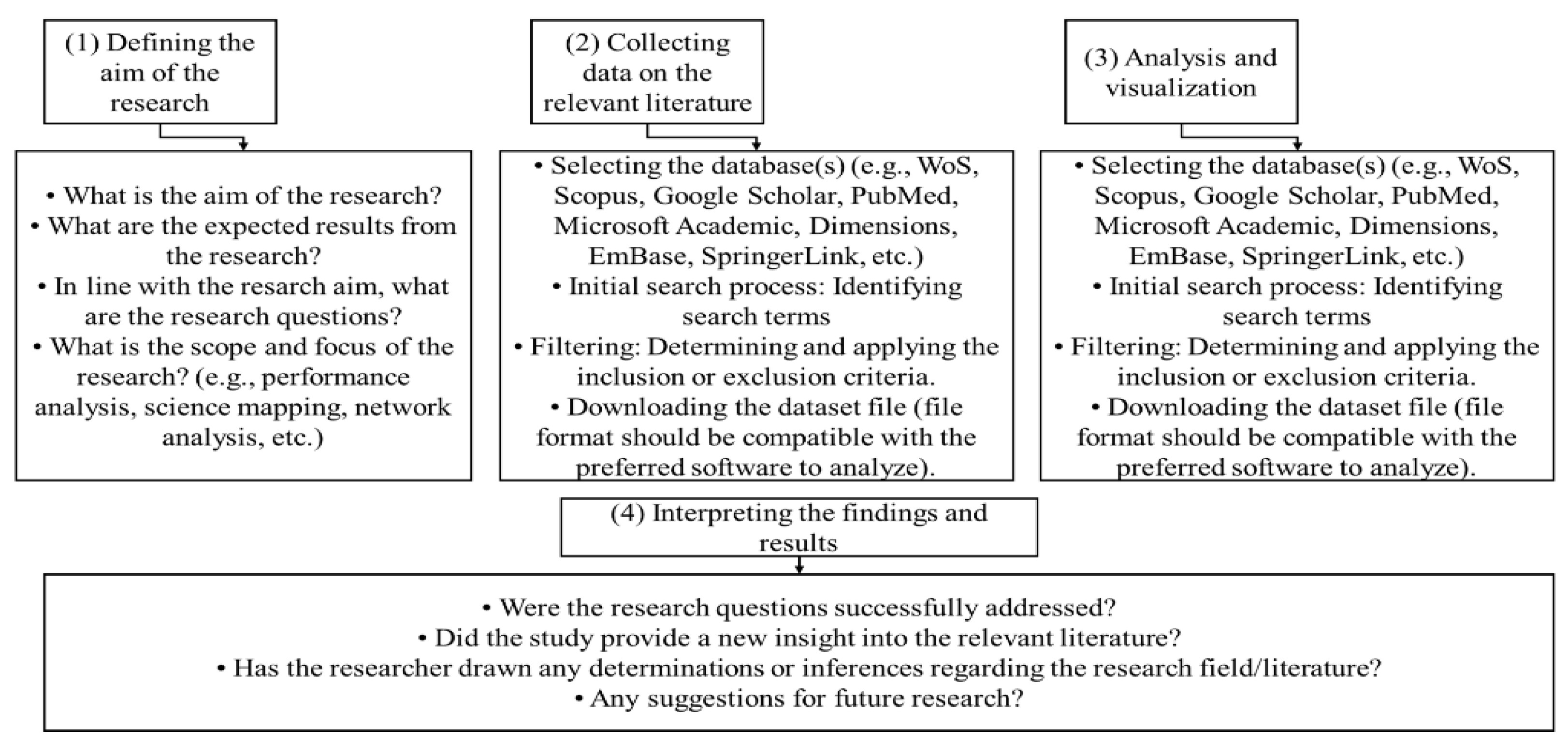
Protocols play a vital role in systematic literature reviews because they ensure careful planning, consistent implementation, and transparency, thereby allowing replication. Only a limited number of protocols exist for conducting bibliometric reviews. In our study, we followed the framework proposed by Öztürk et al. (2024), which is designed in four stages: defining the aim of the research, collecting data on the relevant literature, analysis and visualization, and interpretation of the findings and results. Figure 1 illustrates the model’s structure. In the following section, we present the work completed in each step of the protocol.
The first primary stage, “defining the aim of the research,” contains four substages. The first and second substages involve the designation of the aim of the research and the expected results, which, in this case, are not limited to a descriptive bibliometric analysis but extend to reveal the conceptual development in the field and the evolution of the literature on remote work and job satisfaction, resulting in the construction of a research agenda on the subject. Then, in the third substage, the following research question is formulated: “What is the global trend of scientific publication on remote work and job satisfaction?”. Finally, we define the scope and focus of the research, which includes performance analysis, scientific mapping, network analysis, and antecedent analysis.
In the second primary stage, “collecting data on the relevant literature,” we began with the data collection using the Scopus database, in accordance with prior studies (Ahmed et al., 2022; Alshater et al., 2021; Baker et al., 2020). This database was utilized for several reasons. Firstly, it constitutes one of the greatest multidisciplinary repositories of peer-reviewed scholarly literature. Secondly, it ranks among the most accessible databases cataloging the most esteemed journals in the finance domain (Ahmed et al., 2022). Third, it offers users sophisticated search functionalities and diverse features for bibliometric analysis, including the ability to export bibliographical data tailored to users’ requirements. For the “initial search process,” we chose to limit our process of identifying articles to the period from January 2014 to November 2024, the time of our data collection. We utilized a wide range of search terms derived from prior reviews (e.g., Goodell et al., 2021; Wu et al., 2020), which included the following: “remote work” OR “telecommuting” OR “teleworking” OR “work from home” OR “home-based work” OR “virtual work” OR “distributed work” OR “hybrid work”; “job satisfaction” OR “employee satisfaction” OR “work satisfaction.” A total of 824 results were generated. In the “filtering” substage, only original papers written in English were selected. We defined “original papers” as peer-reviewed journal articles presenting primary research findings directly related to remote work and job satisfaction. We applied Scopus filters to exclude “retracted” and “retracted article” records and to limit the corpus to articles only, excluding errata, retraction notices, editorials, notes, books, and conference items. Then, we used the CiteSpace software (Version 6.3.R3) to remove duplicate papers. To guarantee the scientific quality of the dataset, only original peer-reviewed journal articles were retained, as these publications undergo a formal evaluation process before acceptance. All other sources (conference papers, books, editorials, reviews, retracted publications, and non-English documents) were excluded. The screening was conducted independently by three researchers, and disagreements were resolved through discussion. This filtering phase allowed us to exclude 625 papers and to keep 199 others, which constituted the final basis of our bibliometric analysis.
During the analysis and visualization phase, we employed bibliometrics to identify the essential quantitative characteristics related to a particular field of study (Junquera & Mitre, 2007). This methodology allowed us to verify crucial information related to the research topic, such as the evolution of the number of publications per year and the most productive countries. The use of the VOSviewer software (Version 1.6.20), an online software offering a user-friendly and easy-to-use interface, made it possible to analyze the correlations between variables (employability and digitalization) and data from different countries and journals. Moreover, the software includes a conceptual map and identifies currently popular topics. In addition, the use of the CiteSpace software made it possible to identify the cluster with the most pronounced level of activity. The results generated by Citespace are presented in Appendix A. Furthermore, the 4Ws approach helped answer our theoretical research question.
The fifth section of our article (“Avenues for Future Research”) and the conclusion present the results of the fourth phase, interpreting the findings and results.

3. Results of the Bibliometric Analysis: Performance Analysis and Scientific Mapping

In this section, we describe the use of a bibliometric analysis to methodically map the scientific landscape, building on insights described in Section 3.2 and Section 3.3, which examine the application domains and evolution of remote work and job satisfaction, as well as the important aspects influencing them. By using this method, we measure publication trends, pinpoint significant writers and journals, and find thematic clusters that represent the “Where,” “When,” and “Why” of the research in this field. We offer a more thorough knowledge of the evolution and present status of research on remote work and job satisfaction by combining qualitative insights from the literature review with quantitative bibliometric information. The “Results” section presents the main findings of the bibliometric analysis conducted on the relationship between remote work and job satisfaction. Using data from the Scopus database (2014–2024), we examined publication trends, country contributions, and journal networks. The figures were generated with CiteSpace and VOSviewer, two widely used tools for scientific mapping and visualization.

3.1. Number of Publications per Year

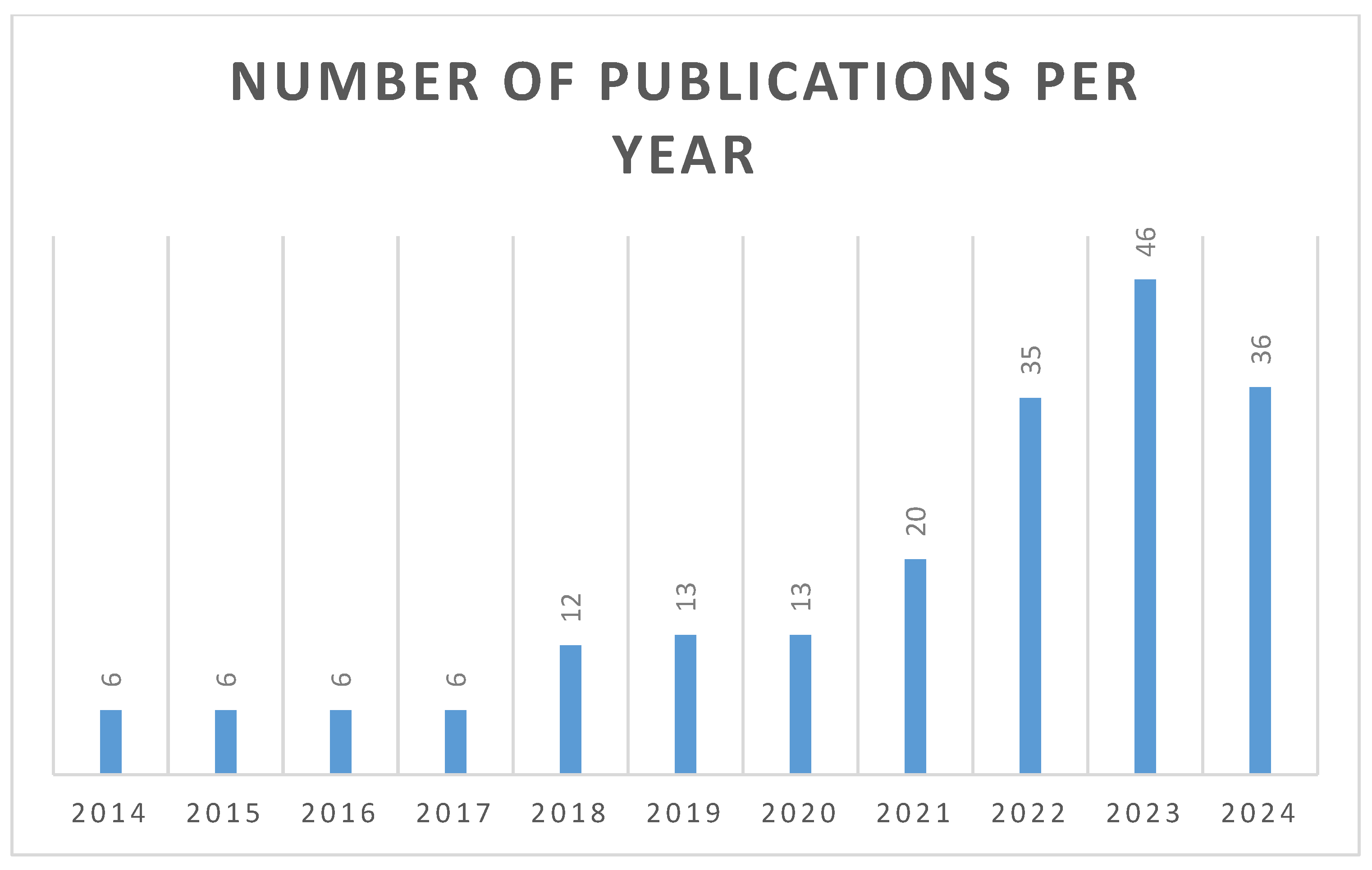
The graph shown in Figure 2 illustrates the growth of the number of publications in the Scopus database between 2014 and 2024. The graph shows a series of significant trends in scientific production on the topic of the relationship between remote work and job satisfaction. Between 2014 and 2017, interest in this relationship had not yet gained momentum, and the publication count remained constant at six articles per year. Starting in 2018, however, a strong rise in the publication count could be observed. The number of articles rose from 6 in 2017 to 12 in 2018 and to 13 in 2019 and 2020, thus indicating a moderate boost in interest in this research topic. The momentum continued to increase in 2021, with 20 publications. This trend was strengthened even further in 2022, when the number of articles was 35. A new high was recorded in 2023 with 46 publications, and this acceleration continued with 36 papers until November 2024. This sudden increase in the number of publications from 2021 onwards is largely explained by the start of the COVID-19 pandemic, which radically changed work habits all over the world.

3.2. Contributions to the Research by Country

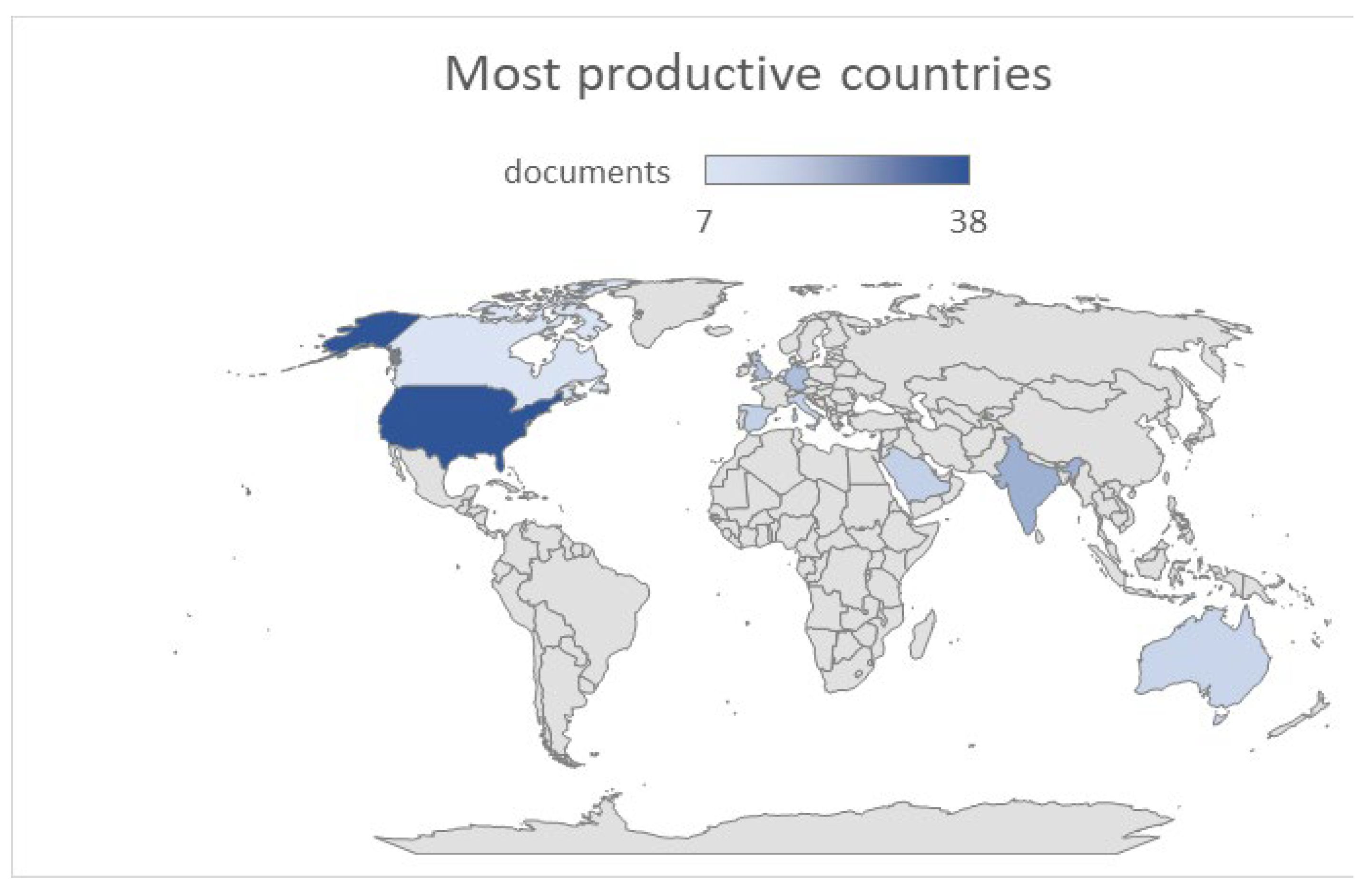
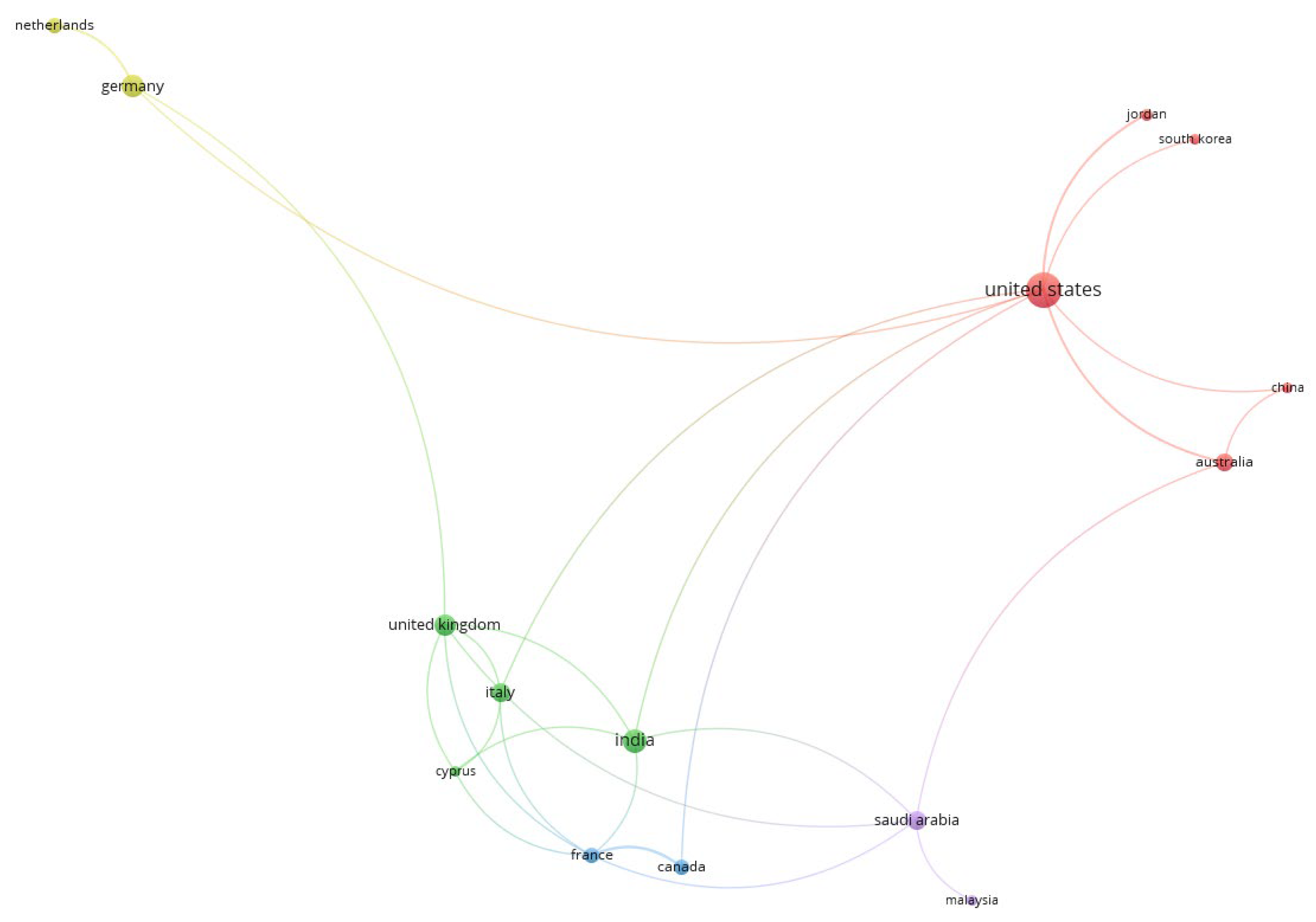
Figure 3 shows the contributions of the countries with the most research on the relationship between job satisfaction and remote work. Nodes represent countries, and edges indicate collaboration links; the map was generated in VOSviewer using fractionalization normalization. The United States tops the list with an exceptional scientific output of 38 papers, next to India (18 papers) and Germany (15 papers). Although these countries lead in terms of quantity, other nations, such as the United Kingdom, also demonstrate notable influence with many citations, indicating the robust impact of their contributions to the field. Simultaneously, contributions to international cooperations are made by other countries, such as Italy, Australia, and Saudi Arabia. This collaboration improves cooperation in the exchange of knowledge and research on remote work, a theme that is becoming increasingly central in the post-pandemic era. In terms of citation counts, the United States, the United Kingdom, and India stand out as the most influential, confirming that their contributions are not only numerous but are also widely recognized within the academic community.
Figure 4 shows a network of scientific collaborations between different countries. The colors represent collaboration clusters, while the size of the nodes and the thickness of the links indicate the importance and strength of the connections, respectively. The red cluster centered around the United States shows that this country, as a global leader in research and innovation, has built strong ties with countries such as China, Australia, and South Korea. This can be explained by the importance of academic exchanges between these nations, as well as by strategic partnerships in the field of new technologies and the digital transformation of work. The United States has thus been a key player in accelerating remote work through its scientific contributions while also strengthening collaborations with countries that have rapidly growing technology industries.
The green cluster, which depicts the significant collaborations between the United Kingdom, India, and several European countries, reflects another dynamic. The United Kingdom, historically linked to India through academic and economic relations, continues to exert notable influence in this field. Moreover, its strong collaborations with countries such as Italy and Cyprus can be explained by the increased research in Europe on the effects of remote work and the adaptation of work systems in the post-COVID context, a subject that has become essential for companies seeking to maintain employee satisfaction through flexible working methods. These European collaborations demonstrate regional synergy on issues related to the transformation of working conditions.
Finally, clusters such as that between Germany and the Netherlands show strong bilateral partnerships, which are probably due to geographical proximity and the shared orientation toward the digitalization of their economies.

3.3. Review and Analysis

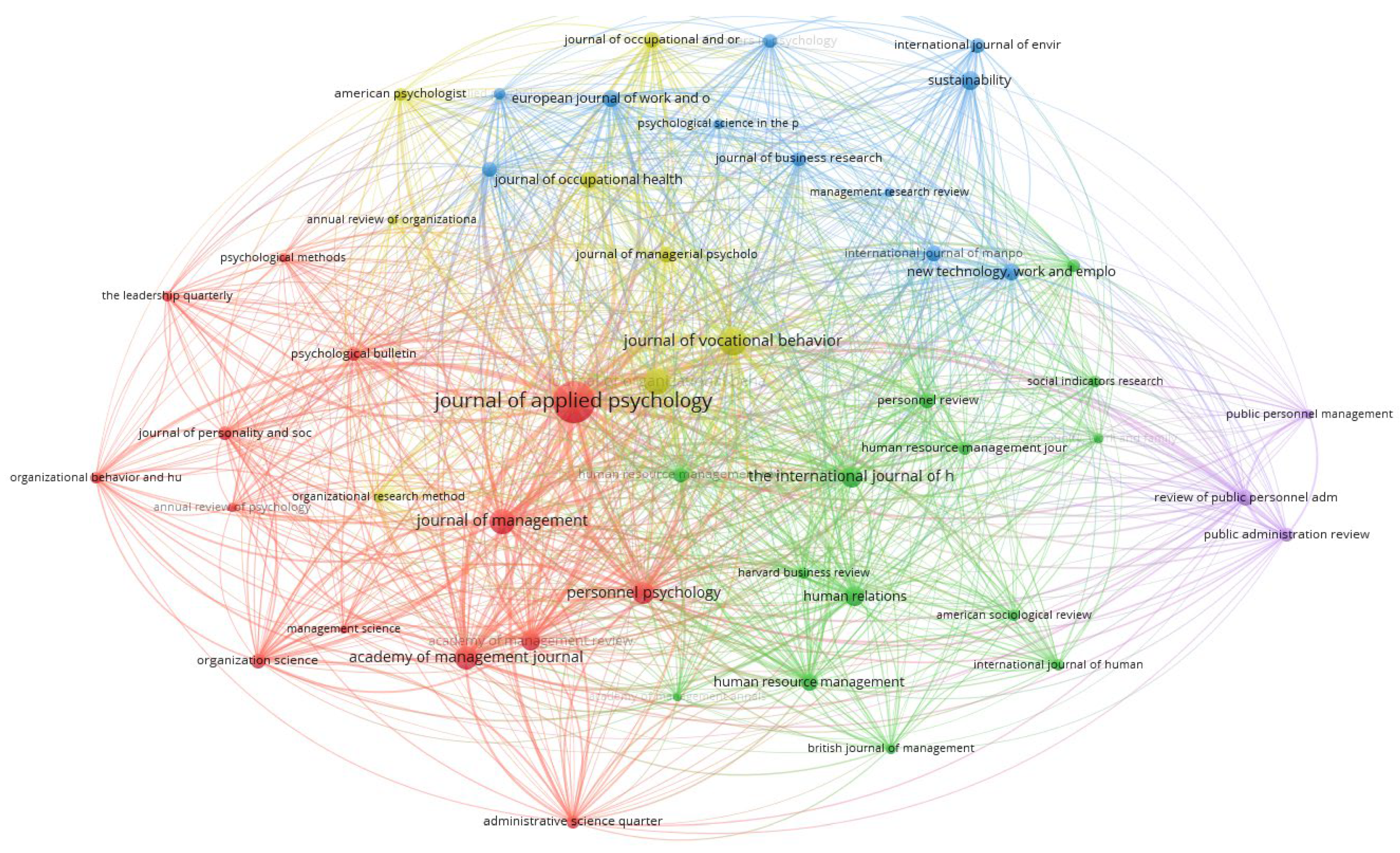
Figure 5 presents clusters that reflect interconnected disciplines where applied psychology, human resource management, occupational health, and behavioral sciences intersect to analyze behaviors and processes within organizations. Each node represents a journal, and edges denote co-citations; visualization was created in CiteSpace using cosine similarity. Each color is used to group journals that are frequently co-cited because they address complementary themes, such as employee wellbeing, talent management, and the impact of organizational practices on performance. This network highlights the importance of interdisciplinary collaborations in better understanding the complex dynamics of the world of work.
The collaborations between academic journals represented by the clusters in this image can be explained by thematic and methodological convergences within the studied disciplines. Each cluster brings together journals that, although specialized, share common areas of interest, which leads to strong co-citation among them.
The red cluster around the Journal of Applied Psychology includes journals dealing with applied psychology and organizational behavior. These collaborations are explained by the fact that these studies focus on how individual behaviors and organizational dynamics influence employee performance and satisfaction. These themes are essential not only in the field of psychology but also in management, hence the strong interaction with management journals such as the Journal of Management. Human resource management and applied psychology naturally converge in the study of productivity, motivation, and wellbeing at work.
Similarly, the green and blue clusters group journals that focus on more specific aspects, such as human resource management and occupational health psychology. Researchers in these fields frequently collaborate because issues of wellbeing, talent management, and the improvement of working conditions converge in many ways, particularly in the era of remote work and the digitalization of work environments. These collaborations are also driven by cross-cutting issues that concern both the public sector (as shown by the purple cluster with public management journals) and the private sector.
As shown in Table 1, the top ten most frequently co-cited journals illustrate the interdisciplinary nature of research on remote work and job satisfaction, bridging applied psychology, management, and human resource studies.
Beyond mapping publication trends, country contributions, and co-citation networks, our bibliometric analysis also highlighted some specific determinants of satisfaction among remote workers. Most of the determinants surfaced through the keyword co-occurrence analysis, which numbered concepts that emerged again and again, such as work–life balance, autonomy, and flexibility. Additionally, when these themes emerged, they were also emphasized by the most frequently cited studies in the bibliometric mapping, reaffirming the significance of these determinants of job satisfaction in the context of remote work. For instance, social isolation and gender differences in work allocation seemed to appear more clearly in the qualitative syntheses of prominent articles. By triangulating the keyword co-occurrence findings with the perspective of the most cited articles included in the bibliometric mapping, we were able to arrive at and emphasize these determinants as the core explanatory variables that connected the bibliometric mapping with the conceptualization of satisfaction experienced by remote workers. Alongside the apparent insight into recurring and key determinants of remote worker job satisfaction, we also outlined a basis for discussing future research. Thus, the following section uses this foundation and these insights to consider how existing knowledge might be expanded by considering dimensions that were not sufficiently illuminated, such as the contexts of culture and sector, the continuing effects of COVID-19, and new work requirements.

4. Antecedent (4Ws)

4.1. Conceptualization (“What”)

Although the concept of remote work is not new, its adoption experienced a notable expansion beginning in 2020 in response to the health crisis caused by the COVID-19 pandemic (Alam & Dewi, 2024). This sudden evolution highlighted the diversity of forms that remote work can take, making it difficult to establish a single universal definition (Bellmann & Hübler, 2021). Indeed, the way in which remote work is implemented depends on multiple factors—notably, the nature of professional activities, the technologies used, and employees’ preferences and situations (Vayre, 2016). Thus, it is necessary to position the definition of remote work within three distinct periods: before, at the time of, and after the global health crisis. This will allow for not only a better understanding of the evolution of the term but also the recognition of its drivers that influenced its development and its impact on organizational practices.
Before the pandemic, remote work was mainly described by Nilles (1994) as a form of work done outside the traditional workplace with communication aided by information and communication technologies (ICTs). This definition highlights two main factors: the use of technology to maintain communication and physical distance from the classic workplace. Vayre (2016) later clarified this definition by stating that it is all professional work done wholly or partially at a distance, outside the employer’s territory, for at least one day per week, and it is based on ICTs. This definition includes three important criteria: geographical distance from the workplace, the frequency of distant work, and the utilization of ICTs as an essential tool for communication and the accomplishment of tasks. These definitions, despite evolving, share common principles that transcend industrial sectors and geographic contexts, underlining remote work as a form of work organization where the use of technology enables professional tasks to be carried out outside the employer’s premises on a regular basis (Solís, 2017).
Remote work has experienced unprecedented growth since the global health crisis. Between January and March 2020, most governments ordered the closure of business premises while encouraging companies to maintain their activities by temporarily resorting to remote work. Faced with this situation, many companies were forced to rapidly implement remote work as a provisional solution, often without prior preparation and in an uncertain context, to ensure the continuity of their operations. According to Fuhrer (2023), “during the lockdown, working from home was—when possible—the mandatory mode of work. This remote work was sudden for most, mandatory and unplanned”. Barrero et al. (2021) highlighted an increase in the rate of remote work from 5% to 50% during the crisis in the United States. All of these researchers presented their definitions by emphasizing the term “forced remote work”, which characterizes the definitions from this period, in addition to them being “unplanned, unanticipated”.
After the COVID-19 pandemic, organizations were led to rethink their work organization methods. They moved from imposed and unprepared remote work to hybrid work models, which have become well-structured and planned (Lauzier et al., 2023). Remote work has profoundly transformed the labor market by promoting greater flexibility, improved efficiency, and increased sustainability (Taboroši et al., 2022). However, as with any major change, this mode of work, despite offering many advantages, also raises considerable challenges on both an individual and an organizational level. Table 2 summarizes the most significant definitions across the three periods.
According to previous studies, it has been shown that remote work can have both positive and negative consequences, depending on the profiles of remote workers, the dimensions of work quality assessed, employer support, personal preferences, and family structure; among these consequences, the effect on job satisfaction is one of the most frequently studied (Smith et al., 2018; Zöllner & Sulíková, 2021; Margheritti et al., 2024). We will first present the different definitions of this concept, as the scientific literature reveals a consensus on the absence of a universal definition of job satisfaction, which has led to the emergence of multiple distinct definitions.
These variations in definitions reflect the complexity of the concept, which is often influenced by contextual and individual factors.

4.2. The Application Domains of the Relationship Between Remote Work and Job Satisfaction (“Where”)

Research on remote work and job satisfaction has been conducted in various fields of activity and areas of study. This relationship has fascinated scholars in a broad array of disciplines, such as economics, psychology, management, and the sociology of work. Karácsony (2021) examined the impact of remote work on Slovak employees during the second wave of the COVID-19 pandemic in Slovakia. The results reveal a clearly positive effect of remote work on employees’ job satisfaction. In particular, the relationship between managers and subordinates improved, while the balance between professional and personal lives also evolved positively. Lu and Zhuang (2023) empirically examined the effects of remote work on workers’ enjoyment during daily work episodes and on job satisfaction in the United Kingdom. Their study led to two major findings. First, among men, remote workers tend to have higher levels of job enjoyment and job satisfaction, which is not the case among women. Second, approximately 46% of the positive effects of remote work on men’s job satisfaction can be explained by higher levels of job enjoyment. Zöllner and Sulíková (2021) conducted a literature review on the risks that employees face and the impact of remote work on their job satisfaction. This research showed that an increase in the frequency of remote work has a positive effect on job satisfaction. However, certain negative aspects, such as social and professional isolation, as well as perceived threats to career advancement, were also highlighted. Sector-specific studies add further nuance. Capecchi and Caputo (2022) showed that public administration employees in Italy experience greater job satisfaction when working from home, while the presence of children in the household significantly affects work–life balance. In the public sector, Barbieri et al. (2025) confirmed the positive effect of flexible scheduling on both job satisfaction and home-based performance. Conversely, Mousa et al. (2025) identified several obstacles to remote work in the Egyptian public sector, including limited employee discretion, citizens’ lack of familiarity with digital services, and insufficient infrastructure. Finally, Ruželė et al. (2024) examined the banking sector and found that remote work influences job satisfaction, engagement, task performance, contextual performance, and counterproductive work behaviors.

4.3. The Evolution of Research on Remote Work (“When”)

The notion of remote work was first introduced in the 1970s by Jack Nilles (Nilles, 1994). Although its use increased during the 1980s, it remained below researchers’ expectations. Faced with the unprecedented COVID-19 crisis, companies were compelled to act fast by adopting new management practices, which greatly accelerated the development of remote work (Frimousse & Peretti, 2021). Remote work, as defined by Scaillerez and Tremblay (2016), boasts high future expansion prospects in the coming years, potentially involving up to 30% of the labor force in developed countries.
In recent years, a notable wave of research has explored the relationship between remote work and job satisfaction, particularly during and after the pandemic (Zöllner & Sulíková, 2021; Margheritti et al., 2024).

4.4. The Relationship Between Remote Work and Job Satisfaction (“Why”)

During the period of widespread contagion in the COVID-19 pandemic, governments and organizations encouraged remote work with the aim of improving professional performance and promoting a better work–life balance by offering greater flexibility and allowing for better reconciliation of both spheres. However, the debate continues as to whether remote work truly improves job satisfaction and other aspects of subjective wellbeing. In fact, theoretical predictions and empirical results concerning remote workers’ satisfaction and job enjoyment are often contradictory. Research indicates that remote work presents both advantages and disadvantages. On the one hand, it can offer benefits such as increased self-efficacy related to working from home, better satisfaction, and enhanced performance. On the other hand, it can generate risks, such as professional isolation, which may negatively impact workers. Moreover, gender inequalities persist both within households and in the labor market, with women devoting more time to household chores and childcare and less time to full-time work compared with men (Kan & Laurie, 2018).

5. Avenues for Future Research

Not only are these bibliometric patterns descriptive, but they also reveal important dynamics in the field. The increase in publications illustrates how remote work became a strategic topic in management research after the pandemic. The concentration of research leadership in the United States, India, and the United Kingdom suggests asymmetries in global knowledge production, raising questions about inclusivity and knowledge transfer across regions. Finally, the identified clusters point to emerging theoretical frameworks, offering guidance for future studies.
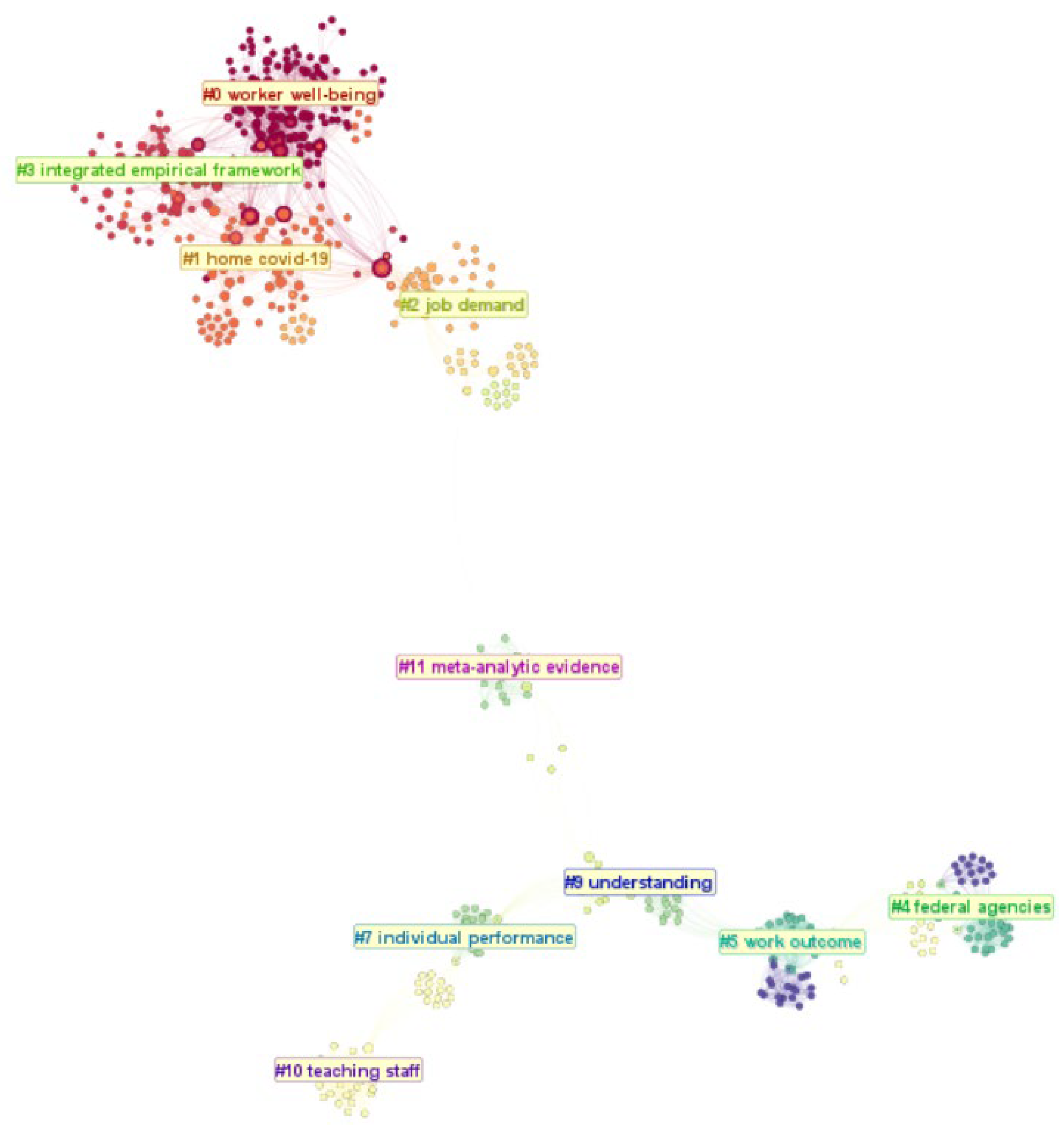
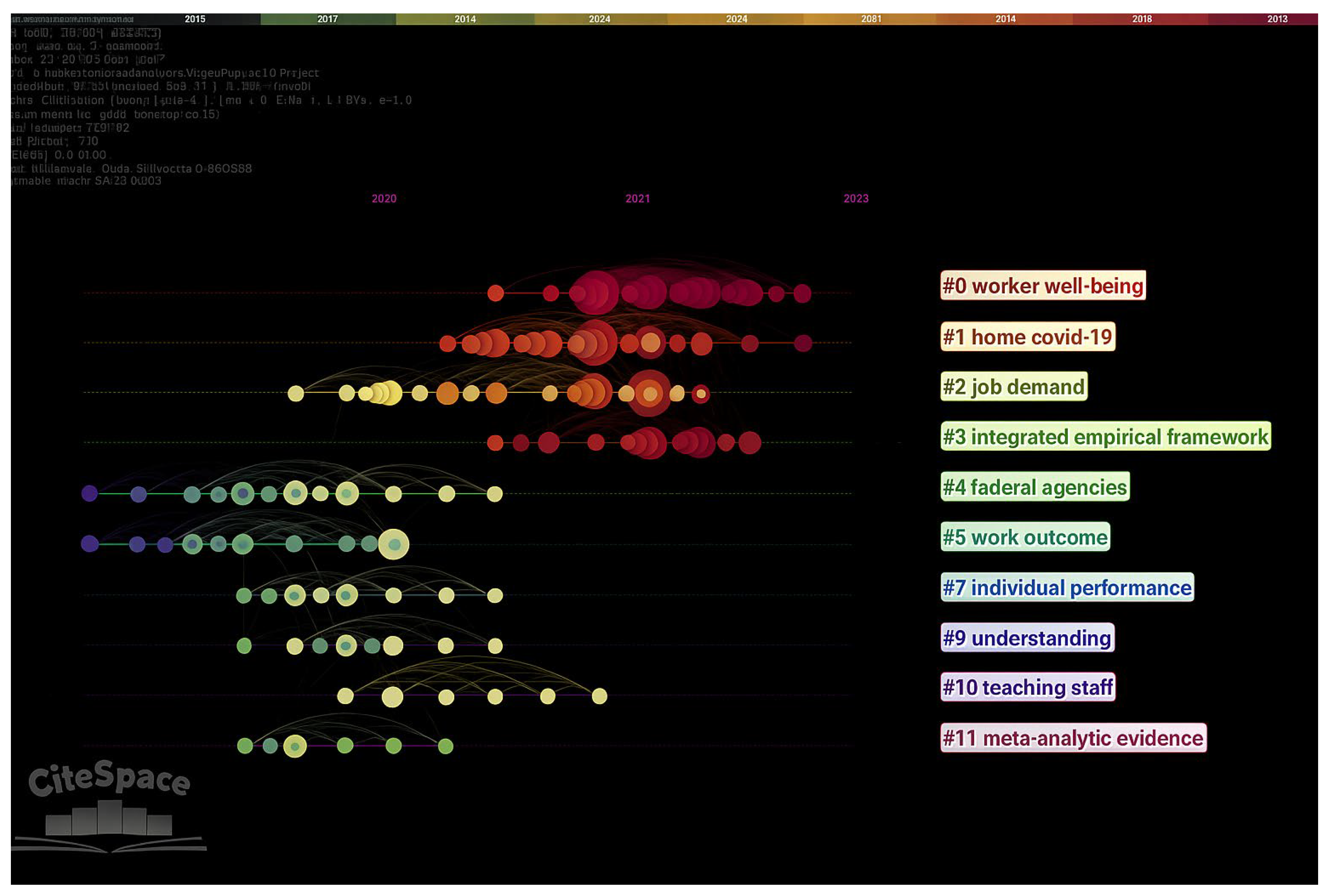
Based on the articles in the literature review, we formulated specific recommendations to guide future research. Since the COVID-19 health crisis, our knowledge of remote work has significantly progressed. By relying on the analysis of co-citation group timelines and the 4Ws, we have identified several topics—as shown in Figure 6 and Figure 7—that deserve to be further explored.
Figure 6 presents the main thematic clusters that structured the literature on remote work and job satisfaction between 2014 and 2024. Clusters illustrate current research themes, node size reflects topic frequency, and colors indicate thematic groups generated in VOSviewer. These clusters, such as worker wellbeing, home-based work during the pandemic, job demand, and integrated empirical frameworks, illustrate how research topics have been organized and consolidated over time. To complement this representation, Figure 7 highlights the clusters that are expected to become future research trends, indicating new directions, such as meta-analytic evidence, teaching staff, and individual performance. Clusters display emerging research trends; node proximity shows thematic similarity, visualized with CiteSpace timeline mapping. By combining the insights from both figures, our analysis demonstrates how current themes progressively evolve into emerging research avenues. This dual perspective provides a clearer understanding of the continuity between past studies and potential future investigations, which is further developed in the following discussion.

5.1. Wellbeing at Work

Remote work and its impacts on job satisfaction, as well as on employee wellbeing, are highly topical subjects (Giang et al., 2024; Bellmann & Hübler, 2021). Although several studies have highlighted the positive and negative effects of remote work on these dimensions, especially for human resource managers, it remains essential for future research to broaden the analytical framework by integrating additional variables and concepts to better understand this complex relationship. One promising avenue for deepening this research would be to examine the impact of national culture on the remote work experience and its effects on wellbeing at work.
Our keyword co-occurrence mapping indicates that our key concepts—such as remote work and job satisfaction—are frequently associated with notions of stress or work–life balance, but they are rarely linked to cultural dimensions. Although a few recent articles have attempted to examine the role of organizational culture, the results of our study reveal a marked underrepresentation of research integrating the variable “national culture” into analyses. This gap suggests the need to further investigate the influence of national cultural contexts on the experience of remote work and job satisfaction.
To date, although studies have explored this relationship in various contexts such as Japan, the United Kingdom, and Canada, the influence of cultural dimensions remains underexplored. For example, a study conducted by Araki and Rappleye (2024) in Japan showed that Japanese employees’ job satisfaction remained high even after their return to the office, suggesting that cultural factors, such as commitment to the company, sense of duty, and intensive work culture, may shape this relationship. Schwoerer et al. (2024) demonstrated that cultural factors significantly influence employee satisfaction at three levels—organizational, national, and individual—which highlights the importance of conducting further research on this topic.
Apart from the cultural aspect, there is little research that has specifically focused on the distinctions between the private and public sectors, as well as their specific characteristics. Indeed, existing works primarily focus on public structures (Capecchi & Caputo, 2022; Mousa et al., 2025), which highlights the importance for future studies to explore the private sector in more detail, as it is still largely unexplored in its specificities. Moreover, remote work in the public sector is often subject to strict regulations and is characterized by more pronounced job security than in the private sector. It would, therefore, be wise for research to take a comparative approach—both sectoral and international—to better understand how structural and institutional disparities between countries affect the link between remote work and job satisfaction.

5.2. Post-COVID-19 Remote Work

Research conducted in various countries has highlighted the negative effects of remote work during the pandemic on physical and mental health, wellbeing, job satisfaction, work–life balance, and productivity (Xiao et al., 2021; Oakman et al., 2020; Kinman et al., 2020; Papanikolaou & Schmidt, 2022). These effects can be explained by the forced nature of remote work, as well as the overload experienced by families, especially those with children, who had to juggle professional and family responsibilities. Given these findings, it is essential to investigate whether such negative effects have persisted in the post-pandemic context, especially now that remote work is more often a choice than a necessity. Some companies have taken steps to improve working conditions at home—for example, by providing comfortable chairs. It would be relevant for future research to evaluate whether these efforts have helped mitigate the initially observed negative effects.
Moreover, one aspect that is likely to persist is the feeling of isolation, the impact of which can vary significantly from person to person. To prevent or reduce this feeling of isolation, companies can adopt various strategies, such as organizing regular meetings (in-person or virtual) and implementing personal and professional development programs. It is essential that future research examines the effectiveness of these measures in reducing isolation. These studies could evaluate whether such precautions effectively decrease the feeling of isolation among workers while taking individual differences into account. Such an investigation would be crucial for adjusting corporate support policies and for providing a more balanced and inclusive work environment, even in the context of prolonged remote work.

5.3. New Work Requirements

The COVID-19 crisis was a catalyst for remote work. However, three years after the beginning of the pandemic, some companies had chosen to return to on-site work. For example, in 2022, Tesla required its employees to return to the office full-time. Other companies, such as Apple, opted for a hybrid model, where they asked employees to work in the office at least three days per week. This hybrid model has been adopted by many companies, especially when the physical presence of certain employees is considered necessary, particularly those in direct contact with clients. For example, Bank of America also reintroduced on-site work for certain critical functions.
Employees holding strategic or specific positions are also often expected to follow the traditional mode of work. Furthermore, recent studies have begun to examine the relationship between remote work and job satisfaction in greater detail, taking the specificity of job roles into account. For instance, the study by Giang et al. (2024) explores the impact of remote work on specific professions. Future research will need to deepen the understanding of the effects of different types of positions and of the hybrid model, as few studies have examined the relationship between this work model and employee satisfaction, as well as the effects of returning to the office.
One promising avenue for research is the exploration of the use of e-HRM (electronic human resource management). The pandemic forced companies to reevaluate and adapt their HR management practices in a hurried manner without prior preparation. In developed countries, many companies began adopting e-HRM softwares to facilitate the management of remote workers. However, few studies have examined the impact of these tools on job satisfaction. It is, therefore, crucial to conduct in-depth research to understand how e-HRM influences employee satisfaction, particularly in the context of remote work.

6. Conclusions

This study underscores that more studies need to be conducted on the psychological, organizational, and social dimensions of remote work while considering cultural specificities and sectoral contexts. Furthermore, the results highlight the importance of developing appropriate organizational measures to derive maximum benefit from remote work with minimal disadvantages and to promote sustainable employee satisfaction within this new work environment.
Our bibliometric results show that worker wellbeing, home-based work during the COVID-19 pandemic, and job demand represent the main themes structuring this research field. These findings suggest that future organizational practices should focus on mitigating isolation, supporting work–life balance, and redesigning job roles to align with hybrid and remote arrangements. In addition, the identification of clusters related to teaching staff, individual performance, and meta-analytic evidence highlights the need for sector-specific analyses and comparative approaches across industries and professions. Another key insight from our results is the strong involvement of countries such as the United States, India, and Germany, which indicates that international collaboration and cross-cultural perspectives are crucial to developing sustainable models of remote work.
Thus, this analysis contributes to a better understanding of the dynamics related to remote work and opens new research perspectives on ways to improve the wellbeing of remote workers, considering the rapid changes in professional environments and employee needs. By linking past research clusters with future trends, our study also provides a roadmap for scholars to explore underexamined areas, such as the impact of e-HRM systems, the role of national culture, and the long-term effects of hybrid work models on job satisfaction.
Our results encourage companies to establish remote work management policies such as providing leadership training for remote supervision, means of preventing isolation, support for work–life balance, and adjustment of digital tools (such as e-HR solutions) to promote employee performance and satisfaction. For government officials, it is essential to establish a precise legal framework regarding mental health at work, as well as fiscal or operational incentives that promote hybrid models.

Author Contributions

Conceptualization, S.B. and N.B.G.; methodology, S.B. and H.B.; software, S.B. and H.B.; validation, S.B.; formal analysis, N.B.G.; resources, S.B.; data curation, S.B.; writing—original draft, N.B.G. and H.B.; writing—review and editing, S.B., N.B.G. and H.B.; visualization, N.B.G.; supervision, S.B. All authors have read and agreed to the published version of the manuscript.

Funding

This research received no external funding.

Data Availability Statement

The raw data supporting the conclusions of this article will be made available by the authors on request.

Conflicts of Interest

The authors declare no conflict of interest.

Appendix A. Summary of Citespace

Time of creation: CEST 2024
Introduction
This summary is automatically generated. To maximize the level of details in the summary, we completed the following tasks before running this function:
  • Clustering and labeling by using the All in One button;
  • Run the burst detection function from the Burstness tab in the Control Panel;
  • Compute the betweenness centrality from the Nodes menu;
  • Save the current visualization as a PNG image in the project folder.
The summary highlights major clusters first, including citing articles and cited references. The importance of nodes will be summarized in terms of citation-based metrics such as citation counts and citation bursts, network-based metrics such as degree centrality and betweenness centrality. Sigma is a combination of both types, i.e., burst and betweenness centrality.
There are other features that are not included in the current summary, for example, structural variation analysis, analysis of uncertainties, concept trees, and dual-map overlays.
Major clusters
The network consists of 10 clusters. The largest 10 clusters are summarized as follows.
Table A1. Summary of the largest 10 clusters.
ClusterIDSizeSilhouetteLabel (LSI)Label (LLR)Label (MI)Average Year
01260being-oriented human resource managementworker well-being (29.61, 1.0 × 10⁻⁴)coronavirus pandemic (0.84)2020
1890influencing work-related outcomehome COVID-19 (21.46, 1.0 × 10⁻⁴)employees concern (0.78)2019
2650professional isolationjob demand (21.95, 1.0 × 10⁻⁴)professional isolation (0.33)2017
3630hr leadership supportintegrated empirical framework (19.43, 1.0 × 10⁻⁴)black swan event (0.93)2020
4570workfederal agencies (12.63, 0.001)role clarity (0.09)2012
5470psychological empowermentwork outcome (17.95, 1.0 × 10⁻⁴)interactive effect (0.12)2012
7370flexible working, individual performance, and employee attitudes: comparing formal and informal arrangementsindividual performance (9.09, 0.005)job satisfaction (0.06)2013
9340understanding teleworkers’ technostress and its influence on job satisfactionunderstanding (9.09, 0.005)job satisfaction (0.06)2014
10300an empirical study of the relationships between the flexible work systems (fws), organizational commitment (oc), work life balance (wlb) and job satisfaction (js) for the teaching staff in the united arab emirates (uae)teaching staff (7.56, 0.01)teaching staff (0.04)2017
11220meta-analytic evidence of the effectiveness of stress management at workmeta-analytic evidence (9.09, 0.005)job satisfaction (0.06)2013
Cluster #0: Worker well-being
The largest cluster (#0) has 126 members with a silhouette value of 0. The major citing articles of the cluster are as follows:
CoverageGCSLCSCiting Articles
1400Araki, S (2024-JAN) Flexibility loss and worker well-being: what happens to job satisfaction when workers lose their telework usage? Socio-Economic Review, V22, P23 DOI 10.1093/ser/mwae009
1400Bielinska-dusza, E (2024-JAN) Study on the impact of remote working on the satisfaction and experience of it workers in poland. Forum Scientiae Oeconomia, V11, P25 DOI 10.23762/FSO_VOL11_NO4_1
1200Rudolph, Cw (2024-JAN) Working from home: when is it too much of a good thing? Human Resource Development Quarterly DOI 10.1002/hrdq.21530
1100Giang, Tt (2024-JAN) Work from home and job outcomes: does well-being matter for accountants in a developing country? International Journal of Organizational Analysis, V32, P16 DOI 10.1108/IJOA-05-2023-3749
1100Gubernator, P (2024-JAN) The effectiveness of well-being-oriented human resource management in the context of telework. International Journal of Human Resource Management DOI 10.1080/09585192.2024.2354829
The most cited members in this cluster are as follows:
  • 9 Nakrosiene A, 2019, working from home: characteristics and outcomes of telework @ international journal of manpower, V40, P87–101
  • 6 Karacsony P, 2021, impact of teleworking on job satisfaction among slovakian employees in the era of COVID-19 @ problems and perspectives in management, v19, p1–9
  • 5 Song Y, 2020, does telework stress employees out? a study on working at home and subjective well-being for wage/salary workers @ journal of happiness studies, v21, p2649–2668
  • 5 ipsen c, 2021, six key advantages and disadvantages of working from home in europe during COVID-19 @ international journal of environmental research and public health, v18, p4
  • 5 kniffin km, 2021, COVID-19 and the workplace: implications issues and insights for future research and action @ american psychologist, v76, p63–77
Cluster #1: home COVID-19
The second largest cluster (#1) has 89 members with a silhouette value of 0. The major citing articles of the cluster are as follows:
CoverageGCSLCSCiting Articles
1320Anthonysamy, L (2022-JAN) Continuance intention of it professionals to telecommute post pandemic: a modified expectation confirmation model perspective. Knowledge Management and E-Learning, V14, P22 DOI 10.34105/j.kmel.2022.14.027
1370Alshibly, Hh (2022-JAN) Unlock the black box of remote e-working effectiveness and e-hrm practices effect on organizational commitment. Cogent Business and Management DOI 10.1080/23311975.2022.2153546
1350Juna, Ma (2022-JAN) Working from home, COVID-19 and multi-dimensional model of well-being theory. International Journal of Work Organisation and Emotion, V13, P29 DOI 10.1504/ijwoe.2022.126957
10670Battisti, E (2022-JAN) Remote working and digital transformation during the COVID-19 pandemic: economic–financial impacts and psychological drivers for employees. Journal of Business Research, V150, P12 DOI 10.1016/j.jbusres.2022.06.010
1090Zöllner, K (2021-JAN) Teleworking and its influence on job satisfaction. IBIMA Business Review DOI 10.5171/2021.558863
6410Sutarto, Ap (2022-JAN) Factors and challenges influencing work-related outcomes of the enforced work from home during the COVID-19 pandemic: preliminary evidence from indonesia. Global Business and Organizational Excellence, V41, P14 DOI 10.1002/joe.22157
The most cited members in this cluster are as follows:
  • 8 charalampous m, 2019, systematically reviewing remote e-workers’ well-being at work: a multidimensional approach @ european journal of work and organizational psychology, v28, p51–73
  • 6 kazekami s, 2020, mechanisms to improve labor productivity by performing telework @ telecommunications policy, v44, p2
  • 4 grant ca, 2019, construction and initial validation of the e-work life scale to measure remote e-working @ employee relations, v41, p16–33
  • 3 smith sa, 2018, communication and teleworking: a study of communication channel satisfaction personality and job satisfaction for teleworking employees @ international journal of business communication, v55, p44–68
  • 3 schall ma, 2019, the relationship between remote work and job satisfaction: the mediating roles of perceived autonomy @ work-family conflict, v0, p0
Cluster #2: job demand
The third largest cluster (#2) has 65 members with a silhouette value of 0. The major citing articles of the cluster are as follows:
CoverageGCSLCSCiting Articles
15820Jamal, Mt (2021-JAN) Work during COVID-19: assessing the influence of job demands and resources on practical and psychological outcomes for employees. Asia-Pacific Journal of Business Administration, V13, P26 DOI 10.1108/APJBA-05-2020-0149
112120Feng, Z (2020-JAN) COVID-19 created a gender gap in perceived work productivity and job satisfaction: implications for dual-career parents working from home. Gender in Management, V35, P17 DOI 10.1108/GM-07-2020-0202
11460Sarbu, M (2018-JAN) The role of telecommuting for work-family conflict among german employees. Research in Transportation Economics, V70, P14 DOI 10.1016/j.retrec.2018.07.009
101060Golden, Td (2020-JAN) Is there a price telecommuters pay? examining the relationship between telecommuting and objective career success. Journal of Vocational Behavior DOI 10.1016/j.jvb.2019.103348
6190Spilker, Ma (2021-JAN) Potential ways to predict and manage telecommuters’ feelings of professional isolation. Journal of Vocational Behavior DOI 10.1016/j.jvb.2021.103646
The most cited members in this cluster are as follows:
  • 9 Belzunegui-Eraso A, 2020, teleworking in the context of the COVID-19 crisis @ sustainability, v12, p9
  • 3 allen td, 2015, how effective is telecommuting? assessing the status of our scientific findings @ psychological science in the public interest, v16, p40–68
  • 3 golden td, 2019, unpacking the role of a telecommuters job in their performance: examining job complexity problem solving interdependence and social support @ journal of business and psychology, v34, p55–69
  • 2 avgoustaki a, 2019, examining the link between flexible working arrangement bundles and employee work effort @ human resource management, v58, p431–449
  • 2 gajendran rs, 2015, are telecommuters remotely good citizens? unpacking telecommutings effects on performance via i-deals and job resources @ personnel psychology, v68, p353–393
Cluster #3: integrated empirical framework
The fourth largest cluster (#3) has 63 members with a silhouette value of 0. The major citing articles of the cluster are as follows:
CoverageGCSLCSCiting Articles
1230Mandal, S (2023-JAN) Enablers of work from home culture: an integrated empirical framework. Benchmarking, V30, P27 DOI 10.1108/BIJ-08-2021-0476
920Pham, Nt (2023-JAN) Improving employee outcomes in the remote working context: a time-lagged study on digital-oriented training, work-to-family conflict and empowering leadership. Asia Pacific Journal of Human Resources, V61, P30 DOI 10.1111/1744-7941.12374
840Harkiolakis, T (2023-JAN) Supporting knowledge workers’ health and well-being in the post-lockdown era. Administrative Sciences DOI 10.3390/admsci13020049
600Margheritti, S (2023-JAN) How to promote teleworkers’ job satisfaction? the telework quality model and its application in small, medium, and large companies. Human Resource Development International DOI 10.1080/13678868.2023.2244705
600Santiago-torner, C (2023-JAN) Teleworking and ethical climate. the mediating effect of job autonomy and organizational commitment; [teletrabajo y clima ético. el efecto mediador de la autonomía laboral y del compromiso organizacional]. Revista de Metodos Cuantitativos para la Economia y la Empresa, V36, P22 DOI 10.46661/revmetodoscuanteconempresa.7540
The most cited members in this cluster are as follows:
  • 5 carnevale jb, 2020, employee adjustment and well-being in the era of COVID-19: implications for human resource management @ journal of business research, v116, p183–187
  • 5 vyas l, 2021, the impact of working from home during COVID-19 on work and life domains: an exploratory study on hong kong @ policy design and practice, v4, p59–76
  • 3 pulido-martos m, 2021, teleworking in times of COVID-19: effects on the acquisition of personal resources @ frontiers in psychology, v0, p12
  • 3 palumbo r, 2020, let me go to the office! an investigation into the side effects of working from home on work-life balance @ international journal of public sector management, v33, p771–790
  • 3 andrade c, 2021, telework and work–family conflict during COVID-19 lockdown in portugal: the influence of job-related factors @ administrative sciences, v11, p3
Cluster #4: federal agencies
The fifth largest cluster (#4) has 57 members with a silhouette value of 0. The major citing articles of the cluster are as follows:
CoverageGCSLCSCiting Articles
25510Caillier, Jg (2016-JAN) Does satisfaction with family-friendly programs reduce turnover? a panel study conducted in u.s. federal agencies. Public Personnel Management, V45, P23 DOI 10.1177/0091026016652424
15230Caillier, Jg (2014-JAN) Do role clarity and job satisfaction mediate the relationship between telework and work effort?. International Journal of Public Administration DOI 10.1080/01900692.2013.798813
The most cited members in this cluster are as follows:
  • 3 caillier jg, 2013, are teleworkers less likely to report leave intentions in the united states federal government than non-teleworkers are? @ american review of public administration, v43, p72–88
  • 3 caillier jg, 2012, the impact of teleworking on work motivation in a u.s. federal government agency @ american review of public administration, v42, p461–480
  • 2 ko j, 2014, the impacts of employee benefits procedural justice and managerial trustworthiness on work attitudes: integrated understanding based on social exchange theory @ public administration review, v74, p176–187
  • 2 bae kb, 2014, the influence of family-friendly policies on turnover and performance in south korea @ public personnel management, v43, p520–542
  • 2 choi s, 2014, organizational fairness and diversity management in public organizations: does fairness matter in managing diversity? @ review of public personnel administration, v34, p307–331
Cluster #5: work outcome
The sixth largest cluster (#5) has 47 members with a silhouette value of 0. The major citing articles of the cluster are as follows:
CoverageGCSLCSCiting Articles
28550Orhan, Ma (2016-JAN) Invisible, therefore isolated: comparative effects of team virtuality with task virtuality on workplace isolation and work outcomes. Revista de Psicologia del Trabajo y de las Organizaciones, V32, P13 DOI 10.1016/j.rpto.2016.02.002
19700Hill, Ns (2014-JAN) The interactive effect of leader-member exchange and electronic communication on employee psychological empowerment and work outcomes. Leadership Quarterly, V25, P11 DOI 10.1016/j.leaqua.2014.04.006
The most cited members in this cluster are as follows:
  • 4 bloom n, 2015, does working from home work? evidence from a chinese experiment @ the quarterly journal of economics, v130, p165–218
  • 2 suh a, 2011, the influence of virtuality on social networks within and across work groups: a multilevel approach @ journal of management information systems, v28, p351–386
  • 2 bartel ca, 2012, knowing where you stand: physical isolation perceived respect and organizational identification among virtual employees @ organization science, v23, p743–757
  • 2 maynard mt, 2012, something(s) old and something(s) new: modeling drivers of global virtual team effectiveness @ journal of organizational behavior, v33, p342–365
  • 1 templer kj, 2012, five-factor model of personality and job satisfaction: the importance of agreeableness in a tight and collectivistic asian society @ applied psychology, v61, p114–129
Cluster #7: individual performance
The seventh largest cluster (#7) has 37 members with a silhouette value of 0. The major citing articles of the cluster are as follows:
CoverageGCSLCSCiting Articles
231190De, menezes Lm (2017-JAN) Flexible working, individual performance, and employee attitudes: comparing formal and informal arrangements. Human Resource Management, V56, P19 DOI 10.1002/hrm.21822
The most cited members in this cluster are as follows:
  • 2 allen td, 2013, work-family conflict and flexible work arrangements: deconstructing flexibility @ personnel psychology, v66, p345–376
  • 2 cotti cd, 2014, workplace flexibilities job satisfaction and union membership in the us workforce @ british journal of industrial relations, v52, p403–425
  • 1 gerdenitsch c, 2014, zeitliche und örtliche flexibilität: möglichkeit und/oder forderung? Time and spatial flexibility: possibility and/or demand? @ oral presentation at the 49th congress of the german psychological society dgps, v0, p0
  • 1 van wanrooy b, 2013, the 2011 workplace employment relations study: first findings, v0, p0
  • 1 allen td, 2015, how effective is telecommuting? @ assessing the status of our scientific findings. Psychological science in the public interest, v16, p40–68
Cluster #9: understanding
The eighth largest cluster (#9) has 34 members with a silhouette value of 0. The major citing articles of the cluster are as follows:
CoverageGCSLCSCiting Articles
181810Suh, A (2017-JAN) Understanding teleworkers’ technostress and its influence on job satisfaction. Internet Research, V27, P19 DOI 10.1108/IntR-06-2015-0181
The most cited members in this cluster are as follows:
  • 2 timms c, 2015, flexible work arrangements work engagement turnover intentions and psychological health @ asia pacific journal of human resources, v53, p83–103
  • 2 coenen m, 2014, workplace flexibility and new product development performance: the role of telework and flexible work schedules @ european management journal, v32, p564–576
  • 1 hajli j, 2015, information technology (it) productivity paradox in the 21st century @ international journal of productivity and performance management, v64, p457–478
  • 1 pas b, 2014, supporting ‘superwomen’? conflicting role prescriptions gender-equality arrangements and career motivation among dutch women physicians @ human relations, v67, p175–204
  • 1 jahn e, 2015, dont worry be flexible? job satisfaction among flexible workers @ australian journal of labour economics, v18, p147–168
Cluster #10: teaching staff
The ninth largest cluster (#10) has 30 members with a silhouette value of 0. The major citing articles of the cluster are as follows:
CoverageGCSLCSCiting Articles
3080Gudep, Vk (2019-JAN) An empirical study of the relationships between the flexible work systems (fws), organizational commitment (oc), work life balance (wlb) and job satisfaction (js) for the teaching staff in the united arab emirates (uae). International Journal of Management, V10, P16 DOI 10.34218/IJM.10.5.2019.002
The most cited members in this cluster are as follows:
  • 2 thompson rj, 2015, applicant attraction to flexible work arrangements: separating the influence of flextime and flexplace @ journal of occupational and organizational psychology, v88, p726–749
  • 1 jiang z, 2017, relationships between organizational justice organizational trust and organizational commitment: a cross-cultural study of china @ south korea and australia, vinternational journal of human resource management, p973–1004
  • 1 greenhaus jh, 2014, the contemporary career: a work-home perspective @ annual review of organizational psychology and organizational behavior, v1, p361–388
  • 1 dalkrani m, 2018, the effect of job satisfaction on employee commitment @ international journal of business & economic sciences applied research, v11, p16–23
  • 1 isimoya oa, 2018, performance related pay and organizational commitment—evidence from nigeria @ journal of economics and management, v34, p4
Cluster #11: meta-analytic evidence
The 10th largest cluster (#11) has 22 members with a silhouette value of 0. The major citing articles of the cluster are as follows:
CoverageGCSLCSCiting Articles
19600Kröll, C (2017-JAN) Meta-analytic evidence of the effectiveness of stress management at work. European Journal of Work and Organizational Psychology, V26, P16 DOI 10.1080/1359432X.2017.1347157
The most cited members in this cluster are as follows:
  • 3 allen td, 2013, work–family conflict and flexible work arrangements: deconstructing flexibility @ personnel psychology, v66, p345–376
  • 1 smith mr, 2012, stress and performance: do service orientation and emotional energy moderate the relationship? @ journal of occupational psychological health psychology, v17, p116–128
  • 1 bloom n, 2014, does working from home work? Evidence from a chinese experiment @ the quarterly journal of economics, v0, p165–208
  • 1 ten brummelhuis ll, 2016, why and when do employees imitate the absenteeism of co-workers @ organizational behavior and human decision processes, v134, p16–30
  • 1 petchesawanga p, 2012, workplace spirituality mediation and work performance @ journal of management, vspirituality and religion, p189–208
Citation counts
The top-ranked item by citation counts is nakrosiene a, 2019, working from home: characteristics and outcomes of telework @ international journal of manpower, v40, p87–101 in cluster #0, with citation counts of 9. the second one is belzunegui-eraso a, 2020, teleworking in the context of the COVID-19 crisis @ sustainability, v12, p9 in cluster #2, with citation counts of 9. the third is charalampous m, 2019, systematically reviewing remote e-workers’ well-being at work: a multidimensional approach @ european journal of work and organizational psychology, v28, p51–73 in cluster #1, with citation counts of 8. the fourth is karacsony p, 2021, impact of teleworking on job satisfaction among slovakian employees in the era of COVID-19 @ problems and perspectives in management, v19, p1–9 in cluster #0, with citation counts of 6. the fifth is kazekami s, 2020, mechanisms to improve labor productivity by performing telework @ telecommunications policy, v44, p2 in cluster #1, with citation counts of 6. the sixth is song y, 2020, does telework stress employees out? a study on working at home and subjective well-being for wage/salary workers @ journal of happiness studies, v21, p2649–2668 in cluster #0, with citation counts of 5. the seventh is ipsen c, 2021, six key advantages and disadvantages of working from home in europe during COVID-19 @ international journal of environmental research and public health, v18, p4 in cluster #0, with citation counts of 5. the eighth is vyas l, 2021, the impact of working from home during COVID-19 on work and life domains: an exploratory study on hong kong @ policy design and practice, v4, p59–76 in cluster #3, with citation counts of 5. the ninth is kniffin km, 2021, COVID-19 and the workplace: implications issues and insights for future research and action @ american psychologist, v76, p63–77 in cluster #0, with citation counts of 5. the 10th is carnevale jb, 2020, employee adjustment and well-being in the era of COVID-19: implications for human resource management @ journal of business research, v116, p183–187 in cluster #3, with citation counts of 5.
Citation CountsNode NameDOICluster ID
9nakrosiene a, 2019, working from home: characteristics and outcomes of telework @ international journal of manpower, v40, p87–101 0
9belzunegui-eraso a, 2020, teleworking in the context of the COVID-19 crisis @ sustainability, v12, p9 2
8charalampous m, 2019, systematically reviewing remote e-workers’ well-being at work: a multidimensional approach @ european journal of work and organizational psychology, v28, p51–73 1
6karacsony p, 2021, impact of teleworking on job satisfaction among slovakian employees in the era of COVID-19 @ problems and perspectives in management, v19, p1–9 0
6kazekami s, 2020, mechanisms to improve labor productivity by performing telework @ telecommunications policy, v44, p2 1
5song y, 2020, does telework stress employees out? a study on working at home and subjective well-being for wage/salary workers @ journal of happiness studies, v21, p2649–2668 0
5ipsen c, 2021, six key advantages and disadvantages of working from home in europe during COVID-19 @ international journal of environmental research and public health, v18, p4 0
5vyas l, 2021, the impact of working from home during COVID-19 on work and life domains: an exploratory study on hong kong @ policy design and practice, v4, p59–76 3
5kniffin km, 2021, COVID-19 and the workplace: implications issues and insights for future research and action @ american psychologist, v76, p63–77 0
5carnevale jb, 2020, employee adjustment and well-being in the era of COVID-19: implications for human resource management @ journal of business research, v116, p183–187 3
BURSTS
The top-ranked item by bursts is Nakrosiene A, 2019, WORKING from home: characteristics and outcomes of telework @ international journal of manpower, v40, p87–101 in cluster #0, with bursts of 0.00. the second one is belzunegui-eraso a, 2020, teleworking in the context of the COVID-19 crisis @ sustainability, v12, p9 in cluster #2, with bursts of 0.00. the third is charalampous m, 2019, systematically reviewing remote e-workers’ well-being at work: a multidimensional approach @ european journal of work and organizational psychology, v28, p51–73 in cluster #1, with bursts of 0.00. the fourth is karacsony p, 2021, impact of teleworking on job satisfaction among slovakian employees in the era of COVID-19 @ problems and perspectives in management, v19, p1–9 in cluster #0, with bursts of 0.00. the fifth is kazekami s, 2020, mechanisms to improve labor productivity by performing telework @ telecommunications policy, v44, p2 in cluster #1, with bursts of 0.00. the sixth is song y, 2020, does telework stress employees out? a study on working at home and subjective well-being for wage/salary workers @ journal of happiness studies, v21, p2649–2668 in cluster #0, with bursts of 0.00. the seventh is ipsen c, 2021, six key advantages and disadvantages of working from home in europe during COVID-19 @ international journal of environmental research and public health, v18, p4 in cluster #0, with bursts of 0.00. the eighth is vyas l, 2021, the impact of working from home during COVID-19 on work and life domains: an exploratory study on hong kong @ policy design and practice, v4, p59–76 in cluster #3, with bursts of 0.00. the ninth is kniffin km, 2021, COVID-19 and the workplace: implications issues and insights for future research and action @ american psychologist, v76, p63–77 in cluster #0, with bursts of 0.00. the 10th is carnevale jb, 2020, employee adjustment and well-being in the era of COVID-19: implications for human resource management @ journal of business research, v116, p183–187 in cluster #3, with bursts of 0.00.
BurstsNode NameDOICluster ID
0.00nakrosiene a, 2019, working from home: characteristics and outcomes of telework @ international journal of manpower, v40, p87–101 0
0.00belzunegui-eraso a, 2020, teleworking in the context of the COVID-19 crisis @ sustainability, v12, p9 2
0.00charalampous m, 2019, systematically reviewing remote e-workers’ well-being at work: a multidimensional approach @ european journal of work and organizational psychology, v28, p51–73 1
0.00karacsony p, 2021, impact of teleworking on job satisfaction among slovakian employees in the era of COVID-19 @ problems and perspectives in management, v19, p1–9 0
0.00kazekami s, 2020, mechanisms to improve labor productivity by performing telework @ telecommunications policy, v44, p2 1
0.00song y, 2020, does telework stress employees out? a study on working at home and subjective well-being for wage/salary workers @ journal of happiness studies, v21, p2649–2668 0
0.00ipsen c, 2021, six key advantages and disadvantages of working from home in europe during COVID-19 @ international journal of environmental research and public health, v18, p4 0
0.00vyas l, 2021, the impact of working from home during COVID-19 on work and life domains: an exploratory study on hong kong @ policy design and practice, v4, p59–76 3
0.00kniffin km, 2021, COVID-19 and the workplace: implications issues and insights for future research and action @ american psychologist, v76, p63–77 0
0.00carnevale jb, 2020, employee adjustment and well-being in the era of COVID-19: implications for human resource management @ journal of business research, v116, p183–187 3
Degree
the top-ranked item by degree is charalampous m, 2019, systematically reviewing remote e-workers’ well-being at work: a multidimensional approach @ european journal of work and organizational psychology, v28, p51–73 in cluster #1, with degree of 53. the second one is nakrosiene a, 2019, working from home: characteristics and outcomes of telework @ international journal of manpower, v40, p87–101 in cluster #0, with degree of 49. the third is belzunegui-eraso a, 2020, teleworking in the context of the COVID-19 crisis @ sustainability, v12, p9 in cluster #2, with degree of 49. the fourth is bloom n, 2015, does working from home work? evidence from a chinese experiment @ the quarterly journal of economics, v130, p165–218 in cluster #5, with degree of 46. the fifth is bartel ca, 2012, knowing where you stand: physical isolation perceived respect and organizational identification among virtual employees @ organization science, v23, p743–757 in cluster #5, with degree of 45. the sixth is maynard mt, 2012, something(s) old and something(s) new: modeling drivers of global virtual team effectiveness @ journal of organizational behavior, v33, p342–365 in cluster #5, with degree of 44. the seventh is suh a, 2011, the influence of virtuality on social networks within and across work groups: a multilevel approach @ journal of management information systems, v28, p351–386 in cluster #5, with degree of 44. the eighth is thompson rj, 2015, applicant attraction to flexible work arrangements: separating the influence of flextime and flexplace @ journal of occupational and organizational psychology, v88, p726–749 in cluster #10, with degree of 44. the ninth is song y, 2020, does telework stress employees out? a study on working at home and subjective well-being for wage/salary workers @ journal of happiness studies, v21, p2649–2668 in cluster #0, with degree of 42. the 10th is caillier jg, 2012, the impact of teleworking on work motivation in a u.s. federal government agency @ american review of public administration, v42, p461–480 in cluster #4, with degree of 42.
DegreeNode NameDOICluster ID
53charalampous m, 2019, systematically reviewing remote e-workers’ well-being at work: a multidimensional approach @ european journal of work and organizational psychology, v28, p51–73 1
49nakrosiene a, 2019, working from home: characteristics and outcomes of telework @ international journal of manpower, v40, p87–101 0
49belzunegui-eraso a, 2020, teleworking in the context of the COVID-19 crisis @ sustainability, v12, p9 2
46bloom n, 2015, does working from home work? evidence from a chinese experiment @ the quarterly journal of economics, v130, p165–218 5
45bartel ca, 2012, knowing where you stand: physical isolation perceived respect and organizational identification among virtual employees @ organization science, v23, p743–757 5
44maynard mt, 2012, something(s) old and something(s) new: modeling drivers of global virtual team effectiveness @ journal of organizational behavior, v33, p342–365 5
44suh a, 2011, the influence of virtuality on social networks within and across work groups: a multilevel approach @ journal of management information systems, v28, p351–386 5
44thompson rj, 2015, applicant attraction to flexible work arrangements: separating the influence of flextime and flexplace @ journal of occupational and organizational psychology, v88, p726–749 10
42song y, 2020, does telework stress employees out? a study on working at home and subjective well-being for wage/salary workers @ journal of happiness studies, v21, p2649–2668 0
42caillier jg, 2012, the impact of teleworking on work motivation in a u.s. federal government agency @ american review of public administration, v42, p461–480 4
Centrality
The top-ranked item by centrality is Charalampous M, 2019, SYSTEMATICALLY REVIEWING REMOTE E-WORKERS’ WELL-BEING AT WORK: A MULTIDIMENSIONAL APPROACH @ EUROPEAN JOURNAL OF WORK AND organizational psychology, v28, p51–73 in cluster #1, with centrality of 0.00. the second one is nakrosiene a, 2019, working from home: characteristics and outcomes of telework @ international journal of manpower, v40, p87–101 in cluster #0, with centrality of 0.00. the third is belzunegui-eraso a, 2020, teleworking in the context of the COVID-19 crisis @ sustainability, v12, p9 in cluster #2, with centrality of 0.00. the fourth is bloom n, 2015, does working from home work? evidence from a chinese experiment @ the quarterly journal of economics, v130, p165–218 in cluster #5, with centrality of 0.00. the fifth is bartel ca, 2012, knowing where you stand: physical isolation perceived respect and organizational identification among virtual employees @ organization science, v23, p743–757 in cluster #5, with centrality of 0.00. the sixth is maynard mt, 2012, something(s) old and something(s) new: modeling drivers of global virtual team effectiveness @ journal of organizational behavior, v33, p342–365 in cluster #5, with centrality of 0.00. the seventh is suh a, 2011, the influence of virtuality on social networks within and across work groups: a multilevel approach @ journal of management information systems, v28, p351–386 in cluster #5, with centrality of 0.00. the eighth is thompson rj, 2015, applicant attraction to flexible work arrangements: separating the influence of flextime and flexplace @ journal of occupational and organizational psychology, v88, p726–749 in cluster #10, with centrality of 0.00. the ninth is song y, 2020, does telework stress employees out? a study on working at home and subjective well-being for wage/salary workers @ journal of happiness studies, v21, p2649–2668 in cluster #0, with centrality of 0.00. the 10th is caillier jg, 2012, the impact of teleworking on work motivation in a u.s. federal government agency @ american review of public administration, v42, p461–480 in cluster #4, with centrality of 0.00.
CentralityNode NameDOICluster ID
0.00charalampous m, 2019, systematically reviewing remote e-workers’ well-being at work: a multidimensional approach @ european journal of work and organizational psychology, v28, p51–73 1
0.00nakrosiene a, 2019, working from home: characteristics and outcomes of telework @ international journal of manpower, v40, p87–101 0
0.00belzunegui-eraso a, 2020, teleworking in the context of the COVID-19 crisis @ sustainability, v12, p9 2
0.00bloom n, 2015, does working from home work? evidence from a chinese experiment @ the quarterly journal of economics, v130, p165–218 5
0.00bartel ca, 2012, knowing where you stand: physical isolation perceived respect and organizational identification among virtual employees @ organization science, v23, p743–757 5
0.00maynard mt, 2012, something(s) old and something(s) new: modeling drivers of global virtual team effectiveness @ journal of organizational behavior, v33, p342–365 5
0.00suh a, 2011, the influence of virtuality on social networks within and across work groups: a multilevel approach @ journal of management information systems, v28, p351–386 5
0.00thompson rj, 2015, applicant attraction to flexible work arrangements: separating the influence of flextime and flexplace @ journal of occupational and organizational psychology, v88, p726–749 10
0.00song y, 2020, does telework stress employees out? a study on working at home and subjective well-being for wage/salary workers @ journal of happiness studies, v21, p2649–2668 0
0.00caillier jg, 2012, the impact of teleworking on work motivation in a u.s. federal government agency @ american review of public administration, v42, p461–480 4
SIGMA
the top-ranked item by sigma is charalampous m, 2019, systematically reviewing remote e-workers’ well-being at work: a multidimensional approach @ european journal of work and organizational psychology, v28, p51–73 in cluster #1, with sigma of 1.00. the second one is nakrosiene a, 2019, working from home: characteristics and outcomes of telework @ international journal of manpower, v40, p87–101 in cluster #0, with sigma of 1.00. the third is belzunegui-eraso a, 2020, teleworking in the context of the COVID-19 crisis @ sustainability, v12, p9 in cluster #2, with sigma of 1.00. the fourth is bloom n, 2015, does working from home work? evidence from a chinese experiment @ the quarterly journal of economics, v130, p165–218 in cluster #5, with sigma of 1.00. the fifth is bartel ca, 2012, knowing where you stand: physical isolation perceived respect and organizational identification among virtual employees @ organization science, v23, p743–757 in cluster #5, with sigma of 1.00. the sixth is maynard mt, 2012, something(s) old and something(s) new: modeling drivers of global virtual team effectiveness @ journal of organizational behavior, v33, p342–365 in cluster #5, with sigma of 1.00. the seventh is suh a, 2011, the influence of virtuality on social networks within and across work groups: a multilevel approach @ journal of management information systems, v28, p351–386 in cluster #5, with sigma of 1.00. the eighth is thompson rj, 2015, applicant attraction to flexible work arrangements: separating the influence of flextime and flexplace @ journal of occupational and organizational psychology, v88, p726–749 in cluster #10, with sigma of 1.00. the ninth is song y, 2020, does telework stress employees out? a study on working at home and subjective well-being for wage/salary workers @ journal of happiness studies, v21, p2649–2668 in cluster #0, with sigma of 1.00. the 10th is caillier jg, 2012, the impact of teleworking on work motivation in a u.s. federal government agency @ american review of public administration, v42, p461–480 in cluster #4, with sigma of 1.00.
SigmaNode NameDOICluster ID
1.00charalampous m, 2019, systematically reviewing remote e-workers’ well-being at work: a multidimensional approach @ european journal of work and organizational psychology, v28, p51–73 1
1.00nakrosiene a, 2019, working from home: characteristics and outcomes of telework @ international journal of manpower, v40, p87–101 0
1.00belzunegui-eraso a, 2020, teleworking in the context of the COVID-19 crisis @ sustainability, v12, p9 2
1.00bloom n, 2015, does working from home work? evidence from a chinese experiment @ the quarterly journal of economics, v130, p165–218 5
1.00bartel ca, 2012, knowing where you stand: physical isolation perceived respect and organizational identification among virtual employees @ organization science, v23, p743–757 5
1.00maynard mt, 2012, something(s) old and something(s) new: modeling drivers of global virtual team effectiveness @ journal of organizational behavior, v33, p342–365 5
1.00suh a, 2011, the influence of virtuality on social networks within and across work groups: a multilevel approach @ journal of management information systems, v28, p351–386 5
1.00thompson rj, 2015, applicant attraction to flexible work arrangements: separating the influence of flextime and flexplace @ journal of occupational and organizational psychology, v88, p726–749 10
1.00song y, 2020, does telework stress employees out? a study on working at home and subjective well-being for wage/salary workers @ journal of happiness studies, v21, p2649–2668 0
1.00caillier jg, 2012, the impact of teleworking on work motivation in a u.s. federal government agency @ american review of public administration, v42, p461–480 4

References

  1. Ahmed, S., Alshater, M. M., El Ammari, A., & Hammami, H. (2022). Artificial intelligence and machine learning in finance: A bibliometric review. Research in International Business and Finance, 61, 101646. [Google Scholar] [CrossRef]
  2. Alam, A. A., & Dewi, E. R. (2024). The mediating role of technological support in enhancing employee productivity and job satisfaction through remote work policies in Indonesia. Jurnal Manajemen Bisnis, 15(2), 347–365. [Google Scholar] [CrossRef]
  3. Alshater, M. M., Hassan, M. K., Khan, A., & Saba, I. (2021). Influential and intellectual structure of Islamic finance: A bibliometric review. International Journal of Islamic and Middle Eastern Finance and Management, 14(2), 339–365. [Google Scholar] [CrossRef]
  4. Araki, S., & Rappleye, J. (2024). Flexibility loss and worker well-being: What happens to job satisfaction when workers lose their telework usage? Socio-Economic Review, 22(2), 859–882. [Google Scholar] [CrossRef]
  5. Baker, H. K., Kumar, S., & Pandey, N. (2020). A bibliometric analysis of managerial finance: A retrospective. Managerial Finance, 46(11), 1495–1517. [Google Scholar] [CrossRef]
  6. Barbieri, B., Bellini, D., Batzella, F., Mondo, M., Pinna, R., Galletta, M., & De Simone, S. (2025). Flexible work in the public sector: A dual perspective on cognitive benefits and costs in remote work environments. Public Personnel Management, 54(1), 99–129. [Google Scholar] [CrossRef]
  7. Barrero, J. M., Bloom, N., & Davis, S. J. (2021). Why working from home will stick (No. w28731). Working paper. National Bureau of Economic Research. [Google Scholar]
  8. Bellmann, L., & Hübler, O. (2021). Working from home, job satisfaction and work–life balance—Robust or heterogeneous links? International Journal of Manpower, 42(3), 424–441. [Google Scholar] [CrossRef]
  9. Brady, J., & Prentice, G. (2025). A post-pandemic critical evaluation of remote working influences on affective well-being, work–life and job satisfaction. DBS Applied Research and Theory Journal, 2, 51–67. [Google Scholar] [CrossRef]
  10. Capecchi, S., & Caputo, G. O. (2022). Job satisfaction and teleworking: A study on public administration workers in Italy. Statistica Applicata-Italian Journal of Applied Statistics, 34(1), 141–156. [Google Scholar] [CrossRef]
  11. Carillo, K., Cachat-Rosset, G., Marsan, J., Saba, T., & Klarsfeld, A. (2021). Adjusting to epidemic-induced telework: Empirical insights from teleworkers in France. European Journal of Information Systems, 30(1), 69–88. [Google Scholar] [CrossRef]
  12. Chakma, R., Paul, J., & Dhir, S. (2021). Organizational ambidexterity: A review and research agenda. IEEE Transactions on Engineering Management, 71, 121–137. [Google Scholar] [CrossRef]
  13. Donthu, N., Kumar, S., Mukherjee, D., Pandey, N., & Lim, W. M. (2021). How to conduct a bibliometric analysis: An overview and guidelines. Journal of Business Research, 133, 285–296. [Google Scholar] [CrossRef]
  14. Frimousse, S., & Peretti, J. M. (2021). Repenser la culture d’entreprise après la crise COVID-19. Question(s) de Management, 31(1), 151–206. [Google Scholar] [CrossRef]
  15. Fuhrer, C. (2023). Le télétravail comme facteur de résilience; quelques leçons de cette crise Covid. Revue Internationale de Psychosociologie et de Gestion des Comportements Organisationnels, 29(79), 85–101. [Google Scholar] [CrossRef]
  16. Giang, T. T., Nguyen, C. H., & Ho, Y. H. (2024). Work from home and job outcomes: Does well-being matter for accountants in a developing country? International Journal of Organizational Analysis, 32(7), 1285–1301. [Google Scholar] [CrossRef]
  17. Goodell, J. W., Kumar, S., Lim, W. M., & Pattnaik, D. (2021). Artificial intelligence and machine learning in Finance: Identifying foundations, themes, and research clusters from bibliometric analysis. Journal of Behavioral and Experimental Finance, 32, 100577. [Google Scholar] [CrossRef]
  18. Junquera, B., & Mitre, M. (2007). Value of bibliometric analysis for research policy: A case study of Spanish research into innovation and technology management. Scientometrics, 71(3), 443–454. [Google Scholar] [CrossRef]
  19. Kan, M. Y., & Laurie, H. (2018). Who is doing the housework in multicultural Britain? Sociology, 52(1), 55–74. [Google Scholar] [CrossRef]
  20. Karácsony, P. (2021). Impact of teleworking on job satisfaction among Slovakian employees in the era of COVID-19. Problems and Perspectives in Management, 19(3), 1–9. [Google Scholar] [CrossRef]
  21. Kinman, G., Grant, C., Fraser, J., Bell, N., Breslin, G., Colville, T., Kwiatowski, R., Steele, C., Tehrani, N., Thomson, L., Waites, B., Whittaker, L., & MacKey, G. (2020, May). Working from home: Healthy, sustainable working during the COVID-19 pandemic and beyond. British Psychological Society. [Google Scholar] [CrossRef]
  22. Kraus, S., Clauss, T., Breier, M., Gast, J., Zardini, A., & Tiberius, V. (2020). The economics of COVID-19: Initial empirical evidence on how family firms in five European countries cope with the corona crisis. International Journal of Entrepreneurial Behavior & Research, 26(5), 1067–1092. [Google Scholar] [CrossRef]
  23. Lauzier, M., Desjardins, G., & Memettre, J. (2023). L’incertitude face au télétravail et ses effets sur la satisfaction au travail: Les rôles de la fatigue au changement et du soutien organisationnel perçu. Ad Machina, (7), 80–96. [Google Scholar] [CrossRef]
  24. Locke, E. A. (1976). The nature and causes of job satisfaction. In M. D. Dunnette (Ed.), Handbook of industrial and organizational psychology (pp. 1297–1349). Rand McNally. [Google Scholar]
  25. Lu, Z., & Zhuang, W. (2023). Can teleworking improve workers’ job satisfaction? Exploring the roles of gender and emotional well-being. Applied Research in Quality of Life, 18(3), 1433–1452. [Google Scholar] [CrossRef]
  26. Margheritti, S., Picco, E., Gragnano, A., Dell’aversana, G., & Miglioretti, M. (2024). How to promote teleworkers’ job satisfaction? The telework quality model and its application in small, medium, and large companies. Human Resource Development International, 27(4), 481–500. [Google Scholar] [CrossRef]
  27. Mousa, M., Arslan, A., Ullah, A., Tarba, S., & Cooper, C. (2025). Work-from-home feasibility and challenges for public sector employees in a developing country. Journal of Organizational Effectiveness: People and Performance, 12(5), 41–59. [Google Scholar] [CrossRef]
  28. Nilles, J. M. (1994). Making telecommuting happen: A guide for telemanagers and telecommuters. John Wiley & Sons. [Google Scholar]
  29. Oakman, J., Kinsman, N., Stuckey, R., Graham, M., & Weale, V. (2020). A rapid review of mental and physical health effects of working at home: How do we optimise health? BMC Public Health, 20, 1825. [Google Scholar] [CrossRef] [PubMed]
  30. Öztürk, O., Kocaman, R., & Kanbach, D. K. (2024). How to design bibliometric research: An overview and a framework proposal. Review of Managerial Science, 18(11), 3333–3361. [Google Scholar] [CrossRef]
  31. Papanikolaou, D., & Schmidt, L. D. (2022). Working remotely and the supply-side impact of COVID-19. The Review of Asset Pricing Studies, 12(1), 53–111. [Google Scholar] [CrossRef]
  32. Parikh, V., & Pirani, S. (2025). Integrating sustainable HRM, digital HRM, and remote work practices: A conceptual framework for enhancing job satisfaction. International Journal of Multidisciplinary Research & Reviews, 4(1), 68–81. [Google Scholar] [CrossRef]
  33. Ruželė, D., Stankevičienė, A., & Koreivaitė, G. (2024, December). The impact of remote work on job satisfaction, engagement and individual work performance in the banking sector. In Evidence-based HRM: A global forum for empirical scholarship. Emerald Publishing Limited. [Google Scholar] [CrossRef]
  34. Scaillerez, A., & Tremblay, D. G. (2016). Le télétravail, comme nouveau mode de régulation de la flexibilisation et de l’organisation du travail: Analyse et impact du cadre légal européen et nord-américain. Revue de L’organisation Responsable, 11(1), 21–31. [Google Scholar] [CrossRef]
  35. Schwoerer, R., Bueechl, J., Beldarrain, Y., & Härting, R. (2024). The effects of remote work on employee satisfaction: An eastern-western cross-cultural analysis. Procedia Computer Science, 246, 1309–1318. [Google Scholar] [CrossRef]
  36. Smith, S. A., Patmos, A., & Pitts, M. J. (2018). Communication and teleworking: A study of communication channel satisfaction, personality, and job satisfaction for teleworking employees. International Journal of Business Communication, 55(1), 44–68. [Google Scholar] [CrossRef]
  37. Solís, M. (2017). Moderators of telework effects on the work-family conflict and on worker performance. European Journal of Management and Business Economics, 26(1), 21–34. [Google Scholar] [CrossRef]
  38. Taboroši, S., Popović, J., Poštin, J., Rajković, J., Berber, N., & Nikolić, M. (2022). Impact of using social media networks on individual work-related outcomes. Sustainability, 14(13), 7646. [Google Scholar] [CrossRef]
  39. Vayre, É. (2016). Formation professionnelle médiatisée et à distance. In Psychologie du travail et des organisations (pp. 213–215). Dunod. [Google Scholar] [CrossRef]
  40. Wang, B., Liu, Y., Qian, J., & Parker, S. K. (2021). Achieving effective remote working during the COVID-19 pandemic: A work design perspective. Applied Psychology, 70(1), 16–59. [Google Scholar] [CrossRef]
  41. Weiss, H. M. (2002). Deconstructing job satisfaction: Separating evaluations, beliefs and affective experiences. Human Resource Management Review, 12(2), 173–194. [Google Scholar] [CrossRef]
  42. Wu, Y., Ngai, E. W., Wu, P., & Wu, C. (2020). Fake online reviews: Literature review, synthesis, and directions for future research. Decision Support Systems, 132, 113280. [Google Scholar] [CrossRef]
  43. Xiao, Y., Becerik-Gerber, B., Lucas, G., & Roll, S. C. (2021). Impacts of working from home during COVID-19 pandemic on physical and mental well-being of office workstation users. Journal of Occupational and Environmental Medicine, 63(3), 181–190. [Google Scholar] [CrossRef]
  44. Zöllner, K., & Sulíková, R. (2021). Teleworking and its influence on job satisfaction. Journal of Human Resources Management Research, 2021, 558863. [Google Scholar] [CrossRef]
Figure 1. The stages and steps of this bibliometric study. (Source: Öztürk et al., 2024).
Admsci 15 00439 g001
Figure 2. Evolution of the number of publications indexed in Scopus.
Admsci 15 00439 g002
Figure 3. Top 10 most productive countries.
Admsci 15 00439 g003
Figure 4. Network of country cooperation.
Admsci 15 00439 g004
Figure 5. Co-citation of journals.
Admsci 15 00439 g005
Figure 6. Different clusters: Current trends.
Admsci 15 00439 g006
Figure 7. Evolution of clusters: Future research pathways.
Admsci 15 00439 g007
Table 1. Top 10 most frequently co-cited journals in the field of job satisfaction and remote work.
RankJournalMain DisciplineCluster Color
1Journal of Applied PsychologyApplied PsychologyRed
2Journal of ManagementManagementRed
3Human Resource Management JournalHuman Resource ManagementGreen
4Journal of Occupational Health PsychologyOccupational HealthBlue
5Academy of Management JournalGeneral ManagementRed
6Personnel PsychologyWork PsychologyRed
7Human RelationsOrganizational BehaviorGreen
8Public Administration ReviewPublic ManagementPurple
9International Journal of Human Resource ManagementInternational HRMGreen
10Work & StressHealth & Well-beingBlue
Table 2. Definitions of job satisfaction.
AuthorsYearDefinition
Hoppock1935A combination of psychological, physiological, and environmental characteristics of work that leads a person to express satisfaction or dissatisfaction.
(Locke, 1976) (most frequently cited)1976A positive or pleasant emotional state resulting from the appraisal that a person makes of their job or job experiences.
Robbins2001The general attitude of an individual toward work.
(Weiss, 2002)2002The result of whether or not workers like their jobs and, by doing them, develop a sense of wellbeing.
Armstrong2006The attitudes and feelings that individuals have toward their jobs.
Paillé2008The result of the appraisal a person makes about their job or job situation.
Fernández-Macias and Muñozde Bustillo Llorente2014The degree to which people like their jobs.
Disclaimer/Publisher’s Note: The statements, opinions and data contained in all publications are solely those of the individual author(s) and contributor(s) and not of MDPI and/or the editor(s). MDPI and/or the editor(s) disclaim responsibility for any injury to people or property resulting from any ideas, methods, instructions or products referred to in the content.