Dual Pathways to Subjective Well-Being in Japanese Employees: Transformational Leadership and Trait Intrinsic Motivation


Abstract
1. Introduction
1.1. Research Background and Objectives
1.2. Transformational Leadership
1.3. Subjective Well-Being
1.4. Review of Prior Research and Positioning of the Present Study
2. Methods
2.1. Research Focus and Theoretical Framework
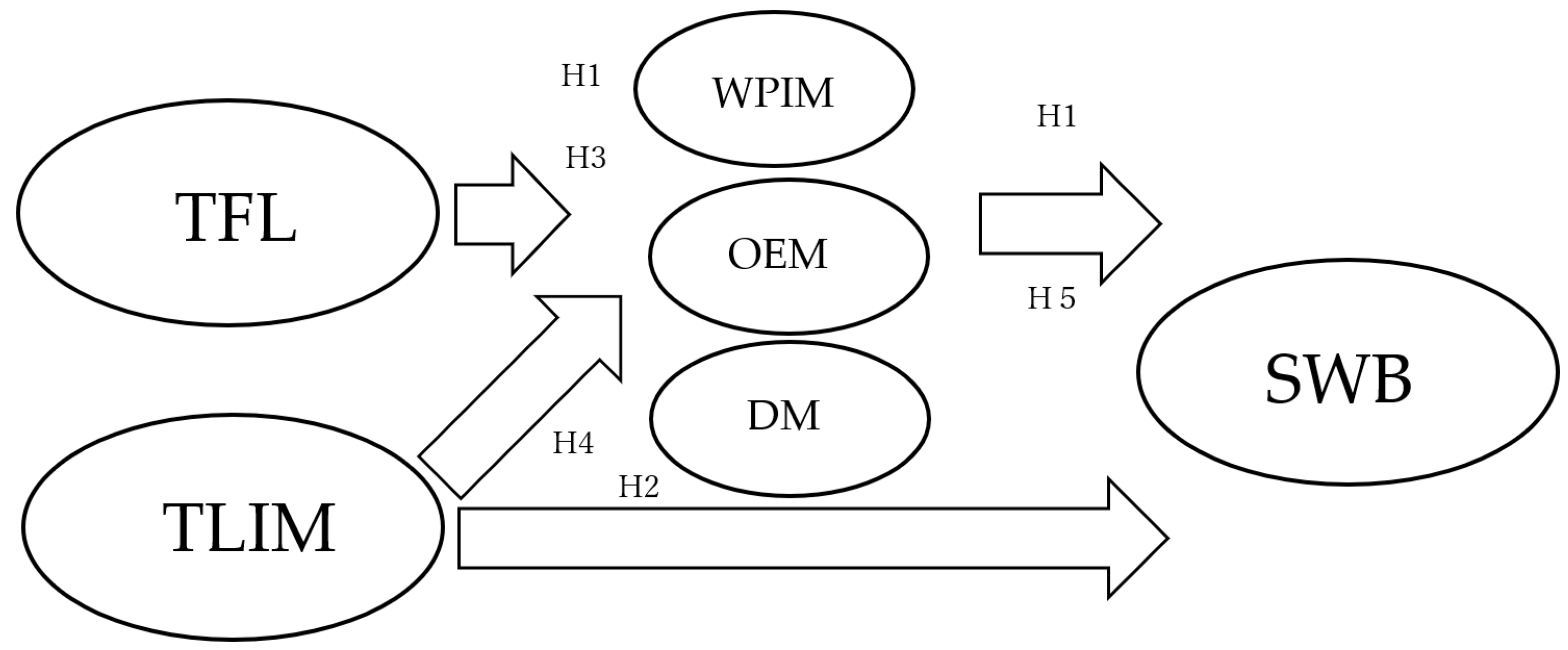
2.2. Hypotheses
2.3. Research Model
2.4. Participants
2.5. Survey Period and Ethical Considerations
2.6. Measurement Scales
2.7. Analytical Procedures
3. Results
3.1. Measurement Model Results
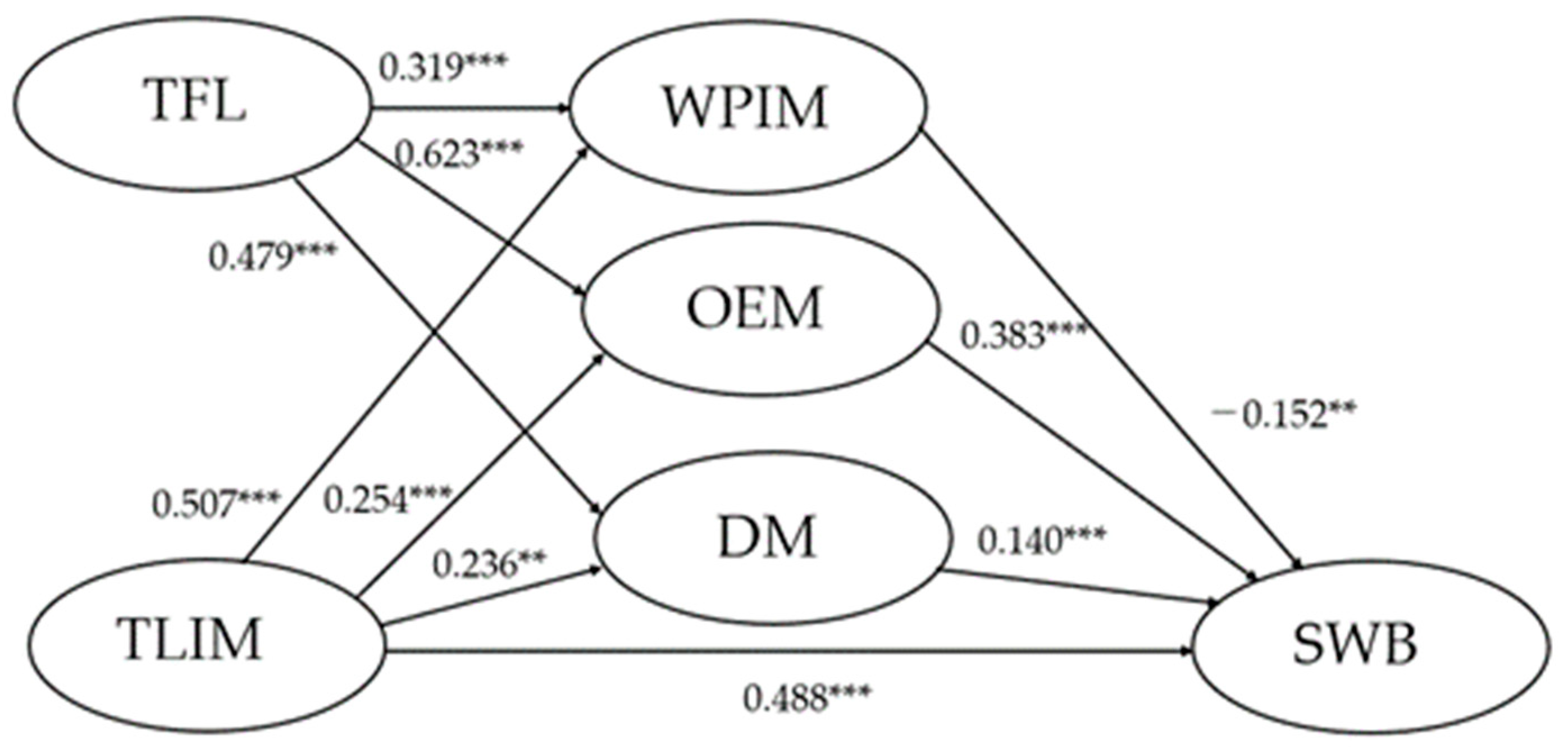
3.2. Hypothesis-Testing Results
- Model fit. The structural model exhibited good fit to the data, χ2(242) = 769.27, χ2/df = 3.18, CFI = 0.948, TLI = 0.940, RMSEA = 0.060. The SEM model fit is provided in the Supplementary Materials as Table S4.
4. General Discussion
4.1. Summary: Concurrent Evidence for a Two-Layer Mechanism
4.2. Consistency with Recent Evidence
4.3. Consistency and Divergence with Theory
4.4. Connection to Institutional and Cultural Contexts
4.5. Practical Implications
4.6. Limitations and Future Directions
4.7. Conclusions
Supplementary Materials
Author Contributions
Funding
Institutional Review Board Statement
Informed Consent Statement
Data Availability Statement
Acknowledgments
Conflicts of Interest
Appendix A. Survey Instrument
| Q1. About Your Immediate Supervisor in the Past Year |
| Please think of the supervisor with whom you had the most contact over the past year, and respond to the following statements about that supervisor’s behaviors and activities. |
| Q1_1 Does your supervisor strive to improve the atmosphere around you (including you and your coworkers)? |
| Q1_2 Do you feel proud to be able to work with your supervisor? |
| Q1_3 Does your supervisor clearly express what needs to be done in easy-to-understand terms? |
| Q1_4 Does your supervisor provide inspiring images or visions that raise your motivation? |
| Q1_5 Does your supervisor help you find meaning in your work? |
| Q1_6 Do you trust your supervisor enough to defend and justify their decisions even when they are not present? |
| Q1_7 Even in difficult situations, can you trust that your supervisor’s policy or direction is the right one? |
| Q1_8 Does your supervisor show concern even for those around you who may be disliked by others? |
| Q1_9 Does your supervisor offer new ways of looking at difficult matters from different perspectives? |
| Q1_10 Does your supervisor encourage you to reconsider things that you previously took for granted? |
| Q1_11 Does your supervisor encourage you to try new methods for solving problems? |
| Q1_12 Does your supervisor support your self-development for personal growth? |
| Q1_13 Does your supervisor help you solve work problems regardless of formal authority boundaries? |
| Q1_14 Does your supervisor appropriately communicate how they feel about your behavior? |
| Q1_15 Regardless of formal authority, does your supervisor make personal sacrifices to help you? |
| Q1_16 Does your supervisor prompt people in the workplace to stay focused on achieving goals? |
| Q1_17 Does your supervisor emphasize goal attainment and recognize you when goals are achieved? |
| Q1_18 Does your supervisor indicate the standards that should be met in performing work? |
| Q1_19 Is your supervisor satisfied when you at least meet the pre-set minimum performance level? |
| Q1_20 Does your supervisor clearly explain what you need to do to receive rewards commensurate with your work? |
| Q2. Your Work Situation in the Past Year (Competitive/Relational/Growth Persistence) |
| Q2_1 Achieving superior results (performance, evaluations) compared to your coworkers is a major source of joy for you. |
| Q2_2 You persist in your duties without giving up until you achieve results superior to your coworkers. |
| Q2_3 You work very hard so as not to lose to your coworkers. |
| Q2_4 You make ongoing efforts to get along well with others. |
| Q2_5 You continuously engage in efforts to build good relationships with coworkers. |
| Q2_6 You pay close attention to being cooperative with coworkers and supervisors. |
| Q2_7 You think about how you can further develop yourself. |
| Q2_8 You work with the view that you should acquire more advanced knowledge and skills. |
| Q2_9 You devote energy to growing beyond your current level. |
| Q2_10 You persist until you complete your tasks. |
| Q2_11 You engage in your duties with a strong sense of purpose in completing assigned tasks. |
| Q2_12 You never give up until you fully carry out your assigned duties. |
| Q3. Your Job Characteristics and Work Engagement in the Past Year |
| Q3_1 Even away from the workplace, you often think about how to proceed with your work. |
| Q3_2 In your private time, you study things that you can use for your work. |
| Q3_3 Outside the workplace, you often jot down ideas related to your work. |
| Q3_4 You habitually work harder than what is expected of you. |
| Q3_5 When you talk about work, time seems to pass quickly. |
| Q3_6 Through your work, you feel you are contributing to what your company aims to achieve. |
| Q3_7 Your job always has things to do; you are seldom left idle. |
| Q3_8 Through your work, you feel you are being useful to others in society. |
| Q3_9 Your job is not monotonous; it allows you to do various things. |
| Q3_10 Your job allows you to direct or mobilize other employees. |
| Q3_11 Thanks to your work, you are recognized as a respectable person in society. |
| Q3_12 When you do good work, people in your company acknowledge or praise you. |
| Q3_13 You think your pay is appropriate for your work. |
| Q3_14 In your job, if you work hard, there is a possibility of promotion. |
| Q3_15 You can make work-related decisions freely by yourself. |
| Q3_16 You can try your own ways of doing things in your work. |
| Q3_17 Your job allows you to proceed at your own pace. |
| Q4. Your Own Leadership toward Subordinates/Coworkers in the Past Year |
| Please respond regarding your own behaviors toward subordinates and coworkers over the past year. |
| Q4_1 You strive to improve the atmosphere around your subordinates and coworkers. |
| Q4_2 You feel proud to be able to work with your subordinates and coworkers. |
| Q4_3 You express what needs to be done to your subordinates and coworkers in clear, understandable terms. |
| Q4_4 You provide inspiring images or visions that raise subordinates’ and coworkers’ motivation. |
| Q4_5 You help subordinates and coworkers find meaning in their work. |
| Q4_6 Even when you are absent, your subordinates and coworkers trust you enough to defend and justify your decisions. |
| Q4_7 Even in difficult situations, your subordinates and coworkers believe your policy or direction is the right one. |
| Q4_8 You show concern for people who may be disliked by others around your subordinates and coworkers. |
| Q4_9 You offer new ways of looking at difficult matters from different perspectives to your subordinates and coworkers. |
| Q4_10 You ask your subordinates and coworkers to reconsider things they previously took for granted. |
| Q4_11 You encourage your subordinates and coworkers to try new methods of problem solving. |
| Q4_12 You support your subordinates’ and coworkers’ self-development for their growth. |
| Q4_13 You help solve work problems for subordinates and coworkers regardless of formal authority boundaries. |
| Q4_14 You appropriately communicate how you feel about your subordinates’ and coworkers’ behaviors. |
| Q4_15 Regardless of formal authority, you make personal sacrifices to help subordinates and coworkers. |
| Q4_16 You prompt people in the workplace to stay focused on achieving goals. |
| Q4_17 You emphasize goal attainment and recognize subordinates and coworkers when goals are achieved. |
| Q4_18 You indicate the standards that should be met in performing work. |
| Q4_19 You are satisfied when people at least meet the pre-set minimum performance level. |
| Q4_20 You clearly explain what subordinates and coworkers need to do to obtain rewards commensurate with their work. |
| Q5. Your Current Behaviors, Feelings, and Life Satisfaction |
| Q5_1 You make an effort in whatever you do. |
| Q5_2 You never give up on anything until the very end. |
| Q5_3 You do not give up on your goals. |
| Q5_4 You always feel highly motivated. |
| Q5_5 You are always fired up (highly energized). |
| Q5_6 You consistently feel brimming with energy. |
| Q5_7 You can maintain concentration on a single task. |
| Q5_8 You can immerse yourself in a single task. |
| Q5_9 Even in difficult situations, you intend to somehow work things out in the end. |
| Q5_10 You can bring out your strength even when you are under pressure. |
| Q5_11 You can concentrate at critical moments. |
| Q5_12 You never give up on anything. |
| Q5_13 In most respects, your life is close to your ideal. |
| Q5_14 You think your life is going very well. |
| Q5_15 You are satisfied with your life. |
| Q5_16 So far, you have obtained the important things you want in life. |
| Q5_17 If you could live your life over, you would change very little. |
Appendix B. Survey Items (Summary)
| Q1. Transformational leadership (supervisor-focused behaviors): |
| Items assessing inspirational motivation, individualized consideration, intellectual stimulation, and contingent reward/standards, adapted to the Japanese workplace context. |
| Q3. Job characteristics and workplace motivation (extrinsic and intrinsic contexts): |
| Items covering cognitive engagement beyond work, task variety, meaning of contribution, recognition, pay/promotion, and autonomy/discretion. |
| Q5. Trait-level vitality and life satisfaction: |
| Items derived from the Kiryoku (vitality) scale (Akiyama et al., 2003) assessing energy, persistence, and effort, along with items adapted from the Satisfaction with Life Scale |
References
- Akiyama, Y., Kinoshita, A., & Sugimura, M. (2003). Kiryo-ku shakudo no sakusei oyobi kiryo-ku to shoyōin to no kanren ni tsuite [The development of “Kiryoku” scale: The scale for psychological energy of college students]. Rinshō Shiseigaku Nenpō (Annals of Clinical Thanatology), 8, 50–64. Available online: https://ir.library.osaka-u.ac.jp/repo/ouka/all/4115/ (accessed on 21 October 2025).
- Allan, B. A., Batz-Barbarich, C., Sterling, H. M., & Tay, L. (2019). Outcomes of meaningful work: A meta-analysis. Journal of Management Studies, 56(3), 500–528. [Google Scholar] [CrossRef]
- Allan, B. A., & Blustein, D. L. (2022). Precarious work and workplace dignity during COVID-19: A longitudinal study. Journal of Vocational Behavior, 136, 103739. [Google Scholar] [CrossRef] [PubMed]
- Bakker, A. B., & Demerouti, E. (2014). Job demands–resources theory. In P. Y. Chen, & C. L. Cooper (Eds.), Wellbeing: A complete reference guide (Vol. 3, pp. 37–64). Wiley-Blackwell. Work and wellbeing. [Google Scholar] [CrossRef]
- Bass, B. M., & Riggio, R. E. (2006). Transformational leadership (2nd ed.). Routledge. [Google Scholar] [CrossRef]
- Choi, K.-E., Zeike, S., Lindert, L., & Pfaff, H. (2023). Transformational leadership and employee mental health: A meta-analysis. International Journal of Environmental Research and Public Health, 20(1), 676. [Google Scholar] [CrossRef]
- Colquitt, J. A., Scott, B. A., Rodell, J. B., Long, D. M., Zapata, C. P., Conlon, D. E., & Wesson, M. J. (2013). Justice at the millennium, a decade later: A meta-analytic test of social exchange and affect-based perspectives. Journal of Applied Psychology, 98(2), 199–236. [Google Scholar] [CrossRef] [PubMed]
- Coxen, L., Van der Vaart, L., & Van den Broeck, A. (2021). Basic psychological needs in the work context: A systematic literature review of diary studies. Frontiers in Psychology, 12, 698526. [Google Scholar] [CrossRef] [PubMed]
- Diener, E., Emmons, R. A., Larsen, R. J., & Griffin, S. (1985). The satisfaction with life scale. Journal of Personality Assessment, 49(1), 71–75. [Google Scholar] [CrossRef] [PubMed]
- Dulebohn, J. H., Bommer, W. H., Liden, R. C., Brouer, R. L., & Ferris, G. R. (2012). A meta-analysis of ante cedents and consequences of LMX. Journal of Management, 38(6), 1715–1759. [Google Scholar] [CrossRef]
- Eurofound. (2023). Living and working in Europe 2023. Publications Office of the European Union. [Google Scholar] [CrossRef]
- Gajendran, R. S., & Harrison, D. A. (2007). The good, the bad, and the unknown about telecommuting: Meta-analysis of psychological mediators and individual consequences. Journal of Applied Psychology, 92(6), 1524–1541. [Google Scholar] [CrossRef] [PubMed]
- Grawitch, M. J., Gottschalk, M., & Munz, D. C. (2006). The path to a healthy workplace: A critical review linking healthy workplace practices, employee well-being, and organizational improvements. Consulting Psychology Journal: Practice and Research, 58(3), 129–147. [Google Scholar] [CrossRef]
- Hagger, M. S., & Hamilton, K. (2021). General causality orientations in self-determination theory: Meta-analysis and test of a process model. European Journal of Personality, 35(5), 710–735. [Google Scholar] [CrossRef]
- Hoch, J. E., Bommer, W. H., Dulebohn, J. H., & Wu, D. (2018). Do ethical, authentic, and servant leadership explain variance above and beyond transformational leadership? A meta-analysis. Journal of Management, 44(2), 501–529. [Google Scholar] [CrossRef]
- Hofstede, G. (2001). Culture’s consequences: Comparing values, behaviors, institutions and organizations across nations (2nd ed.). SAGE. [Google Scholar]
- Japan Institute for Labour Policy and Training (JILPT). (2025). Databook of international labour statistics 2025. Available online: https://www.jil.go.jp/english/estatis/databook/index2025.html (accessed on 21 October 2025).
- Mazzetti, G., Schaufeli, W. B., & Guglielmi, D. (2023). Are work engagement and burnout opposite states? A critical review and meta-analysis. Psychological Reports, 126(3), 1218–1257. [Google Scholar] [CrossRef]
- McAnally, K. A., & Hagger, M. S. (2024). The psychological need to work: A theory of motivation at work grounded in self-determination theory. Behavioral Sciences, 14(6), 428. [Google Scholar] [CrossRef]
- Ministry of Health, Labour and Welfare (MHLW). (2019). Rōdō keizai no bunseki (2019) [Labor economy analysis 2019]. Available online: https://www.mhlw.go.jp/stf/wp/hakusyo/roudou/19/19-1.html (accessed on 21 October 2025).
- Morita, S. (2006). Nihon no kaishain ni okeru teichaku shikō to shokumu manzokukan to no kanren [Intention to serve the same company for long years and job satisfaction in Japanese workers]. Shinrigaku Kenkyū (The Japanese Journal of Psychology), 76(6), 534–539. [Google Scholar] [CrossRef] [PubMed][Green Version]
- Nishio, K. (2008). Kigyō henkaku ni shisuru jinteki shigen kanri: Forowā no shutaisei hakkī no katei ni rīdāshippu ga oyobosu eikyō [Human resource management for corporate transformation: The influence of leadership on developing proactive followers]. Rikkyo Business Design Review, 5, 57–71. [Google Scholar] [CrossRef]
- Ollier-Malaterre, A., Valcour, M., den Dulk, L., & Kossek, E. E. (2013). Theorizing national context to develop comparative work–life research: A review and research agenda. European Management Journal, 31(5), 433–447. [Google Scholar] [CrossRef]
- Ryan, R. M., & Deci, E. L. (2017). Self-determination theory: Basic psychological needs in motivation, development, and wellness. Guilford Press. Available online: https://www.guilford.com/books/Self-Determination-Theory/Ryan-Deci/9781462538966 (accessed on 21 October 2025).
- Shiotsuki, A., Mihara, Y., Furuya, J., Atsu, K., & Hirakimoto, H. (2019). Mokuhyō kanri seido no un’yō to jūgyōin no naihatsu-teki mōtibēshon no kankei [The impact of MBO on employees’ intrinsic motivation]. The Japanese Journal of Labour Studies, 61(8), 86–100. Available online: https://www.jil.go.jp/institute/zassi/backnumber/2019/08/pdf/086-100.pdf (accessed on 21 October 2025).
- Van den Broeck, A., Howard, J. L., Van Vaerenbergh, Y., Leroy, H., & Gagné, M. (2021). Beyond intrinsic and extrinsic motivation: A meta-analysis on self-determination theory’s multidimensional conceptualization of work motivation. Organizational Psychology Review, 11(3), 240–273. [Google Scholar] [CrossRef]
- Xue, Y., Li, X., & Wang, Y. (2022). Transformational leadership and employees’ well-being: A meta-analytic review. Frontiers in Psychology, 13, 941161. [Google Scholar] [CrossRef]


Disclaimer/Publisher’s Note: The statements, opinions and data contained in all publications are solely those of the individual author(s) and contributor(s) and not of MDPI and/or the editor(s). MDPI and/or the editor(s) disclaim responsibility for any injury to people or property resulting from any ideas, methods, instructions or products referred to in the content. |
© 2025 by the authors. Licensee MDPI, Basel, Switzerland. This article is an open access article distributed under the terms and conditions of the Creative Commons Attribution (CC BY) license (https://creativecommons.org/licenses/by/4.0/).
Share and Cite
Saruhashi, M.; Li, R.; Kida, N. Dual Pathways to Subjective Well-Being in Japanese Employees: Transformational Leadership and Trait Intrinsic Motivation. Adm. Sci. 2025, 15, 431. https://doi.org/10.3390/admsci15110431
Saruhashi M, Li R, Kida N. Dual Pathways to Subjective Well-Being in Japanese Employees: Transformational Leadership and Trait Intrinsic Motivation. Administrative Sciences. 2025; 15(11):431. https://doi.org/10.3390/admsci15110431
Chicago/Turabian StyleSaruhashi, Masao, Runjie Li, and Noriyuki Kida. 2025. "Dual Pathways to Subjective Well-Being in Japanese Employees: Transformational Leadership and Trait Intrinsic Motivation" Administrative Sciences 15, no. 11: 431. https://doi.org/10.3390/admsci15110431
APA StyleSaruhashi, M., Li, R., & Kida, N. (2025). Dual Pathways to Subjective Well-Being in Japanese Employees: Transformational Leadership and Trait Intrinsic Motivation. Administrative Sciences, 15(11), 431. https://doi.org/10.3390/admsci15110431