Case Report

Overview of Green Building Material (GBM) Policies and Guidelines with Relevance to Indoor Air Quality Management in Taiwan

Graduate Institute of Bioresources, National Pingtung University of Science and Technology, Pingtung 912, Taiwan
Environments 2018, 5(1), 4; https://doi.org/10.3390/environments5010004

Submission received: 30 October 2017 / Revised: 12 December 2017 / Accepted: 13 December 2017 / Published: 28 December 2017
(This article belongs to the Special Issue Advances in Environmental Engineering)

Abstract

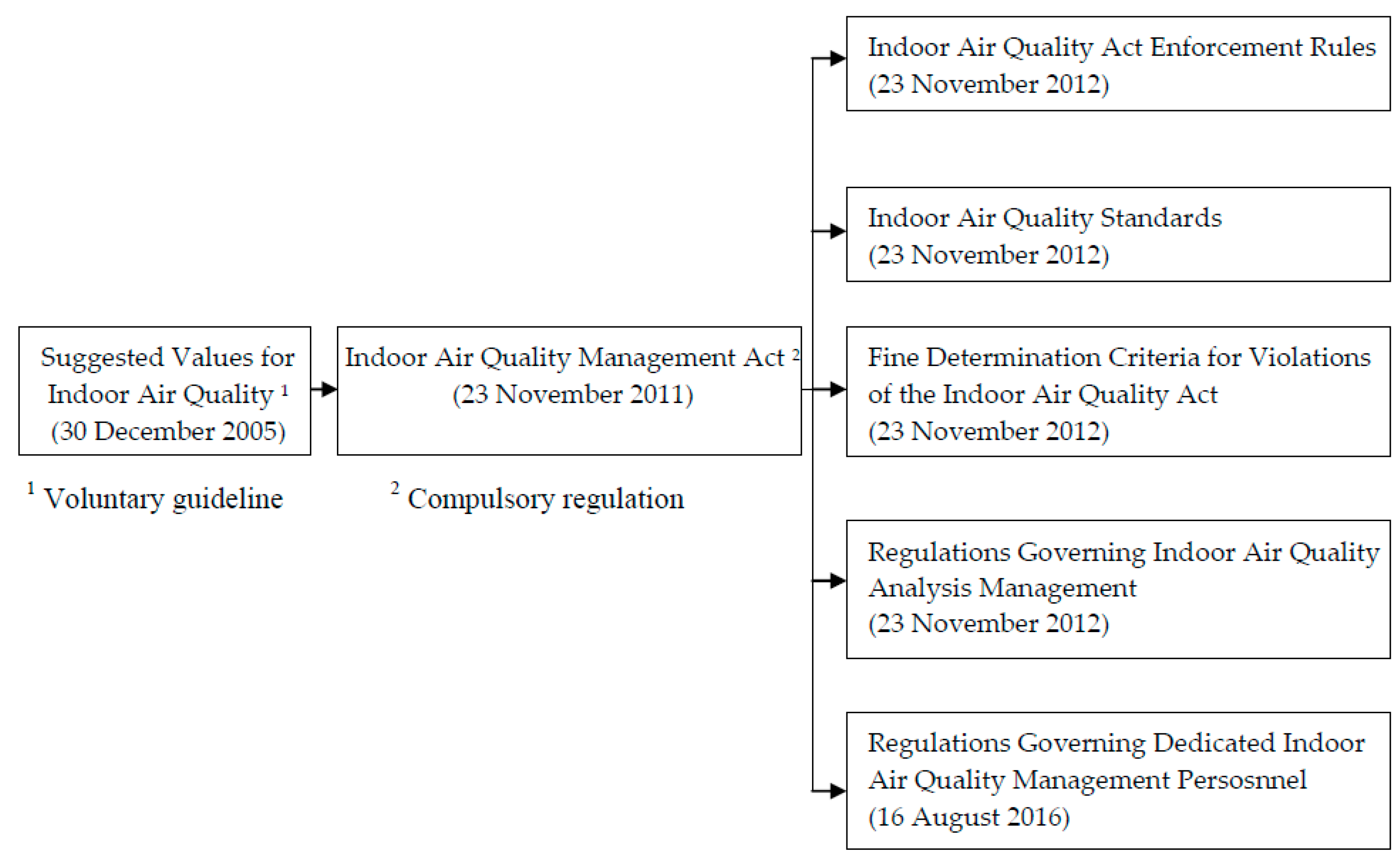
The objective of this paper was to offer a preliminary overview of Taiwan’s success in green building material (GBM) efforts through legal systems and promotion measures, which are relevant to the contribution to indoor air quality (IAQ) due to sustainability and health issues. In the first part of the paper, the IAQ regulations are summarized to highlight the second nation (i.e., Taiwan) around the world in IAQ management by the law. In addition, the permissible exposure limits (PEL) in Taiwan for airborne hazardous substances were first promulgated in 1974 to deal with occupational health issues in the workplace environment. In the second part of the paper, the developing status of the GBM in Taiwan is analyzed to unravel its connection with the Indoor Air Quality Management Act (IAQMA), promulgated on 23 November 2011. By the end of September 2017, a total of 645 GBM labels have been conferred, covering over 5000 green products. Due to the effectiveness of source control, the healthy GBM occupies most of the market, accounting for about 75%. The IAQMA, which took force in November 2012, is expected to significantly increase the use of healthy GBM in new building construction and remodeling, especially in low formaldehyde (HCHO)/volatile organic compound (VOC)-emitting products.
Keywords: green building material; indoor air quality; occupational exposure; volatile organic compound; source control green building material; indoor air quality; occupational exposure; volatile organic compound; source control