

An Innovative Technical Solution for the Extraction and Disposal of Hazardous Industrial Waste for Landfill Decommissioning

 ,
,  ,
,
Abstract
1. Introduction
2. Materials and Methods
2.1. Object of Study
2.2. Project Execution Stages
- Analysis of the territory condition and planned activities.
- Development of a schematic diagram for the safe extraction of liquid waste, including Hazard Class I and II waste [34].
- Analysis of existing technologies for processing hazardous liquid waste, including stages of phase separation, physicochemical destruction of toxicants, and desalination. Development and pilot testing of the technology.
- Development of a solution for the disposal of generated secondary waste (SW—concentrates and paste-like waste) by lithification.
- Analysis of environmental risks of implementing the proposed technology.
- Assessment of the economic efficiency of the developed technical solutions.
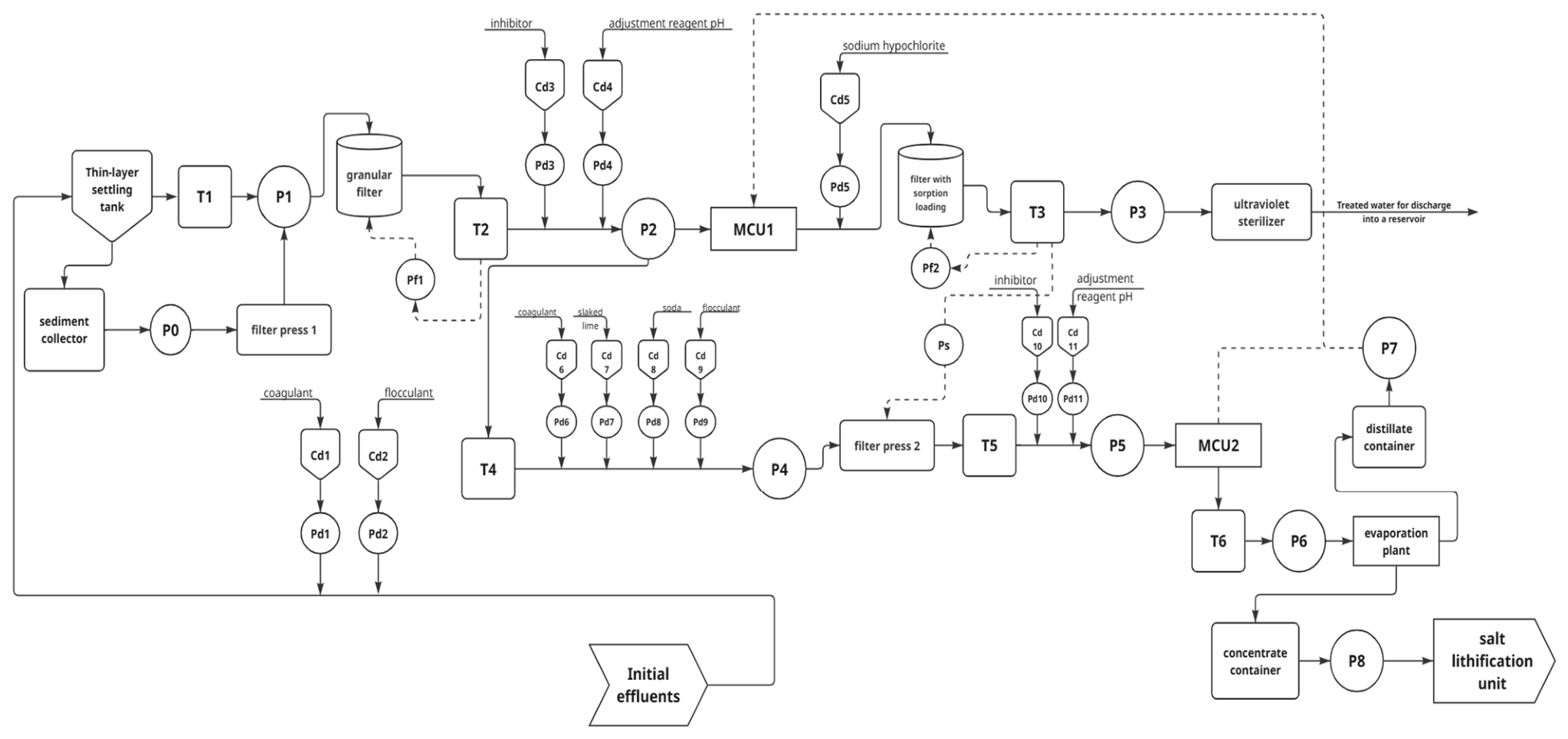
2.3. Wastewater Treatment Plant
2.4. Regulatory Framework and Best Available Techniques
2.5. Materials and Reagents
- evaporated salt concentrate obtained from the evaporation unit at a rate of 2.7 t/h; the calculated composition of the salt concentrate is presented in Table 1;
- dewatered sludge from the filter press, generated during the reagent treatment of liquid waste at a rate of 0.4 t/h; the calculated composition of the dewatered sludge is presented in Table 2;
- spent filtering and sorption media used in the liquid waste treatment plant in a total amount of 63.9 t/year, the composition of which is presented in Table 3.
Characteristics of Oil-Containing Waste
2.6. Lithification Compositions and Screening Procedure
- dry reagent metered dosing block;
- waste feed block for processing;
- mixing block for component blending;
- packaging unit with finished product discharge into bulk bags.
3. Results and Discussion
3.1. Lithification of Evaporated Salt Concentrate Using Composition “A”
3.2. Lithification of Evaporated Salt Concentrate Using Composition “B”
3.3. Lithification of Evaporated Salt Concentrate Using Composition “C”
3.4. Lithification of Evaporated Salt Concentrate, Dewatered Sludge After Reagent Treatment, and Spent Filtering and Sorption Media Using Composition “D”
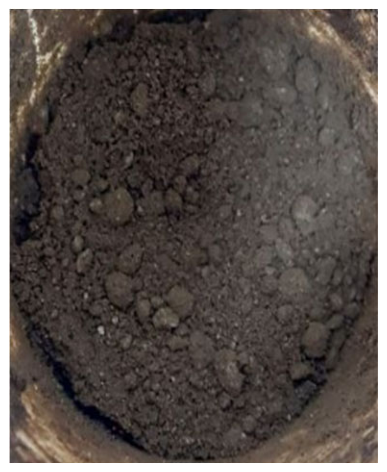
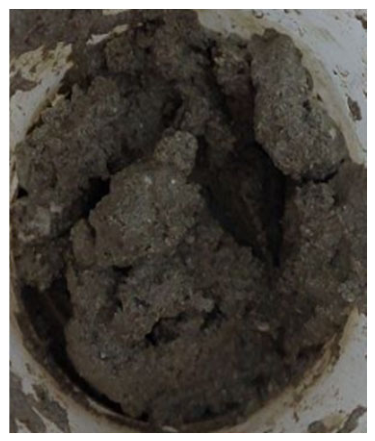
3.5. Lithification with Natural Materials (CaO + Opoka)
- -
- bottom sediments/CaO/Opoka
- -
- 1:0.9:0.5
- -
- 1:0.9:0.2.
- -
- sludge from Cell No. 1/CaO/Opoka
- -
- 1:0.2:0.2.
- -
- initial sludge from Cell No. 2/CaO/Opoka
- -
- 1:0.4:0.2
- -
- 1:0.6:0.1
- Technical specifications for the product
- Certificate of conformity
- Safety data sheet
- Expert opinion (if necessary).
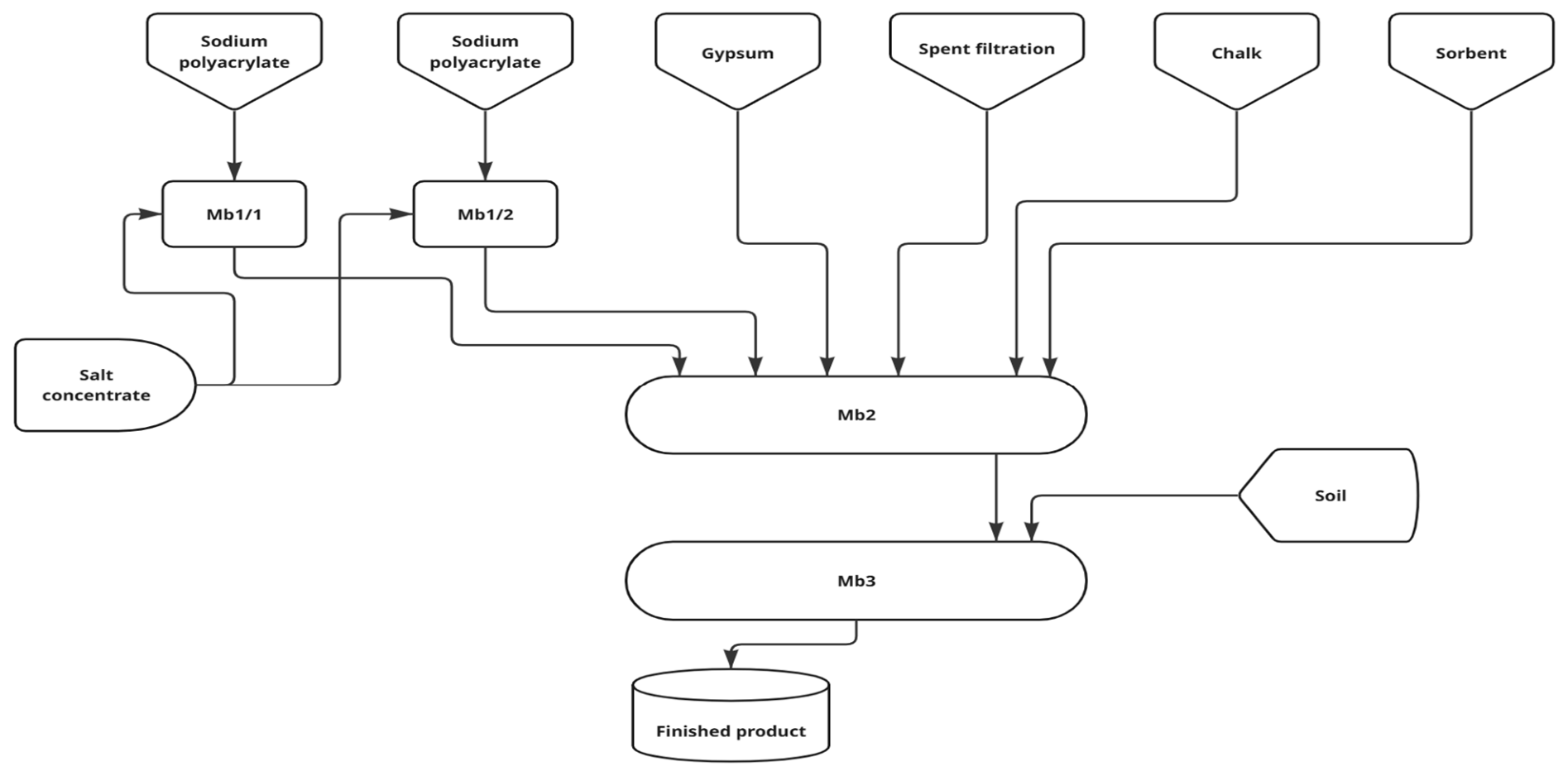
3.6. Process Flow Diagram of the Lithification Unit for Evaporated Salt Concentrate, Dewatered Sludge After Reagent Treatment, and Spent Filtering and Sorption Media
- metered dosing block for sodium polyacrylate (in dry form) Bd1–2;
- mixing block for blending evaporated salt concentrate with sodium polyacrylate, item SM1/1–2;
- metered dosing block for gel after treatment of evaporated salt concentrate with sodium polyacrylate to the mixing block, item SM3;
- metered dosing block for construction gypsum (in dry form);
- metered dosing block for natural chalk (in dry form);
- metered dosing block for spent filtering and sorption media;
- metered dosing block for sorbent D (in dry form);
- metered dosing block for topsoil combined with dewatered sludge;
- mixing block, item SM3;
- packaging unit with finished product discharge into bulk bags.
- Mixing of evaporated salt concentrate with sodium polyacrylate in mixer item SM1/1–2;
- Mixing of the gel after treatment of evaporated salt concentrate with sodium polyacrylate with the remaining components of sorbent D and other secondary waste from the plant in mixer item SM2.
3.7. Discussion on Promising Methods
4. Conclusions
Author Contributions
Funding
Data Availability Statement
Acknowledgments
Conflicts of Interest
Appendix A
Schematic Process Diagram of the Landfill Liquid Waste Treatment Plant

Appendix B

| Parameter Name | Dilution Factor of Aqueous Extract | Test Results, % | Toxicity Criterion | Sample Quality Assessment: Exhibits (Does Not Exhibit) Acute Toxic Effect |
|---|---|---|---|---|
| Sample Before Sorbent Treatment | ||||
| Mortality of Test Object Daphnia magna Straus in Experiment, % vs. Control over 48 h | Control | 0 | ≤10% | - |
| 1 (undiluted) | 30 | Exhibits | ||
| 10 | 20 | Exhibits | ||
| 100 | 40 | Exhibits | ||
| 1000 | 0 | Does Not Exhibit | ||
| 10,000 | 0 | Does Not Exhibit | ||
| Optical Density Deviation Index of Chlorella vulgaris Beijer Culture in % Compared | Control | 0 | Decrease by 20% or more (growth inhibition) or increase by 30% or more (growth stimulation) | - |
| 1 (undiluted) | Growth Stimulation, 45% | Exhibits | ||
| 10 | Growth Stimulation, 34% | Exhibits | ||
| 100 | Growth Stimulation, 48% | Exhibits | ||
| 1000 | Growth Stimulation, 12% | Does Not Exhibit | ||
| 10,000 | Growth Inhibition, 10% | Does Not Exhibit | ||
| Sample After Sorbent Treatment | ||||
| Mortality of Test Object Daphnia magna Straus in Experiment, % vs. Control over 48 h | Control | 0 | ≤10% | - |
| 1 (undiluted) | 0 | Exhibits | ||
| 10 | 0 | Exhibits | ||
| 100 | 0 | Exhibits | ||
| 1000 | 0 | Does Not Exhibit | ||
| 10,000 | 0 | Does Not Exhibit | ||
| Optical Density Deviation Index of Chlorella vulgaris Beijer Culture in % Compared | Control | 0 | Decrease by 20% or more (growth inhibition) or increase by 30% or more (growth stimulation) | - |
| 1 (undiluted) | Growth Stimulation, 16% | Does Not Exhibit | ||
| 10 | Growth Stimulation, 8% | Does Not Exhibit | ||
| 100 | Growth Stimulation, 10% | Does Not Exhibit | ||
| 1000 | Growth Stimulation, 5% | Does Not Exhibit | ||
| 10,000 | Growth Inhibition, 6% | Does Not Exhibit | ||
Appendix C
| Test Object | Observation Duration, hours | Parameter | Result |
|---|---|---|---|
| Dafnia magna Stratus | 96 | toxicity | absent |
| Chlorella vulgaris Beijer | 72 | toxicity | absent |
| Parameter | Leachate Concentration, mg/L (pH = 7.0) | Leachate Concentration, mg/L (pH = 4.0) | Leachate Concentration, mg/L (pH = 9.0) | MPC for Water Bodies, mg/L |
|---|---|---|---|---|
| Petroleum products | <0.05 | <0.05 | <0.05 | 0.05 |
| Ni2+ | <0.01 | 0.02 | <0.01 | 0.01 |
| Cu2+ | <0.001 | <0.001 | <0.001 | 0.001 |
| Pb4+ | <0.001 | 0.003 | 0.002 | 0.006 |
| Phenols | <0.001 | <0.001 | <0.001 | 0.001 |
Appendix D

References
- Kucher, D.E.; Kharchenko, S.G. Some Approaches to the Environmental Safety Strategy. Ecol. Ind. Russ. 2022, 26, 10. [Google Scholar]
- Evseeva, I.S.; Ushakova, O.V.; Rusakov, N.V.; Alekseev, M.M. Sanitary-Chemical Assessment of the Impact of Municipal Solid Waste and Industrial Waste Landfills on Soil Quality. Hyg. Sanit. 2024, 103, 1105–1110. [Google Scholar] [CrossRef]
- Criteria for Classifying Facilities with Negative Impact on the Environment as Facilities of Categories I, II, III and IV. Available online: https://normativ.kontur.ru/document?moduleId=1&documentId=484922 (accessed on 30 March 2026).
- Federal Classification Catalog of Waste. Available online: https://rpn.gov.ru/fkko/ (accessed on 25 March 2026).
- Pinaev, V.E.; Chernyshev, D.A. Elimination of Accumulated Environmental Damage—Organizational and Legal Aspects; Mir Nauki: Moscow, Russia, 2017; Available online: http://izd-mn.com/PDF/07MNNPM17.pdf (accessed on 30 March 2026).
- Lebedev, A. Our Ecotechnologies Can Answer the Most Difficult Environmental Challenges. Vestn. Atomproma 2026, 1. Available online: https://atomvestnik.ru/vse-publikacii/#01.2026 (accessed on 30 March 2026).
- National Project Ecology. Available online: https://www.mnr.gov.ru/activity/np_ecology/ (accessed on 30 March 2026).
- Standards for Water Quality of Water Bodies of Fishery Importance. Available online: https://legalacts.ru/doc/prikaz-rosrybolovstva-ot-26052025-n-296-ob-utverzhdenii-normativov/ (accessed on 30 March 2026).
- Chernetes, K.L.; Bukin, A.A.; Bukhman, N.S.; Pystin, V.N.; Seyanko, A.P.; Tupitsyna, O.V. Forecasting and Elimination of Pollution in Ecosystems Formed by Decommissioned Sludge Accumulators. Vestn. MGSU 2023, 1089–1103. Available online: https://cyberleninka.ru/article/n/prognozirovanie-i-likvidatsiya-zagryazneniy-v-ekosistemah-sformirovannyh-vyvedennymi-iz-ekspluatatsii-shlamonakopitelyami (accessed on 28 March 2026). [CrossRef]
- Zhang, H.; Ji, Z.; Zeng, Y.; Pei, Y. Solidification/Stabilization of Landfill Leachate Concentrate Contaminants Using Solid Alkali-Activated Geopolymers with a High Liquid Solid Ratio and Fixing Rate. Chemosphere 2022, 288, 132495. [Google Scholar] [CrossRef]
- Drouiche, M.; Moussaceb, K.; Joussein, E.; Bollinger, J. Stabilization/Solidification by Hydraulic Binders of Metal Elements from Landfill Leachate. Nova Biotechnol. Chim. 2019, 18, 72–83. [Google Scholar] [CrossRef][Green Version]
- Hoeffner, S.; Conner, J.; Spence, R. Stabilization/Solidification Additives. In Stabilization and Solidification of Hazardous, Radioactive, and Mixed Wastes; CRC Press: Boca Raton, FL, USA, 2005; pp. 118–129. [Google Scholar]
- Xi, Y.; Qian, S.; Jiao, Y.; Gan, W.; Wang, H.; Li, M.; Sun, F. A multi-dimensional AHP comprehensive evaluation of zero liquid discharge systems: A case study of chemical enterprise. Environ. Res. 2026, 299, 124367. [Google Scholar] [CrossRef] [PubMed]
- Patyal, V.; Jaspal, D.; Khare, K. Wastewater Treatment Technologies: A Bibliometric Analysis. Sci. Technol. Libr. 2020, 39, 383–394. [Google Scholar] [CrossRef]
- Branca, T.A.; Colla, V.; Algermissen, D.; Granbom, H.; Martini, U.; Morillon, A.; Pietruck, R.; Rosendahl, S. Reuse and Recycling of By-Products in the Steel Sector: Recent Achievements Paving the Way to Circular Economy and Industrial Symbiosis in Europe. Metals 2020, 10, 345. [Google Scholar] [CrossRef]
- Durán-Sánchez, A.; Álvarez-García, J.; González-Vázquez, E.; Del Río-Rama, M.C. Wastewater Management: Bibliometric Analysis of Scientific Literature. Water 2020, 12, 2963. [Google Scholar] [CrossRef]
- Manzhina, S.A. Russian and Foreign Practices of Sewage Sludge Management. Ecol. Water Manag. 2023, 5, 15–31. [Google Scholar] [CrossRef]
- Pashkevich, M.A.; Kulikova, Y.A. Lithification of MSW Landfill Leachate by Blast Furnace Slag. J. Min. Inst. 2024, 267, 477–487. Available online: https://cyberleninka.ru/article/n/litifikatsiya-domennym-shlakom-filtrata-poligonov-tko (accessed on 29 March 2026).
- Yazev, A.; Milyutina, N.; Averyanova, N.; Velikosel’skaya, E.; Politaeva, N. Lithification of MSW Landfill Leachate as a Way of its Disposal. Ecol. Ind. Russ. 2020, 24, 36–41. [Google Scholar] [CrossRef]
- Zhmur, N.S. Method for Determining the Toxicity of Water and Water Extracts from Soils, Sewage Sludge, Wastes Based on Mortality and Fecundity Changes of Daphnia, 2nd ed.; Federal Register FR.1.39.2007.03222; AKVAROS: Moscow, Russia, 2007; p. 51. ISBN 5-901652-09-6. [Google Scholar]
- Vurdova, N.G.; Kulikova, E.Y. Utilization of Hazardous Sludges by Lithification with Opoka. Constr. Technol. Saf. 2024, 35, 81–87. Available online: https://cyberleninka.ru/article/n/utilizatsiya-opasnyh-shlamov-litifikatsiey-opokami (accessed on 28 March 2026).
- Vurdova, N.G. Environmentally Safe Method of Disposal of Spent Adsorbent for Water Treatment. 21st Century Past Results Probl. Present Plus 2024, 13, 179–187. [Google Scholar]
- Ibraimov, T.; Tashpolotov, Y. Technology for Producing Composite Materials Based on Multi-Component Man-Generic Raw Materials. Bull. Sci. Pract. 2020, 6, 274–280. [Google Scholar] [CrossRef]
- Baskar, A.V.; Bolan, N.; Hoang, S.A.; Sooriyakumar, P.; Kumar, M.; Singh, L.; Jasemizad, T.; Padhye, L.P.; Singh, G.; Vinu, A.; et al. Recovery, Regeneration and Sustainable Management of Spent Adsorbents from Wastewater Treatment Streams: A Review. Sci. Total Environ. 2022, 822, 153555. [Google Scholar] [CrossRef]
- Tikhomirova, E.I.; Aleksashin, A.V.; Koshelev, A.V.; Atamanova, O.V. Development of Technological Solutions and Methods for Obtaining Humino-Mineral Compositions for the Reclamation of Oil-Contaminated Areas. Theor. Appl. Ecol. 2020, 4, 203–209. [Google Scholar] [CrossRef]
- Yurak, V.V.; Apakashev, R.A.; Lebzin, M.S.; Malyshev, A.N. Composite Sorbents from Natural and Man-Made Raw Materials: Optimization of Composition for Reclamation. Min. Inf. Anal. Bull. 2023, 12-1, 177–191. [Google Scholar] [CrossRef]
- Rudnik, M.I.; Gavrilov, Y.L.; Rezanova, E.E. Technologies and Equipment of the Fuel and Energy Complex: Technological and Hardware Conditions for the Creation and Application of Complex Processing of Hazardous Waste Using the “DSR Process”. Ecol. Bull. Russ. 2012, 2, 31–38. [Google Scholar]
- Shpinkova, M.S.; Meshcheryakov, S.V. Reagent Encapsulation of Oil Waste Using Final Products of the Technology as Commercial Products. Ecol. Ind. Russ. 2013, 12, 20–23. [Google Scholar]
- Ziane, Y.; Abeoub, Z.; Boumehdi Toumi, L.; Bensebia, O.; Abdelli, K. Sustainable Remediation of Oil-Based Drill Cuttings: Optimizing Blended Binders for Chloride and Hydrocarbon Stabilization. Soil Sediment Contam. 2025, 1–27. [Google Scholar] [CrossRef]
- Muntean, S.G.; Nistor, M.A.; Nastas, R.; Petuhov, O. Dyes and Heavy Metals Removal from Aqueous Solutions Using Raw and Modified Diatomite. Processes 2023, 11, 2245. [Google Scholar] [CrossRef]
- The European IPPC Bureau. Reference Book on Best Available Techniques. Available online: http://eippcb.jrc.ec.europa.eu/reference/ (accessed on 30 March 2026).
- Directive 2008/1/EC of the European Parliament and of the Council of 15 January 2008 Concerning Integrated Pollution Prevention and Control. Available online: https://eur-lex.europa.eu/LexUriServ/LexUriServ.do?uri=CONSLEG:2008L0001:20090625:EN:PDF (accessed on 29 March 2026).
- Vurdova, N.G.; Vurdov, P.Y.; Birman, Y.A. Mitigation of Risks at the Stages of the Life Cycle of Wastewater Treatment Plants. In Proceedings of the 9th International Conference on Construction, Architecture and Technosphere Safety (ICCATS 2025); Lecture Notes in Civil Engineering; Radionov, A.A., Gasiyarov, V.R., Eds.; Springer: Cham, Switzerland, 2026; Volume 799. [Google Scholar] [CrossRef]
- ITS 52-2022; Waste Management of Hazard Classes I and II: Information and Technical Reference Book on Best Available Technologies (BAT). Hazardous Waste Treatment. Minpromtorg Russia: Moscow, Russia, 2022.
- ISO 16290:2013; Space Systems—Definition of the Technology Readiness Levels (TRLs) and Their Criteria of Assessment. ISO: Geneva, Switzerland, 2013.
- ITS 8-2022; Wastewater Treatment in the Production of Goods, Performance of Works and Provision of Services at Large Enterprises Information and Technical Reference Book on Best Available Technologies (BAT). Hazardous Waste Treatment. Minpromtorg Russia: Moscow, Russia, 2022.
- ITS 15-2021; Waste Recovery and Neutralization (Except Thermal Neutralization); Information and Technical Reference Book on Best Available Technologies (BAT). Hazardous Waste Treatment. Minpromtorg Russia: Moscow, Russia, 2021.
- ITS 17-2024; Disposal of Production and Consumption Waste. Information and Technical Reference Book on Best Available Technologies (BAT). Hazardous Waste Treatment. Minpromtorg Russia: Moscow, Russia, 2024.
- Savenkova, I.V.; Pivovarova, N.A.; Abakumova, E.N. Study of oil capacity of natural opokas of the Astrakhan region. Oil Gas Technol. Environ. Saf. 2024, 1, 15–20. [Google Scholar] [CrossRef]
- Mariana, M.; Heps, A.K.; Mistar, E.M.; Yahya, E.B.; Alfatah, T.; Danish, M.; Amayreh, M. Recent Advances in Activated Carbon Modification Techniques for Enhanced Heavy Metal Adsorption. J. Water Process Eng. 2021, 43, 102221. [Google Scholar] [CrossRef]
- FR.1.39.2007.03222; Biological Control Methods Metodology for Determining the Toxicity of the Wter and Aqueus Extracts from Soils, Sewage Sluge, Waster by Mortality and Changes in Fertility of Dahnia. Aqwaros: Moscow, Russia, 2007.
- Li Zandifar, H.; Maleki, H.; Vakili, S.; Tiznobeik, E.; Esmaeilzadeh, F.; Ghandour, R.; Shah, M.; Mannanova, S. Unveiling magic of supercritical water gasification and oxidation: Advances in simulation and modelling for sustainable energy production and waste management. J. Ind. Eng. Chem. 2025, 151, 75–89. [Google Scholar] [CrossRef]
- Maharana, M.; Manna, M.; Sardar, M.; Sen, S. Heavy Metal Removal by Low-Cost Adsorbents. In Green Adsorbents to Remove Metals, Dyes and Boron from Polluted Water; Environmental Chemistry for a Sustainable World; Inamuddin, Ahamed, M., Lichtfouse, E., Asiri, A., Eds.; Springer: Berlin/Heidelberg, Germany, 2021; Volume 49. [Google Scholar] [CrossRef]
- Basheer, M.Z.; Huang, X.; Cai, X.; Cui, Y.; Muhammad, M. Integrating chemical and microbial strategies for heavy metal remediation in contaminated soils: Opportunities, challenges, and key factors. Environ. Sci. Pollut. Res. 2026, 33, 67–85. [Google Scholar] [CrossRef] [PubMed]
| Component Name | Concentration, mg/L |
|---|---|
| Na+ | 86,614.5 |
| K+ | 12,570.2 |
| NH4+ | 9469.0 |
| Ca2+ | 1553.9 |
| Mg2+ | 2216.8 |
| Cl− | 92,277.7 |
| SO42− | 93,185.9 |
| NO3− | 277.6 |
| F− | 157.1 |
| Phenol | 398.7 |
| Anionic Surfactants | 88.6 |
| Petroleum Products | 36.1 |
| BOD5 | 170,990.0 |
| COD | 313,512.6 |
| Inhibitor IOMS-1 | 505.8 |
| Component Name | Concentration, mg/L |
|---|---|
| Na+ | 3141.4 |
| K+ | 453.6 |
| NH4+ | 342.3 |
| Ca2+ | 57.4 |
| Mg2+ | 79.8 |
| Al(OH)3 | 2955.5 |
| Mn(OH)2 | 2268.9 |
| Cd(OH)2 | 70.9 |
| Co(OH)2 | 65.5 |
| Cu(OH)2 | 4.9 |
| Fe(OH)3 | 169,633.5 |
| Ni(OH)2 | 1173.1 |
| Zn(OH)2 | 4673.7 |
| Pb(OH)2 | 16.0 |
| Cr(OH)3 | 698.2 |
| Cl− | 3329.8 |
| SO42− | 2528.0 |
| NO3− | 10.4 |
| Anionic Surfactants | 139.2 |
| Petroleum Products | 792.6 |
| Suspended Solids | 116,965.5 |
| BOD5 | 342,858.5 |
| COD | 717,295.7 |
| Component Name | Component Content, % |
|---|---|
| Gravel (fraction 2–5 mm) | 14 ± 1.4 |
| Quartz Sand (fraction 0.7–1.2 mm) | 14 ± 1.4 |
| Hydroanthracite Grade A | 8 ± 0.8 |
| Activated Carbon Silcarbon k 835 spezial | 30 ± 3.0 |
| Activated Carbon Silcarbon k 0.3–0.8 | 28 ± 2.8 |
| Ion Exchange Resin Tokem 150 in Na-form | 7 ± 0.7 |
| No. | Parameter Name, Units of Measurement | Results of Quantitative Chemical Analysis of Cell | |
|---|---|---|---|
| No. 1 | No. 2 | ||
| 1 | Mass Fraction of Petroleum Products, mg/kg | 372 | 9341 |
| 2 | Mass Fraction of Organic Matter, % | 3.38 | 8.70 |
| 3 | Mass Fraction of Ash, % | 96.62 | 91.30 |
| 4 | Mass Fraction of Moisture, % | 28.47 | 46.65 |
| No. | Parameter Name, Units of Measurement | Value | Measurement Method Code * |
|---|---|---|---|
| 1 | pH Value | 8.21 | PND F 14.1:2.253-09 |
| 2 | Total Hardness, meq/dm3 | 2.43 | PND F 14.1:2:4.167-2000 |
| 3 | Calcium (Ca), mg/dm3 | 37.54 | PND F 14.1:2:4.154-99 |
| 4 | Magnesium (Mg), mg/dm3 | 6.68 | PND F 14.1:2:4.254-2009 |
| 5 | Total Alkalinity, mg/dm3 | 1.74 | PND F 14.1:2.253-09 |
| 6 | Bicarbonates (HCO3−), g/dm3 | 106.14 | PND F 14.1:2.253-09 |
| 7 | Sodium (Na), mg/dm3 | 12.72 | PND F 14.1:2.253-09 |
| 8 | Potassium (K), mg/dm3 | 2.42 | PND F 14.1:2:3:4.282-18 |
| 9 | Aluminum (Al), mg/dm3 | 10.03 | PND F 14.1:2:4.168-2000 |
| 10 | Total Iron (Fe), mg/dm3 | 118 | PND F 14.1:2.253-09 |
| 11 | Iron II (Fe2+), mg/dm3 | <0.05 | PND F 14.1:2:3:4.282-18 |
| 12 | Copper (Cu), mg/dm3 | 0.108 | PND F 14.1:2:3:4.282-18 |
| 13 | Zinc (Zn), mg/dm3 | 0.583 | PND F 14.1:2:4.187-02 |
| 14 | Ammonium (NH4+), mg/dm3 | 3.89 | PND F 14.1:2.253-09 |
| 15 | Nitrate Ions (NO3−), mg/dm3 | 0.85 | PND F 14.1:2.253-09 |
| 16 | Nitrite Ions (NO2−), mg/dm3 | <0.2 | PND F 14.1:2:4.167-2000 |
| 17 | Sulfate Ions (SO42−), mg/dm3 | 5.3 | PND F 14.1:2:4.154-99 |
| 18 | Phosphate Ions (PO43−), mg/dm3 | <0.25 | PND F 14.1:2:4.254-2009 |
| 19 | Fluoride Ions (F−), mg/dm3 | <0.1 | PND F 14.1:2.253-09 |
| 20 | Chloride Ions (Cl−), mg/dm3 | 15.41 | PND F 14.1:2.253-09 |
| 21 | Sulfides (S2−), mg/dm3 | <0.05 | PND F 14.1:2.253-09 |
| 22 | Anionic Surfactants, mg/dm3 | 2.14 | PND F 14.1:2:3:4.282-18 |
| 23 | Petroleum Products, mg/dm3 | 4190 | PND F 14.1:2:4.168-2000 |
| 24 | Phenols, mg/dm3 | 3.69 | PND F 14.1:2.253-09 |
| 25 | Formaldehyde, mg/dm3 | 0.234 | PND F 14.1:2:3:4.282-18 |
| 26 | COD, mgO2/dm3 | 3870 | PND F 14.1:2:3:4.282-18 |
| 27 | Permanganate Oxidizability, mgO2/dm3 | 368 | PND F 14.1:2:4.187-02 |
| 28 | Turbidity, mg/dm3 | 4900 | PND F 14.1:2.253-09 |
| 29 | Suspended Solids, mg/dm3 | 21,620 | PND F 14.1:2.253-09 |
| 30 | Salinity, mg/dm3 | 139 | PND F 14.1:2:4.167-2000 |
| 31 | Dry Residue, mg/dm3 | – | PND F 14.1:2:4.154-99 |
| Component Name | Component Content, % |
|---|---|
| Sodium Polyacrylate | 3.5 ± 0.5 |
| Construction Gypsum | 24.5 ± 2.5 |
| Soil | 30.0 ± 15.0 |
| Chalk | 35.0 ± 15.0 |
| Sorbent MIU-S (activated carbon) | 7.0 ± 0.7 |
| Oxide | ±Δ | s | Min | Max | CV, % | |
|---|---|---|---|---|---|---|
| SiO2 | 82.75 | 1.18 | 1.05 | 78.88 | 85.65 | 1.44 |
| Al2O3 | 6.04 | 0.31 | 0.20 | 5.46 | 6.63 | 5.07 |
| Fe2O3 | 3.88 | 0.66 | 0.57 | 2.99 | 5.28 | 14.40 |
| TiO2 | 0.36 | 0.07 | 0.06 | 0.27 | 0.62 | 19.02 |
| CaO | 1.47 | 0.46 | 0.39 | 0.77 | 2.39 | 31.47 |
| MgO | 1.11 | 0.07 | 0.05 | 0.95 | 1.26 | 6.60 |
| Na2O | 0.57 | 0.06 | 0.06 | 0.44 | 0.63 | 11.05 |
| K2O | 1.68 | 0.15 | 0.15 | 1.33 | 1.87 | 8.65 |
| LOI | 2.31 | 0.82 | - | - | - | - |
| Mass Ratio Salt Concentrate: Composition “A”: Bentonite | Characteristics of Lithified Waste |
|---|---|
| 2:1:1 | After solidification, the waste is a sticky mass with a resistance of only 12 ± 5 kPa. |
| 1:1:1 | Waste in solid form |
| 1:1:0.3 | Waste in solid form represents a solidified foamed material with a penetration resistance of 180 ± 25 kPa after 6 h |
| Mass Ratio Salt Concentrate: Composition “B” | Characteristics of Lithified Waste |
|---|---|
| 6:1 | The treated waste is a two-phase system; phase separation is observed |
| 4:1 | Waste in the form of a mobile suspension |
| 2:1 | Waste of thick paste-like consistency |
| 1:1 | Waste in the form of lumps |
| Component Name | Component Content, % |
|---|---|
| Evaporated Salt Concentrate | 28.0 ± 2.8 |
| Dewatered Sludge after Filter Press | 3.7 ± 0.4 |
| Spent Filtering and Sorption Media | 0.1 ± 0.01 |
| Composition “D” | 68.2 ± 0.7 |
| Cell No. 2, Sampling Point No. 5, Bottom Sediments Ratios: Initial Solution/CaO/Opoka Ratios: Initial solution/CaO/Opoka | |||
|---|---|---|---|
| 1:1.8:0.4 | 1:1.4:0.4 | 1:1.2:0.4 | 1:1.1:0.2 |
 |  |  |  |
| 1:1:0.2 | 1:0.9:0.5 | 1:0.9:0.2 | |
 |  |  | |
| Waste Sludge from Cell No. 1 Ratios: Sludge/CaO/Opoka Ratios: Sludge/CaO/Opoka | ||
|---|---|---|
| 1:0.4:0.1 | 1:0.2:0.1 | 1:0.2:0.2 |
 |  |  |
| Waste Sludge from Cell No. 2 Ratios: Sludge/CaO/Opoka Ratios: Sludge/CaO/Opoka | ||
|---|---|---|
| 1:0.9:0.2 | 1:0.6:0.2 | 1:0.6:0.1 |
 |  |  |
| 1:0.5:0.3 | 1:0.4:0.2 | 1:0.3:0.3 |
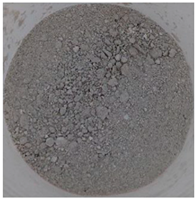 |  |  |
| Component Introduction Sequence | Component Name | Component Consumption, t/h |
|---|---|---|
| 1. | Evaporated Salt Concentrate | 2.7 |
| 2. | Sodium Polyacrylate | 0.27 |
| 3. | Construction Gypsum | 1.9 |
| 4. | Natural Chalk | 1.3 |
| 5. | Spent Filtering and Sorption Media | 0.007 (periodic supply) |
| 6. | Activated Carbon MIU-S | 0.5 |
| 7. | Dewatered Sludge after Filter Press | 0.4 |
| 8. | Topsoil | 3.7 |
Disclaimer/Publisher’s Note: The statements, opinions and data contained in all publications are solely those of the individual author(s) and contributor(s) and not of MDPI and/or the editor(s). MDPI and/or the editor(s) disclaim responsibility for any injury to people or property resulting from any ideas, methods, instructions or products referred to in the content. |
© 2026 by the authors. Licensee MDPI, Basel, Switzerland. This article is an open access article distributed under the terms and conditions of the Creative Commons Attribution (CC BY) license.
Share and Cite
Vurdova, N.G.; Ovchinnikova, T.I.; Tertychnaya, S.V.; Kulikova, A.A.; Meshchanova, V.D.; Vurdov, P.Y.; Birman, Y.A.; Krotova, M.V.; Yakusheva, A.A. An Innovative Technical Solution for the Extraction and Disposal of Hazardous Industrial Waste for Landfill Decommissioning. Environments 2026, 13, 272. https://doi.org/10.3390/environments13050272
Vurdova NG, Ovchinnikova TI, Tertychnaya SV, Kulikova AA, Meshchanova VD, Vurdov PY, Birman YA, Krotova MV, Yakusheva AA. An Innovative Technical Solution for the Extraction and Disposal of Hazardous Industrial Waste for Landfill Decommissioning. Environments. 2026; 13(5):272. https://doi.org/10.3390/environments13050272
Chicago/Turabian StyleVurdova, Nadejda G., Tatyana I. Ovchinnikova, Svetlana V. Tertychnaya, Alexandra A. Kulikova, Valeriia D. Meshchanova, Petr Yu. Vurdov, Yuri A. Birman, Maria V. Krotova, and Anastasia A. Yakusheva. 2026. "An Innovative Technical Solution for the Extraction and Disposal of Hazardous Industrial Waste for Landfill Decommissioning" Environments 13, no. 5: 272. https://doi.org/10.3390/environments13050272
APA StyleVurdova, N. G., Ovchinnikova, T. I., Tertychnaya, S. V., Kulikova, A. A., Meshchanova, V. D., Vurdov, P. Y., Birman, Y. A., Krotova, M. V., & Yakusheva, A. A. (2026). An Innovative Technical Solution for the Extraction and Disposal of Hazardous Industrial Waste for Landfill Decommissioning. Environments, 13(5), 272. https://doi.org/10.3390/environments13050272