Article

Impact of Residual Antibiotics in Livestock Wastewater Effluent on Microbial Activity in a Constructed Wetland

Department of Civil and Environmental Engineering, Kongju National University, Cheonan 31080, Republic of Korea
*
Author to whom correspondence should be addressed.
Environments 2026, 13(5), 265; https://doi.org/10.3390/environments13050265

Submission received: 2 April 2026 / Revised: 27 April 2026 / Accepted: 5 May 2026 / Published: 9 May 2026

Abstract

Various types of antibiotics used excessively in the livestock industry are often discharged into aquatic environments without being fully removed. The release of these antibiotics into natural systems causes a variety of issues, including water pollution and ecological toxicity. This study was conducted to elucidate the mechanisms that govern microbial growth by analyzing the behavior of antibiotics and the changes in microbial communities in a constructed wetland (CW) treating effluent from a livestock wastewater treatment plant (LWTP). The main groups of antibiotics detected in the wetland were sulfonamides and tetracyclines. While most antibiotics showed high removal efficiency in the CW, some were found to persist or accumulate in the wetland over a prolonged period. Distinct shifts in microbial community composition were observed between inflow and outflow samples, indicating that the CW functions as an ecological filter that selects for microbial taxa associated with antibiotic persistence and transformation. Bacillus belonging to the phylum Firmicutes was found to play a role in antibiotic removal as it produces various antibiotic-degrading enzymes. Moreover, the phyla Chloroflexi, Gemmatimonadetes, and Acidobacteria appeared to experience no growth inhibition due to antibiotics and were not directly involved in their degradation. The phylum Actinobacteria was found to possess selective degradation abilities. These findings provide insights for improving constructed wetland design by supporting microbial communities, such as Firmicutes (Bacillus) that are associated with enhanced antibiotic removal and compound-specific degradation.

1. Introduction

Veterinary antibiotics are substances with high physiological activity that are widely used in the livestock industry for disease prevention and treatment, as well as growth promoters [1,2]. In 2023, approximately 789 tons of antibiotics were sold for livestock use in Korea, marking a 22.8% increase from 2014 [3]. Excessive use of antibiotics causes various environmental and aquatic ecosystem issues. Antibiotics administered to animals are not fully metabolized and are subsequently released into the environment after treatment at wastewater treatment facilities [4,5,6,7]. Since existing livestock wastewater treatment plants (LWTPs) are primarily designed to remove easily biodegradable organic matter, they are insufficient for removing complex chemical substances such as antibiotics [8,9]. Due to the diverse chemical characteristics of antibiotics contained in livestock wastewater, the constituents removed during treatment and discharged into aquatic environments are highly complex. In particular, because antibiotics are discharged as trace pollutants (in the range of ng/L to mg/L), it is not only difficult to treat them, but they may also pose risks to human health resulting from bioaccumulation and residual presence in water and soil [10,11]. However, information regarding the types and concentrations of antibiotics used in livestock farming remains severely limited.
For livestock wastewater treatment, biological technologies that remove organic matter and nutrients through microbial respiration under aerobic and anaerobic conditions are extensively utilized. However, because livestock wastewater typically contains higher levels of nutrients compared to its biodegradable organic matter content, it is difficult to improve the quality of treated water through biological mechanisms alone. Therefore, in Korea, constructed wetlands (CWs) are connected downstream of biological treatment facilities to treat effluent from LWTPs and non-point source pollutants discharged during rainfall events. CWs are effective in removing nutrients due to their functions such as microbial respiration, plant photosynthesis, physical sedimentation, adsorption, and filtration [12,13,14].
Because CWs perform through the interplay of multiple mechanisms among microorganisms, plants, and soil substrates, optimized design and operation of CWs are crucial. Optimized CWs play an important role not only in removing organic matter, nutrients, and heavy metals, but also in treating antibiotics [15,16]. According to previous literature, CWs show antibiotic removal efficiencies of over 90% at times, with particularly high efficiency reported for the tetracyclines group of antibiotics [17]. Oh et al. [18] reported antibiotic removal efficiencies of 72.7% in CWs and 64.2% in wastewater treatment facilities, indicating that CWs offer higher removal performance. However, removal efficiency varies depending on the type and chemical components of the antibiotics. The mechanisms for antibiotic removal in CWs are complex, being influenced by physical, chemical, and biological processes simultaneously. Antibiotic removal in CWs is influenced by various parameters such as wetland type, substrates, plants, and microorganisms [19,20]. Microorganisms in CWs play a crucial role in converting organic matter into cellular material or mineralizing it into forms that can be utilized by plants. In addition, microorganisms remove pollutants by forming biofilms on plant surfaces or by degrading organic matter in suspension [21]. However, since various antibiotics discharged from LWTPs are capable of either inhibiting or disrupting microbial activity, they can affect the removal efficiency of the CWs. Moreover, residual antibiotics in wetlands may disrupt the balance of microbial communities by inducing the development of antibiotic-resistant bacteria (ARB) and antibiotic resistance genes (ARGs). Despite the widespread use of antibiotics in livestock wastewater, previous studies have primarily focused on removal efficiency and antibiotic resistance genes (ARGs). For example, ref. [16] investigated the spatial distribution of antibiotics and ARGs in constructed wetlands but did not consider microbial community structure. In addition, recent studies [22] have emphasized the importance of microorganisms while also highlighting the lack of studies linking antibiotic behavior with microbial community dynamics. Therefore, the responses of microbial communities to antibiotic exposure in CWs remain insufficiently understood.
To address this gap, this study investigates the relationship between antibiotic concentrations and microbial community structure in a constructed wetland treating livestock wastewater. Unlike previous studies, this study integrates antibiotic occurrence with microbial community composition to provide insights into the biological mechanisms governing antibiotic removal.

2. Materials and Methods

2.1. Study Site and Monitoring

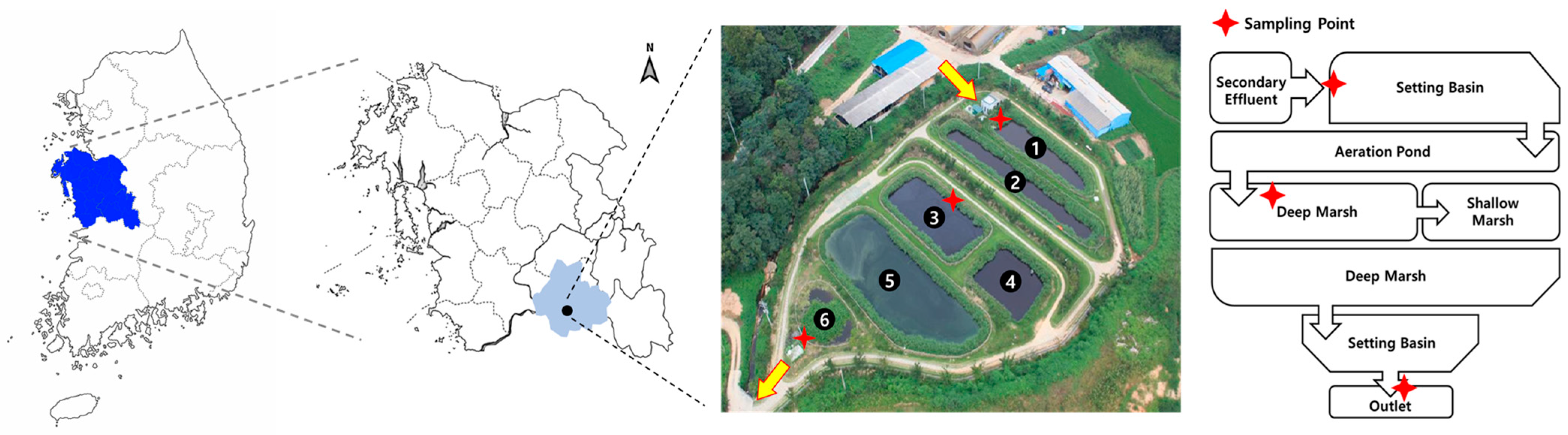
The CW studied in this research is located in Nonsan, Chungcheongnam-do, Republic of Korea. This CW was established in 2007 to treat effluent from an LWTP that processes wastewater generated by about 20,000 pigs, as well as non-point source pollutants discharged from the livestock complex during rain events. It is a free water surface constructed wetland (FWS-CW) consisting of six consecutive cells (Figure 1). Cell 1 functions as a sedimentation basin that removes settleable particulate matter. Cell 2 is an aeration pond designed to increase the dissolved oxygen (DO) levels, thereby enhancing aerobic microbial activity and promoting organic matter degradation. Cell 3 is a deep marsh with a depth of 1 m, where anaerobic conditions induce the degradation of organic matter and denitrification processes. Cell 4 is a shallow marsh with a depth of 30–40 cm, allowing sunlight to penetrate to the bottom and enhancing plant photosynthetic activity, thereby contributing to phosphorus removal and the degradation of residual organic matter. Cell 5 is the second deep marsh that provides additional removal of residual nitrogen compounds. Cell 6 serves as the final sedimentation basin, where suspended solids settle before discharge. The CW treats pollutants from a drainage area of 11 ha and has a surface area of 4492 m2, a storage capacity of 4006 m3, and a hydraulic retention time (HRT) of approximately 48 h during the dry season.
Water quality monitoring for the assessment of water purification efficiency in this CW has been continuously conducted since 2007 [23]. However, studies on the correlation between microorganisms and antibiotics, which may influence water purification efficiency, have only recently begun. Microbial and antibiotic monitoring was conducted twice, once in August and once in September 2024, during the summer season when microbial activity is at its peak. To eliminate the effects of rainfall, the monitoring was carried out under dry weather conditions. Samples for the analysis of microbial communities and antibiotics were collected from three locations: the inflow, interior (wetland), and outflow sections of the CW. During the monitoring period, the average water temperature was 27.68 ± 1.75 °C. All samples were stored and transported in a cooling box at temperatures below 4 °C for analysis.

2.2. Antibiotics and Microbial Community Analysis

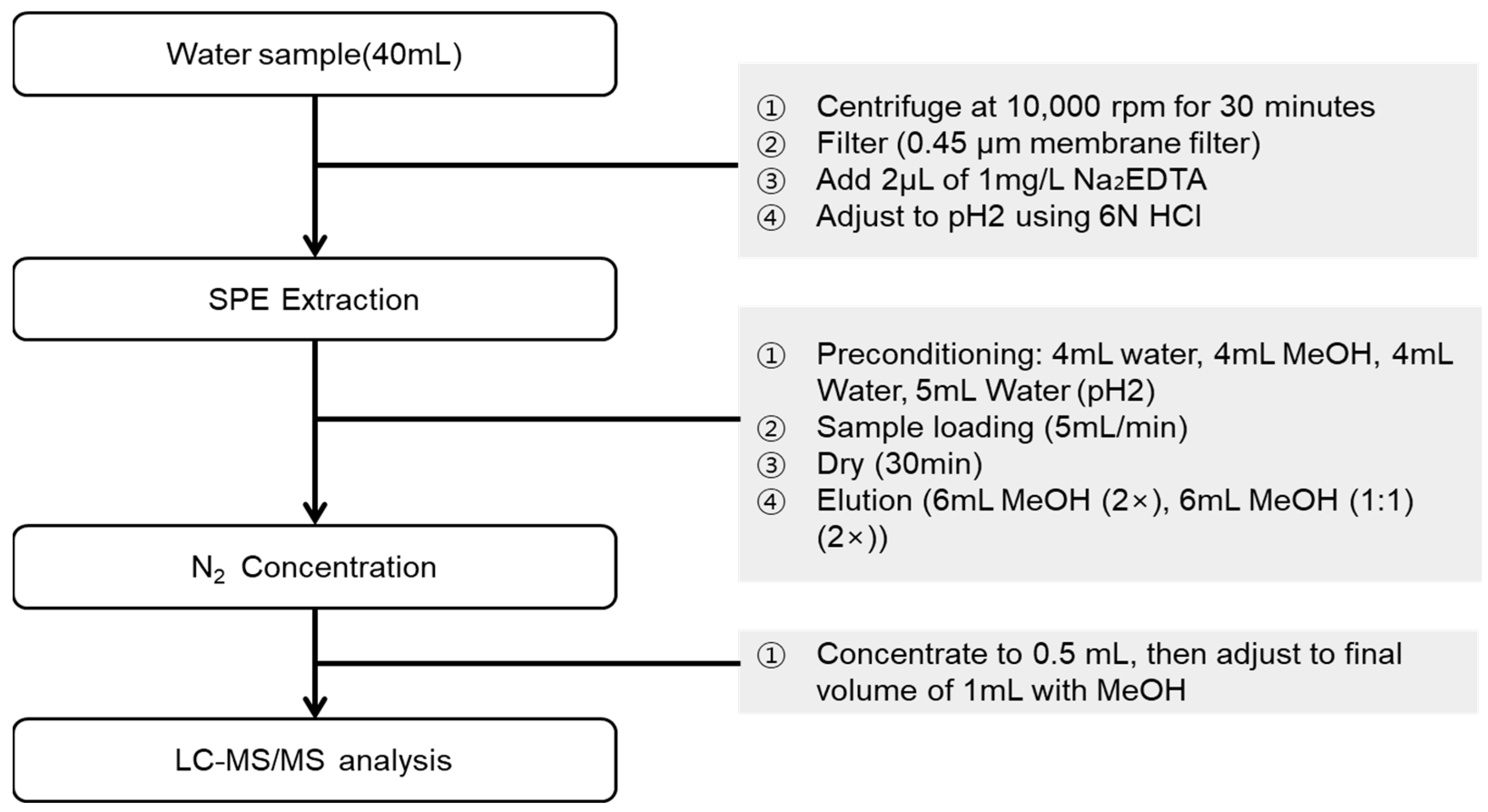
The target antibiotics were selected based on the amount of antibiotics used, occurrence frequencies, and detected concentrations reported by Oh et al. [18], and are summarized in Table S1 in the Supplementary Material. Quantitative analysis of the target antibiotics in the water quality samples was performed through a solid-phase extraction (SPE) process and liquid chromatography, as shown in Figure 2. The pretreated samples were analyzed using a high-performance liquid chromatography–tandem mass spectrometer (LC-MS/MS) (Orbitrap Exploris 120 mass spectrometer, Thermo Fisher Scientific Korea, Seoul, Republic of Korea), equipped with a Hypersil Vanquish C18 column (100 × 2.1 mm, 1.9 μm) for separation [24]. The chromatographic mobile phase consisted of 0.1% formic acid solution (A) and methanol (B). Data collection was performed in multiple reaction monitoring (MRM) mode by recording two MRM transitions per compound (Table S2). Quantification of the substances for analysis was based on external calibration curves, and it was determined that the correlation coefficients for all samples exceeded 0.995 (Table S3 and Figure S1).
For the analysis of microbial communities in the water quality samples, total genomic DNA was extracted using the FastDNA® Spin Kit for Soil (MP Biomedicals, Solon, OH, USA), and DNA concentrations were measured through a spectrophotometer analysis (BioTek Epoch™ Spectrometer, Agilent Technologies, Santa Clara, CA, USA). The extracted DNA was amplified by targeting the V3–V4 hypervariable regions of the bacterial 16S rRNA gene, and specific primers (16S V3–V4: 341F-805R) were used for amplification. All PCR reactions were conducted under standard conditions: initial denaturation at 95 °C for 3 min, followed by 25 cycles of denaturation at 95 °C for 30 s, at 55 °C for 30 s, and at 72 °C for 30 s, with a final extension at 72 °C for 5 min. The PCR products were purified using CleanPCR (CleanNA, Waddinxveen, The Netherlands), and a secondary PCR was performed to attach Illumina Nextera XT adapters. Library quality was assessed using the Quant-iT PicoGreen dsDNA Assay Kit (Invitrogen) (Thermo Fisher Scientific Korea, Seoul, Republic of Korea) and a Bioanalyzer system (Agilent 2100, Agilent Technologies, Santa Clara, CA, USA). The final library was sequenced by using the Illumina MiSeq platform (Illumina, San Diego, CA, USA).

2.3. Statistical Analysis

The EzBioCloud 16S rRNA gene database (https://www.ezbiocloud.net/, accessed on 10 June 2024) was used to classify microorganisms hierarchically [25]. Sequencing reads were filtered according to their quality scores (Q values), and paired-end reads were merged and trimmed to remove primers. Subsequently, the position and orientation of the 16S rRNA gene were verified, and high-quality reads were obtained by removing noise and chimeric sequences. Taxonomic identification was conducted using pairwise alignment based on sequence similarity with the EzBioCloud database, and characteristics of microbial communities were evaluated through OTU clustering [26]. Analyses of pollutant concentrations in water quality parameters, along with alluvial diagrams, Venn diagrams, and Spearman’s correlation analyses, was conducted using the statistical software Origin 2024b (OriginLab, Northampton, MA, USA). p < 0.05 was used to identify significant differences.

3. Results and Discussion

3.1. Antibiotic Concentration in the Constructed Wetland

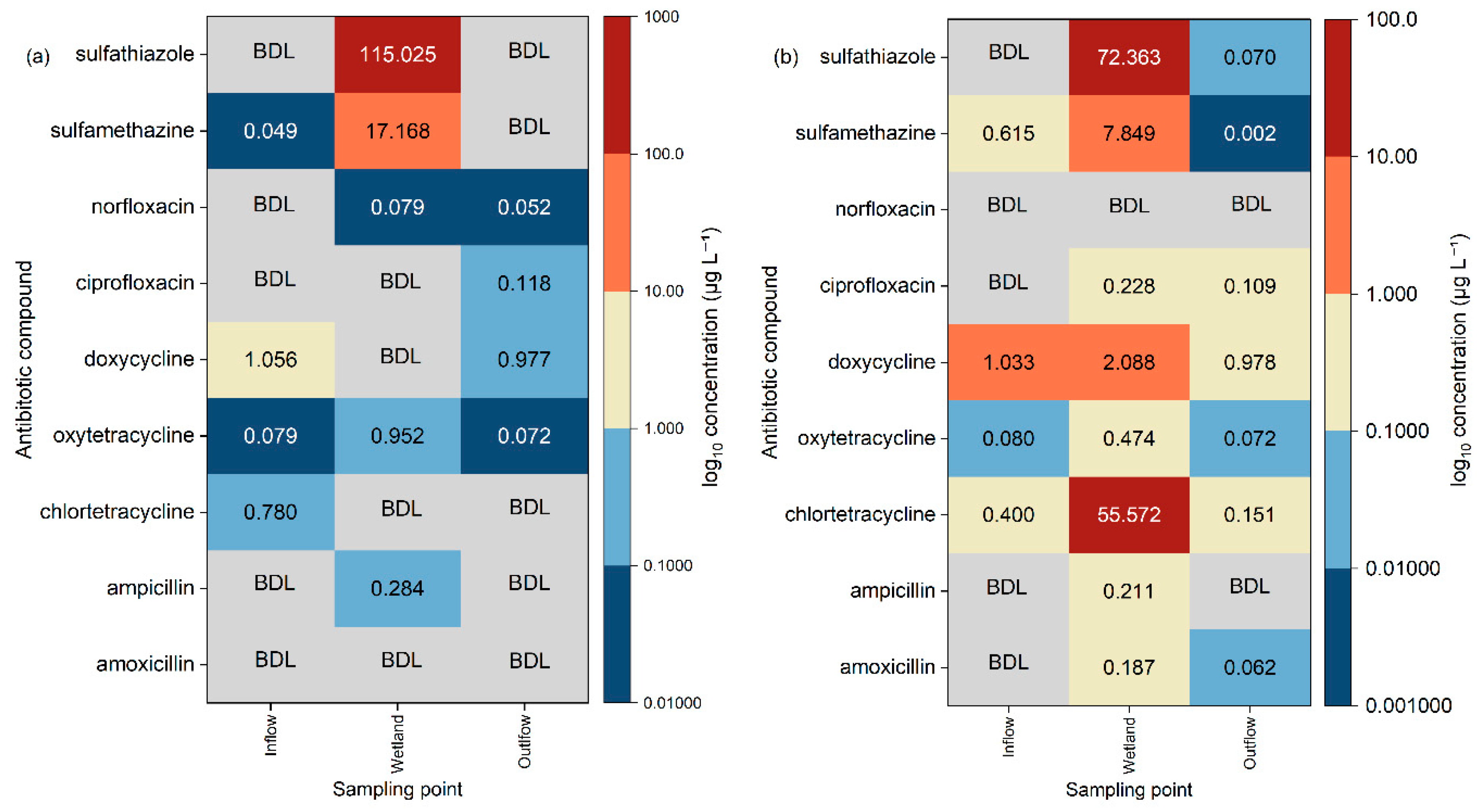
The main antibiotic groups detected at various points within the wetland were sulfonamides and tetracyclines. In particular, as summarized in Figure 3, sulfathiazole and sulfamethazine from the sulfonamide group, and chlortetracycline from the tetracycline group exhibited notable patterns of concentration change. Sulfathiazole increased up to 115.03 µg/L within the wetland but decreased to below the detection limit in the outflow in August. Similarly, in September, its concentration decreased from 72.36 µg/L in the wetland interior to 0.070 µg/L in the outflow, indicating a 99.9% removal rate. Moreover, most antibiotics showed high removal efficiencies of approximately 96% as they passed through the wetland. It was evaluated that the high removal rate of sulfonamides group antibiotics is due to their soil adsorption characteristics [27]. The elevated antibiotic concentrations observed in the wetland, relative to the inflow, suggest either the release of previously accumulated antibiotics from sediments or the formation of intermediate byproducts during microbial degradation. Overall, most antibiotics exhibited decreasing concentration trends as they pass through the wetland. However, certain compounds were found to be concentrated within the wetland interior. This indicates that although wetlands are generally effective in antibiotic removal, the retention or accumulation of certain antibiotics may occur under specific conditions [28].

3.2. Microbial Community in the Constructed Wetland

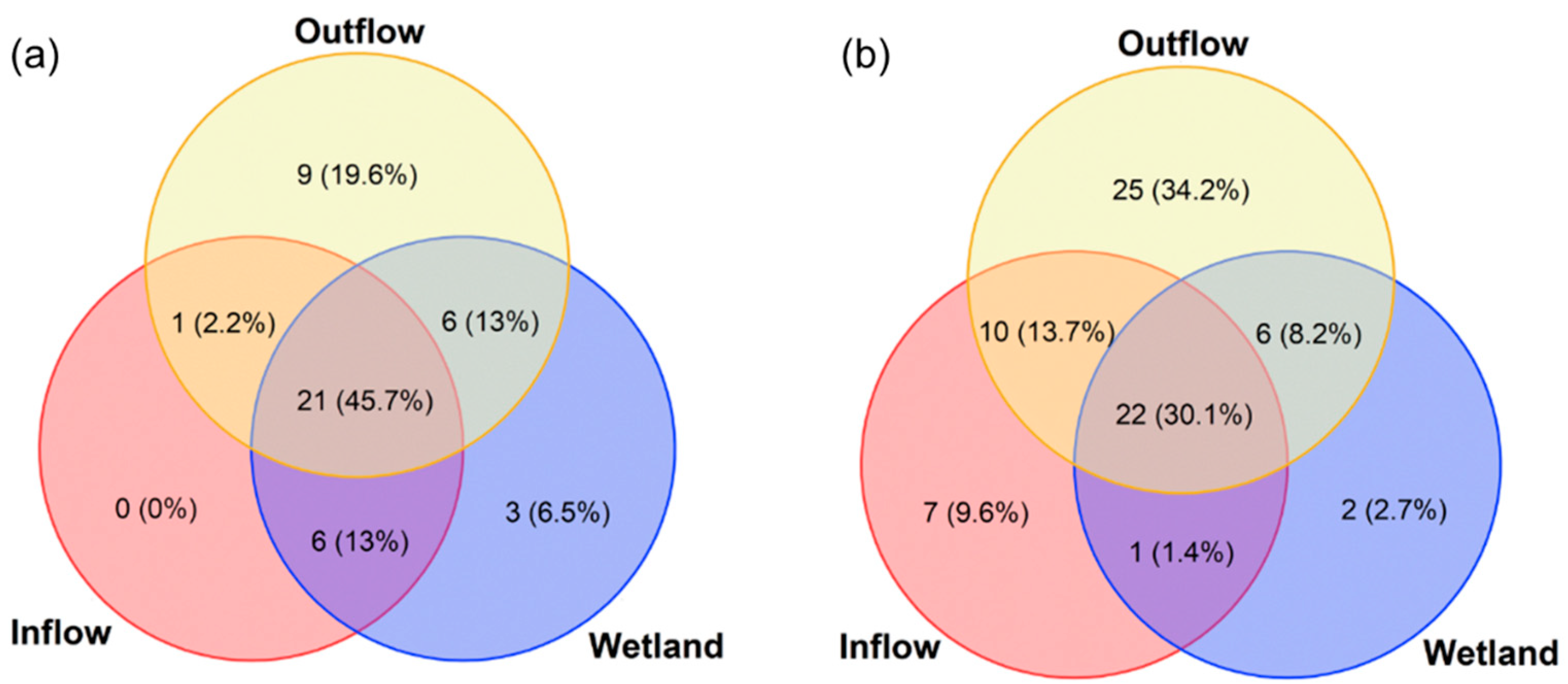
The spatial distribution of microbial communities across different points within the CW was compared using operational taxonomic unit (OTU) analysis, as presented in Figure 4. In August, a total of 46 OTUs were identified across all sampling points. Of these, 21 OTUs (45.7%) were shared across all three locations, indicating that nearly half of the detected microbial community was consistently present throughout the entire wetland system. Notably, no OTUs were unique to the inflow (0%), suggesting that microbial taxa entering the wetland either persisted in downstream compartments or were outcompeted under the prevailing wetland conditions. In September, the total number of detected OTUs increased markedly to 73, reflecting higher microbial diversity across all sampling points. The proportion of OTUs shared across all three locations decreased to 22 (30.1%), while those unique to the outflow increased substantially to 25 (34.2%), indicating a pronounced divergence in outflow community composition relative to upstream points. This pattern suggests that conditions in September, likely associated with shifts in antibiotic concentrations, temperature, and hydraulic dynamics, promoted the selective enrichment of a distinct outflow microbial assemblage. The proportion of microbial communities shared between the inflow and outflow increased dramatically from 2.2% (1 OTU) in August to 13.7% (10 OTUs) in September. These findings indicate that microbial community structures within CWs change dynamically in response to changes in water quality conditions [29]. In particular, various factors including changes in pollutant concentrations, residual characteristics of antibiotics, and physicochemical environment parameters appear to be major factors affecting the formation of different microbial community structures at different points of the inflow, the wetland, and the outflow. Therefore, specialized microbial communities adapted to specific environmental conditions were likely formed depending on the operational state of the wetland [30].
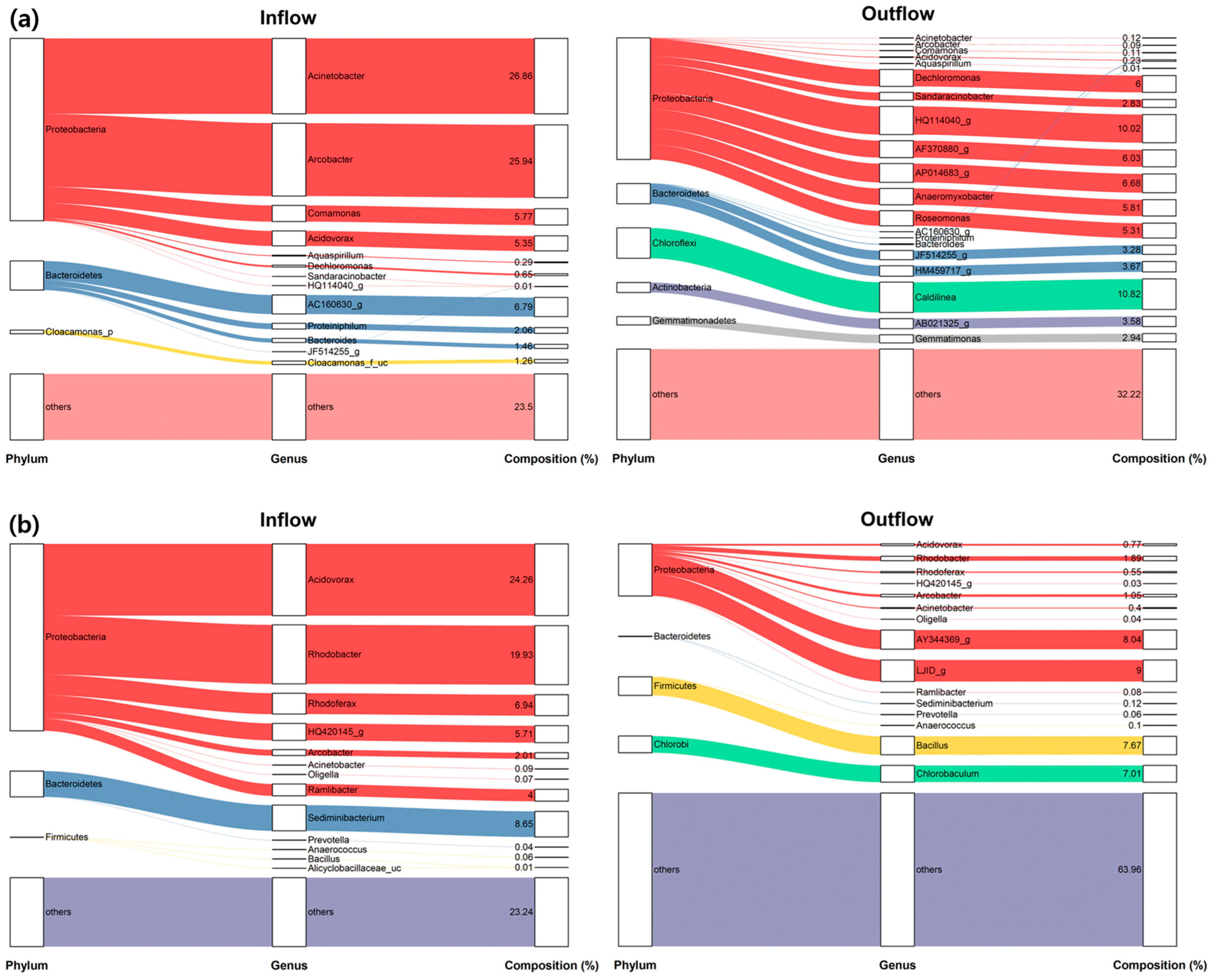
Figure 5 presents a comparative analysis of the taxonomic composition of microbial communities in the inflow and outflow of the CW during August and September. The structure and relative abundance level of microbial communities were visualized from the phylum to genus levels to examine changes in the proportions of different taxa. In both months, Proteobacteria was the dominant phylum commonly observed in both inflow and outflow samples. However, in the September outflow, Firmicutes and Chlorobi, which were barely detected in August, newly emerged with relative rates of 7.67% and 7.01%, respectively. This change suggests that the CW provided a more ecologically stable environment in September than in August, capable of supporting and adapting to a broader diversity of microbial communities. At the genus level, distinct seasonal changes in the composition of microbial communities were also observed. In the August inflow, Acinetobacter (26.86%) and Arcobacter (25.94%) were dominant, whereas in the September inflow, their relative abundances decreased, and Acidovorax (24.26%) and Rhodobacter (19.93%) became predominant. Acidovorax is known to be involved in the denitrification processes and plays an important role in the removal of nitrogenous [31], while Rhodobacter is a photosynthetic bacterium with nitrogen-fixation abilities, which can contribute to another pathway in the nitrogen cycling [32]. In the outflow samples, AY344369_g (8.04%) and JJID_g (9%) newly appeared in September, while the relative abundances of Bacillus (7.67%) belonging to Firmicutes, and Chlorobaculum (7.01%) belonging to Chlorobi also increased substantially. It is highly likely that these changes are closely related to the enhanced antibiotic removal efficiency observed in the September samples. Accordingly, the CW appeared to function as an ecological filter that altered the composition of microbial communities.

3.3. Association Between Antibiotics and Microorganisms

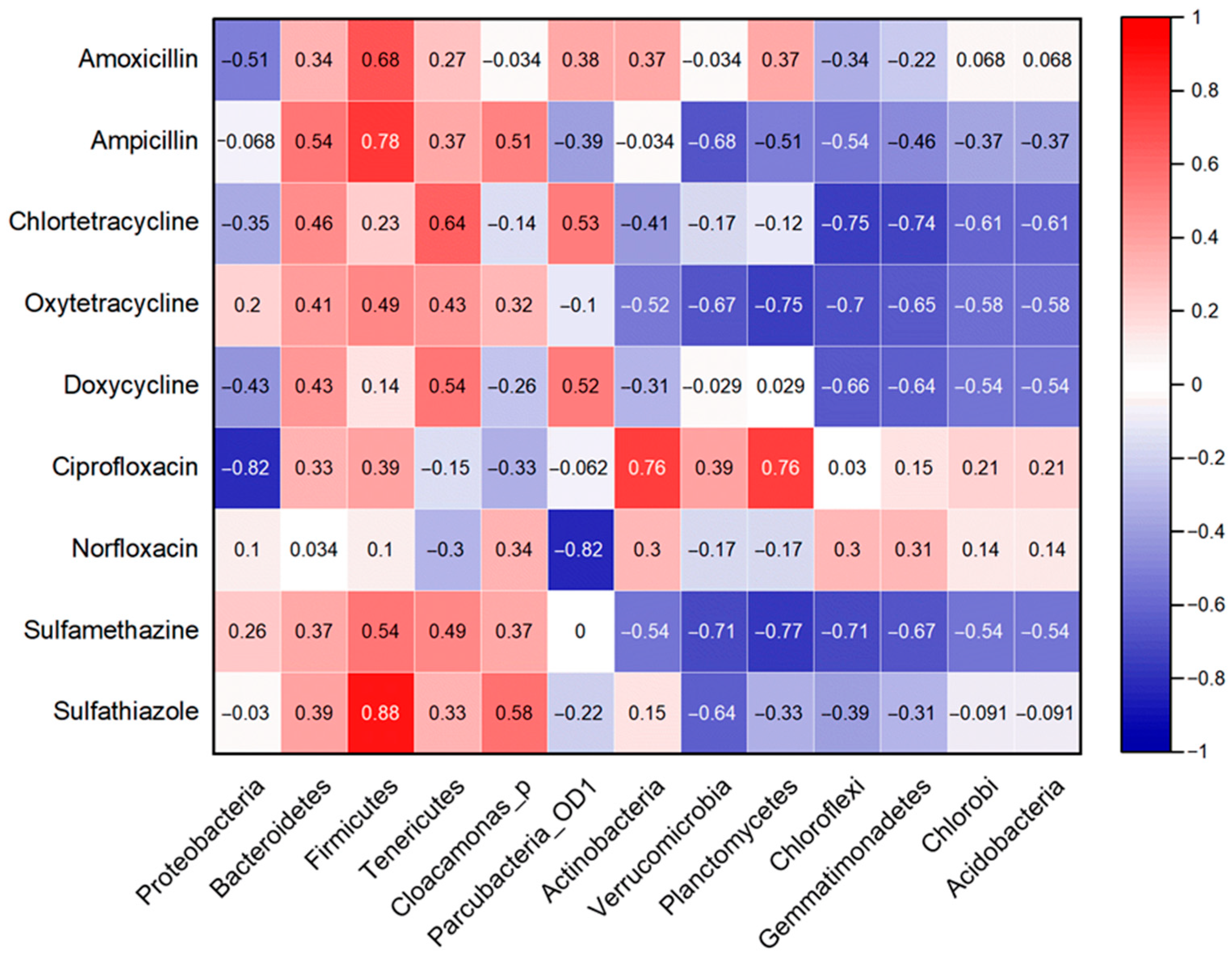
To understand the association between microbial communities and antibiotic behavior in the CW, Spearman’s correlation analysis was conducted between various antibiotic compounds and microbial communities at the microbial phylum level, and the results are summarized in Figure 6. The Firmicutes phylum exhibited strong positive correlations (0.14–0.88) with nearly all antibiotic compounds, with particularly high correlations observed for sulfathiazole (0.88), ampicillin (0.78), and amoxicillin (0.68). This suggests that microorganisms within the genus Bacillus, which belongs to the Firmicutes phylum, can degrade recalcitrant organic matter due to their ability to produce a wide range of enzymes, and some species may even be involved in antibiotic degradation [33,34]. In fact, an increase in Bacillus was observed in the September outflow samples, which is believed to be directly related to the enhanced antibiotic removal efficiency. In contrast, the phyla Chloroflexi, Gemmatimonadetes, and Acidobacteria showed distinct negative correlations (ranging from −0.22 to −0.75) with most antibiotics. This indicates that these phyla neither experience growth inhibition due to antibiotics nor do they contribute directly to antibiotic degradation. The phylum Actinobacteria showed negative correlations with Beta-lactam antibiotics (amoxicillin and ampicillin) but a strong positive correlation (0.76) with the fluoroquinolone antibiotic (ciprofloxacin). This implies that members of the Actinobacteria phylum may possess selective degradation abilities depending on the type of antibiotic involved. These findings provide valuable insights into the taxon-specific responses of microbial communities to individual antibiotic classes in CWs. However, as this study was conducted during the summer season, the observed patterns may not fully reflect seasonal variations in antibiotic behavior and microbial community composition. Future studies incorporating multi-seasonal monitoring will be essential for evaluating the year-round treatment performance of the constructed wetland and for developing season-adaptive management strategies.

4. Conclusions

This study was performed to evaluate the microbial activity influenced by antibiotics through a comparative analysis of antibiotic behavior and changes in microbial communities in a CW that receives effluent from an LWTP. The following conclusions were drawn:
  • The primary antibiotic groups detected in the wetland were sulfonamides and tetracyclines. While most antibiotics showed high removal efficiencies in the CW, antibiotics belonging to the sulfonamides group exhibited particularly high removal efficiency due to their strong adsorption to soil. However, some antibiotics were found to persist or accumulate within the wetland over the long term.
  • Changes in the wetland’s water quality environment dynamically influenced the structure of microbial communities, leading to the emergence of specialized microbial groups adapted to specific environmental conditions. The high concentrations of nutrients in the wetland caused substantial variability in the microbial community composition involved in nitrogen and phosphorus cycling.
  • Microorganisms involved in nutrient cycling in the wetland were found to play important roles in antibiotic degradation as well. The phylum Firmicutes exhibited strong positive correlations with nearly all antibiotic compounds. Among them, Bacillus was evaluated to contribute to antibiotic removal by producing various antibiotic-degrading enzymes.
  • The phyla Chloroflexi, Gemmatimonadetes, and Acidobacteria appeared to experience no growth inhibition due to antibiotics and were not directly involved in their degradation. The phylum Actinobacteria showed negative correlations with Beta-lactam antibiotics (amoxicillin and ampicillin) but a strong positive correlation with fluoroquinolone antibiotics (ciprofloxacin), suggesting selective degradation abilities depending on the type of antibiotic involved.
  • Nature-based solutions (NbS) such as CWs are increasingly being applied to treat effluent from LWTPs. The findings of this study can serve as foundational data for future studies aiming at enhancing the treatment efficiency of effluent containing low levels of biodegradable organic matter compared to nutrient concentrations, as well as various types of antibiotics.

Supplementary Materials

The following supporting information can be downloaded at: https://www.mdpi.com/article/10.3390/environments13050265/s1, Table S1: Molecular structure of the subject antibiotics; Table S2: LC-MS/MS analysis conditions; Table S3: LC–MS/MS identification and validation parameters for target antibiotics; Figure S1: External standard calibration curves for target antibiotics determined by LC–MS/MS.

Author Contributions

Conceptualization, Y.O. and L.K.; methodology, Y.O.; software, Y.O. and M.E.R.; validation, L.K.; formal analysis, Y.O.; investigation, M.E.R. and L.K.; resources, L.K.; data curation, Y.O. and M.E.R.; writing—original draft preparation, Y.O.; writing—review and editing, Y.O. and M.E.R.; visualization, Y.O. and M.E.R.; supervision, L.K.; project administration, Y.O. and L.K.; funding acquisition, L.K. All authors have read and agreed to the published version of the manuscript.

Funding

This research received no external funding.

Data Availability Statement

The original contributions presented in this study are included in the article/Supplementary Material. Further inquiries can be directed to the corresponding author.

Acknowledgments

This research was supported by the National Research Foundation of Korea (NRF) funded by the Ministry of Science and ICT (No. RS-2023-00277793). During the preparation of this manuscript/study, the authors used Claude AI for the purposes of grammar checking and improving the flow of academic writing. The authors have reviewed and edited the output and take full responsibility for the content of this publication.

Conflicts of Interest

The authors declare no conflicts of interest.

References

  1. Kümmerer, K. Antibiotics in the aquatic environment—A review—Part I. Chemosphere 2009, 75, 417–434. [Google Scholar] [CrossRef]
  2. Kümmerer, K. Antibiotics in the aquatic environment—A review—Part II. Chemosphere 2009, 75, 435–441. [Google Scholar] [CrossRef]
  3. Animal and Plant Quarantine Agency (APQA); Ministry of Agriculture, Food and Rural Affairs; Ministry of Food and Drug Safety. Sales of Veterinary Antibiotics in Korea. Available online: https://ebook.qia.go.kr/20240930_134736 (accessed on 10 June 2024).
  4. Wei, R.; Ge, F.; Huang, S.; Chen, M.; Wang, R. Occurrence of veterinary antibiotics in animal wastewater and surface water around farms in Jiangsu Province, China. Chemosphere 2011, 82, 1408–1414. [Google Scholar] [CrossRef]
  5. Chen, J.; Wei, X.D.; Liu, Y.S.; Ying, G.G.; Liu, S.S.; He, L.Y.; Yang, Y.Q. Removal of antibiotics and antibiotic resistance genes from domestic sewage by constructed wetlands. Sci. Total Environ. 2016, 565, 240–248. [Google Scholar] [CrossRef]
  6. Abate, T.A.; Birhanu, A.G. Antibiotic Use in Livestock and Environmental Antibiotic Resistance: A Narrative Review. Environ. Health Insights 2025, 19, 11786302251357775. [Google Scholar] [CrossRef]
  7. Barathe, P.; Kaur, K.; Reddy, S.; Shriram, V.; Kumar, V. Antibiotic Pollution and Associated Antimicrobial Resistance in the Environment. J. Hazard. Mater. Lett. 2024, 5, 100105. [Google Scholar] [CrossRef]
  8. Dan, A.; Yang, Y.; Dai, Y.N.; Chen, C.X.; Wang, S.Y.; Tao, R. Removal of sulfonamides and trimethoprim from domestic sewage in constructed wetlands. Bioresour. Technol. 2013, 146, 363–370. [Google Scholar] [CrossRef]
  9. Chen, T.; Zhang, S.; Zhu, R.; Zhao, M.; Zhang, Y.; Wang, Y.; Liao, X.; Wu, Y.; Mi, J. Distribution and Driving Factors of Antibiotic Resistance Genes in Treated Wastewater from Different Types of Livestock Farms. Sci. Total Environ. 2022, 849, 157837. [Google Scholar] [CrossRef] [PubMed]
  10. Carvalho, I.T.; Santos, L. Antibiotics in the aquatic environments: A review of the European scenario. Environ. Int. 2016, 94, 736–757. [Google Scholar] [CrossRef] [PubMed]
  11. Polianciuc, S.I.; Gurzău, A.E.; Kiss, B.; Ştefan, M.G.; Loghin, F. Antibiotics in the environment: Causes and consequences. Med. Pharm. Rep. 2020, 93, 231–240. [Google Scholar] [CrossRef] [PubMed]
  12. White, J.R.; Belmont, M.A.; Metcalfe, C.D. Pharmaceutical compounds in wastewater: Wetland treatment as a potential solution. Sci. World J. 2006, 6, 1731–1736. [Google Scholar] [CrossRef]
  13. Manoharan, R.K.; Ishaque, F.; Ahn, Y.H. Fate of antibiotic resistant genes in wastewater environments and treatment strategies. Chemosphere 2022, 298, 134671. [Google Scholar] [CrossRef]
  14. Kumari, A.; Raj, S.; Singh, S.K.; Verma, K.K.; Mishra, P.K. Ecological Functions of Microbes in Constructed Wetlands for Natural Water Purification. Water 2025, 17, 2947. [Google Scholar] [CrossRef]
  15. Ávila, C.; García-Galán, M.J.; Borrego, C.M.; Rodríguez-Mozaz, S.; García, J.; Barceló, D. Removal of antibiotics and ARGs in constructed wetlands. Sci. Total Environ. 2021, 755, 142554. [Google Scholar] [CrossRef]
  16. Sabri, N.A.; Schmitt, H.; Van Der Zaan, B.M.; Gerritsen, H.W.; Rijnaarts, H.H.M.; Langenhoff, A.A.M. Performance of full-scale constructed wetlands in removing antibiotics. Sci. Total Environ. 2021, 786, 147368. [Google Scholar] [CrossRef] [PubMed]
  17. National Institute of Environmental Research (NIER). Monitoring of Pharmaceutical Residues in Livestock Areas (II). 2019. Available online: https://ecolibrary.mcee.go.kr/nier/#/search/detail/5686961?offset=1#btn-export (accessed on 10 June 2024).
  18. Oh, Y.; Robles, M.E.; Vispo, C.; Jeon, M.; Kim, L.H. Research trends on antibiotic pollution control in constructed wetlands. J. Wetl. Res. 2024, 26, 511–521. [Google Scholar] [CrossRef]
  19. García, J.; García-Galán, M.J.; Day, J.W.; Boopathy, R.; White, J.R.; Wallace, S.; Hunter, R.G. Removal of emerging contaminants using wetlands. Bioresour. Technol. 2020, 307, 123228. [Google Scholar] [CrossRef] [PubMed]
  20. He, Y.; Zhang, L.; Jiang, L.; Wagner, T.; Sutton, N.B.; Ji, R.; Langenhoff, A.A. Improving antibiotic removal in constructed wetlands. J. Hazard. Mater. 2021, 407, 124386. [Google Scholar] [CrossRef]
  21. Li, Y.; Zhu, G.; Ng, W.J.; Tan, S.K. Removing pharmaceutical contaminants by constructed wetlands. Sci. Total Environ. 2014, 468, 908–932. [Google Scholar] [CrossRef]
  22. Hou, Y.; Ren, B.; Xue, Z.; Li, P.; Song, J.; Zhao, Y. Constructed Wetlands for Emerging Pollutants Removal: A Decade of Advances and Future Directions (2014–2024). Emerg. Contam. 2026, 12, 100673. [Google Scholar] [CrossRef]
  23. Lee, S.; Maniquiz, M.C.; Kim, L.H. Characteristics of contaminants in constructed wetlands treating piggery wastewater. J. Environ. Sci. 2010, 22, 940–945. [Google Scholar] [CrossRef] [PubMed]
  24. Park, K.; Kang, D.; Jo, W.G.; Yu, H.S.; Yoon, Y.S.; Kim, B.-W. Analysis of Water Quality Components and Antibiotics in the Final Effluent of Wastewater Treatment Facilities in the Nakdong River Basin. J. Environ. Sci. Int. 2020, 29, 857–866. [Google Scholar] [CrossRef]
  25. Yoon, S.H.; Ha, S.M.; Kwon, S.; Lim, J.; Kim, Y.; Seo, H.; Chun, J. EzBioCloud database for 16S rRNA classification. Int. J. Syst. Evol. Microbiol. 2017, 67, 1613–1617. [Google Scholar] [CrossRef]
  26. Rideout, J.R.; He, Y.; Navas-Molina, J.A.; Walters, W.A.; Ursell, L.K.; Gibbons, S.M.; Caporaso, J.G. OTU clustering method for microbial community analysis. PeerJ 2014, 2, e545. [Google Scholar] [CrossRef]
  27. Choi, Y.J.; Kim, L.H.; Zoh, K.D. Removal characteristics of antibiotics in constructed wetlands. Ecol. Eng. 2016, 91, 85–92. [Google Scholar] [CrossRef]
  28. Wen, H.; Zhu, H.; Yan, B.; Bañuelos, G.; Shutes, B.; Wang, X.; Tian, L. Antibiotic removal in constructed wetlands intensified by sponge iron. Sci. Total Environ. 2022, 806, 150220. [Google Scholar] [CrossRef] [PubMed]
  29. Zhang, Y.; Ji, Z.; Pei, Y. Nutrient removal and microbial community structure in wetland systems. Process Saf. Environ. Prot. 2021, 147, 1160–1170. [Google Scholar] [CrossRef]
  30. Bydalek, F.; Webster, G.; Barden, R.; Weightman, A.J.; Kasprzyk-Hordern, B.; Wenk, J. Microbial niche differentiation in constructed wetlands. Water Res. 2024, 254, 121408. [Google Scholar] [CrossRef]
  31. Tan, X.; Yang, Y.; Liu, Y.; Li, X.; Fan, X.; Zhou, Z.; Yin, W. Organics and nutrient removal in constructed wetlands. Bioresour. Technol. 2019, 280, 441–446. [Google Scholar] [CrossRef] [PubMed]
  32. Kumar, S.; Diksha; Kumar, R. Biofertilizers for nutrient recycling. Curr. Res. Microb. Sci. 2021, 3, 100094. [Google Scholar] [CrossRef]
  33. Reddy, K.V.; Reddy, A.V.K.; Babu, B.S.; Lakshmi, T.V. Applications of Bacillus sp. in wastewater treatment. Int. J. Sci. Res. Sci. Technol. 2018, 4, 1806–1812. [Google Scholar]
  34. Etesami, H.; Jeong, B.R.; Glick, B.R. Biocontrol of plant diseases by Bacillus spp. Physiol. Mol. Plant Pathol. 2023, 126, 102048. [Google Scholar] [CrossRef]
Figure 1. Study area and wetland system in Nonsan, Chungcheongnam-do, Republic of Korea.
Environments 13 00265 g001
Figure 2. Pretreatment process of water samples for antibiotic analysis.
Environments 13 00265 g002
Figure 3. Spatial distribution of antibiotic concentrations across the constructed wetland (CW) treatment sections during (a) August and (b) September. Color intensity represents log10-transformed concentrations (µg L−1). Values below the detection limit are indicated as BDL (below detection limit).
Environments 13 00265 g003
Figure 4. Distribution of microbial communities in the CW in (a) August and (b) September.
Environments 13 00265 g004
Figure 5. Taxonomic composition of microbial communities in the constructed wetland in (a) August and (b) September.
Environments 13 00265 g005
Figure 6. Spearman correlation matrix for antibiotics and microbial phyla in the constructed wetland.
Environments 13 00265 g006
Disclaimer/Publisher’s Note: The statements, opinions and data contained in all publications are solely those of the individual author(s) and contributor(s) and not of MDPI and/or the editor(s). MDPI and/or the editor(s) disclaim responsibility for any injury to people or property resulting from any ideas, methods, instructions or products referred to in the content.