
Article

Environmental Reservoirs of Microbial Contamination in University Food Services: A Large-Scale Study in Northern Portugal

by
Kamila Soares
1,2,*,
Joana Paiva
1,2,3,
Juan García-Díez
1,2,3,
Irene Oliveira
4,5,
Alexandra Esteves
1,2,3 and
Cristina Saraiva
1,2,3
1
Veterinary and Animal Research Center (CECAV), University of Trás-os-Montes and Alto Douro (UTAD), 5000-801 Vila Real, Portugal
2
Al4AnimalS Associated Laboratory for Animal and Veterinary Science, 5000-801 Vila Real, Portugal
3
Department of Veterinary Science, School of Agrarian and Veterinary Science (ECAV), University of Trás-os-Montes and Alto Douro (UTAD), 5000-801 Vila Real, Portugal
4
Department of Mathematics, School of Science and Technology, University of Trás-os-Montes e Alto Douro (UTAD), 5000-801 Vila Real, Portugal
5
Center for Computational and Stochastic Mathematics (CEMAT), Instituto Superior Técnico, University of Lisbon (IST-UL), 1049-001 Lisboa, Portugal
*
Author to whom correspondence should be addressed.
Environments 2026, 13(4), 209; https://doi.org/10.3390/environments13040209
Submission received: 28 February 2026 / Revised: 1 April 2026 / Accepted: 4 April 2026 / Published: 10 April 2026

Abstract

(1) Background: University food service establishments are complex environments, where high turnover and handling practices create conditions for microbial persistence. Food-contact surfaces (FCSs) and handlers’ hands (FHs) function as dynamic reservoirs, facilitating the circulation of contaminants within these institutional settings. This study aimed to characterise the microbiological contamination of FCSs and FHs in university food service establishments in Northern Portugal and to evaluate their role as interconnected environmental reservoirs within the indoor built environment. (2) Methods: A total of 590 samples were analysed from two universities in Northern Portugal (L1, L2), comprising 380 FCS and 210 FH samples. Aerobic colony counts (ACCs), Enterobacteriaceae, and Moulds and yeasts (MYs) were analysed according to ISO methods. FH samples were additionally screened for Escherichia coli and Staphylococcus spp. (3) Results: Overall, 35.5% of FCSs were classified as non-compliant, according to microbial criteria based on guideline values from the National Health Institute Dr. Ricardo-Jorge (INSA), with non-compliance primarily driven by elevated ACCs and MYs. Based on a Generalised Linear Model (GLM), establishment types (canteens vs. cafes) were associated with Enterobacteriaceae levels (p = 0.016), whereas ACCs and MYs were not significantly associated with district, establishment type, or functional surface category (p > 0.05). Differences between left and right hands showed small effect sizes, and location was a highly significant determinant of hand hygiene acceptability. (4) Conclusions: FCSs and FHs act as relevant contamination reservoirs in these settings. The results indicate that Enterobacteriaceae levels on FCSs differed between establishment types, while ACCs and MYs showed no significant variation across the evaluated environmental factors. Marked differences in hand hygiene acceptability between campuses support the implementation of targeted interventions, including the optimisation of cleaning and disinfection protocols, the structured training of food handlers, and the routine microbiological monitoring of surfaces and hands to improve institutional food safety.

1. Introduction

University food service establishments, as institutional catering environments embedded within the university setting, present additional challenges for hygiene control due to their organisational structure and service dynamics [1,2]. In addition, these environments are characterised by high population density, repeated service cycles, and elevated user turnover, conditions that have been associated with increased risk of foodborne infections and contamination events in large-scale catering systems [3,4]. These settings combine large-scale meal production with standardised service routines, shared preparation areas, and intense circulation of staff and users within the same facility, increasing the frequency of contact events among food, equipment, surfaces, and handlers and favouring microbial dissemination across the indoor environment.
Observational inspections of university canteens have identified operational and personal hygiene deficiencies under routine service conditions, particularly in contexts characterised by limited staffing and high customer turnover [5]. In parallel, questionnaire-based research has shown that food handlers may report adequate knowledge and positive attitudes towards food safety while still demonstrating inconsistencies in daily hygiene practices, highlighting a gap between knowledge and behaviour [6,7]. Although these two approaches address different dimensions, observed performance versus self-reported attitudes, they converge in suggesting that the organisational structure, workload, and behavioural factors can influence hygiene effectiveness in practice. This discrepancy between reported knowledge and actual practices highlights the need for objective microbiological verification of hygiene conditions in real institutional food service environments [8].
This need for objective verification has been supported by microbiological studies performed in food service establishments, which showed that inadequate hygiene practices, high workloads, and operational constraints may compromise effective cleaning and food handlers’ hand hygiene, thereby increasing the likelihood of microbial persistence on food-contact surfaces and food handlers’ hands [9,10,11]. Similar observations have been reported in institutional kitchens, where contamination is not uniformly distributed but tends to concentrate in specific hotspots, including frequently handled surfaces and food handlers’ hands, reinforcing their roles in contamination dynamics.
Food preparation areas rely heavily on manual operations and repeated contact with shared equipment and utensils during routine activities, which can promote frequent and bidirectional microbial transfer among hands, food-contact surfaces, and the food itself, with cross-contamination events occurring at several orders of magnitude and persisting even after handwashing procedures [12]. Food-contact surfaces and food handlers’ hands are, therefore, recognised as central elements in contamination pathways within food service environments. In addition to their role in direct cross-contamination, food-contact surfaces can act as environmental reservoirs that support diverse microbial communities, shaped by surface characteristics, frequency of use, and cleaning effectiveness. Investigations conducted in food service and processing environments have consistently reported the presence of microorganisms on conventional and atypical surfaces, including frequently touched equipment and objects, particularly when sanitisation procedures are insufficient or inconsistently applied [13,14,15]. Studies have also emphasised that food-contact surfaces represent persistent sources of cross-contamination, even in environments where food handlers demonstrate adequate knowledge of hygiene practices [16].
Importantly, contamination dynamics in these environments are not limited to direct hand–surface interactions. A microbiological evaluation of indoor air quality in university canteens and cafes in Northern Portugal documented measurable loads of total mesophilic bacteria and fungi, with variation according to establishment type and functional area [17]. The presence of airborne microorganisms, including mould genera commonly detected in indoor environments, highlights the role of the built environment as an additional contamination interface capable of contributing to surface deposition and microbial recirculation within food preparation areas. Indoor fungal levels are influenced by environmental conditions, and higher heat/humidity periods can promote mould growth, while regulatory/management approaches remain heterogeneous across countries [18]. Fungi are common components of indoor bioaerosols and may deposit onto food-contact surfaces and food handlers’ hands through air–surface interactions, human movement, and cleaning-related disturbances [19].
In food service environments, Moulds and yeasts have been applied as complementary indicators of environmental hygiene, reflecting the combined influence of indoor environmental conditions, operational practices, and surface contamination dynamics when interpreted alongside Aerobic colony counts and Enterobacteriaceae [20,21]. While aerobic mesophilic counts and Enterobacteriaceae remain the most frequently used hygiene indicators for surface monitoring, Moulds and yeasts are comparatively underrepresented in food-service-focused studies, despite their recognised relevance in indoor environments and their documented association with air–surface interactions and potential human exposure [22]. Monitoring studies in institutional catering systems have highlighted the importance of integrating environmental indicators with routine surface assessment to identify contamination hotspots and support targeted hygiene interventions [8].
Within the European Union, Regulation (EC) No 2073/2005 [23] establishes microbiological criteria for foodstuffs and process hygiene but does not define specific microbiological limits for food-contact surfaces or food handlers’ hands. At the national level, the interpretation of environmental monitoring results is commonly supported by guideline values issued by the National Health Institute Dr. Ricardo-Jorge (INSA) [24], which provide reference ranges mainly for bacterial indicators. Deviations from guideline values may signal deficiencies in cleaning efficacy, workflow organisation, or hygiene practices and are commonly interpreted as markers of process failures requiring corrective actions [24,25]. However, no harmonised legislative framework defines microbiological criteria for fungi on surfaces or hands in food service settings. This regulatory gap is particularly relevant, given the recognised presence of Moulds and yeasts in indoor food environments, underscoring the need for comprehensive microbiological assessment strategies that extend beyond product-based criteria and incorporate environmental interfaces.
Epidemiological surveillance has consistently identified collective food service settings, including canteens, as recurrent contexts for foodborne outbreaks, where cross-contamination, insufficient sanitation, and contaminated equipment and utensils are commonly implicated [26,27]. Given this scenario, foodborne diseases continue to represent a major global public health burden, with hundreds of millions of cases reported annually worldwide [28].
In Southern European university settings, large-scale studies integrating food-contact surfaces and food handlers’ hands within the same operational context, and interpreted through environmental hygiene indicators, remain limited. This scarcity constrains the understanding of microbial persistence and circulation dynamics in these establishments, particularly in light of the absence of harmonised microbiological criteria for environmental interfaces.
Therefore, the present study aimed to characterise the microbiological contamination of food-contact surfaces and food handlers’ hands in university food service establishments in Northern Portugal, considering these interfaces as interconnected environmental reservoirs within the indoor built environment. Through systematic swab-based microbiological monitoring conducted across different types of establishments (cafes and canteens) and locations, this work seeks to provide an integrated assessment of environmental hygiene in institutional food services and to support risk-based strategies for the prevention of microbial exposure and cross-contamination in high-occupancy indoor settings.

2. Materials and Methods

2.1. Sampling Plan and Data Collection

This study was designed as a cross-sectional observational study aimed at assessing microbiological contamination on food-contact surfaces (FCSs) and food handlers’ hands (FHs) in university food service establishments in Northern Portugal. A convenience-based sampling approach was used for the selection of study sites. The study considered the university location (L1 and L2), type of establishment (canteens and cafes), and surface categories as the main comparison factors. No interviews were conducted, as the study was based exclusively on microbiological sampling.
Written informed consent was obtained from all the participants prior to hand swabbing; participation was voluntary, and data were anonymised. The study was conducted in accordance with the Declaration of Helsinki and approved by the Ethics Committee of the University of Trás-os-Montes and Alto Douro (CE-UTAD).
Table 1 presents the distribution of samples collected from food-contact surfaces (FCSs) and food handlers’ hands (FHs) by the university location (L1 and L2) and type of food establishment (canteens and cafes).
A total of 380 FCS samples were collected that included a wide variety of surfaces (n = 117) (e.g., walls, shelves, and food preparation tables), food equipment (n = 132) (electrical and mechanical appliances, such as coffee machines, dishwashers, ovens, microwave ovens, toasters, refrigerators, freezers, slicers, electric and gas stoves, and juicers), and food utensils (n = 131) (including items used to handle and/or serve food, such as cutting boards, cutlery, plates, glasses, cups, knives, tongs, ladles, saucepans, frying pans, and slotted spoons). These categories were defined to reflect functional surface types within food service operations, allowing the differentiation between structural surfaces, equipment, and utensils according to their roles in food handling and potential contributions to cross-contamination.
A total of 105 food handlers were sampled, distributed between L1 (n = 57) and L2 (n = 48). Both hands (right and left) were sampled, resulting in 210 hand samples (114 from L1 and 96 from L2), allowing for an analysis categorised by the university location, and hand laterality (left and right), to explore potential differences between left and right hands.
Microbiological samples were collected at the beginning of the work shift, when operations were already underway. Hand samples were obtained using the swab technique: Each sterile swab was placed in a tube containing 10 mL of Tryptone Salt Broth (TS) (0.1% tryptone, 0.85% NaCl) (HiMedia, Mumbai, India) and rubbed longitudinally, vertically, and diagonally over a delimited area of the hand surface for approximately 20 s, applying uniform pressure, and returned to the same tube. A sterile 100 cm2 template was used to standardise the sampled area, and the results were expressed as CFUs/cm2. The same technique was applied to FCSs, using sterile paper templates (10, 25, or 100 cm2) to delimit the sampling area, in accordance with ISO 18593:2018 [29].
After sampling, all the tubes were transported under refrigerated conditions (2 ± 1 °C) and processed within 2 h of arrival at the laboratory. Sample preparation, including the initial suspension and decimal dilutions, was performed according to ISO 6887-1:20 [30].

2.2. Microbial Analysis

All the food-contact surfaces were evaluated for Aerobic colony counts (ACCs), Enterobacteriaceae, and Moulds and yeasts (MYs). Hand hygiene was assessed through the analysis of ACCs, Enterobacteriaceae, MYs, Escherichia coli, and both Coagulase-positive (CoPS) and Coagulase-negative staphylococci (CoNS).
Following the homogenisation of the swabs, serial decimal dilutions were prepared in TS (HiMedia, Mumbai, India). For ACCs, Enterobacteriaceae, and E. coli, 1 mL aliquots were plated using the pour-plate technique. For MYs and Staphylococcus spp., 0.1 mL aliquots were surface-plated using the spread-plate technique.
ACCs were enumerated on Plate-count agar (PCA) (Liofilchem, Roseto degli Abruzzi, Italy) at 30 °C for 72 h, according to ISO 4833-1:2013 [31]; Enterobacteriaceae were determined on Violet–Red Bile–Glucose (VRBG) agar (Liofilchem, Roseto degli Abruzzi, Italy) after incubation at 37 °C for 24 h, following ISO 21528-2:2017 [32]. Mould and yeast counts were enumerated after incubation on Yeast Extract–Glucose–Chloramphenicol (YGC) agar (HiMedia, Mumbai, India) at 25 °C for 3–5 days, in accordance with ISO 21527-1:2008 [33]. E. coli counts were obtained on Tryptone–Bile–X-glucuronide (TBX) agar (VWR, Leuven, Belgium) at 44 °C for 24 h, following ISO 16649-2:2001 [34].
Staphylococcus spp. were enumerated on Baird–Parker Agar (BPA) supplemented with egg yolk–tellurite emulsion (VWR, Leuven, Belgium) at 37 °C for 24–48 h. Both typical and atypical colonies were counted, and presumptive isolates were subjected to coagulase tests to differentiate CoPS and CoNS, in accordance with ISO 6888-1:2021 [35].
The results were expressed as colony-forming units per square centimetre (CFUs/cm2). For statistical analysis, data were log10-transformed (log10 CFUs/cm2).

2.3. Microbiological Criteria

Table 2 summarises the microbiological criteria applied in this study. For hygiene indicators, the criteria were established by INSA [24]. Food-contact surfaces were classified according to the surface risk zone (Zones 1 and 2) and the sampling phase (Phases A and B). Zone 1 includes surfaces in direct contact with ready-to-eat foods and/or the consumer’s mouth or with raw materials, while Zone 2 comprises surfaces that come into contact with the container holding RTE foods (e.g., countertops, transport carts, trays, display cases, and refrigerators). Phases A and B in Zone 1 refer to surfaces ready for use (exposed or stored). Phase A in Zone 2 corresponds to sampling carried out during food handling or service, and Phase B refers to sampling carried out after cleaning and disinfection. Thus, categories A1, B1, A2, and B2 represent combinations of surface risks and hygiene stages, considering proximity to the consumer and operational status at the time of sampling. For food handlers’ hands, microbiological criteria were applied according to hygiene stage E, corresponding to conditions involving contact with ready-to-eat foods.
For Moulds and yeasts, the acceptability limits were adapted according to the normal hygiene level proposed by Wirtanen and Salo [22]. The “poor” limit was used to define non-acceptable results for both contact surfaces, with limits converted to log10 CFUs/cm2.
Global microbiological acceptability was defined as a binary outcome (acceptable/non-acceptable). A sample was deemed globally non-acceptable if any individual parameter (ACCs, Enterobacteriaceae, MYs, E. coli, CoPS, or CoNS) did not meet the established acceptability criteria.

2.4. Statistical Analysis

Statistical analyses were performed using IBM SPSS Statistics (version 31.0; IBM Corp., Armonk, NY, USA). Microbiological counts were log10-transformed (log10 CFUs/cm2) prior to the analysis. Samples with no detectable growth were assigned a value of 0 log10 CFUs/cm2 for statistical purposes.
Descriptive statistics were calculated, and the results are presented as means ± standard deviations. The normality of the data distribution was assessed using the Shapiro–Wilk test.
As several variables did not meet parametric assumptions, non-parametric tests were applied for bivariate comparisons. Comparisons between more than two independent groups were performed using the Kruskal–Wallis test, followed by Bonferroni-adjusted pairwise comparisons when appropriate. Comparisons between two independent groups (e.g., the university location or establishment type) were performed using the Mann–Whitney U test. Paired comparisons between right and left hands were analysed using the Wilcoxon signed-rank test.
To evaluate the simultaneous effect of multiple factors on FCS microbial levels, a Generalised Linear Model (GLM) with a Gaussian distribution and an identity link function was applied. Separate models were fitted for each microbiological parameter (ACCs, Enterobacteriaceae, and MYs), using log10-transformed counts (log10 CFUs/cm2) as dependent variables. The model included the university location (district), type of establishment, and functional surface category as fixed factors. The reference categories were defined as L2 for the district, canteens for the type of establishment, and an acceptability category for the functional surface category.
Interaction terms between main factors were initially tested and retained only when statistically significant. Model assumptions were assessed by examining residual distributions and the homogeneity of variances. Type III tests of model effects were used to assess the statistical significance, and parameter estimates (β) with 95% confidence intervals were calculated.
For categorical variables, global microbiological acceptability was evaluated using the chi-squared (χ2) test. Samples were classified as “acceptable” only when all the microbiological parameters complied with the defined criteria; if at least one parameter exceeded the established limit, the sample was classified as “non-acceptable”. Associations between acceptability outcomes and explanatory variables (the university location and type of establishment) were assessed, and odds ratios (ORs) with 95% confidence intervals (CIs) were calculated to estimate the strengths of associations.
Effect sizes for pairwise comparisons were calculated using effect size estimates (rank-biserial correlation, r) to assess the practical relevance of statistically significant differences. Effect size values were interpreted as indicators of the magnitude of the observed differences.
A significance level of p < 0.05 was adopted for all the statistical analyses, with Bonferroni correction applied in the case of multiple comparisons.

3. Results

3.1. Microbiological Levels and Acceptability of Food-Contact Surfaces (FCSs)

Table 3 summarises the microbiological levels (log CFUs/cm2) of FCSs according to the university location (L1 and L2), type of food establishment (canteens and cafes), and functional category (equipment, work surfaces, and utensils).
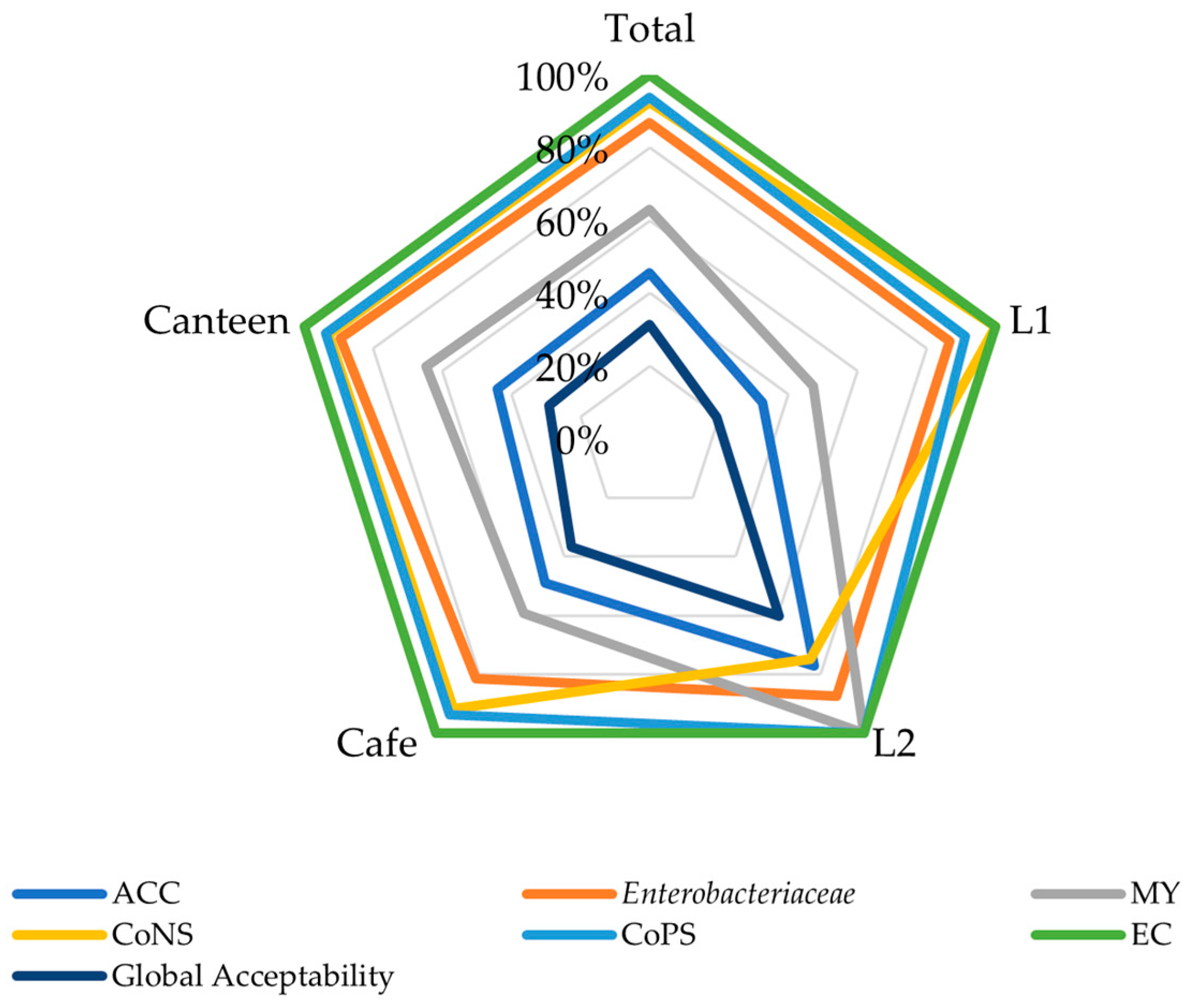
The microbiological acceptability of FCSs was assessed based on the criteria defined in Table 2. The combined outcome of all the indicators, along with the specific acceptability percentages categorised by the university location, type of establishment, and indicator microorganism, is presented in Figure 1. Following the global acceptability approach described in Section 2.3, where a sample is considered as non-acceptable if at least one indicator fails, 64.5% (n = 245) of the FCS samples were classified as microbiologically acceptable.
Regarding individual microorganisms, Enterobacteriaceae recorded the highest levels of compliance, particularly in cafes, where no detectable counts were observed. In contrast, ACCs and MYs were the main contributors to non-acceptable results, with ACCs showing the lowest acceptability rate, closely mirroring the global acceptability trend.
Regarding the establishment types, cafe FCSs presented consistently low ACC levels and an absence of Enterobacteriaceae at both university locations. In these establishments, neither the location nor the surface category significantly affected microbial counts (p > 0.05), and the effect on Enterobacteriaceae could not be statistically assessed due to the lack of detectable counts.
In canteens, the university location emerged as a primary factor, exerting a strong significant effect on ACC levels (p < 0.001), whereas the surface category showed no significant influence (p > 0.05). This location effect remained significant when functional categories were analysed separately, specifically for equipment, utensils, and work surfaces (p < 0.01). Conversely, no significant effects of the location or surface category were identified for Enterobacteriaceae or MYs within canteen environments (p > 0.05).
When analysed by functional group, Zone 1 surfaces showed lower microbiological acceptability, particularly in category 1B, which presented the highest proportion of non-acceptable results (40.4%). In contrast, category 2A exhibited the highest acceptability rate (71.6%). Although category 2B also showed a relatively high proportion of non-acceptable results, the interpretation of these data is limited by the small sample size.

3.2. Microbiological Levels and Acceptability of Food Handlers’ Hands (FHs)

Table 4 presents the microbiological loads (log CFUs/cm2) detected on food handlers’ hands according to the university location (L1: n = 57 and L2: n = 48), type of food establishment (canteens and cafes), and hand laterality (right, left, and both hands).
Regarding hand hygiene, Aerobic colony counts represented the highest microbial loads across all the groups, followed by Moulds and yeasts, and Enterobacteriaceae. The screening for specific pathogens showed that Escherichia coli were not detected in any analysed sample, regardless of the location or establishment type. However, Staphylococci presented a peculiar distribution: Coagulase-positive staphylococci (CoPS) were found at low but detectable levels exclusively in L1. Conversely, Coagulase-negative staphylococci (CoNS) were only detected in L2, with higher counts in cafe settings. A common feature across almost all the parameters was the high data dispersion, as evidenced by the elevated standard deviations, reflecting significant inter-individual variabilities in hand contamination and hygiene efficacy.
Microbial loads showed high variability between individual food handlers, indicating heterogeneous hygiene performance.
The global microbiological acceptability of food handlers’ hands was assessed based on compliance with the microbiological criteria presented in Table 2.
A hand sample is classified as globally unacceptable based on the combined acceptability score of all the evaluated indicators (overall acceptability). A sample was considered as non-acceptable if at least one of the analysed parameters did not meet the defined thresholds.
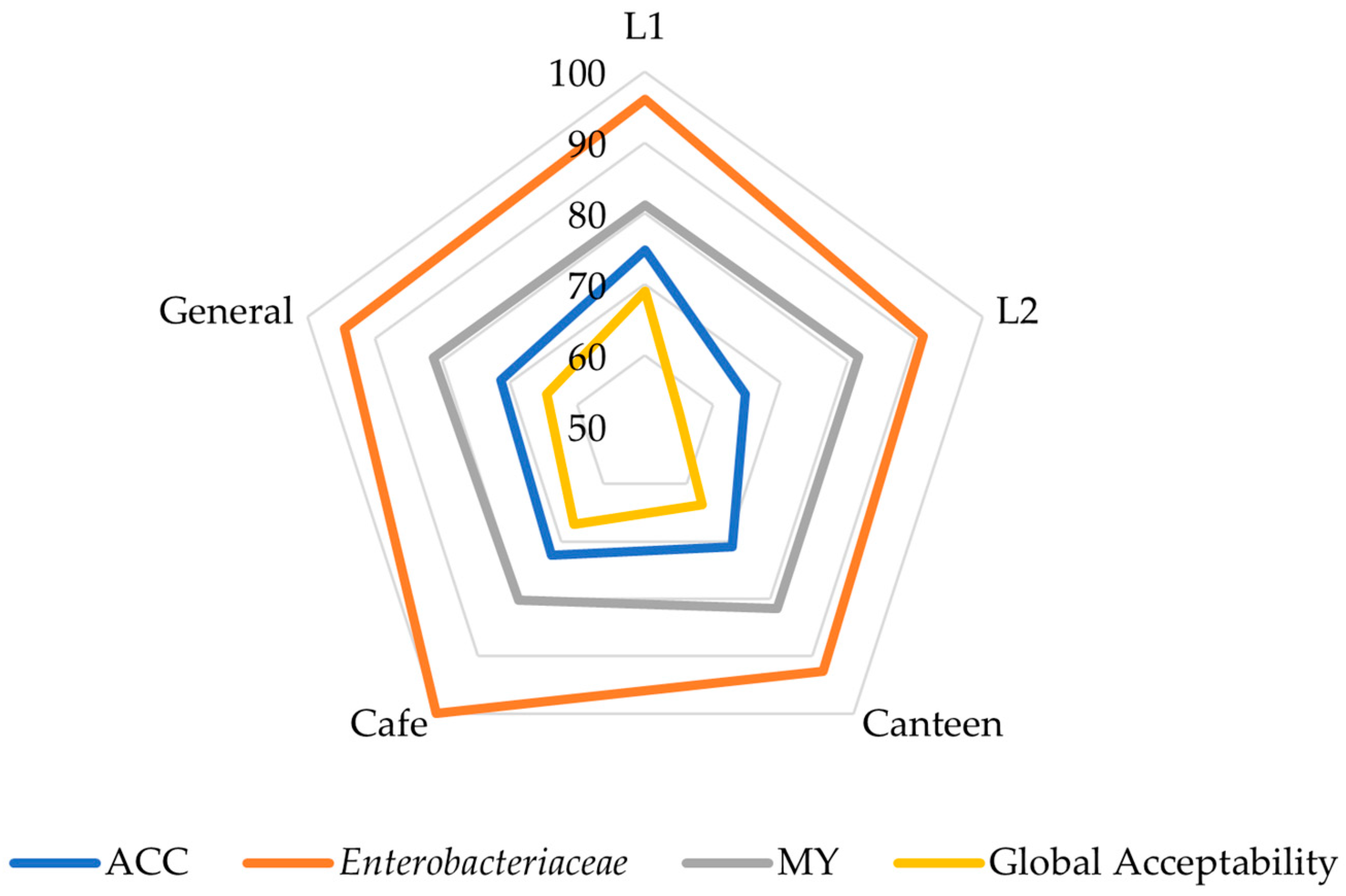
Figure 2 illustrates the distribution of the global microbiological acceptability according to the university location, type of food establishment, and hygiene stage.
Regarding the individual parameters, the microorganisms that recorded the highest levels of acceptability were E. coli (100.0%), followed by CoPS (93.83%), CoNS (92.6%), Enterobacteriaceae (87.0%), and Moulds and yeasts (63.0%). Conversely, the lowest compliance rates were observed for ACCs (45.7%), which were the main parameters contributing to the low overall acceptability observed in this study.

3.3. Results of Statistical Analysis for FCSs and FHs

Based on the Generalised Linear Model, the type of establishment did not significantly influence ACC or MY levels (p > 0.05). However, Enterobacteriaceae counts differed significantly between establishment types (p < 0.05), with higher levels observed in canteens compared with cafes. Parameter estimates indicated that relative to canteens (reference category), cafes presented significantly lower Enterobacteriaceae levels (β = −0.149; 95% CI: from −0.270 to −0.028). Contrary to the initial univariate interpretation, the university location did not significantly influence any of the microbial indicators when evaluated within the multifactorial model. No significant effect of the district was observed for ACCs, Enterobacteriaceae, or MYs (p > 0.05). Similarly, no significant effects of the FCS functional category (equipment, surfaces, or utensils) were observed for any microbial group (p > 0.05). The absence of significant interaction effects further indicates that the observed microbial distributions remained consistent across locations and establishment types. Overall, only the type of establishment was significantly associated with Enterobacteriaceae contamination, whereas ACC and MY levels were not significantly associated with the district, establishment type, or functional surface category.
Comparisons between establishment types (canteens vs. cafes) were performed using the Mann–Whitney U test for independent samples. No statistically significant differences were observed for ACCs, Enterobacteriaceae, MYs, CoNS, or CoPS (p > 0.05).
In univariate analyses, the university location (district) significantly influenced microbial loads (p < 0.001), with higher values observed in L1 compared with L2 across most indicators. However, this effect of the university location was not retained in the multivariable GLM, suggesting that it may be explained by other variables included in the model. In contrast, the GLM identified the establishment type as a significant predictor of Enterobacteriaceae levels, indicating that this effect becomes evident after adjustment for other variables.
Differences between the right (RH) and left hand (LH) were evaluated using the Wilcoxon signed-rank test for paired samples. Statistically significant differences were identified for ACCs (p ≤ 0.001) and Moulds and yeasts (p < 0.05). For ACCs, the right hand showed higher counts than the left hand, whereas for Enterobacteriaceae and MYs, the left hand presented higher microbial loads. No significant effect of the hand laterality was observed for CoPS and CoNS, and no comparison was possible for E. coli because it was not detected in any sample.
For categorical variables, the global microbiological acceptability was evaluated using the chi-squared (χ2) test. Statistical analysis revealed the university location as the factor with the greatest impact on the global hand hygiene acceptability (χ2 = 26.475; p ≤ 0.001), with lower odds of compliance observed at one location compared with the other (OR = 0.157; 95% CI: 0.075–0.329). Conversely, the type of establishment (canteens vs. cafes) did not significantly influence the global acceptability (χ2 = 0.899; p ≥ 0.05; OR = 1.408, 95% CI: 0.6–2.858).
Despite the statistical significance found in some comparisons, effect sizes were consistently low, as indicated by rank-biserial correlation (r) values (ranging from r = 0.175 to r = −0.278). These values indicate a limited magnitude of the observed differences. For descriptive purposes, values from both hands were also expressed as an average (BHs).

4. Discussion

4.1. Food-Contact Surfaces (FCSs)

Microbial contamination was generally low on FCSs, with ACC and MY counts contributing the most to non-acceptable results. Although higher ACC levels were observed in the canteen of university L2, statistical analysis indicated that the university location, rather than establishment type (canteens vs. cafes), was the significant determinant of the microbial variation. These findings indicate that local operational and management factors, specific to each campus, may play a more relevant role in shaping surface contamination patterns than the service format itself.
Lupattelli et al. [36] reported that variability in microbiological quality between collective catering facilities is primarily associated with site-specific management practices, the implementation of prerequisite programmes (Good Manufacturing Practices (GMPs) and Hazard Analysis and Critical Control Points (HACCPs)), and sanitation efficacy rather than the organisational service type. Similar observations were described by Schlegelová et al. [14], who emphasised the roles of structural and environmental conditions in determining microbial loads on FCSs. The absence of a significant effect of the establishment type observed in the present study is consistent with the findings of Garayoa et al. [37], who demonstrated that hygiene compliance in catering services is mainly influenced by site-specific management and the effective implementation of prerequisite programmes, rather than by the broader organisational service context.
These findings are consistent with studies reporting that variability in environmental contamination across food service establishments is primarily driven by local operational conditions and hygiene management practices rather than by the establishment category alone [3,38].
Enterobacteriaceae are commonly used as indicators of general hygiene and cleaning effectiveness in food service environments [39]. In the present study, they were detected at low levels on canteen food-contact surfaces and were absent in cafe environments, a situation frequently reported after routine cleaning and disinfection [40], which is consistent with previously reported post-sanitation conditions.
Moulds and yeasts were detected on food-contact surfaces at both university locations, with a significant effect of the location but not of the surface category. This presence is consistent with the view that fungal contamination in food environments is strongly influenced by broader environmental factors, including the indoor air quality, humidity, and building-related conditions, rather than by direct food contact alone [21]. Viegas et al. [41] reported that 64.2% of sampling sites showed differences between fungal species detected on surfaces and those identified in air samples, highlighting the roles of airborne dispersion and environmental factors in surface contamination.
This interpretation is supported by studies demonstrating that fungal contamination in food-related environments is strongly influenced by indoor environmental conditions, particularly through air–surface interactions and moisture-related factors [16,42].
Fischer and Dott and Jones [33,34] reported that even a low-level fungal presence may be associated with environmental hygiene concerns and should be considered in the context of potential occupational health risks, including allergic and respiratory effects.

4.2. Food Handlers’ Hands (FHs)

Food handlers’ hands exhibited higher microbial levels and variability than food-contact surfaces, particularly for ACCs and MYs. This result is consistent with observations reported by Yıldırım et al. and Popović et al. [11,40], who identified food handlers’ hands as a critical interface for microbial accumulation and cross-contamination in food service environments. In addition, Valero et al. [43] demonstrated that food handlers’ hands act as a central node for bidirectional microbial transfer among handlers, utensils, and food-contact surfaces in catering establishments, reinforcing their roles in contamination pathways, even when overall microbial levels are low.
Similar results have been reported in studies showing that microbial contamination on hands may persist despite adequate knowledge of hygiene practices [7,44].
These results suggest that hand hygiene alone may be insufficient to fully control exposure to environmental microorganisms in complex food service environments, particularly in settings characterised by continuous handling and potential environmental recontamination. Differences between right and left hands were statistically significant for some indicators but associated with small effect sizes, indicating limited practical relevance. Similar observations have been reported by Yıldırım et al. [11], who showed that hand dominance may influence microbial counts without substantially altering the overall hygiene classification. Despite statistically significant differences, effect sizes were small; therefore, values from both hands were also expressed as an average (BHs) for descriptive purposes.
According to Rodgers [45], effective hygiene control in food service environments requires not only individual compliance but also adequate technical competencies, structured training, and the proper integration of Good Manufacturing Practices (GMPs) and HACCP-based systems to manage complex operational conditions. Empirical evidence supports this perspective. Castro et al. [46] and Soares et al. [6] reported that structured hygiene training contributes to reductions in microbial loads on food handlers’ hands; however, these interventions do not fully eliminate contamination, particularly for Aerobic colony counts and Moulds and yeasts. These findings indicate that practical, structured training contributes measurably to hygiene improvement; however, sustained microbiological control requires continuous monitoring to ensure long-term compliance under routine operational conditions.

4.3. Integration and Environmental Implications

Taken together, these results indicate that food-contact surfaces, food handlers’ hands, and the surrounding indoor environment operate as interconnected microbial reservoirs within university food service facilities. Microbial circulation in these settings appears to result from the combined effects of environmental deposition, surface persistence, and repeated human contact during routine food preparation and service activities.
When interpreted within the risk-based classification framework adopted in this study, non-acceptable results were also identified on Zone 2 surfaces. However, greater concern arises in Zone 1, given its direct proximity to ready-to-eat foods and the potential for immediate transfer. The higher proportion of globally non-acceptable results observed in category 1B may, therefore, reflect vulnerabilities during operational phases, whereas findings in Zone 2 are more appropriately interpreted as markers of the overall environmental hygiene performance rather than indicators of direct consumer exposure.
Operational organisation and hygiene practices have been shown to directly influence the microbiological status of ready-to-eat foods and food-contact surfaces [47]. Instead, environmental and building-related factors seem to play a relevant role in shaping contamination patterns. This interpretation is consistent with previous studies highlighting the influences of human activities, infrastructure, and environmental conditions on microbial dynamics in indoor food environments [21,40].
Studies adopting a system-based perspective further support the interpretation of indoor food environments as complex ecosystems, where environmental, structural, and operational factors interact to influence microbial persistence and exposure [48,49].
From a One Health perspective, indoor food service environments should be regarded as complex systems in which environmental, infrastructural, and operational factors interact to influence microbial persistence and exposure [50]. Dacarro et al. and Madureira et al. [51,52] demonstrated in school environments that environmental control factors, including ventilation efficiency, air circulation, and occupancy patterns, significantly affect indoor microbial loads. These findings support a systemic approach to hygiene management that integrates environmental and building-related controls alongside routine sanitation practices [53,54]. As an example of building-level environmental control strategies, UV irradiation applied to internal ventilation surfaces has been shown to substantially reduce airborne-derived microbial contamination, although its effectiveness depends on the irradiation intensity and target microorganisms [55].

5. Conclusions

This study provides an integrated overview of microbial contamination on food-contact surfaces and food handlers’ hands in university food service environments, highlighting their roles as interconnected environmental reservoirs within the indoor built environment. Overall, food-contact surfaces generally exhibited low microbial loads, whereas food handlers’ hands showed greater variability, with Aerobic colony counts and Moulds and yeasts representing the main contributors to non-compliance.
The university location emerged as the primary factor influencing the microbiological levels and global acceptability, while the type of food establishment had a limited effect.
These findings emphasise the need for integrated hygiene management strategies that simultaneously address food-contact surfaces, food handlers’ hands, and environmental conditions. In practical terms, this includes the implementation of standardised cleaning and disinfection protocols with defined frequencies and validation procedures, the continuous and task-specific training of food handlers, and the routine microbiological monitoring of both food-contact surfaces and hands using defined compliance thresholds. Particular attention should be given to operational factors, such as workload and time constraints, which may influence hygiene practices in high-demand service environments. Additionally, the implementation of targeted interventions, such as the reinforcement of hand hygiene at critical control points, optimisation of workflow organisation, and periodic verification of sanitation effectiveness, is recommended to improve compliance under real operational conditions. Strengthening process hygiene monitoring beyond food products, combined with interventions adapted to local operational and infrastructural conditions, may contribute to improved hygiene performance and reduced microbial exposure in university food services.
This study presents some limitations that should be considered when interpreting the results. The cross-sectional design does not allow the assessment of temporal variability, and the absence of behavioural observations limits the interpretation of hygiene practices. In addition, the study was restricted to two university locations, which may limit the generalisability of the findings to other institutional contexts.
Future research may benefit from including fungal identification at the species level and the assessment of the toxigenic potential, integrating these aspects within a One Health framework to improve the understanding of environmental, food, and occupational health interactions.
Furthermore, these findings provide relevant evidence to support risk-based surveillance and preventive strategies in institutional food services by addressing environmental contamination pathways associated with cross-contamination and potential foodborne outbreaks.

Author Contributions

Conceptualisation, C.S.; methodology, K.S., J.P. and C.S.; software, I.O.; validation, C.S.; investigation, K.S. and J.G.-D.; resources, C.S. and A.E.; writing—original draft preparation, K.S., J.P. and J.G.-D.; writing—review and editing, K.S., J.P., A.E. and C.S.; supervision, C.S. and A.E. All authors have read and agreed to the published version of the manuscript.

Funding

The authors would like to thank CECAV for its support through the projects UID/00772/2025 (DOI: https://doi.org/10.54499/UID/00772/2025) and LA/P/0059/2020; and CEMAT for its support through UID/MULTI/04621/2020 (DOI: 10.54499/UID/MULTI/04621/2020) and UIDB/04621/2020 (DOI: 10.54499/UIDB/04621/2020), funded by the Portuguese Foundation for Science and Technology (FCT).

Institutional Review Board Statement

This study was conducted in accordance with the Declaration of Helsinki and approved by the Ethics Committee of the University of Trás-os-Montes and Alto Douro (CE-UTAD) (Ref. Doc85-CE-UTAD-2024).

Informed Consent Statement

Informed consent was obtained from all the subjects involved in the study.

Data Availability Statement

The original contributions presented in this study are included in the article. Further inquiries can be directed to the corresponding author.

Acknowledgments

The authors are grateful to Ana Leite for her valuable laboratory assistance and dedication to the prompt processing of microbiological analyses.

Conflicts of Interest

The authors declare no conflicts of interest.

Abbreviations

The following abbreviations are used in this manuscript:
ACCsAerobic colony counts
ANSESFrench Agency for Food, Environmental, and Occupational Health and Safety
BPABaird–Parker agar
BHsBoth hands
CFUsColony-forming units
CE-UTADEthics Committee of the University of Trás-os-Montes and Alto Douro
CIConfidence interval
CoNSCoagulase-negative staphylococci
CoPSCoagulase-positive staphylococci
EFSAEuropean Food Safety Authority
ECDCEuropean Centre for Disease Prevention and Control
ENTEnterobacteriaceae
FCSsFood-contact surfaces
FHsFood handlers’ hands
GLMGeneralised Linear Model
GMPsGood manufacturing practices
HACCPsHazard Analysis and Critical Control Points
INSANational Institute of Health Dr. Ricardo-Jorge
ISOInternational Organisation for Standardisation
L1University location 1
L2University location 2
LHLeft hand
MYsMoulds and yeasts
OROdds ratio
PCAPlate-count agar
RTEReady to eat
RHRight hand
TBXTryptone–Bile–X-glucuronide agar
TSTryptone salt broth
UVUltraviolet
VRBGViolet–Red Bile–Glucose agar
WHOWorld Health Organisation
YGCYeast Extract–Glucose–Chloramphenicol agar

References

  1. Doherty, S.; Cawood, J.; Dooris, M. Applying the Whole-System Settings Approach to Food within Universities. Perspect. Public Health 2011, 131, 217–224. [Google Scholar] [CrossRef] [PubMed]
  2. Oliveira, L.; BinMowyna, M.N.; Alasqah, I.; Zandonadi, R.P.; Teixeira-Lemos, E.; Chaves, C.; Alturki, H.A.; Albaridi, N.A.; Alribdi, F.F.; Raposo, A. A Pilot Study on Dietary Choices at Universities: Vending Machines, Canteens, and Lunch from Home. Nutrients 2024, 16, 1722. [Google Scholar] [CrossRef]
  3. Gebru, S.B.; Gebremeskel, B.; Tafere, G.R. Food Safety Practices of Food Handlers and Microbial Quality of Food Served at Food Establishments of Academic Institutions in Northern Ethiopia. J. Food Qual. 2024, 2024, 1374413. [Google Scholar] [CrossRef]
  4. Alnafisah, R.; Alnasiri, F.; Alzaharni, S.; Alshikhi, I.; Alqahtani, A. Food Safety Practices during Hajj: On-Site Inspections of Food-Serving Establishments. Trop. Med. Infect. Dis. 2023, 8, 480. [Google Scholar] [CrossRef]
  5. Czarniecka-Skubina, E.; Górska-Warsewicz, H.; Laskowski, W.; Jeznach, M. Consumer Choices and Service Quality in the University Canteens in Warsaw, Poland. Int. J. Environ. Res. Public Health 2019, 16, 3699. [Google Scholar] [CrossRef]
  6. Soares, K.; García-Díez, J.; Esteves, A.; Oliveira, I.; Saraiva, C. Evaluation of Food Safety Training on Hygienic Conditions in Food Establishments. Food Control 2013, 34, 613–618. [Google Scholar] [CrossRef]
  7. Keczeli, V.; Kóró, M.; Tóth, V.; Csákvári, T.; Tisza, B.B.; Szántóri, P.; Asztalos, Á.C.; Verzár, Z.; Kisbenedek, A.G. Food Safety and Food Hygiene Knowledge of Hungarian University Students. Int. J. Environ. Res. Public Health 2024, 21, 1410. [Google Scholar] [CrossRef]
  8. Bittsánszky, A.; Lukács, L.A.; Battay, M.; Süth, M.; Tóth, A.J. Six-Year Environmental Surface Hygiene Monitoring in Hungarian School Kitchens (2019–2024): Hotspots, Seasonality, and One Health Implications. Antibiotics 2026, 15, 120. [Google Scholar] [CrossRef] [PubMed]
  9. Doğan, M.; Tekiner, İ.H. On-Site and One-Year Monitoring of Food Service Business Risks Associated with Poor Hygiene Quality in the Catering Establishments for Consumer Protection. J. Foodserv. Bus. Res. 2021, 24, 274–285. [Google Scholar] [CrossRef]
  10. Garayoa, R.; Córdoba, M.; García-Jalón, I.; Sanchez-Villegas, A.; Vitas, A.I. Relationship between Consumer Food Safety Knowledge and Reported Behavior among Students from Health Sciences in One Region of Spain. J. Food Prot. 2005, 68, 2631–2636. [Google Scholar] [CrossRef]
  11. Yildirim, Y.; Ertaş Onmaz, N.; Gönülalan, Z.; Hizlisoy, H.; Al, S.; Karadal, F.; Kum, E.; Akçay, A. Knowledge and Attitudes in Food Safety and the Occurrence of Indicator Bacteria on Hands of Food Handlers at the Point of Pastrami Sale. Ank. Univ. Vet. Fak. Derg. 2020, 67, 153–160. [Google Scholar] [CrossRef]
  12. Chen, Y.; Jackson, K.M.; Chea, F.P.; Schaffner, D.W. Quantification and Variability Analysis of Bacterial Cross-Contamination Rates in Common Food Service Tasks. J. Food Prot. 2001, 64, 72–80. [Google Scholar] [CrossRef]
  13. Wirtanen, G.; Husmark, U.; Mattila-Sandholm, T. Microbial Evaluation of the Biotransfer Potential from Surfaces with Bacillus Biofilms after Rinsing and Cleaning Procedures in Closed Food-Processing Systems. J. Food Prot. 1996, 59, 727–733. [Google Scholar] [CrossRef]
  14. Schlegelová, J.; Babák, V.; Holasová, M.; Konstantinová, L.; Necidová, L.; Šišák, F.; Vlková, H.; Roubal, P.; Jaglic, Z. Microbial Contamination after Sanitation of Food Contact Surfaces in Dairy and Meat Processing Plants. Czech J. Food Sci. 2010, 28, 450–461. [Google Scholar] [CrossRef]
  15. Kirchner, M.; Goulter, R.M.; Chapman, B.J.; Clayton, J.; Jaykus, L.-A. Cross-Contamination on Atypical Surfaces and Venues in Food Service Environments. J. Food Prot. 2021, 84, 1239–1251. [Google Scholar] [CrossRef]
  16. Issa-Zacharia, A.; Mathew, J.F.; Kilawe, W. Food Safety Knowledge and Microbial Status of Food Contact Surfaces in Primary Schools in Morogoro Municipal, Tanzania. Tanzan. J. Health Res. 2025, 26, 2212–2234. [Google Scholar] [CrossRef]
  17. Soares, K.; Moura, A.T.; García-Díez, J.; Oliveira, I.; Esteves, A.; Saraiva, C. Evaluation of Hygienic Quality of Food Served in Universities Canteens of Northem Portugal. Indian J. Microbiol. 2020, 60, 107–114. [Google Scholar] [CrossRef] [PubMed]
  18. Kim, M.-K.; Seo, S.C.; Park, D. Identification of Bacteria and Fungi in Various Types of Multi-Use Facilities in Bucheon, South Korea. Environments 2022, 9, 136. [Google Scholar] [CrossRef]
  19. Douwes, J.; Thorne, P.; Pearce, N.; Heederik, D. Bioaerosol Health Effects and Exposure Assessment: Progress and Prospects. Ann. Occup. Hyg. 2003, 47, 187–200. [Google Scholar] [CrossRef]
  20. Wirtanem, G.; Salo, S. Chapter III: Biofilm Risks. In Handbook of Hygiene Control in the Food Industry; Lelieveld, H.L.M., Mostert, M.A., Holah, J., Eds.; CRC Press: Boca Raton, FL, USA; Woodhead Pub.: Cambridge, UK, 2005; pp. 46–62. [Google Scholar]
  21. Ratti, M.; Ceriotti, D.; Bibi, R.; Conti, A.; Panella, M. Occupational Exposure to Biological Agents in a Typical Restaurant Setting: Is a Photocatalytic Air Purifier Helpful? Safety 2023, 9, 81. [Google Scholar] [CrossRef]
  22. Wirtanen, G.; Salo, S. Microbial Limits Used for Various Types of Food Process Surfaces—Based on Case Study Evaluations. New Food 2012, 15, 57–61. [Google Scholar]
  23. Regulation (EC) No 2073/2005 of 15 November 2005 on Microbiological Criteria for Foodstuffs. Official Journal of the European Union. 2005. Available online: https://eur-lex.europa.eu/eli/reg/2005/2073/oj/eng (accessed on 27 February 2026).
  24. National Health Institute Doutor Ricardo Jorge (INSA). Guideline Values for Food-Contact Surfaces, Non-Food-Contact Surfaces, and Support Areas; INSA: Lisbon, Portugal, 2019. [Google Scholar]
  25. ANSES. Recommandations Pour Le Développement de Critères d’hygiène Des Procédés Microbiologiques; Rapport N° 2008-SA-0083; ANSES: Paris, France, 2008. [Google Scholar]
  26. European Food Safety Authority (EFSA); European Centre for Disease Prevention and Control (ECDC). The European Union One Health 2023 Zoonoses Report. EFSA J. 2024, 22, e9106. [Google Scholar]
  27. Long, J.; Du, G.; Chen, J.; Xie, C.; Xu, J.; Yuan, J. Bacteria and Poisonous Plants/Fungi Were the Primary Causative Hazards of Foodborne Disease Outbreaks: A Five-Year Survey from Guangzhou, Guangdong. Int. J. Food Microbiol. 2023, 400, 110264. [Google Scholar] [CrossRef]
  28. World Health Organization (WHO). WHO Foodborne Disease Burden Epidemiology Reference Group for 2021–2024; World Health Organization (WHO): Geneva, Switzerland, 2021. [Google Scholar]
  29. ISO 18593:2018; Microbiology of the Food Chain—Horizontal Methods for Sampling Techniques from Surfaces Using Contact Plates and Swabs. International Organization for Standardization (ISO): Geneva, Switzerland, 2018.
  30. ISO 6887-1:2017; Microbiology of the Food Chain. Microbiology of the Food Chain—Preparation of Test Samples, Initial Suspension and Decimal Dilutions for Microbiological Examination—Part 1: General Rules for the Preparation of the Initial Suspension and Decimal Dilutions. International Organization for Standardization (ISO): Geneva, Switzerland, 2017.
  31. ISO 4833-1:2013; Microbiology of the Food Chain—Horizontal Method for the Enumeration of Microorganisms—Part 1: Colony Count at 30 °C. International Organization for Standardization (ISO): Geneva, Switzerland, 2013.
  32. ISO 21528-2:2017; Microbiology of Food and Animal Feeding Stuffs—Horizontal Methods for the Detection and Enumeration of Enterobacteriaceae—Part 2: Colony-Count Method. International Organization for Standardization (ISO): Geneva, Switzerland, 2017.
  33. ISO 21527-1:2008; Microbiology of Food and Animal Feeding Stuffs—Horizontal Method for the Enumeration of Yeasts and Moulds—Part 1: Colony Count Technique in Products with Water Activity Greater than 0.95. International Organization for Standardization (ISO): Geneva, Switzerland, 2008.
  34. ISO 16649-2:2001; Microbiology of Food and Animal Feeding Stuffs: Horizontal Method for the Enumeration of Beta-Glucuronidase Positive Escherichia Coli. Part 2: Colony-Count Technique at 44 °C. Using 5-Bromo-4-Chloro-3-Indolyl Beta-D-Glucuronide. International Organization for Standardization (ISO): Geneva, Switzerland, 2001.
  35. ISO 6888-1:2021; Microbiology of Food and Animal Feeding Stuffs—Horizontal Method for the Enumeration of Coagulase-Positive Staphylococci (Staphylococcus Aureus and Other Species)—Part 1: Technique Using Baird-Parker Agar Medium. International Organization for Standardization (ISO): Geneva, Switzerland, 2021.
  36. Lupattelli, A.; Primavilla, S.; Roila, R.; Felici, A.; Tinaro, M. Microbiological Safety and Quality of Meals and Work Surfaces in Collective Catering Systems in Central Italy: A Five-Year Monitoring Study. Biology 2022, 12, 64. [Google Scholar] [CrossRef] [PubMed]
  37. Garayoa, R.; Abundancia, C.; Díez-Leturia, M.; Vitas, A.I. Essential Tools for Food Safety Surveillance in Catering Services: On-Site Inspections and Control of High-Risk Cross-Contamination Surfaces. Food Control 2017, 75, 48–54. [Google Scholar] [CrossRef]
  38. Caggiano, G.; Diella, G.; Marcotrigiano, V.; Trerotoli, P.; Marzocca, P.; De Vietro, N.; Palmisani, J.; Di Gilio, A.; Zambonin, C.; De Gennaro, G.; et al. Food Ice Hygienic Quality Investigation from Public and Collective Catering. Foods 2025, 14, 1146. [Google Scholar] [CrossRef] [PubMed]
  39. Singh, N.; Anand, S. Enterobacteriaceae. In Encyclopedia of Dairy Sciences; Elsevier: Amsterdam, The Netherlands, 2022; pp. 482–489. [Google Scholar]
  40. Popović, M.; Baltić, M.Ž.; Gusman, V.; Andjelković, R.; Velicki, R.; Bjelanović, J.; Mitrović, R.; Janjić, J. Hygiene Status of Food Contact Surfaces in Public School Canteens in the City of Novi Sad, Serbia. Vojnosanit. Pregl. 2022, 79, 883–889. [Google Scholar] [CrossRef]
  41. Viegas, C.; Faria, T.; Meneses, M.; Carolino, E.; Viegas, S.; Gomes, A.Q.; Sabino, R. Analysis of Surfaces for Characterization of Fungal Burden—Does It Matter? Int. J. Occup. Med. Environ. Health 2016, 29, 623–632. [Google Scholar] [CrossRef]
  42. Ali, A.; Tahir, A.; Ahmed, N.; Trafialek, J.; Alohali, B.M.; Mohamed Ahmed, I.A.; Manzoor, M.F.; Madilo, F.K. Food Safety in the Catering Sector: Nonconformities, Challenges, and Strategic Interventions with Insights from South Asia and Africa. Food Sci. Nutr. 2026, 14, e71400. [Google Scholar] [CrossRef]
  43. Valero, A.; Ortiz, J.C.; Fongaro, G.; Hernández, M.; Rodríguez-Lázaro, D. Definition of Sampling Procedures for Collective-Eating Establishments Based on the Distribution of Environmental Microbiological Contamination on Food Handlers, Utensils and Surfaces. Food Control 2017, 77, 8–16. [Google Scholar] [CrossRef]
  44. Jevšnik, M.; Kirbiš, A.; Vadnjal, S.; Jamnikar-Ciglenečki, U.; Ovca, A.; Kavčič, M. Food Safety Knowledge among Professional Food Handlers in Slovenia: The Results of a Nation-Wide Survey. Foods 2023, 12, 2735. [Google Scholar] [CrossRef]
  45. Rodgers, S. Technological Developments and the Need for Technical Competencies in Food Services. J. R. Soc. Promot. Health 2005, 125, 117–123. [Google Scholar] [CrossRef]
  46. Castro, M.; Soares, K.; Ribeiro, C.J.; Esteves, A.S. Evaluation of the Effects of Food Safety Training on the Microbiological Load Present in Equipment, Surfaces, Utensils, and Food Manipulator’s Hands in Restaurants. Microorganisms 2024, 12, 825. [Google Scholar] [CrossRef] [PubMed]
  47. Rodríguez-Caturla, M.Y.; Valero, A.; Carrasco, E.; Posada, G.D.; García-Gimeno, R.M.; Zurera, G. Evaluation of Hygiene Practices and Microbiological Status of Ready-to-Eat Vegetable Salads in Spanish School Canteens. J. Sci. Food Agric. 2012, 92, 2332–2340. [Google Scholar] [CrossRef]
  48. Ji, Y.G.; Ko, W.H. Developing a Catering Quality Scale for University Canteens in China: From the Perspective of Food Safety. Sustainability 2022, 14, 1281. [Google Scholar] [CrossRef]
  49. Huang, Y.; Yu, H.; Ju, X.; Pan, X. Safety Evaluation and Management Optimization Strategies for Building Operations Under the Integrated Metro Station–Commercial Development Model: A Case Study. Systems 2025, 13, 1081. [Google Scholar] [CrossRef]
  50. Balta, I.; Lemon, J.; Murnane, C.; Pet, I.; Vintila, T.; McCleery, D.; Callaway, T.; Douglas, A.; Stef, L.; Corcionivoschi, N. The One Health Aspect of Climate Events with Impact on Foodborne Pathogens Transmission. One Health 2024, 19, 100926. [Google Scholar] [CrossRef]
  51. Dacarro, C.; Picco, A.M.; Grisoli, P.; Rodolfi, M. Determination of Aerial Microbiological Contamination in Scholastic Sports Environments. J. Appl. Microbiol. 2003, 95, 904–912. [Google Scholar] [CrossRef]
  52. Madureira, J.; Paciência, I.; Ramos, E.; Barros, H.; Pereira, C.; Teixeira, J.P.; De Oliveira Fernandes, E. Children’s Health and Indoor Air Quality in Primary Schools and Homes in Portugal—Study Design. J. Toxicol. Environ. Health Part A 2015, 78, 915–930. [Google Scholar] [CrossRef] [PubMed]
  53. Jones, C.L. Guidelines for the Assessment of Viable Fungal Hygiene on Indoor Surfaces Using RODAC Petri Plates. J. Bacteriol. Mycol. Open Access 2019, 7, 62–65. [Google Scholar] [CrossRef]
  54. Fischer, G.; Dott, W. Relevance of Airborne Fungi and Their Secondary Metabolites for Environmental, Occupational and Indoor Hygiene. Arch. Microbiol. 2003, 179, 75–82. [Google Scholar] [CrossRef] [PubMed]
  55. Kim, H. Microbial Contamination and Sterilization Methods in an Air Circulation-Type Geothermal Ventilation System. Environments 2024, 11, 254. [Google Scholar] [CrossRef]
Figure 1. Percentages of microbiologically acceptable FCS samples according to the university location, type of food establishment, and microbial indicator group.
Environments 13 00209 g001
Figure 2. Percentages of microbiologically acceptable hand samples according to the university location (L1 and L2) and type of food establishment (canteen and cafe).
Environments 13 00209 g002
Table 1. Distribution of food-contact surface (FCS) and food handler (FH) samples by the university location and type of establishment.
University LocationFood Establishment (n)FCS
n (%)
FH
n (%)
L1Canteen (5)184 (72.2)78 (62.3)
Cafe (6)71 (27.8)36 (32.7)
L2Canteen (4)105 (84.0)70 (75.0)
Cafe (3)20 (16.0)26 (25.0)
Total380210
Percentages are expressed within each university location.
Table 2. Microbiological quality criteria applied to FCSs and FHs. Acceptability limits are expressed as CFUs/cm2. Adapted from [22,24].
SurfaceMicroorganismsAcceptability Limits
ACCsENTMYsE. coliCoPSCoNS
FCSsA1≤1≤0.02≤1---
B1≤1≤0.1≤1---
A2≤100≤1≤1.67---
B2≤100≤1≤1.67---
FHsE≤1000≤100≤1.67<5<5<5
ACCs—Aerobic colony counts; ENT—Enterobacteriaceae; MYs—Moulds and yeasts; CoPS—Coagulase-positive staphylococci; CoNS—Coagulase-negative staphylococci; FHs—Food handlers’ hands; FCSs—Food-contact surfaces.
Table 3. Microbiological loads (log CFUs/cm2) of FCSs by the university location and food establishment type. Results are expressed as means ± standard deviations.
MicroorganismsFood
Establishment
EquipmentSurfacesUtensilsp (Equipment ×
Surfaces × Utensils)
p (Canteen ×
Cafe)
L1L2pL1L2pL1L2p
ACCsCanteen0.76 ± 1.291.08 ± 1.42ns0.86 ± 1.501.09 ± 1.35ns0.59 ± 1.331.06 ± 1.39nsnsns
Cafe0.50 ± 1.270.43 ± 0.79ns0.77 ± 1.520.34 ± 0.65ns1.32 ± 1.820.39 ± 0.95nsns
ENTCanteen0.07 ± 0.330.16 ± 0.63ns0.11 ± 0.550.12 ± 0.41ns0.22 ± 0.750.27 ± 0.78nsns*
Cafe0.00 ± 0.000.00 ± 0.00-0.00 ± 0.000.00 ± 0.00-0.00 ± 0.000.00 ± 0.00--
MYsCanteen0.62 ± 1.460.37 ± 1.05ns0.67 ± 1.500.46 ± 0.92ns0.64 ± 1.480.49 ± 1.01nsnsns
Cafe0.34 ± 1.100.29 ± 0.76ns0.82 ± 1.550.54 ± 0.92ns0.90 ± 1.860.33 ± 0.82nsns
ACCs—Aerobic colony counts; ENT—Enterobacteriaceae; MYs—Moulds and yeasts; FCSs—Food-contact surfaces; L1—University location 1; L2—University location 2; *—p ≤ 0.05; ns—Non-significant (p > 0.05).
Table 4. Microbiological loads (log CFUs/cm2) of food handlers’ hands (FHs) by the university location and food establishment type. Results are expressed as means ± standard deviations.
MicroorganismsHandCanteenCafe
L1L2pL1L2pp (Canteen × Cafe)
ACCsRH4.06 ± 2.132.99 ± 2.24***4.72 ± 1.692.45 ± 1.98nsns
LH4.02 ± 2.032.7 ± 2***4.16 ± 1.892.21 ± 1.91nsns
BHs4.04 ± 1.842.85 ± 1.78***4.44 ± 1.602.33 ± 1.84nsns
ENTRH1.17 ± 2.431.34 ± 1.8ns0.57 ± 1.530.77 ± 1.63nsns
LH0.98 ± 1.430.54 ± 1.31ns0.3 ± 1.120.5 ± 1.42nsns
BHs1.07 ± 1.790.94 ± 1.41ns0.44 ± 1.090.63 ± 1.46nsns
MYsRH1.73 ± 2.260.00 ± 0.00***2.17 ± 2.090.00 ± 0.00**ns
LH1.9 ± 2.290.00 ± 0.00***1.42 ± 1.840.00 ± 0.00**ns
BHs1.81 ± 2.000.00 ± 0.00***1.80 ± 1.660.00 ± 0.00***ns
E. coliRH0.00 ± 0.000.00 ± 0.00-0.00 ± 0.000.00 ± 0.00--
LH0.00 ± 0.000.00 ± 0.00-0.00 ± 0.000.00 ± 0.00--
BHs0.00 ± 0.000.00 ± 0.00-0.00 ± 0.000.00 ± 0.00--
CoPSRH0.34 ± 1.100.00 ± 0.00ns0.38 ± 1.280.00 ± 0.00nsns
LH0.32 ± 1.030.00 ± 0.00ns0.33 ± 1.100.00 ± 0.00nsns
BHs0.33 ± 1.060.00 ± 0.00ns0.35 ± 1.180.00 ± 0.00nsns
CoNSRH0.00 ± 0.000.85 ± 1.59***0.00 ± 0.001.14 ± 1.78***ns
LH0.00 ± 0.000.84 ± 1.57***0.00 ± 0.001.10 ± 1.73***ns
BHs0.00 ± 0.000.85 ± 1.58***0.00 ± 0.001.12 ± 1.75***ns
ACCs—Aerobic colony counts; ENT—Enterobacteriaceae; MYs—Moulds and yeasts; CoPS—Coagulase-positive staphylococci; CoNS—Coagulase-negative staphylococci; RH—Right hand; LH—Left hand; BHs—Both hands (values are calculated as the average of RH and LH); L1—University 1; L2—University 2. **—p ≤ 0.01; ***—p ≤ 0.001; ns—non-significant (p > 0.05).
Disclaimer/Publisher’s Note: The statements, opinions and data contained in all publications are solely those of the individual author(s) and contributor(s) and not of MDPI and/or the editor(s). MDPI and/or the editor(s) disclaim responsibility for any injury to people or property resulting from any ideas, methods, instructions or products referred to in the content.