

Environmental Impacts of Italian Food Life Cycle Scenarios for Sustainability Management and Decision Making




Abstract
1. Introduction
- Deeper assessment of the impacts of classic lasagna and its main ingredients, such as fresh pasta, Bolognese sauce, béchamel, and Parmigiano Reggiano, to provide environmental information about very popular food products widely consumed in daily meals both in Italy and worldwide;
- Analysis of the LCA impacts of food redistributed by means of a digital application, integrating the existing LCA literature on surplus food redistributed from physical organizations after collection from retailers (such as food hubs [6], food banks [40], and food emporiums [42]). This LCA study is therefore an opportunity to shed light on the organizational characteristics of digital food platforms, further enriching the current LCA research on these topics [40,41,42,43,44,45,46].
2. Literature Review
3. Materials and Methods
3.1. The Investigated Case Study
3.2. Life Cycle Assessment
3.2.1. Goal and Scope
- Assessing the impacts of classic lasagna over its whole life cycle and using the results of this study for environmental policy purposes [13];
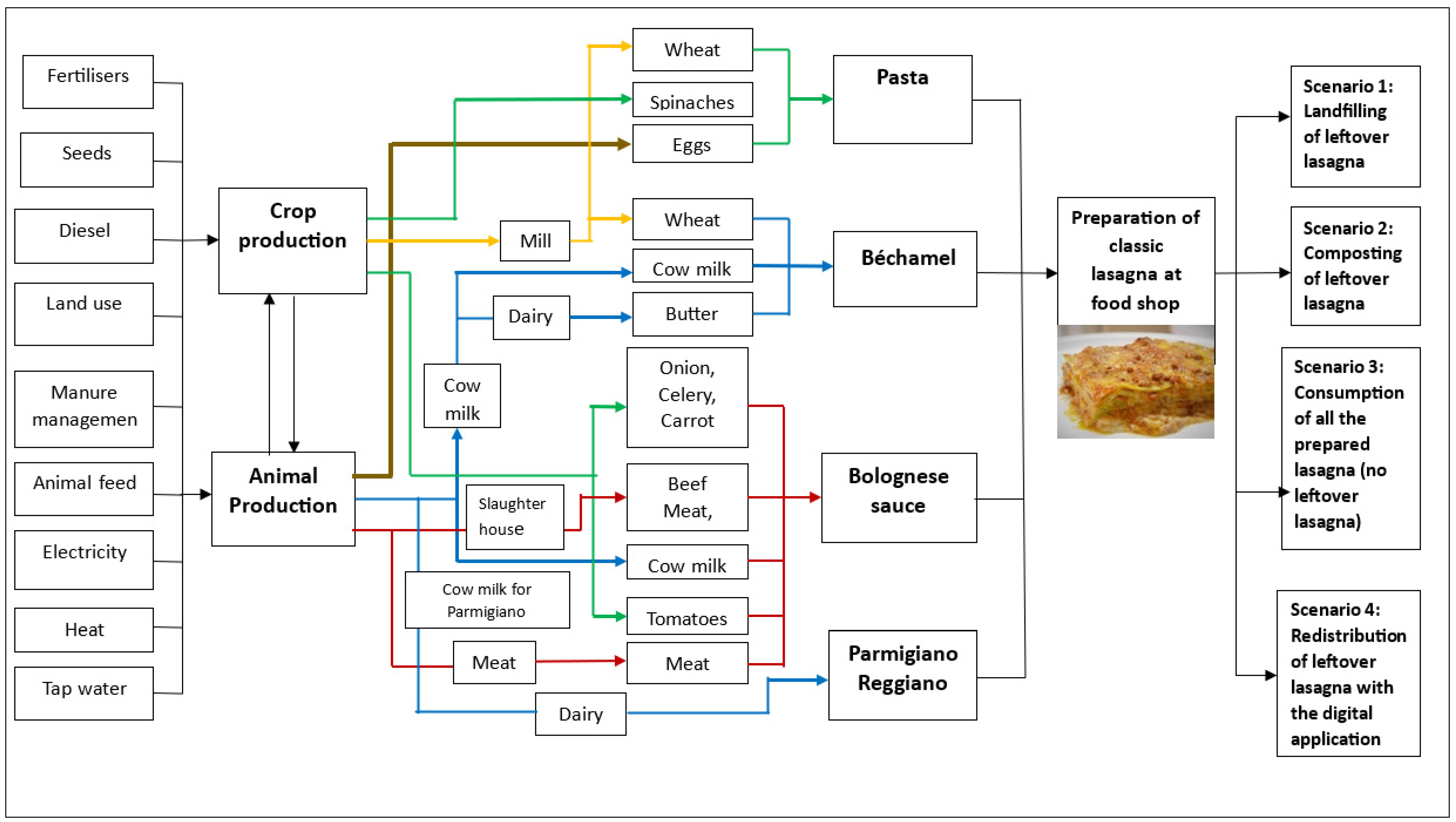
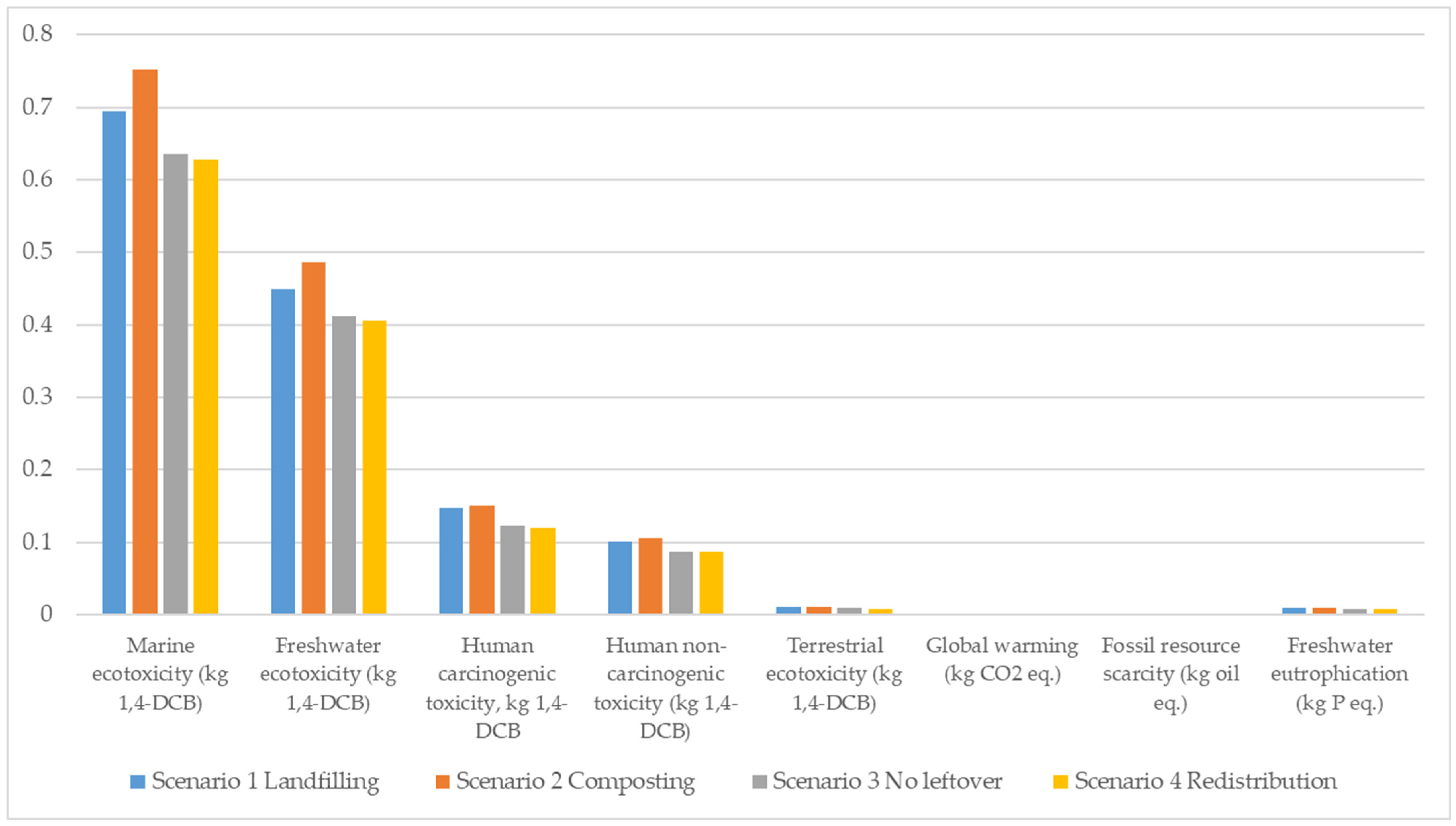
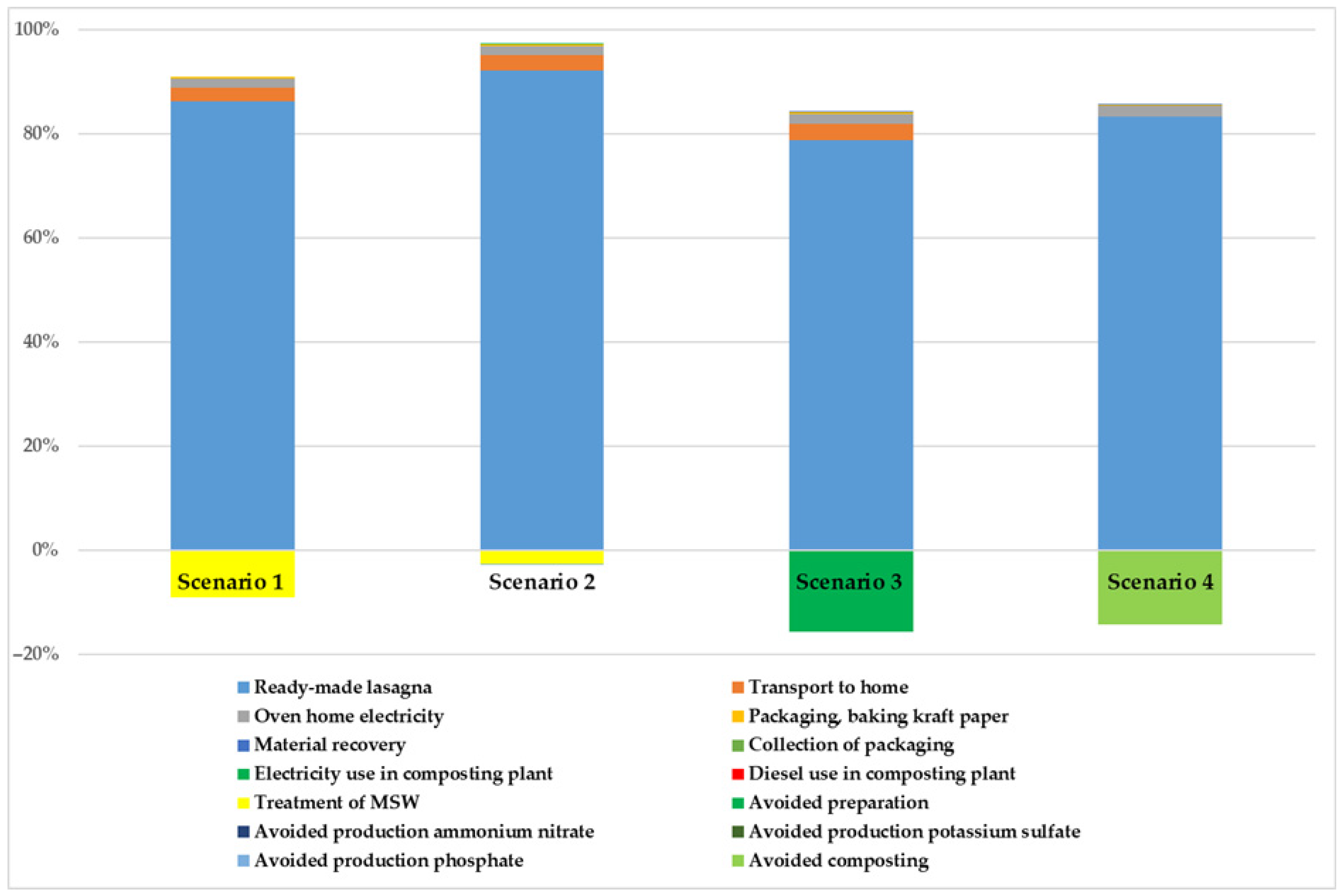
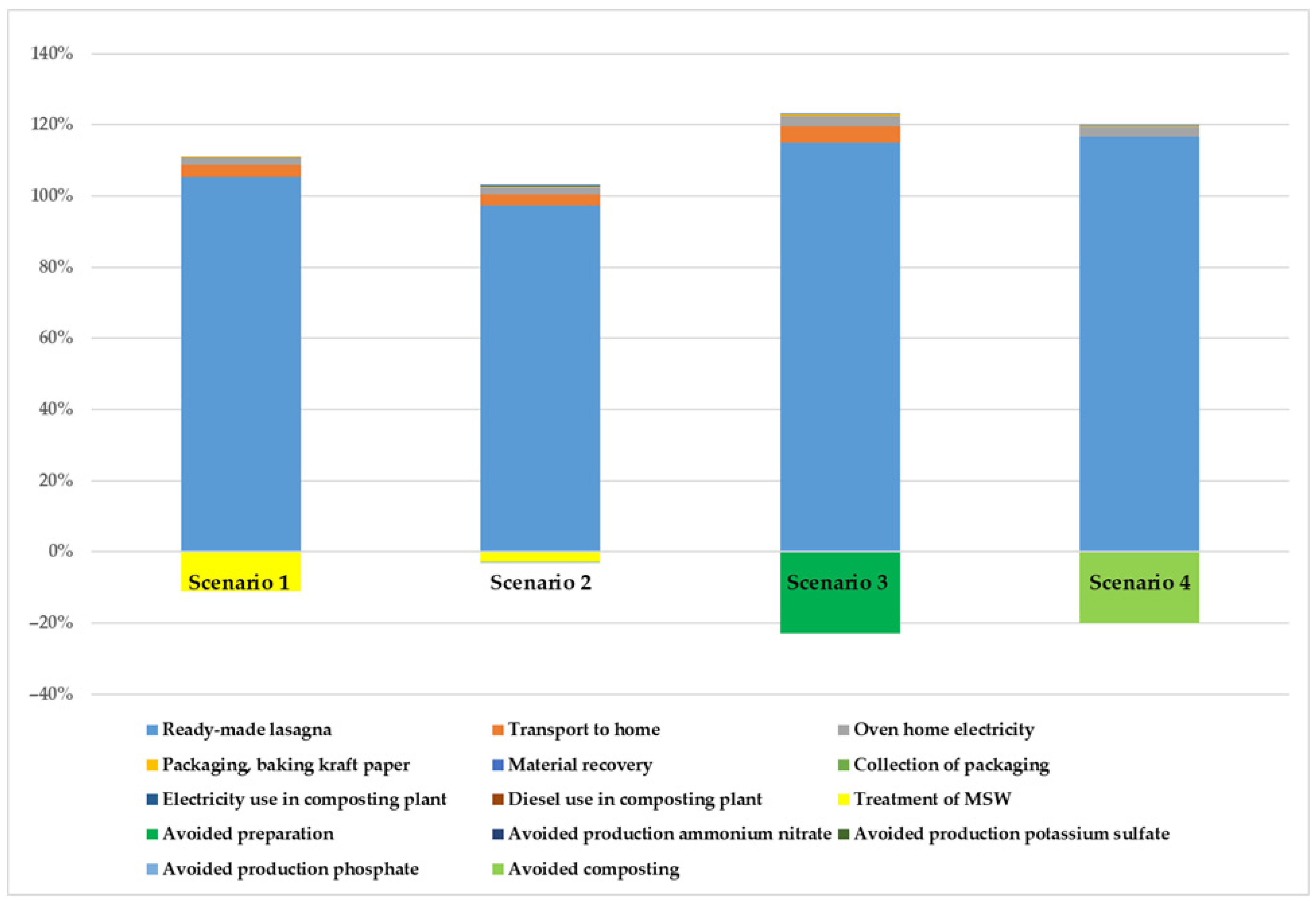
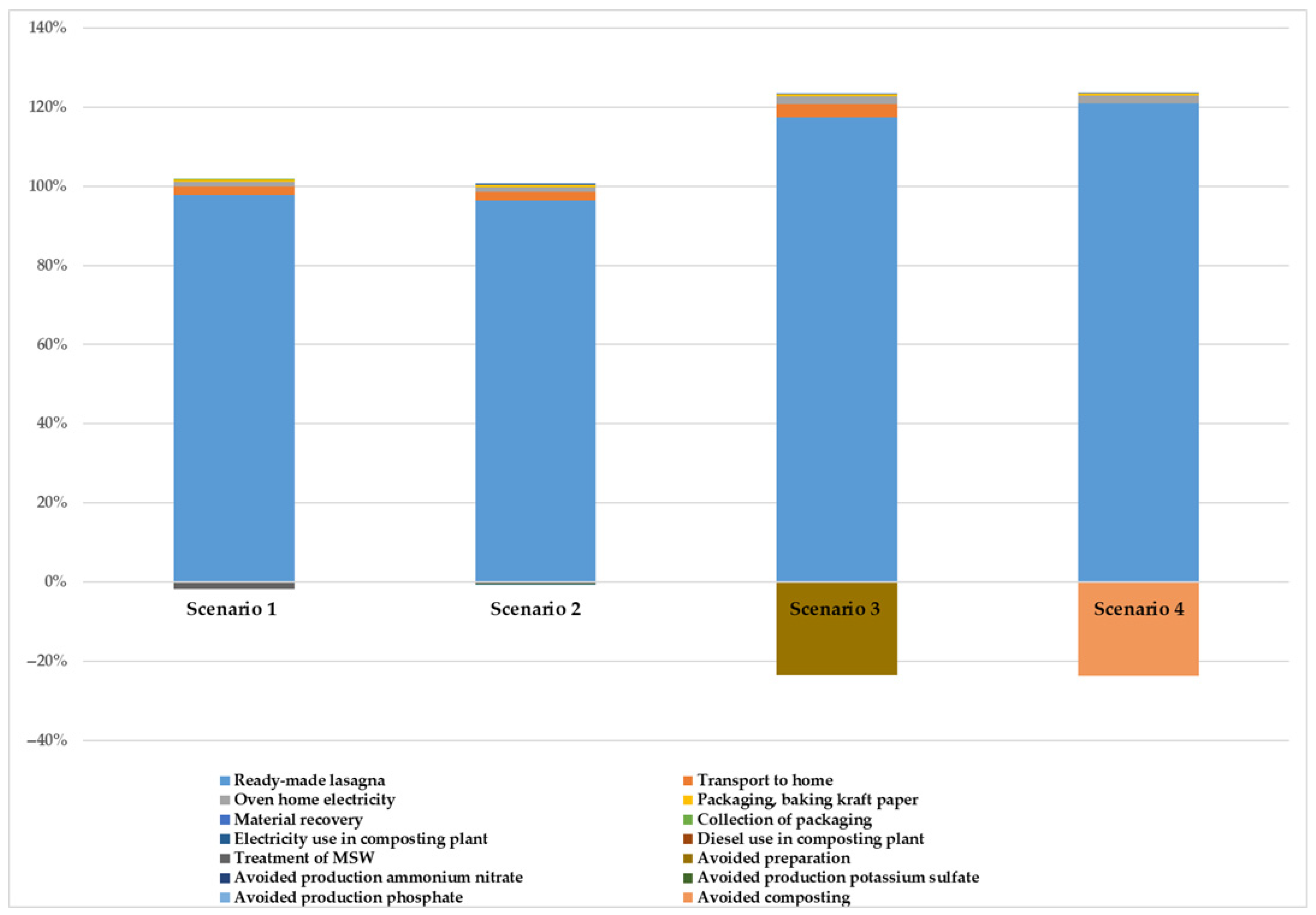
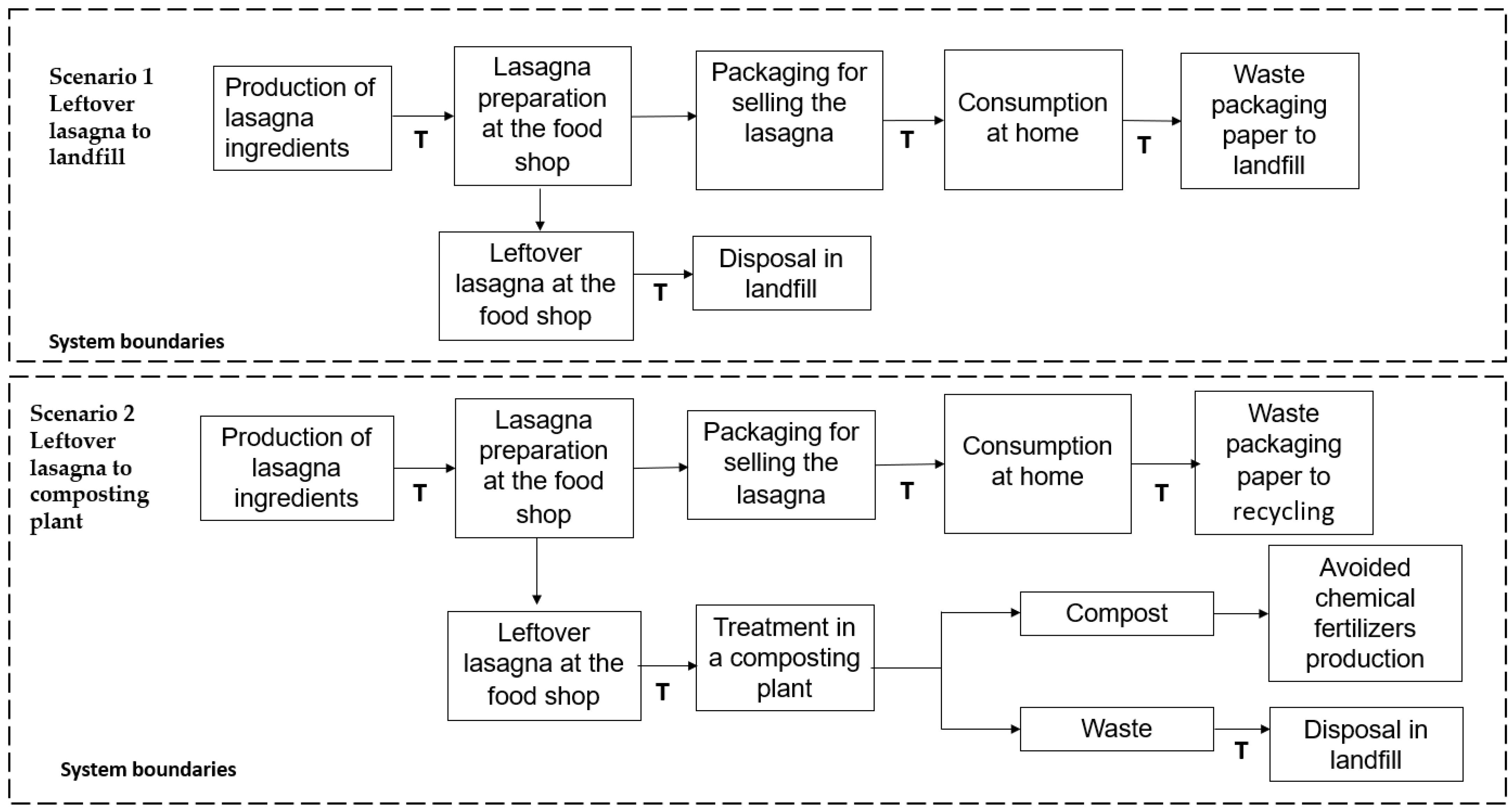
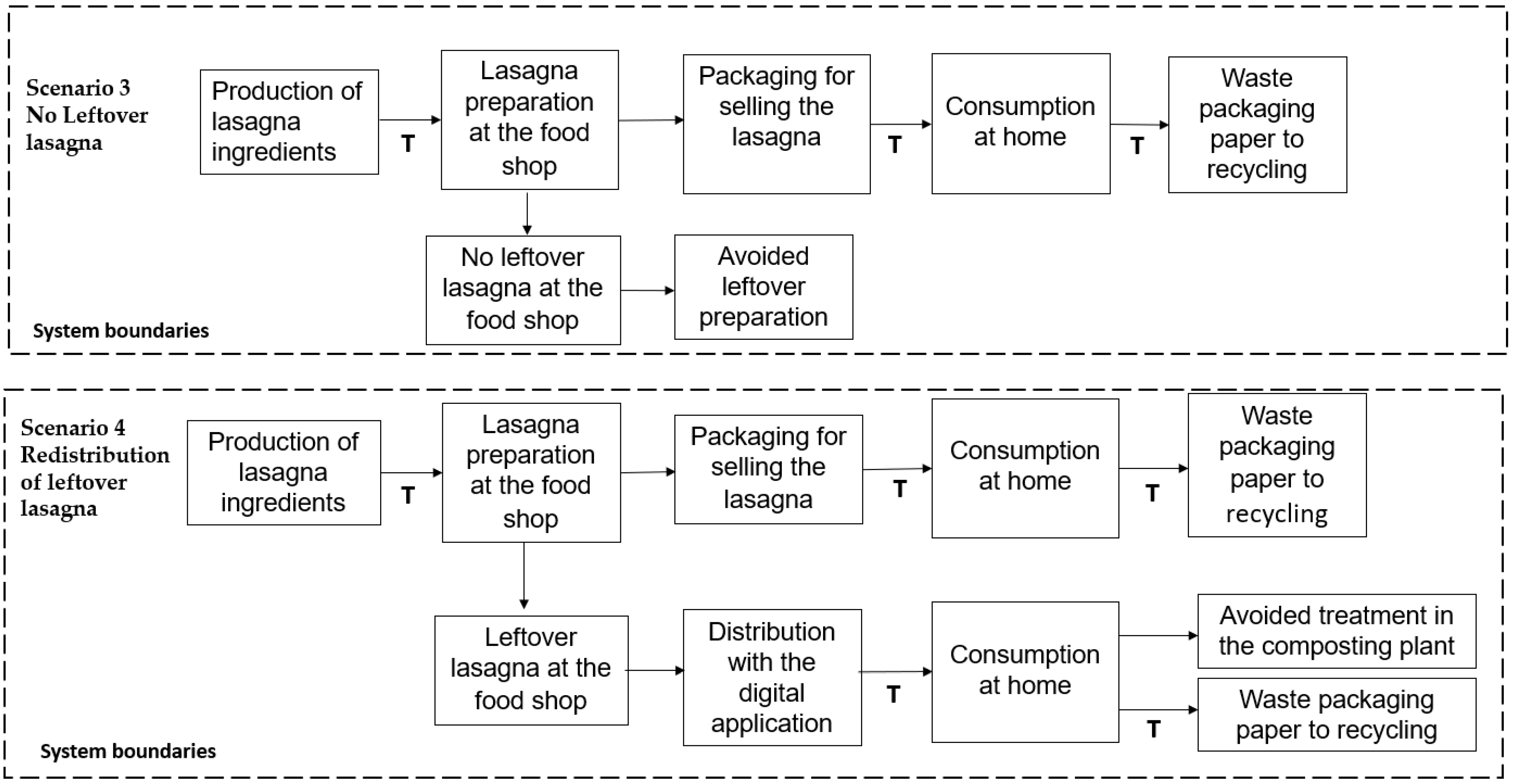
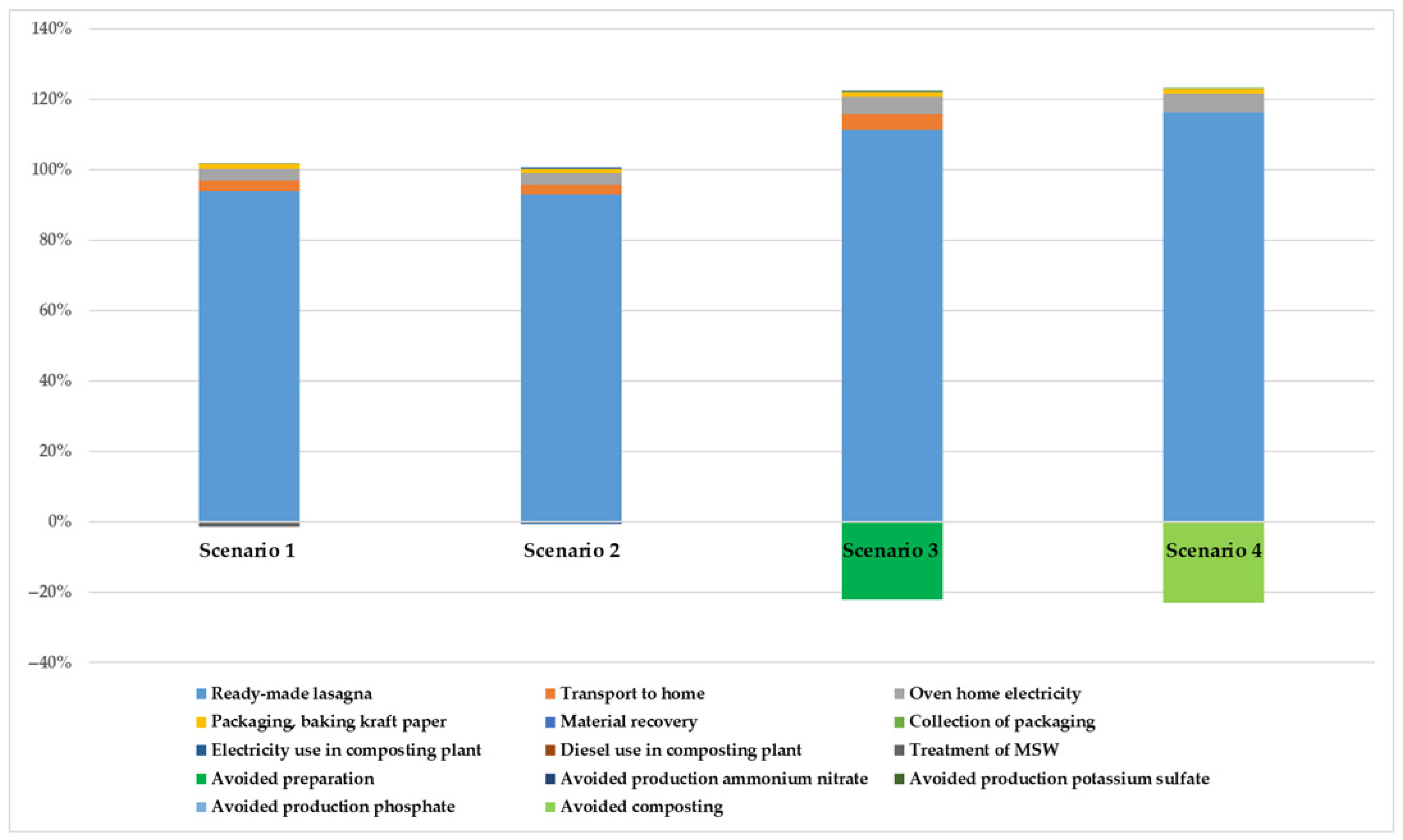
- Comparing four scenarios for the management of end-of-life lasagna, with reference to a functional unit of 1 kg of classic lasagna in its original recipe. The same F.U of 1 kg of classic lasagna has already been adopted by [37] and by studies focused on the impacts of ready-made meals [52] and on surplus food redistribution [42]. The FU is also the most common lasagna package, containing 4 portions for an average Italian family. The geographical context of this study is a city (Bologna) where there is a great awareness of the issue of food waste (start-ups, university, and administration, as mentioned in Section 3.1 [55,56,57,58,59,60]). In more detail, three scenarios (landfilling: scenario 1; composting: scenario 2; and redistribution: scenario 4) are compared to the “ideal” scenario 3, where lasagna prepared at the food shop is entirely consumed and sold by the end of the day, avoiding lasagna leftovers. The choice of these scenarios reflects both the current management of surplus food in the city of Bologna and Italy, as well as other European and international cities and areas, as confirmed by the analyzed literature [40,41,42,43,44,45,46].
3.2.2. Life Cycle Inventory (Stages Until Preparation of Classic Lasagna)

| Processes and Input | Quantity | Unit | F.U. | Data Sources and Assumptions |
|---|---|---|---|---|
| Pasta | 1 kg | Registered recipe of classic lasagna at the Chamber of Commerce of Bologna [64]. | ||
| Wheat flour | 700 | g | Production process of wheat flour from the data by Mill Pivetti, Sustainability Report 2023 [68]. The Mill is located at a distance of 40 km from Bologna. Processes of wheat, electricity, water production, and transport to Bologna from Ecoinvent 3.1. | |
| Eggs | 180 | g | Production process of eggs from [67], an organic system located in the Emilia Romagna Region (Italy). Processes of the feed for the hens from Ecoinvent 3.1. | |
| Spinach (boiled) | 350 | g | Ecoinvent 3.1: Growing on non-perennial crops/growing of vegetables and melons. | |
| Natural gas, low-pressure ROW | 0.03 | m3 | Assumed 0.03 m3 of natural gas (30 min for boiling the spinach), Ecoinvent 3.1 (production process of natural gas, low pressure ROW). |
| Processes and Input | Quantity | Unit | F.U. | Data Sources and Assumptions |
|---|---|---|---|---|
| Bolognese Sauce | 1 kg | Registered recipe of the Bolognese sauce at the Chamber of Commerce of Bologna: [65]. | ||
| Beef meat (including raising of the cattle on the farm, slaughtering, refrigeration, and transport to Bologna) | 400 | g | Ecoinvent 3.1: cattle for slaughtering (animal production/raising of cattle and buffalos). The data of input and output for slaughtering and refrigeration per kg of product have been retrieved from Schmidt Rivera and Azapagic [38] and Mauri [70]. | |
| Pig meat (including raising the pigs on the farm, slaughtering, refrigeration, and transport to Bologna) | 150 | g | Pig raising process was created by using the data by Arrigoni et al. [69] (pig farming process in Italy) and Ecoinvent 3.1 processes for the feed, electricity, and thermal energy. It is assumed that the farm raising the pigs is located in the province of Bologna. The data about input and output of slaughtering and refrigeration processes per kg of product have been retrieved from Schmidt Rivera and Azapagic [38]. | |
| Onion-GLO | 60 | g | Ecoinvent 3.1: Growing on non-perennial crops/growing of vegetables and melons. | |
| Carrot-GLO | 60 | g | Ecoinvent 3.1: Growing on non-perennial crops/growing of vegetables and melons. | |
| Celery- GLO | 60 | g | Ecoinvent 3.1: Growing on non-perennial crops/growing of vegetables and melons. | |
| Tomato-GLO | 215 | g | Ecoinvent 3.1: Growing on non-perennial crops/growing of vegetables and melons. | |
| Skimmed milk from cow milk-GLO | 200 | g | Ecoinvent 3.1: Manufacturing of dairy products. | |
| Meat cube broth | 140 | g | Created the process for meat cubes using Ecoinvent 3.1: Water collection, treatment and supply, and meat cube recipe. The latter used beef meat as the main ingredient. | |
| Vegetable oil refined-GLO | 15 | g | Ecoinvent 3.1: Manufacture of food products/manufacture of vegetable and animal oils and fats. | |
| Natural gas, low-pressure ROW | 0.36 | m3 | Assumed 0.06 m3 of natural gas for cooking per hour for a total of 6 h. |
| Processes and Input | Quantity | Unit | F.U. | Data Sources and Assumptions |
|---|---|---|---|---|
| Béchamel | 1 kg | Registered recipe of lasagna at the Chamber of Commerce of Bologna [64]. | ||
| Wheat flour | 100 | g | Created the production process of wheat flour using the data from Mill Pivetti, Sustainability Report 2023, pag. 16. [67]. Production process of wheat from Ecoinvent 3.1. The mill is located at a distance of 40 km from Bologna. Processes of wheat, electricity, water production, and transport to Bologna from Ecoinvent 3.1. | |
| Skimmed milk from cow milk-GLO | 1030 | g | Ecoinvent 3.1: Manufacturing of dairy products. | |
| Butter | 200 | g | Ecoinvent 3.1: Manufacturing of dairy products. | |
| Natural gas, low-pressure ROW | 0.03 | m3 | Ecoinvent 3.1: Assumed about 30 min for cooking the béchamel. | |
| Transport of butter and milk from the dairy to Bologna | 0.020*20 | Assumed the transport of 10 kg of milk and 10 kg of butter from the dairy at a distance of 20 km. Ecoinvent 3.1: Transport freight lorry 3.5–7.5 t metric tons EURO 6 RER. |
| Processes and Input | Quantity | Unit | F.U. | Data Sources and Assumptions |
|---|---|---|---|---|
| Parmigiano Reggiano | 1 kg | |||
| Milk | 16.48 | kg | The production process of Parmigiano Reggiano requires 16 L of milk for the production of 1 kg of cheese [76]. Density of milk: 1030 kg/L [77] | |
| Electricity | 1.791 | kWh | Ecoinvent 3.1: Electricity medium voltage IT. Consumption of electricity and heat for Parmigiano Reggiano production processes in dairy from Giovenzana et al. [74]. | |
| Thermal energy | 4.762 | kWh | Ecoinvent 3.1: Electricity medium voltage IT. Amount of thermal energy for the production of Parmigiano Reggiano in dairy from Giovenzana et al. [74]. | |
| Transport to Bologna food shop | 0.001*20 | t*km | Ecoinvent 3.1: Transport freight lorry 3.5–7.5 t metric tons EURO 6 Rest of Europe. Assumed a distance by 20 km for the delivery of the cheese (1 kg) to the Bologna [75]. | |
| Milk for the production of Parmigiano Reggiano | 1 kg | |||
| Raising of cows for milk production | The herd of the farm is composed of 85 cows in lactation, 15 dry heifers, and 10 pregnant heifers [71]. The daily diet for the cows in lactation is 13 kg/cow/day of hay and 16 kg/cow/day of complementary feed composed of maize, barley, sugar beet pulp, wheat, and soybean, all organic in Ecoinvent 3.1. The process of hay (alfa-alfa) was created from an Italian farm [73]. The daily diet for the dry heifers is composed of hay (14 kg/cow/day) and complementary feed (2 kg/cow/day), while for pregnant heifers (hay: 12.5 kg/cow/day and complementary feed: 2 kg/cow/day) [71]. | |||
| Alfa-alfa | 0.56 | kg | The process of hay (alfa-alfa) was created using the Italian farm data from Ribaudo [73]. | |
| Barley grain, organic CH | 0.11 | kg | Ecoinvent 3.1. | |
| Maize grain, organic CH | 0.11 | kg | Ecoinvent 3.1. | |
| Soybean, organic CH | 0.11 | kg | Ecoinvent 3.1. | |
| Sugar beet pulp, GLO | 0.11 | kg | Ecoinvent 3.1. | |
| Wheat grain, organic CH | 0.11 | kg | Ecoinvent 3.1. | |
| Electricity medium voltage-IT | 0.04 | kWh | Ecoinvent 3.1. The amount of electricity was calculated from Lovarelli et al. [72] and Giovenzana et al. [74]. | |
| Diesel low sulfur-CH | 0.036 | kg | Ecoinvent 3.1. The amount of diesel was calculated from Lovarelli et al. [72] and Giovenzana et al. [74]. | |
| Tap water-CH | 2.57 | kg | Ecoinvent 3.1. The amount of water was calculated from Lovarelli et al. [72] and Giovenzana et al. [74]. | |
| No transport is assumed because the farm has the dairy, and the milk is used directly for the production of Parmigiano Reggiano [75]. | ||||
| Other output | ||||
| CH4 emissions (enteric fermentation) | 0.0139 | kg | Calculation of the emissions from [69]. Ecoinvent 3.1: Methane biogenic (emission to air/low population density). | |
| The manure produced by the herd was calculated by Ribaudo [73] (average 13 t/cow/year). In total, the herd of 110 cows produced 1430 t of manure per year, and it is assumed to be entirely redistributed in the crop fields of the farm raising the herd. The accounting of the emissions is considered a clearing entry. |
3.2.3. Life Cycle Inventory of the Four Scenarios
3.2.4. Life Cycle Impact Assessment
4. Results and Discussion
4.1. Environmental Impacts of 1 kg of Classic Lasagna Prepared at the Food Shop
4.2. Cumulative Energy Demand for 1 kg of Classic Lasagna Until Preparation
4.3. Analysis of the Impacts of the Four Scenarios
5. Interpretation of the Results
5.1. The Impacts of Lasagna Until Preparation
5.2. Distribution of Lasagna and Different End-of-Life Alternatives
5.3. Linking Environmental Results with Socio-Economic Implications
5.4. Comparison with Previous LCA Studies on Redistribution
6. Conclusions
Author Contributions
Funding
Data Availability Statement
Acknowledgments
Conflicts of Interest
Abbreviations
| Acronym | Full term |
| EU | European Union |
| CSUs | Circular start-ups |
| CE | Circular economy |
| LCA | Life cycle assessment |
| F.U. | Functional unit |
| GWP | Global warming potential |
| GW | Global warming |
| FEP | Freshwater eutrophication potential |
| TEP | Terrestrial acidification potential |
| WDP | Water depletion potential |
| ADP | Abiotic depletion potential |
| AP | Acidification potential |
| EP | Eutrophication potential |
| POCP | Photochemical ozone formation potential |
| CED | Cumulative energy demand |
| CH | Switzerland |
| GLO | Geographical Location Global |
| IT | Italy |
| ROW | Rest of the World |
| RER | Regions of Europe |
Appendix A
| Authors and Year of Publication | Goal of the Study | Functional Unit (F.U.) | Results |
|---|---|---|---|
| Campobasso et al. [51] | Analysis of the environmental impacts of a catering service providing meals to hospitals, schools, and universities in the Puglia Region (Italy). The final goal is improving the awareness, in particular among students, of the importance of taking into account the impacts of food consumption choices. | 1 kg of food is used as a meal. | Salmon-based menu (meal C) recorded the highest impacts (due to the transport), followed by the ready meat menu, which has the highest impact in the production stage. The most relevant impact categories resulted in GWP, eutrophication, acidification, and abiotic depletion. The impacts to GWP, acidification, ADP fossil, and water scarcity potential of tortellini (a kind of stuffed pasta) resulted 4.96 kg CO2 eq./kg, 3.52 kg SO2/kg, 13.08 MJ/kg, and 4.64 m3/kg, while that of Ragu sauce were 4.43 CO2 eq./kg, 0.12 kg SO2/kg, 29.20 MJ/kg, and 29.80 m3/kg. Parmigiano Reggiano has shown 6.67 CO2 eq./kg, 0.07 kg SO2/kg, 36.40 MJ/kg, and 3.19E−07 m3/kg. |
| Mayanti et al. [50] | Evaluating the impacts of food waste in its two main fractions: edible food waste and inedible food waste. A further aim was to expand the analysis of impacts other than climate change. Eleven impact categories have been considered. | Total waste generated by households in a year in Finland. | The results show that most of the impacts are related to the production of food in the agricultural stage for the edible food waste. Meat, as edible food waste, generated the highest impacts in eight out of eleven investigated impact categories, followed by vegetables. Instead, fruit and bread contributed to a much lower extent. The impacts of waste treatment (downstream) are for anaerobic digestion (AD) and waste to energy (WtE), −3.02E+07 kg CO2 eq and −1.90E+07 kg CO2 eq. The sign is negative due to the accounting of avoided impacts. The AD process generated biomethane, replacing the use of petrol production. The WtE process generated electricity and heat, avoiding the use of electricity from the national mix. Further, Biowaste treatment with AD generated higher benefits compared to waste-to-energy. |
| Sundin et al. [53] | Analysis of plate waste generated by a large sample of schools (4913) in the Uppsala Municipality, Sweden. Calculation of the carbon footprint and nutrient losses related to plate waste to understand the environmental and social implications of school meals. | kg CO2 eq./plate waste and kg of CO2 eq./guest. | The total calculated amount of food plate waste in the two schools’ canteens over a period of 8 days of observation was 133.2 kg (of which 94% was edible waste and 5% inedible waste), while the total average per day and per canteen was 8.3 kg, as well as 27 g per guest. The total waste amounted to about 12% of the total food served. The breakdown of the total amount of food waste and total carbon footprint of plate waste during the period of observation shows that beef was the least wasted (2.4 kg compared to the total waste), but had the highest carbon footprint (54.7 kg CO2 eq compared to the carbon footprint of the other foods). On the other side, pasta was wasted the most (37.1 kg), but it has a lower carbon footprint (10.6 kg CO2 eq.) than beef. |
| Avató and Mannheim [49] | Evaluation and comparison of the environmental impacts and primary energy demand in the life cycle of two main dishes (Viennese Steak and Wiener Schnitzel) in a Hungarian restaurant. | 1 portion main dish. | The preparation stage generated higher potential impacts (e.g., to GWP) than the cooking stage since the dishes are based on meat. Total primary energy demand also resulted in higher impacts for the preparation stage. Composting as an end-of-life option for food waste has lower potential impacts than landfilling and incineration. |
| Takacs et al. [39] | Analysis of the environmental impacts of different types of meals (13 types) supplied by lunch service in London (UK), their whole life cycle (from cradle to plate). | 1 single meal. | The results show that in the comparison of the meals (chili, lasagna, curry, and teriyaki) and their potential impacts on GWP, FEP, TAP, and WDP do not depend on their recipe but on their ingredients. Therefore, the vegan or whole-food vegan alternatives of the meals (e.g., lasagna) resulted in much lower impacts than beef lasagna. Beef lasagna generates a potential contribution of 5.78 kg CO2 eq., while vegan and whole-food vegan lasagna generate contributions of 0.37 kg CO2 eq and 0.26 kg CO2 eq, respectively. |
| Schmitdt Rivera and Azapagic [38] | Calculation and comparison of the environmental impacts of the most popular, produced, distributed, and consumed ready-made meals in the UK. | A chilled, ready-made meal for one person consumed at home in the UK. The total weight of each meal is assumed to be 360 g. | The lowest environmental impacts are those associated with pork roast (the contribution to GWP is 2.1 kg CO2 eq./F.U.), while the highest is associated with classic lasagne (5 kg CO2 eq./F.U.). The most significant stage was the production of the ingredients (more than 50% of the total impacts), compared to distribution (14%) and manufacturing (12%). The impacts vary in the meals according to the recipe followed by the manufacturers. The impacts can be reduced by replacing meat with other ingredients. For example, in the case of lasagna and spaghetti, the authors calculated the benefits of replacing meat with soy granules and seitan. They have found a reduction by 17% to GWP and further reductions in other impact categories. |
| Mistretta et al. [52] | Assessment of the energy and environmental impacts of school catering in Lombardia region (Italy); main hotspots in the food life cycle; identification of environmental scenario improvement in the analyzed school catering. | Equivalent meal is served at the selected school’s catering. | The contribution to global energy requirements (GER) is 23.6 MJ, while that to GWP is 1.43 kg CO2 eq. per FU. The production stage is the most impactful stage, accounting for 66% in GER and for 69% in GWP. Food production also generates the highest impacts on acidification and eutrophication, while the transport stage is the largest contributor to photochemical oxidation. |
| Espinoza-Orias and Azapagic [48] | Assessment of the GHG emissions in the life cycle of the most important ready-made and home-made sandwiches produced and consumed in the UK, as well as evaluating the factors contributing the most impact and solutions for improving the impacts. | One individual sandwich serving, composed of two slices of bread and a filling, prepared and ready for consumption. | The results show that the GHG emissions are lower for the home-made sandwich compared to the ready-made sandwich when considering the same filling. The agricultural production stage is the most significant for both types of sandwiches. Reduction in the carbon footprint can be obtained by implementing different scenarios: by using meat, eggs, and cheese in smaller amounts, reducing food waste over the supply chain and at the post-consumer stage, and using alternative packaging and waste management options. However, each scenario has pros and cons. |
| Flury et al. [37] | Analysis and comparison of the environmental impacts and food waste generation of ready-made and home-made lasagna Bolognese in the whole life cycle. | The preparation of two portions (800 g) and 1 kg of lasagna Bolognese ready to be consumed in a household. | The results show that the carbon footprint of ready-made lasagna compared to that of home-made lasagna is in the same range, with lower values for the home-made lasagna, due to the need for packaging and re-heating of the ready-made lasagna. Food losses in the selling stage are slightly higher for the ready-made lasagna than the losses mainly due to the ingredients of the home-made lasagna. |
References
- European Union. Farm to Fork Strategy. 2020. Available online: https://food.ec.europa.eu/horizontal-topics/farm-fork-strategy_en#F2F-Publications (accessed on 30 March 2026).
- United Nations. Stop Food Loss and Waste. For the People. For the Planet. 2024. Available online: https://www.un.org/en/observances/end-food-waste-day (accessed on 17 July 2025).
- United Nations. Ensure Sustainable Production and Consumption. 2025. Available online: https://sdgs.un.org/goals/goal12#targets_and_indicators (accessed on 25 September 2025).
- Casson, A.; Valentini, G.; Rizzuni, A.; Narote, A.D.; Scotti, G.; Guidetti, R.; Giovenzana, V. Redistribution through urban food hubs: A comprehensive sustainability assessment. Environ. Impact Assess. Rev. 2026, 117, 108149. [Google Scholar] [CrossRef]
- Ciccullo, F.; Fabbri, M.; Abdelkafi, N.; Pero, M. Exploring the potential of business models for sustainability and big data for food waste reduction. J. Clean. Prod. 2022, 340, 130673. [Google Scholar] [CrossRef]
- Principato, L.; Comis, C.; Yu, M.; Secondi, L. Food Sharing Platforms as a Technology to Reduce Food Waste at Food Service Level: Recommendations for Businesses and Society. Bus. Ethics Environ. Responsib. 2025, 35, 860–875. [Google Scholar] [CrossRef]
- Sultan Kamal, G.; Bozkurt, İ.; Bölükbas, R.; Özhasar, Y.; Demirci, B.; Yazicioğlu, İ. The strategy food waste in restaurants: A systematic literature review. Trends Food Sci. Technol. 2024, 151, 104625. [Google Scholar] [CrossRef]
- Rabbi, M.F.; Amin, M.B. Circular economy and sustainable practices in the food industry: A comprehensive bibliometric analysis. Clean. Responsible Consum. 2024, 14, 100206. [Google Scholar] [CrossRef]
- Kanwal, N.; Zhang, M.; Zeb, M.; Batool, U.; Khan, I.; Rui, L. From plate to palate: Sustainable solutions for upcycling food waste in restaurants and catering. Trends Food Sci. Technol. 2024, 152, 104687. [Google Scholar] [CrossRef]
- Ghisellini, P.; Ncube, A.; Rotolo, G.; Vassillo, C.; Kaiser, S.; Passaro, R.; Ulgiati, S. Evaluating Environmental and Energy Performance Indicators of Food Systems, within Circular Economy and “Farm to Fork” frameworks. Energies 2023, 16, 1671. [Google Scholar] [CrossRef]
- Amicarelli, V.; Lagioia, G.; Bux, C. Global warming potential of food waste through the life cycle assessment: An analytical review. Environ. Impact Assess. Rev. 2021, 91, 106677. [Google Scholar] [CrossRef]
- Catellani, E.; Manfredini, S.; Amico, C.; Ciccullo, F.; Cigolini, R. Sustainability on the plate: Unveiling the environmental footprint of pasta supply chain through Life Cycle Assessment. Environ. Impact Assess. Rev. 2025, 112, 107921. [Google Scholar] [CrossRef]
- Notarnicola, B.; Sala, S.; Anton, A.; McLaren, S.; Saouter, E.; Sonesson, U. The role of life cycle assessment in supporting sustainable agri-food systems: A review of the challenges. J. Clean. Prod. 2017, 140, 399–409. [Google Scholar] [CrossRef]
- Maselli, G.; Zucaro, A.; Ulgiati, S. Editorial: Insights in urban resource management: 2021. Front. Sustain. Cities 2023, 4, 1114692. [Google Scholar] [CrossRef]
- Elimelech, E.; Segal-Klein, H.; Kaplan Mintz, K.; Katz-Gerro, T.; Ayalon, O. Food waste prevention and reduction: Practices, cultural and personal determinants. Appetite 2024, 200, 107565. [Google Scholar] [CrossRef] [PubMed]
- Chiu, A.S.F.; Aviso, K.B.; Baquillas, J.; Tan, R.R. Can disruptive events trigger transitions toward sustainable consumption? Clean. Responsible Consum. 2020, 1, 100001. [Google Scholar] [CrossRef]
- Santagata, R.; Ripa, M.; Genovese, A.; Ulgiati, S. Food waste recovery pathways: Challenges and opportunities for an emerging bio-based circular economy. A systematic review and an assessment. J. Clean. Prod. 2020, 286, 125490. [Google Scholar] [CrossRef]
- Bourdin, S.; Jacquet, N. Closing the loop at the local scale: Investigating the drivers of and barriers to the implementation of the circular economy in cities and regions. Ecol. Econ. 2025, 231, 108542. [Google Scholar] [CrossRef]
- Zhang, W.; Liu, G.; Ghisellini, P.; Yang, Z. Ecological risk and resilient regulation shifting from city to urban agglomeration: A review. Environ. Impact Assess. Rev. 2024, 105, 107386. [Google Scholar] [CrossRef]
- Compagnucci, L.; Cavicchi, A.; Spigarelli, F.; Natali, L. A multi-stakeholder attempt to address food waste: The case of Wellfood Action EU project. Econ. Agroaliment./Food Econ. 2018, 20, 503–528. [Google Scholar] [CrossRef]
- Ghisellini, P.; Ulgiati, S. Evolution and current development of the circular economy concept with insights from worldwide cities and regions. In Regions, Cities and the Circular Economy; Bourdin, S., Torre, A., Van Leeuven, E., Eds.; Edward Elgar: Cheltenham, UK, 2024; pp. 14–43. [Google Scholar] [CrossRef]
- Schanes, K.; Dobernig, K.; Gõzet, B. Food waste matters—A systematic review of household food waste practices and their policy implications. J. Clean. Prod. 2018, 182, 978–991. [Google Scholar] [CrossRef]
- Vittuari, M.; Pagani, M.; Johnson, T.G.; De Menna, F. Impacts and costs of embodied and nutritional energy of food waste in the US food system: Distribution and consumption (Part B). J. Clean. Prod. 2020, 252, 119857. [Google Scholar] [CrossRef]
- European Commission. Food Waste. 2024. Available online: https://food.ec.europa.eu/food-safety/food-waste_en (accessed on 10 October 2025).
- Daryana, A.P.; Akita, A.; Gabriella, V. Circular Economy Startups: How the Zero Waste Culinary Business Model Creates a Competitive Advantage in the City of Medan. Rev. Leadersh. Innov. Econ. Manag. 2025, 1, 42–57. [Google Scholar] [CrossRef]
- Colimoro, M.; Ripa, M.; Santagata, R.; Ulgiati, S. Environmental Impacts and Benefits of Tofu Production from Organic and Conventional Soybean Cropping: Improvement Potential from Renewable Energy Use and Circular Economy Patterns. Environments 2023, 10, 73. [Google Scholar] [CrossRef]
- Nãrvãnen, E.; Mattila, M.; Mesiranta, N. Institutional work in food waste reduction: Start-ups’ role in moving towards a circular economy. Ind. Mark. Manag. 2021, 93, 605–616. [Google Scholar] [CrossRef]
- Ghisellini, P.; Passaro, R.; Ulgiati, S. Circular Economy Transition in EU and Italy in Key Priority Sectors: Policies, Initiatives and Perspectives. In Circular Economy Adoption; Ghosh, S.K., Ed.; Springer Nature: Singapore, 2023. [Google Scholar] [CrossRef]
- Pirolo. Modelli di Business Contro lo Spreco Alimentare: Il Caso Studio Della Piattaforma Too Good to Go. Università Ca’ Foscari Venezia. 2023. Available online: https://unitesi.unive.it›bitstream (accessed on 18 September 2025). (In Italian)
- Goossens, Y.; Wegner, A.; Schmidt, T. Sustainability Assessment of Food Waste Prevention Measures: Review of Existing Evaluation Practices. Front. Sustain. Food Syst. 2019, 3, 90. [Google Scholar] [CrossRef]
- Ranjbari, M.; Kuděi, M.; Kubalek, J.; Ferraris, A. A Typology of Circular Economy Startups in Agri-Food Supply Chains: An Analysis of 79 Innovative Startups. Bus. Strategy Environ. 2025, 34, 9301–9320. [Google Scholar] [CrossRef]
- Ghisellini, P.; Quinto, I.; Passaro, R.; Ulgiati, S. Exploring environmental and social performances of circular start-ups: An orientation and certification assessment. Bus. Strategy Environ. 2024, 33, 3222–3241. [Google Scholar] [CrossRef]
- Mehrotra, S.; Rupa Jaladi, S. How start-ups in emerging economies embrace circular business models and contribute towards a circular economy. J. Enterpreneurship Emerg. Econ. 2022, 14, 727–753. [Google Scholar] [CrossRef]
- Sehnem, S.; Bispo, D.S.; João, J.O.; de Souza, M.A.L.; Bertoglio, O.; Ciotti, R.; Deon, S.M. Upscaling circular economy in foodtechs businesses in emergent countries: Towards sustainable development through natural resource-based view. Sustain. Dev. 2022, 30, 1200–1221. [Google Scholar] [CrossRef]
- Ranjbari, M.; Shams Esfandabadi, Z.; Siebers, P.-O.; Pisano, P.; Quatraro, F. Digitally enabled food sharing platforms towards effective waste management in a circular economy: A system dynamics simulation model. Technovation 2024, 130, 102939. [Google Scholar] [CrossRef]
- Squiseat. 2025. Available online: https://www.squiseat.it/blog/squiseat-ci-presentiamo (accessed on 22 October 2025).
- Flury, K.; Jungbluth, N.; Houlder, G. Food Losses in the Life Cycle of Lasagna Bolognese: Ready-to-Serve vs. Home Made. The 6th International Conference on Life Cycle Management in Gothenburg. 2013. Available online: https://www.google.com/url?sa=t&source=web&rct=j&opi=89978449&url=https://esu-services.ch/fileadmin/download/flury-2013-lasagne-food-waste-paper.pdf (accessed on 12 October 2025).
- Schmitdt-Rivera, X.C.; Azapagic, A. Life cycle environmental impacts of ready-made meals considering different cuisines and recipes. Sci. Total Environ. 2019, 660, 1168–1181. [Google Scholar] [CrossRef]
- Takacs, B.; Stegemann, J.A.; Kalea, A.Z.; Borrion, A. Comparison of environmental impacts of individual meals—Does it really ake a difference to choose plant-based meals instead of meat-based ones? J. Clean. Prod. 2022, 379, 134782. [Google Scholar] [CrossRef]
- Guo, Z.; Mu, T.; Feingold, B.; Hosler, A.; Bozlak, C.; Pettigrew, S.; Romeiko, X. Comparing the Environmental Impacts of Representative Food Donation and Redistribution Strategies. Foods 2026, 15, 645. [Google Scholar] [CrossRef]
- Sundin, N.; Bartek, L.; Persson Osowski, C.; Strid, I.; Eriksson, M. Sustainability assessment of surplus food donation: A transfer system generating environmental, economic, and social values. Sustain. Prod. Consum. 2023, 38, 41–54. [Google Scholar] [CrossRef]
- Damiani, M.; Pastorello, T.; Carlesso, A.; Tesser, S.; Semenzin, E. Quantifying environmental implications of surplus food redistribution to reduce food waste. J. Clean. Prod. 2021, 289, 125813. [Google Scholar] [CrossRef]
- Sulis, F.; Agostinho, F.; Almeida, C.M.V.B.; Giannetti, B.F. Recognizing the wealth of non-marketable food in distribution centres: The environmental benefits of donation. J. Clean. Prod. 2021, 318, 128482. [Google Scholar] [CrossRef]
- Bergström, P.; Malefors, C.; Strid, I.; Ole Jørgen Hanssen, O.J.; Eriksson, M. Sustainability Assessment of Food Redistribution Initiatives in Sweden. Resources 2020, 9, 27. [Google Scholar] [CrossRef]
- Albizzati, P.F.; Tonini, D.; Chammard, C.B.; Astrup, T.F. Valorisation of surplus food in the French retail sector: Environmental and economic impacts. Waste Manag. 2019, 90, 141–151. [Google Scholar] [CrossRef]
- Eriksson, M.; Strid, I.; Hansson, P.-A. Carbon footprint of food waste management options in the waste hierarchy—A Swedish case study. J. Clean. Prod. 2015, 93, 115–125. [Google Scholar] [CrossRef]
- ISO 14040; Environmental Management—Life Cycle Assessment—Principles and Framework. ISO: Geneva, Switzerland, 2006. Available online: https://www.iso.org/standard/37456.html#amendment (accessed on 22 October 2025).
- ISO 14044; Environmental Management—Life Cycle Assessment—Requirements and Guidelines. ISO: Geneva, Switzerland, 2006. Available online: https://www.iso.org/standard/38498.html#amendment (accessed on 22 October 2025).
- Espinoza-Orias, N.; Azapagic, A. Understanding the impact on climate change of convenience food: Carbon footprint of sandwiches. Sustain. Prod. Consum. 2018, 15, 1–15. [Google Scholar] [CrossRef]
- Avató, J.L.; Mannheim, V. Life Cycle Assessment Model of a Catering Product: Comparing Environmental Impacts for Different End-of-Life Scenarios. Energies 2022, 15, 5423. [Google Scholar] [CrossRef]
- Mayanti, B. Life cycle assessment and waste reduction optimisation of household food waste in Finland. Sci. Total Environ. 2024, 957, 177438. [Google Scholar] [CrossRef] [PubMed]
- Campobasso, V.; Gallucci, T.; Crovella, T.; Vignali, G.; Paiano, A.; Lagioia, G.; Ingrao, C. Life cycle assessment of food catering menus in a university canteen located in Southern Italy. Sci. Total Environ. 2024, 957, 177482. [Google Scholar] [CrossRef] [PubMed]
- Mistretta, M.; Caputo, P.; Cellura, M.; Cusenza, M.A. Energy and environmental life cycle assessment of an institutional catering service: An Italian case study. Sci. Total Environ. 2019, 657, 1150–1160. [Google Scholar] [CrossRef] [PubMed]
- Sundin, N.; Halvarsson, R.; Scherhaufer, S.; Schneider, F.; Eriksson, M. From plate to waste: Composition of school meal waste and associated carbon footprint and nutrient loss. Resour. Conserv. Recycl. 2024, 206, 107656. [Google Scholar] [CrossRef]
- Wastemeter. 2025. Available online: https://sprecometro.it/scopri-il-metodo (accessed on 10 October 2025).
- Last Minute Market. 2025. Available online: https://www.lastminutemarket.it/ (accessed on 22 October 2025).
- HERA. 2024. Available online: https://www.gruppohera.it/-/spreco-alimentare-con-ciboamico-oltre-8-750-pasti-recuperati-dalle-mense-aziendali-del-gruppo-hera-nel-primo-semestre-2024 (accessed on 22 October 2025).
- Banco Alimentare Foundation. Available online: https://www.bancoalimentare.it/sedi-locali/emilia-romagna (accessed on 22 October 2025).
- Cucine Popolari. Available online: https://www.cucinepopolari.org/ (accessed on 22 October 2025).
- Antoniano Canteen. Available online: https://www.antoniano.it/progetti/pasto/?gad_source=1&gad_campaignid=12458912633&gclid=CjwKCAjwgeLHBhBuEiwAL5gNEWNUlzG5LKhEW0p88bz0KedzpOf5c_ok2EpeUZPEVZ1LSvd3WY674BoCTosQAvD_BwE (accessed on 22 October 2025).
- Emilia Romagna Region and ARPAE, 2024. La Gestione dei Rifiuti in Emilia Romagna. Report 2024. Available online: https://www.arpae.it/it/notizie/la-gestione-dei-rifiuti-in-emilia-romagna-report-2024 (accessed on 10 October 2025).
- Benedetti, A.C.; Costantino, C.; Gulli, R.; Predari, G. The process of digitalization of the urban environment for the development of sustainable and circular cities: A case study of Bologna, Italy. Sustainability 2022, 14, 13740. [Google Scholar] [CrossRef]
- Ecoinvent Database. Available online: https://ecoinvent.org/database/ (accessed on 22 October 2025).
- Bologna Welcome. Recipe Classic Lasagna. Available online: https://www.bolognawelcome.com/it/altro/ricette-e-prodotti-tipici/lasagne-verdi-alla-bolognese (accessed on 30 March 2026).
- Chamber of Commerce of Bologna. Recipe of Bolognese Sauce. Available online: https://www.bo.camcom.gov.it/it/blog/depositata-la-rinnovata-ricetta-del-vero-ragu-alla-bolognese (accessed on 22 October 2025).
- Hera Group. Changes Circular Energy. Available online: https://heracomm.gruppohera.it/cambiamenti/consigli-per-la-sostenibilt%C3%A0/quanto-consuma-un-forno-elettrico-consigli-per-risparmiare (accessed on 22 October 2025).
- Pelaracci, S.; Paolotti, L.; Rocchi, L.; Boggia, A.; Castellini, C. Life cycle assessment of organic and conventional egg production: A case study in northern Italy. Clean. Environ. Syst. 2024, 15, 100226. [Google Scholar] [CrossRef]
- Molino Pivetti. Presentation of the Second Sustainability Report. Available online: https://www.molinipivetti.it/molini-pivetti-presenta-il-secondo-report-di-sostenibilita/ (accessed on 22 October 2025).
- Arrigoni, A.; Marveggio, D.; Allievi, F.; Dotelli, G.; Scaccabarozzi, G. Environmental and health-related external costs of meat consumption in Italy: Estimations and recommendations through life cycle assessment. Sci. Total Environ. 2023, 869, 161773. [Google Scholar] [CrossRef]
- Mauri, R. Sostenibilità ambientale di un mattatoio innovativo. Il caso Fontetto. Tesi Sperimentale. Corso di laurea in Scienze e Tecnologie Agrarie. Università Politecnica Delle. Marche 2020. Available online: https://www.google.com/url?sa=t&source=web&rct=j&opi=89978449&url=https://tesi.univpm.it/retrieve/3d547c26-0672-4856-b239-22e6c9746c17/4Sostenibilit%25C3%25A0%2520ambientale%2520di%2520un%2520mattatoio%2520innovativo.pdf&ved=2ahUKEwjBnLjXi56QAxXg0gIHHU0VJJYQFnoECBcQAQ&usg=AOvVaw02CUziouD100S29m3D3dVp (accessed on 12 October 2024).
- Formigoni, A. Uso Della Materie Prime del Territorio nel Razionamento Della Vacca da Latte per Parmigiano Reggiano. 2024. Available online: https://www.google.com/url?sa=t&source=web&rct=j&opi=89978449&url=https://www.crpa.it/media/documents/feedpr_www/presentazioni-CF/27_02_2024_Feed_PR_Formigoni.pdf%3Fv%3D20240228&ved=2ahUKEwjPwq2h74CQAxXnlf0HHW6NKhIQFnoECB4QAQ&usg=AOvVaw08ujs_SclXCOc-BSMaajXC (accessed on 30 September 2025). (In Italian)
- Lovarelli, D.; Tamburini, A.; Garimberti, S.; D’Imporzano, G.; Adani, F. Life cycle assessment of Parmigiano Reggiano PDO cheese with product environmental footprint method: A case study implementing improved slurry management strategies. Sci. Total Environ. 2022, 842, 156856. [Google Scholar] [CrossRef] [PubMed]
- Ribaudo, F. Prontuario di Agricoltura; Hoepli: Milano, Italy, 2021; p. 1025. (In Italian) [Google Scholar]
- Giovenzana, V.; Beghi, R.; Guidetti, R. L’analisi Energetica Integrate per la Filiera Lattiero Casearia. Convegno di Medio Termine Dell’associazione Italiana di Ingegneria Agraria Belgirate, 22–24 Settembre 2011. Available online: https://air.unimi.it/handle/2434/167359 (accessed on 12 October 2025).
- Caseificio Bazzanese. Available online: https://caseificiobazzanese.com/it/content/10-artigianalita (accessed on 22 October 2025).
- Caseificio Lanfredini. Production of Parmigiano Reggiano. Available online: https://www.caseificiolanfredini.it/produzione.php (accessed on 22 October 2025).
- CREA (Council for the Research in Agriculture). Nutritional Tables. Available online: https://www.alimentinutrizione.it/tabelle-nutrizionali/135010 (accessed on 22 October 2025).
- Sinkko, T.; Amadei, A.; Venturelli, S.; Ardente, F. Exploring the Environmental Performance of Alternative Food Packaging Products in the European Union. Life Cycle Impacts of Single-Use and Multiple-Use Packaging. Available online: https://publications.jrc.ec.europa.eu/repository/handle/JRC136771 (accessed on 27 February 2026).
- Buratti, C.; Barbanera, M.; Testarmata, F.; Fantozzi, F. Life Cycle Assessment of organic waste management strategies: An Italian case study. J. Clean. Prod. 2015, 89, 125–136. [Google Scholar] [CrossRef]
- Schumacher, L. ReCiPe. 2025. Available online: https://pre-sustainability.com/articles/recipe/ (accessed on 19 September 2025).
- Borghesi, G.; Stefanini, R.; Vignali, G. Life cycle assessment of packaged organic dairy product: A comparison of different methods for the environmental assessment of alternative scenarios. J. Food Eng. 2022, 318, 110902. [Google Scholar] [CrossRef]
- Dal Prà, A.; Pignedoli, S.; Valli, L.; Lasorella, M.V. Quando il Formaggio è “Sostenibile”: Un Progetto per Ridurre L’impatto Ambientale Delle Attività di Allevamento e di Trasformazione Casearia. 2020. Available online: https://www.pianetapsr.it/flex/cm/pages/ServeBLOB.php/L/IT/IDPagina/2309 (accessed on 25 September 2025).
- Campania Region. Mozzarella di Bufala. Available online: https://agricoltura.regione.campania.it/Tipici/mozzarella-bufala.html (accessed on 22 October 2025).
- Dalla Riva, A.; Burek, J.; Kim, D.; Thoma, G.; Cassandro, M.; De Marchi, M. Environmental life cycle assessment of Italian mozzarella cheese: Hotspots and improvement opportunities. J. Dairy Sci. 2017, 100, 7933–7952. [Google Scholar] [CrossRef] [PubMed]
- Caseificio Val D’Orcia. Production of Pecorino. Available online: https://www.caseificiovaldorcia.it/it/faq-8 (accessed on 22 October 2025).
- Mondello, G.; Salomone, R.; Neri, E.; Patrizia, N.; Bastianoni, S.; Lanuzza, F. Environmental hot-spots and improvement scenarios for Tuscan “Pecorino” cheese using Life Cycle Assessment. J. Clean. Prod. 2018, 195, 810–820. [Google Scholar] [CrossRef]
- Emmentaler Switzerland. Available online: https://www.emmentaler.ch/it/tutto-il-fascino-di-una-forma-di-formaggio (accessed on 22 October 2025).
- Cadeddu, C. Applying a Planetary Health approach in the European urban context: Lessons from Preparing Traditional Lasagna. Eur. J. Public Health 2024, 34, ckae144.831. [Google Scholar] [CrossRef]
- Paolotti, L.; Corridoni, F.; Rocchi, L.; Boggia, A. Evaluating Environmental Sustainability of Pasta Production through the Method LCA. Environ. Clim. Technol. 2023, 27, 593–605. [Google Scholar] [CrossRef]
- Barilla. Emiliane, Environmental Product Declaration. Available online: https://www.bing.com/search?q=barilla+emilane+environmental+product+declaration+&qs=n&form=QBRE&sp=-1&ghc=1&lq=0&pq=barilla+emilane+environmental+product+declaration+&sc=12-50&sk=&cvid=6E96B3301C4C443495843C58ABD09794 (accessed on 22 October 2025).
- Cimini, A.; Moresi, M. Fresh versus Dry Pasta: What is the difference in their environmental impacts? Chem. Eng. Trans. 2023, 102, 7–12. [Google Scholar] [CrossRef]
- Ghisellini, P.; Protano, G.; Viglia, S.; Gaworski, M.; Setti, M.; Ulgiati, S. Integrated Agricultural and Dairy Production within a Circular Economy Framework. A Comparison of Italian and Polish Farming Systems. J. Environ. Account. Manag. 2014, 2, 367–384. [Google Scholar] [CrossRef]
- ISPRA (Higher Institute for Environmental Protection and Research). Rapporto Rifiuti Urbani 2025. Available online: https://www.isprambiente.gov.it/it/pubblicazioni/rapporti/rapporto-rifiuti-urbani-edizione-2025 (accessed on 9 February 2026).
- European Union. Waste and Recycling. Available online: https://environment.ec.europa.eu/topics/waste-and-recycling_en (accessed on 9 February 2026).
- Cao, X.; Williams, P.N.; Zhan, Y.; Coughlin, S.A.; McGrath, J.W.; Chin, J.P.; Xu, Y. Municipal solid waste compost: Global trends and biogeochemical cycling. Soil Environ. Health 2023, 1, 100038. [Google Scholar] [CrossRef]
- Karimi, N. Assessing Global Waste Management: Alternatives to Landfilling in Different Waste Streams—A Scoping Review. Sustainability 2023, 15, 13290. [Google Scholar] [CrossRef]
- Ouedraogo, A.S.; Kumar, A.; Frazier, R.; Sallam, K.A. Comparative Life Cycle Assessment of Landfilling with Sustainable Waste Management Methods for Municipal Solid Wastes. Environments 2024, 11, 248. [Google Scholar] [CrossRef]
- Wang, Y.; Levis, J.W.; Barlaz, M.A. Life-Cycle Assessment of a Regulatory Compliant U.S. Municipal Solid Waste Landfill. Environ. Sci. Technol. 2021, 55, 13583−13592. [Google Scholar] [CrossRef] [PubMed]
- Ashraf, A.I.; Mohareb, E.; Vahdati, M.; Khandakar, A. Social Life Cycle Assessment (S-LCA) of formal and informal waste collectors in decentralized waste to compost facility. Clean. Environ. Syst. 2025, 17, 100284. [Google Scholar] [CrossRef]
- Abduli, M.A.; Naghib, A.; Yonesi, M.; Akbari, A. Life cycle assessment (LCA) of solid waste management strategies in Tehran: Landfill and composting plus landfill. Environ. Monit. Assess. 2011, 178, 487–498. [Google Scholar] [CrossRef]
- Krishnan, R.B.; Sharma, N.K. Solid waste open dumpsite mining in India and sustainable deployment through circular economy. Int. J. Environ. Stud. 2025, 82, 891–901. [Google Scholar] [CrossRef]
- Ravish, P. Sustainable Management of Landfill Sites in India: Addressing Environmental, Health, and Socioeconomic Challenges. Curr. World Environ. 2025, 20, 19. [Google Scholar] [CrossRef]
- Ellen Mac Arthur Foundation. Food and the Circular Economy. 2019. Available online: https://www.ellenmacarthurfoundation.org/food-and-the-circular-economy-deep-dive (accessed on 12 October 2025).
- Eshet, T.; Ayalon, O.; Shecter, M. Valuation of externalities of selected waste management alternatives: A comparative review and analysis. Resour. Conserv. Recycl. 2006, 46, 335–364. [Google Scholar] [CrossRef]
- Bottausci, S.; Magrini, C.; Tuci, G.A.; Bonoli, A. Plastic impurities in biowaste treatment: Environmental and economic life cycle assessment of a composting plant. Environ. Sci. Pollut. Res. 2024, 31, 9964–9980. [Google Scholar] [CrossRef] [PubMed]
- Emilia-Romagna Territorial Agency for Water and Waste Services. Landilling. Available online: https://www.atersir.it/servizio-rifiuti/riconoscimento-oneri-di-disagio-ambientale (accessed on 9 February 2026).
- Comincioli, N.; Romani, I.G.; Vergalli, S. Cost–benefit analysis of landfill emergency securing: Two applications in Southern Italy. Ann. Public Coop. Econ. 2026, 97, 183–205. [Google Scholar] [CrossRef]
- Mauri, F. Valutazione dei Rischi per i Lavoratori Nella Gestione e nel Risanamento di Discariche. Ph.D. Thesis, Sapienza University of Rome, Rome, Italy, 2023. Available online: https://www.google.com/url?sa=t&source=web&rct=j&opi=89978449&url=https://iris.uniroma1.it/retrieve/dd0dca8a-04d6-4570-9133-5f8dd6c9a2b8/Tesi_dottorato_Mauro.pdf (accessed on 9 February 2026).
- Ulgiati, S.; Ghisellini, P.; Liu, Y.; Passaro, R. Emergy-based environmental decision making: H.T. Odum’s heritage for appropriate use of resources and environmental services. Ecol. Model. 2026, 513, 11435. [Google Scholar] [CrossRef]
- Muñoz-Torres, M.J.; Ferrero-Ferrero, I.; Gisbert-Navarro, J.V.; Rivera-Lirio, J.M. Environmental assessment of food loss and waste prevention and reduction solutions: Navigating the complexity of integrating stakeholders’ decisions. Environ. Impact Assess. Rev. 2025, 112, 107788. [Google Scholar] [CrossRef]
- Heijnk, V.; Hess, S. The effect of food prices on fruit and vegetable food waste in private households. Ecol. Econ. 2025, 238, 108748. [Google Scholar] [CrossRef]
- Aureli, V.; Scalvedi, M.L.; Rossi, L. Food Waste of Italian Families: Proportion in Quantity and Monetary Value of Food Purchases. Foods 2021, 10, 1920. [Google Scholar] [CrossRef] [PubMed]





| Processes and Input | Quantity | Unit | F.U. | Data Sources and Assumptions |
|---|---|---|---|---|
| Classic lasagna | 1 kg | Registered recipe of classic lasagna at the Chamber of Commerce of Bologna [64]. | ||
| Bolognese sauce | 334 | g | After [64]. | |
| Béchamel | 333 | g | After [64]. | |
| Pasta | 333 | g | After [64]. | |
| Parmigiano Reggiano | 134 | g | After [64]. | |
| Natural gas, low-pressure ROW | 0.03 | m3 | Ecoinvent 3.1. Assumed 0.03 m3 of natural gas (about 30 min for cooking the pasta before preparing the lasagna). | |
| Electricity, low voltage, Italy | 0.5 | kWh | Ecoinvent 3.1. Required 30 min at 180° for cooking lasagna in the oven (class A) [64]. | |
| Tap water | 1.800 | kg | Water for boiling the pasta for the preparation of the lasagna. |
| Inputs | |||
|---|---|---|---|
| Flows | Amount | Unit | Data Sources and Assumptions |
| Ready-made lasagna at the food shop (purchased and consumed at home) | 0.800 | kg | This study |
| Leftover lasagna at the food shop | 0.200 | kg | This study |
| Packaging, baking kraft paper (used for the lasagna sold to the consumer) | 0.024 | kg | Ecoinvent 3.1, Sinkko et al. [78] |
| Packaging, baking kraft paper (leftover lasagna) | 0.006 | kg | Ecoinvent 3.1, Sinkko et al. [78] |
| Transport by car from home to the food shop and vice versa (average values) | 0.800 | km | Ecoinvent 3.1 (Transport, passenger car, small size) |
| Oven home electricity | 0.400 | kWh | Ecoinvent 3.1 (Electricity, low voltage, Italy) |
| Municipal waste collection service (leftover lasagna with paper packaging) | 0.230*14 | kg*km | Ecoinvent 3.1 (Waste Collection) |
| Municipal solid waste (leftover lasagna with paper packaging) | 0.230 | kg | Ecoinvent 3.1 (Waste treatment and Disposal) |
| Outputs | |||
| Flows | Amount | Unit | References |
| Lasagna consumed at home | 0.800 | kg | This study |
| Leftover lasagna not sold and landfilled | 0.200 | kg | This study |
| Packaging paper disposed of in landfill | 0.03 | kg | This study |
| Inputs | |||
|---|---|---|---|
| Flows | Amount | Unit | Data Sources and Assumptions |
| Ready-made lasagna at the food shop (purchased and consumed at home) | 0.800 | kg | This study |
| Leftover lasagna at the food shop | 0.200 | kg | This study |
| Packaging, baking kraft paper (used for the lasagna sold to the consumer) | 0.024 | kg | Ecoinvent 3.1 and Sinkko et al. [78] |
| Packaging, baking kraft paper (leftover lasagna) | 0.006 | kg | Ecoinvent 3.1 [63] and Sinkko et al. [78] |
| Transport by car from home to the food shop and vice versa (average values) | 0.800 | km | Ecoinvent 3.1 [63] (Transport, passenger car, small size) |
| Oven home electricity | 0.400 | kWh | Ecoinvent 3.1 [63] (Electricity, low voltage, Italy) |
| Municipal waste collection service to the composting plant of leftover lasagna | 0.200*15 | kg*km | Ecoinvent 3.1 [63] (Waste collection) |
| Municipal waste collection service to the recycling plant (packaging paper) | 0.030*11 | kg*km | Ecoinvent 3.1 [63] (Waste collection) |
| Packaging waste for paper recycling | 0.030 | kg | Ecoinvent 3.1 [63] (Material recovery) |
| Outputs | |||
| Flows | Amount | Unit | References |
| Lasagna consumed at home | 0.800 | kg | This study |
| Packaging paper for recycling | 0.03 | kg | This study |
| Treatment in the composting plant | |||
| Input | |||
| Flows | Amount | Unit | Data sources and assumptions |
| Electricity | 0.005 | kWh | Buratti et al. [79] and Ecoinvent 3.1 [63] (electricity medium, voltage, Italy) |
| Diesel | 0.0002 | kg | Buratti et al. [79] and Ecoinvent 3.1 [63] (diesel, low-sulfur) |
| Municipal solid waste treatment in landfill (refuse from the composting plant) | 0.062 | kg | Buratti et al. [79] and Ecoinvent 3.1 [63] (Waste treatment and disposal) |
| Municipal waste collection service (refuse) to landfill | 0.062*21 | kg*km | Buratti et al. [79] and Ecoinvent 3.1 [63] (Waste collection) |
| Outputs | |||
| Flows | Amount | Unit | Data sources and assumptions |
| Lasagna treated in the composting plant | 0.200 | kg | This study |
| Compost produced from leftover lasagna | 0.033 | kg | Buratti et al. [79] |
| Nitrogen fertilizer N (avoided product) | 0.002 | kg | Buratti et al. [79] and Ecoinvent 3.1 [63] (Manufacture of basic chemicals) |
| Phosphate fertilizer P2O5 (avoided product) | 0.001 | kg | Buratti et al. [79] and Ecoinvent 3.1 [63] (Manufacture of basic chemicals) |
| Potassium sulphate K2O (avoided product) | 0.0008 | kg | Buratti et al. [79] and Ecoinvent 3.1 (Manufacture of basic chemicals) |
| Inputs | |||
|---|---|---|---|
| Flows | Amount | Unit | Data Sources and Assumptions |
| Ready-made lasagna (purchased and consumed at home) | 1 | kg | This study |
| Packaging, baking kraft paper | 0.03 | kg | Ecoinvent 3.1 [63], Sinkko et al. [78] |
| Transport by car from home to the food shop and vice versa (average values) | 1 | km | Ecoinvent 3.1 (Transport, passenger car, small size) [63] |
| Oven home electricity | 0.50 | kWh | Ecoinvent 3.1 (Electricity, low voltage) |
| Municipal waste collection service to recycling plant | 0.03*11 | kg*km | Ecoinvent 3.1 (Waste collection) [63] |
| Packaging waste paper recycling | 0.03 | kg | Ecoinvent 3.1 (Material recovery) [63] |
| Outputs | |||
| Flows | Amount | Unit | Data sources and assumptions |
| Lasagna consumed at home | 1 | kg | This study |
| Recovered packaging paper | 0.03 | kg | This study |
| Avoided preparation of lasagna (avoided product) | 0.200 | kg | This study |
| Inputs | |||
|---|---|---|---|
| Flows | Amount | Unit | Data Sources and Assumptions |
| Ready-made lasagna (purchased and consumed at home) | 0.800 | kg | This study |
| Redistributed leftover lasagna with the digital application | −0.200 | kg | This study |
| Packaging, baking kraft paper | 0.03 | kg | Ecoinvent 3.1 [63]; Sinkko et al. [78] |
| Oven home electricity | 0.50 | kWh | Ecoinvent 3.1 (Electricity, low voltage) [63] |
| Municipal waste collection service to recycling plant | 0.03*11 | kg*km | Ecoinvent 3.1 (Waste collection) [63] |
| Packaging waste paper for recycling | 0.03 | kg | Ecoinvent 3.1 (Material recovery) [63] |
| Avoided leftover lasagna from being treated in the composting plant (avoided waste) | −0.200 | kg | This study |
| Outputs | |||
| Flows | Amount | Unit | Data sources and assumptions |
| Lasagna consumed at home | 1 | kg | This study |
| Recovered packaging paper | 0.03 | kg | This study |
| Name | Impact Result | Unit |
|---|---|---|
| Freshwater ecotoxicity | 0.580 | kg 1,4-DCB |
| Ozone formation, human health | 0.013 | kg NOx eq |
| Marine eutrophication | 0.011 | kg N eq |
| Water consumption | 0.150 | m3 |
| Stratospheric ozone depletion | 0.000 | kg CFC11 eq |
| Freshwater eutrophication | 0.006 | kg P eq |
| Terrestrial acidification | 0.052 | kg SO2 eq |
| Human carcinogenic toxicity | 0.401 | kg 1,4-DCB |
| Terrestrial ecotoxicity | 9.278 | kg 1,4-DCB |
| Global warming | 7.256 | kg CO2 eq |
| Human non-carcinogenic toxicity | 15.617 | kg 1,4-DCB |
| Fossil resource scarcity | 1.059 | kg oil eq |
| Fine particulate matter formation | 0.011 | kg PM2.5 eq |
| Ozone formation, terrestrial ecosystems | 0.013 | kg NOx eq |
| Land use | 0.167 | m2a crop eq |
| Marine ecotoxicity | 0.756 | kg 1,4-DCB |
| Ionizing radiation | 0.366 | kBq Co-60 eq |
| Mineral resource scarcity | 0.020 | kg Cu eq |
| Contribution | Process | Amount kg CO2 eq. | |
|---|---|---|---|
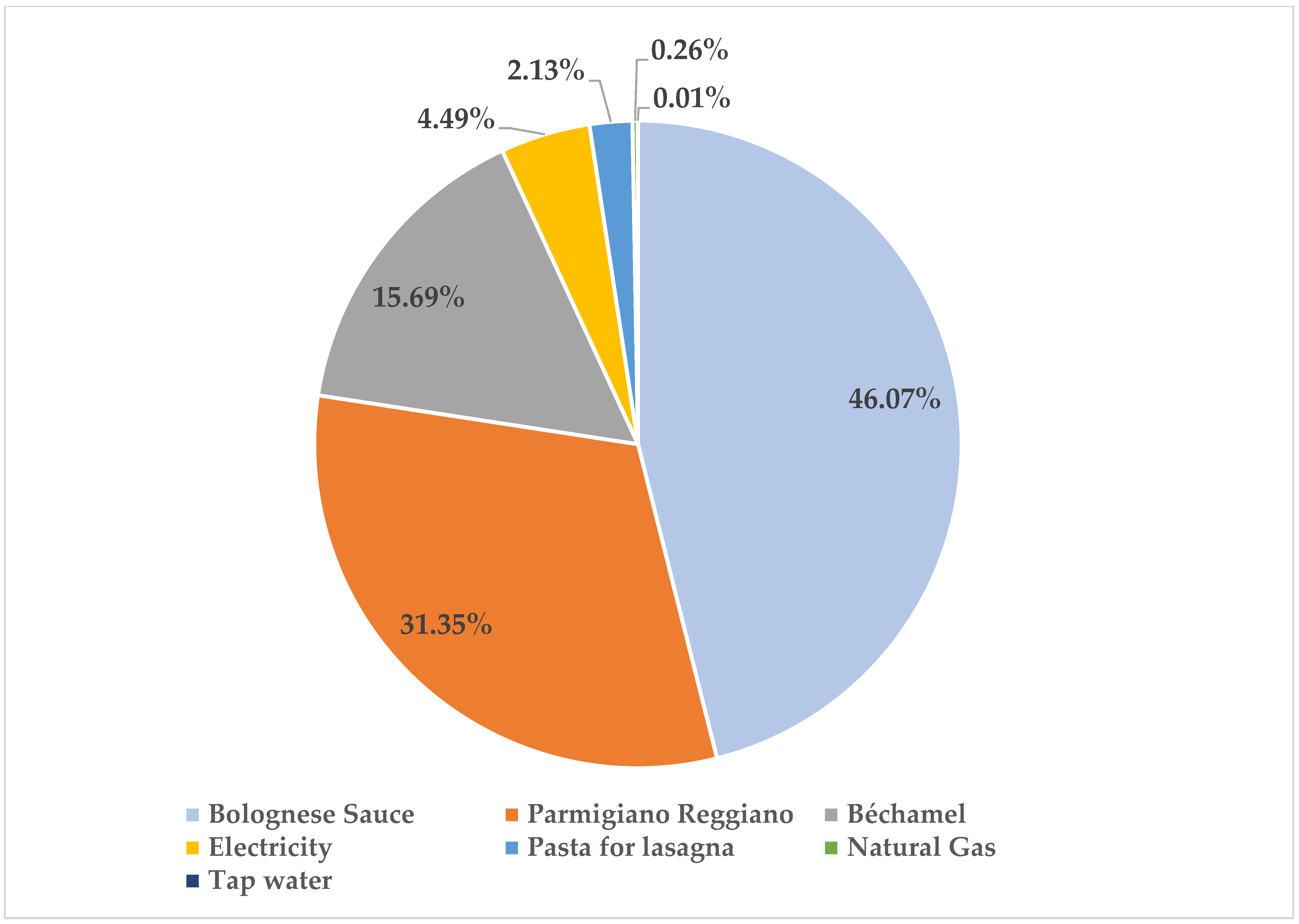
| 100.00% | Lasagna | 7.256 | |
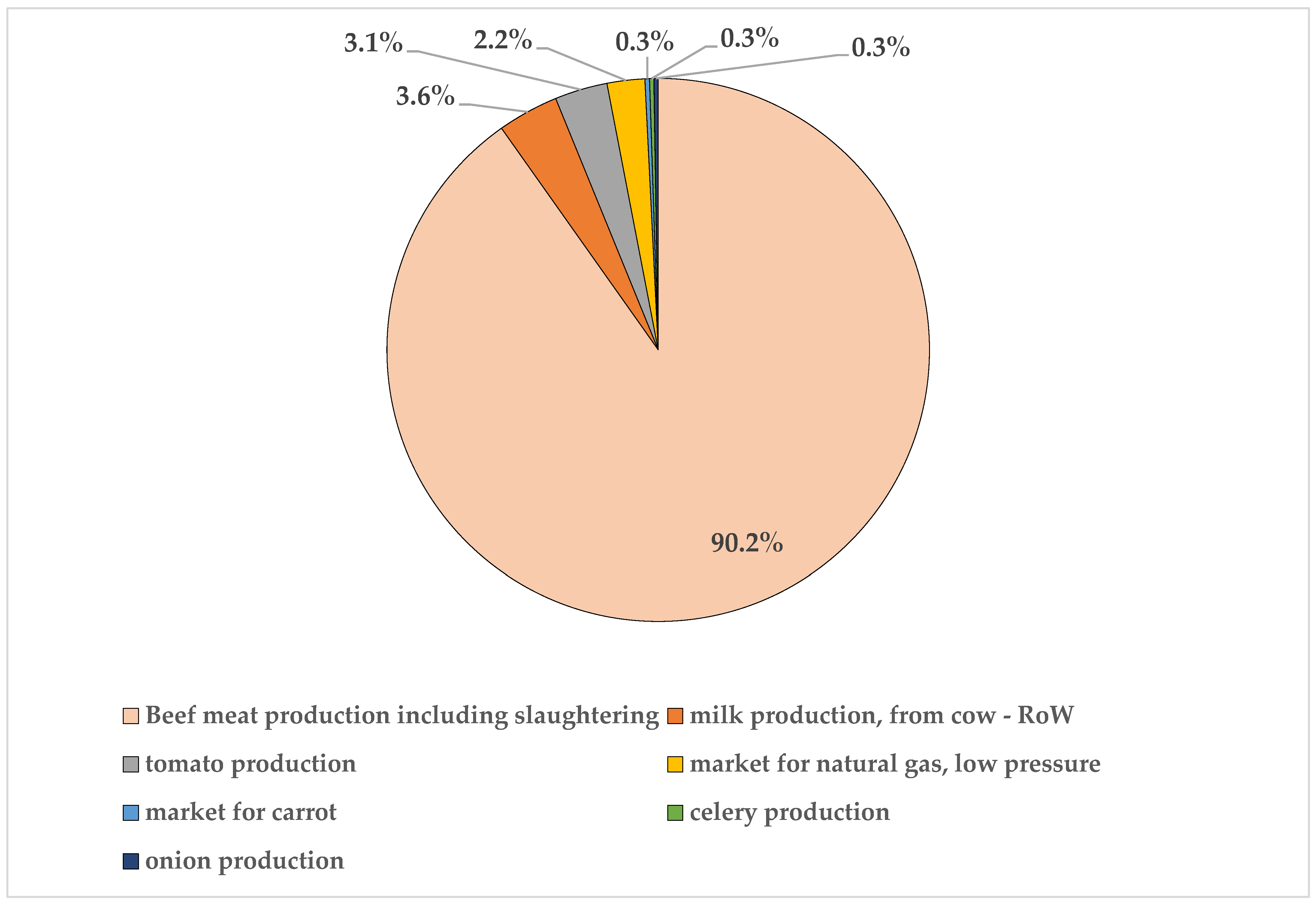
| 46.07% | Bolognese sauce | 3.343 | |
| 41.61% | Beef meat production after slaughtering, refrigeration, and transport to the food shop | 3.015 | |
| 1.68% | Milk production from cow | 0.121 | |
| 1.45% | Tomato production | 0.105 | |
| 1.04% | Natural gas, low pressure | 0.075 | |
| 0.13% | Carrot production | 0.009 | |
| 0.12% | Celery production | 0.009 | |
| 0.12% | Onion production | 0.008 | |
| 0.01% | Pig meat production after slaughtering, refrigeration, and transport to the food shop | 0.001 | |
| 31.35% | Production process of Parmigiano Reggiano | 2.275 | |
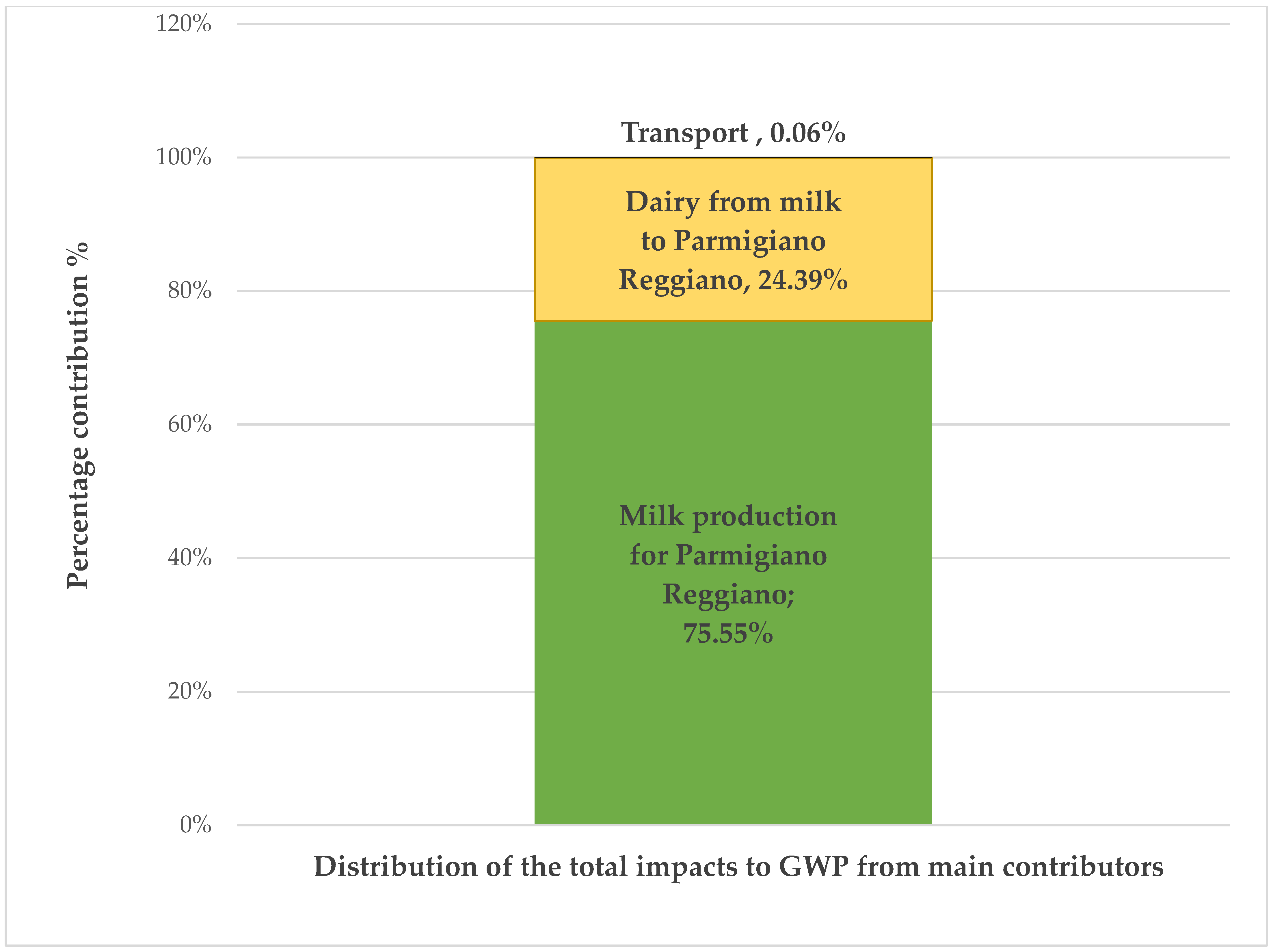
| 23.68% | Production of milk for Parmigiano Reggiano | 1.719 | |
| 7.64% | Market for electricity, medium voltage-IT | 0.555 | |
| 0.02% | Transport, freight, lorry 3.5–7.5 metric ton, EURO6-RER | 0.001 | |
| 15.69% | Béchamel | 1.139 | |
| 8.60% | Milk production, from cow-RoW | 0.624 | |
| 5.96% | Butter production, from cream, from cow milk-GLO | 0.432 | |
| 0.97% | Transport, freight, lorry 3.5–7.5 metric ton, EURO6-RER | 0.071 | |
| 0.09% | Market for natural gas, low-pressure RoW | 0.006 | |
| 0.08% | Wheat flour | 0.006 | |
| 4.49% | Market for electricity, low voltage-IT | 0.326 | |
| 4.48% | Electricity voltage transformation from medium to low voltage-IT | 0.325 | |
| 0.01% | Market for distribution network, electricity low-voltage GLO | 0.001 | |
| 0.00% | Electricity production photovoltaic–IT | 0.000 | |
| 0.00% | Electricity production photovoltaic–IT | 0.000 | |
| 2.13% | Pasta for lasagna | 0.155 | |
| 1.30% | Eggs for the pasta | 0.094 | |
| 0.58% | Wheat Flour | 0.042 | |
| 0.16% | Spinach production-GLO | 0.012 | |
| 0.09% | Market for natural gas, low-pressure RoW | 0.006 | |
| 0.26% | Market for natural gas, low-pressure RoW | 0.019 | |
| 0.18% | Natural gas pressure reduction from high to low pressure-RoW | 0.013 | |
| 0.00% | Market for pipeline, natural gas, low pressure distribution network-GLO | 0.000 | |
| 0.00% | Market for heat, central or small-scale, natural gas-RoW | 0.000 | |
| 0.00% | Market for heat, central or small-scale, natural gas—Europe without Switzerland | 0.000 | |
| 0.01% | Market for tap water-CH | 0.000 |
| Name Category | Impact Result | Unit |
|---|---|---|
| Freshwater ecotoxicity | 1.227 | kg 1,4-DCB |
| Ozone formation, human health | 0.019 | kg NOx eq |
| Marine eutrophication | 0.009 | kg N eq |
| Water consumption | 0.092 | m3 |
| Stratospheric ozone depletion | 0.000 | kg CFC11 eq |
| Freshwater eutrophication | 0.013 | kg P eq |
| Terrestrial acidification | 0.081 | kg SO2 eq |
| Human carcinogenic toxicity | 0.828 | kg 1,4-DCB |
| Terrestrial ecotoxicity | 13.267 | kg 1,4-DCB |
| Global warming | 10.010 | kg CO2 eq |
| Human non-carcinogenic toxicity | 24.806 | kg 1,4-DCB |
| Fossil resource scarcity | 1.107 | kg oil eq |
| Fine particulate matter formation | 0.016 | kg PM2.5 eq |
| Ozone formation, terrestrial ecosystems | 0.020 | kg NOx eq |
| Land use | 0.360 | m2a crop eq |
| Marine ecotoxicity | 1.595 | kg 1,4-DCB |
| Ionizing radiation | 0.262 | kBq Co-60 eq |
| Mineral resource scarcity | 0.029 | kg Cu eq |
| Impact Category | Impact Result | Unit |
|---|---|---|
| Freshwater ecotoxicity | 0.148 | kg 1,4-DCB |
| Ozone formation, human health | 0.025 | kg NOx eq |
| Marine eutrophication | 0.043 | kg N eq |
| Water consumption | 0.305 | m3 |
| Stratospheric ozone depletion | 0.000 | kg CFC11 eq |
| Freshwater eutrophication | 0.002 | kg P eq |
| Terrestrial acidification | 0.100 | kg SO2 eq |
| Human carcinogenic toxicity | 0.166 | kg 1,4-DCB |
| Terrestrial ecotoxicity | 11.95 | kg 1,4-DCB |
| Global warming | 16.97 | kg CO2 eq |
| Human non-carcinogenic toxicity | 29.31 | kg 1,4-DCB |
| Fossil resource scarcity | 2.871 | kg oil eq |
| Fine particulate matter formation | 0.020 | kg PM2.5 eq |
| Ozone formation, terrestrial ecosystems | 0.025 | kg NOx eq |
| Land use | 0.040 | m2a crop eq |
| Marine ecotoxicity | 0.202 | kg 1,4-DCB |
| Ionizing radiation | 1.210 | kBq Co-60 eq |
| Mineral resource scarcity | 0.038 | kg Cu eq |
| CED Category | Unit | Impact Results |
|---|---|---|
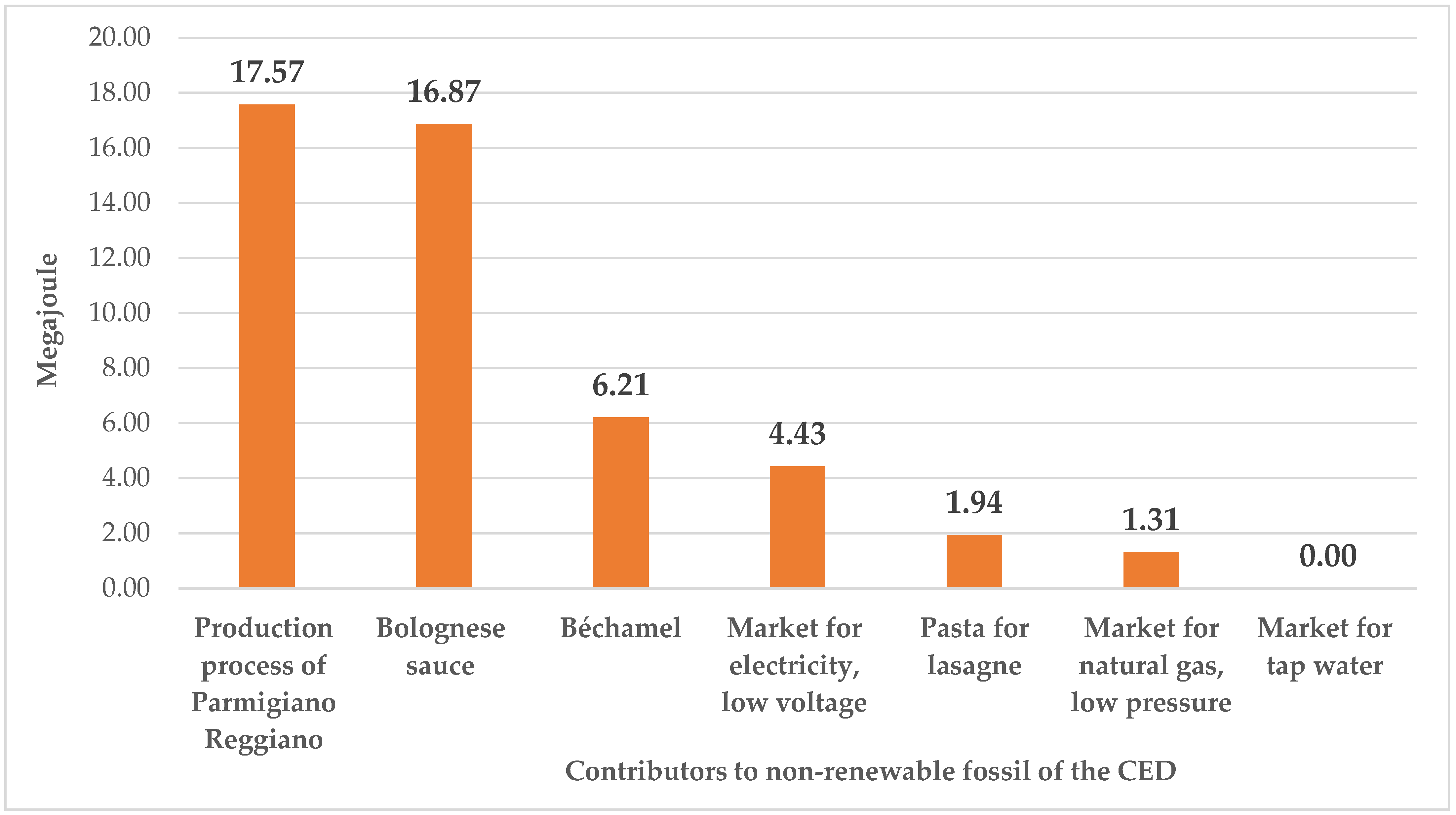
| Non-renewable, fossil | MJ | 48.33 |
| Non-renewable, nuclear | MJ | 4.19 |
| Renewable, biomass | MJ | 78.80 |
| Renewable, water | MJ | 2.29 |
| Renewable, wind, solar, geothermal | MJ | 1.13 |
| Non-renewable, biomass | MJ | 1.04 |
| MJ | 135.77 |
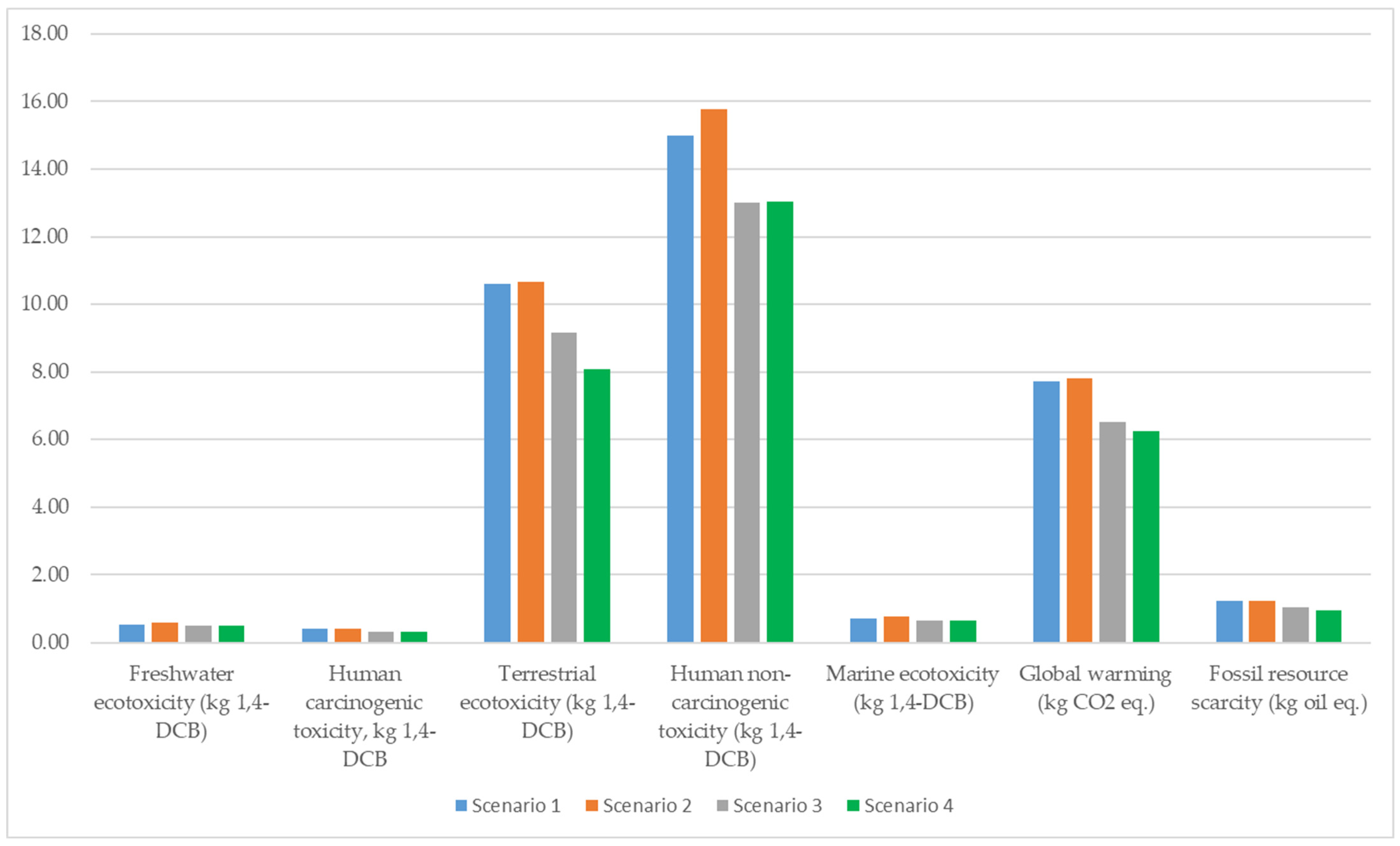
| Unit | Scenario 1 (Leftover Lasagna to Landfill) | Scenario 2 (Leftover Lasagna to Composting Plant) | Scenario 3 (No Leftover Lasagna) | Scenario 4 (Redistribution of Leftover Lasagna) | |
|---|---|---|---|---|---|
| Freshwater ecotoxicity | kg 1,4-DCB | 0.55 | 0.60 | 0.50 | 0.50 |
| Ozone formation, human health | kg NOx eq | 0.01 | 0.01 | 0.01 | 0.01 |
| Marine eutrophication | kg N eq | 0.01 | 0.01 | 0.01 | 0.01 |
| Water consumption | m3 | 0.15 | 0.15 | 0.13 | 0.12 |
| Stratospheric ozone depletion | kg CFC11 eq | 0.00 | 0.00 | 0.00 | 0.00 |
| Freshwater eutrophication | kg P eq | 0.01 | 0.01 | 0.00 | 0.00 |
| Terrestrial acidification | kg SO2 eq | 0.05 | 0.05 | 0.04 | 0.04 |
| Human carcinogenic toxicity | kg 1,4-DCB | 0.41 | 0.42 | 0.34 | 0.33 |
| Terrestrial ecotoxicity | kg 1,4-DCB | 10.60 | 10.66 | 9.16 | 8.07 |
| Global warming | kg CO2 eq | 7.72 | 7.81 | 6.51 | 6.24 |
| Human non-carcinogenic toxicity | kg 1,4-DCB | 14.99 | 15.77 | 12.99 | 13.03 |
| Fossil resource scarcity | kg oil eq | 1.23 | 1.24 | 1.06 | 0.97 |
| Fine particulate matter formation | kg PM2.5 eq | 0.01 | 0.01 | 0.01 | 0.01 |
| Ozone formation, terrestrial ecosystems | kg NOx eq | 0.01 | 0.01 | 0.01 | 0.01 |
| Land use | m2a crop eq | 0.17 | 0.17 | 0.14 | 0.13 |
| Marine ecotoxicity | kg 1,4-DCB | 0.72 | 0.78 | 0.66 | 0.65 |
| Ionizing radiation | kBq Co-60 eq | 0.43 | 0.43 | 0.37 | 0.36 |
| Mineral resource scarcity | kg Cu eq | 0.02 | 0.02 | 0.02 | 0.02 |
| Authors and Year of Publication (from the Year 2026 Inwards) | F.U. | Impact Assessment Method | Modeled Scenarios | Some Results | City |
|---|---|---|---|---|---|
| Casson et al. [6] | Annual operations of one food hub | Environmental, economic, and social impact assessment with related indicators. | Assessment of the environmental, economic, and social impacts and benefits of the annual operations of two food hubs in the Milan urban area. | The results show that fruits and vegetables, followed by bread, have the highest share in the annual amount of recovered food from the two investigated food hubs. The operability of the two hubs results in the net annual production of 107 t of CO2 eq. as well as an annual economic surplus of 316,331 Euro and 69.7 t of surplus food per year. | Milan |
| Guo et al. [40] | 391.8 kg of redistributed food over two weeks | CED, Blue water footprint guidelines, IPCC method, and TRACI model 2.1. | 8 scenarios with different configurations of the activities related to the donation of food surplus (fruits and vegetables) from donors to intermediaries or food banks, and from the latter to food pantries until their eventual disposal in a landfill or its management as feed for pigs. | Net environmental benefits in all the scenarios for GWP, AD, EU, and CED. This suggests that even if the redistribution from donors to food banks causes induced impacts due to transport and other activities, and such impacts are offset by the avoided impacts of landfill disposal and food production. | New York |
| Sundin et al. [41] | 1 kg surplus food prepared for transportation at the retail gate | ReCiPe (2016) 18 midpoint indicators (hierarchist approach) and endpoint indicators. | The investigated donation system in Sweden considers a soup kitchen and a food bag. The first provides cooked meals to vulnerable people, while the second one redistributes weekly food bags to low-income people against the payment of an annual fee. | The environmental benefits of the redistribution systems are higher than the induced impacts, including the rebound effects. The impacts are lower compared to anaerobic digestion (biogas plant). Identified the need for assuring retailers of more financial incentives to improve the economic advantage of food surplus redistribution compared to anaerobic digestion. | Uppsala (Sweden) |
| Damiani et al. [42] | 1 kg of surplus food redistributed by each emporium up to the gate | ReCiPe (2016) 18 midpoint indicators (hierarchist approach) | Comparison of the impacts of redistribution of surplus food recovered from local charities to incineration, anaerobic digestion, and composting. | Most recovered foods were fruits and vegetables, followed by cereal derivatives, dairy products, and lastly, meat and fish. The assessment also shows that redistribution generates environmental savings to the analyzed impact categories due to the avoidance of treating the food surplus, particularly in the incineration plants. | Veneto Region (Northern Italy) |
| Sulis et al. [43] | 1 ton of non-marketable food | ReCiPe (2008) midpoint indicators. | Six scenarios with landfilling of non-marketed food with/without a biogas plant as two baseline scenarios. The others are a combination of a larger fraction (80%) of non-marketed food (composed of fruits and vegetables) delivered to charities and the remaining 20% to landfilling. | The donation scenarios have lower emissions and impacts compared, in particular, to the baseline landfilling scenario. The impacts for donation are 140 times lower for GWP, 100 times lower for human toxicity, and 110 times lower for metal depletion compared to the landfilling scenario. | San Paulo (Brazil) |
| Bergstrom et al. [44] | 1 kg of redistributed surplus food at the gate of the retail/distributor | Life cycle sustainability assessment: LCA, LCC, S-LCA. | Seven scenarios involving, in each one, a different model of redistribution organization (soup kitchen, food bag, social supermarket, virtual market reprocessing, and food bag in retail) for the donation of surplus food from retailers to target groups of consumers, such as low-income people. | In environmental terms, the social supermarkets and food bag centers realized the highest environmental savings, while the largest economic savings were achieved by the food bag in retail. The transport to charity scenario reached the highest number of people in need (low-income/no-income people). | Sweden cities |
| Albizzati et al. [45] | 1 ton of surplus food (wet weight) with packaging from the retail sector in France | Ten midpoint indicators, including GWP, TA, POF, particulate matter, aquatic eutrophication nitrogen, aquatic eutrophication phosphorus, human toxicity, cancer ecotoxicity, fossil resource depletion, and water depletion | Comparison of business-as-usual scenario for surplus food at retail (fruits and vegetables), including the reuse for animal feed production as well as the redistribution to charities) with anaerobic digestion, incineration, and prevention scenarios. | Redistribution of surplus food achieved the highest environmental net benefits after the prevention, compared to the other two options. Cost analysis reveals that redistribution and/or reuse of surplus food for animal feed production has lower costs compared to anaerobic digestion and incineration. | France |
| Eriksson et al. [46] | 1 kg of food waste (including packaging) from the supermarket | GWP | Comparison of six scenarios (landfilling, incineration, composting, anaerobic digestion, animal feed, and donations) for food waste management. Investigated products: wheat bread, bananas, iceberg lettuce, grilled chicken, and beef. | Landfilling resulted in the option with the highest potential impacts to GW for all five types of food, while donation and anaerobic digestion were the options with the lower potential contribution to GW. The optimal food waste management option depends on the properties of the investigated food. Donations (−0.61 to −0.013 kg CO2e/kg food waste) and anaerobic digestion (_0.67 to _0.047 kg CO2e/kg food waste) are the options with the greatest potential of reducing the contribution to GW. | Uppsala (Sweden) |
Disclaimer/Publisher’s Note: The statements, opinions and data contained in all publications are solely those of the individual author(s) and contributor(s) and not of MDPI and/or the editor(s). MDPI and/or the editor(s) disclaim responsibility for any injury to people or property resulting from any ideas, methods, instructions or products referred to in the content. |
© 2026 by the authors. Licensee MDPI, Basel, Switzerland. This article is an open access article distributed under the terms and conditions of the Creative Commons Attribution (CC BY) license.
Share and Cite
Ghisellini, P.; Liu, Y.; Quinto, I.; Passaro, R.; Ulgiati, S. Environmental Impacts of Italian Food Life Cycle Scenarios for Sustainability Management and Decision Making. Environments 2026, 13, 203. https://doi.org/10.3390/environments13040203
Ghisellini P, Liu Y, Quinto I, Passaro R, Ulgiati S. Environmental Impacts of Italian Food Life Cycle Scenarios for Sustainability Management and Decision Making. Environments. 2026; 13(4):203. https://doi.org/10.3390/environments13040203
Chicago/Turabian StyleGhisellini, Patrizia, Yanxin Liu, Ivana Quinto, Renato Passaro, and Sergio Ulgiati. 2026. "Environmental Impacts of Italian Food Life Cycle Scenarios for Sustainability Management and Decision Making" Environments 13, no. 4: 203. https://doi.org/10.3390/environments13040203
APA StyleGhisellini, P., Liu, Y., Quinto, I., Passaro, R., & Ulgiati, S. (2026). Environmental Impacts of Italian Food Life Cycle Scenarios for Sustainability Management and Decision Making. Environments, 13(4), 203. https://doi.org/10.3390/environments13040203