Article

A Tutorial on Using Untargeted Metabolomics Data of Human Excreta to Investigate Drug Excretion and Wastewater Entry


1
Unit of PharmacoTherapy, -Epidemiology & Economics, Groningen Research Institute of Pharmacy, University of Groningen, Antonius Deusinglaan 1, 9713 AV Groningen, The Netherlands
2
Department of Analytical Biochemistry, Groningen Research Institute of Pharmacy, University of Groningen, Antonius Deusinglaan 1, 9713 AV Groningen, The Netherlands
3
Division of Nephrology, Department of Internal Medicine, University Medical Center Groningen, University of Groningen, Hanzeplein 1, 9713 GZ Groningen, The Netherlands
4
Life Sciences Mass Spectrometry, Department of Inorganic and Analytical Chemistry, University of Geneva, Quai Ernest Ansermet 24, 1211 Genève, Switzerland
5
Department of Clinical Pharmacy and Pharmacology, University Medical Center Groningen, University of Groningen, Hanzeplein 1, 9713 GZ Groningen, The Netherlands
*
Author to whom correspondence should be addressed.
Environments 2026, 13(4), 179; https://doi.org/10.3390/environments13040179

Submission received: 20 February 2026 / Revised: 20 March 2026 / Accepted: 22 March 2026 / Published: 24 March 2026

Abstract

Environmental scientists are increasingly monitoring therapeutic drugs and their metabolites in water systems, requiring knowledge of human drug metabolism and excretion. Many published studies, however, rely on data from small-scale human metabolism trials, typically involving around six (healthy, young, male) volunteers. Their generalizability to real-world drug users may be limited, potentially biasing environmental monitoring efforts. Here, we leveraged untargeted LC-SWATH/MS pharmacometabolomics data from 283 potential living kidney donors and 688 kidney transplant recipients to characterize the 24 h urinary excretion profiles of two widely used diuretics frequently monitored in wastewater, hydrochlorothiazide and furosemide. Both are expected to be excreted largely unchanged, which our analyses confirmed. For hydrochlorothiazide, however, we also identified (using reference standards) the previously underreported transformation products chlorothiazide and salamide. These findings highlight the relevance and capability of using untargeted metabolomics data from human excreta to provide insights from large, real-world cohorts into which chemicals enter wastewater systems, with both drugs serving as exemplary case studies for analogous analyses of other drugs. In particular, the qualitative information obtained (e.g., accurate mass, retention time, fragment spectra) may inform targeted biomonitoring and highlight cases where consensus-based estimates of excreted drug or metabolite fractions are overestimated.

1. Introduction

Due to population growth and ageing, the demand for therapeutic drugs has steadily increased in recent years [1,2]. This increased use has also led to substantial environmental contamination, especially in aquatic systems, posing a significant threat to organisms and ecosystems [3,4,5,6]. Consequently, drug-related environmental pollution has received widespread attention, and an increasing number of studies are being conducted in this field [7].
Many of these studies focus on the empirical biomonitoring of contaminants, a valuable tool for assessing their environmental occurrence [8]. Drugs from multiple therapeutic classes have been widely detected in aquatic environments worldwide [9,10,11,12,13]. Notably, many studies utilize mass spectrometry-based analytical methods that primarily target parent drugs [14], the compounds administered to patients to achieve the desired therapeutic effect.
Measurements of parent drugs play an important role in environmental monitoring, as they can be used to identify industrial emissions and trace usage and improper disposal pathways by consumers, including the flushing of unused drugs [15]. However, many drugs are excreted as biotransformation products, also known as metabolites [14]. Drug metabolism generally facilitates elimination from the body, although some drugs, particularly prodrugs, differ because they require metabolic processes to generate pharmacologically active metabolites [16]. An example of this is diazepam, a psychoactive benzodiazepine with central nervous system depressant properties, which has metabolites including temazepam and oxazepam that also exhibit substantial psychotropic activity (and are themselves used as drugs) [17]. A more representative example is candesartan cilexetil, an antihypertensive prodrug without pharmacological activity in humans that is hydrolyzed after gastrointestinal absorption to candesartan, the active compound [18]. In these cases, measuring or modeling only the administered drug (i.e., diazepam, candesartan cilexetil) would not accurately capture the pharmacological potential. Hence, disregarding metabolites may lead to invalid estimates of pharmaceutical pollution, although metabolites are already included in some studies [14].
When assessing metabolites, it is important to consider that knowledge of human drug metabolism is mainly derived from mass balance studies [19]. Due to their high financial and time costs, these studies are typically conducted in a small number of young, healthy (mostly male) volunteers and involve single-dose drug exposures [20,21]. To illustrate, a survey of 104 drugs approved by the United States Food and Drug Administration between 2014 and 2018 indicated that mass balance studies, when conducted, included up to 16 healthy (90%) male (>86%) volunteers and used a single-dose design (97%) [21]. Consequently, these studies may not sufficiently capture the actual metabolic behavior of drugs in target users, which has inspired a new research direction in real-world drug metabolism and excretion [22]. Studies in this field often apply untargeted metabolomics approaches to investigate drug metabolism in large patient populations [22], typically utilizing liquid chromatography (LC) coupled with mass spectrometry (MS), analogous to non-targeted screening approaches in the environmental domain. In these studies, human excreta samples are commonly used, such as 24 h urine, which capture more than a short-term snapshot of metabolism and excretion, unlike blood-based samples. Moreover, recent investigations have identified greater numbers of metabolites in human excreta than previously expected, for example for the environmentally relevant drugs metoprolol, mycophenolate mofetil, and sulfamethoxazole [22,23,24].
In this work, we aimed to obtain insights into real-world metabolism and excretion patterns of the diuretic drugs hydrochlorothiazide and furosemide, which are frequently monitored in wastewater due to their occurrence in the environment and established ecotoxicity [25,26]. These diuretics were studied utilizing existing untargeted LC-MS-based metabolomics data from 24 h urine samples of large numbers of kidney transplant recipients (KTRs) and potential living kidney donors (PLKDs) participating in the TransplantLines Food and Nutrition Biobank and Cohort Study (NCT02811835) [27,28]. In addition, we aimed to elaborate our workflow into a tutorial that provides a reproducible protocol for extracting comparable information on other drugs from existing metabolomics datasets that are abundantly available in public repositories, such as Metabolomics Workbench [29] and MetaboLights [30]. This tutorial is intended to support researchers in investigating how drugs enter sewage systems and may ultimately reach the environment, contributing to water resource conservation and the management of ecological quality. The insights gained from this workflow can inform targeted drug monitoring efforts and highlight cases where consensus-based estimates of excreted drug or metabolite fractions may be overestimated, particularly when novel metabolites are detected. Altogether, we hypothesize that applying a reproducible workflow to existing untargeted metabolomics data enables the identification of expected and possibly novel metabolites of therapeutic drugs, such as hydrochlorothiazide and furosemide, thereby confirming known patterns and providing new insights into their excretion and contributions to pharmaceutical pollution in wastewater.

2. Materials and Methods

2.1. Untargeted LC-MS Profiling Data

This study utilized untargeted LC-MS-based metabolomics data, previously obtained in negative electrospray ionization and ‘SWATH’ data-independent acquisition modes. Data were used from 24 h urine samples of 688 kidney transplant recipients (≥12 months post-transplantation; 43% females, mean age of 53 years, mean body mass index of 27 kg/m2, and strong overrepresentation of polypharmacy) and 283 individuals screened as potential living kidney donors (prior to potential donation; 54% females, mean age of 54 years, mean body mass index of 26 kg/m2). All individuals had enrolled between 2008 and 2010 in the TransplantLines Food and Nutrition Biobank and Cohort Study (NCT02811835), which was approved by the institutional review board of the University Medical Center Groningen (decision METc 2008/186), adhered to the Declaration of Helsinki, and obtained written informed consent from all participants. A detailed description of the TransplantLines study can be found here [27] and a comprehensive overview of the metabolomics study can be found here [28]. Raw data of the latter study have previously been deposited in an open-access data repository and can be found at: https://doi.org/10.26037/yareta:ybdgdynykfe6rkjjxb7d6oynoa [31].

2.2. Drug Metabolite Identification

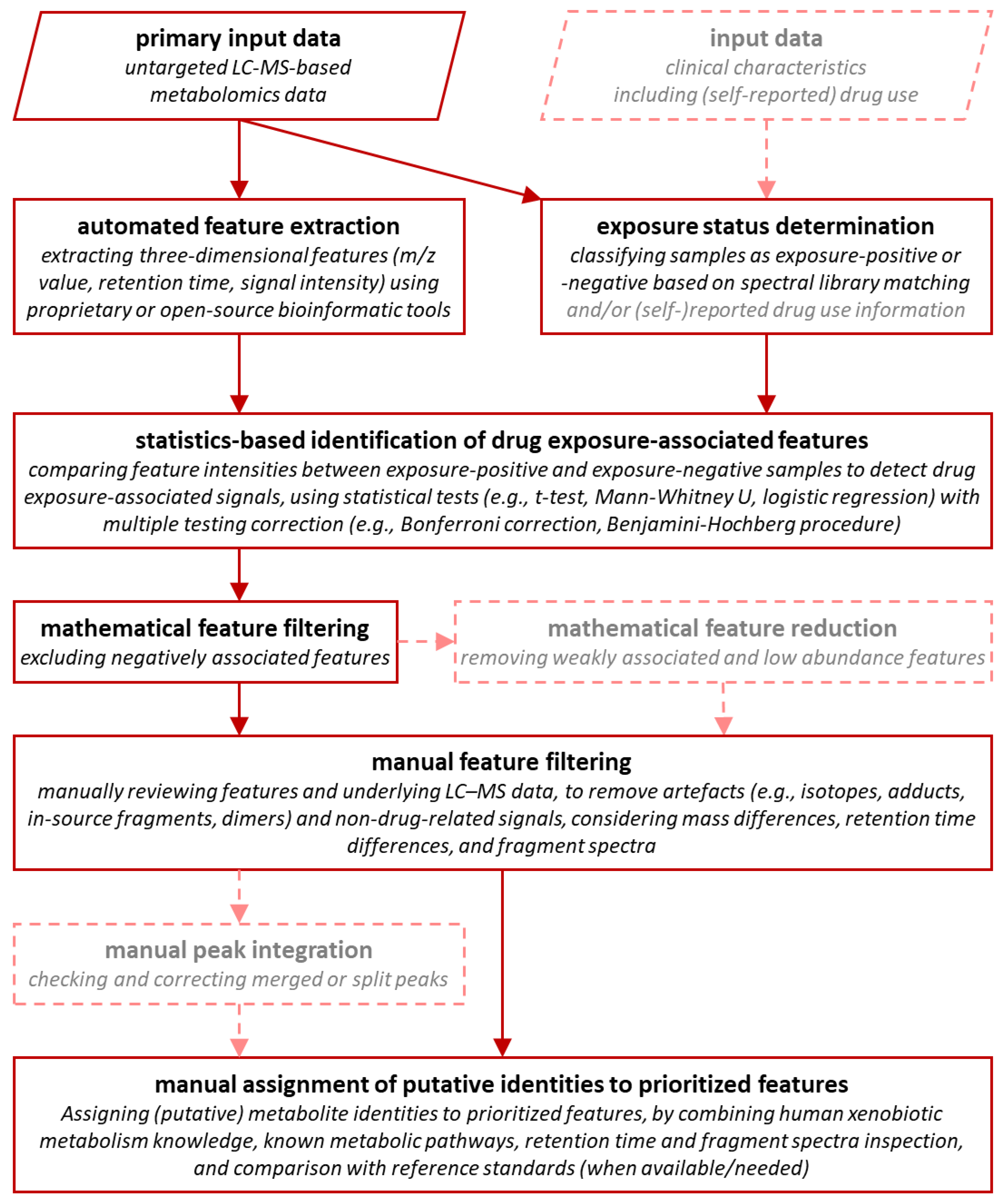
The elucidation of real-world drug metabolite profiles in untargeted metabolomics data generally follows a multi-step workflow. This workflow is outlined in the following subsections and is summarized in Figure 1, encompassing several steps, including: assignment of exposure status, statistical comparison of feature intensities between exposure-positive and exposure-negative samples, and various filtering and interpretation steps, ranging from automated intensity-based filtering to manual assessment of retention time profiles and fragment spectra. This study illustrates this process for the case studies of hydrochlorothiazide and furosemide using SCIEX MarkerView software (version 1.2.1; Concord, Ontario, Canada) for feature extraction and statistical analysis (see Supplementary Table S1); SCIEX PeakView software (version 2.2.0.11391; Concord, Ontario, Canada) for spectral library matching (see Supplementary Figures S1 and S2), manual inspection of retention time profiles and fragment spectra, and confirmation of metabolite identities; and SCIEX MultiQuant software (version 2.1; Concord, Ontario, Canada) for manual signal integration, applying a ±5 mDa extraction window and a 2.0-point Gaussian smoothing width (see Supplementary Table S2).

2.2.1. Defining the Exposure Status

The assignment of exposure statuses (i.e., exposure-positive, exposure-negative) to the samples is essential for the identification of features positively associated with drug use. Self-reported drug use can often be effective in identifying features associated with drug use, yet it is important to consider the possibility of inaccurate self-reporting. To mitigate the inaccuracies, the metabolomics data can be subjected to spectral library matching targeting the parent drug or a major metabolite, depending on which compound is expected to be present in the studied matrix. In practice, these approaches can also be combined to increase confidence in exposure classification by defining exposure-positive samples as those with both self-reported drug use and molecular evidence of drug exposure and exposure-negative samples as those lacking both.

2.2.2. Identification of Drug Use-Associated Features

Identification of drug use-associated features can be performed using a straightforward method for group comparison, such as an independent sample t-test, Mann–Whitney U test, or even logistic regression, which are also commonly applied in genetics research for comparative purposes. Importantly, multiple testing should be considered due to the large number of features typically detected in untargeted metabolomics studies. From a practical perspective, multiple testing could be addressed by controlling the rate of type I errors through application of a Bonferroni correction, where the significance level, alpha, is divided by the total number of tests conducted, which corresponds to the total number of features considered. As an alternative to this rather conservative approach, which may increase the risk of false negatives, methods that control the false discovery rate can be applied, such as the Benjamini–Hochberg procedure. When the exposure groups are furthermore highly unbalanced in terms of size, a practical approach would be to reduce the size of the larger group through random exclusion of samples to achieve more balanced comparisons.

2.2.3. Initial Feature Filtering

A pragmatic first step in reducing the (potentially long) list of statistically significant features is to remove signals that are not positively associated with drug use, for example, by requiring the ratio of the mean intensity in the exposure-positive group to that in the exposure-negative group to be greater than one. To obtain a more manageable set of features for manual investigation, a higher minimum ratio can be applied to exclude weak positively associated features, although this adjustment is optional. Additionally, a (optional) filtering step can be used to remove low-abundance features by comparing mean or median feature intensities relative to the most abundant drug-related signal, typically being the parent drug itself or its major metabolite. Using the median can be a practical approach, providing stringent filtering by prioritizing metabolites present in at least 50% of users. By contrast, using the mean retains metabolites that occur only in subsets of the exposure-positive group but may complicate the analysis, potentially including features corresponding to unrelated xenobiotics that are more frequent in the exposed group. Regardless of whether the median or mean is used, an abundance threshold of 1% relative to the highest observed signal could be considered as an arbitrary cutoff. In cases of extensive metabolism, where the total drug load is distributed across numerous metabolites, a higher threshold (e.g., 5%) may be applied to yield a manageable number of features for subsequent (manual) data handling steps.

2.2.4. Manual Feature Filtering

Depending on the bioinformatics tool used for feature detection, the list of prioritized features may still include ‘artefacts’ such as isotope peaks (e.g., 13C, 37Cl), adducts (e.g., sodium, potassium, ammonium, chlorine, formate), and in-source fragments (e.g., deconjugated phase II metabolites), which can be readily identified by considering features with the corresponding mass differences at the same retention time. At the same retention time, one may also encounter artefacts such as homodimers (e.g., [2M + H]+ in positive ionization mode, [2M − H] in negative mode) or heterodimers, the latter forming when an analyte noncovalently binds to a different analyte eluting at the same retention time. Combinations of these artefacts are also possible, further highlighting the need for critical assessment of feature lists. Additionally, endogenous metabolites or other xenobiotics may be elevated or occur more frequently in the exposed group, causing them to appear among statistically significant features. Their exclusion is typically less straightforward and may require additional filtering approaches, such as applying mass defect filters [32], expert-evaluation of which biotransformation products are logically expected based on human xenobiotic metabolism knowledge, and manual comparison of fragment spectra between the unknown signal and the parent drug or its major metabolite.

2.2.5. Putative Metabolite Identification

Once a final list of prioritized features has been established, (putative) metabolite identities need to be assigned to these signals. This process typically relies on knowledge of human xenobiotic metabolism and, when available, information on the drug’s known metabolic pathways, while also considering known impurities. Features should also be evaluated in the raw data to inspect retention time profiles and mass spectral information, particularly fragment ions. Fragment spectra can be annotated manually or compared against reference spectra of known compounds, such as the parent drug and/or its main metabolite(s). Ideally, the data reveal features corresponding to compounds for which reference standards are commercially available, enabling the highest level of identification confidence. Lower identification levels can still be appropriate, for example, by referring to the levels proposed by consortia such as the Metabolomics Standards Initiative (MSI) [33].
As an additional step, manually guided signal integration can be performed using proprietary software or open-source solutions such as Skyline. This integration can yield more reliable signal intensity values and may also enable additional identifications. Notably, automated feature detection algorithms sometimes merge closely eluting compounds into a single feature or designate a compound as present when it is actually absent. Finally, proposed metabolite identities can be supported or confirmed through more targeted follow-up analyses, potentially using more specific acquisition settings (e.g., MS/MS fragmentation with narrow precursor isolation windows). However, this approach is only feasible when representative samples from exposed individuals are available and may be utilized for analysis.

3. Results

Two previously published datasets containing raw LC-SWATH/MS data from 24 h urine samples were utilized in this work. The first dataset was comprised of metabolomics data from 688 kidney transplant recipients (KTRs), in which 106 (15%) hydrochlorothiazide-positive and 162 (24%) furosemide-positive samples were identified. The second dataset included metabolomics data from 283 potential living kidney donors (PLKDs), in which spectral library matching identified 13 (5%) hydrochlorothiazide-positives and 32 (11%) furosemide-positives. From these datasets, the feature detection software employed reported 36,812 and 25,860 features, respectively.

3.1. Feature Prioritization–Hydrochlorothiazide

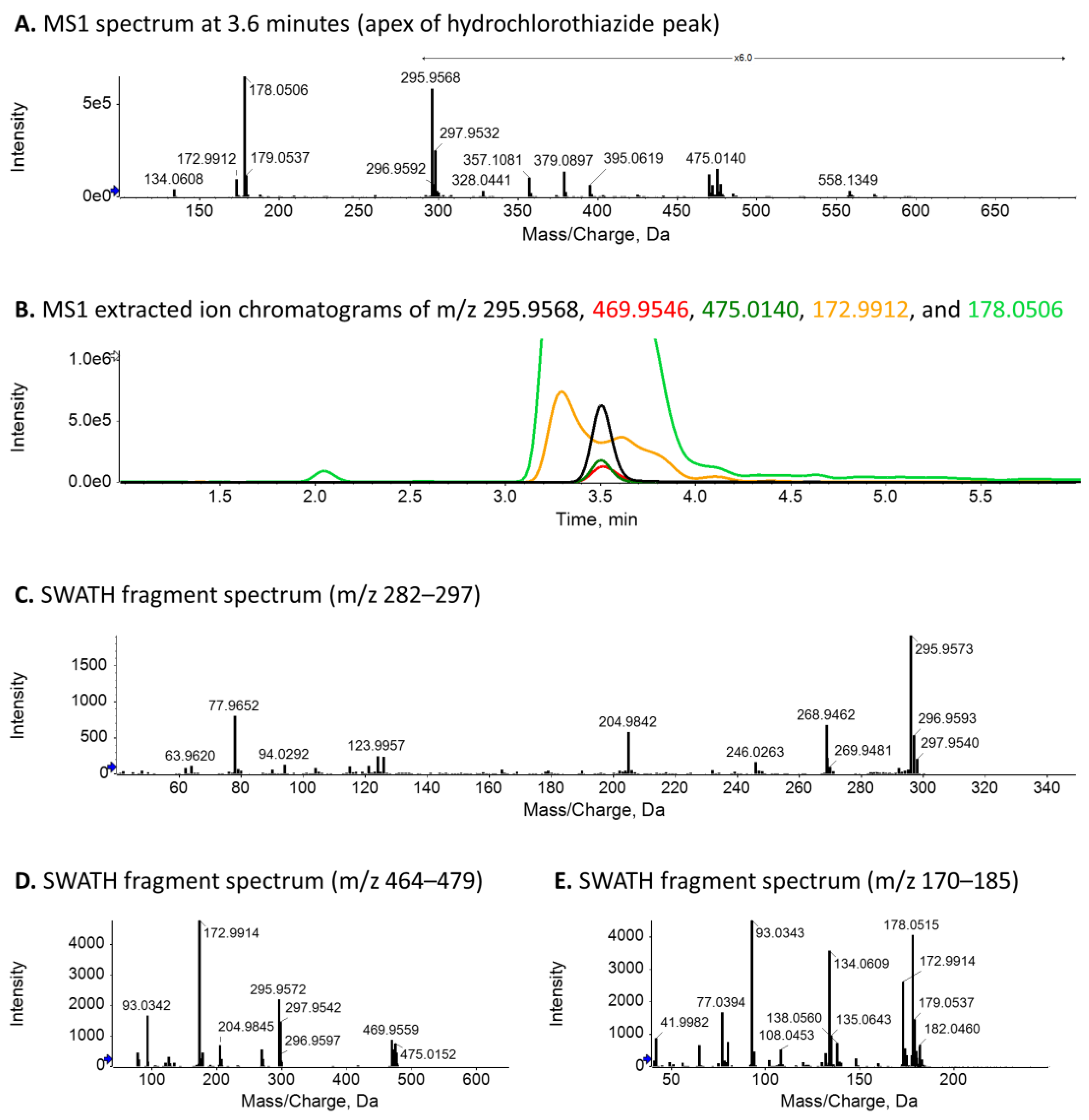
In KTR, 47 (0.13%) features met the significance threshold following t-test analysis using a Bonferroni-corrected significance level of (α/n features = 0.05/36,812) 1.358 × 10⁻⁶. Initial feature filtering excluded features with a mean signal abundance below a pre-set 1%, relative to the feature corresponding to hydrochlorothiazide itself, which was expected (and confirmed) to represent the primary drug-related feature in urine. Additionally, features were removed when the mean signal intensity in the exposed group was less than fivefold the mean intensity in the non-exposed group. After these initial filtering steps, 12 (0.03%) features remained. These were assessed manually with the aim of removing potential artefacts, like isotopes and adducts, but also unrelated (xenobiotic) signals that happen to occur more frequently in the exposed group. The latter signals were not encountered, yet some artefacts (i.e., 6 isotopes, 3 heterodimers; see Figure 2) were observed, ultimately resulting in the final prioritization of 3 (0.01%) features (see Table 1).
In PLKD, 148 (0.57%) features met the significance threshold following t-test analysis using a Bonferroni-corrected significance level of (α/n features = 0.05/25,860) 1.934 × 10⁻⁶. After the initial filtering steps, 27 (0.10%) features remained, while only 3 (0.01%) features were prioritized following manual feature filtering (see Table 1), excluding 9 isotopes, 2 heterodimers, and 13 unrelated (xenobiotic) signals that happen to occur more frequently in the exposed group.

3.2. Feature Prioritization–Furosemide

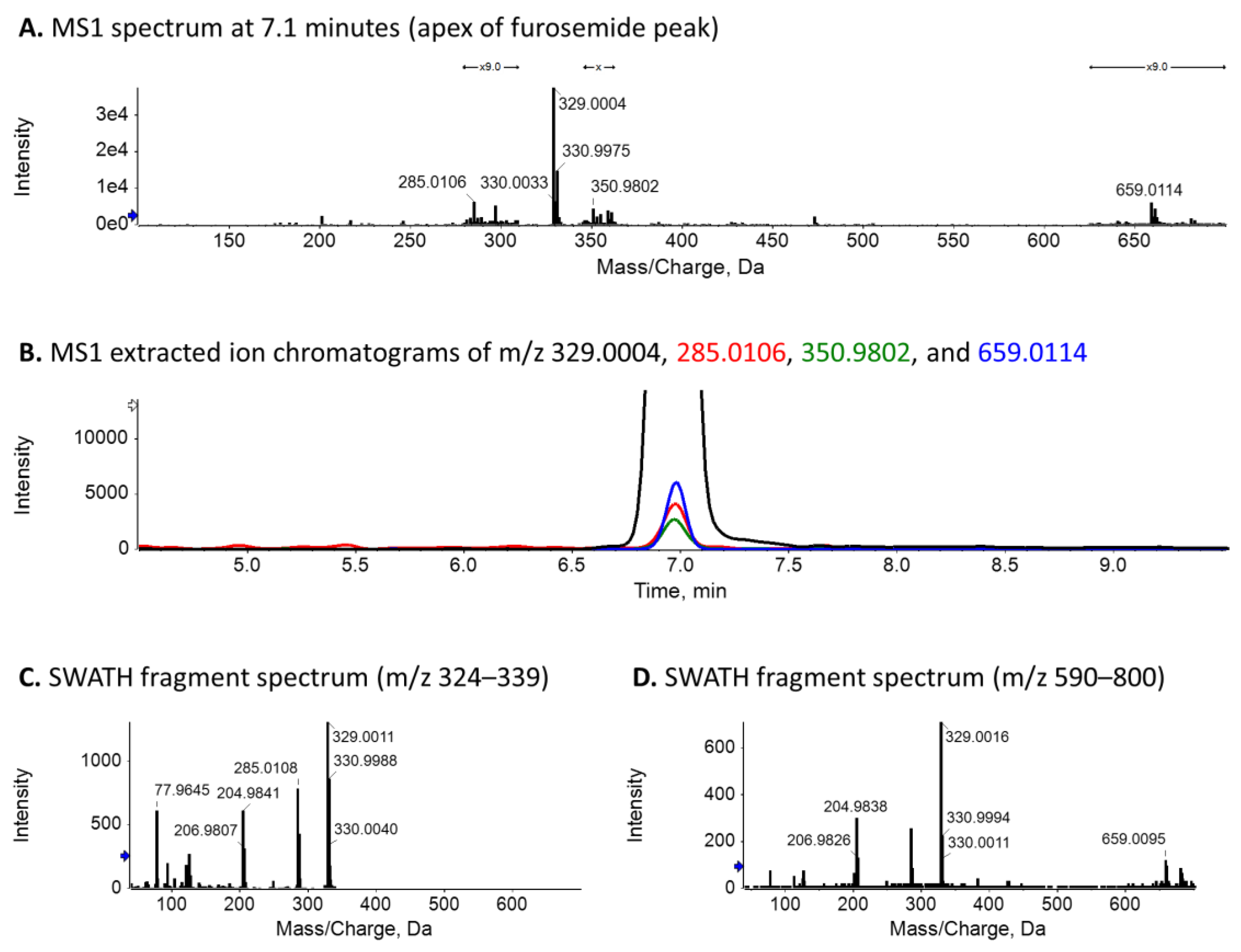
In KTR, 125 (0.34%) features met the significance threshold following t-test analysis using a Bonferroni-corrected significance level of 1.358 × 10⁻⁶. Initial feature filtering excluded features with a mean signal abundance below 1%, relative to the feature corresponding to furosemide itself, which was expected (and confirmed) to represent the primary drug-related feature in urine. Additionally, features were removed when the mean signal intensity in the exposed group was less than fivefold the mean intensity in the non-exposed group. After these initial filtering steps, only 18 (0.05%) features remained, which were assessed manually with the aim of removing potential artefacts, like isotopes and adducts, but also unrelated (xenobiotic) signals that happen to occur more frequently in the exposed group. Two of the latter signals were encountered, and some artefacts (i.e., 9 isotopes, 2 sodium adducts, 1 potassium adduct, 1 heterodimer, 1 homodimer; see Figure 3) were observed, eventually leading to the final prioritization of 2 (0.01%) features (see Table 1).
In PLKD, 220 (0.85%) features met the significance threshold following t-test analysis using a Bonferroni-corrected significance level of 1.934 × 10⁻⁶. After the initial filtering steps, 39 (0.15%) features remained, while only 2 (0.01%) features were prioritized following manual feature filtering (see Table 1), excluding 17 isotopes, 6 adducts, 2 in-source fragments, 1 homodimer, and 11 unrelated (xenobiotic) signals that happen to occur more frequently in the exposed group. Regarding the latter group, this included two features corresponding to the contrast agent iodixanol and a putative iodixanol metabolite (m/z 773.849 and 770.402, respectively; both as [M − 2H]2− ions; see Supplementary Figure S8), which were each accompanied by characteristic isotope and formate adduct features. These signals were elevated in all furosemide-positive PLKD, suggesting that they all underwent a pre-donation computed tomography scan of the kidneys, a procedure in which furosemide was traditionally administered as a single intravenous dose.

3.3. Metabolite Identification

The m/z and retention time information of the prioritized features was used to manually inspect the raw data of exposure-positive samples. First, we assessed the potential merging of closely eluting compounds into a single feature by the automated feature detection software employed. Such merging was not observed, with manually integrated peak intensities showing good agreement with feature intensities, with notable differences occurring primarily for lower-abundance signals (see Supplementary Figure S9). Second, the m/z and retention time information aided in the identification of hydrochlorothiazide and furosemide metabolites, respectively, employing an approach based on known drug metabolism information and an approach based on commonly expected mass differences in metabolites relative to the parent drug.

3.3.1. Hydrochlorothiazide

Expectations of what to encounter in urine were initially based on frequently reported claims that hydrochlorothiazide is not metabolized by humans [34,35]. Nonetheless, the underlying mass balance study (in six healthy volunteers) reported an unidentified urinary substance representing less than 0.5% of the administered dose [36]. A later study (in one nephrotic patient) [37] suggested that this substance could reflect 2-amino-4-chloro-m-benzenedisulfonamide, also known as salamide. The same study also reported that salamide was present up to 0.4% in the hydrochlorothiazide tablets administered, but accounted for 4.3% of the excreted dose in the patient. This suggests that salamide is both a contaminant and a metabolite; hence, it may be encountered in our study, which utilized a mean abundance threshold of ≥1% during feature filtering. A similar consideration applies to chlorothiazide, which was reported in a study (in six healthy volunteers) [38] to be present in urine in quantities ranging between 0.5% and 2% of the administered hydrochlorothiazide dose.
The m/z values of the three prioritized features matched the expected values of hydrochlorothiazide, chlorothiazide, and salamide, with mass deviations below 10 parts-per-million. The lower retention times (in reverse-phase chromatography) of the latter two substances are furthermore consistent with the understanding that xenobiotic metabolism generally aims to render the molecule more water-soluble to facilitate excretion. Additionally, as both chlorothiazide and salamide are known impurities, their identity and that of the parent drug could readily be confirmed using commercial reference standards (see Supplementary Figures S3 to S5), providing the highest level of identification confidence in metabolomics research (MSI level 1 “identified compounds”) [33]. The three prioritized features thus reliably corresponded to hydrochlorothiazide, chlorothiazide, and salamide. Lastly, the relative magnitudes and observed variation in their abundances suggest that these substances have been formed after administration (through human metabolism and/or degradation) rather than being solely the result of chemical contamination of the administered drug product (see Table 2 and Supplementary Figure S10A).

3.3.2. Furosemide

The furosemide case study was approached based on the assessment of commonly expected mass differences in metabolites relative to the parent drug, including oxygenation (+O; m/z-unit increment of 15.9949), demethylation (–CH2; m/z-unit decrease of 14.0157), sulfation (+SO3; m/z-unit increment of 79.9568), glucuronidation (+C6H8O6; m/z-unit increment of 176.0321), and combinations thereof. Moreover, lower retention times (in reverse-phase chromatography) would generally be expected for metabolites compared to the parent drug, as discussed above. However, exceptions exist, notably for conjugation with more apolar groups (e.g., methylation) or when LC separation is influenced by charge state (e.g., N-conjugation). In such cases, metabolites may not always elute earlier than the parent drug.
The m/z value of the prioritized feature with the lowest m/z value matched the expected value of furosemide, and its identity could readily be confirmed using a commercial reference standard (see Supplementary Figure S6), providing the highest level of identification confidence in metabolomics research (MSI level 1 “identified compounds”) [33]. The mass difference between furosemide and the other feature’s m/z value (i.e., +176.032) exactly matches the mass of a glucuronide moiety. Additionally, the feature’s lower retention time would be consistent with phase II conjugation, while its fragment spectrum was practically identical to that of furosemide, with the exception of the +176.032 peak of the residual precursor. No reference standard was furthermore analyzed for this substance, which thus represents an MSI level 3 “putatively characterized compound class” identification. Altogether, one feature could reliably be attributed to furosemide, while the other feature putatively corresponded to furosemide acyl glucuronide (see Table 3 and Supplementary Figure S10B).

4. Discussion

In this study, we used untargeted LC-SWATH/MS metabolomics data from a cohort of 283 potential living kidney donors and a cohort of 688 kidney transplant recipients to characterize the urinary excretion profiles of the diuretic drugs hydrochlorothiazide and furosemide. Both drugs are frequently encountered in clinical practice [39,40] and are of particular interest in environmental research [41], yet their human metabolite profiles are often summarized in a simplified manner. In particular, furosemide is considered to be excreted largely unchanged, with a limited contribution of a glucuronide conjugate [42], whereas hydrochlorothiazide is commonly described as not being metabolized prior to excretion [43], although reports of (very minor) impurities such as chlorothiazide and salamide in drug products exist [44].
By investigating existing untargeted metabolomics data, we were able to assess these summarized views in a real-world setting, notably confirming the excretion pattern of furosemide and expanding the current understanding of hydrochlorothiazide excretion. Specifically, we detected both furosemide and its glucuronide conjugate in a large number of furosemide-positive 24 h urine samples. Additionally, we identified hydrochlorothiazide together with chlorothiazide and salamide in hydrochlorothiazide-positive samples. For the latter two substances, their relative abundances and the considerable inter-sample variability observed suggest that they are not merely contaminants in drug products but may also represent transformation products formed following human administration. Importantly, it should be emphasized that the present data do not allow a definitive distinction between the contributions of impure drug formulations, human metabolism, and post-excretion degradation to the observed fractions of these two substances. Overall, the detected signals likely represent a combination of these sources, which, from an environmental perspective, collectively contribute to the chemical burden entering wastewater systems.
Building on these findings, the two case studies demonstrate the extent to which (and how) existing untargeted metabolomics data can be used to investigate drug excretion and metabolism in real-world populations. Starting from large feature lists generated by automated data-processing tools, candidate features were narrowed to a manageable set through successive filtering steps based on both statistical prioritization and manual interpretation. Importantly, manual evaluation remained indispensable for distinguishing true drug-related signals from analytical artefacts (e.g., isotopes, adducts, in-source fragments, dimeric species) and other substances that are coincidentally or incidentally more abundant and/or more intense in exposure-positive samples.
In this context, the case studies are representative of the challenges commonly encountered in such analyses, based on our recent experience with several tens of therapeutic drugs. However, it should be noted that it is unusual for nearly all prioritized substances to have their identities confirmed using chemical reference standards. More often, only putative identities can be assigned, considering accurate mass, retention time behavior, and spectral similarity to known compounds. In these cases, several bioinformatics tools can prove valuable, including dedicated prediction tools within instrument-vendor software suites, as well as more generic tools such as the Biotransformer Metabolism Prediction Tool [45], SIRIUS [46], FragAssembler [47], or combinations thereof [48]. It should also be noted that hypermetabolism was not observed in the present work, although it has been encountered in earlier work on the proton pump inhibitor omeprazole [24], where it substantially complicated data interpretation.
This theme of (hyper)metabolism is particularly relevant from an environmental perspective, as compounds detected in urine may not remain entirely unchanged as they travel through wastewater and downstream water systems. In this context, certain phase II conjugates, potentially including furosemide glucuronide, are known to be susceptible to deconjugation in aqueous environments [49]. Additionally, various other types of transformation products may form once excreta enter the sewer system, adding to the complexity of water analysis, for which regulatory frameworks recommend the joint consideration of parent drugs and relevant metabolites [50,51]. In this regard, using profiling data obtained from biobanked 24 h urine samples likely limits detection of highly labile metabolites, as the samples are typically kept at room temperature for several hours and undergo a freeze–thaw cycle, representing rather unfavorable pre-analytical conditions.
What follows is that untargeted metabolomics data are arguably mostly relevant for qualitative purposes when reused to obtain analytical insights into drug metabolism of potential environmental relevance. Absolute quantification is typically not possible in these datasets due to the lack of internal standards and rigorous bioanalytical method validation. It is therefore important to emphasize that the relative metabolite abundances reported in this work correspond only to detector signals obtained through the employed workflow. More specifically, variation between different substances reflects not only differences in absolute concentrations but also analytical factors such as ionization efficiency, matrix effects (e.g., salts, coeluting compounds), and analytical workflow-specific factors. Accordingly, these data are best interpreted as indicative of the presence and detection characteristics of drug metabolites rather than precise quantitative estimates of excreted amounts. The strength of such evidence could be improved by analyzing the same drugs across independent datasets. If matching relative signal intensities are observed, initial MS response factor experiments could provide basic quantitative estimates, which would still require validation using fully quantitative LC–MS workflows, when deemed relevant.
At the same time, it is important to note that the field of untargeted screening, particularly in environmental contexts, is increasingly pursuing quantitative interpretation of untargeted LC–MS profiling data, despite the absence of full method validation and compound-specific internal standards [52]. Several studies from this field even report that transformation products may exhibit reduced ionization efficiency compared to their parent drugs, often due to their lower hydrophobicity [52,53,54]. If applicable to our data, the actual metabolite contributions to overall excretion profiles may be underestimated. Nevertheless, we consider the current workflow to be suitable for qualitative interpretation. It also remains uncertain to what extent the detected compounds persist unchanged once entering wastewater, where transformation may occur during wastewater treatment and in downstream aquatic systems. Even if further transformation occurs, the analytical information obtained at the point of excretion (e.g., accurate mass, retention time behavior, fragment spectra) can still provide a valuable reference framework to support the identification of related transformation products in environmental matrices. Additionally, insights from this workflow can inform targeted drug monitoring efforts and highlight cases where consensus-based estimates of excreted drug or metabolite fractions may be overestimated, particularly when novel metabolites are detected. Thus, untargeted metabolomics of human excreta represents a practical and informative basis for studying environmental exposure to drugs and their transformation products, while acknowledging the need for complementary targeted and environmental investigations.

5. Conclusions

This study demonstrates that untargeted metabolomics data of human 24 h urine provides valuable insights into the excretion and metabolism of hydrochlorothiazide and furosemide, confirming established and revealing additional transformation products. Both case studies also highlight key steps in leveraging untargeted metabolomics data to gain real-world understanding of how drugs are excreted and enter wastewater systems. As such, the present work can guide researchers in both clinical and environmental fields to exploit existing untargeted metabolomics datasets for similar purposes. While it is unlikely that all substances detected in human excreta remain persistent after entering wastewater and downstream aquatic systems, the analytical information obtained at the point of excretion can inform the identification of related transformation products in downstream water systems. In this way, the presented workflow can further support the identification of compounds of emerging concern (as associated with therapeutic drug use) in aquatic environments. It does not, however, eliminate the need for further environmental investigations and targeted LC–MS analyses to reliably assess ecotoxicity and occurrence across various aquatic environments. Overall, this workflow can uncover previously unrecognized metabolites, providing new insights and helping refine consensus-based estimates of excreted drug and metabolite fractions for environmental assessments.

Supplementary Materials

The following supporting information can be downloaded at: https://www.mdpi.com/article/10.3390/environments13040179/s1. Figure S1: Exemplary spectral library matching-based identification of hydrochlorothiazide which was observed in the urine of a potential living kidney donor who declared usage of this drug; Figure S2: Exemplary spectral library matching-based identification of furosemide which was observed in the urine of a potential living kidney donor who declared usage of this drug; Figure S3: MS1-level extracted ion chromatogram and SWATH/MS fragment spectrum of hydrochlorothiazide observed in urine of a presumed human hydrochlorothiazide user, as well as product ion scan fragment spectrum of a hydrochlorothiazide reference standard; Figure S4: MS1-level extracted ion chromatogram and SWATH/MS fragment spectrum of chlorothiazide observed in urine of a presumed human hydrochlorothiazide user, as well as product ion scan fragment spectrum of a chlorothiazide reference standard; Figure S5: MS1-level extracted ion chromatogram and SWATH/MS fragment spectrum of salamide observed in urine of a presumed human hydrochlorothiazide user, as well as product ion scan fragment spectrum of a salamide reference standard; Figure S6: MS1-level extracted ion chromatogram and SWATH/MS fragment spectrum of furosemide observed in urine of a presumed human furosemide user, as well as product ion scan fragment spectrum of a furosemide reference standard; Figure S7: MS1-level extracted ion chromatogram and SWATH/MS fragment spectrum of a putatively glucuronidated version of furosemide (+176 Da) observed in urine of a presumed human furosemide user; Figure S8: MS1-level extracted ion chromatogram and SWATH/MS fragment spectra of iodixanol and a putative iodixanol transformation product observed in urine of a potential living kidney donor who was presumably exposed to both furosemide and iodixanol, as well as product ion scan fragment spectrum of a iodixanol reference standard; Figure S9: Scatter plots comparing manually integrated and automatically extracted signal intensities for (A) hydrochlorothiazide- and furosemide-associated signals; Figure S10: Beeswarm plots (including median bars) of relative metabolite abundances observed for (A) hydrochlorothiazide- and (B) furosemide-positive samples (see Table 2 and Table 3). Regarding the metabolite abundance values presented, these were calculated by dividing the signal intensity of each individual substance by the sum of the signal intensities of prioritized the substances found per exposure-positive sample. Table S1: Overview of MarkerView data (pre)processing settings; Table S2: Overview of manually integrated feature signals.

Author Contributions

Conceptualization, F.K.; methodology, F.K.; validation, S.H. and F.K.; formal analysis, S.H., M.A.J.H. and F.K.; investigation, S.H., M.A.J.H. and F.K.; resources, F.K.; data curation, F.K.; writing—original draft preparation, S.H. and F.K.; writing—review and editing, S.H., M.A.J.H., S.J.L.B., G.H., E.H. and F.K.; visualization, S.H. and F.K.; supervision, F.K.; project administration, F.K.; funding acquisition, F.K. All authors have read and agreed to the published version of the manuscript.

Funding

The generation of the TransplantLines Food and Nutrition Biobank and Cohort Study (TxL-FN), trial registration number NCT02811835, was funded by the Top Institute Food and Nutrition, grant number A-1003. Continuation of the TransplantLines Food and Nutrition Biobank and Cohort Study was supported by grants from Astellas BV and Chiesi Pharmaceuticals BV and co-financed by the Dutch Ministry of Economic Affairs and Climate Policy by means of the public–private partnership allowance made available by Top Sector Life Sciences & Health to stimulate public–private partnerships. Shihang Han gratefully acknowledges the funding provided by the China Scholarship Council under file number: 202506350016. Frank Klont gratefully acknowledges the funding provided by the Netherlands Organisation for Scientific Research NWO (domain Applied and Engineering Sciences) under Veni grant agreement no. 19060. Eelko Hak has received funding from the European Union’s Interreg NWE program under grant no. NWE0400548 (PREWAPHARM). Views and opinions expressed are however those of the author(s) only and do not necessarily reflect those of the European Union nor the granting authority. Neither the European Union nor the granting authority can be held responsible for them. All funders had no role in the study design, data collection, analysis, reporting, or the decision to submit for publication.

Institutional Review Board Statement

This study used existing metabolomics data from 24 h urine samples of individuals enrolled in the TransplantLines Food and Nutrition Biobank and Cohort Study (NCT identifier NCT02811835), which was approved by the institutional review board of the University Medical Center Groningen (UMCG; decision METc 2008/186 on 17 September 2008) and adhered to the Declaration of Helsinki.

Informed Consent Statement

All participants provided written informed consent before study participation.

Data Availability Statement

The metabolomics data employed for this study have previously been deposited in an open-access data repository, as can be found at: https://doi.org/10.26037/yareta:ybdgdynykfe6rkjjxb7d6oynoa [31].

Acknowledgments

The authors thank the Netwerk Medicijnresten uit Water Noord-Nederland for offering platforms to exchange knowledge and ideas on the topic of medication residues in water. The authors gratefully acknowledge Cassandra Piccolotto for her support with language editing in preparation of the final version of the manuscript.

Conflicts of Interest

The authors declare no conflicts of interest.

References

  1. Liu, J.-L.; Wong, M.-H. Pharmaceuticals and Personal Care Products (PPCPs): A Review on Environmental Contamination in China. Environ. Int. 2013, 59, 208–224. [Google Scholar] [CrossRef] [PubMed]
  2. Bungau, S.; Tit, D.; Fodor, K.; Cioca, G.; Agop, M.; Iovan, C.; Cseppento, D.; Bumbu, A.; Bustea, C. Aspects Regarding the Pharmaceutical Waste Management in Romania. Sustainability 2018, 10, 2788. [Google Scholar] [CrossRef]
  3. Khan, U.; Bloom, R.A.; Nicell, J.A.; Laurenson, J.P. Risks Associated with the Environmental Release of Pharmaceuticals on the U.S. Food and Drug Administration “Flush List”. Sci. Total Environ. 2017, 609, 1023–1040. [Google Scholar] [CrossRef]
  4. Sallam, N.A.; Alrefaeay, K.A.; ElZayat, E.M.; Fahim, I.S.; Hosney, H.; Lens, P.N.L.; Youssef, A.F.A. A Review on Environmental Impacts and Advanced Removal Strategies of Non-Steroidal Anti-Inflammatory Drugs. Int. J. Environ. Res. 2025, 19, 282. [Google Scholar] [CrossRef]
  5. Georgin, J.; Schumacher de Oliveira, J.; Dehmani, Y.; El Messaoudi, N.; de Albuquerque Carvalho, M.; Meili, L.; Ramos, C.G.; Franco, D.S.P. From Prescription to Pollution: Assessing the Ecological Impact and Treatment Technologies for Antidepressant Contaminants. Sustainability 2025, 17, 9752. [Google Scholar] [CrossRef]
  6. Chu, K.; Qin, S.; Tian, Z.; Ye, F.; Yang, X.; Gu, L.; Liu, Y.; Zhang, Y.; Sha, Y. Distribution and Potential Risks of Antibiotics in Inland Lakes in China. Environ. Res. 2026, 288, 123289. [Google Scholar] [CrossRef]
  7. Kovalenko, V.F.; Sova, A.M. Understanding the Ecotoxicological Impacts of Pharmaceutical Pollution in Aquatic Environments: A Review. J. Water Chem. Technol. 2025, 47, 291–298. [Google Scholar] [CrossRef]
  8. Orlando-Véliz, D.; Bonansea, R.I.; García-Vara, M.; Nikolopoulou, V.; López de Alda, M. Evaluation of Three Sample Preparation Methods for LC-HRMS Suspect Screening of Contaminants of Emerging Concern in Effluent Wastewater. Anal. Chem. 2025, 97, 25946–25957. [Google Scholar] [CrossRef]
  9. González Alonso, S.; Catalá, M.; Maroto, R.R.; Gil, J.L.R.; de Miguel, Á.G.; Valcárcel, Y. Pollution by Psychoactive Pharmaceuticals in the Rivers of Madrid Metropolitan Area (Spain). Environ. Int. 2010, 36, 195–201. [Google Scholar] [CrossRef]
  10. Kot-Wasik, A.; Jakimska, A.; Śliwka-Kaszyńska, M. Occurrence and Seasonal Variations of 25 Pharmaceutical Residues in Wastewater and Drinking Water Treatment Plants. Environ. Monit. Assess. 2016, 188, 661. [Google Scholar] [CrossRef]
  11. Tegegne, A.A.; Mekasha, Y.T.; Ayu, A.A.; Hasen, G.; Suleman, S. A Review on Emerging Pharmaceutical Residues in Ethiopia: Occurrence, Ecotoxicological Aspects, and Regulatory Concerns. Front. Microbiol. 2024, 15, 1499487. [Google Scholar] [CrossRef]
  12. Zanni, S.; Cammalleri, V.; D’Agostino, L.; Protano, C.; Vitali, M. Occurrence of Pharmaceutical Residues in Drinking Water: A Systematic Review. Environ. Sci. Pollut. Res. 2024, 32, 10436–10463. [Google Scholar] [CrossRef] [PubMed]
  13. Maremane, S.R.; Belle, G.N.; Oberholster, P.J.; Omotola, E.O. Occurrence of Selected Covid-19 Drugs in Surface Water Resources: A Review of Their Sources, Pathways, Receptors, Fate, Ecotoxicity, and Possible Interactions with Heavy Metals in Aquatic Ecosystems. Environ. Geochem. Health 2025, 47, 3. [Google Scholar] [CrossRef] [PubMed]
  14. Meyer, C.; Stravs, M.A.; Hollender, J. How Wastewater Reflects Human Metabolism─Suspect Screening of Pharmaceutical Metabolites in Wastewater Influent. Environ. Sci. Technol. 2024, 58, 9828–9839. [Google Scholar] [CrossRef]
  15. Bound, J.P.; Voulvoulis, N. Household Disposal of Pharmaceuticals as a Pathway for Aquatic Contamination in the United Kingdom. Environ. Health Perspect. 2005, 113, 1705–1711. [Google Scholar] [CrossRef] [PubMed]
  16. Chillistone, S.; Hardman, J.G. Modes of Drug Elimination and Bioactive Metabolites. Anaesth. Intensive Care Med. 2023, 24, 482–485. [Google Scholar] [CrossRef]
  17. Wang, C.; Hou, L.; Li, J.; Xu, Z.; Gao, T.; Yang, J.; Zhang, H.; Li, X.; Du, P. Occurrence of Diazepam and Its Metabolites in Wastewater and Surface Waters in Beijing. Environ. Sci. Pollut. Res. 2017, 24, 15379–15389. [Google Scholar] [CrossRef]
  18. Boltia, S.A.; Goda, Z.M.; Fayez, Y.M.; Nebsen, M. A Synergistic Framework for Development of Green HPLC Methods for Determination of Amlodipine Besylate and Candesartan Cilexetil in Presence of Their Hydrolytic Degradation Products in Two Different Matrices. Sustain. Chem. Pharm. 2022, 30, 100857. [Google Scholar] [CrossRef]
  19. Klont, F.; Bellinga, J.S.; Giunchi, V.; Balafas, S.; Hak, E. A Pharmacological View on Accounting for Pharmacokinetic Factors in the Estimation of Pharmaceutical Emissions Based on Drug Usage Data. Environ. Int. 2025, 196, 109312. [Google Scholar] [CrossRef]
  20. Coppola, P.; Andersson, A.; Cole, S. The Importance of the Human Mass Balance Study in Regulatory Submissions. CPT Pharmacomet. Syst. Pharmacol. 2019, 8, 792–804. [Google Scholar] [CrossRef]
  21. Ramamoorthy, A.; Bende, G.; Chow, E.C.Y.; Dimova, H.; Hartman, N.; Jean, D.; Pahwa, S.; Ren, Y.; Shukla, C.; Yang, Y.; et al. Human Radiolabeled Mass Balance Studies Supporting the FDA Approval of New Drugs. Clin. Transl. Sci. 2022, 15, 2567–2575. [Google Scholar] [CrossRef] [PubMed]
  22. Nijdam, F.B.; Hof, M.A.J.; Blokzijl, H.; Bakker, S.J.L.; Hak, E.; Hopfgartner, G.; Klont, F.; Investigators, T. Pharmacometabolomics Enables Real-World Drug Metabolism Sciences. Metabolites 2025, 15, 39. [Google Scholar] [CrossRef] [PubMed]
  23. Heddema, W.A.; Hof, M.A.J.; Sosnowski, P.; Bakker, S.J.L.; Hopfgartner, G.; Klont, F.; Annema, C.; Bakker, S.J.L.; Berger, S.P.; Blokzijl, H.; et al. Pharmacometabolomics Detects Various Unreported Metoprolol Metabolites in Urine of (Potential) Living Kidney Donors and Kidney Transplant Recipients. Clin. Pharmacokinet. 2025, 64, 779–789. [Google Scholar] [CrossRef] [PubMed]
  24. Klont, F.; Sosnowski, P.; Kremer, D.; Knobbe, T.J.; Bonner, R.; Blokzijl, H.; Weersma, R.K.; Bakker, S.J.L.; Investigators, T.; Hak, E.; et al. Assessing the Potential of Untargeted SWATH Mass Spectrometry-Based Metabolomics to Differentiate Closely Related Exposures in Observational Studies. Metabolites 2022, 12, 942. [Google Scholar] [CrossRef]
  25. Sandré, F.; Moilleron, R.; Morin, C.; Garrigue-Antar, L. Comprehensive Analysis of a Widely Used Pharmaceutical, Furosemide, and Its Degradation Products in Aquatic Systems: Occurrence, Fate, and Ecotoxicity. Environ. Pollut. 2024, 348, 123799. [Google Scholar] [CrossRef]
  26. Uzelac, M.M.; Srđenović Čonić, B.; Kladar, N.; Armaković, S.; Armaković, S.J. Removal of Hydrochlorothiazide from Drinking and Environmental Water: Hydrolysis, Direct and Indirect Photolysis. Energy Environ. 2023, 34, 1243–1257. [Google Scholar] [CrossRef]
  27. Van Den Berg, E.; Pasch, A.; Westendorp, W.H.; Navis, G.; Brink, E.J.; Gans, R.O.B.; Van Goor, H.; Bakker, S.J.L. Urinary Sulfur Metabolites Associate with a Favorable Cardiovascular Risk Profile and Survival Benefit in Renal Transplant Recipients. J. Am. Soc. Nephrol. 2014, 25, 1303–1312. [Google Scholar] [CrossRef]
  28. Klont, F.; Stepanović, S.; Kremer, D.; Bonner, R.; Touw, D.J.; Hak, E.; Bakker, S.J.L.; Hopfgartner, G. Untargeted ‘SWATH’ Mass Spectrometry-Based Metabolomics for Studying Chronic and Intermittent Exposure to Xenobiotics in Cohort Studies. Food Chem. Toxicol. 2022, 165, 113188. [Google Scholar] [CrossRef]
  29. Sud, M.; Fahy, E.; Cotter, D.; Azam, K.; Vadivelu, I.; Burant, C.; Edison, A.; Fiehn, O.; Higashi, R.; Nair, K.S.; et al. Metabolomics Workbench: An International Repository for Metabolomics Data and Metadata, Metabolite Standards, Protocols, Tutorials and Training, and Analysis Tools. Nucleic Acids Res. 2016, 44, D463–D470. [Google Scholar] [CrossRef]
  30. Yurekten, O.; Payne, T.; Tejera, N.; Amaladoss, F.X.; Martin, C.; Williams, M.; O’Donovan, C. MetaboLights: Open Data Repository for Metabolomics. Nucleic Acids Res. 2024, 52, D640–D646. [Google Scholar] [CrossRef]
  31. Klont, F.; Hopfgartner, G. Mass Spectrometry-Based Clinical Metabolomics Data of Urine from Kidney Transplant Recipients (KTR), Potential Living Kidney Donors (PLKD), and Living Kidney Donors (LKD). Yareta 2022. [Google Scholar] [CrossRef]
  32. Zhang, H.; Zhang, D.; Ray, K.; Zhu, M. Mass Defect Filter Technique and Its Applications to Drug Metabolite Identification by High-Resolution Mass Spectrometry. J. Mass Spectrom. 2009, 44, 999–1016. [Google Scholar] [CrossRef] [PubMed]
  33. Sumner, L.W.; Amberg, A.; Barrett, D.; Beale, M.H.; Beger, R.; Daykin, C.A.; Fan, T.W.M.; Fiehn, O.; Goodacre, R.; Griffin, J.L.; et al. Proposed Minimum Reporting Standards for Chemical Analysis: Chemical Analysis Working Group (CAWG) Metabolomics Standards Initiative (MSI). Metabolomics 2007, 3, 211–221. [Google Scholar] [CrossRef] [PubMed]
  34. Flockhart, D.A.; Tanus-Santos, J.E. Implications of Cytochrome P450 Interactions When Prescribing Medication for Hypertension. Arch. Intern. Med. 2002, 162, 405. [Google Scholar] [CrossRef]
  35. Morley-Senkler, V.; Jobin, P.; Wright, J.M. Blood Pressure Lowering Effect of Hydrochlorothiazide Compared to Other Diuretics for Hypertension. Cochrane Database Syst. Rev. 2022, 2022, CD015250. [Google Scholar] [CrossRef]
  36. Beermann, B.; Groschinsky-Grind, M.; Rosén, A. Absorption, Metabolism, and Excretion of Hydrochlorothiazide. Clin. Pharmacol. Ther. 1976, 19, 531–537. [Google Scholar] [CrossRef]
  37. Okuda, T.; Itoh, S.; Yamazaki, M.; Nakahama, H.; Fukuhara, Y.; Orita, Y. Biopharmaceutical Studies of Thiazide Diuretics. III. In Vivo Formation of 2-Amino-4-Chloro-m-Benzenedisulfonamide as a Metabolite of Hydrochlorothiazide in a Patient. Chem. Pharm. Bull. 1987, 35, 3516–3518. [Google Scholar] [CrossRef]
  38. Deventer, K.; Pozo, O.J.; Van Eenoo, P.; Delbeke, F.T. Detection of Urinary Markers for Thiazide Diuretics after Oral Administration of Hydrochlorothiazide and Altizide-Relevance to Doping Control Analysis. J. Chromatogr. A 2009, 1216, 2466–2473. [Google Scholar] [CrossRef]
  39. Carey, R.M.; Moran, A.E.; Whelton, P.K. Treatment of Hypertension. JAMA 2022, 328, 1849. [Google Scholar] [CrossRef]
  40. Redfield, M.M.; Borlaug, B.A. Heart Failure With Preserved Ejection Fraction. JAMA 2023, 329, 827. [Google Scholar] [CrossRef]
  41. Castiglioni, S.; Bagnati, R.; Fanelli, R.; Pomati, F.; Calamari, D.; Zuccato, E. Removal of Pharmaceuticals in Sewage Treatment Plants in Italy. Environ. Sci. Technol. 2006, 40, 357–363. [Google Scholar] [CrossRef] [PubMed]
  42. Van Wart, S.A.; Shoaf, S.E.; Mallikaarjun, S.; Mager, D.E. Population-based Meta-analysis of Furosemide Pharmacokinetics. Biopharm. Drug Dispos. 2014, 35, 119–133. [Google Scholar] [CrossRef] [PubMed]
  43. Van Wart, S.A.; Shoaf, S.E.; Mallikaarjun, S.; Mager, D.E. Population-based Meta-analysis of Hydrochlorothiazide Pharmacokinetics. Biopharm. Drug Dispos. 2013, 34, 527–539. [Google Scholar] [CrossRef] [PubMed]
  44. Marzouk, H.M.; El-Hanboushy, S.; Obaydo, R.H.; Fayez, Y.M.; Abdelkawy, M.; Lotfy, H.M. Sustainable Chromatographic Quantitation of Multi-Antihypertensive Medications: Application on Diverse Combinations Containing Hydrochlorothiazide along with LC–MS/MS Profiling of Potential Impurities: Greenness and Whiteness Evaluation. BMC Chem. 2023, 17, 101. [Google Scholar] [CrossRef]
  45. Wishart, D.S.; Tian, S.; Allen, D.; Oler, E.; Peters, H.; Lui, V.W.; Gautam, V.; Djoumbou-Feunang, Y.; Greiner, R.; Metz, T.O. BioTransformer 3.0—A Web Server for Accurately Predicting Metabolic Transformation Products. Nucleic Acids Res. 2022, 50, W115–W123. [Google Scholar] [CrossRef]
  46. Dührkop, K.; Fleischauer, M.; Ludwig, M.; Aksenov, A.A.; Melnik, A.V.; Meusel, M.; Dorrestein, P.C.; Rousu, J.; Böcker, S. SIRIUS 4: A Rapid Tool for Turning Tandem Mass Spectra into Metabolite Structure Information. Nat. Methods 2019, 16, 299–302. [Google Scholar] [CrossRef]
  47. Chen, Y.-C.; Wu, H.-Y.; Wu, W.-S.; Hsu, J.-Y.; Chang, C.-W.; Lee, Y.-H.; Liao, P.-C. Identification of Xenobiotic Biotransformation Products Using Mass Spectrometry-Based Metabolomics Integrated with a Structural Elucidation Strategy by Assembling Fragment Signatures. Anal. Chem. 2023, 95, 14279–14287. [Google Scholar] [CrossRef]
  48. Pozo Garcia, V.; Zhang, M.; Çobanoğlu, T.S.; Holm, K.; Jennings, P.; Poole, D.A.; Moco, S. Predicting Xenobiotic Metabolism: A Computational Approach Mining LC–MS/MS Data with SIRIUS and BioTransformer. Arch. Toxicol. 2025, 100, 979–991. [Google Scholar] [CrossRef]
  49. Brown, A.K.; Wong, C.S. Distribution and Fate of Pharmaceuticals and Their Metabolite Conjugates in a Municipal Wastewater Treatment Plant. Water Res. 2018, 144, 774–783. [Google Scholar] [CrossRef]
  50. Zahn, D.; Arp, H.P.H.; Fenner, K.; Georgi, A.; Hafner, J.; Hale, S.E.; Hollender, J.; Letzel, T.; Schymanski, E.L.; Sigmund, G.; et al. Should Transformation Products Change the Way We Manage Chemicals? Environ. Sci. Technol. 2024, 58, 7710–7718. [Google Scholar] [CrossRef]
  51. Egaña, I.; Domingo-Echaburu, S.; Orive, G.; Lertxundi, U. Safe Levels of Pharmaceuticals in Groundwater. Sci. Total Environ. 2023, 886, 163990. [Google Scholar] [CrossRef]
  52. Kruve, A.; Kiefer, K.; Hollender, J. Benchmarking of the Quantification Approaches for the Non-Targeted Screening of Micropollutants and Their Transformation Products in Groundwater. Anal. Bioanal. Chem. 2021, 413, 1549–1559. [Google Scholar] [CrossRef]
  53. Malm, L.; Palm, E.; Souihi, A.; Plassmann, M.; Liigand, J.; Kruve, A. Guide to Semi-Quantitative Non-Targeted Screening Using LC/ESI/HRMS. Molecules 2021, 26, 3524. [Google Scholar] [CrossRef]
  54. Malm, L.; Liigand, J.; Aalizadeh, R.; Alygizakis, N.; Ng, K.; Frøkjær, E.E.; Nanusha, M.Y.; Hansen, M.; Plassmann, M.; Bieber, S.; et al. Quantification Approaches in Non-Target LC/ESI/HRMS Analysis: An Interlaboratory Comparison. Anal. Chem. 2024, 96, 16215–16226. [Google Scholar] [CrossRef]
Figure 1. Schematic overview of the drug metabolite identification workflow presented, where dashed lines indicate optional steps.
Environments 13 00179 g001
Figure 2. Mass spectra and extracted ion chromatograms from an exemplary hydrochlorothiazide-positive sample. (A) MS1-level fragment spectrum at the time of hydrochlorothiazide elution, with a 6× zoom at m/z 290–690. (B) MS1-level extracted ion chromatograms of hydrochlorothiazide (m/z 296, black), two putative heterodimers (m/z 470 and 475, red and dark green), and the corresponding monomeric signals contributing to dimerization (m/z 173 and 178, orange and light green). (C) MS2-level fragment spectrum at 3.6 min in the SWATH window featuring hydrochlorothiazide. (D) MS2-level fragment spectrum at 3.6 min in the SWATH window featuring both heterodimers. (E) MS2-level fragment spectrum at 3.6 min in the SWATH window featuring both signals putatively contributing to heterodimerization. Finally, all spectra were obtained directly from SCIEX PeakView software (version 2.2.0.11391; Concord, Ontario, Canada), with m/z labels as shown and white/blue arrows on the y-axes indicating threshold levels of the peak labels.
Environments 13 00179 g002
Figure 3. Mass spectra and extracted ion chromatograms from an exemplary furosemide-positive sample. (A) MS1-level fragment spectrum at the time of furosemide elution, with 9× zooms at m/z 280–310, 345–365, and 625–700. (B) MS1-level extracted ion chromatograms of furosemide (m/z 329, black), an in-source fragment (m/z 285, red), its sodium adduct (m/z 351, green), and its homodimer (m/z 659, blue). (C) MS2-level fragment spectrum at 7.1 min in the SWATH window featuring furosemide. (D) MS2-level fragment spectrum at 7.1 min in the SWATH window featuring the homodimer. Finally, no MS2-level fragments are shown for the in-source fragment (present in pane (C)) and the sodium adduct (poor fragmentation). Additionally, all spectra were obtained directly from SCIEX PeakView software (version 2.2.0.11391; Concord, Ontario, Canada), with m/z labels as shown and white/blue arrows on the y-axes indicating threshold levels of the peak labels.
Environments 13 00179 g003
Table 1. Overview of prioritized features.
Kidney Transplant RecipientsPotential Living Kidney Donors
Drugm/zRT (min)Rel. Mean a (%)p Valuem/zRT (min)Rel. Mean a (%)p Value
hydrochlorothiazide283.9573.2148.6 × 10−137283.9573.1101.2 × 10−60
293.9413.2261.7 × 10−142293.9423.288.2 × 10−26
295.957 b3.6100 a1.1 × 10−200295.957 b3.6100 a2.9 × 10−84
furosemide329.000 c7.1100 a1.4 × 10−165329.001 c7.1100 a9.3 × 10−146
505.0326.7457.3 × 10−121505.0326.8205.3 × 10−117
Abbreviations: m/z, mass-to-charge ratio; RT, retention time; rel., relative. a The mean intensity value observed for the feature corresponding to the parent drug was set at 100%, and all other mean values were expressed relative to this highest value. b Feature corresponding to hydrochlorothiazide, as was confirmed using a chemical reference standard. c Feature corresponding to furosemide, as was confirmed using a chemical reference standard. See Supplementary Figures S3 to S7.
Table 2. Overview of identified chemicals associated with exposure to hydrochlorothiazide.
Kidney Transplant Recipients (N = 106)Potential Living Kidney Donors (N = 13)
IdentityMolecular Formulam/zMedian (%)IQR (%)Range (%)Median (%)IQR (%)Range (%)
salamideC6H8ClN3O4S2283.95710.57.7–13.04.5–23.79.77.6–10.62.3–13.9
chlorothiazideC7H6ClN3O4S2293.94114.19.6–22.32.0–66.34.93.0–7.22.0–19.0
hydrochlorothiazideC7H8ClN3O4S2295.95774.066.3–81.328.2–91.885.582.6–88.271.3–92.8
Abbreviations: IQR, interquartile range; m/z, mass-to-charge ratio. The metabolite abundance values presented in the table reflect relative quantitative readouts that were calculated by dividing the signal intensity of each individual substance by the sum of the signal intensities of all the substances found per exposure-positive sample.
Table 3. Overview of (putatively) identified chemicals associated with exposure to furosemide.
Kidney Transplant Recipients (N = 162)Potential Living Kidney Donors (N = 32)
(Putative) IdentityMolecular Formulam/zMedian (%)IQR (%)Range (%)Median (%)IQR (%)Range (%)
furosemideC12H11ClN2O5S329.00077.270.6–83.743.4–99.788.085.0–90.279.8–96.4
furosemide glucuronideC18H19ClN2O11S505.03222.816.3–29.40.3–56.612.09.8–15.03.6–20.2
Abbreviations: IQR, interquartile range; m/z, mass-to-charge ratio. The metabolite abundance values presented in the table reflect relative quantitative readouts that were calculated by dividing the signal intensity of each individual substance by the sum of the signal intensities of all the substances found per exposure-positive sample.
Disclaimer/Publisher’s Note: The statements, opinions and data contained in all publications are solely those of the individual author(s) and contributor(s) and not of MDPI and/or the editor(s). MDPI and/or the editor(s) disclaim responsibility for any injury to people or property resulting from any ideas, methods, instructions or products referred to in the content.