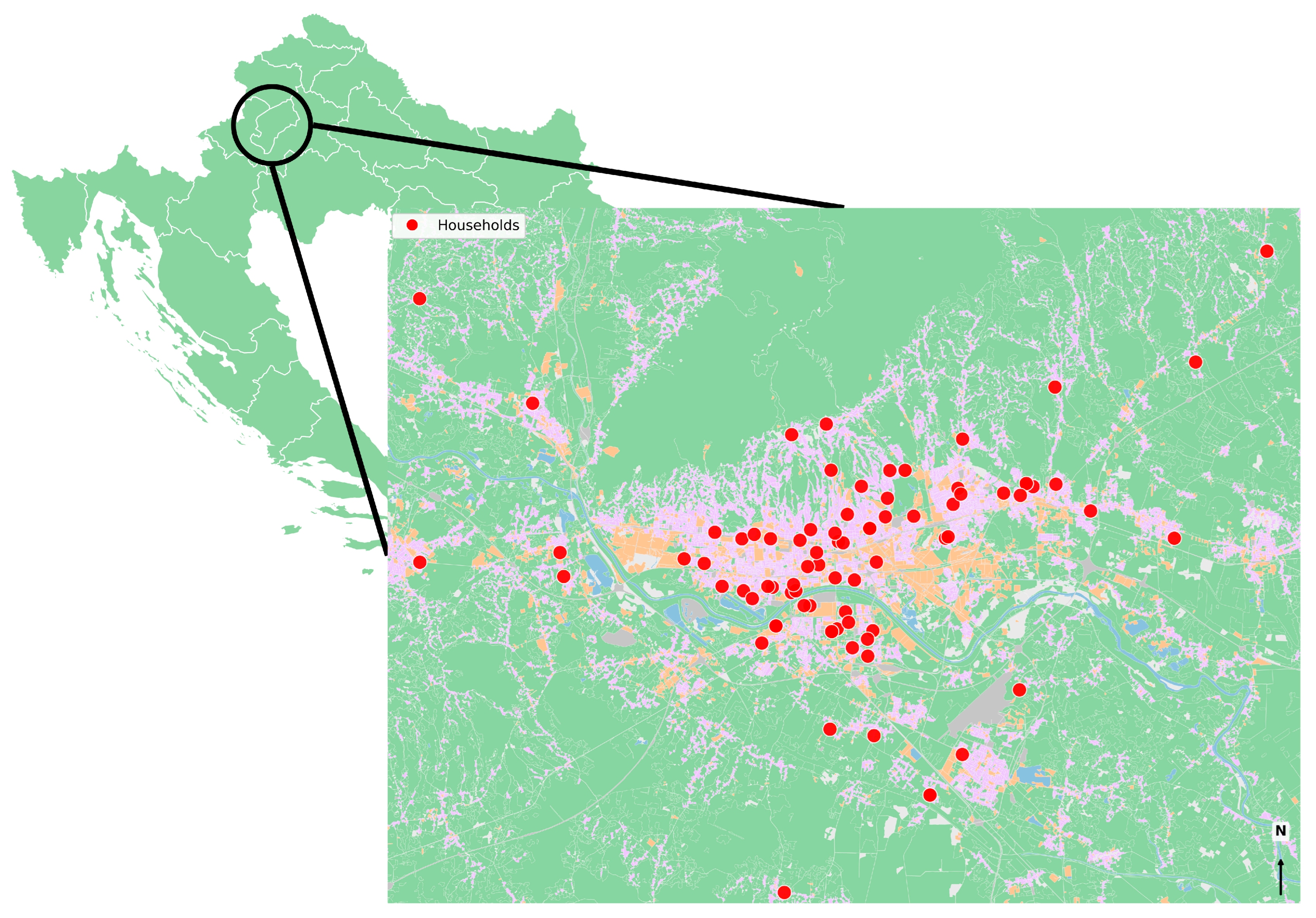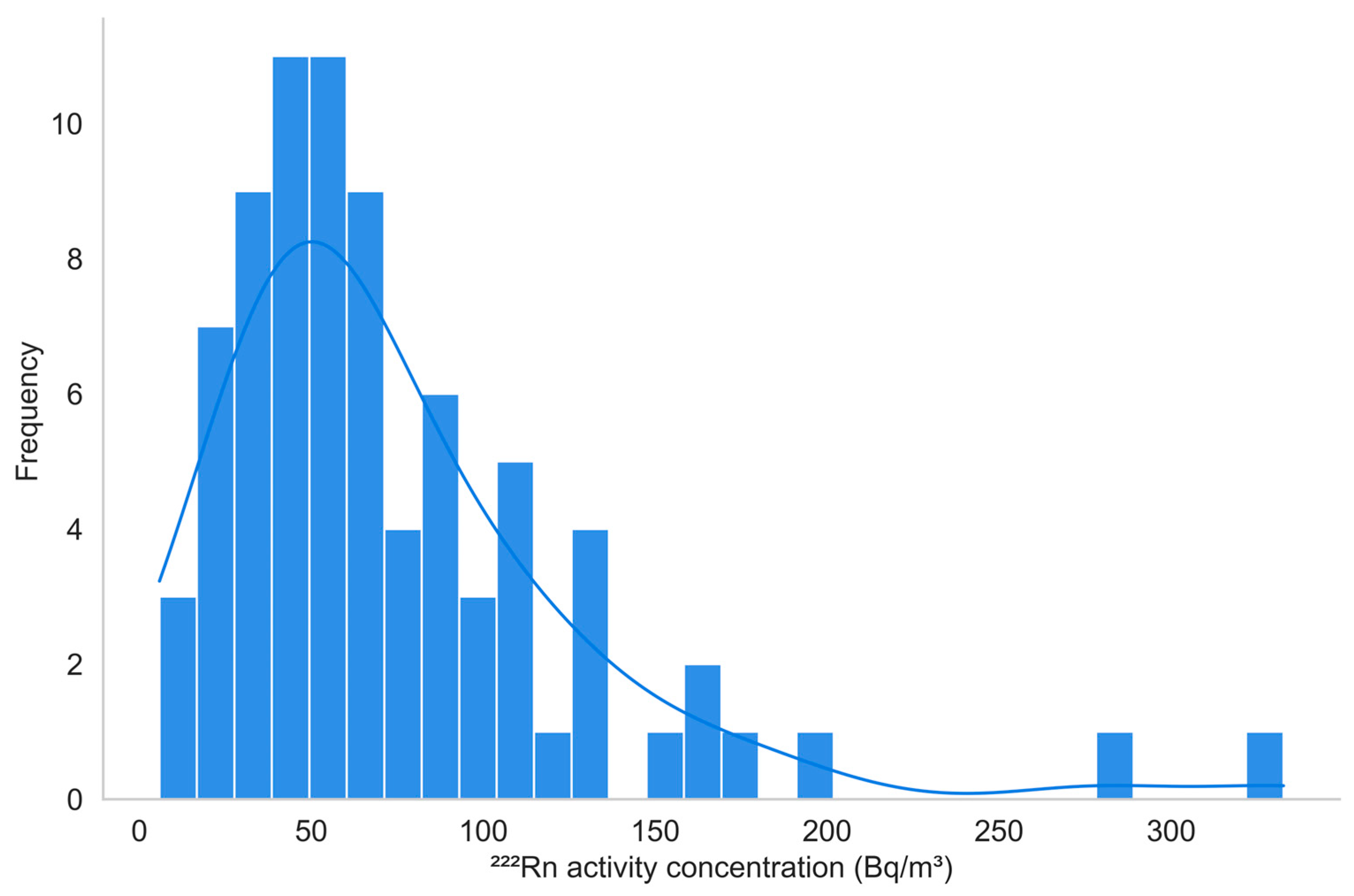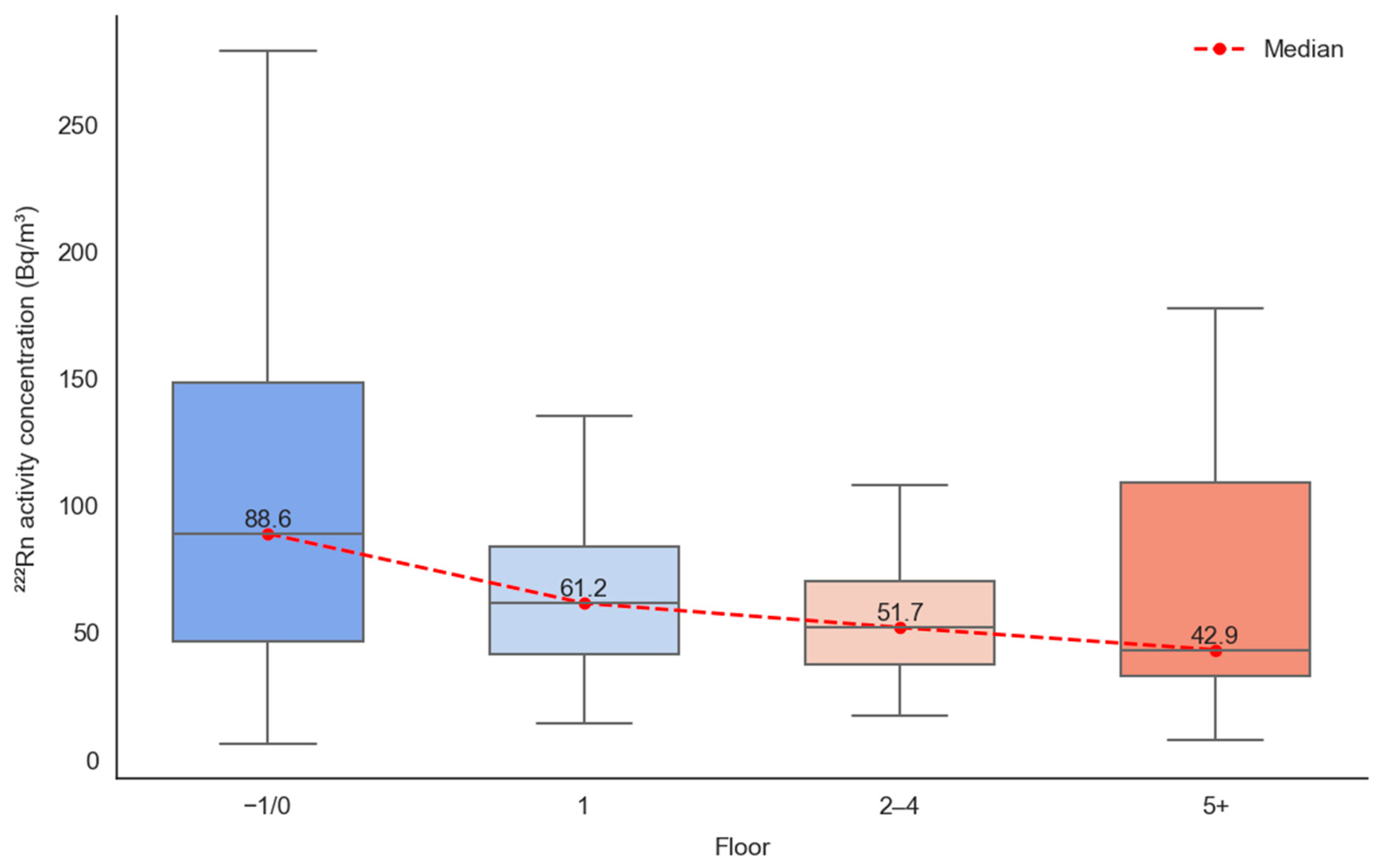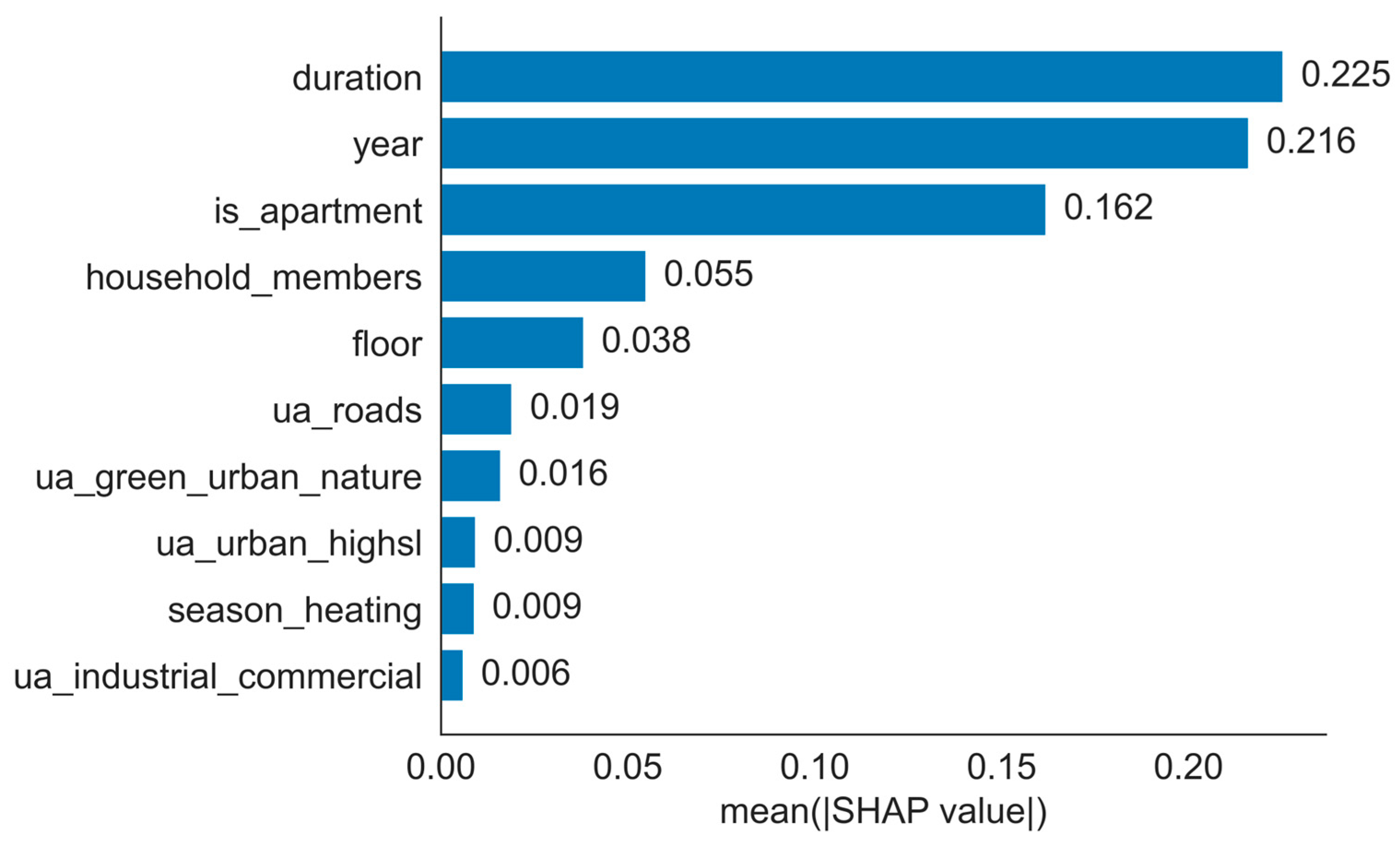

Evaluation of Residential Indoor Radon Levels in Zagreb Using Machine Learning

 , , and
Abstract
1. Introduction
2. Materials and Methods
2.1. Sampling and Data Acquisition
- —number of tracks after the exposure
- —number of background tracks
- —calibration factor (in track number per cm2/Bq/h/m2)
- —exposure time (h)
- —detector surface
- —calibration factor uncertainty (5%)
- —detector surface uncertainty (5%)
- —exposure time uncertainty.
2.2. Statistical Analysis and Data Pre-Processing
2.3. Machine Learning
- Ridge {“model__alpha”: [0.1, 1, 5, 10, 100]}
- Lasso {“model__alpha”: [0.001, 0.01, 0.05, 0.1]}
3. Results
3.1. Hyperparameter Tuning
3.2. Overall Predictive Performance
4. Discussion
5. Conclusions
Author Contributions
Funding
Institutional Review Board Statement
Informed Consent Statement
Data Availability Statement
Acknowledgments
Conflicts of Interest
References
- Altamirano-Astorga, J.; Gutierrez-Garcia, J.O.; Roman-Rangel, E. Forecasting Indoor Air Quality in Mexico City Using Deep Learning Architectures. Atmosphere 2024, 15, 1529. [Google Scholar] [CrossRef]
- Wei, W.; Ramalho, O.; Malingre, L.; Sivanantham, S.; Little, J.C.; Mandin, C. Machine Learning and Statistical Models for Predicting Indoor Air Quality. Indoor Air 2019, 29, 704–726. [Google Scholar] [CrossRef] [PubMed]
- US Environmental Protection Agency. The National Radon Action Plan 2021–2025; US Environmental Protection Agency: Washington, DC, USA, 2022.
- Gigante, G.; Antignani, S.; Di Carlo, C.; Loret, N.; Bochicchio, F. Decoding Indoor Radon: An Explainable AI Approach to Quantifying Building, Environmental, and Inhabitants’ Contributions. Sci. Total Environ. 2025, 998, 180244. [Google Scholar] [CrossRef]
- Petermann, E.; Bossew, P.; Kemski, J.; Gruber, V.; Suhr, N.; Hoffmann, B. Development of a High-Resolution Indoor Radon Map Using a New Machine Learning-Based Probabilistic Model and German Radon Survey Data. Environ. Health Perspect. 2024, 132, 97009. [Google Scholar] [CrossRef]
- Su, C.; Wang, M.; Yin, Y.; Sun, C.; Zou, Z.; Wang, H.; Dai, Y. Approaches to Estimating Indoor Exposure to Radon—A Systematic Review. Atmosphere 2025, 16, 286. [Google Scholar] [CrossRef]
- Andersen, C.E.; Bergsoe, N.C.; Majborn, B.; Ulbak, K. Radon and Natural Ventilation in Newer Danish Single-Family Houses. Indoor Air 1997, 7, 278–286. [Google Scholar] [CrossRef]
- Shabaan, D.H.; EL-Araby, E.H.; Yajzey, R.; Azazi, A.; Alzhrani, S. Evaluation of the Radiation Emission of Radon Gas from Various Building Materials. J. Radiat. Res. Appl. Sci. 2025, 18, 101194. [Google Scholar] [CrossRef]
- Su, C.; Pan, M.; Zhang, Y.; Kan, H.; Zhao, Z.; Deng, F.; Zhao, B.; Qian, H.; Zeng, X.; Sun, Y.; et al. Indoor Exposure Levels of Radon in Dwellings, Schools, and Offices in China from 2000 to 2020: A Systematic Review. Indoor Air 2022, 32, e12920. [Google Scholar] [CrossRef]
- Rezaie, F.; Panahi, M.; Bateni, S.M.; Kim, S.; Lee, J.; Lee, J.; Yoo, J.; Kim, H.; Won Kim, S.; Lee, S. Spatial Modeling of Geogenic Indoor Radon Distribution in Chungcheongnam-Do, South Korea Using Enhanced Machine Learning Algorithms. Environ. Int. 2023, 171, 107724. [Google Scholar] [CrossRef]
- Li, L.; Coull, B.A.; Zilli Vieira, C.L.; Koutrakis, P. High-Resolution National Radon Maps Based on Massive Indoor Measurements in the United States. Proc. Natl. Acad. Sci. USA 2025, 122, e2408084121. [Google Scholar] [CrossRef]
- WHO. WHO Handbook on Indoor Radon: A Public Health Perspective; WHO: Geneva, Switzerland, 2009; ISBN 9789241547673.
- IARC Working Group on the Evaluation of Carcinogenic Risks to Humans. Man-Made Mineral Fibres and Radon; International Agency for Research on Cancer: Lyon, France, 1988; Volume 43.
- Krewski, D.; Lubin, J.H.; Zielinski, J.M.; Alavanja, M.; Catalan, V.S.; Field, R.W.; Klotz, J.B.; Létourneau, E.G.; Lynch, C.F.; Lyon, J.I.; et al. Residential Radon and Risk of Lung Cancer: A Combined Analysis of 7 North American Case-Control Studies. Epidemiology 2005, 16, 137–145. [Google Scholar] [CrossRef]
- Darby, S.; Hill, D.; Auvinen, A.; Barros-Dios, J.M.; Baysson, H.; Bochicchio, F.; Deo, H.; Falk, R.; Forastiere, F.; Hakama, M.; et al. Radon in Homes and Risk of Lung Cancer: Collaborative Analysis of Individual Data from 13 European Case-Control Studies. BMJ 2005, 330, 223. [Google Scholar] [CrossRef]
- Nikkilä, A.; Arvela, H.; Mehtonen, J.; Raitanen, J.; Heinäniemi, M.; Lohi, O.; Auvinen, A. Predicting Residential Radon Concentrations in Finland: Model Development, Validation, and Application to Childhood Leukemia. Scand. J. Work Environ. Health 2020, 46, 278–292. [Google Scholar] [CrossRef] [PubMed]
- Lee, H.; Hanson, H.A.; Logan, J.; Maguire, D.; Kapadia, A.; Dewji, S.; Agasthya, G. Evaluating County-Level Lung Cancer Incidence from Environmental Radiation Exposure, PM2.5, and Other Exposures with Regression and Machine Learning Models. Environ. Geochem. Health 2024, 46, 82. [Google Scholar] [CrossRef] [PubMed]
- Gaskin, J.; Coyle, D.; Whyte, J.; Krewksi, D. Global Estimate of Lung Cancer Mortality Attributable to Residential Radon. Environ. Health Perspect. 2018, 126, 057009. [Google Scholar] [CrossRef] [PubMed]
- European Union. Council Directive 2013/59/EURATOM Laying down Basic Safety Standards for Protection Against the Dangers Arising from Exposure to Ionizing Radiation; European Union: Brussels, Belgium, 2014. [Google Scholar]
- Tsapalov, A.; Kovler, K.; Kiselev, S.; Yarmoshenko, I.; Bobkier, R.; Miklyaev, P. IAEA Safety Guides vs. Actual Challenges for Design and Conduct of Indoor Radon Surveys. Atmosphere 2025, 16, 253. [Google Scholar] [CrossRef]
- Vienneau, D.; Boz, S.; Forlin, L.; Flückiger, B.; de Hoogh, K.; Berlin, C.; Bochud, M.; Bulliard, J.-L.; Zwahlen, M.; Röösli, M. Residential Radon—Comparative Analysis of Exposure Models in Switzerland. Environ. Pollut. 2021, 271, 116356. [Google Scholar] [CrossRef]
- Vukotic, P.; Antovic, N.; Zekic, R.; Djurovic, A.; Andjelic, T.; Svrkota, N.; Mrdak, R.; Dlabac, A. Influence of Climate, Building and Residential Factors on Radon Levels in Ground-Floor Dwellings in Montenegro. Nucl. Technol. Radiat. Prot. 2021, 36, 74–84. [Google Scholar] [CrossRef]
- Alber, O.; Laubichler, C.; Baumann, S.; Gruber, V.; Kuchling, S.; Schleicher, C. Modeling and Predicting Mean Indoor Radon Concentrations in Austria by Generalized Additive Mixed Models. Stoch. Environ. Res. Risk Assess. 2023, 37, 3435–3449. [Google Scholar] [CrossRef]
- Gruber, V.; Baumann, S.; Wurm, G.; Ringer, W.; Alber, O. The New Austrian Indoor Radon Survey (ÖNRAP 2, 2013–2019): Design, Implementation, Results. J. Environ. Radioact. 2021, 233, 106618. [Google Scholar] [CrossRef]
- Casey, J.A.; Ogburn, E.L.; Rasmussen, S.G.; Irving, J.K.; Pollak, J.; Locke, P.A.; Schwartz, B.S. Predictors of Indoor Radon Concentrations in Pennsylvania, 1989–2013. Environ. Health Perspect. 2015, 123, 1130–1137. [Google Scholar] [CrossRef]
- Widya, L.K.; Rezaie, F.; Lee, J.; Lee, J.; Park, B.R.; Yoo, J.; Lee, W.; Lee, S. AI-Driven Geospatial Analysis of Indoor Radon Levels: A Case Study in Chungcheongbuk-Do, South Korea. Earth Syst. Environ. 2025, 9, 3615–3633. [Google Scholar] [CrossRef]
- Carrion-Matta, A.; Lawrence, J.; Kang, C.-M.; Wolfson, J.M.; Li, L.; Vieira, C.L.Z.; Schwartz, J.; Demokritou, P.; Koutrakis, P. Predictors of Indoor Radon Levels in the Midwest United States. J. Air Waste Manag. Assoc. 2021, 71, 1515–1528. [Google Scholar] [CrossRef] [PubMed]
- Rezaie, F.; Kim, S.W.; Alizadeh, M.; Panahi, M.; Kim, H.; Kim, S.; Lee, J.; Lee, J.; Yoo, J.; Lee, S. Application of Machine Learning Algorithms for Geogenic Radon Potential Mapping in Danyang-Gun, South Korea. Front. Environ. Sci. 2021, 9, 753028. [Google Scholar] [CrossRef]
- Baumann, S.; Petermann, E.; Cinelli, G.; Dehandschutter, B.; Čeliković, I.; Lindner-Leschinski, E.; Bossew, P.; Ciotoli, G.; Gruber, V. Radon Hazard Mapping: Usability of Environmental Predictors Including Atmospheric Radon and Radon Flux and Knowledge Transfer between Regions (Belgium and Germany). Environ. Earth Sci. 2025, 84, 196. [Google Scholar] [CrossRef]
- Park, T.H.; Kang, D.R.; Park, S.H.; Yoon, D.K.; Lee, C.M. Indoor Radon Concentration in Korea Residential Environments. Environ. Sci. Pollut. Res. 2018, 25, 12678–12685. [Google Scholar] [CrossRef] [PubMed]
- Benà, E.; Ciotoli, G.; Petermann, E.; Bossew, P.; Ruggiero, L.; Verdi, L.; Huber, P.; Mori, F.; Mazzoli, C.; Sassi, R. A New Perspective in Radon Risk Assessment: Mapping the Geological Hazard as a First Step to Define the Collective Radon Risk Exposure. Sci. Total Environ. 2024, 912, 169569. [Google Scholar] [CrossRef]
- Kropat, G.; Bochud, F.; Murith, C.; Palacios (Gruson), M.; Baechler, S. Modeling of Geogenic Radon in Switzerland Based on Ordered Logistic Regression. J. Environ. Radioact. 2017, 166, 376–381. [Google Scholar] [CrossRef] [PubMed]
- Martin-Gisbert, L.; Ruano-Ravina, A.; López-Vízcaíno, E.; Barros-Dios, J.; Piñeiro-Lamas, M.; Teijeiro, A.; Casal-Fernández, R.; Kelsey, K.; García, G.; Guerra-Tort, C.; et al. The Galician Radon Map: Determining Indoor Radon Exposure Through Census Tracts. Indoor Air 2025, 2025, 4176561. [Google Scholar] [CrossRef]
- Petermann, E.; Meyer, H.; Nussbaum, M.; Bossew, P. Mapping the Geogenic Radon Potential for Germany by Machine Learning. Sci. Total Environ. 2021, 754, 142291. [Google Scholar] [CrossRef]
- Wu, P.-Y.; Johansson, T.; Mangold, M.; Sandels, C.; Mjörnell, K. Evaluating the Indoor Radon Concentrations in the Swedish Building Stock Using Statistical and Machine Learning. J. Phys. Conf. Ser. 2023, 2654, 012086. [Google Scholar] [CrossRef]
- Wu, P.-Y.; Johansson, T.; Sandels, C.; Mangold, M.; Mjörnell, K. Indoor Radon Interval Prediction in the Swedish Building Stock Using Machine Learning. Build. Environ. 2023, 245, 110879. [Google Scholar] [CrossRef]
- Lovrić, M.; Gajski, G.; Fernández-Agüera, J.; Pöhlker, M.; Gursch, H.; Lovrić, M.; Switters, J.; Borg, A.; Mureddu, F.; Auguštin, D.H.; et al. Evidence Driven Indoor Air Quality Improvement: An Innovative and Interdisciplinary Approach to Improving Indoor Air Quality. BioFactors 2025, 51, e2126. [Google Scholar] [CrossRef]
- Tsapalov, A. Temporal Uncertainty in Rational Method: Reassessment of Data from the Article “Short-Term Temporal Variability of Radon in Finnish Dwellings and the Use of Temporal Correction Factors”. Open Res. Eur. 2026, 5, 328. [Google Scholar] [CrossRef]
- ISO 11665-4:2021; Measurement of Radioactivity in the Environment—Air: Radon-222—Part 4: Integrated Measurement Method for Determining Average Activity Concentration Using Passive Sampling and Delayed Analysis. International Organization for Standardization: Geneva, Switzerland, 2021.
- EN ISO/IEC 17025:2017; General Requirements for the Competence of Testing and Calibration Laboratories. International Organization for Standardization: Geneva, Switzerland, 2017.
- European Union’s Copernicus Land Monitoring Service Information Urban Atlas Land Cover/Land Use 2018 (Vector), Europe, 6-Yearly. Available online: https://sdi.eea.europa.eu/catalogue/copernicus/api/records/fb4dffa1-6ceb-4cc0-8372-1ed354c285e6?language=all (accessed on 12 January 2026).
- Pandas Documentation. Pandas 3.0.0 Documentation. Available online: https://pandas.pydata.org/pandas-docs/stable/index.html (accessed on 17 February 2026).
- NumPy Documentation. NumPy v2.4 Manual. Available online: https://numpy.org/doc/stable/index.html (accessed on 17 February 2026).
- SciPy API. SciPy v1.17.0 Manual. Available online: https://docs.scipy.org/doc/scipy/reference/index.html (accessed on 17 February 2026).
- Statsmodels 0.14.6. Available online: https://www.statsmodels.org/stable/index.html (accessed on 18 February 2026).
- Matplotlib Documentation. Matplotlib 3.10.8 Documentation. Available online: https://matplotlib.org/stable/ (accessed on 17 February 2026).
- Seaborn: Statistical Data Visualization. Seaborn 0.13.2 Documentation. Available online: https://seaborn.pydata.org/index.html (accessed on 17 February 2026).
- Waskom, M. Seaborn: Statistical Data Visualization. J. Open Source Softw. 2021, 6, 3021. [Google Scholar] [CrossRef]
- Scikit-Learn. Machine Learning in Python. Scikit-Learn 1.8.0 Documentation. Available online: https://scikit-learn.org/stable/index.html (accessed on 17 February 2026).
- Bossew, P. Radon: Exploring the Log-Normal Mystery. J. Environ. Radioact. 2010, 101, 826–834. [Google Scholar] [CrossRef] [PubMed]
- Hauri, D.D.; Huss, A.; Zimmermann, F.; Kuehni, C.E.; Röösli, M. A Prediction Model for Assessing Residential Radon Concentration in Switzerland. J. Environ. Radioact. 2012, 112, 83–89. [Google Scholar] [CrossRef]
- Stojanovska, Z.; Ivanova, K.; Bossew, P.; Boev, B.; Zunic, Z.; Tsenova, M.; Curguz, Z.; Kolarz, P.; Zdravkovska, M.; Ristova, M. Prediction of Long-Term Indoor Radon Concentration Based on Short-Term Measurements. Nucl. Technol. Radiat. Prot. 2017, 32, 77–84. [Google Scholar] [CrossRef]
- Andersen, C.E.; Raaschou-Nielsen, O.; Andersen, H.P.; Lind, M.; Gravesen, P.; Thomsen, B.L.; Ulbak, K. Prediction of 222Rn in Danish Dwellings Using Geology and House Construction Information from Central Databases. Radiat. Prot. Dosim. 2007, 123, 83–94. [Google Scholar] [CrossRef] [PubMed]
- Chen, T.; Guestrin, C. XGBoost: A Scalable Tree Boosting System. In Proceedings of the ACM SIGKDD International Conference on Knowledge Discovery and Data Mining, Jeju, Korea, 13–17 August 2016; pp. 785–794. [Google Scholar] [CrossRef]
- Breiman, L. Random Forests. Mach. Learn. 2001, 45, 5–32. [Google Scholar] [CrossRef]
- Dicu, T.; Cucoş, A.; Botoş, M.; Burghele, B.; Florică, Ş.; Baciu, C.; Ştefan, B.; Bălc, R. Exploring Statistical and Machine Learning Techniques to Identify Factors Influencing Indoor Radon Concentration. Sci. Total Environ. 2023, 905, 167024. [Google Scholar] [CrossRef]
- Meinshausen, N. Quantile Regression Forests. J. Mach. Learn. Res. 2006, 7, 983–999. [Google Scholar]
- Petermann, E.; Hoffmann, B. Mapping the Exposure to Outdoor Radon in the German Population. J. Environ. Radioact. 2025, 281, 107583. [Google Scholar] [CrossRef]
- Kohavi, R. A Study of Cross-Validation and Bootstrap for Accuracy Estimation and Model Selection. Int. Jt. Conf. Artif. Intell. 1995, 14, 1137–1145. [Google Scholar]
- Xu, Y.; Goodacre, R. On Splitting Training and Validation Set: A Comparative Study of Cross-Validation, Bootstrap and Systematic Sampling for Estimating the Generalization Performance of Supervised Learning. J. Anal. Test. 2018, 2, 249–262. [Google Scholar] [CrossRef] [PubMed]
- Daviran, M.; Masoumi, I.; Ghezelbash, R.; Maggio, S.; De Iaco, S. Machine Learning-Based Mapping of Indoor Radon Potential Using Geogenic Factors. Environ. Ecol. Stat. 2025, 32, 893–928. [Google Scholar] [CrossRef]
- Molnar, C. Interpretable Machine Learning, 3rd ed.; Lulu Press: Morisville, NC, USA, 2025; ISBN 978-3-911578-03-5. Available online: https://christophm.github.io/interpretable-ml-book (accessed on 17 February 2026).
- Welcome to the SHAP Documentation—SHAP Latest Documentation. Available online: https://shap.readthedocs.io/en/latest/ (accessed on 17 February 2026).
- Lundberg, S.M.; Lee, S.-I. A Unified Approach to Interpreting Model Predictions. In Proceedings of the Advances in Neural Information Processing Systems; Guyon, I., Luxburg, U., Von Bengio, S., Wallach, H., Fergus, R., Vishwanathan, S., Garnett, R., Eds.; Curran Associates, Inc.: Red Hook, NY, USA, 2017; Volume 30. [Google Scholar]
- Kropat, G.; Bochud, F.; Jaboyedoff, M.; Laedermann, J.P.; Murith, C.; Palacios, M.; Baechler, S. Major Influencing Factors of Indoor Radon Concentrations in Switzerland. J. Environ. Radioact. 2014, 129, 7–22. [Google Scholar] [CrossRef]
- Kropat, G.; Bochud, F.; Jaboyedoff, M.; Laedermann, J.P.; Murith, C.; Palacios, M.; Baechler, S. Improved Predictive Mapping of Indoor Radon Concentrations Using Ensemble Regression Trees Based on Automatic Clustering of Geological Units. J. Environ. Radioact. 2015, 147, 51–62. [Google Scholar] [CrossRef]
- JSGM 100; Evaluation of Measurement Data—Guide to the Expression of Uncertainty in Measurement. International Organization for Standardization: Geneva, Switzerland, 2008; Volume 50, p. 134.
- Karmoude, M.; Munhungewarwa, B.; Chiraira, I.; Mckenzie, R.; Kong, J.; Smith, B.; Ayana, G.; Njara, N.; Mathaha, T.; Kumar, M.; et al. Machine Learning for Air Quality Prediction and Data Analysis: Review on Recent Advancements, Challenges, and Outlooks. Sci. Total Environ. 2025, 1002, 180593. [Google Scholar] [CrossRef] [PubMed]
- Méndez, M.; Merayo, M.G.; Núñez, M. Machine Learning Algorithms to Forecast Air Quality: A Survey. Artif. Intell. Rev. 2023, 56, 10031–10066. [Google Scholar] [CrossRef]
- Hahn, E.J.; Haneberg, W.C.; Stanifer, S.R.; Rademacher, K.; Backus, J.; Rayens, M.K. Geologic, Seasonal, and Atmospheric Predictors of Indoor Home Radon Values. Environ. Res. Health 2023, 1, 025011. [Google Scholar] [CrossRef] [PubMed]
- Cucu, M.; Dupleac, D. The Impact of Ventilation Rate on Radon Concentration Inside High-Rise Apartment Buildings. Radiat. Prot. Dosim. 2022, 198, 290–298. [Google Scholar] [CrossRef] [PubMed]





| Activity Concentrations of 222Rn (Bq/m3) | |
|---|---|
| count | 80 |
| mean | 74.29 |
| std | 55.44 |
| min | 5.9 |
| 5% | 17.95 |
| 25% | 39.73 |
| 50% | 58.91 |
| 75% | 92.11 |
| 95% | 167.51 |
| max | 332.65 |
| Model * | RMSE Train | MAE Train | R2 Train | RMSE Test | MAE Test | R2 Test |
|---|---|---|---|---|---|---|
| GBR | 0.5480 | 0.3825 | 0.9999 | 33.2638 | 26.0993 | 0.5654 |
| qRF-50th | 31.2360 | 18.5334 | 0.6909 | 39.7278 | 33.1784 | 0.3801 |
| RFR | 37.4508 | 20.9577 | 0.5557 | 39.8401 | 31.2325 | 0.3766 |
| LR | 50.7884 | 31.9096 | 0.1829 | 40.3175 | 33.1589 | 0.3615 |
| XGB | 45.5573 | 26.3556 | 0.3426 | 42.8419 | 30.4625 | 0.2791 |
| Lasso | 54.6211 | 34.7807 | 0.0550 | 43.6915 | 32.6434 | 0.2502 |
| Ridge | 56.8355 | 35.9707 | −0.0232 | 48.0360 | 33.4719 | 0.0937 |
Disclaimer/Publisher’s Note: The statements, opinions and data contained in all publications are solely those of the individual author(s) and contributor(s) and not of MDPI and/or the editor(s). MDPI and/or the editor(s) disclaim responsibility for any injury to people or property resulting from any ideas, methods, instructions or products referred to in the content. |
© 2026 by the authors. Licensee MDPI, Basel, Switzerland. This article is an open access article distributed under the terms and conditions of the Creative Commons Attribution (CC BY) license.
Share and Cite
Bituh, T.; Lovrić Štefiček, M.J.; Čvorišćec, T.; Petrinec, B.; Davila, S. Evaluation of Residential Indoor Radon Levels in Zagreb Using Machine Learning. Environments 2026, 13, 144. https://doi.org/10.3390/environments13030144
Bituh T, Lovrić Štefiček MJ, Čvorišćec T, Petrinec B, Davila S. Evaluation of Residential Indoor Radon Levels in Zagreb Using Machine Learning. Environments. 2026; 13(3):144. https://doi.org/10.3390/environments13030144
Chicago/Turabian StyleBituh, Tomislav, Marija Jelena Lovrić Štefiček, Tea Čvorišćec, Branko Petrinec, and Silvije Davila. 2026. "Evaluation of Residential Indoor Radon Levels in Zagreb Using Machine Learning" Environments 13, no. 3: 144. https://doi.org/10.3390/environments13030144
APA StyleBituh, T., Lovrić Štefiček, M. J., Čvorišćec, T., Petrinec, B., & Davila, S. (2026). Evaluation of Residential Indoor Radon Levels in Zagreb Using Machine Learning. Environments, 13(3), 144. https://doi.org/10.3390/environments13030144