Article

Climate-Driven Habitat Dynamics and Population Ecology of Rhododendron arboreum Sm. in Himachal Pradesh: Implications for Landscape Restoration and Socio-Economic Development

1
Department of Silviculture and Agroforestry, College of Forestry, Dr YS Parmar University of Horticulture and Forestry, Solan 173230, India
2
ICAR-Indian Institute of Soil and Water Conservation, Research Centre, Datia 475661, India
3
Farm Management and Agroforestry, Central Tasar Research and Training Institute, Ranchi 835303, India
4
College of Forestry, Veer Chandra Singh Garhwali Uttarakhand University of Horticulture and Forestry, Ranichauri 249199, India
5
Centre for Herbal Pharmacology and Environmental Sustainability, Chettinad Academy of Research and Education, Kelambakkam 603103, India
6
Chettinad Hospital and Research Institute, Kelambakkam 603103, India
*
Author to whom correspondence should be addressed.
Environments 2026, 13(3), 138; https://doi.org/10.3390/environments13030138
Submission received: 26 January 2026 / Revised: 18 February 2026 / Accepted: 27 February 2026 / Published: 2 March 2026

Abstract

Rhododendron arboreum Sm., an ecologically and culturally important Himalayan tree species and a key species in Himalayan forests, is increasingly threatened by forest degradation, climate change, and habitat fragmentation. However, previous studies have mainly focused on predicting climatic suitability, with limited integration of field-based population ecology and future climate projections, particularly in the western Himalayas. Therefore, the current investigation integrates population ecology and species distribution modeling (MaxEnt model) under CMIP6 climate scenarios (2070 and 2090) to identify climatically suitable and ecologically viable habitats for long-term species persistence across Himachal Pradesh, using 95 occurrence points and seven environmental predictors. Field data confirmed R. arboreum as a dominant species, strongly associated with Quercus leucotrichophora and Cedrus deodara. Habitat suitability was primarily driven by temperature seasonality (58.6%) and precipitation seasonality (14.8%), with 4508 km2 currently suitable. Future projections forecast a distinct upshift but with high uncertainty regarding total area; projections ranged from potential habitat expansion under optimistic models (BCC-CSM2-MR) to significant contraction under pessimistic models (IPSL-CM6A-LR). Overall, findings prioritize climatically stable refugia (Kalatop-Khajjiar, Chail, and Churdhar wildlife sanctuary) not only for ecological monitoring but also as critical areas for developing socio-ecological management strategies to support community-based conservation and livelihood adaptation.

1. Introduction

Globally, climate change is increasing at a faster rate and causing more frequent and intense weather events, which subsequently threaten the survival of plants [1,2]. The global mean temperature has already increased by about 1.2–1.3 °C, and it temporarily surpassed 1.5 °C in 2024 [3]. According to the IPCC [4] report, if the emissions continue at the current rate, the 1.5 °C threshold is likely to be crossed permanently by the early 2030s. The Indian Himalayan region (IHR), which is known for its rich biodiversity and fragile ecosystems, is not immune to the adverse impact of climate change and is already feeling its effects day by day [5]. Recent studies showed that the Himalayas are warming faster than the global average, leading to more extreme temperatures and unpredictable rainfall patterns [6]. Subsequently, it has caused glaciers to melt faster and has disrupted the local ecosystems [7]. Additionally, human activities, such as land-use change, deforestation, and infrastructure expansion, have worsened the condition by increasing habitat loss and fragmentation [8]. These challenges not only affect the plants and animals living in these ecosystems but also the local communities whose livelihoods depend on these forests.
Climate plays a vital role in determining the biodiversity of a particular ecosystem through its influence on the physiological limits, regeneration, and habitat suitability [9]. However, climate change causes many species to adapt or shift to higher latitudes and altitudes to continue their ecological processes in the areas with more favorable climatic conditions [10]. Such an upward shift can hinder growth, increase mortality rates, change dispersal mechanisms, and affect phenological behavior, thus encouraging species to migrate to meet their physiological conditions [10]. Therefore, it is imperative to keep a close eye on Himalayan ecosystems to understand how climate change influences the distribution of keystone species.
In this fragile ecosystem, Rhododendron arboreum Sm. (Rose tree or Lal burans) plays a crucial role, which has both ecological and socio-cultural significance [11]. It thrives well at an elevation ranging from 1200 to 4000 m above mean sea level (m amsl) [12], where temperatures are between 12 and 17 °C and annual rainfall varies from 200 to 1800 mm [13]. Ecologically, R. arboreum is associated with the broadleaf species and Pinus roxburghii at lower elevations and with Quercus semecarpifolia near the timberline [14]. Simultaneously, it holds significant cultural importance, as R. arboreum flowers are traditionally used to make juices and medicines. Thus, the species is a key non-timber forest product that supports the livelihoods of local communities [15]. Globally, R. arboreum is classified as Least Concern IUCN [16]; however, this status may not fully reflect local and regional pressures. Since the species is increasingly threatened by habitat loss, overharvesting, forest fires, and climate change, there is an urgent need for sustainable management and continuous monitoring of the population [17]. Therefore, coordinated efforts in climate adaptation, biodiversity conservation, and sustainable development are essential. In this context, predictive modeling and the assessment of population structure can play a crucial role in protecting the environment and ensuring the well-being of local communities.
Ecological Niche Models (ENMs) serve as a modern approach in ecology for predicting habitat suitability, which plays a crucial role in guiding conservation efforts [18]. Concurrently, advancements in geographic information systems (GIS) and high-resolution spatial and climate data have enhanced the accuracy and applicability of ENMs [19]. ENMs utilize various statistical methods and algorithms to analyze environmental constraints across time and space, thereby providing valuable information about the current and projected distributions of species. Previously, different modeling techniques such as Random Forest, Genetic Algorithm for Rule-Set Production (GARP), Ecological Niche Factor Analysis (ENFA), BIOCLIM, and DOMAIN have been employed for species distribution modeling (SDM) [20,21,22,23,24]. However, the MaxEnt (Maximum Entropy) model is the most preferred due to its simplicity and proven effectiveness [25]. Since the MaxEnt model relies only on species occurrence data and environmental variables to analyze the species-environment interactions for habitat suitability under current and future climate scenarios. In the IHR, the MaxEnt model has been widely used to study the distribution of Rhododendron arboreum (Uttarakhand) [26], Pinus gerardiana [27], Dalbergia species [28,29], and Perilla frutescens [30], which indicates its robustness and suitability for ecological studies for the region. Simultaneously, the population structure significantly influences the community dynamics and ecological development [31] and helps to determine the potential of species for environmental adaptation and ecological importance [32]. Thus, integrating population ecology into SDM can improve the decision-making for conservation and identify the habitats that are not only suitable but also support the long-term survival of species.
Since the distribution of R. arboreum is strongly influenced by ecological importance, socio-economic value, and sensitivity to climatic variability. It is essential to conduct comprehensive research to assess how climate change will affect the distribution of R. arboreum species. Although a few SDM studies have already been conducted for R. arboreum, they either mostly focused on different regions within the IHR or have not considered the population ecology. Furthermore, most of the existing studies mainly focused on predicting the suitable climate for R. arboreum without considering whether these areas can support healthy, sustainable populations amidst changing environmental conditions. Simultaneously, R. arboreum is closely linked to the livelihood of the local peoples; understanding its climate sensitivity and long-term persistence is critical for ecosystem stability and socio-economic resilience in the Himalayan region. Therefore, the current study was conducted to examine the population ecology and predict the potential habitat suitability of R. arboreum under both current and future climate change scenarios. The specific objectives of the study were to (i) assess the population ecology of R. arboreum in Himachal Pradesh, (ii) identify the main factors affecting the distribution of R. arboreum, and (iii) develop a habitat SDM map of R. arboreum for current and projected scenarios. The current study employed an integrated approach that combines the field-based population ecology with SDM under CMIP6 climate scenarios to identify not only habitats suitable for climate but also ecologically viable and potentially stable refugia for long-term persistence of the species. The findings will provide valuable insights for conservation efforts, habitat restoration, and adaptive management, thus supporting the long-term preservation of R. arboreum and the IHR ecosystem in current scenarios of climate change.

2. Materials and Methods

2.1. Study Area

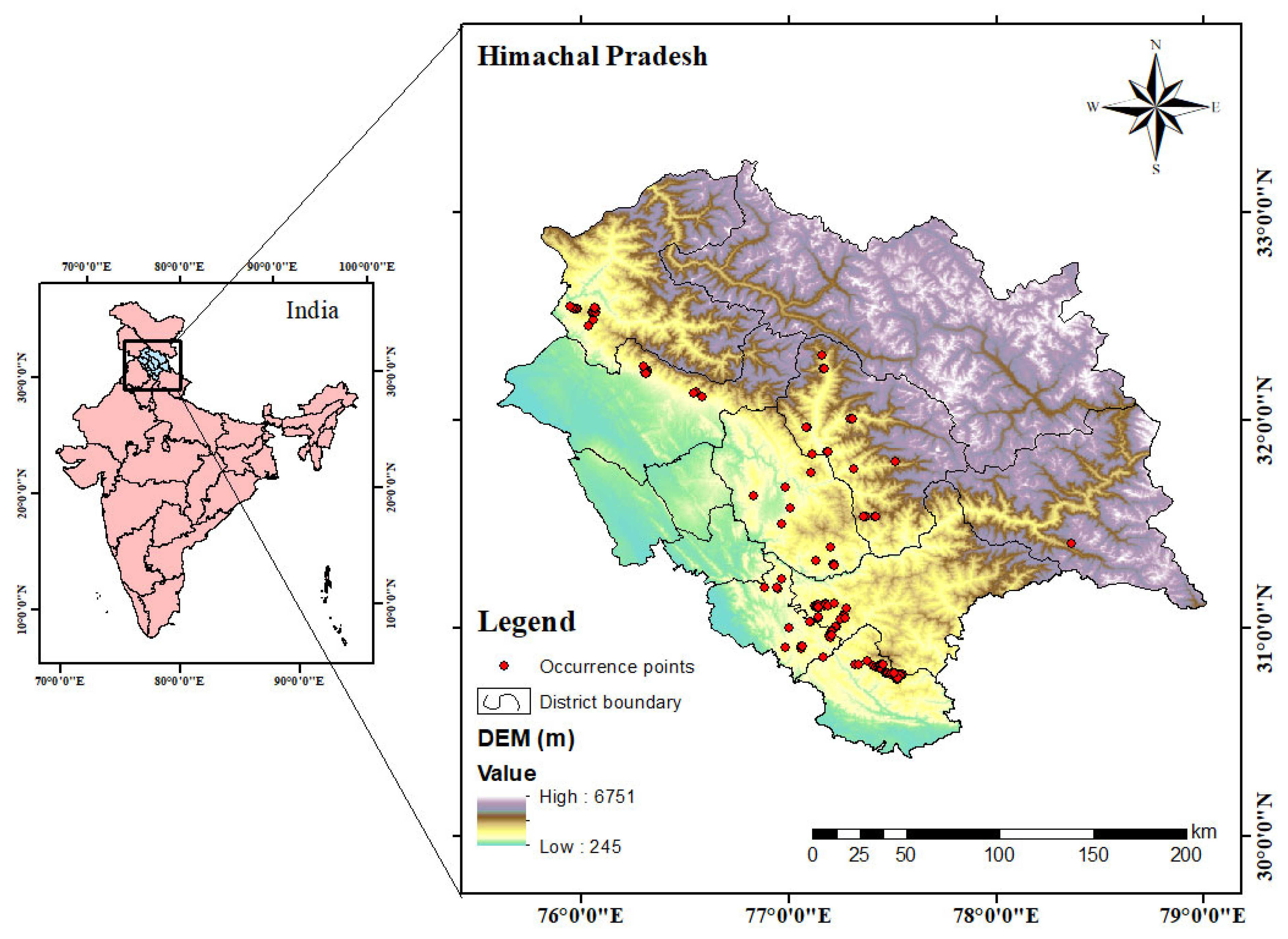
The study was carried out in Himachal Pradesh, a region nestled within the Trans and North-western Himalayas (spanning coordinates from 30°37′50″ N to 33°21′11″ N and 75°59′86″ E to 79°07′22″ E) (Figure 1). The state covers an area of 55,673 km2, with an elevation that varies from 245 to 6751 m amsl, leading to significant variations in soil, topographical, and climate conditions. Thus, it supports a diverse range of vegetation, from subtropical deciduous forests to temperate coniferous forests and alpine meadows [26]. The region is topographically divided into the Shivalik Ranges (Outer Himalayas), the Mid-Mountain or Inner Himalayas, and the Alpine Zone of the Greater Himalayas.

2.2. Population Ecology Assessment

2.2.1. Field Data Collection

Potential occurrence sites were identified using the literature and local knowledge, followed by a reconnaissance survey using stratified sampling from September to October 2024 in seven districts. A total of 21 sites were selected, i.e., three sites in each district, and sample plots of 0.1 ha were established in each site (Figure 2). Within each plot, tree populations were assessed in 10 m × 10 m quadrats measuring DBH (using a tree calliper) and height (Ravi multimeter). Shrub populations were evaluated in nested 5 m × 5 m quadrats, and their diameter and basal area were determined using the standard harvest method. At each site, the presence of R. arboreum was confirmed (at least 5–10 mature trees), and coordinates were recorded using a GPS.

2.2.2. Vegetation and Diversity Analysis

Standard phytosociological parameters, including Importance Value Index (IVI), Relative Basal Area (RBA), Relative Frequency (RF), and Relative Density (RD), were calculated to determine the population structure and ecological dominance, as per the standard procedure described by Phillips [33] and Misra [34]. Subsequently, to understand species distribution patterns and community structure, biodiversity indices including Evenness (E), Simpson’s index (Cd), and the Shannon–Wiener index (H′) [35] were also calculated using Past 4.1.4 © (Hammer, Oslo, Norway). Furthermore, hierarchical cluster analysis based on tree IVI values was computed using XLSTAT version 2023.3 [36] to group sites with similar biological characteristics.

2.3. Ecological Niche Modeling

2.3.1. Occurrence Data

A total of 208 occurrence points were compiled from the field survey, previous literature, and Global Biodiversity Information Facility (GBIF) database. After removing 18 duplicate records, the remaining 190 presence points were spatially filtered using the SpThin package implemented in Wallace (v2.1.3) (https://github.com/wallaceEcoMod/Wallace) within RStudio version 2024.12.0 + 465 (RStudio 2024), running base R version 4.4.1 [37]. The spatial thinning was performed at a 500 m thin distance [38], resulting in a final set of 95 high-quality presence points used for modeling.

2.3.2. Environmental Predictors

A total of thirty-three variables were initially selected based on their established influence on Himalayan flora and their role as proxies for ecosystem stability. These included nineteen bioclimatic variables (1970–2000) from the WorldClim database (https://worldclim.org/data/worldclim21.html; accessed on 18 September 2024), ten edaphic (soil) variables (0–30 cm depth) from the SoilGrids database (https://soilgrids.org/; accessed on 31 January 2025), and four topographic variables from the USGS Earth Explorer portal (Table S1). All predictor layers were resampled to a 30 arc-second (approx. 1 km) spatial resolution to ensure consistency. For future projections, three CMIP6-based global climate models (MIROC6, IPSL-CM6A-LR, and BCC-CSM2-MR) were used, chosen for their reliability in the region. Projections were made for four Shared Socio-economic Pathways (SSPs), namely SSP 126, SSP 245, SSP 370, and SSP 585, for two future time periods: 2061–2080 (2070s) and 2081–2100 (2090s) (Table S2).

2.3.3. Variable Selection and Model Configuration

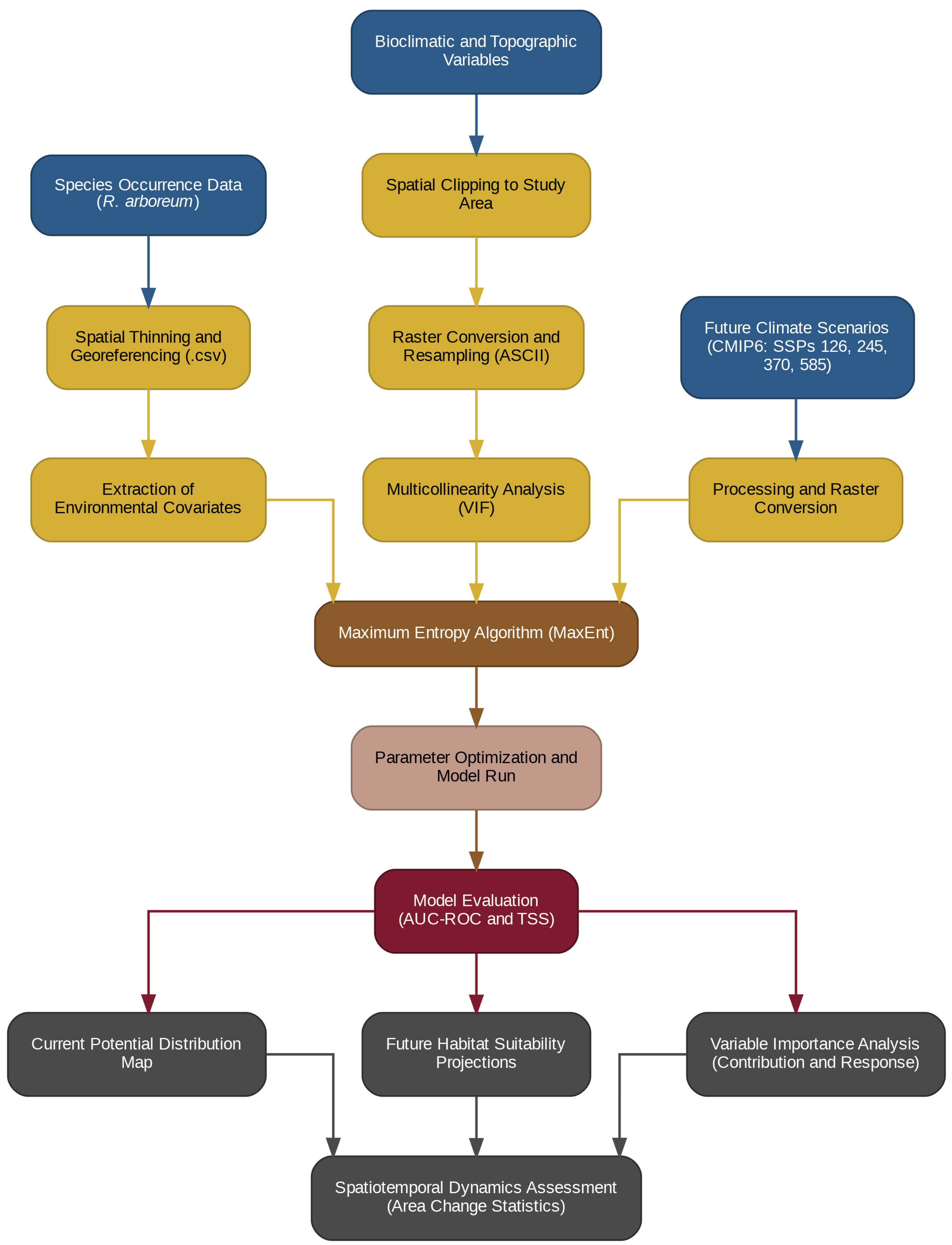
A two-step variable selection process was employed using MaxEnt (version 3.4.4) to reduce multicollinearity and prevent model overfitting (Figure 3). First, an initial model was run with all thirty-three variables using default settings, and predictors with an importance threshold greater than 4% were retained, which eliminated twenty-six variables. The remaining seven predictors were then subjected to a pairwise Pearson’s correlation analysis in Past 4.1.4 software, and using a threshold of |r| = 0.8, all seven variables were confirmed to be sufficiently uncorrelated (Figure S1) and were retained for the final model [39]. The final set of variables used for modeling was Bio3 (isothermality), Bio4 (temperature seasonality), Bio7 (temperature annual range), Bio11 (Mean Temperature of Coldest Quarter), Bio15 (precipitation Seasonality), Bio17 (precipitation of driest quarter), and CFVO (volumetric fraction of coarse fragments). The MaxEnt model was then configured using these seven variables and the 95 occurrence points, applying 10-fold cross-validation, 15 repetitions, a maximum of 500 iterations, and a multiplier of one [40,41]. Response curves and the Jackknife test were also conducted to evaluate the influence and importance of each predictor variable [42].

2.3.4. Model Validation and Habitat Projection

The accuracy of the MaxEnt model was assessed using two reliable, threshold-independent performance metrics, i.e., the Area Under the Curve (AUC) and the True Skill Statistic (TSS), as per the standard procedure described by Thuiller et al. [43] and Allouche et al. [44], respectively. The generated prediction maps were grouped into five suitability categories, viz., unsuitable (0–0.2), low (0.2–0.4), moderate (0.4–0.6), high (0.6–0.8), and very high (0.8–1.0) suitability [45,46]. Additionally, to determine the potential range shifts, the near-current (1970–2000) distribution was subtracted from the projected future distributions under different SSP scenarios [19]. The changes in habitat were classified using a standardized threshold into contraction (<0.1), stability (−0.1–0.1), or expansion (>0.1) to allow for a consistent assessment of distribution shifts.

3. Results

3.1. Population Ecology

The field-based assessment of the population recorded a total of 17 species belonging to nine different families, with a relatively balanced distribution between trees (52.94%) and shrubs (47.06%). In trees, the Pinaceae family dominated with three species, while in shrubs, the Berberidaceae family also dominated with three species (Table S5). R. arboreum was the most dominant species with the highest IVI (43.42%), RD (48.29%), and RBA (6.78 m2 ha−1). The primary species associated were Q. leucotrichophora (IVI = 22.13%) and Cedrus deodara (IVI = 18.25%) (Table 1). Conversely, Picea smithiana was the least dominant species, with the lowest IVI (0.68%) and RBA (0.02 m2 ha−1). The community structure showed significant variability (Table 2), with tree species richness ranging from two species at Jnedghat to five species at Mahunag Road. The total tree density varied from 333 to 467 trees ha−1, while the total basal area (TBA) ranged from 0.27 m2 ha−1 (Chuwin) to 1.92 m2 ha−1 (Khajjiar Road). The H’ for trees ranged from a low of 0.36 at Chuwari Khas, Jot, to a high of 1.68 at Mahunag Road. Similarly, Cd ranged between 0.36 and 0.89, while E remained relatively stable (0.87–1.14). In the shrub layer, species richness was comparatively lower, with 2 to 3 species recorded and densities ranging from 240 to 480 individuals per hectare. Shrub H’ was highest at 1.29 in Dharamshala and lowest at 0.69 in Sokhar Ghanagughat.

3.2. Community Clustering

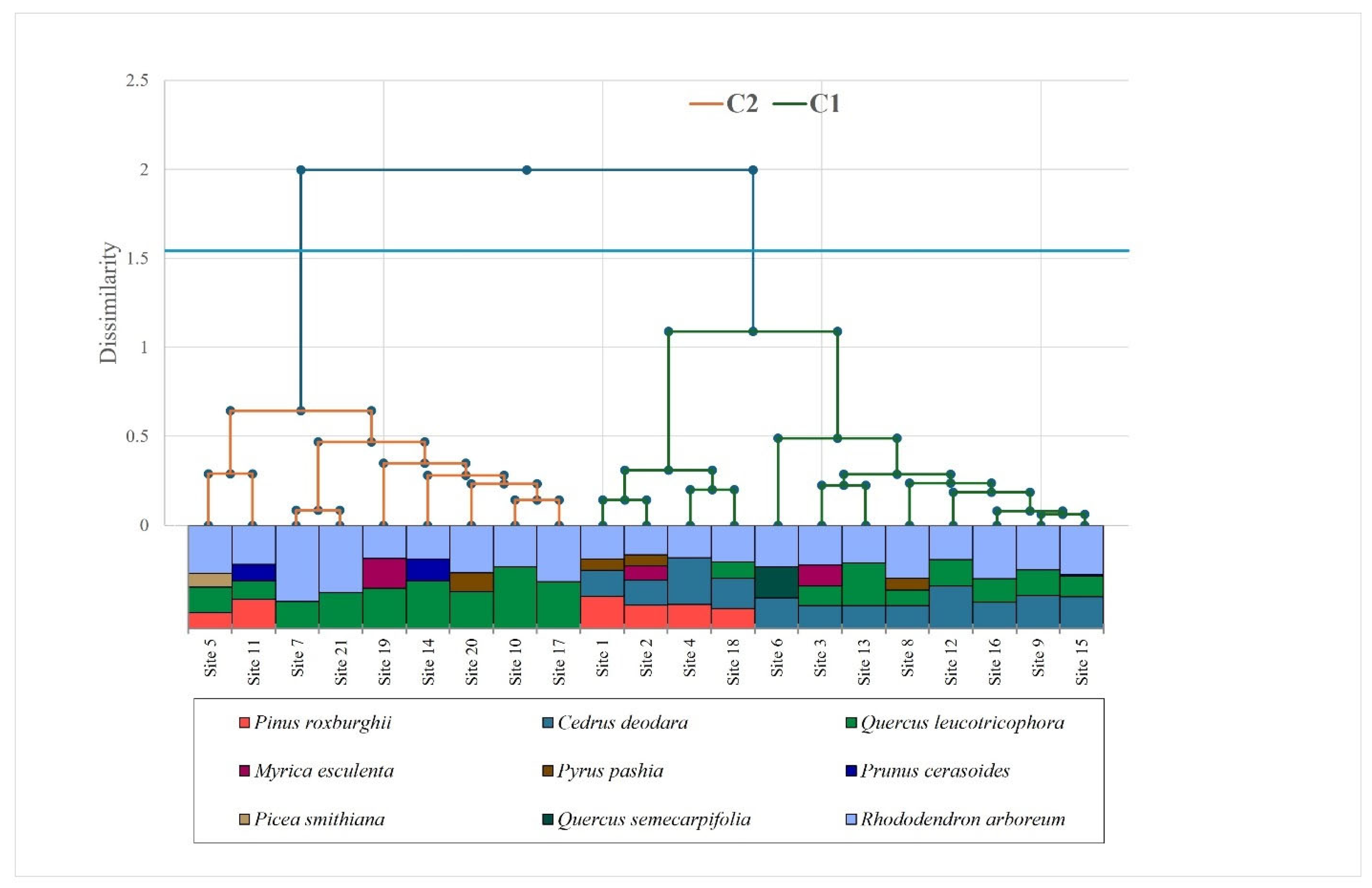
The agglomerative clustering approach (Bray–Curtis dissimilarity index) grouped the sites into two main clusters, C1 and C2, at a dissimilarity threshold of 1.5 (Figure 4). Cluster C1 represents the larger group of sites, characterized by the strong co-dominance of R. arboreum with Cedrus deodara. Moreover, these sites form a relatively homogenous group where these three species constitute most of the community’s importance value. In comparison, cluster C2 has the sites (5, 11, 14, 19) characterized by a more heterogeneous and diverse composition with the presence of Q. leucotrichophora beside R. arboreum.

3.3. Model Performance and Key Environmental Drivers

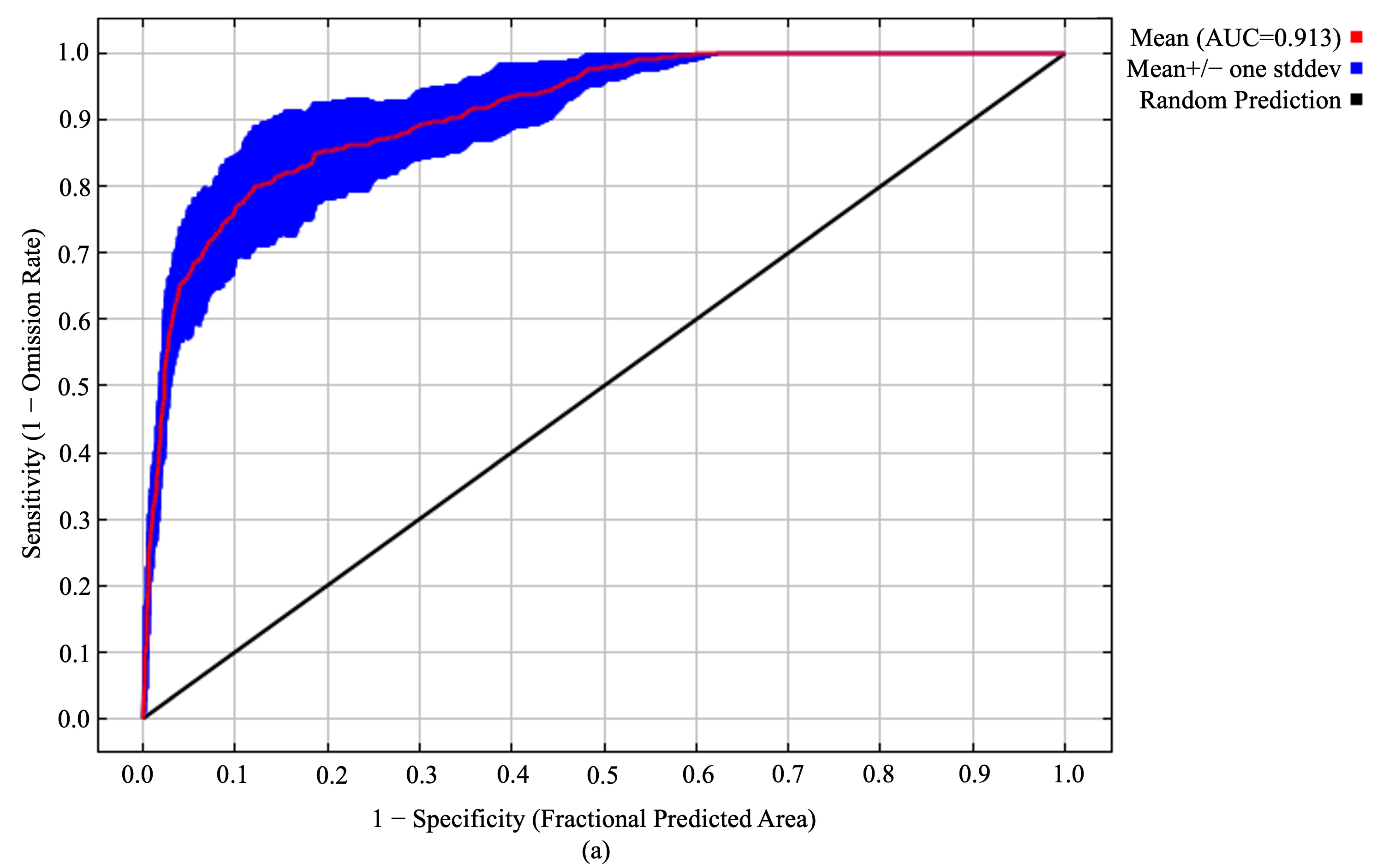
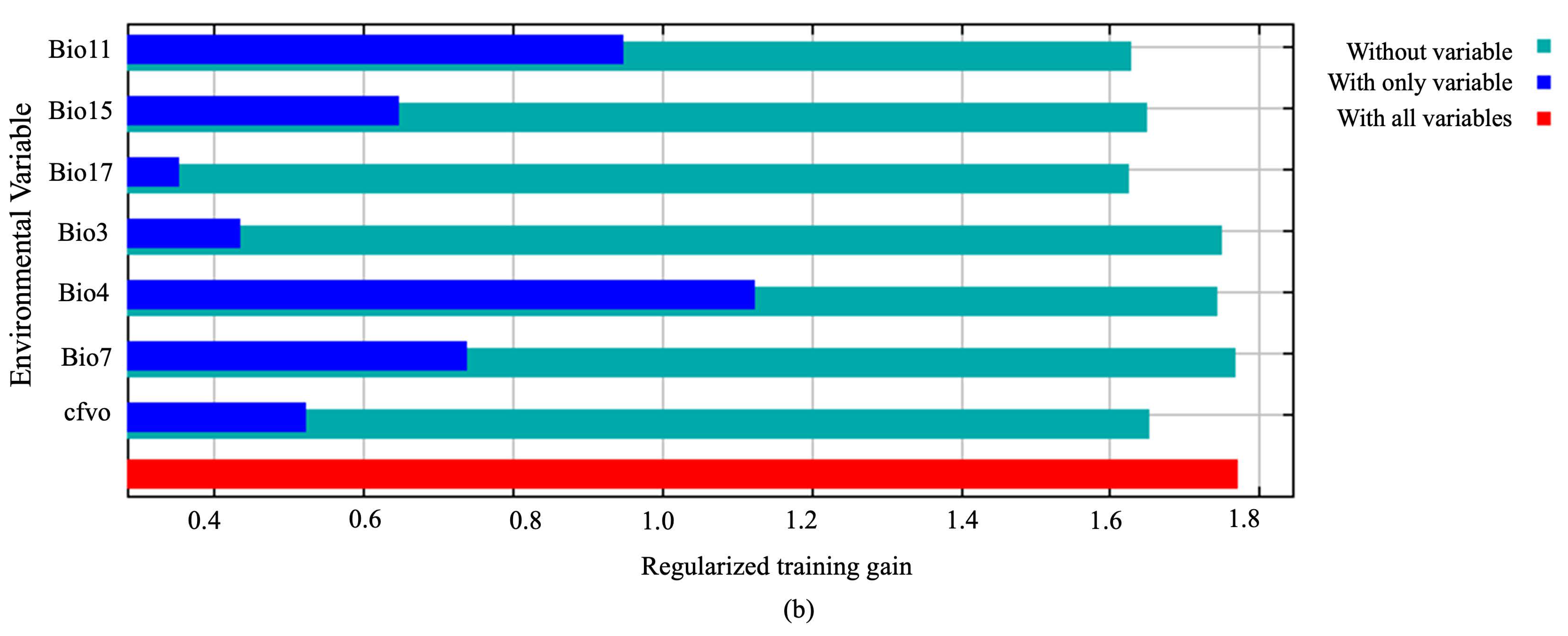
The MaxEnt model exhibited a strong ability to predict the current spatial distribution of R. arboreum. The salibratcon results showed an AUC of 0.9127 ± 0.0268 and a TSS of 0.6996 ± 0.06571 (Figure 5a). The Jackknife evaluation indicated that the distribution of R. arboreum is overwhelmingly influenced by temperature seasonality (Bio_4), which contributed 58.6% to the model. It was followed by precipitation seasonality (Bio_15) (14.8%) and precipitation during the driest quarter (Bio_17) (8.3%) (Figure 5b; Table S3). Permutation testing indicated that Bio_11 (temperature of the coldest quarter) was the most influential (43.5%), followed by CFVO (26.5%), Bio_15 (15.8%), and the remaining variables contributed a total of 14.2%. The response curves indicated that R. arboreum showed highest suitability within the following environmental ranges: Bio_11 (−21.47 to 14.42 °C), Bio_15 (36.52–139.74%), Bio_17 (19–161 mm), Bio_3 (27.90–40.87%), Bio_4 (527.93–895.26 °C), Bio_7 (22.9–34.2 °C), and CFVO (52.67–408.33 cm3 dm−3) (Figure S2).
Table 1. The relative importance and density metrics (IVI, RD, RF) of major tree species associated with Rhododendron arboreum across the study area.
SpeciesRelative (%)
DFBARDRFRDIVI ValuesIVI (%)
Pinus roxburghii0.6728.570.795.988.965.8820.826.94
Cedrus deodara1.5257.143.1013.6817.9123.1754.7618.25
Quercus leucotricophora2.6280.952.3423.5025.3717.5066.3822.13
Myrica esculenta0.3314.290.182.994.481.328.792.93
Pyrus pashia0.2419.050.032.145.970.258.362.79
Prunus cerasoides0.199.520.061.712.990.485.181.73
Picea smithiana0.054.760.020.431.490.122.040.68
Quercus semecarpifolia0.144.760.091.281.490.663.441.15
R. arboreum5.38100.006.7848.2931.3450.61130.2543.42
300100
Note: IVI = Importance Value Index; RD = Relative Dominance; RF = Relative Frequency; RD = Relative Density; BA = Basal Area (m2 ha−1); F = Frequency; D = Density.
Table 2. Phytosociological and diversity metrics for tree and shrub communities across Rhododendron arboreum-dominated sites in Himachal Pradesh.
DistrictSiteLatitudeLongitudeAltitudeDominant Associated Tree SpeciesTreesDominant Associated Shrub SpeciesShrubs
RCDenTBAH′CdEvRCDenH′CdEv
MandiNaihra (Moviseri rd.)31.57493377.0081171454.45Pinus roxburghii, Cedrus deodara, Pyrus pashia44670.401.360.750.98Berberis lycium, Rubus ellipticus, Ribes alpestre32401.431.001.40
Mahunag rd.30.85892277.1678171808.77Pinus roxburghii, Cedrus deodara, Pyrus pashia, Myrica esculenta54330.451.680.831.07Berberis lycium, Rubus ellipticus, Daphne papyracea34001.260.801.17
Kandi Kathora31.83356777.1117851861.99Pinus roxburghii, Cedrus deodara, Myrica esculenta, Quercus leucotricophora44670.341.410.761.02Berberis lycium, Rubus ellipticus23200.820.671.13
KulluKasol—Manikaran rd.32.00857777.297141402.90Cedrus deodara, Pinus roxburghii33001.011.170.721.08Ribes alpestre, Viburnum grandiflorum, Mahonia napaulensis34001.260.801.17
Lug valley rd.31.96684777.0859121564.40Pinus roxburghii, Quercus leucotricophora, Picea smithiaiia43330.391.320.710.93Berberis lycium, Mahonia napaulensis, Ribes alpestre34001.260.801.17
Jalori pass31.53516877.3737773123.90Pinus roxburghii Cedrus deodara, Quercus semecarpifolia33330.331.130.691.03Viburnum grandiflorum, Rhododendron campanulatum, Ribes alpestre34001.150.701.05
ChambaChuari Khas, Jot32.51867276.0603481951.35Quercus leucotricophora24671.010.560.360.87Berberis lycium, Rubus ellipticus, Daphne papyracea34801.180.731.08
Khajjiar rd.32.53905676.0736451990.24Cedrus deodara, Pyrus pashia, Quercus leucotricophora44001.921.240.650.87Berberis asiatica, Rubus ellipticus, Daphne papyracea34001.260.801.17
Dalhausie32.53672275.9854512146.07Cedrus deodara, Quercus leucotricophora33330.811.130.691.03Daphne papyracea, Mahonia napaulensis24000.770.601.08
KangraMcLeod Ganj rd.32.24358476.3203381711.00Quercus leucotricophora23670.610.730.551.04Berberis lycium, Rubus ellipticus, Viburnum grandiflorum34001.260.801.17
Jakhani Devi Rd.32.13690176.5514991615.10Prunus cerasoides, Pinus roxburghii, Quercus leucotricophora43670.511.480.801.10Berberis lycium, Rubus ellipticus24000.770.601.08
Dharamshala32.23841376.313171696.81Quercus leucotricophora, Cedrus deodara33670.451.160.711.06Ribes alpestre, Viburnum grandiflorum, Mahonia napaulensis33201.290.831.21
SolanBadidhar31.19331376.8854962050.40Cedrus deodara, Quercus leucotricophora33671.081.130.691.03Mahonia napaulensis, Rubus ellipticus24000.770.601.08
Sokhar, Ghanagughat31.19081676.9455871767.74Quercus leucotricophora, Prunus cerasoides33670.321.130.691.03Berberis lycium, Rubus ellipticus23200.690.500.99
Chail30.98811477.207922025.38Quercus leucotricophora, Cedrus deodara33331.031.130.691.03Daphne papyracea, Mahonia napaulensis23200.820.671.13
ShimlaTotu (Railway rd.)31.10470677.1255811894.01Quercus leucotricophora, Cedrus deodara33330.541.050.620.95Rubus ellipticus, Mahonia napaulensis,24000.770.601.08
Near Jnedghat31.00729277.229932096.11Quercus leucotricophora23330.610.720.531.03Rubus ellipticus, Viburnum grandiflorum24000.770.601.08
Mashobra rd.31.11701277.2209672283.78Quercus leucotricophora, Pinus roxburghii, Cedrus deodara43330.741.520.821.14Ribes alpestre, Viburnum grandiflorum, Mahonia napaulensis33201.290.831.21
SirmaurRajgarh-Nohradhar30.82138177.3192191892.76Quercus leucotricophora, Myrica esculenta33000.281.170.721.08Mahonia napaulensis, Ribes alpestre24000.770.601.08
Nohradhar30.81975577.4450682033.82Quercus leucotricophora, Pyrus pashia33670.21.090.650.99Mahonia napaulensis, Ribes alpestre, Rubus ellipticus33201.290.831.21
Chunvin (Haripurdhar)30.78488877.510032170.36Quercus leucotricophora24330.270.580.380.89Berberis lycium, Rubus ellipticus, Daphne papyracea34001.260.801.17
Note: Den = density (individuals per hectare); RC = species richness; TBA = total basal area (m2 ha−1); Cd = concentration of dominance; Ev = evenness; H′ = species diversity.

3.4. Current Habitat Suitability Distribution

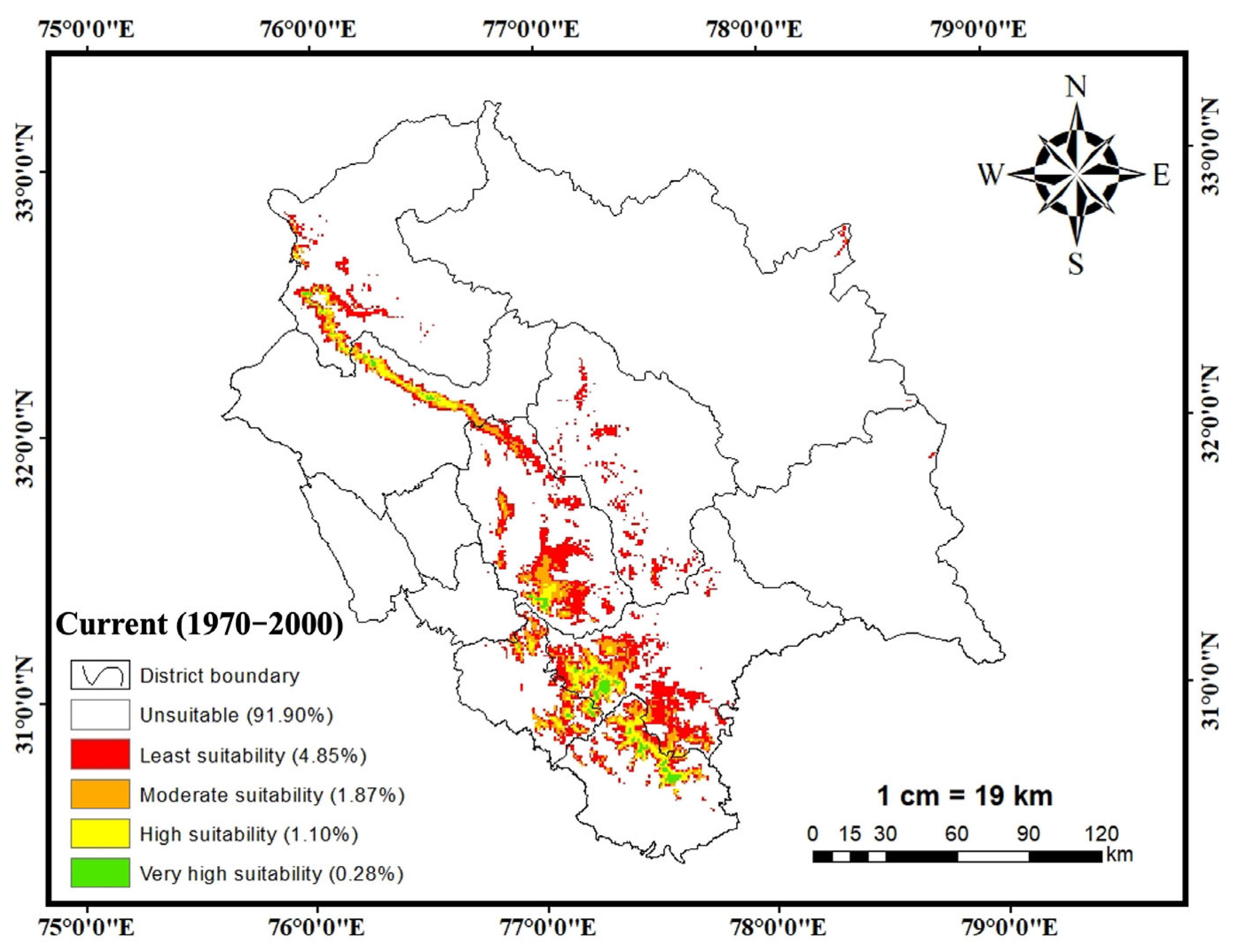
The validated model predicted that under the current climate (1970–2000), suitable habitat for R. arboreum is scarce. Only 8.10% (4508 km2) of the total 55,673 km2 study area was deemed suitable, while 91.90% was unsuitable (p > 0.2) (Figure 6). The most optimal habitats were extremely limited, with very high suitability (0.8–1.0) covering a mere 0.28% (154.64 km2) and high suitability (0.6–0.8) covering only 1.10%. The largest portions of suitable habitat were in the low suitability (4.85%) and moderate suitability (1.87%) classes. These highly suitable habitats were primarily concentrated in parts of Chamba, Kangra, Kullu, Sirmaur, Solan, and Shimla districts.

3.5. Future Habitat Distribution and Range Shifts

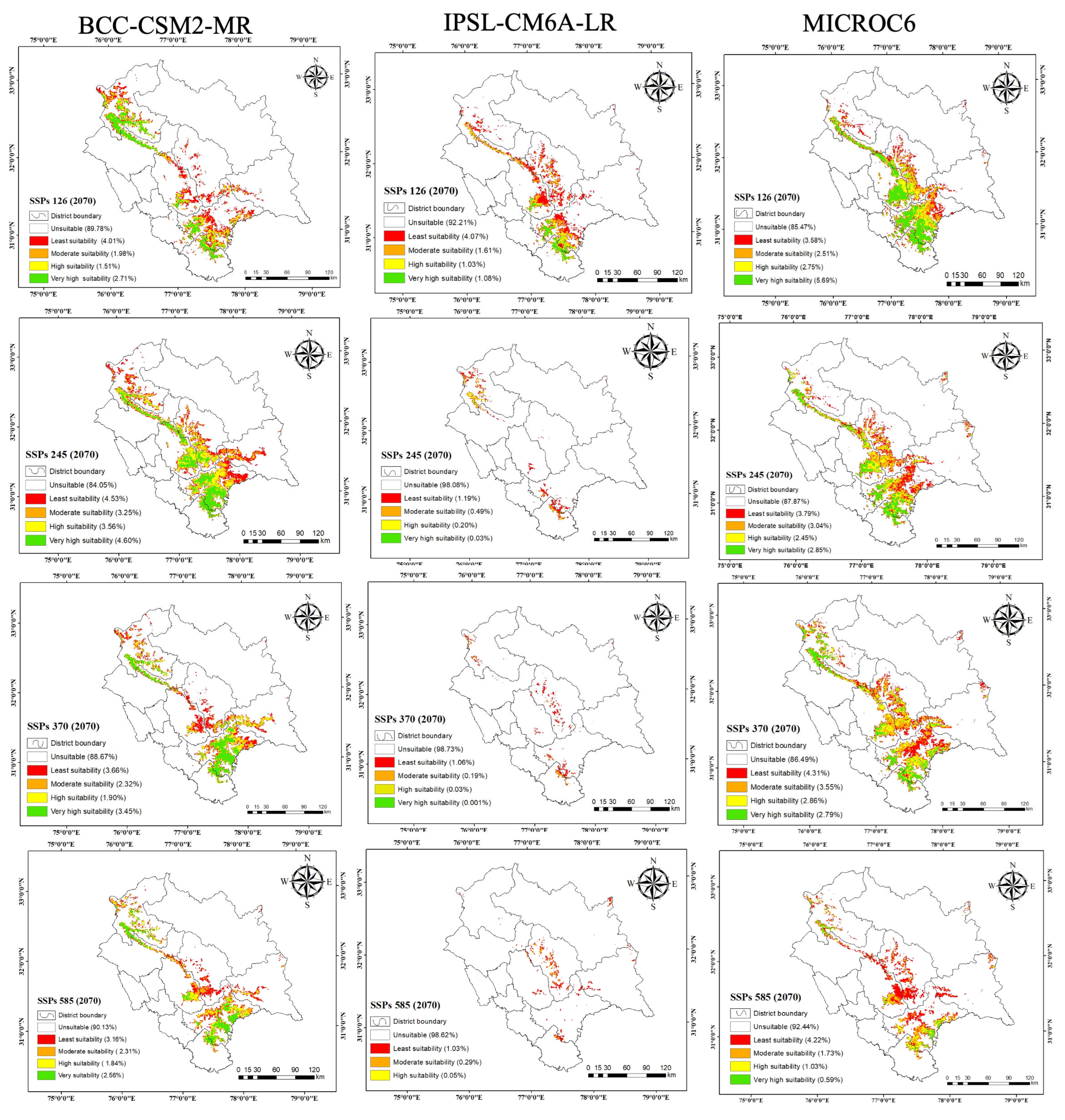
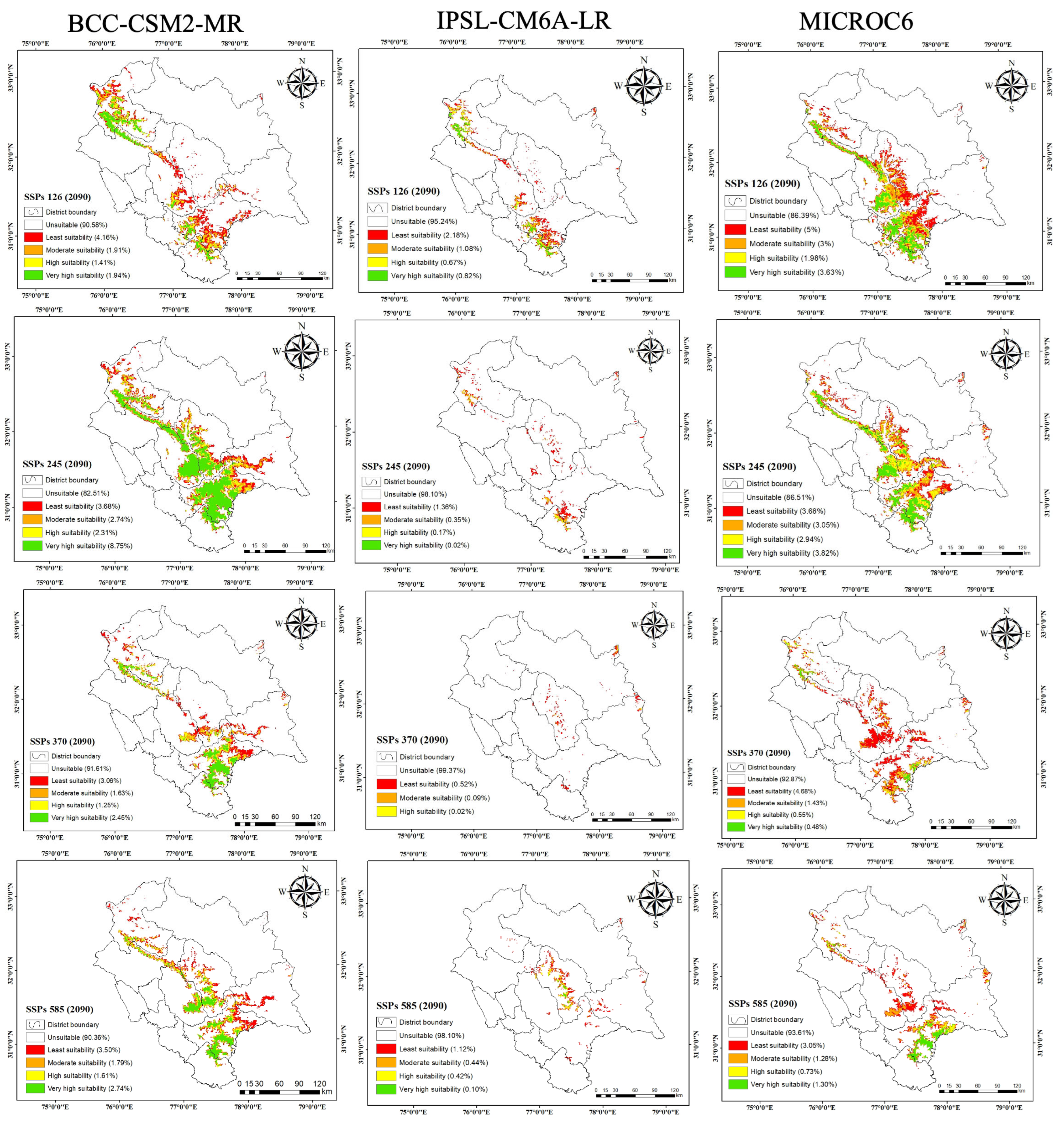
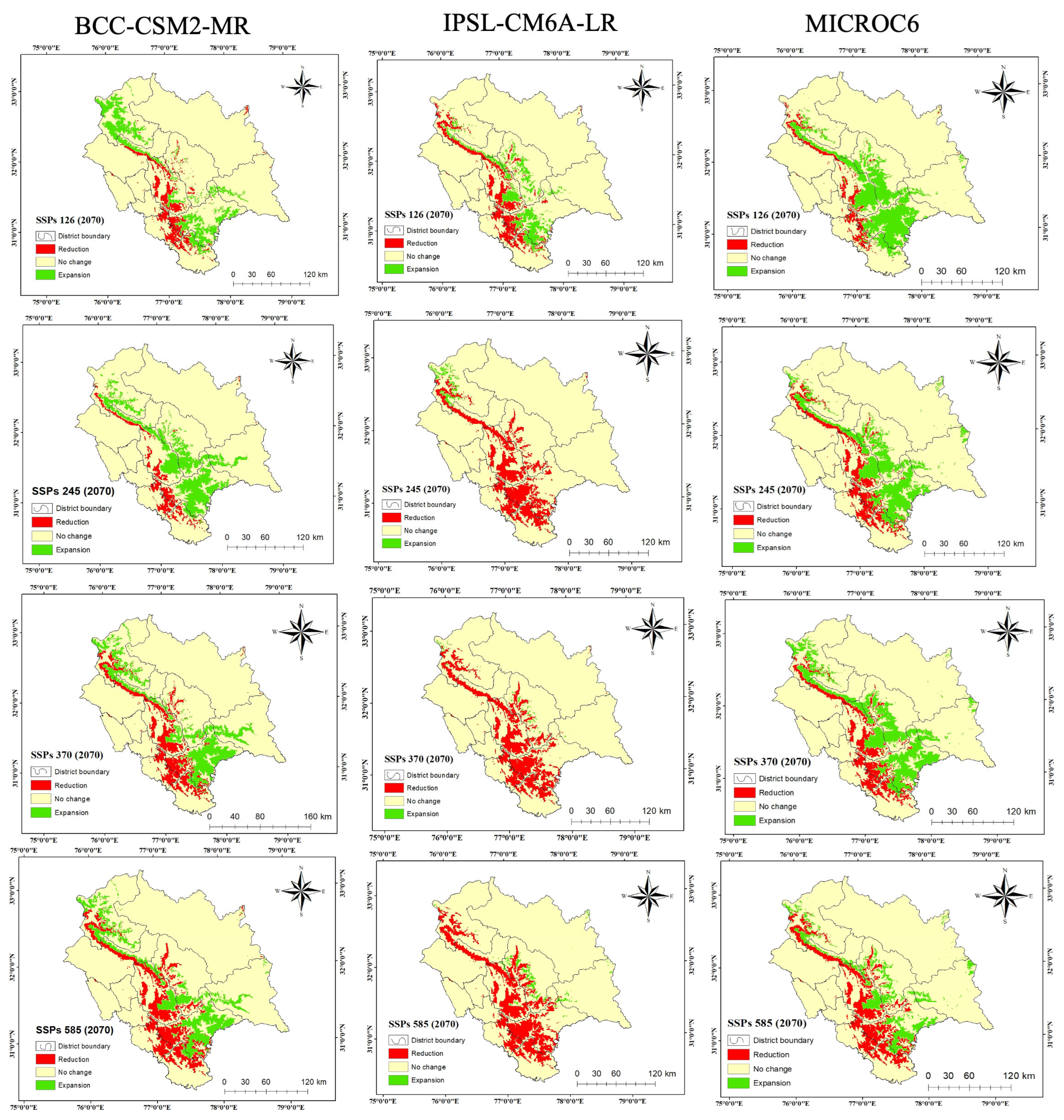
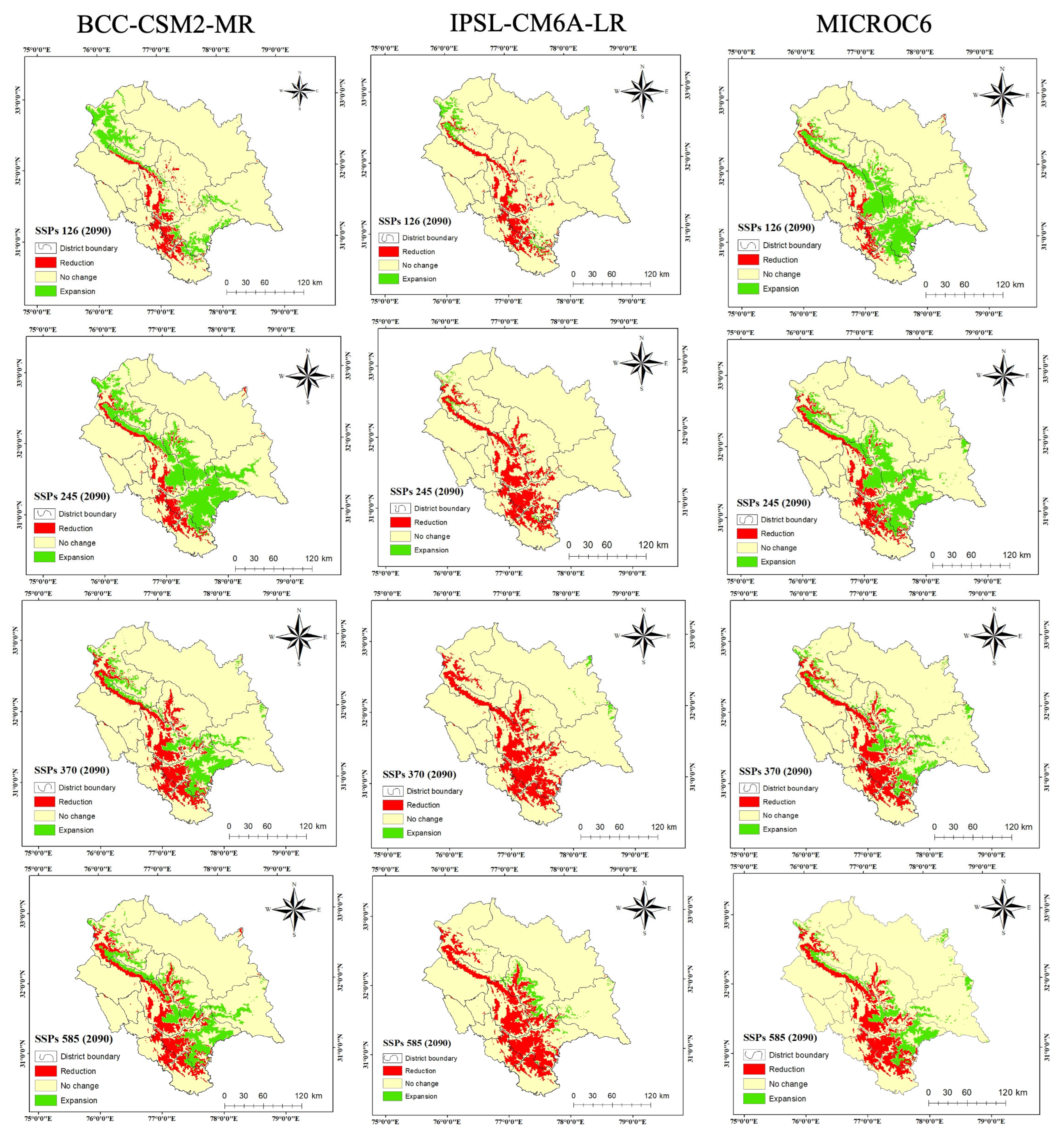
Future habitat projections for the 2070s and 2090s revealed significant uncertainty and highly divergent outcomes, contingent on the selected global climate model (GCM) and SSPs (Table 3; Figure 7 and Figure 8). A consistent pattern emerged among the GCMs, i.e., the BCC-CSM2-MR model consistently projected habitat gains across all scenarios, whereas the IPSL-CM6A-LR model consistently projected significant habitat contractions. The MIROC6 model exhibited mixed, scenario-sensitive trends, generally projecting expansion under lower-emission scenarios (SSP 126, SSP 245) and contraction under higher-emission ones (SSP 370, SSP 585). The extent of divergence is clear in the 2090s projections (Table 3). Under SSP 245, the BCC-CSM2-MR model forecasted the most optimistic scenario, with a rise in total suitable area from 96.94% in the 2070s to 115.99% in the 2090s. In contrast, the most pessimistic outcome was projected by the IPSL-CM6A-LR model under SSP 370, predicting a severe 84.26% (2070s) to 92.27% (2090s) loss of total habitat. Range shift analysis (Figure 9 and Figure 10) confirmed a notable upslope expansion trend, with suitable habitat projected to shift into higher-elevation zones and peripheral areas of its current distribution. However, the magnitude of change was highly model-dependent: BCC-CSM2-MR projected expansion across all scenarios, while IPSL-CM6A-LR projected substantial contraction across nearly all emission pathways. Across the full spectrum of models and scenarios, the most significant potential habitat gain was +115.99% (BCC-CSM2-MR, SSP 245 for 2090s), while the most significant potential loss was −92.27% (IPSL-CM6A-LR, SSP 370 for 2090s).

3.6. Suitability in Forest Type and Conservation Hotspots

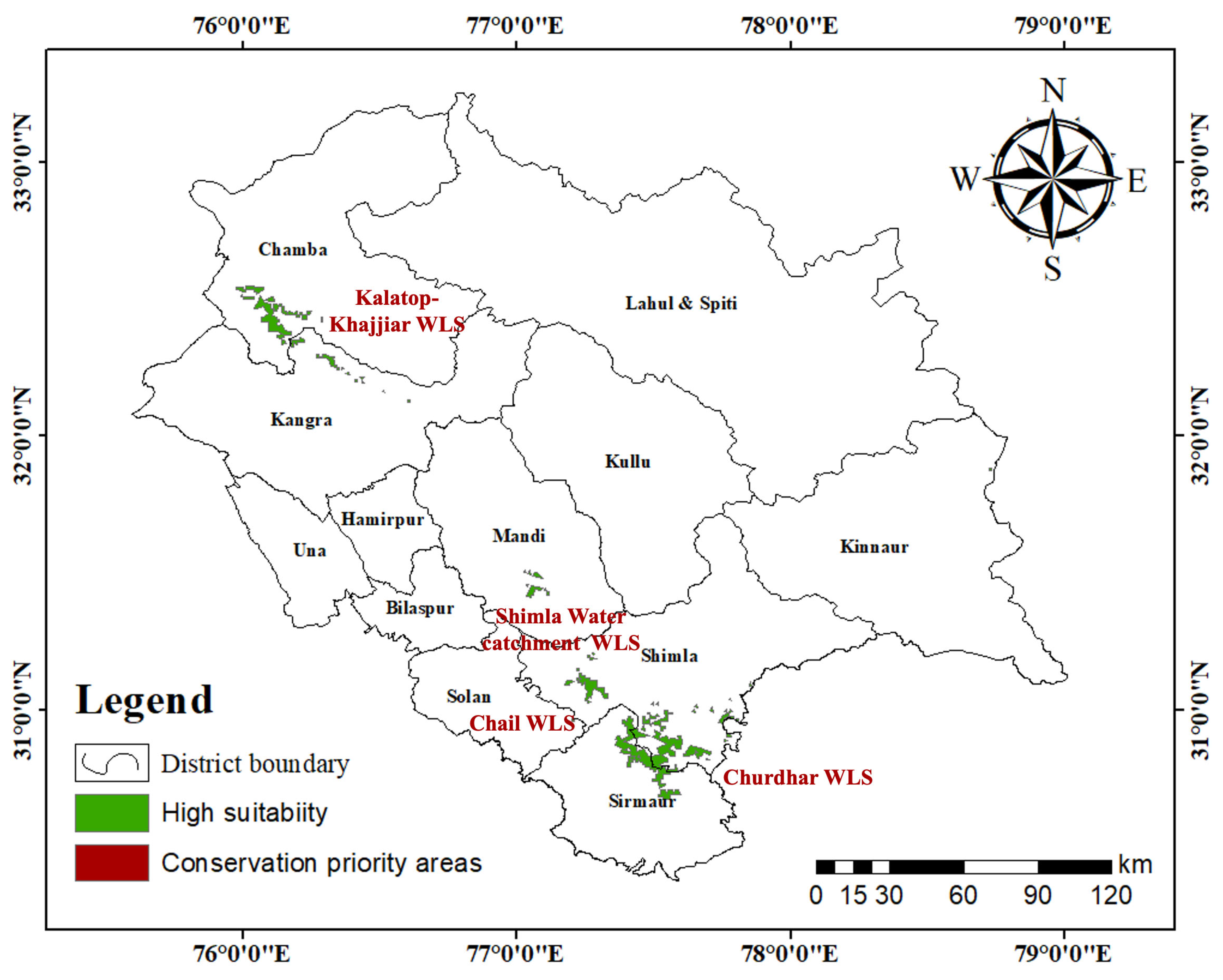
The modeled habitat suitability zones showed a strong correlation with the on-the-ground ecological findings. High-suitability areas were predominantly found within specific forest types. The Moist Deodar Forest (Cedrus deodara) type (12/C1c) emerged as the most dominant within the highly suitable habitat zones, accounting for 33.48% (52.19 km2) of the very high suitability class, 25.71% of the high suitability class, and 18.53% (192.93 km2) of the moderate suitability class (Figure 11). The Ban Oak Forest (12/C1a) (10.93%) and Himalayan Chir Pine Forest (9/C1b) (11.02%) also contained significant portions of highly suitable habitat. Geographically, these predicted high-suitability habitats are distributed across eight districts, with primary concentrations in Chamba, Kangra, Shimla, Solan, and Sirmaur. Moreover, the spatial analysis identified that areas of high suitability coincide with the regions already conserved as protected areas, including Kalatop-Khajjiar, Chail, Shimla Water Catchment, and Churdhar Wildlife Sanctuaries.

4. Discussion

4.1. Ecological Dominance

Effective protection and sustainable management of forest resources depend on a comprehensive understanding of forest composition and how it changes over time [47]. There are several factors, such as temperature, topography, soil conditions, disturbance regimes, and successional patterns, that influence the structure and ecological processes of forests [48]. These factors create the spatial variability that leads to variations in forest characteristics at both local and regional levels. In the present study, the MaxEnt model demonstrated high predictive accuracy (AUC = 0.91; TSS = 0.70), which is supported by population assessment. Similar studies on R. arboreum in the Uttarakhand IHR reported an AUC of 0.886 [26] and a TSS of 0.652 [49]. Furthermore, in the current investigation, 17 species of trees and shrubs from nine different families were recorded, with trees making up 52.94% of the landscape. Also, the model identified Moist Deodar Forest (12/C1c) and Ban Oak Forest (12/C1a) as the primary habitat for the R. arboreum, having the largest areas under the very high suitability zone. These macro-scale predictions align with field observations, where R. arboreum was identified as a dominant species (IVI 43.42%), commonly associated with Cedrus deodara and Quercus leucotrichophora. Hierarchical cluster analysis further supported the relationship by grouping sites based on these species assemblages.
Consequently, the modeled high-suitability zones effectively delineate the niche of the Rhododendron-Cedrus-Quercus community, which plays a crucial role in shaping the forest community structure across elevations from 1200 to 4000 m [50,51,52]. Additionally, differences in biodiversity indices, i.e., from high diversity at Mahunag Road (H′ = 1.68) to lower levels at Chuwari Khas (H′ = 0.36), indicate that while the climatic conditions remain suitable, local human activities, and specific site conditions majorly impact the community stability [53,54]. The variations in Cd and E reveal that the diversity in species composition and distribution across sites is consistent with previous ecological assessment carried out in the IHR region [15,53]. In contrast, shrub communities showed less variation in species richness (2–3 species) and plant density, although diversity indices still varied notably at locations like Dharamshala and Sokhar Ghanagughat. Similar trends had been reported in other parts of the IHR [55,56], which indicate how microclimatic factors, human influence, and specific ecological conditions at each site shape community structure and dynamics [57,58]. The observed dominance of R. arboreum and close association with Q. leucotrichophora and C. deodara indicate that these communities are well integrated and thriving in suitable habitats. Sites with higher plant diversity and balanced community structures tend to be more ecologically stable, indicating that the health of populations reflects both habitat quality and resilience [31,32]. On the other hand, locations with lower diversity and fragmented populations might be experiencing localized stress, which could threaten their long-term survival, especially as climate conditions continue to change.

4.2. Environmental Drivers and Climatic Sensitivity

In the current study, the distribution of R. arboreum is primarily influenced by bioclimatic factors compared to local topographic features. Particularly, Bio_4 was the major variable accounting for 58.6% of the model’s performance, followed by Bio_15 (14.8%) and Bio_17 (8.3%). The dominance of temperature- and precipitation-related factors controls the physiological response of the species to thermal and moisture conditions, which is prominent in mid- to high-elevation Himalayan ecosystems [59]. Bio_4 captures environmental oscillations that align with the adaptive strategies of species to montane climates [60]. Previously, Bhandari, et al. [26] and Veera, et al. [2] also identified Bio_4 as the primary variable for the distribution of R. arboreum. Since temperature variability influences the altitudinal range and phenological cycles of R. arboreum populations in the Uttarakhand Himalayas. Furthermore, seasonal temperature fluctuations play a crucial role in delineating the thermal conditions necessary for dormancy break, bud burst, and successful flowering, which are critical for the survival of the species [61].
Furthermore, R. arboreum has specific chilling conditions during winter, with both duration and intensity of low temperatures directly affecting the reproductive success and growth [62]. The seasonality and the amount of precipitation during the driest quarter play an important role in how moisture availability delineates the ecological habitat of R. arboreum. In particular, moisture levels during the dry season are vital for maintaining the leaf turgidity and supporting photosynthesis, especially in the shallow soils of IHR [63]. Similar patterns of precipitation sensitivity have been observed in other Rhododendron species across the Qinghai–Tibetan Plateau, where water stress during the dry season restricts their distribution at lower altitudes [64]. The precipitation seasonality range, i.e., 36.52–139.74%, was identified as the optimal, which corresponds to environments that avoid both excessive aridity and prolonged waterlogging conditions and are detrimental to Rhododendron root systems.
Furthermore, Bio_11 contributed less to the training of the MaxEnt model, but it showed the highest permutation importance (43.5%), indicating a strong physiological connection of the species to cold stress tolerance. Low winter temperatures at higher altitudes limit cambial reactivation and xylem formation [65]. Therefore, the relationship with Bio_11 delineates the upper altitudinal limit for R. arboreum, beyond which winter mortality outweighs the reproductive advantages. Similarly, Meena, et al. [66,67] have reported comparable cold-related constraints on the distribution of alpine tree species under future climate scenarios. In the current study, the Maxent model indicated an optimum environment condition, viz., temperature seasonality between 527.93 and 895.26 °C, precipitation seasonality of 36.52–139.74%, and precipitation in the driest quarter of 19–161 mm, which defines the narrow climatic niche where R. arboreum can survive and maintain viable populations. The limited niche, i.e., 8.10% of the landscape (highly suitable), indicates the R. arboreum specialized ecological needs and high vulnerability to climate change [67]. Similar patterns of habitat restriction and fragmentation have been observed in other mountain-dwelling species in the Himalayas [68], indicating that R. arboreum is particularly at risk from climate-driven elevational shifts. The patterns observed in population ecology strongly support the modeled habitat suitability. Areas identified as highly suitable in the MaxEnt projections align with sites where R. arboreum shows higher diversity and dominance. It indicates that the climatic suitability alone does not fully determine the distribution of the species; however, a viable population structure and ecological interactions are essential for long-term persistence [47,48]. Hence, combining population ecology with SDM enhances our ability to identify habitats that are ecologically functional beyond just climatic factors.

4.3. Future Habitat Dynamics and Range Shifts

Projections under CMIP6 scenarios indicate that the future distribution of R. arboreum will be significantly influenced by climatic uncertainty. Among the three climate models used, BCC-CSM2-MR forecasts the most optimistic scenario, i.e., a potential habitat expansion of up to +115.99% under SSP 245 by the 2090s. In contrast, IPSL-CM6A-LR predicts a drastic contraction, viz., −92.27% to −100% under SSP 370 and SSP 585, respectively, attributed to increased warming and aridity, which will reduce the ability of species to adapt to these conditions in the future. These differences align with variations in model sensitivity observed in other Himalayan studies using CMIP6 data [69,70]. The predicted expansion under lower-emission scenarios (SSP 126 and SSP 245) indicated that there will be the emergence of new, thermally suitable habitats in subalpine and montane zones. Moreover, the warming will lead to the upslope migration of the R. arboreum to colonize areas where the average temperature and soil moisture conditions become more favorable [61,71]. However, under high-emission pathways (SSP 370 and SSP 585), the combined effects of higher temperature extremes, unpredictable rainfall, and decreasing snow cover are expected to cause significant loss of R. arboreum habitat. Similar climate sensitivities have been reported for other species, such as Q. leucotrichophora, T. wallichiana, and other montane plants across the IHR [69,70].
Although there are some differences across models, all scenarios showed an upward shift in the potential distribution of R. arboreum, which aligns with the escalator to extinction for Himalayan flora facing climate change [71,72]. Specifically, as the temperature rises, the populations of R. arboreum will move to higher elevations. However, their ability to do so will be limited by available suitable ground, competition from other species, and slow dispersal rates. Further, the models predict a significant reduction (up to 100%) in suitable habitat at lower elevations, particularly in forests dominated by Cedrus and Quercus (IPSL projections), indicating a serious risk of community breakdown as temperature and moisture thresholds rise.
Similar patterns of vegetation change have been observed in IHR, where warming appears to disrupt the co-adapted forest communities [68]. Conversely, the BCC-CSM2-MR model consistently showed habitat expansion (16 to 116%) across all emission scenarios, which indicates a stable climate sensitivity and aligns with the bioclimatic ranges of other Himalayan broadleaf species [26,69,73]. Meanwhile, the IPSL-CM6A-LR model showed a more pessimistic projection (except 2070s under SSP 126), attributed to the simulation of strong regional drying and heating [72]. The MIROC6 model shows highly variable, scenario-dependent outcomes, with potential for about 79% expansion in 2070 under SSP 126, whereas a contraction of up to 21% by 2090 under SSP 585, which indicates a tipping point where warming benefits are offset by heat stress under higher emission scenarios. Overall, the future trajectory of R. arboreum remains uncertain. The lower-emission pathways (SSP 126 and SSP 245) will lead to ecological resilience and range expansion. In contrast, higher-emission scenarios (SSP 370 and SSP 585) pose a significant risk of near-complete range loss in IHR.

4.4. Implications for Land Degradation and Socio-Economic Development

The projected changes in R. arboreum habitat extend beyond the ecological reorganization. However, it carries considerable implications for land degradation, ecosystem stability, and socio-economic well-being across the IHR. The model projections vary significantly among the different models; however, the risk of habitat loss in vulnerable mid-elevation zones (1200–2000 m) of IHR remains a critical concern. In more pessimistic scenarios (IPSL-CM6A-LR), the potential contraction of R. arboreum distribution can trigger a chain reaction affecting forest structure and land stability. The loss of a dominant species will destabilize the IHR region by increasing soil erosion, decreasing infiltration, and reducing carbon sequestration [74,75]. These changes can create feedback loops, where climate stress weakens the canopy health, thus making the forests more vulnerable to human activities like habitat destruction, overharvesting, and fires [76,77]. Similar feedback mechanisms have been observed in Q. leucotrichophora and Abies pindrow forests, where declining canopies have led to slope destabilization and nutrient loss [70]. Furthermore, the regeneration of R. arboreum depends on the specific microclimatic windows, i.e., moderate frost exposure for bud differentiation and consistent soil moisture for seedling establishment [26]. Even the rapid uphill migration of R. arboreum poses a serious risk of migration lag, where colonization of higher altitudes with a favorable climate fails to match the pace of habitat loss at lower elevations [60,66]. It will be further worsened by the limited seed dispersal capacity of the species and its high sensitivity to anthropogenic disturbances.
Socio-economically, R. arboreum plays a vital role as a non-timber forest product, thus supporting mountain communities through the sale of flowers used for the preparation of juices, herbal medicines, and traditional rituals [75,78]. As climate change causes the suitable habitats to shift and migrate from their current distribution, traditional harvesters, many of whom are marginalized or women-led communities reliant on seasonal income, may find these resources becoming inaccessible [79,80]. If the severe habitat loss predicted by IPSL-CM6A-LR (up to 92%) occurs, the species will disappear entirely and will disturb the balance of forest ecosystems and the livelihoods that depend on them. Subsequently, it will push local communities toward activities that further degrade the land, such as overgrazing and excessive biomass collection [81,82]. Such patterns will threaten to reduce ecosystem services and increase the vulnerability of livelihoods in the IHR, thus creating a complex feedback loop between poverty and environmental degradation [74,78]. Therefore, to address these challenges, conservation planning needs to focus on identifying climatic refugia and adopting adaptive management approaches. The current study identified Kalatop-Khajjiar, Chail, and Churdhar wildlife sanctuaries as the stable refugia for R. arboreum across various climate scenarios. Conservation efforts should be focused on these regions to ensure species survival in changing climate scenarios. Furthermore, conservation strategies should evolve from passive protection to active socio-ecological management, such as assisted migration to suitable habitats, integration into farming practices, livelihood support, and community involvement in forest governance [75]. Such efforts will help to balance biodiversity conservation with rural resilience, subsequently fostering a sense of shared stewardship among the local communities [78,79]. These adaptive strategies align with SDG 13 (Climate Action) and SDG 15 (Life on Land) and ensure the preservation of both ecological integrity and the socio-economic well-being of Himalayan communities in the face of rapidly changing climate conditions.

4.5. Study Limitations

The current study has certain limitations related to the field sampling design and the underlying modeling assumptions. The field sampling had adopted a stratified sampling approach across the gradient where R. arboreum was present. Simultaneously, the population assessment plots were established in the areas where mature individuals of the R. arboreum were present, which can underrepresent the marginal habitats and early regeneration stages. Moreover, the tree selection concentrated on mature individuals with measurable DBH to maintain consistency in population ecology assessment; therefore, recruitment dynamics were not directly evaluated. From a modeling perspective, MaxEnt relies solely on presence data and presumes an equilibrium between the species and environmental factors. However, the modeling framework did not explicitly include land-use change, human activities, disturbances, interactions among species, and dispersal limitations, which can influence the actual distribution of the species under future climate change [18,25]. Moreover, future projections are influenced by uncertainties intrinsic to CMIP6 climate models, especially in mountainous areas where microclimatic conditions can vary widely [4,69]. Therefore, the projected distributions should be interpreted as likely scenarios compared to the fixed outcomes.

5. Conclusions

The current study integrates field-based population ecology with climate-driven species distribution modeling to improve ecological interpretation of habitat suitability and identify climatically stable refugia for conservation planning under CMIP6 climate uncertainty. The MaxEnt model showed strong predictive accuracy, with an AUC of 0.91 and a TSS of 0.69. The temperature seasonality (Bio_4) and precipitation seasonality (Bio_15) were identified as the primary variables influencing the distribution of the R. arboreum. Currently, the suitable habitat for R. arboreum is limited to about 4508 km2 (8.10%) of the study area and mainly within Moist Deodar, Ban Oak, and Himalayan Chir Pine forests. Future scenarios indicated an upward shift of the species habitat, although the total area of suitable habitat remains highly uncertain. BCC-CSM2-MR models predicted a significant expansion (up to 115%), while IPSL-CM6A-LR forecasted a range collapse (up to 92%). Moreover, the survival and potential migration of species will depend on regional moisture retention under warming conditions and increasing resilience in cooler, moisture-rich high-altitude habitats. The findings confirm that the R. arboreum occupies a narrow climatic niche and remains vulnerable to future climate change, and can alter the composition, structure, and ecological functioning of mid-hill Himalayan Forest ecosystems.
The R. arboreum is a dominant and socio-economically important tree as a key non-timber forest product, and climate-driven shifts in R. arboreum distribution require proactive conservation and adaptive management strategies. Priority should be given to climatically stable refugia such as Kalatop-Khajjiar, Chail, and Churdhar Wildlife Sanctuaries, which can support long-term species persistence and ecological stability under a changing climate. Conservation planning should focus on (i) enhancing habitat connectivity and supporting assisted migration toward suitable high-elevation zones, (ii) strengthening long-term ecological monitoring to detect early climate-induced population changes, and (iii) promoting community-based conservation and sustainable harvesting to protect livelihoods that depend on R. arboreum. Furthermore, considering R. arboreum in restoration and agroforestry initiatives can enhance ecosystem resilience, mitigate land degradation, and aid climate adaptation in Himalayan regions. These efforts support larger climate-action and biodiversity-conservation objectives, which are crucial for maintaining ecosystem stability and supporting mountain communities amid climate change.

Supplementary Materials

The following supporting information can be downloaded at: https://www.mdpi.com/article/10.3390/environments13030138/s1, Table S1: The environmental predictors considered in species distribution modeling of R. arboreum. Table S2: The details of Shared Socio-economic Pathways (SSPs) for climate projections. Table S3: Environmental variables’ relative contribution and permutation importance to the MaxEnt models of R. arboreum. Table S4: The number of different life forms recorded from the study area. Table S5: A list of tree and shrub species identified in the study area with their families. Figure S1: Pearson correlation analysis of significant environment variables for R. arborem (−0.8 ≤ r ≤ +0.8). Figure S2: Response curves illustrating the relationship of predicted probability of R. arboreum occurrence with (a) the mean temperature of the coldest quarter (Bio_11), (b) precipitation seasonality (Bio_15), (c) the precipitation of the driest quarter (Bio_17), (d) isothermality (Bio_3), (e) temperature seasonality (Bio_4), (f) temperature annual range (Bio_7), and (g) the volumetric fraction of the coarse soil fragments (CFVO). The values shown are the average over 15 replicate runs: the blue margins showed standard deviation calculated over 15 replicates.

Author Contributions

Conceptualization, Y.K. and P.S.; Methodology, Y.K. and P.S.; Investigation, Y.K.; Formal analysis, Y.K., V.S., and P.T.; Data curation, Y.K., D.R.B., P.S., K.V., and V.S.; Visualization, Y.K., K.V., V.S., P.T., and V.K.D.; Writing—original draft preparation, P.S.; Writing—review and editing, Y.K., D.R.B., K.V., V.S., V.K.D., and P.T.; Supervision, P.S., D.R.B.; Project administration, P.S. and D.R.B.; Validation, P.S., P.T., and V.K.D. All authors have read and agreed to the published version of the manuscript.

Funding

This research study received no external funding.

Data Availability Statement

The data that support the findings of this study are available from the corresponding author upon reasonable request.

Acknowledgments

The authors are grateful to the Department of Silviculture and Agroforestry, Y. S. Parmar, University of Horticulture and Forestry, Solan (HP), India, for providing the necessary facilities during the study.

Conflicts of Interest

The authors declare no conflicts of interest.

Abbreviations

The following abbreviations are used in this manuscript:
AUCArea Under the Curve
BABasal Area
BioBioclimatic Variable
CFVOCoarse Fragment Volumetric Fraction
CMIP6Coupled Model Intercomparison Project Phase 6
DBHDiameter at Breast Height
DEMDigital Elevation Model
ENMEcological Niche Model
GBIFGlobal Biodiversity Information Facility
GCMGlobal Climate Model
GISGeographic Information System
H′Shannon–Wiener Diversity Index
IHRIndian Himalayan Region
IPCCIntergovernmental Panel on Climate Change
IVIImportance Value Index
MaxEntMaximum Entropy Model
NTFPNon-Timber Forest Product
RBARelative Basal Area
RDRelative Density
RFRelative Frequency
SDMSpecies Distribution Modeling
SSPShared Socio-economic Pathway
TBATotal Basal Area
TSSTrue Skill Statistic
WLSWildlife Sanctuary

References

  1. Al-Qaddi, N.; Vessella, F.; Stephan, J.; Al-Eisawi, D.; Schirone, B. Current and future suitability areas of kermes oak (Quercus coccifera L.) in the Levant under climate change. Reg. Environ. Change 2016, 17, 143–156. [Google Scholar] [CrossRef]
  2. Veera, S.N.S.; Panda, R.M.; Behera, M.D.; Goel, S.; Roy, P.S.; Barik, S.K. Prediction of upslope movement of Rhododendron arboreum in Western Himalaya. Trop. Ecol. 2020, 60, 518–524. [Google Scholar] [CrossRef]
  3. World Meteorological Organization. State of the Global Climate 2024; World Meteorological Organization: Geneva, Switzerland, 2024; p. 1368. [Google Scholar]
  4. IPCC. Climate Change 2022: Impacts, Adaptation, and Vulnerability; Cambridge University Press: Cambridge, UK, 2022. [Google Scholar]
  5. Banerjee, A.; Devi, M.; Nag, A.; Sharma, R.; Kumar, A. Modelling probable distribution of Podophyllum hexandrum in North-Western Himalaya. Indian For. 2017, 143, 1255–1259. [Google Scholar]
  6. Krishnan, R.; Shrestha, A.B.; Ren, G.; Rajbhandari, R.; Saeed, S.; Sanjay, J.; Syed, M.A.; Vellore, R.; Xu, Y.; You, Q. Unravelling climate change in the Hindu Kush Himalaya: Rapid warming in the mountains and increasing extremes. In The Hindu Kush Himalaya Assessment: Mountains, Climate Change, Sustainability and People; Springer: Berlin/Heidelberg, Germany, 2019; pp. 57–97. [Google Scholar]
  7. Rani, S.; Kumar, R.; Maharana, P. Climate change, its impacts, and sustainability issues in the Indian Himalaya: An introduction. In Climate Change: Impacts, Responses and Sustainability in the Indian Himalaya; Springer: Berlin/Heidelberg, Germany, 2022; pp. 1–27. [Google Scholar]
  8. Bellard, C.; Bertelsmeier, C.; Leadley, P.; Thuiller, W.; Courchamp, F. Impacts of climate change on the future of biodiversity. Ecol. Lett. 2012, 15, 365–377. [Google Scholar] [CrossRef]
  9. Saran, S.; Joshi, R.; Sharma, S.; Padalia, H.; Dadhwal, V.K. Geospatial modeling of Brown oak (Quercus semecarpifolia) habitats in the Kumaun Himalaya under climate change scenario. J. Indian Soc. Remote Sens. 2010, 38, 535–547. [Google Scholar] [CrossRef]
  10. Bobrowski, M.; Gerlitz, L.; Schickhoff, U. Modelling the potential distribution of Betula utilis in the Himalaya. Glob. Ecol. Conserv. 2017, 11, 69–83. [Google Scholar] [CrossRef]
  11. Thakur, K.; Verma, S.; Chaudhary, J. Rhododendron campanulatum (Gulabi buransh) the state flower of Himachal Pradesh in the verge of extinction. Just Agric. 2023, 3, 1–4. [Google Scholar]
  12. Rawat, P.; Rai, N.; Kumar, N.; Bachheti, R.K. Review on Rhododendron arboreum—A magical tree. Orient. Pharm. Exp. Med. 2017, 17, 297–308. [Google Scholar] [CrossRef]
  13. Srivastava, P. Rhododendron arboreum: An overview. J. Appl. Pharm. Sci. 2012, 2, 158–162. [Google Scholar]
  14. Gaira, K.S.; Rawal, R.S.; Rawat, B.; Bhatt, I.D. Impact of climate change on the flowering of Rhododendron arboreum in central Himalaya, India. Curr. Sci. 2014, 106, 1735–1738. [Google Scholar]
  15. Singh, S.; Chatterjee, S. Value chain analysis of Rhododendron arboreum squash ‘buransh’ as a non-timber forest product (NTFP) in Western Himalayas: Case study of Chamoli district, Uttarakhand in India. Trees For. People 2022, 7, 100200. [Google Scholar] [CrossRef]
  16. IUCN. The International Union for Conservation of Nature Red List of Threatened Species (Version 2024-1). Available online: https://www.iucnredlist.org (accessed on 12 January 2025).
  17. Laface, V.L.A.; Musarella, C.M.; Tavilla, G.; Sorgonà, A.; Cano-Ortiz, A.; Quinto Canas, R.; Spampinato, G. Current and Potential Future Distribution of Endemic Salvia ceratophylloides Ard. (Lamiaceae). Land 2023, 12, 247. [Google Scholar] [CrossRef]
  18. Xu, W.; Luo, D.; Peterson, K.; Zhao, Y.; Yu, Y.; Ye, Z.; Sun, J.; Yan, K.; Wang, T. Advancements in ecological niche models for forest adaptation to climate change: A comprehensive review. Biol. Rev. Camb. Philos. Soc. 2025, 100, 1754–1781. [Google Scholar] [CrossRef] [PubMed]
  19. Paul, S.; Lata, S.; Barman, T. Habitat distribution modeling of the Pinus gerardiana under projected climate change in the North-Western Himalaya, India. Landsc. Ecol. Eng. 2023, 19, 647–660. [Google Scholar] [CrossRef]
  20. Mirhashemi, H.; Heydari, M.; Ahmadi, K.; Karami, O.; Kavgaci, A.; Matsui, T.; Heung, B. Species distribution models of Brant’s oak (Quercus brantii Lindl.): The impact of spatial database on predicting the impacts of climate change. Ecol. Eng. 2023, 194, 107038. [Google Scholar] [CrossRef]
  21. Micaela Rosas, Y.; Peri, P.L.; Benítez, J.; Vanessa Lencinas, M.; Politi, N.; Martínez Pastur, G. Potential biodiversity map of bird species (Passeriformes): Analyses of ecological niche, environmental characterization and identification of priority conservation areas in southern Patagonia. J. Nat. Conserv. 2023, 73, 126413. [Google Scholar] [CrossRef]
  22. Xie, C.; Chen, L.; Li, M.; Jim, C.Y.; Liu, D. BIOCLIM Modeling for Predicting Suitable Habitat for Endangered Tree Tapiscia sinensis (Tapisciaceae) in China. Forests 2023, 14, 2275. [Google Scholar] [CrossRef]
  23. Wang, X.; Jiang, Y.; Wu, W.; He, X.; Wang, Z.; Guan, Y.; Xu, N.; Chen, Q.; Shen, Y.; Cao, J. Cryptosporidiosis threat under climate change in China: Prediction and validation of habitat suitability and outbreak risk for human-derived Cryptosporidium based on ecological niche models. Infect. Dis. Poverty 2023, 12, 35. [Google Scholar] [CrossRef]
  24. Pearson, R.G. Species’ Distribution Modeling for Conservation Educators and Practitioners. Lessons Conserv. 2010, 3, 54–89. [Google Scholar] [CrossRef]
  25. Phillips, S.J.; Anderson, R.P.; Schapire, R.E. Maximum entropy modeling of species geographic distributions. Ecol. Model. 2006, 190, 231–259. [Google Scholar] [CrossRef]
  26. Bhandari, M.S.; Meena, R.K.; Shankhwar, R.; Shekhar, C.; Saxena, J.; Kant, R.; Pandey, V.V.; Barthwal, S.; Pandey, S.; Chandra, G.; et al. Prediction Mapping Through Maxent Modeling Paves the Way for the Conservation of Rhododendron arboreum in Uttarakhand Himalayas. J. Indian Soc. Remote Sens. 2019, 48, 411–422. [Google Scholar] [CrossRef]
  27. Khan, A.M.; Li, Q.; Saqib, Z.; Khan, N.; Habib, T.; Khalid, N.; Majeed, M.; Tariq, A. MaxEnt Modelling and Impact of Climate Change on Habitat Suitability Variations of Economically Important Chilgoza Pine (Pinus gerardiana Wall.) in South Asia. Forests 2022, 13, 715. [Google Scholar] [CrossRef]
  28. Liu, Y.; Huang, P.; Lin, F.; Yang, W.; Gaisberger, H.; Christopher, K.; Zheng, Y. MaxEnt modelling for predicting the potential distribution of a near threatened rosewood species (Dalbergia cultrata Graham ex Benth). Ecol. Eng. 2019, 141, 105612. [Google Scholar] [CrossRef]
  29. Mahatara, D.; Acharya, A.; Dhakal, B.; Sharma, D.; Ulak, S.; Paudel, P. Maxent modelling for habitat suitability of vulnerable tree Dalbergia latifolia in Nepal. Silva Fenn. 2021, 55, 10441. [Google Scholar] [CrossRef]
  30. Sharma, S.; Arunachalam, K.; Bhavsar, D.; Kala, R. Modeling habitat suitability of Perilla frutescens with MaxEnt in Uttarakhand—A conservation approach. J. Appl. Res. Med. Aromat. Plants 2018, 10, 99–105. [Google Scholar] [CrossRef]
  31. Pande, R.; Bargali, K.; Pande, N. Impacts of disturbance on the population structure and regeneration status of tree species in a Central Himalayan Mixed-Oak Forest, India. Taiwan J. For. Sci. 2014, 29, 179–192. [Google Scholar]
  32. Sudhakar Reddy, C.; Babar, S.; Amarnath, G.; Pattanaik, C. Structure and floristic composition of tree stand in tropical forest in the Eastern Ghats of northern Andhra Pradesh, India. J. For. Res. 2011, 22, 491–500. [Google Scholar] [CrossRef]
  33. Phillips, E.A. Methods of Vegetation Study; Holt, Rinehart and Winston: New York, NY, USA, 1959. [Google Scholar]
  34. Misra, R. Ecology Work Book; Oxford and IBH Publishing Company: New Delhi, India, 1968; pp. 426–427. [Google Scholar]
  35. Whittaker, R.H. Evolution and Measurement of Species Diversity. Taxon 2019, 21, 213–251. [Google Scholar] [CrossRef]
  36. Addinsoft XLSTAT Statistical and Data Analysis Solution (Version 2023.3). Addinsoft: New York, NY, USA, 2023.
  37. Aiello-Lammens, M.E.; Boria, R.A.; Radosavljevic, A.; Vilela, B.; Anderson, R.P. spThin: An R package for spatial thinning of species occurrence records for use in ecological niche models. Ecography 2015, 38, 541–545. [Google Scholar] [CrossRef]
  38. Chauhan, S.; Ghoshal, S.; Kanwal, K.S.; Sharma, V.; Ravikanth, G. Ecological niche modelling for predicting the habitat suitability of endangered tree species Taxus contorta Griff. in Himachal Pradesh (Western Himalayas, India). Trop. Ecol. 2022, 63, 300–313. [Google Scholar] [CrossRef]
  39. Khan, A.M.; Qureshi, R.; Saqib, Z. Multivariate analyses of the vegetation of the western Himalayan forests of Muzaffarabad district, Azad Jammu and Kashmir, Pakistan. Ecol. Indic. 2019, 104, 723–736. [Google Scholar] [CrossRef]
  40. Phillips, S.J. Transferability, sample selection bias and background data in presence-only modelling: A response to Peterson et al. (2007). Ecography 2008, 31, 272–278. [Google Scholar] [CrossRef]
  41. Gao, T.; Xu, Q.; Liu, Y.; Zhao, J.; Shi, J. Predicting the Potential Geographic Distribution of Sirex nitobei in China under Climate Change Using Maximum Entropy Model. Forests 2021, 12, 151. [Google Scholar] [CrossRef]
  42. Baldwin, R.A. Use of Maximum Entropy Modeling in Wildlife Research. Entropy 2009, 11, 854–866. [Google Scholar] [CrossRef]
  43. Thuiller, W.; Richardson, D.M.; Pysek, P.; Midgley, G.F.; Hughes, G.O.; Rouget, M. Niche-based modelling as a tool for predicting the risk of alien plant invasions at a global scale. Glob. Change Biol. 2005, 11, 2234–2250. [Google Scholar] [CrossRef]
  44. Allouche, O.; Tsoar, A.; Kadmon, R. Assessing the accuracy of species distribution models: Prevalence, kappa and the true skill statistic (TSS). J. Appl. Ecol. 2006, 43, 1223–1232. [Google Scholar] [CrossRef]
  45. Akhlaq, R.; Amjad, M.S.; Qaseem, M.F.; Fatima, S.; Chaudhari, S.K.; Khan, A.M.; Khan, S.; Malik, N.Z.; Gardazi, S.M.H.; Bibi, A.; et al. Species Diversity and Vegetation Structure from Different Climatic Zones of Tehsil Harighel, Bagh, Azad Kasmir, Pakistan Analysed through Multivariate Techniques. Appl. Ecol. Environ. Res. 2018, 16, 5193–5211. [Google Scholar] [CrossRef]
  46. Li, Y.; Li, M.; Li, C.; Liu, Z. Optimized Maxent Model Predictions of Climate Change Impacts on the Suitable Distribution of Cunninghamia lanceolata in China. Forests 2020, 11, 302. [Google Scholar] [CrossRef]
  47. Lal, M.; Samant, S.S.; Kumar, R.; Sharma, L.; Paul, S.; Dutt, S.; Negi, D.; Devi, K. Population ecology and niche modelling of endangered Arnebia euchroma in Himachal Pradesh, India-An approach for conservation. Med. Plants—Int. J. Phytomed. Relat. Ind. 2020, 12, 90. [Google Scholar] [CrossRef]
  48. Rawat, P.; Singh, O.; Thapliyal, M.; Verma, P.K.; Singh, I.; Kumar, R.; Dobhal, S.; Singh, R.; Singh, R.; Kumar, A.; et al. Assessment of population ecology and potential habitat modelling of Schleichera oleosa in Uttarakhand Himalaya of India: Implications for management and conservation. Env. Monit Assess 2025, 197, 278. [Google Scholar] [CrossRef]
  49. Anand, A.; Pandey, M.K.; Srivastava, P.K.; Gupta, A.; Khan, M.L. Integrating Multi-Sensors Data for Species Distribution Mapping Using Deep Learning and Envelope Models. Remote Sens. 2021, 13, 3284. [Google Scholar] [CrossRef]
  50. Sharma, N.; Kala, C.P. Utilization pattern, population density and supply chain of Rhododendron arboreum and Rhododendron campanulatum in Dhauladhar Mountain Range of Himachal Pradesh, India. Appl. Ecol. Environ. Sci. 2016, 4, 102–107. [Google Scholar]
  51. Devi, S.; Vats, C.K.; Dhaliwal, Y. Quality evaluation of Rhododendron arboreum flowers of different regions of Himachal Pradesh for standardization of juice extraction technique. Int. J. Adv. Agric. Sci. Technol. 2018, 5, 51–57. [Google Scholar]
  52. Attri, P.K.; Kumari, D.; Kumar, A. Evaluation of Phenological Variations i n response to Climate Change: With Special Reference to Rhododendron arboreum and Quercus leucotrichophora, Shimla, Himachal Pradesh. India. India. Int. J. Environ. Sci. 2022, 11, 103–110. [Google Scholar]
  53. Gairola, S.; Rawal, R.; Todaria, N. Forest vegetation patterns along an altitudinal gradient in sub-alpine zone of west Himalaya, India. Afr. J. Plant Sci. 2008, 2, 42–48. [Google Scholar]
  54. Keck, F.; Peller, T.; Alther, R.; Barouillet, C.; Blackman, R.; Capo, E.; Chonova, T.; Couton, M.; Fehlinger, L.; Kirschner, D.; et al. The global human impact on biodiversity. Nature 2025, 641, 395–400. [Google Scholar] [CrossRef]
  55. Pant, S.; Samant, S. Diversity and regeneration status of tree species in Khokhan Wildlife Sanctuary, north-western Himalaya. Trop. Ecol. 2012, 53, 317–331. [Google Scholar]
  56. Sharma, A.; Samant, S.S. Diversity, Structure and Composition of Forest Communities in Hirb and Shoja Catchments of Himachal Pradesh, North West Himalaya, India. Int. J. Bot. 2012, 9, 50–54. [Google Scholar] [CrossRef]
  57. Shrestha, U.B.; Shrestha, B.B.; Shrestha, S. Biodiversity conservation in community forests of Nepal: Rhetoric and reality. Int. J. Biodivers. Conserv. 2010, 2, 98–104. [Google Scholar]
  58. Sarkar, M.; Devi, A. Assessment of diversity, population structure and regeneration status of tree species in Hollongapar Gibbon Wildlife Sanctuary, Assam, Northeast India. Trop. Plant Res. 2014, 1, 26–36. [Google Scholar]
  59. Sigdel, S.R.; Dyola, N.; Pandey, J.; Liang, E. Impact of Climate Change on Plants in the Nepal Himalayas. In Flora and Vegetation of Nepal; Springer: Berlin/Heidelberg, Germany, 2024; pp. 361–381. [Google Scholar]
  60. Chai, S.X.; Ma, L.P.; Ma, Z.W.; Lei, Y.T.; Ye, Y.Q.; Wang, B.; Xiao, Y.M.; Yang, Y.; Zhou, G.Y. Predicting the impact of climate change on the distribution of rhododendron on the qinghai-xizang plateau using maxent model. Sci. Rep. 2025, 15, 10055. [Google Scholar] [CrossRef] [PubMed]
  61. Anand, A.; Srivastava, P.K.; Pandey, P.C.; Khan, M.L.; Behera, M.D. Assessing the niche of Rhododendron arboreum using entropy and machine learning algorithms: Role of atmospheric, ecological, and hydrological variables. J. Appl. Remote Sens. 2022, 16, 042402. [Google Scholar] [CrossRef]
  62. Rai, S.K. Ecological Modeling of Vascular Plant Diversity Under Different Climate and Land Use Change Scenarios in Nepal Himalaya. Master’s Thesis, Tribhuvan University, Central Library, Kathmandu, Nepal, 2021. [Google Scholar]
  63. Kafle, S.; Thapa, D.; Ghimire, K.; Gautam, J. Ensemble modeling of Rhododendron arboreum distribution in Nepal: Assessing current patterns and projecting future changes. Species 2023, 24, 1–14. [Google Scholar] [CrossRef]
  64. Ao, Q.; Li, H.; Yang, L.; Li, Q.; Long, F.; Xiao, Y.; Zuo, W. Projecting the global potential distribution of nine Rhododendron Subgenus Hymenanthes species under different climate change scenarios. Sci. Rep. 2025, 15, 3459. [Google Scholar] [CrossRef]
  65. Purohit, S.; Rawat, N. MaxEnt modeling to predict the current and future distribution of Clerodendrum infortunatum L. under climate change scenarios in Dehradun district, India. Model. Earth Syst. Environ. 2021, 8, 2051–2063. [Google Scholar] [CrossRef]
  66. Meena, R.K.; Bhandari, M.S.; Thakur, P.K.; Negi, N.; Pandey, S.; Kant, R.; Sharma, R.; Sahu, N.; Avtar, R. MaxEnt-Based Potential Distribution Mapping and Range Shift under Future Climatic Scenarios for an Alpine Bamboo Thamnocalamus spathiflorus in Northwestern Himalayas. Land 2024, 13, 931. [Google Scholar] [CrossRef]
  67. Tiwary, R.; Singh, P.P.; Adhikari, D.; Behera, M.D.; Barik, S.K. Vulnerability assessment of Taxus wallichiana in the Indian Himalayan Region to future climate change using species niche models and global climate models under future climate scenarios. Biodivers. Conserv. 2024, 33, 3475–3494. [Google Scholar] [CrossRef]
  68. Rathore, P.; Roy, A.; Karnatak, H. Predicting the future of species assemblages under climate and land use land cover changes in Himalaya: A geospatial modelling approach. Clim. Change Ecol. 2022, 3, 100048. [Google Scholar] [CrossRef]
  69. Rajlaxmi, A.; Chawla, A.; Kumar, M. Predicting the current and future potential habitat of Taxus species over Indian Himalayan Region using MaxEnt model. Trop. Ecol. 2024, 66, 14–34. [Google Scholar] [CrossRef]
  70. Barman, T.; Paul, S.; Samant, S.S.; Pangtey, D.; Chauhan, A.; Thakur, S.; Tewari, L.M.; Lata, S. Population ecology and habitat suitability modelling of Quercus leucotrichophora A. Camus in relation to climate change in the Himalaya. Proc. Indian Natl. Sci. Acad. 2025, 1–21. [Google Scholar] [CrossRef]
  71. Joshi, D.P.; Ayer, S.; Kafle, S.; Ghimire, S.; Mishra, O.; Pathak, T.R.; Bhatta, K.P.; Ghimire, B.; Adhikari, H. Climate-driven elevational range shift and habitat loss of Ageratina adenophora in Nepal: Predicting invasion using ensemble modeling. Ecol. Front. 2025, 45, 1307–1321. [Google Scholar] [CrossRef]
  72. Fang, J.; Shi, J.; Zhang, P.; Shao, M.; Zhou, N.; Wang, Y.; Xu, X. Potential Distribution Projections for Senegalia senegal (L.) Britton under Climate Change Scenarios. Forests 2024, 15, 379. [Google Scholar] [CrossRef]
  73. Rawat, N.; Purohit, S.; Painuly, V.; Negi, G.S.; Bisht, M.P.S. Habitat distribution modeling of endangered medicinal plant Picrorhiza kurroa (Royle ex benth) under climate change scenarios in Uttarakhand Himalaya, India. Ecol. Inform. 2022, 68, 101550. [Google Scholar] [CrossRef]
  74. Meetei, K.B.; Tsopoe, M.; Giri, K.; Mishra, G.; Verma, P.K.; Rohatgi, D. Climate-resilient pathways and nature-based solutions to reduce vulnerabilities to climate change in the Indian Himalayan Region. In Climate Change in the Himalayas; Elsevier: Amsterdam, The Netherlands, 2023; pp. 89–119. [Google Scholar]
  75. Dhyani, S.; Dhyani, D. Significance of provisioning ecosystem services from moist temperate forest ecosystems: Lessons from upper Kedarnath valley, Garhwal, India. Energy Ecol. Environ. 2016, 1, 109–121. [Google Scholar] [CrossRef]
  76. Pandey, A.; Tamta, S. Oaks of Central Himalaya: A Source of Tasar Silk. In Glimpses of Forestry Research in the Indian Himalayan Region; G.B. Pant Institute of Himalayan Environment & Development: Kosi-Katarmal, India, 2012; p. 149. [Google Scholar]
  77. Thakur, U.; Bisth, N.S.; Kumar, A.; Kumar, M.; Sahoo, U.K. Regeneration Potential of Forest Vegetation of Churdhar Wildlife Sanctuary of India: Implication for Forest Management. Water Air Soil Pollut. 2021, 232, 373. [Google Scholar] [CrossRef]
  78. Rao, K.; Saxena, K.; Tiwari, B. Biodiversity, Climate Change and Socio-Economic Development in the Indian Himalaya; Bishen Singh Mahendra Pal Singh: Dehra Dun, India, 2015. [Google Scholar]
  79. Bhatt, H.; Jugran, H.P. Community-Managed Forests and Their Effectiveness in SDG Implications in the Western Himalayan Region. In Warming Mountains: Implications for Livelihood and Sustainability; Springer: Berlin/Heidelberg, Germany, 2024; pp. 435–458. [Google Scholar]
  80. Baneshwor, N.; Concern, S. Action Research on Medicinal Plants and Other Non-Timber Forest Products in Central Midhills Region of Nepal: Final Technical Report; IDRC Digital Library: Ottawa, ON, Canada, 2004. [Google Scholar]
  81. Shekhar Silori, C. Status and distribution of anthropogenic pressure in the buffer zone of Nanda Devi Biosphere Reserve in western Himalaya, India. Biodivers. Conserv. 2001, 10, 1113–1130. [Google Scholar] [CrossRef]
  82. Singh, S.L.; Kharel, B.P.; Joshi, M.D.; Mathema, P. Watershed Management Case Study: Nepal: Review and Assessment of Watershed Management Strategies and Approaches; FAO: Rome, Italy, 2004; pp. 22–37. [Google Scholar]
Figure 1. The study area map of Himachal Pradesh showing the Digital Elevation Model (DEM) and the geographical distribution of Rhododendron arboreum occurrence points used for modeling.
Environments 13 00138 g001
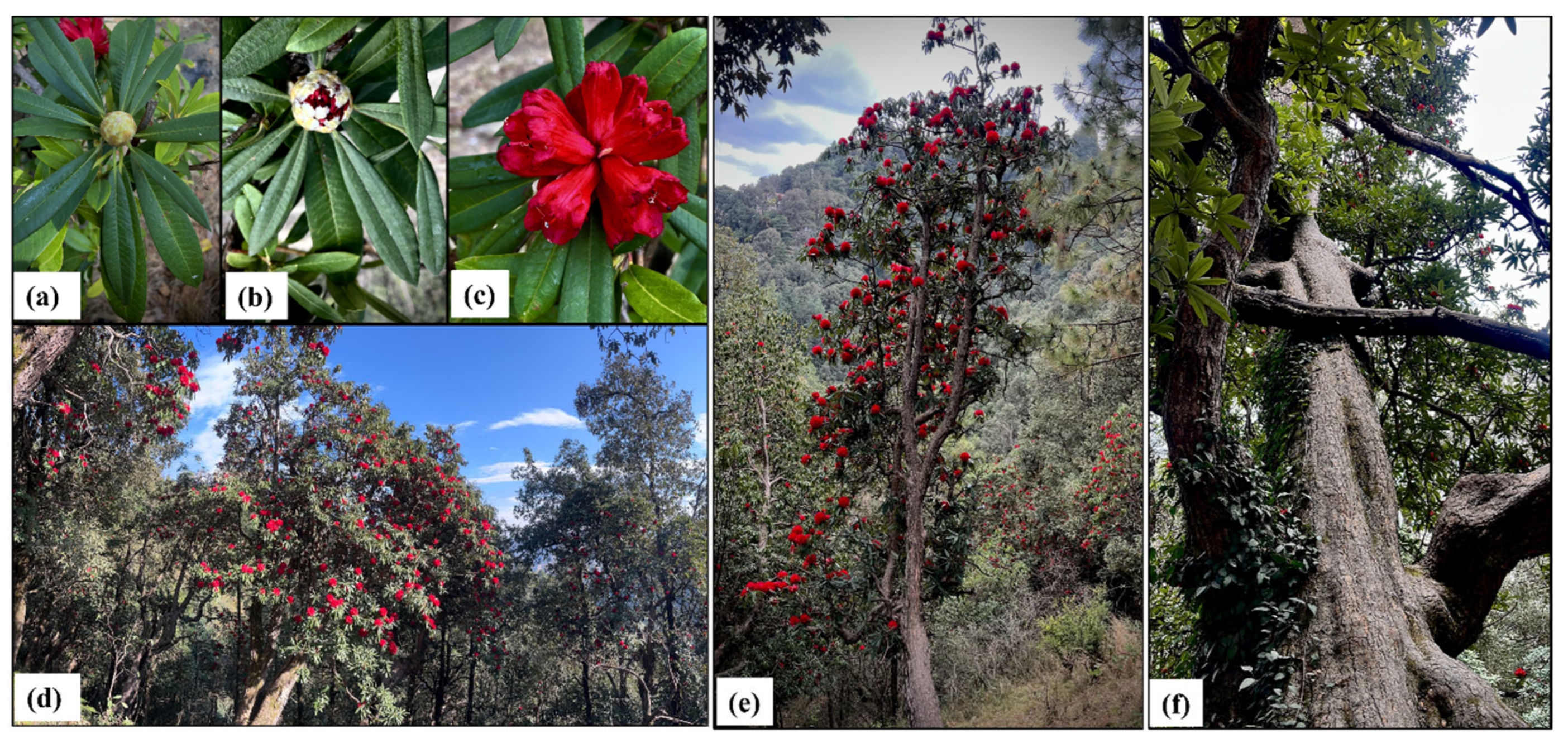
Figure 2. Phenological stages of Rhododendron arboreum and representative mature trees: (a) bud initiation; (b) bud burst; (c) full flowering (Anthesis); (df) mature tree architecture in the study area.
Environments 13 00138 g002
Figure 3. The methodological framework for modeling Rhododendron arboreum distribution using the MaxEnt model.
Environments 13 00138 g003
Figure 4. The Bray–Curtis dissimilarity dendrogram showing the clustering of sites based on the Importance Value Index (IVI) of co-occurring tree species. Clusters C1 and C2 represent distinct ecological associations.
Environments 13 00138 g004
Figure 5. MaxEnt model performance and variable importance: (a) the Receiver Operating Characteristic (ROC) curve showing model accuracy (AUC = 0.91); (b) the Jackknife evaluation showing the proportional contribution of environmental variables.
Environments 13 00138 g005aEnvironments 13 00138 g005b
Figure 6. Predicted current habitat suitability map (1970–2000) for Rhododendron arboreum in Himachal Pradesh, categorized by probability of occurrence.
Environments 13 00138 g006
Figure 7. Projected distribution models of Rhododendron arboreum under SSP 126, SSP 245, SSP 370, and SSP 585 for the period 2070s.
Environments 13 00138 g007
Figure 8. Projected distribution models of Rhododendron arboreum under SSP 126, SSP 245, SSP 370, and SSP 585 for the period 2090s.
Environments 13 00138 g008
Figure 9. The potential shifts in Rhododendron arboreum distribution under different SSP scenarios for the 2070s were evaluated by contrasting projected maps with the species’ present distribution.
Environments 13 00138 g009
Figure 10. The potential shifts in Rhododendron arboreum distribution under different SSP scenarios for the 2090s were evaluated by contrasting projected maps with the species’ present distribution.
Environments 13 00138 g010
Figure 11. Priority areas for the conservation of Rhododendron arboreum in Himachal Pradesh. Here, WLS = Wildlife sanctuary.
Environments 13 00138 g011
Table 3. Projected temporal changes (%) in habitat suitability area for Rhododendron arboreum under CMIP6 scenarios (2070s and 2090s).
Time Period ModelClimate Scenario Change in Unsuitable (%)Change in Low Suitability (0.2–0.4) (%)Change in Moderate Suitability (0.4–0.6) (%)Change in High Suitability (0.6–0.8) (%)Change in Very High Suitability (0.8–1) (%)Total Suitable Area
Current (km2) 51,165.012701.151042.39609.82154.644508
2070sBCC-CSM2-MRSSP 126 −2.31−17.345.9538.04876.9126.21
SSP 245−8.54−6.5673.55225.121557.1196.94
SSP 370−3.52−24.5524.0073.321142.0139.94
SSP 585−1.93−34.7823.3767.58820.7721.86
IPSL-CM6A-LRSSP 1260.33−16.01−14.00−6.22289.16−3.75
SSP 2456.73−75.43−73.83−81.58−88.68−76.34
SSP 3707.42−78.23−90.06−97.13−99.53−84.26
SSP 5857.31−78.75−84.33−95.33−100.00−83.01
MIROC6SSP 126−7.00−26.3033.94151.431948.6379.42
SSP 245−4.39−21.9662.63123.68926.4449.84
SSP 370−5.89−11.2689.78160.89904.2666.80
SSP 5850.59−13.12−7.56−6.22110.86−6.65
2090sBCC-CSM2-MRSSP 126−1.44−14.201.8228.83597.1916.29
SSP 245−10.22−24.0646.61110.653051.00115.99
SSP 370−0.31−36.97−13.0914.47780.683.56
SSP 585−1.68−27.92−4.4147.25886.3419.05
IPSL-CM6A-LRSSP 1263.63−55.09−42.13−38.40196.70−41.20
SSP 2456.74−72.02−81.46−84.09−92.45−76.54
SSP 3708.13−89.36−95.03−98.45−100.00−92.27
SSP 5856.74−76.86−76.49−77.99−64.62−76.50
MIROC6SSP 126−5.993.0560.2580.741205.2268.03
SSP 245−5.87−24.2262.77168.781275.0366.57
SSP 3701.05−3.56−23.79−50.2472.65−11.94
SSP 585 1.89−37.11−31.70−33.49367.93−21.47
Disclaimer/Publisher’s Note: The statements, opinions and data contained in all publications are solely those of the individual author(s) and contributor(s) and not of MDPI and/or the editor(s). MDPI and/or the editor(s) disclaim responsibility for any injury to people or property resulting from any ideas, methods, instructions or products referred to in the content.