Article

Research on Enhancing the Performance of Pre-Treatment Systems for Saline–Alkaline Agricultural Drainage in Southern Xinjiang

1
Northwest Oasis Water-Saving Agriculture Key Laboratory, Ministry of Agriculture and Rural Affairs, Shihezi 832000, China
2
College of Water Conservancy and Civil Engineering, Tarim University, Alar 843300, China
3
The Institute of Seawater Desalination and Multipurpose Utilization, MNR, Tianjin 300192, China
4
Institute of Field Irrigation and Soil Fertilizer, Xinjiang Academy of Agricultural and Reclamation Science, Shihezi 832000, China
*
Author to whom correspondence should be addressed.
These authors contributed equally to this work.
Environments 2025, 12(12), 471; https://doi.org/10.3390/environments12120471
Submission received: 27 October 2025 / Revised: 29 November 2025 / Accepted: 2 December 2025 / Published: 4 December 2025

Abstract

Freshwater scarcity in southern Xinjiang has intensified the need for effective utilization of saline–alkaline agricultural drainage. This study evaluates pre-treatment technologies for reverse osmosis (RO) systems to improve water quality and mitigate membrane fouling. Three processes were tested: coagulation–sedimentation–media filtration (G1), micro-flocculation–media filtration (G2), and micro-flocculation (G3) combined with ultrafiltration and varying polyaluminum chloride (PAC) dosages (0–15 mg·L−1). Results show that G1 and G2 significantly outperform G3 in removing turbidity, organic matter, and inorganic ions, achieving SDI15 < 5 and turbidity < 0.3 NTU, meeting RO feedwater standards. Optimal performance occurred at the 7.5–10 mg·L−1 coagulant dosage range, effectively controlling flux decline and fouling. The integrated pre-treatment–ultrafiltration system provides a robust technical framework for saline–alkaline water desalination, offering practical guidance for sustainable water resource utilization in arid agricultural regions.

1. Introduction

Water scarcity and pronounced imbalances between supply and demand are major bottlenecks constraining sustainable economic development in arid regions [1]. To address the severe challenges posed by freshwater shortages, seawater desalination technology has gradually become a key technical support for obtaining freshwater resources in arid, semi-arid and coastal regions [2,3]. Large-volume flood irrigation for salt leaching is commonly used in the process of ameliorating saline–alkali land [4,5]. This process generates large quantities of saline–alkali drainage water characterized by high mineralization, high hardness, and excessive organic matter, for which there is currently no systematic strategy for resource utilization [6]. This not only results in resource wastage but also poses risks of secondary salinization and ecological degradation to downstream desert ecosystems. Therefore, the rational development and utilization of the abundant saline–alkali water resources with great exploitation potential in southern Xinjiang [7,8,9] are of great importance for alleviating the water crisis and improving salinized soils [10,11].
Reverse osmosis (RO) technology, owing to its high desalination efficiency, low energy consumption, and convenient operation, has been widely applied in seawater and brackish water desalination [12]. However, membrane fouling and scaling-induced flux decline, shortened membrane lifetime, and increased operating costs pose major challenges to its practical application [13]. As the “front-end barrier” in membrane-based desalination processes, the pre-treatment stage directly determines product water quality, energy efficiency, and the overall operating costs of the system [14]. Efficient pre-treatment is therefore crucial for ensuring the long-term and stable operation of RO systems. Pre-treatment technologies for RO systems mainly comprise conventional processes (such as coagulation, sedimentation, filtration, oxidation, and adsorption) and membrane-based processes (such as microfiltration and ultrafiltration) [15]. Although both types of pre-treatment can effectively mitigate fouling in RO systems, the quality of saline–alkali water varies markedly among regions due to differences in pollution sources [16]. When treating such water sources, single pre-treatment processes often suffer from technical bottlenecks, including excessive chemical consumption, suboptimal filtration performance, and poor resistance to water quality fluctuations, which, if not properly controlled, can readily lead to fouling and clogging in RO systems [17,18]. In contrast, integrated pre-treatment technologies can effectively overcome the limitations of single-unit processes in removing complex contaminants, thereby providing complementary and synergistic benefits [19,20]. Previous studies have shown that the addition of coagulants can enhance the filtration performance of the pre-treatment system [21], improve product water quality, and mitigate fouling in downstream membrane units [22,23]. These improvements, in turn, exert a decisive influence on the operating costs and service life of the desalination system [24,25]. When conventional seawater desalination technologies are applied to the treatment of agricultural saline–alkali drainage, they face the dual challenges of high energy consumption and severe membrane-fouling risks [26,27]. By comparison, membrane-based integrated pre-treatment technologies can significantly alleviate these problems. It has been reported that micro-flocculation–filtration technology, which couples coagulation and filtration units while omitting the sedimentation step, not only reduces capital investment and chemical consumption, but also provides stable, high-quality product water, making it particularly suitable for treating slightly polluted water sources characterized by low temperature, low turbidity, and low color [28].
Based on an analysis of the local agricultural saline–alkali water quality characteristics, this study investigates the effects of different pre-treatment processes and their operational parameters on filtration performance, and elucidates the relationship between the product water quality of the pre-treatment system and membrane fouling. The objective is to identify suitable pre-treatment processes and operational parameters for the desalination of agricultural saline–alkali drainage in southern Xinjiang, thereby providing valuable insights for developing new agricultural water-resource recycling models in arid regions.

2. Materials and Methods

2.1. Test Site and Raw Water Quality

The present study was conducted through field experiments at the 23rd Brigade of the 13th Regiment, First Division of the Xinjiang Production and Construction Corps, located in Alar City, China (40°32′17″ N, 81°31′57 ″E). The water intake point is the primary drainage channel of Alar City, which has an annual basin runoff of approximately 4.73 × 10⁷ m3. Its water quality and discharge volume are relatively stable and therefore considered representative. The characteristics of the raw water are shown in Table 1.

2.2. Experimental Design

The present study employed a split-plot design, with pre-treatment process combinations constituting the main plots (G1: coagulation–sedimentation–media filtration, G2: micro-flocculation–media filtration, G3: micro-flocculation), and coagulant dosage serving as the subplots 0, 2.5, 5, 7.5, 10, 12.5, and 15 mg·L−1 (T1–T7), resulting in 21 treatment configurations. The permeate water quality obtained under different pre-treatment processes and coagulant dosages was comparatively analyzed to identify the optimal pre-treatment scheme. On this basis, a pre-treatment–ultrafiltration integrated system was constructed to mitigate specific flux decline and suppress membrane fouling and scaling.
Materials: Polyaluminum chloride (PAC, 28% purity) was purchased from Ruihua Water Purification Materials Co., Ltd. (Zhengzhou, Henan, China). AFM active glass filter media was supplied by Daisila Technology Group Co., Ltd. (Guangzhou, China). Quartz sand was obtained from Xinjiang Yihuaipudao Environmental Protection Equipment Co., Ltd. (Urumqi, China). The ultrafiltration membrane was procured from Guangdong Jucheng Bayer Technology Co., Ltd. (Guangzhou, China), with a pore size of 0.1 μm, a molecular weight cut-off of 100 kDa, and an operating pressure of 0.1–0.2 MPa.
The pre-treatment system was designed with a processing capacity of 1 m3/h. The mixing unit employed polyaluminum chloride (28% purity), which was dosed using a peristaltic pump. The hydraulic retention time (HRT) of the inclined-plate sedimentation tank was set to 30 min. The media filtration system adopted a two-stage configuration: the first-stage media filter used quartz sand as the filter medium (particle size: 2–4 mm), while the second-stage filter utilized AFM (Activated Filter Media) glass media (particle size: 0.4–1 mm). The thickness of each filter layer was maintained uniformly at 1.0–1.2 m.

2.3. Testing Metrics and Methods

2.3.1. Determination of Physicochemical Properties of Water

Turbidity in the water samples was measured using a WZS-172 turbidity meter (Leici, Shanghai, China). The silt density index (SDI15) was determined with an SDI tester (QZDY Pollution Index Tester, Shanghai, China). The concentration of Cl ions was analyzed using a fully automated chemical analyzer (SmartChem 200, Westco Scientific Instruments Inc., Brookfield, CT, USA), while the concentration of Na+ ions was measured using a flame photometer (FP6410, Shanghai Precision Instruments Co., Ltd., Shanghai, China). The concentrations of Ca2+ and Mg2+ ions were determined using the ethylenediaminetetraacetic acid (EDTA) titration method.

2.3.2. Determination of Organic Matter Indicators

Chlorophyll content in the water samples was determined in strict accordance with the technical specifications of Measurement of Phytoplankton in Water Quality—Filter Membrane-Spectrophotometric Method (HJ 1215-2021) [29]. During the experiment, water samples were periodically collected at each sampling point, filtered through a membrane using 1 L of sample water, rapidly frozen with liquid nitrogen, and subsequently stored at −80 °C in an ultra-low-temperature freezer. Quantitative analysis was conducted by measuring the absorbance of particulate matter retained on the membrane. Before testing, the filter membrane was soaked in methanol for 4 h to extract non-algal pigments, and a blank membrane was used as the reference. The phytoplankton content was then calculated based on the absorbance difference. Total organic carbon (TOC) was determined using high-temperature catalytic oxidation with nondispersive infrared detection (Shimadzu TOC-L; ISO 8245:1999) [30]. Ultraviolet absorbance (UV254) was measured using a UV-visible spectrophotometer at a wavelength of 254 nm.

2.3.3. Metal Ion Determination

The water samples were acidified with 1% HNO3 and stored in polypropylene bottles. Iron and manganese ions were determined by flame atomic absorption spectrometry (FAAS), with Fe analyzed at 248.3 nm and Mn at 279.5 nm. A 0.1% LaCl3 solution was added to eliminate interference from coexisting ions. Aluminum ions were determined by graphite furnace atomic absorption spectrometry (GFAAS) using a pyrolytic-coated graphite tube. A 0.5% Mg(NO3)2 matrix modifier was added, with the temperature program set as 110 °C (drying), 1300 °C (ash), and 2500 °C (atomization). The calibration curves for each element exhibited a linear correlation coefficient (R2) greater than 0.995.

2.3.4. Membrane Flux

The ultrafiltration membrane was soaked in ultrapure water for at least 24 h, during which the water was replaced 2–3 times to remove the protective coating on the membrane surface. Before conducting the filtration test, the membrane was pre-filtered with ultrapure water, and the experiment was initiated once the system flux had stabilized. During the experiment, an electronic balance was used to record the real-time weight of the permeate from the ultrafiltration system, which was then used to calculate the membrane flux ratio, defined as J/J0.
J0 is the membrane flux during ultrapure water filtration; J is the membrane flux when the water produced from medium filtration is used as the water source.
Membrane flux calculation formula:
J = V A t
In the formula, J is the membrane flux (m3·m−2·h−1); V is the filtration volume of the ultrafiltration system (m3); A is the membrane area (m2); and t is the filtration time (h).

2.4. Data Processing and Analysis

Data processing was conducted using Microsoft Excel 2019. 8. Analysis of variance (ANOVA) and significance testing were conducted with SPSS 26 (IBM Corp., Chicago, IL, USA). Origin 2021 and Microsoft PowerPoint 2019 were employed for graph plotting. The entropy weight-TOPSIS multi-objective decision analysis method was employed to evaluate the optimal solution for pre-treatment processes and dosing amounts.

3. Results and Analysis

3.1. Comparative Analysis of the Optimal Flocculation Conditions for the Pre-Treatment Unit

3.1.1. Removal Performance of the Pre-Treatment Unit for Particulate Matter in Water

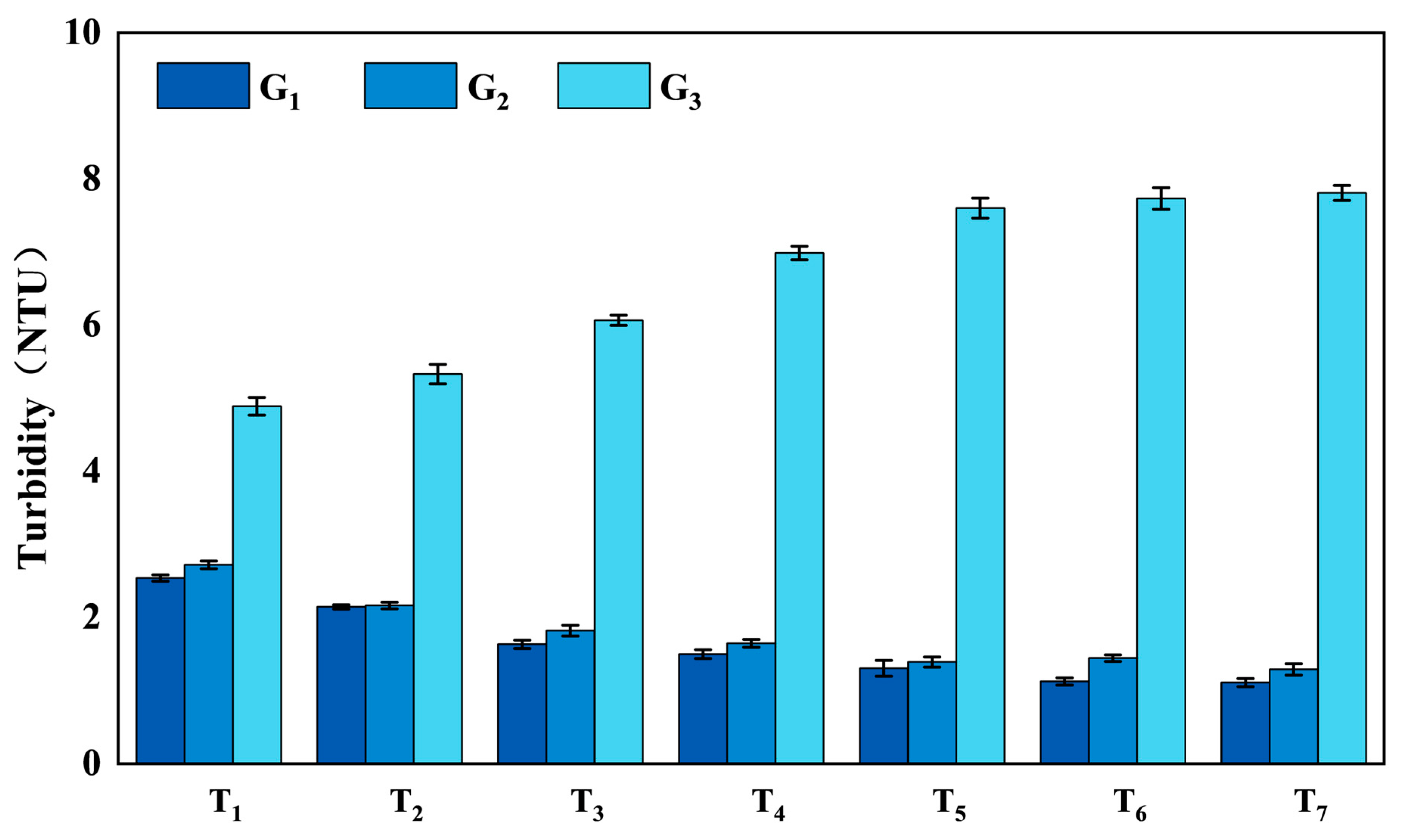
The removal efficiency of turbidity in water under different coagulant dosage conditions for each pre-treatment process is shown in Figure 1. In the context of the G1 and G2 processes, an increase in chemical dosage resulted in a reduction in the turbidity of the system’s treated water. The turbidity removal rates at T2–T6 exhibited an enhancement of 4.41–13.24% in comparison to T1. However, the G3 pre-treatment process proved ineffective in achieving adequate turbidity removal, and the application of higher chemical dosages resulted in an increase in the turbidity of the treated water. At equivalent chemical dosages, the G1 and G2 processes exhibited superior particulate removal performance in comparison to G3, achieving turbidity removal rates that were 44.89% and 46.37% higher than those of G3, respectively. The interaction of pre-treatment processes and dosage was found to be a significant factor in the performance of G1T7 treatment, which exhibited optimal particulate removal performance, showing improvements of 13.23% to 34.98% over CK (control without coagulant addition).

3.1.2. Removal Performance of the Pre-Treatment Unit for Organic Matter in Water

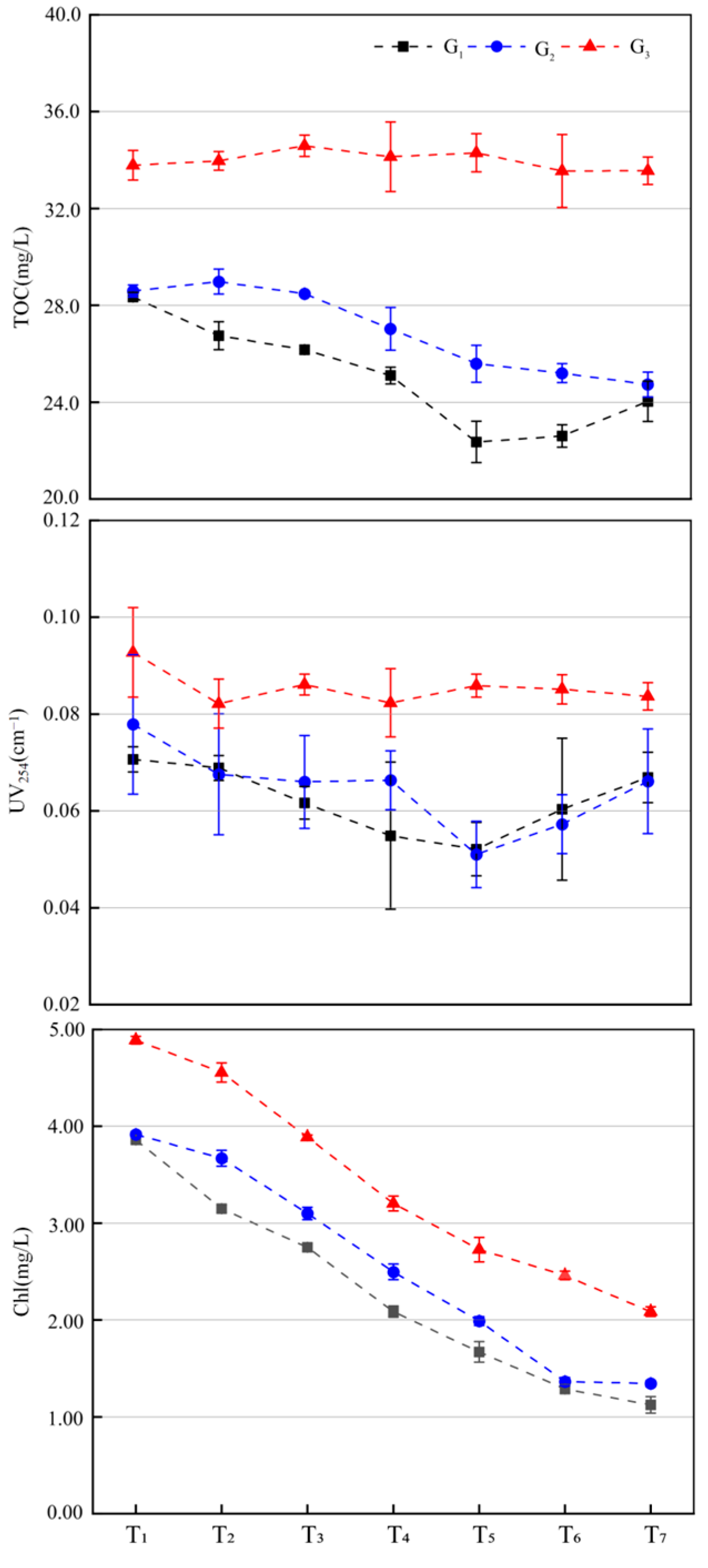
The removal effects of the pre-treatment units on chlorophyll (Chl), TOC, and UV254 in water under different coagulant dosages are shown in Figure 2. The results show that the G1 and G2 pre-treatment units performed better than G3 in removing Chl, TOC, and UV254, with removal rates improving by 16.39% and 21.78% (Chl), 19.62% and 24.89% (TOC), and 21.71% and 24.19% (UV254), respectively. The Chl removal rate increased monotonically with the coagulant dosage, achieving optimal removal at 15 mg·L−1. However, the removal effects of UV254 and TOC exhibited threshold values, with the best removal effects occurring at 10 mg·L−1 (T5) and 12.5 mg·L−1 (T6), respectively.

3.2. Filtration Effectiveness and Membrane Fouling Process of the Integrated Pre-Treatment

3.2.1. Removal Efficiency of Turbidity and Organic Matter

The filtration effect of the integrated pre-treatment units on water pollutants is shown in Table 2. A significant interaction between the integrated pre-treatment units and coagulant dosage was observed for the removal of turbidity and organic matter. The study showed that the permeate water quality was substantially improved following integrated pre-treatment, with turbidity removal rates exceeding 97.22% and permeate turbidity maintained below 0.3 NTU. These values meet the feed-water requirements of reverse osmosis systems (turbidity < 1 NTU, preferably <0.3 NTU). Compared with G3-UF, the G1-UF and G2-UF pre-treatment processes demonstrated enhanced removal efficiencies for TOC, UV254, and chlorophyll, with increases of 3.10% and 12.48% (TOC), 10.11% and 10.91% (UV254), and 3.14% and 3.66% (Chl), respectively. Furthermore, increasing the coagulant dosage significantly improved the removal of organic matter. For the T2–T6 treatments, the removal rates were higher than those of T1 by 1.67–10.31% (TOC), 5.56–24.31% (UV254), and 2.06–4.38% (Chl).

3.2.2. Effects of Specific Flux and SDI15 on Ultrafiltration Membrane Fouling

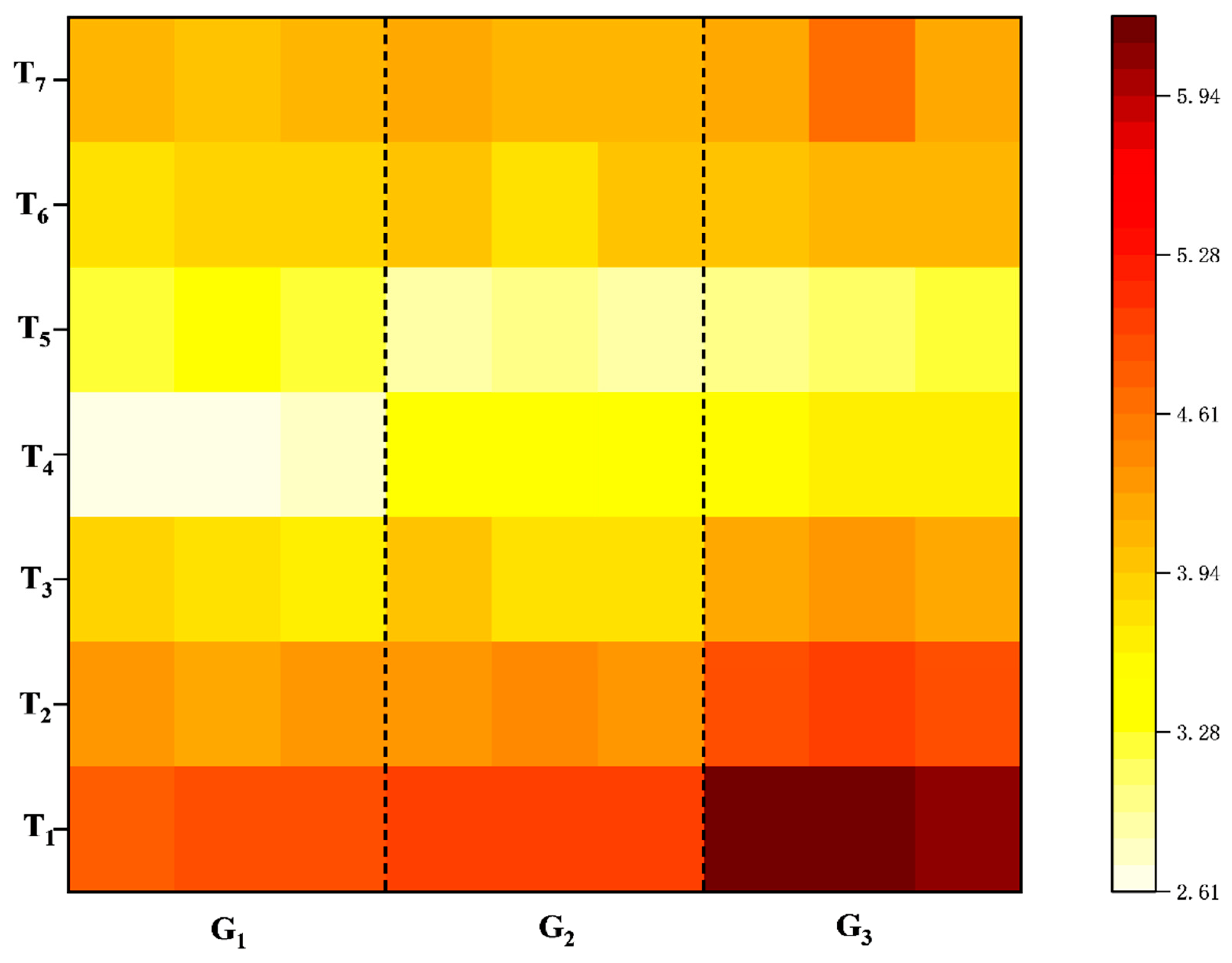
The study found that the raw water and the permeates from the G1, G2, and G3 pre-treatment units all exceeded the measurement range of the SDI15 test, indicating that they failed to meet the reverse osmosis feed-water requirement (SDI15 < 5). As shown in Figure 3, coupling the pre-treatment processes with ultrafiltration significantly reduced the SDI15 values of the permeates. Notably, the SDI15 values for the G1-UF and G2-UF integrated pre-treatments were both below 5, with reductions of 9.76% and 12.34%, respectively, compared with the G3-UF process. With increasing coagulant dosage, the SDI15 removal performance of each integrated pre-treatment unit exhibited a nonlinear pattern, initially declining and subsequently improving. Among all treatment combinations, G1T4-UF achieved the greatest reduction in SDI15, with a decrease of 2.7 in the permeate.
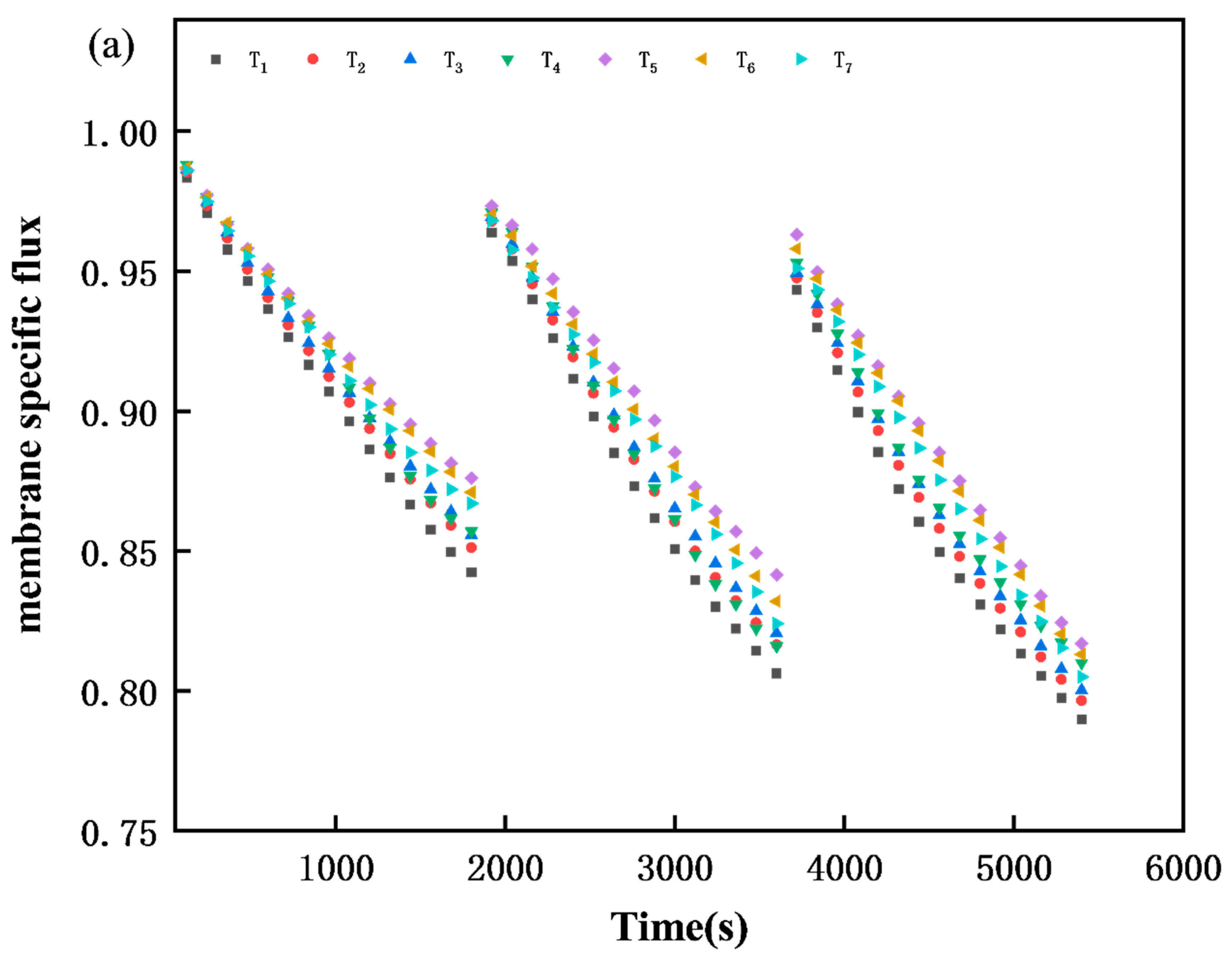
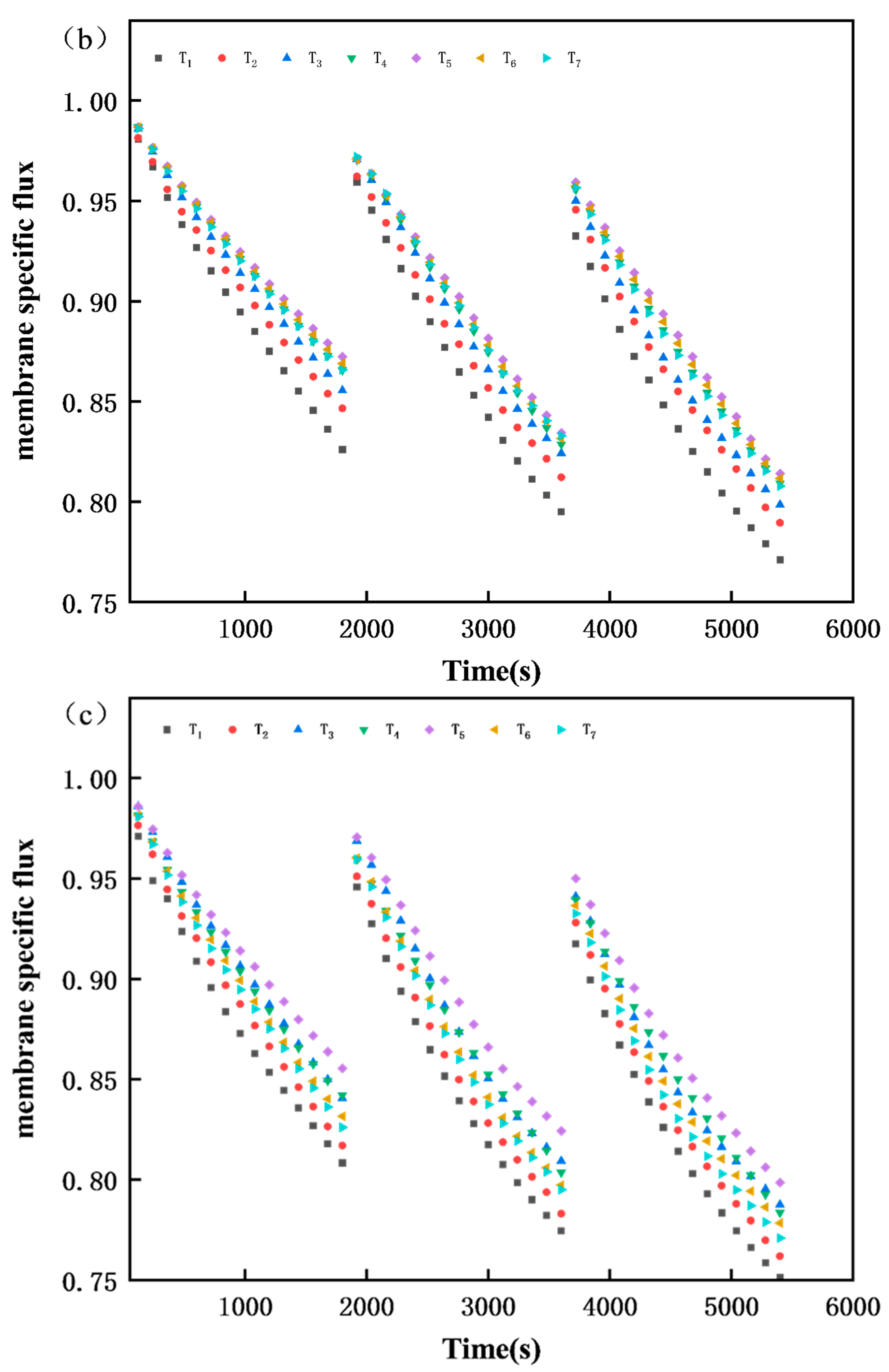
The variation in membrane specific flux decay for each integrated pre-treatment unit under increasing coagulant dosage is shown in Figure 4. As the system operating time increased, the application of conventional hydraulic backwashing partially restored the membrane specific flux; however, an overall declining trend remained evident across all integrated pre-treatment units. Notably, specific flux decay in the G1-UF and G2-UF units was more effectively controlled compared with the G3-UF unit. In addition, as the coagulant dosage increased, the specific flux decay of each integrated pre-treatment unit first decreased and then increased. Among all treatments, G1T4 and G2T4 exhibited the lowest specific flux decay values, reaching 0.81, and all pre-treatment processes showed better control over membrane flux decay rate after coagulant addition compared to CK (no coagulant added).

3.2.3. Removal Effectiveness of the Integrated Pre-Treatment Unit for Ions in Water

The removal effectiveness of each integrated pre-treatment unit for inorganic salt ions in water is shown in Table 3. The results indicate that both the type of integrated pre-treatment unit and the coagulant dosage significantly influenced the permeate water quality, with a notable interaction observed between the two factors. As shown in Table 3, the G1-UF and G2-UF pre-treatment units exhibited better removal performance for inorganic pollutants in water than G3-UF, with improvements of 11.26–13.31% (Ca2+), 9.64–11.74% (Mg2+), 3.57–4.55% (Al3+), and 1.38–1.82% (EC), respectively. Furthermore, increasing the coagulant dosage further enhanced the filtration performance of each pre-treatment system. For the T2–T6 treatments, the removal rates of inorganic salt ions were higher than those of T1 by 4.98–11.51% (Ca2+), 3.30–12.32% (Mg2+), and 3.41–8.38% (EC).

3.3. Comprehensive Evaluation Based on Entropy Weight-TOPSIS Method

The present study employed the entropy-weighted TOPSIS method for comprehensive evaluation in order to determine the effects of different pre-treatment processes on turbidity, SDI15, membrane specific flux, organic pollutants, and inorganic pollutants (Table 4). The evaluation encompassed target weighting, Euclidean distance, comprehensive score calculation, and TOPSIS ranking of varying coagulant dosage combinations across pre-treatment systems. Using the entropy-weighting approach, the relative weights of the indicators were determined as follows: UV254 (13.39%), TOC (23.41%), chlorophyll (11.59%), SDI15 (6.47%), Turbidity (16.08%), Al3+ (20.16%), and membrane specific flux (8.90%). Based on the comprehensive TOPSIS scores, the top three performing systems were G1T5, G1T6, and G1T4.

4. Discussion

Agricultural saline–alkaline drainage differs fundamentally from typical seawater or industrial wastewaters: it is characterized by high mineralization and salt accumulation and is frequently subject to variable pollutant loads-such as residual agrochemicals and episodic algal blooms. These conditions engender complex interactions among colloids, dissolved electrolytes and organic matter, undermining the ability of conventional pretreatment to simultaneously remove particulate colloids and control dissolved organics. In practice, this complexity accelerates membrane fouling, increases cleaning frequency, and substantially raises energy consumption, thereby constituting a major technical barrier to the wider deployment of desalination for this water source. Selecting an appropriate pre-treatment process is crucial for ensuring the long-term, stable operation of reverse osmosis systems and directly influences the service life of reverse osmosis membranes [31,32,33]. The findings of this study indicate that, compared with the G3 treatment, the G1 and G2 pre-treatment processes exhibit superior removal efficiencies for particulate matter and organic pollutants. This suggests that coagulation alone is insufficient for effectively filtering and intercepting contaminants in saline–alkaline water and further confirms that the incorporation of a media filtration unit can substantially enhance the removal of particulate matter and algal-derived organic substances. These results are consistent with the findings reported by Namazi et al. [34]. Several studies have similarly demonstrated that the addition of coagulants is essential for improving the filtration efficiency of pre-treatment systems [35,36,37]. as coagulants promote electro neutralization of colloidal particles in water, thereby facilitating floc formation and enhancing the removal performance of media filtration [38]. However, the experimental results of this study clearly show that conventional pre-treatment processes (G1, G2, G3) are inadequate for effectively removing SDI15-forming particles from saline–alkaline agricultural drainage in southern Xinjiang. As a result, the permeate water quality fails to meet the feed-water requirements for reverse osmosis systems (SDI15 < 5) [39].
Membrane separation technology employs semi-permeable membranes to selectively permit the passage of specific substances, thereby achieving efficient separation of salts and impurities. Previous studies have reported that integrated technologies can effectively overcome the technical bottlenecks of membrane fouling and clogging associated with the limited filtration efficiency and poor resistance to water-quality fluctuations observed in traditional pre-treatment processes [40]. In this study, the integration of the three pre-treatment processes (G1, G2, G3) with ultrafiltration significantly improved system performance, enabling both permeate turbidity and SDI15 to meet the feed-water requirements for reverse osmosis. This improvement is primarily attributed to the ultrafiltration membrane’s high-efficiency retention of suspended solids, bacteria, and macromolecular organic matter [41], which substantially enhances the feed-water quality for subsequent reverse osmosis treatment [42]. The integrated process demonstrated strong adaptability for treating the specific saline–alkaline water sources investigated in this study. Through synergistic coupling effects, it improved permeate water quality while effectively addressing the limitations of filtration efficiency in conventional pre-treatment processes and mitigating the issues of fouling and clogging in single membrane separation units. Furthermore, the experimental data revealed a significant correlation between the removal efficiency of particulate matter and organic matter in the pre-treatment units and both SDI15 and the membrane specific flux decay rate, consistent with the findings of Zhao et al. [28].
The causes of membrane fouling and clogging are closely associated with the presence of inorganic ions such as calcium and magnesium carbonates and metal hydroxides in water [43]. In coagulation-sedimentation units, colloidal calcium and magnesium are primarily removed through chemical precipitation (CaCO3/Mg(OH)2 crystallization) and co-precipitation. In contrast, ultrafiltration relies on membrane pores to retain these precipitated colloids but cannot effectively remove dissolved ions. In this study, it was observed that increasing the coagulant dosage led to elevated concentrations of calcium, magnesium, and aluminum ions in the water. When the coagulant dosage was below 10 mg·L−1, no significant difference in aluminum concentration was observed among the permeates of the G1-UF, G2-UF, and G3-UF systems. However, when the dosage exceeded 10 mg·L−1, aluminum concentrations increased markedly, indicating that excessive coagulant remained unreacted in the water [28]. Therefore, when applying coagulants, it is essential to account for the threshold dosage range. Moreover, the three pre-treatment processes exhibit limited removal of calcium and magnesium ions. To effectively mitigate membrane flux decline and the increased energy consumption associated with inorganic scaling (e.g., Ca2+ and Mg2+ deposition on the membrane surface), the appropriate addition of antiscalants prior to reverse osmosis feedwater is recommended [44], supplemented by routine chemical cleaning and maintenance to jointly reduce the risk of membrane fouling. Optimizing both the pre-treatment process and the coagulant dosage is an effective strategy for enhancing system retention efficiency and minimizing the fouling and clogging risks in membrane systems. Previous research has demonstrated that the filtration performance of pre-treatment systems does not exhibit a simple, linear positive correlation with coagulant dosage [45]. In this study, the pre-treatment schemes in G1–G3 all exhibited superior membrane-fouling control under the coagulant dosage condition T5. This observation can be explained by a “critical-threshold” effect in coagulation–ultrafiltration systems. At an optimal dosage near T5, the coagulant promotes aggregation of colloidal particles through charge neutralization and bridging/sweep flocculation, producing large, mechanically robust flocs that are readily retained by the ultrafiltration membrane. Such aggregation substantially reduces pore blocking and cake-layer resistance, thereby maintaining higher membrane flux and a lower flux-decline rate. By contrast, dosages that exceed this threshold can be detrimental: excessive dosing may cause over-neutralization or charge reversal, leading to colloid re-stabilization or formation of fragile flocs that readily break apart; additionally, surplus coagulant can accumulate on the membrane surface to form an adhesive layer or increase stickiness, ultimately accelerating membrane fouling. This indicates that a clear dosage threshold exists for coagulants in the pre-treatment system. Exceeding the optimal dosage range leads to residual coagulant remaining in the water, which then becomes an additional source of contamination and exacerbates membrane fouling [46]. Therefore, optimizing the coagulant dosage is essential for controlling membrane-fouling rates and reducing system operating costs. In particular, precise dosage control is critical for preventing irreversible fouling of reverse osmosis membranes caused by residual aluminum ions. In this study, no significant differences in aluminum concentrations were observed among the permeates of the pre-treatment systems at low to moderate coagulant dosages (<10 mg·L−1). However, at higher dosages (10–15 mg·L−1), aluminum concentrations increased significantly, likely due to the incomplete reaction and subsequent persistence of excess coagulant in the water [28]. These findings underscore the need for appropriate pre-treatment configuration and strict coagulant dosage control to ensure effective filtration performance and prevent contamination of the membrane system. By reducing both membrane-fouling rates and coagulant consumption, the overall operating costs of the system can be further minimized. In summary, practical engineering applications should determine the pre-treatment scheme and optimal coagulant dosage strictly based on the specific water-quality characteristics of the source water.
The operating parameters of the pre-treatment unit are critical for ensuring the safe, stable, and long-term operation of the ultrafiltration system. In this study, periodic hydraulic backwashing effectively restored the flux of the ultrafiltration membrane, indicating that regular backwashing is an essential measure for maintaining flux recovery. However, the flux recovery rate exhibited a gradual decline over time. This decline can be attributed to the formation of a cake layer on the membrane surface by certain pollutants, while other contaminants cause irreversible pore blockage within the membrane structure [47]. Research has shown that membrane pore clogging is the fundamental cause of irreversible flux decline. Although hydraulic backwashing can effectively remove the cake layer on the membrane surface, it has limited impact on pore blockages that have already formed [48]. In practical applications, periodic chemical cleaning (acid and alkali washing) and air–water mixed scrubbing are commonly implemented as enhanced cleaning strategies to restore ultrafiltration membrane flux and maintain permeate water quality and operational stability, thereby addressing issues such as pore clogging and flux decline. To determine the most suitable pre-treatment processes and operational parameters for reverse osmosis desalination of farmland saline–alkali drainage in southern Xinjiang, this study employed the entropy-weighted TOPSIS method to comprehensively evaluate permeate water quality, inorganic and organic pollutant removal, and membrane specific flux decay. Among all configurations, the coagulation–sedimentation–media filtration–ultrafiltration process demonstrated the best overall performance, followed by the micro-flocculation–media filtration–ultrafiltration process. Under the conditions of achieving high permeate quality (SDI15 < 3, Turbidity < 0.1 NTU) and effectively controlling membrane fouling, the micro-flocculation–media filtration process offers significant advantages. By eliminating the sedimentation unit, it reduces construction costs, lowers energy consumption, and minimizes land requirements. Compared with coagulation-sedimentation-media filtration and micro-flocculation alone, the micro-flocculation-media filtration-ultrafiltration process provides superior energy efficiency and overall treatment performance for saline–alkali agricultural drainage in this region. With precise control of coagulant dosage, this integrated process can serve as an effective pre-treatment strategy for saline–alkali drainage desalination in southern Xinjiang, substantially improving filtration performance and suppressing membrane fouling. Following further validation and optimization through pilot-scale studies, it is expected to become a competitive and practical pre-treatment solution for large-scale agricultural saline–alkali drainage desalination.

5. Conclusions

This study examines the selection of effective pre-treatment processes and strategies for controlling membrane fouling in the desalination of saline–alkaline agricultural drainage in southern Xinjiang. The experimental results demonstrate that incorporating flocculation and media filtration units significantly improves permeate water quality and reduces the risk of ultrafiltration membrane fouling. Moreover, precise coagulant dosing is critical for optimizing system performance, as it directly influences filtration efficiency and fouling mitigation. This study emphasizes that accurate dosage control is essential in practical applications to ensure stable and efficient system operation. The findings obtained in this work confirm the feasibility and effectiveness of the proposed integrated pre-treatment approaches for enhancing desalination performance in saline–alkaline farmland drainage. These results provide theoretical and technical support for developing robust pre-treatment strategies applicable to agricultural water reuse in arid regions.

Author Contributions

Z.S.: conceptualization, data curation, formal analysis, methodology, investigation, visualization, software, and writing—original draft. B.J.: conceptualization, methodology, and writing. P.H.: investigation, methodology, and formal analysis. Y.L.: methodology, formal analysis, and visualization. X.W. (Xiaoli Wang): conceptualization and methodology. X.W. (Xingpeng Wang): writing (review & editing), project administration, funding acquisition, conceptualization, supervision, and validation. All authors have read and agreed to the published version of the manuscript.

Funding

This work was supported by the Key Laboratory Open Project of the Corps (20230WSL-01); Financial and Technological Plan Project of the Corps (2023AB034); 2024 Annual Ministry-Province Cooperation Project (2024ZRBSHZ112).

Data Availability Statement

The original contributions presented in this study are included in the article. Further inquiries can be directed to the corresponding author.

Conflicts of Interest

The authors declare no conflicts of interest.

References

  1. Mugagga, F.; Nabaasa, B.B. The centrality of water resources to the realization of sustainable development goals (sdg). A review of potentials and constraints on the african continent. Int. Soil Water Conserv. Res. 2016, 4, 215–223. [Google Scholar] [CrossRef]
  2. Alenezi, A.; Alabaiadly, Y. Emerging technologies in water desalination: A review and future outlook. Energy Nexus 2025, 17, 100373. [Google Scholar] [CrossRef]
  3. Fthenakis, V.; Zhang, Z. Making production of water with desalination more sustainable. Nat. Water 2024, 2, 1057–1058. [Google Scholar] [CrossRef]
  4. Yang, S.; Miao, Q.; Shi, H.; Zhao, Y.; Liu, X.; Nie, X.; Feng, W.; Gonçalves, J.M.; Zhang, T.; Li, Y.; et al. Spatial and temporal heterogeneity of soil salinity and ionic coupling relationship under the water-saving renovation of a typical irrigation district in arid and semi-arid areas. Sci. Total Environ. 2024, 951, 175776. [Google Scholar] [CrossRef]
  5. Jat Baloch, M.Y.; Zhang, W.; Sultana, T.; Akram, M.; Shoumik, B.A.A.; Khan, M.Z.; Farooq, M.A. Utilization of sewage sludge to manage saline–alkali soil and increase crop production: Is it safe or not? Environ. Technol. Innov. 2023, 32, 103266. [Google Scholar] [CrossRef]
  6. Fang, S.; Tu, W.; Mu, L.; Sun, Z.; Hu, Q.; Yang, Y. Saline alkali water desalination project in southern xinjiang of china: A review of desalination planning, desalination schemes and economic analysis. Renew. Sustain. Energy Rev. 2019, 113, 109268. [Google Scholar] [CrossRef]
  7. Zhang, X.; Li, Y.; Li, F. Spatial distribution characteristics of soil water-salt gradients in the ecological buffer zone of arid zone lakes and their influencing factors. J. Clean. Prod. 2024, 444, 141299. [Google Scholar] [CrossRef]
  8. Zhou, B.; Liang, C.; Chen, X.; Ye, S.; Peng, Y.; Yang, L.; Duan, M.; Wang, X. Magnetically-treated brackish water affects soil water-salt distribution and the growth of cotton with film mulch drip irrigation in xinjiang, china. Agric. Water Manag. 2022, 263, 107487. [Google Scholar] [CrossRef]
  9. Xu, Q.; Xu, Y.; Xia, H.; Zhang, Q.; Li, P.; Liu, H.; Li, M.; Gong, P. Optimizing brackish water irrigation strategies: Promoting the ecological and economic benefits of salt wasteland utilization. Agric. Water Manag. 2025, 317, 109652. [Google Scholar] [CrossRef]
  10. Soni, S.; Jindal, M.K.; Tewari, P.K.; Anand, V. Potential and challenges of desalination technologies for arid and semiarid regions: A comprehensive review. Desalination 2025, 600, 118458. [Google Scholar] [CrossRef]
  11. Qadir, M.; Sharma, B.R.; Bruggeman, A.; Choukr-Allah, R.; Karajeh, F. Non-conventional water resources and opportunities for water augmentation to achieve food security in water scarce countries. Agric. Water Manag. 2007, 87, 2–22. [Google Scholar] [CrossRef]
  12. Aryanti, P.T.P.; Afred, M.Y.; Wardani, A.K.; Lugito, G.; Kadja, G.T.M.; Wenten, I.G.; Khoiruddin, K. Ultra low-pressure reverse osmosis (ulpro) membrane for desalination: Current challenges and future directions. Desalination 2023, 560, 116650. [Google Scholar] [CrossRef]
  13. Jiang, S.; Li, Y.; Ladewig, B.P. A review of reverse osmosis membrane fouling and control strategies. Sci. Total Environ. 2017, 595, 567–583. [Google Scholar] [CrossRef] [PubMed]
  14. Alayande, A.B.; Lim, J.; Kim, J.; Hong, S.; Al-Amoudi, A.S.; Park, B. Fouling control in swro desalination during harmful algal blooms: A historical review and future developments. Desalination 2022, 543, 116094. [Google Scholar] [CrossRef]
  15. Wang, Y.; Li, M.; Yang, H. A review on mitigation of pressure-driven membrane fouling by coagulation/flocculation as a pretreatment in membrane separation processes. Sep. Purif. Technol. 2025, 364, 132370. [Google Scholar] [CrossRef]
  16. Gao, L.; Yuan, Z.; Mao, X.; Ma, T. Salinity levels, trends and drivers of surface water salinization across china’s river basins. Water Res. 2025, 281, 123556. [Google Scholar] [CrossRef]
  17. Anis, S.F.; Hashaikeh, R.; Hilal, N. Reverse osmosis pretreatment technologies and future trends: A comprehensive review. Desalination 2019, 452, 159–195. [Google Scholar] [CrossRef]
  18. Sun, Q.; Han, Z.; Yan, H.; Fan, Z.; Dong, J.; Tian, J.; Geng, M.; Zhang, R. Identification of the pre-treatment effects on ultrafiltration membrane fouling behavior at a full-scale drinking water treatment plant. J. Environ. Chem. Eng. 2025, 13, 115758. [Google Scholar] [CrossRef]
  19. Li, B.; Qi, B.; Guo, Z.; Wang, D.; Jiao, T. Recent developments in the application of membrane separation technology and its challenges in oil-water separation: A review. Chemosphere 2023, 327, 138528. [Google Scholar] [CrossRef]
  20. Tripathy, P.; Kulkarni, H.V.; Kalla, S. Exploration of multifaceted domain of advanced membrane separation processes for wastewater treatment and desalination—A review. Desalination 2025, 614, 119133. [Google Scholar] [CrossRef]
  21. Guo, C.; Wang, Y.; Kang, X.; Zhu, J.; Cao, J.; Xu, D.; Wu, D.; Wang, F.; Lu, X.; Zhu, X. From irreversible to reversible: Systematic pretreatment strategies mitigate nanofiltration membrane fouling in drinking water production by altering fouling mechanisms. Desalination 2026, 620, 119620. [Google Scholar] [CrossRef]
  22. Knapik, E.; Chruszcz-Lipska, K.; Łukańko, Ł.; Wysocki, S. Reuse of flowback water from hydraulic fracturing for drilling mud preparation and secondary hydrocarbon recovery. Energies 2021, 14, 5921. [Google Scholar] [CrossRef]
  23. Wolska, M.; Urbańska-Kozłowska, H.; Solipiwko-Pieścik, A. An assessment of coagulation process efficiency as a pre-treatment for reusing filtration backwash in water treatment plants. Arch. Civ. Eng. 2025, LXXI, 225–240. [Google Scholar] [CrossRef]
  24. Choi, J.-K.; Paudel, A.; Sapkota, S.; Alsehli, M.; Alshamrani, A.; Park, J.; Hong, Y.; Romeiko, X. Comparative assessment of conventional and emerging desalination technologies: A holistic review for sustainable water solutions. Desalination 2025, 614, 119140. [Google Scholar] [CrossRef]
  25. Dolar, D.; Košutić, K.; Strmecky, T. Hybrid processes for treatment of landfill leachate: Coagulation/uf/nf-ro and adsorption/uf/nf-ro. Sep. Purif. Technol. 2016, 168, 39–46. [Google Scholar] [CrossRef]
  26. Khedher, M.; Phogat, V.; Chow, C.W.K.; Palmer, N.; Anese, J.; Tucker, A.; Petrie, P.; van den Akker, B.; Rameezdeen, R. Evaluation of current inland desalination of moderately saline brackish groundwater for expansion of irrigated agriculture. Groundw. Sustain. Dev. 2025, 29, 101449. [Google Scholar] [CrossRef]
  27. Seyed Sabour, S.M.J.; Ghorashi, B. A comprehensive review of major water desalination techniques and mineral extraction from saline water. Sep. Purif. Technol. 2024, 349, 127913. [Google Scholar] [CrossRef]
  28. Zhao, J.; Jiang, T.; Cheng, Y.; Cao, J. The influence of micro-flocculation on membrane fouling during ultrafiltration of dissolved organic matter. J. Water Process Eng. 2023, 56, 104361. [Google Scholar] [CrossRef]
  29. HJ 1215-2021; Water Quality—Determination of Phytoplankton—Filtration Membrane-Microscope Counting Method. Ministry of Ecology and Environment of the People’s Republic of China: Beijing, China, 2021.
  30. ISO-8245-1999; Water Quality—Guidelines for the Determination of Total Organic Carbon (TOC) and Dissolved Organic Carbon (DOC). International Organization for Standardization: Genève, Switzerland, 1999.
  31. Moon, J.; Son, S.; Kim, J.; Park, K. Critical challenges in high-salinity seawater reverse osmosis systems: Technical, energy, and environmental reviews. Desalination 2025, 607, 118811. [Google Scholar] [CrossRef]
  32. Tayeh, Y.A.; Alazaiza, M.Y.D.; Alzghoul, T.M.; Bashir, M.J.K. A comprehensive review of ro membrane fouling: Mechanisms, categories, cleaning methods and pretreatment technologies. J. Hazard. Mater. Adv. 2025, 18, 100684. [Google Scholar] [CrossRef]
  33. Yuan, W.; Chen, X.; Yu, Z.; Wan, Y.; Lin, J.; Ye, W. Critical review of membrane fouling in reverse osmosis treatment: Characterizations, models, mechanisms, and controls. Sep. Purif. Technol. 2025, 363, 132119. [Google Scholar] [CrossRef]
  34. Al Namazi, M.; Li, S.; Abdalrhman, A.S.; Amy, G.L.; Leiknes, T.; Ghaffour, N. Algal organic matter (aom) characterization and removal efficiency using various seawater desalination pretreatment techniques. Desalination 2025, 602, 118558. [Google Scholar] [CrossRef]
  35. Tomasi, I.T.; Santos, I.; Gozubuyuk, E.; Santos, O.; Boaventura, R.A.R.; Botelho, C.M.S. A sustainable solution for aquaculture wastewater treatment: Evaluation of tannin-based and conventional coagulants. Chemosphere 2025, 377, 144320. [Google Scholar] [CrossRef] [PubMed]
  36. Nguyen, T.A.; Nguyen, H.D.; Schmalz, B.; Tran, L.L. Coagulation/floculation as a key unit in the decentralized surface water treatment systems in upland rural areas of vietnam: Results from a lab scale to a pilot scale system. Process Saf. Environ. Prot. 2025, 194, 1194–1205. [Google Scholar] [CrossRef]
  37. Abo, L.D.; Jayakumar, M.; Jeyapaul, A.S.; Rangaraju, M.; Areti, H.A.; Assefa Adugna, A. Comprehensive review on co-integration of conventional systems and advanced oxidation processes for industrial and agricultural wastewater treatment applications. Environ. Adv. 2025, 20, 100638. [Google Scholar] [CrossRef]
  38. Wang, S.; Xu, Y.; Chen, S.; Shi, B.; Xu, H.; Ding, W.; Huang, X.; Zhang, K. Enhancement of sand filtration performance by titanium-chitosan micro-flocculation coupled with ferrate(vi) pre-oxidation. Sep. Purif. Technol. 2023, 327, 124911. [Google Scholar] [CrossRef]
  39. Harvey, N.J.; ur Rehman, Z.; Leiknes, T.; Ghaffour, N.; Urakawa, H.; Missimer, T.M. Organic compounds and microbial assessment of a seawater reverse osmosis facility at tampa bay water, USA. Desalination 2020, 496, 114735. [Google Scholar] [CrossRef]
  40. Xu, B.; Fu, Y.; Lu, X.; Li, Z.; He, M.; Teo, W.J.; Song, W.; Nghiem, L.D.; Bae, S.; Ng, H.Y. Integration of cao2/fe2+ and ultrafiltration acts as multiple-workfunctions pretreatment for seawater desalination during harmful algal blooms. Desalination 2024, 587, 117908. [Google Scholar] [CrossRef]
  41. Altmann, T.; Rousseva, A.; Vrouwenvelder, J.; Shaw, M.; Das, R. Effectiveness of ceramic ultrafiltration as pretreatment for seawater reverse osmosis. Desalination 2023, 564, 116781. [Google Scholar] [CrossRef]
  42. Guastalli, A.R.; Simon, F.X.; Penru, Y.; de Kerchove, A.; Llorens, J.; Baig, S. Comparison of dmf and uf pre-treatments for particulate material and dissolved organic matter removal in swro desalination. Desalination 2013, 322, 144–150. [Google Scholar] [CrossRef]
  43. Mustika, P.C.B.W.; Sutrisna, P.D.; Sutijan, S.; Petrus, H.T.B.M.; Sumardi, S.; Astuti, W. Understanding membrane fouling in pressure-driven and thermal-driven processes for brines applications: Challenges, mechanisms, characterization, mitigation strategies, and future perspectives. J. Water Process Eng. 2025, 72, 107631. [Google Scholar] [CrossRef]
  44. Tijing, L.D.; Woo, Y.C.; Choi, J.-S.; Lee, S.; Kim, S.-H.; Shon, H.K. Fouling and its control in membrane distillation—A review. J. Membr. Sci. 2015, 475, 215–244. [Google Scholar] [CrossRef]
  45. Yan, M.; Shen, X.; Gao, B.; Guo, K.; Yue, Q. Coagulation-ultrafiltration integrated process for membrane fouling control: Influence of al species and suva values of water. Sci. Total Environ. 2021, 793, 148517. [Google Scholar] [CrossRef] [PubMed]
  46. Xu, B.; Lu, X.; Fu, Y.; Diao, L.; Liang, H.; Bae, S.; Ng, H.Y.; Ma, J. Novel use of ferrous iron/peroxymonosulfate for high-performance seawater desalination pretreatment under harmful algal blooms. Water Res. 2023, 247, 120758. [Google Scholar] [CrossRef]
  47. Chen, J.; Qin, Q.; Liu, J.; Jia, H.; Wang, J. The mystery of ‘air resistance’ in submerged hollow fiber membranes: A controllable ‘irreversible fouling’. J. Membr. Sci. 2025, 727, 124079. [Google Scholar] [CrossRef]
  48. Dubovenko, R.; Dmitrenko, M.; Mikulan, A.; Puzikova, M.; Korovina, A.; Stanislavchuk-Abovskii, D.; Kuzminova, A.; Fetin, P.; Mazur, A.; Su, R.; et al. Blended cellulose nitrate/cellulose acetate membranes for enhanced water treatment performance in ultrafiltration. Carbohydr. Polym. 2025, 363, 123713. [Google Scholar] [CrossRef]
Figure 1. Effectiveness of each pre-treatment system in removing turbidity.
Environments 12 00471 g001
Figure 2. Comparative Analysis of Organic Matter Removal Efficiency in Pre-treatment Processes: TOC Concentration, UV254 Absorbance, Chl Content.
Environments 12 00471 g002
Figure 3. SDI15 Values of Product Water from Different pre-treatment Processes.
Environments 12 00471 g003
Figure 4. Decline of Membrane-Specific Flux under Different Pre-treatment Processes: (a) coagulation sedimentation ultrafiltration, (b) micro-flocculation media ultrafiltration filtration, and (c) micro-flocculation ultrafiltration.
Environments 12 00471 g004aEnvironments 12 00471 g004b
Table 1. Raw Water Quality Parameters for Agricultural Drainage.
IndicatorNumerical ValueIndicatorNumerical Value
Turbidity/NTU10.8 ± 1.09UV254/cm−10.096 ± 0.006
EC/(mS·cm−1)11.68 ± 1.94Chl/(mg·L−1)5.17 ± 0.33
Ca2+/(mg·L−1)308.14 ± 12.28TOC/(mg·L−1)35.89 ± 2.83
Mg2+/(mg·L−1)320.24 ± 23.26Al3+/(μg·L−1)286.97 ± 9.19
pH8.12 ± 0.14Na+/(mg·L−1)2137 ± 105.34
Cl/(mg·L−1)2619 ± 73.01
Note: The above values are all average values measured during the experiment.
Table 2. Filtration Performance of Contaminants Using Ultrafiltration Technology Coupled with Various pre-treatment Systems.
TreatmentsNTUTOCUV254Chl
G1-UFT10.24 ± 0.031 a17.19 ± 0.27 f0.060 ± 0.003 d0.50 ± 0.016 e
T20.26 ± 0.021 a16.22 ± 0.16 e0.052 ± 0.005 cd0.43 ± 0.006 d
T30.24 ± 0.035 a14.69 ± 0.59 d0.048 ± 0.007 bc0.40 ± 0.004 c
T40.24 ± 0.026 a13.29 ± 0.14 bc0.039 ± 0.008 ab0.39 ± 0.006 c
T50.25 ± 0.035 a12.48 ± 0.37 a0.034 ± 0.008 a0.35 ± 0.008 b
T60.25 ± 0.036 a12.81 ± 0.67 ab0.037 ± 0.006 ab0.31 ± 0.010 a
T70.24 ± 0.035 a13.55 ± 0.15 c0.038 ± 0.008 ab0.31 ± 0.008 a
G2-UFT10.24 ± 0.031 a19.29 ± 0.13 d0.060 ± 0.009 c0.53 ± 0.016 d
T20.27 ± 0.031 a19.17 ± 0.55 d0.053 ± 0.007 bc0.45 ± 0.008 c
T30.24 ± 0.030 a17.62 ± 0.59 c0.049 ± 0.007 abc0.41 ± 0.004 b
T40.27 ± 0.026 a17.23 ± 0.60 e0.040 ± 0.009 ab0.43 ± 0.031 b
T50.28 ± 0.015 a15.25 ± 0.30 a0.035 ± 0.007 a0.37 ± 0.004 a
T60.28 ± 0.006 a15.52 ± 0.19 a0.038 ± 0.008 ab0.35 ± 0.009 a
T70.27 ± 0.020 a16.42 ± 0.27 b0.039 ± 0.008 ab0.35 ± 0.005 a
G2-UFT10.26 ± 0.026 a19.98 ± 0.21 d0.064 ± 0.007 c0.80 ± 0.008 e
T20.25 ± 0.012 a19.27 ± 0.26 bcd 0.063 ± 0.006 c0.63 ± 0.015 d
T30.26 ± 0.015 a19.74 ± 0.48 cd0.059 ± 0.005 c0.56 ± 0.008 c
T40.27 ± 0.006 a18.72 ± 0.71 b0.057 ± 0.004 bc0.52 ± 0.013 b
T50.26 ± 0.015 a17.63 ± 0.57 a0.045 ± 0.004 a0.51 ± 0.006 b
T60.27 ± 0.012 a17.36 ± 0.13 a0.046 ± 0.005 a0.51 ± 0.004 b
T70.27 ± 0.020 a18.88 ± 0.76 bc0.048 ± 0.007 ab0.49 ± 0.004 a
G*******
Tns******
G × Tns**ns**
Note: Different lowercase letters in the table indicate statistically significant differences (p < 0.05). G denotes the pre-treatment process, T represents the coagulant dosage, and G × T indicates the interaction between the two factors. Symbols * and ** denote significance at the 0.05 and 0.01 levels, respectively, while ns indicates no significant difference.
Table 3. Water Quality Parameters for Produced Water from Each Pre-treatment System.
TreatmentsCa2+Mg2+Al3+EC
G1-UFT1266.81 ± 7.25 d285.50 ± 4.02 d133.97 ± 5.04 d11.28 ± 0.07 b
T2253.69 ± 5.44 c273.93 ± 6.40 c141.40 ± 6.51 d11.20 ± 0.01 c
T3238.24 ± 6.97 b258.46 ± 3.20 b95.88 ± 5.20 c11.12 ± 0.03 a
T4222.48 ± 4.74 a236.60 ± 5.60 a72.68 ± 4.99 b11.06 ± 0.04 a
T5225.75 ± 5.48 a234.90 ± 4.06 a52.02 ± 7.04 a10.94 ± 0.06 a
T6225.86 ± 5.00 a232.60 ± 7.22 a71.31 ± 6.60 b11.08 ± 0.05 a
T7224.71 ± 6.36 a230.92 ± 2.31 a93.49 ± 5.05 c11.12 ± 0.04 a
G2-UFT1275.96 ± 8.56 a291.08 ± 2.59 d133.25 ± 5.69 e11.32 ± 0.02 d
T2252.79 ± 6.00 b277.94 ± 6.12 c141.48 ± 5.96 e11.22 ± 0.03 c
T3246.49 ± 5.20 b265.73 ± 5.61 b105.95 ± 5.86 d11.18 ± 0.04 bc
T4230.42 ± 5.85 a242.22 ± 1.00 a74.88 ± 4.70 b11.16 ± 0.05 bc
T5233.11 ± 5.15 a 241.87 ± 1.40 a55.89 ± 4.63 a11.07 ± 0.04 a
T6232.02 ± 7.81 a241.22 ± 0.84 a73.82 ± 4.19 b11.09 ± 0.02 a
T7231.00 ± 8.59 a239.82 ± 1.82 a95.15 ± 4.64 c11.12 ± 0.02 ab
G3-UFT1291.65 ± 7.64 c300.26 ± 2.19 c133.04 ± 5.98 d11.53 ± 0.01 e
T2281.88 ± 6.55 b293.27 ± 5.24 bc146.73 ± 7.78 e11.44 ± 0.03 d
T3276.38 ± 2.26 ab284.90 ± 7.43 a124.80 ± 7.70 d11.35 ± 0.04 c
T4275.13 ± 1.98 ab281.72 ± 2.81 a91.54 ± 4.18 b11.24 ± 0.08 b
T5272.77 ± 1.57 a281.91 ± 5.77 a66.51 ± 6.02 a11.15 ± 0.06 a
T6271.67 ± 1.66 a286.29 ± 0.95 ab81.90 ± 7.11 b11.23 ± 0.02 b
T7275.11 ± 3.55 ab287.74 ± 1.52 ab107.73 ± 7.57 c11.35 ± 0.04 c
G********
T********
G × T******
Note: Different lowercase letters in the table indicate statistically significant differences (p < 0.05). G denotes the pre-treatment process, T represents the coagulant dosage, and G × T indicates the interaction between the two factors. Symbols * and ** denote significance at the 0.05 and 0.01 levels, respectively, while ns indicates no significant difference.
Table 4. TOPSIS evaluation of pre-treatment filtration performance (turbidity, SDI15, membrane flux and organic pollutants).
TreatmentEuclidean DistancesComprehensive
Score Index
TOPSIS
Rank
d+d
G1-UFT10.250.200.4512
T20.230.230.5011
T30.130.290.709
T40.070.350.843
T50.020.400.951
T60.040.380.902
T70.090.340.785
G2-UFT10.260.180.4114
T20.260.200.4413
T30.180.240.5810
T40.120.300.718
T50.070.360.843
T60.070.350.834
T70.100.320.767
G3-UFT10.370.070.1721
T20.360.080.1720
T30.340.100.2319
T40.310.140.3118
T50.310.190.3815
T60.300.170.3516
T70.310.150.3217
Disclaimer/Publisher’s Note: The statements, opinions and data contained in all publications are solely those of the individual author(s) and contributor(s) and not of MDPI and/or the editor(s). MDPI and/or the editor(s) disclaim responsibility for any injury to people or property resulting from any ideas, methods, instructions or products referred to in the content.