1. Introduction
Municipal solid waste (MSW) continues to pose one of the most pressing environmental challenges worldwide. The World Bank estimates that global MSW generation will reach 3.4 billion tons by 2050, up from 2.01 billion tons in 2016, if no significant interventions are implemented [
1]. Rapid urbanization, industrial growth, and shifting consumption patterns are driving this increase, particularly in low- and middle-income countries with underdeveloped waste infrastructures remain underdeveloped [
2]. Poor waste handling exacerbates greenhouse gas emissions, degrades ecosystems, and poses direct risks to human health [
3]. In this context, the “zero-aaste” paradigm has gained international traction as a systemic approach aligned with circular economy principles, emphasizing prevention, resource recovery, and governance innovation [
4,
5].
Despite this momentum, implementation of zero-waste policies remains uneven, especially in developing countries. National frameworks often prioritize technological and infrastructural solutions, yet local communities frequently struggle to adopt sustainable practices [
6]. This has resulted in what scholars describe as the “policy–practice gap,” in which ambitious government targets fail to translate into consistent household- or community-level behavior [
7]. Recent studies [
8,
9,
10,
11,
12,
13,
14,
15,
16,
17] have highlighted that similar gaps between policy ambition and local implementation persist internationally, emphasizing the need for governance models that integrate the behavioral, institutional, and social dimensions of waste management.
Research in solid-waste management has traditionally emphasized technical and infrastructural innovations, such as treatment facilities, recycling technologies, and waste-to-energy systems [
18,
19]. While valuable, these approaches often overlook the governance and social dimensions that are critical to zero-waste transitions [
20]. Building upon sustainability theory and circular economy perspectives, this study follows the approach proposed in [
21], emphasizing that waste systems must integrate environmental responsibility, governance, and participation to achieve genuine sustainability outcomes. Evidence increasingly suggests that sustainable practices depend not only on infrastructure but also on community engagement, shared responsibility, and effective governance structures [
22].
Competency-based approaches—widely used in education, healthcare, and workforce development to specify skills and capacities necessary for effective performance [
23,
24]—remain underexplored in environmental governance, especially waste management [
25]. This absence of competency-oriented frameworks is significant, as it leaves local governments without structured tools to guide behavioral interventions. Existing Thai studies have examined participation, awareness, and environmental literacy in isolation [
26,
27], but no integrated and validated waste governance framework has yet been developed for waste governance. Consequently, municipalities and community leaders lack systematic means to identify which social capacities most strongly drive zero-waste behaviors.
To address this gap, this study introduces and empirically validates the ARUN Model—the first competency-based governance framework for zero-waste communities [
28]. It advances beyond previous works by systematically identifying and testing behavioral, cognitive, and social competencies that influence household waste-management behavior.
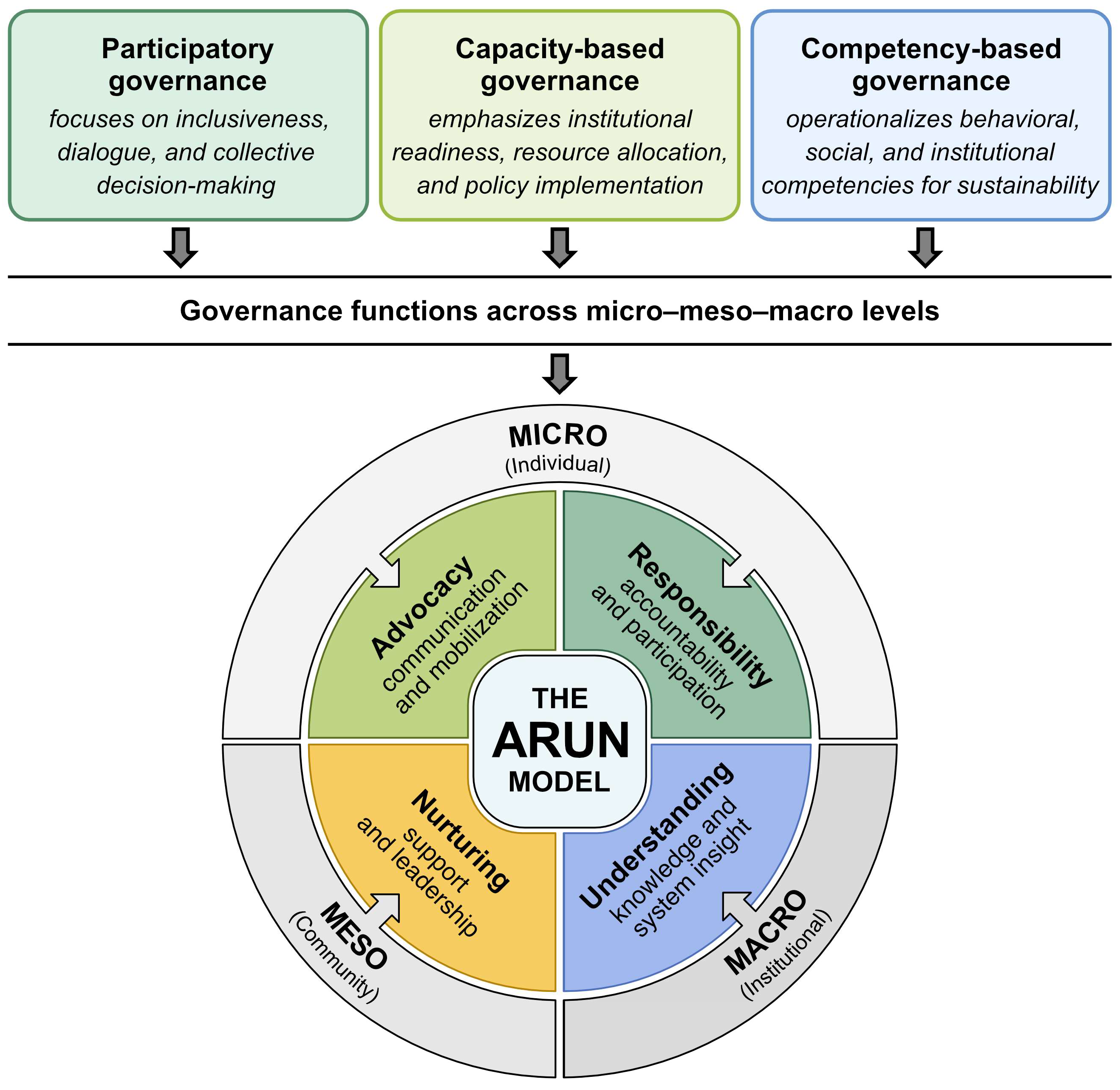
Competency-based governance extends beyond participatory and capacity-based frameworks. Participatory governance focuses on inclusiveness and collective decision-making, and capacity-based governance emphasizes institutional readiness. In contrast, competency-based governance operationalizes the behavioral, social, and institutional capacities required for sustainability. As illustrated in
Figure 1, this alignment clarifies how competencies function across micro, meso, and macro levels to support zero-waste outcomes.
Figure 1 shows the context of integrating participatory, capacity-based, and competency-based governance across micro, meso, and macro levels for zero-waste community management. The model conceptualizes four interrelated competencies—advocacy (A), responsibility (R), understanding (U), and nurturing (N)—which collectively provide a competency-based framework for bridging the policy–practice gap in environmental governance.
The ARUN Model was empirically validated with undertaken through a mixed-methods study in a Thai local administrative organization. A household survey of 300 residents was used to measured the latent competency structure, analyzed using through exploratory factor analysis (EFA) and regression techniques. Complementary focus groups and interviews with local officials and community leaders provided qualitative validation and contextual interpretation. This design ensured both statistical rigor and contextual richness. These methodological choices directly respond to persistent gaps in the literature, as few studies have systematically developed and empirically tested competency-based frameworks for waste governance in low- and middle-income contexts [
29,
30]. Comparative experiences, such as Indonesia’s Gianyar Waste Recovery Project [
31] and broader Asia–Pacific reviews [
32], further highlight the lack of structured approaches that integrate community competencies into governance processes.
Against this backdrop, the present study advances the field by addressing two interrelated research questions: What social competencies constitute a practical framework for environmental governance in zero-waste communities, and how do these competencies influence community behavior and participation in waste management practices? By situating the ARUN Model within a Thai community context, this study demonstrates how strengthening social competencies can bridge the persistent policy–practice gap while contributing to global sustainability transitions.
2. Materials and Methods
2.1. Research Design
This study adopted a
mixed-methods sequential explanatory design, integrating quantitative and qualitative approaches in two distinct but connected phases [
33,
34]. In the first phase, a structured household survey was conducted to identify the latent competency structure and examine associations with zero-waste behaviors. In the second phase, focus group discussions (FGDs) and semi-structured interviews with community leaders and local officials were carried out to validate and enrich the quantitative findings.
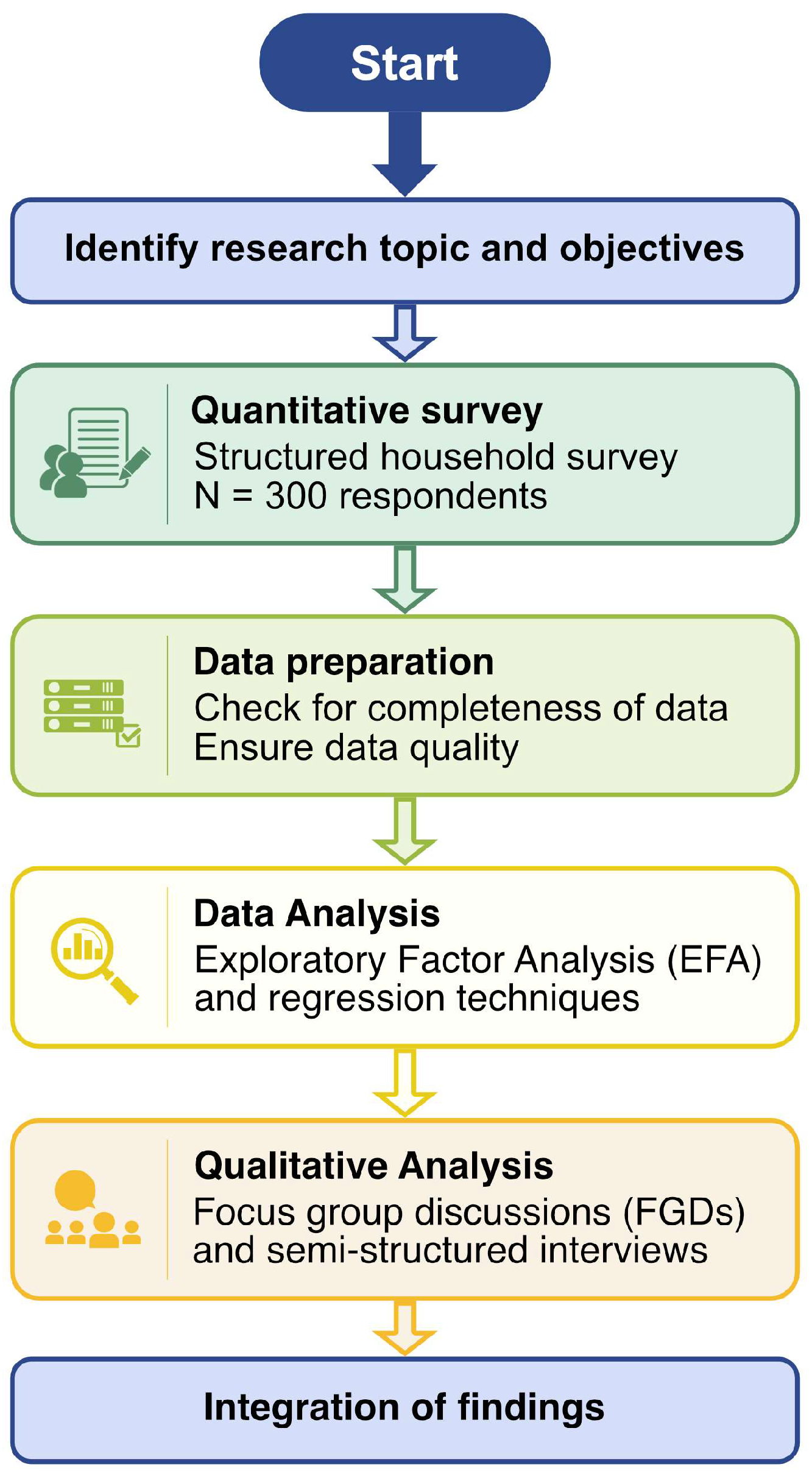
To provide a clear and rigorous methodological roadmap, the research classification detailing the nature, objective, and approach is summarized in
Table 1, and the detailed procedural flow is presented in
Figure 2.
This design was chosen because waste governance involves complex socio-technical interactions that cannot be adequately captured by quantitative measures alone [
35]. The sequential strategy allowed us to identify statistical patterns and interpret the underlying social mechanisms, thereby strengthening methodological rigor [
36,
37].
Integrating the two phases sequentially ensured the convergence, complementarity, and triangulation of the findings, resulting in a comprehensive understanding of competency-based governance for zero-waste communities.
Figure 2 illustrates the sequential workflow, outlining the progression from quantitative survey and statistical analysis to qualitative validation and results integration. The workflow consists of five interconnected steps: (i) quantitative household survey, (ii) data preparation, (iii) exploratory factor analysis (EFA) and regression, (iv) focus group discussions (FGDs) and semi-structured interviews, and (v) integration of findings. This sequential process ensured methodological rigor and complementarity between the quantitative and qualitative phases.
2.2. Study Site
This study was conducted in the Saeng Arun Subdistrict Administrative Organization (SAO), located in Thap Sakae District, Prachuap Khiri Khan Province, Thailand. Saeng Arun comprises six villages—Rai Nai, Saeng Thong, Yub Huai, Saeng Arun, Hin Thoen, and Ton Kradon–Sam Nong—with a total population of 3836 residents (2029 female and 1807 male) and approximately 1000 households [
43]. The educational infrastructure includes one early childhood center and three schools under the Ministry of Education, reflecting semi-rural service characteristics. The local economy is primarily based on agriculture (coconut, rubber, and fruit orchards), small-scale fisheries, and emerging eco-tourism. The average household income remains modest compared with urban municipalities, highlighting resource constraints typical of peri-urban communities [
44].
The community waste governance practices include household segregation, waste banks, and composting schemes. However, findings from the FF67 project revealed persistent challenges, including limited household participation, gaps in environmental literacy, and dependence on local leadership for continuity [
45].
These characteristics made Saeng Arun an appropriate testbed for validating the ARUN Model. The existing initiatives correspond to advocacy and responsibility, while strong village leadership and SAO support reflect Nurturing. Conversely, gaps in knowledge and awareness represent the understanding dimension. Thus, Saeng Arun provided a real-world context where the interplay of social competencies could be empirically tested.
Case selection followed a purposive strategy, identifying Saeng Arun as a
typical semi-rural municipality that embodies Thailand’s policy–practice gap in zero-waste transitions [
46]. The site was chosen for three reasons: (i) active participation in national zero-waste campaigns since 2016, (ii) mixed success in household waste segregation programs, and (iii) availability of longitudinal data from community reports and the FF67 project, which enabled contextual triangulation [
47].
The case represents an “embedded governance environment,” where household, community, and institutional levels interact dynamically. This configuration provided ideal conditions for testing how the ARUN competencies—advocacy, responsibility, understanding, and nurturing—manifest in local governance practice.
At the national and global levels, this case aligns with Thailand’s zero-waste community strategies and reflects international insights emphasizing that local social competencies and governance capacity are critical determinants of sustainability. This is consistent with findings from the Pollution Control Department (PCD), the World Bank, and UN-Habitat, all of which highlight the significance of localized behavioral frameworks for advancing zero-waste transitions [
48,
49,
50].
2.3. Data Collection
2.3.1. Quantitative Survey
The quantitative phase involved a structured household survey administered to 300 households within the Saeng Arun Subdistrict Administrative Organization. A stratified random sampling strategy was applied to ensure proportional representation across villages and socio-economic groups. The respondents were household heads or adult representatives (≥18 years) who were primarily responsible for household decision-making regarding waste management. The sample size of 300 households was considered adequate for both exploratory factor analysis (EFA) and regression, meeting the commonly recommended criterion of at least five to ten respondents per survey item [
51]. In addition, the Kaiser–Meyer–Olkin (KMO) measure of sampling adequacy (>0.80) and a significant Bartlett’s test of sphericity confirmed the suitability of the dataset for factor extraction, supporting both the adequacy and statistical power of the sample [
52].
The survey instrument consisted of 45 Likert-scale items (1 = strongly disagree to 5 = strongly agree) designed to measure the four hypothesized competency domains of the ARUN Model—advocacy, responsibility, understanding, and nurturing—together with outcome variables reflecting zero-waste behaviors. Items assessing advocacy measured communication and mobilization (e.g., “I actively share information with neighbors about reducing household waste”). Responsibility emphasized accountability and participation (e.g., “I feel accountable for the way my household disposes of waste”). Understanding reflected knowledge and system awareness (e.g., “I understand the local rules and regulations for separating recyclable and organic waste”). Nurturing captured leadership and social support (e.g., “Community leaders encourage and support my household to participate in waste reduction activities”). In addition to competencies, behavioral indicators measured household waste segregation frequency, participation in recycling schemes, and involvement in community environmental campaigns.
The case and respondent selection procedures were clearly documented to enhance transparency and replicability. Enumerators used pre-tested checklists to ensure consistency across all households, following the criteria of village distribution, gender, and age diversity.
The questionnaire was originally drafted in English, translated into Thai, and back-translated by bilingual experts to ensure conceptual and cultural equivalence [
53]. Content validity was further established, through expert review by three academics and practitioners specializing in environmental management, social sciences, and local governance. Following revisions, a pilot test was conducted with 30 households outside the main sample area. The pilot demonstrated acceptable internal consistency, with Cronbach’s alpha values exceeding 0.70 across all domains, indicating strong reliability for full-scale deployment [
54]. Data were collected during face-to-face household interviews by trained enumerators familiar with the local context. The enumerators were trained on the study objectives, ethical considerations, and standardized procedures to minimize interviewer bias and ensure consistency. The responses were first recorded in paper-based questionnaires and subsequently digitized for statistical analysis.
To reinforce methodological clarity, a checklist of survey stages (design, pilot, validation, data entry, and verification) was maintained throughout the process, ensuring transparency and traceability from data collection to analysis.
This survey design and validation process followed established best practices in competency measurement and instrument development, emphasizing expert validation, pre-testing, and iterative refinement to ensure construct validity and reliability [
55,
56].
2.3.2. Qualitative Validation
To complement and validate the quantitative findings, the study included a qualitative phase consisting of two focus group discussions (FGDs) and five in-depth interviews. The FGDs were conducted with groups of eight to ten participants each, representing residents, women’s associations, and community volunteers actively involved in local waste management programs. The participants were recruited purposively, in consultation with village leaders, to ensure diversity in demographic characteristics and experiential perspectives.
Each focus group was designed to reflect the community’s socio-demographic composition of the community and its functional roles in waste governance, thus ensuring representativeness in perspectives and voices.
Each session was held in the Saeng Arun Subdistrict Administrative Organization’s community hall and lasted approximately 90–120 min, allowing the participants to elaborate on shared experiences and community dynamics. The in-depth interviews targeted five key informants, including local administrative officials responsible for environmental management and community leaders such as village heads and waste bank coordinators. Each interview lasted between 45 and 60 min and focused on institutional perspectives regarding governance mechanisms, leadership roles, and the challenges of translating zero-waste policies into practice.
A semi-structured interview guide was developed, outlining the advocacy, responsibility, understanding, and nurturing domains, to ensure alignment between the qualitative phase and the ARUN Model dimensions.
A semi-structured interview guide was used consistently across the FGDs and interviews, balancing comparability with flexibility to explore emergent themes. The guide addressed three primary domains: (i) barriers to adopting zero-waste practices (e.g., limited financial resources, lack of incentives, and infrastructure gaps), (ii) motivational drivers (e.g., cultural norms, peer influence, and perceived household or community benefits of waste reduction), and (iii) governance dimensions (e.g., participation mechanisms, leadership support, and institutional capacity). These domains were explicitly aligned with the four competency areas of the ARUN Model, ensuring a systematic comparison of the qualitative findings and survey results.
All sessions were conducted in Thai, audio-recorded with prior informed consent, and transcribed verbatim. Field notes were taken to document group dynamics, tone, and non-verbal cues to enriching the transcripts interpretation. Multiple strategies were used to ensure the trustworthiness of the qualitative findings. Credibility was enhanced through member checking with the participants and peer debriefing among investigators. Transferability was supported by providing detailed descriptions of the study site, participant characteristics, and local governance context. Dependability was addressed with intercoder reliability testing (Cohen’s Kappa > 0.75) and the maintenance of a systematic audit trail. Confirmability was strengthened by triangulating qualitative insights with quantitative results to minimize researcher bias and enhance objectivity [
57,
58,
59].
This approach ensured that the qualitative phase not only validated the statistical patterns observed in the quantitative survey but also provided nuanced insights into the social mechanisms through which competencies were enacted in practice.
2.4. Data Analysis
2.4.1. Exploratory Factor Analysis (EFA)
Survey data were analyzed using IBM SPSS Statistics version 28.0 (IBM Corp., Armonk, NY, USA). Before factor extraction, data suitability was confirmed with the Kaiser–Meyer–Olkin (KMO) measure (>0.80) and Bartlett’s test of sphericity (
p < 0.001), both indicating appropriateness for factor analysis [
60]. An exploratory factor analysis (EFA) was conducted using principal component extraction with varimax rotation to identify the latent competency structure. Factors were retained when eigenvalues exceeded 1.0 and item loadings were ≥0.50, following standard thresholds recommended by Tabachnick and Fidell [
61] and Hair et al. [
62]. The four extracted factors were interpreted as the ARUN competency domains—advocacy, responsibility, understanding, and nurturing—based on both theoretical expectations and item content alignment [
63].
2.4.2. Reliability and Validity
The Internal consistency of the identified factors was assessed using Cronbach’s alpha coefficients, with values ≥ 0.70 considered acceptable for reliability [
64]. Item–total correlations were used to test convergent validity, while low cross-loadings verified discriminant validity. Together, these ensured that constructs measured by the ARUN Model were conceptually distinct, internally consistent, and statistically sound [
65,
66].
2.4.3. Regression Analysis
To evaluate the predictive influence of competencies on zero-waste behaviors, multiple regression analysis was conducted. The independent variables were the competency factors identified through EFA, and the dependent variables were self-reported zero-waste behaviors, including the frequency of household segregation and recycling participation. Variance Inflation Factors (VIFs) were calculated to confirm the absence of multicollinearity, and assumptions of linearity, homoscedasticity, and normality were verified using diagnostic plots [
67].
To ensure scientific rigor in statistical reporting, all regression coefficients are presented with their corresponding 95% confidence intervals (CIs) and standardized effect sizes (Cohen’s f
2) in the
Section 3, where applicable.
2.4.4. Justification of the ARUN Model
Regarding the methodology, the ARUN Model is justified by its primary aim to empirically bridge the gap between social capacity and behavioral outcomes.
The model’s strengths include the following:
Theoretical grounding in Social Cognitive Theory, originally proposed by Bandura [
68], and environmental education principles, which together provide a robust behavioral foundation.
Empirical validation within a Thai semi-rural governance context, ensuring cultural relevance and policy applicability [
69].
An integrated multi-dimensional structure (A, R, U, N) capturing the complexity of socio-technical waste governance interactions.
A recognized limitation, however, is potential constraint on generalizability to highly urbanized or cross-national settings, necessitating further validation in diverse governance environments.
2.4.5. Qualitative Thematic Analysis
The qualitative transcripts from the FGDs and interviews were analyzed using NVivo 12 (QSR International, Melbourne, Australia). The analysis followed Braun and Clarke’s six-phase thematic process—familiarization, coding, theme generation, review, definition, and reporting [
70]. Codes were developed inductively and grouped into themes corresponding to the ARUN competencies while allowing for emergent contextual nuances. Two researchers independently coded the transcripts; inter-coder agreement (Cohen’s κ > 0.75) confirmed reliability. Triangulation was employed to link quantitative findings with qualitative insights, enhancing interpretive depth and validity [
71].
2.4.6. Triangulation
The findings from the quantitative and qualitative phases were integrated using methodological triangulation, enabling both convergence and complementarity of the results [
72,
73]. Quantitative analysis established the factor structure and behavioral impacts of the ARUN competencies, while qualitative insights provided contextualized explanations of how these competencies were enacted in practice. Discrepancies between data sources were also examined to highlight areas where and local leaders differed in their perceptions of governance competencies. This integrative approach enhanced the credibility and comprehensiveness of the study’s conclusions.
2.5. Ethical Considerations
This study was reviewed and approved by the Human Research Ethics Committee of Rajamangala University of Technology Thanyaburi, Thailand (COA No. 45, RMUTT_REC No. Exp 45/67, dated 24 May 2024). All the participants provided informed consent after being clearly informed about the study objectives and procedures. Participation was voluntary, confidentiality was strictly maintained, and no personal identifiers were used in the analysis. The respondents were assured of the right to withdraw at any time without consequences.
2.6. Use of Generative AI
In preparing this manuscript, a generative AI tool (ChatGPT, GPT-4.1, OpenAI, San Francisco, CA, USA; accessed September 2025) was used solely for language editing and style refinement. The AI tool was not used for study design, data collection, data analysis, or interpretation of the results. All AI-assisted text was carefully reviewed and verified by the authors, who take full responsibility for the content. This disclosure is made in accordance with the Environments journal policy on the use of generative AI.
3. Results
3.1. Exploratory Factor Analysis (EFA)
The dataset was first assessed for sampling adequacy and suitability for factor analysis. The Kaiser–Meyer–Olkin (KMO) value of 0.837 indicated considering sampling adequacy, and Bartlett’s test of sphericity was statistically significant (χ2 = 9673.320, df = 50, p < 0.001), confirming that the correlation matrix was appropriate for factor extraction. Principal component analysis with varimax rotation extracted four factors with eigenvalues greater than 1.0, together explaining 67.3% of the total variance.
This four-factor solution aligned with the hypothesized ARUN Model, comprising advocacy for sustainable waste management, responsibility and participation in waste management, understanding of waste management and pollution prevention, and nurturing reuse and recycling practices. The factor loadings for the retained items ranged from 0.52 to 0.84, with no problematic cross-loadings, supporting the model’s construct validity of the model. Items under advocacy emphasized information sharing and community mobilization; responsibility reflected accountability in household waste practices; Understanding represented awareness of local waste regulations; and nurturing captured leadership encouragement and institutional support.
Each factor’s reliability exceeded Cronbach’s α = 0.80, and no cross-loading above 0.40 was observed, confirming internal consistency and discriminant validity.
These results provide empirical support for the theoretical validity of the ARUN competency structure, demonstrating that the social competencies required for zero-waste governance are multidimensional yet interconnected.
Table 2 presents representative items and their factor loadings for each competency domain.
3.2. Reliability and Validity
The internal consistency of the extracted factors was assessed using Cronbach’s alpha. All four competency domains demonstrated satisfactory internal reliability, with coefficients ranging from 0.798 to 0.845, exceeding the commonly accepted threshold of 0.70 [
74]. Specifically,
Advocacy for Sustainable Waste Management (12 items) achieved an alpha of 0.812,
Responsibility and Participation in Waste Management (12 items) achieved 0.845,
Understanding of Waste Management and Pollution Prevention (10 items) achieved 0.798, and
Nurturing Reuse and Recycling Practices (11 items) achieved 0.833.
These results indicate that the measurement items within each domain consistently captured their respective constructs. Convergent validity was supported by item–total correlations greater than 0.50 across all domains. In contrast, discriminant validity was evidenced by the absence of problematic cross-loadings in the factor analysis, confirming that the domains were conceptually distinct yet complementary.
Together, these findings confirm that the ARUN Model exhibits sound psychometric properties for assessing social competencies pertinent to zero-waste governance.
Table 3 presents the number of items and Cronbach’s alpha values for each domain.
Content validity was further assessed through an Index of Item–Objective Congruence (IOC), evaluated by three experts in environmental management, social science, and local governance. The IOC values for all items were above the recommended minimum of 0.50, ensuring conceptual alignment with the intended constructs [
75]. Construct validity was additionally supported by the exploratory factor analysis results (
Section 3.1), which revealed a clear four-factor solution with no problematic cross-loadings.
To enhance reporting rigor and transparency, all reliability and validity indices were verified following standard psychometric guidelines, ensuring replicability of the ARUN framework in similar community contexts.
Taken together, these results demonstrate that the ARUN instrument is both psychometrically robust and contextually appropriate for assessing social competencies relevant to zero-waste governance.
3.3. Regression Analysis
The predictive influence of the ARUN competencies on zero-waste behaviors was examined through multiple regression analysis, with four competency domains—Advocacy for Sustainable Waste Management, Responsibility and Participation in Waste Management, Understanding of Waste Management and Pollution Prevention, and Nurturing Reuse and Recycling Practices—serving as independent variables. The dependent variable represented overall zero-waste behaviors, including household waste segregation, participation in recycling schemes, and involvement in community environmental campaigns.
The overall regression model was statistically significant, F(4, 295) = 45.62, p < 0.001, explaining 38.7% of the variance in zero-waste behaviors (Adjusted R2 = 0.387). Among the predictors, Responsibility and Participation in Waste Management exerted the strongest positive effect (β = 0.410, p < 0.001), followed by Nurturing Reuse and Recycling Practices (β = 0.281, p < 0.001). Advocacy for Sustainable Waste Management also showed a significant positive contribution (β = 0.190, p = 0.012), whereas Understanding of Waste Management and Pollution Prevention did not have a statistically significant influence (β = 0.072, p = 0.174).
To ensure scientific rigor and transparency, all regression coefficients are reported with corresponding 95% confidence intervals (CIs) and standardized effect sizes (Cohen’s f
2) in
Table 4 and the
Section 3.
These findings indicate that competencies emphasizing personal accountability and collective support are more influential in shaping household waste behaviors than knowledge alone. In particular, responsibility through institutional participation and leadership encouragement appears to be a critical driver of behavioral change within zero-waste governance systems.
An alternative grouping analysis, in which competencies were clustered into broader domains of sustainable waste management support, promotion of reuse and recycling, and waste management knowledge, further indicated that knowledge can even exert a negative but significant effect (β = −0.162, p < 0.05). This reinforces the notion that knowledge, without adequate structural support or incentives, may not directly translate into higher participation and can reflect frustration when households lack the capacity to act on what they know.
3.4. Qualitative Thematic Analysis
Qualitative data from community leaders and household interviews were analyzed thematically following Braun and Clarke’s six-phase approach [
76]. The coding process generated themes that were highly consistent with the four ARUN competency domains while also revealing context-specific nuances of zero-waste governance. The
Advocacy for Sustainable Waste Management theme captured practices of information-sharing, persuasion, and mobilization, such as encouraging neighbors to adopt waste segregation.
Responsibility and Participation in Waste Management emphasized accountability at both household and community levels, including routine waste sorting and adherence to collective waste rules.
Understanding of Waste Management and Pollution Prevention reflected awareness of local regulations, knowledge of waste reduction, and recognition of the environmental benefits of proper disposal. Finally,
Nurturing Reuse and Recycling Practices encompassed the role of local leaders, community groups, and municipal authorities in fostering supportive conditions for sustainable behavior, including infrastructure provision and social recognition mechanisms.
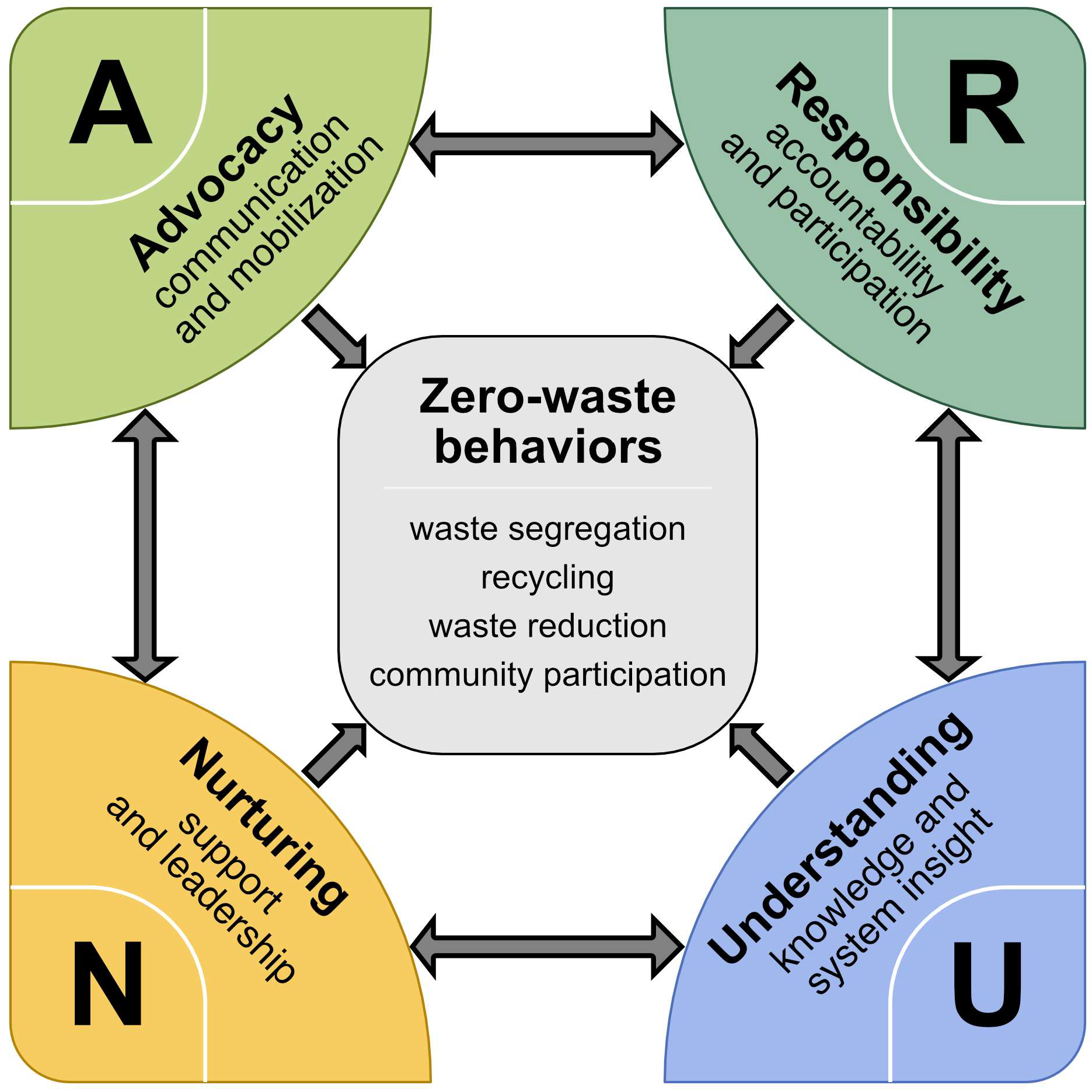
Figure 3 presents an integration map that synthesizes these four thematic domains, illustrating how competencies operate in dynamic interaction—linking individual behaviors (advocacy and understanding) with institutional mechanisms (responsibility and nurturing). This visualization clarifies the pathways through which social competencies collectively drive zero-waste governance and community sustainability outcomes.
The analysis suggests that while individual competencies provide the foundation, external nurturing and responsibility structures are critical in transforming knowledge and advocacy into sustained action. These findings provide qualitative validation for the ARUN Model, complementing the quantitative evidence presented in
Section 3.1,
Section 3.2 and
Section 3.3.
3.5. Triangulation of Findings
Integration the quantitative and qualitative findings provided a more holistic understanding of the ARUN competency framework in the context of zero-waste governance. Quantitative analyses confirmed the structural validity and reliability of the four-factor model, with the exploratory factor analysis and regression results highlighting the predictive influence of responsibility and nurturing as the strongest drivers of household and community-level waste behaviors. In contrast, advocacy and understanding were shown to contribute indirectly, laying the foundation for behavioral readiness.
The qualitative results complemented these statistical findings by revealing how community dynamics translated competencies into action. The participants emphasized that leadership support (nurturing) and institutional accountability mechanisms (responsibility) enabled households to apply knowledge gained through advocacy and understanding. This integration illustrates the interactive mechanisms through which social and behavioral competencies reinforce each other in daily waste governance practice.
Together, the qualitative narratives enriched the quantitative patterns by illustrating the mechanisms through which competencies operate in everyday contexts. The convergence of both strands underscores the multidimensional nature of governance competencies. While structural and social supports act as primary enablers of zero-waste behaviors, individual competencies in awareness and advocacy are essential prerequisites for effective implementation.
As illustrated in
Figure 3, this triangulated interpretation bridges the empirical and theoretical dimensions of the ARUN Model—demonstrating that competency-based governance is both statistically validated and behaviorally grounded in community practice. The combined evidence enhances theoretical coherence, confirming that zero-waste transitions depend on the synergistic functioning of advocacy, responsibility, understanding, and nurturing across micro, meso, and macro governance levels.
This triangulation strengthens the empirical credibility of the ARUN Model and confirms its contextual relevance for advancing sustainable waste governance at the local level.
4. Discussion
This study contributes to the growing body of literature on environmental governance and zero-waste communities by validating the ARUN Model as a competency-based framework that explicitly links social competencies with waste management behaviors. By employing a mixed-methods sequential explanatory design, the study integrated quantitative rigor with qualitative depth, providing both statistical confirmation and contextual interpretation. The following sections discuss how the ARUN Model is interpreted within the governance context, how competencies connect to waste behaviors, and how these insights translate into methodological integration and policy implications.
4.1. Interpreting the ARUN Model in Zero-Waste Governance
The ARUN Model demonstrates that zero-waste governance is not only a technical or infrastructural challenge but fundamentally a matter of social competencies, with advocacy, responsibility, understanding, and nurturing collectively shaping household and community behaviors. As shown in
Figure 1, these four domains operate together and influence both individual and collective waste management practices. Advocacy, expressed through communication and mobilization, encourages households to adopt practices such as segregation and recycling. This result aligns with earlier studies demonstrating that communication and awareness campaigns can effectively influence community-wide behavior [
77,
78,
79]. Responsibility, encompassing accountability and participation, fosters long-term engagement in waste reduction. Communities that establish clear roles and promote participation are more likely to maintain consistency in zero-waste practices, which corresponds to research on participatory governance that emphasizes shared duties between citizens and authorities [
80]. Understanding, related to knowledge and system awareness, forms the basis for turning values into action. Households with stronger knowledge of waste management systems and local regulations are more engaged in sustainable practices, echoing findings that highlight environmental literacy as an important factor [
81].
Finally, nurturing, which includes leadership, institutional incentives, and social support, appears to be essential for sustaining behaviors over time. While advocacy and responsibility may initiate participation, nurturing provides the conditions that allow behaviors to continue and remain resilient, reflecting perspectives that emphasize the role of supportive institutions and leadership in long-term change [
82]. Overall, these findings suggest that the ARUN Model not only presents a useful framework for competency-based governance but also helps explain the social processes that enable communities to move toward zero-waste outcomes. Together, these four domains explain why zero-waste governance must be understood as a socially embedded process, providing a foundation for linking competencies to observable waste management behaviors.
4.2. Linking Competencies to Waste Behaviors
The validation of the ARUN Model provides actionable insights for local governments and practitioners, highlighting how advocacy, responsibility, understanding, and nurturing can be strengthened through targeted policies, education, and institutional support to promote sustainable waste governance. The thematic analysis revealed how the four ARUN domains translate into concrete waste practices—segregation, recycling, reduction, and participation—while these behaviors, in turn, reinforce the competencies themselves (
Figure 3). The relationships were reciprocal, showing that competencies and behaviors evolve together rather than in a one-directional manner. Advocacy supported household and community adoption of segregation and recycling by raising awareness and motivating participation. In turn, visible practices reinforced advocacy, as successful campaigns encouraged broader engagement [
83]. Responsibility was evident in consistent waste reduction practices where accountability mechanisms were in place, such as community monitoring or shared agreements were in place, underscoring the role of shared responsibility in sustaining participation [
84].
Understanding enabled households to gain greater awareness of waste flows, policies, and impacts, allowing them to recycle and reduce more effectively. Active participation further deepened understanding, creating a cycle of knowledge and practice [
85]. Nurturing provided the strongest support, as leadership, peer encouragement, and institutional incentives fostered long-term behavior resilience of behaviors. Positive outcomes—such as cleaner surroundings or reduced disposal costs—further reinforced these supportive conditions [
86]. Taken together, these findings confirm that competencies and behaviors are mutually reinforcing; competencies drive waste-related actions, while successful practices strengthen competencies. This reciprocal relationship highlights the ARUN Model’s practical value and sets the stage for integrating quantitative and qualitative insights.
4.3. Integrating Quantitative and Qualitative Insights
The sequential integration of quantitative and qualitative findings strengthened the explanatory power of the ARUN Model by highlighting both the structural predictors and the lived mechanisms that sustain zero-waste practices. The quantitative analysis established the validity of the four-factor framework, showing that responsibility and nurturing were the strongest predictors of waste behaviors. In parallel, the qualitative phase illuminated the social processes behind these results, demonstrating how leadership, peer encouragement, and accountability practices translated competencies into everyday action.
For instance, while the regression confirmed the predictive strength of responsibility, the focus group discussions explained this effect by showing how shared monitoring and collaborative agreements sustained participation. Similarly, nurturing was statistically significant; where the interviews revealed that leader encouragement and institutional incentives fostered trust and motivation for long-term engagement.
This triangulated interpretation strengthens theoretical coherence between quantitative and qualitative strands and aligns the ARUN Model with international frameworks such as the UN-Habitat Waste Wise Cities Tool (WaCT) and the OECD Competency Framework for Environmental Governance, both of which emphasize behavioral and institutional capacities as complementary pillars of sustainability [
87,
88].
Overall, the synthesis of both strands enhances the empirical credibility of the ARUN Model and underscores its practical value for community-based governance, suggesting that sustainable waste practices emerge not only from measurable competencies but also from the relational and contextual processes that give those competencies life within communities [
89].
4.4. Implications for Policy and Practice
The validation of the ARUN Model has direct implications for local governance, community engagement, and national sustainability strategies. First, advocacy should be institutionalized within municipal waste management programs. Well-designed campaigns, delivered by trusted community leaders and media channels, can enhance awareness and mobilization, providing the initial momentum for zero-waste practices [
90]. Second, responsibility requires mechanisms such as participatory monitoring, household commitments, and role assignments to strengthen accountability. Embedding participatory governance structures within local administrations ensures that waste practices are not only adopted but also sustained over time [
91]. Third, understanding highlights the importance of continuous environmental education. Integrating waste literacy into school curricula, community training, and local policy guidelines equips households with the knowledge necessary for informed participation, aligning with broader calls for capacity building as a cornerstone of sustainable development [
92]. Fourth, nurturing emphasizes the role of community leaders, institutions, and peer networks in providing long-term support. Policy frameworks should create enabling environments through incentives, recognition schemes, and leadership development programs. Such mechanisms are essential to embed zero-waste behaviors into daily community life.
Finally, aligning with global sustainability agendas, the ARUN Model can be integrated within national and international policy frameworks—such as Thailand’s BCG (Bio-Circular-Green) Economy Model, the UN-Habitat WaCT, and the OECD competency-based approaches—to enable scalability beyond local contexts. This integration provides a structured yet adaptable pathway for embedding social competencies into sustainability governance systems worldwide.
Taken together, these implications show that competency-based governance offers a scalable and adaptable framework for local governments. By strengthening advocacy, responsibility, understanding, and nurturing, policymakers can design integrated interventions that move beyond technical waste solutions to foster lasting social change and provide a replicable model for other communities.
5. Conclusions
This study validated the ARUN Model as a competency-based framework for advancing zero-waste governance at the community level. By integrating quantitative rigor with qualitative depth, this research demonstrated that waste governance extends beyond technical or infrastructural solutions and is fundamentally shaped by social competencies. The four domains of advocacy, responsibility, understanding, and nurturing were shown to influence household and community waste practices both individually and interactively.
The quantitative analyses confirmed the model’s structural validity, while the qualitative findings provided insights into how competencies are enacted in daily governance. Responsibility and nurturing emerged as the strongest drivers of sustained zero-waste behaviors, whereas advocacy and understanding provided the informational and motivational foundations for participation.
Beyond its theoretical contribution, the ARUN Model offers practical guidance for policy and practice. Embedding advocacy in communication strategies, institutionalizing responsibility through participatory mechanisms, promoting understanding via environmental education, and sustaining nurturing through leadership and institutional support together form a coherent framework for long-term zero-waste transitions.
Finally, the model’s principles can be integrated within broader sustainability policies—such as Thailand’s BCG (Bio-Circular-Green) Economy Model, the UN-Habitat WaCT, and the OECD Competency Framework—to guide decision-makers in embedding social competencies within environmental governance systems. This integration enhances both scalability and policy relevance, enabling the ARUN Model to serve as a reference for sustainable community-based waste management globally.
6. Limitations and Future Research
This study has several limitations that should be acknowledged. First, the quantitative phase used a sample of 300 households within a single subdistrict, which, while adequate for factor analysis, may limit the generalizability of findings to other socio-economic or cultural contexts. Second, the use of self-reported survey data may be subject to response bias, potentially overstating or understating actual waste management behaviors. Third, the cross-sectional design precludes causal inferences about the long-term effects of competencies on behavioral persistence. Conceptually, the ARUN Model was validated within a Thai semi-rural community setting, which provides important local grounding but may not fully capture governance dynamics in urban or international contexts. Broader testing across different cultural, institutional, and policy environments would strengthen the model’s applicability and refine its generalizability.
Future research should address these limitations by employing larger and more diverse samples, conducting longitudinal studies to examine behavioral persistence over time, and designing comparative studies across regions or countries. Experimental or policy-oriented research could also test the impact of specific interventions—such as leadership training, incentive schemes, or environmental literacy programs—on strengthening ARUN competencies. Such extensions would not only enhance the ARUN Model’s empirical robustness but also expand its utility as a framework for sustainable waste governance in diverse contexts.




 ,
,