Associations Among Stressful Events, Social Support, and Alcohol Use in Women and Men


Abstract
1. Introduction
2. Materials and Methods
2.1. Participants
2.2. Procedures
2.2.1. Recent Stressful Events
2.2.2. Social Support
2.2.3. Alcohol Use
2.3. Data Analysis
3. Results
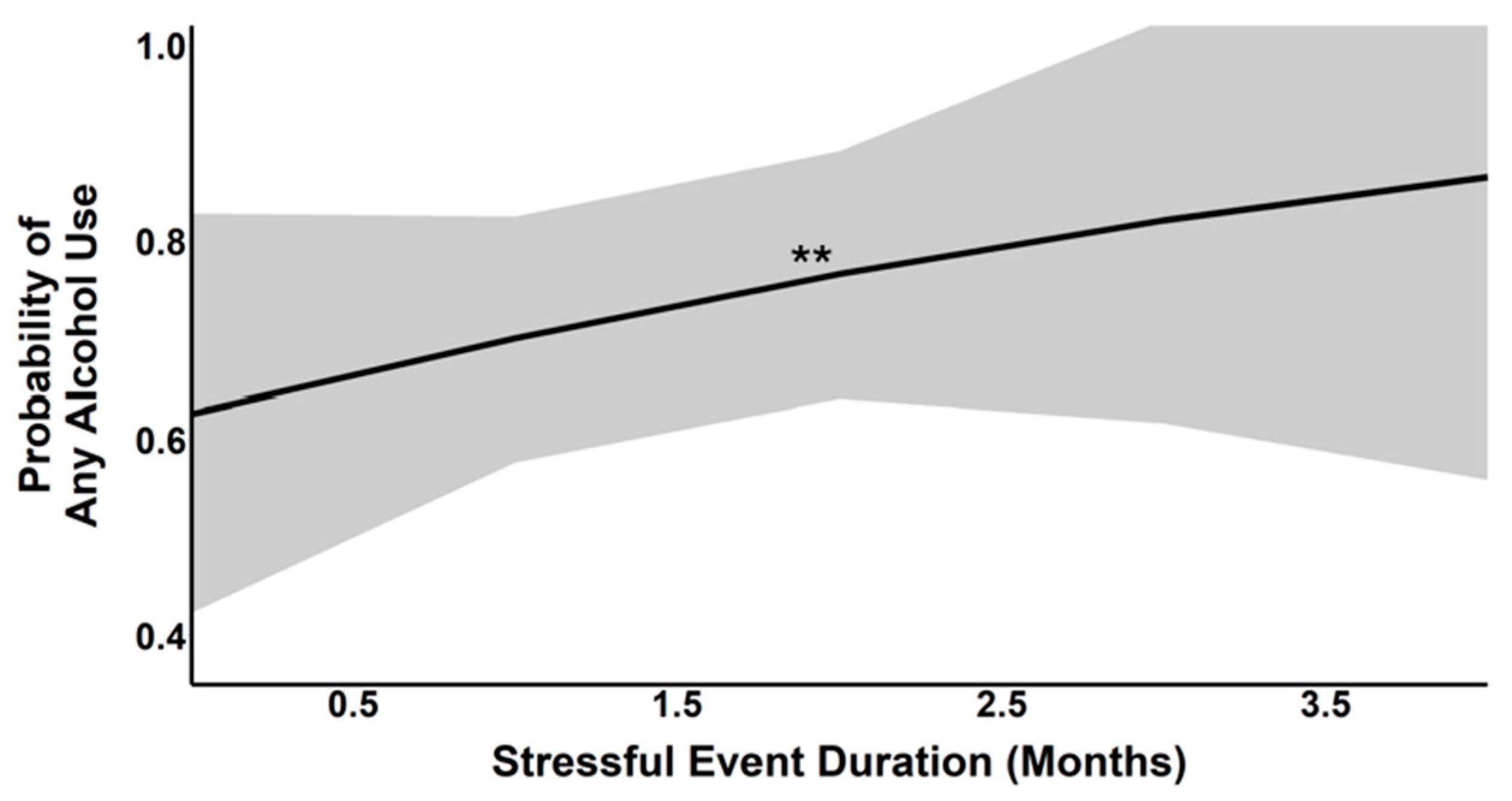
3.1. Duration of Stressful Events Predicts Any Alcohol Use
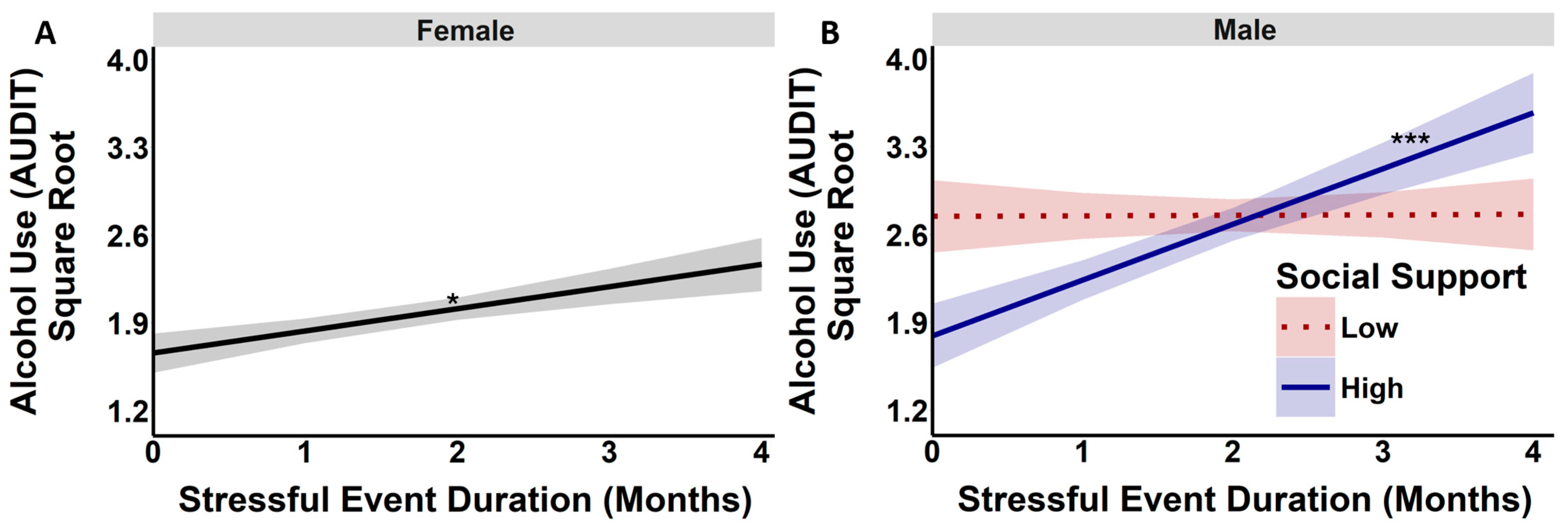
3.2. Number and Duration of Recent Stressful Events Predict Alcohol Use Severity (AUDIT Scores) with Social Support Moderation for Men
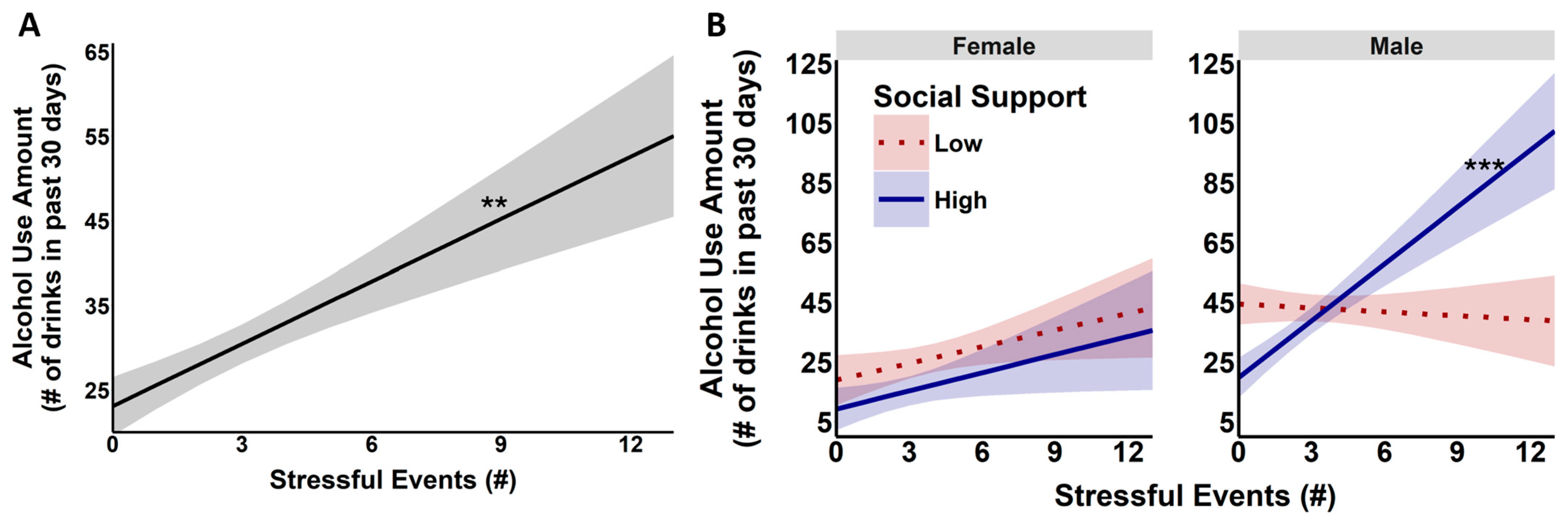
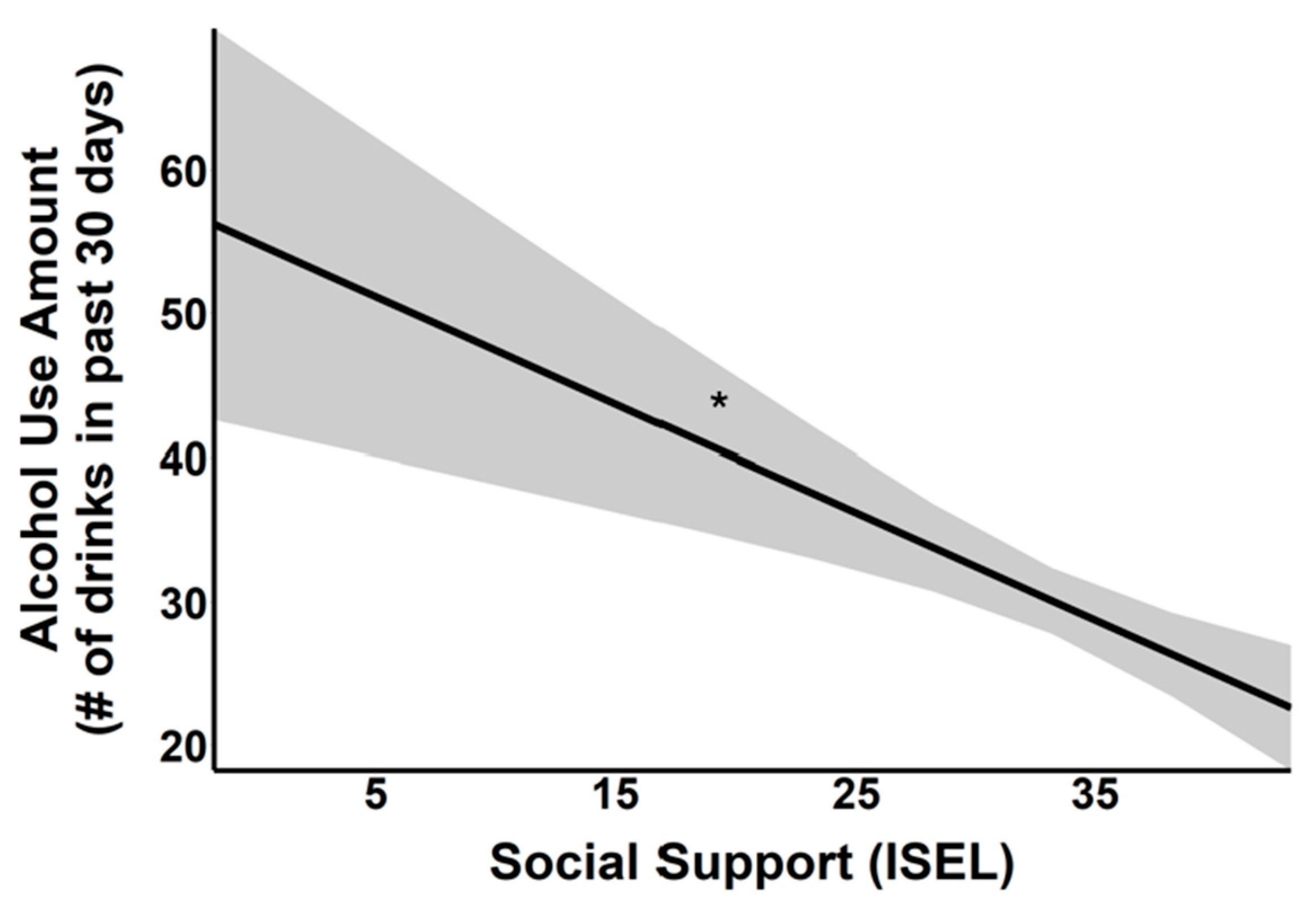
3.3. Number and Duration of Stressful Events Interact with Social Support to Predict Alcohol Use
4. Discussion
Author Contributions
Funding
Institutional Review Board Statement
Informed Consent Statement
Data Availability Statement
Conflicts of Interest
Abbreviations
| SS | Social Support |
| AUDIT | Alcohol Use Disorder Identification Test |
| CAI | Cumulative Adversity Index |
| ISEL | Interpersonal Support Evaluation List |
References
- Acoba, E. F. (2024). Social support and mental health: The mediating role of perceived stress. Frontiers in Psychology, 15, 1330720. [Google Scholar] [CrossRef]
- Ansell, E. B., Rando, K., Tuit, K., Guarnaccia, J., & Sinha, R. (2012). Cumulative adversity and smaller gray matter volume in medial prefrontal, anterior cingulate, and insula regions. Biological Psychiatry, 72(1), 57–64. [Google Scholar] [CrossRef]
- Blaine, S. K., & Sinha, R. (2017). Alcohol, stress, and glucocorticoids: From risk to dependence and relapse in alcohol use disorders. Neuropharmacology, 122, 136–147. [Google Scholar] [CrossRef] [PubMed]
- Borsari, B., & Carey, K. B. (2001). Peer influences on college drinking: A review of the research. Journal of Substance Abuse, 13(4), 391–424. [Google Scholar] [CrossRef]
- Borsari, B., & Carey, K. B. (2006). How the quality of peer relationships influences college alcohol use. Drug and Alcohol Review, 25(4), 361–370. [Google Scholar] [CrossRef] [PubMed]
- Buydens-Branchey, L., Noumair, D., & Branchey, M. (1990). Duration and intensity of combat exposure and posttraumatic stress disorder in Vietnam veterans. Journal of Nervous and Mental Disease, 178(9), 582–587. [Google Scholar] [CrossRef] [PubMed]
- Cohen, S., & Hoberman, H. M. (1983). Positive events and social supports as buffers of life change stress 1. Journal of Applied Social Psychology, 13(2), 99–125. [Google Scholar] [CrossRef]
- Cui, X., Liu, K., Ji, Y., Han, S., & Cheng, Y. (2025). Global trends in the burden of alcohol use disorders in the working-age population from 1990 to 2021 and projections for the next 20 years. Frontiers in Public Health, 13, 1616343. [Google Scholar] [CrossRef]
- Gottlieb, B. H. (Ed.). (2013). Coping with chronic stress. Springer Science & Business Media. [Google Scholar]
- Guinle, M. I. B., & Sinha, R. (2020). The role of stress, trauma, and negative affect in alcohol misuse and alcohol use disorder in women. Alcohol Research: Current Reviews, 40(2), 5. [Google Scholar] [CrossRef]
- Hermes, G., Fogelman, N., Seo, D., & Sinha, R. (2021). Differential effects of recent versus past traumas on mood, social support, binge drinking, emotional eating and BMI, and on neural responses to acute stress. Stress, 24(6), 686–695. [Google Scholar] [CrossRef]
- Hinz, A., Esser, P., Richter, D., Schönfelder, A., Glaesmer, H., Lehmann-Laue, A., Heyne, S., Leuteritz, K., Sender, A., Springer, F., Götze, H., & Mehnert-Theuerkauf, A. (2025). Social support in a large general population sample over the course of six years. Scientific Reports, 15(1), 6405. [Google Scholar] [CrossRef]
- Homish, G. G., & Leonard, K. E. (2008). The social network and alcohol use. Journal of Studies on Alcohol and Drugs, 69(6), 906–914. [Google Scholar] [CrossRef] [PubMed]
- Hovnanyan, A. (2023). Dai micro-stressor allo stress traumatico: Effetti sulla salute mentale e il comportamento [Doctoral dissertation, Università degli Studi di Padova]. Available online: https://hdl.handle.net/20.500.14242/94633 (accessed on 13 November 2025).
- Jennison, K. M. (1992). The impact of stressful life events and social support on drinking among older adults: A general population survey. The International Journal of Aging and Human Development, 35(2), 99–123. [Google Scholar] [CrossRef]
- Jodis, C. A., Schwartz, J. A., & Everett, D. C. (2023). Social support as a protective factor for alcohol use disorders: Results from a nationally representative family history study. Alcohol and Alcoholism, 58(1), 60–67. [Google Scholar] [CrossRef]
- Jose, B. S., Van Oers, H. A., Van De Mheen, H. D., Garretsen, H. F., & Mackenbach, J. P. (2000). Stressors and alcohol consumption. Alcohol and Alcoholism, 35(3), 307–312. [Google Scholar] [CrossRef]
- Kelley, M. L., Milletich, R. J., Hollis, B. F., Veprinsky, A., Robbins, A. T., & Snell, A. K. (2017). Social support and relationship satisfaction as moderators of the stress-mood-alcohol link association in US Navy members. The Journal of Nervous and Mental Disease, 205(2), 99–105. [Google Scholar] [CrossRef]
- Kirsch, D. E., Grodin, E. N., Nieto, S. J., Kady, A., & Ray, L. A. (2024). Early life stress is associated with greater negative emotionality and peripheral inflammation in alcohol use disorder. Neuropsychopharmacology, 49(11), 1719–1728. [Google Scholar] [CrossRef]
- Kranzler, H. R. (2023). Overview of alcohol use disorder. American Journal of Psychiatry, 180(8), 565–572. [Google Scholar] [CrossRef] [PubMed]
- Martín del campo-Navarro, A. S., Cervera-Vallejos, M. F., Quevedo, P. M., Álvarez-Aguirre, A., & Fuentes-Ocampo, L. (2024). Influence of masculinity and femininity on alcohol consumption in young people: A scoping review. Aquichan, 24(2), e2424. [Google Scholar] [CrossRef]
- Maxwell, A. M., Harrison, K., Rawls, E., & Zilverstand, A. (2022). Gender differences in the psychosocial determinants underlying the onset and maintenance of alcohol use disorder. Frontiers in Neuroscience, 16, 808776. [Google Scholar] [CrossRef]
- Mikneviciute, G., Pulopulos, M. M., Allaert, J., Armellini, A., Rimmele, U., Kliegel, M., & Ballhausen, N. (2023). Adult age differences in the psychophysiological response to acute stress. Psychoneuroendocrinology, 153, 106111. [Google Scholar] [CrossRef]
- Moreno-Fernández, R. D., Bernabéu-Brotons, E., Carbonell-Colomer, M., Buades-Sitjar, F., & Sampedro-Piquero, P. (2024). Sex-related differences in young binge drinkers on the neurophysiological response to stress in virtual reality. Frontiers in Public Health, 12, 1348960. [Google Scholar] [CrossRef] [PubMed]
- Olff, M. (2017). Sex and gender differences in post-traumatic stress disorder: An update. European Journal of Psychotraumatology, 8, 1351204. [Google Scholar] [CrossRef]
- Patock-Peckham, J. A., Corbin, W. R., Smyth, H., Canning, J. R., Ruof, A., & Williams, J. (2022). Effects of stress, alcohol prime dose, and sex on ad libitum drinking. Psychology of Addictive Behaviors, 36(7), 871. [Google Scholar] [CrossRef]
- Peterson-Sockwell, H., Rejeski, W. J., Fanning, J., Porges, S. W., Heilman, K. J., Laurienti, P. J., & Gauvin, L. (2023). Differential momentary reports of stress and affect associated with alcohol consumption in middle-aged versus younger adults. Substance Use & Misuse, 58(5), 666–675. [Google Scholar] [CrossRef] [PubMed]
- Platt, A., Sloan, F. A., & Costanzo, P. (2010). Alcohol-consumption trajectories and associated characteristics among adults older than age 50. Journal of Studies on Alcohol and Drugs, 71(2), 169–179. [Google Scholar] [CrossRef]
- Rapier, R., McKernan, S., & Stauffer, C. S. (2019). An inverse relationship between perceived social support and substance use frequency in socially stigmatized populations. Addictive Behaviors Reports, 10, 100188. [Google Scholar] [CrossRef]
- Reifman, A., Watson, W. K., & McCourt, A. (2006). Social networks and college drinking: Probing processes of social influence and selection. Personality and Social Psychology Bulletin, 32(6), 820–832. [Google Scholar] [CrossRef]
- RStudio Team. (2021). RStudio: Integrated development for R. RStudio. PBC. Available online: http://www.rstudio.com/ (accessed on 1 February 2026).
- Russell, M. A., Almeida, D. M., & Maggs, J. L. (2017). Stressor-related drinking and future alcohol problems among university students. Psychology of Addictive Behaviors, 31(6), 676. [Google Scholar] [CrossRef]
- Saunders, J. B., Aasland, O. G., Babor, T. F., De la Fuente, J. R., & Grant, M. (1993). Development of the alcohol use disorders identification test (AUDIT): WHO collaborative project on early detection of persons with harmful alcohol consumption-II. Addiction, 88(6), 791–804. [Google Scholar] [CrossRef]
- Shaw, B. A., Agahi, N., & Krause, N. (2011). Are changes in financial strain associated with changes in alcohol use and smoking among older adults? Journal of Studies on Alcohol and Drugs, 72(6), 917–925. [Google Scholar] [CrossRef]
- Sinha, R. (2008). Chronic stress, drug use, and vulnerability to addiction. Annals of the New York Academy of Sciences, 1141(1), 105–130. [Google Scholar] [CrossRef]
- Sinha, R. (2012). How does stress lead to risk of alcohol relapse? Alcohol Research: Current Reviews, 34(4), 432. [Google Scholar] [CrossRef]
- Slopen, N., Williams, D. R., Fitzmaurice, G. M., & Gilman, S. E. (2011). Sex, stressful life events, and adult onset depression and alcohol dependence: Are men and women equally vulnerable? Social Science & Medicine, 73(4), 615–622. [Google Scholar] [CrossRef]
- Smith, L. J., Gallagher, M. W., Tran, J. K., & Vujanovic, A. A. (2018). Posttraumatic stress, alcohol use, and alcohol use reasons in firefighters: The role of sleep disturbance. Comprehensive Psychiatry, 87, 64–71. [Google Scholar] [CrossRef] [PubMed]
- Steptoe, A., Wardle, J., Pollard, T. M., Canaan, L., & Davies, G. J. (1996). Stress, social support and health-related behavior: A study of smoking, alcohol consumption and physical exercise. Journal of Psychosomatic Research, 41(2), 171–180. [Google Scholar] [CrossRef] [PubMed]
- Tamres, L. K., Janicki, D., & Helgeson, V. S. (2002). Sex differences in coping behavior: A meta-analytic review and an examination of relative coping. Personality and Social Psychology Review, 6(1), 2–30. [Google Scholar] [CrossRef]
- Taylor, S. E. (2011). Social support: A review. In H. S. Friedman (Ed.), The Oxford handbook of health psychology (pp. 189–214). Oxford University Press. [Google Scholar]
- Turner, R. J., & Lloyd, D. A. (1995). Lifetime traumas and mental health: The significance of cumulative adversity. Journal of Health and Social Behavior, 36, 360–376. [Google Scholar] [CrossRef]
- Urberg, K., Goldstein, M. S., & Toro, P. A. (2005). Supportive relationships as a moderator of the effects of parent and peer drinking on adolescent drinking. Journal of Research on Adolescence, 15(1), 1–19. [Google Scholar] [CrossRef]
- Veenstra, M. Y., Lemmens, P. H., Friesema, I. H., Garretsen, H. F., Knottnerus, J. A., & Zwietering, P. J. (2006). A literature overview of the relationship between life-events and alcohol use in the general population. Alcohol and Alcoholism, 41(4), 455–463. [Google Scholar] [CrossRef]
- Westermeyer, J., Thuras, P., & Waaijer, A. (2004). Size and complexity of social networks among substance abusers: Childhood and current correlates. The American Journal on Addictions, 13(4), 372–380. [Google Scholar] [CrossRef]
- Willis, M. A., Ran, T., & Lane, S. P. (2025). Efficacy of coping with negative affect via alcohol use pre-and post acute stress. Behavioral Sciences, 15(12), 1614. [Google Scholar] [CrossRef] [PubMed]
- Wilson, D. R. (2010). Health consequences of childhood sexual abuse. Perspectives in Psychiatric Care, 46(1), 56–64. [Google Scholar] [CrossRef] [PubMed]
- Xu, K., Zhang, X., Wang, Z., Hu, Y., & Sinha, R. (2018). Epigenome-wide association analysis revealed that SOCS3 methylation influences the effect of cumulative stress on obesity. Biological Psychology, 131, 63–71. [Google Scholar] [CrossRef] [PubMed]
- Zamboanga, B. L., Newins, A. R., Ford, K., & Perrotte, J. K. (2024). Conformity to masculine norms and its association with drinking behaviors and alcohol-related consequences among adult men: A meta-analysis. Social Science & Medicine, 359, 117198. [Google Scholar] [CrossRef]
- Zhou, Y., Kivimäki, M., Holt-Lunstad, J., Yan, L. L., Zhang, Y., Wang, H., Wang, S., & Xu, X. (2025). Stressful life events in childhood and adulthood and risk of physical, psychological and cognitive multimorbidities: A multicohort study. EClinicalMedicine, 83, 103225. [Google Scholar] [CrossRef]



| Female N = 220 (47.62%) | Male N = 242 (52.38%) | Whole Sample N = 462 | |
|---|---|---|---|
| Age | 29.49 (9.41) | 29.56 (8.78) | 29.53 (9.07) |
| Education | 14.91 (2.24) | 14.92 (2.27) | 14.91 (2.26) |
| Employment | |||
| Full-time | 44 (22.45%) | 57 (26.03%) | 101 (24.34%) |
| Part-time | 61 (31.12%) | 41 (18.72%) | 102 (24.58%) |
| Unemployed | 46 (23.47%) | 72 (32.88%) | 118 (28.43%) |
| Never Employed | 45 (22.96%) | 49 (22.37%) | 94 (22.65%) |
| Race | |||
| Caucasian | 126 (57.27%) | 167 (69.01%) | 293 (63.42%) |
| African American | 56 (25.45%) | 53 (21.9%) | 109 (23.59%) |
| Hispanic | 20 (9.09%) | 11 (4.54%) | 31 (6.71%) |
| Asian | 8 (3.64%) | 8 (3.3%) | 16 (3.46%) |
| Other | 10 (4.54%) | 3 (1.24%) | 13 (2.81%) |
| Recent Stressful Events (#) | 2.93 (2.57) | 2.77 (2.56) | 2.85 (2.56) |
| Recent Stressful Events Duration (months t) | 1.61 (0.64) | 1.66 (0.96) | 1.63 (0.99) |
| Alcohol Use Severity (AUDIT) * | 5.37 (6.63) | 8.69 (7.80) | 7.11 (7.44) |
| Any Alcohol Use * | |||
| Yes | 148 (67.58%) | 190 (78.51%) | 338 (73.32%) |
| No | 71 (32.42%) | 52 (21.49%) | 123 (26.68%) |
| Alcohol Use Amount (# of drinks, 30 days) * | 19.98 (41.77) | 39.09 (54.55) | 29.88 (49.68) |
| Alcohol Use Frequency (# days, 30 days) * | 5.25 (6.47) | 9.27 (8.61) | 7.36 (7.91) |
| Social Support (range 2–40) | 33.19 (6.31) | 33.22 (6.74) | 33.21 (6.54) |
| 1 | 2 | 3 | 4 | 5 | 6 | 7 | 8 | |
|---|---|---|---|---|---|---|---|---|
| 1. Recent Stressful Events # | — | 0.46 *** | 0.10 | 0.16 * | 0.30 *** | −0.24 *** | 0.07 | −0.16 * |
| 2. Recent Stressful Events Duration | 0.46 ** | — | 0.12 | 0.06 | 0.16 * | −0.13 | 0.11 | −0.02 |
| 3. Alcohol Use Frequency (# of days) | 0.01 | 0.04 | — | 0.68 ** | 0.41 ** | −0.05 | 0.10 | 0.08 |
| 4. Alcohol Use Amount (# of drinks) | 0.12 | 0.10 | 0.72 ** | — | 0.57 ** | −0.18 ** | 0.06 | −0.10 |
| 5. Alcohol Use Severity (AUDIT) | 0.15 * | 0.14 * | 0.58 ** | 0.67 ** | — | −0.23 ** | 0.09 | −0.24 ** |
| 6. Social Support | −0.13 * | −0.15 * | 0.06 | −0.05 | −0.15 * | — | −0.24 ** | 0.22 ** |
| 7. Age | 0.00 | 0.01 | 0.15 * | 0.15 * | 0.16 * | −0.12 | — | 0.02 |
| 8. Education | −0.11 | −0.03 | −0.02 | −0.08 | −0.12 | 0.15 * | 0.03 | — |
| Probability of Monthly or More Alcohol Use t | AUDIT | Amount of Alcohol Consumed (30 Days) | ||||
|---|---|---|---|---|---|---|
| Event # | Event Duration | Event # | Event Duration | Event # | Event Duration | |
| Age | 6.20 * | 5.20 * | 0.26 | 0.13 | 4.11 * | 3.98 * |
| Education | 0.23 | 0.21 | 1.87 | 3.38 | 1.3 | 2.6 |
| Sex | 6.48 * | 7.60 ** | 32.38 *** | 32.15 *** | 20.50 *** | 18.98 *** |
| Recent Life Events | 1.47 | 9.00 ** | 19.50 *** | 10.45 ** | 7.23 ** | 1.96 |
| Social Support | 2.21 | 2.58 | 0.76 | 2.63 | 2.2 | 3.87 * |
| Sex × Recent Life Events | 0.01 | 0.003 | 0.35 | 0.17 | 0.31 | 0.85 |
| Sex × Social Support | 0.02 | 0.09 | <0.001 | 0.03 | 0.16 | 0.09 |
| Recent Life Events × Social Support | 0.94 | 0.01 | 1.19 | 0.94 | 4.20 * | 3.57 |
| Sex × Recent Life Events × Social Support | 0.04 | 2.74 | 1.71 | 5.88 ** | 3.81 | 1.41 |
| Model Value | 17.01 * | 26.19 ** | 6.61 *** | 6.18 *** | 4.91 *** | 4.18 *** |
Disclaimer/Publisher’s Note: The statements, opinions and data contained in all publications are solely those of the individual author(s) and contributor(s) and not of MDPI and/or the editor(s). MDPI and/or the editor(s) disclaim responsibility for any injury to people or property resulting from any ideas, methods, instructions or products referred to in the content. |
© 2026 by the authors. Licensee MDPI, Basel, Switzerland. This article is an open access article distributed under the terms and conditions of the Creative Commons Attribution (CC BY) license.
Share and Cite
Hovnanyan, A.; Sinha, R.; Fogelman, N. Associations Among Stressful Events, Social Support, and Alcohol Use in Women and Men. Behav. Sci. 2026, 16, 261. https://doi.org/10.3390/bs16020261
Hovnanyan A, Sinha R, Fogelman N. Associations Among Stressful Events, Social Support, and Alcohol Use in Women and Men. Behavioral Sciences. 2026; 16(2):261. https://doi.org/10.3390/bs16020261
Chicago/Turabian StyleHovnanyan, Ani, Rajita Sinha, and Nia Fogelman. 2026. "Associations Among Stressful Events, Social Support, and Alcohol Use in Women and Men" Behavioral Sciences 16, no. 2: 261. https://doi.org/10.3390/bs16020261
APA StyleHovnanyan, A., Sinha, R., & Fogelman, N. (2026). Associations Among Stressful Events, Social Support, and Alcohol Use in Women and Men. Behavioral Sciences, 16(2), 261. https://doi.org/10.3390/bs16020261