


Cognitive Tendencies Influencing Decision-Making in Youn Footballers and the Role of Psychological Support

 ,
,  ,
,  , ,
, ,  and
and
Abstract
1. Introduction
2. Materials and Methods
2.1. Research Model
2.2. Ethical Considerations
2.3. Participants
2.4. Data Collection
2.4.1. Automatic Thoughts Questionnaire (ATQ) Short Form
2.4.2. Dysfunctional Attitude Scale (DAS)
2.4.3. Scale of Effective Decision-Making in Sport (SEDMS)
2.5. Data Analysis
3. Results
3.1. Findings Related to the Mediation Model
3.2. Findings Related to the Moderation Model
4. Discussion
Limitations
5. Conclusions
5.1. Recommendations for Practitioners
5.2. Recommendations for Future Research
Author Contributions
Funding
Institutional Review Board Statement
Informed Consent Statement
Data Availability Statement
Acknowledgments
Conflicts of Interest
References
- Andersen, M. B. (2000). Doing sport psychology. Human Kinetics. [Google Scholar]
- Arvinen-Barrow, M., & Walker, N. (2013). Introduction to the psychology of sport injuries. In The psychology of sport injury and rehabilitation (pp. 2–5). Routledge. [Google Scholar]
- Balconi, M., & Rovelli, K. (2024). Does emotional valence affect cognitive performance and neurophysiological response during decision making? A preliminary study. Frontiers in Neuroscience, 18, 1408526. [Google Scholar] [CrossRef] [PubMed]
- Baron, R. M., & Kenny, D. A. (1986). The moderator–mediator variable distinction in social psychological research: Conceptual, strategic, and statistical considerations. Journal of Personality and Social Psychology, 51(6), 1173–1182. [Google Scholar] [CrossRef] [PubMed]
- Batmaz, S., & Özdel, K. (2016). Psychometric properties of the revised and abbreviated form of the Turkish version of the dysfunctional attitude scale. Psychological Reports, 118(1), 180–198. [Google Scholar] [CrossRef] [PubMed]
- Beck, A. T. (1979). Cognitive therapy and the emotional disorders. Penguin. [Google Scholar]
- Beck, A. T. (1995). Cognitive therapy: Basics and beyond. Guilford Press. [Google Scholar]
- Beck, J. S. (2011). Cognitive behavior therapy: Basics and beyond (2nd ed.). Guilford Press. [Google Scholar]
- Chen, L. H., Kuo, C.-C., Ni, Y.-L., & Hsu, S.-C. (2023). A longitudinal and multilevel investigation of grateful climate in cultivating psychological resilience: The mediating role of athlete’s gratitude. Applied Research in Quality of Life, 19(2), 665–682. [Google Scholar] [CrossRef]
- Clemente, F. M., Afonso, J., Castillo, D., Los Arcos, A., Silva, A. F., & Sarmento, H. (2020). The effects of small-sided soccer games on tactical behavior and collective dynamics: A systematic review. Chaos, Solitons & Fractals, 134, 109710. [Google Scholar] [CrossRef]
- Cohen, J. (2013). Statistical power analysis for the behavioral sciences. Routledge. [Google Scholar]
- Çetin, M. Ç., & Kara, M. (2024). Sporda etkili karar verme ölçeği (SEKVÖ): Geçerlik ve güvenirlik çalışması [Scale of effective decision-making in sport (SEDMS): Validity and reliability study]. Gazi Journal of Physical Education and Sport Sciences, 29(1), 40–52. [Google Scholar]
- Dawson, J. F. (2014). Moderation in management research: What, why, when, and how. Journal of Business and Psychology, 29(1), 1–19. [Google Scholar] [CrossRef]
- Eccles, D. W. (2020). Expertise in sport: The state of the art. In Handbook of sport psychology (pp. 465–486). Wiley. [Google Scholar]
- Farrow, D., Baker, J., & MacMahon, C. (2013). Developing sport expertise: Researchers and coaches put theory into practice. Routledge. [Google Scholar]
- Field, A. (2024). Discovering statistics using IBM SPSS statistics. Sage Publications Limited. [Google Scholar]
- Gardner, F. L., & Moore, Z. E. (2021). The psychology of enhancing human performance: The mindfulness-acceptance-commitment (MAC) approach. Springer. [Google Scholar]
- George, D., & Mallery, P. (2024). IBM SPSS statistics 29 step by step: A simple guide and reference. Routledge. [Google Scholar]
- Gouttebarge, V., Frings-Dresen, M. H., & Sluiter, J. K. (2015). Mental and psychosocial health among current and former professional footballers. Occupational and Environmental Medicine, 72(11), 772–777. [Google Scholar] [CrossRef]
- Gökdağ, C., & Kaçar-Başaran, S. (2019). Klinik bir örneklemde işlevsel olmayan bilişlere ilişkin ölçeklerin kısa versiyonları: Fonksiyonel Olmayan Tutumlar Ölçeği ve Otomatik Düşünceler Ölçeği [Short versions of scales for dysfunctional cognitions in a clinical sample: The Dysfunctional Attitudes Scale and the Automatic Thoughts Questionnaire]. Türk Psikiyatri Dergisi, 30(2), 118–126. [Google Scholar]
- Gucciardi, D. F., Hanton, S., & Fleming, S. (2015). Are mental toughness and mental health contradictory concepts in elite sport? Psychology of Sport and Exercise, 19, 136–146. [Google Scholar]
- Hair, J. F., Black, W. C., Babin, B. J., & Anderson, R. E. (2014). Multivariate data analysis (7th ed.). Pearson Education. [Google Scholar]
- Hayes, A. F. (2017). Introduction to mediation, moderation, and conditional process analysis: A regression-based approach. Guilford Publications. [Google Scholar]
- Hu, L. T., & Bentler, P. M. (1999). Cutoff criteria for fit indexes in covariance structure analysis: Conventional criteria versus new alternatives. Structural Equation Modeling: A Multidisciplinary Journal, 6(1), 1–55. [Google Scholar] [CrossRef]
- Kahneman, D. (2011). Thinking, fast and slow. Allen Lane and Penguin Books. [Google Scholar]
- Kalaycı, Ş. (2010). SPSS uygulamalı çok değişkenli istatistik teknikleri [SPSS applied multivariate statistical techniques] (Vol. 5). Asil Yayın Dağıtım. [Google Scholar]
- Kim, H. Y. (2013). Statistical notes for clinical researchers: Assessing normal distribution (2) using skewness and kurtosis. Restorative Dentistry & Endodontics, 38(1), 52–54. [Google Scholar] [CrossRef] [PubMed]
- Kline, R. B. (2023). Principles and practice of structural equation modeling. Guilford Publications. [Google Scholar]
- Kwon, S. M., & Oei, T. P. (1994). The roles of two levels of cognitions in the development, maintenance, and treatment of depression. Clinical Psychology Review, 14(5), 331–358. [Google Scholar] [CrossRef]
- Lemyre, P. N., Roberts, G. C., & Stray-Gundersen, J. (2007). Motivation, overtraining, and burnout: Can self-determined motivation predict overtraining and burnout in elite athletes? European Journal of Sport Science, 7(2), 115–126. [Google Scholar] [CrossRef]
- MacKinnon, D. P., Fairchild, A. J., & Fritz, M. S. (2007). Mediation analysis. Annual Review of Psychology, 58, 593–614. [Google Scholar] [CrossRef]
- Makrakis, V., Biasutti, M., Kostoulas-Makrakis, N., Ghazali, M., Othman, W., Ali, M., Fitriyanto, N. A., & Mavrantonaki, K. (2024). ICT-enabled education for sustainability justice in South East Asian Universities. Sustainability, 16(10), 4049. [Google Scholar] [CrossRef]
- Mojtahedi, D., Hillier, M., Papageorgiou, K., Perry, J., Dewhurst, S., Clough, P., Denovan, A., & Dagnall, N. (2023). Competition anxiety in combat sports and the importance of mental toughness. Behavioral Sciences, 13(9), 713. [Google Scholar] [CrossRef]
- Netemeyer, R. G., Williamson, D. A., Burton, S., Biswas, D., Jindal, S., Landreth, S., Mills, G., & Primeaux, S. (2002). Psychometric properties of shortened versions of the Automatic Thoughts Questionnaire. Educational and Psychological Measurement, 62(1), 111–129. [Google Scholar] [CrossRef]
- Oudejans, R. R., Kuijpers, W., Kooijman, C. C., & Bakker, F. C. (2011). Thoughts and attention of athletes under pressure: Skill-focus or performance worries? Anxiety, Stress, & Coping, 24(1), 59–73. [Google Scholar] [CrossRef]
- Parkin, B. L., & Walsh, V. (2017). Gunslingers, poker players, and chickens 2: Decision-making under physical performance pressure in subelite athletes. Progress in Brain Research, 234, 317–338. [Google Scholar]
- Raab, M. (2012). Simple heuristics in sports. International Review of Sport and Exercise Psychology, 5(2), 104–120. [Google Scholar] [CrossRef]
- Raheem, M. A., Udoh, N. S., & Gbolahan, A. T. (2019). Choosing appropriate regression model in the presence of multicollinearity. Open Journal of Statistics, 9(2), 159–173. [Google Scholar] [CrossRef]
- Rice, S. M., Purcell, R., De Silva, S., Mawren, D., McGorry, P. D., & Parker, A. G. (2016). The mental health of elite athletes: A narrative systematic review. Sports Medicine, 46(9), 1333–1353. [Google Scholar] [CrossRef] [PubMed]
- Robbins, M. W., Ghosh-Dastidar, B., & Ramchand, R. (2021). Blending probability and nonprobability samples with applications to a survey of military caregivers. Journal of Survey Statistics and Methodology, 9(5), 1114–1145. [Google Scholar] [CrossRef]
- Shearer, D. A., Leeworthy, S., Jones, S., Rickards, E., Blake, M., Heirene, R. M., Gross, M. J., & Bruton, A. M. (2020). There is an “eye” in team: Exploring the interplay between emotion, gaze behavior, and collective efficacy in team sport settings. Frontiers in Sports and Active Living, 2, 18. [Google Scholar] [CrossRef]
- Sweller, J. (2011). Cognitive load theory. Psychology of Learning and Motivation, 55, 37–76. [Google Scholar]
- Tabachnick, B. G., & Fidell, L. S. (2013). Using multivariate statistics. Pearson. [Google Scholar]
- Tavakol, M., & Dennick, R. (2011). Making sense of Cronbach’s alpha. International Journal of Medical Education, 2, 53–55. [Google Scholar] [CrossRef]
- Thelwell, R. C., Weston, N. J., Greenlees, I. A., & Hutchings, N. V. (2008). Stressors in elite sport: A coach perspective. Journal of Sports Sciences, 26(9), 905–918. [Google Scholar] [CrossRef]
- Thomas, C., & Zolkoski, S. (2020). Preventing stress among undergraduate learners: The importance of emotional intelligence, resilience, and emotion regulation. Frontiers in Education, 5, 94. [Google Scholar] [CrossRef]
- Tyrer, S., & Heyman, B. (2016). Sampling in epidemiological research: Issues, hazards and pitfalls. BJPsych Bulletin, 40(2), 57–60. [Google Scholar] [CrossRef]
- Vealey, R. S., & Chase, M. A. (2016). Best practice for youth sport. Human Kinetics. [Google Scholar]
- Weissman, A. N., & Beck, A. T. (1978, March 27–31). Development and validation of the dysfunctional attitude scale: A preliminary investigation [Paper presentation]. Annual Meeting of the Association for Advancement of Behavior Therapy, Toronto, ON, Canada. [Google Scholar]
- Wu, D., Luo, Y., Ma, S., Huang, C.-J., & Zhang, W. (2021). Organizational stressors predict competitive trait anxiety and burnout in young athletes: Testing psychological resilience as a moderator. Current Psychology, 41(12), 8345–8353. [Google Scholar] [CrossRef]
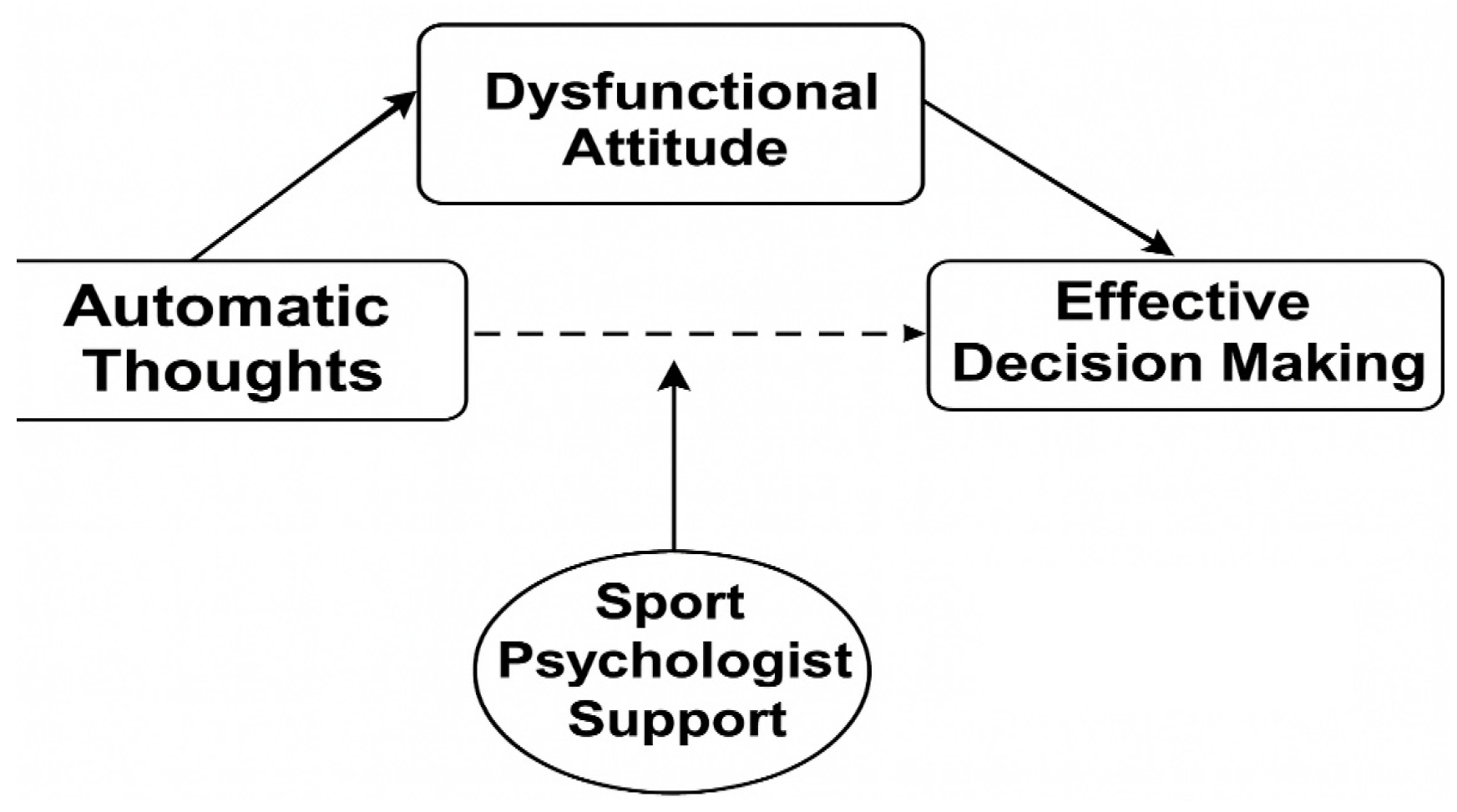
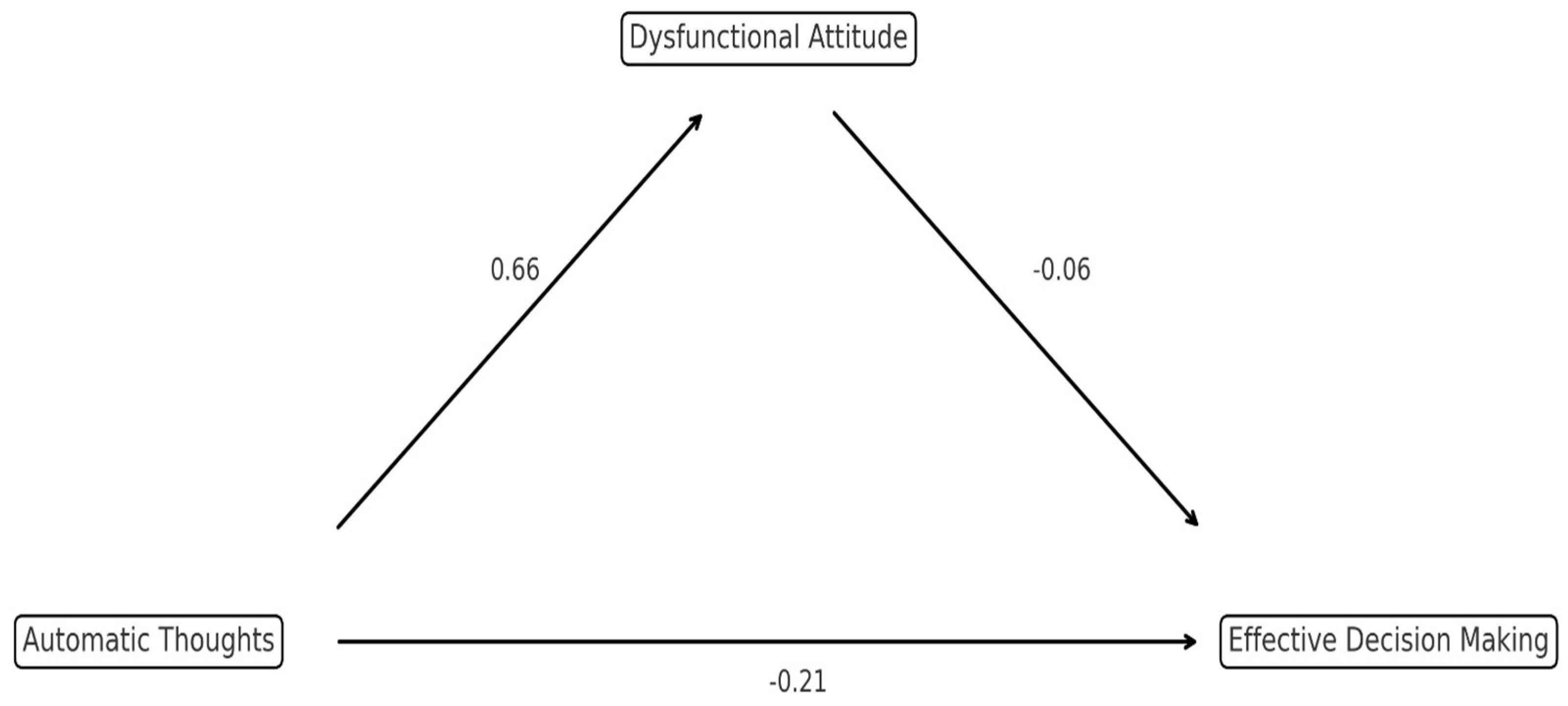
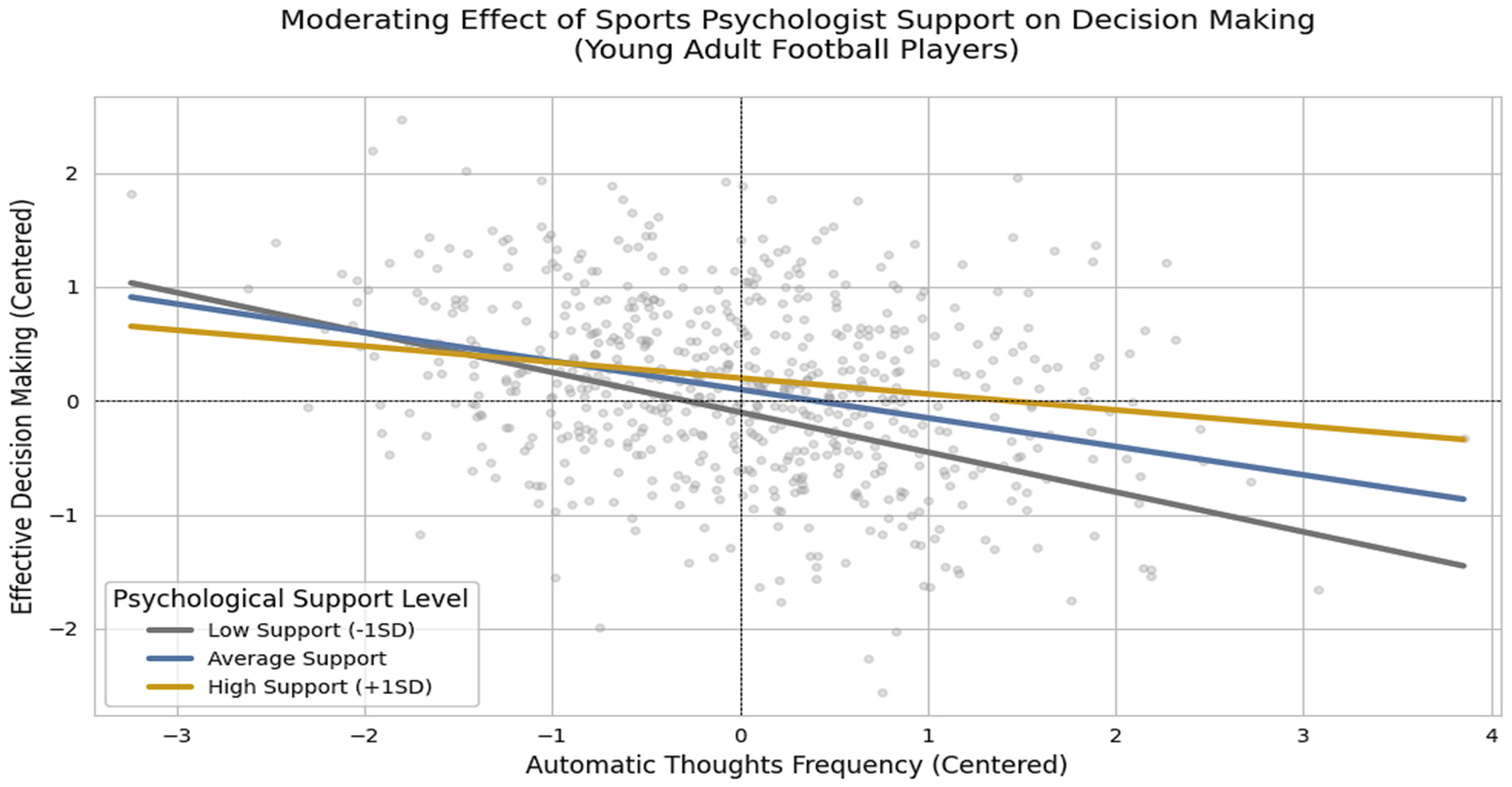

| Kolmogorov–Smirnov | Shapiro–Wilk | |||||
|---|---|---|---|---|---|---|
| Statistic | df | p | Statistic | df | p | |
| Dysfunctional Attitudes | 0.136 | 636 | p < 0.001 | 0.927 | 636 | p < 0.001 |
| Automatic Thought Frequency | 0.083 | 636 | p < 0.001 | 0.973 | 636 | p < 0.001 |
| Effective Decision-Making in Sport | 0.091 | 636 | p < 0.001 | 0.957 | 636 | p < 0.001 |
| Variable | N | Skewness | SE | Std. Z | |
|---|---|---|---|---|---|
| Dysfunctional Attitudes | 636 | 2.51 | 0.878 | 0.97 | 0.905 |
| Automatic Thought Frequency | 636 | 2.18 | 0.239 | 0.97 | 0.246 |
| Effective Decision-Making in Sport | 636 | 4.04 | −0.510 | 0.97 | −0.525 |
| CMIN/DF (x2/df) | CFI | TLI | SRMR | RMSEA | |
|---|---|---|---|---|---|
| Dysfunctional Attitudes | 403/164 = 2.45 | 0.89 | 0.88 | 0.05 | 0.08 |
| Automatic Thought Frequency | 147/40 = 3.67 | 0.93 | 0.90 | 0.06 | 0.08 |
| Effective Decision-Making in Sport | 44/14 = 3.14 | 0.92 | 0.89 | 0.04 | 0.07 |
| Variable | SD | 1 | 2 | 3 | Cronbach’s Alpha (α) | |
|---|---|---|---|---|---|---|
| 1. Dysfunctional Attitudes | 2.51 | 1.14 | 1 | 0.422 ** | −0.205 ** | 0.90 |
| 2. Automatic Thought Frequency | 2.18 | 0.73 | 1 | −0.273 ** | 0.80 | |
| 3. Effective Decision-Making in Sport | 4.04 | 0.68 | 1 | 0.87 |
| Label | Estimate | SE | Z | p | Mediation Effect (%) | |
|---|---|---|---|---|---|---|
| Auto_Thoughts → Dysfunctional_Attitude | a | 0.659 | 0.05 | 11.75 | <0.001 | |
| Dysfunctional_Attitude → Effective_Dec_Making | b | −0.064 | 0.02 | −2.59 | 0.010 | |
| Auto_Thoughts → Effective_Dec_Making | c | −0.211 | 0.03 | −5.43 | <0.001 | |
| Indirect | a × b | −0.043 | 0.01 | −2.53 | 0.011 | 16.8 |
| Direct | c | −0.211 | 0.03 | −5.43 | <0.001 | 83.2 |
| Total | c + a × b | −0.254 | 0.03 | −7.17 | <0.001 | 100.0 |
| Dependent Variable | Predictor(s) | R2 | Cohen’s f2 | Effect Size |
|---|---|---|---|---|
| Dysfunctional Attitudes | Automatic Thought Frequency | 0.18 | 0.22 | Medium |
| Effective Decision-Making in Sport | Dysfunctional Attitudes, Automatic Thought Frequency | 0.23 | 0.29 | Large |
| Estimate | SE | Z | p | |
|---|---|---|---|---|
| Automatic Thought Frequency | −0.248 | 0.0351 | −7.06 | <0.001 |
| Psychologist Support | −0.182 | 0.0762 | −2.39 | 0.017 |
| Automatic Thought × Psychologist Support | 0.312 | 0.1001 | 3.12 | 0.002 |
| Average | −0.248 | 0.0353 | −7.01 | <0.001 |
| Low (−1SD) | −0.353 | 0.0480 | −7.35 | <0.001 |
| High (+1SD) | −0.142 | 0.0498 | −2.86 | 0.004 |
Disclaimer/Publisher’s Note: The statements, opinions and data contained in all publications are solely those of the individual author(s) and contributor(s) and not of MDPI and/or the editor(s). MDPI and/or the editor(s) disclaim responsibility for any injury to people or property resulting from any ideas, methods, instructions or products referred to in the content. |
© 2026 by the authors. Licensee MDPI, Basel, Switzerland. This article is an open access article distributed under the terms and conditions of the Creative Commons Attribution (CC BY) license.
Share and Cite
Kara, M.; Genç, M.; Talaghir, L.-G.; Bențea, C.C.; Olaru, B.S.; Ivan, P. Cognitive Tendencies Influencing Decision-Making in Youn Footballers and the Role of Psychological Support. Behav. Sci. 2026, 16, 205. https://doi.org/10.3390/bs16020205
Kara M, Genç M, Talaghir L-G, Bențea CC, Olaru BS, Ivan P. Cognitive Tendencies Influencing Decision-Making in Youn Footballers and the Role of Psychological Support. Behavioral Sciences. 2026; 16(2):205. https://doi.org/10.3390/bs16020205
Chicago/Turabian StyleKara, Mehmet, Murat Genç, Laurentiu-Gabriel Talaghir, Cristina Corina Bențea, Bogdan Sorin Olaru, and Paula Ivan. 2026. "Cognitive Tendencies Influencing Decision-Making in Youn Footballers and the Role of Psychological Support" Behavioral Sciences 16, no. 2: 205. https://doi.org/10.3390/bs16020205
APA StyleKara, M., Genç, M., Talaghir, L.-G., Bențea, C. C., Olaru, B. S., & Ivan, P. (2026). Cognitive Tendencies Influencing Decision-Making in Youn Footballers and the Role of Psychological Support. Behavioral Sciences, 16(2), 205. https://doi.org/10.3390/bs16020205

