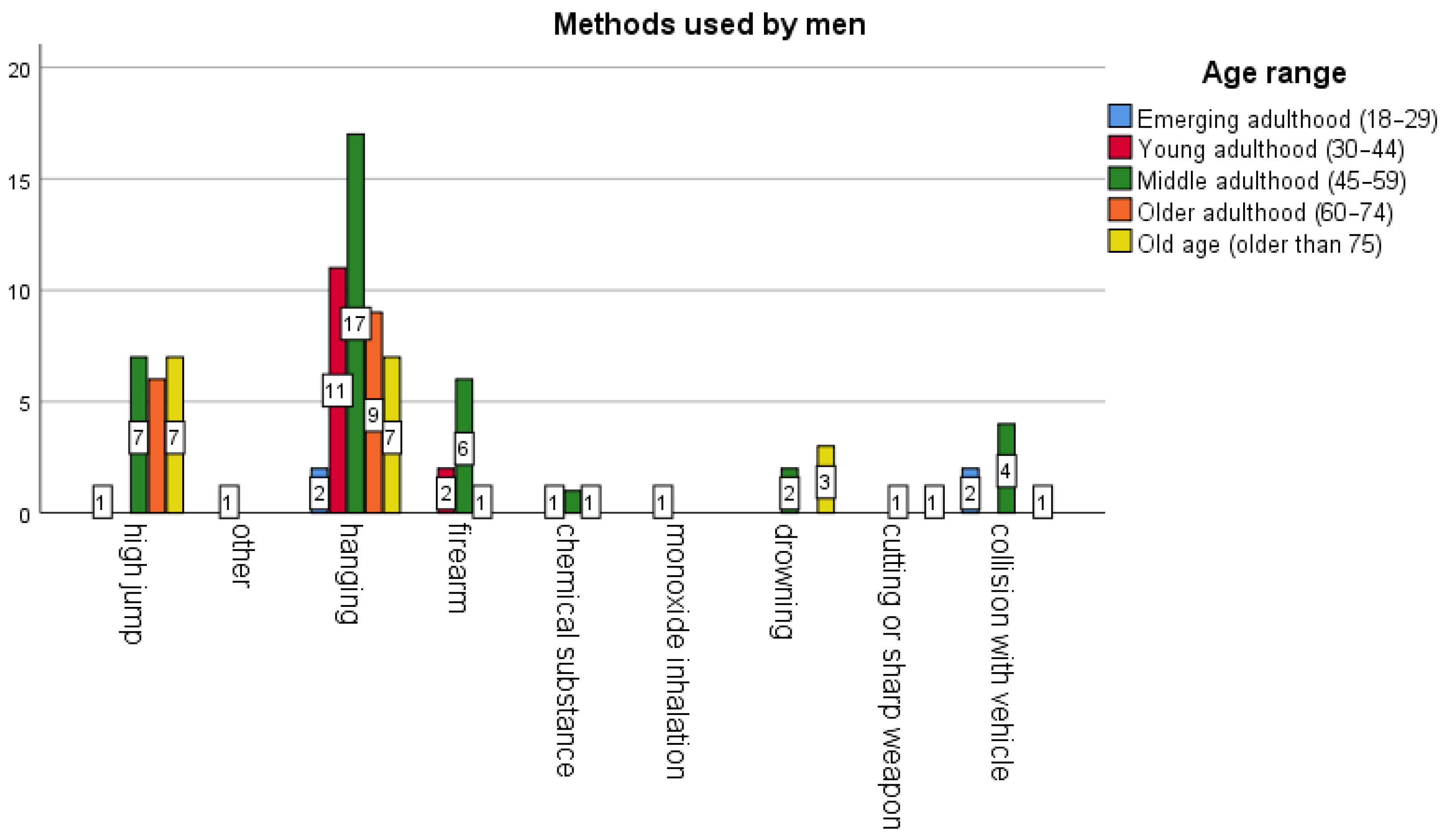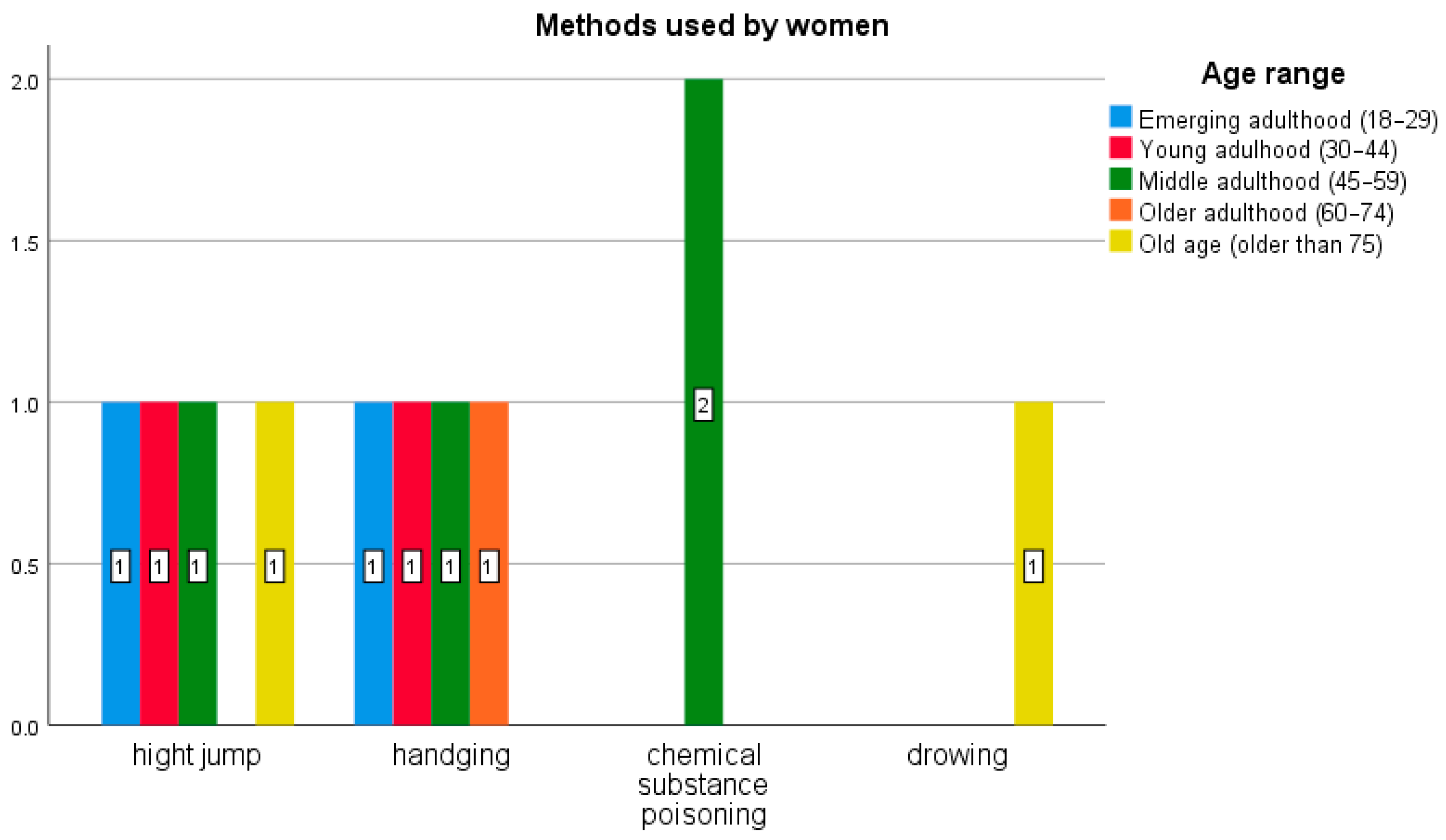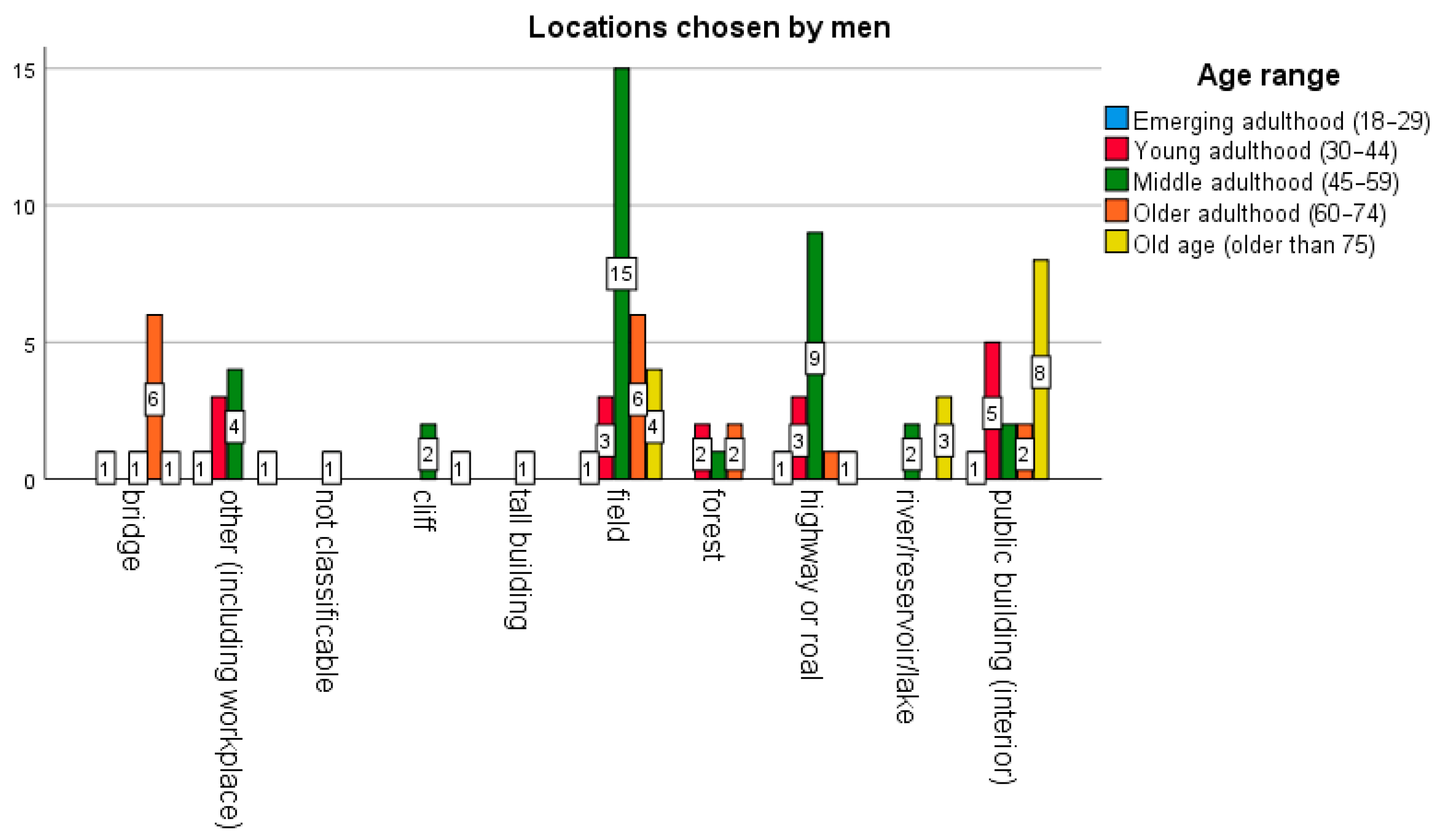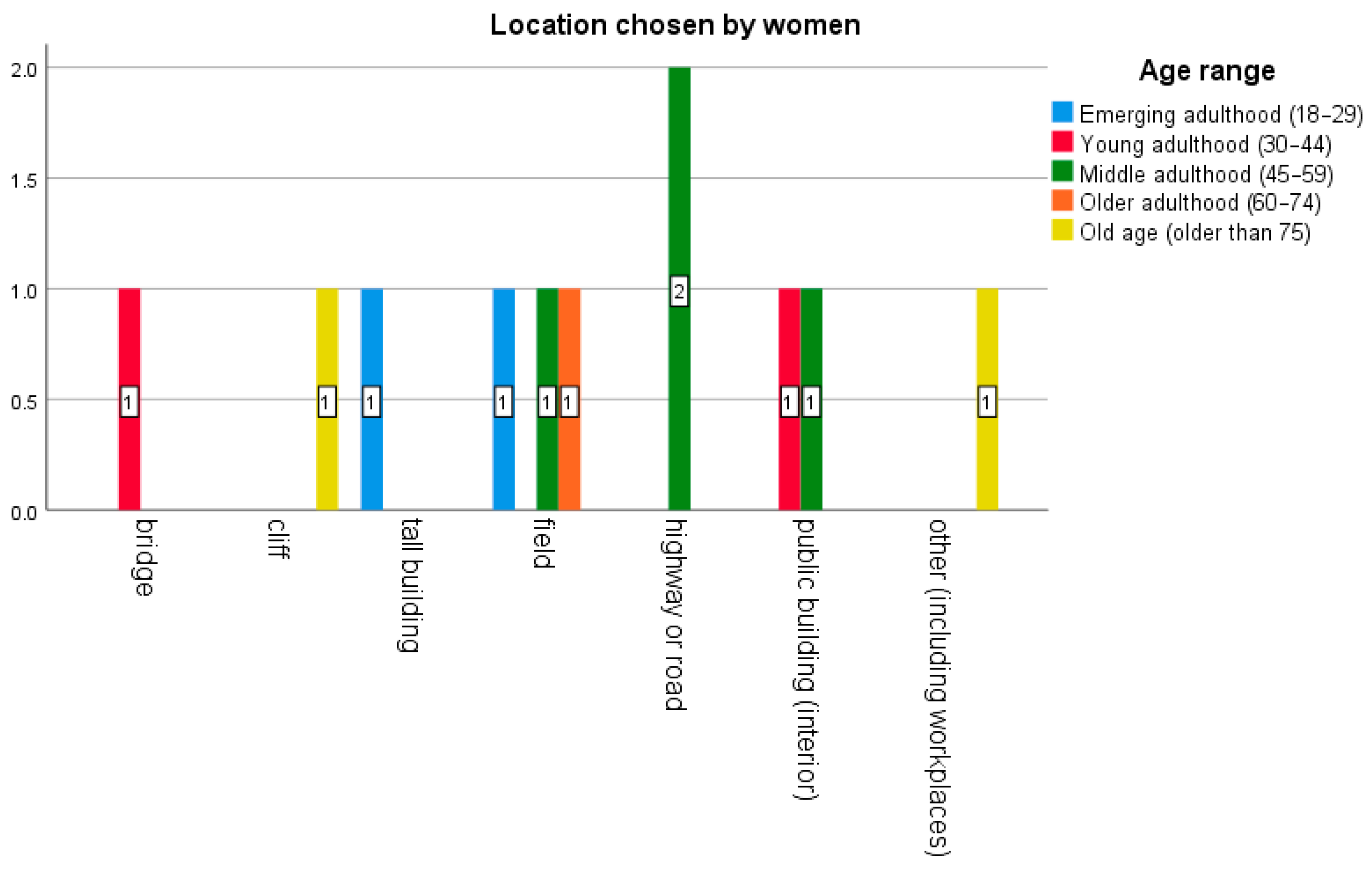


Identification and Analysis of Critical Suicide Sites and Factors in Castilla-La Mancha (2020–2024): Forensic and Healthcare Collaboration for Prevention

 , , ,
, , ,
Abstract
1. Introduction
2. Materials and Methods
2.1. Study Design
2.2. Participants and Scope
2.3. Study Variables
2.4. Data Analysis
3. Results
4. Discussion
Author Contributions
Funding
Institutional Review Board Statement
Informed Consent Statement
Data Availability Statement
Acknowledgments
Conflicts of Interest
References
- Bandara, P., Pirkis, J., Clapperton, A., Shin, S., Too, L. S., Reifels, L., Onie, S., Page, A., Andriessen, K., Krysinska, K., Flego, A., Schlichthorst, M., Spittal, M. J., Mihalopoulos, C., & Le, L. K. (2022). Cost-effectiveness of installing barriers at bridge and cliff sites for suicide prevention in Australia. JAMA Network Open, 5(4), e226019. [Google Scholar] [CrossRef]
- Barbería, E., Gispert, R., Gallo, B., Ribas, G., Puigdefàbregas, A., Freitas, A., Segú, E., Torralba, P., García-Sayago, F., & Estarellas, A. (2018). Improving suicide mortality statistics in Tarragona (Catalonia, Spain) between 2004–2012. Journal of Psychiatry and Mental Health, 11(4), 227–233. [Google Scholar] [CrossRef]
- Barboza-Salerno, G. E., Watson-Grace, A., Shockley-McCarthy, K., Harrington, T., Warren, K., & Steelesmith, D. (2025). The land cover paradox: Characteristics of blue- and green spaces within and beyond high-risk suicide clusters. SSM—Population Health, 31, 101820. [Google Scholar] [CrossRef]
- Chung, Y. W., Kang, S. J., Matsubayashi, T., Sawada, Y., & Ueda, M. (2016). The effectiveness of platform screen doors for the prevention of subway suicides in South Korea. Journal of Affective Disorders, 194, 80–83. [Google Scholar] [CrossRef]
- Comisionado de Salud Mental, Ministerio de Sanidad. (2025). Plan de Acción para la Prevención del Suicidio 2025–2027 [Action plan for suicide prevention 2025–2027]. Gobierno de España. Available online: https://www.sanidad.gob.es/gabinete/notasPrensa.do?id=6618 (accessed on 15 September 2025).
- Consejo Médico Forense. (2024). Informe sobre mortalidad con intervención judicial. 2022. Ministerio de la Presidencia, Justicia y Relaciones con las Cortes, Gobierno de España. [Google Scholar]
- Cox, G. R., Owens, C., Robinson, J., Nicholas, A., Lockley, A., Williamson, M., Cheung, Y. T., & Pirkis, J. (2013). Interventions to reduce suicides at suicide hotspots: A systematic review. BMC Public Health, 13, 214. [Google Scholar] [CrossRef]
- García-Fernández, D., Marcos del Cano, A. M., & Topa, G. (2024). Suicide and public interest in the Spanish press: Theoretical analysis from the constitutional jurisprudence on freedom of information. SEECI Communication Journal, 57, 1–33. [Google Scholar] [CrossRef]
- GBD 2021 Suicide Collaborators. (2025). Global, regional, and national burden of suicide, 1990–2021: A systematic analysis for the Global Burden of Disease Study 2021. The Lancet Public Health, 10(3), e189–e202. [Google Scholar] [CrossRef]
- Giner, L., & Guija, J. A. (2014). Número de suicidios en España: Diferencias entre los datos del Instituto Nacional de Estadística y los aportados por los Institutos de Medicina Legal [Number of suicides in Spain: Differences between data from the Spanish Statistical Office and the Institutes of Legal Medicine]. Revista de Psiquiatría y Salud Mental, 7(3), 139–146. [Google Scholar] [CrossRef] [PubMed]
- Giupponi, G., Thoma, H., Lamis, D., Forte, A., Pompili, M., & Kapfhammer, H. P. (2019). Posttraumatic stress reactions of underground drivers after suicides by jumping to arriving trains; feasibility of an early stepped care outpatient intervention. Journal of Trauma & Dissociation, 20(5), 495–510. [Google Scholar] [CrossRef] [PubMed]
- Hemmer, A., Meier, P., & Reisch, T. (2017). Comparing different suicide prevention measures at bridges and buildings: Lessons we have learned from a national survey in Switzerland. PLoS ONE, 12(1), e0169625. [Google Scholar] [CrossRef] [PubMed]
- Jain, N., Wijnen, B., Lohumi, I., Chatterjee, S., & Evers, S. M. A. A. (2024). Economic burden of suicides and suicide attempts in low- and middle-income countries: A systematic review of costing studies. Expert Review of Pharmacoeconomics & Outcomes Research, 24(9), 1067–1079. [Google Scholar] [CrossRef]
- Joyner, L., Mackenzie, J. M., Willis, A., Phillips, P., Cliffe, B., Marsh, I., Pettersen, E., Hawton, K., & Marzano, L. (2025). Suicide prevention measures at high-risk locations: A goal-directed motivation perspective. Behavioral Sciences, 15(8), 1009. [Google Scholar] [CrossRef] [PubMed]
- LeFevre, M. L. (2014). Screening for suicide risk in adolescents, adults, and older adults in primary care: US Preventive Services Task Force recommendation statement. Annals of Internal Medicine, 160(10), 719–726. [Google Scholar] [CrossRef]
- Mackenzie, D. W., Lester, D., Manson, R., & Yeh, C. (2016). Do suicides from the Golden Gate Bridge cluster? Psychological Reports, 118(1), 70–73. [Google Scholar] [CrossRef]
- Marzano, L., Spence, R., Marsh, I., Barbin, A., & Kruger, I. (2025). How does news coverage of suicide affect suicidal behavior at a high-frequency location? A 7-year time series analysis. BMJ Public Health, 3(1), e002136. [Google Scholar] [CrossRef] [PubMed]
- Merli, R., & Costanza, A. (2024). Effectiveness of physical barriers to prevent suicide by jumping from high-risk bridges: From an integrative review to a northern Italian province’s paradigm. Preventive Medicine Reports, 42, 102745. [Google Scholar] [CrossRef]
- National Institute for Mental Health in England. (2006). Guidance on action to be taken at suicide hotspots. Available online: https://sprc.org/wp-content/uploads/2023/01/SuicideHotspotsGuidance-PDF.pdf (accessed on 15 September 2025).
- National Institute of Statistics [INE]. (2024). Deaths by cause of death. Year 2023. Available online: https://www.ine.es (accessed on 15 September 2025).
- Nevarez-Flores, A. G., Pandey, V., Angelucci, A. P., Neil, A. L., McDermott, B., & Castle, D. (2025). Means restriction for suicide prevention: An umbrella review. Acta Psychiatrica Scandinavica, 151(6), 653–667. [Google Scholar] [CrossRef] [PubMed]
- Owens, C., Hardwick, R. J. L., Charles, N., & Watkinson, G. (2015). Preventing suicides in public places: A practice resource. Available online: https://assets.publishing.service.gov.uk/media/5c2f6f8b40f0b66cf8298a70/Preventing_suicides_in_public_places.pdf (accessed on 15 September 2025).
- Owens, C., Lloyd-Tomlins, S., Emmens, T., & Aitken, P. (2009). Suicides in public places: Findings from one English county. European Journal of Public Health, 19(6), 580–582. [Google Scholar] [CrossRef]
- Pirkis, J., Too, L. S., Spittal, M. J., Krysinska, K., Robinson, J., & Cheung, Y. T. (2015). Interventions to reduce suicides at suicide hotspots: A systematic review and meta-analysis. The Lancet Psychiatry, 2(11), 994–1001. [Google Scholar] [CrossRef]
- Salgado, P. (2015, August 12). These are some of the places marked by suicide in Spain. Vice. Available online: https://www.vice.com/es/article/algunos-de-los-lugares-marcados-por-el-suicidio-en-espana-924/ (accessed on 15 September 2025).
- Santurtún, M., Santurtún, A., Agudo, G., & Zarrabeitia, M. T. (2016). Method used in suicide deaths in Spain: Poisoning and non-toxic violent agents. Cuadernos de Medicina Forense, 22(3–4), 73–80. Available online: http://scielo.isciii.es/scielo.php?script=sci_arttext&pid=S1135-76062016000200003&lng=es&tlng=es (accessed on 22 October 2025).
- Shen, Y. S., Lung, S.-C. C., & Cui, S. (2022). Exploring multiple pathways and mediation effects of urban environmental factors for suicide prevention. Environmental Pollution, 294, 118642. [Google Scholar] [CrossRef]
- Shin, S., Spittal, M. J., Clapperton, A., Pirkis, J., & Too, L. S. (2025). Trends in, and risk factors for, suicide in public places: A 17-year case-control study in Australia. Suicide & Life-threatening Behavior, 55(2), e70017. [Google Scholar] [CrossRef]
- Simina-Petra Simion, S.-O., & Jung, H. (2025). Gender disparities in suicide: A deeper look into the complexity of suicidal acts. Legal Medicine, 77, 102679. [Google Scholar] [CrossRef] [PubMed]
- Too, L. S., Shin, S., Mavoa, S., Law, P. C. F., Clapperton, A., Roberts, L., Arensman, E., Spittal, M. J., & Pirkis, J. (2024). High-risk suicide locations in Australia. JAMA Network Open, 7(6), e2417770. [Google Scholar] [CrossRef] [PubMed]
- Too, L. S., Shin, S., Taouk, Y., Pirkis, J., Sinyor, M., Yip, P. S. F., & Hawton, K. (2025). Impact of interventions at frequently used suicide locations on occurrence of suicides at other sites: A systematic review and meta-analysis. Psychological Medicine, 55, E168. [Google Scholar] [CrossRef] [PubMed]
- Ueda, M., Sawada, Y., & Matsubayashi, T. (2015). The effectiveness of installing physical barriers for preventing railway suicides and accidents: Evidence from Japan. Journal of Affective Disorders, 178, 1–4. [Google Scholar] [CrossRef]
- World Health Organization. (2025). Suicide 2021. Available online: https://www.who.int/news-room/fact-sheets/detail/suicide (accessed on 20 September 2025).
- Xing, Y., Lu, J., & Chen, S. (2019). Evaluating the effectiveness of platform screen doors for preventing metro suicides in China. Journal of Affective Disorders, 253, 63–68. [Google Scholar] [CrossRef]
- Zalsman, G., Hawton, K., Wasserman, D., van Heeringen, K., Arensman, E., Sarchiapone, M., Carli, V., Höschl, C., Barzilay, R., Balazs, J., Purebl, G., Kahn, J. P., Sáiz, P. A., Lipsicas, C. B., Bobes, J., Cozman, D., Hegerl, U., & Zohar, J. (2016). Suicide prevention strategies revisited: 10-year systematic review. The Lancet Psychiatry, 3(7), 646–659. [Google Scholar] [CrossRef]



| Method | ||||||||||
|---|---|---|---|---|---|---|---|---|---|---|
| Location | Jumping | Hanging | Firearm | Poisoning | Inhalation | Drowning | Stabbing | Vehicle Collision | Total | Total |
| Toledo/Albacete | ||||||||||
| Bridge | 5/4 | 1/0 | 0/0 | 0/0 | 0/0 | 0/0 | 0/0 | 0/0 | 6/4 | 10 |
| Cliff | 1/3 | 0/0 | 0/0 | 0/0 | 0/0 | 0/0 | 0/0 | 0/0 | 1/3 | 4 |
| High-rise building | 12 | 0/0 | 0/0 | 0/0 | 0/0 | 0/0 | 0/0 | 0/0 | 12/0 | 12 |
| Field | 1/0 | 12/14 | 1/2 | 1/0 | 1/0 | 0/0 | 0/0 | 6/0 | 22/16 | 38 |
| Forest | 0/0 | 1/1 | 2/1 | 0/0 | 0/0 | 0/0 | 0/0 | 0/0 | 3/2 | 5 |
| Highway or road | 3/0 | 5/2 | 2 | 1/0 | 0/0 | 0/0 | 1/0 | 3/1 | 15/3 | 18 |
| River, reservoir | 0/0 | 0/0 | 0/0 | 0/0 | 0/0 | 5/0 | 0/0 | 0/0 | 5/0 | 5 |
| Public building (interior) | 5/1 | 7/1 | 1/1 | 3/0 | 0/0 | 0/0 | 1/0 | 0/0 | 17/3 | 20 |
| Other | 0/0 | 9/3 | 0/0 | 1/0 | 0/0 | 0/1 | 1/0 | 0/0 | 11/4 | 15 |
| Not classifiable as critical site | 6/29 | 125/55 | 15/9 | 21/14 | 3/2 | 0/3 | 9/3 | 0/0 | 179/115 | 294 |
| Totals | 33/37 | 160/76 | 21/13 | 27/14 | 4/2 | 5/4 | 12/4 | 9/1 | 271/150 | 421 |
Disclaimer/Publisher’s Note: The statements, opinions and data contained in all publications are solely those of the individual author(s) and contributor(s) and not of MDPI and/or the editor(s). MDPI and/or the editor(s) disclaim responsibility for any injury to people or property resulting from any ideas, methods, instructions or products referred to in the content. |
© 2025 by the authors. Licensee MDPI, Basel, Switzerland. This article is an open access article distributed under the terms and conditions of the Creative Commons Attribution (CC BY) license.
Share and Cite
Vallejo-Sánchez, B.; Solano-Pinto, N.; Huertes-Del Arco, A.; Muñoz, V.; Casillas, M.; Arroyo, C.; Moreno, F. Identification and Analysis of Critical Suicide Sites and Factors in Castilla-La Mancha (2020–2024): Forensic and Healthcare Collaboration for Prevention. Behav. Sci. 2026, 16, 7. https://doi.org/10.3390/bs16010007
Vallejo-Sánchez B, Solano-Pinto N, Huertes-Del Arco A, Muñoz V, Casillas M, Arroyo C, Moreno F. Identification and Analysis of Critical Suicide Sites and Factors in Castilla-La Mancha (2020–2024): Forensic and Healthcare Collaboration for Prevention. Behavioral Sciences. 2026; 16(1):7. https://doi.org/10.3390/bs16010007
Chicago/Turabian StyleVallejo-Sánchez, Beatriz, Natalia Solano-Pinto, Ana Huertes-Del Arco, Valeriano Muñoz, Mónica Casillas, Carolina Arroyo, and Fernando Moreno. 2026. "Identification and Analysis of Critical Suicide Sites and Factors in Castilla-La Mancha (2020–2024): Forensic and Healthcare Collaboration for Prevention" Behavioral Sciences 16, no. 1: 7. https://doi.org/10.3390/bs16010007
APA StyleVallejo-Sánchez, B., Solano-Pinto, N., Huertes-Del Arco, A., Muñoz, V., Casillas, M., Arroyo, C., & Moreno, F. (2026). Identification and Analysis of Critical Suicide Sites and Factors in Castilla-La Mancha (2020–2024): Forensic and Healthcare Collaboration for Prevention. Behavioral Sciences, 16(1), 7. https://doi.org/10.3390/bs16010007