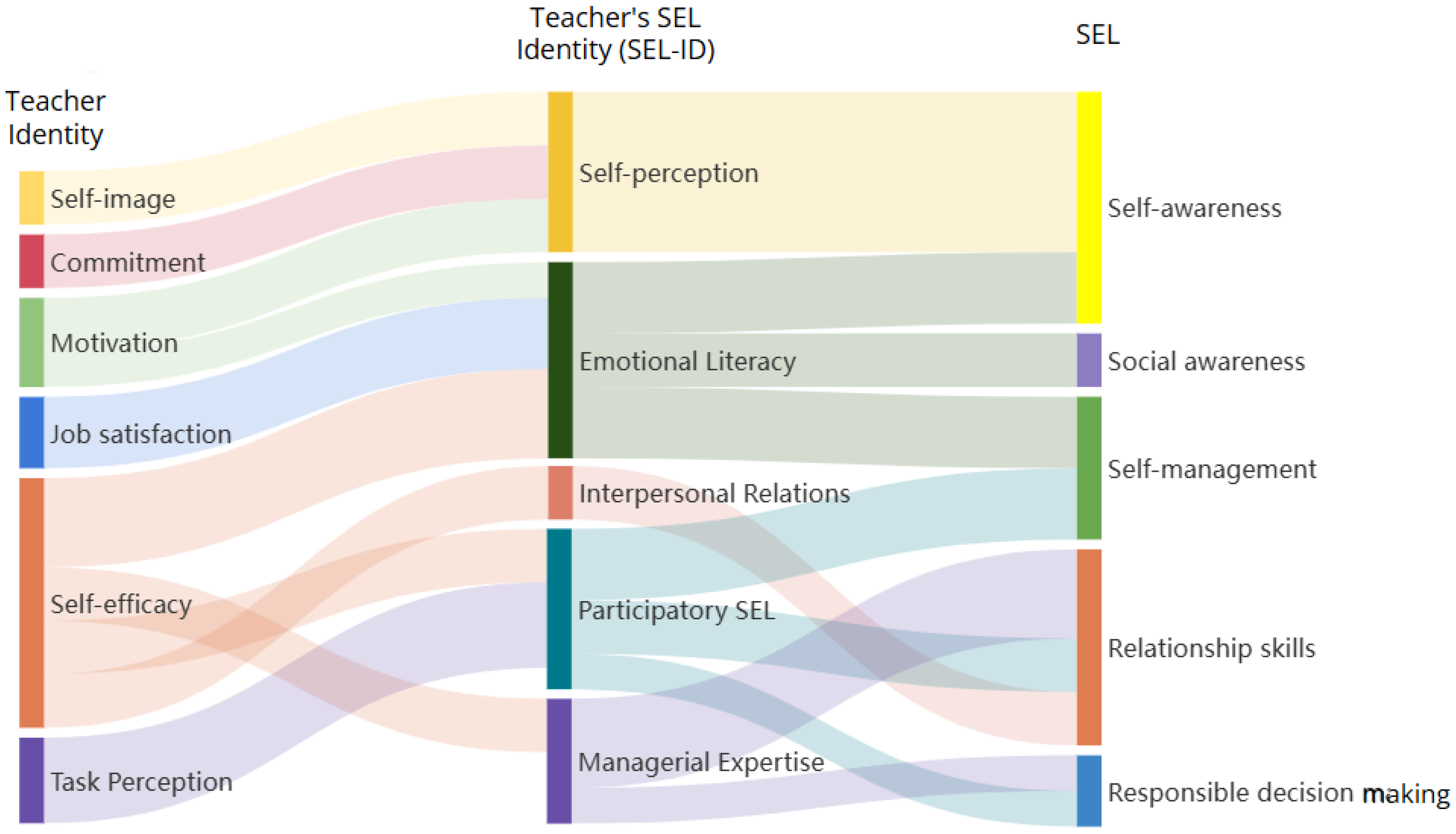

Teachers’ SEL Identity (SEL-ID): An Intersection Between Teacher Identity and Social and Emotional Learning (SEL)

Abstract
1. Introduction
2. Conceptualization and Related Research
2.1. SEL in Education
2.2. Teacher SEC and Learning Environment
2.3. Teacher Identity
2.4. The Purpose of the Study
3. Methodology
3.1. Participants
3.2. Research Design and Procedure
3.3. Data Collection
3.3.1. Semi-Structured Interviews
3.3.2. Classroom Observations
3.4. Data Analysis
4. Findings and Discussion
4.1. Self-Perception
“… I really dislike leaving any task unfinished. I cannot stand it when something is left hanging like a stone in the air; I feel I must complete it. My intrinsic motivation comes from this-being able to like myself requires that I finish what I start. For example, if I clean a table, I might even wipe it twice just so I can say, ‘Great, it’s really done well.”(Ada, interview 1.)
“I have a competitive spirit. I never give up. I try to do the best I can with the tasks I am given. I enjoy pursuing resources that will renew me, taking on responsibilities in this regard, putting something out there… I enjoy getting my hands dirty and being productive.”(Ada, interview 1.)
4.2. Emotional Literacy
“On days when I’m on duty, I get very tense. I get very irritable, and this energy rubs off on the children… art… I work with watercolors. Adrenaline music relaxes me, I don’t know. It helps clear my mind, I love it.”(Hale, interview 1.)
“I’ve never been angry before. I don’t know what to do. I raise my voice, yes, that’s probably the first thing a teacher does, raising voice. Sometimes friends say, “Your voice is loud,” but yes, sometimes you say, “When you get angry, what do you do?” Well, your voice gets louder. So, if you can’t leave the classroom at that moment and there’s nothing else you can do, your voice gets louder-that’s the first thing happens. If I have a partner teacher in the class and I can go outside, I can take a breath, talk to my family, have something warm to drink.”(Gonca, interview 2.)
“I can’t just let go off of things immediately; I need to go home, lie down, and think more intensely. Sometimes it costs me a whole night. Certain issues keep me turning from side to side, rethinking and complicating them, then resolving them again. Later I motivate myself, telling myself, ‘This is not as big a problem as I thought.’ In time, everything goes back to normal.”
4.3. Interpersonal Relations
4.4. Participatory SEL
“In terms of prioritizing, I usually put children to a vote when we experience such things. I usually vote on whether we should go to the playground or the park, whichever has more fingers, whichever has more applause, you know, I usually prefer this way, but if both experiences are desired, if there is an experience in the middle and it is beautiful, I will definitely do both.”(Beril, interview 3.)
4.5. Managerial Expertise
“A verbal argument broke out between two children. The teacher was standing nearby in the classroom. When the argument started, the teacher quietly watched them, occasionally making eye contact, while also observing the children playing in the classroom. The teacher did not intervene in the children’s verbal argument. One of the children asked his friend, “What happened, why do you feel that way?” The other child replied, “You used the bad word to me, it made me angry.” Then, one said, “I didn’t use that word to you; you misunderstood me,” and they resolved the argument between themselves and continued playing their game in the center.”
“At the very simplest level, we are all familiar with our rules by now. Every day, based on my observations, I remind them of whatever they are most lacking in. Yes, this was in our class rules. Today, this was not really followed. I think some of our friends have forgotten these rules a little, so I remind them, saying, ‘Let’s all remember our rules together.”(Selin, interview 3.)
5. Suggestions
6. Conclusions
7. Implications
Author Contributions
Funding
Institutional Review Board Statement
Informed Consent Statement
Data Availability Statement
Acknowledgments
Conflicts of Interest
References
- Andrews, P. G., Moulton, M. J., & Hughes, H. E. (2018). Integrating social justice into middle grades teacher education. Middle School Journal, 49(5), 4–15. [Google Scholar] [CrossRef]
- Avraamidou, L. (2014). Studying science teacher identity: Current insights and future research directions. Studies in Science Education, 50(2), 145–179. [Google Scholar] [CrossRef]
- Avraamidou, L. (2019). Stories we live, identities we build: How are elementary teachers’ science identities shaped by their lived experiences? Cultural Studies of Science Education, 14, 33–59. [Google Scholar] [CrossRef]
- Ballantyne, J., & Grootenboer, P. (2012). Exploring relationships between teacher identities and disciplinarity. International Journal of Music Education, 30(4), 368–381. [Google Scholar] [CrossRef]
- Bandura, A., Caprara, G. V., Barbaranelli, C., Gerbino, M., & Pastorelli, C. (2003). Role of affective self-regulatory efficacy in diverse spheres of psychosocial functioning. Child Development, 74(3), 769–782. [Google Scholar] [CrossRef] [PubMed]
- Bächler, R., & Salas, R. (2021). School memories of preservice teachers: An analysis of their role in the conceptions about the relationships between emotions and teaching/learning processes. Frontiers in Psychology, 12, 690941. [Google Scholar] [CrossRef] [PubMed]
- Beauchamp, C., & Thomas, L. (2009). Understanding teacher identity: An overview of issues in the literature and implications for teacher education. Cambridge Journal of Education, 39(2), 175–189. [Google Scholar] [CrossRef]
- Beijaard, D., Meijer, P. C., & Verloop, N. (2004). Reconsidering research on teachers’ professional identity. Teaching and Teacher Education, 20(2), 107–128. [Google Scholar] [CrossRef]
- Beijaard, D., Verloop, N., & Vermunt, J. D. (2000). Teachers’ perceptions of professional identity: An exploratory study from a personal knowledge perspective. Teaching and Teacher Education, 16(7), 749–764. [Google Scholar] [CrossRef]
- Brackett, M. A., Palomera, R., Mojsa-Kaja, J., Reyes, M. R., & Salovey, P. (2010). Emotion-regulation ability, burnout, and job satisfaction among British secondary-school teachers. Psychology in the Schools, 47(4), 406–417. [Google Scholar] [CrossRef]
- Brouwers, A., Evers, W. J., & Tomic, W. (2001). Self-efficacy in eliciting social support and burnout among secondary-school teachers. Journal of Applied Social Psychology, 31(7), 1474–1491. [Google Scholar] [CrossRef]
- Canrinus, E. T., Helms-Lorenz, M., Beijaard, D., Buitink, J., & Hofman, A. (2012). Self-efficacy, job satisfaction, motivation and commitment: Exploring the relationships between indicators of teachers’ professional identity. European Journal of Psychology of Education, 27(1), 115–132. [Google Scholar] [CrossRef]
- Cappella, E., Hamre, B. K., Kim, H. Y., Henry, D. B., Frazier, S. L., Atkins, M. S., & Schoenwald, S. K. (2012). Teacher consultation and coaching within mental health practice: Classroom and child effects in urban elementary schools. Journal of Consulting and Clinical Psychology, 80(4), 597–610. [Google Scholar] [CrossRef] [PubMed]
- Carminati, L. (2018). Generalizability in qualitative research: A tale of two traditions. Qualitative Health Research, 28(13), 2094–2101. [Google Scholar] [CrossRef] [PubMed]
- Charmaz, K. (2014). Grounded theory in global perspective: Reviews by international researchers. Qualitative Inquiry, 20(9), 1074–1084. [Google Scholar] [CrossRef]
- Cipriano, C., Strambler, M. J., Naples, L. H., Ha, C., Kirk, M., Wood, M., Sehgal, K., Zieher, A. K., Eveleigh, A., McCarthy, M., Funaro, M., Ponnock, A., Chow, J. C., & Durlak, J. (2023). The state of evidence for social and emotional learning: A contemporary meta-analysis of universal school-based SEL interventions. Child Development, 94(5), 1181–1204. [Google Scholar] [CrossRef]
- Collaborative for Academic, Social, and Emotional Learning. (2020, November). CASEL’s SEL framework: What are the core competence areas and where are they promoted? Available online: https://casel.org/casel-sel-framework-11-2020/ (accessed on 1 October 2020).
- Corbin, J., & Strauss, A. (2014). Basics of qualitative research: Techniques and procedures for developing grounded theory. Sage Publications. [Google Scholar]
- Davis, T., & Park, E. (2025). A systematic review of early-career teacher wellbeing, stress, burnout and support mechanisms during and post COVID-19 pandemic. Education Sciences, 15(8), 996. [Google Scholar] [CrossRef]
- Day, C., Kington, A., Stobart, G., & Sammons, P. (2006). The personal and professional selves of teachers: Stable and unstable identities. British Educational Research Journal, 32(4), 601–616. [Google Scholar] [CrossRef]
- Duane, A. M., Caouette, J. D., Morris, K. S., Metzger, A. N., CalHOPE Research Committee & Shapiro, V. B. (2025). Securing the foundation: Providing supports and building teacher capacity for SEL implementation through a university-based continuing education course. Social and Emotional Learning: Research, Practice, and Policy, 5, 100082. [Google Scholar] [CrossRef]
- Durlak, J. A., Mahoney, J. L., & Boyle, A. E. (2022). What we know, and what we need to find out about universal, school-based social and emotional learning programs for children and adolescents: A review of meta-analyses and directions for future research. Psychological Bulletin, 148(11–12), 765–782. [Google Scholar] [CrossRef]
- Durlak, J. A., & Weissberg, R. P. (2011). Promoting social and emotional development is an essential part of students’ education. Human Development, 54(1), 1–3. Available online: https://www.jstor.org/stable/26764985 (accessed on 23 September 2025). [CrossRef]
- Durlak, J. A., Weissberg, R. P., Dymnicki, A. B., Taylor, R. D., & Schellinger, K. B. (2011). The impact of enhancing students’ social and emotional learning: A meta-analysis of school-based universal interventions. Child Development, 82(1), 405–432. [Google Scholar] [CrossRef] [PubMed]
- Dymnicki, A. B., Weissberg, R. P., & Henry, D. B. (2011). Understanding how programs work to prevent overt aggressive behaviors: A meta-analysis of mediators of elementary school–based programs. Journal of School Violence, 10(4), 315–337. [Google Scholar] [CrossRef]
- Ekmekci, A., & Serrano, D. M. (2022). The impact of teacher quality on student motivation, achievement, and persistence in science and mathematics. Education Sciences, 12(10), 649. [Google Scholar] [CrossRef]
- Elias, M. J. (2003). Academic and social-emotional learning (Vol. 11). International Academy of Education. [Google Scholar]
- Emmer, E. T., & Sabornie, E. J. (Eds.). (2014). Handbook of classroom management: Research, practice, and contemporary issues (2nd ed.). Routledge. [Google Scholar]
- Evans, R., Murphy, S., & Scourfield, J. (2015). Implementation of a school-based social and emotional learning intervention: Understanding diffusion processes within complex systems. Prevention Science, 16(5), 754–764. [Google Scholar] [CrossRef] [PubMed]
- Ferreira, M., Reis-Jorge, J., & Olcina-Sempere, G. (2025, January). Social and emotional learning-Portuguese and Spanish teachers’ representations and classroom practices. In Frontiers in education (Vol. 9, p. 1461964). Frontiers Media SA. [Google Scholar]
- Fitzgerald, M. M., Shipman, K., Pauletic, M., Ellesworth, K., & Dymnicki, A. (2022). Promoting educator social emotional competence, well-being, and student–educator relationships: A pilot study. Mental Health & Prevention, 26, 200234. [Google Scholar] [CrossRef]
- Flores, M. A., & Day, C. (2006). Contexts which shape and reshape new teachers’ identities: A multi-perspective study. Teaching and Teacher Education, 22(2), 219–232. [Google Scholar] [CrossRef]
- Friesen, M. D., & Besley, S. C. (2013). Teacher identity development in the first year of teacher education: A developmental and social psychological perspective. Teaching and Teacher Education, 36, 23–32. [Google Scholar] [CrossRef]
- Gee, J. P. (2000). Identity as an analytic lens for research in education. Review of Research in Education, 25, 99–125. [Google Scholar] [CrossRef]
- Gimbert, B. G., Miller, D., Herman, E., Breedlove, M., & Molina, C. E. (2023). Social emotional learning in schools: The importance of educator competence. Journal of Research on Leadership Education, 18, 3–39. [Google Scholar] [CrossRef]
- Goddard, R. D., Hoy, W. K., & Hoy, A. W. (2000). Collective teacher efficacy: Its meaning, measure, and impact on student achievement. American Educational Research Journal, 37(2), 479–507. [Google Scholar] [CrossRef]
- Gol-Guven, M. (2009). Evaluation of the quality of early childhood classrooms in Turkey. Early Child Development and Care, 179(4), 437–451. [Google Scholar] [CrossRef]
- Gol-Guven, M. (2016). The lions quest program in Turkey: Teachers’ views and classroom practices. International Journal of Emotional Education, 8(2), 60–69. [Google Scholar]
- Gol-Guven, M. (2017). The effectiveness of the lions quest program: Skills for growing on school climate, students’ behaviors, perceptions of school, and conflict resolution skills. European Early Childhood Education Research Journal, 25(4), 575–594. [Google Scholar] [CrossRef]
- Hamre, B. K., & Pianta, R. C. (2001). Early teacher–child relationships and the trajectory of children’s school outcomes through eighth grade. Child Development, 72(2), 625–638. [Google Scholar] [CrossRef]
- Hanna, F., Oostdam, R., Severiens, S. E., & Zijlstra, B. J. (2019). Domains of teacher identity: A review of quantitative measurement instruments. Educational Research Review, 27, 15–27. [Google Scholar] [CrossRef]
- Hanna, F., Oostdam, R., Severiens, S. E., & Zijlstra, B. J. (2020). Assessing the professional identity of primary student teachers: Design and validation of the teacher identity measurement scale. Studies in Educational Evaluation, 64, 100822. [Google Scholar] [CrossRef]
- Hargreaves, A. (1998). The emotional practice of teaching. Teaching and Teacher Education, 14(8), 835–854. [Google Scholar] [CrossRef]
- Hart, S. C., DiPerna, J. C., Lei, P.-W., Zhao, H., Sun, T., Li, X., & Husmann, K. (2024). Does universal SEL promote academic success? Examining learner outcomes under routine conditions in first-grade classrooms. AERA Open, 10, 23328584241262746. [Google Scholar] [CrossRef]
- Hemi, M. E., & Kasperski, R. (2023). Development and validation of ‘EduSEL’: Educators’ socio-emotional learning questionnaire. Personality and Individual Differences, 201, 111926. [Google Scholar] [CrossRef]
- Hen, M., & Goroshit, M. (2016). Social–emotional competencies among teachers: An examination of interrelationships. Cogent Education, 3(1), 1151996. [Google Scholar] [CrossRef]
- Henriksen, D., Creely, E., Gruber, N., & Leahy, S. (2025). Social-emotional learning and generative AI: A critical literature review and framework for teacher education. Journal of Teacher Education, 76(3), 312–328. [Google Scholar] [CrossRef]
- Hodgen, J., & Askew, M. (2011). Emotion, identity and teacher learning: Becoming a primary mathematics teacher. In C. Day, & J. K. Lee (Eds.), New understandings of teacher’s work: Emotions and educational change (pp. 165–183). Springer. [Google Scholar] [CrossRef]
- Humphries, M. L., Williams, B. V., & May, T. (2018). Early childhood teachers’ perspectives on social-emotional competence and learning in urban classrooms. Journal of Applied School Psychology, 34(2), 157–179. [Google Scholar] [CrossRef]
- Jagers, R. J., Rivas-Drake, D., & Williams, B. (2019). Transformative social and emotional learning (SEL): Toward SEL in service of educational equity and excellence. Educational Psychologist, 54, 162–184. [Google Scholar] [CrossRef]
- Jennings, P. A., Brown, J. L., Frank, J. L., Doyle, S., Oh, Y., Davis, R., Rasheed, D., DeWeese, A., DeMauro, A. A., Cham, H., & Greenberg, M. T. (2017). Impacts of the CARE for teachers program on teachers’ social and emotional competence and classroom interactions. Journal of Educational Psychology, 109(7), 1010–1028. [Google Scholar] [CrossRef]
- Jennings, P. A., Doyle, S., Oh, Y., Rasheed, D., Frank, J. L., & Brown, J. L. (2019). Long-term impacts of the CARE program on teachers’ self-reported social and emotional competence and well-being. Journal of School Psychology, 76, 186–202. [Google Scholar] [CrossRef]
- Jennings, P. A., & Greenberg, M. T. (2009). The prosocial classroom: Teacher social and emotional competence in relation to student and classroom outcomes. Review of Educational Research, 79(1), 491–525. [Google Scholar] [CrossRef]
- Jennings, P. A., Hofkens, T. L., Braun, S. S., Nicholas-Hoff, P. Y., Min, H. H., & Cameron, K. (2021). Teachers as prosocial leaders promoting social and emotional learning. In N. Yoder, & A. Skoog-Hoffman (Eds.), Motivating the SEL field forward through equity (Advances in Motivation and Achievement, Vol. 21, pp. 79–95). Emerald Publishing Limited. [Google Scholar] [CrossRef]
- Jones, S. M., & Bouffard, S. M. (2012). Social and emotional learning in schools: From programs to strategies and commentaries. Social Policy Report, 26(4), 1–33. [Google Scholar] [CrossRef]
- Jones, S. M., Bouffard, S. M., & Weissbourd, R. (2013). Educators’ social and emotional skills vital to learning. Phi Delta Kappan, 94(8), 62–65. [Google Scholar] [CrossRef]
- Jones, S. M., & Kahn, J. (2017). The evidence base for how we learn: Supporting students’ social, emotional, and academic development. Consensus statements of evidence from the council of distinguished scientists. Aspen Institute. Available online: https://www.aspeninstitute.org/wp-content/uploads/2017/09/SEAD-Research-Brief-9.12_updated-web.pdf (accessed on 9 September 2025).
- Kaplan, A., & Garner, J. K. (2017). A complex dynamic systems perspective on identity and its development: The dynamic systems model of role identity. Developmental Psychology, 53(11), 2036. [Google Scholar] [CrossRef]
- Kaufman, J. H., Stein, M. K., & Junker, B. (2016). Factors associated with alignment between teacher survey reports and classroom observation ratings of mathematics instruction. The Elementary School Journal, 116(3), 339–364. [Google Scholar] [CrossRef]
- Kelchtermans, G., & Deketelaere, A. (2016). The emotional dimension in becoming a teacher. In J. Loughran, & M. L. Hamilton (Eds.), International handbook of teacher education (pp. 429–461). Springer. [Google Scholar]
- Kirk, B. A., Schutte, N. S., & Hine, D. W. (2008). Development and preliminary validation of an emotional self-efficacy scale. Personality and Individual Differences, 45(5), 432–436. [Google Scholar] [CrossRef]
- Klassen, R. M., Tze, V. M., Betts, S. M., & Gordon, K. A. (2011). Teacher efficacy research 1998–2009: Signs of progress or unfulfilled promise? Educational Psychology Review, 23(1), 21–43. [Google Scholar] [CrossRef]
- Korthagen, F. A. (2004). In search of the essence of a good teacher: Towards a more holistic approach in teacher education. Teaching and Teacher Education, 20(1), 77–97. [Google Scholar] [CrossRef]
- Lambert, N. M., Stillman, T. F., Hicks, J. A., Kamble, S., Baumeister, R. F., & Fincham, F. D. (2013). To belong is to matter: Sense of belonging enhances meaning in life. Personality and Social Psychology Bulletin, 39(11), 1418–1427. [Google Scholar] [CrossRef]
- Lemberger-Truelove, M. E., Li, D., Kim, H., Wills, L., Thompson, K., & Lee, Y. Y. (2025). Meta-analysis of social and emotional learning interventions delivered by school counselors. Journal of Counseling & Development, 103(1), 39–48. [Google Scholar] [CrossRef]
- Mahoney, J. L., Weissberg, R. P., Greenberg, M. T., Dusenbury, L., Jagers, R. J., Niemi, K., Schlinger, M., Schlund, J., Shriver, T. P., VanAusdal, K., & Yoder, N. (2021). Systemic social and emotional learning: Promoting educational success for all preschool to high school students. American Psychologist, 76(7), 1128–1142. [Google Scholar] [CrossRef]
- Matischek-Jauk, M., & Reicher, H. (2021). Social and emotional learning as part of professional development in initial teacher education. In International approaches to promoting social and emotional learning in schools (pp. 90–108). Routledge. [Google Scholar]
- McCormick, M. P., Neuhaus, R., O’Connor, E. E., White, H. I., Horn, E. P., Harding, S., Cappela, E., & McClowry, S. (2021). Long-term effects of social-emotional learning on academic skills: Evidence from a randomized trial of INSIGHTS. Journal of Research on Educational Effectiveness, 14(1), 1–27. [Google Scholar] [CrossRef]
- McGovern, G., Pinetta, B. J., Montoro, J. M., Channey, J., Rosario-Ramos, E., & Rivas-Drake, D. (2023). Stretching towards social justice: A case study of transformative social and emotional learning (SEL). Social and Emotional Learning: Research, Practice, and Policy, 2, 100018. [Google Scholar] [CrossRef]
- Nias, J. (1996). Thinking about feeling: The emotions in teaching. Cambridge Journal of Education, 26(3), 293–306. [Google Scholar] [CrossRef]
- Nowell, L. S., Norris, J. M., White, D. E., & Moules, N. J. (2017). Thematic analysis: Striving to meet the trustworthiness criteria: Striving to meet the trustworthiness criteria. International Journal of Qualitative Methods, 16(1), 1609406917733847. [Google Scholar] [CrossRef]
- O’Brien, A., Panayiotou, M., Santos, J., Hamilton, S., & Humphrey, N. (2025). A systematic review informing recommendations for assessing implementation variability in universal, school-based social and emotional learning interventions. Social and Emotional Learning: Research, Practice, and Policy, 5, 100112. [Google Scholar] [CrossRef]
- OECD. (2025). TALIS starting strong 2024 conceptual framework. OECD Publishing. [Google Scholar] [CrossRef]
- Olsen, B. (2016). Teaching what they learn, learning what they live: How teachers’ personal histories shape their professional development. Routledge. [Google Scholar]
- Owen, D., & Phillips, D. (2025). Conceptualizing and measuring civic SEL. APSA Preprints. [Google Scholar] [CrossRef]
- Perry, C., & Ball, I. W. (2008). Identifying the underlying dimensions of teachers’ emotional intelligence. Available online: https://www.researchgate.net/publication/266909096_Identifying_the_underlying_dimensions_of_teachers_emotional_intelligence (accessed on 1 November 2025).
- Pianta, R. C. (2001). Student–teacher relationship scale. Professional manual. Psychological Assessment Resources. [Google Scholar]
- Pianta, R. C., Hamre, B. K., & Allen, J. P. (2012). Teacher-student relationships and engagement: Conceptualizing, measuring, and improving the capacity of classroom interactions. In S. Christenson, A. Reschly, & C. Wylie (Eds.), Handbook of research on student engagement (pp. 365–386). Springer. [Google Scholar] [CrossRef]
- Pianta, R. C., La Paro, K. M., & Hamre, B. K. (2008). Classroom assessment scoring system™: Manual K-3. Paul H. Brookes Publishing Co. [Google Scholar]
- Poulou, M. S., & Garner, P. W. (2025). Teacher-student relationships: The roles of teachers’ emotional competence, social emotional learning beliefs, and burnout. Teachers and Teaching, 31(7), 1229–1250. [Google Scholar] [CrossRef]
- Rahimi, S., & Khatooni, M. (2024). Saturation in qualitative research: An evolutionary concept analysis. International Journal of Nursing Studies Advances, 6, 100174. [Google Scholar] [CrossRef]
- Ramirez, T., Brush, K., Raisch, N., Bailey, R., & Jones, S. M. (2021, August). Equity in social emotional learning programs: A content analysis of equitable practices in PreK-5 SEL Programs. In Frontiers in education (Vol. 6, p. 679467). Frontiers Media SA. [Google Scholar]
- Richter, E., Brunner, M., & Richter, D. (2021). Teacher educators’ task perception and its relationship to professional identity and teaching practice. Teaching and Teacher Education, 101, 103303. [Google Scholar] [CrossRef]
- Rodgers, C. R., & Scott, K. H. (2008). The development of the personal self and professional identity in learning to teach. In M. Cochran-Smith, S. Feiman-Nemser, & D. J. McIntyre (Eds.), Handbook of research on teacher education (pp. 732–755). Routledge/Taylor & Francis Group. [Google Scholar]
- Roeser, R. W., Skinner, E., Beers, J., & Jennings, P. A. (2012). Mindfulness training and teachers’ professional development: An emerging area of research and practice. Child Development Perspectives, 6(2), 167–173. [Google Scholar] [CrossRef]
- Ryan, R. M., & Deci, E. L. (2020). Intrinsic and extrinsic motivation from a self-determination theory perspective: Definitions, theory, practices, and future directions. Contemporary Educational Psychology, 61, 101860. [Google Scholar] [CrossRef]
- Scheirlinckx, J., Teixeira, K., Alves, G., Primi, R., De Clercq, B., De Fruyt, F., & John, O. P. (2025). More than just experience? Effects of years of teaching, age, and gender on teachers’ social-emotional and instructional characteristics. Teaching and Teacher Education, 167, 105203. [Google Scholar] [CrossRef]
- Schepens, A., Aelterman, A., & Vlerick, P. (2009). Student teachers’ professional identity formation: Between being born as a teacher and becoming one. Educational Studies, 35(4), 361–378. [Google Scholar] [CrossRef]
- Schonert-Reichl, K. A. (2017). Social and emotional learning and teachers. The Future of Children, 27(1), 137–155. [Google Scholar] [CrossRef]
- Schonert-Reichl, K. A. (2019). Promoting the well-being of children through social and emotional learning: Recent research and implications for education. In L. Castelli, J. Marcionetti, A. Plata, & A. Ambrosetti (Eds.), Well-being in education systems: Conference abstract book, Locarno 2019 (pp. 26–32). Hogrefe. [Google Scholar]
- Schunk, D. H., & Pajares, F. (2009). Self-efficacy theory. In K. R. Wentzel, & A. Wigfield (Eds.), Handbook of motivation at school (pp. 35–54). Routledge. [Google Scholar]
- Shi, J., Cheung, A. C., & Ni, A. (2025). A meta-analysis of effective social-emotional learning programs in Pre-K-12 classrooms: Disentangling the critical role of curriculum-based approaches in promoting students’ social emotional skills. Current Psychology, 44, 7054–7068. [Google Scholar] [CrossRef]
- Skaalvik, E. M., & Skaalvik, S. (2007). Dimensions of teacher self-efficacy and relations with strain factors, perceived collective teacher efficacy, and teacher burnout. Journal of Educational Psychology, 99(3), 611. [Google Scholar] [CrossRef]
- Smith, B. (2018). Generalizability in qualitative research: Misunderstandings, opportunities and recommendations for the sport and exercise sciences. Qualitative Research in Sport, Exercise and Health, 10(1), 137–149. [Google Scholar] [CrossRef]
- Starr, S., Haley, H. L., Mazor, K. M., Ferguson, W., Philbin, M., & Quirk, M. (2006). Initial testing of an instrument to measure teacher identity in physicians. Teaching and Learning in Medicine, 18(2), 117–125. [Google Scholar] [CrossRef]
- Sutton, R. E., & Wheatley, K. F. (2003). Teachers’ Emotions and Teaching: A Review of the Literature and Directions for Future Research. Educational Psychology Review, 15, 327–358. [Google Scholar] [CrossRef]
- Talvio, M., Hietajärvi, L., & Lintunen, T. (2021). The challenge of sustained behavioral change–The development of teachers social and emotional learning (SEL) during and after a Lions Quest workshop. In M. Talvio, & K. Lonka (Eds.), International approaches to promoting social and emotional learning in schools: A framework for developing teaching strategy (pp. 207–219). Routledge, Taylor & Francis. [Google Scholar] [CrossRef]
- Taylor, R. D., Oberle, E., Durlak, J. A., & Weissberg, R. P. (2017). Promoting positive youth development through school-based social and emotional learning interventions: A meta-analysis of follow-up effects. Child Development, 88(4), 1156–1171. [Google Scholar] [CrossRef]
- Thierry, K. L., Vincent, R. L., & Norris, K. (2022). Teacher-level predictors of the fidelity of implementation of a social-emotional learning curriculum. Early Education and Development, 33(1), 92–106. [Google Scholar] [CrossRef]
- Tom, K. M. (2012). Measurement of teachers’ social-emotional competence: Development of the social-emotional competence teacher rating scale [Ph.D. thesis, Department of Special Education and Clinical Sciences and the Graduate School of the University of Oregon]. [Google Scholar]
- Tschannen-Moran, M., & Hoy, A. W. (2001). Teacher efficacy: Capturing an elusive construct. Teaching and Teacher Education, 17(7), 783–805. [Google Scholar] [CrossRef]
- Turan Bora, H., & Akbaba Altun, S. (2025). Fostering students’ sense of school belonging: Emotional intelligence and socio-ecological perspectives. Journal of Intelligence, 13(9), 112. [Google Scholar] [CrossRef] [PubMed]
- Ulla, T., & Poom-Valickis, K. (2023, January). Program support matters: A systematic review on teacher-and school related contextual factors facilitating the implementation of social-emotional learning programs. In Frontiers in education (Vol. 7, p. 965538). Frontiers Media SA. [Google Scholar]
- Varghese, M., Morgan, B., Johnston, B., & Johnson, K. A. (2005). Theorizing language teacher identity: Three perspectives and beyond. Journal of Language, Identity & Education, 4(1), 21–44. [Google Scholar] [CrossRef]
- Wang, X., Gao, Y., Wang, Q., & Zhang, P. (2024). Relationships between self-efficacy and teachers’ well-being in middle school English teachers: The mediating role of teaching satisfaction and resilience. Behavioral Sciences, 14(8), 629. [Google Scholar] [CrossRef]
- Weissberg, R. P., Durlak, J. A., Domitrovich, C. E., & Gullotta, T. P. (2015). Social and emotional learning: Past, present, and future. In J. A. Durlak, C. E. Domitrovich, R. P. Weissberg, & T. P. Gullotta (Eds.), Handbook of social and emotional learning: Research and practice (pp. 3–19). Guilford Press. [Google Scholar]
- Wigelsworth, M., Verity, L., Mason, C., Qualter, P., & Humphrey, N. (2022). Social and emotional learning in primary schools: A review of the current state of evidence. British Journal of Educational Psychology, 92(3), 898–924. [Google Scholar] [CrossRef]
- Yağan, E., Özgenel, M., & Baydar, F. (2022). Professional self-understanding of teachers in different career stages: A phenomenological analysis. BMC Psychology, 10(1), 57. [Google Scholar] [CrossRef]
- Young, T. T., Pettit, T., Kalbach, L. M., Diercks, R., & Vargason, L. M. (2022). Teacher identity development: A formative approach to Pre-service teachers’ dispositional development. AILACTE Journal, 19, 75–108. [Google Scholar]
- Zembylas, M. (2005). Beyond teacher cognition and teacher beliefs: The value of the ethnography of emotions in teaching. International Journal of Qualitative Studies in Education, 18(4), 465–487. [Google Scholar] [CrossRef]
- Zembylas, M. (2007). Emotional ecology: The intersection of emotional knowledge and pedagogical content knowledge in teaching. Teaching and Teacher Education, 23(4), 355–367. [Google Scholar] [CrossRef]
- Zins, J. E., Payton, J. W., Weissberg, R. P., & O’Brien, M. U. (2007). Social and emotional learning for successful school performance. In G. Matthews, M. Zeidner, & R. D. Roberts (Eds.), The science of emotional intelligence: Knowns and unknowns (pp. 376–395). Oxford University Press. [Google Scholar]


| Pseudonyms | Education Level | Experience |
|---|---|---|
| Buse | Bachelor’s degree | 0–3 years |
| Deniz | Bachelor’s degree | 0–3 years |
| Selin | Bachelor’s degree | 0–3 years |
| Seda | 2-year degree | 4–6 years |
| Senem | Bachelor’s degree | 0–3 years |
| Ayla | Bachelor’s degree | 4–6 years |
| Beril | Bachelor’s degree | 4–6 years |
| Hale | Bachelor’s degree | 4–6 years |
| Sara | Bachelor’s degree | 4–6 years |
| Tansu | 2-year degree | 7–9 years |
| Gonca | Bachelor’s degree | 10–12 years |
| Ada | Master’s degree | 16 years and above |
| Data Collection Methods | Frequency & Duration | Interview Questions |
|---|---|---|
| Semi-structured interviews | 3 interviews per teacher (~45 min each) | 1st: Teacher narratives and role (“How did you decide to become a teacher?”) 2nd: Emotions and SEL beliefs (“How do your emotions play a role in your teaching?”) 3rd: Classroom priorities and SEL strategies (“What are your priorities in the classroom?”) |
| Classroom observations | 3 observations per teacher (each ~half day) | Guided by CLASS, we focused on teacher sensitivity, teachers’ emotional expressiveness, teacher–child interactions, emotional climate, and SEL integration |
| Domain and Definition | Axial Coding | Open Code | Illustrative Quotations |
|---|---|---|---|
| Interpersonal relations | Parent–Teacher Partnership | Seeking parental support for problem behavior | “Some gave up, and some reacted. I told them, ‘Don’t give up, we’ll keep going…’ We were constantly working together.” Teachers motivate parents to remain engaged, even when they feel overwhelmed (relational perseverance). |
| Trust-based, restorative, and solution-focused relationships with parents, and professional relationships with colleagues that are open, constructive, respectful, and emotionally supportive | Professional relations with parents | “If the crisis is my fault, I apologize… We can talk to families about the situation and exchange ideas on how to fix it.” Accepting mistakes, modeling accountability, and using dialogue as a restorative tool (interpersonal responsibility). | |
| Collaborative Colleague Dynamics | Being open for feedback | “I really want someone to evaluate it… Please tell me if you think I’ve done something wrong.” Desire for honest, improvement-oriented feedback; evidence of relational trust. | |
| Open communication with colleagues | “In calmer times… we talk like this: ‘This is how I understood it, this is how I felt… I wish you hadn’t said those things, you could have said it differently.’ With open communication, we clarify any misunderstandings and focus on resolving them. Ultimately, whoever is right apologizes.” Using “I” language, expressing feelings calmly, clarifying misunderstandings, focusing on resolution rather than being right, and apologizing when necessary, which reflects mature, restorative, and emotionally safe communication among colleagues. | ||
| Collaborative teamwork and mutual respect | “If there’s a problem, everyone covers each other’s backs immediately.” Emotional security, collective care, and mutual respect are emotional resources. | ||
| Supportive colleague relationship | Coworkers act as “emotional buffers, sources of professional learning, and co-creators of a positive school climate.” Mutual support helps teachers manage stress and resolve challenges. |
| SEL-ID Component | Micro-Level (Teacher and Classroom Level) | Macro-Level (Policy and Program Design-Based) |
|---|---|---|
| Self-perception | Self-reflective activities | Structured reflective practice modules in pre-service programs |
| Emotional Literacy | Engaging emotion check-in routines | PD curricula embed emotion regulation training Schools establish well-being policies |
| Interpersonal Relations | Strengthen parent–teacher partnerships Engagement in peer feedback cycles | Implementation of school-wide restorative communication policies Building a relational school culture among colleagues |
| Participatory SEL | Daily routines encouraging children’s involvement | School policies that support a participatory classroom culture |
| Managerial Expertise | Teaching and modeling conflict resolution in the classroom in an explicit manner throughout the process Individualized support plans for children having difficulty in resolving conflicts | SEL-aligned classroom management training |
Disclaimer/Publisher’s Note: The statements, opinions and data contained in all publications are solely those of the individual author(s) and contributor(s) and not of MDPI and/or the editor(s). MDPI and/or the editor(s) disclaim responsibility for any injury to people or property resulting from any ideas, methods, instructions or products referred to in the content. |
© 2025 by the authors. Licensee MDPI, Basel, Switzerland. This article is an open access article distributed under the terms and conditions of the Creative Commons Attribution (CC BY) license.
Share and Cite
Kaplan, Z.; Göl-Güven, M. Teachers’ SEL Identity (SEL-ID): An Intersection Between Teacher Identity and Social and Emotional Learning (SEL). Behav. Sci. 2026, 16, 58. https://doi.org/10.3390/bs16010058
Kaplan Z, Göl-Güven M. Teachers’ SEL Identity (SEL-ID): An Intersection Between Teacher Identity and Social and Emotional Learning (SEL). Behavioral Sciences. 2026; 16(1):58. https://doi.org/10.3390/bs16010058
Chicago/Turabian StyleKaplan, Zehra, and Mine Göl-Güven. 2026. "Teachers’ SEL Identity (SEL-ID): An Intersection Between Teacher Identity and Social and Emotional Learning (SEL)" Behavioral Sciences 16, no. 1: 58. https://doi.org/10.3390/bs16010058
APA StyleKaplan, Z., & Göl-Güven, M. (2026). Teachers’ SEL Identity (SEL-ID): An Intersection Between Teacher Identity and Social and Emotional Learning (SEL). Behavioral Sciences, 16(1), 58. https://doi.org/10.3390/bs16010058