Hooked and Distracted? A Network Analysis on the Interplay of Social Media Addiction, Fear of Missing Out, Cyberloafing, Work Engagement and Organizational Commitment

Abstract
1. Introduction
2. Theoretical Background
2.1. Social Media Use
2.1.1. Social Media Addiction
2.1.2. Motivational Drivers of Social Media Addiction
2.2. Fear of Missing Out
2.2.1. Different Contextual Conceptualizations of FoMO
2.2.2. Cognitive and Behavioral Antecedents of Fear of Missing Out
2.3. Procrastination and Cyberloafing
2.3.1. Procrastination
2.3.2. Cyberloafing
2.3.3. Psychological and Situational Causes of Cyberloafing
2.4. Work Engagement
2.5. Organizational Commitment
2.6. Hypotheses and Research Question
2.6.1. Social Media Addiction and Work Engagement
2.6.2. Social Media Addiction and Organizational Commitment
2.6.3. Social Media Addiction and Fear of Missing Out
2.6.4. Fear of Missing Out and Cyberloafing
2.6.5. Cyberloafing and Work Engagement
2.6.6. Cyberloafing and Organizational Commitment
2.7. Research Question
3. Methods
3.1. Open Science Practices
3.2. Sample and Procedure
3.3. Measures
3.3.1. Bergen Social Media Addiction Scale (BSMAS)
3.3.2. Fear of Missing Out Scale
3.3.3. Cyberloafing Scale
3.3.4. Utrecht Work Engagement Scale (UWES)
3.3.5. Organizational Commitment Questionnaire (OCQ)
3.4. Statistical Analyses
4. Results
4.1. Social Media Use
4.2. Testing of Hypotheses
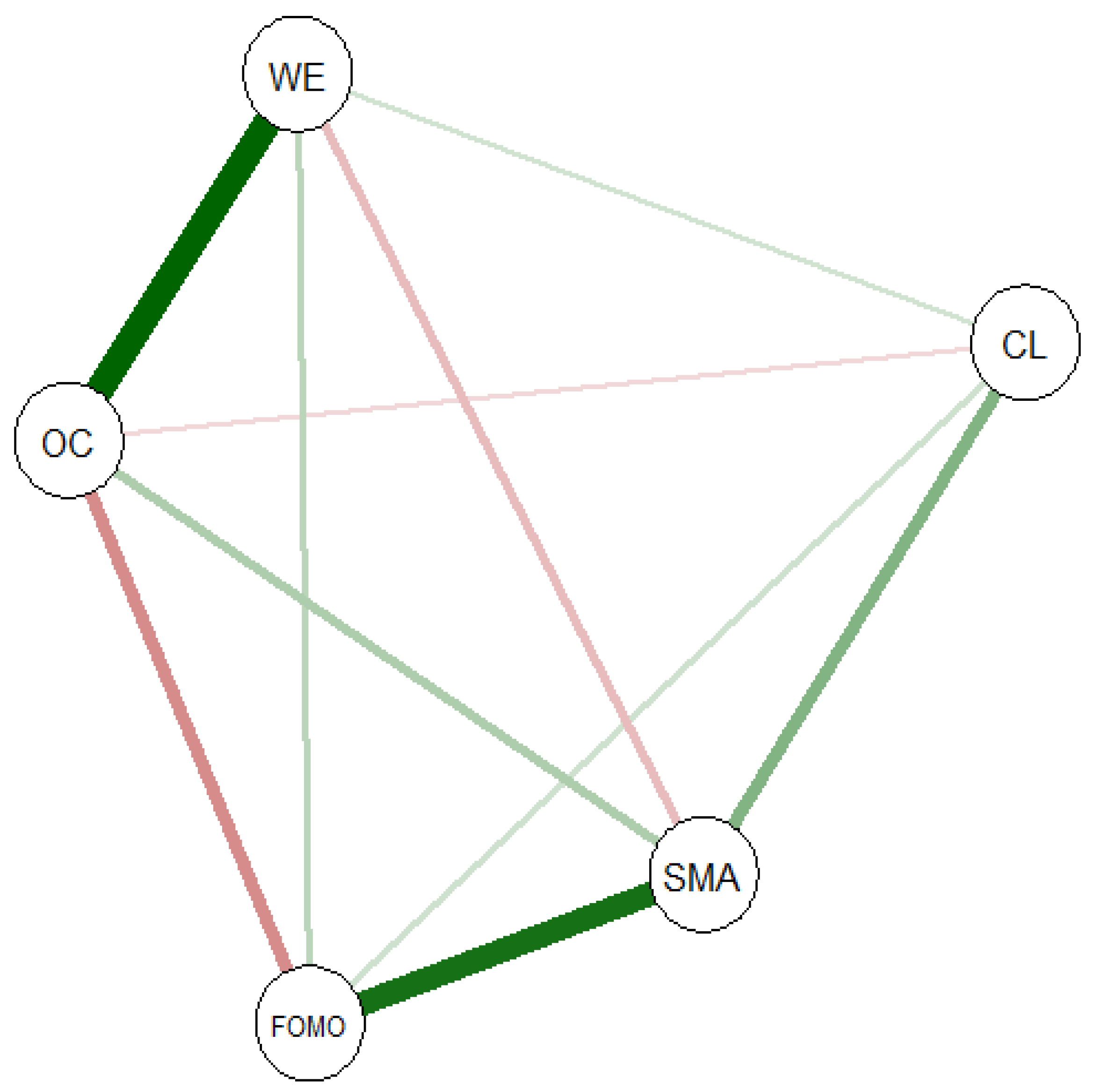
4.3. Network Analysis
4.4. Network Structure
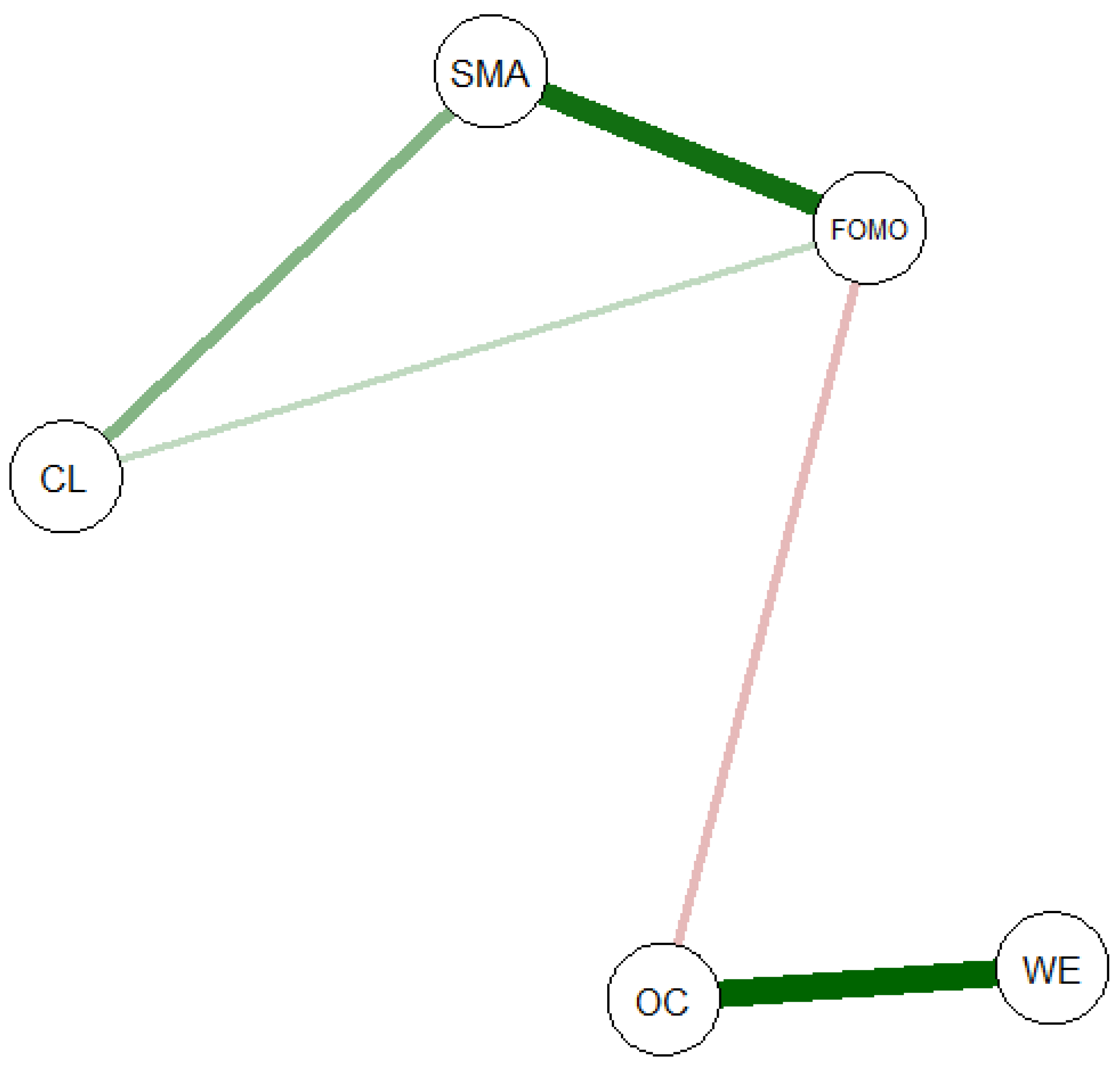
4.5. Explorative Analyses: Network Analysis Using Graphical LASSO with EBIC Model Selection
5. Discussion
5.1. Summary of Results and Interpretation
5.2. Limitations
5.3. Theoretical and Practical Implications
5.4. Future Research Directions
6. Conclusions
Author Contributions
Funding
Institutional Review Board Statement
Informed Consent Statement
Data Availability Statement
Conflicts of Interest
Appendix A
Demographic Data

| Language | Frequency | Percentage |
|---|---|---|
| German | 408 | 90.27% |
| Italian | 11 | 2.43% |
| English | 10 | 2.21% |
| Russian | 9 | 1.99% |
| Turkish | 6 | 1.33% |
| French | 5 | 1.11% |
| Portuguese | 5 | 1.11% |
| Arabian | 4 | 0.88% |
| Spanish | 3 | 0.66% |
| Polish | 3 | 0.66% |
| Others | 39 | 5.53% |
| Occupational Status | Frequency | Percentage |
|---|---|---|
| Student | 278 | 61.50% |
| Employed | 12 | 2.65% |
| Student and employed | 162 | 35.84% |
| Retired | 0 | 0.00% |
| Unemployed | 0 | 0.00% |
| Language | Frequency | Percentage |
|---|---|---|
| 0–10 h | 61 | 13.86% |
| 11–20 h | 100 | 22.73% |
| 21–30 h | 126 | 28.64% |
| 31–40 h | 120 | 27.27% |
| 41–50 h | 29 | 6.59% |
| More than 50 h | 4 | 0.91% |
| Language | Frequency | Percentage |
|---|---|---|
| 0–10 h | 67 | 38.51% |
| 11–20 h | 61 | 35.06% |
| 21–30 h | 27 | 15.52% |
| 31–40 h | 12 | 6.90% |
| 41–50 h | 7 | 4.02% |
| More than 50 h | 0 | 0.00% |
Appendix B
Survey Instruments
| Items (English) | Items (German) | Response Category | |
|---|---|---|---|
| How often during the last year have you… | Wie oft innerhalb des letzten Jahres haben bzw. sind Sie… | ||
| 1. | …spent a lot of time thinking about social media or planned use of social media? | …viel Zeit damit verbracht, über soziale Medien nachzudenken oder die Nutzung von sozialen Medien geplant? | English 1 = very rarely 2 = rarely 3 = sometimes 4 = often 5 = very often German 1 = sehr selten 2 = selten 3 = manchmal 4 = oft 5 = sehr oft |
| 2. | …felt an urge to use social media more and more? | …einen Drang verspürt, soziale Medien mehr und mehr zu nutzen? | |
| 3. | … used social media to forget about personal problems? | …soziale Medien genutzt, um persönliche Probleme zu vergessen? | |
| 4. | … tried to cut down on the use of social media without success? | …versucht ohne Erfolg die Nutzung von sozialen Medien zu reduzieren? | |
| 5. | … become restless or troubled if you have been prohibited from using social media? | …unruhig oder besorgt geworden, wenn Ihnen nicht gestattet wurde soziale Medien zu nutzen? | |
| 6. | … used social media so much that it has had a negative impact on your job/studies? | …soziale Medien in einem so hohen Maß genutzt, dass es einen negativen Einfluss auf Ihre Arbeit/Studium/Schule hatte? |
| Items (English) | Items (German) | Response Category | |
|---|---|---|---|
| 1. | I fear others have more rewarding experiences than me. | Ich fürchte, andere machen mehr belohnende Erfahrungen als ich. | English 1 = not at all true of me 2 = slightly true of me 3 = moderately true of me 4 = very true of me 5 = extremely true of me German 1 = trifft überhaupt nicht für mich zu 2 = trifft geringfügig für mich zu 3 = trifft etwas für mich zu 4 = trifft sehr für mich zu 5 = trifft extrem gut für mich zu |
| 2. | I fear my friends have more rewarding experiences than me. | Ich fürchte, meine Freunde haben mehr belohnende Erfahrungen als ich. | |
| 3. | I get worried when I find out my friends are having fun without me. | Es beunruhigt mich, wenn ich erfahre, dass meine Freunde ohne mich Spaß haben. | |
| 4. | I get anxious when I don’t know what my friends are up to. | Ich werde ängstlich, wenn ich nicht weiß, was meine Freunde vorhaben. | |
| 5. | It is important that I understand my friends ‘‘in jokes’’. | Es ist wichtig, dass ich die Witze meiner Freunde verstehe. | |
| 6. | Sometimes, I wonder if I spend too much time keeping up with what is going on. | Manchmal frage ich mich, ob ich nicht zu viel Zeit damit verbringe, herauszufinden, was gerade los ist. | |
| 7. | It bothers me when I miss an opportunity to meet up with friends. | Es ärgert mich, wenn ich eine Gelegenheit verpasse, meine Freunde zu treffen. | |
| 8. | When I have a good time it is important for me to share the details online (e.g., updating status). | Wenn es mir gerade gut geht, ist es für mich wichtig, Einzelheiten darüber online mitzuteilen (z. B. meinen Status zu updaten). | |
| 9. | When I miss out on a planned get-together it bothers me. | Wenn ich ein geplantes Treffen verpasse, ärgert mich das. | |
| 10. | When I go on vacation, I continue to keep tabs on what my friends are doing. | Auch wenn ich in Urlaub gehe, verfolge ich das, was meine Freunde so treiben, weiter. |
| Items (English) | Items (German) | Response Category | |
|---|---|---|---|
| 1. | Visit non-job related websites | Besuch von nicht berufsbezogenen Websites | English 1 = never 2 = a few times per month 3 = a few times per week 4 = once a day 5 = a few times a day 6 = constantly German 1 = nie 2 = einige Male pro Monat 3 = einige Male pro Woche 4 = einmal pro Tag 5 = einige Male pro Tag 6 = ständig |
| 2. | Visit general news websites | Besuch von allgemeine Nachrichten-Websites | |
| 3. | Visit entertainment websites | Besuch von Unterhaltungs-Websites | |
| 4. | Visit sports related websites | Besuch von sportbezogenen Websites | |
| 5. | Instant message/chat online | Instant messaging/Online chatten | |
| 6. | Download non-work related information | Herunterladen von nicht arbeitsbezogenen Informationen | |
| 7. | Look for employment | Nach einer (anderen) Arbeitsstelle suchen | |
| 8. | Shop online | Online einkaufen | |
| 9. | Play online games | Online-Spiele spielen | |
| 10. | Visit adult-oriented (sexually explicit) websites | Besuch von Websites für Erwachsene (sexuell explizit) | |
| 11. | Visit online discussion boards or forums | Besuch von Online-Diskussionsforen oder -Plattformen | |
| 12. | Visit video sharing sites (YouTube, etc.) | Besuch von Videoportalen (YouTube usw.) | |
| 13. | Visit social networking websites (Facebook, etc.) | Besuch von Websites für soziale Netzwerke (Instagram usw.) | |
| 14. | Visit investment or banking websites | Besuch von Websites für Investitionen oder Banken | |
| 15. | Check non-work related email | Abrufen von nicht berufsbezogenen E-Mails | |
| 16. | Send non-work related email | Versenden von nicht berufsbezogenen E-Mails | |
| 17. | Receive non-work related email | Empfangen von nicht berufsbezogenen E-Mails | |
| 18. | Play games on social networking sites (Facebook games) | Spiele in sozialen Netzwerken spielen (Facebook-Spiele) | |
| 19. | Visit social news websites (reddit) | Besuch von sozialen Nachrichten-Websites (reddit) |
| Items (English) | Items (German) | Response Category | |
|---|---|---|---|
| 1. | At my work, I feel bursting with energy. | Bei meiner Arbeit bin ich voll überschäumender Energie. | English 1 = never 2 = almost never 3 = rarely 4 = sometimes 5 = often 6 = very often 7 = always German 1 = nie 2 = fast nie 3 = ab und zu 4 = regelmäßig 5 = häufig 6 = sehr häufig 7 = immer |
| 2. | At my job, I feel strong and vigorous. | Beim Arbeiten fühle ich mich fit und tatkräftig. | |
| 3. | I am enthusiastic about my job. | Ich bin von meiner Arbeit begeistert. | |
| 4. | My job inspires me. | Meine Arbeit inspiriert mich. | |
| 5. | When I get up in the morning, I feel like going to work. | Wenn ich morgens aufstehe, freue ich mich auf meine Arbeit. | |
| 6. | I feel happy when I am working intensely. | Ich fühle mich glücklich, wenn ich intensiv arbeite. | |
| 7. | I am proud of the work that I do. | Ich bin stolz auf meine Arbeit. | |
| 8. | I am immersed in my work. | Ich gehe völlig in meiner Arbeit auf. | |
| 9. | I get carried away when I’m working. | Meine Arbeit reißt mich mit. |
| Items (English) | Items (German) | Response Category | |
|---|---|---|---|
| 1. | I am willing to put in a great deal of effort beyond that normally expected in order to help this company be successful. | Ich bin bereit, mich mehr als nötig zu engagieren, um zum Erfolg des Unternehmens beizutragen. | English 1 = totally disagree … 5 = totally agree German 1 = stimme absolut nicht zu … 5 = stimme völlig zu |
| 2. | I talk up this organization to my friends as a great company to work for. | Freunden gegenüber lobe ich dieses Unternehmen als besonders guten Arbeitgeber. | |
| 3. | I feel very little loyalty to this organization. * | Ich fühle mich diesem Unternehmen nur wenig verbunden. * | |
| 4. | I would accept almost any type of job assignment in order to keep working for this company. | Ich würde fast jede Veränderung meiner Tätigkeit akzeptieren, nur um auch weiterhin für dieses Unternehmen arbeiten zu können. | |
| 5. | I find that my values and the company’s values are very similar. | Ich bin der Meinung, dass meine Wertvorstellungen und die des Unternehmens sehr ähnlich sind. | |
| 6. | I am proud to tell others that I am part of this company. | Ich bin stolz, wenn ich anderen sagen kann, dass ich zu diesem Unternehmen gehöre. | |
| 7. | I could just as well be working for a different company as long as the type of work were similar. * | Eigentlich könnte ich genauso gut für ein anderes Unternehmen arbeiten, solange die Tätigkeit vergleichbar wäre. * | |
| 8. | This company really inspires the very best in me in the way of job performance. | Dieses Unternehmen spornt mich zu Höchstleistungen in meiner Tätigkeit an. | |
| 9. | It would take very little change in my present circumstances to cause me to leave this company. * | Schon kleine Veränderungen in meiner gegenwärtigen Situation würden mich zum Verlassen des Unternehmens bewegen. * | |
| 10. | I am extremely glad that I chose this company to work for over others I was considering at the time I joined. | Ich bin ausgesprochen froh, dass ich bei meinem Eintritt dieses Unternehmen anderen vorgezogen habe. | |
| 11. | There’s not too much to be gained by sticking with this organization indefinitely. * | Ich verspreche mir nicht allzu viel davon, mich langfristig an dieses Unternehmen zu binden. * | |
| 12. | Often, I find it difficult to agree with this company’s policies on important matters relating to its employees. * | Ich habe oft Schwierigkeiten, mit der Unternehmenspolitik in Bezug auf wichtige Arbeitnehmerfragen übereinzustimmen. * | |
| 13. | I really care about the fate of this company. | Die Zukunft dieses Unternehmens liegt mir sehr am Herzen. | |
| 14. | For me this is the best of all possible companies for which to work. | Ich halte dieses für das beste aller Unternehmen, die für mich in Frage kommen. | |
| 15. | Deciding to work for this organization was a definite mistake on my part. * | Meine Entscheidung, für dieses Unternehmen zu arbeiten war sicher ein Fehler. * |
Appendix C
Translation Procedure of the Cyberloafing Scale
| Original Item (English) | Translation (German) | Back-Translation (English) | |
|---|---|---|---|
| 1. | Visit non-job related websites | Besuch von nicht berufsbezogenen Websites | Visiting work-based websites |
| 2. | Visit general news websites | Besuch von allgemeinen Nachrichten-Websites | Visiting news websites |
| 3. | Visit entertainment websites | Besuch von Unterhaltungs-Websites | Visiting entertainment websites |
| 4. | Visit sports related websites | Besuch von sportbezogenen Websites | Visiting sport websites |
| 5. | Instant message/chat online | Sofortnachrichten/Chat online | Direct messenger/online chat |
| 6. | Download non-work related information | Herunterladen von nicht arbeitsbezogenen Informationen | Downloading non-work-related information |
| 7. | Look for employment | Nach einer (anderen) Arbeitsstelle suchen | Looking for another workplace |
| 8. | Shop online | Online einkaufen | Online shopping |
| 9. | Play online games | Online-Spiele spielen | Playing online-games |
| 10. | Visit adult-oriented (sexually explicit) websites | Besuch von Websites für Erwachsene (sexuell explizit) | Visiting adult websites (sexual, explicit) |
| 11. | Visit online discussion boards or forums | Besuch von Online-Diskussionsforen oder -Plattformen | Visiting online-discussion forum or panels |
| 12. | Visit video sharing sites (YouTube, etc.) | Besuch von Videoportalen (YouTube usw.) | Visiting video platforms (YouTube etc.) |
| 13. | Visit social networking websites (Facebook, etc.) | Besuch von Websites für soziale Netzwerke (Instagram, Facebook usw.) | Visiting websites of social network platforms (Facebook etc.) |
| 14. | Visit investment or banking websites | Besuch von Websites für Investitionen oder Banken | Visiting investment or banking websites |
| 15. | Check non-work related email | Abrufen von nicht berufsbezogenen E-Mails | Access non-work-related emails |
| 16. | Send non-work related email | Versenden von nicht berufsbezogenen E-Mails | Sending non-work-related emails |
| 17. | Receive non-work related email | Empfangen von nicht berufsbezogenen E-Mails | Receiving non-working-related emails |
| 18. | Play games on social networking sites (Facebook games) | Spiele in sozialen Netzwerken spielen (Facebook-Spiele) | Playing social-network-games (Facebook etc.) |
| 19. | Visit social news websites (reddit) | Besuch von sozialen Nachrichten-Websites (reddit) | Visiting social-network websites (reddit) |
Appendix D
Participants’ Use of Social Media Platforms
| Social Media Platform | Frequency | Percentage |
|---|---|---|
| 69 | 15.27% | |
| 407 | 90.04% | |
| 444 | 98.23% | |
| Snapchat | 280 | 61.95% |
| TikTok | 189 | 41.81% |
| 57 | 12.61% | |
| Telegram | 36 | 7.96% |
| Twitter/X | 28 | 6.19% |
| 6 | 1.33% | |
| Twitch | 31 | 6.86% |
| YouTube | 353 | 78.10% |
| 41 | 9.07% | |
| 235 | 51.99% | |
| Others | 10 | 2.21% |
| Number of Social Media Platforms Used | Frequency | Percentage |
|---|---|---|
| 1 | 10 | 2.21% |
| 2 | 16 | 3.54% |
| 3 | 58 | 12.80% |
| 4 | 105 | 23.20% |
| 5 | 113 | 25.00% |
| 6 | 95 | 21.00% |
| 7 | 36 | 7.96% |
| 8 | 13 | 2.88% |
| 9 | 3 | 0.66% |
| 10 | 1 | 0.22% |
| 11 | 2 | 0.44% |
| Frequency of Use | Frequency | Percentage |
|---|---|---|
| Never | 5 | 1.11% |
| 1–2 times per month | 3 | 0.66% |
| 3–4 times per month | 5 | 1.11% |
| 1–2 times per week | 7 | 1.55% |
| 3–4 times per week | 16 | 3.54% |
| At least once per day | 76 | 16.81% |
| 3–4 times per day | 133 | 29.42% |
| More than 4 times per day | 207 | 45.80% |
| Frequency of Use | Frequency | Percentage |
|---|---|---|
| Never | 275 | 60.84% |
| 1–2 times per month | 56 | 12.39% |
| 3–4 times per month | 26 | 5.75% |
| 1–2 times per week | 35 | 7.74% |
| 3–4 times per week | 19 | 4.20% |
| At least once per day | 22 | 4.87% |
| 3–4 times per day | 16 | 3.54% |
| More than 4 times per day | 3 | 0.66% |
| Frequency of Use | Frequency | Percentage |
|---|---|---|
| Never | 0 | 0.00% |
| 1–2 times per month | 0 | 0.00% |
| 3–4 times per month | 2 | 0.44% |
| 1–2 times per week | 4 | 0.88% |
| 3–4 times per week | 1 | 0.22% |
| At least once per day | 22 | 4.87% |
| 3–4 times per day | 63 | 13.94% |
| More than 4 times per day | 360 | 79.65% |
Appendix E
Results of the Network Analysis
| 1 | 2 | 3 | 4 | 5 | |
|---|---|---|---|---|---|
| 1. Social Media Addiction | - | ||||
| 2. Fear of Missing Out | 0.45 | - | |||
| 3. Cyberloafing | 0.24 | 0.10 | - | ||
| 4. Work Engagement | −0.15 | 0.13 | 0.09 | - | |
| 5. Organizational Commitment | 0.16 | −0.26 | −0.09 | 0.50 | - |
Appendix F
Results of the EBICglasso Network Analysis
| 1 | 2 | 3 | 4 | 5 | |
|---|---|---|---|---|---|
| 1. Social Media Addiction | - | ||||
| 2. Fear of Missing Out | 0.39 | - | |||
| 3. Cyberloafing | 0.20 | 0.10 | - | ||
| 4. Work Engagement | - | - | - | - | |
| 5. Organizational Commitment | - | −0.13 | - | 0.42 | - |
| Node | Measure | Value (Absolute) | Value (z-Standardized) | |
|---|---|---|---|---|
| 1 | Social Media Addiction | Betweenness | 3 | 0.54 |
| 2 | Fear of Missing Out | Betweenness | 3 | 1.10 |
| 3 | Cyberloafing | Betweenness | 0 | −1.10 |
| 4 | Work Engagement | Betweenness | 0 | −1.10 |
| 5 | Organizational Commitment | Betweenness | 3 | 0.54 |
| 6 | Social Media Addiction | Closeness | 0.03 | 0.74 |
| 7 | Fear of Missing Out | Closeness | 0.04 | 1.24 |
| 8 | Cyberloafing | Closeness | 0.02 | −1.05 |
| 9 | Work Engagement | Closeness | 0.02 | −0.90 |
| 10 | Organizational Commitment | Closeness | 0.03 | −0.03 |
| 11 | Social Media Addiction | Strength | 0.59 | 0.81 |
| 12 | Fear of Missing Out | Strength | 0.63 | 1.05 |
| 13 | Cyberloafing | Strength | 0.30 | −1.27 |
| 14 | Work Engagement | Strength | 0.37 | −0.77 |
| 15 | Organizational Commitment | Strength | 0.51 | 0.18 |
| 16 | Social Media Addiction | Expected Influence | 0.59 | 1.64 |
| 17 | Fear of Missing Out | Expected Influence | 0.36 | −0.10 |
| 18 | Cyberloafing | Expected Influence | 0.30 | −0.54 |
| 19 | Work Engagement | Expected Influence | 0.37 | −0.01 |
| 20 | Organizational Commitment | Expected Influence | 0.24 | −1.00 |
References
- Abel, J. P., Buff, C. L., & Burr, S. A. (2016). Social media and the Fear of Missing Out: Scale development and assessment. Journal of Business & Economics Research, 14(1), 33–44. [Google Scholar] [CrossRef]
- Abu Seman, S. A., Mohd Hashim, M. J., Zainal, N. Z., & Mohd Ishar, N. I. (2024). Distracted in the digital age: Unveiling cyberslacking habits among university students. International Journal of e-Learning and Higher Education, 19(1), 7–30. Available online: https://ir.uitm.edu.my/id/eprint/95092/ (accessed on 1 November 2025). [CrossRef]
- Ahuja, S., & Gupta, S. (2019). Organizational commitment and work engagement as a facilitator for sustaining higher education professionals. International Journal of Recent Technology and Engineering, 7(6), 1846–1851. [Google Scholar]
- Allen, N. J., & Meyer, J. P. (1990). The measurement and antecedents of affective, continuance and normative commitment to the organization. Journal of Occupational Psychology, 63(1), 1–18. [Google Scholar] [CrossRef]
- Andel, S. A., Kessler, S. R., Pindek, S., Kleinman, G., & Spector, P. E. (2019). Is cyberloafing more complex than we originally thought? Cyberloafing as a coping response to workplace aggression exposure. Computers in Human Behavior, 101, 124–130. [Google Scholar] [CrossRef]
- Andreassen, C. S., Billieux, J., Griffiths, M. D., Kuss, D. J., Demetrovics, Z., Mazzoni, E., & Pallesen, S. (2016). The relationship between addictive use of social media and video games and symptoms of psychiatric disorders: A large-scale cross-sectional study. Psychology of Addictive Behaviors, 30(2), 252–262. [Google Scholar] [CrossRef] [PubMed]
- Andreassen, C. S., & Pallesen, S. (2014). Social network site addiction—An overview. Current Pharmaceutical Design, 20(25), 4053–4061. [Google Scholar] [CrossRef] [PubMed]
- Andreassen, C. S., Torsheim, T., Brunborg, G. S., & Pallesen, S. (2012). Development of a Facebook addiction scale. Psychological Reports, 110(2), 501–517. [Google Scholar] [CrossRef]
- Askew, K. L. (2012). The relationship between cyberloafing and task performance and an examination of the theory of planned behavior as a model of cyberloafing [Doctorate dissertation, University of South Florida]. Available online: https://core.ac.uk/download/pdf/154469515.pdf (accessed on 1 November 2025).
- Baethge, A., Rigotti, T., & Roe, R. A. (2015). Just more of the same, or different? An integrative theoretical framework for the study of cumulative interruptions at work. European Journal of Work and Organizational Psychology, 24(2), 308–323. [Google Scholar] [CrossRef]
- Bakker, A. B., & Demerouti, E. (2007). The job demands-resources model: State of the art. Journal of Managerial Psychology, 22(3), 309–328. [Google Scholar] [CrossRef]
- Bakker, A. B., & Leiter, M. P. (2010). Work engagement: A handbook of essential theory and research. Psychology Press. [Google Scholar]
- Beard, K. W., & Wolf, E. M. (2001). Modification in the proposed diagnostic criteria for Internet addiction. Cyberpsychology & Behavior: The Impact of the Internet, Multimedia and Virtual Reality on Behavior and Society, 4(3), 377–383. [Google Scholar] [CrossRef]
- Blackwell, D., Leaman, C., Tramposch, R., Osborne, C., & Liss, M. (2017). Extraversion, neuroticism, attachment style and Fear of Missing Out as predictors of social media use and addiction. Personality and Individual Differences, 116, 69–72. [Google Scholar] [CrossRef]
- Blanchard, A. L., & Henle, C. A. (2008). Correlates of different forms of cyberloafing: The role of norms and external locus of control. Computers in Human Behavior, 24(3), 1067–1084. [Google Scholar] [CrossRef]
- Brailovskaia, J., Schillack, H., & Margraf, J. (2020). Tell me why are you using social media (SM)! Relationship between reasons for use of SM, SM flow, daily stress, depression, anxiety, and addictive SM use—An exploratory investigation of young adults in Germany. Computers in Human Behavior. Advanced online publication. [Google Scholar] [CrossRef]
- Budnick, C. J., Rogers, A. P., & Barber, L. K. (2020). The Fear of Missing Out at work: Examining costs and benefits to employee health and motivation. Computers in Human Behavior, 104, 106161. [Google Scholar] [CrossRef]
- Buglass, S. L., Binder, J. F., Betts, L. R., & Underwood, J. D. (2017). Motivators of online vulnerability: The impact of social network site use and FOMO. Computers in Human Behavior, 66, 248–255. [Google Scholar] [CrossRef]
- Carr, C. T., & Hayes, R. A. (2015). Social media: Defining, developing, and divining. Atlantic Journal of Communication, 23(1), 46–65. [Google Scholar] [CrossRef]
- Casale, S., Rugai, L., & Fioravanti, G. (2018). Exploring the role of positive metacognitions in explaining the association between the Fear of Missing Out and social media addiction. Addictive Behaviors, 85, 83–87. [Google Scholar] [CrossRef]
- Chavan, M., Galperin, B. L., Ostle, A., & Behl, A. (2022). Millennial’s perception on cyberloafing: Workplace deviance or cultural norm? Behavior & Information Technology, 41(13), 2860–2877. [Google Scholar] [CrossRef]
- Choi, Y. (2018). Narcissism and social media addiction in workplace. The Journal of Asian Finance, Economics and Business, 5(2), 95–104. [Google Scholar] [CrossRef]
- Christian, M. S., Garza, A. S., & Slaughter, J. E. (2011). Work engagement: A quantitative review and test of its relations with task and contextual performance. Personnel Psychology, 64(1), 89–136. [Google Scholar] [CrossRef]
- Corbeanu, A., & Iliescu, D. (2023). The link between work engagement and job performance. Journal of Personnel Psychology, 22(3), 111–122. [Google Scholar] [CrossRef]
- Costantini, G., Epskamp, S., Borsboom, D., Perugini, M., Mõttus, R., Waldorp, L. J., & Cramer, A. O. (2015). State of the aRt personality research: A tutorial on network analysis of personality data in R. Journal of Research in Personality, 54, 13–29. [Google Scholar] [CrossRef]
- Deci, E. L., & Ryan, R. M. (1985). Intrinsic motivation and self-determination in human behavior. Springer US. [Google Scholar] [CrossRef]
- Dinçer, E., Saygın, M., & Karadal, H. (2022). The Fear of Missing Out (FoMO): Theoretical approach and measurement in organizations. In F. Özsungur (Ed.), Handbook of research on digital violence and discrimination studies (pp. 631–651). IGI Global Scientific Publishing. [Google Scholar] [CrossRef]
- Dogan, H., Norman, H., Alrobai, A., Jiang, N., Nordin, N., & Adnan, A. (2019). A web-based intervention for social media addiction disorder management in higher education: Quantitative survey study. Journal of Medical Internet Research, 21(10), e14834. [Google Scholar] [CrossRef] [PubMed]
- Dursun, O. O., Donmez, O., & Akbulut, Y. (2018). Predictors of cyberloafing among preservice information technology teachers. Contemporary Educational Technology, 9(1), 22–41. [Google Scholar] [CrossRef]
- Ellison, N. B., Steinfield, C., & Lampe, C. (2007). The benefits of Facebook “Friends:” Social capital and college students’ use of online social network sites. Journal of Computer-Mediated Communication, 12(4), 1143–1168. [Google Scholar] [CrossRef]
- Epskamp, S., Borsboom, D., & Fried, E. I. (2018). Estimating psychological networks and their accuracy: A tutorial paper. Behavior Research Methods, 50(1), 195–212. [Google Scholar] [CrossRef]
- Epskamp, S., & Fried, E. I. (2018). A tutorial on regularized partial correlation networks. Psychological Methods, 23(4), 617–634. [Google Scholar] [CrossRef]
- Ferrari, J. R. (1993). Procrastination and impulsiveness: Two sides of a coin? In W. G. McCown, J. Johnson, & M. B. Shure (Eds.), The impulsive client: Theory, research, and treatment (pp. 265–276). American Psychological Association. [Google Scholar] [CrossRef]
- Ferrari, J. R. (1994). Dysfunctional procrastination and its relationship with self-esteem, interpersonal dependency, and self-defeating behaviors. Personality and Individual Differences, 17(5), 673–679. [Google Scholar] [CrossRef]
- Fioravanti, G., Casale, S., Benucci, S. B., Prostamo, A., Falone, A., Ricca, V., & Rotella, F. (2021). Fear of Missing Out and social networking sites use and abuse: A meta-analysis. Computers in Human Behavior, 122, 106839. [Google Scholar] [CrossRef]
- Foygel, R., & Drton, M. (2010). Extended Bayesian information criteria for Gaussian graphical models. Advances in Neural Information Processing Systems, 23, 1–9. [Google Scholar]
- Fu, W., Li, R., & Liang, Y. (2023). The relationship between stress perception and problematic social network use among Chinese college students: The mediating role of the Fear of Missing Out. Behavioral Sciences, 13(6), 497. [Google Scholar] [CrossRef] [PubMed]
- Fusi, F., & Feeney, M. K. (2018). Social media in the workplace: Information exchange, productivity, or waste? The American Review of Public Administration, 48(5), 395–412. [Google Scholar] [CrossRef]
- Garg, G., & Shourie, S. (2023). Relationship between social media addiction, FOMO and self-esteem among young adults. International Journal of Interdisciplinary Approaches in Psychology, 1(3), 381–395. [Google Scholar]
- Garrett, R. K., & Danziger, J. N. (2008a). Disaffection or expected outcomes: Understanding personal Internet use during work. Journal of Computer-Mediated Communication, 13(4), 937–958. [Google Scholar] [CrossRef]
- Garrett, R. K., & Danziger, J. N. (2008b). On cyberslacking: Workplace status and personal internet use at work. Cyberpsychology & Behavior: The Impact of the Internet, Multimedia and Virtual Reality on Behavior and Society, 11(3), 287–292. [Google Scholar] [CrossRef]
- Georgescu, M., & Popescul, D. (2015). Social media—The new paradigm of collaboration and communication for business environment. Procedia Economics and Finance, 20, 277–282. [Google Scholar] [CrossRef]
- Griffiths, M. D. (2000). Internet addiction—Time to be taken seriously? Addiction Research, 8(5), 413–418. [Google Scholar] [CrossRef]
- Griffiths, M. D., & Kuss, D. J. (2017). Adolescent social media addiction (revisited). Education and Health, 35(3), 49–52. [Google Scholar]
- Groenestein, E., Willemsen, L., van Koningsbruggen, G. M., & Kerkhof, P. (2024). Fear of Missing Out and social media use: A three-wave longitudinal study on the interplay with psychological need satisfaction and psychological well-being. New Media & Society. Advanced online publication. [Google Scholar] [CrossRef]
- Gullu, B. F., & Serin, H. (2020). The relationship between Fear of Missing Out (FoMO) levels and cyberloafing behavior of teachers. Journal of Education and Learning, 9(5), 205–214. [Google Scholar] [CrossRef]
- Gürbüz, F., Bayrakli, M., & Gezgin, D. M. (2023). The effect of cyberloafing behaviors on smartphone addiction in university students: The mediating role of Fear of Missing Out. Journal of Educational Technology and Online Learning, 6(1), 234–248. [Google Scholar] [CrossRef]
- Hakanen, J. J., Bakker, A. B., & Schaufeli, W. B. (2006). Burnout and work engagement among teachers. Journal of School Psychology, 43(6), 495–513. [Google Scholar] [CrossRef]
- Hamutoglu, N. B., Topal, M., & Gezgin, D. M. (2020). Investigating direct and indirect effects of social media addiction, social media usage and personality traits on FOMO. International Journal of Progressive Education, 16(2), 248–261. [Google Scholar] [CrossRef]
- Hartijasti, Y., & Fathonah, N. (2014). Cyberloafing across generation X and Y in Indonesia. Journal of Information Technology Applications & Management, 21(1), 1–16. [Google Scholar]
- Hassan, K. M., & Bolong, J. (2021). Relationship between social media addiction and organizational commitment. Al-I’lam-Journal of Contemporary Islamic Communication and Media, 1(1), 1–17. [Google Scholar] [CrossRef]
- Haynes, T. (2018). Dopamine, Smartphones & You: A battle for your time. Harvard University: Harvard Science in the News. [Google Scholar]
- Hensel, P. G., & Kacprzak, A. (2020). Job overload, organizational commitment, and motivation as antecedents of cyberloafing: Evidence from employee monitoring software. European Management Review, 17(4), 931–942. [Google Scholar] [CrossRef]
- Hoşgör, H., Ülker Dörttepe, Z., & Memiş, K. (2021). Social media addiction and work engagement among nurses. Perspectives in Psychiatric Care, 57(4), 1966–1973. [Google Scholar] [CrossRef]
- Hou, Y., Xiong, D., Jiang, T., Song, L., & Wang, Q. (2009). Social media addiction: Its impact, mediation, and intervention. Cyberpsychology: Journal of Psychosocial Research on Cyberspace, 13(1), 4. [Google Scholar] [CrossRef]
- Ibrahim, M., Yusra, Y., & Shah, N. U. (2022). Impact of social media addiction on work engagement and job performance. Polish Journal of Management Studies, 25(1), 179–192. [Google Scholar] [CrossRef]
- Jones, P. J., Ma, R., & McNally, R. J. (2021). Bridge centrality: A network approach to understanding comorbidity. Multivariate Behavioral Research, 56(2), 353–367. [Google Scholar] [CrossRef] [PubMed]
- Kanning, U. P., & Hill, A. (2013). Validation of the Organizational Commitment Questionnaire (OCQ) in six languages. Journal of Business and Media Psychology, 4(2), 11–20. [Google Scholar]
- Kaplan, A. M., & Haenlein, M. (2010). Users of the world, unite! The challenges and opportunities of social media. Business Horizons, 53(1), 59–68. [Google Scholar] [CrossRef]
- Kardefelt-Winther, D. (2014). A conceptual and methodological critique of internet addiction research: Towards a model of compensatory internet use. Computers in Human Behavior, 31, 351–354. [Google Scholar] [CrossRef]
- Kerse, G., Deniz, V., & Cakici, A. B. (2025). The effect of “Fear of Missing Out at Work (W-FoMO)” on psychological well-being: The serial mediating roles of smartphone use after work and work-family conflict. SAGE Open, 15(2), 21582440251337617. [Google Scholar] [CrossRef]
- Khan, A. N., Moin, M. F., Khan, N. A., & Zhang, C. (2022). A multistudy analysis of abusive supervision and social network service addiction on employee’s job engagement and innovative work behavior. Creativity and Innovation Management, 31(1), 77–92. [Google Scholar] [CrossRef]
- Koay, K. Y. (2018). Workplace ostracism and cyberloafing: A moderated–mediation model. Internet Research, 28(4), 1122–1141. [Google Scholar] [CrossRef]
- Koessmeier, C., & Büttner, O. B. (2021). Why are we distracted by social media? Distraction situations and strategies, reasons for distraction, and individual differences. Frontiers in Psychology, 12, 711416. [Google Scholar] [CrossRef]
- Kuss, D. J., & Griffiths, M. D. (2011). Online social networking and addiction-a review of the psychological literature. International Journal of Environmental Research and Public Health, 8(9), 3528–3552. [Google Scholar] [CrossRef]
- Kuss, D. J., & Griffiths, M. D. (2017). Social networking sites and addiction: Ten lessons learned. International Journal of Environmental Research and Public Health, 14(3), 311. [Google Scholar] [CrossRef] [PubMed]
- Kwala, A. F., & Agoyi, M. (2025). The Influence of cyberloafing on workplace outcomes: A study utilizing the job demands-resources (JD-R) theory. SAGE Open, 15(1), 21582440251327521. [Google Scholar] [CrossRef]
- Lenny, D. J., Doleck, T., & Bazelais, P. (2019). Self-determination, loneliness, Fear of Missing Out, and academic performance. Knowledge Management & E-Learning, 11(4), 485–496. [Google Scholar]
- Lian, S.-L., Sun, X.-J., Zhou, Z.-K., Fan, C.-Y., Niu, G.-F., & Liu, Q.-Q. (2018). Social networking site addiction and undergraduate students’ irrational procrastination: The mediating role of social networking site fatigue and the moderating role of effortful control. PLoS ONE, 13(12), e0208162. [Google Scholar] [CrossRef]
- Lim, V. K. G. (2002). The IT way of loafing on the job: Cyberloafing, neutralizing and organizational justice. Journal of Organizational Behavior, 23(5), 675–694. [Google Scholar] [CrossRef]
- Lim, V. K. G., & Chen, D. J. (2012). Cyberloafing at the workplace: Gain or drain on work? Behavior & Information Technology, 31(4), 343–353. [Google Scholar] [CrossRef]
- Lim, V. K. G., & Teo, T. S. H. (2005). Prevalence, perceived seriousness, justification and regulation of cyberloafing in Singapore: An exploratory study. Information & Management, 42(8), 1081–1093. [Google Scholar]
- Liu, Y., Gao, Q., & Ma, L. (2021). Taking micro-breaks at work: Effects of watching funny short-form videos on subjective experience, physiological stress, and task performance. In P.-L. P. Rau (Ed.), Cross-cultural design. Applications in arts, learning, well-being, and social development (pp. 183–200). Springer Nature. [Google Scholar] [CrossRef]
- Liu, Y., & Lei, K. (2025). Development and validity test of impression management efficacy scale based on self-presentation behavior of Chinese youth on social media. Frontiers in Psychology, 16, 1494083. [Google Scholar] [CrossRef] [PubMed]
- Macit, H. B., Macit, G., & Güngör, O. (2018). A research on social media addiction and dopamine driven feedback. Journal of Mehmet Akif Ersoy University Economics and Administrative Sciences Faculty, 5(3), 882–897. [Google Scholar] [CrossRef]
- Medhurst, A. R., & Albrecht, S. L. (2016). Salesperson work engagement and flow. Qualitative Research in Organizations and Management: An International Journal, 11(1), 22–45. [Google Scholar] [CrossRef]
- Methot, J. R., Rosado-Solomon, E. H., Downes, P. E., & Gabriel, A. S. (2021). Office chitchat as a social ritual: The uplifting yet distracting effects of daily small talk at work. Academy of Management Journal, 64(5), 1445–1471. [Google Scholar] [CrossRef]
- Metin, U. B., Peeters, M. C. W., & Taris, T. W. (2018). Correlates of procrastination and performance at work: The role of having “good fit”. Journal of Prevention & Intervention in the Community, 46(3), 228–244. [Google Scholar] [CrossRef]
- Metin, U. B., Taris, T. W., Peeters, M. C. W., Korpinen, M., Smrke, U., Razum, J., Kolářová, M., Baykova, R., & Gaioshko, D. (2020). Validation of the procrastination at work scale. European Journal of Psychological Assessment, 36(5), 767–776. [Google Scholar] [CrossRef]
- Meyer, J. P., Paunonen, S. V., Gellatly, I. R., Goffin, R. D., & Jackson, D. N. (1989). Organizational commitment and job performance: It’s the nature of the commitment that counts. Journal of Applied Psychology, 74(1), 152–156. [Google Scholar] [CrossRef]
- Mills, J. E., Hu, B., Beldona, S., & Clay, J. (2001). Cyberslacking! Cornell Hotel and Restaurant Administration Quarterly, 42(5), 34–47. [Google Scholar] [CrossRef]
- Montag, C., Błaszkiewicz, K., Sariyska, R., Lachmann, B., Andone, I., Trendafilov, B., Eibes, M., & Markowetz, A. (2015). Smartphone usage in the 21st century: Who is active on WhatsApp? BMC Research Notes, 8(1), 331. [Google Scholar] [CrossRef]
- Mowday, R. T., Steers, R. M., & Porter, L. W. (1979). The measurement of organizational commitment. Journal of Vocational Behavior, 14(2), 224–247. [Google Scholar] [CrossRef]
- Muafi, M. (2023). The effects of cyberloafing on organizational commitment: The role of emotional exhaustion and job overload. Jurnal Bisnis: Teori Dan Implementasi, 14(2), 323–337. [Google Scholar] [CrossRef]
- Mullarkey, M. C., Marchetti, I., & Beevers, C. G. (2019). Using network analysis to identify central symptoms of adolescent depression. Journal of Clinical Child and Adolescent Psychology, 48(4), 656–668. [Google Scholar] [CrossRef] [PubMed]
- Müller, S. M., Wegmann, E., Stolze, D., & Brand, M. (2020). Maximizing social outcomes? Social zapping and Fear of Missing Out mediate the effects of maximization and procrastination on problematic social networks use. Computers in Human Behaviors, 107, 106296. [Google Scholar] [CrossRef]
- Niaei, M., Peidaei, M. M., & Nasiripour, A. A. (2014). The relation between staff cyberloafing and organizational commitment in organization of environmental protection. Arabian Journal of Business and Management Review (Kuwait Chapter), 3(7), 59–71. [Google Scholar] [CrossRef]
- Oosthuizen, A., Rabie, G. H., & Beer, L. T. d. (2018). Investigating cyberloafing, organisational justice, work engagement and organisational trust of South African retail and manufacturing employees. SA Journal of Human Resource Management, 16, a1001. [Google Scholar] [CrossRef]
- Orhan, M. A., Castellano, S., Khelladi, I., Marinelli, L., & Monge, F. (2021). Technology distraction at work. Impacts on self-regulation and work engagement. Journal of Business Research, 126, 341–349. [Google Scholar] [CrossRef]
- Özcan, H. M., & Koç, U. (2022). The role of Fear of Missing Out (FoMO) in the relationship between personality traits and cyberloafing. Ege Academic Review, 23(1), 11–26. [Google Scholar] [CrossRef]
- Öztürk, M., & Kerse, G. (2022). Smartphone and internet addiction as predictors of cyberloafing levels in students: A mediated model. Education for Information, 38, 189–204. [Google Scholar] [CrossRef]
- Pellegrino, A., Stasi, A., & Bhatiasevi, V. (2022). Research trends in social media addiction and problematic social media use: A bibliometric analysis. Frontiers in Psychiatry, 13, 1017506. [Google Scholar] [CrossRef]
- Przybylski, A. K., Murayama, K., DeHaan, C. R., & Gladwell, V. (2013). Motivational, emotional, and behavioral correlates of Fear of Missing Out. Computers in Human Behavior, 29(4), 1841–1848. [Google Scholar] [CrossRef]
- Pychyl, T. A., Lee, J. M., Thibodeau, R., & Blunt, A. (2000). Five days of emotion: An experience sampling study of undergraduate student procrastination. Journal of Social Behavior & Personality, 15(5), 239–254. [Google Scholar]
- Quan-Haase, A., & Young, A. L. (2010). Uses and gratifications of social media: A comparison of Facebook and instant messaging. Bulletin of Science, Technology & Society, 30(5), 350–361. [Google Scholar] [CrossRef]
- Rafiei, M., Taghi Amini, M., & Foroozandeh, N. (2014). Studying the impact of the organizational commitment on the job performance. Management Science Letters, 4(8), 1841–1848. [Google Scholar] [CrossRef]
- Ramayah, T. (2010). Personal web usage and work inefficiency. Business Strategy Series, 11(5), 295–301. [Google Scholar] [CrossRef]
- Ramesh, R., & John, A. S. (2023). Determinants of procrastination among young adults in their academics and professional lives. Youth Voice Journal, 2023, 3. Available online: https://search.ebscohost.com/login.aspx?direct=true&profile=ehost&scope=site&authtype=crawler&jrnl=20492073&an=171382950&h=6cemfvxa%2ffykijqbgxkv4vo5w9q6meqg9binrrtxobh9hvdo1iixryd63xagdaplajzrl77jy8sozrkpalnciq%3d%3d&crl=c (accessed on 1 November 2025).
- Reer, F., Tang, W. Y., & Quandt, T. (2019). Psychosocial well-being and social media engagement: The mediating roles of social comparison orientation and Fear of Missing Out. New Media & Society, 21(7), 1486–1505. [Google Scholar] [CrossRef]
- Reimann, L.-E., Binnewies, C., Ozimek, P., & Loose, S. (2023). I do not want to miss a thing! Consequences of employees’ workplace Fear of Missing Out for ICT use, well-being, and recovery experiences. Behavioral Sciences, 14(1), 8. [Google Scholar] [CrossRef]
- Robinaugh, D. J., Millner, A. J., & McNally, R. J. (2016). Identifying highly influential nodes in the complicated grief network. Journal of Abnormal Psychology, 125(6), 747–757. [Google Scholar] [CrossRef]
- Saks, A. M. (2006). Antecedents and consequences of employee engagement. Journal of Managerial Psychology, 21(7), 600–619. [Google Scholar] [CrossRef]
- Salehan, M., & Negahban, A. (2013). Social networking on smartphones: When mobile phones become addictive. Computers in Human Behavior, 29(6), 2632–2639. [Google Scholar] [CrossRef]
- Saritepeci, M. (2020). Predictors of cyberloafing among high school students: Unauthorized access to school network, metacognitive awareness and smartphone addiction. Education and Information Technologies, 25(3), 2201–2219. [Google Scholar] [CrossRef]
- Schaufeli, W. B., & Bakker, A. B. (2004a). Job demands, job resources, and their relationship with burnout and engagement: A multi-sample study. Journal of Organizational Behavior, 25(3), 293–315. [Google Scholar] [CrossRef]
- Schaufeli, W. B., & Bakker, A. B. (2004b). Utrecht work engagement scale—Preliminary manual. Utrecht University website. Available online: https://www.wilmarschaufeli.nl/publications/Schaufeli/Test%20Manuals/Test_manual_UWES_English.pdf (accessed on 1 November 2025).
- Senécal, C., Koestner, R., & Vallerand, R. J. (1995). Self-regulation and academic procrastination. The Journal of Social Psychology, 135(5), 607–619. [Google Scholar] [CrossRef]
- Seppälä, P., Mauno, S., Feldt, T., Hakanen, J., Kinnunen, U., Tolvanen, A., & Schaufeli, W. (2009). The construct validity of the utrecht work engagement scale: Multisample and longitudinal evidence. Journal of Happiness Studies, 10(4), 459–481. [Google Scholar] [CrossRef]
- Simpson, W. K., & Pychyl, T. A. (2009). In search of the arousal procrastinator: Investigating the relation between procrastination, arousal-based personality traits and beliefs about procrastination motivations. Personality and Individual Differences, 47(8), 906–911. [Google Scholar] [CrossRef]
- Spitzer, M. (2015). Smartphones, angst und stress. Nervenheilkunde, 34(08), 591–600. [Google Scholar] [CrossRef]
- Sun, Y., & Zhang, Y. (2021). A review of theories and models applied in studies of social media addiction and implications for future research. Addictive Behaviors, 114, 106699. [Google Scholar] [CrossRef]
- Syed, S., Singh, H., Thangaraju, S. K., Bakri, N. E., Hwa, K. Y., & Kusalavan, P. A. L. (2020). The impact of cyberloafing on employees’ job performance: A review of literature. Journal of Advances in Management Sciences & Information Systems, 6, 16–28. [Google Scholar]
- Tunc-Aksan, A., & Akbay, S. E. (2019). Smartphone addiction, Fear of Missing Out, and perceived competence as predictors of social media addiction of adolescents. European Journal of Educational Research, 8(2), 559–569. [Google Scholar] [CrossRef]
- Turan, G. B., Özer, Z., & Atan, G. (2021). The relationship between cyberloafing levels and social media addiction among nursing students. Perspectives in Psychiatric Care, 57(2), 836–843. [Google Scholar] [CrossRef]
- Turel, O., & Serenko, A. (2012). The benefits and dangers of enjoyment with social networking websites. European Journal of Information Systems, 21(5), 512–528. [Google Scholar] [CrossRef]
- Tutgun Ünal, A. (2020). A comparative study of social media addiction among Turkish and Korean university students. Journal of Economy Culture and Society, (62), 307–322. [Google Scholar] [CrossRef]
- Van Eerde, W. (2016). Procrastination and well-being at work. In F. M. Sirios, & T. A. Pychyl (Eds.), Procrastination, health, and well-being (pp. 233–253). Elsevier. [Google Scholar] [CrossRef]
- VanMeter, R. A., Grisaffe, D. B., & Chonko, L. B. (2015). Of “Likes” and “Pins”: The effects of consumers’ attachment to social media. Journal of Interactive Marketing, 32, 70–88. [Google Scholar] [CrossRef]
- Van Zoonen, W., Verhoeven, J. W., & Vliegenthart, R. (2017). Understanding the consequences of public social media use for work. European Management Journal, 35(5), 595–605. [Google Scholar] [CrossRef]
- Vogel, E. A., Rose, J. P., Roberts, L. R., & Eckles, K. (2014). Social comparison, social media, and self-esteem. Psychology of Popular Media Culture, 3(4), 206–222. [Google Scholar] [CrossRef]
- Wang, J., Wang, P., Yang, X., Zhang, G., Wang, X., Zhao, F., Zhao, M., & Lei, L. (2019). Fear of Missing Out and procrastination as mediators between sensation seeking and adolescent smartphone addiction. International Journal of Mental Health and Addiction, 17(4), 1049–1062. [Google Scholar] [CrossRef]
- Wang, J., & Wang, S. (2025). The emotional reinforcement mechanism of and phased intervention strategies for social media addiction. Behavioral Sciences, 15(5), 665. [Google Scholar] [CrossRef] [PubMed]
- Whiting, A., & Williams, D. (2013). Why people use social media: A uses and gratifications approach. Qualitative Market Research: An International Journal, 16(4), 362–369. [Google Scholar] [CrossRef]
- Xie, X., Wang, Y., Wang, P., Zhao, F., & Lei, L. (2018). Basic psychological needs satisfaction and Fear of Missing Out: Friend support moderated the mediating effect of individual relative deprivation. Psychiatry Research, 268, 223–228. [Google Scholar] [CrossRef] [PubMed]
- Zivnuska, S., Carlson, J. R., Carlson, D. S., Harris, R. B., & Harris, K. J. (2019). Social media addiction and social media reactions: The implications for job performance. The Journal of Social Psychology, 159(6), 746–760. [Google Scholar] [CrossRef] [PubMed]


| Variable/Scale | Number of Items | Response Format | Cronbach’s α | M | SD |
|---|---|---|---|---|---|
| Bergen Social Media Addiction Scale | 6 | Very rarely (1)–very often (5) | 0.79 | 2.68 | 0.80 |
| Fear of Missing Out Scale | 10 | Not at all true of me (1)–Extremely true of me (5) | 0.74 | 2.62 | 0.59 |
| Cyberloafing Scale | 19 | Never (1)–Once a day (4)–Constantly (6) | 0.89 | 2.39 | 0.73 |
| Utrecht Work Engagement Scale | 9 | Never (1)–Always (7) | 0.92 | 4.21 | 0.99 |
| Organizational Commitment Questionnaire (OCQ) | 15 | Totally disagree (1)–Totally agree (5) | 0.91 | 3.20 | 0.78 |
| Node | Measure | Value (Absolute) | Value (z-Standardized) | |
|---|---|---|---|---|
| 1 | Social Media Addiction | Betweenness | 3 | 1.38 |
| 2 | Fear of Missing Out | Betweenness | 2 | 0.61 |
| 3 | Cyberloafing | Betweenness | 0 | −0.92 |
| 4 | Work Engagement | Betweenness | 0 | −0.92 |
| 5 | Organizational Commitment | Betweenness | 1 | −0.15 |
| 6 | Social Media Addiction | Closeness | 0.05 | 0.83 |
| 7 | Fear of Missing Out | Closeness | 0.05 | 1.06 |
| 8 | Cyberloafing | Closeness | 0.03 | −1.37 |
| 9 | Work Engagement | Closeness | 0.03 | −0.55 |
| 10 | Organizational Commitment | Closeness | 0.05 | 0.04 |
| 11 | Social Media Addiction | Strength | 1.01 | 0.69 |
| 12 | Fear of Missing Out | Strength | 0.94 | 0.36 |
| 13 | Cyberloafing | Strength | 0.52 | −1.72 |
| 14 | Work Engagement | Strength | 0.87 | 0.02 |
| 15 | Organizational Commitment | Strength | 1.00 | 0.66 |
| 16 | Social Media Addiction | Expected Influence | 0.71 | 1.42 |
| 17 | Fear of Missing Out | Expected Influence | 0.43 | −0.27 |
| 18 | Cyberloafing | Expected Influence | 0.34 | −0.78 |
| 19 | Work Engagement | Expected Influence | 0.57 | 0.60 |
| 20 | Organizational Commitment | Expected Influence | 0.31 | −0.97 |
Disclaimer/Publisher’s Note: The statements, opinions and data contained in all publications are solely those of the individual author(s) and contributor(s) and not of MDPI and/or the editor(s). MDPI and/or the editor(s) disclaim responsibility for any injury to people or property resulting from any ideas, methods, instructions or products referred to in the content. |
© 2025 by the authors. Licensee MDPI, Basel, Switzerland. This article is an open access article distributed under the terms and conditions of the Creative Commons Attribution (CC BY) license (https://creativecommons.org/licenses/by/4.0/).
Share and Cite
Ozimek, P.; Sander, A.; Borgert, N.; Rohmann, E.; Bierhoff, H.-W. Hooked and Distracted? A Network Analysis on the Interplay of Social Media Addiction, Fear of Missing Out, Cyberloafing, Work Engagement and Organizational Commitment. Behav. Sci. 2025, 15, 1719. https://doi.org/10.3390/bs15121719
Ozimek P, Sander A, Borgert N, Rohmann E, Bierhoff H-W. Hooked and Distracted? A Network Analysis on the Interplay of Social Media Addiction, Fear of Missing Out, Cyberloafing, Work Engagement and Organizational Commitment. Behavioral Sciences. 2025; 15(12):1719. https://doi.org/10.3390/bs15121719
Chicago/Turabian StyleOzimek, Phillip, Anna Sander, Nele Borgert, Elke Rohmann, and Hans-Werner Bierhoff. 2025. "Hooked and Distracted? A Network Analysis on the Interplay of Social Media Addiction, Fear of Missing Out, Cyberloafing, Work Engagement and Organizational Commitment" Behavioral Sciences 15, no. 12: 1719. https://doi.org/10.3390/bs15121719
APA StyleOzimek, P., Sander, A., Borgert, N., Rohmann, E., & Bierhoff, H.-W. (2025). Hooked and Distracted? A Network Analysis on the Interplay of Social Media Addiction, Fear of Missing Out, Cyberloafing, Work Engagement and Organizational Commitment. Behavioral Sciences, 15(12), 1719. https://doi.org/10.3390/bs15121719