How Quotation Types Shape Classic Novel Reading in Chinese: A Comparison Between Human Eye-Movements and Large Language Models
Abstract
1. Introduction
1.1. Quotation and Narrative Perspective
1.2. Empirical Studies of Quotation and Perspective
1.2.1. Direct and Indirect Speech
1.2.2. Free Direct and Free Indirect Speech
1.2.3. Chinese Narrative and Cultural Context
1.3. The Present Study
2. Materials and Methods
2.1. Participants
2.2. Design and Materials
2.3. Procedure
2.4. Data Analysis
2.4.1. Eye Movement
2.4.2. Surprisal and Entropy Estimation
3. Results
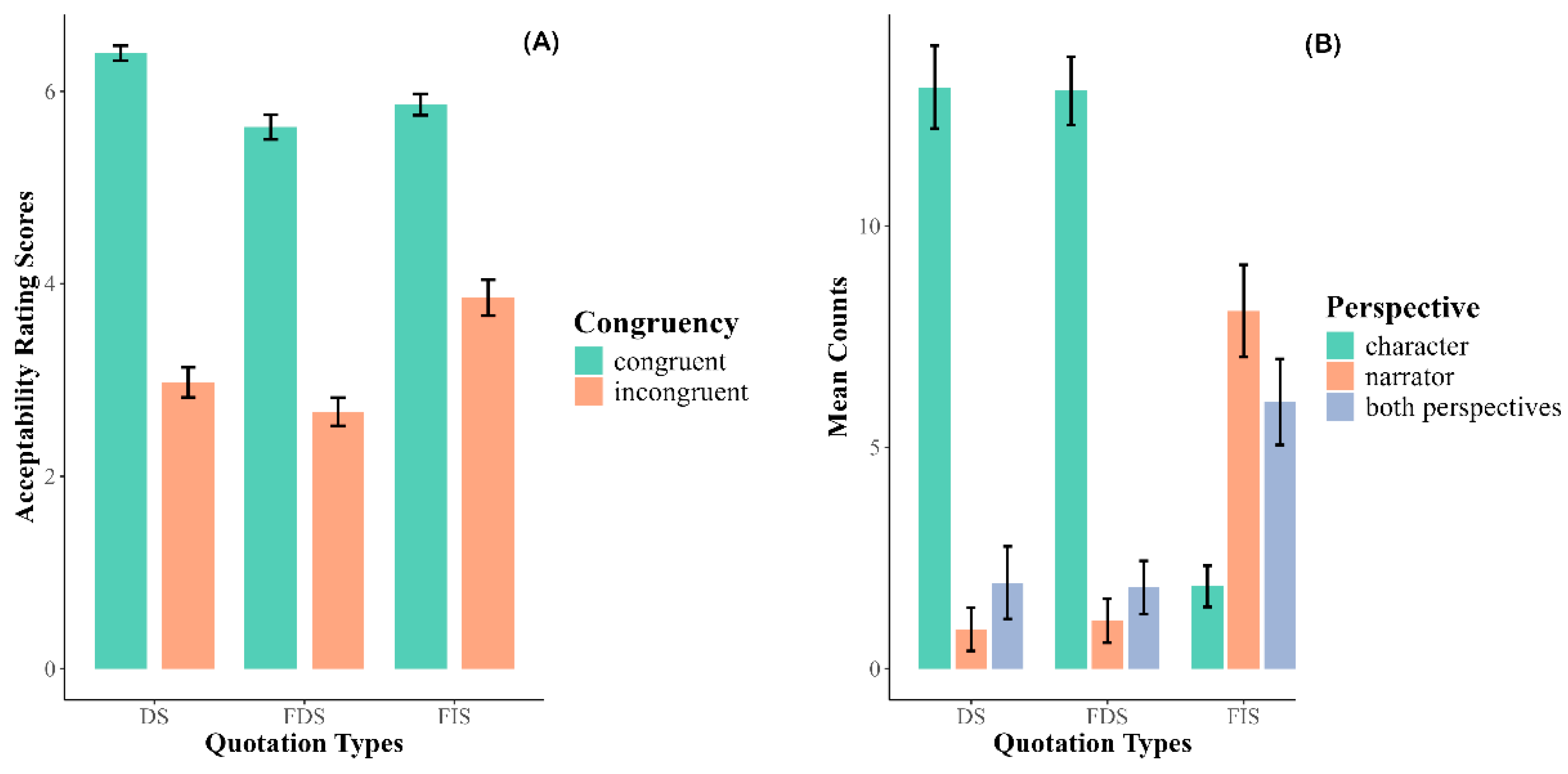
3.1. Text Comprehension
3.2. Results of the Eye-Movement Analyses
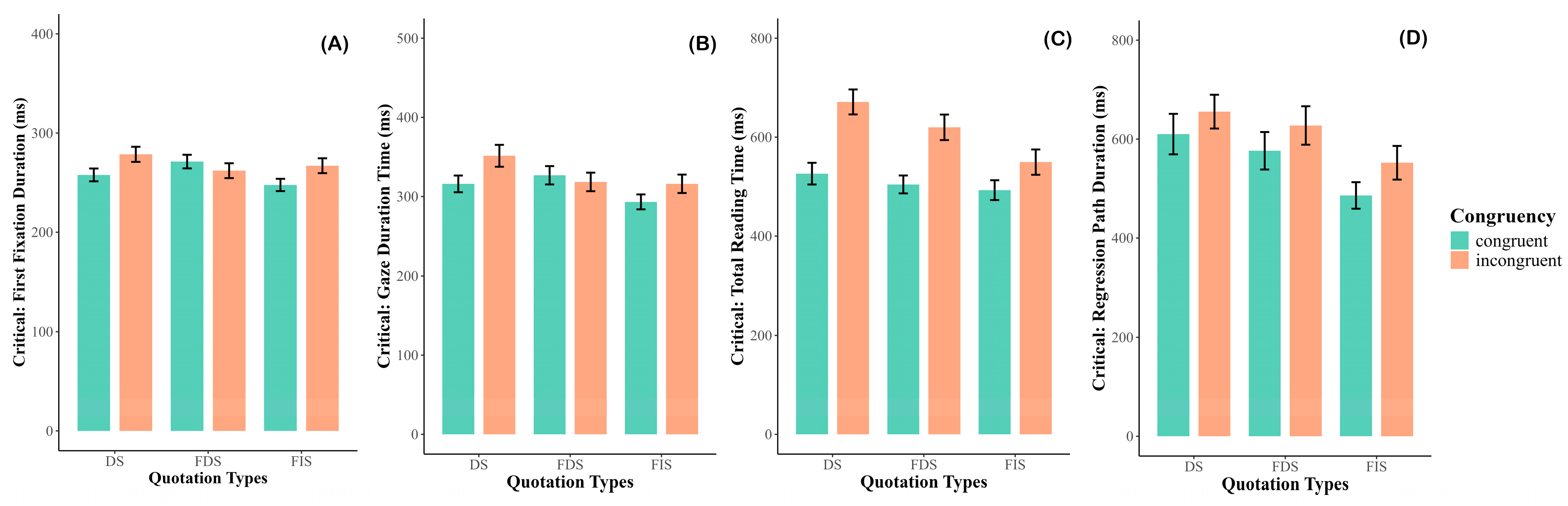
3.2.1. The Critical Region (ROI 1)
First Fixation Duration
Gaze Duration
Total Reading Time
Regression Path Duration
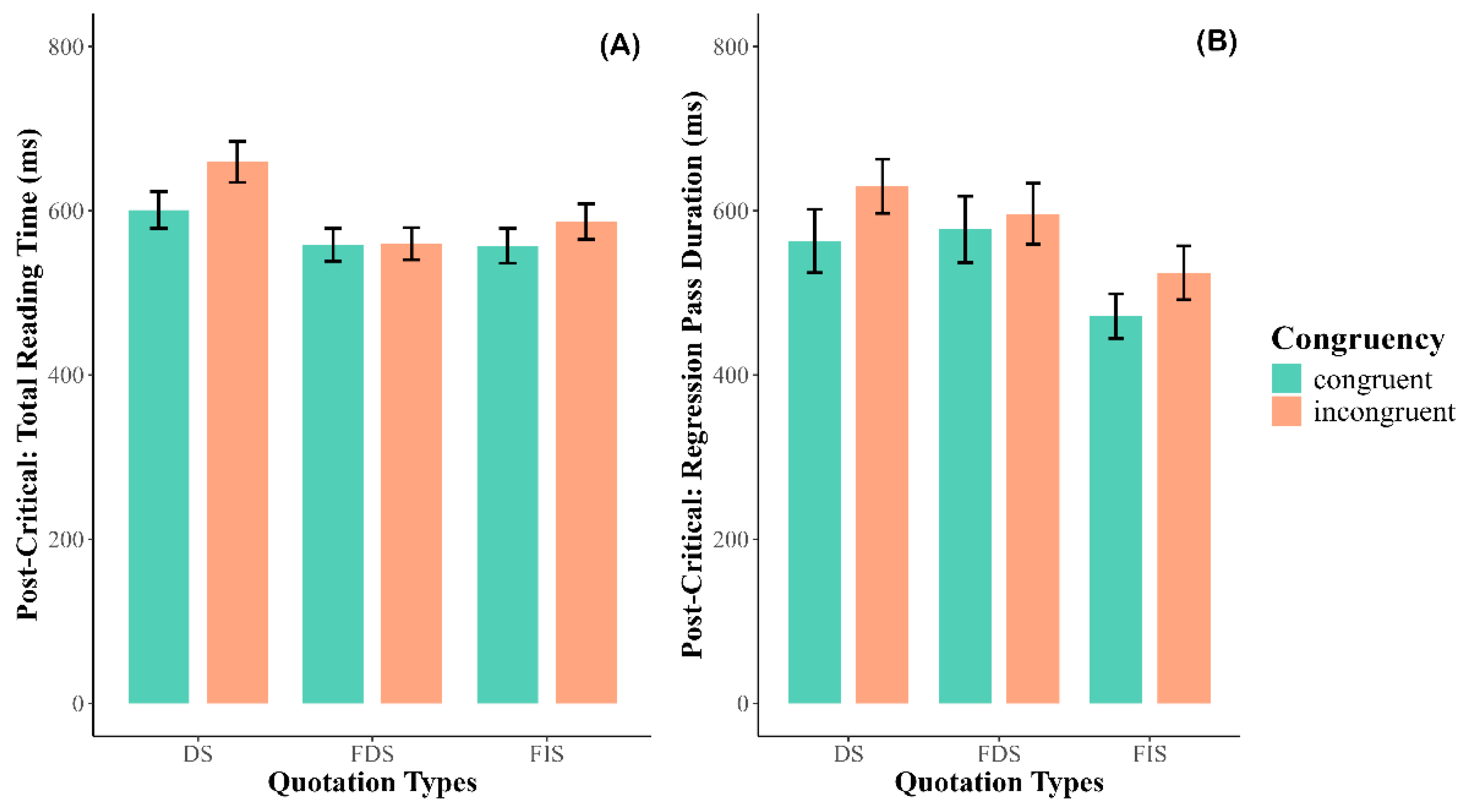
3.2.2. The Post-Critical Region (ROI 2)
First Fixation Duration
Gaze Duration
Total Reading Time
Regression Path Duration
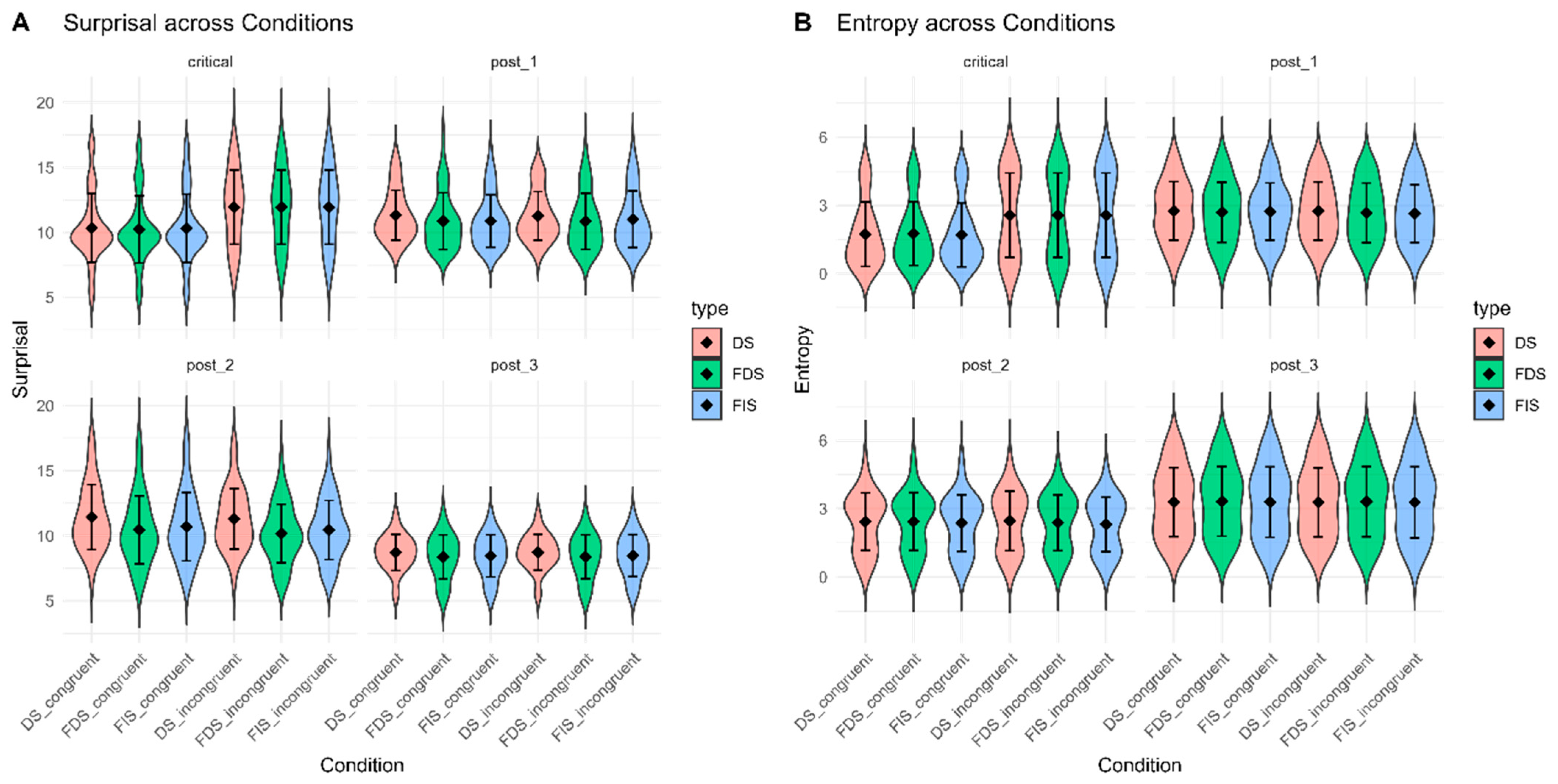
3.3. LLM Results
3.3.1. Surprisal
3.3.2. Entropy
4. Discussion
4.1. Direct Speech, Perspective Shifts, and Processing Cost
4.2. Free Indirect Speech: Absence of a Dual-Voice Effect
4.3. Implications for Embodied Cognition and Theory of Mind
4.4. Comparing Human and LLM Processing
4.5. Why Surprisal and Entropy Gave Different Empirical Pictures
4.6. Limitations
5. Conclusions
Supplementary Materials
Author Contributions
Funding
Institutional Review Board Statement
Informed Consent Statement
Data Availability Statement
Conflicts of Interest
References
- Abrusán, M. (2021). The spectrum of perspective shift: Protagonist projection versus free indirect discourse. Linguistics and Philosophy, 44(4), 839–873. [Google Scholar] [CrossRef]
- Alderson-Day, B., Moffatt, J., Bernini, M., Mitrenga, K., Yao, B., & Fernyhough, C. (2020). Processing speech and thoughts during silent reading: Direct reference effects for speech by fictional characters in voice-selective auditory cortex and a theory-of-mind network. Journal of Cognitive Neuroscience, 32(9), 1637–1653. [Google Scholar] [CrossRef]
- Banfield, A. (1982). Unspeakable sentences: Narration and representation in the language of fiction. Routledge & Kegan Paul. [Google Scholar]
- Barr, D. J., Levy, R., Scheepers, C., & Tily, H. J. (2013). Random effects structure for confirmatory hypothesis testing: Keep it maximal. Journal of Memory and Language, 68(3), 255–278. [Google Scholar] [CrossRef] [PubMed]
- Barsalou, L. W. (1999). Perceptual symbol systems. Behavioral and Brain Sciences, 22(4), 577–660. [Google Scholar] [CrossRef]
- Barsalou, L. W. (2008). Grounded cognition. Annual Review of Psychology, 59, 617–645. [Google Scholar] [CrossRef]
- Barsalou, L. W. (2020). Challenges and opportunities for grounding cognition. Journal of Cognition, 3(1), 31. [Google Scholar] [CrossRef]
- Bates, D., Mächler, M., Bolker, B., & Walker, S. (2015). Fitting linear mixed-effects models using lme4. Journal of Statistical Software, 67(1), 1–48. [Google Scholar] [CrossRef]
- Bray, J. (2007). The ‘dual voice’ of free indirect discourse: A reading experiment. Language and Literature, 16(1), 37–52. [Google Scholar] [CrossRef]
- Chang, W. S., Duan, Y. Y., Qian, J. J., Wu, F. Y., Jiang, X. M., & Zhou, X. L. (2020). Gender interference in processing Chinese compound reflexive: Evidence from reading eye-tracking. Language, Cognition and Neuroscience, 35(10), 1355–1370. [Google Scholar] [CrossRef]
- Chen, X., & Ren, J. (2020). A memetic cultural practice: The use of generalized kinship terms in a research seminar attended by Chinese graduate students. Lingua, 245, 102942. [Google Scholar] [CrossRef]
- Clark, H. H., & Gerrig, R. J. (1990). Quotations as demonstrations. Language, 66(4), 764–805. [Google Scholar] [CrossRef]
- Coulmas, F. (1986). Direct and indirect speech. Mouton de Gruyter. [Google Scholar]
- Delfitto, D., Fiorin, G., & Reboul, A. (2016). The semantics of person and de se effects in free indirect discourse. SpringerPlus, 5(1), 1451. [Google Scholar] [CrossRef]
- Diao, X. (2024). The influence of free direct speech and free indirect speech on reader’s perspective-taking: Evidence from event-related potentials [Master’s thesis, Nanjing Normal University]. [Google Scholar]
- Dixon, P., & Bortolussi, M. (1996). Literary communication: Effects of reader–narrator cooperation. Poetics, 23(6), 405–430. [Google Scholar] [CrossRef]
- Doron, E. (1991). Point of view as a factor of content. In S. Moore, & A. Z. Wyner (Eds.), Proceedings of the first semantics and linguistic theory conference (pp. 51–64). Cornell University. [Google Scholar]
- Eerland, A., Engelen, J. A. A., & Zwaan, R. A. (2013). The influence of direct and indirect speech on mental representations. PLoS ONE, 8(6), e65480. [Google Scholar] [CrossRef]
- Eerland, A., & Zwaan, R. A. (2018). The influence of direct and indirect speech on source memory. Collabra: Psychology, 4(1), 5. [Google Scholar] [CrossRef]
- Ehrlich, S. (1990). Point of view: A linguistic analysis of literary style. Routledge. [Google Scholar]
- Fang, M., & Zhou, Y. (2022). The exploration of free direct speech in storytelling. Contemporary Rhetoric, 234(6), 1–12. (In Chinese). [Google Scholar]
- Faul, F., Erdfelder, E., Lang, A.-G., & Buchner, A. (2007). G*Power 3: A flexible statistical power analysis program for the social, behavioral, and biomedical sciences. Behavior Research Methods, 39(2), 175–191. [Google Scholar] [CrossRef]
- Fludernik, M. (1993). The fictions of language and the languages of fiction. Routledge. [Google Scholar]
- Hagenaar, E. (1992). Stream of consciousness and free indirect discourse in modern Chinese literature. Centre of Non-Western Studies, Leiden University. [Google Scholar]
- Hale, J. (2001, June 2–7). A probabilistic Earley parser as a psycholinguistic model. Second Meeting of the North American Chapter of the Association for Computational Linguistics (pp. 59–66), Pittsburgh, PA, USA. Available online: https://aclanthology.org/N01-1021/ (accessed on 19 September 2025).
- Holtgraves, T. (2001). Language as social action: Social psychology and language use. Psychology Press. [Google Scholar]
- Kim, Y.-S. G. (2016). Direct and mediated effects of language and cognitive skills on comprehension of oral narrative texts (listening comprehension) for children. Journal of Experimental Child Psychology, 141, 101–120. [Google Scholar] [CrossRef] [PubMed]
- Kim, Y.-S. G. (2020). Hierarchical and dynamic relations of language and cognitive skills to reading comprehension: Testing the direct and indirect effects model of reading (DIER). Journal of Educational Psychology, 112(4), 667–684. [Google Scholar] [CrossRef]
- Kim, Y.-S. G., Dore, R., Cho, M., Golinkoff, R., & Amendum, S. J. (2021). Theory of mind, mental state talk, and discourse comprehension: Theory of mind process is more important for narrative comprehension than for informational text comprehension. Journal of Experimental Child Psychology, 209, 105181. [Google Scholar] [CrossRef]
- Köder, F., Maier, E., & Hendriks, P. (2015). Perspective shift increases processing effort of pronouns: A comparison between direct and indirect speech. Language, Cognition and Neuroscience, 30(8), 940–946. [Google Scholar] [CrossRef]
- Leech, G. N., & Short, M. (1981). Style in fiction: A linguistic introduction to English fictional prose. Longman. [Google Scholar]
- Levy, R. (2008). Expectation-based syntactic comprehension. Cognition, 106(3), 1126–1177. [Google Scholar] [CrossRef]
- Li, J., Dijkstra, K., & Zwaan, R. A. (2022). The use of direct and indirect speech across psychological distance. Memory & Cognition, 50, 1816–1825. [Google Scholar] [CrossRef] [PubMed]
- Li, J., Dijkstra, K., & Zwaan, R. A. (2024). Deictic shift in the production of direct and indirect speech. Language and Cognition, 16(3), 559–573. [Google Scholar] [CrossRef]
- Lu, H. (2000). A brief history of Chinese fiction. University Press of the Pacific. [Google Scholar]
- Maier, E. (2015). Quotation and unquotation in free indirect discourse. Mind & Language, 30(3), 345–373. [Google Scholar] [CrossRef]
- Mason, R. A., & Just, M. A. (2006). Neuroimaging contributions to the understanding of discourse processes. In M. Traxler, & M. A. Gernsbacher (Eds.), Handbook of psycholinguistics (pp. 765–799). Elsevier. [Google Scholar]
- Oh, B. D., & Schuler, W. (2022, December 7–11). Entropy- and distance-based predictors from GPT-2 attention patterns predict reading times over and above GPT-2 surprisal. 2022 Conference on Empirical Methods in Natural Language Processing (pp. 9324–9334), Abu Dhabi, United Arab Emirates. [Google Scholar]
- Page, N. (1973). Speech in the English novel. Longman. [Google Scholar]
- Pezzulo, G., Barsalou, L. W., Cangelosi, A., Fischer, M. H., McRae, K., & Spivey, M. J. (2011). The mechanics of embodiment: A dialog on embodiment and computational modeling. Frontiers in Psychology, 2, 5. [Google Scholar] [CrossRef] [PubMed]
- Reingold, E. M., Yang, J., & Rayner, K. (2010). The time course of word frequency and case alternation effects on fixation times in reading: Evidence for lexical control of eye movements. Journal of Experimental Psychology: Human Perception and Performance, 36(6), 1677–1683. [Google Scholar] [CrossRef]
- Salem, S., Weskott, T., & Holler, A. (2017). Does narrative perspective influence readers’ perspective-taking? An empirical study on free indirect discourse, psycho-narration and first-person narration. Glossa: A Journal of General Linguistics, 2(1), 61. [Google Scholar] [CrossRef]
- Schlenker, P. (2004). Context of thought and context of utterance: A note on free indirect discourse and the historical present. Mind & Language, 19(3), 279–304. [Google Scholar] [CrossRef]
- Shannon, C. E. (1948). A mathematical theory of communication. Bell System Technical Journal, 27, 379–423, 623–656. [Google Scholar] [CrossRef]
- Sharvit, Y. (2008). The puzzle of free indirect discourse. Linguistics and Philosophy, 31(3), 353–395. [Google Scholar] [CrossRef]
- Shen, D. (1991a). A reassessment of “free indirect speech”. Foreign Language Teaching and Research, 86(2), 11–16. [Google Scholar]
- Shen, D. (1991b). On the idiosyncrasies of modes of speech presentation in Chinese narrative fiction. Journal of Peking University (Philosophy and Social Sciences), 4, 76–82. [Google Scholar]
- Shen, D. (2003). Difference behind similarity: Focalization in third person center of consciousness and first person retrospective narration. In C. Jacobs, & H. Sussman (Eds.), Acts of narrative (pp. 81–92). Stanford University Press. [Google Scholar]
- Slattery, T. J., Angele, B., & Rayner, B. (2011). Eye movements and display change detection during reading. Journal of Experimental Psychology: Human Perception and Performance, 37(6), 1924–1938. [Google Scholar] [CrossRef]
- So, R. J. (2016). Transpacific community: America, China, and the rise and fall of a global cultural network. Columbia University Press. [Google Scholar]
- Sotirova, V. (2006). Reader responses to narrative point of view. Poetics, 34(2), 108–133. [Google Scholar] [CrossRef]
- Sternberg, M. (1982). Proteus in quotation-land: Mimesis and the forms of reported discourse. Poetics Today, 3(2), 107–156. [Google Scholar] [CrossRef]
- Stites, M. C., Luke, S. G., & Christianson, K. (2013). The psychologist said quickly, “Dialogue descriptions modulate reading speed!”. Memory & Cognition, 41, 137–151. [Google Scholar] [CrossRef]
- Stokke, A. (2013). Protagonist projection. Mind & Language, 28(2), 204–232. [Google Scholar] [CrossRef]
- Tomasello, R., Boux, I., & Pulvermüller, F. (2025). Theory of Mind and the brain substrates of direct and indirect communicative action understanding. Philosophical Transactions of the Royal Society B, 380, 20230497. [Google Scholar] [CrossRef]
- Tompkins, V., Montgomery, D. E., Dore, R. A., & Lee, B. K. (2025). Theory of mind and text comprehension across the lifespan: A meta-analysis. Developmental Psychology, 61(6), 1112–1125. [Google Scholar] [CrossRef]
- Vandelanotte, L. (2004). Deixis and grounding in speech and thought representation. Journal of Pragmatics, 36, 489–520. [Google Scholar] [CrossRef]
- Verhagen, A. (2023). The origins of perspective taking lie in iconic language use: Unifying theories of signs, conversation, and narrative perspective. Frontiers in Communication, 8, 623662. [Google Scholar] [CrossRef]
- Wade, E., & Clark, H. H. (1993). Reproduction and demonstration in quotations. Journal of Memory and Language, 32(6), 805–819. [Google Scholar] [CrossRef]
- Yan, S. Y., & Jaeger, T. F. (2020). Expectation adaptation during natural reading. Language, Cognition and Neuroscience, 35(10), 1394–1422. [Google Scholar] [CrossRef]
- Yao, B. (2021). Mental simulations of phonological representations are causally linked to silent reading of direct versus indirect speech. Journal of Cognition, 4(1), 6. [Google Scholar] [CrossRef]
- Yao, B., Belin, P., & Scheepers, C. (2011). Silent reading of direct versus indirect speech activates voice-selective areas in the auditory cortex. Journal of Cognitive Neuroscience, 23(10), 3146–3152. [Google Scholar] [CrossRef] [PubMed]
- Yao, B., & Scheepers, C. (2011). Contextual modulation of reading rate for direct versus indirect speech quotations. Cognition, 121(3), 447–453. [Google Scholar] [CrossRef] [PubMed]
- Yao, B., & Scheepers, C. (2015). Inner voice experiences during processing of direct and indirect speech. In L. Frazier, & E. Gibson (Eds.), Explicit and implicit prosody in sentence processing: Studies in honor of Janet Dean Fodor (pp. 287–307). Springer. [Google Scholar]
- Yao, B., Taylor, J. R., Banks, B., & Kotz, S. A. (2021). Reading direct speech quotes increases theta phase-locking: Evidence for cortical tracking of inner speech? NeuroImage, 239, 118313. [Google Scholar] [CrossRef]
- Zhao, Z., Chen, H., Zhang, J., Zhao, W. X., Liu, T., Lu, W., Chen, X., Deng, H., Ju, Q., & Du, X. (2019, November 3–7). UER: An open-source toolkit for pre-training models. Proceedings of the 2019 Conference on Empirical Methods in Natural Language Processing and the 9th International Joint Conference on Natural Language Processing (EMNLP-IJCNLP): System Demonstrations (pp. 241–246), Hong Kong, China. [Google Scholar]


| Examples | |
|---|---|
| Part A: Context | 哪吒率先施法,变出三头六臂,朝那妖怪打去,没想到那妖怪只取出一个圈,往空抛起,就将哪吒的兵器尽数套来。哪吒之父李靖见状,便让哪吒在身后等待,拿起宝塔便要施法,谁知被那妖怪把宝塔也给收了去,哪吒见他父王居然也败了,觉得非常不可思议。 Nezha took the lead in casting magic, with his three heads and six arms appearing to attack the monster. Unexpectedly, the monster only took out a circle and threw it into the air. Then Nezha’s weapon was taken by the monster. Nezha’s father, LiJing asked Nezha to wait behind him. He picked up the pagoda and tried to cast magic, but his pagoda was also taken by the monster soon. Nezha felt incredible that his father had also been defeated. |
| Part B: Critical sentence | /ROI 1/ROI 2/ |
| DS-congruent | 哪吒大吃一惊,他说:“我真是没有想到,竟连/父王/也吃/败仗/了。/” Nezha was shocked. “I can’t believe it, father has also been defeated,” he said. |
| DS-incongruent | 哪吒大吃一惊,他说:“我真是没有想到,竟连/李靖/也吃/败仗/了。/” Nezha was shocked. “I can’t believe it, Lijing has also been defeated,” he said. |
| FDS-congruent | 哪吒大吃一惊,我真是没有想到,竟连/父王/也吃/败仗/了。/ Nezha was shocked. I can’t believe it, father has also been defeated. |
| FDS-incongruent | 哪吒大吃一惊,我真是没有想到,竟连/李靖/也吃/败仗/了。/ Nezha was shocked. I can’t believe it, Lijing has also been defeated.. |
| FIS-congruent | 哪吒大吃一惊,他真是没有想到,竟连/父王/也吃/败仗/了。/ Nezha was shocked. He couldn’t believe it, father had also been defeated. |
| FIS-incongruent | 哪吒大吃一惊,他真是没有想到,竟连/李靖/也吃/败仗/了。/ Nezha was shocked. He couldn’t believe it, Lijing had also been defeated. |
| Character’s Perspective | Narrator’s Perspective | Both Perspective | Total | |
|---|---|---|---|---|
| DS | 473 | 32 | 70 | 575 |
| FDS | 470 | 39 | 66 | 575 |
| FIS | 67 | 291 | 217 | 575 |
| Eye- Movement | ROI | Congruency | Quotation Type | DS > FDS | DS > FIS | FDS > FIS |
|---|---|---|---|---|---|---|
| FFD | ROI 1 (critical) | Yes (DS) | n.s. | n.s. | n.s. | Yes |
| GD | ROI 1 (critical) | n.s. | Yes | n.s. | Yes | n.s. |
| TRT | ROI 1 (critical) | Yes | Yes | n.s. | Yes | Yes |
| RPD | ROI 1 (critical) | Yes | Yes | n.s. | Yes | Yes |
| FFD | ROI 2 (post-critical) | n.s. | n.s. | - | - | - |
| GD | ROI 2 (post-critical) | n.s. | n.s. | - | - | - |
| TRT | ROI 2 (post-critical) | Yes | Yes | Yes | Yes | n.s. |
| RPD | ROI 2 (post-critical) | Yes | Yes | n.s. | Yes | Yes |
| LLM Metrics | Word Position | Consistency | Quotation Type | DS > FDS | DS > FIS | FIS > FDS |
|---|---|---|---|---|---|---|
| Surprisal | Critical | Yes | n.s. | – | – | – |
| Post-1 | n.s. | Yes | Yes | Yes | Yes | |
| Post-2 | n.s. | Yes | Yes | Yes | Yes | |
| Post-3 | n.s. | Yes | Yes | Yes | n.s. | |
| Entropy | Critical | Yes | n.s. | – | – | – |
| Post-1 | n.s. | n.s. | – | – | – | |
| Post-2 | n.s. | Yes | n.s. | DS < FIS | n.s. | |
| Post-3 | n.s. | n.s. | – | – |
Disclaimer/Publisher’s Note: The statements, opinions and data contained in all publications are solely those of the individual author(s) and contributor(s) and not of MDPI and/or the editor(s). MDPI and/or the editor(s) disclaim responsibility for any injury to people or property resulting from any ideas, methods, instructions or products referred to in the content. |
© 2025 by the authors. Licensee MDPI, Basel, Switzerland. This article is an open access article distributed under the terms and conditions of the Creative Commons Attribution (CC BY) license (https://creativecommons.org/licenses/by/4.0/).
Share and Cite
Chen, L.; Zuo, W.; Xu, X. How Quotation Types Shape Classic Novel Reading in Chinese: A Comparison Between Human Eye-Movements and Large Language Models. Behav. Sci. 2025, 15, 1650. https://doi.org/10.3390/bs15121650
Chen L, Zuo W, Xu X. How Quotation Types Shape Classic Novel Reading in Chinese: A Comparison Between Human Eye-Movements and Large Language Models. Behavioral Sciences. 2025; 15(12):1650. https://doi.org/10.3390/bs15121650
Chicago/Turabian StyleChen, Lijuan, Wenjia Zuo, and Xiaodong Xu. 2025. "How Quotation Types Shape Classic Novel Reading in Chinese: A Comparison Between Human Eye-Movements and Large Language Models" Behavioral Sciences 15, no. 12: 1650. https://doi.org/10.3390/bs15121650
APA StyleChen, L., Zuo, W., & Xu, X. (2025). How Quotation Types Shape Classic Novel Reading in Chinese: A Comparison Between Human Eye-Movements and Large Language Models. Behavioral Sciences, 15(12), 1650. https://doi.org/10.3390/bs15121650