1. Introduction
As artificial intelligence has evolved from an efficiency-enhancing tool into a core force driving strategic organizational change (
Budhwar et al., 2023), its workplace applications have continued to expand. Some organizations have begun to deploy embodied AI systems in settings such as customer service, production operations, on-site guidance, and task assistance, including service robots, industrial robotic arms, and intelligent guidance devices. In this development, leaders, as interpreters of organizational strategy and key decision makers in resource allocation, provide an important reference point for employees’ use of AI. In particular, leaders’ attention to specific AI applications in daily management (
Dong et al., 2025) constitutes an important external context through which employees perceive and respond to AI-related work situations. However, existing research has mainly focused on the application of AI technologies themselves or on employees’ direct human–AI interaction (
Wu et al., 2024;
Wu et al., 2025;
Wu & Zhang, 2024). Less is known about how employees interpret and respond to leader AI-focused attention and how this attention is associated with their self-initiated and future-oriented work behaviors. Clarifying this top-down process is therefore important for understanding how organizational vitality and employee initiative may be fostered in the AI era.
A review of the existing literature suggests that research at the intersection of leadership and AI has mainly developed along three streams. One stream examines AI-enabled leadership, focusing on how leaders use AI tools for decision analysis, team management, and performance enhancement (
Joshi, 2025;
Mohammed et al., 2025;
Florea & Croitoru, 2025). Another stream focuses on AI symbolism, namely how leaders communicate the importance of and support for AI technologies through their words and actions, thereby shaping employees’ readiness for organizational change and their evaluations of leadership effectiveness (
Hu et al., 2025;
He et al., 2023). In addition, emerging studies have begun to examine leaders’ supportive behaviors during AI implementation, such as providing training and clear communication, and their potential role in reducing employees’ anxiety and enhancing acceptance (
Sha et al., 2025;
H.-Y. Wang et al., 2025;
Sarkar, 2025;
Van Quaquebeke & Gerpott, 2024). These studies provide an important foundation for understanding the role of leaders in AI-related change. However, they tend to position employees as passive adapters or responders, paying insufficient attention to the deeper proactive psychological processes and behavioral motives that may emerge after employees perceive leaders’ intentions. As a core dimension of employees’ positive work behavior, employee proactive behavior refers to self-initiated and discretionary actions that go beyond formal role requirements and are intended to improve one’s work situation or the organizational environment. It includes proactive learning, problem solving, and process improvement and serves as an important basis for organizational adaptation and sustainable development (
Grant & Ashford, 2008;
Fay & Frese, 2001;
Crant, 2000;
Li et al., 2023). In the context of AI-driven changes in work paradigms, employee proactive behavior is no longer confined to traditional work domains. It is also reflected in employees’ active adaptation to AI technologies, their use of AI tools to improve work effectiveness, and their exploration of ways to integrate AI into work processes. This raises an important question: Is leaders’ high level of attention to AI interpreted by subordinates as a developmental signal that may encourage initiative, or is it perceived as a source of performance pressure and role threat that may be associated with avoidance and delay? The complex mechanism underlying this process warrants further investigation.
To unpack this black box, this study draws on work-related rumination theory as its core explanatory framework and examines employees’ psychological responses to leader AI-focused attention from the perspective of cognitive and affective processing. Work-related rumination refers to repeated thinking about work-related issues during nonwork time and is commonly classified into problem-solving pondering and affective rumination (
Querstret & Cropley, 2012). Problem-solving pondering is a constructive and solution-oriented form of repetitive thinking, often accompanied by positive expectations and future-oriented planning. By contrast, affective rumination reflects a passive form of repetitive thinking in which attention is centered on negative emotions and worries. Leader AI-focused attention constitutes an important work-related stimulus for employees. On the one hand, it may be interpreted as encouragement for innovation and adaptation, thereby making employees more likely to engage in constructive thinking about the future possibilities of AI-enabled work. On the other hand, it may also be perceived as a signal of potential skill obsolescence and role replacement, thereby making employees more likely to experience anxiety and uncertainty.
The extent to which employees engage in the aforementioned rumination pathways, as well as the intensity of such engagement, may also be shaped by their cognitive frames of interpretation. Among these factors, AI job role clarity represents a key boundary condition. AI job role clarity refers to employees’ cognition, understanding, and expectations regarding their work design, role positioning, scope of responsibilities, and task requirements in an AI-enabled collaborative work environment (
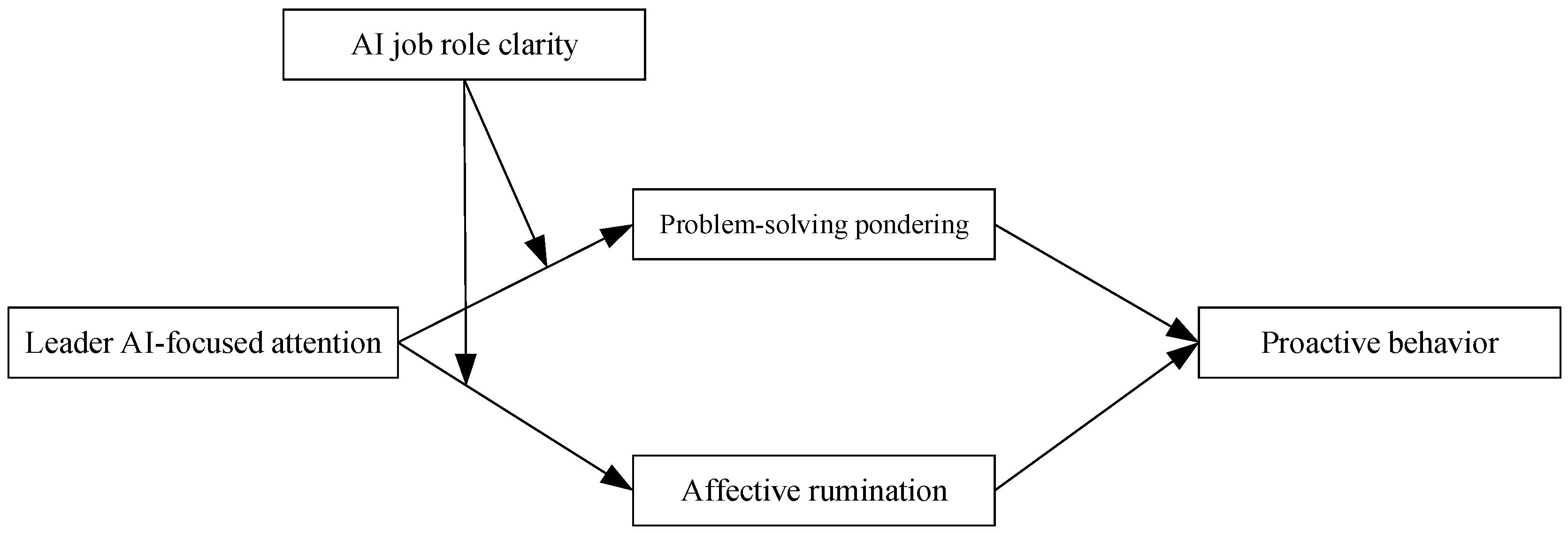
Chowdhury et al., 2022). When employees have a clear understanding of their role requirements in the AI context, leader AI-focused attention is more likely to be interpreted as a specific developmental guide, thereby prompting problem-solving pondering about the use of AI tools, the optimization of work processes, and the development of relevant capabilities. Conversely, when AI job roles are ambiguous, employees may find it difficult to discern the specific requirements conveyed by leader AI-focused attention. In this case, they are more likely to interpret such attention as an uncertain source of pressure and to engage in affective rumination about skill adaptation, role changes, and performance expectations. Accordingly, this study develops a moderated dual-mediation model to examine the differentiated pathways through which leader AI-focused attention is associated with employee proactive behavior via affective rumination and problem-solving pondering, as well as the moderating role of AI job role clarity in these pathways.
This study makes several theoretical contributions. First, from a research perspective, this study treats leader AI-focused attention as an important contextual signal and situates it within specific work settings involving AI robots. AI robots should not be viewed as entities detached from AI; rather, they represent a more concrete, observable, and interactive form through which AI technology is encountered in organizations. It is through these specific work settings that employees perceive leaders’ sustained attention to AI-related issues. By focusing on how leader AI-focused attention is associated with subordinates’ underlying behavioral motives, this study helps clarify how employees interpret and respond to leaders’ attentional signals in human–AI collaboration. Second, this study extends work-related rumination theory to AI-related work contexts by explaining how employees may continue to engage in cognitive and affective processing during nonwork time after perceiving leader AI-focused attention. This offers a useful theoretical lens for understanding employees’ nonwork-time psychological activities in AI-related work settings. Third, this study distinguishes between two mediating pathways, namely affective rumination and problem-solving pondering, which reflect affective and cognitive processing, respectively. It further introduces AI job role clarity as a cognitive moderator to explain how employees’ cognitive clarity may shape their affective and cognitive processing of work-related information during nonwork time. Overall, this study provides a more refined explanatory framework for understanding how leader AI-focused attention is associated with employee proactive behavior from an integrated cognitive and affective perspective. The theoretical model of this study is shown in
Figure 1.
5. General Discussion
Drawing on work-related rumination theory, this study develops a moderated mediation model to examine the mechanism linking leader AI-focused attention to employee proactive behavior. Using a three-wave time-lagged design and empirical analysis of 514 valid responses, the results show that leader AI-focused attention is associated with employees’ problem-solving pondering and may also be accompanied by affective rumination, forming two distinct pathways related to employee proactive behavior. Specifically, leader AI-focused attention positively predicts both problem-solving pondering and affective rumination and is further linked to employee proactive behavior through these two forms of work-related rumination. In other words, problem-solving pondering and affective rumination serve as dual mediators in the relationship between leader AI-focused attention and employee proactive behavior.
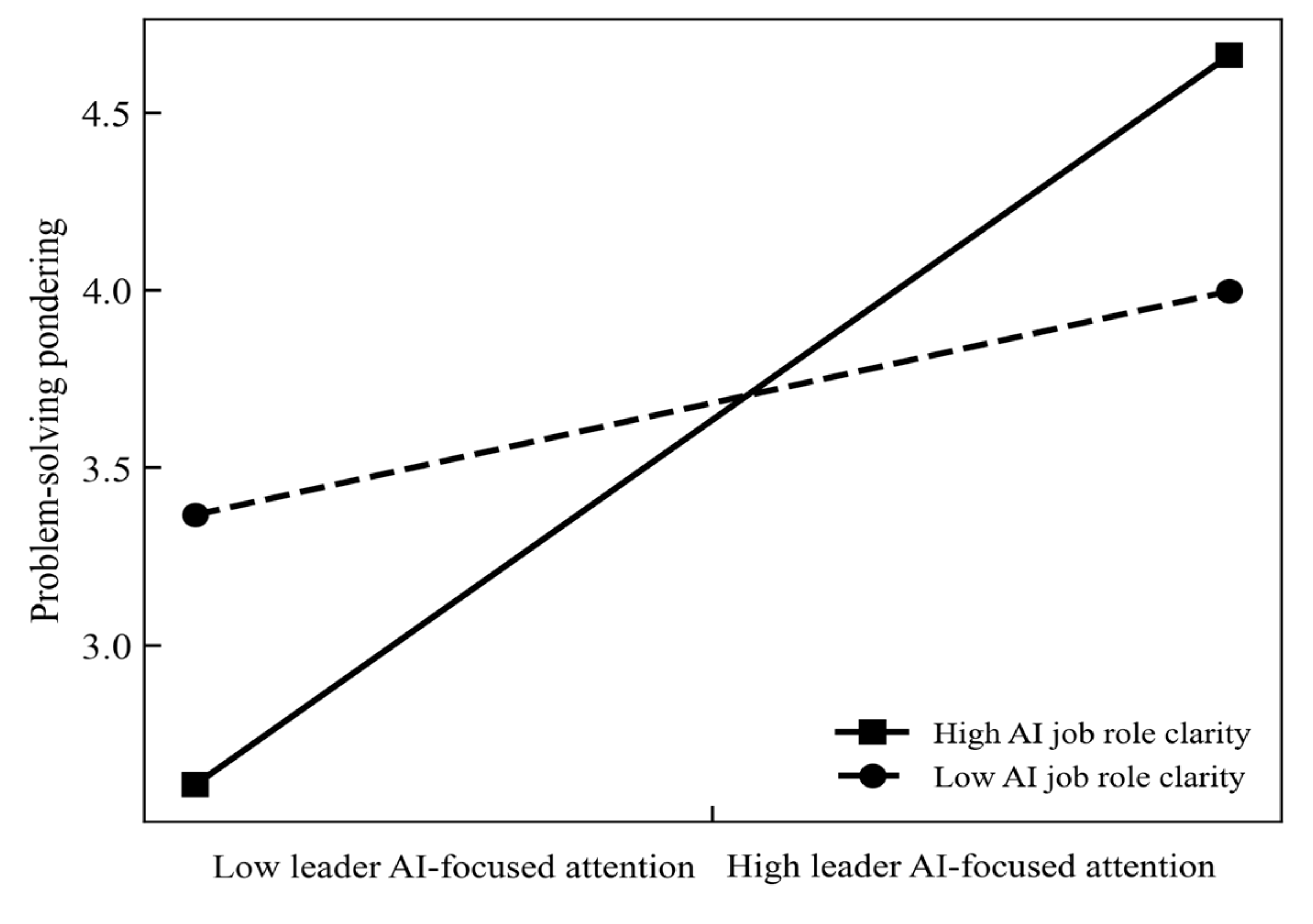
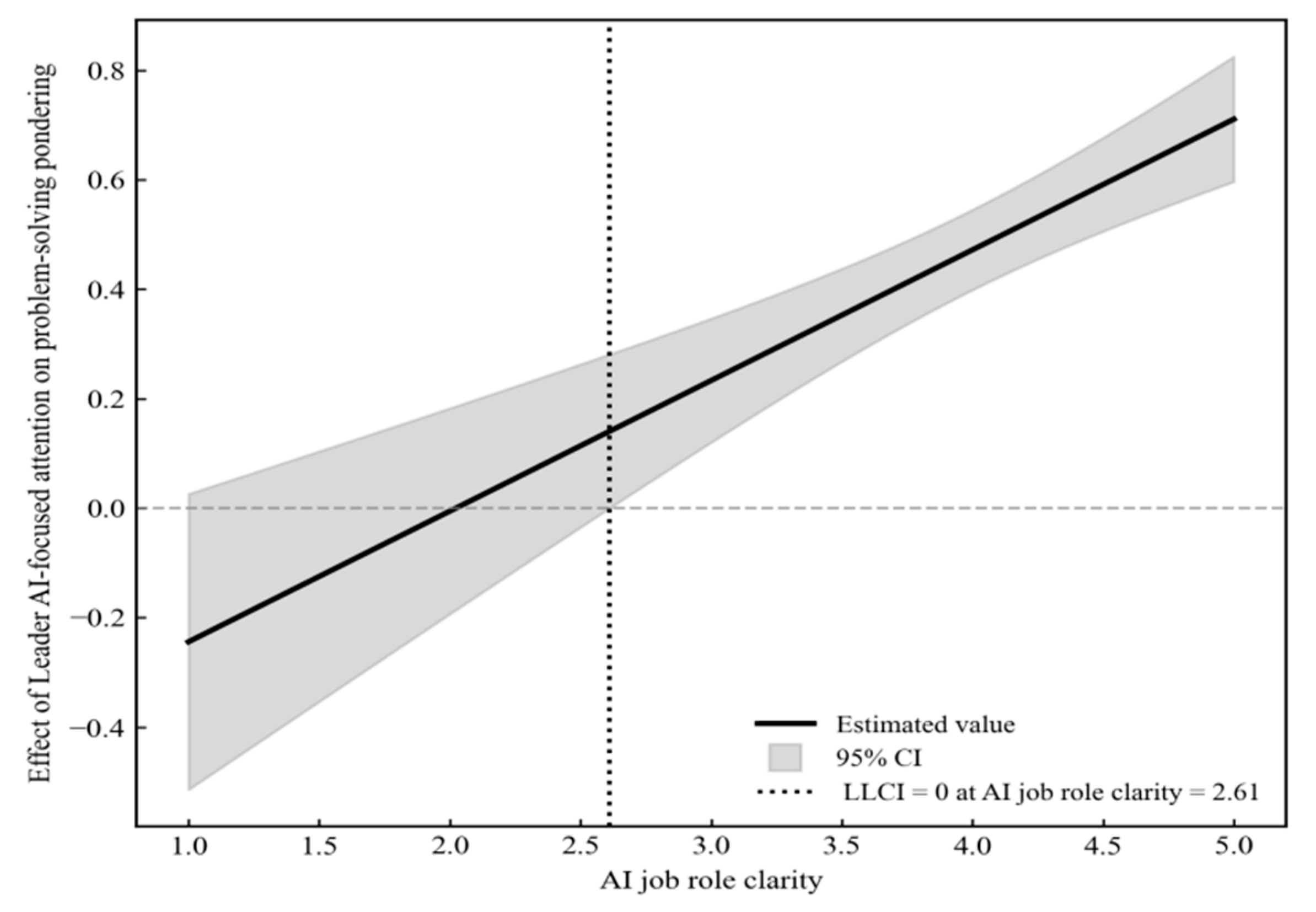
Further, our findings suggest that the moderating role of AI job role clarity is primarily evident in the problem-solving pondering pathway. When employees have a clearer understanding of how AI is positioned in their jobs, where their responsibilities begin and end, and what AI-related collaboration requires, leader AI-focused attention is more likely to be translated into task-specific reflection on AI-related work and, in turn, to be positively linked to employee proactive behavior. By contrast, the moderating effect of AI job role clarity in the affective rumination pathway was not statistically significant. This pattern does not suggest that AI job role clarity is unimportant. Rather, it indicates that its role may lie mainly in shaping employees’ cognitive processing. Specifically, AI job role clarity may help employees interpret leaders’ AI-focused attention as a cue for task improvement, process optimization, and capability alignment, thereby facilitating more constructive problem-solving pondering. However, affective rumination may not diminish simply because employees have clearer role boundaries, as worries and uncertainty triggered by AI-related changes may persist even when role expectations are clarified. In this sense, the present study highlights the path-specific role of AI job role clarity in AI-related work contexts: it appears more relevant to the cognitive translation of leaders’ AI-focused attention than to the immediate reduction in negative psychological responses.
Regarding the unsupported H5 and H6, one possible explanation is that affective rumination in AI-related work contexts may not stem solely from ambiguous role boundaries. Compared with problem-solving pondering, affective rumination is more closely tied to emotion-laden repetitive thinking about threat, uncertainty, and anticipated loss. Such rumination may arise from AI anxiety, job insecurity, concerns about skill obsolescence, and perceived replacement threats. Even when employees clearly understand their current responsibilities in AI-related tasks, they may still worry that AI adoption will change performance evaluation criteria, reduce the value of their existing experience and skills, or increase uncertainty about their future career development. Thus, although AI job role clarity may help employees develop a more concrete understanding of current task requirements, it may not be sufficient to alleviate their emotional concerns about the longer-term implications of AI. Future research could further examine whether factors such as psychological safety, organizational support, leader reassurance, and employees’ trust in the organization’s AI implementation process serve as more relevant boundary conditions for the affective rumination pathway.
5.1. Theoretical Contributions
First, this study incorporates leader AI-focused attention into the explanatory framework of employee proactive behavior in AI-related work contexts, thereby enriching existing understanding of the factors associated with employees’ positive behavioral responses in such contexts. Prior research has begun to examine the relationship between AI-related contexts and employees’ positive behavioral responses, addressing issues such as employee voice, proactive behavior, career proactivity, and job crafting from the perspectives of organizational AI adoption, employee–AI collaboration, and proactive adaptation after AI implementation. For example, organizational AI adoption may be linked to employee voice through work engagement (
Jeong, 2026); employee–AI collaboration may be associated with employee proactive behavior by reducing workload (
Sun et al., 2025); and AI implementation may also be related to employees’ proactive job crafting (
X. Lin et al., 2025). These studies provide an important foundation for understanding how employees proactively adapt to AI. Building on this line of research, the present study further introduces leader AI-focused attention as a contextual signal, suggesting that employee proactive behavior is related not only to AI technologies themselves and the process of using them, but also to the way leaders sustain attention to AI in daily management. In doing so, this study extends the explanation of the antecedents of employee proactive behavior in AI-related work contexts from the level of technology application and employee adaptation to the leadership context.
Second, by introducing work-related rumination theory, this study further explains how leader AI-focused attention is linked to employees’ psychological processing beyond the work context. Prior research on AI-related work contexts has shown that AI-related factors may correspond to psychological mechanisms in different directions. For example, leader AI awareness may be positively associated with employee voice through intrinsic motivation, while also being negatively associated with employee voice through job insecurity (
Zhou & Lyu, 2025). Similarly, AI disruptive threat may be linked to employee innovative behavior through technology insecurity and thriving at work (
Leong et al., 2025). These studies mainly reveal the coexistence of positive and negative mechanisms in AI-related work contexts. Building on this line of research, the present study extends attention to employees’ sustained psychological processing during nonwork time, showing that leader AI-focused attention is associated not only with task-oriented problem-solving pondering but also with affective rumination centered on technological pressure, role changes, and uncertainty. In this way, this study extends the discussion of the “double-edged” effects of AI-related work contexts from employees’ immediate responses at work to their post-work rumination processes. It also broadens, to some extent, the applicability of work-related rumination theory to organizational contexts shaped by artificial intelligence (
Cropley & Zijlstra, 2011;
Querstret & Cropley, 2012).
Furthermore, this study contributes to a deeper understanding of leadership-related contextual signals in human–AI interaction research. Existing studies on human–AI interaction have paid considerable attention to employees’ direct contact with AI technologies, AI use experiences, trust in AI, and adaptive behaviors toward AI, emphasizing how employees adjust their cognition, skills, and behaviors after AI enters the workplace (
Glikson & Woolley, 2020;
Raisch & Krakowski, 2021;
Parker & Grote, 2022). For example, AI may not only replace certain tasks but also augment employees’ work capabilities and decision-making processes, meaning that employees’ responses in AI-related work contexts often involve complex psychological processes such as adaptation, reliance, vigilance, and role reorientation (
Raisch & Krakowski, 2021;
Tang et al., 2023). Compared with this line of research, the present study is likewise situated in AI-related work contexts, but its focus is not on how employees directly use AI. Instead, it examines how employees interpret the AI-focused attentional signals continuously conveyed by leaders. In this respect, this study, to some extent, complements the explanatory boundary of existing research on positive adaptation to AI. AI-related signals do not stem only from the technology itself or from AI-related communication among coworkers; they may also arise from leaders’ sustained attention to AI in daily management. Employees’ responses to such signals are not limited to whether they accept or use AI, but are also reflected in their continued thinking about work problems, role requirements, and future actions. This perspective connects the technology-adaptation view in human–AI interaction research with the process of leader attentional influence in organizational contexts.
Finally, this study offers a more specific account of the boundary role of AI job role clarity. Recent research on artificial intelligence and work has shown that technological change not only alters the way tasks are performed, but also reshapes job content, work boundaries, and the allocation of responsibilities (
Cascio & Montealegre, 2016). At the same time, differences in employees’ behavioral responses in AI-related contexts have increasingly been examined through the lens of boundary conditions and contingency relationships (
H. Lin et al., 2024;
Sun et al., 2025). Building on this work, the present study further suggests that AI job role clarity reflects the extent to which employees clearly understand the functional boundaries of AI in their jobs, the division of responsibilities, and the modes of human–AI collaboration. It therefore represents a cognitive condition that is closely tied to AI-related work contexts. The findings indicate that AI job role clarity is mainly associated with a stronger relationship between leader AI-focused attention and problem-solving pondering, whereas it does not significantly moderate the affective rumination pathway. This finding does not weaken the theoretical value of AI job role clarity; rather, it reveals the path-specific nature of its role. AI job role clarity may be more likely to help employees understand AI-related tasks and collaboration requirements and to relate to more concrete problem-solving pondering. However, role clarity alone may not be sufficient to buffer worries, uncertainty, and emotion-laden repetitive thinking triggered by AI-related changes. Thus, this study provides a more cautious explanation of the boundary role of AI job role clarity and suggests that future research should further distinguish between cognitive and affective boundary conditions in AI-related work contexts.
5.2. Practical Implications
This study offers practical implications for how organizations can more effectively stimulate employee proactive behavior during AI-enabled transformation. As AI robots are increasingly incorporated into organizational work processes, leaders’ sustained attention to AI becomes an important cue through which employees interpret the organization’s technological orientation, task requirements, and future work standards. If leaders repeatedly emphasize only the importance of AI, efficiency improvement, or transformation pressure, employees may interpret such attention as performance pressure or job threat, thereby experiencing greater psychological burden. Therefore, organizations should guide managers at different levels to improve the way they communicate about AI and translate leader AI-focused attention into more concrete work improvement issues. In departmental meetings, project reviews, and performance conversations, leaders can place greater emphasis on how AI helps employees improve work quality, shorten process time, reduce repetitive tasks, and enhance their problem-solving capabilities, rather than merely stressing the need to adapt to AI as quickly as possible. For organizations, AI-related leadership communication can be incorporated into managerial training programs. Through case-based exercises, communication script design, and management scenario simulations, organizations can help managers develop a more supportive and development-oriented communication style.
In addition, organizations should pay attention to the development of AI job role clarity. The clearer employees are about the functional role of AI in their positions, the boundaries of their responsibilities, and the modes of human–AI collaboration, the more likely they are to interpret leader AI-focused attention as a positive signal related to task improvement and capability development. In practice, organizations can help employees clarify the specific role of AI robots in work processes, as well as employees’ own responsibilities in AI-related collaborative tasks, by updating job descriptions, providing guidelines for human–AI collaboration processes, establishing AI tool use protocols, clarifying task boundaries, and offering scenario-based training. These practices can not only reduce employees’ ambiguity regarding AI-related requirements but also help translate leader AI-focused attention into more concrete problem-solving pondering.
At the same time, managers should recognize that clarifying role boundaries does not mean that employees’ emotional strain will automatically disappear. AI job role clarity is more likely to help employees understand “what should be done” and “how to do it,” but it may not directly resolve the worries and uncertainty they experience in response to AI-related changes. Therefore, when promoting AI applications, organizations should not rely solely on process descriptions and responsibility allocation to alleviate employees’ concerns. They also need to attend to employees’ psychological experiences during AI use. Organizations can establish mechanisms for AI-related consultation, experience sharing, problem feedback, and peer support, so that employees can express their concerns about AI applications, job changes, and capability alignment in a timely manner. Managers should also provide timely feedback on employees’ attempts, improvements, and innovations in AI use, helping them recognize opportunities for growth in the new technological context. In this way, AI implementation is not merely an adjustment of technological tools and work processes; it can also become a process through which employees understand new tasks, develop new capabilities, and form employee proactive behavior.
5.3. Limitations and Future Research
First, although this study adopted a multi-wave survey design, which helps reduce potential bias associated with measuring all variables at a single point in time, the focal variables were still primarily based on employee self-reports, and employee proactive behavior was also self-rated. Therefore, the findings should be interpreted within the boundaries of self-reported survey data. Future research could incorporate supervisor ratings, coworker evaluations, or objective behavioral data to assess employee proactive behavior from multiple sources, thereby enhancing the robustness of the findings.
Second, although this study used screening questions to restrict the sample to technology-oriented firms and AI-robot-related work contexts, it did not further differentiate more fine-grained information such as industry sector, job function, and the intensity of AI implementation. This limitation may constrain the applicability of the findings across different AI-enabled work contexts. Specifically, industries may differ substantially in the maturity of AI applications, the depth of technological embeddedness, and the modes of human–AI collaboration. In organizations where AI applications are relatively mature, AI may have become deeply embedded in work processes, performance evaluation, and task coordination. In such contexts, employees may be more likely to interpret leader AI-focused attention in terms of task improvement, process optimization, and capability development. By contrast, in organizations where AI applications remain at the pilot or early implementation stage, employees may be more likely to interpret leader AI-focused attention as a signal of technological substitution, job adjustment, or performance pressure. Similarly, employees in different job roles may vary in the frequency and form of their contact with AI. Frontline operations, customer service, and production collaboration roles may involve more frequent direct interaction with AI systems, whereas back-office management, technical support, or functional roles may involve more indirect exposure to AI through data systems, process platforms, or decision-support tools. Therefore, the relationships between leader AI-focused attention, employees’ rumination processes, and employee proactive behavior may be jointly bounded by industry maturity, job characteristics, and the degree of AI embeddedness. Future research could collect more detailed information on industry type, job category, frequency of AI use, degree of AI embeddedness, and stage of AI implementation, and compare the mechanisms related to leader AI-focused attention across different AI-related work contexts. This would allow a more nuanced understanding of the boundary conditions of the proposed model.
Third, although the measurement of leader AI-focused attention in this study was based on an established scale, the scale was originally developed in an AI-robot work context. As the forms of AI applications in organizations continue to diversify, the AI systems employees encounter may include service robots, industrial robots, algorithmic management systems, intelligent decision-making systems, and generative AI tools. Future research could further examine the applicability of the leader AI-focused attention measure across different forms of AI technology and compare whether employees understand leader AI-focused attention differently across various AI application scenarios. Such efforts would further enhance the explanatory power of this construct across different organizational contexts.
Finally, in this study, AI job role clarity primarily strengthened the problem-solving pondering pathway, whereas its moderating effect on the affective rumination pathway was not statistically significant. This suggests that employees’ clear understanding of their AI-related work roles may be more likely to help them interpret task requirements, responsibility boundaries, and modes of collaboration, thereby fostering problem-solving pondering. However, worries, uncertainty, and emotion-laden repetitive thinking triggered by AI-related changes may require additional supportive conditions to be alleviated. Future research could further incorporate variables such as AI anxiety, career security, organizational support, psychological safety, and AI-related training support to examine which factors are more effective in reducing affective rumination in AI-related work contexts. Such efforts would further refine the explanation of the boundary conditions under which leader AI-focused attention is linked to employee proactive behavior.