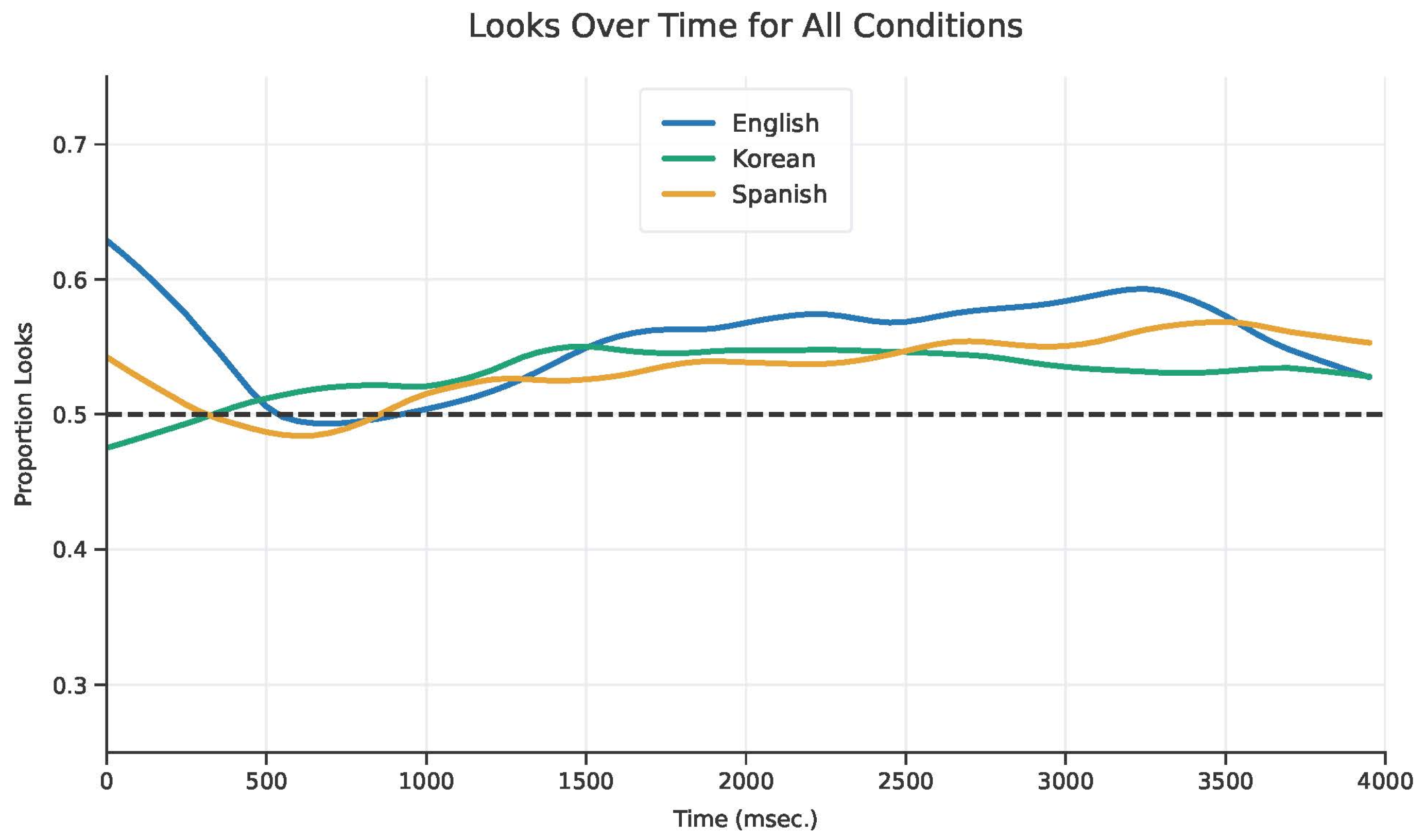
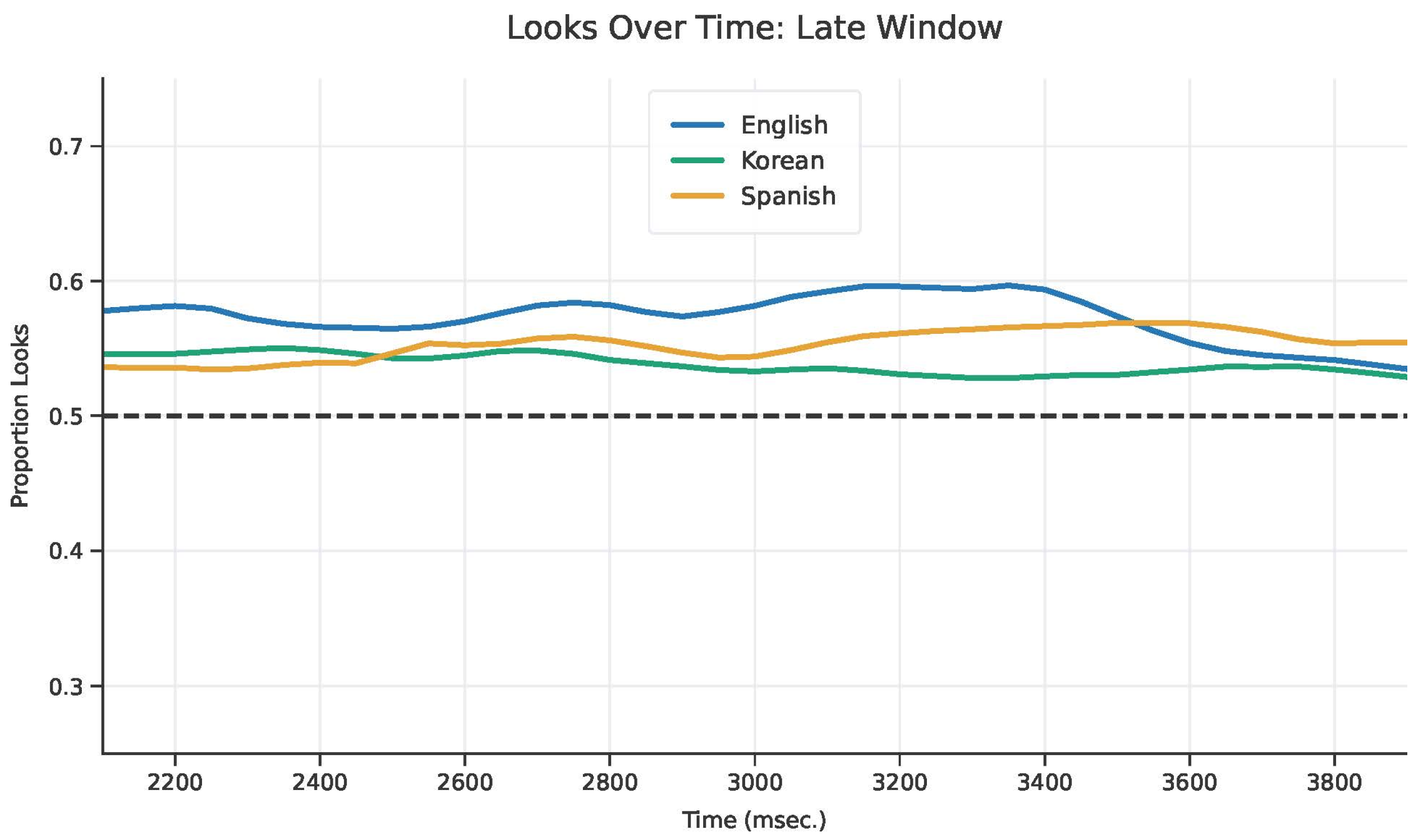
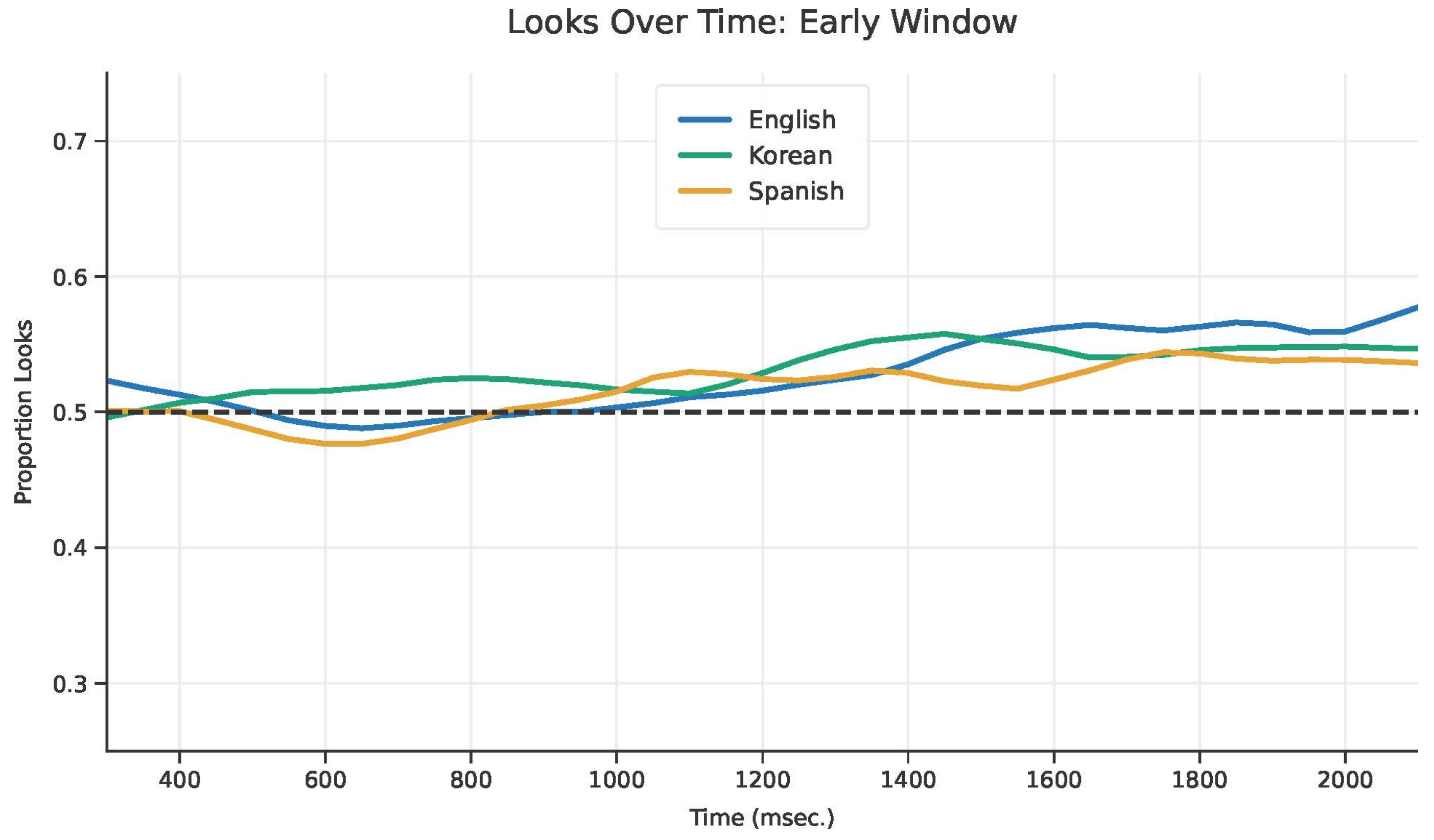
The Impact of Accented Input on Spanish-English Bilingual Children’s Word Learning



Abstract
1. Introduction
1.1. The Impact of Accented Input on Bilinguals’ Processing and Comprehension
1.2. Factors Impacting Performance on Tasks Involving Accented Input
1.3. The Current Study
2. Materials and Methods
2.1. Participants
2.2. Materials
2.2.1. Standardized Measures
2.2.2. Novel Word Learning Task
2.2.3. Bilingual Variables
2.2.4. Length of Bilingualism
2.2.5. Number of Non-Native English Speakers
2.2.6. Strength of Foreign Accent in English
2.3. Analyses
3. Results
3.1. Early Time Window
3.2. Late Time Window
3.3. Individual Differences Analyses
3.3.1. Language Skills
3.3.2. Bilingual Variables
3.3.3. Length of Bilingualism
3.3.4. Number of Non-Native English Speakers
3.3.5. Strength of Accent
4. Discussion
4.1. Factors Impacting Children’s Learning from Accented Input
4.2. The Bilingual Experience
4.3. Conclusions
Author Contributions
Funding
Institutional Review Board Statement
Informed Consent Statement
Data Availability Statement
Conflicts of Interest
Appendix A

| Word | Target | General American English Speaker | Spanish Speaker | Korean Speaker |
|---|---|---|---|---|
| bafere | /ˈbæfɪr/ | [ˈbæfɪɹ] | [ˈbaːfiɾ] | [baˈfɪɹ] |
| botefe | /ˈbɑtif/ | [ˈbɑtif] | [ˈbatef] | [boʊˈtif] |
| dinume | /ˈdaɪnum/ | [ˈdaɪnum] | [ˈdainum] | [ˈdɪnum̚] |
| dulek | /ˈdulɛk/ | [ˈdulɛk] | [ˈdulek] | [duˈlɛk] |
| getov | /ˈgɛtɑv/ | [ˈgɛtɑv] | [ˈgetav] | [gɛˈtɑv] |
| gonepe | /ˈgoʊnip/ | [ˈgoʊnip] | [ˈgonip] | [goʊˈnif̚] |
| kitoge | /ˈkɪtoʊg/ | [ˈkɪtoʊg] | [ˈkigoʊh] | [kɪˈtoʊg̚] |
| kosof | /ˈkɑsɑf/ | [ˈkɑsɑf] | [ˈkasaf] | [kɑˈsɑf] |
| pedede | /ˈpɛdid/ | [ˈpɛdid] | [ˈpedid̚] | [pɛˈdɪd̚] |
| pomive | /ˈpoʊmaɪv/ | [ˈpoʊmaɪv] | [ˈpomaɪv] | [poʊˈmɪm] |
| tepate | /ˈtɛpeɪt/ | [ˈtɛpeɪt] | [ˈtepeɪt] | [tɛˈpeɪt̚] |
| tinade | /ˈtɪneɪd/ | [ˈtɪneɪd] | [ˈtineɪd] | [tɪˈneɪd̚] |
| 1 | We use the term “accented speech” as a shorthand to refer to speech produced in varieties that differ from the local norm (e.g., General American English). Our use of this term reflects relative differences in accent familiarity rather than the presence versus absence of an accent. |
References
- Adank, P., Evans, B. G., Stuart-Smith, J., & Scott, S. K. (2009). Comprehension of familiar and unfamiliar native accents under adverse listening conditions. Journal of Experimental Psychology: Human Perception and Performance, 35(2), 520–529. [Google Scholar] [CrossRef]
- Banks, B., Gowen, E., Munro, K. J., & Adank, P. (2015). Cognitive predictors of perceptual adaptation to accented speech. The Journal of the Acoustical Society of America, 137(4), 2015–2024. [Google Scholar] [CrossRef]
- Barker, B. A., & Turner, L. M. (2014). Influences of foreign accent on preschoolers’ word recognition and story comprehension. Applied Psycholinguistics, 36(5), 1111–1132. [Google Scholar] [CrossRef]
- Bates, D., Maechler, M., Bolker, B., & Walker, S. (2015). Fitting linear mixed-effects models using lme4. Journal of Statistical Software, 67(1), 1–48. [Google Scholar] [CrossRef]
- Bent, T. (2014). Children’s perception of foreign-accented words. Journal of Child Language, 41(6), 1334–1355. [Google Scholar] [CrossRef]
- Bent, T., & Atagi, E. (2015). Children’s perception of nonnative-accented sentences in noise and quiet. The Journal of the Acoustical Society of America, 138(6), 3985–3993. [Google Scholar] [CrossRef]
- Bent, T., Baese-Berk, M., Borrie, S. A., & McKee, M. (2016). Individual differences in the perception of regional, nonnative, and disordered speech varieties. The Journal of the Acoustical Society of America, 140(5), 3775–3786. [Google Scholar] [CrossRef] [PubMed]
- Bent, T., & Bradlow, A. R. (2003). The interlanguage speech intelligibility benefit. The Journal of the Acoustical Society of America, 114(3), 1600–1610. [Google Scholar] [CrossRef] [PubMed]
- Boersma, P., & Weenink, D. (2015). Praat: Doing phonetics by computer (version 6.0) [Computer software]. University of Amsterdam. [Google Scholar]
- Braun, B., Czeke, N., Rimpler, J., Zinn, C., Probst, J., Goldlücke, B., Kretschmer, J., & Zahner-Ritter, K. (2021). Remote testing of the familiar word effect with non-dialectal and dialectal German-learning 1–2-year-olds. Frontiers in Psychology, 12, 714363. [Google Scholar] [CrossRef] [PubMed]
- Buac, M., & Kaushanskaya, M. (2023). The impact of non-native language input on bilingual children’s language skills. Languages, 8(4), 277. [Google Scholar] [CrossRef]
- Byers-Heinlein, K., & Fennell, C. T. (2014). Perceptual narrowing in the context of increased variation: Insights from bilingual infants. Developmental Psychobiology, 56(2), 274–291. [Google Scholar] [CrossRef]
- Chun, E., & Kaan, E. (2022). The effects of speaker accent on syntactic priming in second language speakers. Second Language Research, 38(2), 189–212. [Google Scholar] [CrossRef]
- Darley, F. L., Aronson, A. E., & Brown, J. R. (1975). Motor speech disorders. W. B. Saunders. [Google Scholar]
- Delle Luche, C., Durrant, S., Poltrock, S., & Floccia, C. (2015). A methodological investigation of the intermodal preferential looking paradigm: Methods of analyses, picture selection and data rejection criteria. Infant Behavior and Development, 40, 151–172. [Google Scholar] [CrossRef]
- Dink, J. W., & Ferguson, B. (2015). eyetrackingR: An R package for eye-tracking data analysis (version 0.1.8) [Computer software]. Available online: https://cran.r-project.org/package=eyetrackingR (accessed on 15 February 2019).
- Ellis, E. M., Borovsky, A., Elman, J. L., & Evans, J. L. (2015). Novel word learning: An eye-tracking study. Are 18-month-old late talkers really different from their typical peers? Journal of Communication Disorders, 58, 143–157. [Google Scholar] [CrossRef]
- Evans, B. G., & Tomé Lourido, G. (2019). Effects of language background on the development of sociolinguistic awareness: The perception of accent variation in monolingual and multilingual 5–7 year old children. Phonetica, 76(2–3), 142–162. [Google Scholar] [CrossRef]
- Frizelle, P., Harte, J., Fletcher, P., & Gibbon, F. (2018). Investigating the effect of regional native accents on sentence comprehension in children with language impairment. International Journal of Speech-Language Pathology, 20(4), 434–446. [Google Scholar] [CrossRef]
- Gilkerson, J., & Richards, J. A. (2008). The LENA natural language study. Technical Report No. LTR-02-1. LENA Foundation.
- Gupta, P., Lipinski, J., Abbs, B., Lin, P. H., Aktunc, E., Ludden, D., Martin, N., & Newman, R. (2004). Space aliens and nonwords: Stimuli for investigating the learning of novel word-meaning pairs. Behavior Research Methods, Instruments, & Computers, 36(4), 599–603. [Google Scholar] [CrossRef] [PubMed]
- Hanulíková, A., & Weber, A. (2012). Sink positive: Linguistic experience with th substitutions influences nonnative word recognition. Attention, Perception & Psychophysics, 74(3), 613–629, (Erratum in 2017, Attention, Perception & Psychophysics, 79(7), 2234). [Google Scholar]
- Holtby, A. (2010). The effect of age and exposure in the development of L2 accent perception. PMC Working Paper Series. University of Alberta, Prarie Metropolis Center. [Google Scholar]
- Janse, E., & Adank, P. (2012). Predicting foreign-accent adaptation in older adults. Quarterly Journal of Experimental Psychology, 65(8), 1563–1585. [Google Scholar] [CrossRef] [PubMed]
- Kapa, L. L., & Colombo, J. (2013). Attentional control in early and later bilingual children. Cognitive Development, 28(3), 233–246. [Google Scholar] [CrossRef] [PubMed]
- Lany, J., & Saffran, J. R. (2010). From statistics to meaning: Infants’ acquisition of lexical categories. Psychological Science, 21(2), 284–291. [Google Scholar] [CrossRef]
- Levy, H., Konieczny, L., & Hanulíková, A. (2019). Processing of unfamiliar accents in monolingual and bilingual children: Effects of type and amount of accent experience. Journal of Child Language, 46(2), 368–392. [Google Scholar] [CrossRef]
- Luk, G., De Sa, E. R. I. C., & Bialystok, E. (2011). Is there a relation between onset age of bilingualism and enhancement of cognitive control? Bilingualism: Language and Cognition, 14(4), 588–595. [Google Scholar] [CrossRef]
- Marian, V., Bartolotti, J., Chabal, S., & Shook, A. (2012). CLEARPOND: Cross-linguistic easy-access resource for phonological and orthographic neighborhood densities. PLoS ONE, 7(8), e43230. [Google Scholar] [CrossRef]
- McDonald, M., Gross, M., Buac, M., Batko, M., & Kaushanskaya, M. (2018). Processing and comprehension of accented speech by monolingual and bilingual children. Language Learning and Development, 14(2), 113–129. [Google Scholar] [CrossRef]
- Mirman, D. (2017). Growth curve analysis and visualization using R. Chapman and Hall/CRC. [Google Scholar]
- Mulak, K. E., & Best, C. T. (2013). Development of word recognition across speakers and accents. In Theoretical and computational models of word learning: Trends in psychology and artificial intelligence (pp. 242–269). IGI Global. [Google Scholar]
- Mulak, K. E., Bonn, C. D., Chládková, K., Aslin, R. N., & Escudero, P. (2017). Indexical and linguistic processing by 12-month-olds: Discrimination of speaker, accent and vowel differences. PLoS ONE, 12(5), e0176762. [Google Scholar] [CrossRef]
- Nathan, L., Wells, B., & Donlan, C. (1998). Children’s comprehension of unfamiliar regional accents: A preliminary investigation. Journal of Child Language, 25(2), 343–365. [Google Scholar] [CrossRef]
- Newman, R. S., Morini, G., Kozlovsky, P., & Panza, S. (2018). Foreign accent and toddlers’ word learning: The effect of phonological contrast. Language Learning and Development, 14(2), 97–112. [Google Scholar] [CrossRef]
- O’Connor, C., & Gibbon, F. E. (2011). Familiarity of speaker accent on Irish children’s performance on a sentence comprehension task. Journal of Clinical Speech and Language Studies, 18, 1–18. [Google Scholar] [CrossRef]
- Pinet, M., Iverson, P., & Huckvale, M. (2011). Second-language experience and speech-in-noise recognition: Effects of talker–listener accent similarity. The Journal of the Acoustical Society of America, 130(3), 1653–1662. [Google Scholar] [CrossRef] [PubMed]
- Place, S., & Hoff, E. (2011). Properties of dual language exposure that influence 2-year-olds’ bilingual proficiency. Child Development, 82(6), 1834–1849. [Google Scholar] [CrossRef] [PubMed]
- Place, S., & Hoff, E. (2016). Effects and noneffects of input in bilingual environments on dual language skills in 2 ½-year-olds. Bilingualism: Language and Cognition, 19(5), 1023–1041. [Google Scholar] [CrossRef]
- Potter, C. E., & Saffran, J. R. (2017). Exposure to multiple accents supports infants’ understanding of novel accents. Cognition, 166, 67–72. [Google Scholar] [CrossRef]
- R Core Team. (2018). R: A language and environment for statistical computing [Software]. R Foundation for Statistical Computing. Available online: https://www.R-project.org/ (accessed on 15 February 2019).
- Roid, G. H., Miller, L. J., Pomplun, M., & Koch, C. (2013). Leiter international performance scale, third edition (Leiter-3). WPS. [Google Scholar]
- Schmale, R., Cristia, A., & Seidl, A. (2012). Toddlers recognize words in an unfamiliar accent after brief exposure. Developmental Science, 15(6), 732–738. [Google Scholar] [CrossRef]
- Schmale, R., Hollich, G., & Seidl, A. (2011). Contending with foreign accent in early word learning. Journal of Child Language, 38(5), 1096–1108. [Google Scholar] [CrossRef]
- Schmale, R., & Seidl, A. (2009). Accommodating variability in voice and foreign accent: Flexibility of early word representations. Developmental Science, 12(4), 583–601. [Google Scholar] [CrossRef]
- Singh, L., Fu, C. S., Tay, Z. W., & Golinkoff, R. M. (2018). Novel word learning in bilingual and monolingual infants: Evidence for a bilingual advantage. Child Development, 89(3), e183–e198. [Google Scholar] [CrossRef]
- Storkel, H. L., & Adlof, S. M. (2009). Adult and child semantic neighbors of the Kroll and Potter (1984) nonobjects. Journal of Speech, Language, and Hearing Research, 52(2), 289–305. [Google Scholar] [CrossRef] [PubMed]
- Tao, L., & Taft, M. (2016). Effects of early home language environment on perception and production of speech. Bilingualism: Language and Cognition, 20(5), 1030–1044. [Google Scholar] [CrossRef]
- Unsworth, S. (2016). Quantity and quality of language input in bilingual language development. In E. Nicoladis, & S. Montanari (Eds.), Lifespan perspectives on bilingualism (pp. 136–196). De Gruyter Mouton/APA. [Google Scholar]
- Van Heugten, M., Krieger, D. R., & Johnson, E. K. (2015). The developmental trajectory of toddlers’ comprehension of unfamiliar regional accents. Language Learning and Development, 11(1), 41–65. [Google Scholar] [CrossRef]
- Zimmerman, I. L., Steiner, V. G., & Pond, R. E. (2012). Preschool language scales—Fifth edition, Spanish (PLS-5, Spanish). Pearson. [Google Scholar]


| Group Performance Mean (SD) | |
|---|---|
| n | 46 |
| Gender | 17 boys, 29 girls |
| Age (years) | 4.88 (0.60) |
| Socioeconomic Status | 14.42 (4.83) |
| English Age of Acquisition (months) | 9.74 (13.22) |
| Spanish Age of Acquisition (months) | 1.22 (7.10) |
| English Daily Exposure (%) | 44.06 (16.63) |
| Spanish Daily Exposure (%) | 55.94 (16.56) |
| Non-verbal IQ | 103.22 (7.11) |
| Receptive Language | 112.59 (13.89) |
| Expressive Language | 108.54 (14.08) |
| Total Language | 111.52 (14.66) |
| General American-English Speaker | Spanish-Accented English Speaker | Korean-Accented English Speaker | |
|---|---|---|---|
| Fundamental Frequency (Hz) | 217.27 (10.93) | 221.15 (6.98) | 202.18 (5.96) |
| Speech Rate (syllable/second) | 2.73 (0.16) | 2.33 (0.17) | 2.36 (0.15) |
| Average Duration of Speech (seconds) | 10.67 (1.13) | 13.34 (0.60) | 10.56 (0.47) |
| Estimate | Standard Error | t-Value | |
|---|---|---|---|
| Intercept | 0.15 | 0.04 | 3.49 *** |
| Linear | 0.88 | 0.24 | 3.69 *** |
| Quadratic | −0.56 | 0.19 | −2.92 ** |
| Cubic | −0.14 | 0.16 | −0.86 |
| Korean Condition | −0.04 | 0.02 | −2.57 ** |
| Spanish Condition | −0.02 | 0.02 | −1.46 |
| Linear: Korean Condition | −0.95 | 0.14 | −6.77 *** |
| Linear: Spanish Condition | −0.09 | 0.14 | −0.68 |
| Quadratic: Korean Condition | 0.15 | 0.14 | 1.08 |
| Quadratic: Spanish Condition | 0.42 | 0.14 | 2.99 ** |
| Cubic: Korean Condition | 0.45 | 0.14 | 3.19 ** |
| Cubic: Spanish Condition | 0.21 | 0.14 | 1.47 |
| Estimate | Standard Error | t-Value | |
|---|---|---|---|
| Intercept | 0.11 | 0.04 | 2.78 ** |
| Linear | 0.42 | 0.24 | 1.73 |
| Quadratic | −0.07 | 0.14 | −0.51 |
| Cubic | −0.11 | 0.09 | −1.17 |
| Korean Condition | −0.07 | 0.02 | −3.25 ** |
| Linear: Korean Condition | 0.01 | 0.1 | 0.10 |
| Quadratic: Korean Condition | −0.07 | 0.14 | −0.47 |
| Cubic: Korean Condition | −0.15 | 0.14 | −1.10 |
| Estimate | Standard Error | t-Value | |
|---|---|---|---|
| Intercept | 0.24 | 0.06 | 3.92 *** |
| Linear | 0.09 | 0.15 | 0.62 |
| Quadratic | −0.18 | 0.13 | −1.45 |
| Cubic | −0.28 | 0.10 | −2.70 ** |
| Korean Condition | −0.15 | 0.02 | −6.54 *** |
| Spanish Condition | −0.04 | 0.02 | −1.96 * |
| Linear: Korean Condition | −0.27 | 0.14 | −1.94 * |
| Linear: Spanish Condition | 0.25 | 0.14 | 1.82 |
| Quadratic: Korean Condition | 0.35 | 0.14 | 2.57 ** |
| Quadratic: Spanish Condition | 0.09 | 0.14 | 0.67 |
| Cubic: Korean Condition | 0.35 | 0.13 | 2.61 ** |
| Cubic: Spanish Condition | 0.17 | 0.13 | 1.26 |
| Estimate | Standard Error | t-Value | |
|---|---|---|---|
| Intercept | 0.14 | 0.07 | 2.05 |
| Linear | 0.15 | 0.17 | 0.88 |
| Quadratic | 0.04 | 0.12 | 0.36 |
| Cubic | −0.04 | 0.08 | −0.52 |
| Korean Condition | 0.13 | 0.02 | 5.60 *** |
| Linear: Korean Condition | 0.56 | 0.13 | 4.17 *** |
| Quadratic: Korean Condition | −0.21 | 0.13 | −1.53 |
| Cubic: Korean Condition | −0.20 | 0.13 | −1.52 |
| Length of Bilingualism | Number Non-Native English Speakers | Strength of Accent | |
|---|---|---|---|
| Length of Bilingualism | -- | −0.13 | 0.07 |
| Number Non-native English Speakers | −0.13 | -- | 0.27 |
| Strength of Accent | 0.07 | 0.27 | -- |
Disclaimer/Publisher’s Note: The statements, opinions and data contained in all publications are solely those of the individual author(s) and contributor(s) and not of MDPI and/or the editor(s). MDPI and/or the editor(s) disclaim responsibility for any injury to people or property resulting from any ideas, methods, instructions or products referred to in the content. |
© 2026 by the authors. Licensee MDPI, Basel, Switzerland. This article is an open access article distributed under the terms and conditions of the Creative Commons Attribution (CC BY) license.
Share and Cite
Buac, M.; Kaushanskaya, M. The Impact of Accented Input on Spanish-English Bilingual Children’s Word Learning. Behav. Sci. 2026, 16, 943. https://doi.org/10.3390/bs16060943
Buac M, Kaushanskaya M. The Impact of Accented Input on Spanish-English Bilingual Children’s Word Learning. Behavioral Sciences. 2026; 16(6):943. https://doi.org/10.3390/bs16060943
Chicago/Turabian StyleBuac, Milijana, and Margarita Kaushanskaya. 2026. "The Impact of Accented Input on Spanish-English Bilingual Children’s Word Learning" Behavioral Sciences 16, no. 6: 943. https://doi.org/10.3390/bs16060943
APA StyleBuac, M., & Kaushanskaya, M. (2026). The Impact of Accented Input on Spanish-English Bilingual Children’s Word Learning. Behavioral Sciences, 16(6), 943. https://doi.org/10.3390/bs16060943