Youth Impulsivity as a Moderator in the Relationship Between Parental Punitive Discipline and Child-to-Parent Violence


Abstract
1. Introduction
1.1. Family Characteristics: Parental Punitive Discipline as a Risk Factor
1.2. Individual Characteristics: Impulsivity as a Risk Factor
1.3. Interaction Between Family and Individual Characteristics: Impulsivity as a Moderator
1.4. The Current Study
- To analyze the relationship and the predictive value of parental punitive discipline (father and mother) on CPV toward fathers and mothers. H1: Both paternal and maternal punitive discipline would be positively associated with and significant predictors of CPV toward both fathers and mothers. A more intense effect is expected within the same than across parental figures (Beckmann et al., 2021; Cano-Lozano et al., 2022; Del Hoyo-Bilbao et al., 2020).
- To examine the association between youth impulsivity and CPV, toward both fathers and mothers, as well as its predictive value. H2: Youth impulsivity will be positively associated with and a significant predictor of CPV toward both fathers and mothers (Calvete et al., 2011; Contreras & Cano-Lozano, 2015; Ibabe et al., 2007).
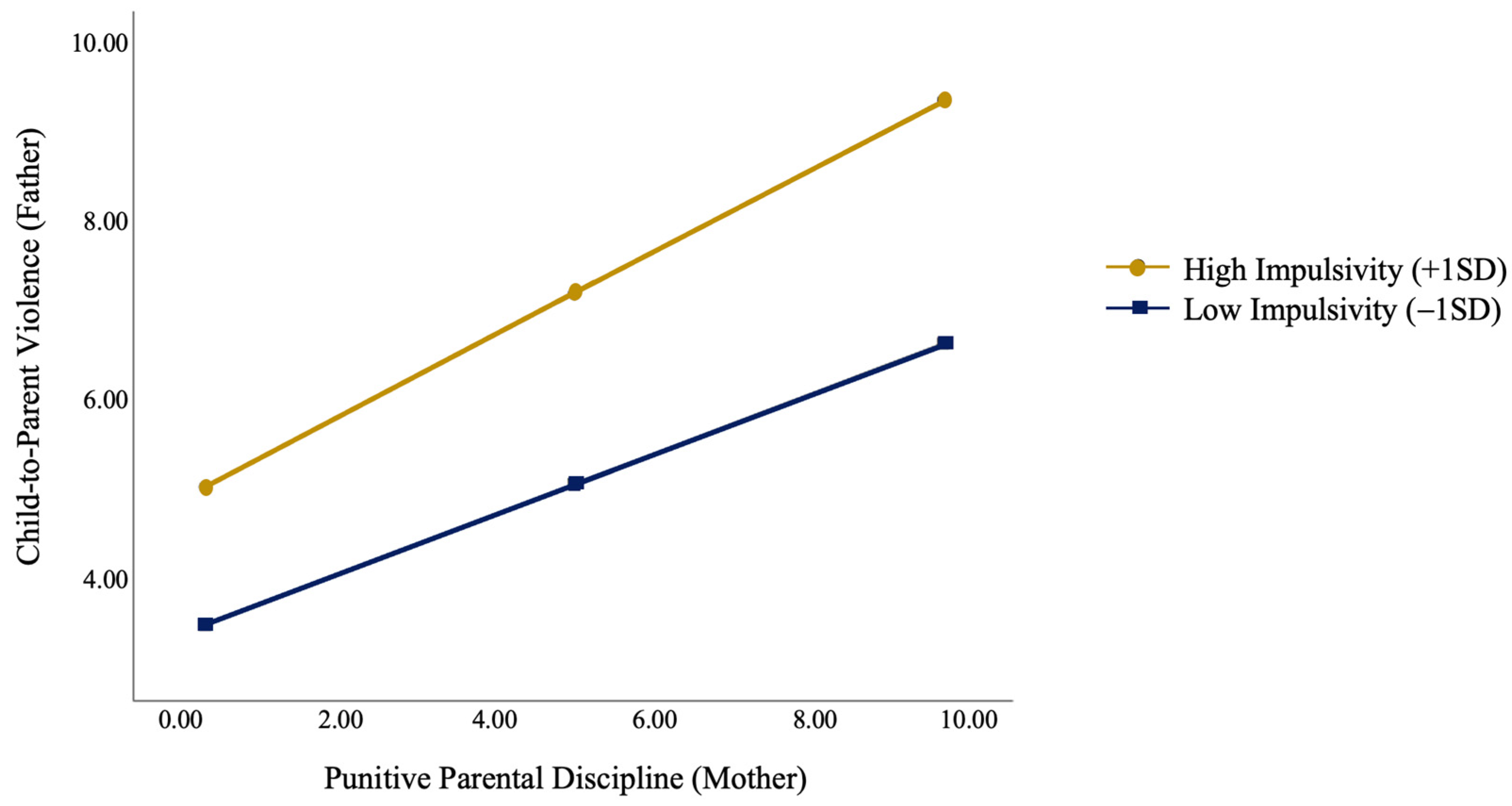
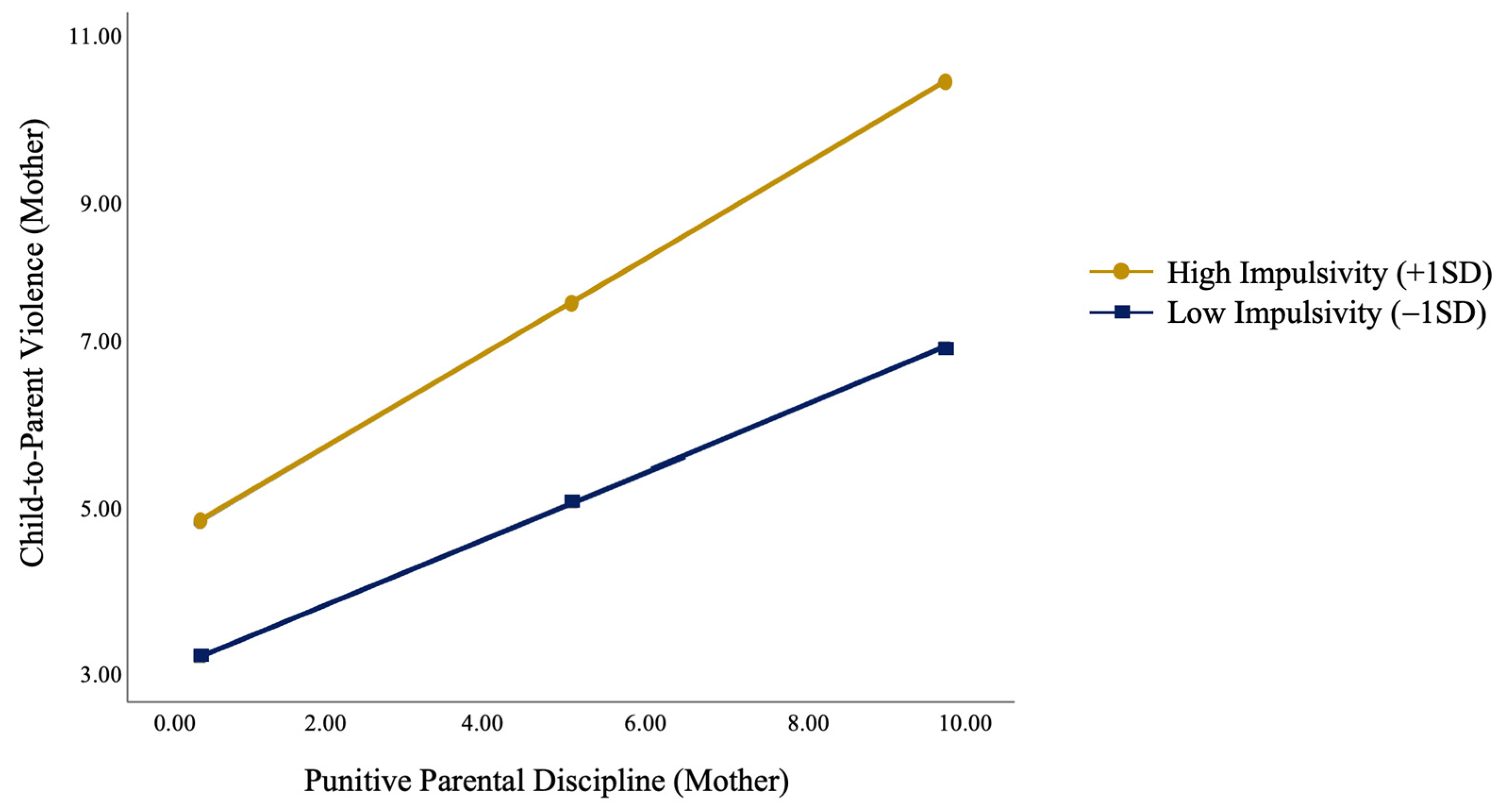
- To explore the moderating role of youth impulsivity in the relationship between paternal and maternal punitive discipline and CPV toward fathers and mothers. H3: Impulsivity will moderate this relationship, such that higher levels of impulsivity will strengthen the association between both paternal and maternal punitive discipline and CPV toward both fathers and mothers, with more intense effects within the same than between different parental figures (Gao et al., 2024).
2. Method
2.1. Participants
2.2. Instruments
2.3. Procedure
2.4. Data Analysis
3. Results
4. Discussion
Author Contributions
Funding
Institutional Review Board Statement
Informed Consent Statement
Data Availability Statement
Conflicts of Interest
References
- Alfons, A., Ateş, N. Y., & Groenen, P. J. F. (2022). A robust bootstrap test for mediation analysis. Organizational Research Methods, 25(3), 591–617. [Google Scholar] [CrossRef]
- Armstrong, G. S., Cain, C. M., Wylie, L. E., Muftić, L. R., & Bouffard, L. A. (2018). Risk factor profile of youth incarcerated for child to parent violence: A nationally representative sample. Journal of Criminal Justice, 58, 1–9. [Google Scholar] [CrossRef]
- Arnett, J. J. (2000). Emerging adulthood: A theory of development from the late teens through the twenties. American Psychologist, 55(5), 469–480. [Google Scholar] [CrossRef] [PubMed]
- Bandura, A. (1977). Social learning theory. General Learning Press. [Google Scholar]
- Bandura, A., & Walters, R. H. (1959). Adolescent aggression: A study of the influence of child-training practices and family interrelationships. Ronald. [Google Scholar]
- Barratt, E. S., & Patton, J. H. (1983). Impulsivity: Cognitive, behavioral, and psychophysiological correlates. In M. Zuckerman (Ed.), Biological bases of sensation seeking, impulsivity and anxiety (pp. 77–121). Erlbaum. [Google Scholar]
- Bautista-Aranda, N., Contreras, L., & Cano-Lozano, M. C. (2023). Exposure to violence during childhood and child-to-parent violence: The mediating role of moral disengagement. Healthcare, 11(10), 1402. [Google Scholar] [CrossRef] [PubMed]
- Beckmann, L. (2020). Exposure to family violence and adolescent aggression in multiple social contexts: Classroom social resources as moderators. Journal of Interpersonal Violence, 35, 471–484. [Google Scholar] [CrossRef]
- Beckmann, L., Bergmann, M. C., Fischer, F., & Mößle, T. (2021). Risk and protective factors of child-to-parent violence: A comparison between physical and verbal aggression. Journal of Interpersonal Violence, 36(3–4), NP1309–NP1334. [Google Scholar] [CrossRef]
- Burgos-Benavides, L., Cano-Lozano, M. C., Ramírez, A., Palacios, M. D., Sinchi, H. F., & Rodríguez-Díaz, F. J. (2025). Assessing child-to-parent violence: Measures of invariance and frequencies in Young. Family Relations, 74(4), 2167–2184. [Google Scholar] [CrossRef]
- Calvete, E., Gámez-Guadix, M., & García-Salvador, S. (2015). Social information processing in child-to-parent aggression: Bidirectional associations in a 1-year prospective study. Journal of Child and Family Studies, 24, 2204–2216. [Google Scholar] [CrossRef]
- Calvete, E., Gámez Guadix, M., & Orue, I. (2010). The Dimensions of Discipline Inventory (DDI)-Child and adolescent version: Analysis of the parental discipline from a gender perspective. Anales de Psicología, 26(2), 410–418. [Google Scholar]
- Calvete, E., Orue, I., & Sampedro, R. (2011). Violencia filio-parental en la adolescencia: Características ambientales y personales [Child to parent violence in adolescence: Environmental and individual characteristics]. Infancia y Aprendizaje: Journal for the Study of Education and Development, 34(3), 349–363. [Google Scholar] [CrossRef]
- Cano-Lozano, M. C., León, S. P., & Contreras, L. (2021a). Child-to-parent violence: Examining the frequency and reasons in Spanish Youth. Family Relations, 70(4), 1132–1149. [Google Scholar] [CrossRef]
- Cano-Lozano, M. C., León, S. P., & Contreras, L. (2022). Relationship between punitive discipline and child-to-parent violence: The moderating role of the context and implementation of parenting practices. International Journal of Environmental Research and Public Health, 19(1), 182. [Google Scholar] [CrossRef]
- Cano-Lozano, M. C., Navas-Martínez, M. J., & Contreras, L. (2021b). Child-to-parent violence during confinement due to COVID-19: Relationship with other forms of family violence and psychosocial stressors in Spanish youth. Sustainability, 13(20), 11431. [Google Scholar] [CrossRef]
- Cano-Lozano, M. C., Rodríguez-Díaz, F. J., León, S. P., & Contreras, L. (2020). Analyzing the relationship between child-to-parent violence and perceived parental warmth. Frontiers in Psychology, 11, 590097. [Google Scholar] [CrossRef] [PubMed]
- Chen, P., & Jacobson, K. C. (2013). Impulsivity moderates promotive environmental influences on adolescent delinquency: A comparison across family, school, and neighborhood contexts. Journal of Abnormal Child Psychology, 41(7), 1133–1143. [Google Scholar] [CrossRef][Green Version]
- Chen, Y., Zhu, J., Ye, Y., Huang, L., Yang, J., Chen, L., & Zhang, W. (2021). Parental rejection and adolescent problematic mobile phone use: Mediating and moderating roles of school engagement and impulsivity. Current Psychology, 40, 5166–5174. [Google Scholar] [CrossRef]
- Cohen, J. (1988). Statistical power analysis for the behavioral sciences (2nd ed.). Lawrence Erlbaum Associates. [Google Scholar]
- Cohen, J. (1992). A power primer. Psychological Bulletin, 112, 155–159. [Google Scholar] [CrossRef]
- Contreras, L., & Cano-Lozano, M. C. (2015). Exploring psychological features in adolescents who assault their parents: A different profile of young offenders? Journal of Forensic Psychiatry and Psychology, 26, 224–241. [Google Scholar] [CrossRef]
- Contreras, L., León, S. P., & Cano-Lozano, M. C. (2020). Socio-cognitive variables involved in the relationship between violence exposure at home and child-to-parent violence. Journal of Adolescence, 80(1), 19–28. [Google Scholar] [CrossRef] [PubMed]
- Contreras, L., Navas-Martínez, M. J., Rodríguez-Díaz, F. J., & Cano-Lozano, M. C. (2026). Prevalence, relationships and patterns of reactive versus proactive violence behavior in different forms of adolescent violence. Journal of Child and Family Studies, 35, 411–425. [Google Scholar] [CrossRef]
- Cook, R. D. (1977). Detection of influential observation in linear regression. Technometrics, 19(1), 15–18. [Google Scholar] [CrossRef]
- Cottrell, B. (2001). Parent abuse: The abuse of parent by their teenage children. Health Canada, Family Violence Prevention Unit. [Google Scholar]
- Cottrell, B., & Monk, P. (2004). Adolescent to parent abuse. A qualitative overview of common themes. Journal of Family Issues, 25(8), 1072–1095. [Google Scholar] [CrossRef]
- Del Hoyo-Bilbao, J., Gámez-Guadix, M., & Calvete, E. (2018). Corporal punishment by parents and child-to-parent aggression in Spanish adolescents. Anales de Psicología, 34(1), 108–116. [Google Scholar] [CrossRef]
- Del Hoyo-Bilbao, J., Orue, I., Gámez-Guadix, M., & Calvete, E. (2020). Multivariate models of child-to-mother violence and child-to-father violence among adolescents. European Journal of Psychology Applied to Legal Context, 12(1), 11–21. [Google Scholar] [CrossRef]
- Dunn, T. J., Baguley, T., & Brunsden, V. (2014). From alpha to omega: A practical solution to the pervasive problem of internal consistency estimation. British Journal of Psychology, 105(3), 399–412. [Google Scholar] [CrossRef]
- Eurostat. (2024). Young people housing conditions. European Commission. Available online: https://ec.europa.eu/eurostat (accessed on 1 March 2026).
- Flora, D. B. (2020). Your coefficient alpha is probably wrong, but which coefficient omega is right? A tutorial on using R to obtain better reliability estimates. Advances in Methods and Practices in Psychological Science, 3(4), 484–501. [Google Scholar] [CrossRef]
- Fossati, A., Ceglie, A. D., Acquarini, E., & Barratt, E. S. (2001). Psychometric properties of an Italian version of the Barratt Impulsiveness Scale-11 (BIS-11) in nonclinical subjects. Journal of Clinical Psychology, 57(6), 815–828. [Google Scholar] [CrossRef] [PubMed]
- Gallego, R., Novo, M., Fariña, F., & Arce, R. (2019). Child-to-parent violence and parent-to-child violence: A meta-analytic review. European Journal of Psychology Applied to Legal Context, 11(2), 51–59. [Google Scholar] [CrossRef]
- Gao, L., Kong, F., Zhang, Z., & Wang, X. (2024). Lifting the veil of silence: Parental harsh discipline predicts adolescent-to-parent violence. Journal of Family Violence, 41, 237–251. [Google Scholar] [CrossRef]
- García, F., & Gracia, E. (2010). ¿Qué estilo de socialización parental es el idóneo en España? Un estudio con niños y adolescentes de 10 a 14 años [What is the optimum parental socialisation style in Spain? A study with children and adolescents aged 10–14 years]. Infancia y Aprendizaje: Journal for the Study of Education and Development, 33(3), 365–384. [Google Scholar] [CrossRef]
- Gámez-Guadix, M., & Calvete, E. (2012). Violencia filio-parental y su asociación con la exposición a la violencia marital y la agresión de padres a hijos [Child-to-parent violence and its association with exposure to marital violence and parent-to-child violence]. Psicothema, 24(2), 277–283. [Google Scholar] [PubMed]
- Gámez-Guadix, M., Orue, I., Calvete, E., Carrobles, J. A., Muñoz-Rivas, M., & Almendros, C. (2010). Propiedades psicométricas de la versión española del Inventario de Dimensiones de Disciplina (DDI) en universitarios [Psychometric properties of the Spanish version of the Dimensions of Discipline Inventory (DDI) in university students]. Psicothema, 22(1), 151–156. [Google Scholar] [PubMed]
- Hair, J. F., Black, W. C., Babin, B. J., & Anderson, R. E. (2019). Multivariate data analysis (8th ed.). Cengage. [Google Scholar]
- Hardt, J., & Rutter, M. (2004). Validity of adult retrospective reports of adverse childhood experiences: Review of the evidence. Journal of Child Psychology and Psychiatry, 45(2), 260–273. [Google Scholar] [CrossRef]
- Hayes, A. (2017). Introduction to mediation, moderation, and conditional process analysis: A regression-based approach. The Guilford Press. [Google Scholar]
- Hernández, A., Martín, A. M., Hess-Medler, S., & García-García, J. (2020). What goes on in this house do not stay in this house: Family variables related to adolescent-to-parent offenses. Frontiers in Psychology, 11, 581761. [Google Scholar] [CrossRef]
- Howard, J., & Rottem, N. (2008). It all starts at home: Male adolescent violence to mothers. Inner South Community Health Service Inc.; Child Abuse Research Australia. [Google Scholar]
- Ibabe, I. (2020). A systematic review of youth-to-parent aggression: Conceptualization, typologies, and instruments. Frontiers in Psychology, 11, 577757. [Google Scholar] [CrossRef]
- Ibabe, I., Arnoso, A., & Elgorriaga, E. (2020). Child-to-parent violence as an intervening variable in the relationship between inter-parental violence exposure and dating violence. International Journal of Environmental Research and Public Health, 17(5), 1514. [Google Scholar] [CrossRef] [PubMed]
- Ibabe, I., Arnoso, A., & Elgorriaga, E. (2023). Early intervention program in youth-to-parent aggression: Clinically relevant long-term changes. Journal of Family Violence, 38, 1273–1285. [Google Scholar] [CrossRef]
- Ibabe, I., Jaureguizar, J., & Díaz, O. (2007). Violencia filio-parental: Conductas violentas de jóvenes hacia sus padres [Child-parent violence: Adolescents’ violent behaviors towards their parents]. Servicio Central de Publicaciones del Gobierno Vasco. [Google Scholar]
- Izaguirre, A., & Calvete, E. (2017). Exposure to family violence as a predictor of dating violence and child-to-parent aggression in Spanish adolescents. Youth and Society, 49(3), 393–412. [Google Scholar] [CrossRef]
- Jiménez-García, P., Contreras, L., Pérez, B., Cova, F., & Cano-Lozano, M. C. (2020). Adaptation and psychometric properties of the Child-to-Parent Violence (CPV-Q) in Young Chileans. Iberoamerican Journal of Psychology and Health, 56(3), 33–46. [Google Scholar] [CrossRef]
- Jiménez-García, P., Pérez, B., Contreras, L., & Cano-Lozano, M. C. (2022). Analysing child-to-parent violence in Chilean adolescents: Prevalence and reasons. Current Psychology, 41, 6314–6325. [Google Scholar] [CrossRef]
- Jiménez-Granado, A., Del Hoyo-Bilbao, J., & Fernández-González, L. (2023). Interaction of parental discipline strategies and adolescents’ personality traits in the prediction of child-to-parent violence. European Journal of Psychology Applied to Legal Context, 15(1), 43–52. [Google Scholar] [CrossRef]
- Johnson, B., Richert, T., & Svensson, B. (2022). Physical violence and property damage towards parents, committed by adult children with drug problems. Journal of Family Violence, 37(1), 165–180. [Google Scholar] [CrossRef]
- Junco-Guerrero, M., Fernández-Baena, F. J., & Cantón-Cortés, D. (2025). Risk factors for child-to-parent violence: A scoping review. Journal of Family Violence, 40, 139–164. [Google Scholar] [CrossRef]
- Junco-Guerrero, M., Ruiz-Fernández, A., & Cantón-Cortés, D. (2021). Family environment and child-to-parent violence: The role of emotional insecurity. Journal of Interpersonal Violence, 37, NP13581–NP13602. [Google Scholar] [CrossRef]
- Kline, R. B. (2015). Principles and practice of structural equation modeling (4th ed.). Guilford Press. [Google Scholar]
- Laible, D. J., & Carlo, G. (2004). The differential relations of maternal and paternal support and control to adolescent social competence, self-worth, and sympathy. Journal of Adolescent Research, 19(6), 759–782. [Google Scholar] [CrossRef]
- Leve, L. D., Kim, H. K., & Pears, K. C. (2005). Childhood temperament and family environment as predictors of internalizing and externalizing problems from ages 5 to 7. Journal of Abnormal Child Psychology, 33(5), 505–520. [Google Scholar] [CrossRef] [PubMed]
- Loinaz, I., & Ma de Sousa, A. (2020). Assessing risk and protective factors in clinical and judicial child-to-parent violence cases. European Journal of Psychology Applied to Legal Context, 12(1), 43–51. [Google Scholar] [CrossRef]
- MacKenzie, M. J., Nicklas, E., Waldfogel, J., & Brooks-Gunn, J. (2012). Corporal punishment and child behavioural and cognitive outcomes through 5 years of age: Evidence from a contemporary urban birth cohort study. Infant and Child Development, 21, 3–33. [Google Scholar] [CrossRef] [PubMed]
- Margolin, G., & Baucom, B. R. (2014). Adolescents’ aggression to parents: Longitudinal links with parents’ physical aggression. Journal of Adolescent Health, 55(5), 645–651. [Google Scholar] [CrossRef]
- Martín, A. M., & Cortina, H. (2023). Profiles of adolescents who abuse their parents: A gender-based analysis. Anuario de Psicología Jurídica, 33(1), 135–145. [Google Scholar] [CrossRef]
- Molla-Esparza, C., & Aroca-Montolío, C. (2018). Menores que maltratan a sus progenitores: Definición integral y su ciclo de violencia 670 [Minnors who abuse their parents: Comprehensive definition and their cycle of violence]. Anuario de Psicología Jurídica, 28(1), 15–21. [Google Scholar] [CrossRef]
- Monroe, S. M., & Simons, A. D. (1991). Diathesis-stress theories in the context of life stress research: Implications for the depressive disorders. Psychological Bulletin, 110(3), 406–425. [Google Scholar] [CrossRef]
- Navas-Martínez, M. J., Burrai, J., Mari, E., Burgos-Benavides, L., Giannini, A. M., & Cano-Lozano, M. C. (2025). Italian validation of the child-to-parent violence questionnaire: Frequency and reasons for violence among young adults. Journal of Family Violence. advance online publication. [Google Scholar] [CrossRef]
- Navas-Martínez, M. J., & Cano-Lozano, M. C. (2023). Risk factors in specialists and generalists of child-to-parent violence: Gender differences and predictors of reactive and proactive reasons. Behavioral Sciences, 13(2), 85. [Google Scholar] [CrossRef]
- Oliva, A., Parra, Á., Sánchez-Queija, I., & López, F. (2007). Estilos educativos materno y paterno: Evaluación y relación con el ajuste adolescente [Maternal and paternal parenting styles: Assessment and relationship with adolescent adjustment]. Anales de Psicología, 23(1), 49–56. [Google Scholar]
- Oquendo, M. A., Baca-García, E., Graver, R., Morales, M., Montalvan, V., & Mann, J. (2001). Spanish adaptation of the Barratt Impulsiveness Scale (BIS-11). European Journal of Psychiatry, 15(3), 147–155. [Google Scholar]
- Pagani, L., Tremblay, R. E., Nagin, D., Zoccolillo, M., Vitaro, F., & McDuff, P. (2009). Risk factor models for adolescent verbal and physical aggression toward fathers. Journal of Family Violence, 24, 173–182. [Google Scholar] [CrossRef]
- Patton, J. H., Stanford, M. S., & Barratt, E. S. (1995). Factor structure of the Barratt impulsiveness scale. Journal of Clinical Psychology, 51(6), 768–774. [Google Scholar] [CrossRef]
- Pereira, R., Loinaz, I., Del Hoyo-Bilbao, J., Arróspide, J., Bertino, L., Calvo, A., Montes, Y., & Gutiérrez, M. (2017). Propuesta de definición de violencia filio-parental: Consenso de la Sociedad Española para el Estudio de la Violencia filio-parental (SEVIFIP) [Proposal for a definition of child-to-parent violence: Consensus of the Spanish Society for the Study of Child-to-Parent Violence (SEVIFIP)]. Papeles del Psicólogo, 38(3), 216–223. [Google Scholar] [CrossRef]
- Pinquart, M. (2017). Associations of parenting dimensions and styles with externalizing problems of children and adolescents: An updated meta-analysis. Developmental Psychology, 53(5), 873–932. [Google Scholar] [CrossRef] [PubMed]
- Podsakoff, P. M., MacKenzie, S. B., Lee, J.-Y., & Podsakoff, N. P. (2003). Common method biases in behavioral research: A critical review of the literature and recommended remedies. Journal of Applied Psychology, 88(5), 879–903. [Google Scholar] [CrossRef] [PubMed]
- Preacher, K. J., & Hayes, A. F. (2008). Asymptotic and resampling strategies for assessing and comparing indirect effects in multiple mediator models. Behavior Research Methods, 40(3), 879–891. [Google Scholar] [CrossRef] [PubMed]
- Rico, E., Rosado, J., & Cantón-Cortés, D. (2017). Impulsiveness and child-to-parent violence: The role of aggressor’s sex. The Spanish Journal of Psychology, 20, e15. [Google Scholar] [CrossRef] [PubMed]
- Rogers, M. M., & Ashworth, C. (2024). Child-to-parent violence and abuse: A scoping review. Trauma, Violence, & Abuse, 25(4), 3285–3298. [Google Scholar] [CrossRef]
- Schwarz, N. (1999). Self-reports: How the questions shape the answers. American Psychologist, 54(2), 93–105. [Google Scholar] [CrossRef]
- Simmons, M., McEwan, T., & Purcell, R. (2020). A social-cognitive investigation of young adults who abuse their parents. Journal of Interpersonal Violence, 37(1–2), NP327–NP349. [Google Scholar] [CrossRef]
- Stanford, M. S., Mathias, C. W., Dougherty, D. M., Lake, S. L., Anderson, N. E., & Patton, J. H. (2009). Fifty years of the barratt impulsiveness scale: An update and review. Personality and Individual Differences, 47, 385–395. [Google Scholar] [CrossRef]
- Straus, M. A., & Fauchier, A. (2007). Manual for the dimensions of discipline inventory (DDI). Family Research Laboratory, University of New Hampshire. [Google Scholar]
- Ulman, A., & Straus, M. A. (2003). Violence by children against mothers in relation to violence between parents and corporal punishment by parents. Journal of Comparative Family Studies, 34(1), 41–60. [Google Scholar] [CrossRef]
- Zhu, J., Yu, C., Zhang, W., Bao, Z., Jiang, Y., Chen, Y., & Zhen, S. (2016). Peer victimization, deviant peer affiliation, and impulsivity: Predicting adolescent problem behaviors. Child Abuse & Neglect, 58, 39–50. [Google Scholar] [CrossRef]



| 1 | 2 | 3 | 4 | 5 | |
|---|---|---|---|---|---|
| 1. Child-to-Parent Violence (Father) | - | ||||
| 2. Child-to-Parent Violence (Mother) | 0.832 | - | |||
| 3. Parental Punitive Discipline (Father) | 0.480 | 0.430 | - | ||
| 4. Parental Punitive Discipline (Mother) | 0.403 | 0.505 | 0.712 | - | |
| 5. Impulsivity | 0.236 | 0.315 | 0.229 | 0.274 | - |
| Child-to-Parent Violence (Father) | Child-to-Parent Violence (Mother) | ||||||
|---|---|---|---|---|---|---|---|
| Model | B | t | 95% CI | B | t | 95% CI | |
| 1 | Direct and interaction effects | ||||||
| Punitive Discipline (Father) | 0.600 | 3.539 *** | [0.267, 0.932] | 0.204 | 1.215 | [−0.126, 0.534] | |
| Impulsivity | 0.149 | 4.214 *** | [0.080, 0.219] | 0.186 | 5.292 *** | [0.117, 0.255] | |
| Punitive Discipline (Father) * Impulsivity | −0.002 | −0.417 | [−0.010, 0.007] | 0.006 | 1.375 | [−0.002, 0.014] | |
| Sex | 0.208 | 0.609 | [−0.463, 0.880] | 0.377 | 1.111 | [−0.289, 1.043] | |
| Age | −0.149 | −1.695 | [−0.322, 0.024] | −0.194 | −2.228 * | [−0.365, −0.023] | |
| 2 | Direct and interaction effects | ||||||
| Punitive Discipline (Mother) | 0.067 | 0.361 | [−0.296, 0.429] | 0.035 | 0.209 | [−0.297, 0.368] | |
| Impulsivity | 0.112 | 2.985 ** | [0.038, 0.186] | 0.124 | 3.586 *** | [0.056, 0.191] | |
| Punitive Discipline (Mother) * Impulsivity | 0.009 | 1.991 * | [0.001, 0.019] | 0.014 | 3.104 ** | [0.005, 0.022] | |
| Sex | −0.030 | −0.084 | [−0.727, 0.667] | 0.216 | 0.663 | [−0.423, 0.855] | |
| Age | −0.097 | −1.063 | [−0.277, 0.082] | −0.141 | −1.688 | [−0.306, 0.023] | |
| Conditional effects | |||||||
| −1SD below the mean of Impulsivity (28.8) | 0.340 | 5.824 *** | [0.226, 0.455] | 0.426 | 7.961 *** | [0.321, 0.532] | |
| +1SD above the mean of Impulsivity (42.3) | 0.468 | 10,501 *** | [0.380, 0.555] | 0.608 | 14.904 *** | [0.528, 0.689] | |
Disclaimer/Publisher’s Note: The statements, opinions and data contained in all publications are solely those of the individual author(s) and contributor(s) and not of MDPI and/or the editor(s). MDPI and/or the editor(s) disclaim responsibility for any injury to people or property resulting from any ideas, methods, instructions or products referred to in the content. |
© 2026 by the authors. Licensee MDPI, Basel, Switzerland. This article is an open access article distributed under the terms and conditions of the Creative Commons Attribution (CC BY) license.
Share and Cite
Cano-Lozano, M.C.; Contreras, L.; Navas-Martínez, M.J. Youth Impulsivity as a Moderator in the Relationship Between Parental Punitive Discipline and Child-to-Parent Violence. Behav. Sci. 2026, 16, 936. https://doi.org/10.3390/bs16060936
Cano-Lozano MC, Contreras L, Navas-Martínez MJ. Youth Impulsivity as a Moderator in the Relationship Between Parental Punitive Discipline and Child-to-Parent Violence. Behavioral Sciences. 2026; 16(6):936. https://doi.org/10.3390/bs16060936
Chicago/Turabian StyleCano-Lozano, M. Carmen, Lourdes Contreras, and María J. Navas-Martínez. 2026. "Youth Impulsivity as a Moderator in the Relationship Between Parental Punitive Discipline and Child-to-Parent Violence" Behavioral Sciences 16, no. 6: 936. https://doi.org/10.3390/bs16060936
APA StyleCano-Lozano, M. C., Contreras, L., & Navas-Martínez, M. J. (2026). Youth Impulsivity as a Moderator in the Relationship Between Parental Punitive Discipline and Child-to-Parent Violence. Behavioral Sciences, 16(6), 936. https://doi.org/10.3390/bs16060936