Research on the Purchase Behavior of Owner–Pet Matching Outfits Based on the Extended Theory of Planned Behavior



Abstract
1. Introduction
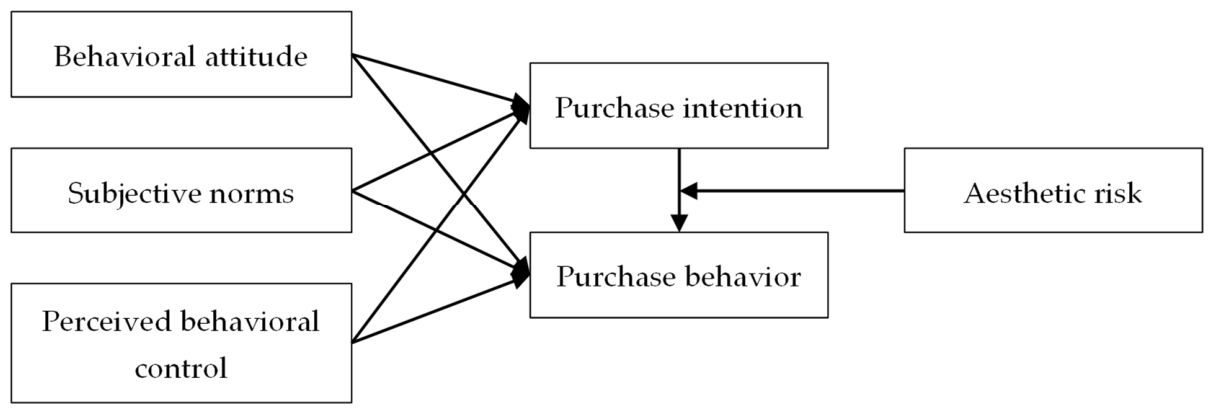
2. Theories and Hypotheses
2.1. Theory of Planned Behavior
2.2. Behavioral Attitude
2.3. Subjective Norms
2.4. Perceived Behavioral Control
2.5. Aesthetic Risk
3. Methodology
3.1. Samples and Procedures
3.2. Measures
4. Results
4.1. Validity Issues
4.2. Correlation Analysis
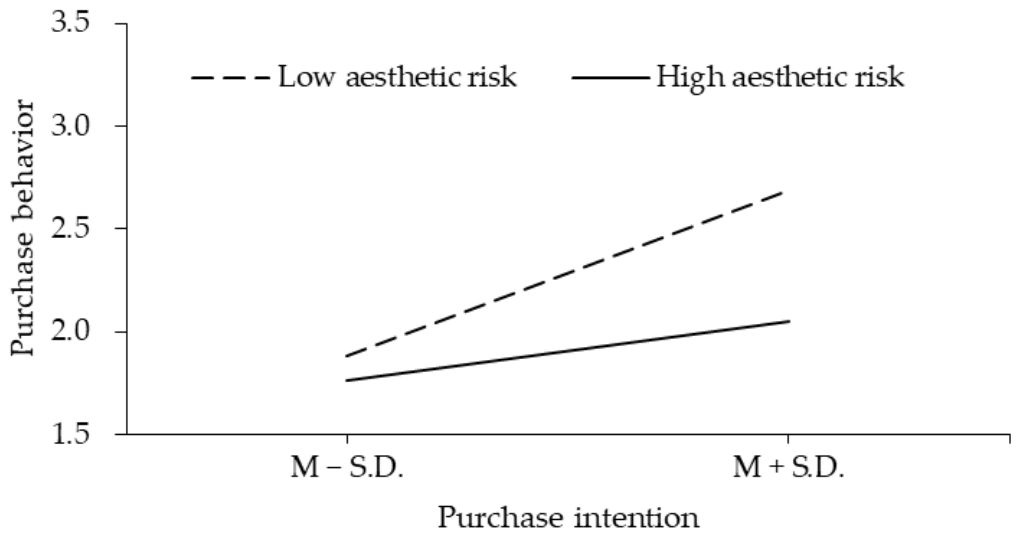
4.3. Hypotheses Testing
5. Discussion
5.1. Conclusions and Theoretical Contributions
5.2. Practical Implications
5.3. Limitations and Future Research
Author Contributions
Funding
Institutional Review Board Statement
Informed Consent Statement
Data Availability Statement
Acknowledgments
Conflicts of Interest
References
- Ai, C., Akaichi, F., Glenk, K., Revoredo-Giha, C., & Costa-Font, M. (2025). What drives pet food choices? A systematic literature review. Animals, 15(22), 3235. [Google Scholar] [CrossRef] [PubMed]
- Ajzen, I. (1985). From intentions to actions: A theory of planned behavior. In Action control: From cognition to behavior (pp. 11–39). Springer. [Google Scholar] [CrossRef]
- Ajzen, I. (1991). The theory of planned behavior. Organizational Behavior and Human Decision Processes, 50(2), 179–211. [Google Scholar] [CrossRef]
- Ajzen, I. (2020). The theory of planned behavior: Frequently asked questions. Human Behavior and Emerging Technologies, 2(4), 314–324. [Google Scholar] [CrossRef]
- Albloushy, H., & Hiller Connell, K. Y. (2019). Purchasing environmentally sustainable apparel: The attitudes and intentions of female Kuwaiti consumers. International Journal of Consumer Studies, 43(4), 390–401. [Google Scholar] [CrossRef]
- Apaolaza, V., Hartmann, P., Paredes, M. R., Trujillo, A., & D’Souza, C. (2022). What motivates consumers to buy fashion pet clothing? The role of attachment, pet anthropomorphism, and self-expansion. Journal of Business Research, 141, 367–379. [Google Scholar] [CrossRef]
- Batool, N., Wani, M. D., Shah, S. A., & Dada, Z. A. (2024). Theory of planned behavior and value-belief norm theory as antecedents of pro-environmental behaviour: Evidence from the local community. Journal of Human Behavior in the Social Environment, 34(5), 693–709. [Google Scholar] [CrossRef]
- Becker, M., Volk, H., & Kunzmann, P. (2022). Is pet health insurance able to improve veterinary care? Why pet health insurance for dogs and cats has limits: An ethical consideration on pet health insurance. Animals, 12(13), 1728. [Google Scholar] [CrossRef] [PubMed]
- Carfora, V., Cavallo, C., Caso, D., Del Giudice, T., De Devitiis, B., Viscecchia, R., Nardone, G., & Cicia, G. (2019). Explaining consumer purchase behavior for organic milk: Including trust and green self-identity within the theory of planned behavior. Food Quality and Preference, 76, 1–9. [Google Scholar] [CrossRef]
- Chung, M. H. (2023). A study on consumer consciousness and purchasing tendency on pet fashion products (dog clothes). Journal of the Korea Fashion and Costume Design Association, 25(3), 31–39. [Google Scholar]
- Conradie, P., Van Hove, S., Pelka, S., Karaliopoulos, M., Anagnostopoulos, F., Brugger, H., & Ponnet, K. (2023). Why do people turn down the heat? Applying behavioural theories to assess reductions in space heating and energy consumption in Europe. Energy Research & Social Science, 100, 103059. [Google Scholar] [CrossRef]
- Cuong, D. T. (2024). Examining how factors consumers’ buying intention of secondhand clothes via theory of planned behavior and stimulus organism response model. Journal of Open Innovation: Technology, Market, and Complexity, 10(4), 100393. [Google Scholar] [CrossRef]
- Diddi, S., Yan, R. N., Bloodhart, B., Bajtelsmit, V., & McShane, K. (2019). Exploring young adult consumers’ sustainable clothing consumption intention-behavior gap: A Behavioral Reasoning Theory perspective. Sustainable Production and Consumption, 18, 200–209. [Google Scholar] [CrossRef]
- Dogbey, G., Dugah, A., Abbiw, R. K., Agbolosu, A., Asare-Dompreh, K., Odoom, T., Okine, A., Amakye-Anim, J., Otsyina, H. R., & Enyetornye, B. (2024). Impact of COVID-19 on pets and pet owners: A survey conducted in selected veterinary clinics in Accra, Ghana. Heliyon, 10(17), e37328. [Google Scholar] [CrossRef] [PubMed]
- D’Souza, C., Apaolaza, V., Hartmann, P., & Nguyen, N. (2023). The consequence of possessions: Self-identity, extended self, psychological ownership and probabilities of purchase for pet’s fashion clothing. Journal of Retailing and Consumer Services, 75, 103501. [Google Scholar] [CrossRef]
- Etuk, A., Anyadighibe, J. A., James, E. E., & Ukpe, M. U. (2022). Sociological factors and consumer buying behaviour towards fashion clothing. International Journal of Applied Research in Social Sciences, 4(2), 21–34. [Google Scholar] [CrossRef]
- Fantechi, T., Califano, G., Caracciolo, F., & Contini, C. (2024). Puppy power: How neophobia, attitude towards sustainability, and animal empathy affect the demand for insect-based pet food. Food Research International, 177, 113879. [Google Scholar] [CrossRef] [PubMed]
- Feng, X., Tang, H., Fan, W., Ren, M., & Zhong, Y. (2025). The impact of subjective social class on green consumption: The moderating role of status symbols. Current Psychology, 44(2), 935–944. [Google Scholar] [CrossRef]
- Fishbein, M., & Ajzen, I. (1975). Belief, attitude, intention, and behavior: An introduction to theory and research. Addison-Wesley. [Google Scholar]
- Frommeyer, B., Wagner, E., Hossiep, C. R., & Schewe, G. (2022). The utility of intention as a proxy for sustainable buying behavior—A necessary condition analysis. Journal of Business Research, 143, 201–213. [Google Scholar] [CrossRef]
- Gao, R. (2025). The multidimensional evolution of the global pet economy: Driving forces, industrial structure, and sustainable development challenges. Highlights in Business, Economics and Management, 65, 93–99. [Google Scholar] [CrossRef]
- Genç, B., & İnce, A. (2025). The commodification of companionship: Pets in the age of consumerism. In R. Z. Abbas, T. Akhtar, & M. Jamil (Eds.), Pathways of infection: Zoonoses and environmental disease transmission. Unique Scientific Publishers. [Google Scholar] [CrossRef]
- Gruber, R., Häfner, M., & Kachel, S. (2024). Dressing up social psychology: Empirically investigating the psychological functions of clothing using the example of symbolic protection. British Journal of Social Psychology, 63(2), 1003–1035. [Google Scholar] [CrossRef] [PubMed]
- Hu, X., & Hu, J. (2025). Exploring the mechanisms of different social norms influencing green consumption attitude and behavior. Asia Pacific Journal of Marketing and Logistics, 37(8), 2228–2244. [Google Scholar] [CrossRef]
- Hwang, C., & Kim, T. H. (2020). Religiosity and modesty: How veiled Muslim women in the United States define modest activewear. International Journal of Fashion Design, Technology and Education, 13(2), 131–139. [Google Scholar] [CrossRef]
- Kaur, J., & Bhardwaj, N. (2021). Their control will make or break the sustainable clothing deal-a study of the moderating impact of actual behavioural control on the purchase intention-behaviour gap for sustainable clothing in India. Australasian Accounting, Business and Finance Journal, 15(5), 59. [Google Scholar] [CrossRef]
- Kim, I., Jung, H. J., & Lee, Y. (2021). Consumers’ value and risk perceptions of circular fashion: Comparison between secondhand, upcycled, and recycled clothing. Sustainability, 13(3), 1208. [Google Scholar] [CrossRef]
- Kretzler, B., König, H. H., & Hajek, A. (2022). Pet ownership, loneliness, and social isolation: A systematic review. Social Psychiatry and Psychiatric Epidemiology, 57(10), 1935–1957. [Google Scholar] [CrossRef] [PubMed]
- Kumar, B., Manrai, A. K., & Manrai, L. A. (2017). Purchasing behaviour for environmentally sustainable products: A conceptual framework and empirical study. Journal of Retailing and Consumer Services, 34, 1–9. [Google Scholar] [CrossRef]
- Kumar, N., Garg, P., & Singh, S. (2022). Pro-environmental purchase intention towards eco-friendly apparel: Augmenting the theory of planned behavior with perceived consumer effectiveness and environmental concern. Journal of Global Fashion Marketing, 13(2), 134–150. [Google Scholar] [CrossRef]
- Laheri, V. K., Lim, W. M., Arya, P. K., & Kumar, S. (2024). A multidimensional lens of environmental consciousness: Towards an environmentally conscious theory of planned behavior. Journal of Consumer Marketing, 41(3), 281–297. [Google Scholar] [CrossRef]
- Lao, K. (2014). Research on mechanism of consumer innovativeness influencing green consumption behavior. Nankai Business Review International, 5(2), 211–224. [Google Scholar] [CrossRef]
- Liang, H., Ouyang, Z., Liu, J., & Zhu, G. (2025). The development trend analysis of pet industry. In 2025 7th International conference on software engineering and computer science (CSECS) (pp. 1–6). IEEE. [Google Scholar] [CrossRef]
- Liu, Y., Cai, L., Ma, F., & Wang, X. (2023). Revenge buying after the lockdown: Based on the SOR framework and TPB model. Journal of Retailing and Consumer Services, 72, 103263. [Google Scholar] [CrossRef]
- Liu, Y., Chang, X., Yang, S., Li, Z., & Wu, Y. (2024). “Pets make you spend more!” Impact of pet ownership on consumer purchase decisions. Journal of Business Research, 183, 114838. [Google Scholar] [CrossRef]
- Maidin, N. A. S., Nazri, M. A., Anim, N. A. H. M., & Omar, N. A. (2025). Exploring the behavioural intention of pet owners towards pet accessories: An extended theory of planned behaviour. Selangor Business Review, 10, 100–116. [Google Scholar]
- McDonald, S. E., Doherty, C., Sweeney, J., Kisiel, L., Matijczak, A., Niestat, L., & Gupta, M. (2022). Barriers to and facilitators of pet grooming among clients served by a subsidized grooming service program. Frontiers in Veterinary Science, 9, 1021707. [Google Scholar] [CrossRef] [PubMed]
- Menor-Campos, D. J. (2024). Ethical concerns about fashionable dog breeding. Animals, 14(5), 756. [Google Scholar] [CrossRef] [PubMed]
- Muldoon, J. C., & Williams, J. M. (2024). When having a pet becomes a luxury you can no longer afford. Anthrozoös, 37(5), 881–904. [Google Scholar] [CrossRef]
- Qi, X., & Ploeger, A. (2019). Explaining consumers’ intentions towards purchasing green food in Qingdao, China: The amendment and extension of the theory of planned behavior. Appetite, 133, 414–422. [Google Scholar] [CrossRef] [PubMed]
- Rahman, M. S., Bag, S., Hossain, M. A., Fattah, F. A. M. A., Gani, M. O., & Rana, N. P. (2023). The new wave of AI-powered luxury brands online shopping experience: The role of digital multisensory cues and customers’ engagement. Journal of Retailing and Consumer Services, 72, 103273. [Google Scholar] [CrossRef]
- Rausch, T. M., & Kopplin, C. S. (2021). Bridge the gap: Consumers’ purchase intention and behavior regarding sustainable clothing. Journal of Cleaner Production, 278, 123882. [Google Scholar] [CrossRef]
- Si, H., Duan, X., Zhang, W., Su, Y., & Wu, G. (2022). Are you a water saver? Discovering people’s water-saving intention by extending the theory of planned behavior. Journal of Environmental Management, 311, 114848. [Google Scholar] [CrossRef] [PubMed]
- Vänskä, A. (2016). ‘Cause I wuv you!’ Pet dog fashion and emotional consumption. Ephemera: Theory & Politics in Organization, 16(4), 75–97. [Google Scholar]
- Wang, C., Wang, H., Li, Y., Dai, J., Gu, X., & Yu, T. (2025). Factors influencing university students’ behavioral intention to use generative artificial intelligence: Integrating the theory of planned behavior and AI literacy. International Journal of Human-Computer Interaction, 41(11), 6649–6671. [Google Scholar] [CrossRef]
- Wang, Y., Zhao, J., & Pan, J. (2024). The investigation of green purchasing behavior in China: A conceptual model based on the theory of planned behavior and self-determination theory. Journal of Retailing and Consumer Services, 77, 103667. [Google Scholar] [CrossRef]
- Wei, W., Prasetyo, Y. T., Belmonte, Z. J. A., Cahigas, M. M. L., Nadlifatin, R., & Gumasing, M. J. J. (2025). Applying the technology acceptance model–theory of planned behavior (TAM-TPB) model to study the acceptance of building information modeling (BIM) in green building in China. Acta Psychologica, 254, 104790. [Google Scholar] [CrossRef] [PubMed]
- Xia, L., Zhong, W., & Wang, J. (2023). To dress up or not: Political identity and dog owners’ purchase of dog apparels. Psychology & Marketing, 40(10), 2118–2131. [Google Scholar] [CrossRef]
- Yadav, R., & Pathak, G. S. (2016). Young consumers’ intention towards buying green products in a developing nation: Extending the theory of planned behavior. Journal of Cleaner Production, 135, 732–739. [Google Scholar] [CrossRef]
- Ye, J., & Kuang, C. (2026). Determinants of Chinese individuals’ clothing-recycling intentions: A dual-logic analysis integrating TPB, NAM, and perceived convenience (PLS-SEM and NCA). Humanities and Social Sciences Communications, 13, 369. [Google Scholar] [CrossRef]
- Zahid, N. M., Khan, J., & Tao, M. (2023). Exploring mindful consumption, ego involvement, and social norms influencing second-hand clothing purchase. Current Psychology, 42(16), 13960–13974. [Google Scholar] [CrossRef]
- Zhang, L., Wei, W., Rathjens, B., & Zheng, Y. (2023). Pet influencers on social media: The joint effect of message appeal and narrator. International Journal of Hospitality Management, 110, 103453. [Google Scholar] [CrossRef]



| Variables | Items | λ | CR | AVE |
|---|---|---|---|---|
| Behavioral Attitude | BA1 | 0.849 | 0.839 | 0.575 |
| BA2 | 0.897 | |||
| BA3 | 0.717 | |||
| BA4 | 0.509 | |||
| Subjective Norms | SN1 | 0.781 | 0.732 | 0.482 |
| SN2 | 0.731 | |||
| SN3 | 0.548 | |||
| Perceived Behavioral Control | BC1 | 0.849 | 0.896 | 0.683 |
| BC2 | 0.842 | |||
| BC3 | 0.827 | |||
| BC4 | 0.787 | |||
| Aesthetic Risk | AR1 | 0.773 | 0.892 | 0.674 |
| AR2 | 0.899 | |||
| AR3 | 0.836 | |||
| AR4 | 0.770 | |||
| Purchase Intention | PI1 | 0.847 | 0.898 | 0.689 |
| PI2 | 0.821 | |||
| PI3 | 0.855 | |||
| PI4 | 0.795 | |||
| Purchase Behavior | PB1 | 0.722 | 0.877 | 0.707 |
| PB2 | 0.935 | |||
| PB3 | 0.851 |
| Variables | 1 | 2 | 3 | 4 | 5 | 6 |
|---|---|---|---|---|---|---|
| 1. Behavioral Attitude | (0.758) | |||||
| 2. Subjective Norms | 0.529 ** | (0.694) | ||||
| 3. Perceived Behavioral Control | 0.117 | 0.0367 ** | (0.826) | |||
| 4. Aesthetic Risk | −0.137 * | −0.0161 * | −0.294 ** | (0.821) | ||
| 5. Purchase Intention | 0.559 ** | 0.486 ** | 0.084 | −0.061 | (0.830) | |
| 6. Purchase Behavior | 0.299 ** | 0.459 ** | 0.334 ** | −0.317 ** | 0.399 ** | (0.841) |
| Variables | Purchase Intention | Purchase Behavior | ||
|---|---|---|---|---|
| Model 1 | Model 2 | Model 3 | Model 4 | |
| Control variables | ||||
| Gender | −0.015 | 0.048 | 0.052 | 0.060 |
| Age | −0.046 | 0.007 | 0.020 | 0.005 |
| Education | −0.026 | 0.048 | 0.055 | 0.083 |
| Monthly income | −0.029 | −0.093 | −0.085 | −0.054 |
| Relationship status | −0.018 | −0.017 | −0.012 | −0.030 |
| Fertility status | −0.054 | −0.011 | 0.004 | −0.009 |
| Pets | 0.006 | −0.018 | −0.020 | −0.029 |
| Independent variable | ||||
| Behavioral attitude | 0.411 *** | 0.108 | −0.002 | −0.018 |
| Subjective norms | 0.296 *** | 0.323 *** | 0.243 ** | 0.253 ** |
| Perceived behavioral control | −0.064 | 0.185 ** | 0.203 ** | 0.137 * |
| Mediating variable | ||||
| Purchase intention | 0.268 *** | 0.289 *** | ||
| Moderating variable | ||||
| Aesthetic risk | −0.201 ** | |||
| Interaction term | ||||
| Purchase intention × Aesthetic risk | −0.136 * | |||
| R2 | 0.378 | 0.261 | 0.306 | 0.367 |
| F(df1,df2) | 12.836(10,211) *** | 7.451(10,211) *** | 8.399(11,210) *** | 9.286(13,208) *** |
| Path | a | Sa | b | Sb | a × b | z Value | p Value |
|---|---|---|---|---|---|---|---|
| BA→PI→PB | 0.411 | 0.065 | 0.268 | 0.094 | 0.110 | 2.599 | p < 0.01 |
| SN→PI→PB | 0.296 | 0.057 | 0.268 | 0.094 | 0.079 | 2.499 | p < 0.05 |
| BC→PI→PB | −0.064 | 0.041 | 0.268 | 0.094 | −0.017 | −1.369 | p > 0.05 |
Disclaimer/Publisher’s Note: The statements, opinions and data contained in all publications are solely those of the individual author(s) and contributor(s) and not of MDPI and/or the editor(s). MDPI and/or the editor(s) disclaim responsibility for any injury to people or property resulting from any ideas, methods, instructions or products referred to in the content. |
© 2026 by the authors. Licensee MDPI, Basel, Switzerland. This article is an open access article distributed under the terms and conditions of the Creative Commons Attribution (CC BY) license.
Share and Cite
Chen, S.; Qian, D.; Xiao, Z. Research on the Purchase Behavior of Owner–Pet Matching Outfits Based on the Extended Theory of Planned Behavior. Behav. Sci. 2026, 16, 1021. https://doi.org/10.3390/bs16061021
Chen S, Qian D, Xiao Z. Research on the Purchase Behavior of Owner–Pet Matching Outfits Based on the Extended Theory of Planned Behavior. Behavioral Sciences. 2026; 16(6):1021. https://doi.org/10.3390/bs16061021
Chicago/Turabian StyleChen, Sisi, Diqing Qian, and Zengrui Xiao. 2026. "Research on the Purchase Behavior of Owner–Pet Matching Outfits Based on the Extended Theory of Planned Behavior" Behavioral Sciences 16, no. 6: 1021. https://doi.org/10.3390/bs16061021
APA StyleChen, S., Qian, D., & Xiao, Z. (2026). Research on the Purchase Behavior of Owner–Pet Matching Outfits Based on the Extended Theory of Planned Behavior. Behavioral Sciences, 16(6), 1021. https://doi.org/10.3390/bs16061021