Preventing Sexual Violence Against Adolescent Girls: Psychometric Validation of the EDR-ESIA Screening Instrument for Early Detection of Exploitation Risk


Abstract
1. Introduction
2. Methods
2.1. Participants
2.2. Instrument
2.3. Procedure
2.4. Data Analysis
3. Results
3.1. Dimensionality
3.2. Differences According to Sex and Age Group
3.3. Cut-Off Points
4. Discussion
Limitations and Future Research Directions
5. Conclusions
Author Contributions
Funding
Institutional Review Board Statement
Informed Consent Statement
Data Availability Statement
Acknowledgments
Conflicts of Interest
References
- Ali, S., Haykal, H. A., & Youssef, E. Y. M. (2023). Child sexual abuse and the internet: A systematic review. Human Arenas, 6(2), 404–421. [Google Scholar] [CrossRef]
- Armstrong, S. (2017). Instruments to identify commercially sexually exploited children: Feasibility of use in an emergency department setting. Pediatric Emergency Care, 33(12), 794–799. [Google Scholar] [CrossRef] [PubMed]
- Averdijk, M., Ribeaud, D., & Eisner, M. (2019). Longitudinal risk factors of selling and buying sexual services among youths in Switzerland. Archives of Sexual Behavior, 49, 11279–11290. [Google Scholar] [CrossRef]
- Baird, K., & Connolly, J. (2023). Recruitment and entrapment pathways of minors into sex trafficking in Canada and the United States: A systematic review. Trauma, Violence, & Abuse, 24(1), 189–202. [Google Scholar]
- Ballester, L., Orte, C., & Rosón, C. (2022). A survey study on pornography consumption among young Spaniards and its impact on interpersonal relationships. Net Journal of Social Sciences, 10(3), 71–86. [Google Scholar] [CrossRef]
- Ballester, L., Rosón, C., Noya, M., & Calderón-Cruz, B. (2020). Revisión sistemática sobre los efectos de la nueva pornografía online y las intervenciones preventivas de las consecuencias negativas. In L. Ballester, C. Rosón, & T. Facal, (Coord.), Pornografía y educación afectivosexual (pp. 81–116). Octaedro. [Google Scholar]
- Barnert, E. S., Bath, E., Heard-Garris, N., Lee, J., Guerrero, A., Biely, C., Jackson, N., Chung, P. J., & Dudovitz, R. (2022). Commercial sexual exploitation during adolescence: A US-based national study of adolescent to adult health. Public Health Reports, 137, 53S–62S. [Google Scholar] [CrossRef] [PubMed]
- Barnert, E. S., Iqbal, Z., Bruce, J., Anoshiravani, A., Kolhatkar, G., & Greenbaum, J. (2017). Commercial sexual exploitation and sex trafficking of children and adolescents: A narrative review. Academic Pediatrics, 17(8), 825–829. [Google Scholar] [CrossRef]
- Basson, D. (2017). Validation of the commercial sexual exploitation-identification tool (CSE-IT) [Technical report]. WestCoast Children’s Clinic. [Google Scholar]
- Basson, D., Rosenblatt, E., & Haley, H. (2012). Research to action: Sexually exploited minors (SEM) needs and strengths. WestCoast Children’s Clinic. [Google Scholar]
- Benavente, B., Ballester, L., Pich, J., & Pereda, N. (2021). Risk factors for commercial sexual exploitation of children and adolescents: Results of an international Delphi panel. Psicothema, 33(3), 449–455. [Google Scholar] [CrossRef]
- Benavente, B., Ballester, L., Pich, J., & Pereda, N. (2022a). Detección de la explotación sexual en la infancia y la adolescencia mediante la evaluación de indicadores de riesgo en España. Papeles del Psicólogo, 43(2), 90–95. [Google Scholar] [CrossRef]
- Benavente, B., Bully, P., & Ballester, L. (2024). Instruments for the identification of child sexual exploitation: A systematic review. Trauma, Violence, & Abuse, 25(3), 2204–2218. [Google Scholar] [CrossRef]
- Benavente, B., Díaz-Faes, D. A., Ballester, L., & Pereda, N. (2022b). Commercial sexual exploitation of children and adolescents in europe: A systematic review. Trauma, Violence, & Abuse, 23(5), 1529–1548. [Google Scholar] [CrossRef]
- Benavente, B., & Pereda, N. (2026). Manual de detección y actuación ante la explotación sexual infantil y adolescente. Editorial Octaedro. [Google Scholar]
- Bloxsom, G., McKibbin, G., Humphreys, C., Davidson, J., & Halfpenny, N. (2024). Five forms of coerced “self-produced” child sexual exploitation material: A critical interpretive synthesis. Trauma, Violence, & Abuse, 25(5), 4230–4244. [Google Scholar] [CrossRef] [PubMed]
- Brady, M. (2018). UK paramedics confidence in identifying child sexual abuse: A mixed-methods investigation. Journal of Child Sexual Abuse, 27(4), 439–458. [Google Scholar] [CrossRef]
- Caffo, E., Asta, L., & Scandroglio, F. (2021). Child abuse and exploitation: What we know about the problem and new perspectives. In Online child sexual exploitation: Treatment and prevention of abuse in a digital world (pp. 3–21). Springer. [Google Scholar]
- Chin, W. W. (1998). The Partial Least Squares approach for structural equation modeling. In G. A. Marcoulides (Ed.), Modern methods for business research (pp. 295–336). Lawrence Erlbaum Associates. [Google Scholar]
- Cockbain, E., Ashby, M., & Brayley, H. (2017). Immaterial boys? A large-scale exploration of gender-based differences in child sexual exploitation service users. Sexual Abuse: A Journal of Research and Treatment, 29(7), 658–684. [Google Scholar] [CrossRef]
- Connella, A., Valentine, C., Stone, S., & Reid, J. A. (2023). Exploring the role of prior sexual abuse in the commercial sexual exploitation of boys and young men. Journal of Child Sexual Abuse, 33(6), 714–735. [Google Scholar] [CrossRef]
- de Santisteban, P., & Gámez-Guadix, M. (2018). Prevalence and risk factors among minors for online sexual solicitations and interactions with adults. Journal of Sex Research, 55(7), 939–950. [Google Scholar] [CrossRef]
- Diamantopoulos, A., & Siguaw, J. A. (2006). Formative versus reflective indicators in organizational measure development: A comparison and empirical illustration. British Journal of Management, 17(4), 263–282. [Google Scholar] [CrossRef]
- Diamantopoulos, A., & Winklhofer, H. M. (2001). Index construction with formative indicators: An alternative to scale development. Journal of Marketing Research, 38(2), 269–277. [Google Scholar] [CrossRef]
- Dixon, S. (2024). Child sexual exploitation (CSE) networks: Reassembling structure and activity. Journal of Sexual Aggression, 31(3), 396–412. [Google Scholar] [CrossRef]
- Dorotic, M., & Johnsen, J. W. (2023). Child sexual abuse on the internet: Report on the analysis of technological factors that affect the creation and sharing of child sexual abuse material on the internet [Forskningsrapport, BI]. Handelshøyskolen BI. [Google Scholar]
- Drejer, C., Riegler, M. A., Halvorsen, P., Johnson, M. S., & Baugerud, G. A. (2024). Livestreaming technology and online child sexual exploitation and abuse: A scoping review. Trauma, Violence, & Abuse, 25(1), 260–274. [Google Scholar] [CrossRef]
- ECPAT Interagency Working Group. (2016). Terminology guidelines for the protection of children from sexual exploitation and sexual abuse. ECPAT International. Available online: https://www.ohchr.org/sites/default/files/TerminologyGuidelines_en.pdf (accessed on 17 March 2026).
- ECPAT International. (2021). Global Boys Initiative: A global review of existing literature on the sexual exploitation of boys. ECPAT International. Available online: https://ecpat.org/wp-content/uploads/2021/09/Global-Boys-Initiative-Literature-Review-ECPAT-International-2021.pdf (accessed on 12 May 2026).
- Engelmann, L., Weirich, C. A., & May-Chahal, C. (2025). Developing quality standards for community-based online child sexual exploitation and abuse interventions. Child Abuse & Neglect, 164, 107444. [Google Scholar] [CrossRef]
- European Union Agency for Law Enforcement Cooperation. (2020). Internet Organised Crime Threat Assessment (IOCTA) 2020. Europol. [Google Scholar]
- European Union Agency for Law Enforcement Cooperation. (2025). Internet Organised Crime Threat Assessment (IOCTA) 2025. Europol. [Google Scholar]
- Euser, S., Alink, L. R., Tharner, A., van Ijzendoorn, M. H., & Bakermans-Kranenburg, M. J. (2013). The prevalence of child sexual abuse in out-of-home care: A comparison between abuse in residential and in foster care. Child Maltreatment, 18(4), 221–231. [Google Scholar] [CrossRef] [PubMed]
- Finkelhor, D., Sutton, S., Turner, H., & Colburn, D. (2024). How risky is online sexting by minors? Journal of Child Sexual Abuse, 33(2), 169–182. [Google Scholar] [CrossRef]
- Finkelhor, D., Turner, H., Colburn, D., Mitchell, K., & Mathews, B. (2023). Child sexual abuse images and youth produced images: The varieties of image-based sexual exploitation and abuse of children. Child Abuse & Neglect, 143, 106269. [Google Scholar] [CrossRef]
- Franchino-Olsen, H. (2021). Frameworks and theories relevant for organizing commercial sexual exploitation of children/domestic minor sex trafficking risk factors: A systematic review of proposed frameworks to conceptualize vulnerabilities. Trauma, Violence & Abuse, 22(2), 306–317. [Google Scholar] [CrossRef]
- Fredlund, C., Dahlström, Ö., Svedin, C. G., Wadsby, M., Jonsson, L. S., & Priebe, G. (2018). Adolescents’ motives for selling sex in a welfare state—A swedish national study. Child Abuse & Neglect, 81, 286–295. [Google Scholar]
- Fredlund, C., Svensson, F., Svedin, C. G., Priebe, G., & Wadsby, M. (2013). Adolescents’ lifetime experience of selling sex: Development over five years. Journal of Child Sexual Abuse, 22(3), 312–325. [Google Scholar] [CrossRef] [PubMed]
- Fry, D., Krzeczkowska, A., Ren, J., Lu, M., Fang, X., & Into the Light Index Study Group. (2025). Prevalence estimates and nature of online child sexual exploitation and abuse: A systematic review and meta-analysis. The Lancet Child & Adolescent Health, 9(3), 184–193. [Google Scholar] [CrossRef]
- Gauthier-Duchesne, A., Hébert, M., & Daspe, M. È. (2017). Gender as a predictor of posttraumatic stress symptoms and externalizing behavior problems in sexually abused children. Child Abuse & Neglect, 64, 79–88. [Google Scholar] [CrossRef] [PubMed]
- Greenbaum, J. (2018). Child sex trafficking and commercial sexual exploitation. Advances in Pediatrics, 65(1), 55–70. [Google Scholar] [CrossRef]
- Greenbaum, J. (2020). A public health approach to global child sex trafficking. Annual Review of Public Health, 41, 481–497. [Google Scholar] [CrossRef]
- Hair, J. F., Hult, G. T. M., Ringle, C. M., & Sarstedt, M. (2022). A primer on partial least squares structural equation modeling (PLS-SEM) (3rd ed.). SAGE Publications. [Google Scholar]
- Interiano-Shiverdecker, C. G., Romero, D. E., Anderson, A., & Castellon, N. E. (2022). A content analysis of sex trafficking instruments. International Journal for the Advancement of Counselling, 44(3), 373–394. [Google Scholar] [CrossRef]
- Jackson, A. (2014). Literature review: Young people at high risk of sexual exploitation, absconding and other significant harms. Berry Street Childhood Institute. [Google Scholar]
- Joleby, M., Landström, S., Lunde, C., & Jonsson, L. S. (2021). Experiences and psychological health among children exposed to online child sexual abuse–a mixed methods study of court verdicts. Psychology, Crime & Law, 27(2), 159–181. [Google Scholar] [CrossRef]
- Josenhans, V., Kavenagh, M., Smith, S., & Wekerle, C. (2020). Gender, rights and responsibilities: The need for a global analysis of the sexual exploitation of boys. Child Abuse & Neglect, 110, 104291. [Google Scholar] [CrossRef] [PubMed]
- Laird, J. J., Klettke, B., Hall, K., & Hallford, D. (2023). Toward a global definition and understanding of child sexual exploitation: The development of a conceptual model. Trauma, Violence & Abuse, 24(4), 2243–2264. [Google Scholar] [CrossRef]
- Lerpiniere, J., Hawthorn, M., Smith, I., Connelly, G., Kendrick, A., & Welch, V. (2013). The sexual exploitation of looked after children in Scotland. A scoping study to inform methodology for inspection. Centre for Excellence for Looked After Children in Scotland. [Google Scholar]
- Levkovich, I., Yatzkar, U., & Shenaar-Golan, V. (2025). Age and gender differences in emotional and behavioral functioning among youth referred to a psychiatric outpatient clinic at a public hospital. Children, 12(6), 683. [Google Scholar] [CrossRef]
- Lewis, T., McElroy, E., Harlaar, N., & Runyan, D. (2016). Does the impact of child sexual abuse differ from maltreated but non-sexually abused children? A prospective examination of the impact of child sexual abuse on internalizing and externalizing behavior problems. Child Abuse & Neglect, 51, 31–40. [Google Scholar] [CrossRef]
- LOPIVI. (2021). Ley orgánica 8/2021, de 4 de junio, de protección integral a la infancia y la adolescencia frente a la violencia. Boletín Oficial del Estado, 134, 69284–69333. Available online: https://www.boe.es/diario_boe/txt.php?id=BOE-A-2021-9347 (accessed on 12 May 2026).
- Lu, M., Lamond, M., & Fry, D. (2024). A content analysis of metrics on online child sexual exploitation and abuse used by online content-sharing services. Child Abuse & Neglect, 157, 107046. [Google Scholar] [CrossRef]
- Madigan, S., Ly, A., Rash, C. L., Van Ouytsel, J., & Temple, J. R. (2018). Prevalence of multiple forms of sexting behavior among youth: A systematic review and meta-analysis. JAMA Pediatrics, 172(4), 327–335. [Google Scholar] [CrossRef]
- Mármol, C. J., Luna, A., & Legaz, I. (2025). Disproportionate cybersexual victimization of women from adolescence into midlife in spain: Implications for targeted protection and prevention. Behavioral Sciences, 15(11), 1571. [Google Scholar] [CrossRef]
- Minihan, S., Burton, M., Nicholas, M., Trengove, K., Napier, S., & Brown, R. (2024). Prevalence and predictors of requests for facilitated child sexual exploitation on online platforms. Trends and Issues in Crime and Criminal Justice, 692, 1–19. [Google Scholar] [CrossRef]
- Ortega-Barón, J., Machimbarrena, J. M., Calvete, E., Orue, I., Pereda, N., & González-Cabrera, J. (2022). Epidemiology of online sexual solicitation and interaction of minors with adults: A longitudinal study. Child Abuse & Neglect, 131, 105759. [Google Scholar] [CrossRef]
- Øien, R. A., Cogo-Moreira, H., Nordahl-Hansen, A., Juel, E. K., Silverman, W. K., Larsen, K., & Lebowitz, E. R. (2025). Sex and age as moderators in the expression of internalizing and externalizing behaviors: Insights from the Child Behavior Checklist (CBCL). BMC Psychology, 13, 1211. [Google Scholar] [CrossRef]
- Panlilio, C. C., Dierkhising, C. B., Richardson, J., & Runner, J. (2022). Evaluating and validating the classification accuracy of a screening instrument to assess risk for commercial sexual exploitation of child welfare–involved children and adolescents. Public Health Reports, 137, 73S–82S. [Google Scholar] [CrossRef] [PubMed]
- Pedersen, W., & Hegna, K. (2003). Children and adolescents who sell sex: A community study. Social Science & Medicine, 56(1), 135–147. [Google Scholar] [CrossRef]
- Pereda, N., Arruabarrena, I., Benavente, B., Águila-Otero, A., Codina, M., & Guardiola, M. J. (2023). Estudio de prevención del riesgo de explotación sexual de los niños, niñas y adolescentes en los centros de acogimiento residencial del sistema de protección a la infancia de Cantabria. Dirección General de Políticas Sociales del Gobierno de Cantabria. [Google Scholar]
- Pereda, N., & Águila-Otero, A. (2026). Prevalence and factors associated with intentional pornography access among Spanish adolescents. Sexuality Research and Social Policy. [Google Scholar] [CrossRef]
- Pereda, N., Águila-Otero, A., Codina, M., & Cabrera, M. (2022). Guía común de actuación para la detección, notificación y derivación de casos de explotación sexual contra la infancia en centros residenciales, con especial atención a niñas y adolescentes. Ministerio de Igualdad. [Google Scholar]
- Pereda, N., Águila-Otero, A., & Leiva, V. (2025). Prevalence and associated characteristics of sexual exploitation in a representative sample of spanish youth from an intersectional perspective. Child Abuse & Neglect, 160, 107234. [Google Scholar] [CrossRef] [PubMed]
- Pereda, N., Codina, M., & Kanter, B. (2021). Explotación sexual comercial infantil y adolescente: Una aproximación a la situación en España. Papeles del Psicólogo, 42(3), 193–199. [Google Scholar] [CrossRef]
- Perry, E. W., Osborne, M. C., Lee, N., Kinnish, K., & Self-Brown, S. R. (2022). Posttraumatic cognitions and posttraumatic stress symptoms among young people who have experienced commercial sexual exploitation and trafficking. Public Health Reports, 137, 91S–101S. [Google Scholar] [CrossRef]
- Romero, D., Interiano-Shiverdecker, C., Castellon, N., & Strentzsch, J. (2021). A review of child sex trafficking instruments. Journal of Child and Adolescent Counseling, 7(1), 56–69. [Google Scholar] [CrossRef]
- Sarstedt, M., Hair, J. F., Ringle, C. M., Thiele, K. O., & Gudergan, S. P. (2022). Estimation issues with PLS and CB-SEM: Where the bias lies! Journal of Business Research, 69(10), 3998–4010. [Google Scholar] [CrossRef]
- Seto, M. C., Roche, K., Mariesa, N., & Jennifer, N. (2024). Predictors of online child sexual exploitation through image-sharing. Child Protection and Practice, 2, 100045. [Google Scholar] [CrossRef]
- Shadish, W. R., Cook, T. D., & Campbell, D. T. (2002). Experimental and quasi-experimental designs for generalized causal inference. Houghton, Mifflin and Company. [Google Scholar]
- Stockholm. (1996). First world congress against commercial sexual exploitation of children. Available online: http://www.csecworldcongress.org/ (accessed on 10 March 2026).
- UNICEF. (2020). Gender dimensions of violence against children and adolescents. UNICEF Child Protection Programme Division. Available online: https://www.unicef.org/media/93986/file/Child-Protection-Gender-Dimensions-of-VACAG-2021.pdf (accessed on 12 May 2026).
- van der Spuy, A., Witting, S., Burton, P., Day, E., Livingstone, S., & Sylwander, K. R. (2024). Guiding principles for addressing technology-facilitated child sexual exploitation and abuse. Digital Futures for Children Centre, London School of Economics and Political Sciences, and 5Rights Foundation. [Google Scholar]
- Walsh, K., Eggins, E., Hine, L., Mathews, B., Kenny, M. C., Howard, S., Ayling, N., Dallaston, E., Pink, E., & Vagenas, D. (2022). Child protection training for professionals to improve reporting of child abuse and neglect. The Cochrane Database of Systematic Reviews, 7(7), CD011775. [Google Scholar] [CrossRef] [PubMed]
- Weprotect. (2023). Global threat assessment 2023. Assessing the scale and scope of child sexual exploitation and abuse online, to transform the response. Available online: https://www.weprotect.org/wp-content/uploads/Global-Threat-Assessment-2023-English.pdf (accessed on 10 March 2026).
- Weston, S., & Mythen, G. (2023). Child sexual exploitation and the adoption of public health approaches to prevention: Critical reflections on evolving processes and practices. Crime Prevention and Community Safety, 25, 227–242. [Google Scholar] [CrossRef]
- World Health Organization. (2017). Responding to children and adolescents who have been sexually abused: WHO clinical guidelines. World Health Organization. [Google Scholar]


| Characteristics | n | % |
|---|---|---|
| Sex | ||
| Female | 117 | 58.8 |
| Male | 80 | 40.2 |
| Unknown | 2 | 1.0 |
| Age group | ||
| 11–13 years | 34 | 17.1 |
| 14–17 years | 160 | 80.4 |
| Unknown | 5 | 2.5 |
| Autonomous community | ||
| Balearic Islands | 6 | 3.0 |
| Galicia | 8 | 4.0 |
| Basque Country | 86 | 43.2 |
| Cantabria | 98 | 49.2 |
| Unknown | 1 | 0.5 |
| Legal situation | ||
| Spanish nationality | 138 | 69.3 |
| Regularised/or | 39 | 19.6 |
| Migrant | 11 | 5.5 |
| Unaccompanied migrant/or | 5 | 2.5 |
| Unknown | 6 | 3.0 |
| LGTBI collective | ||
| Yes | 16 | 8.0 |
| No | 151 | 75.9 |
| Unknown | 32 | 16.1 |
| Minority ethnicity | ||
| Yes | 46 | 23.1 |
| No | 146 | 73.4 |
| Unknown | 7 | 3.5 |
| Educational level | ||
| Primary | 59 | 29.6 |
| Secondary | 103 | 51.8 |
| Baccalaureate | 4 | 2.0 |
| VET | 23 | 11.6 |
| Dropped out | 2 | 1.0 |
| Unknown | 8 | 4.0 |
| Special Educational Learning Needs | ||
| Yes | 52 | 26.1 |
| No | 139 | 68.9 |
| Unknown | 8 | 4.0 |
| Proficiency in the official language | ||
| Yes | 167 | 83.9 |
| No | 19 | 9.5 |
| Unknown | 13 | 6.5 |
| Not Present | Mild | Moderate | Serious | Unknown | |||
|---|---|---|---|---|---|---|---|
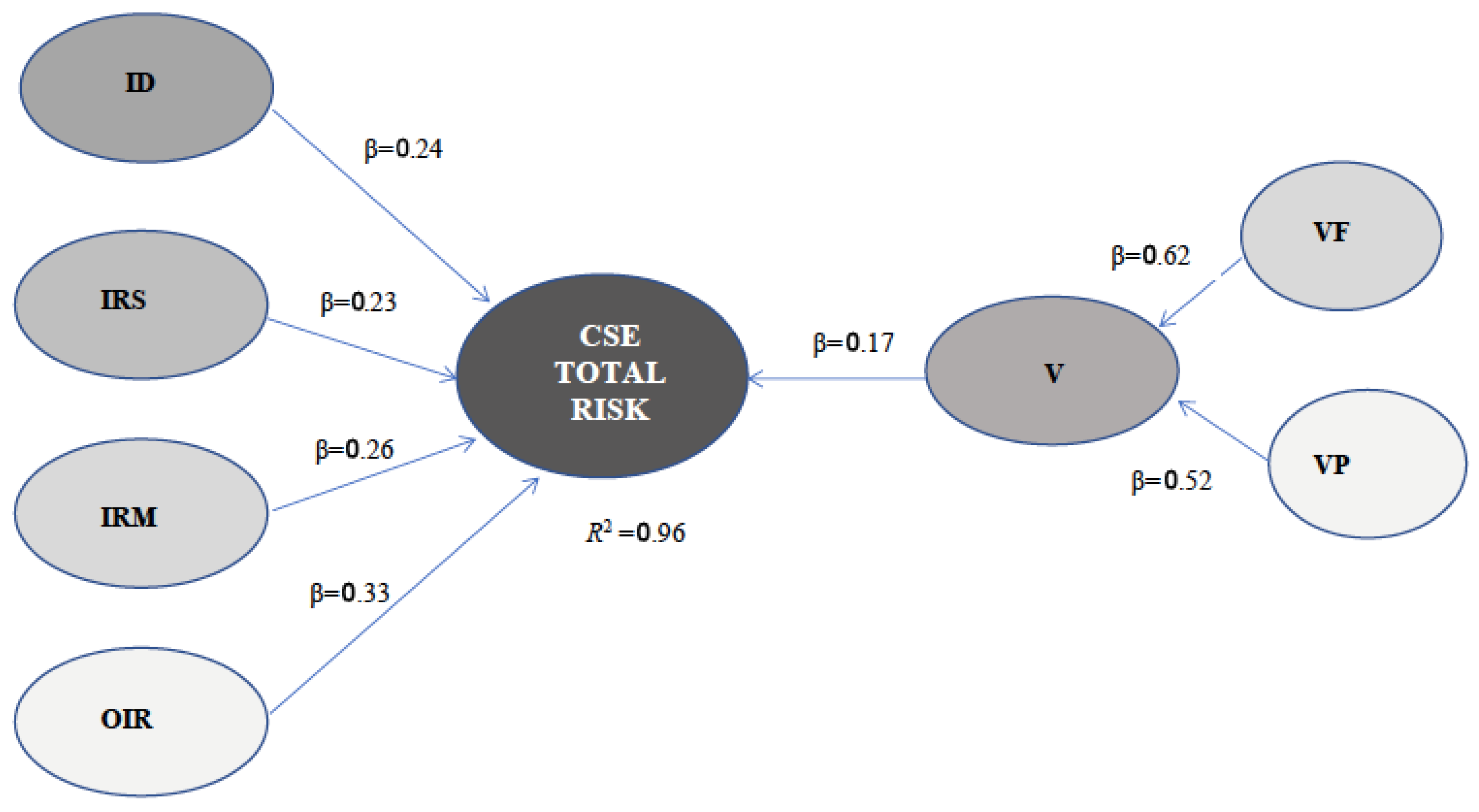
| % | % | % | % | % | λ | VIF | |
| CSE Target Indicator (ID) | |||||||
| ID1. Receives goods in exchange for sex | 72.8 | 2.2 | 1.7 | 3.0 | 15.1 | 0.62 | 2.49 |
| ID2. Recruiter of other minors for sexual exploitation | 78.9 | 1.3 | 0.0 | 0.4 | 13.8 | 0.30 | 2.49 |
| ID3. Unjustified possession of money, jewellery, mobiles, or other objects of value | 68.5 | 15.5 | 7.3 | 1.3 | 3.0 | 0.58 | 2.49 |
| ID4. Sexually active 13-year-old minor | 73.7 | 5.2 | 3.0 | 2.2 | 7.8 | 0.34 | 2.49 |
| ID5. Risky sexual relations | 35.8 | 15.9 | 9.9 | 11.2 | 23.7 | 0.75 | 2.49 |
| ID6. Involved in online sexual activity | 53.9 | 10.8 | 3.0 | 3.4 | 27.7 | 0.44 | 2.48 |
| ID7. Recurring sexually transmitted infections | 75.4 | 6.5 | 0.4 | 0 | 12.1 | 0.52 | 2.47 |
| ID8. Acquaintances and/or friends connected to sexual exploitation | 57.3 | 6.0 | 1.7 | 3.0 | 27.6 | 0.47 | 2.47 |
| ID9. Relations with people and places close to prostitution | 61.2 | 3.9 | 1.7 | 2.2 | 25.4 | 0.54 | 2.45 |
| ID10. Friends and/or partners older than the minor (5years of difference) | 50.4 | 9.5 | 11.6 | 7.8 | 15.9 | 0.67 | 2.40 |
| ID11. Online relationships and/or meetings with strangers | 50.4 | 7.3 | 5.6 | 4.7 | 27.6 | 0.47 | 2.23 |
| ID12. Abuse/dependence on alcohol and/or other drugs | 47.8 | 22.8 | 11.2 | 10.3 | 3.4 | 0.68 | 1.98 |
| ID13. Recurring physical injuries of unknown origin | 77.6 | 4.3 | 2.6 | 0.9 | 8.6 | 0.44 | 1.20 |
| Indicator of Significant Risk (IRS) | 2.09 | ||||||
| IRS1. Hiding information | 23.7 | 31.9 | 25.0 | 12.1 | 5.2 | 0.77 | 1.58 |
| IRS2. Providing inconsistent stories | 44.8 | 22.8 | 15.5 | 8.2 | 4.7 | 0.74 | 1.57 |
| IRS3. Running away from home | 65.1 | 13.4 | 7.3 | 5.6 | 3.4 | 0.67 | 1.57 |
| IRS4. Truancy | 69.4 | 7.8 | 6.9 | 8.6 | 2.6 | 0.59 | 1.57 |
| IRS5. Addiction to online or in-person gambling | 76.7 | 2.6 | 2.2 | 2.6 | 10.8 | 0.16 | 1.56 |
| IRS6. Verbalization of knowledge of the “Sugar Daddy” or “Sugar Dating” offer and the intention of making money from it | 67.7 | 14.4 | 1.7 | 0.9 | 11.2 | 0.37 | 1.56 |
| IRS7. Involvement in dysfunctional gangs/groups of friends | 64.2 | 12.5 | 6.5 | 6.5 | 5.2 | 0.59 | 1.56 |
| IRS8. Commission of crimes | 69.0 | 10.3 | 5.6 | 3.9 | 6.0 | 0.44 | 1.55 |
| IRS9. Weapon possession | 84.5 | 1.7 | 0.0 | 2.2 | 4.7 | 0.14 | 1.52 |
| IRS10. Tattoos that would indicate belonging to a gang or gang ownership | 90.9 | 0.4 | 0.0 | 0.0 | 3.0 | 0.39 | 1.51 |
| IRS11. Minor involved in drug trafficking | 76.7 | 5.2 | 1.3 | 0.9 | 10.3 | 0.44 | 1.48 |
| IRS12. On-line grooming | 66.8 | 0.9 | 0.9 | 0.4 | 25.4 | 0.47 | 2.41 |
| Indicators of Moderate Risk (IMR) | 2.41 | ||||||
| IRM1. Arriving home late | 68.2 | 17.2 | 7.8 | 9.1 | 4.3 | 0.62 | 2.41 |
| IRM2. Self-harm | 72.4 | 11.2 | 5.6 | 2.2 | 3.9 | 0.55 | 2.40 |
| IRM3. Suicidal ideas or attempts | 69.4 | 11.6 | 5.2 | 1.3 | 5.6 | 0.35 | 2.39 |
| IRM4. Occasional alcohol consumption | 43.5 | 33.6 | 8.2 | 6.0 | 4.7 | 0.63 | 2.38 |
| IRM5. Occasional drug consumption | 56.9 | 14.2 | 6.9 | 9.5 | 7.8 | 0.66 | 2.37 |
| IRM6. Sentimental relationships with a high level of emotional dependence | 44.8 | 12.1 | 16.4 | 9.9 | 13.8 | 0.52 | 2.37 |
| IRM7. Over 13 years old and sexually active | 40.1 | 19.0 | 16.8 | 8.6 | 13.8 | 0.70 | 2.36 |
| IRM8. Menstrual and/or gynaecological disorders | 65.9 | 10.3 | 3.9 | 2.6 | 11.2 | 0.36 | 2.33 |
| IRM9. Pregnancy tests | 71.1 | 9.5 | 3.4 | 1.7 | 9.1 | 0.52 | 1.58 |
| IRM10. Pregnancies/Abortions | 82.3 | 2.2 | 0.9 | 0.9 | 7.3 | 0.35 | 1.39 |
| IRM11. Sudden personality changes | 50.4 | 22.4 | 15.1 | 7.3 | 0.9 | 0.68 | 2.69 |
| IRM12. Important changes in physical appearance or way of dressing | 76.7 | 7.8 | 5.6 | 2.2 | 2.2 | 0.57 | 1.03 |
| Other Indicators of Risk (OIR) | 1.03 | ||||||
| OIR1. Minor is a sexual aggressor | 80.6 | 0.9 | 1.3 | 1.3 | 10.3 | 0.10 | 1.03 |
| OIR2. Emotional distress | 19.0 | 28.9 | 30.6 | 19.8 | 1.3 | 0.73 | 1.03 |
| OIR3. Signs and symptoms of depression | 36.6 | 28.9 | 17.2 | 12.1 | 2.2 | 0.66 | 1.02 |
| OIR4. Fears/State of alertness | 47.8 | 24.1 | 12.5 | 6.5 | 5.2 | 0.65 | 1.02 |
| OIR5. Anxiety | 29.3 | 32.8 | 21.1 | 9.9 | 3.9 | 0.68 | 1.02 |
| OIR6. Signs and symptoms of malnutrition | 85.8 | 3.9 | 0.9 | 1.7 | 1.7 | 0.37 | 1.02 |
| OIR7. Hypersexualised clothing | 73.7 | 8.6 | 8.2 | 3.4 | 1.7 | 0.63 | 1.02 |
| OIR8. Significant decrease in academic performance | 65.5 | 12.5 | 5.6 | 8.2 | 3.4 | 0.61 | 1.02 |
| OIR9. Irregular attendance at school | 71.6 | 6.9 | 6.0 | 7.3 | 3.0 | 0.60 | 1.02 |
| OIR10. Abuse of mobiles and social networks | 44.0 | 19.0 | 15.5 | 11.2 | 6.9 | 0.54 | 2.49 |
| OIR11. Sleeping problems | 53.4 | 17.2 | 11.6 | 6.0 | 8.6 | 0.57 | 2.49 |
| OIR12. Lack of social skills | 39.7 | 28.0 | 17.2 | 8.2 | 3.0 | 0.37 | 2.49 |
| Not Present | Present | Unknown | |||
|---|---|---|---|---|---|
| % | % | % | λ | VIF | |
| Family Vulnerability Indicators (VF) | |||||
| VF1. Presence of any disability? | 84.1 | 8.2 | 7.8 | 0.26 | 1.24 |
| VF2. Migrant family or migrant minor | 53.9 | 39.7 | 2.2 | 0.17 | 1.11 |
| VF3. Inattention/Neglect/Abuse in childhood | 10.8 | 82.8 | 5.6 | 0.48 | 1.10 |
| VF4. Inappropriate living conditions | 47.8 | 26.3 | 24.1 | 0.52 | 1.10 |
| VF5. Family history of mental health issues | 26.3 | 31.5 | 39.7 | 0.52 | 1.10 |
| VF6. Family history of committing crimes | 31.5 | 35.8 | 31.5 | 0.63 | 1.10 |
| VF7. Family history of substance abuse | 21.6 | 41.4 | 36.2 | 0.54 | 1.10 |
| VF8. Family violence and/or gender-based violence inside the family | 16.8 | 50.4 | 31.5 | 0.70 | 1.09 |
| VF9. Family history of prostitution | 47.0 | 6.5 | 45.7 | 0.64 | 1.09 |
| VF10. Breakdown of family ties | 21.1 | 73.3 | 4.7 | 0.40 | 1.09 |
| Personal Vulnerability Indicators (VP) | 1.17 | ||||
| VP1. Lack of positive ties with a protective adult | 36.2 | 57.8 | 4.7 | 0.62 | 1.14 |
| VP2. Prior history of bullying | 48.3 | 17.7 | 32.8 | 0.61 | 1.14 |
| VP3. Prior history of child sexual abuse | 51.3 | 19.8 | 27.2 | 0.65 | 1.13 |
| VP4. Sexualised behaviour of the minor | 65.5 | 26.3 | 6.5 | 0.45 | 1.11 |
| VP5. Eating disorders | 79.7 | 10.8 | 7.8 | 0.37 | 1.11 |
| VP6. Social isolation | 44.8 | 22.8 | 4.7 | 0.52 | 1.10 |
| VP7. Low self-esteem | 28.9 | 65.1 | 5.6 | 0.56 | 1.24 |
| Sex | Age Group | ||||||||||||||
|---|---|---|---|---|---|---|---|---|---|---|---|---|---|---|---|
| Min | Max | Mean | 95% CI Mean | SD | ZU | Min | Max | Mean | 95% CI Mean | SD | ZU | ||||
| LL | UL | (p) | LL | UL | (p) | ||||||||||
| CSE target indicators | |||||||||||||||
| Male | 0 | 15 | 2.26 | 1.63 | 2.89 | 3.03 | 4.68 | 11–13 | 0 | 18 | 1.89 | 0.60 | 3.17 | 3.74 | 15.0 |
| Female | 0 | 21 | 4.79 | 3.95 | 5.63 | 4.81 | (<0.001) | 14–17 | 0 | 21 | 4.13 | 3.47 | 4.79 | 4.51 | (0.001) |
| Indicators of significant risk of CSE | |||||||||||||||
| Male | 0 | 16 | 4.36 | 3.47 | 5.25 | 4.31 | 0.08 | 11–13 | 0 | 10 | 2.51 | 1.53 | 3.50 | 2.87 | 8.47 |
| Female | 0 | 17 | 4.26 | 3.55 | 4.97 | 4.06 | (0.933) | 14–17 | 0 | 17 | 4.59 | 3.97 | 5.21 | 4.22 | (0.014) |
| Indicators of moderate risk of CSE | |||||||||||||||
| Male | 0 | 15 | 3.43 | 2.75 | 4.12 | 3.30 | 4.88 | 11–13 | 0 | 15 | 1.89 | 0.86 | 2.91 | 2.99 | 31.41 |
| Female | 0 | 25 | 6.84 | 5.85 | 7.82 | 5.62 | (<0.001) | 14–17 | 0 | 25 | 6.12 | 5.37 | 6.88 | 5.14 | (<0.001) |
| Other indicators of risk of CSE | |||||||||||||||
| Male | 0 | 24 | 6.23 | 5.12 | 7.34 | 5.36 | 3.46 | 11–13 | 0 | 24 | 7.63 | 5.43 | 9.82 | 6.39 | 2.76 |
| Female | 0 | 33 | 9.41 | 8.24 | 10.59 | 6.71 | (0.001) | 14–17 | 0 | 33 | 8.30 | 7.37 | 9.24 | 6.37 | (0.251) |
| Vulnerabilities | |||||||||||||||
| Male | 1 | 12 | 5.67 | 5.12 | 6.23 | 2.67 | 3.50 | 11–13 | 0 | 14 | 6.40 | 5.28 | 7.52 | 3.26 | 0.20 |
| Female | 0 | 14 | 7.05 | 6.56 | 7.54 | 2.81 | (<0.001) | 14–17 | 1 | 14 | 6.49 | 6.08 | 6.90 | 2.79 | (0.914) |
Disclaimer/Publisher’s Note: The statements, opinions and data contained in all publications are solely those of the individual author(s) and contributor(s) and not of MDPI and/or the editor(s). MDPI and/or the editor(s) disclaim responsibility for any injury to people or property resulting from any ideas, methods, instructions or products referred to in the content. |
© 2026 by the authors. Licensee MDPI, Basel, Switzerland. This article is an open access article distributed under the terms and conditions of the Creative Commons Attribution (CC BY) license.
Share and Cite
Benavente, B.; Bully, P.; Ballester, L. Preventing Sexual Violence Against Adolescent Girls: Psychometric Validation of the EDR-ESIA Screening Instrument for Early Detection of Exploitation Risk. Behav. Sci. 2026, 16, 831. https://doi.org/10.3390/bs16050831
Benavente B, Bully P, Ballester L. Preventing Sexual Violence Against Adolescent Girls: Psychometric Validation of the EDR-ESIA Screening Instrument for Early Detection of Exploitation Risk. Behavioral Sciences. 2026; 16(5):831. https://doi.org/10.3390/bs16050831
Chicago/Turabian StyleBenavente, Beatriz, Paola Bully, and Lluís Ballester. 2026. "Preventing Sexual Violence Against Adolescent Girls: Psychometric Validation of the EDR-ESIA Screening Instrument for Early Detection of Exploitation Risk" Behavioral Sciences 16, no. 5: 831. https://doi.org/10.3390/bs16050831
APA StyleBenavente, B., Bully, P., & Ballester, L. (2026). Preventing Sexual Violence Against Adolescent Girls: Psychometric Validation of the EDR-ESIA Screening Instrument for Early Detection of Exploitation Risk. Behavioral Sciences, 16(5), 831. https://doi.org/10.3390/bs16050831