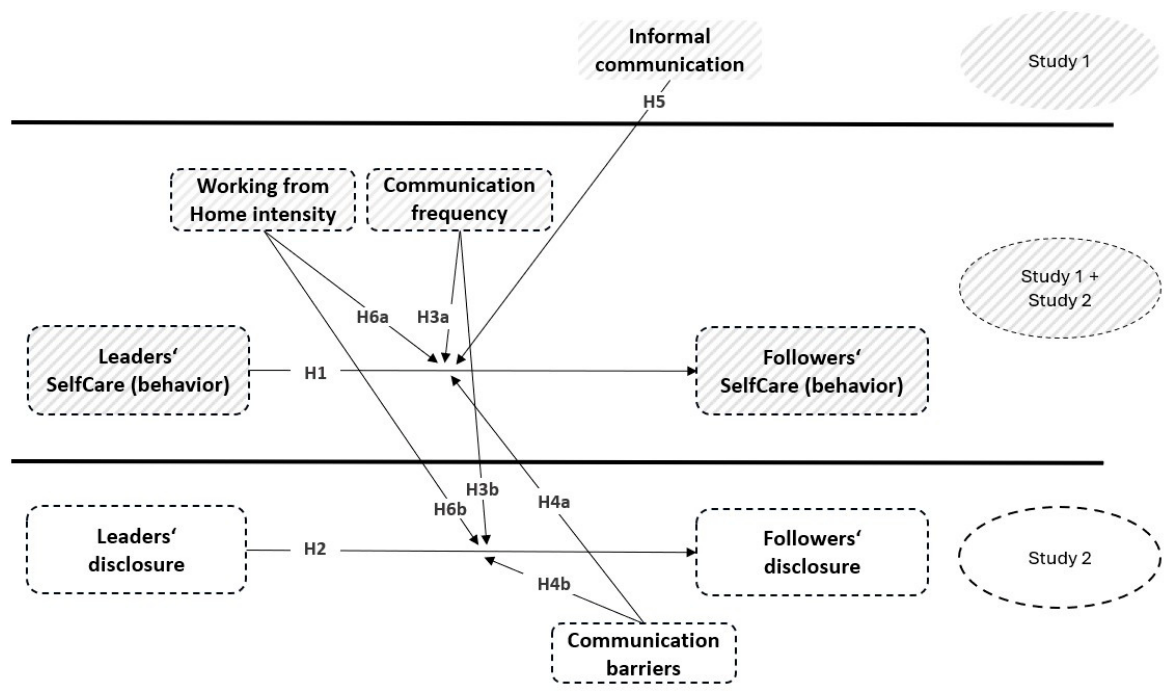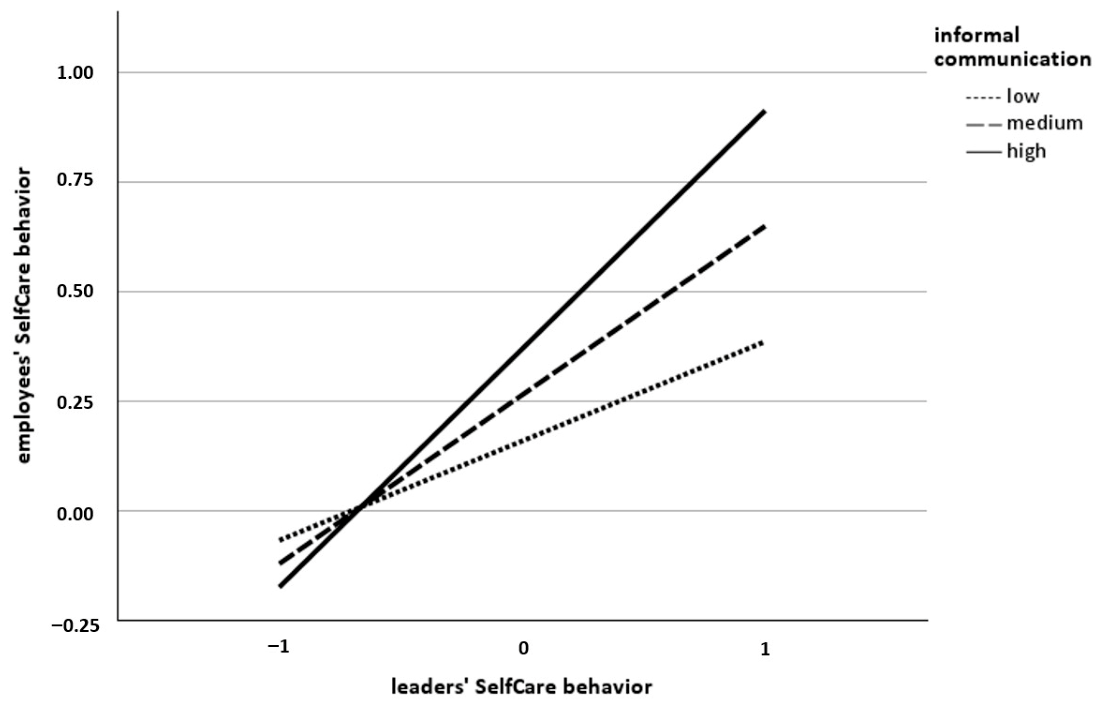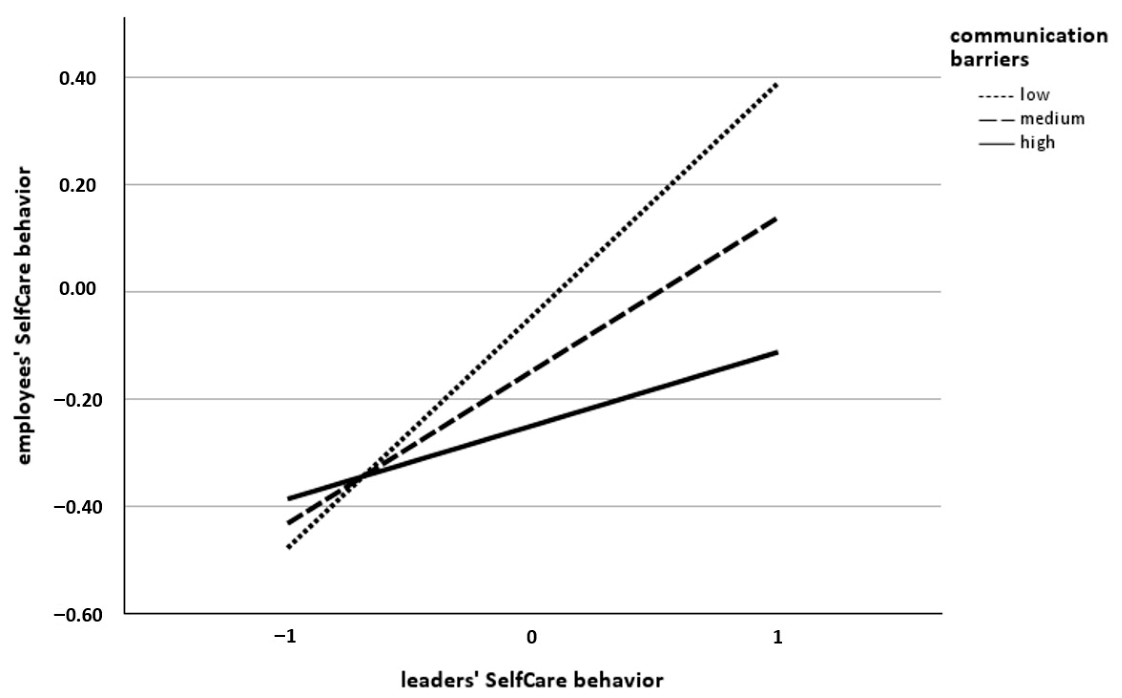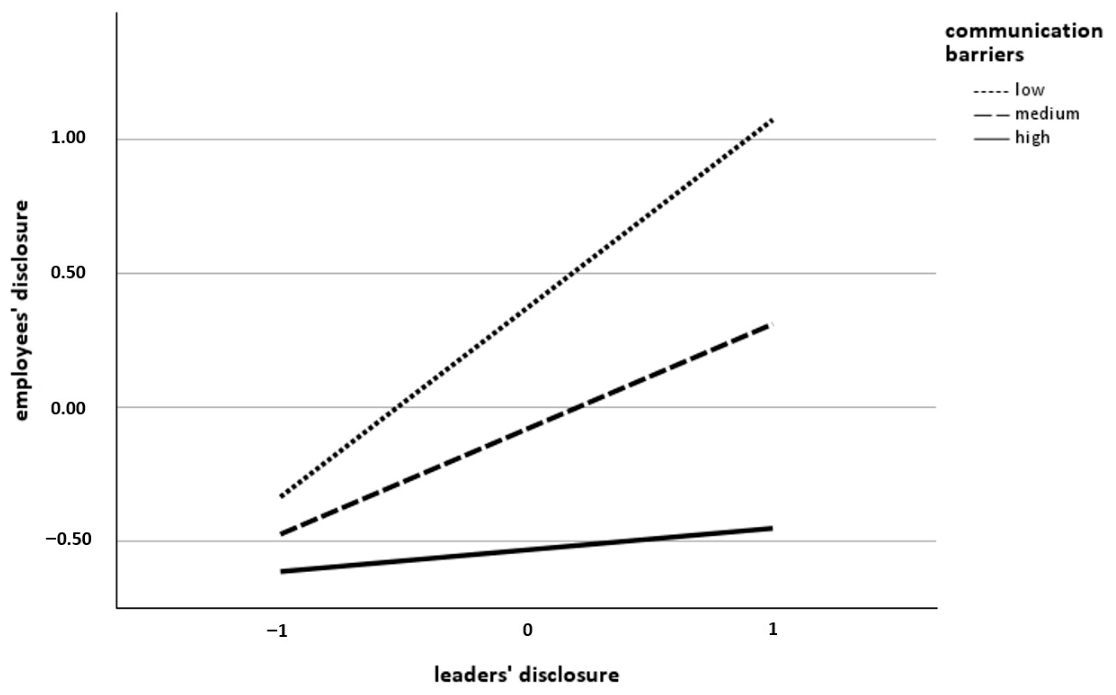
What Fosters Leaders’ Health Role Modeling? Communication and Remote Work as Boundary Conditions


Abstract
1. Introduction
2. Leaders as Behavioral Models
3. Leaders’ Role Modeling of Health-Oriented Behavior
3.1. SelfCare Role Modeling
3.2. Modeling Vulnerability: Disclosure Role Modeling
3.3. Boundary Conditions of Leaders’ Health-Related Role Model Effect
3.3.1. Communication Frequency: A Driver of Role Model Visibility?
3.3.2. Communication Barriers: Obstacles for Role Modeling?
3.3.3. Informal Communication: A Catalyst for the SelfCare Role Model Effect?
3.3.4. Working from Home Intensity: A Challenge for Leaders’ Role Model Effect?
4. Study 1
4.1. Materials and Methods
4.1.1. Participants and Procedure
4.1.2. Measures
4.1.3. Statistical Analysis
4.2. Results
4.2.1. Descriptive Statistics
4.2.2. Leaders’ Health-Related Role Model Effect
4.2.3. Moderating Effects of Work Setting and Communication Aspects
5. Study 2
5.1. Materials and Methods
5.1.1. Participants and Procedure
5.1.2. Measures
5.1.3. Statistical Analysis
5.2. Results
5.2.1. Descriptive Statistics
5.2.2. Leaders’ Health-Related Role Model Effect
5.2.3. Moderating Effects of Work Setting and Communication Aspects
6. Discussion
6.1. Leaders’ as Role Models
6.2. Moderating Factors of the Role-Modeling Pattern
6.3. Theoretical and Practical Implications
6.4. Strengths, Limitations, and Future Research
7. Conclusions
Author Contributions
Funding
Institutional Review Board Statement
Informed Consent Statement
Data Availability Statement
Acknowledgments
Conflicts of Interest
References
- Allen, M. S., Iliescu, D., & Greiff, S. (2022). Single item measures in psychological science. European Journal of Psychological Assessment, 38(1), 1–5. [Google Scholar] [CrossRef]
- Amoadu, M., Ansah, E. W., & Sarfo, J. O. (2024). Preventing workplace mistreatment and improving workers’ mental health: A scoping review of the impact of psychosocial safety climate. BMC Psychology, 12(1), 195. [Google Scholar] [CrossRef]
- Antonakis, J., & Atwater, L. E. (2002). Leader distance: A review and a proposed theory. Leadership Quarterly, 13(6), 673–704. [Google Scholar] [CrossRef]
- Arnold, M., Goldschmitt, M., & Rigotti, T. (2023). Dealing with information overload: A comprehensive review. Frontiers in Psychology, 14, 1122200. [Google Scholar] [CrossRef]
- Babapour Chafi, M., Hultberg, A., & Bozic Yams, N. (2022). Post-pandemic office work: Perceived challenges and opportunities for a sustainable work environment. Sustainability, 14(1), 294. [Google Scholar] [CrossRef]
- Bakker, A. B., & Demerouti, E. (2007). The job demands-resources model: State of the art. Journal of Managerial Psychology, 22(3), 309–328. [Google Scholar] [CrossRef]
- Bakker, A. B., & Demerouti, E. (2017). Job demands-resources theory: Taking stock and looking forward. Journal of Occupational Health Psychology, 22(3), 273–285. [Google Scholar] [CrossRef]
- Bandura, A. (1969). Social-learning theory of identificatory processes. In D. A. Goslin (Ed.), Handbook of socialization theory and research (pp. 213–262). Rand McNally & Company. [Google Scholar]
- Bandura, A. (1971). Social learning theory. General Learning Press. [Google Scholar]
- Bandura, A. (1986). Social foundations of thought and action. A social cognitive theory. Prentice-Hall. [Google Scholar]
- Bass, B. M., & Avolio, B. J. (Eds.). (1994a). Improving organizational effectiveness through transformational leadership. Sage. Available online: http://www.loc.gov/catdir/enhancements/fy0902/93030874-b.html (accessed on 4 December 2025).
- Bass, B. M., & Avolio, B. J. (1994b). Transformational leadership and organizational culture. International Journal of Public Administration, 17(3–4), 541–554. [Google Scholar] [CrossRef]
- Bass, B. M., & Steidlmeier, P. (1999). Ethics, character, and authentic transformational leadership behavior. Leadership Quarterly, 10(2), 181–217. [Google Scholar] [CrossRef]
- Beckel, J. L. O., & Fisher, G. G. (2022). Telework and worker health and well-being: A review and recommendations for research and practice. International Journal of Environmental Research and Public Health, 19(7), 3879. [Google Scholar] [CrossRef] [PubMed]
- Bravo-Duarte, F., Tordera, N., & Rodríguez, I. (2025). Wellbeing in telework: A systematic review of leadership competencies. Frontiers in Organizational Psychology, 3, 1576926. [Google Scholar] [CrossRef]
- Brohan, E., Henderson, C., Wheat, K., Malcolm, E., Clement, S., Barley, E. A., Slade, M., & Thornicroft, G. (2012). Systematic review of beliefs, behaviours and influencing factors associated with disclosure of a mental health problem in the workplace. BMC Psychiatry, 12, 11. [Google Scholar] [CrossRef]
- Bruhn, K., Tautz, D., & Felfe, J. (2025). The role of leader-employee communication in health-oriented leadership. Gruppe. Interaktion. Organisation. Zeitschrift Für Angewandte Organisationspsychologie (GIO). Advance online publication. [Google Scholar] [CrossRef]
- Clarke, E., Näswall, K., Masselot, A., & Malinen, S. (2025). Feeling safe to speak up: Leaders improving employee wellbeing through psychological safety. Economic and Industrial Democracy, 46(1), 152–176. [Google Scholar] [CrossRef]
- Cohen, J. (1988). Statistical power analysis for the behavioral sciences (2nd ed.). Erlbaum. [Google Scholar]
- Conrad, C. R., & Poole, M. S. (2012). Strategic organizational communication in a global economy: In a global economy (7th ed.). Wiley-Blackwell. [Google Scholar]
- Corrigan, P. W., Kosyluk, K. A., & Rüsch, N. (2013). Reducing self-stigma by coming out proud. American Journal of Public Health, 103(5), 794–800. [Google Scholar] [CrossRef]
- Cozby, P. C. (1973). Self-disclosure: A literature review. Psychological Bulletin, 79(2), 73–91. [Google Scholar] [CrossRef]
- Daft, R. L., & Lengel, R. H. (1986). Organizational information requirements, media richness and structural design. Management Science, 32(5), 554–571. [Google Scholar] [CrossRef]
- Daud, M. F., Abdul Latif, A. S. S. S., Ku Ahmad, K. N. A., Izuan Ramlan, M. A., Mohamed Ayub, M. S., Safian, R., Abdullah, S. F. M., & Mohd Ashraff, N. A. (2017). Understanding language as a communication barrier among executives in corporate organization towards effective communication. Journal of Global Business and Social Entrepreneurship (GBSE), 3(8), 1–11. Available online: http://gbse.my/v3no8september17/Paper-130-.pdf.
- Day, A., Paquet, S., Scott, N., & Hambley, L. A. (2012). Perceived information and communication technology (ICT) demands on employee outcomes: The moderating effect of organizational ICT support. Journal of Occupational Health Psychology, 17(4), 473–491. [Google Scholar] [CrossRef] [PubMed]
- Demerouti, E., Bakker, A. B., Nachreiner, F., & Schaufeli, W. B. (2001). The job demands-resources model of burnout. Journal of Applied Psychology, 86(3), 499–512. [Google Scholar] [CrossRef] [PubMed]
- De Oliveira, C., Saka, M., Bone, L., & Jacobs, R. (2023). The role of mental health on workplace productivity: A critical review of the literature. Applied Health Economics and Health Policy, 21(2), 167–193. [Google Scholar] [CrossRef] [PubMed]
- Deutsche Gesellschaft für Psychologie. (2018). Ethisches handeln in der psychologischen forschung [ethical behavior in psychological research]. Hogrefe. [Google Scholar]
- De Vries, R. E., Bakker-Pieper, A., & Oostenveld, W. (2010). Leadership = Communication? The relations of leaders’ communication styles with leadership styles, knowledge sharing and leadership outcomes. Journal of Business and Psychology, 25(3), 367–380. [Google Scholar] [CrossRef] [PubMed]
- Dietz, C., Zacher, H., Scheel, T. E., Otto, K., & Rigotti, T. (2020). Leaders as role models: Effects of leader presenteeism on employee presenteeism and sick leave. Work & Stress, 34(3), 300–322. [Google Scholar] [CrossRef]
- Eisenberg, J., Post, C., & DiTomaso, N. (2019). Team dispersion and performance: The role of team communication and transformational leadership. Small Group Research, 50(3), 348–380. [Google Scholar] [CrossRef]
- Ellison, M. L., Russinova, Z., MacDonald-Wilson, K. L., & Lyass, A. (2003). Patterns and correlates of workplace disclosure among professionals and managers with psychiatric conditions. Journal of Vocational Rehabilitation, 18(1), 3–13. [Google Scholar] [CrossRef]
- Enyia, C. D., & Orokor, L. E. (2016). The role of formal and informal communication in determining employee affective and continuance commitment in oil and gas companies. International Journal of Advanced Academic Research, 2(9), 33–44. [Google Scholar]
- Eurostat. (2022). Employed persons working from home as a percentage of the total employment, by sex, age and professional status (%). European Statistical Office. [Google Scholar] [CrossRef]
- Faltermaier, T. (1994). Gesundheitsbewusstsein und Gesundheitshandeln [health awareness and health behavior]. Beltz Psychologie-Verl.-Union. [Google Scholar]
- Faul, F., Erdfelder, E., Buchner, A., & Lang, A.-G. (2009). Statistical power analyses using G*Power 3.1: Tests for correlation and regression analyses. Behavior Research Methods, 41(4), 1149–1160. [Google Scholar] [CrossRef]
- Fay, M. J. (2011). Informal communication of co-workers: A thematic analysis of messages. Qualitative Research in Organizations and Management: An International Journal, 6(3), 212–229. [Google Scholar] [CrossRef]
- Fay, M. J., & Kline, S. L. (2011). Coworker relationships and informal communication in high-intensity telecommuting. Journal of Applied Communication Research, 39(2), 144–163. [Google Scholar] [CrossRef]
- Felfe, J., & Heinitz, K. (2010). The impact of consensus and agreement of leadership perceptions on commitment, organizational citizenship behaviour, and customer satisfaction. European Journal of Work and Organizational Psychology, 19(3), 279–303. [Google Scholar] [CrossRef]
- Felfe, J., Krick, A., Hauff, S., Renner, K.-H., Klebe, L., Schübbe, K., Tautz, D., Frontzkowski, Y., Gubernator, P., & Neidlinger, S. M. (2022). Working from home: Opportunities and risks for working conditions, leadership and health. In D. Schulz, A. Fay, M. Schulz, & W. Matiaske (Eds.), dtec.bw-beiträge der helmut-schmidt-universität/universität der bundeswehr hamburg—forschungsaktivitäten im zentrum für digitalisierungs- und technologieforschung der bundeswehr dtec.bw (pp. 335–341). Helmut-Schmidt-Universität/Universität der Bundeswehr. [Google Scholar] [CrossRef]
- Follmer, K. B., Sabat, I. E., & Siuta, R. L. (2020). Disclosure of stigmatized identities at work: An interdisciplinary review and agenda for future research. Journal of Organizational Behavior, 41(2), 169–184. [Google Scholar] [CrossRef]
- Franke, F., Felfe, J., & Pundt, A. (2014). The impact of health-oriented leadership on follower health: Development and test of a new instrument measuring health-promoting leadership. German Journal of Human Resource Management: Zeitschrift Für Personalforschung, 28(1–2), 139–161. [Google Scholar] [CrossRef]
- Fröhlich, L. S., Krick, A., & Felfe, J. (2025). When followers do not emulate their leaders: Unraveling the health-related role model effect of leaders. Journal of Applied Social Psychology, 55(12), 967–989. [Google Scholar] [CrossRef]
- Gajendran, R. S., & Harrison, D. A. (2007). The good, the bad, and the unknown about telecommuting: Meta-analysis of psychological mediators and individual consequences. Journal of Applied Psychology, 92(6), 1524–1541. [Google Scholar] [CrossRef]
- González-Romá, V., & Hernández, A. (2014). Climate uniformity: Its influence on team communication quality, task conflict, and team performance. Journal of Applied Psychology, 99(6), 1042–1058. [Google Scholar] [CrossRef]
- Gosch, N., Schulte, E.-M., & Kauffeld, S. (2023). Capturing the impact employees have on their coworkers and leaders: A holistic approach on health-specific support behavior from employees. Frontiers in Psychology, 14, 1183862. [Google Scholar] [CrossRef] [PubMed]
- Graf, B., & Antoni, C. H. (2023). Drowning in the flood of information: A meta-analysis on the relation between information overload, behaviour, experience, and health and moderating factors. European Journal of Work and Organizational Psychology, 32(2), 173–198. [Google Scholar] [CrossRef]
- Greenberg, M. A., & Stone, A. A. (1992). Emotional disclosure about traumas and its relation to health: Effects of previous disclosure and trauma severity. Journal of Personality and Social Psychology, 63(1), 75–84. [Google Scholar] [CrossRef]
- Greene, K. (2009). An integrated model of health disclosure decision-making. In T. D. Afifi, & W. A. Afifi (Eds.), Uncertainty and information regulation in interpersonal contexts: Theories and applications (pp. 226–253). Routledge. [Google Scholar]
- Grimm, L. A., Bauer, G. F., & Jenny, G. J. (2021). Is the health-awareness of leaders related to the working conditions, engagement, and exhaustion in their teams? A multi-level mediation study. BMC Public Health, 21(1), 1935. [Google Scholar] [CrossRef]
- Grinza, E., & Rycx, F. (2020). The impact of sickness absenteeism on firm productivity: New evidence from belgian matched employer–employee panel data. Industrial Relations, 59(1), 150–194. [Google Scholar] [CrossRef]
- Hackney, A., Yung, M., Somasundram, K. G., Nowrouzi-Kia, B., Oakman, J., & Yazdani, A. (2022). Working in the digital economy: A systematic review of the impact of work from home arrangements on personal and organizational performance and productivity. PLoS ONE, 17(10), e0274728. [Google Scholar] [CrossRef] [PubMed]
- Hammer, L. B., Kossek, E. E., Zimmerman, K., & Daniels, R. (2007). Clarifying the construct of family-supportive supervisory behaviors (FSSB): A multilevel perspective. In D. C. Ganster, & P. L. Perrewé (Eds.), Research in occupational stress and well being: v. 6. Exploring the work and non-work interface (Vol. 6, pp. 165–204). Elsevier JAI. [Google Scholar] [CrossRef]
- Hill, N. S., Axtell, C., Raghuram, S., & Nurmi, N. (2024). Unpacking virtual work’s dual effects on employee well-being: An integrative review and future research agenda. Journal of Management, 50(2), 752–792. [Google Scholar] [CrossRef]
- Holmes, J., & Marra, M. (2004). Relational practice in the workplace: Women’s talk or gendered discourse? Language in Society, 33(03). [Google Scholar] [CrossRef]
- Ito, A., & Bligh, M. C. (2016). Feeling vulnerable? Disclosure of vulnerability in the charismatic leadership relationship. Journal of Leadership Studies, 10(3), 66–70. [Google Scholar] [CrossRef]
- Jarvenpaa, S. L., & Leidner, D. E. (1999). Communication and trust in global virtual teams. Organization Science, 10(6), 791–815. [Google Scholar] [CrossRef]
- Jiménez, P., Winkler, B., & Dunkl, A. (2017). Creating a healthy working environment with leadership: The concept of health-promoting leadership. International Journal of Human Resource Management, 28(17), 2430–2448. [Google Scholar] [CrossRef]
- Johns, G. (2024). The context deficit in leadership research. Leadership Quarterly, 35(1), 101755. [Google Scholar] [CrossRef]
- Johnson, C. E., & Hackman, M. Z. (2018). Leadership: A communication perspective (7th ed.). Waveland Press, Inc. Available online: https://permalink.obvsg.at/AC16487463 (accessed on 13 December 2025).
- Jones, K. P., & King, E. B. (2014). Managing concealable stigmas at work. Journal of Management, 40(5), 1466–1494. [Google Scholar] [CrossRef]
- Kaluza, A. J., Weber, F., van Dick, R., & Junker, N. M. (2021). When and how health-oriented leadership relates to employee well-being—The role of expectations, self-care, and LMX. Journal of Applied Social Psychology, 51(4), 404–424. [Google Scholar] [CrossRef]
- Kamal Bahrain, N. N., Raihan Sakrani, S. N., & Maidin, A. (2023). Communication barriers in work environment: Understanding impact and challenges. International Journal of Academic Research in Business and Social Sciences, 13(11), 1489–1503. [Google Scholar] [CrossRef] [PubMed]
- Kelman, H. C. (1958). Compliance, identification, and internalization three processes of attitude change. Journal of Conflict Resolution, 2(1), 51–60. [Google Scholar] [CrossRef]
- Klebe, L., Felfe, J., & Klug, K. (2021). Healthy leadership in turbulent times: The effectiveness of health-oriented leadership in crisis. British Journal of Management, 32(4), 1203–1218. [Google Scholar] [CrossRef]
- Klebe, L., Felfe, J., Krick, A., & Pischel, S. (2023). The shadows of digitisation: On the losses of health-oriented leadership in the face of ICT hassles. Behaviour & Information Technology, 43(3), 605–622. [Google Scholar] [CrossRef]
- Klug, K., Felfe, J., & Krick, A. (2019). Caring for oneself or for others? How consistent and inconsistent profiles of health-oriented leadership are related to follower strain and health. Frontiers in Psychology, 10, 2456. [Google Scholar] [CrossRef] [PubMed]
- Klug, K., Felfe, J., & Krick, A. (2022). Does self-care make you a better leader? A multisource study linking leader self-care to health-oriented leadership, employee self-care, and health. International Journal of Environmental Research and Public Health, 19(11), 6733. [Google Scholar] [CrossRef]
- Koch, A. R., & Binnewies, C. (2015). Setting a good example: Supervisors as work-life-friendly role models within the context of boundary management. Journal of Occupational Health Psychology, 20(1), 82–92. [Google Scholar] [CrossRef] [PubMed]
- Koch, T., & Denner, N. (2022). Informal communication in organizations: Work time wasted at the water-cooler or crucial exchange among co-workers? Corporate Communications: An International Journal, 27(3), 494–508. [Google Scholar] [CrossRef]
- Kraut, R. E., Fish, R. S., Root, R. W., & Chalfonte, B. L. (1990). Informal communication in organizations: Form, function, and technology. In S. Oskamp, & S. Spacapan (Eds.), Human reactions to technology: Claremont symposium on applied social psychology (pp. 145–199). Sage. [Google Scholar]
- Krick, A., Arnold, M., & Felfe, J. (2024). SelfCare when working from home: Easier but also more important. Frontiers in Organisational Psychology-Employee Well-Being and Health, 2, 1333689. [Google Scholar] [CrossRef]
- Krick, A., & Felfe, J. (2022). Health-oriented leadership in a digital world: A literature review. In D. Schulz, A. Fay, M. Schulz, & W. Matiaske (Eds.), dtec.bw-beiträge der helmut-schmidt-universität/universität der bundeswehr hamburg—Forschungsaktivitäten im zentrum für digitalisierungs- und technologieforschung der bundeswehr dtec.bw (pp. 347–357). Helmut-Schmidt-Universität/Universität der Bundeswehr. [Google Scholar] [CrossRef]
- Krick, A., & Felfe, J. (2024). Gesundheitsorientierte führungskompetenz: Trainingsmanual [health-oriented leadership competence: A training manual]. Springer. [Google Scholar] [CrossRef]
- Krupa, T., Kirsh, B., Cockburn, L., & Gewurtz, R. (2009). Understanding the stigma of mental illness in employment. Work (Reading, Mass.), 33(4), 413–425. [Google Scholar] [CrossRef]
- Lal, B., Dwivedi, Y. K., & Haag, M. (2021). Working from home during COVID-19: Doing and managing technology-enabled social interaction with colleagues at a distance. Information Systems Frontiers: A Journal of Research and Innovation, 25, 1333–1350. [Google Scholar] [CrossRef]
- Lindell, M. K., & Whitney, D. J. (2001). Accounting for common method variance in cross-sectional research designs. Journal of Applied Psychology, 86(1), 114–121. [Google Scholar] [CrossRef]
- Liu, L., Zhang, C., & Fang, C.-C. (2022). Effects of health-promoting leadership, employee health on employee engagement: Employability as moderating variable. International Journal of Workplace Health Management, 15(1), 1–18. [Google Scholar] [CrossRef]
- Lunde, L. K., Fløvik, L., Christensen, J. O., Johannessen, H. A., Finne, L. B., Jørgensen, I. L., Mohr, B., & Vleeshouwers, J. (2022). The relationship between telework from home and employee health: A systematic review. BMC Public Health, 22, 47. [Google Scholar] [CrossRef]
- Lundqvist, D., Reineholm, C., Ståhl, C., & Wallo, A. (2022). The impact of leadership on employee well-being: On-site compared to working from home. BMC Public Health, 22(1), 2154. [Google Scholar] [CrossRef]
- Lütjens, D., & Felfe, J. (2025). Casual yet crucial: How informal nonwork-related communication shapes transformational leadership in hybrid work environments. European Journal of Work and Organizational Psychology, 1–15. [Google Scholar] [CrossRef]
- Marks, M. A., Zaccaro, S. J., & Mathieu, J. E. (2000). Performance implications of leader briefings and team-interaction training for team adaptation to novel environments. Journal of Applied Psychology, 85(6), 971–986. [Google Scholar] [CrossRef] [PubMed]
- Marlow, S. L., Lacerenza, C. N., Paoletti, J., Burke, C. S., & Salas, E. (2018). Does team communication represent a one-size-fits-all approach? A meta-analysis of team communication and performance. Organizational Behavior and Human Decision Processes, 144, 145–170. [Google Scholar] [CrossRef]
- Marlow, S. L., Lacerenza, C. N., & Salas, E. (2017). Communication in virtual teams: A conceptual framework and research agenda. Human Resource Management Review, 27(4), 575–589. [Google Scholar] [CrossRef]
- Martinez, W., Hickson, G. B., Miller, B. M., Doukas, D. J., Buckley, J. D., Song, J., Sehgal, N. L., Deitz, J., Braddock, C. H., & Lehmann, L. S. (2014). Role-modeling and medical error disclosure: A national survey of trainees. Academic Medicine: Journal of the Association of American Medical Colleges, 89(3), 482–489. [Google Scholar] [CrossRef]
- Martinko, M. J., Harvey, P., & Douglas, S. C. (2007). The role, function, and contribution of attribution theory to leadership: A review. Leadership Quarterly, 18(6), 561–585. [Google Scholar] [CrossRef]
- Methot, J. R., Rosado-Solomon, E. H., Downes, P. E., & Gabriel, A. S. (2021). Office chitchat as a social ritual: The uplifting yet distracting effects of daily small talk at work. Academy of Management Journal, 64(5), 1445–1471. [Google Scholar] [CrossRef]
- Montano, D., Schleu, J. E., & Hüffmeier, J. (2023). A meta-analysis of the relative contribution of leadership styles to followers’ mental health. Journal of Leadership & Organizational Studies, 30(1), 90–107. [Google Scholar] [CrossRef]
- Morgenroth, T., Ryan, M. K., & Peters, K. (2015). The motivational theory of role modeling: How role models influence role aspirants’ goals. Review of General Psychology, 19(4), 465–483. [Google Scholar] [CrossRef]
- Nakrošienė, A., Bučiūnienė, I., & Goštautaitė, B. (2019). Working from home: Characteristics and outcomes of telework. International Journal of Manpower, 40(1), 87–101. [Google Scholar] [CrossRef]
- Norberg, B. L., Austad, B., Kristiansen, E., Zanaboni, P., & Getz, L. O. (2025). The dynamics of doctor-patient communication during remote consultations: Qualitative study among norwegian contract general practitioners. Journal of Medical Internet Research, 27, e57679. [Google Scholar] [CrossRef]
- Omilion-Hodges, L. M., & Baker, C. R. (2017). Communicating leader-member relationship quality. International Journal of Business Communication, 54(2), 115–145. [Google Scholar] [CrossRef]
- Pischel, S., & Felfe, J. (2023). “Should I tell my leader or not?”-Health-oriented leadership and stigma as antecedents of employees’ mental health information disclosure intentions at work. Journal of Occupational and Environmental Medicine, 65(1), 74–85. [Google Scholar] [CrossRef]
- Pischel, S., Felfe, J., & Klebe, L. (2022). “Should I further engage in staff care?”: Employees’ disclosure, leaders’ skills and goal conflict as antecedents of health-oriented leadership. International Journal of Environmental Research and Public Health, 20(1), 162. [Google Scholar] [CrossRef]
- Podsakoff, P. M., Mackenzie, S. B., Lee, J.-Y., & Podsakoff, N. P. (2003). Common method biases in behavioral research: A critical review of the literature and recommended remedies. Journal of Applied Psychology, 88(5), 879–903. [Google Scholar] [CrossRef]
- Pundt, F., & Felfe, J. (2017). HoL. An instrument to assess health-oriented leadership. Hogrefe. [Google Scholar]
- Ragins, B. R. (2008). Disclosure disconnects: Antecedents and consequences of disclosing invisible stigmas across life domains. Academy of Management Review, 33(1), 194–215. [Google Scholar] [CrossRef]
- Rindfuss, R. R., Choe, M. K., Tsuya, N. O., Bumpass, L. L., & Tamaki, E. (2015). Do low survey response rates bias results? Evidence from Japan. Demographic Research, 32, 797–828. [Google Scholar] [CrossRef]
- Rosseel, Y. (2012). Lavaan: An R package for structural equation modeling. Journal of Statistical Software, 48(2). [Google Scholar] [CrossRef]
- Salancik, G. R., & Pfeffer, J. (1978). A social information processing approach to job attitudes and task design. Administrative Science Quarterly, 23(2), 224. [Google Scholar] [CrossRef]
- Santa Maria, A., Wolter, C., Gusy, B., Kleiber, D., & Renneberg, B. (2019). The impact of health-oriented leadership on police officers’ physical health, burnout, depression and well-being. Policing: A Journal of Policy and Practice, 13(2), 186–200. [Google Scholar] [CrossRef]
- Schoorman, F. D., Mayer, R. C., & Davis, J. H. (2007). An integrative model of organizational trust: Past, present, and future. Academy of Management Review, 32(2), 344–354. [Google Scholar] [CrossRef]
- Schwarzer, R. (2004). Psychologie des Gesundheitsverhaltens [psychology of health behavior]: Einführung in die gesundheitspsychologie (3rd ed.). Hogrefe. Available online: http://www.socialnet.de/rezensionen/isbn.php?isbn=978-3-8017-1816-9 (accessed on 1 December 2025).
- Shamir, B. (1999). Leadership in boundaryless organizations: Disposable or indispensable? European Journal of Work and Organizational Psychology, 8(1), 49–71. [Google Scholar] [CrossRef]
- Shamir, B., & Ben-Ari, E. (1999). Leadership in an open army? Civilian connections, interorganizational frameworks and changes in military leadership. In J. G. Hunt, G. E. Dodge, & L. Wong (Eds.), Monographs in leadership and management: Vol. 1. Out-of-the-box leadership: Transforming the twenty-first century army and other top-performing organizations (pp. 15–40). JAI Press. [Google Scholar]
- Shee, P. Y., Dollard, M. F., & Idris, M. A. (2026). How psychosocial safety climate affects employee well-being via basic psychological needs: A longitudinal multilevel moderated mediation study. Journal of Applied Psychology, 111(1), 68–90. [Google Scholar] [CrossRef]
- Shockley, K. M., Allen, T. D., Dodd, H., & Waiwood, A. M. (2021). Remote worker communication during COVID-19: The role of quantity, quality, and supervisor expectation-setting. Journal of Applied Psychology, 106(10), 1466–1482. [Google Scholar] [CrossRef]
- Spector, P. E. (2019). Do not cross me: Optimizing the use of cross-sectional designs. Journal of Business and Psychology, 34(2), 125–137. [Google Scholar] [CrossRef]
- Stich, J.-F., Farley, S., Cooper, C., & Tarafdar, M. (2015). Information and communication technology demands: Outcomes and interventions. Journal of Organizational Effectiveness: People and Performance, 2(4), 327–345. [Google Scholar] [CrossRef]
- Tajfel, H., & Turner, J. C. (2004). The social identity theory of intergroup behavior. In J. T. Jost, & J. Sidanius (Eds.), Political psychology (pp. 276–293). Psychology Press. [Google Scholar] [CrossRef]
- Tautz, D., Felfe, J., Klebe, L., & Krick, A. (2024). Transformational leadership and well-being when working from home—The role of ICT demands. Journal of Managerial Psychology. Ahead-of-print. [Google Scholar] [CrossRef]
- Tautz, D., Krick, A., & Felfe, J. (2023). Informelle kommunikation als führungsinstrument [informal communication as a leadership tool]. In J. Felfe, & R. Dick (Eds.), Handbuch mitarbeiterführung [handbook of employee leadership] (pp. 101–112). Springer. [Google Scholar] [CrossRef]
- Tautz, D., Schübbe, K., & Felfe, J. (2022). Working from home and its challenges for transformational and health-oriented leadership. Frontiers in Psychology, 13, 1017316. [Google Scholar] [CrossRef]
- Toth, K. E., & Dewa, C. S. (2014). Employee decision-making about disclosure of a mental disorder at work. Journal of Occupational Rehabilitation, 24(4), 732–746. [Google Scholar] [CrossRef] [PubMed]
- van Zoonen, W., Sivunen, A. E., & Blomqvist, K. (2024). Out of sight—Out of trust? An analysis of the mediating role of communication frequency and quality in the relationship between workplace isolation and trust. European Management Journal, 42(4), 515–526. [Google Scholar] [CrossRef]
- Viererbl, B., Denner, N., & Koch, T. (2022). “You don’t meet anybody when walking from the living room to the kitchen”: Informal communication during remote work. Journal of Communication Management, 26(3), 331–348. [Google Scholar] [CrossRef]
- Wegge, J., Shemla, M., & Haslam, S. A. (2014). Leader behavior as a determinant of health at work: Specification and evidence of five key pathways. German Journal of Human Resource Management: Zeitschrift Für Personalforschung, 28(1–2), 6–23. [Google Scholar] [CrossRef]
- Weisband, S., & Atwater, L. (1999). Evaluating self and others in electronic and face-to-face groups. Journal of Applied Psychology, 84(4), 632–639. [Google Scholar] [CrossRef]
- World Health Organization. (2022). Who guidelines on mental health at work, 1st ed.; World Health Organization. Available online: https://www.ncbi.nlm.nih.gov/books/NBK586364/ (accessed on 3 December 2025).
- World Medical Association. (2013). World medical association declaration of Helsinki: Ethical principles for medical research involving human subjects. JAMA, 310(20), 2191–2194. [Google Scholar] [CrossRef]
- Yue, C. A., Men, L. R., & Berger, B. K. (2021). Leaders as communication agents. In L. R. Men, & A. Tkalac Verčič (Eds.), New perspectives in organizational communication. Current trends and issues in internal communication: Theory and practice (pp. 19–38). Palgrave Macmillan. [Google Scholar] [CrossRef]
- Zhang, C., & Liu, L. (2022). The influence of health-promoting leadership on employees’ positive workplace outcomes: The mediating role of employability and the moderating role of workplace civility. International Journal of Environmental Research and Public Health, 19(22), 15300. [Google Scholar] [CrossRef]



| Study 1 | Study 2 | 1 | 2 | 3 | 4 | 5 | 6 | 7 | 8 | 9 | 10 | 11 | 12 | 13 | 14 | |||
|---|---|---|---|---|---|---|---|---|---|---|---|---|---|---|---|---|---|---|
| M (SD) | α | M (SD) | α | |||||||||||||||
| Control variables | ||||||||||||||||||
| 1 Gender a | - | - | - | - | - | −0.11 | 0.06 | 0.09 | −0.01 | 0.16 | 0.18 | −0.09 | 0.06 | 0.03 | 0.19 | 0.06 | −0.06 | - |
| 2 Age | 44.07 (10.65) | - | 44.03 (11.28) | - | −0.17 | - | −0.07 | −0.05 | 0.07 | 0.06 | 0.11 | 0.04 | 0.12 | 0.17 | 0.22 | −0.06 | −0.01 | - |
| Leader SelfCare Behavior | ||||||||||||||||||
| 3 General | 3.36 (0.66) | 0.79 | 3.12 (0.79) | 0.87 | −0.03 | 0.01 | - | 0.89 | −0.82 | 0.30 | 0.24 | −0.31 | 0.21 | 0.26 | −0.03 | 0.05 | −0.33 | - |
| 4 Promotion | 3.47 (0.74) | 0.91 | 3.24 (0.90) | 0.87 | −0.02 | −0.02 | 0.77 | - | −0.48 | 0.27 | 0.22 | −0.27 | 0.25 | 0.35 | 0.00 | 0.13 | −0.46 | - |
| 5 Risk | 2.75 (0.89) | 0.81 | 3.04 (0.95) | 0.88 | 0.03 | −0.03 | −0.85 | −0.32 | - | −0.24 | −0.19 | 0.27 | −0.09 | −0.06 | 0.04 | 0.07 | 0.07 | - |
| Employee SelfCare Behavior | ||||||||||||||||||
| 6 General | 3.49 (0.73) | 0.84 | 3.24 (0.76) | 0.88 | −0.06 | 0.04 | 0.44 | 0.43 | −0.30 | - | 0.94 | −0.82 | 0.21 | 0.33 | 0.08 | 0.11 | −0.21 | - |
| 7 Promotion | 3.65 (0.79) | 0.78 | 3.36 (0.79) | 0.86 | 0.02 | 0.02 | 0.34 | 0.41 | −0.17 | 0.94 | - | −0.57 | 0.22 | 0.31 | 0.09 | 0.09 | −0.15 | - |
| 8 Risk | 2.92 (0.95) | 0.84 | 3.00 (0.98) | 0.86 | 0.20 | −0.05 | −0.48 | −0.30 | 0.46 | −0.72 | −0.45 | - | −0.14 | −0.27 | −0.04 | −0.11 | 0.24 | - |
| Self-Disclosure | ||||||||||||||||||
| 9 L’ Disclosure | - | - | 2.70 (0.90) | 0.78 | - | - | - | - | - | - | - | - | - | 0.49 | 0.06 | 0.35 | −0.36 | - |
| 10 E’ Disclosure | - | - | 3.48 (1.03) | 0.92 | - | - | - | - | - | - | - | - | - | - | 0.09 | 0.29 | −0.46 | - |
| Work Setting | ||||||||||||||||||
| 11 WfH Intensity | 2.86 (1.21) | - | 3.07 (1.53) | - | −0.07 | 0.06 | 0.17 | 0.25 | −0.04 | 0.28 | 0.27 | −0.20 | - | - | - | −0.19 | −0.08 | - |
| Communication Aspects | ||||||||||||||||||
| 12 Frequency | 3.58 (1.14) | - | 3.45 (1.05) | - | −0.02 | 0.09 | 0.09 | 0.18 | 0.01 | 0.14 | 0.12 | −0.12 | - | - | −0.02 | - | −0.28 | - |
| 13 Barriers | - | - | 2.18 (0.92) | 0.90 | - | - | - | - | - | - | - | - | - | - | - | - | - | - |
| 14 Informal Comm. | 3.03 (1.01) | 0.92 | - | - | 0.04 | −0.03 | 0.14 | 0.23 | −0.02 | 0.25 | 0.23 | −0.20 | - | - | 0.10 | 0.50 | - | - |
| Study 1 | Study 2 | Study 2 | ||||||
|---|---|---|---|---|---|---|---|---|
| Predictors | Employees’ SelfCare b | Predictors | Employees’ SelfCare b | Predictors | Employees’ Disclosure | |||
| β | SE | β | SE | β | SE | |||
| Age | 0.01 | 0.02 | Age | 0.09 | 0.01 | Age | 0.12 † | 0.01 |
| Gender a | −0.05 | 0.09 | Gender a | 0.14 * | 0.11 | Gender a | 0.02 | 0.13 |
| Leaders’ SelfCare b | 0.35 *** | 0.07 | Leaders’ SelfCare a | 0.30 *** | 0.07 | Leaders’ Disclosure | 0.35 *** | 0.07 |
| WfH_i | 0.19 ** | 0.04 | WfH_i | 0.06 | 0.04 | WfH_i | 0.03 | 0.04 |
| Comm. Frequency | 0.03 | 0.04 | Comm. Frequency | 0.07 | 0.05 | Comm. Frequency | 0.06 | 0.06 |
| Informal Comm. | 0.15 * | 0.05 | Comm. Barriers | −0.12 | 0.06 | Comm. Barriers | −0.41 *** | 0.07 |
| L’ SC b × WfH_i | 0.03 | 0.05 | L’ SC b × WfH_i | −0.04 | 0.05 | L’ D × WfH_i | 0.05 | 0.05 |
| L’ SC b × CF | −0.04 | 0.07 | L’ SC b × CF | 0.00 | 0.07 | L’ D × CF | −0.08 | 0.07 |
| L’ SC b × IC | 0.16 * | 0.07 | L’ SC b × CB | −0.17 * | 0.07 | L’ D × CB | −0.27 *** | 0.07 |
| adj. R2 | 0.27 | 0.12 | 0.39 | |||||
| N | 227 | 227 | 198 | |||||
Disclaimer/Publisher’s Note: The statements, opinions and data contained in all publications are solely those of the individual author(s) and contributor(s) and not of MDPI and/or the editor(s). MDPI and/or the editor(s) disclaim responsibility for any injury to people or property resulting from any ideas, methods, instructions or products referred to in the content. |
© 2026 by the authors. Licensee MDPI, Basel, Switzerland. This article is an open access article distributed under the terms and conditions of the Creative Commons Attribution (CC BY) license.
Share and Cite
Fröhlich, L.S.; Krick, A.; Felfe, J.; Kirschnereit, S.; Ernsting, A. What Fosters Leaders’ Health Role Modeling? Communication and Remote Work as Boundary Conditions. Behav. Sci. 2026, 16, 827. https://doi.org/10.3390/bs16050827
Fröhlich LS, Krick A, Felfe J, Kirschnereit S, Ernsting A. What Fosters Leaders’ Health Role Modeling? Communication and Remote Work as Boundary Conditions. Behavioral Sciences. 2026; 16(5):827. https://doi.org/10.3390/bs16050827
Chicago/Turabian StyleFröhlich, Lene S., Annika Krick, Jörg Felfe, Sarah Kirschnereit, and Anna Ernsting. 2026. "What Fosters Leaders’ Health Role Modeling? Communication and Remote Work as Boundary Conditions" Behavioral Sciences 16, no. 5: 827. https://doi.org/10.3390/bs16050827
APA StyleFröhlich, L. S., Krick, A., Felfe, J., Kirschnereit, S., & Ernsting, A. (2026). What Fosters Leaders’ Health Role Modeling? Communication and Remote Work as Boundary Conditions. Behavioral Sciences, 16(5), 827. https://doi.org/10.3390/bs16050827