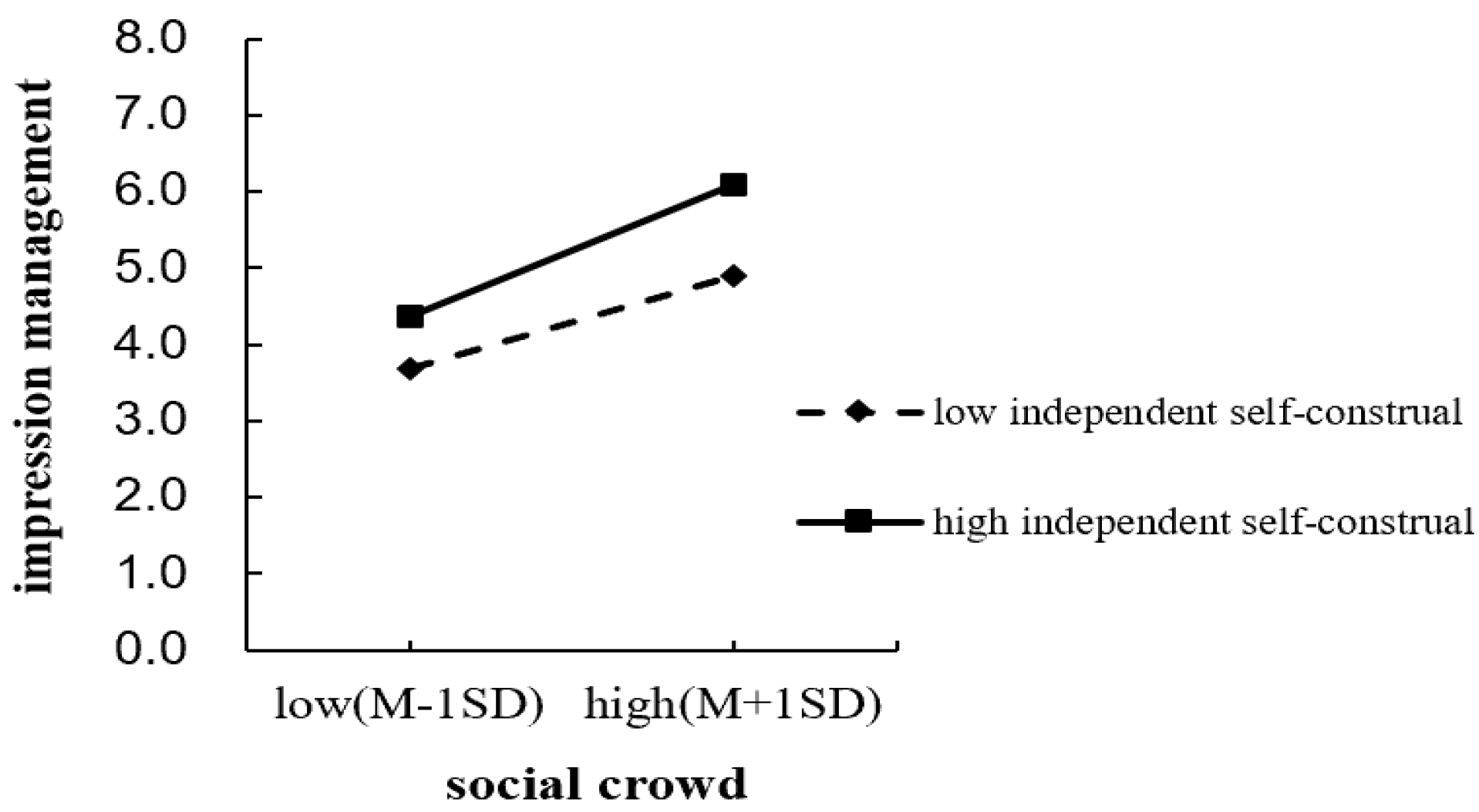
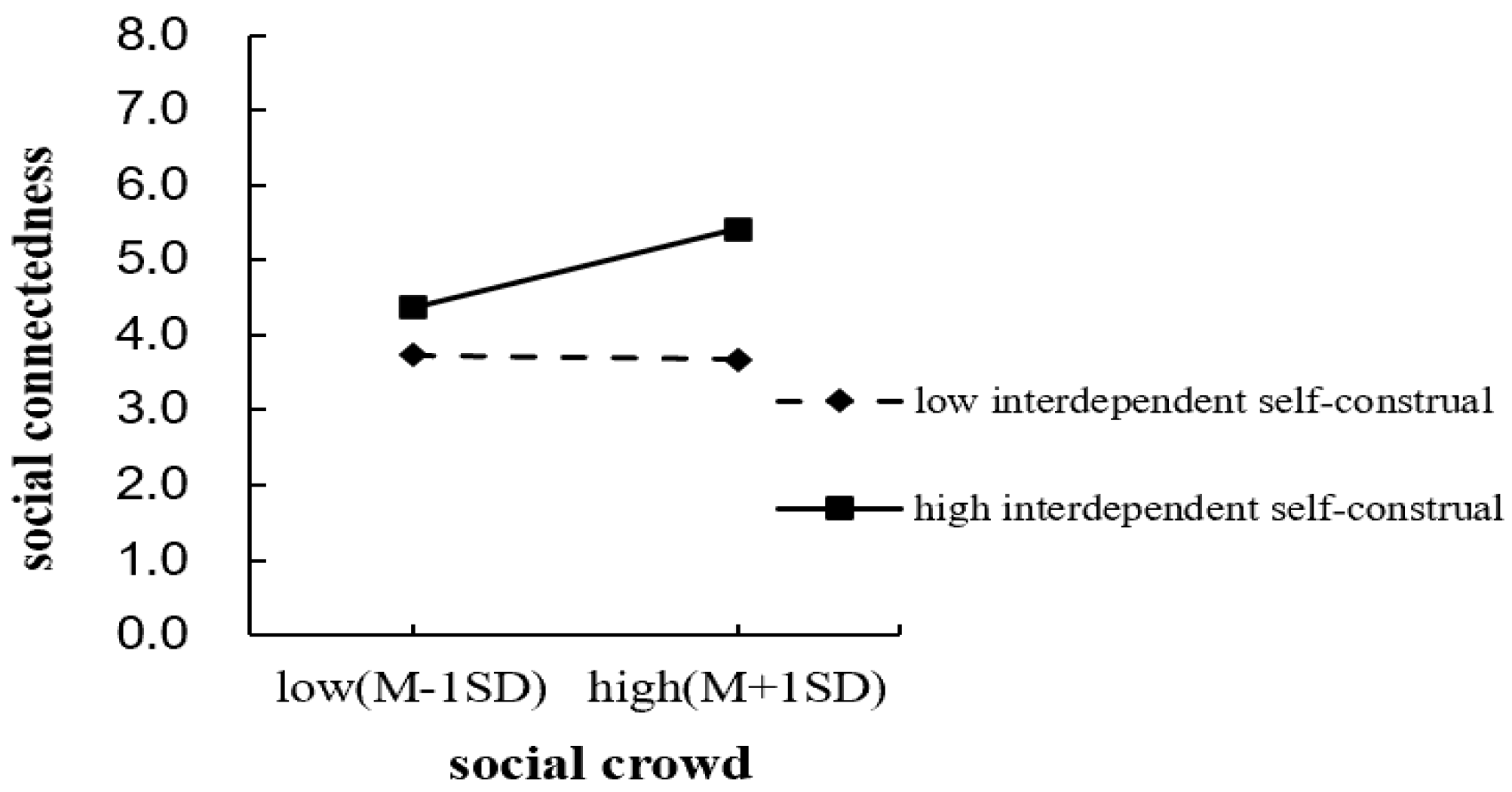
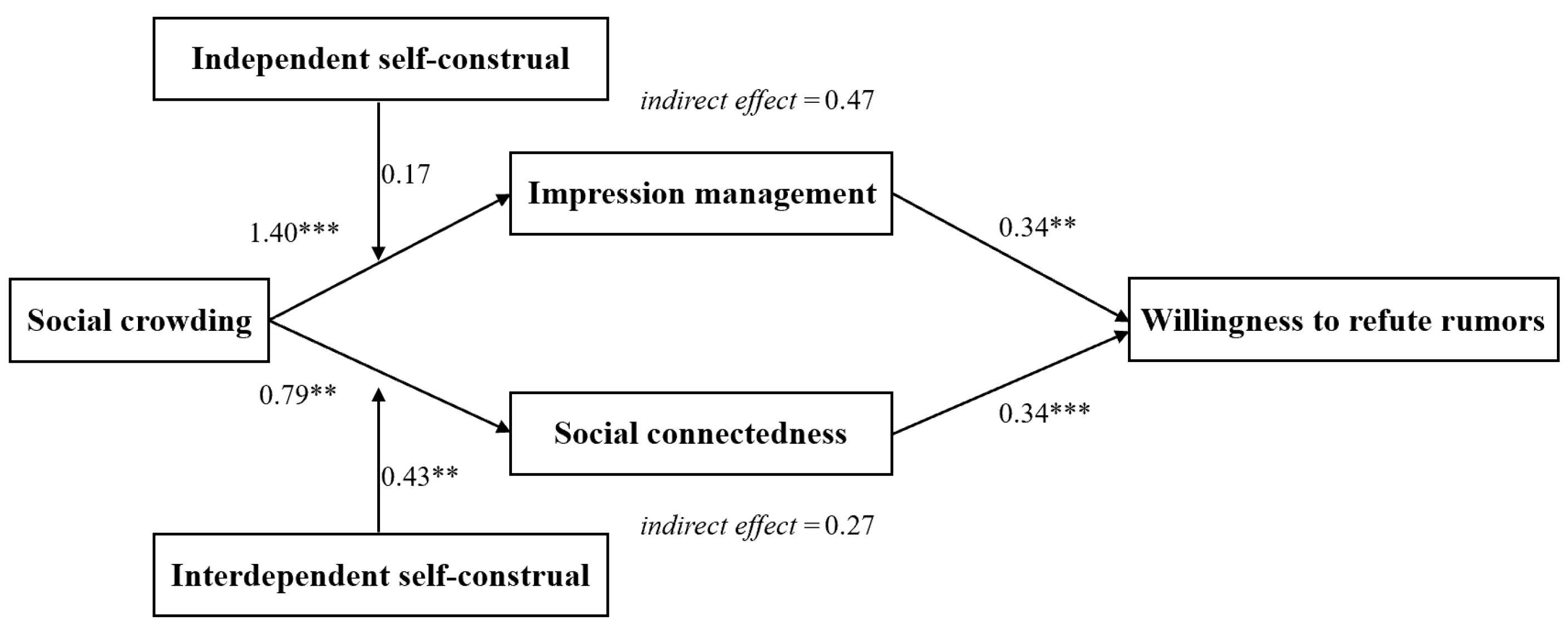
Influence of Social Crowding on Rumor Refutation: The Mediating Effect of Impression Management and Social Connectedness

Abstract
1. Introduction
2. Literature Review
2.1. Rumor Refutation: From the Perspective of the Moral Judgment Analysis Framework
2.2. Social Crowding
2.3. The Mediating Role of Impression Management
2.4. The Mediating Role of Social Connectedness
2.5. The Moderating Role of Self-Construal
2.6. Overview of Studies
3. Study 1
3.1. Method
3.1.1. Participants and Design
3.1.2. Procedure and Materials
3.2. Results
3.3. Discussion
4. Study 2
4.1. Method
4.1.1. Participants and Design
4.1.2. Procedure and Materials
4.2. Results
4.2.1. Manipulation Checks
4.2.2. The Impact of Social Crowding on Willingness to Refute Rumors
4.3. Discussion
5. Study 3
5.1. Method
5.1.1. Participants and Design
5.1.2. Procedure and Materials
5.2. Results
5.2.1. Manipulation Checks
5.2.2. The Impact of Social Crowding on Willingness to Refute Rumors
5.2.3. The Parallel Mediating Effects of Impression Management and Social Connectedness
5.2.4. The Moderating Effects of Self-Construal
5.2.5. The Moderated Mediation Effects
5.3. Discussion
6. General Discussion
6.1. Theoretical Implications
6.2. Practical Implications
6.3. Limitations and Future Research
7. Conclusions
Author Contributions
Funding
Institutional Review Board Statement
Informed Consent Statement
Data Availability Statement
Conflicts of Interest
References
- Allport, G. W. (1954). The nature of prejudice. Addison-Wesley. [Google Scholar]
- Andrews, M., Luo, X., Fang, Z., & Ghose, A. (2015). Mobile ad effectiveness: Hyper-contextual targeting with crowdedness. Marketing Science, 35(2), 218–233. [Google Scholar] [CrossRef]
- Aron, A., Aron, E. N., & Smollan, D. (1992). Inclusion of other in the self scale and the structure of interpersonal closeness. Journal of Personality and Social Psychology, 63(4), 596–612. [Google Scholar] [CrossRef]
- Baum, A., & Koman, S. (1976). Differential response to anticipated crowding: Psychological effects of social and spatial density. Journal of Personality and Social Psychology, 34(3), 526–536. [Google Scholar] [CrossRef]
- Baumeister, R. F. (1982). A self-presentational view of social phenomena. Psychological Bulletin, 10, 3–26. [Google Scholar] [CrossRef]
- Brewer, M. B., & Gardner, W. (1996). Who is this “we”? Levels of collective identity and self representations. Journal of Personality and Social Psychology, 71(1), 83–93. [Google Scholar] [CrossRef]
- Brown, J., & Smart, S. A. (1991). The self and social conduct: Linking self-representations to prosocial behavior. Journal of Personality and Social Psychology, 60(3), 368–375. [Google Scholar] [CrossRef]
- Campbell, J. D. (1990). Self-esteem and clarity of the self-concept. Journal of Personality and Social Psychology, 59(3), 538–549. [Google Scholar] [CrossRef]
- Chao, F., Zhou, Q., Yu, G., & Sun, Y. (2025). Punishing evil and promoting good: The moderating role of subject reputation in the effect of emotion on sharing debunking information. Humanities and Social Sciences Communications, 12, 1413. [Google Scholar] [CrossRef]
- Consiglio, I., De Angelis, M., & Costabile, M. (2018). The effect of social density on word of mouth. Journal of Consumer Research, 45(3), 511–528. [Google Scholar] [CrossRef]
- De Groot, J. I. M., & Steg, L. (2010). Relationships between value orientations, self-determined motivational types and pro-environmental behavioural intentions. Journal of Environmental Psychology, 30(4), 368–378. [Google Scholar] [CrossRef]
- Desor, A. (1972). Toward a psychological theory of crowding. Journal of Personality and Social Psychology, 21(1), 79–83. [Google Scholar] [CrossRef]
- de Souza e Silva, A. (2006). From cyber to hybrid: Mobile technologies as interfaces of hybrid spaces. Space and Culture, 9(3), 261–278. [Google Scholar] [CrossRef]
- Eroglu, S. A., Machleit, K., & Barr, T. F. (2005). Perceived retail crowding and shopping satisfaction: The role of shopping values. Journal of Business Research, 58(8), 1146–1153. [Google Scholar] [CrossRef]
- Evans, G. W., Lepore, S. J., & Allen, K. M. (2000). Cross-cultural differences in tolerance for crowding: Fact or fiction? Journal of Personality and Social Psychology, 79(2), 204. [Google Scholar] [CrossRef] [PubMed]
- Gilovich, T., Medvec, V. H., & Savitsky, K. (2000). The spotlight effect in social judgment: An egocentric bias in estimates of the salience of one’s own actions and appearance. Journal of Personality and Social Psychology, 78(2), 211–222. [Google Scholar] [CrossRef]
- Ha, Y., & Lee, Y. (2016). Effects of spatial crowding on store loyalty: Roles of store size. Universal Journal of Psychology, 4(3), 123–131. [Google Scholar] [CrossRef]
- Hall, E. T. (1966). The hidden dimension. Doubleday. [Google Scholar]
- Harrell, G. D., Hutt, M. D., & Anderson, J. C. (1980). Path analysis of buyer behavior under conditions of crowding. Journal of Marketing Research, 17(1), 45–51. [Google Scholar] [CrossRef]
- He, W., & Wei, K. (2009). What drives continued knowledge sharing? an investigation of knowledge-contribution and -seeking beliefs. Decision Support Systems, 46(4), 826–838. [Google Scholar] [CrossRef]
- Hock, S. J., & Bagchi, R. (2018). The impact of crowding on calorie consumption. Journal of Consumer Research, 44(5), 1123–1140. [Google Scholar] [CrossRef]
- Huang, X., Huang, Z. Q., & Wyer, R. S. (2018). The influence of social crowding on brand attachment. Journal of Consumer Research, 44(5), 1068–1084. [Google Scholar] [CrossRef]
- Hui, M. K. M., & Bateson, J. E. G. (1990). Testing a theory of crowding in the service environment. Advances in Consumer Research, 17(1), 866–873. [Google Scholar]
- Humphreys, L. (2013). Mobile social media: Future challenges and opportunities. Mobile Media & Communication, 1(1), 20–25. [Google Scholar] [CrossRef]
- Kacmar, K. M., Delery, J. E., & Ferris, G. R. (1992). Differential effectiveness of applicant impression management tactics on employment interview decisions. Journal of Applied Social Psychology, 22(16), 1250–1272. [Google Scholar] [CrossRef]
- Kim, A., Moravec, P. L., & Dennis, A. R. (2019). Combating fake news on social media with source ratings: The effects of user and expert reputation ratings. Journal of Management Information Systems, 36(3), 931–968. [Google Scholar] [CrossRef]
- Kristofferson, K., White, K., & Peloza, J. (2014). The nature of slacktivism: How the social observability of an initial act of token support affects subsequent prosocial action. Journal of Consumer Research, 40(6), 1149–1166. [Google Scholar] [CrossRef]
- Lalwani, A. K., & Shavitt, S. (2009). The “me” I claim to be: Cultural self-construal elicits self-presentational goal pursuit. Journal of Personality and Social Psychology, 97(1), 88–102. [Google Scholar] [CrossRef] [PubMed]
- Lazer, D. M. J., Baum, M. A., Benkler, Y., Berinsky, A. J., Greenhill, K. M., Menczer, F., Nyhan, B., Pennycook, G., Rothschild, D., Schudson, M., Sloman, S. A., Sunstein, C. R., Thorson, E. A., Watts, D. J., & Zittrain, J. L. (2018). The science of fake news. Science, 359(6380), 1094–1096. [Google Scholar] [CrossRef]
- Lee, R. M., & Robbins, S. B. (1995). Measuring belongingness: The social connectedness and the social assurance scales. Journal of Counseling Psychology, 42(2), 232–241. [Google Scholar] [CrossRef]
- Li, J. G. T., Kim, J. O., & Lee, S. Y. (2009). An empirical examination of perceived retail crowding, emotions, and retail outcomes. The Service Industries Journal, 29(5), 635–652. [Google Scholar] [CrossRef]
- Lim, J. S. (2017). The third-person effect of online advertising of cosmetic surgery: A path model for predicting restrictive versus corrective actions. Journalism & Mass Communication Quarterly, 94(4), 972–993. [Google Scholar] [CrossRef]
- Liu, C. J., & Li, S. (2009). Contextualized self: When the self runs into social dilemmas. International Journal of Psychology, 44(6), 451–458. [Google Scholar] [CrossRef]
- Machleit, K. A., Kellaris, J. J., & Eroglu, S. A. (1994). Human versus spatial dimensions of crowding perceptions in retail environments: A note on their measurement and effect on shopper satisfaction. Marketing Letters, 5(2), 183–194. [Google Scholar] [CrossRef]
- Maeng, A., Tanner, R. J., & Soman, D. (2013). Conservative when crowded: Social crowding and consumer choice. Journal of Marketing Research, 50(6), 739–752. [Google Scholar] [CrossRef]
- Markus, H. R., & Kitayama, S. (1991). Culture and the self: Implications for cognition, emotion, and motivation. Psychological Review, 98(2), 224–253. [Google Scholar] [CrossRef]
- McClintock, C. G., & Allison, S. T. (1989). Social value orientation and helping behavior. Journal of Applied Social Psychology, 19(89), 353–362. [Google Scholar] [CrossRef]
- McGrew, P. L. (1970). Social and spatial density effects of spacing behavior in preschool children. Journal of Child Psychology and Psychiatry, 11(3), 197–205. [Google Scholar] [CrossRef]
- Morrison, K. R., & Johnson, C. S. (2011). When what you have is who you are: Self-uncertainty leads individualists to see themselves in their possessions. Personality and Social Psychology Bulletin, 37(5), 639–651. [Google Scholar] [CrossRef]
- O’Guinn, T. C., Tanner, R. J., & Maeng, A. (2015). Turning to space: Social density, social class, and the value of things in stores. Journal of Consumer Research, 42(2), 196–213. [Google Scholar] [CrossRef]
- Paek, H., & Hove, T. (2019). Mediating and moderating roles of trust in government in effective risk rumor management: A test case of Radiation-Contaminated seafood in South Korea. Risk Analysis, 39(12), 2653–2667. [Google Scholar] [CrossRef]
- Pennycook, G., & Rand, D. G. (2019). Fighting misinformation on social media using crowdsourced judgments of news source quality. Proceedings of the National Academy of Sciences, 116(7), 2521–2526. [Google Scholar] [CrossRef]
- Puzakova, M., & Kwak, H. (2017). Should anthropomorphized brands engage customers? The impact of social crowding on brand preferences. Journal of Marketing, 81(6), 99–115. [Google Scholar] [CrossRef]
- Sarraf, S., Kushwaha, A. K., Kar, A. K., Dwivedi, Y. K., & Giannakis, M. (2024). How did online misinformation impact stockouts in the e-commerce supply chain during COVID-19—A mixed methods study. International Journal of Production Economics, 267, 109064. [Google Scholar] [CrossRef]
- Shen, M. Q., Wang, H. Z., & Hu, G. M. (2019). A literature review and prospects of social crowding research in marketing. Foreign Economics & Management, 41(3), 85–97. [Google Scholar]
- Sng, O., Neuberg, S. L., Varnum, M. E. W., & Kenrick, D. T. (2017). The crowded life is a slow life: Population density and life history strategy. Journal of Personality and Social Psychology, 112(5), 736–754. [Google Scholar] [CrossRef]
- Sripada, C. (2016). Self-expression: A deep self theory of moral responsibility. Philosophical Studies, 173(5), 1203–1232. [Google Scholar] [CrossRef]
- Stieler, M., & Germelmann, C. C. (2016). The ties that bind us: Feelings of social connectedness in socio-emotional experiences. The Journal of Consumer Marketing, 33(6), 397–407. [Google Scholar] [CrossRef]
- Stokols, D. (1972). On the distinction between density and crowding: Some implications for future research. Psychological Review, 79(3), 275–277. [Google Scholar] [CrossRef] [PubMed]
- Sturmer, S., Snyder, M., Kropp, A., & Siem, B. (2006). Empathy-motivated helping: The moderating role of group membership. Personality and Social Psychology Bulletin, 32(7), 943–956. [Google Scholar] [CrossRef] [PubMed]
- Sun, Y., Chia, S. C., Lu, F., & Oktavianus, J. (2022). The battle is on: Factors that motivate people to combat anti-vaccine misinformation. Health Communication, 37(3), 327–336. [Google Scholar] [CrossRef]
- Tan, Q., Zhan, Y., Gao, S., Fan, W., Chen, J., & Zhong, Y. (2015). Closer the relatives are, more intimate and similar we are: Kinship effects on self-other overlap. Personality and Individual Differences, 73, 7–11. [Google Scholar] [CrossRef]
- Tang, Z., Miller, A. S., Zhou, Z., & Warkentin, M. (2022). Understanding rumor combating behavior on social media. The Journal of Computer Information Systems, 62(6), 1112–1124. [Google Scholar] [CrossRef]
- Utz, S. (2004). Self-construal and cooperation: Is the interdependent self more cooperative than the independent self? Self and Identity, 3(3), 177–190. [Google Scholar] [CrossRef]
- van Rompay, T. J. L., Galetzka, M., Pruyn, A. T. H., & Garcia, J. M. (2008). Human and spatial dimensions of retail density: Revisiting the role of perceived control. Psychology & Marketing, 25(4), 319–335. [Google Scholar] [CrossRef]
- Vosoughi, S., Roy, D., & Aral, S. (2018). The spread of true and false news online. Science, 359(6380), 1146–1151. [Google Scholar] [CrossRef]
- Wang, Y., Ma, S., & Li, D. (2015). Customer participation in virtual brand communities: The self-construal perspective. Information & Management, 52(5), 577–587. [Google Scholar] [CrossRef]
- Wang, Y., Tang, Y., Zuo, J., & Bartsch, K. (2022). Exploring rumor combating behavior of social media on NIMBY conflict: Temporal modes, frameworks and strategies. Environmental Impact Assessment Review, 96, 106839. [Google Scholar] [CrossRef]
- Watson, D., Clark, L. A., & Tellegen, A. (1988). Development and validation of brief measures of positive and negative affect: The PANAS scales. Journal of Personality and Social Psychology, 54(6), 1063. [Google Scholar] [CrossRef]
- Watson, J., Wilson, E., & Hagiliassis, N. (2017). Supporting end of life decision making: Case studies of relational closeness in supported decision making for people with severe or profound intellectual disability. Journal of Applied Research in Intellectual Disabilities, 30(6), 1022–1034. [Google Scholar] [CrossRef]
- Worchel, S., & Teddlie, C. (1976). The experience of crowding: A two-factor theory. Journal of Personality and Social Psychology, 34(1), 30–40. [Google Scholar] [CrossRef]
- Xu, J., Shen, H., & Wyer, R. S. (2012). Does the distance between us matter? Influences of physical proximity to others on consumer choice. Consumer Psychology, 22(3), 418–423. [Google Scholar] [CrossRef]
- Zhang, M., & Wang, J. (2009). Psychological distance asymmetry: The spatial dimension vs. other dimensions. Journal of Consumer Psychology, 19(3), 497–507. [Google Scholar] [CrossRef]
- Zhao, L., Yin, J., & Song, Y. (2016). An exploration of rumor combating behavior on social media in the context of social crises. Computers in Human Behavior, 58, 25–36. [Google Scholar] [CrossRef]


Disclaimer/Publisher’s Note: The statements, opinions and data contained in all publications are solely those of the individual author(s) and contributor(s) and not of MDPI and/or the editor(s). MDPI and/or the editor(s) disclaim responsibility for any injury to people or property resulting from any ideas, methods, instructions or products referred to in the content. |
© 2026 by the authors. Licensee MDPI, Basel, Switzerland. This article is an open access article distributed under the terms and conditions of the Creative Commons Attribution (CC BY) license.
Share and Cite
Sun, Z.; Yuan, M.; Xuan, H.; Ni, W.; Zhang, L. Influence of Social Crowding on Rumor Refutation: The Mediating Effect of Impression Management and Social Connectedness. Behav. Sci. 2026, 16, 803. https://doi.org/10.3390/bs16050803
Sun Z, Yuan M, Xuan H, Ni W, Zhang L. Influence of Social Crowding on Rumor Refutation: The Mediating Effect of Impression Management and Social Connectedness. Behavioral Sciences. 2026; 16(5):803. https://doi.org/10.3390/bs16050803
Chicago/Turabian StyleSun, Zhaoyang, Mengchan Yuan, Haolin Xuan, Wan Ni, and Li Zhang. 2026. "Influence of Social Crowding on Rumor Refutation: The Mediating Effect of Impression Management and Social Connectedness" Behavioral Sciences 16, no. 5: 803. https://doi.org/10.3390/bs16050803
APA StyleSun, Z., Yuan, M., Xuan, H., Ni, W., & Zhang, L. (2026). Influence of Social Crowding on Rumor Refutation: The Mediating Effect of Impression Management and Social Connectedness. Behavioral Sciences, 16(5), 803. https://doi.org/10.3390/bs16050803