The Role of Social Media Interaction in Developing Intercultural Digital Communication Competence: A Systematic Literature Review

Abstract
1. Introduction
2. Theoretical Framework
3. Methodology
3.1. Review Design and Protocol
3.2. Data Sources and Search Strategy
3.3. Inclusion and Exclusion Criteria
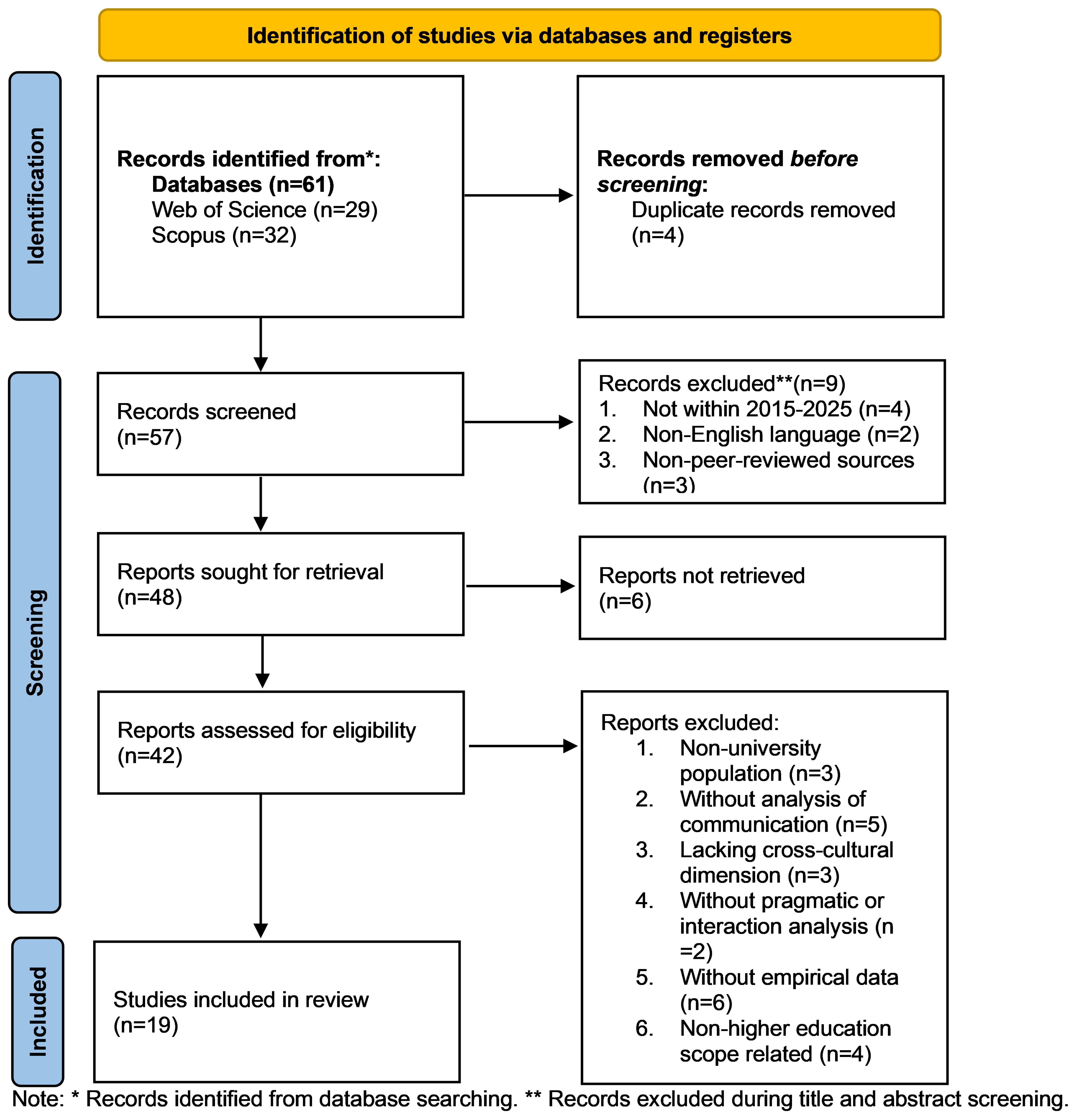
3.4. Study Selection and Screening Process
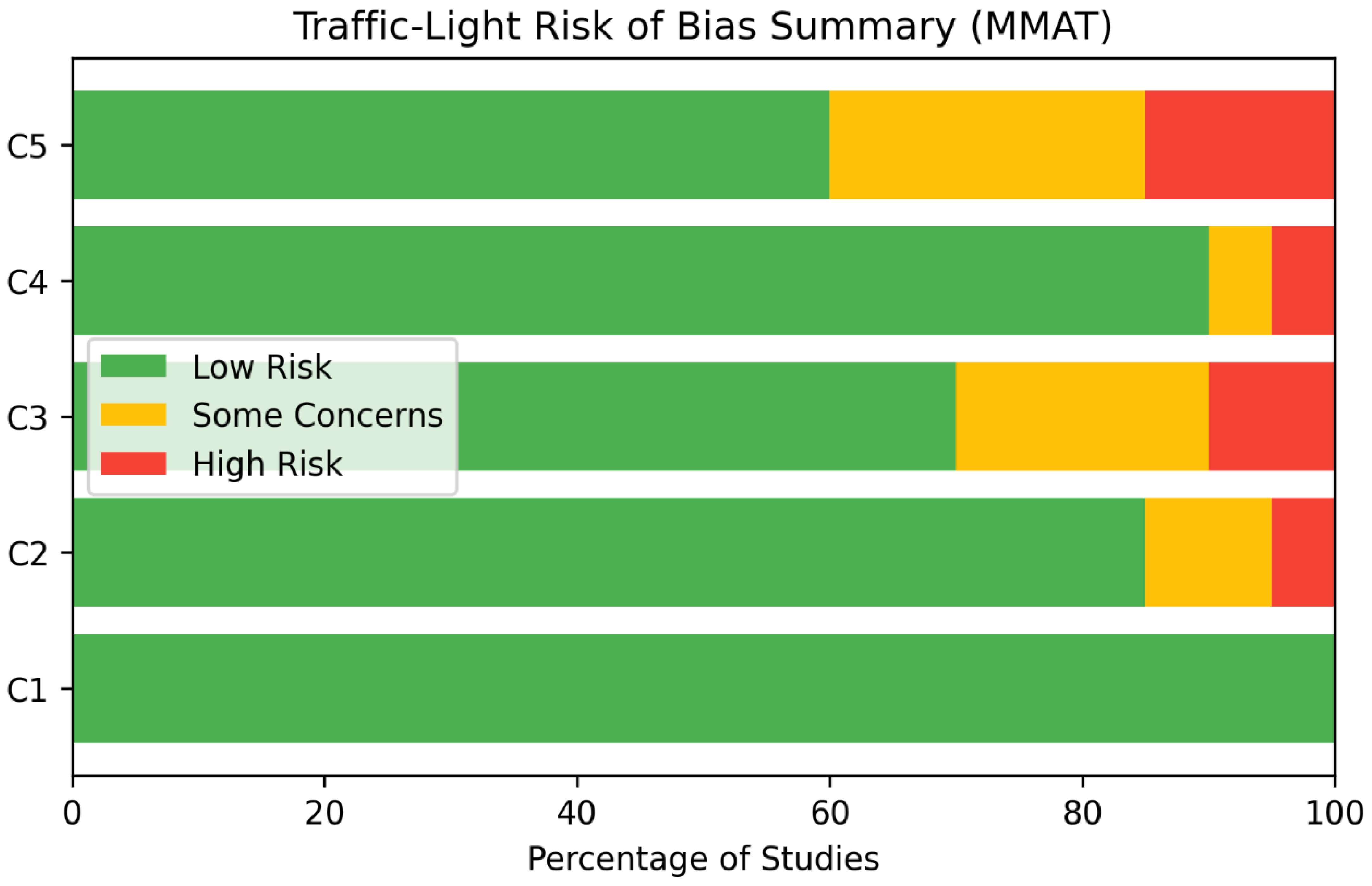
3.5. Quality Assessment
4. Results
4.1. Descriptive Overview of Research Trends (RQ1–RQ3)
4.1.1. Research Development and Disciplinary Orientation (RQ1)
4.1.2. Cultural Contexts and Interactional Settings (RQ1)
4.1.3. Participant Characteristics and Educational Settings (RQ1)
4.1.4. Digital Platforms and Communication Modalities (RQ1 & RQ3)
4.1.5. Methodological Approaches and Analytical Focus (RQ1)
4.1.6. Outcome Measures and Competence Dimensions (RQ2 & RQ3)
4.2. Thematic Synthesis (RQ2 & RQ3)
4.2.1. Social Media as Environments for Behavioral Adaptation (RQ2)
4.2.2. Micro-Pragmatic and Multimodal Features as Behavioral Resources (RQ2)
4.2.3. Instructional Support as a Mechanism for Behavioral Change (RQ3)
4.2.4. Affective Processes and Engagement in Interaction (RQ3)
5. Discussion
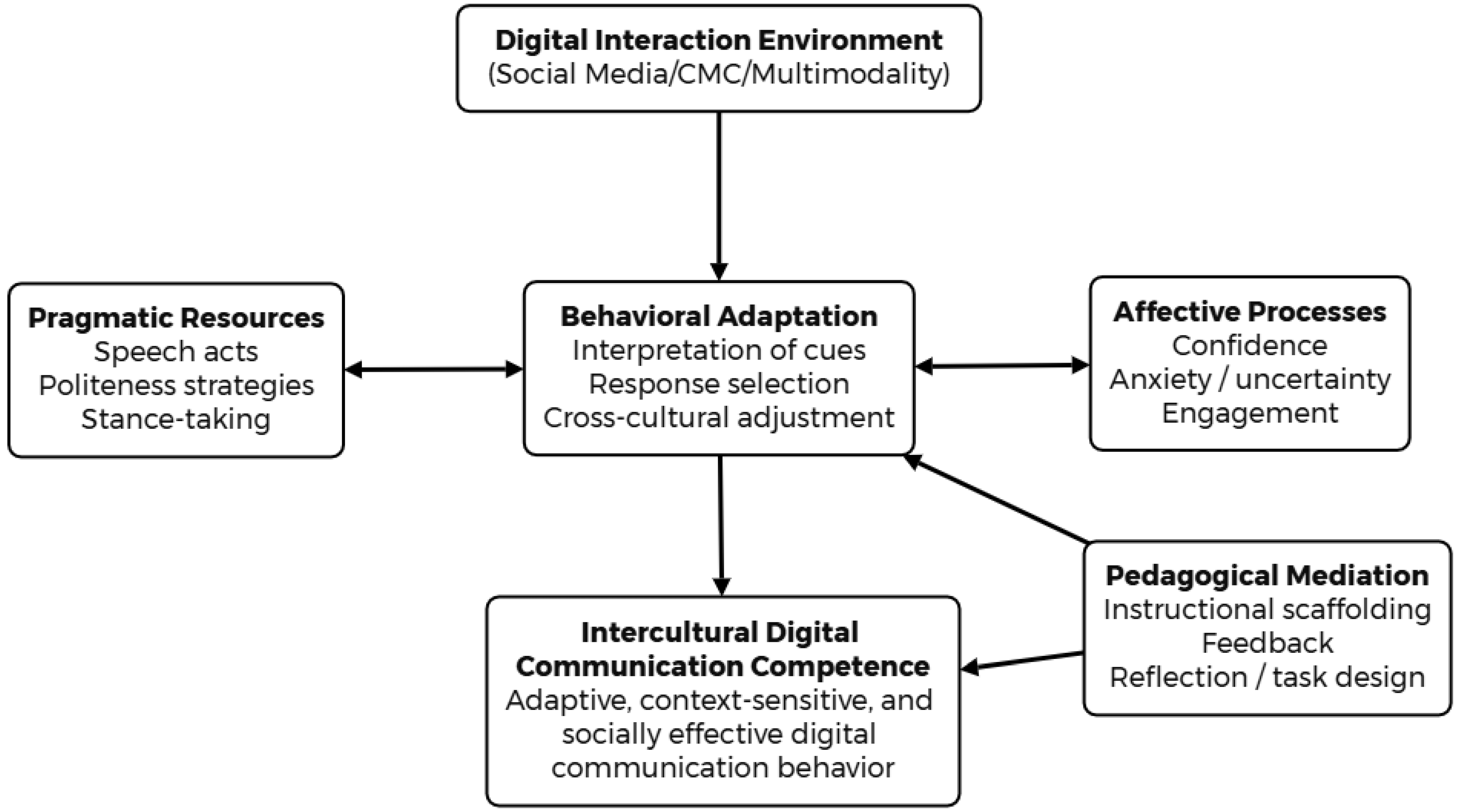
5.1. Intercultural Digital Communication as Situated and Adaptive Behavior
5.2. Micro-Pragmatics and Multimodal Features as Behavioral Signals
5.3. The Role of Pedagogical Mediation in Shaping Behavior
5.4. Affective Processes and Participation in Intercultural Interaction
5.5. Technology, Feedback, and the Future of Communication Training
5.6. Limitations and Tensions in Digital Intercultural Interaction
5.7. Geographical Distribution and Generalizability of Findings
6. Conclusions
6.1. Summary of Key Findings
6.2. Implications for Higher Education and Existing Models
6.3. Directions for Future Research
6.4. Concluding Remarks
Author Contributions
Funding
Institutional Review Board Statement
Informed Consent Statement
Data Availability Statement
Conflicts of Interest
References
- Alghasab, M., & Alvarez-Ayure, C. P. (2023). Towards the promotion of intercultural competences: Telecollaborative conversations between Kuwaiti and Colombian English as a foreign language university students. Computer Assisted Language Learning, 36(4), 555–583. [Google Scholar] [CrossRef] [Scilit]
- Al-Rahmi, A. M., Shamsuddin, A., Wahab, E., Al-Rahmi, W. M., Alismaiel, O. A., & Crawford, J. (2022). Social media usage and acceptance in higher education: A structural equation model. Frontiers in Education, 7, 964456. [Google Scholar] [CrossRef] [Scilit]
- Alzahrani, F., & Elshemy, R. (2023). Digitally mediated communication of emojis by visually impaired users: The case of sarcastic WhatsApp messages. Journal of Intercultural Communication, 23, 58–65. [Google Scholar] [CrossRef] [Scilit]
- Andrienko, T., Genin, V., & Kozubska, I. (2021). Developing intercultural business competence via team learning in post-pandemic era. Advanced Education, 8(18), 53–69. [Google Scholar] [CrossRef] [Scilit]
- Bardis, B., Silman, F., & Mohammadzadeh, B. (2021). Cross-cultural pragmatic competence in an EFL context for a sustainable learning environment: A case of Northern Cyprus. Sustainability, 13(18), 10346. [Google Scholar] [CrossRef] [Scilit]
- Basantes-Andrade, A., Bastidas-Amador, G., Ruiz-Chagna, C., Congo-Cervantes, M., & Quintana-Andrade, G. (2025). Integración de tecnologías digitales en la Enseñanza de competencias interculturales: Mapeo sistemático de la literatura. F1000Research, 14, 772. [Google Scholar] [CrossRef] [Scilit]
- Benz, A., Ebert, C., Jäger, G., & Rooij, R. v. (2011). Language, games, and evolution: An introduction (pp. 1–13). Springer. [Google Scholar] [CrossRef] [Scilit]
- Blyth, C. S. (2018). Immersive technologies and language learning. Foreign Language Annals, 51(1), 225–232. [Google Scholar] [CrossRef] [Scilit]
- Brown, P., & Levinson, S. C. (1987). Politeness: Some universals in language usage. Cambridge University Press. [Google Scholar] [CrossRef] [Scilit]
- Burgess, A., Roberts, C., Lane, S., Haq, I. U., Clark, T., Kalman, E., Pappalardo, N., & Bleasel, J. (2021). Peer review in team-based learning: Influencing feedback literacy. BMC Medical Education, 21(1), 426. [Google Scholar] [CrossRef] [Scilit] [PubMed]
- Butow, P., & Hoque, E. (2020). Using artificial intelligence to analyse and teach communication in healthcare. The Breast, 50, 49–55. [Google Scholar] [CrossRef] [Scilit]
- Chan, K. S., & Zary, N. (2019). Applications and challenges of implementing artificial intelligence in medical education: Integrative review. Jmir Medical Education, 5(1), e13930. [Google Scholar] [CrossRef] [Scilit]
- Chen, X., & Feng, S. (2023). Exploring the relationships between social presence and teaching presence in online video-based learning. Journal of Computer Assisted Learning, 39(6), 1769–1785. [Google Scholar] [CrossRef] [Scilit]
- Deardorff, D. K. (2006). Identification and assessment of intercultural competence as a student outcome of internationalization. Journal of Studies in International Education, 10(3), 241–266. [Google Scholar] [CrossRef] [Scilit]
- Diaz, M. A., Lau, K., & Lin, C. Y. (2020). Pragmatic functions of I think in computer-mediated, cross-cultural communication between Taiwanese and Japanese undergraduate students. Pragmatics, 30(4), 510–533. [Google Scholar] [CrossRef] [Scilit]
- Fatima, A., Akhter, M. S., Kanekar, A., Roy, S., Mitra, R. B., Imade, B., & Sharma, M. (2025). A scoping review of the use and determinants of social media among college students. Healthcare, 13(17), 2234. [Google Scholar] [CrossRef] [Scilit] [PubMed]
- Fountoulakis, M. S. (2024). Evaluating the impact of AI tools on language proficiency and intercultural communication in second language education. International Journal of Second and Foreign Language Education, 3(1), 12–26. [Google Scholar] [CrossRef] [Scilit]
- Fuchs, C. (2020). “Soy estudiante de ingles:)”—A telecollaborative approach to intercultural and ethnographic engagement in a Hong Kong university course. JALT CALL Journal, 16(1), 3–27. [Google Scholar] [CrossRef] [Scilit]
- Garcia, M. M. R., Burns, L. V. F., & Sánchez, M. J. N. (2019, November 7–9). The learning design for mediation training through online environments: Getting to the fifth language skill. 16th International Conference on Cognition and Exploratory Learning in Digital Age (CELDA 2019), Cagliari, Italy. [Google Scholar] [CrossRef] [Scilit]
- Ghorbanzadeh, D., & Sharbatiyan, M. (2024). The role of website features in creating value co-creation behaviors and enhancing the brand image and reputation of higher education institutions. Interactive Technology and Smart Education, 21(1), 21–43. [Google Scholar] [CrossRef] [Scilit]
- Gorokhovskaya, N. A. (2024). Model of formation of communicative competences of students-programmers in the process of joint activity. Siberian Pedagogical Journal, 79(2), 93–105. [Google Scholar] [CrossRef] [Scilit]
- Gosak, L., Štiglic, G., Cilar, L., Félix, I. B., Braam, K. I., Fijačko, N., Guerreiro, M. P., & Lorber, M. (2021). Digital tools in behavior change support education in health and other students: A systematic review. Healthcare, 10(1), 1. [Google Scholar] [CrossRef] [Scilit]
- Greenhow, C., Galvin, S., Brandon, D. L., & Askari, E. (2020). A decade of research on K–12 teaching and teacher learning with social media: Insights on the state of the field. Teachers College Record: The Voice of Scholarship in Education, 122(6), 1–72. [Google Scholar] [CrossRef] [Scilit]
- Grondin, F., Lomanowska, A. M., & Jackson, P. L. (2019). Empathy in computer-mediated interactions: A conceptual framework for research and clinical practice. Clinical Psychology: Science and Practice, 26(4), 17. [Google Scholar] [CrossRef] [Scilit]
- Gutiérrez-Santiuste, E., & Ritacco-Real, M. (2023). Intercultural communicative competence in higher education through telecollaboration: Typology and development. Education and Information Technologies, 28(11), 13885–13912. [Google Scholar] [CrossRef] [Scilit] [PubMed]
- Handford, M., Maele, J. V., Matouš, P., & Maemura, Y. (2019). Which “culture”? A critical analysis of intercultural communication in engineering education. Journal of Engineering Education, 108(2), 161–177. [Google Scholar] [CrossRef] [Scilit]
- Hansen, M., Fabriz, S., & Stehle, S. (2015). Cultural cues in students’ computer-mediated communication: Influences on e-mail style, perception of the sender, and willingness to help. Journal of Computer-Mediated Communication, 20(3), 278–294. [Google Scholar] [CrossRef] [Scilit]
- Hong, Q. N., Fàbregues, S., Bartlett, G., Boardman, F., Cargo, M., Dagenais, P., Gagnon, M. P., Griffiths, F., Nicolau, B., O’Cathain, A., Rousseau, M.-C., Vedel, I., & Pluye, P. (2018). The Mixed Methods Appraisal Tool (MMAT) version 2018 for information professionals and researchers. Education for Information, 34(4), 285–291. [Google Scholar] [CrossRef] [Scilit]
- Hosseini, S., Deng, X., Miyake, Y., & Nozawa, T. (2021). Encouragement of turn-taking by real-time feedback impacts creative idea generation in dyads. IEEE Access, 9, 57976–57988. [Google Scholar] [CrossRef] [Scilit]
- Idris, M. M., & Widyantoro, A. (2019). Intercultural Communicative Competence (ICC): What should Indonesian EFL teachers have related to ICC’s elements? Journal of English Language Teaching and Linguistics, 4(1), 67. [Google Scholar] [CrossRef] [Scilit]
- Ismailov, M. (2021). Virtual exchanges in an inquiry-based learning environment: Effects on intra-cultural awareness and intercultural communicative competence. Cogent Education, 8(1), 1982601. [Google Scholar] [CrossRef] [Scilit]
- Kimura, T. (2024). The role of strategic communication and sensemaking in implementing management innovation. Qualitative Research in Organizations and Management: An International Journal, 19(4), 282–308. [Google Scholar] [CrossRef] [Scilit]
- Koivumäki, K., & Wilkinson, C. (2022). “One might tweet just for money”: Organisational and institutional incentives for researchers’ social media communication and public engagement practices. Studies in Communication Sciences, 22, 471–491. [Google Scholar] [CrossRef] [Scilit]
- Kousar, A., Memon, S., & Simming, I. A. (2020). The pragmatic analysis of emojis by ESL learners in verbal modalities: A case study of Whatsapp chat. International Journal of Computer Science and Network Security, 20(10), 199–205. [Google Scholar] [CrossRef]
- Kwayu, S. (2021). Social media ecosystem and its influence on small business strategic practices. IntechOpen. [Google Scholar] [CrossRef] [Scilit]
- Lang-Rigal, J., & Galarreta-Aima, D. (2019, November 11–13). Improving students’ confidence in speaking a second language: Using talkabroad [videoconference with native speakers] in Spanish courses. 12th International Conference of Education, Research and Innovation (ICERI 2019), Seville, Spain. [Google Scholar]
- Li, Q. (2023). Investigating second language request strategies by a Chinese undergraduate student majoring in business English. Theory and Practice in Language Studies, 13(4), 1048–1056. [Google Scholar] [CrossRef] [Scilit]
- Liang, M. Y. (2024). Contingent (dis)agreement and emotional expressiveness in online responsive discourse. Journal of Pragmatics, 219, 58–68. [Google Scholar] [CrossRef] [Scilit]
- Liu, T., Ungar, L., Curtis, B., Sherman, G., Yadeta, K., Tay, L., Eichstaedt, J. C., & Guntuku, S. C. (2022). Head versus heart: Social media reveals differential language of loneliness from depression. NPJ Mental Health Research, 1(1), 16. [Google Scholar] [CrossRef] [Scilit] [PubMed]
- Lu, X., Balakrishnan, K., Chan, T. J., & Na, M. (2025). The role of real-time engagement in shaping social media check-in behavior: Moderating effects of trust and peer influence. Brain and Behavior, 15(9), e70887. [Google Scholar] [CrossRef] [Scilit]
- Ma, G., & Yang, X. (2025). Fostering intercultural competence through AI-driven tools: A case study of linguistic and cultural adaptability in Chinese EFL education. Digital Technologies Research and Applications, 4(1), 158–169. [Google Scholar] [CrossRef] [Scilit]
- Malyndra, D., Drajatı, N. A., & Asrori, M. (2020). Students’ willingness to communicate in extramural English activities in digital EFL context: A narrative inquiry. Edulangue, 3(1), 49–68. [Google Scholar] [CrossRef] [Scilit]
- Mosly, I. (2024). Artificial intelligence’s opportunities and challenges in engineering curricular design: A combined review and focus group study. Societies, 14(6), 89. [Google Scholar] [CrossRef] [Scilit]
- Mukadam, A. S., Suresh, S., & Jacobs, C. (2025). Beyond traditional simulation: An exploratory study on the effectiveness and acceptability of ChatGPT-4o advanced voice mode for communication skills practice among medical students. Cureus, 17, e84381. [Google Scholar] [CrossRef] [Scilit]
- Najafi, K., Shahim, A., & Noori, M. (2024). Relationship between willingness to communicate (WTC) and writing ability among Afghanistan EFL learners. Integrated Journal for Research in Arts and Humanities, 4(1), 64–67. [Google Scholar] [CrossRef] [Scilit]
- Page, M. J., McKenzie, J. E., Bossuyt, P. M., Boutron, I., Hoffmann, T., Mulrow, C. D., Shamseer, L., Tetzlaff, J., Akl, E. A., Brennan, S., Chou, R., Glanville, J., Grimshaw, J., Hróbjartsson, A., Lalu, M. M., Li, T., Loder, E., Mayo-Wilson, E., McDonald, S., … Moher, D. (2021). The PRISMA 2020 statement: An updated guideline for reporting systematic reviews. BMJ, 372, n71. [Google Scholar] [CrossRef] [Scilit]
- Pikhart, M., & Klímová, B. (2020). eLearning 4.0 as a sustainability strategy for generation Z language learners: Applied linguistics of second language acquisition in younger adults. Societies, 10(2), 38. [Google Scholar] [CrossRef] [Scilit]
- Qi, C. (2018). Social media usage of students, role of tie strength, and perceived task performance. Journal of Educational Computing Research, 57(2), 385–416. [Google Scholar] [CrossRef] [Scilit]
- Rajagopal, K., Firssova, O., Beeck, I. O. d., Stappen, E. V. d., Stoyanov, S., Henderikx, P., & Buchem, I. (2020). Learner skills in open virtual mobility. Research in Learning Technology, 28, 1–18. [Google Scholar] [CrossRef] [Scilit]
- Rajan, S. K. (2025). Pratixa: A cognitive framework for behavioral decision-making and its mathematical formalization. Futures & Foresight Science, 7(3), 1–12. [Google Scholar] [CrossRef] [Scilit]
- Roshid, M. M., & Chowdhury, R. (2023). Power dynamics in business English as a lingua franca discourse. Business and Professional Communication Quarterly, 87(3), 432–461. [Google Scholar] [CrossRef] [Scilit]
- Sato, T. (2020). The formation of subjectivity in Asian students in Japanese higher education. Turkish Online Journal of Qualitative Inquiry, 11(4), 436–457. [Google Scholar] [CrossRef] [Scilit]
- Shadiev, R., Chen, X., Reynolds, B. L., Song, Y., & Altınay, F. (2024a). Facilitating cognitive development and addressing stereotypes with a cross-cultural learning activity supported by interactive 360-degree video technology. British Journal of Educational Technology, 55(6), 2668–2696. [Google Scholar] [CrossRef] [Scilit]
- Shadiev, R., Sintawati, W., Kerimbayev, N., & Altınay, F. (2024b). Systematic review (2003–2023): Exploring technology-supported cross-cultural learning through review studies. Sustainability, 16(2), 755. [Google Scholar] [CrossRef] [Scilit]
- Shobirin, A., Leastari, D. C., Nuzula, F., & Umeidah, F. (2018). The use of social media for engineering lecturers and students. Bulletin of Social Informatics Theory and Application, 2(2), 73–78. [Google Scholar] [CrossRef] [Scilit]
- Smith, G. (2024). The role of pragmatics in cross-cultural communication. European Journal of Linguistics, 3(1), 13–24. [Google Scholar] [CrossRef] [Scilit]
- Tariq, U., Sarfraz, S., & Abbas, A. (2020). Digital media users and Facebook hashtags’ misinterpretations. Online Information Review, 44(6), 1183–1198. [Google Scholar] [CrossRef] [Scilit]
- Taylor, E., & Hignett, S. (2014). Evaluating evidence: Defining levels and quality using critical appraisal mixed methods tools. Herd Health Environments Research & Design Journal, 7(3), 144–151. [Google Scholar] [CrossRef] [Scilit]
- Wei, L. (2024). Relationship among perceived teacher support, academic self-efficacy, and online learning engagement in college EFL learning. Open Journal of Modern Linguistics, 14(3), 290–314. [Google Scholar] [CrossRef]
- Wilmot, N. V., Vigier, M., & Humonen, K. (2023). Language as a source of otherness. International Journal of Cross Cultural Management, 24(1), 59–80. [Google Scholar] [CrossRef] [Scilit]
- Wongsuban, S., Kewara, P., & Namfah, N. (2024). Promoting intercultural competence through different versions of Cinderella stories for Thai high school students. Reflections, 31(2), 815–836. [Google Scholar] [CrossRef] [Scilit]
- Xia, Y., Shin, S.-Y., & Kim, J.-C. (2024). Cross-Cultural Intelligent Language Learning System (CILS): Leveraging AI to facilitate language learning strategies in cross-cultural communication. Applied Sciences, 14(13), 5651. [Google Scholar] [CrossRef] [Scilit]
- Yoshida, R. (2020). Emotional scaffolding in text chats between Japanese language learners and native Japanese speakers. Foreign Language Annals, 53(3), 505–526. [Google Scholar] [CrossRef] [Scilit]
- Zhang, Y. (2021). Combining computer-mediated communication with data-driven instruction: EFL learners’ pragmatic development of compliment responses. System, 103, 102624. [Google Scholar] [CrossRef] [Scilit]
- Zhang, Y. (2023). The influence of game-enhanced communication on EFL learners’ pragmatic competence in compliment responses. Applied Linguistics, 46(1), 110–127. [Google Scholar] [CrossRef] [Scilit]
- Zhang, Y. (2024). The influence of practice contexts on L2 learners’ compliment responses: Telecollaborative video-based practice versus face-to-face practice. Computer Assisted Language Learning, 37(7), 2174–2201. [Google Scholar] [CrossRef] [Scilit]
- Zhang, Y. (2025). The bidirectionality of pragmatic transfer in Chinese English language learners’ compliment responses: The effects of second language proficiency. Language Learning, 75(3), 898–929. [Google Scholar] [CrossRef] [Scilit]



| Database | Search String |
|---|---|
| Scopus | TITLE-ABS-KEY (“social media” OR Instagram OR Facebook OR Twitter OR TikTok OR WeChat OR “computer-mediated communication” OR “digital communication”) AND TITLE-ABS-KEY (intercultural OR “cross-cultural” OR multicultural OR “second language” OR L2) AND TITLE-ABS-KEY (pragmatic* OR politeness OR “speech act*” OR compliment* OR “face work”) AND TITLE-ABS-KEY (“higher education” OR universit* OR “college student*” OR undergraduat* OR postgraduat*) |
| Web of Science (Core Collection) | TS = (“social media” OR Instagram OR Facebook OR Twitter OR TikTok OR WeChat OR “computer-mediated communication” OR “digital communication”) AND TS = (intercultural OR “cross-cultural” OR multicultural OR “second language” OR L2) AND TS = (pragmatic* OR politeness OR “speech act*” OR compliment* OR “face work”) AND TS = (“higher education” OR universit* OR “college student*” OR undergraduat* OR postgraduat*) |
| Criteria | Inclusion | Exclusion |
|---|---|---|
| Population | Focused on higher education students. | Non-university populations |
| Context | Examined communication occurring in social media or computer-mediated environments | Without an analysis of communication |
| Cultural Scope | Addressed cross-cultural or intercultural dimensions of communication | Lacking a cross-cultural dimension |
| Focus of Analysis | Investigated pragmatic or interactional features | Without pragmatic or interactional analysis |
| Study Design | Reported empirical findings | Without empirical data |
| Educational Scope | Related to higher education or learning contexts | Non-higher education related |
| Publication Type | Peer-reviewed sources | Non-peer-reviewed sources |
| Language | English | Non-English |
| Study (Author, Year) | Study Type | Criteria Met (Out of 5) | Quality Level |
|---|---|---|---|
| (Fuchs, 2020) | Qualitative | 5/5 | High |
| (Zhang, 2021) | Quantitative | 5/5 | High |
| (Liang, 2024) | Qualitative | 4/5 | High |
| (Hansen et al., 2015) | Quantitative | 5/5 | High |
| (Tariq et al., 2020) | Quantitative | 3/5 | Medium |
| (Pikhart & Klímová, 2020) | Quantitative | 3/5 | Medium |
| (Yoshida, 2020) | Qualitative | 4/5 | High |
| (Lang-Rigal & Galarreta-Aima, 2019) | Quantitative | 3/5 | Medium |
| (Li, 2023) | Qualitative | 4/5 | High |
| (Diaz et al., 2020) | Qualitative | 5/5 | High |
| (Alghasab & Alvarez-Ayure, 2023) | Mixed Methods | 5/5 | High |
| (Ismailov, 2021) | Quantitative | 4/5 | High |
| (Zhang, 2025) | Quantitative | 5/5 | High |
| (Sato, 2020) | Qualitative | 4/5 | High |
| (Zhang, 2023) | Quantitative | 5/5 | High |
| (Zhang, 2024) | Quantitative | 5/5 | High |
| (Kousar et al., 2020) | Qualitative | 3/5 | Medium |
| (Ghorbanzadeh & Sharbatiyan, 2024) | Quantitative | 3/5 | Medium |
| (Gutiérrez-Santiuste & Ritacco-Real, 2023) | Mixed Methods | 4/5 | High |
| Articles | Platform/Technology | Pragmatic Focus | Educational Outcomes |
|---|---|---|---|
| (Fuchs, 2020) | Intercultural engagement, discourse norms | Informal learning of intercultural and pragmatic awareness | |
| (Zhang, 2021) | Text-based CMC, data-driven instruction | Compliment responses | Improved pragmatic appropriateness & strategy diversity |
| (Liang, 2024) | Facebook discussions | (Dis)agreement, emotional expressiveness | Enhanced stance awareness and relational alignment |
| (Hansen et al., 2015) | Email-based CMC | Politeness cues, style alignment | Cultural cues influenced perception & willingness to interact |
| (Tariq et al., 2020) | Pragmatic ambiguity, interpretation | Raised awareness of pragmatic misinterpretation online | |
| (Pikhart & Klímová, 2020) | AI-enhanced eLearning systems | Digital interaction expectations | Highlighted the need for intelligent communication support |
| (Yoshida, 2020) | Text chat | Socio-affective scaffolding | Improved engagement and interaction quality |
| (Lang-Rigal & Galarreta-Aima, 2019) | Video-based virtual exchange | Oral interaction, confidence | Reduced anxiety and increased speaking confidence |
| (Li, 2023) | Request strategies, pragmatic transfer | Revealed culturally influenced pragmatic patterns | |
| (Diaz et al., 2020) | Text-based CMC | Stance-taking, mitigation | Improved awareness of pragmatic softening |
| (Alghasab & Alvarez-Ayure, 2023) | Telecollaborative discussions | Intercultural competence | Pedagogical mentoring enhanced intercultural interaction |
| (Ismailov, 2021) | Inquiry-based virtual exchange | Intra- and intercultural communication | Increased engagement and intercultural confidence |
| (Zhang, 2025) | Online interaction tasks | Bidirectional pragmatic transfer | Demonstrated language influence in digital contexts |
| (Sato, 2020) | Social media, interviews | Identity and subjectivity | Supported reflective intercultural awareness |
| (Zhang, 2023) | Messaging tools | Compliment responses in gaming | Game-mediated interaction supported pragmatic development |
| (Zhang, 2024) | Telecollaborative video vs. face-to-face | Compliment responses | outperformed face-to-face practice |
| (Kousar et al., 2020) | Emoji use and pragmatic meaning | Emojis functioned as culturally situated pragmatic cues | |
| (Ghorbanzadeh & Sharbatiyan, 2024) | University websites, social platforms | Engagement and interaction value | Platform features shaped communicative engagement |
| (Gutiérrez-Santiuste & Ritacco-Real, 2023) | Videoconferencing/telecollaboration | Intercultural communication behavior | Development of behavioral, and cognitive dimensions of intercultural competence |
| Included Articles | Distribution of the Study Population |
|---|---|
| (Gutiérrez-Santiuste & Ritacco-Real, 2023) | Spain |
| (Zhang, 2025) | China |
| (Sato, 2020) | Japan |
| (Zhang, 2023) | China |
| (Zhang, 2024) | China |
| (Kousar et al., 2020) | Pakistan |
| (Ghorbanzadeh & Sharbatiyan, 2024) | Iran |
| (Alghasab & Alvarez-Ayure, 2023) | Kuwait VS. Colombia |
| (Ismailov, 2021) | Japan |
| (Fuchs, 2020) | China |
| (Zhang, 2021) | China |
| (Liang, 2024) | International |
| (Hansen et al., 2015) | International |
| (Tariq et al., 2020) | International |
| (Pikhart & Klímová, 2020) | International |
| (Yoshida, 2020) | Japan |
| (Lang-Rigal & Galarreta-Aima, 2019) | International |
| (Li, 2023) | China |
| (Diaz et al., 2020) | International |
| Theme | Core Focus | Representative Studies |
|---|---|---|
| Theme 1 | Social Media as Environments for Behavioral Adaptation | (Fuchs, 2020), (Liang, 2024), (Diaz et al., 2020), (Alghasab & Alvarez-Ayure, 2023), (Ismailov, 2021), (Sato, 2020), (Ghorbanzadeh & Sharbatiyan, 2024) |
| Theme 2 | Micro-Pragmatic and Multimodal Features | (Liang, 2024), (Li, 2023), (Diaz et al., 2020), (Zhang, 2023), (Zhang, 2024), (Kousar et al., 2020), (Zhang, 2025) |
| Theme 3 | Instructional Support for Behavioral Change | (Zhang, 2021), (Alghasab & Alvarez-Ayure, 2023), (Ismailov, 2021), (Zhang, 2023), (Zhang, 2024), (Ghorbanzadeh & Sharbatiyan, 2024), (Gutiérrez-Santiuste & Ritacco-Real, 2023) |
| Theme 4 | Affective Processes and Engagement in Interaction | (Yoshida, 2020), (Lang-Rigal & Galarreta-Aima, 2019), (Ismailov, 2021), (Zhang, 2023), (Zhang, 2024) |
Disclaimer/Publisher’s Note: The statements, opinions and data contained in all publications are solely those of the individual author(s) and contributor(s) and not of MDPI and/or the editor(s). MDPI and/or the editor(s) disclaim responsibility for any injury to people or property resulting from any ideas, methods, instructions or products referred to in the content. |
© 2026 by the authors. Licensee MDPI, Basel, Switzerland. This article is an open access article distributed under the terms and conditions of the Creative Commons Attribution (CC BY) license.
Share and Cite
Zhang, C.; Husain, S.; Mamat, R. The Role of Social Media Interaction in Developing Intercultural Digital Communication Competence: A Systematic Literature Review. Behav. Sci. 2026, 16, 794. https://doi.org/10.3390/bs16050794
Zhang C, Husain S, Mamat R. The Role of Social Media Interaction in Developing Intercultural Digital Communication Competence: A Systematic Literature Review. Behavioral Sciences. 2026; 16(5):794. https://doi.org/10.3390/bs16050794
Chicago/Turabian StyleZhang, Chenxi, Salina Husain, and Roslina Mamat. 2026. "The Role of Social Media Interaction in Developing Intercultural Digital Communication Competence: A Systematic Literature Review" Behavioral Sciences 16, no. 5: 794. https://doi.org/10.3390/bs16050794
APA StyleZhang, C., Husain, S., & Mamat, R. (2026). The Role of Social Media Interaction in Developing Intercultural Digital Communication Competence: A Systematic Literature Review. Behavioral Sciences, 16(5), 794. https://doi.org/10.3390/bs16050794