


Imagining the Future Aged Self Reduces Ageism: The Role of Self–Other Overlap and the Moderating Effect of Gain–Loss Framing

Abstract
1. Introduction
1.1. Ageism: Scope, Manifestations, and Consequences
1.2. The Temporal Nature of Ageism and Future-Self Perspective Taking
1.3. Welfare Trade-Offs and Contextual Moderation: Gain Versus Loss
2. Study 1
2.1. Materials and Methods
2.1.1. Participants
2.1.2. Materials
2.1.3. Procedures
Demographics and Baseline Measures
Perspective-Taking Manipulation
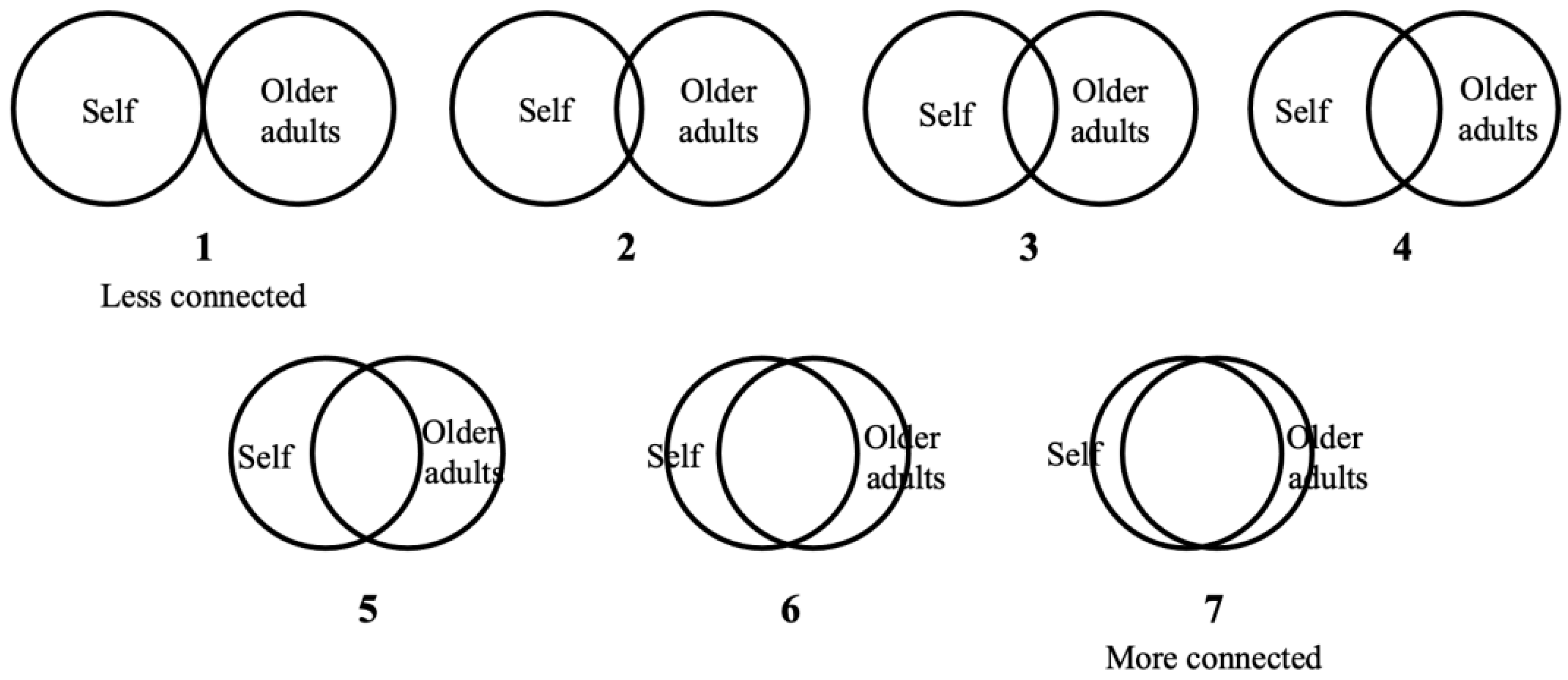
Manipulation Check
Dictator Game
Debriefing
2.1.4. Data Analyses
2.2. Results and Discussion
2.2.1. Manipulation Check: IOS
2.2.2. Baseline Equivalence: Kogan OP and IRI
2.2.3. Dictator Game
3. Study 2
3.1. Materials and Methods
3.1.1. Participants
3.1.2. Materials
3.1.3. Procedures
Demographics and Baseline Measures
Perspective-Taking Manipulation
Manipulation Check
Future Contact Intention
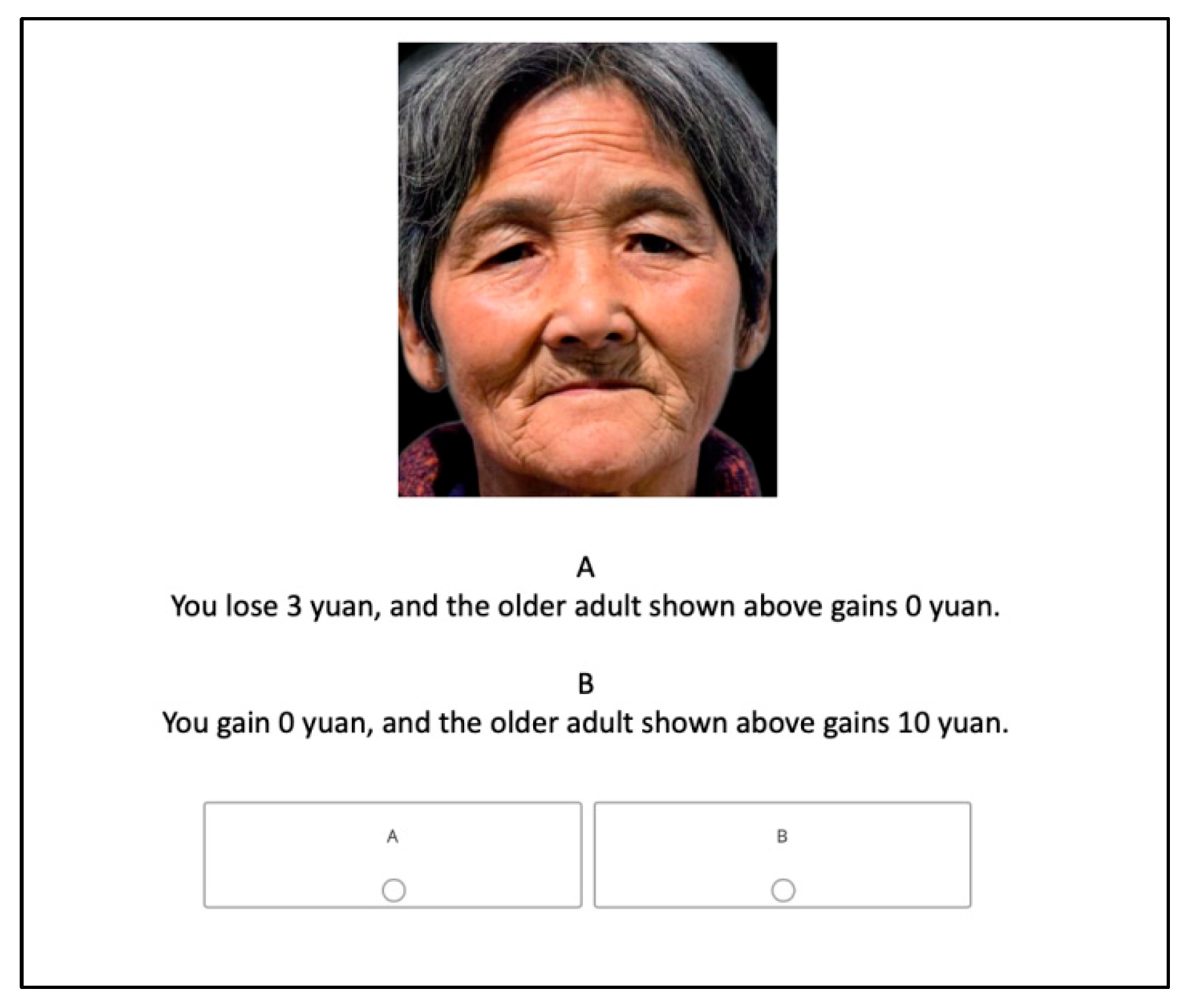
Welfare Trade-Off Task
Debriefing
3.1.4. Data Analyses
3.2. Results and Discussion
3.2.1. Manipulation Check: IOS and Future Contact Intention
3.2.2. Baseline Equivalence: Kogan OP, IRI, and IAT
3.2.3. Welfare Trade-Off Task
4. General Discussion
4.1. Possible Psychological Pathways Linking the Self to Ageism-Related Prosocial Outcomes
4.2. Contextual Moderators of Future-Self Interventions
4.3. Theoretical and Practical Implications
4.3.1. Theoretical Implications
4.3.2. Practical Implications
4.4. Limitations and Future Directions
5. Conclusions
Author Contributions
Funding
Institutional Review Board Statement
Informed Consent Statement
Data Availability Statement
Acknowledgments
Conflicts of Interest
References
- Aron, A., Lewandowski, G. W., Jr., Mashek, D., & Aron, E. N. (2013). The self-expansion model of motivation and cognition in close relationships. In J. A. Simpson, & L. Campbell (Eds.), The Oxford handbook of close relationships (pp. 90–115). Oxford University Press. [Google Scholar]
- Aron, A., Mashek, D., & Aron, E. N. (2004). The inclusion of other in the self scale and the structure of interpersonal closeness. In G. J. Fletcher, & M. S. Clark (Eds.), Interpersonal cognition (pp. 27–36). Guilford Press. [Google Scholar]
- Ayalon, L. (2020). There is nothing new under the sun: Ageism and intergenerational tension in the age of the COVID-19 outbreak. International Psychogeriatrics, 32(10), 1221–1224. [Google Scholar] [CrossRef]
- Bartels, D. M., & Rips, L. J. (2010). Psychological connectedness and intertemporal choice. Journal of Experimental Psychology: General, 139(1), 49. [Google Scholar] [CrossRef] [PubMed]
- Bates, D., Mächler, M., Bolker, B., & Walker, S. (2015). Fitting linear mixed-effects models using lme4. Journal of Statistical Software, 67(1), 1–48. [Google Scholar] [CrossRef]
- Ben-Ner, A., McCall, B. P., Stephane, M., & Wang, H. (2009). Identity and in-group/out-group differentiation in work and giving behaviors: Experimental evidence. Journal of Economic Behavior & Organization, 72(1), 153–170. [Google Scholar] [CrossRef]
- Bernstein, R. E., Laurent, S. M., Nelson, B. W., & Laurent, H. K. (2015). Perspective-taking induction mitigates the effect of partner attachment avoidance on self–partner overlap. Personal Relationships, 22(2), 356–367. [Google Scholar] [CrossRef]
- Bodner, E. (2009). On the origins of ageism among older and younger adults. International Psychogeriatrics, 21(6), 1003–1014. [Google Scholar] [CrossRef] [PubMed]
- Brown, R. (2011). Prejudice: Its social psychology (2nd ed.). Wiley-Blackwell. [Google Scholar]
- Burnes, D., Sheppard, C., Henderson, C. R., Jr., Wassel, M., Cope, R., Barber, C., & Pillemer, K. (2019). Interventions to reduce ageism against older adults: A systematic review and meta-analysis. American Journal of Public Health, 109(8), e1–e9. [Google Scholar] [CrossRef]
- Chang, E. S., Kannoth, S., Levy, S., Wang, S. Y., Lee, J. E., & Levy, B. R. (2020). Global reach of ageism on older persons’ health: A systematic review. PLoS ONE, 15(1), e0220857. [Google Scholar] [CrossRef]
- Chen, Z., & Zhang, X. (2022). We were all once young: Reducing hostile ageism from younger adults’ perspective. Frontiers in Psychology, 13, 793373. [Google Scholar] [CrossRef]
- Christian, J., Turner, R., Holt, N., Larkin, M., & Cotler, J. H. (2014). Does intergenerational contact reduce ageism: When and how contact interventions actually work? Journal of Arts and Humanities, 3(1), 1–15. [Google Scholar]
- Cialdini, R. B., Brown, S. L., Lewis, B. P., Luce, C., & Neuberg, S. L. (1997). Reinterpreting the empathy–altruism relationship: When one into one equals oneness. Journal of Personality and Social Psychology, 73(3), 481–494. [Google Scholar] [CrossRef]
- Cuddy, A. J. C., & Fiske, S. T. (2002). Doddering but dear: Process, content, and function in stereotyping of older persons. In T. D. Nelson (Ed.), Ageism: Stereotyping and prejudice against older persons (pp. 3–26). MIT Press. [Google Scholar]
- Cuddy, A. J. C., Fiske, S. T., & Glick, P. (2007). The BIAS map: Behaviors from intergroup affect and stereotypes. Journal of Personality and Social Psychology, 92(4), 631–648. [Google Scholar] [CrossRef]
- Cuddy, A. J. C., Norton, M. I., & Fiske, S. T. (2005). This old stereotype: The pervasiveness and persistence of the elderly stereotype. Journal of Social Issues, 61(2), 267–285. [Google Scholar] [CrossRef]
- Curotto, P. C., Sander, D., d’Argembeau, A., & Klimecki, O. (2022). Back to the future: A way to increase prosocial behavior. PLoS ONE, 17(8), e0272340. [Google Scholar] [CrossRef]
- Davis, M. H. (1980). A multidimensional approach to individual differences in empathy. JSAS Catalog of Selected Documents in Psychology, 10, 85. [Google Scholar]
- Delton, A. W. (2010). A psychological calculus for welfare tradeoffs [Doctoral dissertation, University of California, Santa Barbara]. [Google Scholar]
- Delton, A. W., & Robertson, T. E. (2016). How the mind makes welfare tradeoffs: Evolution, computation, and emotion. Current Opinion in Psychology, 7, 12–16. [Google Scholar] [CrossRef]
- Dionigi, R. A. (2015). Stereotypes of aging: Their effects on the health of older adults. Journal of Geriatrics, 2015(1), 954027. [Google Scholar] [CrossRef]
- Dreber, A., Ellingsen, T., Johannesson, M., & Rand, D. G. (2013). Do people care about social context? Framing effects in dictator games. Experimental Economics, 16(3), 349–371. [Google Scholar] [CrossRef]
- Engle-Friedman, M., Tipaldo, J., Piskorski, N., Young, S. G., & Rong, C. (2022). Enhancing environmental resource sustainability by imagining oneself in the future. Journal of Environmental Psychology, 79, 101746. [Google Scholar] [CrossRef]
- Feng, C., Zhang, Y., Zhang, Z., & Yuan, J. (2021). Prosocial gains and losses: Modulations of human social decision-making by loss–gain context. Frontiers in Psychology, 12, 755910. [Google Scholar] [CrossRef] [PubMed]
- Gaesser, B., & Schacter, D. L. (2014). Episodic simulation and episodic memory can increase intentions to help others. Proceedings of the National Academy of Sciences USA, 111(12), 4415–4420. [Google Scholar] [CrossRef]
- Galinsky, A. D., & Moskowitz, G. B. (2000). Perspective-taking: Decreasing stereotype expression, stereotype accessibility, and in-group favoritism. Journal of Personality and Social Psychology, 78(4), 708–724. [Google Scholar] [CrossRef] [PubMed]
- Gao, J., Li, H., & Chen, Y. (2020). The influence of gain–loss context and psychological distance on self–other trade-offs. Acta Psychologica Sinica, 52(9), 1074–1086. [Google Scholar] [CrossRef]
- Green, S. L., & Dorr, N. (2016). Changing attitudes toward older adults through a simulated aging exercise: Implications for family therapy. Women & Therapy, 39(1–2), 69–85. [Google Scholar] [CrossRef]
- Hall, J., Kahn, D. T., Skoog, E., & Öberg, M. (2021). War exposure, altruism and the recalibration of welfare tradeoffs towards threatening social categories. Journal of Experimental Social Psychology, 94, 104101. [Google Scholar] [CrossRef]
- He, D., Workman, C. I., Kenett, Y. N., He, X., & Chatterjee, A. (2021). The effect of aging on facial attractiveness: An empirical and computational investigation. Acta Psychologica, 219, 103385. [Google Scholar] [CrossRef]
- Hershfield, H. E., Cohen, T. R., & Thompson, L. (2012). Short horizons and tempting situations: Lack of continuity to our future selves leads to unethical decision making and behavior. Organizational Behavior and Human Decision Processes, 117(2), 298–310. [Google Scholar] [CrossRef]
- Hewstone, M., Lolliot, S., Swart, H., Myers, E., Voci, A., Al Ramiah, A., & Cairns, E. (2014). Intergroup contact and intergroup conflict. Peace and Conflict: Journal of Peace Psychology, 20(1), 39–53. [Google Scholar] [CrossRef]
- Kahneman, D., & Tversky, A. (1979). Prospect theory: An analysis of decision under risk. Econometrica, 47(2), 263–291. [Google Scholar] [CrossRef]
- Kirkpatrick, M., Delton, A. W., Robertson, T. E., & de Wit, H. (2015). Prosocial effects of MDMA: A measure of generosity. Journal of Psychopharmacology, 29(6), 661–668. [Google Scholar] [CrossRef]
- Kite, M. E., Stockdale, G. D., Whitley, B. E., Jr., & Johnson, B. T. (2005). Attitudes toward younger and older adults: An updated meta-analytic review. Journal of Social Issues, 61(2), 241–266. [Google Scholar] [CrossRef]
- Kite, M. E., & Wagner, L. S. (2002). Attitudes toward older adults. In T. D. Nelson (Ed.), Ageism: Stereotyping and prejudice against older persons (pp. 129–161). The MIT Press. [Google Scholar]
- Koessler, A.-K., Heinz, N., & Engel, S. (2023). Perspective-taking with affected others to promote climate change mitigation. Frontiers in Psychology, 14, 1225165. [Google Scholar] [CrossRef] [PubMed]
- Kogan, N. (1961). Attitudes toward old people: The development of a scale and an examination of correlates. Journal of Abnormal and Social Psychology, 62(1), 44–54. [Google Scholar] [CrossRef]
- Kuznetsova, A., Brockhoff, P. B., & Christensen, R. H. B. (2017). lmerTest package: Tests in linear mixed effects models. Journal of Statistical Software, 82(13), 1–26. [Google Scholar] [CrossRef]
- Law, K. F., Syropoulos, S., Coleman, M., & Young, L. (2025). A future beyond ourselves: Self-oriented prospection predicts increased intergenerational responsibility. Personality and Individual Differences, 233, 112915. [Google Scholar] [CrossRef]
- Lenth, R. V. (2016). Least-squares means: The R package lsmeans. Journal of statistical software, 69(1), 1–33. [Google Scholar] [CrossRef]
- Levitt, S. D., & List, J. A. (2007). What do laboratory experiments measuring social preferences reveal about the real world? Journal of Economic Perspectives, 21(2), 153–174. [Google Scholar] [CrossRef]
- Levy, B. R. (2003). Mind matters: Cognitive and physical effects of aging self-stereotypes. The Journals of Gerontology Series B: Psychological Sciences and Social Sciences, 58(4), P203–P211. [Google Scholar] [CrossRef]
- Levy, B. R. (2009). Stereotype embodiment: A psychosocial approach to aging. Current Directions in Psychological Science, 18(6), 332–336. [Google Scholar] [CrossRef] [PubMed]
- Li, J., Sun, Y., Li, M., Li, H. E., Fan, W., & Zhong, Y. (2020). Social distance modulates prosocial behaviors in the gain and loss contexts: An event-related potential (ERP) study. International Journal of Psychophysiology, 150, 83–91. [Google Scholar] [CrossRef] [PubMed]
- Liu, Y.-E., Yang, W.-L., Ma, Y.-L., While, A., Ye, W.-Q., & Chen, J. (2014). 中文版Kogan老年态度量表的修订研究 [Revision of the Chinese version of the Kogan attitude toward older people scale]. Chinese Nursing Research, 28(21), 2493–2496. [Google Scholar]
- Liu, Z., Ding, D., Zheng, Y., Li, Z., & Xiong, R. (2023). When you were old: Exploring a virtual reality older adults experience simulation system. In 2023 IEEE international conference on systems, man, and cybernetics (SMC) (pp. 3620–3626). IEEE. [Google Scholar] [CrossRef]
- Luo, X., Yu, T., Tan, M., & Zhong, Y. (2024). Impact of empathic concern on prosocial behavior in gain and loss contexts: Evidence from event-related potential. Brain Sciences, 14(4), 400. [Google Scholar] [CrossRef]
- Lytle, A., & Levy, S. R. (2019). Reducing ageism: Education about aging and extended contact with older adults. The Gerontologist, 59(3), 580–588. [Google Scholar] [CrossRef]
- Ma, D. S., Correll, J., & Wittenbrink, B. (2015). The Chicago Face Database: A free stimulus set of faces and norming data. Behavior Research Methods, 47(4), 1122–1135. [Google Scholar] [CrossRef]
- Ma, G., Chen, Z., Zou, W., & Zhang, X. (2024). To help or not: Negative aging stereotypes held by younger adults could promote helping behaviors toward older adults. Current Psychology, 43(2), 1041–1051. [Google Scholar] [CrossRef]
- McCullough, M. E., Kurzban, R., & Tabak, B. A. (2013). Cognitive systems for revenge and forgiveness. Behavioral and Brain Sciences, 36(1), 1–15. [Google Scholar] [CrossRef]
- Monahan, C., Macdonald, J., Lytle, A., Apriceno, M., & Levy, S. R. (2020). COVID-19 and ageism: How positive and negative responses impact older adults and society. American Psychologist, 75(7), 887–896. [Google Scholar] [CrossRef] [PubMed]
- North, M. S., & Fiske, S. T. (2012). An inconvenienced youth? Ageism and its potential intergenerational roots. Psychological Bulletin, 138(5), 982–997. [Google Scholar] [CrossRef]
- North, M. S., & Fiske, S. T. (2013). Act your (old) age: Prescriptive, ageist biases over succession, consumption, and identity. Personality and Social Psychology Bulletin, 39(6), 720–734. [Google Scholar] [CrossRef]
- North, M. S., & Fiske, S. T. (2015). Modern attitudes toward older adults in the aging world: A cross-cultural meta-analysis. Psychological Bulletin, 141(5), 993–1021. [Google Scholar] [CrossRef]
- North, M. S., & Fiske, S. T. (2016). Resource scarcity and prescriptive attitudes generate subtle, intergenerational older-worker exclusion. Journal of Social Issues, 72(1), 122–145. [Google Scholar] [CrossRef]
- Oh, S. Y., Bailenson, J., Weisz, E., & Zaki, J. (2016). Virtually old: Embodied perspective taking and the reduction of ageism under threat. Computers in Human Behavior, 60, 398–410. [Google Scholar] [CrossRef]
- Orne, M. T. (1962). On the social psychology of the psychological experiment: With particular reference to demand characteristics and their implications. American Psychologist, 17(11), 776–783. [Google Scholar] [CrossRef]
- Ortiz-Riomalo, J. F., Koessler, A.-K., & Engel, S. (2021). Inducing perspective-taking for prosocial behaviour in natural resource management. Journal of Environmental Economics and Management, 110, 102513. [Google Scholar] [CrossRef]
- R Core Team. (2023). R: A language and environment for statistical computing [Computer software]. R Foundation for Statistical Computing. Available online: https://www.r-project.org/ (accessed on 1 February 2026).
- Riek, B. M., Mania, E. W., & Gaertner, S. L. (2006). Intergroup threat and outgroup attitudes: A meta-analytic review. Personality and Social Psychology Review, 10(4), 336–353. [Google Scholar] [CrossRef] [PubMed]
- Rilling, J. K., & Sanfey, A. G. (2011). The neuroscience of social decision-making. Annual Review of Psychology, 62(1), 23–48. [Google Scholar] [CrossRef] [PubMed]
- Sassenrath, C., Vorauer, J. D., & Hodges, S. D. (2022). The link between perspective-taking and prosociality—Not as universal as you might think. Current Opinion in Psychology, 44, 94–99. [Google Scholar] [CrossRef] [PubMed]
- Shepherd, B. F., & Brochu, P. M. (2021). How do stereotypes harm older adults? A theoretical explanation for the perpetration of elder abuse and its rise. Aggression and Violent Behavior, 57, 101435. [Google Scholar] [CrossRef]
- Sherif, M. (1966). In common predicament: Social psychology of intergroup conflict and cooperation. Houghton Mifflin. [Google Scholar]
- Shimizu, Y., & Grassi, M. (2022). Negative attitudes toward older adults: Subjective time to become older and “stereotype embodiment theory”-based intervention. Experimental Results, 3, e21. [Google Scholar] [CrossRef]
- Shimizu, Y., Hashimoto, T., & Karasawa, K. (2022). Decreasing anti-elderly discriminatory attitudes: Conducting a ‘stereotype embodiment theory’-based intervention. European Journal of Social Psychology, 52(1), 174–190. [Google Scholar] [CrossRef]
- Simić, A., Sacchi, S., & Perugini, M. (2025). When future leads to a moral present: Future self-relatedness predicts moral judgments and behavior in everyday life. Personality and Social Psychology Bulletin, 51(7), 1240–1258. [Google Scholar] [CrossRef]
- Spaccatini, F., Giovannelli, I., & Pacilli, M. G. (2022). “You are stealing our present”: Younger people’s ageism towards older people predicts attitude towards age-based COVID-19 restriction measures. Journal of Social Issues, 78(4), 769–789. [Google Scholar] [CrossRef]
- Stathi, S., & Crisp, R. J. (2008). Imagining intergroup contact promotes projection to outgroups. Journal of Experimental Social Psychology, 44(4), 943–957. [Google Scholar] [CrossRef]
- Stephan, W. G., & Stephan, C. W. (2000). An integrated threat theory of prejudice. In Reducing prejudice and discrimination (pp. 23–45). Psychology Press. [Google Scholar]
- Su, Y. J., Zhang, H., & Zhang, K. (2012). Social decision-making: The equilibrium between self interest and the interests of others. Journal of Psychological Science, 35(6), 1423–1428. Available online: https://jps.ecnu.edu.cn/EN/Y2012/V35/I6/1423 (accessed on 1 February 2026).
- Sutter, A., Vaswani, M., Denice, P., Choi, K. H., Bouchard, J., & Esses, V. M. (2022). Ageism toward older adults during the COVID-19 pandemic: Intergenerational conflict and support. Journal of Social Issues, 78(4), 815–841. [Google Scholar] [CrossRef]
- Tajfel, H., & Turner, J. C. (1979). An integrative theory of intergroup conflict. In W. G. Austin, & S. Worchel (Eds.), The social psychology of intergroup relations (pp. 33–47). Brooks/Cole. [Google Scholar]
- Tajfel, H., & Turner, J. C. (1986). The social identity theory of intergroup behavior. In S. Worchel, & W. G. Austin (Eds.), Psychology of intergroup relations (pp. 7–24). Nelson-Hall. [Google Scholar]
- Tasdemir, N. (2020). Young group identification and motives as predictors of ageism, aging anxiety, and life satisfaction. The Journal of Genetic Psychology, 181(5), 375–390. [Google Scholar] [CrossRef]
- Thai, S., & Lockwood, P. (2015). Comparing you = comparing me: Social comparisons of the expanded self. Personality and Social Psychology Bulletin, 41(7), 989–1004. [Google Scholar] [CrossRef]
- Tooby, J., Cosmides, L., Sell, A., Lieberman, D., & Sznycer, D. (2008). Internal regulatory variables and the design of human motivation: A computational and evolutionary approach. In A. J. Elliot (Ed.), Handbook of approach and avoidance motivation (pp. 251–271). Lawrence Erlbaum Associates. [Google Scholar]
- Turner, R. N., Hewstone, M., Voci, A., Paolini, S., & Christ, O. (2007). Reducing prejudice via direct and extended cross-group friendship. European Review of Social Psychology, 18(1), 212–255. [Google Scholar] [CrossRef]
- Van Gelder, J.-L., Hershfield, H., & Nordgren, L. F. (2013). Vividness of the future self predicts delinquency. Psychological Science, 24, 974–980. [Google Scholar] [CrossRef]
- Vorauer, J. D. (2013). The case for and against perspective-taking. In M. P. Zanna, & J. M. Olson (Eds.), Advances in experimental social psychology (Vol. 48, pp. 59–115). Academic Press. [Google Scholar] [CrossRef]
- Wang, C. S., Tai, K., Ku, G., & Galinsky, A. D. (2014). Perspective-taking increases willingness to engage in intergroup contact. PLoS ONE, 9(1), e85681. [Google Scholar] [CrossRef]
- Wen, F., Ke, W., He, S., Zuo, B., Li, L., & Ma, S. (2022). The effect of group identity shifting on impression updating in older adults: The mediating role of common ingroup identity. Acta Psychologica Sinica, 54(9), 1059. [Google Scholar] [CrossRef]
- Wlodarczyk, A., Basabe, N., & Bobowik, M. (2014). The perception of realistic and symbolic threat and its influence on prejudice, ingroup favouritism and prosocial response: The native population in the face of immigration. Revista de Psicología Social, 29(1), 60–89. [Google Scholar] [CrossRef]
- Workman, C. I., Humphries, S., Hartung, F., Aguirre, G. K., Kable, J. W., & Chatterjee, A. (2021). Morality is in the eye of the beholder: The neurocognitive basis of “the anomalous-is-bad” stereotype. Annals of the New York Academy of Sciences, 1494(1), 3–17. [Google Scholar] [CrossRef]
- World Health Organization. (2025). Ageing and health. Available online: https://www.who.int/news-room/fact-sheets/detail/ageing-and-health (accessed on 1 February 2026).
- Zhong, Y., Yang, Z., & Fan, W. (2015). The effects of self-other overlap on helping behavior: Moderating of perspective taking. Acta Psychologica Sinica, 47(8), 1050. [Google Scholar] [CrossRef]
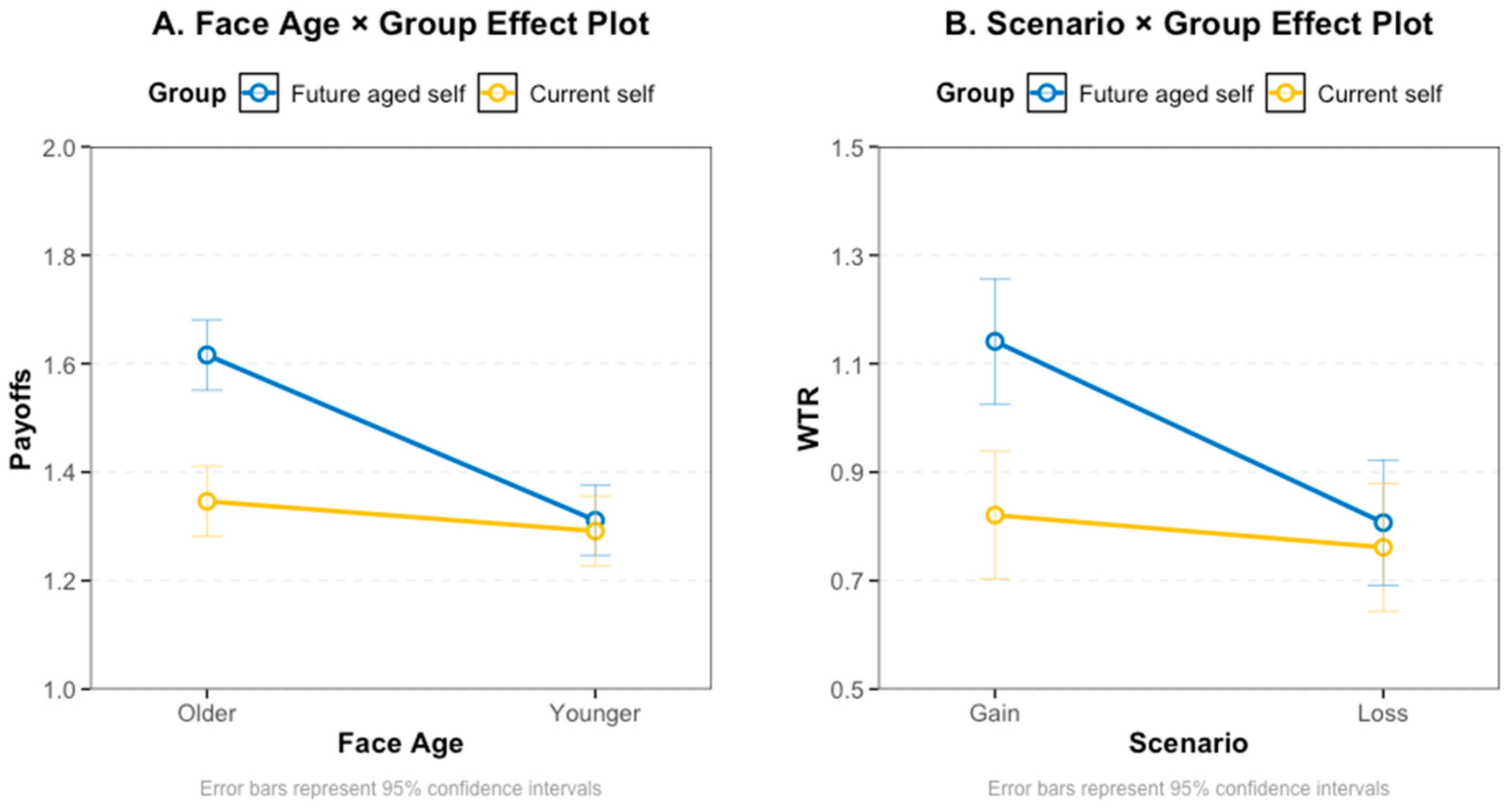


| Fixed Effects | SE | t Value | p Value | |
|---|---|---|---|---|
| Intercept | 1.62 | 0.03 | 48.77 | <0.001 |
| Face age (Younger) | −0.30 | 0.04 | −7.94 | <0.001 |
| Group (Control) | −0.27 | 0.05 | −5.76 | <0.001 |
| Face age (Younger): Group (Control) | 0.25 | 0.05 | 4.60 | <0.001 |
| Younger Face | Older Face | Overall | |
|---|---|---|---|
| Future aged self | 1.31 (0.71) | 1.62 (0.62) | 1.46 (0.69) |
| Current self | 1.29 (0.69) | 1.34 (0.72) | 1.32 (0.70) |
| Overall | 1.30 (0.70) | 1.48 (0.69) |
| Trial | Option | Self Gain (Loss) | Other Gain (Loss) 1 | Self–Other Benefit Ratio | WTR |
|---|---|---|---|---|---|
| 1 | A B | 150 | 010 | 1.50 | 1.6 |
| 2 | A B | 120 | 010 | 1.20 | 1.35 |
| 3 | A B | 100 | 010 | 1.00 | 1.10 |
| 4 | A B | 80 | 010 | 0.80 | 0.90 |
| 5 | A B | 60 | 010 | 0.60 | 0.70 |
| 6 | A B | 40 | 010 | 0.40 | 0.50 |
| 7 | A B | 20 | 010 | 0.20 | 0.30 |
| 8 | A B | 10 | 010 | 0.10 | 0.15 |
| 9 | A B | −10 | 010 | −0.10 | 0.00 |
| 10 | A B | −30 | 010 | −0.30 | −0.20 |
| Fixed Effects | SE | t Value | p Value | |
|---|---|---|---|---|
| Intercept | 1.14 | 0.06 | 19.46 | <0.001 |
| Scenario (Loss) | −0.33 | 0.05 | −6.50 | <0.001 |
| Group (Control) | −0.32 | 0.08 | −3.82 | <0.001 |
| Scenario (Loss): Group (Control) | 0.27 | 0.07 | 3.74 | <0.001 |
| Group | Gain | Loss | Overall |
|---|---|---|---|
| Future-aged-self | 1.14 (0.43) | 0.81 (0.50) | 0.97 (0.50) |
| Current-self | 0.82 (0.57) | 0.76 (0.50) | 0.79 (0.53) |
| Overall | 0.98 (0.53) | 0.78 (0.50) |
Disclaimer/Publisher’s Note: The statements, opinions and data contained in all publications are solely those of the individual author(s) and contributor(s) and not of MDPI and/or the editor(s). MDPI and/or the editor(s) disclaim responsibility for any injury to people or property resulting from any ideas, methods, instructions or products referred to in the content. |
© 2026 by the authors. Licensee MDPI, Basel, Switzerland. This article is an open access article distributed under the terms and conditions of the Creative Commons Attribution (CC BY) license.
Share and Cite
He, D.; He, Q.; Zhu, H.; He, X. Imagining the Future Aged Self Reduces Ageism: The Role of Self–Other Overlap and the Moderating Effect of Gain–Loss Framing. Behav. Sci. 2026, 16, 783. https://doi.org/10.3390/bs16050783
He D, He Q, Zhu H, He X. Imagining the Future Aged Self Reduces Ageism: The Role of Self–Other Overlap and the Moderating Effect of Gain–Loss Framing. Behavioral Sciences. 2026; 16(5):783. https://doi.org/10.3390/bs16050783
Chicago/Turabian StyleHe, Dexian, Quan He, Hongyan Zhu, and Xianyou He. 2026. "Imagining the Future Aged Self Reduces Ageism: The Role of Self–Other Overlap and the Moderating Effect of Gain–Loss Framing" Behavioral Sciences 16, no. 5: 783. https://doi.org/10.3390/bs16050783
APA StyleHe, D., He, Q., Zhu, H., & He, X. (2026). Imagining the Future Aged Self Reduces Ageism: The Role of Self–Other Overlap and the Moderating Effect of Gain–Loss Framing. Behavioral Sciences, 16(5), 783. https://doi.org/10.3390/bs16050783

