Portuguese Adaptation and Psychometric Validation of the Brief Scale of Mood Regulation Through Music (B-MMR) with Students



Abstract
1. Introduction
1.1. Music Listening and Mood-Regulation in Daily Life
1.2. The Psychophysiology of Music and Emotion
1.3. The Current Study
2. Materials and Methods
2.1. Participants
2.2. Instruments
2.3. Procedure
2.4. Data Analysis
3. Results
3.1. Descriptive Statistics
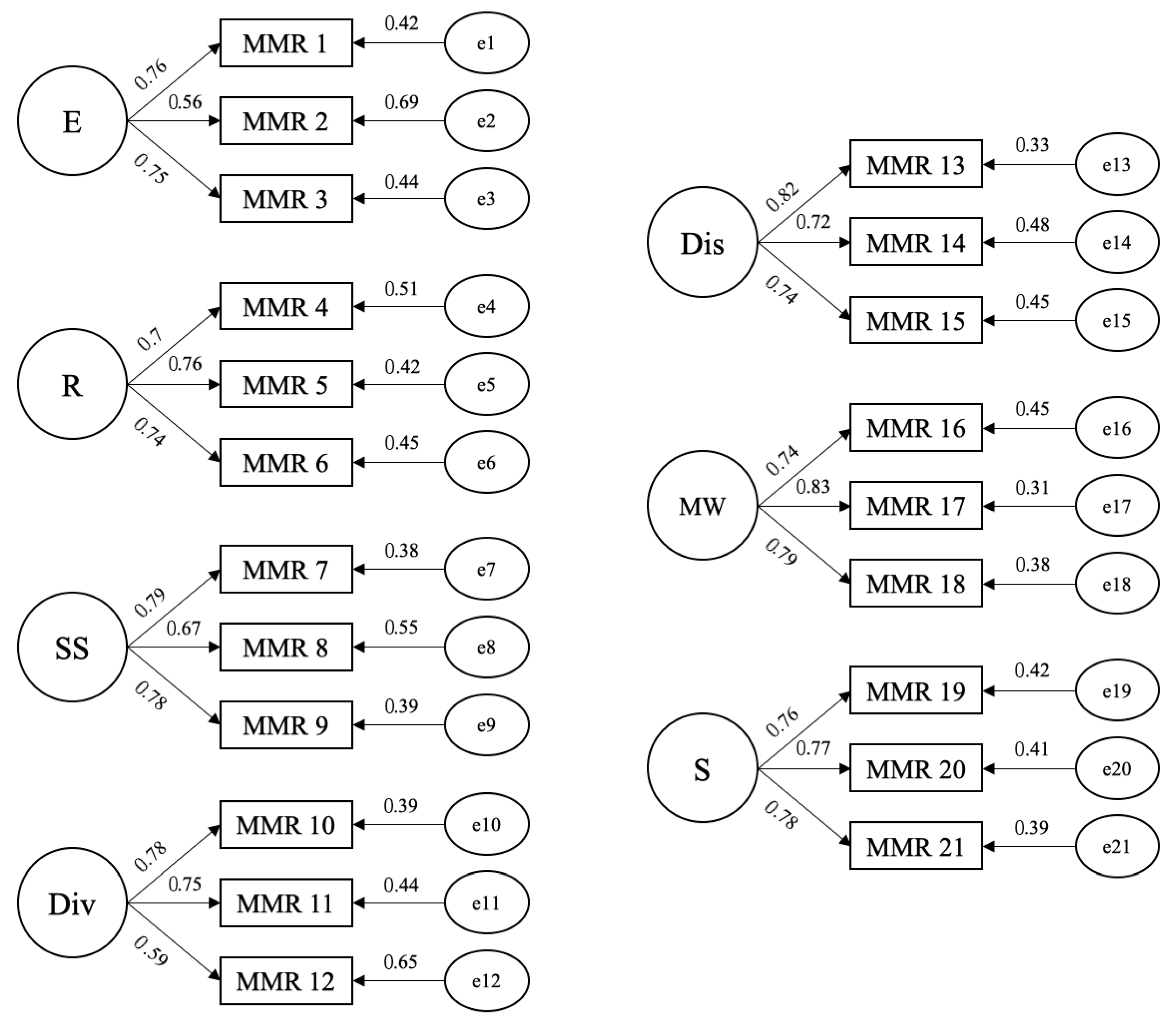
3.2. Confirmatory Analysis
3.3. Reliability and Average Variance Extracted
3.4. Invariance
3.5. External Validity: Associations with Emotional Experiences
4. Discussion
4.1. Summary of Main Findings
4.2. Limitations
4.3. Future Research Directions
5. Conclusions
Author Contributions
Funding
Institutional Review Board Statement
Informed Consent Statement
Data Availability Statement
Acknowledgments
Conflicts of Interest
References
- Ansani, A., Mallia, L., & Saarikallio, S. (2025). Music in mood regulation brief scale (B-MMR): Italian version and insights on musical preferences, expertise, and reward experiences. Music Perception, 42(4), 389–405. [Google Scholar] [CrossRef]
- Arthurs, Y., Merlini, E., & Omigie, D. (2025). Unpacking musical beauty: Sound, emotion, and impact differences across expertise and personality. PLoS ONE, 20(11), e0335905. [Google Scholar] [CrossRef]
- Balluerka, N., Gorostiaga, A., Alonso-Arbiol, I., & Haranburu, M. (2007). The adaptation of measurement instruments from one culture to another: A practical perspective. Psicothema, 19(1), 124–133. [Google Scholar] [PubMed]
- Baltazar, M., Burunat, I., & Saarikallio, S. (2026). The emotional complexity of musical experiences: Cultural and individual factors. Journal of Research in Personality, 121, 104693. [Google Scholar] [CrossRef]
- Baltazar, M., Västfjäll, D., Asutay, E., Koppel, L., & Saarikallio, S. (2019). Is it me or the music? Stress reduction and the role of regulation strategies and music. Music & Science, 2, 1–16. [Google Scholar] [CrossRef]
- Bjureberg, J., Ljótsson, B., Tull, M. T., Hedman, E., Sahlin, H., Lundh, L. G., Bjärehed, J., DiLillo, D., Messman, T. L., Hellner, C., & Gratz, K. L. (2016). Development and validation of a brief version of the difficulties in emotion regulation scale: The DERS-16. Journal of Psychopathology and Behavioral Assessment, 38(2), 284–296. [Google Scholar] [CrossRef]
- Bonett, D. G., & Wright, T. A. (2015). Cronbach’s alpha reliability: Interval estimation, hypothesis testing, and sample size planning. Journal of Organizational Behavior, 36(1), 3–15. [Google Scholar] [CrossRef]
- Brattico, E., Alluri, V., Bogert, B., Jacobsen, T., Vartiainen, N., Nieminen, S., & Tervaniemi, M. (2011). A Functional MRI study of happy and sad emotions in music with and without lyrics. Frontiers in Psychology, 2, 308. [Google Scholar] [CrossRef] [PubMed] [PubMed Central]
- Brattico, E., & Varankaitė, U. (2019). Aesthetic empowerment through music. Musicae Scientiae, 23(3), 285–303. [Google Scholar] [CrossRef]
- Brown, T. A. (2006). Confirmatory factor analysis for applied research. Guilford. [Google Scholar]
- Carlson, E., Saarikallio, S., Toiviainen, P., Bogert, B., Kliuchko, M., & Brattico, E. (2015). Maladaptive and adaptive emotion regulation through music: A behavioral and neuroimaging study of males and females. Frontiers in Human Neuroscience, 9, 466. [Google Scholar] [CrossRef] [PubMed] [PubMed Central]
- Carmines, E. G., & Zeller, R. A. (1979). Reliability and validity assessment. Sage. [Google Scholar] [CrossRef]
- Cascarino, E., Knight, T., & Macdonald, J. A. (2021). “The music gets through”: Experiences of classical composers and observations of hospitalized adolescents in a music-based intervention. Psychology of Music, 50(5), 1373–1389. [Google Scholar] [CrossRef]
- Chen, F. F. (2007). Sensitivity of goodness of fit indexes to lack of measurement invariance. Structural Equation Modeling: A Multidisciplinary Journal, 14(3), 464–504. [Google Scholar] [CrossRef]
- Cheung, G. W., & Rensvold, R. B. (2002). Evaluating goodness-of-fit indexes for testing measurement invariance. Structural Equation Modeling: A Multidisciplinary Journal, 9, 233–255. [Google Scholar] [CrossRef] [PubMed]
- Chu, T., & Tsai, C. (2026). Music’s context-dependent influence on oxytocin, social bonding, and emotion regulation: A systematic review. Frontiers in Cognition, 4, 1678665. [Google Scholar] [CrossRef]
- Cochran, W. G. (2007). Sampling techniques. John Wiley & Sons. [Google Scholar]
- Dai, R., Toiviainen, P., Campo, F. F., & Brattico, E. (2025). Differences in dynamic functional connectivity between musicians and non-musicians during naturalistic music listening. Frontiers in Neuroscience, 19, 1649733. [Google Scholar] [CrossRef]
- Eerola, T., & Saari, P. (2025). What emotions does music express? structure of affect terms in music using iterative crowdsourcing paradigm. PLoS ONE, 20(1), e0313502. [Google Scholar] [CrossRef]
- Eerola, T., & Schutz, M. (2025). Major-minorness in tonal music: Evaluation of relative mode estimation using expert ratings and audio-based key-finding principles. Psychology of Music, 03057356251326065. [Google Scholar] [CrossRef]
- Ekman, P., & Cordaro, D. (2011). What is meant by calling emotions basic. Emotion Review, 3(4), 364–370. [Google Scholar] [CrossRef]
- Elvers, P., Fischinger, T., & Steffens, J. (2018). Music listening as self-enhancement: Effects of empowering music on momentary explicit and implicit self-esteem. Psychology of Music, 46(3), 307–325. [Google Scholar] [CrossRef]
- Fornell, C., & Larcker, D. F. (1981). Evaluating structural equation models with unobservable variables and measurement error. Journal of Marketing Research, 18(1), 39–50. [Google Scholar] [CrossRef]
- Garrido, S., & Schubert, E. (2015). Moody melodies: Do they cheer us up? A study of the effect of sad music on mood. Psychology of Music, 43(2), 244–261. [Google Scholar] [CrossRef]
- Gomez-Canon, J. S., Lennie, T. M., Eerola, T., Aragon, P., Cano, E., Herrera, P., & Gomez, E. (2025). Personalisation and profiling using algorithms and not-so-popular colombian music: Goal-directed mechanisms in music emotion recognition. EPJ Data Science, 14(1), 80. [Google Scholar] [CrossRef]
- Graves, T. A., Eerola, T., Clayton, M., Nizami, S. M., & Rafiq, M. U. (2025). A genre-specific structure of subjective feeling in music listening: What do qawwālī listeners feel? Musicae Scientiae, 30(1), 3–26. [Google Scholar] [CrossRef]
- Groarke, J. M., & Hogan, M. J. (2019). Listening to self-chosen music regulates induced negative affect for both younger and older adults. PLoS ONE, 14(6), e0218017. [Google Scholar] [CrossRef]
- Hargreaves, D., & Lamont, A. (2017). The psychology of musical development. Cambridge University Press. [Google Scholar] [CrossRef]
- Harley, J. M., Pekrun, R., Taxer, J. L., & Gross, J. J. (2019). Emotion regulation in achievement situations: An integrated model. Educational Psychologist, 54(2), 106–126. [Google Scholar] [CrossRef]
- Hernández, A., Hidalgo, M. D., Hambleton, R. K., & Gómez-Benito, J. (2020). International test commission guidelines for test adaptation: A criterion checklist. Psicothema, 32(3), 390–398. [Google Scholar] [CrossRef]
- Hofmann, W., Schmeichel, B. J., & Baddeley, A. D. (2012). Executive functions and self-regulation. Trends in Cognitive Sciences, 16(3), 174–180. [Google Scholar] [CrossRef]
- Hu, L. T., & Bentler, P. M. (2009). Cutoff criteria for fit indexes in covariance structure analysis: Conventional criteria versus new alternatives. Structural Equation Modeling: A Multidisciplinary Journal, 6(1), 1–55. [Google Scholar] [CrossRef]
- Jimenez, I., Kuusi, T., & Doll, C. (2020). Common chord progressions and feelings of remembering. Music & Science, 3, 2059204320916849. [Google Scholar] [CrossRef]
- Juslin, P. N. (2013). From everyday emotions to aesthetic emotions: Towards a unified theory of musical emotions. Elsevier BV. [Google Scholar] [CrossRef]
- Juslin, P. N., Barradas, G., & Eerola, T. (2015). From sound to significance: Exploring the mechanisms underlying emotional reactions to music. The American Journal of Psychology, 128(3), 281–304. [Google Scholar] [CrossRef]
- Juslin, P. N., Harmat, L., & Eerola, T. (2014). What makes music emotionally significant? Exploring the underlying mechanisms. Psychology of Music, 42(4), 599–623. [Google Scholar] [CrossRef]
- Juslin, P. N., & Västfjäll, D. (2008). Emotional responses to music: The need to consider underlying mechanisms. The Behavioral and Brain Sciences, 31(5), 559–575. [Google Scholar] [CrossRef]
- Kahn, J. H., Enevold, K. C., Feltner-Williams, D., & Ladd, K. (2025). Using music to feel better: Are different emotion-regulation strategies truly distinct? Psychology of Music, 53(4), 535–547. [Google Scholar] [CrossRef]
- Koelsch, S. (2020). A coordinate-based meta-analysis of music-evoked emotions. NeuroImage, 223, 117350. [Google Scholar] [CrossRef]
- Krause, A. E., Dimmock, J., Rebar, A. L., & Jackson, B. (2021a). Music listening predicted improved life satisfaction in university students during early stages of the COVID-19 pandemic. Frontiers in Psychology, 11, 631033. [Google Scholar] [CrossRef] [PubMed]
- Krause, A. E., Glasser, S., & Osborne, M. (2021b). Augmenting function with value: An exploration of reasons to engage and disengage from music listening. Music & Science, 4, 20592043211022535. [Google Scholar] [CrossRef]
- Krause, A. E., North, A. C., & Hewitt, L. Y. (2015). Music-listening in everyday life: Devices and choice. Psychology of Music, 43(2), 155–170. [Google Scholar] [CrossRef]
- Krause, A. E., Scott, W. G., Flynn, S., Foong, B., Goh, K., Wake, S., Miller, D., & Garvey, D. (2023). Listening to music to cope with everyday stressors. Musicae Scientiae, 27(1), 176–192. [Google Scholar] [CrossRef]
- Lamont, A. (2011). University students’ strong experiences of music. Musicae Scientiae, 15(2), 229–249. [Google Scholar] [CrossRef]
- Liljeström, S., Juslin, P. N., & Västfjäll, D. (2013). Experimental evidence of the roles of music choice, social context, and listener personality in emotional reactions to music. Psychology of Music, 41(5), 579–599. [Google Scholar] [CrossRef]
- Lonsdale, A. J., & North, A. C. (2011). Why do we listen to music? A uses and gratifications analysis. The British Journal of Psychology, 102(1), 108–134. [Google Scholar] [CrossRef]
- Lundqvist, L., Carlsson, F., Hilmersson, P., & Juslin, P. N. (2009). Emotional responses to music: Experience, expression, and physiology. Psychology of Music, 37(1), 61–90. [Google Scholar] [CrossRef]
- McClymont, R. G., & Krause, A. E. (2026). The impact of a focused listening experience on self-compassion and mental health help-seeking. Psychology of Music, 54(3), 338–359. [Google Scholar] [CrossRef]
- McKenzie, S. M., Krause, A. E., Glasser, S., & Osborne, M. S. (2025). Exploring the role of music listening in cultivating self-compassion. Psychology of Music, 27(1), 176–192. [Google Scholar] [CrossRef]
- Memon, M. A., Thurasamy, R., Ting, H., & Cheah, J.-H. (2025). Purposive sampling: A review and guidelines for quantitative research. Journal of Applied Structural Equation Modeling, 9(1), 1–23. [Google Scholar] [CrossRef]
- Muñiz, J., Elosua, P., & Hambleton, R. K. (2013). Guidelines for the translation and adaptation of the tests: Second edition. Psicothema, 25(2), 151–157. [Google Scholar] [CrossRef]
- Nawaz, S., & Omigie, D. (2025). Qualities of music-evoked autobiographical memories are associated with auditory features of the memory-evoking music. PLoS ONE, 20(8), e0329072. [Google Scholar] [CrossRef]
- Nunnally, J. C. (1978). Psychometric theory. McGraw-Hill. [Google Scholar]
- Ongchoco, J. D. K., & Melcher, D. (2026). Aesthetic speed preferences when viewing dance synchronize to a ‘natural’ pace of human movement. Cognition, 271, 106421. [Google Scholar] [CrossRef]
- Pas, P., Hulshoff Pol, H. E., Raemaekers, M., & Vink, M. (2021). Self-regulation in the pre-adolescent brain. Developmental Cognitive Neuroscience, 51, 101012. [Google Scholar] [CrossRef]
- Pekrun, R. (2017). Emotion and achievement during adolescence. Child Development Perspectives, 11(3), 215–221. [Google Scholar] [CrossRef]
- Priyadarshini, A., & Divakarla, U. (2026). RaagaDhvani: A novel augmented multi-feature dataset: Advancing emotion recognition in carnatic music with multimodal features and hybrid deep learning. Data in Brief, 64, 112364. [Google Scholar] [CrossRef]
- Saarikallio, S. (2007). Music as mood regulation in adolescence (Jyväskylä Studies in Humanities, 67). University of Jyväskylä. Available online: https://jyx.jyu.fi/bitstream/handle/123456789/13403/9789513927318.pdf?seq (accessed on 23 October 2025).
- Saarikallio, S. (2012). Development and validation of the brief music in mood regulation scale (B-MMR). Music Perception, 30(1), 97–105. [Google Scholar] [CrossRef]
- Saarikallio, S., & Erkkilä, J. (2007). The role of music in adolescents’ mood regulation. Psychology of Music, 35(1), 88–109. [Google Scholar] [CrossRef]
- Saarikallio, S., Vuoskoski, J., & Luck, G. (2014). Adolescents’ expression and perception of emotion in music reflects their broader abilities of emotional communication. Psychology of Well-Being, 4(1), 21. [Google Scholar] [CrossRef]
- Saarikallio, S. H., Maksimainen, J. P., & Randall, W. M. (2019). Relaxed and connected: Insights into the emotional–motivational constituents of musical pleasure. Psychology of Music, 47(5), 644–662. [Google Scholar] [CrossRef]
- Saarikallio, S. H., Randall, W. M., & Baltazar, M. (2020). Music listening for supporting adolescents’ sense of agency in daily life. Frontiers in Psychology, 10, 2911. [Google Scholar] [CrossRef]
- Sakka, L. S., & Juslin, P. N. (2018). Emotion regulation with music in depressed and non-depressed individuals. Music & Science, 1, 2059204318755023. [Google Scholar] [CrossRef]
- Schäfer, K., Saarikallio, S., & Eerola, T. (2020). Music may reduce loneliness and act as social surrogate for a friend: Evidence from an experimental listening study. Music & Science, 3, 2059204320935709. [Google Scholar] [CrossRef]
- Schellenberg, E. G. (2012). Cognitive performance after listening to music: A review of the Mozart effect. In R. A. R. MacDonald, G. Kreutz, & L. Mitchell (Eds.), Music, health, and wellbeing (pp. 324–338). Oxford University Press. [Google Scholar] [CrossRef]
- Schellenberg, E. G., & Mankarious, M. (2012). Music training and emotion comprehension in childhood. Emotion, 12, 887–891. [Google Scholar] [CrossRef] [PubMed]
- Schermelleh-Engel, K., Moosbrugger, H., & Müller, H. (2003). Evaluating the fit of structural equation models: Tests of significance and descriptive goodness-of-fit measures. Methods of Psychological Research Online, 8(2), 23–74. [Google Scholar]
- Schubert, E. (2013). Loved music can make a listener feel negative emotions. Musicae Scientiae, 17(1), 11–26. [Google Scholar] [CrossRef]
- Tulving, E. (1983). Elements of episodic memory. Oxford University Press. [Google Scholar]
- Vandenberg, R. J., & Lance, C. E. (2000). A review and synthesis of the measurement invariance literature: Suggestions, practices, and recommendations for organizational research. Organizational Research Methods, 3(1), 4–70. [Google Scholar] [CrossRef]
- Van Goethem, A., & Sloboda, J. (2011). The functions of music for affect regulation. Musicae Scientiae, 15(2), 208. [Google Scholar] [CrossRef]
- Willimek, B., & Willimek, D. (2022). Music and emotions—Research on the theory of musical equilibration (die Strebetendenz-Theorie). Eunomios. [Google Scholar] [CrossRef]
- Willimek, D., & Willimek, B. (2011). Music und emotionen—Studien zur strebetedenz-theorie. Deutscher Wissenschaftsverlag. [Google Scholar]


| Items | M | SD | Asymmetry | Kurtosis | λ |
|---|---|---|---|---|---|
| MMR 1 When I’m busy around the house and no one else is around, I like to have some music on the background [Quando estou ocupado/a por casa e não há ninguém por perto, gosto de ouvir música de fundo.] | 4.5 | 0.85 | −2.08 | 4.66 | 0.76 |
| MMR 2 I listen to music to make cleaning and doing other housework more pleasant [Oiço música para tornar as limpezas e outras tarefas domésticas mais agradáveis.] | 4.69 | 0.79 | −2.7 | 7.89 | 0.56 |
| MMR 3 I usually put background music on to make the atmosphere more pleasant [Costumo pôr música de fundo para tornar o ambiente mais agradável.] | 4.19 | 0.99 | −1.19 | 0.93 | 0.75 |
| MMR 4 When I’m tired out, I rest by listening to music [Quando me sinto cansado/a, oiço música para descansar.] | 3.41 | 1.3 | −0.34 | −0.07 | 0.7 |
| MMR 5 I listen to music to perk up after a rough day [Oiço música para me animar depois de um dia difícil.] | 3.97 | 1.15 | −0.95 | −0.01 | 0.76 |
| MMR 6 When I’m exhausted, I listen to music to perk up [Quando estou exausto/a, ouço música para me arrebitar.] | 3.37 | 1.29 | −0.25 | −1.07 | 0.74 |
| MMR 7 I feel fantastic putting my soul fully into the music [Sinto-me fantástico/a quando me entrego inteiramente à música.] | 4.21 | 1.01 | −1.17 | 0.69 | 0.79 |
| MMR 8 Music has offered me magnificent experiences [A música já me proporcionou experiências magníficas.] | 4.56 | 0.79 | −1.96 | 3.74 | 0.67 |
| MMR 9 I want to feel the music in my whole body [Quero sentir a música no meu corpo todo.] | 3.79 | 1.24 | −0.71 | −0.57 | 0.78 |
| MMR 10 When stressful thoughts keep going round and round in my head, I start to listen to music to get them off my mind [Quando não paro de remoer pensamentos stressantes, oiço música para os tirar da cabeça.] | 3.62 | 1.27 | −0.58 | −0.72 | 0.78 |
| MMR 11 For me, music is a way to forget about my worries [Para mim, a música é uma forma de esquecer as minhas preocupações.] | 3.77 | 1.19 | −0.72 | −0.44 | 0.75 |
| MMR 12 When I feel bad, I try to get myself in a better mood by engaging in some nice, music-related activity [Quando me sinto em baixo, tento ficar mais bem-disposto/a fazendo alguma atividade agradável relacionada com a música.] | 3.61 | 1.17 | −0.47 | −0.66 | 0.59 |
| MMR 13 When I’m angry with someone, I listen to music that expresses my anger [Quando estou zangado/a com alguém, oiço música que exprime a minha raiva.] | 2.81 | 1.44 | 0.2 | −1.3 | 0.82 |
| MMR 14 When I’m really angry, I feel like listening to some aggressive music [Quando estou muito zangado/a, ponho-me a ouvir música mais agressiva.] | 2.36 | 1.4 | 0.61 | −0.97 | 0.72 |
| MMR 15 When everything feels bad, it helps me to listen to music that expresses my bad feelings [Quando tudo me corre mal, ajuda-me ouvir música que exprime os meus sentimentos negativos.] | 3.29 | 1.42 | −0.3 | −1.19 | 0.74 |
| MMR 16 Music has helped me to get through hard experiences [A música ajudou-me a ultrapassar experiências difíceis.] | 3.84 | 1.23 | −0.8 | −0.4 | 0.74 |
| MMR 17 Music helps me to recognize different feelings in myself [A música ajuda-me a compreender diferentes sentimentos em mim próprio/a.] | 3.63 | 1.29 | −0.62 | −0.7 | 0.83 |
| MMR 18 When I’m distressed by something, music helps me to clarify my feelings [Quando estou angustiado/a com alguma coisa, a música ajuda-me a perceber melhor o que sinto.] | 3.22 | 1.3 | −0.19 | −1.04 | 0.79 |
| MMR 19 I listen to music to find solace when worries overwhelm me [Oiço música para me acalmar sempre que as preocupações me atormentam.] | 3.49 | 1.22 | −0.37 | −0.85 | 0.76 |
| MMR 20 When everything feels bad, music understands and comforts me [Quando tudo corre mal, a música compreende-me e reconforta-me.] | 3.61 | 1.27 | −0.6 | −0.67 | 0.77 |
| MMR 21 When I’m feeling sad, listening to music comforts me [Quando me sinto triste, ouvir música reconforta-me.] | 4.08 | 1.06 | −1.06 | 0.41 | 0.78 |
| Model | X2 | df | X2/df | NFI | TLI | CFI | RMSEA (IC 90%) |
|---|---|---|---|---|---|---|---|
| 21 items | 449.66 * | 168 | 2.68 | 0.91 | 0.92 | 0.94 | 0.06 (0.05, 0.07) |
| Estimation Method | E | R | SS | Div | Dis | MW | S |
|---|---|---|---|---|---|---|---|
| α by Cronbach | 0.72 | 0.78 | 0.77 | 0.73 | 0.8 | 0.82 | 0.81 |
| Composite reliability | 0.73 | 0.78 | 0.79 | 0.75 | 0.8 | 0.83 | 0.81 |
| AVE | 0.48 | 0.54 | 0.56 | 0.51 | 0.58 | 0.62 | 0.59 |
| E | R | SS | Div | Dis | MW | S | |
|---|---|---|---|---|---|---|---|
| E | 0.69 | ||||||
| R | 0.46 | 0.73 | |||||
| SS | 0.36 | 0.27 | 0.75 | ||||
| Div | 0.45 | 0.57 | 0.4 | 0.71 | |||
| Dis | 0.31 | 0.35 | 0.35 | 0.34 | 0.76 | ||
| MW | 0.39 | 0.48 | 0.57 | 0.56 | 0.56 | 0.79 | |
| S | 0.46 | 0.56 | 0.46 | 0.69 | 0.53 | 0.72 | 0.77 |
| Model | χ2 | df | χ2/df | CFI | TLI | RMSEA (90% CI) | ΔCFI | ΔRMSEA |
|---|---|---|---|---|---|---|---|---|
| M1. Configural | 684.20 * | 336 | 2.04 | 0.930 | 0.912 | 0.066 [0.059, 0.073] | — | — |
| M2. Metric | 696.27 * | 350 | 1.99 | 0.930 | 0.916 | 0.064 [0.057, 0.071] | 0.0004 | −0.002 |
| M3. Scalar | 720.09 * | 364 | 1.98 | 0.928 | 0.917 | 0.064 [0.057, 0.071] | −0.002 | −0.001 |
| M4. Full Uniqueness | 769.15 * | 385 | 2.00 | 0.923 | 0.915 | 0.064 [0.058, 0.071] | −0.006 | 0.001 |
| Anger | Fear | Surprise | Sadness | Disgust | Contempt | Happiness | |
|---|---|---|---|---|---|---|---|
| E | −0.05 | −0.07 | −0.02 | 0.2 ** | −0.12 * | 0.07 | 0.25 ** |
| R | 0.09 | 0.01 | 0.12 ** | 0.14 ** | −0.02 | 0.23 ** | 0.23 ** |
| SS | 0.1 * | 0.11 * | 0.26 ** | 0.21 ** | 0.04 | 0.24 ** | 0.24 ** |
| Div | 0.01 | −0.04 | 0.09 | 0.14 ** | −0.11 * | 0.17 ** | 0.29 ** |
| Dis | 0.35 ** | 0.12 ** | 0.09 * | 0.38 ** | 0.1 * | 0.22 ** | 0.08 |
| MW | 0.21 ** | 0.06 | 0.23 ** | 0.29 ** | 0.04 | 0.27 ** | 0.18 ** |
| S | 0.1* | 0.01 | 0.1 * | 0.26 ** | −0.07 | 0.19 ** | 0.28 ** |
Disclaimer/Publisher’s Note: The statements, opinions and data contained in all publications are solely those of the individual author(s) and contributor(s) and not of MDPI and/or the editor(s). MDPI and/or the editor(s) disclaim responsibility for any injury to people or property resulting from any ideas, methods, instructions or products referred to in the content. |
© 2026 by the authors. Licensee MDPI, Basel, Switzerland. This article is an open access article distributed under the terms and conditions of the Creative Commons Attribution (CC BY) license.
Share and Cite
Pereira, A.I.; Tomé-Lourido, D.; Hermida, M.-Á. Portuguese Adaptation and Psychometric Validation of the Brief Scale of Mood Regulation Through Music (B-MMR) with Students. Behav. Sci. 2026, 16, 761. https://doi.org/10.3390/bs16050761
Pereira AI, Tomé-Lourido D, Hermida M-Á. Portuguese Adaptation and Psychometric Validation of the Brief Scale of Mood Regulation Through Music (B-MMR) with Students. Behavioral Sciences. 2026; 16(5):761. https://doi.org/10.3390/bs16050761
Chicago/Turabian StylePereira, Ana Isabel, David Tomé-Lourido, and Miguel-Ángel Hermida. 2026. "Portuguese Adaptation and Psychometric Validation of the Brief Scale of Mood Regulation Through Music (B-MMR) with Students" Behavioral Sciences 16, no. 5: 761. https://doi.org/10.3390/bs16050761
APA StylePereira, A. I., Tomé-Lourido, D., & Hermida, M.-Á. (2026). Portuguese Adaptation and Psychometric Validation of the Brief Scale of Mood Regulation Through Music (B-MMR) with Students. Behavioral Sciences, 16(5), 761. https://doi.org/10.3390/bs16050761