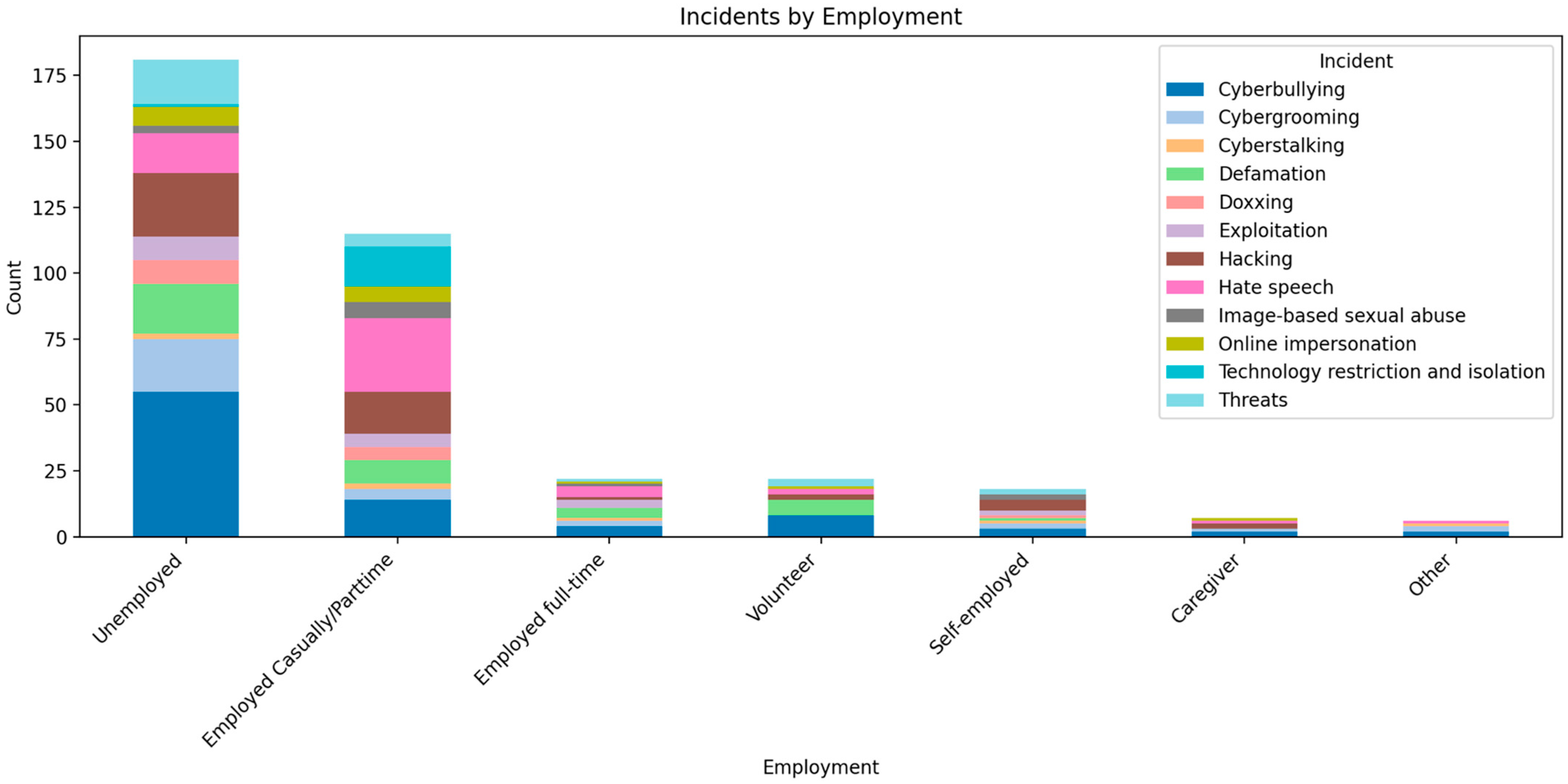
A Baseline Quantitative Analysis of Technology-Facilitated Gender-Based Violence Against Women with Disabilities in South Africa


Abstract
1. Introduction
2. Methods
2.1. Study Population and Sample
2.2. Data Collection and Analysis
2.3. Ethics
3. Results
3.1. Participants’ Demographics
3.1.1. Types of Disabilities
3.1.2. Level of Education
3.1.3. Socio-Economic Status
3.2. Prevalence of TFGBV
3.3. Intersectionality
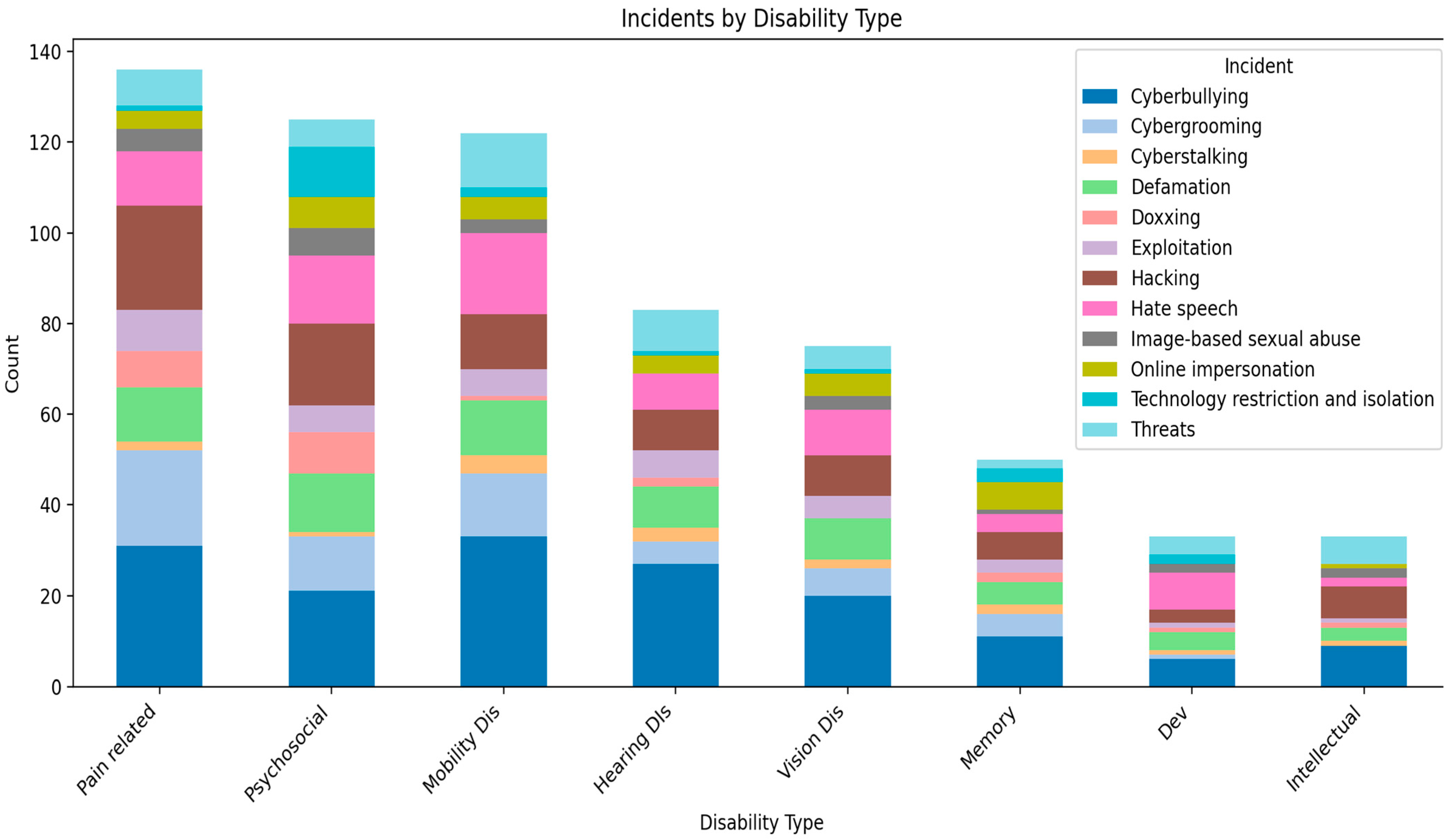
3.3.1. Disability Type and Type of TFGBV Experienced
3.3.2. Race and Type of TFGBV Experienced
3.3.3. Education Level and Type of TFGBV Experienced
3.3.4. Socio-Economic Status and Type of TFGBV Experienced
4. Discussion
Limitations
5. Conclusions
Author Contributions
Funding
Institutional Review Board Statement
Informed Consent Statement
Data Availability Statement
Acknowledgments
Conflicts of Interest
Abbreviations
| GBV | Gender-Based Violence |
| ICTs | Information and Communication Technologies |
| LMIC | Low- and Middle-Income Countries |
| TFGBV | Technology-Facilitated Gender-Based Violence |
Appendix A. Survey Terminology and Definitions
- Types of Disabilities
- -
- Moving around, even when using a support, like a cane. Walking on a flat surface for 15 min. Walking up or down a flight of stairs (about 12 steps).
- -
- Bending over and picking up an object from the floor.
- -
- Reaching in any direction, for example, above your head.
- -
- Picking up small objects with your fingers, like a pencil or scissors.
- -
- Pain caused by another condition which lasts for 6 months or more.
- -
- Pain that is always there.
- -
- Ongoing pain that happens from time to time.
Appendix B. Types of Technology-Facilitated Gender-Based Violence (TFGBV)
- -
- ‘Sextortion’: when someone blackmails another person by threatening to release explicit or private images of them;
- -
- ‘Revenge porn’: when intimate content is shared without a person’s consent;
- -
- Sharing child sexual exploitation materials with people who do not know about it.
| 1 | In the South African context, this is an apartheid racial category which referred to people of mixed blood/race. They mostly speak Afrikaans. In this study, we refer to Coloured as a cultural identity, not skin colour (Erasmus, 2001). |
References
- Afrouz, R. (2023). The nature, patterns and consequences of technology-facilitated domestic abuse: A scoping review. Trauma, Violence, & Abuse, 24(2), 913–927. [Google Scholar] [CrossRef]
- Alberts, C., & Kheswa, J. G. (2017). Social networks and sexual behaviour amongst adolescent females in one secondary school in Eastern Cape, South Africa. African Population Studies, 31(2), 3823–3832. [Google Scholar] [CrossRef][Green Version]
- Arenas, J., Jiménez, A., & Bote, M. (2023). Health and socioeconomic determinants of abuse among women with disabilities. International Journal of Environmental Research and Public Health, 20, 6191. [Google Scholar] [CrossRef] [PubMed]
- Backe, E. L., Lilleston, P., & McCleary-Sills, J. (2018). Networked individuals, gendered violence: A literature review of cyberviolence. Violence and Gender, 5(3), 135–146. [Google Scholar] [CrossRef]
- Bailey, J., & Burkell, J. (2021). Tech-facilitated violence: Thinking structurally and intersectionally. Journal of Gender-Based Violence, 5, 531–542. [Google Scholar] [CrossRef]
- Bansal, V., Rezwan, M., Iyer, M., Leasure, E., Roth, C., Pal, P., & Hinson, L. (2023). A scoping review of technology-facilitated gender-based violence in low- and middle-income countries across Asia. Trauma, Violence, & Abuse, 25, 463–475. [Google Scholar] [CrossRef]
- Barter, C., & Koulu, S. (2021). Digital technologies and gender-based violence—Mechanisms for oppression, activism and recovery. Journal of Gender-Based Violence, 5(3), 367–375. [Google Scholar] [CrossRef]
- Bauer, G. R., Churchill, S. M., Mahendran, M., Walwyn, C., Lizotte, D., & Villa-Rueda, A. A. (2021). Intersectionality in quantitative research: A systematic review of its emergence and applications of theory and methods. SSM Population Health, 14, 100798. [Google Scholar] [CrossRef]
- Bean, T., Danh, L. T. M., Van, V. P., Thuy, N. T. T., Tam, D. N. H., & Thanh, P. T. T. (2024). Vietnamese youth’s perception on slut-shaming on social media. Trends in Psychology, 1–19. [Google Scholar] [CrossRef]
- Brownridge, D. A. (2006). Partner violence against women with disabilities. Violence Against Women, 12(9), 805–822. [Google Scholar] [CrossRef]
- Clements, F., Orchard, L., & Chadwick, D. (2024). A scoping review investigating the perspectives of people with mild to moderate intellectual disabilities on experiences of cyberbullying victimisation and its subtypes. Journal of Intellectual Disabilities, 29, 17446295241252214. [Google Scholar] [CrossRef] [PubMed]
- Cornish, F., Nyutsem Breton, N., Moreno-Tabarez, U., Rua, M., & Hodgetts, D. (2023). Participatory action research. Nature Reviews Methods Primers, 3(1), 34. [Google Scholar] [CrossRef]
- Crenshaw, K. (1989). Demarginalizing the intersection of race and sex: A black feminist critique of antidiscrimination doctrine, feminist theory and antiracist politics. University of Chicago Legal Forum, 1989(1), 8. Available online: http://chicagounbound.uchicago.edu/uclf/vol1989/iss1/8 (accessed on 1 March 2026).
- Dagne, H., Doherty, K., Campbell, J., Saul, A., & Roydhouse, J. (2025). Proxy reporting in health: A scoping review of instructions, perspectives, and reporting experiences. Quality of Life Research, 34(7), 1835–1847. [Google Scholar] [CrossRef]
- De Filippo, A., Bellatin, P., Tietz, N., Grant, E., Whitefield, A., Nkopane, P., Devereux, C., Crawford, K., Vermeulen, B., & Hatcher, A. M. (2023). Effects of digital chatbot on gender attitudes and exposure to intimate partner violence among young women in South Africa. PLoS Digit Health, 2(10), e0000358. [Google Scholar] [CrossRef]
- Dickman, B. J., & Roux, A. J. (2005). Complainants with learning disabilities in sexual abuse cases: A 10-year review of a psycho-legal project in Cape Town, South Africa. British Journal of Learning Disabilities, 33(3), 138–144. [Google Scholar] [CrossRef]
- Dunn, S. (2020). Technology-facilitated gender-based violence: An overview (Centre for International Governance Innovation: Supporting a safer internet paper, issue). Available online: https://www.cigionline.org/publications/technology-facilitated-gender-based-violence-overview/ (accessed on 13 June 2022).
- Economist Intelligence Unit. (2021). Measuring the prevalence of online violence against women. Economist Intelligence Unit. Available online: https://onlineviolencewomen.eiu.com/ (accessed on 13 June 2022).
- Edwards, M., Suarez-Tangil, G., Peersman, C., Stringhini, G., Rashid, A., & Whitty, M. (2018, May 24). The geography of online dating fraud. Workshop on Technology and Consumer Protection, San Franciso, CA, USA. Available online: https://research-information.bris.ac.uk/en/publications/the-geography-of-online-dating-fraud (accessed on 13 June 2022).
- Ellis, K., & Kent, M. (2011). Disability and new media. Routledge. [Google Scholar] [CrossRef]
- Erasmus, Z. (2001). Coloured by history, shaped by place: New perspectives on coloured identities in Cape Town [Social identities South Africa series]. Kwela Books. [Google Scholar]
- Goggin, G., & Soldatić, K. (2022). Automated decision-making, digital inclusion and intersectional disabilities. New Media & Society, 24(2), 384–400. [Google Scholar] [CrossRef]
- Hameed, S., Tyabashe-Phume, B., Tunggal, E., Hunt, X., Ned, L., & Soldatić, K. (2025). Technology-facilitated gender-based violence against women with disabilities in low- and middle-income countries: A scoping review protocol. BMJ Open, 15, e093988. [Google Scholar] [CrossRef]
- Henry, N., & Flynn, A. (2019). Image-based sexual abuse: Online distribution channels and illicit communities of support. Violence Against Women, 25(16), 1932–1955. [Google Scholar] [CrossRef]
- Henry, N., Flynn, A., & Powell, A. (2020). Technology-facilitated domestic and sexual violence: A review. Violence Against Women, 26(15–16), 1828–1854. [Google Scholar] [CrossRef]
- Henry, N., & Powell, A. (2015). Embodied harms: Gender, shame, and technology-facilitated sexual violence. Violence Against Women, 21(6), 758–779. [Google Scholar] [CrossRef]
- Hinson, L., Mueller, J., O’Brien-Milne, L., & Wandera, N. (2018). Technology-facilitated gender-based violence: What is it, and how do we measure it? Available online: https://www.svri.org/sites/default/files/attachments/2018-07-24/ICRW_TFGBVMarketing_Brief_v8-Web.pdf (accessed on 13 June 2022).
- Huang, S., & Wang, Y. (2023). How people with physical disabilities can obtain social support through online videos: A qualitative study in China. International Journal of Environmental Research and Public Health, 20(3), 2423. [Google Scholar] [CrossRef] [PubMed]
- Idongesit, E. (2014). Youths, social media and gender-based violence: An emerging trend in Nigeria. International Journal of Economy, Management and Social Sciences, 3(1), 21–27. [Google Scholar]
- Internet Sans Frontières. (2019). #IWD2019: Online gender-based violence affects 45% of women on social media in West and Central Africa. Internet Sans Frontières Webpage. Available online: https://internetwithoutborders.org/iwd2019-online-gender-based-violence-affects-45-of-women-on-social-media-in-west-and-central-africa/ (accessed on 13 June 2022).
- Jain, S., & Agrawal, S. (2020). Perceived vulnerability of cyberbullying on social networking sites: Effects of security measures, addiction and self-disclosure. Indian Growth and Development Review, 14(2), 149–171. [Google Scholar] [CrossRef]
- Kim, C., & Ferraresso, R. (2023). Examining technology-facilitated intimate partner violence: A systematic review of journal articles. Trauma, Violence, & Abuse, 24(3), 1325–1343. [Google Scholar] [CrossRef]
- Kwagala, B., & Galande, J. (2022). Disability status, partner behavior, and the risk of sexual intimate partner violence in Uganda: An analysis of the demographic and health survey data. BMC Public Health, 22, 1872. [Google Scholar] [CrossRef]
- Lake, N. C. (2017). Corrective rape and black lesbian sexualities in contemporary South African cultural texts. University of the Free State. Available online: http://hdl.handle.net/11660/6430 (accessed on 13 June 2022).
- Ledingham, E., Wright, G., & Mitra, M. (2022). Sexual violence against women with disabilities: Experiences with force and lifetime risk. American Journal of Preventive Medicine, 62, 895–902. [Google Scholar] [CrossRef]
- Lenhart, A., Ybarra, M., Zickuhr, K., & Price-Feeney, M. (2016). Online harassment, digital abuse, and cyberstalking in America. Data & Society Research Institute/Center for Innovative Public Health Research. [Google Scholar]
- Lynch, I., Reygan, F., & Ramphalile, M. (2021). ‘Having to use English others us’: South African terminologies of sexual and gender diversity. Sexualities, 25(5–6), 804–820. [Google Scholar] [CrossRef]
- Makinde, O. A., Odimegwu, C. O., Abdulmalik, J. O., Babalola, S. O., & Fawole, O. I. (2016). Gender-based violence following social media acquaintance in Nigeria. African Journal of Reproductive Health, 20(4), 67–76. [Google Scholar] [CrossRef] [PubMed]
- Marnewick, C., Meda, L., Condy, J., & Phillips, H. (2022). Using an intervention programme to empower intellectually disabled learners to use WhatsApp in a special needs unit in Cape Town, South Africa. Cogent Education, 9, 2142447. [Google Scholar] [CrossRef]
- McMahon, S., Power, M., Snyder, S., & Elias-Lambert, N. (2025). Centering intersectionality in bystander intervention: Advancing inclusive and equitable prevention strategies. Journal of Family Violence, 40, 1459–1466. [Google Scholar] [CrossRef]
- Miano, P., & Urone, C. (2024). What the hell are you doing? A PRISMA systematic review of psychosocial precursors of slut-shaming in adolescents and young adults. Psychology & Sexuality, 15(1), 97–113. [Google Scholar]
- Mooketsi, B. E. (2018). An investigation on the prevalence of cyberbullying amongst undergraduate students in the University of Botswana. Mosenodi Journal, 21(2), 44–54. [Google Scholar]
- Mulisa, F., & Getahun, D. A. (2018). Perceived benefits and risks of social media: Ethiopian secondary school students’ perspectives. Journal of Technology in Behavioral Science, 3(4), 294–300. [Google Scholar] [CrossRef]
- Mutero, V. (2026). Beyond the surface: Understanding the cultural roots of corrective rape in South African townships. Culture, Health & Sexuality, 28(4), 432–444. [Google Scholar] [CrossRef]
- Papp, L. J., Hagerman, C., Gnoleba, M. A., Erchull, M. J., Liss, M., Miles-McLean, H., & Robertson, C. M. (2015). Exploring perceptions of slut-shaming on Facebook: Evidence for a reverse sexual double standard. Gender Issues, 32(1), 57–76. [Google Scholar] [CrossRef]
- Phasha, T. N., & Nyokangi, D. (2012). School-based sexual violence among female learners with mild intellectual disability in South Africa. Violence Against Women, 18(3), 309–321. [Google Scholar] [CrossRef] [PubMed]
- Plan International. (2020). Free to be online? A report on girls’ and young women’s experiences of online harassment. Plan International. Available online: https://plan-international.org/publications/free-to-be-online/ (accessed on 13 June 2022).
- Posetti, J., Shabbir, N., Maynard, D., Bontcheva, K., & Aboulez, N. (2021). The chilling: Global trends in online violence against women journalists (research discussion paper). UNESCO. [Google Scholar]
- Republic of South Africa. (2013). Protection of personal information act. government gazette. RSA. Available online: https://www.gov.za/sites/default/files/gcis_document/201409/3706726-11act4of2013protectionofpersonalinforcorrect.pdf (accessed on 2 February 2024).
- Sam, D. L., Bruce, D., Agyemang, C. B., Amponsah, B., & Arkorful, H. (2019). Cyberbullying victimization among high school and university students in Ghana. Deviant Behavior, 40(11), 1305–1321. [Google Scholar] [CrossRef]
- South African Human Rights Council. (2017). Research brief on disability and equality in South Africa 2013–2017. Available online: https://sahrc.org.za/home/21/files/RESEARCH%20BRIEF%20ON%20DISABILITY%20AND%20EQUALITY%20IN%20SOUTH%20AFRICA%202013%20to%202017.pdf (accessed on 2 February 2024).
- South African Police Service. (2023). Speaking notes for police minister general bheki cele on the occasion of the release of quarter 4 crime statistics in Cape Town, 30 May 2023. South African Government Website. Available online: https://www.gov.za/speeches/minister-bheki-cele-release-quarter-4-crime-statistics (accessed on 30 May 2023).
- Trevisan, F. (2014). Scottish disability organizations and online media: A path to empowerment or “business as usual”? Disability Studies Quarterly, 34(3). [Google Scholar] [CrossRef]
- Tyabashe-Phume, B. P., Tunggal, E., Hameed, S., Hunt, X., Soldatić, K., & Ned, L. (2025). Scoping review on technology-facilitated gender-based violence against women with disabilities and LGBTQI+ persons in low-and middle-income countries. African Journal of Disability, 14, 11. [Google Scholar] [CrossRef]
- United Nations Population Fund. (2022). The virtual is real: A forum addressing technology-facilitated violence against women and girl. Available online: https://www.unfpa.org/thevirtualisreal (accessed on 20 July 2024).
- United Nations Women. (2015). Urgent action needed to combat online violence against women and girls, viewed 12 September 2024. Available online: https://www.unwomen.org/en/news/stories/2015/9/cyber-violence-report-press-release (accessed on 11 June 2022).
- United Nations Women. (2020). Online and ICT-facilitated violence against women and girls during COVID-19. UN Women Digital Library. Available online: https://www.unwomen.org/sites/default/files/Headquarters/Attachments/Sections/Library/Publications/2020/Brief-Online-and-ICT-facilitated-violence-against-women-and-girls-during-COVID-19-en.pdf (accessed on 11 June 2022).
- United Nations Women. (2022). Accelerating efforts to tackle online and technology-facilitated violence against women and girls. United Nations Women. Available online: https://www.unwomen.org/en/digital-library/publications/2022/10/accelerating-efforts-to-tackle-online-and-technology-facilitated-violence-against-women-and-girls (accessed on 2 February 2023).
- United Nations Women & WHO. (2023). Technology-facilitated violence against women: Taking stock of evidence and data collection. Available online: https://www.unwomen.org/en/digital-library/publications/2023/04/technology-facilitated-violence-against-women-taking-stock-of-evidence-and-data-collection (accessed on 30 January 2024).
- Urone, C., Passiglia, G., Graceffa, G., & Miano, P. (2024). Pathways of self-determination: A constructivist grounded theory study of slut-shaming vulnerability in a group of young adults. Sexuality & Culture, 28(4), 1339–1368. [Google Scholar]
- Waller, A., Lokhande, A., Ekambaram, V., Deshpande, S., & Ostermeyer, B. (2018). Cyberbullying: An unceasing threat in today’s digitalized world. Psychiatric Annals, 48, 408–415. [Google Scholar] [CrossRef]
- Wickenden, M. (2023). Disability and other identities?—How do they intersect? Frontiers in Rehabilation Sciences, 4, 1200386. [Google Scholar] [CrossRef] [PubMed]
- Wolbers, H., & Boxall, H. (2024). Online dating app facilitated sexual violence victimisation among people with disability [Trends & issues in crime and criminal justice No. 695]. Australian Institute of Criminology. [Google Scholar] [CrossRef]
- World Health Oorganization. (2020). Addressing violence against children, women and older people during the COVID-19 pandemic: Key actions. World Health Organization. Available online: https://www.who.int/publications/i/item/WHO-2019-nCoV-Violence_actions-2020.1 (accessed on 11 June 2022).
- Zelenko, O., Gomez, R., & Kelly, N. (2021). Research co-design: Meaningful collaboration in research. In How to be a design academic. CRC Press. [Google Scholar]


| Category | Mean | Median | Mode | Range | Total |
|---|---|---|---|---|---|
| African/Black | 20.25 | 13.5 | 12 | 50 | 243 |
| Coloured | 7.666667 | 6 | 6 | 26 | 92 |
| White | 2.333333 | 2.5 | 1 | 4 | 28 |
| Indian | 0.666667 | 0.5 | 0 | 2 | 8 |
Disclaimer/Publisher’s Note: The statements, opinions and data contained in all publications are solely those of the individual author(s) and contributor(s) and not of MDPI and/or the editor(s). MDPI and/or the editor(s) disclaim responsibility for any injury to people or property resulting from any ideas, methods, instructions or products referred to in the content. |
© 2026 by the authors. Licensee MDPI, Basel, Switzerland. This article is an open access article distributed under the terms and conditions of the Creative Commons Attribution (CC BY) license.
Share and Cite
Ned, L.; Tyabashe-Phume, B.; Tunggal, E.; Soldatić, K. A Baseline Quantitative Analysis of Technology-Facilitated Gender-Based Violence Against Women with Disabilities in South Africa. Behav. Sci. 2026, 16, 745. https://doi.org/10.3390/bs16050745
Ned L, Tyabashe-Phume B, Tunggal E, Soldatić K. A Baseline Quantitative Analysis of Technology-Facilitated Gender-Based Violence Against Women with Disabilities in South Africa. Behavioral Sciences. 2026; 16(5):745. https://doi.org/10.3390/bs16050745
Chicago/Turabian StyleNed, Lieketseng, Babalwa Tyabashe-Phume, Eunice Tunggal, and Karen Soldatić. 2026. "A Baseline Quantitative Analysis of Technology-Facilitated Gender-Based Violence Against Women with Disabilities in South Africa" Behavioral Sciences 16, no. 5: 745. https://doi.org/10.3390/bs16050745
APA StyleNed, L., Tyabashe-Phume, B., Tunggal, E., & Soldatić, K. (2026). A Baseline Quantitative Analysis of Technology-Facilitated Gender-Based Violence Against Women with Disabilities in South Africa. Behavioral Sciences, 16(5), 745. https://doi.org/10.3390/bs16050745