


Corporate Welfare and Parenting Self-Regulation as Protective Resources Against Stress and Quiet Quitting: A Moderated Mediation Model Across Mothers and Fathers

 , , and
Abstract
1. Introduction
1.1. Job Demands-Resources Theory
1.2. Corporate Welfare
1.3. Parenting Self-Regulation
1.4. The Interplay Between Job Resources, Stress, and Quiet Quitting
1.5. Aims of the Study
2. Materials and Methods
2.1. Participants and Procedure
2.2. Measures
2.3. Data Analysis
3. Results
3.1. Common Method Bias Assessment and Psychometric Properties of the Self-Report Instrument
3.2. Psychometric Properties of the Perceived Corporate Welfare Scale
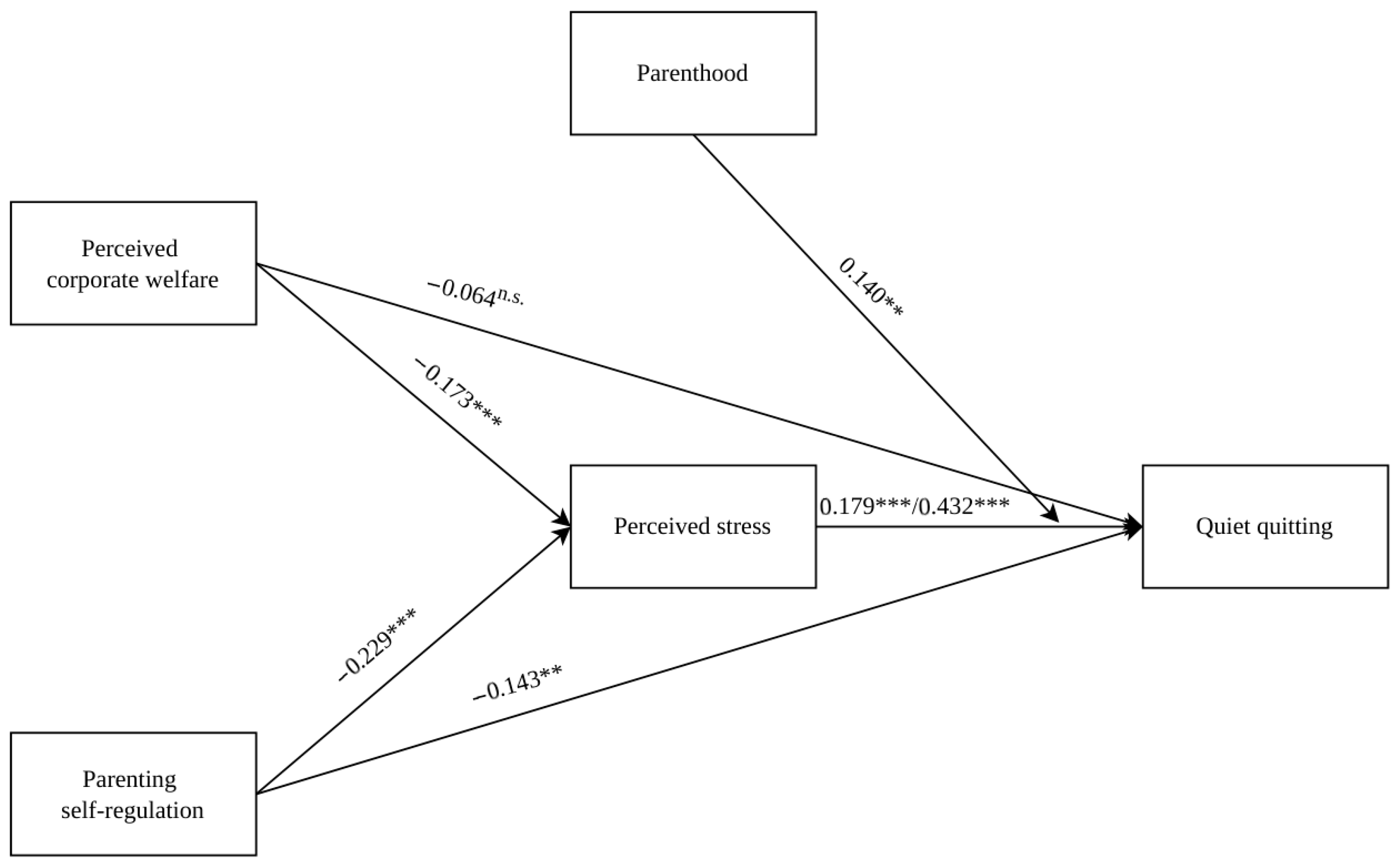
3.3. The Moderated Mediation Model
4. Discussion and Conclusions
Author Contributions
Funding
Institutional Review Board Statement
Informed Consent Statement
Data Availability Statement
Conflicts of Interest
Abbreviations
| AVE | Average Variance Extracted |
| CFA | Confirmatory Factor Analysis |
| CFI | Comparative Fit Index |
| CI | Confidence Interval |
| CMB | Common Method Bias |
| CR | Composite Reliability |
| JD-R | Job Demands-Resources |
| M | Mean |
| PSF | Parenting self-regulation |
| Quiet quitting | |
| RMSEA | Root-Mean-Square Error of Approximation |
| SD | Standard Deviation |
| SRMR | Standardized Root-Mean-Square Residual |
| STRESS | Perceived stress |
| TLI | Tucker–Lewis Index |
| WELF | Perceived corporate welfare |
Appendix A. Perceived Corporate Welfare Scale
| Strongly disagree Fortemente in disaccordo | Disagree In disaccordo | Mixed feelings Né in disaccordo né d’accordo | Agree D’accordo | Strongly agree Fortemente d’accordo |
| 1 | 2 | 3 | 4 | 5 |
| Items |
| 1. Welfare measures are identified by my Organization on the basis of an analysis of my specific needs (e.g., support with caregiving responsibilities) 1. Le misure di welfare sono individuate dalla mia Organizzazione sulla base dell’analisi delle mie specifiche necessità (es. supporto nei carichi di cura) |
| 2. Welfare measures proposed by my Organization address my needs (e.g., flexible working hours) 2. Le misure di welfare proposte dalla mia Organizzazione rispondono ai miei bisogni (es. orari flessibili) |
| 3. My Organization systematically monitors whether the welfare measures provided are adequate to meet my needs 3. L’Organizzazione in cui lavoro monitora in modo costante se le misure di welfare proposte siano adeguate ai miei bisogni |
| 4. I am aware of the welfare measures offered by my Organization 4. Sono a conoscenza delle misure di welfare proposte dalla mia Organizzazione |
| 5. My Organization effectively implements what it communicates regarding welfare policies 5. La mia Organizzazione mette in pratica ciò che comunica in tema di welfare |
| 6. Within my Organization, I can easily access welfare measures that support my well-being (e.g., by promoting a better work-life balance) 6. Nella mia Organizzazione posso usufruire facilmente delle misure di welfare a sostegno del mio benessere (es. favorendo un miglior equilibrio tra vita e lavoro) |
| 7. Welfare measures proposed by my Organization demonstrate its concrete commitment to sustainability 7. Le misure di welfare proposte dalla mia Organizzazione sono la dimostrazione del suo impegno concreto in termini di sostenibilità |
| 8. Welfare measures identified by my Organization contribute to reducing pay gaps and promoting gender equity within my work environment (e.g., supporting parenthood) 8. Le misure di welfare individuate dalla mia Organizzazione contribuiscono al contrasto del divario retributivo e alla promozione dell’equità di genere nel mio contesto lavorativo (es. sostenendo la genitorialità) |
| 9. Welfare measures adopted in my Organization foster a corporate culture oriented toward employee well-being and the care of their family members 9. Le misure di welfare adottate nella mia Organizzazione promuovono una cultura aziendale orientata al benessere dei/delle dipendenti e alla cura dei loro familiari |
| Note. This scale may be freely copied as long as (a) authors are credited, (b) no changes are made, and (c) it is not sold. Anyone interested in using the scale should notify the corresponding author. |
| 1 | Presidential Decree No. 917 of 22 December 1986. Approvazione del testo unico delle imposte sui redditi [Approval of the Italian Tax Consolidated Text]. Gazzetta Ufficiale No. 302 (31 December 1986). Art. 51, 100. |
| 2 | Law No. 208 of 28 December 2015. Disposizioni per la formazione del bilancio annuale e pluriennale dello Stato (Legge di Stabilità 2016) [Provisions for the formation of the annual and multi-year State budget (Stability Law 2016)]. Gazzetta Ufficiale No. 302 (30 December 2015). |
| 3 | Law No. 232 of 11 December 2016. Bilancio di previsione dello Stato per l’anno finanziario 2017 e bilancio pluriennale per il triennio 2017-2019 [State budget for the 2017 financial year and multi-year budget for the 2017–2019 triennium]. Gazzetta Ufficiale No. 297 (21 December 2016). |
References
- Albanese, A. M., Russo, G. R., & Geller, P. A. (2019). The role of parental self-efficacy in parent and child well-being: A systematic review of associated outcomes. Child: Care, Health and Development, 45(3), 333–363. [Google Scholar] [CrossRef]
- AlHashmi, M., Jabeen, F., & Papastathopoulos, A. (2019). Impact of leader–member exchange and perceived organisational support on turnover intention: The mediating effects of psychological stress. Policing: An International Journal, 42(4), 520–536. [Google Scholar] [CrossRef]
- Allen, D. G., Shore, L. M., & Griffeth, R. W. (2003). The role of perceived organizational support and supportive human resource practices in the turnover process. Journal of Management, 29(1), 99–118. [Google Scholar] [CrossRef]
- Almendingen, A., & Pilkington, P. (2024). Parenting self-efficacy and psychological distress in parents of children with an autism spectrum disorder. Journal of Autism and Developmental Disorders, 54(7), 2604–2614. [Google Scholar] [CrossRef]
- Ardıç, M., & Erişen, M. A. (2025). Effect of work stress, job satisfaction and work engagement on quiet quitting in healthcare workers. Sağlık ve Hemşirelik Yönetimi Dergisi, 12(1), 130–139. [Google Scholar] [CrossRef]
- Bagozzi, R. P., & Yi, Y. (2012). Specification, evaluation, and interpretation of structural equation models. Journal of the Academy of Marketing Science, 40(1), 8–34. [Google Scholar] [CrossRef]
- Bakker, A. B., & Demerouti, E. (2017). Job demands–resources theory: Taking stock and looking forward. Journal of Occupational Health Psychology, 22(3), 273–285. [Google Scholar] [CrossRef] [PubMed]
- Bakker, A. B., & Demerouti, E. (2024). Job demands-resources theory: Frequently asked questions. Journal of Occupational Health Psychology, 29(3), 188–200. [Google Scholar] [CrossRef]
- Bakker, A. B., Demerouti, E., & Sanz-Vergel, A. (2023). Job demands–resources theory: Ten years later. Annual Review of Organizational Psychology and Organizational Behavior, 10(1), 25–53. [Google Scholar] [CrossRef]
- Bakker, A. B., Ten Brummelhuis, L. L., Prins, J. T., & Der Heijden, F. M. M. A. V. (2011). Applying the job demands–resources model to the work–home interface: A study among medical residents and their partners. Journal of Vocational Behavior, 79(1), 170–180. [Google Scholar] [CrossRef]
- Battistelli, A., & Mariani, M. G. (2011). Supporto organizzativo: Validazione della versione italiana della survey of perceived organizational support (versione a 8 item). [Organizational support: Validation of the Italian version of the survey of perceived organizational support (8-item version)]. Giornale Italiano di Psicologia, 38(1), 189–214. [Google Scholar] [CrossRef]
- Bernuzzi, C., Paganin, G., Petrilli, S., & Margheritti, S. (2025). Old trends in new clothing? Exploring the quiet quitting phenomenon through a scoping review. Current Psychology, 44(11), 10990–11010. [Google Scholar] [CrossRef]
- Berthon, P., Ewing, M., & Hah, L. L. (2005). Captivating company: Dimensions of attractiveness in employer branding. International Journal of Advertising, 24(2), 151–172. [Google Scholar] [CrossRef]
- Biggs, A., Brough, P., & Drummond, S. (2017). Lazarus and folkman’s psychological stress and coping theory. In C. L. Cooper, & J. C. Quick (Eds.), The handbook of stress and health (pp. 349–364). Wiley. [Google Scholar] [CrossRef]
- Blau, F. D., & Kahn, L. M. (2017). The gender wage gap: Extent, trends, and explanations. Journal of Economic Literature, 55(3), 789–865. [Google Scholar] [CrossRef]
- Blom, R., Jaspers, E., Knies, E., & Van Der Lippe, T. (2025). Family-friendly policies and workplace supports: A meta-analysis of their effects on career, job, and work-family outcomes. Journal of Vocational Behavior, 157, 104091. [Google Scholar] [CrossRef]
- Boz, A. (2026). Understanding teacher quiet quitting: How workload, engagement and stress shape the influence of transformational leadership. European Journal of Education, 61(1), e70513. [Google Scholar] [CrossRef]
- Brown, T. A. (2015). Confirmatory factor analysis for applied research (2nd ed.). Guilford Press. [Google Scholar]
- Buchanan, C. M., Gangel, M. J., McCurdy, A. L., Fletcher, A. C., & Buehler, C. (2022). Parental self-efficacy and physiological responses to stress among mothers of early adolescents. Journal of Youth and Adolescence, 51(4), 643–658. [Google Scholar] [CrossRef]
- Busacca, M., & Pasian, P. (2025). Welfare locale: Teorie, attori, transizioni [Local welfare: Theories, actors, transitions]. Egea. [Google Scholar]
- Caputo, A., Molino, M., Cerato, B., & Cortese, C. G. (2023). Employer attractiveness: Two instruments to measure employer branding and reputation. Sage Open, 13(3), 1–17. [Google Scholar] [CrossRef]
- CENSIS. (2026). IX rapporto Censis-Eudaimon. A ognuno il suo welfare aziendale: La sfida praticabile. Il punto di vista di lavoratori e aziende [IX Censis-Eudaimon report. Corporate welfare for all: The feasible challenge. The perspective of workers and companies]. CENSIS. [Google Scholar]
- Chung, H., & Van Der Lippe, T. (2020). Flexible working, work–life balance, and gender equality: Introduction. Social Indicators Research, 151(2), 365–381. [Google Scholar] [CrossRef]
- Cohen, S., Kamarck, T., & Mermelstein, R. (1983). A global measure of perceived stress. Journal of Health and Social Behavior, 24(4), 385. [Google Scholar] [CrossRef]
- Colquitt, J. A. (2001). On the dimensionality of organizational justice: A construct validation of a measure. Journal of Applied Psychology, 86(3), 386–400. [Google Scholar] [CrossRef] [PubMed]
- Coltrane, S., Miller, E. C., DeHaan, T., & Stewart, L. (2013). Fathers and the flexibility stigma. Journal of Social Issues, 69(2), 279–302. [Google Scholar] [CrossRef]
- Dal Corso, L. (2024). Welfare aziendale: Motivazione e benessere delle persone al lavoro. [Corporate welfare: Motivation and well-being of people at work]. In T. Barone, S. Cavallarin, & M. Barazzuol (Eds.), Declinazioni e percorsi del welfare in Veneto [Welfare trends and developments in Veneto] (pp. 51–58). Veneto Welfare. [Google Scholar]
- Dal Corso, L., & Rapisarda, S. (in press). Il ruolo strategico del welfare aziendale a sostegno della genitorialità. [The strategic role of corporate welfare in supporting parenthood]. In M. Barazzuol, & S. Cavallarin (Eds.), Inclusione, welfare e innovazione sociale. Il mondo del lavoro alla prova della parità [Inclusion, welfare, and social innovation: The world of work put to the test of equality]. Egea.
- Danacı, E., Arıca, E. Ö., & Erdoğan, T. K. (2026). The relationship between stress of conscience and quiet quitting in nurses: The mediating role of compassion fatigue. Healthcare, 14(3), 316. [Google Scholar] [CrossRef]
- D’Angelo, C., Gazzaroli, D., & Gozzoli, C. (2020). Organisational Welfare in Italian SMEs: The Process of Valorising Human Resources. Sustainability, 12(22), 9318. [Google Scholar] [CrossRef]
- De Carlo, A., Girardi, D., Falco, A., Dal Corso, L., & Di Sipio, A. (2019). When does work interfere with teachers’ private life? An application of the job demands-resources model. Frontiers in Psychology, 10, 1121. [Google Scholar] [CrossRef]
- De Falco, M. (2023). Corporate and occupational welfare: The need for a quantitative approach to modern industrial relations. E-Journal of International and Comparative Labour Studies, 12(1), 56–69. [Google Scholar]
- Demerouti, E. (2025). Job demands-resources and conservation of resources theories: How do they help to explain employee well-being and future job design? Journal of Business Research, 192, 115296. [Google Scholar] [CrossRef]
- Demerouti, E., & Bakker, A. B. (2023). Job demands-resources theory in times of crises: New propositions. Organizational Psychology Review, 13(3), 209–236. [Google Scholar] [CrossRef]
- Demerouti, E., Bakker, A. B., Nachreiner, F., & Schaufeli, W. B. (2001). The job demands-resourse model of burnout. Journal of Applied Psychology, 86(3), 499–512. [Google Scholar] [CrossRef]
- Dilchert, S., Stanek, K. C., & Ones, D. S. (2025). Expanding our understanding of quiet quitting: Antecedents, correlates, and consequences. Human Resource Management, 65(3), 679–704. [Google Scholar] [CrossRef]
- Dilekçi, Ü., Kaya, A., & Çiçek, İ. (2025). Occupational stress, burnout, and change fatigue as predictors of quiet quitting among teachers. Acta Psychologica, 254, 104812. [Google Scholar] [CrossRef]
- Dong, C. (2026). Yes to the ethic of care, but at what cost? Examining how personal and organizational care perceptions influence work stress and quiet quitting in the public sector. Management Communication Quarterly, 1–42. [Google Scholar] [CrossRef]
- Eisenberger, R., Huntington, R., Hutchison, S., & Sowa, D. (1986). Perceived organizational support. Journal of Applied Psychology, 71(3), 500–507. [Google Scholar] [CrossRef]
- El-Sayed, B. K. M., Asal, M. G. R., & El-Sayed, A. A. I. (2026). Navigating quiet quitting among critical care nurses in the digital era: The impact of techno-stress and digital resilience. Nursing in Critical Care, 31(1), e70273. [Google Scholar] [CrossRef]
- Florean, I. S., Dobrean, A., & Balazsi, R. (2025). From parenting self-efficacy to child externalizing problems: The role of perceived parent stress and practices. Family Relations, 74(4), 2185–2200. [Google Scholar] [CrossRef]
- Garcia, A. S., Carotta, C. L., Brown, R., Da Rosa, P., Pravecek, B., & Carson, P. (2021). Parenting stress, self-efficacy and COVID-19 health risks as predictors of general stress among nurses. International Journal of Nursing Practice, 27(6), e13009. [Google Scholar] [CrossRef] [PubMed]
- Geng, R., Geng, X., & Geng, S. (2026). Identifying key antecedents of quiet quitting among nurses: A cross-profession meta-analytic review. Journal of Advanced Nursing, 82(1), 913–933. [Google Scholar] [CrossRef]
- Giorgi, G., León-Perez, J. M., Montani, F., Fernández-Salinero, S., Ortiz-Gómez, M., Ariza-Montes, A., Arcangeli, G., & Mucci, N. (2020). Fear of non-employability and of economic crisis increase workplace harassment through lower organizational welfare orientation. Sustainability, 12(9), 3876. [Google Scholar] [CrossRef]
- Haar, J., Ghafoor, A., & Brougham, D. (2026). Quiet quitting after COVID-19: Antecedents and gender differences. Asia Pacific Journal of Human Resources, 64(2), e70065. [Google Scholar] [CrossRef]
- Hamilton, V. E., Matthews, J. M., & Crawford, S. B. (2015). Development and preliminary validation of a parenting self-regulation scale: “Me as a parent.”. Journal of Child and Family Studies, 24(10), 2853–2864. [Google Scholar] [CrossRef]
- Hampson, S. C. (2018). Mothers do not make good workers: The role of work/life balance policies in reinforcing gendered stereotypes. Global Discourse, 8(3), 510–531. [Google Scholar] [CrossRef]
- Hareendrakumar, V. R., Subramoniam, S., & Bijulal, D. (2021). Measuring total reward satisfaction: Scale development and empirical validation for public sector employees in India. Metamorphosis: A Journal of Management Research, 20(2), 77–89. [Google Scholar] [CrossRef]
- Henderson, R., Lehman, J., & Sunder, A. (2024). Clock-out: What explains “Quiet Quitting” in financial services? Financial Planning Review, 7(3–4), e1192. [Google Scholar] [CrossRef]
- Hobfoll, S. E., Halbesleben, J., Neveu, J.-P., & Westman, M. (2018). Conservation of resources in the organizational context: The reality of resources and their consequences. Annual Review of Organizational Psychology and Organizational Behavior, 5(1), 103–128. [Google Scholar] [CrossRef]
- IBM Corp. (2023). IBM SPSS statistics for windows (Version 29.0) [Computer software]. IBM Corp.
- Ikenga, G. U., & Van Der Sijde, P. (2024). Twenty-first century competencies; about competencies for industry 5.0 and the opportunities for emerging economies. Sustainability, 16(16), 7166. [Google Scholar] [CrossRef]
- Islam, M. A., Somu, S., & Karatepe, O. M. (2026). Antecedents and consequences of quiet quitting: A systematic literature review. The Service Industries Journal, 1–36. [Google Scholar] [CrossRef]
- Jayanthi, S., & Ilangovan, K. (2019). A study on awareness and satisfaction towards employee welfare measures. International Journal of Engineering and Management Research, 9(4), 155–160. [Google Scholar] [CrossRef]
- Kestler-Peleg, M., Lavenda, O., Stenger, V., Bendett, H., Alhalel-Lederman, S., Maayan-Metzger, A., & Strauss, T. (2020). Maternal self-efficacy mediates the association between spousal support and stress among mothers of NICU hospitalized preterm babies. Early Human Development, 146, 105077. [Google Scholar] [CrossRef]
- Kvande, E., & Brandth, B. (2020). Designing parental leave for fathers—Promoting gender equality in working life. International Journal of Sociology and Social Policy, 40(5/6), 465–477. [Google Scholar] [CrossRef]
- Lavenda, O., Hershkovitz-Freudenthal, A., & Leshem, E. (2026). A closer look at parenting stress: Parent, child, and contextual characteristics. Family Relations, 75(1), 323–341. [Google Scholar] [CrossRef]
- Law, K. H., Dimmock, J., Guelfi, K. J., Nguyen, T., Gucciardi, D., & Jackson, B. (2019). Stress, depressive symptoms, and maternal self-efficacy in first-time mothers: Modelling and predicting change across the first six months of motherhood. Applied Psychology: Health and Well-Being, 11(1), 126–147. [Google Scholar] [CrossRef] [PubMed]
- Lazarus, R. S. (1966). Psychological stress and the coping process. McGraw-Hill. [Google Scholar]
- Lazarus, R. S., & Folkman, S. (1994). Stress, appraising, and coping. Springer. [Google Scholar]
- Lesener, T., Gusy, B., & Wolter, C. (2019). The job demands-resources model: A meta-analytic review of longitudinal studies. Work & Stress, 33(1), 76–103. [Google Scholar] [CrossRef]
- Li, F., Xu, M., Wu, D., Tang, Y., Zhang, L., Liu, X., Zhou, L., Li, F., & Jiang, L. (2022). From child social impairment to parenting stress in mothers of children with ASD: The role of parental self-efficacy and social support. Frontiers in Psychiatry, 13, 1005748. [Google Scholar] [CrossRef]
- Lin-Lewry, M., Thi Thuy Nguyen, C., Hasanul Huda, M., Tsai, S.-Y., Chipojola, R., & Kuo, S.-Y. (2024). Effects of digital parenting interventions on self-efficacy, social support, and depressive symptoms in the transition to parenthood: A systematic review and meta-analysis. International Journal of Medical Informatics, 185, 105405. [Google Scholar] [CrossRef] [PubMed]
- Little, T. D. (2013). Longitudinal structural equation modeling. The Guilford Press. [Google Scholar]
- Little, T. D., Cunningham, W. A., Shahar, G., & Widaman, K. F. (2002). To parcel or not to parcel: Exploring the question, weighing the merits. Structural Equation Modeling: A Multidisciplinary Journal, 9(2), 151–173. [Google Scholar] [CrossRef]
- MacKinnon, D. P., Cheong, J., & Pirlott, A. G. (2012). Statistical mediation analysis. In H. Cooper, P. M. Camic, D. L. Long, A. T. Panter, D. Rindskopf, & J. Sher (Eds.), APA handbook of research methods in psychology, Vol 2: Research designs: Quantitative, qualitative, neuropsychological, and biological (pp. 313–331). American Psychological Association. [Google Scholar]
- Mailey, E. L., & McAuley, E. (2014). Physical activity intervention effects on perceived stress in working mothers: The role of self-efficacy. Women & Health, 54(6), 552–568. [Google Scholar] [CrossRef]
- Matthews, J., Millward, C., Hayes, L., & Wade, C. (2022). Development and Validation of a short-form parenting self-efficacy scale: Me as a parent scale (MaaPs-SF). Journal of Child and Family Studies, 31(8), 2292–2302. [Google Scholar] [CrossRef]
- Mondo, M., Sechi, C., & Cabras, C. (2021). Psychometric evaluation of three version of the Italian perceived stress scale. Current Psychology, 40, 1884–1892. [Google Scholar] [CrossRef]
- Mundakir, M., Choliq, I., Sukadiono, S., Vika, R. F., & Firman, F. (2025). Parenting self-efficacy mediates relationship between caregiving burden and parenting stress among parents of adolescents with disabilities: A cross-sectional study. Jurnal Ners, 20(2), 145–153. [Google Scholar] [CrossRef]
- Nimmi, P. M., Syed, F., Manjaly, N. B., & Harsha, G. (2024). Employee’s narrative on quiet quitting—A qualitative analysis. Employee Relations: The International Journal, 46(7), 1406–1421. [Google Scholar] [CrossRef]
- Olivelli, F. (2020). L’inquadramento sistematico del welfare aziendale [The systematic framework of corporate welfare]. Rivista del Diritto della Sicurezza Sociale, 20(1), 103–124. [Google Scholar] [CrossRef]
- Öztürk, E., Arikan, Ö. U., & Ocak, M. (2023). Understanding quiet quitting: Triggers, antecedents and consequences. Uluslararası Davranış, Sürdürülebilirlik ve Yönetim Dergisi, 10(18), 57–79. [Google Scholar] [CrossRef]
- Patel, P. C., Guedes, M. J., Bachrach, D. G., & Cho, Y. (2025). A multidimensional quiet quitting scale: Development and test of a measure of quiet quitting. PLoS ONE, 20(4), e0317624. [Google Scholar] [CrossRef] [PubMed]
- Perrigino, M. B., Dunford, B. B., & Wilson, K. S. (2018). Work–family backlash: The “dark side” of work–life balance (WLB) policies. Academy of Management Annals, 12(2), 600–630. [Google Scholar] [CrossRef]
- Podsakoff, P. M., MacKenzie, S. B., Lee, J.-Y., & Podsakoff, N. P. (2003). Common method biases in behavioral research: A critical review of the literature and recommended remedies. Journal of Applied Psychology, 88(5), 879–903. [Google Scholar] [CrossRef]
- Podsakoff, P. M., Podsakoff, N. P., Williams, L. J., Huang, C., & Yang, J. (2024). Common method bias: It’s bad, it’s complex, it’s widespread, and it’s not easy to fix. Annual Review of Organizational Psychology and Organizational Behavior, 11, 17–61. [Google Scholar] [CrossRef]
- Rapisarda, S., De Carlo, A., Pasqualetto, E., Volling, B. L., & Dal Corso, L. (2024a). Breaking the maternity mold: Navigating the return to work and challenging rigid maternal beliefs through an online psychological intervention. Frontiers in Global Women’s Health, 5, 1266162. [Google Scholar] [CrossRef]
- Rapisarda, S., Martucci, M., Arcucci, E., & Dal Corso, L. (2025, April 26–28). Balancing work-life time: A new measurement of corporate welfare. International Psychological Applications Conference and Trends—InPact 2025, Budapest, Hungary. [Google Scholar]
- Rapisarda, S., Santoro, V., & Dal Corso, L. (2024b). Unleashing the potential of metaphors: A categorization system for exploring return to work after maternity. Archives of Women’s Mental Health, 27, 607–618. [Google Scholar] [CrossRef]
- R Core Team. (2023). R: A language and environment for statistical computing (Version 4.3) [Computer software]. Available online: https://cran.r-project.org (accessed on 12 March 2026).
- Rhoades, L., & Eisenberger, R. (2002). Perceived organizational support: A review of the literature. Journal of Applied Psychology, 87(4), 698–714. [Google Scholar] [CrossRef] [PubMed]
- Sasirekha, S., Monica, P., Mythily, B., & Vimalan, C. (2021). A study to identify the employee satisfaction on welfare measures at shipping and logistics sector. Turkish Online Journal of Qualitative Inquiry, 12(4), 691–698. [Google Scholar]
- Saxbe, D., Rossin-Slater, M., & Goldenberg, D. (2018). The transition to parenthood as a critical window for adult health. American Psychologist, 73(9), 1190–1200. [Google Scholar] [CrossRef]
- Smith, C. J., Han, Y., Dupré, K. E., & Sears, G. J. (2022). Perceived organizational support and its interaction with voice on police officers’ organizational cynicism, stress and emotional exhaustion. Policing: An International Journal, 45(2), 200–217. [Google Scholar] [CrossRef]
- Spagnoli, P., Farnese, M. L., D’Olimpio, F., Millefiorini, A., & Scafuri Kovalchuk, L. (2017). Psychometric properties of the Italian version of colquitt’s organizational justice scale (OJS). International Journal of Organizational Analysis, 25(5), 861–874. [Google Scholar] [CrossRef]
- Sviluppo Lavoro Italia. (2026). Famiglia e Lavoro. Rapporto annuale 2025 [Family and Work. Annual Report 2025]. Sviluppo Lavoro Italia. [Google Scholar]
- ten Brummelhuis, L. L., & Bakker, A. B. (2012). A resource perspective on the work–home interface: The work–home resources model. American Psychologist, 67(7), 545–556. [Google Scholar] [CrossRef] [PubMed]
- Tetteh, S., Wu, C., Opata, C. N., Asirifua Agyapong, G. N. Y., Amoako, R., & Osei-Kusi, F. (2020). Perceived organisational support, job stress, and turnover intention: The moderation of affective commitments. Journal of Psychology in Africa, 30(1), 9–16. [Google Scholar] [CrossRef]
- The jamovi project. (2024). Jamovi (Version 2.5) [Computer software]. Available online: https://www.jamovi.org (accessed on 12 March 2026).
- Thomason, E., Flynn, H. A., Himle, J. A., & Volling, B. L. (2015). Are women’s parenting-specific beliefs associated with depressive symptoms in the perinatal period? Development of the rigidity of maternal beliefs scale. Depression and Anxiety, 32(2), 141–148. [Google Scholar] [CrossRef] [PubMed]
- Trstenjak, M., Benešova, A., Opetuk, T., & Cajner, H. (2025). Human factors and ergonomics in industry 5.0—A systematic literature review. Applied Sciences, 15(4), 2123. [Google Scholar] [CrossRef]
- Vinitha, S., Vanitha, P., & Malarkodi, K. (2020). A study on employee satisfaction towards welfare measures. Journal of Emerging Technologies and Innovative Research, 7(5), 400–408. [Google Scholar]
- Waid, J., Abusaleh, K., & Marsalis, S. (2025). Approaches to strengthen parental self-efficacy: An umbrella review of systematic reviews. Children and Youth Services Review, 177, 108483. [Google Scholar] [CrossRef]
- Williams, J. (2000). Unbending gender: Why family and work conflict and what to do about it. Oxford University Press. [Google Scholar]
- World Economic Forum. (2025). Future of jobs report 2025. Available online: https://www.weforum.org/publications/the-future-of-jobs-report-2025/ (accessed on 25 February 2026).
- Wu, M., Zhou, W., Hu, S., Peng, F., Yang, F., & Zhang, L. (2024). Parenting self-efficacy and parenting stress mediates the effects of the association of perceived social support and readiness for discharge among parents of children with primary nephrotic syndrome. Journal of Pediatric Nursing, 75, e93–e101. [Google Scholar] [CrossRef] [PubMed]

| Socio-Demographic | Frequence | Percentage |
|---|---|---|
| Age | ||
| Between 18 and 39 years | 414 | 52.5% |
| Between 40 and 49 years | 165 | 20.9% |
| Between 50 and 59 years | 162 | 20.6% |
| 60 and over | 47 | 6.0% |
| Education | ||
| Elementary/Middle school diploma | 85 | 10.8% |
| High school diploma | 305 | 38.7% |
| University degree | 305 | 38.7% |
| Post-graduate degree | 81 | 10.3% |
| Other | 12 | 1.5% |
| Occupation | ||
| Employed in paid work | 674 | 85.5% |
| Freelance | 88 | 11.2% |
| Other | 26 | 3.3% |
| Work contract | ||
| Open-ended contract | 515 | 65.4% |
| Fixed-term contract | 141 | 17.9% |
| Other | 41 | 5.2% |
| Missing data | 91 | 11.5% |
| Work time | ||
| Full-time | 591 | 75.0% |
| Part-time | 164 | 20.8% |
| Other | 33 | 4.2% |
| Marital status | ||
| Married or cohabiting | 429 | 54.4% |
| Divorced or separated | 63 | 8.0% |
| Single or unmarried | 282 | 35.8% |
| Other | 14 | 1.8% |
| Parenthood | ||
| Non-parent | 343 | 43.5% |
| Mother | 233 | 29.6% |
| Father | 212 | 26.9% |
| Number of children * | ||
| One | 206 | 46.3% |
| Two | 199 | 44.7% |
| Three or more | 37 | 8.3% |
| Missing data | 3 | 0.7% |
| Items | Standardized Coefficients |
|---|---|
| Item 1 | 0.712 |
| Item 2 | 0.748 |
| Item 3 | 0.800 |
| Item 4 | 0.608 |
| Item 5 | 0.834 |
| Item 6 | 0.860 |
| Item 7 | 0.898 |
| Item 8 | 0.814 |
| Item 9 | 0.870 |
| Variables | M | SD | 1 | 2 | 3 |
|---|---|---|---|---|---|
| 1. Perceived corporate welfare | 3.001 | 0.906 | - | ||
| 2. Perceived stress | 1.568 | 0.877 | −0.252 *** | - | |
| 3. Quiet quitting | 2.338 | 0.828 | −0.144 *** | 0.326 *** | - |
| Variables | M | SD | 1 | 2 | 3 | 4 |
|---|---|---|---|---|---|---|
| 1. Perceived corporate welfare | 3.055 | 0.942 | - | |||
| 2. Parenting self-regulation | 3.887 | 0.522 | 0.209 *** | - | ||
| 3. Perceived stress | 1.466 | 0.855 | −0.240 *** | −0.290 *** | - | |
| 4. Quiet quitting | 2.258 | 0.851 | −0.164 *** | −0.246 *** | 0.359 *** | - |
| Antecedents | Outcomes | |||||||||
|---|---|---|---|---|---|---|---|---|---|---|
| Perceived Stress | Quiet Quitting | |||||||||
| B | SE | β | p | 95% CI | B | SE | β | p | 95% CI | |
| Perceived corporate welfare | −0.157 | 0.041 | −0.173 | 0.001 | [−0.2425; −0.0739] | −0.058 | 0.041 | −0.064 | 0.152 | [−0.1422; 0.0294] |
| Parenting self-regulation | −0.375 | 0.074 | −0.229 | 0.001 | [−0.5298; −0.2153] | −0.232 | 0.075 | −0.143 | 0.002 | [−0.3923; −0.0865] |
| Parenthood | −0.264 | 0.077 | −0.155 | 0.001 | [−0.4152; −0.1132] | −0.327 | 0.150 | −0.048 | 0.029 | [−0.6213; −0.0329] |
| Perceived stress—Mother | 0.174 | 0.046 | 0.179 | 0.001 | [0.0413; 0.3022] | |||||
| Perceived stress—Father | 0.453 | 0.046 | 0.432 | 0.001 | [0.2899; 0.6235] | |||||
| Perceived stress X Parenthood | 0.279 | 0.088 | 0.140 | 0.002 | [0.1054; 0.4529] | |||||
| Moderator Levels | Indirect Effect | Standardized Indirect Effect | Bootstrap 5000 Times 95% CI | |
|---|---|---|---|---|
| CI Lower | CI Upper | |||
| Mother | WELF → STRESS → QQ | −0.031 | −0.0576 | −0.0049 |
| Father | WELF → STRESS → QQ | −0.075 | −0.1200 | −0.0297 |
| Mother | PSR → STRESS → QQ | −0.041 | −0.1273 | −0.0145 |
| Father | PSR → STRESS → QQ | −0.099 | −0.2630 | −0.0870 |
Disclaimer/Publisher’s Note: The statements, opinions and data contained in all publications are solely those of the individual author(s) and contributor(s) and not of MDPI and/or the editor(s). MDPI and/or the editor(s) disclaim responsibility for any injury to people or property resulting from any ideas, methods, instructions or products referred to in the content. |
© 2026 by the authors. Licensee MDPI, Basel, Switzerland. This article is an open access article distributed under the terms and conditions of the Creative Commons Attribution (CC BY) license.
Share and Cite
Rapisarda, S.; Girardi, D.; Pileri, J.; Falco, A.; Dal Corso, L. Corporate Welfare and Parenting Self-Regulation as Protective Resources Against Stress and Quiet Quitting: A Moderated Mediation Model Across Mothers and Fathers. Behav. Sci. 2026, 16, 743. https://doi.org/10.3390/bs16050743
Rapisarda S, Girardi D, Pileri J, Falco A, Dal Corso L. Corporate Welfare and Parenting Self-Regulation as Protective Resources Against Stress and Quiet Quitting: A Moderated Mediation Model Across Mothers and Fathers. Behavioral Sciences. 2026; 16(5):743. https://doi.org/10.3390/bs16050743
Chicago/Turabian StyleRapisarda, Sebastiano, Damiano Girardi, Jessica Pileri, Alessandra Falco, and Laura Dal Corso. 2026. "Corporate Welfare and Parenting Self-Regulation as Protective Resources Against Stress and Quiet Quitting: A Moderated Mediation Model Across Mothers and Fathers" Behavioral Sciences 16, no. 5: 743. https://doi.org/10.3390/bs16050743
APA StyleRapisarda, S., Girardi, D., Pileri, J., Falco, A., & Dal Corso, L. (2026). Corporate Welfare and Parenting Self-Regulation as Protective Resources Against Stress and Quiet Quitting: A Moderated Mediation Model Across Mothers and Fathers. Behavioral Sciences, 16(5), 743. https://doi.org/10.3390/bs16050743

