Article

Predictors of High School Students’ Intentions and Behaviors in Using AI Learning Tools: An Extended Theory of Planned Behavior Approach

1
Jing Hengyi School of Education, Hangzhou Normal University, Hangzhou 311121, China
2
Chinese Education Modernization Research Institute, Jing Hengyi School of Education, Hangzhou Normal University, Hangzhou 311121, China
*
Author to whom correspondence should be addressed.
Behav. Sci. 2026, 16(5), 736; https://doi.org/10.3390/bs16050736
Submission received: 27 March 2026 / Revised: 28 April 2026 / Accepted: 30 April 2026 / Published: 9 May 2026

Abstract

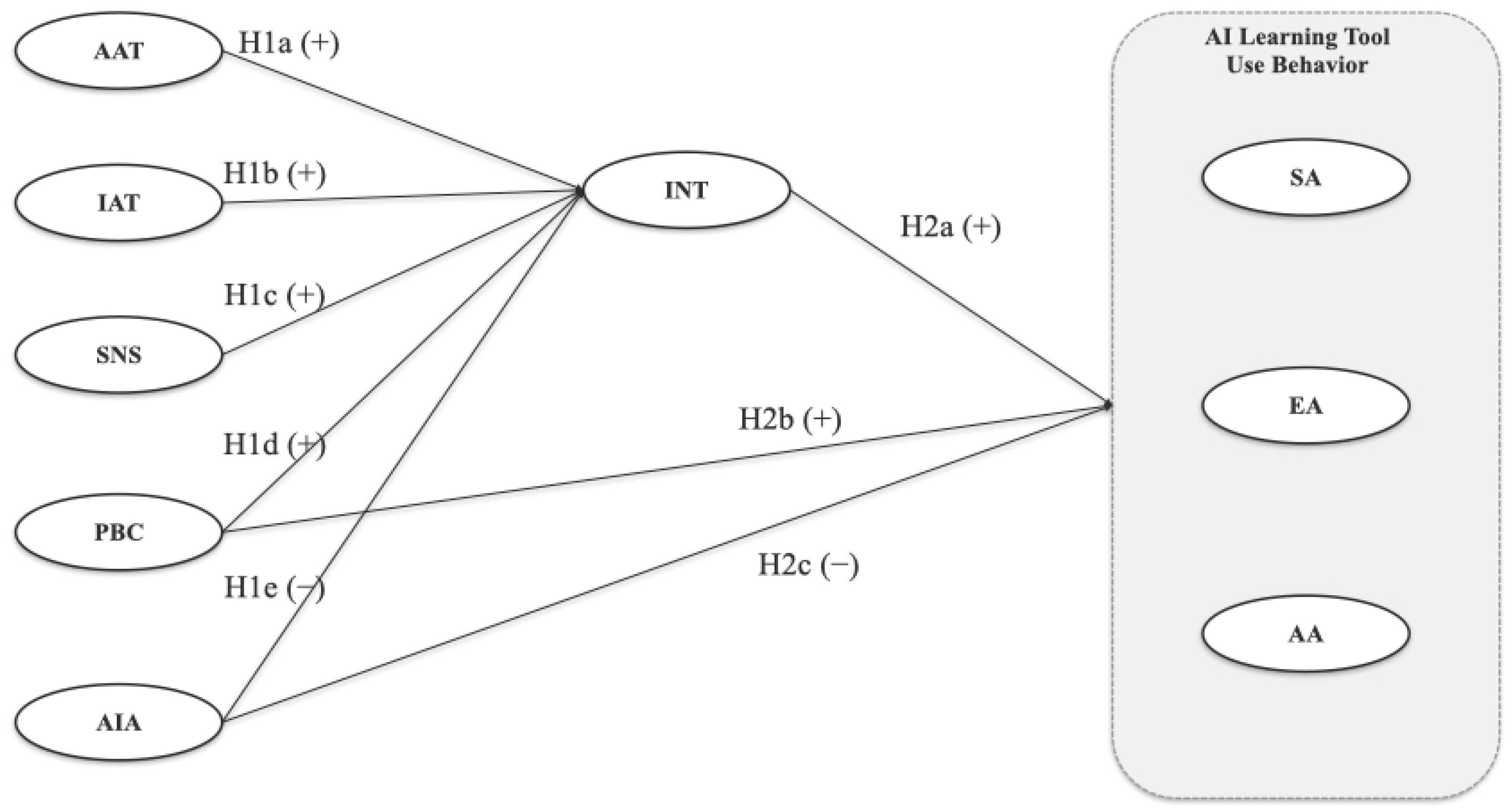
AI learning tools are now common enough in secondary education that students are expected to know how to use them, yet we still know relatively little about what drives their use among high school students. This study applied an extended theory of planned behavior (TPB) model to examine whether affective attitude, instrumental attitude, subjective norms, perceived behavioral control, and AI anxiety predicted students’ intention to use AI learning tools and their use behaviors, the latter encompassing three dimensions: seeking AI help, evaluating AI responses, and applying AI output. Attitude was divided into affective and instrumental components, and AI anxiety was added as a separate emotional predictor. Data were collected from 513 students in three public high schools in Hangzhou, China, and analyzed with structural equation modeling. Affective attitude, instrumental attitude, subjective norms, and perceived behavioral control all positively predicted intention. AI anxiety did not significantly predict intention, but it negatively predicted seeking AI help, evaluating AI responses, and applying AI output. The results suggest that, for these students, AI anxiety is more closely associated with behavioral engagement than intention formation. This distinction helps to clarify how adolescents use AI learning tools and may inform more focused school support for responsible AI use.
Keywords: AI learning tools; theory of planned behavior; AI anxiety; intention; learning behavior; high school students AI learning tools; theory of planned behavior; AI anxiety; intention; learning behavior; high school students