Article

The Effect of Thermal Pain on Working Memory: Behavioral Evidence from the n-Back Task

1
Brain and Artificial Intelligence Laboratory, School of Automation, Northwestern Polytechnical University, 1 Dongxiang Road, Chang’an District, Xi’an 710129, China
2
Department of Neurosurgery, Graduate School of Medicine, The University of Osaka, 2-2 Yamadaoka, Suita 565-0871, Osaka, Japan
3
School of Business, Xi’an International Studies University, South Wenyuan Road, Chang’an District, Xi’an 710128, China
4
Tokuyukai Rehabilitation Clinic, 2-24-18 Shinsenri Nishimachi, Toyonaka 560-0083, Osaka, Japan
*
Author to whom correspondence should be addressed.
Behav. Sci. 2026, 16(5), 701; https://doi.org/10.3390/bs16050701
Submission received: 22 January 2026 / Revised: 28 March 2026 / Accepted: 27 April 2026 / Published: 4 May 2026
(This article belongs to the Section Cognition)

Abstract

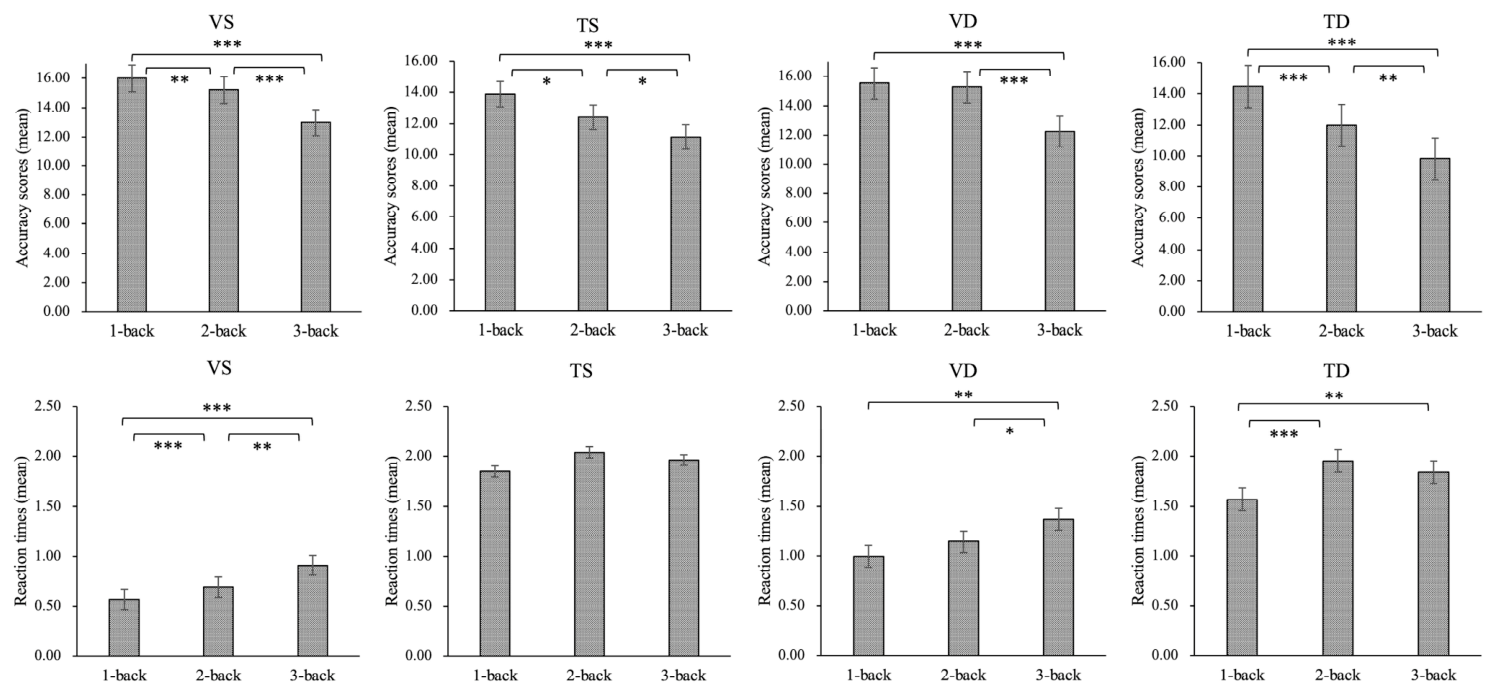
Pain and working memory interact bidirectionally, yet most paradigms treat pain as an extraneous distractor rather than task-relevant content. This study investigated whether thermal sensations can be encoded and updated in working memory in an n-back paradigm. Nineteen healthy adults completed visual (location) and thermal (temperature) single n-back tasks, cross-modal conditions with task-irrelevant distractors, and a dual n-back task across three load levels (1-, 2-, 3-back). Results showed that thermal cues consistently yielded lower accuracy and longer response times (RTs) compared to visual cues (p < 0.001, q < 0.001). While task-irrelevant thermal input tended to prolong RTs in the visual task under low load (p = 0.033, q = 0.099), task-irrelevant visual input showed a trend-level improvement in thermal-task accuracy under high load (3-back; p = 0.020, q = 0.060), consistent with a potential cross-modal effect. Qualitative data indicated that participants strategically transcoded thermal sensations into word or numerical labels to support maintenance. These findings demonstrate that pain can be operationalized as mnemonic content, though its processing incurs significant executive costs due to transcoding demands and resource competition. By shifting focus from “pain-as-interference” to “pain-as-content”, this paradigm offers a principled approach for the mechanistic study of nociceptive working memory updating and provides a foundation for quantifying cognitive interference in clinical pain populations.
Keywords: thermal pain stimulation; working memory; cognitive load; n-back task thermal pain stimulation; working memory; cognitive load; n-back task