Implementation Strategies and Outcomes for Whole-System Violence Reduction: A Case Study from Northern Ireland
Abstract
1. Introduction
1.1. Literature Review
1.2. What Is EPPOC?
1.3. Aim and Questions
2. Materials and Methods
2.1. Design
2.2. Case Study
2.3. Data Sources
2.4. Analytic Approach: Implementation Mapping
2.5. Ethics, Confidentiality, and Safe Reporting
2.6. Authors’ Roles in EPPOC
3. Findings (Results): EPPOC as Implementation Architecture in Practice
- how was EPPOC implemented as a system-level intervention?
- what implementation strategies were used?
- what factors influenced implementation outcomes?
3.1. EPPOC as a System-Level Intervention
3.2. The Implementation Architecture
3.2.1. Cross-Government Governance
- brought together authority, funding, and statutory levers across multiple Northern Ireland departments and agencies under a shared cross-Executive mandate, supported by formal governance and external scrutiny arrangements rather than single-department ownership (EPPOC, 2022; Independent Reporting Commission, 2025);
- addressed fragmented responses to paramilitary harm, youth violence, and coercive control by embedding multi-agency delivery and shared problem-solving across statutory and community sectors, rather than relying on isolated departmental or enforcement responses (EPPOC, 2022; Northern Ireland Affairs Committee, 2024); and
- established sustained cross-agency decision-making structures at both strategic and local levels, including cross-Executive governance arrangements and place-based partnership mechanisms (EPPOC, 2022).
3.2.2. A Codesigned, Shared Outcomes and Benefits Framework
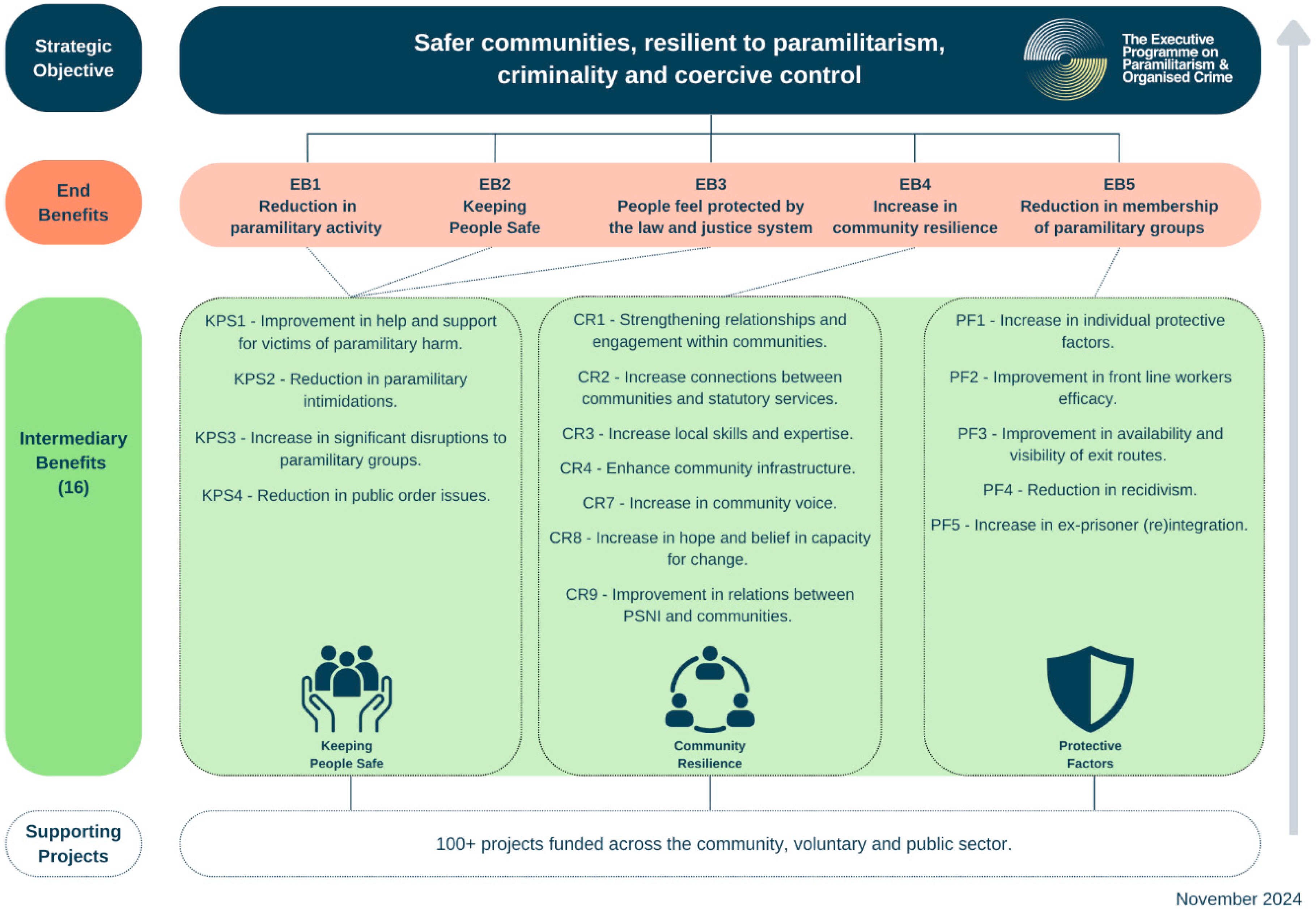
- identifies the changes required at project level to help to drive population-level impact (across keeping people safe, community resilience and individual protective factors);
- connects diverse projects and multiple methodologies to a shared theory of change; and
- helps to structure governance, planning and adaptation.
3.2.3. Collaborative Infrastructure
- cross-agency forums for problem-solving and sharing ‘what works’, particularly around barriers that no agency could resolve alone;
- local planning mechanisms;
- shared tools and language around trauma, coercion and protective factors.
3.2.4. Learning Systems
- systematic monitoring of projects, relevant issues, the policy environment and wider strategic enablers;
- action research and project-level evaluations over multiple years (Coyle et al., 2022; Walsh, 2022a, 2022c, 2023a, 2023b, 2024a, 2024b; Walsh & Cunningham, 2023);
- structured annual reviews of benefits across the Programme, resulting in an overall contribution analysis of the Programme’s impact; and
- thematic studies on drug-related intimidation (EPPOC & PHA, 2025); child criminal exploitation (Walsh, 2022b; Walsh et al., 2025c), and Adverse Childhood Experiences (Walsh et al., 2025a, 2025b).
3.2.5. A Trauma-Informed Approach
- delivery of accessible training across sectors;
- introducing organisational development support and practice standards; and
- strengthening frontline workers’ capability to respond to coercion, exploitation and adversity in safe, consistent and sustainable ways.
3.2.6. Constraints and Weaknesses
3.3. Implementation Strategies and Mechanisms
3.3.1. Authorise, Fund and Stabilise
3.3.2. Building the Delivery System
3.3.3. Learnable and Adaptable System
3.4. Implementation Outcomes
3.4.1. Acceptability
3.4.2. Adoption
3.4.3. Appropriateness
3.4.4. Costs
3.4.5. Feasibility
3.4.6. Fidelity
3.4.7. Penetration
3.4.8. Sustainability
3.4.9. Synthesis
4. Discussion: What Is Replicable About EPPOC?
4.1. Characteristics of Intervention
4.2. Outer-Setting
4.3. Inner-Setting
4.4. Individual-Level
4.5. Process Mechanisms
4.6. Transferability
- a stable or protected authorising environment capable of buffering volatility;
- cross-government ownership rather than departmental containment to prevent siloed delivery and ensure shared accountability;
- a shared outcomes and benefits framework that aligns diverse interventions to system-level goals;
- the ability to build practitioner capability and maintain safe practice in coercive or contested contexts;
- a learning system that supports iteration, contextual adaptation and cross-agency sensemaking; and
- mechanisms for mainstreaming to reduce dependence on ring-fenced funding.
4.7. Limitations
5. Conclusions
Author Contributions
Funding
Institutional Review Board Statement
Informed Consent Statement
Data Availability Statement
Acknowledgments
Conflicts of Interest
Appendix A. Implementation Strategies Used by EPPOC

| Implementation Strategy | Used by EPPOC? | Brief Description of EPPOC’s Utilisation of Strategy |
|---|---|---|
| Fund and contract for the clinical innovation | Yes | EPPOC allocated and managed funding for multi-agency projects delivering trauma informed and preventative activity. |
| Access new funding | Yes | EPPOC secured new government funding through the Fresh Start Agreement and subsequent programme approvals. |
| Place innovation on fee for service lists/formularies | No | EPPOC did not use reimbursement based mechanisms. |
| Alter incentive/allowance structures | No | EPPOC did not alter financial incentives for practitioners or organisations. |
| Make billing easier | No | EPPOC did not make changes to billing processes. |
| Alter patient/consumer fees | No | EPPOC did not modify consumer fee structures. |
| Use other payment schemes | No | EPPOC did not use alternative payment models. |
| Develop disincentives | No | EPPOC did not develop financial disincentives for non-adoption. |
| Use capitated payments | No | EPPOC did not introduce capitated payment systems. |
| Implementation Strategy | Used by EPPOC? | Brief Description of EPPOC’s Utilisation of Strategy |
|---|---|---|
| Identify and prepare champions | Yes | EPPOC intentionally identified key individuals across departments and delivery organisations and supported them to promote the programme’s aims and drive cultural and operational change. |
| Organise clinician implementation team meetings | No | EPPOC did not centrally organise formal clinician implementation teams, although some delivery partners and key leads used similar mechanisms within their own projects. However, at a system level, we used this strategy with key delivery leads and leadership figures. |
| Recruit, designate, and train for leadership | Yes | EPPOC recruited and equipped departmental and project leaders to support shared ownership of outcomes and coordinate change across sectors. |
| Inform local opinion leaders | Yes | EPPOC engaged influential practitioners and community figures to reinforce understanding of programme priorities and encourage wider adoption. |
| Build a coalition | Yes | EPPOC built a cross departmental and cross sector coalition that mobilised collective resources, authority, and commitment to address paramilitary harm. |
| Obtain formal commitments | Yes | EPPOC secured formal departmental commitments to shared delivery responsibilities, governance structures, and agreed outcomes. |
| Identify early adopters | Yes | EPPOC identified delivery leads and organisations willing to adopt new approaches early, using their experience to shape broader implementation. |
| Conduct local consensus discussions | Yes | EPPOC facilitated cross agency and community discussions to build shared understanding of harms and agreement on appropriate interventions. |
| Capture and share local knowledge | Yes | EPPOC gathered practice insight from delivery partners and community organisations and shared this learning across the system. |
| Use advisory boards and workgroups | Yes | EPPOC used advisory groups, workstreams, and governance boards to gather multi stakeholder input and support decision making. |
| Use an implementation advisor | No | EPPOC did not use an external implementation advisor because its approach evolved from internal programme management rather than implementation science. |
| Model and simulate change | Yes | EPPOC used modelling and scenario testing to assess proposed changes and understand system wide impacts before introducing new activity. |
| Visit other sites | Yes | EPPOC learned from visits to other jurisdictions and programmes to understand comparable approaches to violence reduction and system reform. |
| Involve executive boards | Yes | EPPOC engaged executive boards and senior governance structures across departments to maintain oversight and ensure accountability. |
| Develop an implementation glossary | Yes | EPPOC developed shared terminology to support consistent understanding of trauma informed principles, outcomes, and programme mechanisms. |
| Develop academic partnerships | Yes | EPPOC partnered with academic institutions to draw in research expertise and strengthen evaluation and learning. |
| Promote network weaving | Yes | EPPOC strengthened cross sector relationships by intentionally connecting partners to support information sharing and collaborative problem solving. |
| Implementation Strategy | Used by EPPOC? | Brief Description of EPPOC’s Utilisation of Strategy |
|---|---|---|
| Mandate change | Yes | EPPOC secured ministerial and departmental mandates that positioned the programme as a priority requiring cross government action. |
| Change record systems | Yes | EPPOC supported changes to data systems to improve shared visibility of harms, interventions, and outcomes. |
| Change physical structure and equipment | Yes | EPPOC enabled changes to physical spaces and equipment where required to support delivery partners and improve service access. |
| Create or change credentialing and/or licensure standards | No | EPPOC did not alter credentialing or professional licensing arrangements because these lay beyond programme remit. |
| Change service sites | Yes | EPPOC expanded or adjusted service locations to increase access for communities affected by paramilitary harm. |
| Change accreditation or membership requirements | No | EPPOC did not seek changes in accreditation or membership requirements for organisations. |
| Start a dissemination organisation | No | EPPOC did not create a dedicated dissemination body, relying instead on existing structures and cross government governance. |
| Change liability laws | No | EPPOC did not pursue legal liability reforms because these fell outside its operational scope. |
| Implementation Strategy | Used by EPPOC? | Brief Description of EPPOC’s Utilisation of Strategy |
|---|---|---|
| Facilitation | Yes | EPPOC provided facilitation through its central team, enabling problem solving, coordination, and support across departments and delivery partners. |
| Provide local technical assistance | No | EPPOC did not establish a local technical assistance model because projects were too varied for a centralised technical team to support. |
| Provide clinical supervision | Yes | Some EPPOC funded interventions included clinical supervision structures to support trauma informed practice. |
| Centralise technical assistance | No | EPPOC did not create a centralised technical assistance function due to the diversity of interventions and system level focus. |
| Implementation Strategy | Used by EPPOC? | Brief Description of EPPOC’s Utilisation of Strategy |
|---|---|---|
| Conduct ongoing training | Yes | EPPOC funded extensive trauma informed training across statutory, voluntary, and community organisations. |
| Provide ongoing consultation | Yes | EPPOC provided sustained consultation through learning forums, governance structures, and cross departmental engagement. |
| Develop educational materials | Yes | EPPOC supported the development of trauma informed toolkits, e learning modules, guidance, and organisational development materials. |
| Make training dynamic | Yes | EPPOC delivered interactive, context sensitive, and adaptive training formats to meet varied organisational needs. |
| Distribute educational materials | Yes | EPPOC distributed training resources and materials across sectors. |
| Use train-the-trainer strategies | Yes | EPPOC invested in train the trainer models to build internal capacity and scale trauma informed practice. |
| Conduct educational meetings | Yes | EPPOC organised cross agency training sessions, briefings, and workshops to support understanding and adoption. |
| Conduct educational outreach visits | No | EPPOC did not use structured outreach visits as an implementation method. |
| Create a learning collaborative | Yes | EPPOC established learning forums and cross sector spaces for shared reflection and improvement. |
| Shadow other experts | Yes | EPPOC facilitated opportunities for practitioners and leaders to observe expertise in trauma informed and collaborative approaches. |
| Work with educational institutions | Yes | EPPOC collaborated with universities to strengthen training, research, and evaluation. |
| Implementation Strategy | Used by EPPOC? | Brief Description of EPPOC’s Utilisation of Strategy |
|---|---|---|
| Assess for readiness and identify barriers and facilitators | Yes | EPPOC assessed contextual barriers including trauma, coercive control, siloed systems, and resource constraints. |
| Audit and provide feedback | No | Some audit and feedback processes existed within individual projects, but EPPOC did not operate a comprehensive system level audit mechanism. |
| Purposefully reexamine the implementation | Yes | EPPOC periodically reconsidered its implementation model, especially during transitions between programme phases. |
| Develop and implement tools for quality monitoring | No | EPPOC did not create formal quality monitoring tools at system level, though some partners did so within their own organisations. |
| Develop and organise quality monitoring systems | No | EPPOC did not develop full system wide quality monitoring systems but supported more limited performance dashboards and reporting. |
| Develop a formal implementation blueprint | Yes | EPPOC developed a programme blueprint through MSP methodology, outlining governance, outcomes, and delivery structures. |
| Conduct local need assessment | Yes | EPPOC commissioned and used local needs assessments to inform portfolio design and prioritisation. |
| Stage implementation scale up | Yes | EPPOC adopted a phased approach, starting with early delivery mechanisms and later scaling to system level reform. |
| Obtain and use patients/consumers and family feedback | Yes | EPPOC used community and service user feedback within project level evaluation and in shaping portfolio learning. |
| Conduct cyclical small tests of change | Yes | EPPOC supported iterative piloting and refinement through portfolio projects, using test and learn cycles. |
| Implementation Strategy | Used by EPPOC? | Brief Description of EPPOC’s Utilisation of Strategy |
|---|---|---|
| Tailor strategies | Yes | EPPOC tailored strategies across departments and localities based on differing needs, risks, and delivery conditions. |
| Promote adaptability | Yes | EPPOC promoted adaptability by embedding feedback loops and allowing projects to evolve as insights emerged. |
| Use data experts | Yes | EPPOC used data expertise from departmental analysts and cross Executive platforms to support monitoring and decision making. |
| Use data warehousing techniques | No—but attempts made | EPPOC attempted to develop shared data architecture but did not fully implement warehousing solutions due to technical and organisational barriers. |
| Implementation Strategy | Used by EPPOC? | Brief Description of EPPOC’s Utilisation of Strategy |
|---|---|---|
| Involve patients/consumers and family members | Yes | EPPOC involved service users and communities through participatory evaluation, co design, and community feedback loops. |
| Intervene with patients/consumers to enhance uptake and adherence | No | EPPOC did not run clinical adherence interventions because its focus is system level rather than clinical pathways. |
| Prepare patients/consumers to be active participants | No | EPPOC did not deliver structured programmes designed to activate service users in clinical decision making. |
| Increase demand | No | EPPOC did not focus on increasing consumer demand for specific interventions. |
| Use mass media | Yes | EPPOC used communications and public engagement campaigns to raise awareness of harms and available support. |
| Implementation Strategy | Used by EPPOC? | Brief Description of EPPOC’s Utilisation of Strategy |
|---|---|---|
| Facilitate relay of clinical data to providers | Yes | EPPOC improved data flows for some projects by supporting shared dashboards and cross agency information exchange. |
| Remind clinicians | No | EPPOC did not use reminder systems for practitioners. |
| Develop resource sharing agreements | Yes | EPPOC supported resource sharing arrangements across departments and partners. |
| Revise professional roles | No | EPPOC did not revise professional roles at system level. |
| Create new clinical teams | Yes | Some EPPOC funded interventions established new multidisciplinary teams to support trauma responsive practice. |
References
- Alderdice, J., McBurney, J., & McWilliams, M. (2016). The fresh start panel report on the disbandment of paramilitary groups in Northern Ireland. Available online: https://www.northernireland.gov.uk/sites/default/files/publications/newnigov/The%20Fresh%20Start%20Panel%20report%20on%20the%20disbandment%20of%20paramilitary%20groups.pdf (accessed on 20 April 2026).
- Ansell, C., & Gash, A. (2008). Collaborative governance in theory and practice. Journal of Public Administration Research and Theory, 18(4), 543–571. [Google Scholar] [CrossRef]
- Barranco, L., Freire, K., & Payne, G. H. (2022). Moving evidence to action: A strategy to support the implementation of comprehensive violence prevention efforts. Health Promotion Practice, 23(5), 824–833. [Google Scholar] [CrossRef] [PubMed]
- Best, A., Berland, A., Herbert, C., Bitz, J., van Dijk, M. W., Krause, C., Cochrane, D., Noel, K., Marsden, J., McKeown, S., & Millar, J. (2016). Using systems thinking to support clinical system transformation. Journal of Health Organization and Management, 30(3), 302–323. [Google Scholar] [CrossRef] [PubMed]
- Coyle, B., Murray, C., Breslin, G., & Walsh, C. (2022). Supporting positive youth development during a global pandemic: An evaluation of the fresh start through sport pilot programme. Available online: https://pure.ulster.ac.uk/ws/portalfiles/portal/100450191/FSTS_Report_Final.pdf (accessed on 20 April 2026).
- Criminal Justice Inspection Northern Ireland. (2026, February 25). An inspection of child criminal exploitation in Northern Ireland. Available online: https://www.cjini.org/wp-content/uploads/2026/02/CJI-Child-Criminal-Exploitation-Report-Final.pdf (accessed on 20 April 2026).
- Curran, G. M. (2020). Implementation science made too simple: A teaching tool. Implementation Science Communications, 1, 27. [Google Scholar] [CrossRef]
- Damschroder, L. J., Aron, D. C., Keith, R. E., Kirsh, S. R., Alexander, J. A., & Lowery, J. C. (2009). Fostering implementation of health services research findings into practice: A consolidated framework for advancing implementation science. Implementation Science, 4, 50. [Google Scholar] [CrossRef]
- Damschroder, L. J., Reardon, C. M., Widerquist, M. A. O., & Lowery, J. (2022). The updated Consolidated Framework for Implementation Research based on user feedback. Implementation Science, 17, 75. [Google Scholar] [CrossRef] [PubMed]
- DoH. (2024). Child criminal exploitation action plan. Available online: https://www.health-ni.gov.uk/publications/child-criminal-exploitation-cce-action-plan-health (accessed on 20 April 2026).
- DRIVE. (2021, November). A data-driven intervention model to respond effectively to drug-related intimidation and violence in communities in Ireland. Available online: https://driveproject.ie/wp-content/uploads/2023/01/DRIVE-Model-Executive-Summary.pdf (accessed on 20 April 2026).
- Emerson, K., Nabatchi, T., & Balogh, S. (2012). An integrative framework for collaborative governance. Journal of Public Administration Research and Theory, 22(1), 1–29. [Google Scholar] [CrossRef]
- EPPOC. (2020). Tackling paramilitary activity, criminality and organised crime an interim review and proposed next steps for delivery of the executive action plan. Available online: https://www.endingtheharm.com/wp-content/uploads/2022/06/tackling-paramilitary-term-review.pdf (accessed on 20 April 2026).
- EPPOC. (2021). Executive action plan delivery updates on tackling paramilitary activity. Available online: https://www.justice-ni.gov.uk/publications/executive-action-plan-delivery-updates-tackling-paramilitary-activity (accessed on 20 April 2026).
- EPPOC. (2022). Submission to the Northern Ireland Affairs Committee’s inquiry into the effects of paramilitaries on society in Northern Ireland. Available online: https://www.endingtheharm.com/wp-content/uploads/2022/11/Northern-Ireland-Affairs-Committees-Inquiry-Submission.pdf (accessed on 20 April 2026).
- EPPOC. (2024). Widespread support for campaign that challenges harms hidden in plain sight. Available online: https://www.endingtheharm.com/research-papers/widespread-support-for-campaign-that-challenges-harms-hidden-in-plain-sight/ (accessed on 20 April 2026).
- EPPOC & PHA. (2025). Drug related intimidation in Northern Ireland: Nature, support needs and how to respond: A summary report. Available online: https://www.endingtheharm.com/wp-content/uploads/2025/10/Drug-related-Intimidation-Report-Tagged.pdf (accessed on 20 April 2026).
- Hazelden, C. (2025, October 15). Community resilience in Northern Ireland: A framework for transformation. CREST Research. Available online: https://crestresearch.ac.uk/comment/community-resilience-in-northern-ireland-a-framework-for-transformation/ (accessed on 20 April 2026).
- Independent Reporting Commission. (2018). First report of the independent reporting commission. Independent Reporting Commission. Available online: https://www.ircommission.org/sites/irc/files/media-files/IRC%20REPORT%202018%20FINAL.pdf (accessed on 20 April 2026).
- Independent Reporting Commission. (2019). Second report of the independent reporting commission. Independent Reporting Commission. Available online: https://www.ircommission.org/sites/irc/files/media-files/IRC%20REPORT%202019%20FINAL.pdf (accessed on 20 April 2026).
- Independent Reporting Commission. (2020). Third report of the independent reporting commission. Independent Reporting Commission. Available online: https://www.ircommission.org/sites/irc/files/media-files/IRC%20REPORT%202020%20FINAL.pdf (accessed on 20 April 2026).
- Independent Reporting Commission. (2021). Fourth report of the independent reporting commission. Independent Reporting Commission. Available online: https://www.ircommission.org/sites/irc/files/media-files/IRC%20REPORT%202021%20FINAL.pdf (accessed on 20 April 2026).
- Independent Reporting Commission. (2022). Fifth report of the independent reporting commission. Independent Reporting Commission. Available online: https://www.ircommission.org/sites/irc/files/media-files/IRC%20REPORT%202022%20FINAL.pdf (accessed on 20 April 2026).
- Independent Reporting Commission. (2023). Sixth report of the independent reporting commission. Independent Reporting Commission. Available online: https://www.ircommission.org/sites/irc/files/media-files/IRC%20Sixth%20Report%202023.pdf (accessed on 20 April 2026).
- Independent Reporting Commission. (2024). Seventh report of the independent reporting commission. Independent Reporting Commission. Available online: https://www.ircommission.org/sites/irc/files/media-files/IRC%20SEVENTH%20REPORT%202024.pdf (accessed on 20 April 2026).
- Independent Reporting Commission. (2025). Eighth report of the independent reporting commission. Independent Reporting Commission. Available online: https://www.ircommission.org/publications/irc-eighth-report (accessed on 20 April 2026).
- May, C. R., Johnson, M., & Finch, T. (2018). Implementation, context and complexity. Implementation Science, 13(1), 141. [Google Scholar] [CrossRef]
- McAlister, S., Haydon, D., & Scraton, P. (2013). Violence in the lives of children and youth in “post-conflict” Northern Ireland. Children, Youth and Environments, 23(1), 1–22. [Google Scholar] [CrossRef]
- Mooney, S., Fargas, M., MacDonald, M., Bunting, L., O’Neill, D., Walsh, C., Hayes, D., & Montgomery, L. (2024). ‘We are on a journey’. Implementing trauma informed approaches in Northern Ireland. Safeguarding board Northern Ireland. Available online: https://pureadmin.qub.ac.uk/ws/portalfiles/portal/597435510/TIA_Implementation_NI_Main_Report_2024.pdf (accessed on 20 April 2026).
- Moore, S., Condon, J. R., He, V. Y., Stothers, K., Williams, T., & Guthridge, S. (2022). The extent of violence inflicted on adolescent aboriginal girls in the Northern territory. BMC Public Health, 22, 1627. [Google Scholar] [CrossRef] [PubMed]
- NICCY. (2021). Child criminal exploitation—Safeguarding children and young people from abuse and exploitation. Available online: https://www.niccy.org/publications/advice-to-government-child-criminal-exploitation-safeguarding-children-and-young-people-from-abuse-and-exploitation/ (accessed on 20 April 2026).
- NI Executive. (2016). Tackling paramilitary activity, criminality, and organised crime: Executive action plan. Available online: https://cain.ulster.ac.uk/events/peace/stormont-agreement/2016-07-19_NIE_Action-Plan_Paramilitary.pdf (accessed on 20 April 2026).
- NISRA. (2019). Evaluation of aspire September 2017 to September 2018. Available online: https://www.pbni.org.uk/files/pbni/2022-12/Evaluation%20of%20Aspire%20May%202019.pdf (accessed on 20 April 2026).
- NISRA. (2025a). Perceptions of paramilitarism in Northern Ireland: Summary findings from the Northern Ireland life and times survey 2017 to 2024. Available online: https://www.justice-ni.gov.uk/sites/default/files/2025-10/Perceptions%20of%20Paramilitarism%20-%20Summary%20findings%20from%20the%20Northern%20Ireland%20Life%20and%20Times%20Survey%202017%20to%202024.pdf (accessed on 20 April 2026).
- NISRA. (2025b). Perceptions of paramilitarism in Northern Ireland: Summary findings from the young life and times survey 2017 to 2024. Available online: https://www.justice-ni.gov.uk/sites/default/files/2025-10/Perceptions%20of%20Paramilitarism%20-%20Summary%20findings%20from%20the%20Young%20Life%20and%20Times%20Survey%202017%20to%202024.pdf (accessed on 20 April 2026).
- Northern Ireland Affairs Committee. (2024). The effect of paramilitary activity and organised crime on society in Northern Ireland. Available online: https://committees.parliament.uk/publications/43124/documents/214542/default/ (accessed on 20 April 2026).
- Northern Ireland Housing Executive. (2024). Intimidation statistics and data (homelessness presentations by reason, 2018/19–2022/23). Available online: https://www.nihe.gov.uk/intimidation-statistics-and-data (accessed on 20 April 2026).
- Northern Ireland Office. (2015). A fresh start: The stormont agreement and implementation plan. Available online: https://assets.publishing.service.gov.uk/media/5a80a8a5e5274a2e8ab516ce/A_Fresh_Start_-_The_Stormont_Agreement_and_Implementation_Plan_-_Final_Version_20_Nov_2015_for_PDF.pdf (accessed on 20 April 2026).
- Open Innovation Team. (2023). The role of systems of support in serious youth violence: Evidence and gaps. UK Government. Available online: https://assets.publishing.service.gov.uk/government/uploads/system/uploads/attachment_data/file/1165634/The_role_of_systems_of_support_in_serious_youth_violence_-_evidence_and_gaps_June_2023.pdf (accessed on 20 April 2026).
- Perreault, S. (2022). Victimization of first nations people, métis and inuit in Canada. Canadian Centre for Justice and Community Safety Statistics. Available online: https://www150.statcan.gc.ca/n1/pub/85-002-x/2022001/article/00012-eng.htm (accessed on 20 April 2026).
- Powell, B. J., Beidas, R. S., Lewis, C. C., Aarons, G. A., McMillen, J. C., Proctor, E. K., & Mandell, D. S. (2017). Methods to improve the selection and tailoring of implementation strategies. Journal of Behavioral Health Services and Research, 44(2), 177–194. [Google Scholar] [CrossRef] [PubMed]
- Powell, B. J., Waltz, T. J., Chinman, M. J., Damschroder, L. J., Smith, J. L., Matthieu, M. M., Proctor, E. K., & Kirchner, J. E. (2015). A refined compilation of implementation strategies: Results from the Expert Recommendations for Implementing Change (ERIC) project. Implementation Science, 10, 21. [Google Scholar] [CrossRef] [PubMed]
- Proctor, E., Silmere, H., Raghavan, R., Hovmand, P., Aarons, G., Bunger, A., Griffey, R., & Hensley, M. (2011). Outcomes for implementation research: Conceptual distinctions, measurement challenges, and research agenda. Administration and Policy in Mental Health and Mental Health Services Research, 38, 65–76. [Google Scholar] [CrossRef] [PubMed]
- Proctor, E. K., Powell, B. J., & McMillen, J. C. (2013). Implementation strategies: Recommendations for specifying and reporting. Implementation Science, 8, 139. [Google Scholar] [CrossRef] [PubMed]
- Public Health England. (2019). A whole-system multi-agency approach to serious violence prevention. Available online: https://www.gov.uk/government/publications/preventing-serious-violence-a-multi-agency-approach/preventing-serious-violence-summary (accessed on 20 April 2026).
- Sturgeon, B., & Bryan, D. (2020). Communities in transition: Mid term review. Available online: https://cooperationireland.org/resources/publications (accessed on 20 April 2026).
- Sturgeon, B., Morrow, D., Geddes, L., Bryan, D., McAlister, S., Hazelden, C., & Sheridan, P. (2024). Understanding the persistence of armed/paramilitary groups in Northern Ireland. ARK Working Paper. ARK. Available online: https://www.ark.ac.uk/ARK/sites/default/files/2024-08/pgroups.pdf (accessed on 20 April 2026).
- Substance Abuse and Mental Health Services Administration. (2014). SAMHSA’s concept of trauma and guidance for a trauma-informed approach. HHS Publication No. SMA 14-4884. U.S. Department of Health and Human Services. Available online: https://www.nctsn.org/resources/samhsas-concept-of-trauma-and-guidance-for-a-trauma-informed-approach (accessed on 20 April 2026).
- The Executive Office. (2025, February 27). Programme for government 2024–2027: Our plan—Doing what matters most. Available online: https://www.northernireland.gov.uk/articles/programme-government-2024-2027-our-plan-doing-what-matters-most (accessed on 20 April 2026).
- Trevethan, S., & Maxwell, E. (2023). Crime prevention in Indigenous communities: An examination of culturally-relevant programs and culturally-competent evaluation approaches. Public Safety Canada. Available online: https://www.publicsafety.gc.ca/cnt/rsrcs/pblctns/2023-r009/index-en.aspx (accessed on 20 April 2026).
- Walsh, C. (2021, April). Common Purpose: A model for enhancing complex service designs in the prevention of higher harm youth violence, youth and policy. Available online: https://www.youthandpolicy.org/articles/common-purpose/ (accessed on 20 April 2026).
- Walsh, C. (2022a). Accelerators: Targeted youth services’ contribution towards the attainment of multiple sustainable development goals (SDGs). Queen’s University Belfast and Education Authority. Available online: https://pureadmin.qub.ac.uk/ws/portalfiles/portal/321875471/SDG_accelerator_final.pdf (accessed on 20 April 2026).
- Walsh, C. (2022b). Child criminal exploitation: From contextual to criminal harm: Young people’s perceptions and experiences of child criminal exploitation (CCE) in Northern Ireland. Available online: https://www.endingtheharm.com/wp-content/uploads/2023/03/Criminal-harms-report-final.pdf (accessed on 20 April 2026).
- Walsh, C. (2022c). Developing women in the community. A formative pre/post test evaluation. Available online: https://pureadmin.qub.ac.uk/ws/portalfiles/portal/321875393/DfC_Developing_Women_in_the_Community_Evaluation.pdf (accessed on 20 April 2026).
- Walsh, C. (2023a). Developing women in the community. programme evaluation. Available online: https://pureadmin.qub.ac.uk/ws/portalfiles/portal/526195926/DFC_report_2023.pdf (accessed on 20 April 2026).
- Walsh, C. (2023b). Disrupting the cycle of youth violence: The role of social support for youth in a Northern Irish youth work programme. Journal of Child & Adolescent Trauma, 16(3), 671–679. [Google Scholar]
- Walsh, C. (2023c). Human rights and the management of threats to life: An evidence informed review of a multiagency response in Northern Ireland and directions for the future of safeguarding victims of community violence and serious harm. Department of Justice (Northern Ireland). Available online: https://pureadmin.qub.ac.uk/ws/portalfiles/portal/527115081/Human_rights_fin.pdf (accessed on 20 April 2026).
- Walsh, C. (2024a). CONNECT: A relational youth work hospital based violence intervention in Northern Ireland. Education Authority for Northern Ireland. Available online: https://pureadmin.qub.ac.uk/ws/portalfiles/portal/616158860/CONNECT-Report.pdf (accessed on 20 April 2026).
- Walsh, C. (2024b). Y-box: A proof of concept for engaging boys and young men in violent injury prevention. Injury Prevention, 30, A1. [Google Scholar]
- Walsh, C., Bunting, L., Davidson, G., Doherty, N., McCartan, C., Mulholland, C., & Shevlin, M. (2025a). The prevalence and impact of adverse childhood experiences in Northern Ireland. The Executive Programme on Paramilitarism and Organised Crime. Available online: https://pureadmin.qub.ac.uk/ws/portalfiles/portal/631630700/Impact_of_Adverse_Childhood_Experiences_-_Tagged.pdf (accessed on 20 April 2026).
- Walsh, C., Bunting, L., Davidson, G., Mulholland, C., McCartan, C., Doherty, N., & Shevlin, M. (2025b). Prevalence and impact of adverse childhood experiences and extrafamilial violence: A representative survey of adults in Northern Ireland. BMJ Public Health, 3(2). [Google Scholar] [CrossRef]
- Walsh, C., & Cunningham, T. (2023). The pains of paramilitarism: The latent criminogenic effects of exposure to paramilitary violence among young men in a post-conflict society. Journal of Child & Adolescent Trauma, 16(3), 547–558. [Google Scholar] [CrossRef] [PubMed]
- Walsh, C., Keaney-Bell, A., & McKinstry, A. (2025c). A review of child criminal exploitation and organisational readiness in Northern Ireland: Elevated risk, uneven response. Available online: https://www.endingtheharm.com/wp-content/uploads/2025/10/CCE-eReport-2025.pdf (accessed on 20 April 2026).
- Walsh, C., & Redmond, S. (2026). Youth violence and serious crime: Innovations and future directions for theory, research and practice [Special issue introduction]. Behavioral Sciences. Available online: https://www.mdpi.com/journal/behavsci/special_issues/C3MP093GH3 (accessed on 20 April 2026).
- Waltz, T. J., Powell, B. J., Matthieu, M. M., Damschroder, L. J., Chinman, M. J., Smith, J. L., Proctor, E. K., & Kirchner, J. E. (2015). Use of concept mapping to characterize relationships among implementation strategies and assess their feasibility and importance: Results from the Expert Recommendations for Implementing Change (ERIC) study. Implementation Science, 10, 109. [Google Scholar] [CrossRef] [PubMed]
- World Health Organization. (2014). Global status report on violence prevention 2014. WHO Press. [Google Scholar]
- World Health Organization. (2022). Violence prevention unit: Approach, objectives and activities 2022–2026. Available online: https://www.who.int/teams/social-determinants-of-health/violence-prevention/ (accessed on 20 April 2026).
- World Health Organization. (2024). Youth violence. Available online: https://www.who.int/news-room/fact-sheets/detail/youth-violence (accessed on 20 April 2026).
- Yin, R. K. (2018). Case study research and applications: Design and methods. SAGE Publications. [Google Scholar]
- Youth Endowment Fund. (2024). Programmes evidence and gap map of interventions to prevent children getting involved in violence: Final report (2nd ed.). Youth Endowment Fund. Available online: https://youthendowmentfund.org.uk/wp-content/uploads/2025/01/YEF-EGM-Report-2nd-edition-2024_to-publish.pdf (accessed on 20 April 2026).

Disclaimer/Publisher’s Note: The statements, opinions and data contained in all publications are solely those of the individual author(s) and contributor(s) and not of MDPI and/or the editor(s). MDPI and/or the editor(s) disclaim responsibility for any injury to people or property resulting from any ideas, methods, instructions or products referred to in the content. |
© 2026 by the authors. Licensee MDPI, Basel, Switzerland. This article is an open access article distributed under the terms and conditions of the Creative Commons Attribution (CC BY) license.
Share and Cite
Hazelden, C.; Farrington, C. Implementation Strategies and Outcomes for Whole-System Violence Reduction: A Case Study from Northern Ireland. Behav. Sci. 2026, 16, 684. https://doi.org/10.3390/bs16050684
Hazelden C, Farrington C. Implementation Strategies and Outcomes for Whole-System Violence Reduction: A Case Study from Northern Ireland. Behavioral Sciences. 2026; 16(5):684. https://doi.org/10.3390/bs16050684
Chicago/Turabian StyleHazelden, Claire, and Christopher Farrington. 2026. "Implementation Strategies and Outcomes for Whole-System Violence Reduction: A Case Study from Northern Ireland" Behavioral Sciences 16, no. 5: 684. https://doi.org/10.3390/bs16050684
APA StyleHazelden, C., & Farrington, C. (2026). Implementation Strategies and Outcomes for Whole-System Violence Reduction: A Case Study from Northern Ireland. Behavioral Sciences, 16(5), 684. https://doi.org/10.3390/bs16050684