Turn-Taking Transitions in Conversations Among Autistic–Autistic, Non-Autistic–Non-Autistic, and Mixed-Neurotype Adult Pairs
Abstract
1. Introduction
Current Study
- Do the frequencies of turn-exchange types (gaps and gapless turn-exchanges) differ across autistic–autistic, non-autistic–non-autistic, and mixed neurotype pairs?
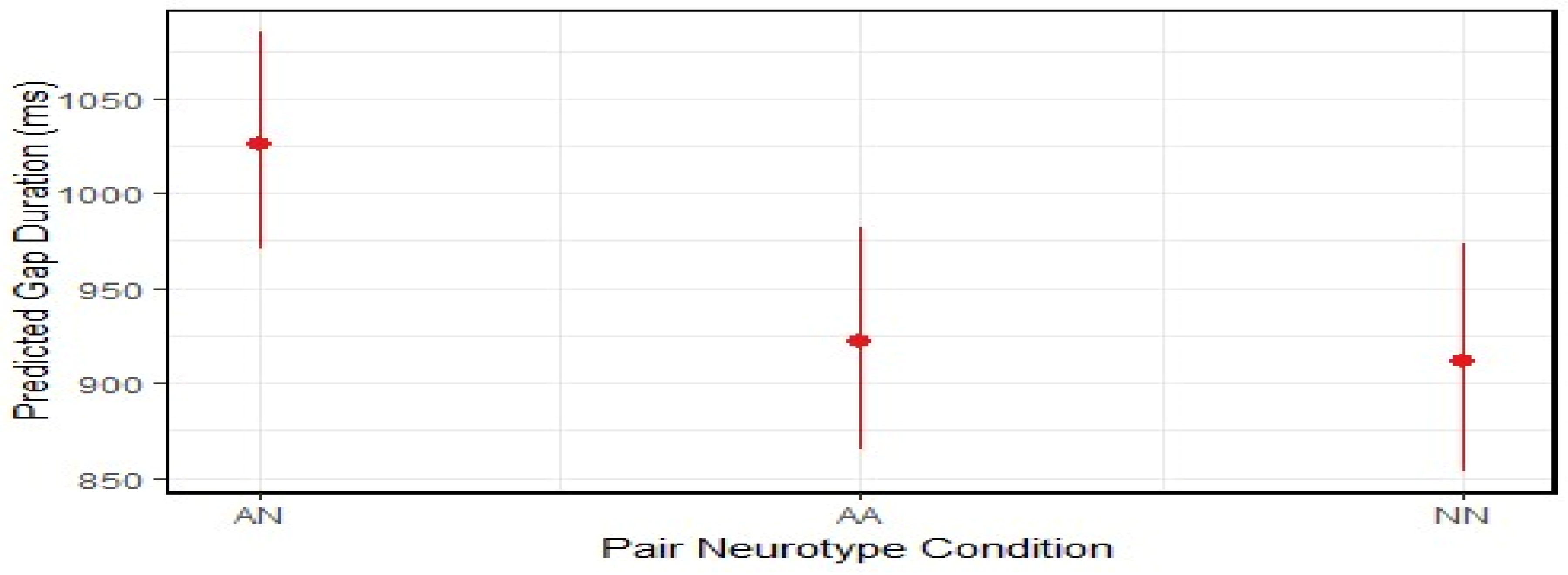
- Do the durations of gap transitions differ across autistic–autistic, non-autistic–non-autistic, and mixed neurotype pairs?
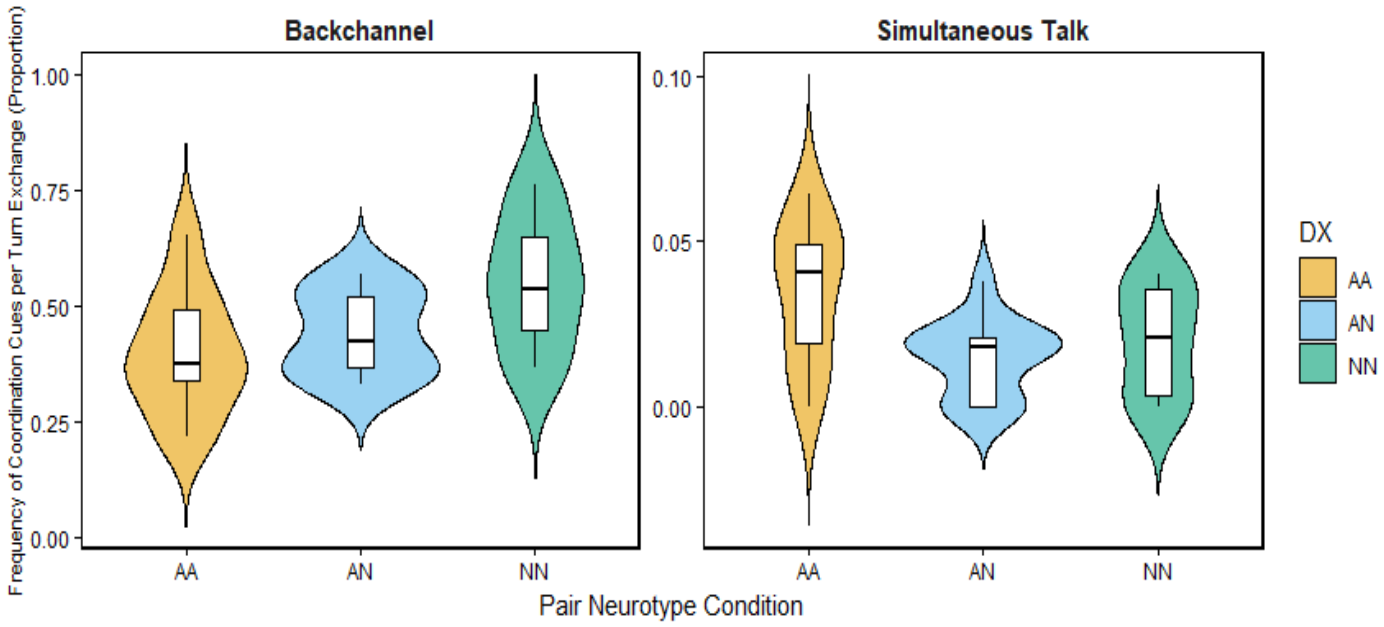
- Do autistic–autistic, non-autistic–non-autistic, and mixed neurotype pairs differ in how often backchanneling occurs?
- Do autistic–autistic, non-autistic–non-autistic, and mixed neurotype pairs differ in how often simultaneous talk occurs?
- Do specific turn-taking dynamics predict the quality of task performance including accuracy, efficiency, and rapport?
2. Method and Materials
2.1. Participants
2.2. Recording Procedure
- Autistic neurotype-matched dyads: Both participants were autistic.
- Non-autistic neurotype-matched dyads: Both participants were non-autistic.
- Neurotype-mixed dyads: Participants had different neurotypes (one autistic, one non-autistic).
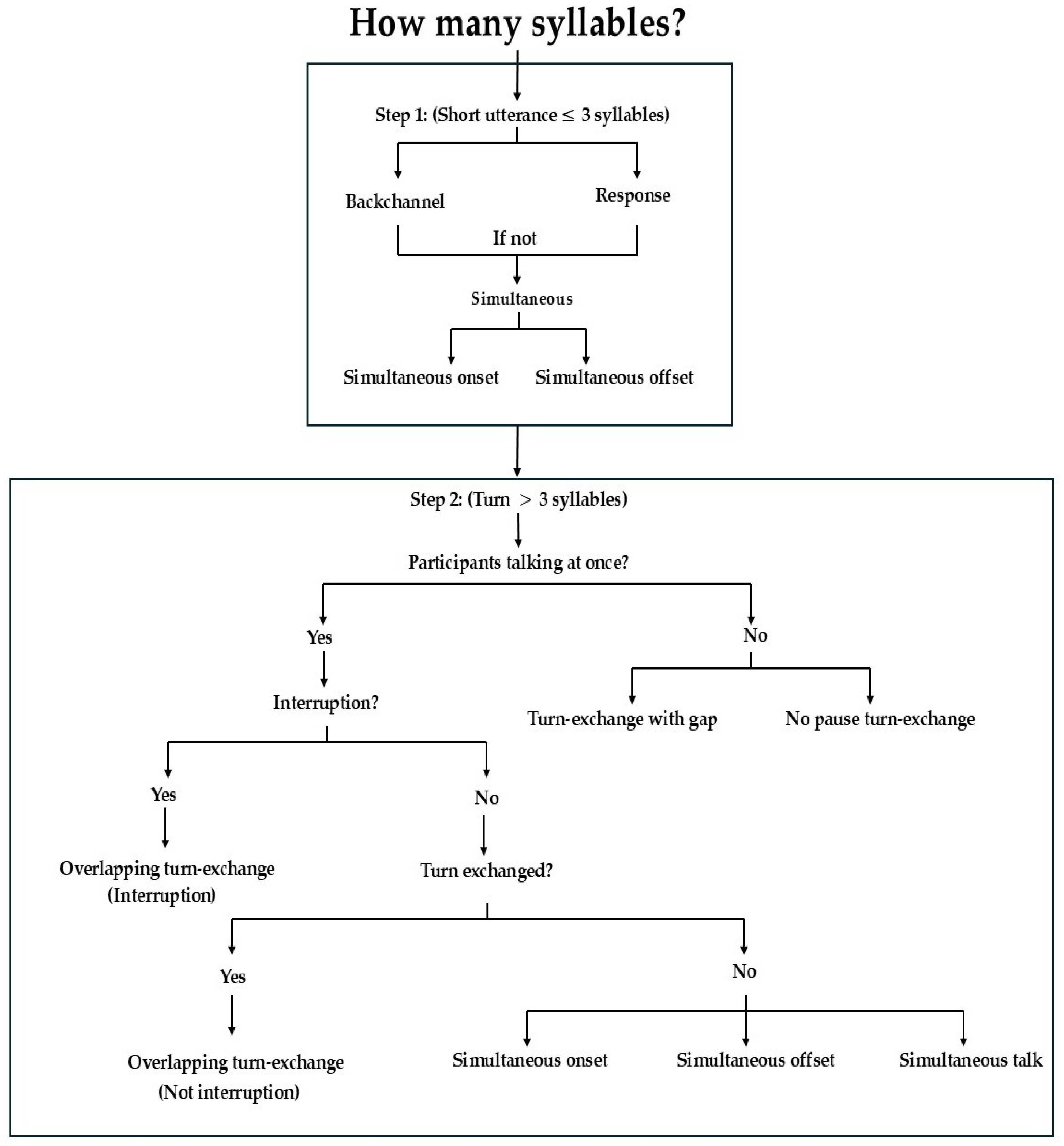
2.3. Coding Procedure and Categories
- (1)
- Turn-exchange with gap (perceived silence between one participant stopping their turn and the other starting their turn);
- (2)
- No pause turn-exchange (no perceived silence between one participant stopping and the other starting);
- (3)
- Overlapping turn-exchange (overlapping speech by both speakers without signs of interruption);
- (4)
- Overlapping turn-exchange with interruption (one speaker could be heard to stop themselves while the other spoke);
- (5)
- Backchannel (short affirming responses that are ≤3 syllables such as “mm-hmm”, “yeah” which occur during the other’s turn);
- (6)
- Simultaneous talk (both speakers talk simultaneously, with one speaker’s utterance occurring within the others, such that it starts after the first speaker and ends before that speaker);
- (7)
- Simultaneous onset (both speakers begin speaking at the same time based on perceptual judgment, such that one speaker ends before the other);
- (8)
- Simultaneous offset (both speakers end their speech at the same moment based on perceptual judgment, such that one speaker starts later, but they finish together), and
- (9)
- Response (≤3-syllable answers to questions).
2.4. Data Analysis
3. Results
3.1. Frequency of Turn-Exchange Types
3.2. Duration of Gap Transition
3.3. Temporal Alignments in Conversation
3.4. Relations Between Turn-Taking Dynamics and Task Performance: Accuracy, Efficiency, and Rapport
4. Discussion
4.1. Summary of Findings
4.2. Limitations and Future Studies
4.3. Importance of Study
Author Contributions
Funding
Institutional Review Board Statement
Informed Consent Statement
Data Availability Statement
Acknowledgments
Conflicts of Interest
References
- Brown, P., & Levinson, S. C. (1987). Politeness: Some universals in language usage. Cambridge University Press. [Google Scholar]
- Cho, S., Cola, M., Knox, A., Pelella, M. R., Russell, A., Hauptmann, A., Covello, M., Cieri, C., Liberman, M., Schultz, R. T., & Parish-Morris, J. (2023). Sex differences in the temporal dynamics of autistic children’s natural conversations. Molecular Autism, 14(1), 13. [Google Scholar] [CrossRef]
- Clift, R. (2016). Conversation analysis. Cambridge University Press. [Google Scholar]
- Copping, B., Holzmeyer, E., Kumar, S., Ones, D. S., & Buder, E. H. (2023). TSCR: A comprehensive coding system for task-oriented vocal interaction analysis. In R. Skarnitzl, & J. Volín (Eds.), Proceedings of the 20th international congress of phonetic sciences (ICPhS 2023) (pp. 3502–3506). International Phonetic Association. Available online: https://www.internationalphoneticassociation.org/icphs-proceedings/ICPhS2023/full_papers/624.pdf (accessed on 28 May 2025).
- Corps, R. E., Gambi, C., & Pickering, M. J. (2018). Coordinating utterances during turn-taking: The role of prediction, response preparation, and articulation. Discourse Processes, 55(2), 230–240. [Google Scholar] [CrossRef]
- Cox, C., Fusaroli, R., Nielsen, Y., Cho, S., Rocca, R., Simonsen, A., Knox, A., Lyons, M., Liberman, M., Cieri, C., Schillinger, S., Lee, A., Hauptmann, A., Tena, K., Chatham, C., Miller, J., Pandey, J., Russell, A., Schultz, R., & Parish-Morris, J. (2025). Social context matters for turn-taking dynamics: A comparative study of autistic and typically developing children. Cognitive Science, 49, e70124. [Google Scholar] [CrossRef]
- Crompton, C. J., Sharp, M., Axbey, H., Fletcher-Watson, S., Flynn, E. G., & Ropar, D. (2020). Neurotype-matching, but not being autistic, influences self and observer ratings of interpersonal rapport. Frontiers in Psychology, 11, 586171. [Google Scholar] [CrossRef]
- DeBrabander, K. M., Morrison, K. E., Jones, D. R., Faso, D. J., Chmielewski, M., & Sasson, N. J. (2019). Do first impressions of autistic adults differ between autistic and nonautistic observers? Autism in Adulthood, 1(4), 250–257. [Google Scholar] [CrossRef] [PubMed]
- De Jaegher, H. (2013). Embodiment and sense-making in autism. Frontiers in Integrative Neuroscience, 7, 15. [Google Scholar] [CrossRef]
- Delgado, R. E., Buder, E. H., & Oller, D. K. (2010). AACT (Action Analysis Coding and Training). Intelligent Hearing Systems. [Google Scholar]
- Dingemanse, M., & Liesenfeld, A. (2022). From text to talk: Harnessing conversational corpora for humane and diversity-aware language technology. In S. Muresan, P. Nakov, & A. Villavicencio (Eds.), Proceedings of the 60th annual meeting of the association for computational linguistics (Volume 1: Long papers) (pp. 5614–5633). Association for Computational Linguistics. [Google Scholar] [CrossRef]
- Dunne, M., & Ng, S. H. (1994). Simultaneous speech in small group conversation: All-together-now and one-at-a-time? Journal of Language and Social Psychology, 13(1), 45–71. [Google Scholar] [CrossRef]
- Emborg, C. (2024). Enduring the silence: High silence tolerance and other tools for promoting topic initiations of a man with autism. Clinical linguistics & Phonetics, 38(9), 857–879. [Google Scholar] [CrossRef]
- Fletcher-Watson, S. (2024). What’s in a name? The costs and benefits of a formal autism diagnosis. Autism: The International Journal of Research and Practice, 28(2), 257–262. [Google Scholar] [CrossRef]
- Foster, S. J., Ackerman, R. A., Wilks, C. E., Dodd, M., Calderon, R., Ropar, D., Fletcher-Watson, S., Crompton, C. J., & Sasson, N. J. (2025). Rapport in same and mixed neurotype groups of autistic and non-autistic adults. Autism: The International Journal of Research and Practice, 29(7), 1700–1710. [Google Scholar] [CrossRef]
- Garrod, S., & Pickering, M. J. (2015). The use of content and timing to predict turn transitions. Frontiers in Psychology, 6, 751. [Google Scholar] [CrossRef]
- Geelhand, P., Kissine, M., Michels, J., Noël, J., & Becchio, C. (2024). Autistic adults display different verbal behavior only in mixed-neurotype interactions: Evidence from a referential communication task. Autism. advance online publication. [CrossRef]
- Heldner, M., & Edlund, J. (2010). Pauses, gaps and overlaps in conversations. Journal of Phonetics, 38(4), 555–568. [Google Scholar] [CrossRef]
- Heritage, J. (1984). Garfinkel and ethnomethodology. Polity Press. [Google Scholar]
- Jameson, M., & Bean, A. (2025). Mutual understanding: The role of neurotype-matching and perceptions in communication effectiveness. American Journal of Speech-Language Pathology, 34(6), 3164–3182. [Google Scholar] [CrossRef]
- Levinson, S. C. (2016). Turn-taking in human communication: Origins and implications for language processing. Trends in Cognitive Sciences, 20(1), 6–14. [Google Scholar] [CrossRef]
- Levinson, S. C., & Torreira, F. (2015). Timing in turn-taking and its implications for processing models of language. Frontiers in Psychology, 6, 731. [Google Scholar] [CrossRef]
- Lewis, L. F. (2016). Exploring the experience of self-diagnosis of autism spectrum disorder in adults. Archives of Psychiatric Nursing, 30(5), 575–580. [Google Scholar] [CrossRef]
- Lockwood Estrin, G., Milner, V., Spain, D., Happé, F., & Colvert, E. (2021). Barriers to autism spectrum disorder diagnosis for young women and girls: A systematic review. Review Journal of Autism and Developmental Disorders, 8(4), 454–470. [Google Scholar] [CrossRef]
- Milton, D. E. M. (2012). On the ontological status of autism: The ‘double empathy problem’. Disability & Society, 27(6), 883–887. [Google Scholar] [CrossRef]
- Morrison, K. E., DeBrabander, K. M., Jones, D. R., Faso, D. J., Ackerman, R. A., & Sasson, N. J. (2020). Outcomes of real-world social interaction for autistic adults paired with autistic compared to typically developing partners. Autism: The International Journal of Research and Practice, 24(5), 1067–1080. [Google Scholar] [CrossRef]
- Oates, M., Bean, A., Kickbusch, R., & Sauer, S. (2024). Extending double empathy: Effects of neurotype-matching on communication success in an expository context. American Journal of Speech-Language Pathology, 33(5), 2364–2377. [Google Scholar] [CrossRef]
- Ochi, K., Ono, N., Owada, K., Kojima, M., Kuroda, M., Sagayama, S., & Yamasue, H. (2019). Quantification of speech and synchrony in the conversation of adults with autism spectrum disorder. PLoS ONE, 14(12), e0225377. [Google Scholar] [CrossRef]
- Pfaender, S., & Couper-Kuhlen, E. (2019). Turn-sharing revisited: An exploration of simultaneous speech in interactions between couples. Journal of Pragmatics, 147, 22–48. [Google Scholar] [CrossRef]
- R Core Team. (2025). R: A language and environment for statistical computing (Version 4.5.0). R Foundation for Statistical Computing. Available online: https://www.r-project.org/ (accessed on 28 August 2025).
- Rifai, O. M., Fletcher-Watson, S., Jiménez-Sánchez, L., & Crompton, C. J. (2022). Investigating markers of rapport in autistic and nonautistic interactions. Autism in Adulthood: Challenges and Management, 4(1), 3–11. [Google Scholar] [CrossRef]
- Ruiter, J., Mitterer, H., & Enfield, N. J. (2006). Projecting the end of a speaker’s turn: A cognitive cornerstone of conversation. Language, 82(3), 515–535. [Google Scholar] [CrossRef]
- Sarrett, J. C. (2016). Biocertification and neurodiversity: The role and implications of self-diagnosis in autistic communities. Neuroethics, 9(1), 23–36. [Google Scholar] [CrossRef]
- Seuren, L. M., Wherton, J., Greenhalgh, T., & Shaw, S. E. (2021). Whose turn is it anyway? Latency and the organization of turn-taking in video-mediated interaction. Journal of Pragmatics, 172, 63–78. [Google Scholar] [CrossRef]
- Stivers, T., Enfield, N. J., Brown, P., Englert, C., Hayashi, M., Heinemann, T., Hoymann, G., Rossano, F., de Ruiter, J. P., Yoon, K.-E., & Levinson, S. C. (2009). Universals and cultural variation in turn-taking in conversation. Proceedings of the National Academy of Sciences, 106(26), 10587–10592. [Google Scholar] [CrossRef]
- Tickle-Degnen, L., & Rosenthal, R. (1990). The nature of rapport and its nonverbal correlates. Psychological Inquiry, 1(4), 285–293. [Google Scholar] [CrossRef]
- Wehrle, S., Cangemi, F., Janz, A., Vogeley, K., & Grice, M. (2023). Turn-timing in conversations between autistic adults: Typical short-gap transitions are preferred, but not achieved instantly. PLoS ONE, 18(4), e0284029. [Google Scholar] [CrossRef]
- Wynn, C. J., Borrie, S. A., & Sellers, T. P. (2018). Speech rate entrainment in children and adults with and without autism spectrum disorder. American Journal of Speech-Language Pathology, 27(3), 965–974. [Google Scholar] [CrossRef] [PubMed]





| Category | Subcategory | Autistic (n = 32) | Non-Autistic (n = 36) |
|---|---|---|---|
| Gender | Woman | 11 | 27 |
| Man | 5 | 8 | |
| Nonbinary | 6 | 0 | |
| Agender | 3 | 0 | |
| Genderqueer | 3 | 0 | |
| Gender-fluid | 1 | 0 | |
| Self-identify: queer, nonbinary, trans-fem | 1 | 0 | |
| Self-identify: trans-masc | 1 | 0 | |
| Not reported | 1 | 1 | |
| Race/Ethnicity | Arab or Middle Eastern | 1 | 2 |
| Asian | 1 | 6 | |
| Black or African American | 0 | 4 | |
| Hispanic, Latinx, or Spanish origin | 1 | 2 | |
| Native American or Indigenous | 0 | 0 | |
| White (non-Hispanic) | 26 | 19 | |
| Asian and White | 2 | 2 | |
| Not reported | 1 | 1 | |
| Age (years) | 18–25 | 19 | 19 |
| 26–35 | 6 | 9 | |
| 36–45 | 5 | 3 | |
| 46–55 | 0 | 1 | |
| 56–65 | 0 | 0 | |
| 70+ | 0 | 1 | |
| Not reported | 2 | 3 | |
| Education | Did not finish high school | 0 | 0 |
| High school diploma or GED | 5 | 10 | |
| Attended college, did not complete degree | 8 | 5 | |
| Associate’s degree | 4 | 0 | |
| Bachelor’s degree | 11 | 9 | |
| Master’s degree | 1 | 8 | |
| Doctorate or professional degree | 2 | 3 | |
| Not reported | 1 | 1 | |
| Employment | Student | 16 | 15 |
| Student + employed part-time | 3 | 2 | |
| Employed part-time | 6 | 7 | |
| Employed full-time | 4 | 9 | |
| Unemployed | 1 | 1 | |
| Self-employed | 1 | 0 | |
| Retired | 0 | 1 | |
| Other: gap year | 0 | 1 | |
| Not reported | 0 | 1 |
| Predictor | Estimate (β) | SE | t | p |
|---|---|---|---|---|
| Autistic–Autistic: Gap | −0.107 | 0.043 | −2.505 | 0.0012 |
| Non-autistic–Non-autistic: Gap | −0.118 | 0.044 | −2.685 | 0.007 |
Disclaimer/Publisher’s Note: The statements, opinions and data contained in all publications are solely those of the individual author(s) and contributor(s) and not of MDPI and/or the editor(s). MDPI and/or the editor(s) disclaim responsibility for any injury to people or property resulting from any ideas, methods, instructions or products referred to in the content. |
© 2026 by the authors. Licensee MDPI, Basel, Switzerland. This article is an open access article distributed under the terms and conditions of the Creative Commons Attribution (CC BY) license.
Share and Cite
Poursoroush, Z.; Buder, E.H.; Jameson, M. Turn-Taking Transitions in Conversations Among Autistic–Autistic, Non-Autistic–Non-Autistic, and Mixed-Neurotype Adult Pairs. Behav. Sci. 2026, 16, 677. https://doi.org/10.3390/bs16050677
Poursoroush Z, Buder EH, Jameson M. Turn-Taking Transitions in Conversations Among Autistic–Autistic, Non-Autistic–Non-Autistic, and Mixed-Neurotype Adult Pairs. Behavioral Sciences. 2026; 16(5):677. https://doi.org/10.3390/bs16050677
Chicago/Turabian StylePoursoroush, Zahra, Eugene H. Buder, and Morgan Jameson. 2026. "Turn-Taking Transitions in Conversations Among Autistic–Autistic, Non-Autistic–Non-Autistic, and Mixed-Neurotype Adult Pairs" Behavioral Sciences 16, no. 5: 677. https://doi.org/10.3390/bs16050677
APA StylePoursoroush, Z., Buder, E. H., & Jameson, M. (2026). Turn-Taking Transitions in Conversations Among Autistic–Autistic, Non-Autistic–Non-Autistic, and Mixed-Neurotype Adult Pairs. Behavioral Sciences, 16(5), 677. https://doi.org/10.3390/bs16050677